EP2684073B1 - Digitales hf-empfängersystem und verfahren - Google Patents
Digitales hf-empfängersystem und verfahren Download PDFInfo
- Publication number
- EP2684073B1 EP2684073B1 EP12708320.2A EP12708320A EP2684073B1 EP 2684073 B1 EP2684073 B1 EP 2684073B1 EP 12708320 A EP12708320 A EP 12708320A EP 2684073 B1 EP2684073 B1 EP 2684073B1
- Authority
- EP
- European Patent Office
- Prior art keywords
- sva
- digital receiver
- frequency bin
- fixed
- word
- Prior art date
- Legal status (The legal status is an assumption and is not a legal conclusion. Google has not performed a legal analysis and makes no representation as to the accuracy of the status listed.)
- Active
Links
Images


Classifications
-
- H—ELECTRICITY
- H04—ELECTRIC COMMUNICATION TECHNIQUE
- H04L—TRANSMISSION OF DIGITAL INFORMATION, e.g. TELEGRAPHIC COMMUNICATION
- H04L25/00—Baseband systems
- H04L25/02—Details ; arrangements for supplying electrical power along data transmission lines
- H04L25/0202—Channel estimation
- H04L25/022—Channel estimation of frequency response
-
- G—PHYSICS
- G01—MEASURING; TESTING
- G01S—RADIO DIRECTION-FINDING; RADIO NAVIGATION; DETERMINING DISTANCE OR VELOCITY BY USE OF RADIO WAVES; LOCATING OR PRESENCE-DETECTING BY USE OF THE REFLECTION OR RERADIATION OF RADIO WAVES; ANALOGOUS ARRANGEMENTS USING OTHER WAVES
- G01S13/00—Systems using the reflection or reradiation of radio waves, e.g. radar systems; Analogous systems using reflection or reradiation of waves whose nature or wavelength is irrelevant or unspecified
- G01S13/88—Radar or analogous systems specially adapted for specific applications
- G01S13/89—Radar or analogous systems specially adapted for specific applications for mapping or imaging
- G01S13/90—Radar or analogous systems specially adapted for specific applications for mapping or imaging using synthetic aperture techniques, e.g. synthetic aperture radar [SAR] techniques
-
- G—PHYSICS
- G01—MEASURING; TESTING
- G01S—RADIO DIRECTION-FINDING; RADIO NAVIGATION; DETERMINING DISTANCE OR VELOCITY BY USE OF RADIO WAVES; LOCATING OR PRESENCE-DETECTING BY USE OF THE REFLECTION OR RERADIATION OF RADIO WAVES; ANALOGOUS ARRANGEMENTS USING OTHER WAVES
- G01S7/00—Details of systems according to groups G01S13/00, G01S15/00, G01S17/00
- G01S7/02—Details of systems according to groups G01S13/00, G01S15/00, G01S17/00 of systems according to group G01S13/00
- G01S7/28—Details of pulse systems
- G01S7/285—Receivers
- G01S7/292—Extracting wanted echo-signals
Definitions
- the invention relates to Radio Frequency (RF) digital receivers. More specifically, but not exclusively, it relates to RF digital receivers used for the detection of targets which use a 1-dimensional discrete Fourier transform (DFT) with a particular window function applied to a data capture window (DCW) before the DFT.
- DFT discrete Fourier transform
- DCW data capture window
- DFT discrete Fourier transform
- window function (which can be interpreted as a filter) is a trade-off between the metrics of filter frequency-domain response, such as noise equivalent bandwidth (NEB); sidelobe levels; scalloping loss; 3 dB resolution and 6 dB resolution. Window functions that tend to have low sidelobe levels also have a poorer frequency resolution and a poorer NEB (an example of which is a Hamming window).
- NEB noise equivalent bandwidth
- Decision rules are necessary to make sense of the spectral estimate formed from the output of the DFT block.
- the decision rules are essentially an algorithmic description of the frequency-domain response of the window function used in front of the DFT. Such decision rules are standard practice and typically sub-optimal if there are closely spaced signals.
- US Patent 6,298,363 describes adaptive windowing of FFT data for increased resolution and sidelobe rejection in a system. However, this only applies to the use of a joint 5-point SVA formulation, a joint 7-point SVA formulation and a formulation which selects the minimum from the results of the joint 5-point and 7-point SVA formulations.
- NonlinearApodization forSidelobe Control in SAR Imagery IEEE Trans. On Aerospace and Elect. Syst., Vol. 31, No. 1, pp. 267 - 279, Jan 1995 by H.C. Stankwitz, R. J. Dallaire and J. R. Fienup , derives two formulations of 3-point SVA: one where it operates separately on real and imaginary parts of data sets and one where it operates on real and imaginary parts jointly.
- the joint 3-point formulation of SVA is the type used in this device.
- the present invention is mostly similar to conventional RF digital receivers which use a DFT except for the removal of a window function, the removal of decision rules and the addition of SVA.
- SVA is optimised for DSP.
- the SVA technique effectively improves the spectral estimate by minimising sidelobes whilst maintaining the frequency-domain mainlobe resolution ofa rectangular window function. This leads to optimised detection in the RF digital receiver.
- the invention differs from prior applications of SVA such as those described above as it is used in a detection role in an RF digital receiver and in one form of the invention is optimised for DSP.
- the invention aims to overcome window function-related limitations of conventional RF digital receivers (see Figure 1 for a diagram of such a receiver).
- the use of SVA at the output of the DFT block means both the window function block and decision rules block can be removed from the RF digital receiver and crucially, the trade-off between the factors described above is avoided and therefore detection is optimised.
- SVA in this invention is used in a detection role and in one form of the invention it is applied in a manner optimised for DSP.
- FIG. 1 shows a block diagram of a conventional, known RF digital receiver 1.
- the exact RF digital receiver architecture may vary, however the key stages needed for detection are shown in Figure 1 .
- a signal is received at the antenna 2 input to a low noise amplifier 3 then transmitted via further amplification means 4 to an Analog to Digital Converter (ADC) 5.
- the ADC sends groups of sequences of samples, called DCWs, to be weighted by a window function applied via suitable means 6.
- the choice of window function applied at 6 constrains the spectral estimate to a particular frequency resolution (related to the mainlobe width of the frequency-domain response of the window function), a particular level of sidelobe spectral leakage and a particular processing loss (due to the NEB of the window).
- the signal output at 6 has a discrete Fourier transform (DFT) applied by suitable means at 7 which is then converted into polar co-ordinates at 8 to form a spectral estimate 9. This is then compared against a detection threshold via suitable comparison means 10 and decision rules 11 applied to output final detection decisions for each frequency bin 12.
- DFT discrete Fourier transform
- the rectangular window has a frequency-domain response shown in panel (b) which has good frequency resolution (narrow mainlobe) but poor spectral leakage protection (high sidelobes).
- the Hann window has the opposite properties. This is shown in panel (d) it has poor frequency resolution (wide mainlobe) but good spectral leakage protection (low sidelobes).
- the decision rules means 11 in Figure 1 is required to describe the pattern of the frequency-domain response of the window function which was chosen. This logic is necessary to prevent false detections due to high sidelobes or wide mainlobes.
- An example of such a decision rule might state that if a large spectral peak is found in one frequency bin and if a Hann window function was used, then no detections are permitted in the immediate neighbour bins because they are likely to be due to the wide mainlobe.
- Figure 3 shows the block diagram for the invention RF digital receiver 1 which incorporates the joint, 3-point SVA technique into the data flow.
- Features shared between the system in Figure 1 and Figure 3 have the same reference numerals.
- the device is an RF digital receiver which utilises the joint, 3-point SVA technique (SVA) via suitable means 13 after the DFT means 7, instead of the application of a window function by suitable means 6 before the DFT means 7.
- SVA 3-point SVA technique
- the ADC 5 sends DCWs to be processed by the DFT 7, from which the complex output is processed by SVA 13.
- the SVA technique effectively allows each frequency bin to have its own corresponding time-domain window function chosen from the family of raised-cosine window functions.
- the SVA technique chooses the optimum window function from this family according to a simple power minimisation equation (see Equation 1).
- a spectral estimate is formed 9 which is thresholded via suitable comparison means 10 for spectral peaks. Decision rules 11 to sort through the various spectral peaks are not used.
- the SVA means 13 effectively applies an algorithm that selects the optimum window function for each frequency bin from the raised-cosine family of window functions. Therefore both low sidelobes and narrow mainlobe can be achieved at the same time, greatly reducing the reliance on the decision rules means 11 to the point where they can be omitted in Figure 3 .
- the processing loss which occurs in the system in Figure 3 when anything other than a rectangular window function is used means 6 is also recovered from the use of SVA means 13.
- Equation 3 From inspection of Equation 3, the divisor is real and positive and the sign of the dividend determines the sign of ⁇ . If the dividend is less than or equal to zero, it follows that ⁇ is less than or equal to zero. Therefore from Equation 2 no further mathematical operations on the processed frequency bin are required.
- the first step which SVA-optimised-for-DSP follows is to calculate the dividend. This is achieved as multiply-accumulate (MACC) operations in Table 1. A check is performed whether the sign bit of the dividend is negative (shown as a sign test in Table 1) or if all bits in the word are zero (shown as an "OR" short circuit operation in Table 1). If either of these tests is true no further processing on that particular frequency bin is undertaken (i.e the division operation in Equation 3 and operations in Equation 2 for that frequency bin are not calculated). This saves on either computational time or power consumption depending on whether the SVA-optimised-for-DSP is implemented as a procedure or as a pipeline.
- MCC multiply-accumulate
- a test is applied to the quotient which is returned from the division as to whether it is greater than or equal to 1 ⁇ 2.
- this test is performed by appending the first fractional bit of the quotient to the integer bits of the quotient and applying an OR short circuit operation. If this test is returned as true, a "barrel" shift operation one place to the right is performed on the "sum of the neighbour frequency bins" (shift denoted in Table 2 as "»").
- a barrel shift operation is computationally much simpler than a multiplication which allows a saving to be made on either computational time or power consumption depending on whether the SVA-optimised-for-DSP is implemented as a procedure or as a pipeline.
- Figure 4 shows the results of the RF digital receivers attempting to detect a single tone of random frequency.
- Figure 5 shows the results of the RF digital receivers attempting to detect a weaker random frequency tone in the presence of a stronger random frequency tone.
- the weaker and stronger tones were close in frequency and were separated by a nominal frequency spacing equivalent to two DFT frequency bins. However the exact spacing varied because the frequencies were chosen at random over a frequency bin interval.
- SNR out in Figure 4 refers to the signal-to-noise ratio at the output of the DFT block and
- SIR out in Figure 5 refers to the signal-to-interference ratio at the output of the DFT block.
- P d stands for the probability of detection in both figures. The probability of false alarm chosen for the simulations was 0.01.
- Figure 4 demonstrates the RF digital receiver which utilised the SVA technique matched the performance of the rectangular-windowed, conventional RF digital receiver and surpassed the performance of the Chebyshev- and Hann-windowed, conventional RF digital receivers.
- Figure 4 shows the use of SVA in an RF digital receiver was able to match the performance of a rectangular-windowed RF digital receiver. From this alone it would appear that there is little advantage in using the SVA technique over the rectangular window function. However this scenario favours the use of the rectangular window because the RF digital receivers sought only to detect one signal and therefore sidelobe levels were ignored.
- Figure 5 shows the RF digital receiver which utilised the SVA technique gave the best detection performance. Many factors become relevant during the detection of one signal in close frequency proximity to another, such as sidelobe levels, mainlobe width and processing loss. Since the SVA technique optimises all of these factors, the RF digital receiver which used SVA gave the best performance for this scenario.
Landscapes
- Engineering & Computer Science (AREA)
- Remote Sensing (AREA)
- Radar, Positioning & Navigation (AREA)
- Physics & Mathematics (AREA)
- Computer Networks & Wireless Communication (AREA)
- General Physics & Mathematics (AREA)
- Electromagnetism (AREA)
- Power Engineering (AREA)
- Signal Processing (AREA)
- Radar Systems Or Details Thereof (AREA)
- Complex Calculations (AREA)
- Digital Transmission Methods That Use Modulated Carrier Waves (AREA)
- Circuits Of Receivers In General (AREA)
Claims (10)
- Digitales Hochfrequenz-Empfängersystem (HF-Empfängersystem) zur Detektion von HF-Signalen, umfassend:einen digitalen HF-Empfänger, der Mittel zur diskreten Fourier-Transformation (DFT-Mittel) enthält, wobei das digitale Empfängersystem zum Treffen von Detektionsentscheidungen anhand eines von einer Antenne empfangenen HF-Signals basierend auf einem spektralen Schätzwert, der aus einer Ausgabe der DFT-Mittel gebildet wird, dient; wobei das digitale Empfängersystem dadurch gekennzeichnet ist, dassder digitale-HF-Empfänger konfiguriert ist, um:a) das HF-Signal abzutasten, um eine Folge von Datenerfassungsfenstern bereitzustellen;b) die Datenerfassungsfenster mit einer diskreten Fourier-Transformation (DFT) zu verarbeiten;c) eine räumlich variante Apodisation (SVA) anzuwenden, die für das Durchführen einer digitalen Signalverarbeitung (DSP) auf der komplexen Ausgabe der fouriertransformierten Daten konfiguriert ist, um einen spektralen Schätzwert zu erhalten, wobei das Anwenden der SVA beinhaltet, dass:(c1) Parameter α für jeden Frequenzbereich nach folgender Gleichung berechnet werden:
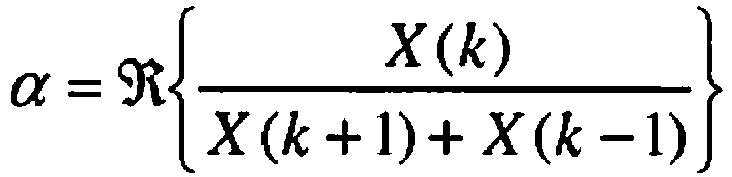 (c2) die berechneten Parameter auf jeden Frequenzbereich angewendet werden gemäßund
 (d) Detektionen auf dem spektralen Schätzwert auszuführen.
 - Digitales HF-Empfängersystem nach Anspruch 1, wobei der digitale HF-Empfänger durch Aktivieren von SVA so konfiguriert ist, dass er den spektralen Schätzwert beeinflusst, indem er eine Nebenkeulen-Spektralleckage unter gleichzeitiger Beibehaltung einer Frequenzauflösung einer Rechteckfensterfunktion minimiert.
- Digitales HF-Empfängersystem nach Anspruch 1 oder 2, wobei der digitale HF-Empfänger konfiguriert ist, um zum Aktivieren der SVA eine digitale Signalverarbeitung (DSP) auszuführen, um die Rechenzeit oder den Stromverbrauch zu beeinflussen, je nachdem ob die SVA als Verfahren oder als Pipeline realisiert ist.
- Digitaler HF-Empfänger nach einem der Ansprüche 1 bis 3, wobei das Anwenden der berechneten Parameter auf jeden Frequenzbereich das Berechnen des Dividenden beinhaltet, wobei, wenn der Dividend negativ ist oder wenn alle Bits in dem Dividenden Null sind, keine weitere Verarbeitung in einem entsprechenden Frequenzbereich durchgeführt wird.
- Digitales HF-Empfängersystem nach Anspruch 3, bei dem die DSP des digitalen Empfängersystems so konfiguriert ist, dass sie den spektralen Schätzwert durch Minimierung der Nebenkeulen-Spektralleckage unter gleichzeitiger Beibehaltung einer Frequenzauflösung einer Rechteckfensterfunktion beeinflusst.
- Verfahren zum Detektieren von Funkfrequenzen, das umfasst, dass: in einem HF-Empfänger:a) das empfangene HF-Signal abgetastet wird, um eine Folge von Datenerfassungsfenstern bereitzustellen;b) die Datenerfassungsfenster mit einer diskreten Fourier-Transformation (DFT) verarbeitet werden;c) eine räumlich variante Apodisation (SVA) angewendet wird, die für die Durchführung einer digitalen Signalverarbeitung (DSP) auf der komplexen Ausgabe der fouriertransformierten Daten konfiguriert ist, um einen spektralen Schätzwert zu erhalten, wobei das Anwenden der SVA umfasst:
Berechnen von Parametern α in jedem Frequenzbereich gemäß der folgenden Gleichung:
 (d) Durchführen von Detektionen auf dem spektralen Schätzwert.
 - Verfahren nach Anspruch 7, bei dem die SVA für eine digitale Signalverarbeitung (DSP) konfiguriert ist, wobei das Verfahren für jeden Frequenzbereich an einer Ausgabe einer DFT umfasst:a) Berechnen der Ausdrücke I(k+1) + I(k-1) und Q(k+1) + Q(k-1) zur Bildung von Festkommawörtern, und vorübergehendes Speichern von Kopien der Wörter in einem Speicher;b) Berechnen, basierend auf den Festkommawörtern, von I(k) [|(k+1) + I(k-1)] + Q(k) [Q(k+1) + Q(k-1)] mit Multiply-Accumulate-Operationen (MACC-Operationen), um ein weiteres Festkommawort zu bilden;c) Anwenden eines Vorzeichentests und eines ODER-Kurzschlussbetriebstests auf Bits des weiteren Festkommaworts; undd) Beenden der Verarbeitung für einen Frequenzbereich, wenn einer der Tests wahr zurückgegeben hat, oder ansonsten Berechnung eines Ausdrucks:mit den MACC-Operationen und den Festkommawörtern, um noch ein weiteres Festkommawort zu bilden,

wobei I ein Realteil ist, Q ein Imaginärteil ist und k eine ganze Zahl ist, die den Frequenzbereich darstellt. - Verfahren nach Anspruch 8, umfassend die weiteren Schritte, dass:a) ein Signal unter Verwendung des weiteren Festkommaworts als Dividend und des noch weiteren Festkommaworts als Divisor geteilt wird, um zwei Wörter zu bilden: eines mit ganzzahligen Bits und eines mit Bruchzahl-Bits;b) ein höchstwertiges Bruchzahl-Bit aus dem Wort, das die Bruchzahl-Bits enthält, an das Wort angehängt wird, das die ganzzahligen Bits enthält, um ein kombiniertes Festkommawort zu bilden;c) eine Prüfung angewendet wird, ob das kombinierte Festkommawort größer oder gleich ½ ist;d) eine Barrel-Shift-Operation um eine Stelle nach rechts für die Festkommawörter durchgeführt wird, um resultierende Barrel-Shift-Wörter zu bilden; unde) ein jeweiliges resultierendes Wort von einem jeweiligen Frequenzbereich subtrahiert wird und das Verfahren beendet wird, wenn der Test des kombinierten Festkommawortes wahr zurückgibt; oder ansonsten jedes Wort, das die Bruchzahl-Bits enthält, wobei ein höchstwertiges Bit entfernt ist, mit einem entsprechenden Festkommawort multipliziert wird, um ein Produkt zu erzeugen, das jedem jeweiligen Frequenzbereich zugeordnet ist, und das Produkt von dem jeweiligen Frequenzbereich mit MACC-Operationen subtrahiert wird.
- Verfahren nach Anspruch 8, bei dem die Signalausgabe mit angewendeter SVA für die digitale Signalverarbeitung vorbereitet wird.
- Verfahren nach Anspruch 8, wobei die Verarbeitung ohne Anwendung einer Fensterfunktion durchgeführt wird und die Vorformungsdetektionen ohne Detektionsregellogik durchgeführt werden.
Applications Claiming Priority (2)
| Application Number | Priority Date | Filing Date | Title |
|---|---|---|---|
| GBGB1104107.6A GB201104107D0 (en) | 2011-03-10 | 2011-03-10 | Radio frequency digital receiver system and method |
| PCT/EP2012/054146 WO2012120126A1 (en) | 2011-03-10 | 2012-03-09 | Radio frequency digital receiver system and method |
Publications (2)
| Publication Number | Publication Date |
|---|---|
| EP2684073A1 EP2684073A1 (de) | 2014-01-15 |
| EP2684073B1 true EP2684073B1 (de) | 2018-09-19 |
Family
ID=43980803
Family Applications (1)
| Application Number | Title | Priority Date | Filing Date |
|---|---|---|---|
| EP12708320.2A Active EP2684073B1 (de) | 2011-03-10 | 2012-03-09 | Digitales hf-empfängersystem und verfahren |
Country Status (6)
| Country | Link |
|---|---|
| US (1) | US9374246B2 (de) |
| EP (1) | EP2684073B1 (de) |
| ES (1) | ES2702797T3 (de) |
| GB (1) | GB201104107D0 (de) |
| TR (1) | TR201819395T4 (de) |
| WO (1) | WO2012120126A1 (de) |
Families Citing this family (2)
| Publication number | Priority date | Publication date | Assignee | Title |
|---|---|---|---|---|
| ES2691496T3 (es) * | 2014-11-14 | 2018-11-27 | Airbus Defence and Space GmbH | Reducción de datos de recepción de un radar, en particular de un radar de apertura sintética |
| DE102018132739B4 (de) | 2018-12-18 | 2022-08-25 | Endress+Hauser SE+Co. KG | Verfahren zur FMCW-basierten Abstandsmessung |
Family Cites Families (10)
| Publication number | Priority date | Publication date | Assignee | Title |
|---|---|---|---|---|
| US5349359A (en) | 1993-05-10 | 1994-09-20 | Environmental Research Institute Of Michigan | Spatially variant apodization |
| US5686922A (en) * | 1995-09-29 | 1997-11-11 | Environmental Research Institute Of Michigan | Super spatially variant apodization (Super - SVA) |
| JP3234232B2 (ja) | 1995-09-29 | 2001-12-04 | ヴェリディアン エリム インターナショナル インコーポレイテッド | 超空間的可変アポダイゼーション(スーパーsva) |
| TW465234B (en) * | 1997-02-18 | 2001-11-21 | Discovision Ass | Single chip VLSI implementation of a digital receiver employing orthogonal frequency division multiplexing |
| US6298363B1 (en) | 1997-11-13 | 2001-10-02 | The Johns Hopkins University | Adaptive windowing of FFT data for increased resolution and sidelobe rejection |
| US7076168B1 (en) * | 1998-02-12 | 2006-07-11 | Aquity, Llc | Method and apparatus for using multicarrier interferometry to enhance optical fiber communications |
| JP4199144B2 (ja) * | 2004-03-11 | 2008-12-17 | 株式会社東芝 | ウェイト関数生成装置、参照信号生成装置、送信信号生成装置、信号処理装置及びアンテナ装置 |
| US7546208B2 (en) * | 2005-03-07 | 2009-06-09 | Mks Instruments, Inc. | Method and apparatus of signal processing for use in spectrometry using an improved apodization function |
| US20080024359A1 (en) | 2006-07-25 | 2008-01-31 | Harris Corporation | System and method for geometric apodization |
| US8232915B2 (en) * | 2010-04-20 | 2012-07-31 | Raytheon Company | Three quarter spatially variant apodization |
-
2011
- 2011-03-10 GB GBGB1104107.6A patent/GB201104107D0/en not_active Ceased
-
2012
- 2012-03-09 WO PCT/EP2012/054146 patent/WO2012120126A1/en not_active Ceased
- 2012-03-09 EP EP12708320.2A patent/EP2684073B1/de active Active
- 2012-03-09 ES ES12708320T patent/ES2702797T3/es active Active
- 2012-03-09 US US14/004,352 patent/US9374246B2/en active Active
- 2012-03-09 TR TR2018/19395T patent/TR201819395T4/tr unknown
Non-Patent Citations (1)
| Title |
|---|
| None * |
Also Published As
| Publication number | Publication date |
|---|---|
| EP2684073A1 (de) | 2014-01-15 |
| US20140086365A1 (en) | 2014-03-27 |
| GB201104107D0 (en) | 2011-04-27 |
| WO2012120126A1 (en) | 2012-09-13 |
| US9374246B2 (en) | 2016-06-21 |
| ES2702797T3 (es) | 2019-03-05 |
| TR201819395T4 (tr) | 2019-01-21 |
Similar Documents
| Publication | Publication Date | Title |
|---|---|---|
| Delamou et al. | Deep learning-based estimation for multitarget radar detection | |
| Anitori et al. | Design and analysis of compressed sensing radar detectors | |
| Mehr et al. | A deep neural network approach for classification of GNSS interference and jamming | |
| Malanowski | Detection and parameter estimation of manoeuvring targets with passive bistatic radar | |
| KR101294681B1 (ko) | 기상 신호 처리장치 및 그 처리방법 | |
| CN104111449B (zh) | 一种改进的基于广义内积的空时二维自适应处理方法 | |
| Zaimbashi | Forward M-ary hypothesis testing based detection approach for passive radar | |
| CN110048977B (zh) | 基于灰度共生矩阵纹理特征检测的短波信号体制识别方法及装置 | |
| Decurninge et al. | Robust Burg estimation of radar scatter matrix for autoregressive structured SIRV based on Fréchet medians | |
| CN107329115A (zh) | 基于gcrbf网络的lfm信号参数估计方法 | |
| EP2684073B1 (de) | Digitales hf-empfängersystem und verfahren | |
| Han et al. | Communication emitter individual identification via 3D‐Hilbert energy spectrum‐based multiscale segmentation features | |
| Liu et al. | RF fingerprint recognition based on spectrum waterfall diagram | |
| CN114487595B (zh) | 单频脉冲信号检测方法 | |
| CN118209941A (zh) | 一种基于残差零陷准则正交匹配追踪算法的稀疏捷变频波形目标检测方法 | |
| CN106093925A (zh) | 一种多雷达联合检测方法 | |
| Sun et al. | Wavelet de‐noising Kalman filter‐based Global Navigation Satellite System carrier tracking in the presence of ionospheric scintillation | |
| CN107315169B (zh) | 基于二阶统计量相似度的杂波协方差矩阵估计方法 | |
| Zhuo et al. | A subbandadaptive filter for DTV based passive radar | |
| EP3712626B1 (de) | Datenmanipulator auf basis von hochratiger dft und datenmanipulationsverfahren für eine leistungsstarke und robuste signalverarbeitung | |
| Andrić et al. | Information‐based algorithm for moving object detection | |
| CN116150558A (zh) | 特高频局部放电传感系统函数的线性关系判别方法及系统 | |
| Galushko | Analysis of the CA CFAR algorithm as applied to detection of stationary Gaussian signals against a normal noise background | |
| CN115015849A (zh) | 一种干扰抑制方法以及相关装置 | |
| US8001167B2 (en) | Automatic BNE seed calculator |
Legal Events
| Date | Code | Title | Description |
|---|---|---|---|
| PUAI | Public reference made under article 153(3) epc to a published international application that has entered the european phase |
Free format text: ORIGINAL CODE: 0009012 |
|
| 17P | Request for examination filed |
Effective date: 20131010 |
|
| AK | Designated contracting states |
Kind code of ref document: A1 Designated state(s): AL AT BE BG CH CY CZ DE DK EE ES FI FR GB GR HR HU IE IS IT LI LT LU LV MC MK MT NL NO PL PT RO RS SE SI SK SM TR |
|
| DAX | Request for extension of the european patent (deleted) | ||
| 17Q | First examination report despatched |
Effective date: 20150908 |
|
| R17C | First examination report despatched (corrected) |
Effective date: 20151211 |
|
| RAP1 | Party data changed (applicant data changed or rights of an application transferred) |
Owner name: LEONARDO MW LTD Owner name: THE UNIVERSITY COURT OF THE UNIVERSITY OF EDINBURG |
|
| STAA | Information on the status of an ep patent application or granted ep patent |
Free format text: STATUS: EXAMINATION IS IN PROGRESS |
|
| GRAP | Despatch of communication of intention to grant a patent |
Free format text: ORIGINAL CODE: EPIDOSNIGR1 |
|
| STAA | Information on the status of an ep patent application or granted ep patent |
Free format text: STATUS: GRANT OF PATENT IS INTENDED |
|
| INTG | Intention to grant announced |
Effective date: 20180413 |
|
| GRAS | Grant fee paid |
Free format text: ORIGINAL CODE: EPIDOSNIGR3 |
|
| GRAA | (expected) grant |
Free format text: ORIGINAL CODE: 0009210 |
|
| STAA | Information on the status of an ep patent application or granted ep patent |
Free format text: STATUS: THE PATENT HAS BEEN GRANTED |
|
| AK | Designated contracting states |
Kind code of ref document: B1 Designated state(s): AL AT BE BG CH CY CZ DE DK EE ES FI FR GB GR HR HU IE IS IT LI LT LU LV MC MK MT NL NO PL PT RO RS SE SI SK SM TR |
|
| REG | Reference to a national code |
Ref country code: GB Ref legal event code: FG4D |
|
| REG | Reference to a national code |
Ref country code: CH Ref legal event code: EP |
|
| REG | Reference to a national code |
Ref country code: AT Ref legal event code: REF Ref document number: 1043888 Country of ref document: AT Kind code of ref document: T Effective date: 20181015 |
|
| REG | Reference to a national code |
Ref country code: IE Ref legal event code: FG4D |
|
| REG | Reference to a national code |
Ref country code: DE Ref legal event code: R096 Ref document number: 602012051228 Country of ref document: DE |
|
| REG | Reference to a national code |
Ref country code: NL Ref legal event code: MP Effective date: 20180919 |
|
| REG | Reference to a national code |
Ref country code: SE Ref legal event code: TRGR |
|
| PG25 | Lapsed in a contracting state [announced via postgrant information from national office to epo] |
Ref country code: GR Free format text: LAPSE BECAUSE OF FAILURE TO SUBMIT A TRANSLATION OF THE DESCRIPTION OR TO PAY THE FEE WITHIN THE PRESCRIBED TIME-LIMIT Effective date: 20181220 Ref country code: BG Free format text: LAPSE BECAUSE OF FAILURE TO SUBMIT A TRANSLATION OF THE DESCRIPTION OR TO PAY THE FEE WITHIN THE PRESCRIBED TIME-LIMIT Effective date: 20181219 Ref country code: LT Free format text: LAPSE BECAUSE OF FAILURE TO SUBMIT A TRANSLATION OF THE DESCRIPTION OR TO PAY THE FEE WITHIN THE PRESCRIBED TIME-LIMIT Effective date: 20180919 Ref country code: RS Free format text: LAPSE BECAUSE OF FAILURE TO SUBMIT A TRANSLATION OF THE DESCRIPTION OR TO PAY THE FEE WITHIN THE PRESCRIBED TIME-LIMIT Effective date: 20180919 Ref country code: NO Free format text: LAPSE BECAUSE OF FAILURE TO SUBMIT A TRANSLATION OF THE DESCRIPTION OR TO PAY THE FEE WITHIN THE PRESCRIBED TIME-LIMIT Effective date: 20181219 Ref country code: FI Free format text: LAPSE BECAUSE OF FAILURE TO SUBMIT A TRANSLATION OF THE DESCRIPTION OR TO PAY THE FEE WITHIN THE PRESCRIBED TIME-LIMIT Effective date: 20180919 Ref country code: SE Free format text: LAPSE BECAUSE OF FAILURE TO SUBMIT A TRANSLATION OF THE DESCRIPTION OR TO PAY THE FEE WITHIN THE PRESCRIBED TIME-LIMIT Effective date: 20180919 |
|
| REG | Reference to a national code |
Ref country code: LT Ref legal event code: MG4D |
|
| PG25 | Lapsed in a contracting state [announced via postgrant information from national office to epo] |
Ref country code: AL Free format text: LAPSE BECAUSE OF FAILURE TO SUBMIT A TRANSLATION OF THE DESCRIPTION OR TO PAY THE FEE WITHIN THE PRESCRIBED TIME-LIMIT Effective date: 20180919 Ref country code: HR Free format text: LAPSE BECAUSE OF FAILURE TO SUBMIT A TRANSLATION OF THE DESCRIPTION OR TO PAY THE FEE WITHIN THE PRESCRIBED TIME-LIMIT Effective date: 20180919 Ref country code: LV Free format text: LAPSE BECAUSE OF FAILURE TO SUBMIT A TRANSLATION OF THE DESCRIPTION OR TO PAY THE FEE WITHIN THE PRESCRIBED TIME-LIMIT Effective date: 20180919 |
|
| REG | Reference to a national code |
Ref country code: ES Ref legal event code: FG2A Ref document number: 2702797 Country of ref document: ES Kind code of ref document: T3 Effective date: 20190305 |
|
| REG | Reference to a national code |
Ref country code: AT Ref legal event code: MK05 Ref document number: 1043888 Country of ref document: AT Kind code of ref document: T Effective date: 20180919 |
|
| PG25 | Lapsed in a contracting state [announced via postgrant information from national office to epo] |
Ref country code: AT Free format text: LAPSE BECAUSE OF FAILURE TO SUBMIT A TRANSLATION OF THE DESCRIPTION OR TO PAY THE FEE WITHIN THE PRESCRIBED TIME-LIMIT Effective date: 20180919 Ref country code: PL Free format text: LAPSE BECAUSE OF FAILURE TO SUBMIT A TRANSLATION OF THE DESCRIPTION OR TO PAY THE FEE WITHIN THE PRESCRIBED TIME-LIMIT Effective date: 20180919 Ref country code: IS Free format text: LAPSE BECAUSE OF FAILURE TO SUBMIT A TRANSLATION OF THE DESCRIPTION OR TO PAY THE FEE WITHIN THE PRESCRIBED TIME-LIMIT Effective date: 20190119 Ref country code: EE Free format text: LAPSE BECAUSE OF FAILURE TO SUBMIT A TRANSLATION OF THE DESCRIPTION OR TO PAY THE FEE WITHIN THE PRESCRIBED TIME-LIMIT Effective date: 20180919 Ref country code: RO Free format text: LAPSE BECAUSE OF FAILURE TO SUBMIT A TRANSLATION OF THE DESCRIPTION OR TO PAY THE FEE WITHIN THE PRESCRIBED TIME-LIMIT Effective date: 20180919 Ref country code: NL Free format text: LAPSE BECAUSE OF FAILURE TO SUBMIT A TRANSLATION OF THE DESCRIPTION OR TO PAY THE FEE WITHIN THE PRESCRIBED TIME-LIMIT Effective date: 20180919 Ref country code: CZ Free format text: LAPSE BECAUSE OF FAILURE TO SUBMIT A TRANSLATION OF THE DESCRIPTION OR TO PAY THE FEE WITHIN THE PRESCRIBED TIME-LIMIT Effective date: 20180919 |
|
| PG25 | Lapsed in a contracting state [announced via postgrant information from national office to epo] |
Ref country code: PT Free format text: LAPSE BECAUSE OF FAILURE TO SUBMIT A TRANSLATION OF THE DESCRIPTION OR TO PAY THE FEE WITHIN THE PRESCRIBED TIME-LIMIT Effective date: 20190119 Ref country code: SM Free format text: LAPSE BECAUSE OF FAILURE TO SUBMIT A TRANSLATION OF THE DESCRIPTION OR TO PAY THE FEE WITHIN THE PRESCRIBED TIME-LIMIT Effective date: 20180919 Ref country code: SK Free format text: LAPSE BECAUSE OF FAILURE TO SUBMIT A TRANSLATION OF THE DESCRIPTION OR TO PAY THE FEE WITHIN THE PRESCRIBED TIME-LIMIT Effective date: 20180919 |
|
| REG | Reference to a national code |
Ref country code: DE Ref legal event code: R097 Ref document number: 602012051228 Country of ref document: DE |
|
| PLBE | No opposition filed within time limit |
Free format text: ORIGINAL CODE: 0009261 |
|
| STAA | Information on the status of an ep patent application or granted ep patent |
Free format text: STATUS: NO OPPOSITION FILED WITHIN TIME LIMIT |
|
| PG25 | Lapsed in a contracting state [announced via postgrant information from national office to epo] |
Ref country code: DK Free format text: LAPSE BECAUSE OF FAILURE TO SUBMIT A TRANSLATION OF THE DESCRIPTION OR TO PAY THE FEE WITHIN THE PRESCRIBED TIME-LIMIT Effective date: 20180919 |
|
| 26N | No opposition filed |
Effective date: 20190620 |
|
| PG25 | Lapsed in a contracting state [announced via postgrant information from national office to epo] |
Ref country code: MC Free format text: LAPSE BECAUSE OF FAILURE TO SUBMIT A TRANSLATION OF THE DESCRIPTION OR TO PAY THE FEE WITHIN THE PRESCRIBED TIME-LIMIT Effective date: 20180919 Ref country code: SI Free format text: LAPSE BECAUSE OF FAILURE TO SUBMIT A TRANSLATION OF THE DESCRIPTION OR TO PAY THE FEE WITHIN THE PRESCRIBED TIME-LIMIT Effective date: 20180919 |
|
| REG | Reference to a national code |
Ref country code: CH Ref legal event code: PL |
|
| PG25 | Lapsed in a contracting state [announced via postgrant information from national office to epo] |
Ref country code: LU Free format text: LAPSE BECAUSE OF NON-PAYMENT OF DUE FEES Effective date: 20190309 |
|
| REG | Reference to a national code |
Ref country code: BE Ref legal event code: MM Effective date: 20190331 |
|
| PG25 | Lapsed in a contracting state [announced via postgrant information from national office to epo] |
Ref country code: IE Free format text: LAPSE BECAUSE OF NON-PAYMENT OF DUE FEES Effective date: 20190309 Ref country code: LI Free format text: LAPSE BECAUSE OF NON-PAYMENT OF DUE FEES Effective date: 20190331 Ref country code: CH Free format text: LAPSE BECAUSE OF NON-PAYMENT OF DUE FEES Effective date: 20190331 |
|
| PG25 | Lapsed in a contracting state [announced via postgrant information from national office to epo] |
Ref country code: BE Free format text: LAPSE BECAUSE OF NON-PAYMENT OF DUE FEES Effective date: 20190331 |
|
| PG25 | Lapsed in a contracting state [announced via postgrant information from national office to epo] |
Ref country code: MT Free format text: LAPSE BECAUSE OF NON-PAYMENT OF DUE FEES Effective date: 20190309 |
|
| PG25 | Lapsed in a contracting state [announced via postgrant information from national office to epo] |
Ref country code: CY Free format text: LAPSE BECAUSE OF FAILURE TO SUBMIT A TRANSLATION OF THE DESCRIPTION OR TO PAY THE FEE WITHIN THE PRESCRIBED TIME-LIMIT Effective date: 20180919 |
|
| REG | Reference to a national code |
Ref country code: DE Ref legal event code: R082 Ref document number: 602012051228 Country of ref document: DE Representative=s name: MANITZ FINSTERWALD PATENT- UND RECHTSANWALTSPA, DE Ref country code: DE Ref legal event code: R081 Ref document number: 602012051228 Country of ref document: DE Owner name: LEONARDO UK LTD, GB Free format text: FORMER OWNERS: LEONARDO MW LTD, BASILDON, ESSEX, GB; THE UNIVERSITY COURT OF THE UNIVERSITY OF EDINBURGH, EDINBURGH, LOTHIAN, GB Ref country code: DE Ref legal event code: R081 Ref document number: 602012051228 Country of ref document: DE Owner name: THE UNIVERSITY COURT OF THE UNIVERSITY OF EDIN, GB Free format text: FORMER OWNERS: LEONARDO MW LTD, BASILDON, ESSEX, GB; THE UNIVERSITY COURT OF THE UNIVERSITY OF EDINBURGH, EDINBURGH, LOTHIAN, GB |
|
| PG25 | Lapsed in a contracting state [announced via postgrant information from national office to epo] |
Ref country code: HU Free format text: LAPSE BECAUSE OF FAILURE TO SUBMIT A TRANSLATION OF THE DESCRIPTION OR TO PAY THE FEE WITHIN THE PRESCRIBED TIME-LIMIT; INVALID AB INITIO Effective date: 20120309 |
|
| PG25 | Lapsed in a contracting state [announced via postgrant information from national office to epo] |
Ref country code: MK Free format text: LAPSE BECAUSE OF FAILURE TO SUBMIT A TRANSLATION OF THE DESCRIPTION OR TO PAY THE FEE WITHIN THE PRESCRIBED TIME-LIMIT Effective date: 20180919 |
|
| REG | Reference to a national code |
Ref country code: ES Ref legal event code: PC2A Owner name: LEONARDO UK LTD Effective date: 20240906 |
|
| PGFP | Annual fee paid to national office [announced via postgrant information from national office to epo] |
Ref country code: ES Payment date: 20250428 Year of fee payment: 14 |
|
| PGFP | Annual fee paid to national office [announced via postgrant information from national office to epo] |
Ref country code: SE Payment date: 20260319 Year of fee payment: 15 |
|
| PGFP | Annual fee paid to national office [announced via postgrant information from national office to epo] |
Ref country code: GB Payment date: 20260324 Year of fee payment: 15 |
|
| PGFP | Annual fee paid to national office [announced via postgrant information from national office to epo] |
Ref country code: DE Payment date: 20260319 Year of fee payment: 15 |
|
| PGFP | Annual fee paid to national office [announced via postgrant information from national office to epo] |
Ref country code: IT Payment date: 20260320 Year of fee payment: 15 |
|
| PGFP | Annual fee paid to national office [announced via postgrant information from national office to epo] |
Ref country code: FR Payment date: 20260320 Year of fee payment: 15 |
|
| PGFP | Annual fee paid to national office [announced via postgrant information from national office to epo] |
Ref country code: TR Payment date: 20260303 Year of fee payment: 15 |