EP2684152B1 - Procédé et système pour assurer une sécurité de plateforme dynamique dans un système d'exploitation d'un dispositif - Google Patents
Procédé et système pour assurer une sécurité de plateforme dynamique dans un système d'exploitation d'un dispositif Download PDFInfo
- Publication number
- EP2684152B1 EP2684152B1 EP11860634.2A EP11860634A EP2684152B1 EP 2684152 B1 EP2684152 B1 EP 2684152B1 EP 11860634 A EP11860634 A EP 11860634A EP 2684152 B1 EP2684152 B1 EP 2684152B1
- Authority
- EP
- European Patent Office
- Prior art keywords
- application
- application software
- agent
- secure
- software
- Prior art date
- Legal status (The legal status is an assumption and is not a legal conclusion. Google has not performed a legal analysis and makes no representation as to the accuracy of the status listed.)
- Active
Links
Images




Classifications
-
- G—PHYSICS
- G06—COMPUTING OR CALCULATING; COUNTING
- G06F—ELECTRIC DIGITAL DATA PROCESSING
- G06F21/00—Security arrangements for protecting computers, components thereof, programs or data against unauthorised activity
- G06F21/50—Monitoring users, programs or devices to maintain the integrity of platforms, e.g. of processors, firmware or operating systems
- G06F21/55—Detecting local intrusion or implementing counter-measures
- G06F21/554—Detecting local intrusion or implementing counter-measures involving event detection and direct action
-
- G—PHYSICS
- G06—COMPUTING OR CALCULATING; COUNTING
- G06F—ELECTRIC DIGITAL DATA PROCESSING
- G06F21/00—Security arrangements for protecting computers, components thereof, programs or data against unauthorised activity
- G06F21/50—Monitoring users, programs or devices to maintain the integrity of platforms, e.g. of processors, firmware or operating systems
- G06F21/57—Certifying or maintaining trusted computer platforms, e.g. secure boots or power-downs, version controls, system software checks, secure updates or assessing vulnerabilities
- G06F21/575—Secure boot
-
- G—PHYSICS
- G06—COMPUTING OR CALCULATING; COUNTING
- G06F—ELECTRIC DIGITAL DATA PROCESSING
- G06F21/00—Security arrangements for protecting computers, components thereof, programs or data against unauthorised activity
- G06F21/60—Protecting data
- G06F21/62—Protecting access to data via a platform, e.g. using keys or access control rules
-
- H—ELECTRICITY
- H04—ELECTRIC COMMUNICATION TECHNIQUE
- H04L—TRANSMISSION OF DIGITAL INFORMATION, e.g. TELEGRAPHIC COMMUNICATION
- H04L63/00—Network architectures or network communication protocols for network security
- H04L63/14—Network architectures or network communication protocols for network security for detecting or protecting against malicious traffic
- H04L63/1441—Countermeasures against malicious traffic
-
- H—ELECTRICITY
- H04—ELECTRIC COMMUNICATION TECHNIQUE
- H04W—WIRELESS COMMUNICATION NETWORKS
- H04W12/00—Security arrangements; Authentication; Protecting privacy or anonymity
- H04W12/08—Access security
-
- G—PHYSICS
- G06—COMPUTING OR CALCULATING; COUNTING
- G06F—ELECTRIC DIGITAL DATA PROCESSING
- G06F2221/00—Indexing scheme relating to security arrangements for protecting computers, components thereof, programs or data against unauthorised activity
- G06F2221/21—Indexing scheme relating to G06F21/00 and subgroups addressing additional information or applications relating to security arrangements for protecting computers, components thereof, programs or data against unauthorised activity
- G06F2221/2141—Access rights, e.g. capability lists, access control lists, access tables, access matrices
Definitions
- the present invention relates generally to mitigating security threats and recovering from security breaches on electronic devices. More particularly, the present invention relates to: (a) preventing unauthorized use and access of an electronic device and digital assets such as games, applications, e-books, video files, text files and other digital data considered of value on that electronic device using a secure software agent embedded in the device; (b) providing a means to mitigate the damage that may be caused by automated attacks that may occur by installing secure software agents that are diverse from on agent to the next; and (c) providing a means to recover from attacks that may occur by updating the secure software agent with one that is diverse from the original agent in functionality (for example, introducing additional security checks) and structure (for example, by re-ordering the location of binary code in the agent).
- malware whereby the third-party software sold to the consumer may contain malicious software known as malware (e.g., worms, viruses, Trojans, rootkits, and backdoors).
- malware may cause a breach of consumer privacy -- e.g., malware on a mobile phone might monitor a user's position via the GPS capabilities of the mobile phone and transmit such positional data to a remote server.
- Malware may also cause identity theft or fraudulent use of the device or related services -- e.g., malware on a mobile phone could automatically dial services which add charges to a user's mobile phone subscription.
- Malware may also cause network stability problems for operators -- e.g., malware on mobile phones could inappropriately use network capabilities such as SMS or mobile voice calling to create a denial of service attack against a mobile network operator's network impacting the network service quality or availability.
- application piracy Another significant security concern is application piracy.
- applications are subject to piracy whereby a consumer may obtain a copy of the application for free and install it on their device or on a similar device that is not authorized or supported by the provider of the Internet-based retail interface.
- Application piracy causes the provider of the Internet-based retail interface and the developer to generate less revenue than they would in the absence of application piracy.
- Additional security concerns include unauthorized applications.
- Providers of Internet-based retail interfaces may "certify" applications to ensure that malware is not present in the applications sold through their Internet-based retail interfaces. This serves to provide some level of protection against the malware concerns noted above and to prevent applications from otherwise compromising the security of the device and/or device network (i.e., mobile network). If this certification process can be circumvented or is not exhaustive, then consumers may unknowingly download malware onto their devices from an unauthorized Internet-based retail interface or other Internet web site. If this certification process can be circumvented or is not adequate to detect potential malware then consumers may unknowingly download malware onto their devices from an Internet-based retail interface.
- a hostile user may install software on a device owned by the hostile user to enable the hostile user to access cryptographic keys used by a media application to decrypt content, siphon digital content (i.e., capture decrypted, compressed digital content at some point in the media rendering path) or "screen scrape" digital content (i.e., capture decrypted, decompressed digital content at some point in the media rendering path).
- siphon digital content i.e., capture decrypted, compressed digital content at some point in the media rendering path
- screen scrape digital content
- Process isolation may be supported by the operating system (or a hypervisor installed beneath the operating system) to ensure that each application and parts of the system runs in its own process and dedicated memory space such that, by default, no application has the capability to perform any operation that could adversely affect another application, the operating system (OS), or the consumer.
- OS operating system
- Each application process can be considered to be running in its own operating environment often referred to as its own “sandbox.”
- operating system services e.g., on a mobile phone OS, send short message service (SMS) text messages, get user location, record phone calls, take pictures, or the like
- SMS short message service
- Access control involves the ability to address the requirement for applications to use OS services or resources outside the sandbox or for native applications, OS services or resources that could enable a native application to adversely affect other applications, the consumer or a network.
- the OS includes access control functionality that makes decisions about whether to grant such access to a requesting application.
- This access control functionality may be combined with the concept of permissions. For example in the Android OS from Google Inc., application developers must declare the permissions required by their applications in an associated manifest file to enable the application to perform any operation that might adversely affect other applications, the OS, or the consumer. Access control decisions may also be based on the privileges inherently granted to an application (e.g., user application or root access in the Linux OS).
- LSM Linux Security Module
- Prime APIs are another mechanism to limit the ability of applications to access operating system services or resources that may adversely affect platform security.
- system API's may be open or public
- the OEM may limit access to certain operating system services by maintaining the secrecy of API's required to access such services from applications developers. This is normally coupled with an application certification process to ensure that applications submitted for certification do not attempt to call such private API's.
- Another problem is that a hacker could modify or replace the root of trust in the OS (i.e., a digital certificate and software) used to verify the integrity of the application against the signature generated by the Internet-based retail interface provider such that the application can be modified following application certification/signing, such that the permissions associated with the application can be modified, such that a hostile third party could load an unauthorized application onto the device or such that a pirated application can be loaded onto the device by a consumer.
- the OS i.e., a digital certificate and software
- Virtual machines is yet another security method used to apply platform security.
- Virtual machines such as the JavaTM virtual machine (JVM) are designed to allow the safe execution of applications obtained from potentially untrusted sources.
- JVM accepts a form of computer intermediate language commonly referred to as JavaTM bytecode which is a programming language conceptually representing the instruction set of a stack-oriented, capability architecture from Oracle Corporation of Redwood Shores, California.
- JavaTM applications run in a restricted sandbox which is designed to protect the user from misbehaving code or malware. This comes with performance limitations and limitations in terms of the functionality -- e.g., applications are prevented from accessing operating system functions and resources that are deemed to be “hazardous”.
- Media application obfuscation is a security method which can be used in conjunction with platform security, or in cases where platform security does not exist, whereby software obfuscation techniques may be applied to media applications to prevent cryptographic keys that are used to decrypt the content from being discovered by a hostile user and to prevent media siphoning or screen scraping attacks on the media playback path.
- the media playback path may be implemented by the OEM or another third party that gives the provider of the media application limited ability to implement obfuscation techniques within the media playback path.
- the present invention provides a method and system for renewable or "dynamic" platform security. Though applicable to any mobile phones, games consoles, tablets, set top boxes, televisions or other consumer electronic devices, the present invention will be described in terms of such devices that use an open OS such as, but not limited to, the Linux or AndroidTM OS. In particular, the preferred embodiment will be shown and described relative to the AndroidTM OS for purposes of illustration only and should not be construed as limiting the intended scope of the present invention. Indeed, advantages of the present invention in terms of countering malware, application piracy or modification, improving platform access control, and securing media playback on devices are universally applicable to any device OS with particular usefulness to any open device as a result of the inherently greater security risks associated with such open devices. Moreover, the present invention is intended as a new method and system of application control and which is usable with, and in addition to, existing platform security.
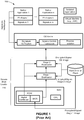
- Intervening layers include the various known software and hardware elements including a hard disk drive (HDD) storage device or flash memory 220 , the OS kernel 215 and OS kernel application interface layer 214 which manages system calls between the OS native applications 223 and the AndroidTM OS 213.
- the layered execution stack further includes a JavaTM access control (JAC) layer 212 between the AndroidTM OS 213 and the virtual machine (VM) layer 211 (i.e., Dalvik, which is the AndroidTM VM that forms an integral part of the AndroidTM OS).
- the VM layer serves to convert the given application into a compact executable form (i.e., the ".dex" format in terms of AndroidTM applications) suitable for execution in a known manner on the given device.
- the agent 217 is embedded in the OS kernel 215.
- the agent 217 is Linux Security Module interface (LSM I/F) compliant.
- LSM is not further discussed herein as it is a known framework (which is applicable to AndroidTM as well as Linux distributions) that allows the Linux kernel to support a variety of computer security models without favoring any single security implementation.
- the agent 217 is itself protected using known software protection techniques such as, but not limited to, those described in more detail in United States Patent Nos. 6,594,761 , 6,779,114 , 6,842,862 , and 7,506,177 each issued to Chow et al . which illustrate examples of such tamper resistance that may be usable in conjunction with the present invention.
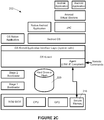
- FIGURE 2A While the secure store 218 is shown in FIGURE 2A as being a separate component of the inventive system, it should be understood that the secure store 218 may exist within the hard drive or flash 220 as seen in alternative embodiment 201 if FIGURE 2B . Still further, the secure store 218 may exist as a secure memory within the system on a chip base layer 219 as seen in further alternative embodiment 202 in FIGURE 2C .
- the agent is configured to control application access to OS kernel resources and data.
- the access control decisions made by the agent are based on, but not limited to, factors such as: OS kernel integrity, application integrity, application context, and the privileges granted by any given trusted root authority.
- An access control decision based on OS kernel integrity determines whether the kernel has been modified, been replaced, been added to, or had portions removed in an unauthorized manner. The access control decision will also determine whether the secure boot process even occurred. If the OS kernel has been modified, replaced, added to or portions removed or the secure boot process cannot be positively verified, this determination would serve to invalidate many of the assumptions that the agent or an application or a secure application such as a media player would normally operate under.
- the agent is configured to control access to application resources which may include, for example, a portion of the application that has been encrypted by the agent, or data files that are required by the application to execute (e.g., game resource files), or data to control execution of applications.
- application resources may include, for example, a portion of the application that has been encrypted by the agent, or data files that are required by the application to execute (e.g., game resource files), or data to control execution of applications.
- application resources may include, for example, a portion of the application that has been encrypted by the agent, or data files that are required by the application to execute (e.g., game resource files), or data to control execution of applications.
- application resources may include, for example, a portion of the application that has been encrypted by the agent, or data files that are required by the application to execute (e.g., game resource files), or data to control execution of applications.
- access control decisions are based on factors such as, but not limited to, the presence of valid license data or the confirmation of the identity of the device or consumer
- the objective of generating and deploying diverse agents is to prevent an automated attack -- i.e., an attack developed by a sophisticated attacker that can be sufficiently automated that it is simple to use by an average consumer and that would be applicable to each and every agent deployed in some installed base of devices.
- Such diverse agents may be deployed across different instantiations of a device, different types of devices, devices sold in different geographic regions or by different operators, etc.
- Updated agents are those whereby if an agent, A1, with functionality set F1, is deployed in the field and is compromised or attacked in some way, it is desirable to fix such vulnerability. This may be accomplished by generating an agent, A2, that incorporates the functionality F1 but which also incorporates a new functionality designed to prevent the attack on A1. This incremental functionality, F2, is such that the functionality of A2 is now F1 + F2. By applying diversity capabilities to A2, it is more difficult for an attacker to isolate the software functions in A2 (e.g., through differential analysis) which implement the new functionality F2. Updated agents provide a mechanism to address attacks on devices or agents that are already deployed in the field. Such updated agents could be downloaded by consumers, pushed to the device via a software update mechanism or pulled to the device by the existing agent.
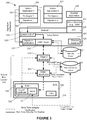
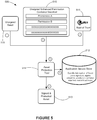
- FIGURE 3 a more detailed schematic 300 of the dynamic platform security functionality is shown in accordance with the generalized stack architecture of the present invention as in FIGURE 2 .
- the base layer includes typical SOC 329 components including a CPU 330 and ROM 333 within which BIOS 331 resides.
- FIGURE 3 there is a typical secure boot loader sequence 310 provided as shown. It should be understood that the embodiment of the present invention could leverage existing secure boot technology. It should equally be understood that the boot sequence may equally apply to 1 stage or the many stages there-after. Typically there are 2 boot loading stages 334, 335 in a system as shown in FIGURE 3 . Generally speaking, bottom up validation of secure boot components occurs as the first component validates the second component before transferring execution control to the next component. This boot time integrity verification is shown by way of dotted lines. Here, the first stage occurs upon device reset, where ROM code is hard wired to the device reset address.
- the OS kernel 325 is shown as the Linux kernel modified for the AndroidTM OS 339.
- this specific implementation of the invention uses the Linux Security Module ("LSM").
- LSM is a framework that allows the Linux kernel 325 to support a variety of computer security models while avoiding favoring any single security implementation.
- LSM provides hooks at every point in the Linux kernel 325 where a user-level system call is about to result in access to an important internal kernel object.
- LSM can be used to implement a wide range of security functions (e.g., Mandatory Access Control (MAC), On Access Virus Checking).
- MAC Mandatory Access Control
- On Access Virus Checking e.g., On Access Virus Checking
- the agent 326 performs IV checks on a number of device software components on an ongoing basis. This "integrity monitoring” is done to detect any unauthorized modification (e.g., tampering) such as the modification, replacement, removal, or additions of components or sub-components that are critical to supporting the security objectives for the system.
- unauthorized modification e.g., tampering
- Such components monitored via IV by the agent 336 in accordance with the present invention include: ROM BIOS 331 ; HDD or device flash memory 328 ; stage 1 bootloader 334 ; stage 2 bootloader 335 ; Linux kernel 325 or portions of the Linux kernel; system call interface (I/F) 338 ; agent 336 including the secure store 327 (during both boot time and run time as indicated, respectfully, by dotted and solid arrows in FIGURE 3 ); native application 320 ; AndroidTM OS 339 ; native AndroidTM application 321 ; JAC 324 ; AndroidTM (Dalvik) virtual machine 323 ; AndroidTM application 322 ; and application & system provisioning sequence (as further described with regard to FIGURES 4 and 5 below).
- FIGURE 3 Such integrity monitoring (shown by solid arrows) of native application 1 320 is illustrated in FIGURE 3 .
- the agent 336 continuously monitors native application 1 320 such that integrity is verified when the native application 1 320 attempts to access system resources through the system call I/F 338. This occurs through signature verification 337 whereby the agent 336 implements IV by comparing signature 1 340 to a known good value corresponding to application 1 resources.
- application 1 resources include IV information and the application signing certificate stored in a secure store 327. If the signature 1 value is the same as the stored application signing certificate (i.e., known good value), then the agent 336 assumes that the native application 1 320 has not been modified by an attacker and that its permissions or privileges 341 have not been modified.
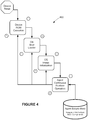
- FIGURE 3 The process isolation block 326 shown in FIGURE 3 will be further explained with regard to FIGURE 4 where there is illustrated a runtime boot loading sequence 400 in accordance with the present invention.
- a top down validation at steps 1, 2, and 3 of secure boot components can be seen. This validation serves to ensure that the OS that is loaded onto the device is the one intended by the OEM or operator and that the OS has the intended functionality.
- the agent gains execution control during initialization (at step 4), the agent will perform IV upon itself along with the previously executed components of the secure boot loader including the boot ROM image, the OS boot loader, and the OS image.
- the agent assumes that the OS that is installed on the device is the intended OS and that certain security functionality that may be performed by the OS has not been modified. However, if the agent determines that one or more of the components cannot be authenticated, the agent may take corrective action.
- One possible corrective action taken by the agent is to replace the boot components with a backup image of the intended boot components, then reset the device and start the boot up process again. If the agent detects that the system is invalid after a number of attempts to correct invalid components, then the agent may deny all further access to critical system resources or application resources. It should be readily apparent that the number of attempts is a matter of design choice and therefore a predetermined variable within the intended scope of the present invention. Likewise, the determination of which system resources may be considered critical may be predetermined based upon the given device usage. As well, other corrective actions are possible without straying from the intended scope of the present invention.
- FIGURE 5 illustrates the processing that is applied to an application (unprotected) submitted by a developer during the application certification process 500.
- the agent in accordance with the present invention includes an asset protection tool 514 which is a software tool configured to create and update the encrypted application secure store 512.
- the asset protection tool 514 stores information to protect the unprotected application.
- tamper resistant techniques can be applied to the stored information such as, but not limited to, secure loader and IV, and the use of whitebox cryptography to protect cryptographic secrets at rest (e.g., on disk) and in use (e.g., in-memory).
- the permission information created in the provisioning sequence of FIGURE 5 is further used by the agent during installation and runtime of the given application being placed onto the device. Moreover, when the given application code selected from the types of available applications is provisioned the resulting signed enhanced permission container manifest in the application secure store thereby contains all the permissions that the application code requires during runtime.
- the enhanced permission container manifest specifies the application code signature and the signature of the container itself so as to prevent tampering of the container or application after the application code has been signed.
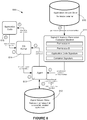
- initial installation 600 of application permissions is illustrated.
- the signed enhanced permission container manifest 611 shown is found within the application secure store 610 that was created during provisioning time in FIGURE 5 .
- the enhanced permission container manifest 611 is encrypted by the asset protection tool. Accordingly, this facilitates transfer of the enhanced permission container manifest 611 from the application secure store 610 to the agent secure store 612.
- Both the application secure store 610 and the agent secure store 612 comprise the secure store as generally shown in FIGURE 3 .
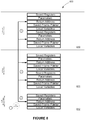
- the enhanced permission container manifest 611 there exists a permission list (i.e., Permission A, Permission B, ... etc.).
- the permission list determines what OS kernel resources can be accessed by the given application code that forms the application being installed and run.
- the application code signature is used by the agent 613 to IV the application to ensure it has not been modified at the time it makes the OS request for particular kernel permissions, such as "install" requests.
- the container signature is a reference value for the container itself, and is used by the agent 613 to ensure the contents of the container have not changed.
- the agent 613 at step 6 stores the validated application's enhanced permission container manifest into the agent secure store 612 for future reference. Based upon the step 5 validation operation, the agent 613 allows or denies the install to the OS kernel 614 at step 7. In turn, the OS Kernel 614 at step 8 passes the permission (allow or deny) to the installer directive that is installing the application to be installed to ultimately allow or deny installation of the application code 615.
- This kernel access control 700 is shown in FIGURE 7 in terms of continuous runtime system integrity. Here, the sequence of how the entire system integrity is maintained is shown whenever any application makes an OS request for kernel services.
- an installed and running application (i.e., user application) 710 is shown making a request for OS services or resources 711. This request is passed to the OS kernel 712 and which request is, in turn, passed along to the agent 713 via the LSM functionality that will ultimately allow or deny the request.
- the criteria used by the agent 713 to allow or deny the application request may include: system/application integrity, application permissions, application behavior, security context for other applications that may be running, and remote commands (element 216 , shown previously in regard to FIGURE 2A ).
- the agent decision criteria related to system/application integrity includes whether tampering has been detected to either system or application components.
- the agent decision criteria related to the security context of any other applications that may be running also disregards whether an application may have permission to access certain kernel services and instead looks to whether allowing a request when another trusted application is running could negatively affect one or more of these trusted applications.
- the agent properly enforces permissions at run time.
- the requesting application may try to access certain memory or drivers to capture high definition video after a trusted high definition video player application that implements digital rights management has decrypted the video thereby calling into question the appropriateness of the high definition video data usage by the requesting application (i.e., the agent may block access to the screen buffer memory, though allow the playing of the video itself).
- the agent decision criteria related to remote commands involve providing the agent the ability to support commands from a remote entity (e.g., a service provider) that could override the applications permissions or privileges.
- a remote entity e.g., a service provider
- the agent would also base decisions to provide system access on remote commands that would prevent the device from being used by an unauthorized user of the device.
- a mobile operator may wish to disable or limit the access an application or applications have to network services or other kernel resources in the event that such an application is causing problems with network reliability or stability (e.g., by generating a high volume of traffic or connections that cannot be sustained by the network).
- the agent could override the privileges that the application has or prevent the application from executing at all.
- commands from the remote command controller may be used to limit permissions (e.g., reduce privileges, change privileges, or revoke privileges). Further, such commands from the remote command controller may be used to remove applications from the device, including terminating the application if currently executing, removing the application from memory, or un-installing the application completely.
- the present invention may not only serve to "kill” applications, but may also serve to limit access to system resources beyond the access that is implied in the privileges associated with the given application -- e.g., even if an application has the privilege to send SMS messages, this is not quantified in the privileges such that when the application sends, for example, 10,000 SMS messages an hour, the agent could "throttle this back” based on some "normal behavior" template stored in the agent secure store or based on remote commands. Still further, the agent may be used to report anomalous behavior back to the remote entity so that, for example, a mobile operator or designated third party could make decisions about what to do (e.g., an application has made X requests for a system resource over some period of time).
- the agent 713 therefore allows or denies the request, and, at step 7, the allowance or denial of the request is passed along to the OS kernel 712.
- the OS kernel 712 passes along the allowance or denial of the request at step 8.
- the application event returns control back to the application 710 at step 9 with the decision to allow or deny the request.
- FIGURE 8 illustrates how the present invention efficiently provides application integrity monitoring while maintaining system integrity at the same time.
- the address spaces for the agent 812 , OS kernel 811 , and application 810 are shown.
- the agent address space 812 is therefore shared with the OS kernel address space 811.
- Return addresses in the calling stack are data points into integrity verification information that is contained in the agent.
- the start of runtime validation (at step 1) of the application involves the agent walking the stack of the request for OS service while validating all return addresses (at steps 2 through 4) and performing integrity verification on the address range utilizing the call stack signature as described below.
- the OS kernel passes along this request of a kernel service to the agent.
- This OS kernel is LSM enabled such that the agent is required to allow or deny the request.
- the signature of call stack of "Application ID 12032" would be "12032:12:23:44:10" and used in the integrity verification check by the agent.
- the depth of the stack is a variable length but not to exceed 128 samples. Also, the depth of the stack between the OS kernel and the agent is known and calculated prior to the application calling the OS kernel services. From this calculation, the agent may determine that all the return addresses on the call stack are included in the integrity verification signature range when the application and system components were provisioned. It should be understood that all the return addresses must be found in the list of signatures of the signed application and system components, which are stored in the agent secure store, in order for the agent to allow the OS to service the application.
- the validation sequence begins at step 1. Thereafter, at step 2, the agent examines the stack and determines the return address which identifies the location of the calling code in the OS Kernel address space 811. Based on the calling code, the agent at step 3 verifies that the caller is legitimate and has recently and successfully had its integrity verified. There may be several layers of this checking in the OS Kernel address space 811 , as indicated in FIGURE 8 . Thereafter, at step 4, a similar return address determination and validation process is performed as calling code in the stack appears from the application address space 810. Again, there may be several layers of this checking in the application address space 810 , as shown in FIGURE 8 .
- any request that an application 914 makes to the OS kernel 913 after installation of the application 914 will be validated using the signed enhanced permission container manifest 910 that is stored in the agent secure store 911.
- the agent 912 will allow or deny the request based on the integrity of the system and the permission provided in the enhanced permission container 910.
- the enforcement sequence includes an application 914 making an OS request at step 1 and, at step 2, the OS kernel 913 validates the request with the agent 912. At step 3, the agent 912 validates the OS integrity as already described above.
- the agent 912 validates the type of OS Kernel request from the signed enhanced permission container manifest 910 , the agent 912 then passes the allow or deny decision based on the validation in the steps 3 and 4 to the OS kernel 913 at step 5. Subsequently, the OS kernel 913 passes such allow or deny decision to the application 914 at step 6 based on the agent decision passed to it.
Landscapes
- Engineering & Computer Science (AREA)
- Computer Security & Cryptography (AREA)
- Theoretical Computer Science (AREA)
- Software Systems (AREA)
- Computer Hardware Design (AREA)
- General Engineering & Computer Science (AREA)
- Physics & Mathematics (AREA)
- General Physics & Mathematics (AREA)
- Computer Networks & Wireless Communication (AREA)
- Signal Processing (AREA)
- Health & Medical Sciences (AREA)
- Bioethics (AREA)
- General Health & Medical Sciences (AREA)
- Computing Systems (AREA)
- Storage Device Security (AREA)
- Stored Programmes (AREA)
Claims (17)
- Procédé d'amélioration de la sécurité d'un dispositif, ledit dispositif comprenant une couche d'abstraction utilisable entre un matériel de dispositif et un logiciel d'application, ledit procédé comprenant les étapes consistant à :incorporer un agent logiciel sécurisé (912) dans ladite couche d'abstraction, dans lequel ladite couche d'abstraction est un système d'exploitation ;stocker, dans une mémoire sécurisée (911) accessible uniquement par l'agent logiciel sécurisé, des informations de sécurité propres audit logiciel d'application (914) pour une utilisation à durée d'exécution continue par ledit agent logiciel sécurisé (912) afin d'assurer l'intégrité opérationnelle permanente dudit dispositif ; etsurveiller en continu ledit logiciel d'application (914) pendant l'exécution pour vérifier l'intégrité opérationnelle dudit logiciel d'application lorsque ledit logiciel d'application tente d'accéder à des ressources de système.
- Procédé d'actionnement d'un dispositif pour améliorer la sécurité d'un dispositif, ledit dispositif comprenant une couche d'abstraction opérationnelle entre un matériel de dispositif et un logiciel d'application, ledit procédé comprenant les étapes consistant à :stocker, dans une mémoire sécurisée (911) accessible uniquement par l'agent logiciel sécurisé, des informations de sécurité uniques par rapport audit logiciel d'application (914) pour une utilisation à durée d'exécution continue par un agent logiciel sécurisé (912) afin d'assurer l'intégrité opérationnelle permanente dudit dispositif ; etsurveiller en continu ledit logiciel d'application (914) pendant l'exécution pour vérifier l'intégrité opérationnelle dudit logiciel d'application lorsque ledit logiciel d'application tente d'accéder à des ressources de système, dans lequel ledit agent de logiciel sécurisé (912) est incorporé dans ladite couche d'abstraction.
- Procédé selon la revendication 1 ou 2, dans lequel ledit système d'exploitation est un système d'exploitation ouvert.
- Procédé selon la revendication 3, dans lequel ledit système d'exploitation ouvert comprend un noyau Linux.
- Procédé selon la revendication 4, dans lequel ledit procédé comprend en outre la réalisation d'une séquence de validation de signature de pile d'appels d'exécution, dans lequel, facultativement, ladite séquence de validation de signature de pile d'appels d'exécution comprend l'étape consistant à :
examiner une pile d'appels pour déterminer une adresse de retour identifiant un emplacement de code appelant à partir d'un espace d'adressage, vérifier, sur la base dudit emplacement de code appelant, la légitimité d'un appelant correspondant à ladite adresse de retour, et répéter ledit examen et vérifier à partir d'un espace d'adresse d'application. - Procédé selon la revendication 4, dans lequel ledit agent logiciel sécurisé est conforme à un module de sécurité Linux.
- Procédé selon la revendication 6, dans lequel ledit procédé comporte en outre une ou plusieurs des étapes suivantes consistant à :(a) déterminer une présence de logiciel malveillant dans le logiciel d'application, ou une modification de celui-ci ; ou(b) identifier une utilisation non autorisée dudit logiciel d'application ; ou(c) fournir une commande d'accès de plate-forme dudit logiciel d'application; ou(d) fournir une lecture multimédia sécurisée dudit logiciel d'application, ledit logiciel d'application étant une application multimédia ;dans lequel l'étape supplémentaire est basée sur lesdites informations de sécurité propres audit logiciel d'application.
- Procédé selon la revendication 4 ou 6, dans lequel ledit procédé comprend en outre une mise à jour dudit agent logiciel sécurisé sur la base de l'une quelconque parmi :(a) une indication de menaces de sécurité jusque-là inconnues ;(b) une identification d'une attaque réussie réelle par une menace de sécurité ; ou(c) une identification et une analyse d'une attaque réussie par une menace à la sécurité ou d'une attaque en cours de développement.
- Procédé selon la revendication 4 ou 6, dans lequel ledit logiciel d'application est une application multimédia et où ledit procédé comprend en outre une limitation ou une commande d'accès à des ressources dudit noyau Linux lorsqu'un tel accès conduit à une utilisation non autorisée de ladite application multimédia ou de médias lus par une telle application multimédia.
- Procédé selon la revendication 9, dans lequel ledit procédé comporte en outre un déplacement de privilèges connus dudit logiciel d'application.
- Procédé selon la revendication 9, dans lequel une instance dudit logiciel d'application est un lecteur multimédia et où ledit procédé comprend en outre l'étape consistant à empêcher toutes les autres instances dudit logiciel d'application d'accéder à un trajet de rendu multimédia comprenant un tampon de trame utilisé par ledit lecteur multimédia.
- Procédé selon la revendication 9, dans lequel ledit procédé empêche un accès dudit logiciel d'application à des ressources dudit noyau Linux sur la base de l'une quelconque parmi :(a) une indication que ledit noyau Linux est compromis ; ou(b) une indication que ledit logiciel d'application fournit automatiquement des données relatives à la confidentialité dudit dispositif électronique consommateur à un serveur distant non autorisé, dans lequel, facultativement, lesdites données relatives à la confidentialité comprennent des données spécifiques à un utilisateur sélectionnées dans un groupe constitué de données de localisation indiquant un emplacement d'utilisateur de dispositif, un historique d'appels d'utilisateur de dispositif, des données de courrier électronique d'utilisateur de dispositif, des données photographiques d'utilisateur de dispositif, des données de carnet de contacts d'utilisateur de dispositif et des données personnelles d'utilisateur de dispositif.
- Procédé selon la revendication 4, dans lequel ledit procédé vérifie en outre de manière permanente que ledit noyau Linux n'a pas été soumis à modification et, facultativement, après le démarrage dudit noyau Linux, qu'un processus de démarrage sécurisé a été mis en œuvre.
- Procédé selon la revendication 4 ou 6, dans lequel ledit agent logiciel sécurisé comprend la capacité de prendre en charge les instructions provenant d'une entité distante de manière à dépasser des autorisations prédéterminées accordées audit logiciel d'application, dans lequel, facultativement, lesdites instructions comprennent une quelconque parmi :(a) désactiver un dispositif exécutant ledit logiciel d'application sur indication que ledit dispositif est utilisé d'une manière non autorisée ;(b) limiter le fonctionnement dudit logiciel d'application fonctionnant sur un dispositif sur indication que ledit logiciel d'application cause des problèmes de fonctionnalité d'un réseau sur lequel ledit dispositif fonctionne ;(c) limiter lesdites autorisations prédéterminées accordées audit logiciel d'application ;(d) supprimer ledit logiciel d'application à partir dudit dispositif ;(e) mettre fin à une opération dudit logiciel d'application ; ou(f) supprimer ledit logiciel d'application de la mémoire dudit dispositif.
- Procédé selon la revendication 14, dans lequel ledit agent logiciel sécurisé est configuré pour rapporter un comportement anormal à ladite entité distante.
- Procédé selon les revendications 1 ou 2, dans lequel lesdites informations de sécurité propres audit logiciel d'application sont un certificat de signature d'application et dans lequel la vérification de l'intégrité opérationnelle dudit logiciel d'application comprend la comparaison d'une signature du logiciel d'application avec le certificat de signature d'application.
- Système pour améliorer la sécurité d'un dispositif, ledit système étant agencé pour exécuter le procédé selon l'une quelconque des revendications précédentes.
Applications Claiming Priority (1)
| Application Number | Priority Date | Filing Date | Title |
|---|---|---|---|
| PCT/CA2011/050135 WO2012119218A1 (fr) | 2011-03-09 | 2011-03-09 | Procédé et système pour assurer une sécurité de plateforme dynamique dans un système d'exploitation d'un dispositif |
Publications (3)
| Publication Number | Publication Date |
|---|---|
| EP2684152A1 EP2684152A1 (fr) | 2014-01-15 |
| EP2684152A4 EP2684152A4 (fr) | 2014-08-20 |
| EP2684152B1 true EP2684152B1 (fr) | 2020-07-22 |
Family
ID=46797349
Family Applications (1)
| Application Number | Title | Priority Date | Filing Date |
|---|---|---|---|
| EP11860634.2A Active EP2684152B1 (fr) | 2011-03-09 | 2011-03-09 | Procédé et système pour assurer une sécurité de plateforme dynamique dans un système d'exploitation d'un dispositif |
Country Status (7)
| Country | Link |
|---|---|
| US (2) | US9635048B2 (fr) |
| EP (1) | EP2684152B1 (fr) |
| CN (1) | CN103827881B (fr) |
| AU (1) | AU2011361577B2 (fr) |
| CA (1) | CA2829104C (fr) |
| WO (1) | WO2012119218A1 (fr) |
| ZA (1) | ZA201307336B (fr) |
Families Citing this family (38)
| Publication number | Priority date | Publication date | Assignee | Title |
|---|---|---|---|---|
| CN104335220B (zh) | 2012-03-30 | 2018-04-20 | 爱迪德技术有限公司 | 用于防止和检测安全威胁的方法和系统 |
| WO2013168148A2 (fr) | 2012-05-08 | 2013-11-14 | Serentic Ltd. | Procédé de génération et de modification dynamiques d'une architecture d'entité électronique |
| CN103310149B (zh) | 2013-05-27 | 2018-06-26 | 华为终端(东莞)有限公司 | 系统功能调用的方法、装置及终端 |
| US20150019852A1 (en) * | 2013-07-12 | 2015-01-15 | International Games System Co., Ltd. | Verification method for system execution environment |
| US9323929B2 (en) * | 2013-11-26 | 2016-04-26 | Qualcomm Incorporated | Pre-identifying probable malicious rootkit behavior using behavioral contracts |
| DE102014206006A1 (de) * | 2014-03-31 | 2015-10-01 | Siemens Aktiengesellschaft | Verfahren und Vorrichtung zum Manipulationsschutz einer Recheneinrichtung |
| CN105278969A (zh) * | 2014-06-16 | 2016-01-27 | 腾讯科技(深圳)有限公司 | 一种应用程序的代码验证方法及系统 |
| KR102337990B1 (ko) * | 2014-09-18 | 2021-12-13 | 삼성전자주식회사 | 권한 설정 토큰을 이용하는 전자 장치 |
| US9646154B2 (en) * | 2014-12-12 | 2017-05-09 | Microsoft Technology Licensing, Llc | Return oriented programming (ROP) attack protection |
| US10943014B2 (en) | 2015-10-01 | 2021-03-09 | Twistlock, Ltd | Profiling of spawned processes in container images and enforcing security policies respective thereof |
| US10922418B2 (en) | 2015-10-01 | 2021-02-16 | Twistlock, Ltd. | Runtime detection and mitigation of vulnerabilities in application software containers |
| US10915628B2 (en) | 2015-10-01 | 2021-02-09 | Twistlock, Ltd. | Runtime detection of vulnerabilities in an application layer of software containers |
| US10664590B2 (en) | 2015-10-01 | 2020-05-26 | Twistlock, Ltd. | Filesystem action profiling of containers and security enforcement |
| US10223534B2 (en) | 2015-10-15 | 2019-03-05 | Twistlock, Ltd. | Static detection of vulnerabilities in base images of software containers |
| US10778446B2 (en) * | 2015-10-15 | 2020-09-15 | Twistlock, Ltd. | Detection of vulnerable root certificates in software containers |
| KR101703826B1 (ko) * | 2015-10-23 | 2017-02-08 | 한국전자통신연구원 | 스마트 기기 대상 비인가 행위 기반 플래시 메모리 내부의 데이터 보호 장치 및 방법 |
| CN106878233B (zh) * | 2015-12-10 | 2020-11-10 | 联芯科技有限公司 | 安全数据的读取方法、安全服务器、终端及系统 |
| US10146681B2 (en) | 2015-12-24 | 2018-12-04 | Intel Corporation | Non-uniform memory access latency adaptations to achieve bandwidth quality of service |
| US10409600B1 (en) * | 2016-01-25 | 2019-09-10 | Apple Inc. | Return-oriented programming (ROP)/jump oriented programming (JOP) attack protection |
| US10275365B1 (en) | 2016-03-21 | 2019-04-30 | Apple Inc. | Cryptographic signatures for capability-based addressing |
| JP6697416B2 (ja) * | 2016-07-07 | 2020-05-20 | 信越化学工業株式会社 | レジスト下層膜材料、パターン形成方法、レジスト下層膜形成方法、及びレジスト下層膜材料用化合物 |
| US10216934B2 (en) | 2016-07-18 | 2019-02-26 | Crowdstrike, Inc. | Inferential exploit attempt detection |
| US10778654B2 (en) | 2016-09-16 | 2020-09-15 | Arris Enterprises Llc | Method and apparatus for protecting confidential data in an open software stack |
| KR102667438B1 (ko) * | 2017-01-25 | 2024-05-20 | 삼성전자주식회사 | 전자 장치 및 전자 장치의 데이터 관리 방법 |
| US9785519B1 (en) * | 2017-02-16 | 2017-10-10 | Red Hat Israel, Ltd. | Driver switch for device error recovery for assigned devices |
| US10346612B1 (en) * | 2017-06-19 | 2019-07-09 | Architecture Technology Corporation | Computer network defense training on operational networks using software agents |
| EP3646220B1 (fr) | 2017-06-29 | 2023-06-07 | Hewlett-Packard Development Company, L.P. | Surveillances de dispositif informatique par l'intermédiaire d'applications d'agent |
| CN107368343B (zh) * | 2017-08-21 | 2021-03-26 | 创维集团智能科技有限公司 | 一种基于安卓系统的终端开机方法、终端及存储介质 |
| US10990679B2 (en) * | 2018-05-07 | 2021-04-27 | Mcafee, Llc | Methods, systems, articles of manufacture and apparatus to verify application permission safety |
| US20190362066A1 (en) * | 2018-05-25 | 2019-11-28 | Microsoft Technology Licensing, Llc | Accessing secure system resources by low privilege processes |
| NL2022559B1 (en) * | 2019-02-12 | 2020-08-28 | Univ Delft Tech | Secure integrated circuit architecture |
| EP3696698A1 (fr) * | 2019-02-18 | 2020-08-19 | Verimatrix | Procédé de protection d'un programme logiciel contre la falsification |
| CN113692583A (zh) * | 2020-03-06 | 2021-11-23 | 华为技术有限公司 | 电子装置和安全防护方法 |
| US11409846B2 (en) | 2021-01-14 | 2022-08-09 | Safelishare, Inc. | User controlled trusted and isolated computing environments |
| CA3221836A1 (fr) * | 2021-07-28 | 2023-02-02 | Louis A. Steinberg | Procedes de gestion du risque de chaine d'approvisionnement de logiciel par intention declaree |
| US12562918B2 (en) | 2022-06-22 | 2026-02-24 | Apple Inc. | Pointer authentication |
| US12481763B2 (en) | 2023-12-06 | 2025-11-25 | Nxp B.V. | System and method for regulating access to secure functions |
| CN118378256A (zh) * | 2024-02-01 | 2024-07-23 | 深圳赋乐科技集团有限公司 | 一种Android应用可信环境检测方法、装置、设备及存储介质 |
Family Cites Families (30)
| Publication number | Priority date | Publication date | Assignee | Title |
|---|---|---|---|---|
| US7086086B2 (en) * | 1999-02-27 | 2006-08-01 | Alonzo Ellis | System and method for maintaining N number of simultaneous cryptographic sessions using a distributed computing environment |
| WO2000072149A1 (fr) | 1999-05-25 | 2000-11-30 | Motorola Inc. | Verification prealable d'applications dans un environnement informatique mobile |
| US7774838B2 (en) | 2001-02-14 | 2010-08-10 | Tricerat, Inc. | Thorough operation restriction |
| US7827611B2 (en) * | 2001-08-01 | 2010-11-02 | Mcafee, Inc. | Malware scanning user interface for wireless devices |
| JP2003114806A (ja) * | 2001-10-04 | 2003-04-18 | Hitachi Ltd | Os更新方法及びセキュリティ制御方法並びにその実施装置 |
| US7103914B2 (en) * | 2002-06-17 | 2006-09-05 | Bae Systems Information Technology Llc | Trusted computer system |
| CA2496664C (fr) | 2002-08-23 | 2015-02-17 | Exit-Cube, Inc. | Systeme d'exploitation a chiffrement |
| US7434259B2 (en) * | 2002-10-21 | 2008-10-07 | Microsoft Corporation | Method for prompting a user to install and execute an unauthenticated computer application |
| DE10252347A1 (de) * | 2002-11-11 | 2004-05-19 | Giesecke & Devrient Gmbh | Überwachte Unterprogrammausführung |
| US7149900B2 (en) * | 2002-12-12 | 2006-12-12 | Intel Corporation | Method of defending software from debugger attacks |
| US7546587B2 (en) | 2004-03-01 | 2009-06-09 | Microsoft Corporation | Run-time call stack verification |
| JP2006053788A (ja) * | 2004-08-12 | 2006-02-23 | Ntt Docomo Inc | ソフトウェア動作監視装置及びソフトウェア動作監視方法 |
| US7631356B2 (en) * | 2005-04-08 | 2009-12-08 | Microsoft Corporation | System and method for foreign code detection |
| US8839450B2 (en) * | 2007-08-02 | 2014-09-16 | Intel Corporation | Secure vault service for software components within an execution environment |
| US7669242B2 (en) * | 2005-06-30 | 2010-02-23 | Intel Corporation | Agent presence monitor configured to execute in a secure environment |
| US20070050848A1 (en) * | 2005-08-31 | 2007-03-01 | Microsoft Corporation | Preventing malware from accessing operating system services |
| US7516112B1 (en) * | 2006-03-24 | 2009-04-07 | Sandia Corporation | Flexible, secure agent development framework |
| CN101127634B (zh) * | 2006-08-15 | 2010-10-20 | 华为技术有限公司 | 一种移动台安全更新升级的方法及其系统 |
| US8468244B2 (en) * | 2007-01-05 | 2013-06-18 | Digital Doors, Inc. | Digital information infrastructure and method for security designated data and with granular data stores |
| US8254568B2 (en) * | 2007-01-07 | 2012-08-28 | Apple Inc. | Secure booting a computing device |
| US8127412B2 (en) * | 2007-03-30 | 2012-03-06 | Cisco Technology, Inc. | Network context triggers for activating virtualized computer applications |
| CN101335746A (zh) * | 2007-06-29 | 2008-12-31 | 国际商业机器公司 | 保护软件系统的完整性的安全设备和方法及其系统 |
| US20100083381A1 (en) * | 2008-09-30 | 2010-04-01 | Khosravi Hormuzd M | Hardware-based anti-virus scan service |
| US7979844B2 (en) * | 2008-10-14 | 2011-07-12 | Edss, Inc. | TICC-paradigm to build formally verified parallel software for multi-core chips |
| US8171547B2 (en) * | 2008-12-03 | 2012-05-01 | Trend Micro Incorporated | Method and system for real time classification of events in computer integrity system |
| US8606911B2 (en) * | 2009-03-02 | 2013-12-10 | Headwater Partners I Llc | Flow tagging for service policy implementation |
| US8635705B2 (en) * | 2009-09-25 | 2014-01-21 | Intel Corporation | Computer system and method with anti-malware |
| US8539584B2 (en) * | 2010-08-30 | 2013-09-17 | International Business Machines Corporation | Rootkit monitoring agent built into an operating system kernel |
| US9087199B2 (en) * | 2011-03-31 | 2015-07-21 | Mcafee, Inc. | System and method for providing a secured operating system execution environment |
| US9043903B2 (en) * | 2012-06-08 | 2015-05-26 | Crowdstrike, Inc. | Kernel-level security agent |
-
2011
- 2011-03-09 WO PCT/CA2011/050135 patent/WO2012119218A1/fr not_active Ceased
- 2011-03-09 US US14/003,502 patent/US9635048B2/en active Active
- 2011-03-09 EP EP11860634.2A patent/EP2684152B1/fr active Active
- 2011-03-09 CN CN201180070771.2A patent/CN103827881B/zh not_active Expired - Fee Related
- 2011-03-09 CA CA2829104A patent/CA2829104C/fr not_active Expired - Fee Related
- 2011-03-09 AU AU2011361577A patent/AU2011361577B2/en not_active Ceased
-
2013
- 2013-10-01 ZA ZA2013/07336A patent/ZA201307336B/en unknown
-
2017
- 2017-04-02 US US15/477,099 patent/US10333967B2/en active Active
Non-Patent Citations (1)
| Title |
|---|
| None * |
Also Published As
| Publication number | Publication date |
|---|---|
| WO2012119218A8 (fr) | 2013-01-10 |
| CN103827881B (zh) | 2017-12-12 |
| CA2829104C (fr) | 2019-01-15 |
| AU2011361577B2 (en) | 2017-04-20 |
| EP2684152A4 (fr) | 2014-08-20 |
| US20150040224A1 (en) | 2015-02-05 |
| WO2012119218A1 (fr) | 2012-09-13 |
| ZA201307336B (en) | 2014-11-26 |
| US20170302697A1 (en) | 2017-10-19 |
| US9635048B2 (en) | 2017-04-25 |
| EP2684152A1 (fr) | 2014-01-15 |
| CN103827881A (zh) | 2014-05-28 |
| US10333967B2 (en) | 2019-06-25 |
| CA2829104A1 (fr) | 2012-09-13 |
| AU2011361577A1 (en) | 2013-10-03 |
Similar Documents
| Publication | Publication Date | Title |
|---|---|---|
| US12197566B2 (en) | Method and system for preventing and detecting security threats | |
| US10333967B2 (en) | Method and system for dynamic platform security in a device operating system | |
| KR101158184B1 (ko) | 클라이언트 플랫폼들 상의 콘텐츠 보호 | |
| US20110167259A1 (en) | Software license enforcement | |
| US20160004859A1 (en) | Method and system for platform and user application security on a device | |
| KR20200041639A (ko) | 차량용 소프트웨어 업데이트 장치 및 그 제어 방법 |
Legal Events
| Date | Code | Title | Description |
|---|---|---|---|
| PUAI | Public reference made under article 153(3) epc to a published international application that has entered the european phase |
Free format text: ORIGINAL CODE: 0009012 |
|
| 17P | Request for examination filed |
Effective date: 20131007 |
|
| AK | Designated contracting states |
Kind code of ref document: A1 Designated state(s): AL AT BE BG CH CY CZ DE DK EE ES FI FR GB GR HR HU IE IS IT LI LT LU LV MC MK MT NL NO PL PT RO RS SE SI SK SM TR |
|
| DAX | Request for extension of the european patent (deleted) | ||
| A4 | Supplementary search report drawn up and despatched |
Effective date: 20140717 |
|
| RIC1 | Information provided on ipc code assigned before grant |
Ipc: G06F 21/55 20130101AFI20140711BHEP Ipc: G06F 21/57 20130101ALI20140711BHEP |
|
| STAA | Information on the status of an ep patent application or granted ep patent |
Free format text: STATUS: EXAMINATION IS IN PROGRESS |
|
| 17Q | First examination report despatched |
Effective date: 20170221 |
|
| GRAP | Despatch of communication of intention to grant a patent |
Free format text: ORIGINAL CODE: EPIDOSNIGR1 |
|
| STAA | Information on the status of an ep patent application or granted ep patent |
Free format text: STATUS: GRANT OF PATENT IS INTENDED |
|
| INTG | Intention to grant announced |
Effective date: 20191025 |
|
| GRAS | Grant fee paid |
Free format text: ORIGINAL CODE: EPIDOSNIGR3 |
|
| GRAA | (expected) grant |
Free format text: ORIGINAL CODE: 0009210 |
|
| STAA | Information on the status of an ep patent application or granted ep patent |
Free format text: STATUS: THE PATENT HAS BEEN GRANTED |
|
| AK | Designated contracting states |
Kind code of ref document: B1 Designated state(s): AL AT BE BG CH CY CZ DE DK EE ES FI FR GB GR HR HU IE IS IT LI LT LU LV MC MK MT NL NO PL PT RO RS SE SI SK SM TR |
|
| REG | Reference to a national code |
Ref country code: GB Ref legal event code: FG4D |
|
| REG | Reference to a national code |
Ref country code: CH Ref legal event code: EP |
|
| REG | Reference to a national code |
Ref country code: DE Ref legal event code: R096 Ref document number: 602011067931 Country of ref document: DE |
|
| REG | Reference to a national code |
Ref country code: AT Ref legal event code: REF Ref document number: 1294092 Country of ref document: AT Kind code of ref document: T Effective date: 20200815 |
|
| REG | Reference to a national code |
Ref country code: IE Ref legal event code: FG4D |
|
| REG | Reference to a national code |
Ref country code: NL Ref legal event code: FP |
|
| REG | Reference to a national code |
Ref country code: LT Ref legal event code: MG4D |
|
| REG | Reference to a national code |
Ref country code: AT Ref legal event code: MK05 Ref document number: 1294092 Country of ref document: AT Kind code of ref document: T Effective date: 20200722 |
|
| PG25 | Lapsed in a contracting state [announced via postgrant information from national office to epo] |
Ref country code: NO Free format text: LAPSE BECAUSE OF FAILURE TO SUBMIT A TRANSLATION OF THE DESCRIPTION OR TO PAY THE FEE WITHIN THE PRESCRIBED TIME-LIMIT Effective date: 20201022 Ref country code: SE Free format text: LAPSE BECAUSE OF FAILURE TO SUBMIT A TRANSLATION OF THE DESCRIPTION OR TO PAY THE FEE WITHIN THE PRESCRIBED TIME-LIMIT Effective date: 20200722 Ref country code: ES Free format text: LAPSE BECAUSE OF FAILURE TO SUBMIT A TRANSLATION OF THE DESCRIPTION OR TO PAY THE FEE WITHIN THE PRESCRIBED TIME-LIMIT Effective date: 20200722 Ref country code: GR Free format text: LAPSE BECAUSE OF FAILURE TO SUBMIT A TRANSLATION OF THE DESCRIPTION OR TO PAY THE FEE WITHIN THE PRESCRIBED TIME-LIMIT Effective date: 20201023 Ref country code: AT Free format text: LAPSE BECAUSE OF FAILURE TO SUBMIT A TRANSLATION OF THE DESCRIPTION OR TO PAY THE FEE WITHIN THE PRESCRIBED TIME-LIMIT Effective date: 20200722 Ref country code: HR Free format text: LAPSE BECAUSE OF FAILURE TO SUBMIT A TRANSLATION OF THE DESCRIPTION OR TO PAY THE FEE WITHIN THE PRESCRIBED TIME-LIMIT Effective date: 20200722 Ref country code: LT Free format text: LAPSE BECAUSE OF FAILURE TO SUBMIT A TRANSLATION OF THE DESCRIPTION OR TO PAY THE FEE WITHIN THE PRESCRIBED TIME-LIMIT Effective date: 20200722 Ref country code: BG Free format text: LAPSE BECAUSE OF FAILURE TO SUBMIT A TRANSLATION OF THE DESCRIPTION OR TO PAY THE FEE WITHIN THE PRESCRIBED TIME-LIMIT Effective date: 20201022 Ref country code: PT Free format text: LAPSE BECAUSE OF FAILURE TO SUBMIT A TRANSLATION OF THE DESCRIPTION OR TO PAY THE FEE WITHIN THE PRESCRIBED TIME-LIMIT Effective date: 20201123 Ref country code: FI Free format text: LAPSE BECAUSE OF FAILURE TO SUBMIT A TRANSLATION OF THE DESCRIPTION OR TO PAY THE FEE WITHIN THE PRESCRIBED TIME-LIMIT Effective date: 20200722 |
|
| PG25 | Lapsed in a contracting state [announced via postgrant information from national office to epo] |
Ref country code: LV Free format text: LAPSE BECAUSE OF FAILURE TO SUBMIT A TRANSLATION OF THE DESCRIPTION OR TO PAY THE FEE WITHIN THE PRESCRIBED TIME-LIMIT Effective date: 20200722 Ref country code: RS Free format text: LAPSE BECAUSE OF FAILURE TO SUBMIT A TRANSLATION OF THE DESCRIPTION OR TO PAY THE FEE WITHIN THE PRESCRIBED TIME-LIMIT Effective date: 20200722 Ref country code: PL Free format text: LAPSE BECAUSE OF FAILURE TO SUBMIT A TRANSLATION OF THE DESCRIPTION OR TO PAY THE FEE WITHIN THE PRESCRIBED TIME-LIMIT Effective date: 20200722 Ref country code: IS Free format text: LAPSE BECAUSE OF FAILURE TO SUBMIT A TRANSLATION OF THE DESCRIPTION OR TO PAY THE FEE WITHIN THE PRESCRIBED TIME-LIMIT Effective date: 20201122 |
|
| REG | Reference to a national code |
Ref country code: DE Ref legal event code: R097 Ref document number: 602011067931 Country of ref document: DE |
|
| PG25 | Lapsed in a contracting state [announced via postgrant information from national office to epo] |
Ref country code: EE Free format text: LAPSE BECAUSE OF FAILURE TO SUBMIT A TRANSLATION OF THE DESCRIPTION OR TO PAY THE FEE WITHIN THE PRESCRIBED TIME-LIMIT Effective date: 20200722 Ref country code: CZ Free format text: LAPSE BECAUSE OF FAILURE TO SUBMIT A TRANSLATION OF THE DESCRIPTION OR TO PAY THE FEE WITHIN THE PRESCRIBED TIME-LIMIT Effective date: 20200722 Ref country code: DK Free format text: LAPSE BECAUSE OF FAILURE TO SUBMIT A TRANSLATION OF THE DESCRIPTION OR TO PAY THE FEE WITHIN THE PRESCRIBED TIME-LIMIT Effective date: 20200722 Ref country code: IT Free format text: LAPSE BECAUSE OF FAILURE TO SUBMIT A TRANSLATION OF THE DESCRIPTION OR TO PAY THE FEE WITHIN THE PRESCRIBED TIME-LIMIT Effective date: 20200722 Ref country code: RO Free format text: LAPSE BECAUSE OF FAILURE TO SUBMIT A TRANSLATION OF THE DESCRIPTION OR TO PAY THE FEE WITHIN THE PRESCRIBED TIME-LIMIT Effective date: 20200722 Ref country code: SM Free format text: LAPSE BECAUSE OF FAILURE TO SUBMIT A TRANSLATION OF THE DESCRIPTION OR TO PAY THE FEE WITHIN THE PRESCRIBED TIME-LIMIT Effective date: 20200722 |
|
| PLBE | No opposition filed within time limit |
Free format text: ORIGINAL CODE: 0009261 |
|
| STAA | Information on the status of an ep patent application or granted ep patent |
Free format text: STATUS: NO OPPOSITION FILED WITHIN TIME LIMIT |
|
| PG25 | Lapsed in a contracting state [announced via postgrant information from national office to epo] |
Ref country code: AL Free format text: LAPSE BECAUSE OF FAILURE TO SUBMIT A TRANSLATION OF THE DESCRIPTION OR TO PAY THE FEE WITHIN THE PRESCRIBED TIME-LIMIT Effective date: 20200722 |
|
| 26N | No opposition filed |
Effective date: 20210423 |
|
| PG25 | Lapsed in a contracting state [announced via postgrant information from national office to epo] |
Ref country code: SK Free format text: LAPSE BECAUSE OF FAILURE TO SUBMIT A TRANSLATION OF THE DESCRIPTION OR TO PAY THE FEE WITHIN THE PRESCRIBED TIME-LIMIT Effective date: 20200722 |
|
| PG25 | Lapsed in a contracting state [announced via postgrant information from national office to epo] |
Ref country code: SI Free format text: LAPSE BECAUSE OF FAILURE TO SUBMIT A TRANSLATION OF THE DESCRIPTION OR TO PAY THE FEE WITHIN THE PRESCRIBED TIME-LIMIT Effective date: 20200722 |
|
| PG25 | Lapsed in a contracting state [announced via postgrant information from national office to epo] |
Ref country code: MC Free format text: LAPSE BECAUSE OF FAILURE TO SUBMIT A TRANSLATION OF THE DESCRIPTION OR TO PAY THE FEE WITHIN THE PRESCRIBED TIME-LIMIT Effective date: 20200722 |
|
| REG | Reference to a national code |
Ref country code: CH Ref legal event code: PL |
|
| GBPC | Gb: european patent ceased through non-payment of renewal fee |
Effective date: 20210309 |
|
| REG | Reference to a national code |
Ref country code: BE Ref legal event code: MM Effective date: 20210331 |
|
| PG25 | Lapsed in a contracting state [announced via postgrant information from national office to epo] |
Ref country code: LI Free format text: LAPSE BECAUSE OF NON-PAYMENT OF DUE FEES Effective date: 20210331 Ref country code: LU Free format text: LAPSE BECAUSE OF NON-PAYMENT OF DUE FEES Effective date: 20210309 Ref country code: CH Free format text: LAPSE BECAUSE OF NON-PAYMENT OF DUE FEES Effective date: 20210331 Ref country code: IE Free format text: LAPSE BECAUSE OF NON-PAYMENT OF DUE FEES Effective date: 20210309 Ref country code: GB Free format text: LAPSE BECAUSE OF NON-PAYMENT OF DUE FEES Effective date: 20210309 Ref country code: FR Free format text: LAPSE BECAUSE OF NON-PAYMENT OF DUE FEES Effective date: 20210331 |
|
| PG25 | Lapsed in a contracting state [announced via postgrant information from national office to epo] |
Ref country code: BE Free format text: LAPSE BECAUSE OF NON-PAYMENT OF DUE FEES Effective date: 20210331 |
|
| PG25 | Lapsed in a contracting state [announced via postgrant information from national office to epo] |
Ref country code: HU Free format text: LAPSE BECAUSE OF FAILURE TO SUBMIT A TRANSLATION OF THE DESCRIPTION OR TO PAY THE FEE WITHIN THE PRESCRIBED TIME-LIMIT; INVALID AB INITIO Effective date: 20110309 Ref country code: CY Free format text: LAPSE BECAUSE OF FAILURE TO SUBMIT A TRANSLATION OF THE DESCRIPTION OR TO PAY THE FEE WITHIN THE PRESCRIBED TIME-LIMIT Effective date: 20200722 |
|
| P01 | Opt-out of the competence of the unified patent court (upc) registered |
Effective date: 20240320 |
|
| PG25 | Lapsed in a contracting state [announced via postgrant information from national office to epo] |
Ref country code: MK Free format text: LAPSE BECAUSE OF FAILURE TO SUBMIT A TRANSLATION OF THE DESCRIPTION OR TO PAY THE FEE WITHIN THE PRESCRIBED TIME-LIMIT Effective date: 20200722 |
|
| PG25 | Lapsed in a contracting state [announced via postgrant information from national office to epo] |
Ref country code: TR Free format text: LAPSE BECAUSE OF FAILURE TO SUBMIT A TRANSLATION OF THE DESCRIPTION OR TO PAY THE FEE WITHIN THE PRESCRIBED TIME-LIMIT Effective date: 20200722 |
|
| PG25 | Lapsed in a contracting state [announced via postgrant information from national office to epo] |
Ref country code: MT Free format text: LAPSE BECAUSE OF FAILURE TO SUBMIT A TRANSLATION OF THE DESCRIPTION OR TO PAY THE FEE WITHIN THE PRESCRIBED TIME-LIMIT Effective date: 20200722 |
|
| P04 | Withdrawal of opt-out of the competence of the unified patent court (upc) registered |
Free format text: CASE NUMBER: APP_17487/2025 Effective date: 20250410 |
|
| PGFP | Annual fee paid to national office [announced via postgrant information from national office to epo] |
Ref country code: DE Payment date: 20260320 Year of fee payment: 16 |
|
| PGFP | Annual fee paid to national office [announced via postgrant information from national office to epo] |
Ref country code: NL Payment date: 20260323 Year of fee payment: 16 |