EP2684672A2 - Extrusionslinie zur herstellung einer flachen faser aus einem synthetischem rohmaterial - Google Patents
Extrusionslinie zur herstellung einer flachen faser aus einem synthetischem rohmaterial Download PDFInfo
- Publication number
- EP2684672A2 EP2684672A2 EP12754746.1A EP12754746A EP2684672A2 EP 2684672 A2 EP2684672 A2 EP 2684672A2 EP 12754746 A EP12754746 A EP 12754746A EP 2684672 A2 EP2684672 A2 EP 2684672A2
- Authority
- EP
- European Patent Office
- Prior art keywords
- raw material
- film
- flat
- synthetic raw
- line
- Prior art date
- Legal status (The legal status is an assumption and is not a legal conclusion. Google has not performed a legal analysis and makes no representation as to the accuracy of the status listed.)
- Withdrawn
Links
Images


Classifications
-
- B—PERFORMING OPERATIONS; TRANSPORTING
- B29—WORKING OF PLASTICS; WORKING OF SUBSTANCES IN A PLASTIC STATE IN GENERAL
- B29C—SHAPING OR JOINING OF PLASTICS; SHAPING OF MATERIAL IN A PLASTIC STATE, NOT OTHERWISE PROVIDED FOR; AFTER-TREATMENT OF THE SHAPED PRODUCTS, e.g. REPAIRING
- B29C69/00—Combinations of shaping techniques not provided for in a single one of main groups B29C39/00 - B29C67/00, e.g. associations of moulding and joining techniques; Apparatus therefore
- B29C69/001—Combinations of shaping techniques not provided for in a single one of main groups B29C39/00 - B29C67/00, e.g. associations of moulding and joining techniques; Apparatus therefore a shaping technique combined with cutting, e.g. in parts or slices combined with rearranging and joining the cut parts
-
- B—PERFORMING OPERATIONS; TRANSPORTING
- B29—WORKING OF PLASTICS; WORKING OF SUBSTANCES IN A PLASTIC STATE IN GENERAL
- B29C—SHAPING OR JOINING OF PLASTICS; SHAPING OF MATERIAL IN A PLASTIC STATE, NOT OTHERWISE PROVIDED FOR; AFTER-TREATMENT OF THE SHAPED PRODUCTS, e.g. REPAIRING
- B29C48/00—Extrusion moulding, i.e. expressing the moulding material through a die or nozzle which imparts the desired form; Apparatus therefor
- B29C48/001—Combinations of extrusion moulding with other shaping operations
- B29C48/0018—Combinations of extrusion moulding with other shaping operations combined with shaping by orienting, stretching or shrinking, e.g. film blowing
-
- B—PERFORMING OPERATIONS; TRANSPORTING
- B29—WORKING OF PLASTICS; WORKING OF SUBSTANCES IN A PLASTIC STATE IN GENERAL
- B29C—SHAPING OR JOINING OF PLASTICS; SHAPING OF MATERIAL IN A PLASTIC STATE, NOT OTHERWISE PROVIDED FOR; AFTER-TREATMENT OF THE SHAPED PRODUCTS, e.g. REPAIRING
- B29C48/00—Extrusion moulding, i.e. expressing the moulding material through a die or nozzle which imparts the desired form; Apparatus therefor
- B29C48/001—Combinations of extrusion moulding with other shaping operations
- B29C48/0022—Combinations of extrusion moulding with other shaping operations combined with cutting
-
- B—PERFORMING OPERATIONS; TRANSPORTING
- B29—WORKING OF PLASTICS; WORKING OF SUBSTANCES IN A PLASTIC STATE IN GENERAL
- B29C—SHAPING OR JOINING OF PLASTICS; SHAPING OF MATERIAL IN A PLASTIC STATE, NOT OTHERWISE PROVIDED FOR; AFTER-TREATMENT OF THE SHAPED PRODUCTS, e.g. REPAIRING
- B29C48/00—Extrusion moulding, i.e. expressing the moulding material through a die or nozzle which imparts the desired form; Apparatus therefor
- B29C48/03—Extrusion moulding, i.e. expressing the moulding material through a die or nozzle which imparts the desired form; Apparatus therefor characterised by the shape of the extruded material at extrusion
- B29C48/05—Filamentary, e.g. strands
-
- B—PERFORMING OPERATIONS; TRANSPORTING
- B29—WORKING OF PLASTICS; WORKING OF SUBSTANCES IN A PLASTIC STATE IN GENERAL
- B29C—SHAPING OR JOINING OF PLASTICS; SHAPING OF MATERIAL IN A PLASTIC STATE, NOT OTHERWISE PROVIDED FOR; AFTER-TREATMENT OF THE SHAPED PRODUCTS, e.g. REPAIRING
- B29C48/00—Extrusion moulding, i.e. expressing the moulding material through a die or nozzle which imparts the desired form; Apparatus therefor
- B29C48/03—Extrusion moulding, i.e. expressing the moulding material through a die or nozzle which imparts the desired form; Apparatus therefor characterised by the shape of the extruded material at extrusion
- B29C48/07—Flat, e.g. panels
- B29C48/08—Flat, e.g. panels flexible, e.g. films
-
- B—PERFORMING OPERATIONS; TRANSPORTING
- B29—WORKING OF PLASTICS; WORKING OF SUBSTANCES IN A PLASTIC STATE IN GENERAL
- B29C—SHAPING OR JOINING OF PLASTICS; SHAPING OF MATERIAL IN A PLASTIC STATE, NOT OTHERWISE PROVIDED FOR; AFTER-TREATMENT OF THE SHAPED PRODUCTS, e.g. REPAIRING
- B29C48/00—Extrusion moulding, i.e. expressing the moulding material through a die or nozzle which imparts the desired form; Apparatus therefor
- B29C48/16—Articles comprising two or more components, e.g. co-extruded layers
- B29C48/18—Articles comprising two or more components, e.g. co-extruded layers the components being layers
- B29C48/21—Articles comprising two or more components, e.g. co-extruded layers the components being layers the layers being joined at their surfaces
-
- B—PERFORMING OPERATIONS; TRANSPORTING
- B29—WORKING OF PLASTICS; WORKING OF SUBSTANCES IN A PLASTIC STATE IN GENERAL
- B29C—SHAPING OR JOINING OF PLASTICS; SHAPING OF MATERIAL IN A PLASTIC STATE, NOT OTHERWISE PROVIDED FOR; AFTER-TREATMENT OF THE SHAPED PRODUCTS, e.g. REPAIRING
- B29C48/00—Extrusion moulding, i.e. expressing the moulding material through a die or nozzle which imparts the desired form; Apparatus therefor
- B29C48/25—Component parts, details or accessories; Auxiliary operations
- B29C48/36—Means for plasticising or homogenising the moulding material or forcing it through the nozzle or die
- B29C48/49—Means for plasticising or homogenising the moulding material or forcing it through the nozzle or die using two or more extruders to feed one die or nozzle
-
- B—PERFORMING OPERATIONS; TRANSPORTING
- B29—WORKING OF PLASTICS; WORKING OF SUBSTANCES IN A PLASTIC STATE IN GENERAL
- B29C—SHAPING OR JOINING OF PLASTICS; SHAPING OF MATERIAL IN A PLASTIC STATE, NOT OTHERWISE PROVIDED FOR; AFTER-TREATMENT OF THE SHAPED PRODUCTS, e.g. REPAIRING
- B29C48/00—Extrusion moulding, i.e. expressing the moulding material through a die or nozzle which imparts the desired form; Apparatus therefor
- B29C48/25—Component parts, details or accessories; Auxiliary operations
- B29C48/88—Thermal treatment of the stream of extruded material, e.g. cooling
- B29C48/911—Cooling
- B29C48/9135—Cooling of flat articles, e.g. using specially adapted supporting means
-
- B—PERFORMING OPERATIONS; TRANSPORTING
- B29—WORKING OF PLASTICS; WORKING OF SUBSTANCES IN A PLASTIC STATE IN GENERAL
- B29C—SHAPING OR JOINING OF PLASTICS; SHAPING OF MATERIAL IN A PLASTIC STATE, NOT OTHERWISE PROVIDED FOR; AFTER-TREATMENT OF THE SHAPED PRODUCTS, e.g. REPAIRING
- B29C55/00—Shaping by stretching, e.g. drawing through a die; Apparatus therefor
- B29C55/02—Shaping by stretching, e.g. drawing through a die; Apparatus therefor of plates or sheets
- B29C55/04—Shaping by stretching, e.g. drawing through a die; Apparatus therefor of plates or sheets uniaxial, e.g. oblique
- B29C55/06—Shaping by stretching, e.g. drawing through a die; Apparatus therefor of plates or sheets uniaxial, e.g. oblique parallel with the direction of feed
-
- D—TEXTILES; PAPER
- D01—NATURAL OR MAN-MADE THREADS OR FIBRES; SPINNING
- D01D—MECHANICAL METHODS OR APPARATUS IN THE MANUFACTURE OF ARTIFICIAL FILAMENTS, THREADS, FIBRES, BRISTLES OR RIBBONS
- D01D5/00—Formation of filaments, threads, or the like
- D01D5/28—Formation of filaments, threads, or the like while mixing different spinning solutions or melts during the spinning operation; Spinnerette packs therefor
- D01D5/30—Conjugate filaments; Spinnerette packs therefor
- D01D5/32—Side-by-side structure; Spinnerette packs therefor
-
- D—TEXTILES; PAPER
- D01—NATURAL OR MAN-MADE THREADS OR FIBRES; SPINNING
- D01D—MECHANICAL METHODS OR APPARATUS IN THE MANUFACTURE OF ARTIFICIAL FILAMENTS, THREADS, FIBRES, BRISTLES OR RIBBONS
- D01D5/00—Formation of filaments, threads, or the like
- D01D5/42—Formation of filaments, threads, or the like by cutting films into narrow ribbons or filaments or by fibrillation of films or filaments
- D01D5/426—Formation of filaments, threads, or the like by cutting films into narrow ribbons or filaments or by fibrillation of films or filaments by cutting films
-
- B—PERFORMING OPERATIONS; TRANSPORTING
- B29—WORKING OF PLASTICS; WORKING OF SUBSTANCES IN A PLASTIC STATE IN GENERAL
- B29C—SHAPING OR JOINING OF PLASTICS; SHAPING OF MATERIAL IN A PLASTIC STATE, NOT OTHERWISE PROVIDED FOR; AFTER-TREATMENT OF THE SHAPED PRODUCTS, e.g. REPAIRING
- B29C48/00—Extrusion moulding, i.e. expressing the moulding material through a die or nozzle which imparts the desired form; Apparatus therefor
- B29C48/25—Component parts, details or accessories; Auxiliary operations
- B29C48/30—Extrusion nozzles or dies
- B29C48/305—Extrusion nozzles or dies having a wide opening, e.g. for forming sheets
- B29C48/307—Extrusion nozzles or dies having a wide opening, e.g. for forming sheets specially adapted for bringing together components, e.g. melts within the die
-
- B—PERFORMING OPERATIONS; TRANSPORTING
- B29—WORKING OF PLASTICS; WORKING OF SUBSTANCES IN A PLASTIC STATE IN GENERAL
- B29C—SHAPING OR JOINING OF PLASTICS; SHAPING OF MATERIAL IN A PLASTIC STATE, NOT OTHERWISE PROVIDED FOR; AFTER-TREATMENT OF THE SHAPED PRODUCTS, e.g. REPAIRING
- B29C48/00—Extrusion moulding, i.e. expressing the moulding material through a die or nozzle which imparts the desired form; Apparatus therefor
- B29C48/25—Component parts, details or accessories; Auxiliary operations
- B29C48/88—Thermal treatment of the stream of extruded material, e.g. cooling
- B29C48/911—Cooling
- B29C48/9135—Cooling of flat articles, e.g. using specially adapted supporting means
- B29C48/914—Cooling drums
-
- B—PERFORMING OPERATIONS; TRANSPORTING
- B29—WORKING OF PLASTICS; WORKING OF SUBSTANCES IN A PLASTIC STATE IN GENERAL
- B29C—SHAPING OR JOINING OF PLASTICS; SHAPING OF MATERIAL IN A PLASTIC STATE, NOT OTHERWISE PROVIDED FOR; AFTER-TREATMENT OF THE SHAPED PRODUCTS, e.g. REPAIRING
- B29C48/00—Extrusion moulding, i.e. expressing the moulding material through a die or nozzle which imparts the desired form; Apparatus therefor
- B29C48/25—Component parts, details or accessories; Auxiliary operations
- B29C48/88—Thermal treatment of the stream of extruded material, e.g. cooling
- B29C48/919—Thermal treatment of the stream of extruded material, e.g. cooling using a bath, e.g. extruding into an open bath to coagulate or cool the material
-
- B—PERFORMING OPERATIONS; TRANSPORTING
- B29—WORKING OF PLASTICS; WORKING OF SUBSTANCES IN A PLASTIC STATE IN GENERAL
- B29K—INDEXING SCHEME ASSOCIATED WITH SUBCLASSES B29B, B29C OR B29D, RELATING TO MOULDING MATERIALS OR TO MATERIALS FOR MOULDS, REINFORCEMENTS, FILLERS OR PREFORMED PARTS, e.g. INSERTS
- B29K2105/00—Condition, form or state of moulded material or of the material to be shaped
- B29K2105/06—Condition, form or state of moulded material or of the material to be shaped containing reinforcements, fillers or inserts
- B29K2105/16—Fillers
Definitions
- the invention relates to equipment for polymers processing, particularly to equipment for processing polymers through extrusion of flat yarn from synthetic raw material with predetermined characteristics.
- the flat yarn from synthetic raw materials obtained on this equipment can be applied in many industries for various purposes. For example, in weaving industry, food industry, as packaging material, and it may have advantages over known yarns. It is more durable, resistant to petrol and moisture, and provides the possibility to reuse it.
- the flat yam from synthetic raw materials can be used in radio electronics, instrument-making, and other industries.
- extrusion lines for flat fiber manufacturing from synthetic material are known.
- the extrusion line for flat fiber manufacturing from synthetic raw materials is known (see http://www.ligatek.ru/extruders/jc-fy-s.htm) .
- the well-known extrusion line described on this site includes flat-die and continuous filtration system that make possible producing flat fiber. This line produces a tape of uniform thickness across the width of the tape.
- the fiber after fibrillation is used to make twines, ropes, cable fillers, basis for carpet backing, and artificial green grass.
- Bath with hot water, which is a part of the line, is fully insulated so as to reduce heat loss and energy consumption.
- Furnace with hot air is fully insulated, and equipped with two zones of automatic temperature control and air duct.
- the line includes extrusion unit. Screw conveyor of extrusion unit provides necessary quality of melting, mixing and extrusion. Automatic temperature control reduces power consumption and maintains a constant level of temperature with low fluctuations (+/-1.0°C). Cylinder of extrusion unit is fully insulated and equipped with a cooling fan. A geared pump is designed for sequential extrusion of molten polymeric material. Pressure check shall be made before and after pump operation. To improve the extrusion consistency and quality of yam, pressure up to a geared pump shall be controlled.
- Quench water bath is designed for smoothing water flow, maintaining constant water temperature, and eliminating agitation on the water surface. Bath can be moved in the horizontal and vertical directions.
- the line also includes yam-drawing device. Extrusion method of synthetic flat yarns manufacturing, which is implemented using the line advertised on this site, allows obtaining single-layer flat yarns for further applications, such as weaving production. But such a method for extruded synthetic flat yarns manufacturing has some disadvantages.
- the main disadvantages of this extrusion line for flat yarns manufacturing from synthetic raw materials, as an analogue is high cost of manufactured flat yam from synthetic raw material, as well as its reduced strength properties.
- the automatic device instead of manual one is used to change the filter when changing the melt filter before the die is necessary, in order to minimize the stops of line, because of poor quality of raw materials, including the recycled raw applications, improper regulation of the melt characteristics, after replacing the screw, or change-over to a different type of raw material.
- Grid movement will be controlled by timer, and the speed, by the operator.
- suction device provides an output of entirely dry tape even at high speeds.
- rotating device for longitudinal cutting the flat tape extruded from the die and cooled is cut into strips.
- the strips are fed to the system of air orientation, or the dual system of non-contact air heating and stretching. Thereafter the strips are fed to the combined stretching and shrinking unit, which drives are independent. On the combined unit shrinkage is prevented and tension of flat yarns coming to winding unit is relieved.
- Winding unit has three pairs of winding rollers of hot, normal and cold temperatures, operating at variable speed. For production of conventional flat yarns, a combination of hot, neutral and cold rollers is offered. Water-cooled rollers provide a constant temperature of flat yarns entering the winding unit. For production of fibrillated flat yarns, the line is equipped with fibrillator, which is located between the orientation air oven and combined stretching and shrinking unit.
- Fibrillator needle roller has an independent drive, and needles are performed with possibility of their adjusting in accordance with the desired structure of fibrillation.
- the modular design of the device allows simultaneous making both fibrillated and non-fibrillated tapes.
- Winding unit provides producing of rolls with wound flat yarns of required quality and colour, and in automatic technology, it provides automated change of wound rolls by empty ones.
- Extrusion method of synthetic flat yam manufacturing which is implemented using the line advertised on this site, allows obtaining single-layer flat yarns for further applications, such as weaving production.
- extrusion method for synthetic flat yarns production has some disadvantages.
- the main disadvantages of the known extrusion line for flat yarns production form synthetic raw materials, as an analogue, is high cost of flat synthetic yam produced by this line, and reduced strength properties.
- the line includes the following processing equipments. These are, first of all, extruder with charging hopper, pressure control pump, and driver.
- the line also includes a filter for melts, flat-die, bath with cooling water, and receiving rollers, which are installed after the bath.
- the described line has a device for cutting the tape into separate strips.
- the line also includes stretching rollers; their number and degree of stretching on each roller depends on specified functional properties of flat yam.
- the line also includes device for suction and transport of edged strips.
- the line includes a chamber for stretching in hot air conditions, and receiving and winding machine.
- a special feature of this line is a singular adiabatic extruder with output pressure regulation.
- the extrusion system consists of an extruder with a 90 mm, 27D length screw, made with special geometric contour design, continuously operating band mesh filter, and a special pump, allowing adjusting the extrusion process pressure.
- the extruder provides uniform polymer melting with high degree of melt homogenization.
- the pump generates the required pressure, supplying flat-die with the melt. Screw rotary speed corresponds to a given pressure before and after adjustment of the pump. Due to the constant pressure of the pump, which is supported by defined screw rotary speed, the pressure of the melt on flat-die also remains constant.
- this combination of adiabatic extruder with a metering pump provides some technical advantages. Due to such pump, the extruder may continue efficient work with a very high performance up to 500-550 kg/hr at a low backpressure of melt.
- the pump increases the pressure from 50 bar at inlet to 200 bar at outlet to flat-die.
- Extruder screw is designed specially for implementing of high-productive process with regard to obtaining of high quality and uniformly homogenized melt, and running with a speed of 280 rpm. Temperature of polymer melt, despite the high performance and high speed of the screw does not exceed 220°C. Usually, when using extruder with different geometry of screw and without pressure boosting with pump, the melt temperature reaches 240-260°C.
- Typical parameters for this are sizes of the finished packages and cartridge, as well as technological requirements to the ends of bobbin, and besides, to tension and winding speed.
- Tape yarns for tape processing in circular loom are used most of all. This line has a number of advantages, except the above listed; among them are the following. First of all, high speed potential of up to 450 m/min, low power consumption, and low heat output of electric motors.
- this extrusion line for synthetic flat yam manufacturing also has some disadvantages.
- the main disadvantages of known extrusion line for synthetic flat yam manufacturing, as the previous analogues, are high cost of flat yam from synthetic raw material, as well as its reduced strength properties.
- polypropylene or polyethylene are much more expensive than such materials as calcium carbonate, calcium stearate, or talc, for cheapening yam, additives based on calcium carbonate, calcium stearate, talc, and the like, are generally applied.
- organic calcium carbonate was administered as additive in the form of milled cattle bones, and fish bones, in order to utilise them, and thus cheapen the flat synthetic yam.
- particles, such as calcium carbonate (CaCO 3 ) escaping on the surface of tapes obtained in general processing, which is subsequently cut into flat strips, and from which yarns are then manufactured, form a roughened surface.
- Particles of calcium carbonate (CaCO 3 ) escaping on the surface of already finished yam have significant abrasive qualities. This results in additional wear of equipment parts, with which yam subsequently contacts, for example, the working parts of the loom. This determined by the fact that the yam actively contacts with mechanisms of the loom, at least at five locations in the loom where the particles, for example, of sodium carbonate or calcium stearate are collected. Alongside with that, particles of carbonate or calcium stearate can stand out in a significant amount of the surface layer of yam with all the ensuing consequences. Primarily, knocked out from the surface layer calcium carbonate particles form dust, which, falling into the rotating parts of the looms and machinery, additionally increases the wear.
- CaCO 3 calcium carbonate
- an extrusion line for production of flat yarns from synthetic material includes the film forming flat-die and device for its cooling, and apparatuses for cutting the film into strips, stretching, shrinkage, and winding the yarns obtained on cores; comprising at least two extruders, forming melts with a different, predetermined properties; comprising a device for distributing melt at least in three layers of a multilayer film; comprising a cooling device designed as a water bath or a cooling roll; and, after the cooling apparatus in line, a means for removing water from a film installed, made in the form of rollers with an elastic material on the periphery thereof.
- essence of the invention lies also in the fact that in an extrusion line for production of flat yarns from synthetic material, following device for water removal from the film, slotted tubes for removal of remainders of water are installed.
- the essence of the invention lies also in the fact that in an extrusion line for production of flat yarns from synthetic material, following extruding machines, a device for distribution of liquid melts by layers is installed.
- essence of the invention lies also in the fact that flat-die for film process in an extrusion line for production of flat yarns from synthetic material is executed triple-slotted.
- essence of the invention lies in the fact that in an extrusion line for production of flat yarns from synthetic material flat-die for film process is executed five-slotted.
- essence of the invention lies also in the fact that in an extrusion line for production of flat yarns from synthetic material, following device for film cutting on stripes, the fibrillator is installed.
- essence of the invention lies also in the fact that in an extrusion line for production of flat yarns from synthetic material, following device for stretching, a device for thread twisting is installed.
- essence of the invention lies also in the fact that in an extrusion line for production of flat yarns from synthetic material, following device for twisting, a device for yam oiling is installed.
- An extrusion line for production of three-layer flat yarns from synthetic material represents a chain of serial and parallel equipment units (see Figure 3 ).
- mixer 6 At the beginning of the line mixer 6 is installed, representing a cylindrical form vessel with inlying paddles for «dry» blending of components. Rotation of paddles is provided by induction motor via planetary reduction gear (not shown on the drawing).
- Tray of the mixer 6 for unloading mixed components is situated above metal box 7.
- Box 7 is meant for the reception of raw ready mixture from mixer 6.
- Box 7 is connected with vacuum loader 8 through flexible pipeline 9.
- bunker 10 Under the vacuum loader 8 is situated bunker 10, which is installed onto the feed end of auger-cylinder part of extruder machine 11.
- Extruder machine 11 represents material cylinder with the auger inside.
- the auger is connected with induction motor with the possibility to control the inverter through the reduction gear.
- heating elements are situated, operated by thermo controllers, which provide heating of material cylinder, auger and, consequently, raw material fed into extruder machine.
- filter unit 12 is situated, meant for filtration of melt through close-meshed metal lath situated inside the unit.
- Filter unit 12 is connected through connector 13 to distribution adapter 14.
- Distribution adapter 14 represents a device with channels for supply and distribution of liquid melts by layers in three-layer flat-die 15. Similarly and in parallel to described above units, following ones are situated: mixer 16, box 17, pipeline 18, vacuum loader 19, bunker 20, auger-cylinder part 21, filter unit 22, and connector 23.
- Distribution adapter 14 is connected with three-layer flat-die 15, in which channels are made for distribution and combination of liquid melt layers along the entire length of flat-die.
- cooling bath 24 is installed, representing rectangular metal vessel with two situated inside non-rotatable metal shafts 25, and water supply and circulation system. Cooling bath 24, filled with water, provides liquid melts cooling for the film formation.
- a unit of water nip rolls 26 is located consisting of two rubber coated rolls intended to remove water from the film surface, and of pneumatic clamping system for the rolls. Unit of water nip rolls 26 is connected to an induction motor, inverter-controlled via reduction gear.
- moisture-removing pipes 27 are installed, intended for extraction of residual moisture from the film surface.
- Moisture-removing pipes 27 are slotted to capture moisture, and are connected through flexible hoses with an aspirating fan.
- by-pass roller 33 is located, which serves to guide the film to cutting unit 34.
- Cutting unit 34 is located above by-pass rollers 30, and represents metal shaft with thread and nut, onto which metal or plastic rings are put. Cutting elements are arranged between the rings. Rings on the shaft are tightened with nut.
- the shaft of device for device for cutting 29 is positioned transversely to the film, wherein cutting elements of device for device for cutting 29 are installed in order to cut the film into strips.
- receiving shaft unit 31 is installed, which represents a base frame with attached metal shafts. These shafts are connected with an induction motor, inverter-controlled via reduction gear.
- Stretching furnace 32 is a non-hermetic metal box with an opening lid, inside of which are heating elements operated by a temperature controllers, and induction motor with wings on the rotor axis. Between the cover and the box some space is provided for passage of strips.
- unit of shafts 33 is installed, consisting of groups of stretching shafts 34, and shrinking shafts 35 and 36.
- shafts 35 are equipped with a heating system for shaft surfaces
- shafts 36 are equipped with a cooling system.
- winding station 37 is installed that is made as a base frame, on which the properly winders 38 are located. Their number depends on the number of produced filament reels. Basically, winders 38 represent a plate with rollers for passage of the thread, axis for fixing the core, and changing device installed on it. Each of the winders 38 is connected with induction motor.
- the new extrusion line for production of three-layer flat yarns from synthetic material works in the following manner.
- Polypropylene and granulated coloring "super-concentrate" substance are filled by measuring cup into the mixer 6, wherein "dry” blending is performed.
- the mixing time is set by the timer.
- the obtained mixture is poured into box 7.
- bunker 10 equipped with system for drying raw materials and magnetic trap for metal particles, the mixture is adjusted to required humidity, and accidental metal particles are removed.
- mixture of synthetic materials is supplied to the auger-cylinder extruder zone 11 for compaction and heating. Then heated synthetic materials are converted into liquid melt for forming outer layers of three-layer film.
- the resulting melt is fed under pressure from auger-cylinder extruder zone 11 to filter unit 12, where unwanted inclusions are filtered from melt.
- the filtered melt from the filter unit 12 via connector 13 is supplied to the channel, corresponding to outer layers, of the distribution adapter 14.
- melt flows into the outer layers formation channels of a three-layer flat-die 15.
- polypropylene and additive based on calcium carbonate (CaCO 3 ) in the form of granules are poured by measuring cup into mixer 16, where they "dry” blending is performed. Prepared mixture is poured into box 17. Using vacuum loader 19 through pipeline 18, the mixture of components is continuously taken from box 17 and supplied to the bunker 20.
- bunker 20 equipped with system for drying raw materials and magnetic trap for metal particles, the mixture is adjusted to required humidity, and accidental metal particles are removed.
- mixture of synthetic materials is fed into the auger-cylinder extruder zone 21 for compaction and heating.
- heated synthetic materials are converted into liquid melt for forming the internal layer of the three-layer film.
- the resulting melt is fed under pressure from auger-cylinder zone 21 to filter unit 22, wherein the melt is filtered off unwanted inclusions.
- the filtered melt from filter unit 22 through the connector 23 enters the channel corresponding to the internal layer of the distributing adapter 14. From the inner layer channel of distributing adapter 14 melt enters the channel for forming the internal layer of the three-layer flat-die 15.
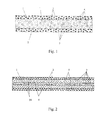
- melts From bushing part of three-layer flat-die 15 all three melt layers come out simultaneously without mixing, but interconnected. Melts will be distributed as follows: the external layer - the internal layer - the external layer.
- the cooled melt forms a three-layer film, which is held closer to bottom of the bath 24 by non-rotatable shafts 25 to extend the path and therefore, high-quality cooling of the film.
- the resulting film is carried through the unit of water nip rolls 21 with a rubber coating, which remove water from the surface of the film. Residual moisture is removed from surface of the film on moisture-removing pipes 27.
- the extrusion line for obtaining five-layer flat fiber from synthetic raw material represents a row of serial and parallel equipment units (see Figure 4 ).
- mixer 6 At the beginning of the line mixer 6 is installed, representing a cylindrical form vessel with inlying paddles for "dry" blending of components. Rotation of paddles is provided by an asynchronous motor via a planetary reduction gear. The mixing time is set with a timer. Tray of the mixer 6 for unloading mixed components is situated above metal box 7. Box 7 is designed for receiving of raw ready mixture from mixer 6. Box 7 is connected with vacuum loader 8 through flexible pipeline 9. Under vacuum loader 8 is situated bunker 10, which is installed onto the feed end of auger-cylinder part of extruder machine 11. Extruder machine 11 represents material cylinder with the auger inside.
- the auger is connected with induction motor with a possibility to control the inverter through reduction gear.
- heating elements are situated, operated by thermo controllers, which provide heating of material cylinder, auger and, consequently, raw material, fed into the extruder machine.
- the cylinder filter unit 12 is situated, meant for filtration of melt through the close-meshed metal lath situated inside the unit.
- Filter unit 12 is connected through connector 13 to distribution adapter 14.
- Distribution adapter 14 represents a device with channels for supply and distribution of liquid melts by layers in five-layer die 15. Similarly and parallel to described above units, following ones are situated : mixer 16, box 17, pipeline 18, vacuum loader 19, bunker 20, auger-cylinder part 21, filter unit 22, and connector 23.
- Connector 23, similar to connector 13, is connected with distribution adapter 14.
- Mixer 40 box 41, pipeline 42, vacuum loader 43, bunker 44, auger-cylinder part 45, filter unit 46, and connector 47.
- Connector 47 similar to reducer connector 13, is connected with distribution adapter 14.
- Distribution adapter 14 is connected with five-layer flat-die 15, in which channels are made for distribution and combination of five melt layers along the entire length of the die.
- cooling bath 24 is installed, representing rectangular metal vessel with two situated inside non-rotatable metal shafts 25, and water supply and circulation system. Cooling bath 24, filled with water, provides liquid melts cooling for the film formation.
- a unit of water nip rolls 26 is located consisting of two rubber coated rolls, intended to remove water from the film surface, and of pneumatic clamping system for the rolls.
- Unit of water nip rolls 26 is connected to an induction motor, inverter-controlled via reduction gear.
- moisture-removing pipes 27 are located, intended for extraction of residual moisture from the film surface.
- Moisture-removing pipes 27 are slotted to capture moisture, and are connected through flexible hoses with an aspirating fan.
- by-pass roller 28 is located, which serves to guide the film to device for cutting 29.
- Device for cutting 29 is located above by-pass rollers 30, and represents a metal shaft with thread and nut, onto which metal or plastic rings are put.
- Cutting elements are arranged between the rings. Rings on the shaft are tightened with nut.
- the shaft of cutting unit is positioned transversely to the film, wherein cutting elements of device for cutting 29 are installed in order to cut the film into strips.
- receiving shaft unit 31 is installed, which represents a base frame with attached metal shafts. These shafts are connected with an induction motor, inverter-controlled via reduction gear.
- Stretching furnace 32 is a non-hermetic metal box with an opening lid, inside of which are heating elements operated by temperature controllers, and induction motor with wings on the rotor axis. Between the cover and the box some space is provided for passage of strips.
- shafts 33 Following the stretching furnace 32 unit of shafts 33 is installed, consisting of groups of stretching shafts 34, and shrinking shafts 35 and 36. Moreover, shafts 35 are with a system of heating for shaft surfaces, and shafts 36 are equipped with a cooling system.
- winding station 37 is installed that is made as a base frame, on which the properly winders 38 are located. Their number depends on the number of produced filament reels. Basically, winders 38 a plate with rollers for passage of the thread, an axis for fixing the core, and a changing device installed on it. Each of winders 38 is connected with induction motor.
- the new extrusion line for production of five-layer flat yarns from synthetic raw material works in the following manner.
- Polypropylene and granulated coloring "super-concentrate" substance are filled by measuring cup tank into the mixer 6, wherein "dry” blending is performed.
- Prepared mixture is poured into box 7.
- vacuum loader 8 through pipeline 9, the mixture of components is continuously taken from box 7 and fed to bunker 10.
- the bunker 10 equipped with system for drying raw materials and magnetic trap for metal particles, the mixture is adjusted to required humidity, and accidental metal particles are removed.
- mixture of synthetic raw materials is supplied to the auger-cylinder extruder zone 21 for compaction and heating. Then synthetic raw materials are converted into liquid melt for forming outer layers of the five-layer film.
- the resulting melt is fed under pressure from auger-cylinder extruder zone 11 to filter unit 12, where unwarranted inclusions are filtered from melt.
- the filtered melt from the filter unit 12 via connector 13 is supplied to the channel, corresponding to outer layers, of distribution adapter 14. From the channels of outer layers of distribution adapter 14 melt flows into the outer layers formation channels five-layer flat-die 15.
- polypropylene and additive based on calcium carbonate (CaCO 3 ) in the form of granules are poured by measuring cup into mixer 16, where the "dry" blending is performed. Mixture is poured into box 17. Using vacuum loader 19 through pipeline 18, the mixture of components is continuously taken from box 17 and supplied to bunker 20.
- bunker 20 equipped with system for drying raw materials and magnetic trap for metal particles, the mixture is adjusted to required humidity, and accidental metal particles are removed.
- mixture of synthetic raw materials is fed into screw the auger-cylinder extruder zone 21 for compaction and heating.
- heated synthetic raw materials are converted into liquid melt for forming middle layers of five-layer film.
- the resulting melt is fed under pressure from auger-cylinder zone 21 to filter unit 22, where the melt is filtered off unwanted inclusions.
- the filtered melt from filter unit 22 through connector 23 enters the channel of distribution adapter 14, corresponding to middle layers. From channel of middle layers of distribution adapter 14, melt enters the channel for forming middle layers of five-layer flat-die 15.
- polypropylene of one or several grades granulated form is poured by measuring cup into mixer 40, where the "dry" blending is performed.
- Prepared mixture is poured into box 41.
- Using vacuum loader 43 through pipeline 42 the mixture of components is continuously taken from box 41 and fed to bunker 44.
- bunker 44 equipped with system for drying raw materials and magnetic trap for metal particles, the mixture is adjusted to required humidity, and accidental metal particles are removed.
- the mixture of synthetic raw materials is fed to auger-cylinder zone 45 of extrusion machine for compaction and heating. Then heated synthetic raw materials are converted into liquid melt for forming reinforced layer of five-layer film.
- the resulting melt is fed under pressure from auger-cylinder zone 45 to filter unit 46, where the melt is filtered off unwanted inclusions.
- the filtered melt from filter unit 46 through connector 47 enters the channel of distribution adapter 14, corresponding to reinforced layer. From the channel of reinforced layer of distribution adapter 14, the melt enters the channel for forming reinforced layer of five-layer flat-die 15. From bushing part of five-layer flat-die 15 all five melt layers come simultaneously without mixing, but interconnected.
- the melts are distributed as follows: exterior layer - middle layer - reinforced layer - middle layer - exterior layer. Thus obtained melt is fed for cooling to bath 24 filled with water.
- the cooled melt in the form of film is held closer to the bottom of bath 24 by non-rotatable shafts 25 to extend the path and therefore, high-quality cooling of the film.
- the film is carried through the unit of water nip rolls 26 with rubber coating, which removes water from surface of the film. Residual moisture is removed from surface of the film on moisture-removing pipes 27.
- by-pass roller 28, and then by-pass rollers 30, the film is served on the group of receiving shafts 31.
- blades of device for cutting 29 can easily cut the film into strips of specified width, and therefore receiving shafts 31 receive five-layer flat strips .
- the flat strips are subjected to multiple stretching.
- the strips are from receiving shafts 31 through stretching furnace 32 to group of stretching shafts 34 of shaft unit 33. Air inside furnace 32 is heated by means of heating elements and fed into the space of passing strips.
- Rotation velocity of hot roll group 35 is equal to rotation velocity of stretching shafts group 34, and the rotation velocity of cold roll group 36 is 5 % less than the rotation velocity of hot rolls 35.
- Thread is heated, wherein differential velocity between rolls 35 and 36 facilitates the process of relieving molecular structure strain in the thread.
- yam shrinking process is performed and yam decreases in length by 5 %.
- Finished yarns are fed to winding station 37, where through the instrumentality of winders 38 they are carried to filament winding cores. Thus, five-layer flat yarns wound on cores are obtained.
- the application of the new extrusion line to give flat thread of synthetic raw material in industry and in other branches will permit to reduce sharply the cost of flat synthetic fibers, produced with this method, without reducing their strength qualities.
- Advantages of the production and application of flat multilayer filaments obtained in novel extrusion line are as follows.
- the particles of calcium carbonate (CaCO 3 ), or other additives such as talc, are absent on the glossy surface of the film that prevents the retention of water, for an additive, for example, calcium carbonate (CaCO 3 ) in this case is introduced into the inner layer protected by the outer layers.
- novel extrusion line has no significant abrasive properties as obtained by the known lines, which lead to additional wear of equipment parts, which subsequently adjoins the fiber, for example, working parts of a weaving loom.
- the reliability of the weaving line is also increased by elimination of electrical equipment failure.
- the absence of so-called chalk dust will improve the sanitary conditions of workers, and generally reduce the wear on equipment as well.
- the uptake of more various additives, such as calcium carbonate (CaCO 3 ) is possible for saving more expensive polymers.
- the less use of expensive coloured super concentrate is possible by means of putting it only in the exterior layers. At that, each of the exterior layers may be substantially thinner than the inner layer.
Landscapes
- Engineering & Computer Science (AREA)
- Mechanical Engineering (AREA)
- Physics & Mathematics (AREA)
- Thermal Sciences (AREA)
- Textile Engineering (AREA)
- Extrusion Moulding Of Plastics Or The Like (AREA)
- Spinning Methods And Devices For Manufacturing Artificial Fibers (AREA)
- Yarns And Mechanical Finishing Of Yarns Or Ropes (AREA)
- Nonwoven Fabrics (AREA)
Applications Claiming Priority (2)
| Application Number | Priority Date | Filing Date | Title |
|---|---|---|---|
| RU2011108913/05A RU2448831C2 (ru) | 2011-03-09 | 2011-03-09 | Экструзионная линия для получения плоской нити из синтетического сырья |
| PCT/RU2012/000143 WO2012121623A2 (ru) | 2011-03-09 | 2012-02-29 | Экструзионная линия для получения плоской нити из синтетического сырья |
Publications (2)
| Publication Number | Publication Date |
|---|---|
| EP2684672A2 true EP2684672A2 (de) | 2014-01-15 |
| EP2684672A4 EP2684672A4 (de) | 2015-02-25 |
Family
ID=44740130
Family Applications (1)
| Application Number | Title | Priority Date | Filing Date |
|---|---|---|---|
| EP12754746.1A Withdrawn EP2684672A4 (de) | 2011-03-09 | 2012-02-29 | Extrusionslinie zur herstellung einer flachen faser aus einem synthetischem rohmaterial |
Country Status (4)
| Country | Link |
|---|---|
| EP (1) | EP2684672A4 (de) |
| CN (1) | CN103347675A (de) |
| RU (1) | RU2448831C2 (de) |
| WO (1) | WO2012121623A2 (de) |
Cited By (2)
| Publication number | Priority date | Publication date | Assignee | Title |
|---|---|---|---|---|
| CN103614793A (zh) * | 2013-12-02 | 2014-03-05 | 宜宾丝丽雅股份有限公司 | 粘胶扁平单丝生产的新工艺 |
| CN108099227A (zh) * | 2017-12-22 | 2018-06-01 | 湖南工业大学 | 竹纤维/聚氯乙烯复合材料的制备方法及基于该方法制备得到的复合材料 |
Families Citing this family (10)
| Publication number | Priority date | Publication date | Assignee | Title |
|---|---|---|---|---|
| CN105386144A (zh) * | 2015-12-08 | 2016-03-09 | 芜湖恒一塑料设备制造有限公司 | 一种塑料扁丝拉丝机组 |
| CN105729817A (zh) * | 2016-04-15 | 2016-07-06 | 佛山市顺德区靓迪机械有限公司 | 全自动塑料薄膜生产设备 |
| CN106393626B (zh) * | 2016-10-20 | 2018-11-27 | 福州大学 | 硬质塑料螺旋弹簧增强的软管及其制造设备和制造方法 |
| JP6727653B2 (ja) * | 2017-04-25 | 2020-07-22 | 株式会社Tbm | フィラメント |
| CN109304852A (zh) * | 2018-11-09 | 2019-02-05 | 浙江科达包装机械厂 | 塑料挤出拉丝设备 |
| CN111118701A (zh) * | 2019-12-30 | 2020-05-08 | 格瑞夫柔性包装(常州)有限公司 | 一种环保型柔性工业集装袋加工工艺 |
| CN112477065B (zh) * | 2020-11-04 | 2021-10-22 | 安徽戴家工艺有限公司 | 一种藤编塑料的挤出成型生产线及其方法 |
| CN114536707B (zh) * | 2022-03-07 | 2024-01-30 | 浙江光晖达新材料科技有限公司 | 一种薄膜生产防粘膜装置 |
| CN115025718B (zh) * | 2022-07-25 | 2023-08-01 | 安徽环态生物能源科技开发有限公司 | 一种颗粒成型机用可柔性调节的压辊机构 |
| CN118880478B (zh) * | 2024-10-08 | 2025-01-21 | 河南省弘安塑业有限公司 | 一种塑料挤出平膜拉丝机组及拉丝工艺 |
Family Cites Families (10)
| Publication number | Priority date | Publication date | Assignee | Title |
|---|---|---|---|---|
| NL132712C (de) * | 1964-05-12 | |||
| GB1243512A (en) * | 1967-08-09 | 1971-08-18 | Ole-Bendt Rasmussen | Method of producing filaments, fibres or fibre networks |
| SU386034A1 (ru) * | 1971-04-23 | 1973-06-14 | Способ получения термопластичных волокон | |
| NL189238C (nl) * | 1976-02-18 | 1993-02-16 | Montedison Spa | Werkwijze voor het vervaardigen van een gelaagd, geextrudeerd, meerlagig voorwerp uit thermoplastisch materiaal en aldus verkregen voorwerp. |
| DE2622289C3 (de) * | 1976-05-19 | 1980-03-20 | Dynamit Nobel Ag, 5210 Troisdorf | Vorrichtung zum Extrudieren einer gemusterten Bahn aus thermoplastischen Kunststoffen |
| DK146217C (da) * | 1980-02-29 | 1984-03-05 | Rasmussen O B | Coekstruderingsdyse |
| US6054086A (en) * | 1995-03-24 | 2000-04-25 | Nippon Petrochemicals Co., Ltd. | Process of making high-strength yarns |
| EP1277573A1 (de) * | 2001-07-19 | 2003-01-22 | Lankhorst Indutech B.V. | Polyolefinband oder -garn |
| ITMI20070266A1 (it) * | 2007-02-13 | 2008-08-14 | Tessiture Pietro Radici S P A | Filo sintetico termoplastico per la realizzazione di tappeti di erba artificiale o simili, procedimento per la sua produzione e tappeti incorporanti lo stesso. |
| WO2010023606A1 (en) * | 2008-08-27 | 2010-03-04 | Lohia Starlinger Limited | A novel mono-axially oriented multilayer slit film tape yarn, and an apparatus and a process to make the same |
-
2011
- 2011-03-09 RU RU2011108913/05A patent/RU2448831C2/ru active IP Right Revival
-
2012
- 2012-02-29 CN CN2012800043627A patent/CN103347675A/zh active Pending
- 2012-02-29 WO PCT/RU2012/000143 patent/WO2012121623A2/ru not_active Ceased
- 2012-02-29 EP EP12754746.1A patent/EP2684672A4/de not_active Withdrawn
Cited By (3)
| Publication number | Priority date | Publication date | Assignee | Title |
|---|---|---|---|---|
| CN103614793A (zh) * | 2013-12-02 | 2014-03-05 | 宜宾丝丽雅股份有限公司 | 粘胶扁平单丝生产的新工艺 |
| CN103614793B (zh) * | 2013-12-02 | 2016-02-10 | 宜宾丝丽雅股份有限公司 | 粘胶扁平单丝生产的新工艺 |
| CN108099227A (zh) * | 2017-12-22 | 2018-06-01 | 湖南工业大学 | 竹纤维/聚氯乙烯复合材料的制备方法及基于该方法制备得到的复合材料 |
Also Published As
| Publication number | Publication date |
|---|---|
| RU2011108913A (ru) | 2011-07-10 |
| WO2012121623A3 (ru) | 2012-11-15 |
| WO2012121623A9 (ru) | 2013-01-10 |
| EP2684672A4 (de) | 2015-02-25 |
| WO2012121623A2 (ru) | 2012-09-13 |
| RU2448831C2 (ru) | 2012-04-27 |
| CN103347675A (zh) | 2013-10-09 |
Similar Documents
| Publication | Publication Date | Title |
|---|---|---|
| EP2684672A2 (de) | Extrusionslinie zur herstellung einer flachen faser aus einem synthetischem rohmaterial | |
| RU2447995C2 (ru) | Экструзионный способ получения плоской нити из синтетического сырья | |
| US4919872A (en) | Process for metering color concentrates to thermoplastic polymer melts | |
| US3987136A (en) | Process for the production of a synthetic fiber cord | |
| CN212983277U (zh) | 一种纱线纺织润滑装置 | |
| CN102041560B (zh) | 20旦1孔尼龙6半消光全牵伸纤维生产工艺 | |
| PT1211046E (pt) | Processo e instalação para a produção de massas de plástico reforçadas por fibras | |
| BRPI0917065B1 (pt) | planta e método para produzir fios elásticos contínuos feitos de borracha de silicone | |
| EP2350360B1 (de) | Verfahren und vorrichtung zur herstellung von strangförmigen waren | |
| US6110403A (en) | Method of producing a synthetic yarn | |
| CN1120081C (zh) | 由可流动的塑料和固体纤维填絮通过挤压制造混配料的方法及实施该方法的装置 | |
| KR101340218B1 (ko) | 합성수지 필름사 제조장치 | |
| CN210506659U (zh) | 一种可控直径变异和色比变化包覆丝及其生产设备 | |
| CN203393282U (zh) | 一种利用废旧pet生产扁丝的装置 | |
| CN221371370U (zh) | 一种复合纤维产品生产纺丝设备 | |
| RU2840751C1 (ru) | Линия для изготовления филамента | |
| CN110843191A (zh) | 一种无污水排放塑料扁丝拉丝机 | |
| FI76730B (fi) | Anvaendning av ytbehandlat armeringsmedel vid extrudering och sprutpressning av termoplast. | |
| CN111793833A (zh) | 一种再生聚酯多组份混色长丝纤维的生产方法 | |
| CN114311769B (zh) | 吨袋的生产方法 | |
| KR20080028665A (ko) | 폴리에스테르 원사를 이용한 피브씨 코팅 원사 제조장치 | |
| CN115341289A (zh) | 一种避免初生纤维之间发生黏连的刚性聚合纤维制备方法 | |
| KR200313722Y1 (ko) | 합성수지가 강화된 유리섬유칩 제조장치 | |
| CN109023567B (zh) | 一种pvc管型膜丝的生产设备及工艺 | |
| WO2023110236A1 (de) | Verfahren und anlage zur herstellung eines gezwirnten synthetischen garns |
Legal Events
| Date | Code | Title | Description |
|---|---|---|---|
| PUAI | Public reference made under article 153(3) epc to a published international application that has entered the european phase |
Free format text: ORIGINAL CODE: 0009012 |
|
| 17P | Request for examination filed |
Effective date: 20130827 |
|
| AK | Designated contracting states |
Kind code of ref document: A2 Designated state(s): AL AT BE BG CH CY CZ DE DK EE ES FI FR GB GR HR HU IE IS IT LI LT LU LV MC MK MT NL NO PL PT RO RS SE SI SK SM TR |
|
| DAX | Request for extension of the european patent (deleted) | ||
| A4 | Supplementary search report drawn up and despatched |
Effective date: 20150122 |
|
| RIC1 | Information provided on ipc code assigned before grant |
Ipc: B29C 47/56 20060101ALN20150116BHEP Ipc: D01D 5/42 20060101ALI20150116BHEP Ipc: B29C 55/06 20060101ALN20150116BHEP Ipc: B29C 47/06 20060101AFI20150116BHEP Ipc: D01F 8/00 20060101ALI20150116BHEP Ipc: D01F 8/04 20060101ALN20150116BHEP Ipc: B29C 47/88 20060101ALN20150116BHEP |
|
| STAA | Information on the status of an ep patent application or granted ep patent |
Free format text: STATUS: THE APPLICATION IS DEEMED TO BE WITHDRAWN |
|
| 18D | Application deemed to be withdrawn |
Effective date: 20150821 |