EP2685618A2 - Stromversorgung, Festkörper-LED-Elementbeleuchtungsvorrichtung und Leuchte - Google Patents
Stromversorgung, Festkörper-LED-Elementbeleuchtungsvorrichtung und Leuchte Download PDFInfo
- Publication number
- EP2685618A2 EP2685618A2 EP12184620.8A EP12184620A EP2685618A2 EP 2685618 A2 EP2685618 A2 EP 2685618A2 EP 12184620 A EP12184620 A EP 12184620A EP 2685618 A2 EP2685618 A2 EP 2685618A2
- Authority
- EP
- European Patent Office
- Prior art keywords
- circuit
- voltage
- capacitor
- diode
- switching element
- Prior art date
- Legal status (The legal status is an assumption and is not a legal conclusion. Google has not performed a legal analysis and makes no representation as to the accuracy of the status listed.)
- Withdrawn
Links
Images




Classifications
-
- H—ELECTRICITY
- H02—GENERATION; CONVERSION OR DISTRIBUTION OF ELECTRIC POWER
- H02M—APPARATUS FOR CONVERSION BETWEEN AC AND AC, BETWEEN AC AND DC, OR BETWEEN DC AND DC, AND FOR USE WITH MAINS OR SIMILAR POWER SUPPLY SYSTEMS; CONVERSION OF DC OR AC INPUT POWER INTO SURGE OUTPUT POWER; CONTROL OR REGULATION THEREOF
- H02M1/00—Details of apparatus for conversion
- H02M1/42—Circuits or arrangements for compensating for or adjusting power factor in converters or inverters
- H02M1/4208—Arrangements for improving power factor of AC input
-
- H—ELECTRICITY
- H02—GENERATION; CONVERSION OR DISTRIBUTION OF ELECTRIC POWER
- H02M—APPARATUS FOR CONVERSION BETWEEN AC AND AC, BETWEEN AC AND DC, OR BETWEEN DC AND DC, AND FOR USE WITH MAINS OR SIMILAR POWER SUPPLY SYSTEMS; CONVERSION OF DC OR AC INPUT POWER INTO SURGE OUTPUT POWER; CONTROL OR REGULATION THEREOF
- H02M1/00—Details of apparatus for conversion
- H02M1/42—Circuits or arrangements for compensating for or adjusting power factor in converters or inverters
- H02M1/4208—Arrangements for improving power factor of AC input
- H02M1/425—Arrangements for improving power factor of AC input using a single converter stage both for correction of AC input power factor and generation of a high frequency AC output voltage
-
- Y—GENERAL TAGGING OF NEW TECHNOLOGICAL DEVELOPMENTS; GENERAL TAGGING OF CROSS-SECTIONAL TECHNOLOGIES SPANNING OVER SEVERAL SECTIONS OF THE IPC; TECHNICAL SUBJECTS COVERED BY FORMER USPC CROSS-REFERENCE ART COLLECTIONS [XRACs] AND DIGESTS
- Y02—TECHNOLOGIES OR APPLICATIONS FOR MITIGATION OR ADAPTATION AGAINST CLIMATE CHANGE
- Y02B—CLIMATE CHANGE MITIGATION TECHNOLOGIES RELATED TO BUILDINGS, e.g. HOUSING, HOUSE APPLIANCES OR RELATED END-USER APPLICATIONS
- Y02B70/00—Technologies for an efficient end-user side electric power management and consumption
- Y02B70/10—Technologies improving the efficiency by using switched-mode power supplies [SMPS], i.e. efficient power electronics conversion e.g. power factor correction or reduction of losses in power supplies or efficient standby modes
Definitions
- Embodiments described herein relate generally to a power supply device including a power converting circuit that converts electric power from an output of a full-wave rectifier into a load according to a switching action of a switching element, a solid-state light-emitting element lighting device including the power supply device, and a luminaire including the solid-state light-emitting element lighting device.
- a smoothing circuit is used in order to supply electric power even near a zero-cross point of a commercial alternating-current power supply.
- a rectifying smoothing circuit of a capacitor input type is used.
- a smoothing voltage can be charged to a peak voltage of a power supply voltage and an output voltage can be fixed.
- a conduction angle of an input current narrows, a peak waveform current is generated to deteriorate an input power factor. Further, an input current harmonic rises.
- phase control dimming is performed in a luminaire. Therefore, in order to cope with the phase control dimming, it is desired to expand an input current conduction angle to secure a holding current of a thyristor (a triac), which is a switching element, in a dimmer.
- a thyristor a triac
- a power supply device includes a rectifier, a power converting circuit, and a partial smoothing circuit.
- the rectifier rectifies an alternating-current voltage.
- the power converting circuit includes at least one switching element and converts an output of the rectifier into a direct-current voltage according to a switching action of the switching element.
- the partial smoothing circuit includes, in series, a capacitor and a diode connected in polarity opposite to output polarity of the rectifier.
- the partial smoothing circuit is provided on an output side of the rectifier in parallel to the power converting circuit.
- the capacitor is charged according to the switching action of the switching element of the power converting circuit.
- the partial smoothing circuit supplies charged electric charges of the capacitor to the power converting circuit via the diode in a trough portion of an output voltage of the rectifier.
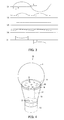
- FIGS. 1 to 4 A configuration according to a first embodiment is explained below with reference to FIGS. 1 to 4 .
- a luminaire 10 is, for example, a bulb-type lamp.
- the luminaire 10 includes a light-emitting module 11, a lighting circuit 12, which is an LED lighting circuit, functioning as a solid-state light-emitting element lighting device that supplies electric power to the light-emitting module 11, a base body 13 functioning as a luminaire main body that includes the lighting circuit 12 and on one end side of which in a lamp axis direction (a direction in which a globe 14 and a cap 15 are connected) the light-emitting module 11 is arranged, the globe 14 attached to one end side of the base body 13 to cover the light-emitting module 11, and the cap 15 attached to the other end of the base body 13.
- the luminaire 10 has the length in the lamp axis direction and a maximum outer diameter in a direction orthogonal to the lamp axis direction equivalent to the dimensions of an incandescent lamp for general lighting.
- the luminaire 10 is formed in a shape approximate to the shape of the incandescent lamp as a whole.
- the light-emitting module 11 includes a disk-like substrate 18 functioning as a module substrate and a light-emitting section 19 arranged on the surface on one end side of the substrate 18.
- Plural light-emitting diodes (LEDs) 20 which are solid-state light-emitting elements functioning as loads, are arranged on the light-emitting section 19.
- the light-emitting diodes 20 are, for example, electrically connected in series.
- the lighting circuit 12 includes a power supply device (a switching regulator) 25.
- a full-wave rectifier REC1 which is a rectifier that full-wave rectifies a (alternating-current) voltage V1 of a commercial alternating-current power supply e, which is an alternating-current power supply, is electrically connected to the commercial alternating-current power supply e via the cap 15.
- the series circuit 22 and the power converting circuit 23 are electrically connected by a second diode D2 to configure a partial smoothing circuit 24. Further, electric power is supplied to the lighting circuit 12 from the commercial alternating-current power supply e via a phase control dimmer 26.
- the lighting circuit 12 is electrically connected to the cap 15 via a pair of lead wires 27 and electrically connected to the light-emitting section 19 (the light-emitting diodes 20) of the light-emitting module 11 via a not-shown wire.
- the capacitor C1 partially smoothes (fills a trough of) a voltage V2, which is supplied from the full-wave rectifier REC1 to the power converting circuit 23, only when the voltage is relatively low.
- a voltage V2 which is supplied from the full-wave rectifier REC1 to the power converting circuit 23, only when the voltage is relatively low.
- an electrolytic capacitor is used as the capacitor C1.
- the first diode D1 discharges the charged electric charges of the capacitor C1 to supply electric power from the capacitor C1 to the power converting circuit 23 when an instantaneous value of a voltage V1 of the commercial alternating-current power supply e (a full-wave rectifying voltage of the full-wave rectifier REC1) is equal to or smaller than a predetermined value (smaller than the predetermined value).
- the first diode D1 is electrically connected to one end (a high voltage side) of the output ends of the full-wave rectifier REC1 in a direction in which the capacitor C1 is discharged, i.e., in polarity opposite to output polarity of the full-wave rectifier REC1.
- the second diode D2 charges the capacitor C1 according to the switching action of the switching element Q1 of the power converting circuit 23.
- the second diode D2 is electrically connected in a direction in which the capacitor C1 is charged.
- the power converting circuit 23 is a DC-DC converter, i.e., a falling-voltage chopper circuit including a series circuit 28 of the switching element Q1 and a third diode D3, an inductor L1 electrically connected between a connection point of the switching element Q1 and the third diode D3 and the second diode D2, and an output capacitor C2 connected to an intermediate tap C of the inductor L1.
- the output capacitor C2 is electrically connected to the light-emitting diodes 20 (the light-emitting section 19) in parallel.
- the switching element Q1, the inductor L1, and the output capacitor C2 are electrically connected between the output ends of the full-wave rectifier REC1.
- the power converting circuit 23 is configured such that an increasing current, which linearly increases, flows from the full-wave rectifier REC1 to the inductor L1 when the switching element Q1 is turned on, electromagnetic energy is accumulated in the inductor L1, and, when the switching element Q1 is turned off, the electromagnetic energy accumulated in the inductor L1 is discharged into a closed circuit formed by the third diode D3 and a decreasing current, which linearly decreases, flows from the inductor L1 in the same direction as the increasing current.
- the power converting circuit 23 outputs a voltage smaller than a peak value of the voltage V1 of the commercial alternating-current power supply e to between both ends of the output capacitor C2.
- the number of turns of a primary winding wire L1a is set to, for example, n1.
- the number of turns of a secondary winding wire L1b electrically connected to the primary winding wire L1a is set to n2.
- the primary winding wire L1a is electrically connected to the connection point of the switching element Q1 and the third diode D3.
- the secondary winding wire L1b is electrically connected to the second diode D2.
- the phase control dimmer 26 is a dimmer of a so-called leading edge type that sets, according to dimming control, a delay time t from a zero-cross point of the commercial alternating-current power supply e until an output of electric power to the light-emitting diodes 20 is turned on.
- a triac TR which is a thyristor functioning as a self-holding element, is electrically connected to the commercial alternating-current power supply e in series.
- a timer circuit 31 is electrically connected to the triac TR.
- a filter circuit 32 is electrically connected to both ends of the triac TR ( FIG. 2 ).
- the phase control dimmer 26 is simply referred to as dimmer 26.
- the timer circuit 31 includes a time constant circuit, which is a series circuit of a variable resistor VR electrically connected to the triac TR in parallel and having resistance variably set according to dimming control and a capacitor C3, and a DIAC DI functioning as a trigger element, one end of which is electrically connected to a connection point of the variable resistor VR and the capacitor C3, which is an output end of the time constant circuit, and the other end of which is electrically connected to a control terminal of the triac TR.
- a time constant circuit which is a series circuit of a variable resistor VR electrically connected to the triac TR in parallel and having resistance variably set according to dimming control and a capacitor C3, and a DIAC DI functioning as a trigger element, one end of which is electrically connected to a connection point of the variable resistor VR and the capacitor C3, which is an output end of the time constant circuit, and the other end of which is electrically connected to a control terminal of the triac TR.
- the filter circuit 32 includes a capacitor C4 and a coil La. Noise is prevented from leaking to the commercial alternating-current power supply e side.
- the capacitor C3 When the voltage V1 is applied to the dimmer 26 from the commercial alternating-current power supply e, the capacitor C3 is charged and the voltage at an output end of the capacitor C3 reaches a break-over voltage of the DIAC DI. Therefore, a gate current flows into the control terminal of the triac TR through the DIAC DI and the triac TR is turned on, whereby the dimmer 26 supplies an electric current to the light-emitting diodes 20 side.
- the triac TR supplies an electric current while maintaining conduction until the electric current decreases to be equal to or smaller than a holding current peculiar to the triac TR.
- a power supply voltage decreases to near the zero-cross point, the electric current flowing through the triac TR decreases and the triac TR is turned off.
- the capacitor C3 is charged to the opposite polarity and the DIAC DI is broken over in the same manner to ignite the triac TR. Thereafter, this operation is repeated. Therefore, when the variable resistor VR is operated via a not-shown dial set on a wall surface or the like to change the resistance of the variable resistor VR, since the time constant (the delay time t) changes, a conduction angle (a phase angle) of turn-on of the triac TR, i.e., a dimming degree changes. As a result, the dimmer 26 can change an output voltage thereof according to a dimming degree determined according to operation by a user.
- the base body (a housing) 13 is formed of, for example, resin or metal in a covered cylindrical shape.
- the substrate 18 of the light-emitting module 11 is arranged on one end side of the base body 13.
- the pair of lead wires 27 are led out from the other end side of the base body 13.
- the cap 15 can be connected to a socket of a general illumination bulb.
- the cap 15 includes a shell on which a screw thread is formed along the circumferential surface, an insulating section provided on the surface on the other end side of the shell, and an eyelet provided at the top of the insulating section.
- the voltage of the commercial alternating-current power supply e is supplied, via the dimmer 26, from the socket to the lighting circuit 12 through the cap 15.
- the voltage at the output end of the capacitor C3 of the time constant circuit reaches the break-over voltage of the DIAC DI at every half cycle of the voltage V1 of the commercial alternating-current power supply e.
- the gate current flows into the control terminal of the triac TR through the DIAC DI and the triac TR is turned on. Therefore, an output voltage changes.
- the output voltage is input to the full-wave rectifier REC1 of the lighting circuit 12 and full-wave rectified by the full-wave rectifier REC1.
- the voltage V2 ( FIG. 3 ) is generated at the output ends of the full-wave rectifier REC1 and input to the power converting circuit 23.
- a solid line indicates a state without the dimmer 26 and an imaginary line indicates a predetermined dimming state.
- ON and OFF of the switching element Q1 is switched at a high frequency sufficiently higher than the frequency of the commercial alternating-current power supply e. Then, a load voltage V3, which is a direct-current voltage smoothed by the output capacitor C2, is supplied to the light-emitting diodes 20 and the light-emitting diodes 20 are turned on. Light from the light-emitting diodes 20 is transmitted through the globe 14 and irradiated to the outside.
- a charging voltage V4 ( FIG. 3 ) of the capacitor C1 is determined according to the load voltage V3 and a turn ratio of the primary winding wire L1a and the secondary winding wire L1b of the inductor L1.
- an instantaneous value of the voltage V2 is smaller than the charging voltage V4 of the capacitor C1, which is a predetermined value, electric power is supplied to the power converting circuit 23 at a voltage lower than the peak value of the voltage V1 on a power supply side from the capacitor C1 discharged via the first diode D1.
- the instantaneous value of the voltage V2 is larger than the charging voltage V4, electric power is supplied to the power converting circuit 23 from the power supply side, i.e., an output side of the full-wave rectifier REC1.
- the voltage V2 output from the full-wave rectifier REC1 is partially smoothed and a current conduction angle is expanded. In other words, the current conduction angle is larger as a value of the charging voltage V4 is smaller.
- the capacitor C1 of the partial smoothing circuit 24 is charged using the high-frequency switching action of the switching element Q1 of the power converting circuit 23, which is the falling-voltage chopper circuit, the capacitor C1 is not directly charged from the power supply voltage. Therefore, it is possible to suppress a rush current. Further, the voltage V2 output from the full-wave rectifier REC1 to the power converting circuit 23 is partially smoothed by supplying charged electric charges of the charged capacitor C1 to the power converting circuit 23 using the first diode D1 in a trough portion of the output voltage (the voltage V2) of the full-wave rectifier REC1. Therefore, for example, compared with a configuration including a separate power factor improving circuit including an active filter circuit, it is possible to obtain a high power factor with a simple configuration.
- Detecting means and output converting means of the power converting circuit 23 in this case are not shown in the figures. However, the detecting means and the output converting means can be configured as appropriate using known detecting means, switching control means of the switching element Q1, and the like.
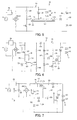
- the same action and effects can be realized even in a configuration in which electric connections on the high-voltage side and the low-voltage side are interchanged as in a second embodiment shown in FIG. 5 , i.e., the capacitor C1 is set on the high-voltage side and the first diode D1 is set on the low-voltage side in the series circuit 22 and the third diode D3 is set on the high-voltage side and the switching element Q1 is set on the low-voltage side in the series circuit 28.
- a third embodiment is explained with reference to FIG. 6 .
- Components and action same as those in the embodiments explained above are denoted by the same reference numerals and signs and explanation of the components and the action is omitted.
- a bleeder circuit 35 which is a constant current circuit, is connected between the full-wave rectifier REC1 and the power converting circuit 23 according to the second embodiment shown in FIG. 5 .
- the bleeder circuit 35 extracts, in a period in which the voltage V1 (the output voltage of the full-wave rectifier REC1) is smaller than a predetermined value, a bleeder current that can actuate the timer circuit 31 for turning on the triac TR of the dimmer 26 or causes the triac TR to self-hold an electric current.
- a switching element Q4 such as a bipolar transistor of the NPN type, a control terminal of which is electrically connected to a connection point of the resistors R3 and R4, is electrically connected to the other end of a resistor R5, one end of which is electrically connected to a connection point of the switching element Q2 and the resistor R2, and a control terminal of the switching element Q3. Further, the bleeder circuit 35 is electrically connected to the power converting circuit 23 via a diode Da for reverse current prevention.
- the dimmer 26 is operated and the lighting circuit 12 is set to an appropriate dimming degree
- the commercial alternating-current power supply e is turned on, during each half cycle of the voltage V1
- an alternating-current voltage is applied to a closed circuit of the time constant circuit of the timer circuit 31 of the dimmer 26, the full-wave rectifier REC1, and the series circuit of the resistors R3 and R4 and a bleeder current flows to the series circuit of the resistors R3 and R4.
- the switching element Q2 is turned on.
- the capacitor C3 is charged and the voltage of the capacitor C3 reaches the break-over voltage of the DIAC DI. Then, since the DIAC DI conducts, an electric current from the capacitor C3 flows into the control element of the triac TR and the triac TR is turned on. As a result, in the half cycle of the voltage V1, a voltage after a phase angle at which the triac TR is turned on is applied between input ends of the full-wave rectifier REC1 and full-wave rectified.
- the lighting circuit 12 includes the bleeder circuit 35 for obtaining the holding current of the triac TR of the dimmer 26. Therefore, even in the lighting circuit 12 including the light-emitting diodes 20 having a small lighting current, it is possible to cause the dimmer 26 to operate more stably.
- FIGS. 7 and 8 A fourth embodiment is explained with reference to FIGS. 7 and 8 .
- Components and action same as those in the embodiments explained above are denoted by the same reference numerals and signs and explanation of the components and the action is omitted.
- the power converting circuit 23 is a DC-DC converter, i.e., a rising-voltage chopper circuit including a series circuit 37 of a choke coil L2 and the switching element Q1 connected between both ends of the series circuit 22, which is connected between the output ends of the full-wave rectifier REC1, and a series circuit 38 of a fourth diode D4 for reverse current prevention and a smoothing capacitor C5 connected between both ends of the switching element Q1. Further, a noise prevention capacitor C6 for noise filtering is electrically connected to an output side of the dimmer 26.
- the power converting circuit 23 is configured to turn on and off the switching element Q1 to generate, making use of self-induction of the choke coil L2, a predetermined load voltage V3 larger than the voltage V1 of the commercial alternating-current power supply e between both ends of the smoothing capacitor C5.
- the choke coil L2 (a primary winding wire L2a) is electrically connected to one end (the high-voltage side) of the output ends of the full-wave rectifier REC1 in parallel to the series circuit 22 of the capacitor C1 and the first diode D1.
- a secondary winding wire L2b is magnetically coupled to the choke coil L2 (the primary winding wire L2a).
- One end of the secondary winding wire L2b is electrically connected to an input side of the choke coil L2 (the primary winding wire L2a), i.e., one end of the output ends of the full-wave rectifier REC1.
- the other end of the secondary winding wire L2b is electrically connected to the second diode D2.
- the number of turns of the choke coil L2 (the primary winding wire L2a) is set to, for example, n3.
- the number of turns of the secondary winding wire L2b is set to, for example, n4.
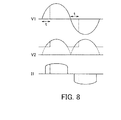
- the voltage V2 ( FIG. 8 ) is generated at the output ends of the full-wave rectifier REC1 and input to the power converting circuit 23.
- a solid line indicates a state without the dimmer 26 and an imaginary line indicates a predetermined dimming state.
- ON and OFF of the switching element Q1 is switched at a high frequency sufficiently higher than the frequency of the commercial alternating-current power supply e. Then, the load voltage V3, which is a direct-current voltage smoothed by the smoothing capacitor C5, is supplied to the light-emitting diodes 20 and the light-emitting diodes 20 are turned on. Light from the light-emitting diodes 20 is transmitted through the globe 14 and irradiated to the outside.
- a charging voltage V4 of the capacitor C1 is determined according to the load voltage V3 and a turn ratio of the choke coil L2 (the primary winding wire L2a) and the secondary winding wire L2b.
- an instantaneous value of the voltage V2 is smaller than the charging voltage V4 of the capacitor C1, which is a predetermined value, i.e., in a trough portion of the voltage V2, electric power is supplied to the power converting circuit 23 at a voltage higher than the voltage V1 on the power supply side from the capacitor C1 discharged via the first diode D1.
- the instantaneous value of the voltage V2 is larger than the charging voltage V4, electric power is supplied to the power converting circuit 23 from the power supply side, i.e., the output side of the full-wave rectifier REC1.
- the voltage V2 output from the full-wave rectifier REC1 is partially smoothed and a current conduction angle is expanded.
- the capacitor C1 of the partial smoothing circuit 24 is charged using the high-frequency switching action of the switching element Q1 of the power converting circuit 23, which is the rising-voltage chopper circuit, the capacitor C1 is not directly charged from the power supply voltage. Therefore, it is possible to suppress a rush current. Further, the voltage V2 output from the full-wave rectifier REC1 to the power converting circuit 23 is partially smoothed by supplying charged electric charges of the charged capacitor C1 to the power converting circuit 23 using the first diode D1 in a trough portion of the output voltage (the voltage V2) of the full-wave rectifier REC1. Therefore, for example, compared with a configuration including a separate power factor improving circuit including an active filter circuit, it is possible to obtain a high power factor with a simple configuration.
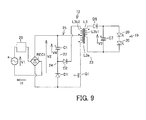
- a fifth embodiment is explained with reference to FIGS. 9 and 10 .
- Components and action same as those in the embodiments explained above are denoted by the same reference numerals and signs and explanation of the components and the action is omitted.
- the power converting circuit 23 is a DC-DC converter, i.e., a flyback converter including a choke coil L3, the switching element Q1 electrically connected in series to one end of a primary winding wire L3a, which is a primary side of the choke coil L3, and a fifth diode D5 for rectification (reverse current prevention) and an output capacitor C7 electrically connected to a secondary side of the choke coil L3, i.e., a (first) secondary winding wire L3b1 magnetically coupled to and electrically insulated from the primary winding wire L3a.
- a DC-DC converter i.e., a flyback converter including a choke coil L3, the switching element Q1 electrically connected in series to one end of a primary winding wire L3a, which is a primary side of the choke coil L3, and a fifth diode D5 for rectification (reverse current prevention) and an output capacitor C7 electrically connected to a secondary side of the choke coil L3, i.e., a
- the power converting circuit 23 is configured to turn on and off the switching element Q1 to generate, making use of self-induction of the choke coil L3, the predetermined load voltage V3 larger than the voltage V1 of the commercial alternating-current power supply e between both ends of the output capacitor C7 connected between both ends of the secondary winding wire L3b1.
- a (second) secondary winding wire L3b2, which is a secondary side, electrically connected to the primary winding wire L3a of the choke coil L3 is electrically connected to the second diode D2.
- the number of turns of the primary winding wire L3a is set to, for example, n5
- the number of turns of the secondary winding wire L3b1 is set to, for example, n6
- the number of turns of the secondary winding wire L3b2 is set to, for example, n7.
- the voltage V2 ( FIG. 10 ) is generated at the output ends of the full-wave rectifier REC1 and input to the power converting circuit 23.
- a solid line indicates a state without the dimmer 26 and an imaginary line indicates a predetermined dimming state.
- ON and OFF of the switching element Q1 is switched at a high frequency sufficiently higher than the frequency of the commercial alternating-current power supply e. Then, the load voltage V3, which is a direct-current voltage smoothed by the output capacitor C7, is supplied to the light-emitting diodes 20 and the light-emitting diodes 20 are turned on. Light from the light-emitting diodes 20 is transmitted through the globe 14 and irradiated to the outside.
- the capacitor C1 when the switching element Q1 is turned on, the capacitor C1 is charged via the second diode D2.
- the charging voltage V4 of the capacitor C1 is determined according to the load voltage V3 and a turn ratio of the primary winding wire L3a and the secondary winding wire L3b2 of the choke coil L3.
- an instantaneous value of the voltage V2 is smaller than the charging voltage V4 of the capacitor C1, which is a predetermined value, i.e., in the trough portion of the voltage V2, electric power is supplied to the power converting circuit 23 at a voltage higher than the voltage V1 on the power supply side from the capacitor C1 discharged via the first diode D1.
- the instantaneous value of the voltage V2 is larger than the charging voltage V4, electric power is supplied to the power converting circuit 23 from the power supply side, i.e., the output side of the full-wave rectifier REC1.
- the voltage V2 output from the full-wave rectifier REC1 is partially smoothed and a current conduction angle is expanded.
- the capacitor C1 of the partial smoothing circuit 24 is charged using the high-frequency switching action of the switching element Q1 of the power converting circuit 23, which is the flyback converter, the capacitor C1 is not directly charged from the power supply voltage. Therefore, it is possible to suppress a rush current. Further, the voltage V2 output from the full-wave rectifier REC1 to the power converting circuit 23 is partially smoothed by supplying charged electric charges of the charged capacitor C1 to the power converting circuit 23 using the first diode D1 in the trough portion of the output voltage (the voltage V2) of the full-wave rectifier REC1. Therefore, for example, compared with a configuration including a separate power factor improving circuit including an active filter circuit, it is possible to obtain a high power factor with a simple configuration.
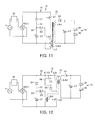
- the same action and effects can be realized even in a configuration in which electric connections on the high-voltage side and the low-voltage side are interchanged as in a sixth embodiment shown in FIG. 11 , i.e., the first diode D1 is set on the high-voltage side, the capacitor C1 is set on the low-voltage side, the switching element Q1 is set on the high-voltage side, and the choke coil L3 is set on the low-voltage side in the series circuit 22.
- a snubber circuit 41 including a diode Db, a resistor R6, and a capacitor C8 and configured to regenerate an electric current flowing to the primary winding wire L3a of the choke coil L3 is electrically connected to the primary winding wire L3a of the choke coil L3 and the second diode D2 is electrically connected to the secondary winding wire L3b2 magnetically coupled to and electrically insulated from the primary winding wire L3a of the choke coil L3.
- FIG. 13 An eighth embodiment is explained with reference to FIG. 13 .
- Components and action same as those in the embodiments explained above are denoted by the same reference numerals and signs and explanation of the components and the action is omitted.
- the fifth diode D5 is connected to a connection point of the choke coil L3 and the switching element Q1 and the output capacitor C7 is connected between an output side of the fifth diode D5 and the primary winding wire L3a of the choke coil L3.
- the voltage V2 ( FIG. 8 ) is generated at the output ends of the full-wave rectifier REC1 and input to the power converting circuit 23.
- ON and OFF of the switching element Q1 is switched at a high frequency sufficiently higher than the frequency of the commercial alternating-current power supply e. Then, the load voltage V3, which is a direct-current voltage smoothed by the output capacitor C7, is supplied to the light-emitting diodes 20 and the light-emitting diodes 20 are turned on. Light from the light-emitting diodes 20 is transmitted through the globe 14 and irradiated to the outside.
- the capacitor C1 when the switching element Q1 is turned on, the capacitor C1 is charged via the second diode D2.
- the charging voltage V4 of the capacitor C1 is determined according to the load voltage V3 and a turn ratio of the primary winding wire L3a and the secondary winding wire L3b2 of the choke coil L3.
- an instantaneous value of the voltage V2 is smaller than the charging voltage V4 of the capacitor C1, which is a predetermined value, i.e., in the trough portion of the voltage V2, electric power is supplied to the power converting circuit 23 at a voltage higher than the voltage V1 on the power supply side from the capacitor C1 discharged via the first diode D1.
- the instantaneous value of the voltage V2 is larger than the charging voltage V4, electric power is supplied to the power converting circuit 23 from the power supply side, i.e., the output side of the full-wave rectifier REC1.
- the voltage V2 output from the full-wave rectifier REC1 is partially smoothed and a current conduction angle is expanded.
- the capacitor C1 of the partial smoothing circuit 24 is charged using the high-frequency switching action of the switching element Q1 of the power converting circuit 23, which is the flyback converter, the capacitor C1 is not directly charged from the power supply voltage. Therefore, it is possible to suppress a rush current. Further, the voltage V2 output from the full-wave rectifier REC1 to the power converting circuit 23 is partially smoothed by supplying charged electric charges of the charged capacitor C1 to the power converting circuit 23 using the first diode D1 in the trough portion of the output voltage (the voltage V2) of the full-wave rectifier REC1. Therefore, for example, compared with a configuration including a separate power factor improving circuit including an active filter circuit, it is possible to obtain a high power factor with a simple configuration.
- the same action and effects can be realized even in a configuration in which electric connections on the high-voltage side and the low-voltage side are interchanged as in a ninth embodiment shown in FIG. 14 , i.e., the first diode D1 is set on the high-voltage side, the capacitor C1 is set on the low-voltage side, the switching element Q1 is set on the high-voltage side, and the choke coil L3 is set on the low-voltage side in the series circuit 22.
- a circuit for feeding the holding current of the triac TR of the dimmer 26 is not provided. Therefore, it is possible to suppress deterioration in reliability due to a decrease in circuit efficiency by the circuit, an increase in a temperature rise, and the like and contribute to energy saving.
- the dimmer 26 of the leading edge type is used that sets, according to dimming control, the delay time t from the zero-cross point of the commercial alternating-current power supply e until an output of electric power to the light-emitting diodes 20 is turned on. If the dimmer 26 of the leading edge type is applied to a power supply device including a general smoothing circuit of a capacitor input type, when the triac TR of the dimmer 26 is turned on, a peak of an input current flowing into a circuit sometimes reaches a value several ten times as large as an effective value of a steady-state input current. Therefore, it is anticipated that a wiring capacity increases and stress is applied to components in the dimmer 26.
- the capacitor C1 is charged by the switching action of the switching element Q1 of the power converting circuit 23 to realize partial smoothing. Consequently, even if the dimmer 26 of the leading edge type is used, it is possible to cause the dimmer 26 to stably operate. It is possible to prevent an increase in the number of components and an increase in costs by separately providing, for example, a component for suppressing a rush current. Further, it is possible to suppress a temperature rise and noise, reduce size, and improve reliability.
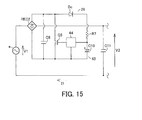
- the dimmer 26 may be a dimmer of a trailing edge type that sets, according to dimming control, the delay time t from the zero-cross point of the commercial alternating-current power supply e until an output of electric power to the light-emitting diodes 20 is turned off, as in a tenth embodiment shown in Figs. 15 and 16 .
- the dimmer 26 includes a full-wave rectifier REC2, input ends of which are connected between the commercial alternating-current power supply e and one end of the input ends of the full-wave rectifier REC1, a capacitor C9 for smoothing connected between output ends of the full-wave rectifier REC2, a switching element Q5 connected between both ends of the capacitor C9 for smoothing, a diode Dc connected between both ends of the switching element Q5, an auxiliary power supply circuit 43, which is a series circuit of a resistor R7 and a capacitor C10, and a control circuit 44 that receives power supply by the capacitor C10 and controls switching of the switching element Q5.
- a noise prevention capacitor C11 for noise filtering is connected between the dimmer 26 and the full-wave rectifier REC1.
- the control circuit 44 When the luminaire 10 operates, in the lighting circuit 12, first, in the dimmer 26, the control circuit 44 operates with power supply from the capacitor C10 charged by an output voltage of the full-wave rectifier REC2 via the diode Dc and the resistor R7 in an OFF period of the switching element Q5.
- the control circuit 44 turns on the switching element Q5 with the delay time t corresponding to a dimming degree determined according to operation by the user, whereby the output voltage changes.
- the output voltage is input to the full-wave rectifier REC1 and full-wave rectified by the full-wave rectifier REC1.
- the voltage V2 FIG. 16 ) is generated at the output ends of the full-wave rectifier REC1 and input to the power converting circuit 23.
- ON and OFF of the switching element Q1 is switched at a high frequency sufficiently higher than the frequency of the commercial alternating-current power supply e. Then, the load voltage V3 is supplied to the light-emitting diodes 20 and the light-emitting diodes 20 are turned on. Light from the light-emitting diodes 20 is transmitted through the globe 14 and irradiated to the outside.
- the capacitor C1 is charged via the second diode D2. If an instantaneous value of the voltage V2 is smaller than the charging voltage V4 of the capacitor C1, which is a predetermined value, i.e., in the trough portion of the voltage V2, electric power is supplied to the power converting circuit 23 at a voltage lower than the voltage V1 on a power supply side from the capacitor C1 discharged via the first diode D1. If the instantaneous value of the voltage V2 is larger than the charging voltage V4, electric power is supplied to the power converting circuit 23 from the power supply side, i.e., the output side of the full-wave rectifier REC1. As a result, the voltage V2 output from the full-wave rectifier REC1 is partially smoothed and a current conduction angle is expanded.
- the dimmer 26 of the trailing edge type is used that sets, according to dimming control, the delay time t from the zero-cross point of the commercial alternating-current power supply e until an output of electric power to the light-emitting diodes 20 is turned off. If the dimmer 26 of the trailing edge type is applied to a power supply device including a general smoothing circuit of the capacitor input type, in a period in which an input current is 0 even if the dimmer 26 is interrupted, since there is no path for discharging charges accumulated in the noise prevention capacitor C11, the charges remain. In a period in which the switching element Q5 is interrupted, a leak current flows out because the capacitor C10 in the dimmer 26 is charged.
- the bleeder circuit is configured to operate at a voltage equal to or lower than a predetermined voltage in order to prevent a decrease in circuit efficiency of the power supply device 25. Therefore, if the dimmer 26 is interrupted in a phase in which a power supply voltage is relatively high, a discharge operation by the bleeder circuit is not easy. If the bleeder circuit is configured to always feed an electric current, a decrease in circuit efficiency is inevitable. Therefore, the capacitor C1 is charged according to the switching action of the switching element Q1 of the power converting circuit 23 to realize partial smoothing.
- the partial smoothing circuit 24 is provided that supplies the charged electric charges of the capacitor C1 charged according to the switching action of the switching element Q1 of the power converting circuit 23 to the power converting circuit 23 via the first diode D1 in the trough portion of the output voltage (the voltage V1) of the full-wave rectifier REC1. Therefore, since the capacitor C1 is not directly charged from the power supply voltage, it is possible to suppress a rush current. Further, the voltage V2 output from the full-wave rectifier REC1 to the power converting circuit 23 is partially smoothed. Therefore, it is possible to improve a power factor only with a converter at one stage and obtain a high power factor with a simple configuration.
- the series circuit 22 of the capacitor C1 and the first diode D1 and the power converting circuit 23 are connected in parallel.
- the first diode D1 is connected in a direction in which the capacitor C1 is discharged and in polarity opposite to the polarity of the full-wave rectifier REC1.
- the power converting circuit 23 includes at least one switching element Q1 and converts electric power from an output of the full-wave rectifier REC1 to the light-emitting diodes 20 according to the switching action of the switching element Q1.
- the power supply device 25 charges the capacitor C1 via the second diode D2 according to the switching action of the switching element Q1 of the power converting circuit 23.
- the capacitor C1 is not directly charged by the power supply voltage, a capacitor having a low withstanding voltage and small in size can be used.
- the power supply device 25, the lighting circuit 12, and the luminaire 10 can be further reduced in size.
- the power supply device 25 can expand a current conduction angle, the power supply device 25 has high affinity with the dimmer 26.
- the trough of the voltage V2 is filled by the capacitor C1. Therefore, it is possible to secure the power supply voltage even in a period in which the dimmer 26 is off and easily perform output control.
- the power supply device 25 can continuously feed an electric current to the light-emitting diodes 20. Therefore, it is possible to cause the light-emitting diodes 20 to stably emit light.
- the capacitor C1 is charged using the inductor L1 or the choke coil L2 or L3. Therefore, it is possible to easily control a charging amount of the capacitor C1 simply by changing a turn ratio of the primary side and the secondary side of the inductor L1 or the choke coil L2 or L3.
- the luminaire 10 is not limited to the bulb-type lamp.
- the luminaire 10 can be an arbitrary luminaire including the light-emitting diodes 20 such as a downlight, a spotlight, or a straight tube type lamp.
- the power supply device 25 is not limited to the power supply device used in the luminaire 10 and the lighting circuit 12.
- the other components may be interposed between the power converting circuit 23 and the full-wave rectifier REC1.
- the partial smoothing circuit 24 and the power converting circuit 23 are provided in parallel, the other components may be interposed or may not be interposed between the partial smoothing circuit 24 and the power converting circuit 23.
- the solid-state light-emitting element is not limited to the light-emitting diode.
- an organic EL element or a semiconductor laser can be used.
Landscapes
- Engineering & Computer Science (AREA)
- Power Engineering (AREA)
- Circuit Arrangement For Electric Light Sources In General (AREA)
- Dc-Dc Converters (AREA)
- Rectifiers (AREA)
Applications Claiming Priority (1)
| Application Number | Priority Date | Filing Date | Title |
|---|---|---|---|
| JP2012158116A JP2014023225A (ja) | 2012-07-13 | 2012-07-13 | 電源装置、固体発光素子点灯装置および照明装置 |
Publications (2)
| Publication Number | Publication Date |
|---|---|
| EP2685618A2 true EP2685618A2 (de) | 2014-01-15 |
| EP2685618A3 EP2685618A3 (de) | 2014-03-12 |
Family
ID=47177741
Family Applications (1)
| Application Number | Title | Priority Date | Filing Date |
|---|---|---|---|
| EP12184620.8A Withdrawn EP2685618A3 (de) | 2012-07-13 | 2012-09-17 | Stromversorgung, Festkörper-LED-Elementbeleuchtungsvorrichtung und Leuchte |
Country Status (4)
| Country | Link |
|---|---|
| US (1) | US20140015432A1 (de) |
| EP (1) | EP2685618A3 (de) |
| JP (1) | JP2014023225A (de) |
| CN (1) | CN103546027A (de) |
Cited By (2)
| Publication number | Priority date | Publication date | Assignee | Title |
|---|---|---|---|---|
| CN111431614A (zh) * | 2020-03-31 | 2020-07-17 | 青岛海信宽带多媒体技术有限公司 | 一种光模块 |
| US10855151B2 (en) | 2017-12-20 | 2020-12-01 | Abb Schweiz Ag | Rotor balancing/fixation via injection or compression molding |
Families Citing this family (7)
| Publication number | Priority date | Publication date | Assignee | Title |
|---|---|---|---|---|
| US9692316B1 (en) * | 2013-07-18 | 2017-06-27 | Marvell International Ltd. | Bleeder method using switch node coupling capacitor for TRIAC dimming of solid state lighting |
| US9402293B2 (en) * | 2014-04-24 | 2016-07-26 | Power Integrations, Inc. | Multi-bleeder mode control for improved LED driver performance |
| CN104022636A (zh) * | 2014-06-19 | 2014-09-03 | 熊晓丹 | 一种驱动开关型负载的高功率因数填谷电路及开关电源 |
| CN107405151A (zh) * | 2015-02-27 | 2017-11-28 | 伊西康有限责任公司 | 用于外科器械的增强型电池 |
| CN106027016B (zh) * | 2016-06-29 | 2018-08-14 | 浙江桃园科技有限公司 | 感性负载电压脉宽调制去磁电路 |
| JP6673949B2 (ja) * | 2018-01-29 | 2020-04-01 | ファナック株式会社 | モータ駆動装置および判定方法 |
| TWI693783B (zh) * | 2018-10-09 | 2020-05-11 | 遠東科技大學 | 具降壓及升壓功能之直流-直流轉換器 |
Family Cites Families (10)
| Publication number | Priority date | Publication date | Assignee | Title |
|---|---|---|---|---|
| JPS61240597A (ja) * | 1985-04-17 | 1986-10-25 | 松下電器産業株式会社 | 交流‐直流変換回路 |
| JP3232593B2 (ja) * | 1991-08-22 | 2001-11-26 | 松下電工株式会社 | 電源装置 |
| JP3273572B2 (ja) * | 1992-06-11 | 2002-04-08 | キヤノン株式会社 | 直流電源装置 |
| JPH06283283A (ja) * | 1993-03-26 | 1994-10-07 | Toshiba Lighting & Technol Corp | 放電灯点灯装置 |
| JPH0956161A (ja) * | 1995-08-19 | 1997-02-25 | Toko Inc | 力率改善回路 |
| JP4226963B2 (ja) * | 2003-07-04 | 2009-02-18 | 三菱電機株式会社 | 電力変換装置 |
| US7061776B2 (en) * | 2004-07-12 | 2006-06-13 | System General Corp. | Half-bridge flyback power converter |
| JP4253650B2 (ja) * | 2005-08-30 | 2009-04-15 | 株式会社エヌ・ティ・ティ・データ・イー・エックス・テクノ | スイッチング電源回路及びトランス |
| JP2010192842A (ja) * | 2009-02-20 | 2010-09-02 | Toshiba Lighting & Technology Corp | Led点灯装置 |
| US8222832B2 (en) * | 2009-07-14 | 2012-07-17 | Iwatt Inc. | Adaptive dimmer detection and control for LED lamp |
-
2012
- 2012-07-13 JP JP2012158116A patent/JP2014023225A/ja active Pending
- 2012-09-14 US US13/618,814 patent/US20140015432A1/en not_active Abandoned
- 2012-09-17 EP EP12184620.8A patent/EP2685618A3/de not_active Withdrawn
-
2013
- 2013-01-28 CN CN201310032519.3A patent/CN103546027A/zh active Pending
Non-Patent Citations (1)
| Title |
|---|
| None |
Cited By (3)
| Publication number | Priority date | Publication date | Assignee | Title |
|---|---|---|---|---|
| US10855151B2 (en) | 2017-12-20 | 2020-12-01 | Abb Schweiz Ag | Rotor balancing/fixation via injection or compression molding |
| CN111431614A (zh) * | 2020-03-31 | 2020-07-17 | 青岛海信宽带多媒体技术有限公司 | 一种光模块 |
| CN111431614B (zh) * | 2020-03-31 | 2023-02-28 | 青岛海信宽带多媒体技术有限公司 | 一种光模块 |
Also Published As
| Publication number | Publication date |
|---|---|
| EP2685618A3 (de) | 2014-03-12 |
| US20140015432A1 (en) | 2014-01-16 |
| JP2014023225A (ja) | 2014-02-03 |
| CN103546027A (zh) | 2014-01-29 |
Similar Documents
| Publication | Publication Date | Title |
|---|---|---|
| EP2685618A2 (de) | Stromversorgung, Festkörper-LED-Elementbeleuchtungsvorrichtung und Leuchte | |
| CN103139987B (zh) | 点亮设备和具有该点亮设备的照明器具 | |
| JP5830986B2 (ja) | 点灯制御回路及びその点灯制御回路を用いた照明灯及びその照明灯を用いた照明器具 | |
| CN104868703B (zh) | 无辅助绕组的高压转换器 | |
| JP6048943B2 (ja) | 駆動回路、照明用光源、及び、照明装置 | |
| JP4918180B2 (ja) | Ledの点灯回路、ランプおよび照明装置 | |
| CN103139956B (zh) | 点亮设备和具有该点亮设备的照明器具 | |
| EP2296441A2 (de) | LED-Lichtvorrichtung und Beleuchtungsvorrichtung | |
| EP2296438A1 (de) | Leuchtdioden-Beleuchtungsvorrichtung | |
| JP5457927B2 (ja) | 発光素子の制御回路 | |
| JP2011233450A (ja) | 発光素子の制御回路 | |
| JP6145980B2 (ja) | 照明装置 | |
| CN105323913B (zh) | 点亮装置、照明装置和照明器具 | |
| JP5686218B1 (ja) | 点灯装置および照明器具 | |
| JP2011018557A (ja) | Led点灯用電源回路及び該led点灯用電源回路を搭載したled電球 | |
| JP6070049B2 (ja) | Led点灯装置及びled照明器具 | |
| EP2480051A2 (de) | Beleuchtungsvorrichtung und Leuchte | |
| WO2013128509A1 (ja) | 直流電源回路 | |
| JP5561467B2 (ja) | Led点灯装置 | |
| JP5842129B2 (ja) | Led点灯装置及びそれを用いた照明器具 | |
| JP6485770B2 (ja) | 点灯装置及び照明器具 | |
| TW201517691A (zh) | 發光裝置 | |
| TWM553090U (zh) | 照明系統 | |
| JPWO2016129307A1 (ja) | Led照明装置 | |
| JP2012029526A (ja) | スイッチング電源装置、並びに、led照明装置 |
Legal Events
| Date | Code | Title | Description |
|---|---|---|---|
| PUAI | Public reference made under article 153(3) epc to a published international application that has entered the european phase |
Free format text: ORIGINAL CODE: 0009012 |
|
| AK | Designated contracting states |
Kind code of ref document: A2 Designated state(s): AL AT BE BG CH CY CZ DE DK EE ES FI FR GB GR HR HU IE IS IT LI LT LU LV MC MK MT NL NO PL PT RO RS SE SI SK SM TR |
|
| AX | Request for extension of the european patent |
Extension state: BA ME |
|
| PUAL | Search report despatched |
Free format text: ORIGINAL CODE: 0009013 |
|
| AK | Designated contracting states |
Kind code of ref document: A3 Designated state(s): AL AT BE BG CH CY CZ DE DK EE ES FI FR GB GR HR HU IE IS IT LI LT LU LV MC MK MT NL NO PL PT RO RS SE SI SK SM TR |
|
| AX | Request for extension of the european patent |
Extension state: BA ME |
|
| RIC1 | Information provided on ipc code assigned before grant |
Ipc: H02M 1/42 20070101AFI20140206BHEP |
|
| 17P | Request for examination filed |
Effective date: 20140611 |
|
| RBV | Designated contracting states (corrected) |
Designated state(s): AL AT BE BG CH CY CZ DE DK EE ES FI FR GB GR HR HU IE IS IT LI LT LU LV MC MK MT NL NO PL PT RO RS SE SI SK SM TR |
|
| GRAP | Despatch of communication of intention to grant a patent |
Free format text: ORIGINAL CODE: EPIDOSNIGR1 |
|
| INTG | Intention to grant announced |
Effective date: 20150218 |
|
| STAA | Information on the status of an ep patent application or granted ep patent |
Free format text: STATUS: THE APPLICATION HAS BEEN WITHDRAWN |
|
| 18W | Application withdrawn |
Effective date: 20150226 |