EP2686767B1 - Procédé tolérant aux changements de génération d'identifiants pour un ensemble d'actifs dans un environnement informatique au moyen d'un schéma de code de correction d'erreurs - Google Patents
Procédé tolérant aux changements de génération d'identifiants pour un ensemble d'actifs dans un environnement informatique au moyen d'un schéma de code de correction d'erreurs Download PDFInfo
- Publication number
- EP2686767B1 EP2686767B1 EP11860843.9A EP11860843A EP2686767B1 EP 2686767 B1 EP2686767 B1 EP 2686767B1 EP 11860843 A EP11860843 A EP 11860843A EP 2686767 B1 EP2686767 B1 EP 2686767B1
- Authority
- EP
- European Patent Office
- Prior art keywords
- asset
- error
- identifier
- parameters
- assets
- Prior art date
- Legal status (The legal status is an assumption and is not a legal conclusion. Google has not performed a legal analysis and makes no representation as to the accuracy of the status listed.)
- Active
Links
Images



Classifications
-
- H—ELECTRICITY
- H04—ELECTRIC COMMUNICATION TECHNIQUE
- H04L—TRANSMISSION OF DIGITAL INFORMATION, e.g. TELEGRAPHIC COMMUNICATION
- H04L9/00—Cryptographic mechanisms or cryptographic arrangements for secret or secure communications; Network security protocols
- H04L9/06—Cryptographic mechanisms or cryptographic arrangements for secret or secure communications; Network security protocols the encryption apparatus using shift registers or memories for block-wise or stream coding, e.g. DES systems or RC4; Hash functions; Pseudorandom sequence generators
- H04L9/0643—Hash functions, e.g. MD5, SHA, HMAC or f9 MAC
-
- G—PHYSICS
- G06—COMPUTING OR CALCULATING; COUNTING
- G06F—ELECTRIC DIGITAL DATA PROCESSING
- G06F9/00—Arrangements for program control, e.g. control units
- G06F9/06—Arrangements for program control, e.g. control units using stored programs, i.e. using an internal store of processing equipment to receive or retain programs
- G06F9/44—Arrangements for executing specific programs
-
- G—PHYSICS
- G06—COMPUTING OR CALCULATING; COUNTING
- G06F—ELECTRIC DIGITAL DATA PROCESSING
- G06F11/00—Error detection; Error correction; Monitoring
- G06F11/07—Responding to the occurrence of a fault, e.g. fault tolerance
- G06F11/08—Error detection or correction by redundancy in data representation, e.g. by using checking codes
- G06F11/10—Adding special bits or symbols to the coded information, e.g. parity check, casting out 9's or 11's
-
- G—PHYSICS
- G06—COMPUTING OR CALCULATING; COUNTING
- G06F—ELECTRIC DIGITAL DATA PROCESSING
- G06F21/00—Security arrangements for protecting computers, components thereof, programs or data against unauthorised activity
- G06F21/50—Monitoring users, programs or devices to maintain the integrity of platforms, e.g. of processors, firmware or operating systems
- G06F21/57—Certifying or maintaining trusted computer platforms, e.g. secure boots or power-downs, version controls, system software checks, secure updates or assessing vulnerabilities
-
- H—ELECTRICITY
- H04—ELECTRIC COMMUNICATION TECHNIQUE
- H04L—TRANSMISSION OF DIGITAL INFORMATION, e.g. TELEGRAPHIC COMMUNICATION
- H04L2209/00—Additional information or applications relating to cryptographic mechanisms or cryptographic arrangements for secret or secure communication H04L9/00
- H04L2209/34—Encoding or coding, e.g. Huffman coding or error correction
Definitions
- the present invention relates generally to generating identifiers for a computing environment. More particularly, the present invention relates to generating an identifier for a collection of assets in a computing environment, in a change-tolerant manner, using an error-correction scheme.
- a method to determine the system identifier needs to accommodate occasional changes to the device identifiers.
- One way of supporting hardware updates is by allowing a small number device identifiers to change while still generating the same system identifier.
- a known way to achieve this is by recording the unique device identifiers during an initialization phase and, during the identifier calculation phase, comparing the recorded parameters with the actual parameters. If a sufficient match exists, the recorded parameters are used to obtain the system identifier.
- the method consists of recording the contributing information, comparing the recorded information with actual information, and enabling use of the system if a sufficient match exists between the actual information and the recorded information.
- Embodiments of the present invention provide a secure and change-tolerant method that calculates a computing environment identifier based on retrieved asset parameters and an error-correction fingerprint associated with the computing environment.
- the identifier can be used to affect or determine the functionality of applications running in the computing environment.
- change-tolerant is analogous to fault-tolerant and variation-tolerant, and is meant to indicate that the identifier can be obtained even when some assets of the computing environment have been changed subsequent to the error-correction fingerprinting of the computing environment.
- an “asset” is any data, application, device, node or other component of a computing environment. Assets generally include hardware (e.g. servers and switches), software (e.g. mission critical applications and support systems) and confidential information.
- the terms "computing environment” and “computer system” are used herein interchangeably, and are intended to encompass single computers and other devices including a processor, distributed computing systems, components thereof, data stored or otherwise associated therewith, and including the data associated with users of such computer systems, attached or accessible peripheral devices, software applications and operating systems, and combinations thereof.
- assert parameter means an assigned or determined parameter that is limited in occurrence for a given class of asset, situation, or area.
- Asset parameters may be unique or may exclusively identify an asset at least at the time the parameter is assigned or determined.
- Asset parameters can be expressed as, for example, numbers, symbols, strings of numbers and characters, or functions. In other scenarios, asset parameters may not be unique but combinations of asset parameters can be.
- An example system in which the present method can be used is a computer (computing environment) that has a number of peripheral devices each having a more or less unique device identifier, such as a serial number or other assigned asset parameter.
- device identifiers are assigned to a device by the manufacturer.
- the method also can be applied to a network of embedded microcontrollers in which each microcontroller has a unique identifier.
- Such configurations commonly occur in more complex systems (e.g. airplanes, cars, industrial machines) that are repaired by replacing entire microcontroller modules. In such machines it may be beneficial to link the firmware for the controllers to the particular networked set.
- Data sources associated with, or stored on, a computer system can also be considered assets.
- Asset parameters can be obtained by applying a function to parameters associated with one or more assets.
- an asset parameter may result from a function that takes parameters associated with computer memory, a particular application, or a collection of files as input.
- Certain asset parameters may also require user input (e.g. a password, an answer to a question (e.g., favorite color, mother's maiden name etc.), the inserting of a removable data source or the scanning of a fingerprint) in order to become available for processing by the method described herein.
- some assets may have no asset parameter associated thereto. As such, an absence of asset parameter can be considered a valid input when defining an error-correcting fingerprint and when determining an identifier of a computing environment.
- Embodiments of the present invention use concepts from the technical field error-correcting codes (which can also be referred to as error-correction codes) that enable the reliable transmission of data over an unreliable communication link.
- the main variants of (Forward) Error Correcting codes (FEC) are block codes that operate on fixed blocks of data and convolution codes that operate on streams of data. In several applications these two types of codes are combined to achieve data rates that are close to the Shannon limit.
- Turbo codes or LDPC codes low-density parity-check codes
- any error-correcting coding can be applied with embodiments of the present invention, the description of some embodiments of the invention will be based on linear codes such as the Maximum Distance Separable codes of which Reed Solomon codes are well known examples. Error-correcting codes other than Maximum Distance Separable codes can be used without departing from the scope of the present invention.
- an error-correcting block code can map a message x consisting of k symbols to a codeword c consisting of n symbols.
- the message may be denoted by ( x 1 , x 2 , ..., x k ), and the codeword by ( c 1 , c 2 , ..., c n ).
- the symbols in a message and in a codeword are chosen from a fixed alphabet of size q .
- the length of the code is n, and k is referred to as the dimension of the code.
- a decoding algorithm is used to retrieve x from r.
- the error-correcting capability of an error-correcting code can depend on the minimum distance of the code.
- the minimum distance is defined as the minimum number of symbol positions in which any two codewords differ, and is denoted by d.
- a code with minimum distance d can correct up to Floor(( d -1)/2) errors.
- a linear error-correcting code of length n, dimension k and minimum distance d can be referred to as an [ n,k,d ] q code.
- Reed-Solomon code is an [ n,k,n-k +1] q code; in other words, the minimum distance d equals n-k +1 .
- Reed Solomon codes can also be used in erasure channels, in which the code can correct any set of n-k symbol erasures (lost symbols). Further information on Reed-Solomon Codes can be found in the article Reed-Solomon Codes by Bernard Sklar , available on the Internet. Further information can be found, for example, in Channel Codes: Classical and Modern by Ryan, William E., Shu Lin (2009), Cambridge University Press, ISBN 978-0-521-84868-8 ; and in The Art of Error Correcting Coding by Robert H. Morelos-Zaragoza, Second Edition, John Wiley & Sons, 2006, ISBN: 0470015586 .
- Figure 1A shows an exemplary initialization method in accordance with some embodiments of the present invention.
- the method Figure 1A shows how a fingerprint (which can also be referred to as an error-correction fingerprint) can be generated for a collection of assets present in a computer environment.
- This collection of assets, present at initialization can be referred to as the original collection of assets.
- the asset parameters of the original collection of assets are retrieved.
- an error-correction operation is performed on a pre-determined identifier to provide codeword symbols.
- a pre-determined function operates on the codewords and on the retrieved asset parameters to generated the error-correction fingerprint of the computer environment.
- the error-correction fingerprint is a function of the original collection of assets and of the identifier.
- Figure 1B shows an exemplary method of how an identifier for a current collection of assets of a computing environment can be obtained.
- the computing environment has associated thereto an error-correcting fingerprint, which is a function of the asset parameters at an initialization stage where the computing environment had an original collection of assets.
- the asset parameters of the current collection of assets are retrieved.
- the retrieved asset parameters and the fingerprint are processed to obtain code symbols.
- an error-correction operation for example, a Reed-Solomon error correction operation, is applied to the code symbols to obtain the identifier. If the current collection of assets is identical to the original collection of assets, then the identifier will always be correct. If the current collection of assets differs from the original collection of assets then, depending on which assets are different, on how many of the assets are different, and on the error-correction operation that was used to obtain the fingerprint, the identifier may or may not be correct.
- Figure 2 shows another exemplary initialization method in accordance with some embodiments of the present invention. That is, Figure 2 shows how an error-correction fingerprint of a computing system can be calculated in accordance with some embodiments of the present invention.
- the asset parameters p 1 , p 2 ,... p n are retrieved (e.g., read or otherwise obtained) from the assets within the computing environment. These assets form the original collection of assets.
- the retrieved asset parameters p 1 , p 2 ,... p n are processed through a hash function to obtain hash values h 1 , h 2 ,... h n .
- Any suitable hash function can be used without departing from the scope of the present invention.
- the hash values h 1 , h 2 ,... h n serve as input to a transform function T , shown at steps 54 1 -54 n .
- the symbols c 1 , c 2 ,... c n are codewords symbols generated by a codeword generator module 56 (using a codeword generation algorithm) as a function of an identifier x 1 , x 2 ,... x k , which can be generated by an identifier generator 58 .
- the identifier generator 58 can also be referred to as an identity message server or as a message generator.
- the transform function T, T T ( c i , h i ) , generates a transform parameter t i as a function of the codeword symbol c i .
- the transform parameters t 1 , t 2 ,... t n define the error-correcting fingerprint 42 as function of the hash values and of the codeword symbols.
- the codeword generator module 56 uses a codeword generation algorithm (which can include Reed-Solomon error-code) to generate the codeword symbols as a function of the identifier.
- the identifier can be regarded as a unique key that is specific to a particular computing environment. The identifier can be randomly generated. In some applications, the identifier may represent a key in a public key cryptographic system, which may have some special constraints preventing the random generation of such keys.
- Keys that are used in the Data Encryption Standard (DES) cryptographic algorithm use 56 bits.
- the Advanced Encryption Standard (AES) uses 128 or 256 bit keys.
- the Rivest, Shamir, Adleman (RSA) algorithm uses key lengths of 2048 or 3072 bits.
- an identifier can range in size from around 48 to 3K bits.
- good cryptographic algorithms require an exhaustive key search to break, so any additional bit in the key doubles the number of searches to find the key.
- the identifier can be generated using a random number generator and should be long enough to differentiate computing systems and to resist dictionary attack.
- the codeword generator algorithm and the error-correction code should be chosen in accordance with at least the identifier length, the number of asset parameters, and hash algorithms.
- an initialization portion of the application reads the asset parameters and sends them to a server.
- the server calculates, as a function of the asset parameters, and in accordance with a codeword generation algorithm (which can include Reed-Solomon error correction code), the error-correction fingerprint of the computing environment and returns the fingerprint to the application running in the computing environment.
- the server may also generate an instance of the application with the error-correction fingerprint embedded into the new application.
- the server sends the application instance to the computing platform (computing environment) for execution or installation.
- the error-correction fingerprint enables the application to convert the asset parameters into a system identifier as described in further details below.
- Figure 3 shows an implementation of the method of Figure 1B .
- Figure 3 relates to a computing environment that has n asset parameters p' 1 , p' 2 , ... p' n .
- the asset parameters are retrieved (e.g., read or otherwise obtained) from the assets within the computing environment at steps 36 1 -36 n .
- the retrieved asset parameters p' 1 , p' 2 ,... p' n are processed by a hash function to obtain hash values h' 1 , h' 2 ,... h' n .
- the hash function is the same as that used at the initialization stage.
- the hash values will typically depend on the asset parameters.
- the hash values h' 1 , h' 2 ,... h' n are mapped, by a mapping operation L , as a function of the transform parameters t 1 , t 2 ,... t n of the error-correction fingerprint 42 , into respective code symbols c' 1 , c' 2 ,... c' n .
- the pre-determined transform parameters t 1 , t 2 ,... t n define the error-correcting fingerprint 42 and are determined at an initialization stage such as described in the example of Figure 2 .
- an error-correction module 46 applies an error-correction algorithm to the code symbols c' 1 , c' 2 ,...
- the error-correction algorithm can include Reed-Solomon error-correction code or any other suitable type of error-correction code.
- the error-correction algorithm applied by the error-correction module 46 is functionally the opposite of the codeword generation algorithm applied by codeword generator module 56 of Figure 2 .
- the identifier x' 1 , x' 2 ,...x' k obtained at the output of the error-correction module 46 will be the same as the identifier x 1 , x 2 ,...x k input to the codeword generation module 56 ( Figure 2 ) provided the asset parameters p' 1 , p' 2 ,...p' n are the same as the asset parameters p 1 , p 2 ,.. .p n ( Figure 2 ), or provided they differ by no more than an amount acceptable to the particular error-correcting code applied by the error correction module 46 ( Figure 2 ). That is, provided the difference (error) in asset parameters p' 1 , p' 2 ,. . .p' n and p 1 , p 2 ,... p n is no larger than what can be tolerated by the error-correction module 46 .
- the lookup function L (at steps 40 1 -40 n of Figure 3 ) is configured by the transform parameters t i .
- the t i -configured lookup function L produces output values that are not equal to c i .
- Special provisions can be made for generating a transform mapping function for encoding values representing absent asset parameters if the error correcting code supports them.
- the transform parameter generating function T may be beneficial to implement as an XOR function on h i and c i .
- Other functional representations can also be used.
- a table lookup can represent any function. Instead of a lookup table, it is possible to actually use a calculation to generate the same result. XOR is one such operation (calculation).
- a simple addition for L and a subtraction for T can be used.
- Figure 4 An example of the relationship between the transform function T and the lookup function L is shown in Figure 4 , which shows how the transform function T ( 54 i ) and the lookup function L ( 40 i ) are used in conjunction.
- the transform function T ( 54 i ) maps the codeword symbol c i , and an initial hash value h i , to a transform parameter t i .
- the lookup function L ( 40 i ) produces a code symbol c' i that is equal to the initial value of c i only if h' i is equal to h i .
- the lookup function L produces a received symbol value c' i that is different than c i . That is, if an original asset present at initialization has been replaced by a replacement asset, the code symbol value corresponding to the replacement asset will be different than the codeword symbol corresponding to the original asset.
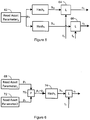
- the asset parameter p 3 read at step 62 is hashed into two hash values h 3 and h 4 that can be used as separate inputs to the lookup functions 64 and 66 in order to produce, in accordance with transform parameters t 3 and t 4 , the codewords c 3 and c 4 , which can be used to generate an error-correction fingerprint.
- This can allow the assignment of different weights to the asset parameters. For example, an asset parameter that has associate thereto more than one hash value will generally have a greater role in determining a computer environment identifier than an asset parameter that has only one hash value associated thereto.
- a hash function can be applied to a sum of asset parameters instead of being applied to the individual asset parameters. That is, H(p 1 + p 2 ) may replace the hash functions H(p i ) and H(p 2 ). Subsequent the initialization stage, a change to one or both of the assets, and thereby a change to their respective asset parameters, will generally have the same effects on the identifier recovered.
- An example is shown at Figure 6 where the asset parameter p 1 retrieved at step 68 is summed, at step 70 , with the asset parameter p 2 retrieved at step 72 . The summed asset parameter p 1 + p 2 is then hashed at step 74 to produce hash value h 1 , which is input into the lookup function 75 to generate, as a function of transform parameter t 1 the codeword c 1 .
- an asset parameter may also be split into multiple parts before being hashed to multiple hashed parameters. There also could be substantial processing before generating a hash or after applying the hash function. Such indirect use of an error correcting module is also within the scope of the present invention.
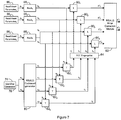
- Figure 7 shows an example of the present invention with respect to an application (a software application) that relies on three assets and on a Reed-Solomon (4,2) error correcting code.
- the application is to produce a valid result (a valid identifier) only if one essential asset is correct and if at least one of the remaining two assets are correct. An error in the essential asset or errors of both the other two assets will not provide the valid identifier and will prevent the application from providing the intended functionality.
- the asset having asset parameter p 3 is the essential asset, and this asset parameter has associated thereto two hash values h 3 and h 4 .
- Each codeword symbol c i is input to a transform function T , which also has as input a hash value obtained from an original collection of assets for which the error-correction fingerprint 84 is being determined.
- the hash values are h 1 , h 2 , h 3 , and h 4 .
- the asset parameter p 3 and hence its related asset, has associated thereto two hash values h 3 and h 4 without which a valid identifier cannot be obtained.
- the transform function 82 1 outputs the transform parameter t 1
- the transform function 82 2 outputs the transform parameter t 2
- the transform function 82 3 outputs the transform parameter t 3
- the transform function 82 4 outputs the transform parameter t 4 .
- the transform parameter t 1 , t 2 , t 3 , and t 4 constitute the error-correction fingerprint 84 .
- the asset parameters p 1 , p 2 , and p 3 are retrieved at steps 86 1 -86 3 .
- Hash value h 1 is obtained at step 88 1 , as a function of asset parameter p 1 .
- Hash value h 2 is obtained at step 88 2 , as a function of asset parameter p 2 .
- Hash values h 3 and h 4 are obtained at step 88 3 , as a function of asset parameter p 3 .
- L h i ,t i
- the code symbol c' i will be identical to the codeword symbol c i only if the asset parameter used to determine c' i is the same as that used to determine the transform parameter t i .
- Figure 7 also shows the use of an RS(4,2) error-correction module 92 , which uses an error-correction algorithm based on Reed-Solomon error-correction code.
- the essential asset parameter p 3 is used to generate two hash values h 3 and h 4 .
- the essential asset parameter p 3 needs to be correct in order for the RS(4,2) error correction module 92 to produce a valid output. If p 3 is correct, one of the remaining hash parameters ( h 1 or h 2 ) may be incorrect as the RS(4,2) error correction module 92 can recover from that error.
- the error correction module may give an indication of the number of incorrect symbols that can be tolerated by the application. Adjustment to the number of intentionally wrong inputs at recovery can be made accordingly.
- some computing platforms can support a challenge-response device (function) such as, for example, a Physical Unclonable Function, a dongle, a smart card, etc.
- a challenge-response device such as, for example, a Physical Unclonable Function, a dongle, a smart card, etc.
- the exemplary identifying message recovery method of Figure 3 can be adapted to issue challenges to the challenge-response device and to process the responses.
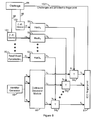
- FIG 8 shows an initialization example similar to the example of Figure 2 but where instead of reading asset parameters p 1 and p 2 , a challenge device (function) 94 provides two challenges to two challenge-response devices 100 and 101 to obtain responses CR 1 and CR 2 .
- the responses CR 1 and CR 2 are subsequently treated as asset parameters and, as such, can be referred to as such. That is, the responses CR 1 and CR 2 constitute asset parameters.
- the challenge-response devices 100 and 101 can each be associated with a different asset of the computing environment.
- the challenge device 94 provides a first challenge 96 to the challenge-response device 100 .
- the challenge-response device 100 provides a response CR 1 to the hash function 52 1 , which produces the hash value h 1 .
- the challenge device 94 also provides a second challenge 98 to the challenge-response device 101 , which in turn provides a response CR 2 to the hash function 52 2 .
- the hash function 52 2 produces the hash value h 2 .
- CR 1 and CR 2 are treated as asset parameters by the hash functions.
- hash values other than h 1 and h 2 are obtained by retrieving corresponding asset parameters such as at step 50 n , which provides asset parameter p n , and providing the asset parameters to their respective hash function.
- the hash values h 1 , h 2 , ...h n are provided to a transform function T.
- the symbols c 1 , c 2 ,... c n are codewords symbols generated by a codeword generator module 56 as a function of the identifier x 1 , x 2 ,...
- the transform function T T ( c i , h i ) , generates a transform parameter t i as a function of the codeword symbol c i and of the hash value h i .
- the transform parameters t 1 , t 2 ,... t n are comprised in the error-correcting fingerprint 61 .
- any number of hash values can be obtained by processing responses from a challenge-response device.
- all the hash values can be obtained by processing responses from a challenge-response device or, as in the example of Figure 8 , only a portion of the entire number of hash values can be obtained by processing responses from a challenge-response device.
- the error-correction fingerprint 61 can include the same challenges as the ones used to obtain the response. That is, in the example of Figure 8 , the challenges 96 and 98 will be part of the error-correction fingerprint 61 , which will be able to issue those challenges when identifying a computing environment. The provision of the challenges 96 and 98 to the error-correction fingerprint 61 is shown at 102 .
- Figure 9 shows an error-correction fingerprint 104 used in generating code symbols that can be used to obtain an identifier.
- the error-correction fingerprint 104 is operationally connected to a challenge-response device (function) 106 .
- the challenge-response device (function) 106 of the present example is associated to an asset n of the computing environment.
- the error-correction fingerprint 104 comprises m transform parameters t and m challenges i.
- Figure 9 shows the challenge-response device 106 receiving a challenge i 2 from the error-correction fingerprint 104 , and, in response to the challenge i 2 , providing a response CR n,2 to the hash function 150 , which outputs a hash value h n,2 to a lookup function 152 .
- the lookup function also receives as input a transform parameter t n,2 from the error-correction fingerprint 104 and, outputs a code symbol c' n,2 to an error-correction module (not shown).
- the challenge-response device 106 is to provide a response to each challenge submitted by the error-correction fingerprint 104 .
- the challenge-response device 106 provides the m responses CR n,1 , CR n , 2 , ... CR n,m to the hash function 150 .
- Each response is transformed into a hash value ( h n,1 , h n,2 , ... h n,m ).
- the hash values and the transform parameters (t n,1 , t n,2 , ...t n,m comprised in the error-correction fingerprint 104) are input to a lookup function L , which outputs code symbols ( c' n,1 , c' n,2 , ... c' n,m ) .
- the code symbols which are provided to an error-correction module (not shown).
- the error-correction fingerprint will also include transform parameters for which there are no associated challenges.
- Another application of the present invention is to use the identifier (identifying message) as a key that can be used in a cryptographic operation.
- the key recovery requires the right error-correction fingerprint which will decode to the intended key on the computing platform with a sufficient number of correct asset parameter values.
- Embodiments of the invention can be represented as a computer program product stored in a machine-readable medium (also referred to as a computer-readable medium, a processor-readable medium, or a computer usable medium having a computer-readable program code embodied therein).
- the machine-readable medium can be any suitable tangible, non-transitory medium, including magnetic, optical, or electrical storage medium including a diskette, compact disk read only memory (CD-ROM), memory device (volatile or non-volatile), or similar storage mechanism.
- the machine-readable medium can contain various sets of instructions, code sequences, configuration information, or other data, which, when executed, cause a processor to perform steps in a method according to an embodiment of the invention.
Landscapes
- Engineering & Computer Science (AREA)
- Theoretical Computer Science (AREA)
- General Engineering & Computer Science (AREA)
- Software Systems (AREA)
- Computer Security & Cryptography (AREA)
- General Physics & Mathematics (AREA)
- Physics & Mathematics (AREA)
- Computer Hardware Design (AREA)
- Quality & Reliability (AREA)
- Power Engineering (AREA)
- Computer Networks & Wireless Communication (AREA)
- Signal Processing (AREA)
- Error Detection And Correction (AREA)
- Detection And Prevention Of Errors In Transmission (AREA)
Claims (15)
- Procédé d'obtention d'un premier identifiant (x'1, x'2, ..., x'k) pour une collection actuelle d'actifs associés à un environnement informatique, le procédé comprenant les étapes consistant à :obtenir (30) des paramètres d'actif (p'1, p'2, ..., p'n), les paramètres d'actif étant associés à la collection actuelle d'actifs ;traiter (32) les paramètres d'actif et une empreinte digitale (42) conformément à une fonction prédéterminée pour obtenir des symboles de code (c'1, c'2, ..., c'n) pour le premier identifiant, l'empreinte digitale étant associée à l'environnement informatique, l'empreinte digitale étant basée sur une collection originale d'actifs de l'environnement informatique et de symboles de mot de code (c1, c2, ..., cn) pour un second identifiant (x1, x2, ... xk) ; etappliquer (34) un algorithme de correction d'erreur aux symboles de code pour le premier identifiant afin d'obtenir le premier identifiant.
- Procédé selon la revendication 1, dans lequel la fonction prédéterminée comprend la conversion (38) de chaque paramètre d'actif en au moins une valeur de hachage (h'1, h'2, ..., h'n) pour obtenir une série de valeurs de hachage.
- Procédé selon la revendication 2, dans lequel la fonction prédéterminée comprend en outre la mise en correspondance de la série de valeurs de hachage avec les symboles de code conformément à l'empreinte digitale.
- Procédé selon la revendication 3, dans lequel :l'empreinte digitale est associée à des paramètres de transformation (t1, t2, ..., tn) ; etla mise en correspondance de la série de valeurs de hachage avec les symboles de code est effectuée conformément aux paramètres de transformation.
- Procédé selon la revendication 4, dans lequel la mise en correspondance de la série de valeurs de hachage avec les symboles de code comprend l'exécution d'une opération XOR entre la série de valeurs de hachage et les paramètres de transformation.
- Procédé de définition d'une empreinte digitale (42) pour un environnement informatique auquel est associée une collection d'origine d'actifs, le procédé comprenant les étapes consistant à :générer (22) des symboles de mot de code (c1, c2, ..., cn) conformément à un algorithme de génération de mot de code, dans lequel ledit algorithme de génération de mot de code comprend l'exécution d'une opération de correction d'erreur sur un identifiant (x1, x2, ..., xk) ; ettraiter (24) des paramètres d'actif (p1, p2, ..., Pn) et des symboles de mot de code conformément à une fonction prédéterminée pour obtenir l'empreinte digitale, les paramètres d'actif étant associés à la collection d'origine d'actifs.
- Procédé selon la revendication 6, dans lequel la génération de symboles de mot de code comprend la fourniture d'un identifiant en tant qu'entrée dans l'algorithme de génération de mot de code.
- Procédé selon la revendication 6 ou 7, dans lequel le traitement est précédé par un accès aux actifs pour obtenir (20) les paramètres d'actif à partir de ceux-ci.
- Procédé selon l'une quelconque des revendications 6 à 8, dans lequel le traitement comprend la conversion (52) de chaque paramètre d'actif en au moins une valeur de hachage (h1, h2, ..., hn) pour obtenir une série de valeurs de hachage.
- Procédé selon la revendication 9, dans lequel :l'empreinte digitale comprend une série de paramètres de transformation (t1, t2, ..., tn) ; etla fonction prédéterminée met en correspondance la série de valeurs de hachage et la série de paramètres de transformation conformément aux symboles de mot de code.
- Procédé selon l'une quelconque des revendications 6 à 10, dans lequel le traitement est précédé par l'obtention des paramètres d'actif.
- Procédé selon l'une quelconque des revendications 1 à 5 ou selon la revendication 11, dans lequel :au moins un des actifs a, associé à celui-ci, un dispositif de question-réponse (106) ; etl'obtention des paramètres d'actif comprend les étapes consistant à :fournir au moins une question au dispositif de question-réponse ; etrecevoir, du dispositif de question-réponse, une réponse pour chaque au moins une question, chaque réponse constituant un paramètre d'actif,dans lequel, facultativement, le dispositif de question-réponse comprend au moins un parmi :(a) un dispositif de fonction physique non clonable,(b) une clé électronique, et(c) une carte à puce.
- Procédé selon l'une quelconque des revendications 1 à 12, dans lequel l'algorithme comprend un code de correction d'erreur Reed-Solomon.
- Système conçu pour exécuter un procédé selon l'une quelconque des revendications précédentes.
- Programme informatique qui, lorsqu'il est exécuté par un processeur, amène le processeur à exécuter un procédé selon l'une quelconque des revendications 1 à 13.
Applications Claiming Priority (1)
| Application Number | Priority Date | Filing Date | Title |
|---|---|---|---|
| PCT/CN2011/000417 WO2012122674A1 (fr) | 2011-03-15 | 2011-03-15 | Procédé tolérant aux changements de génération d'identifiants pour un ensemble d'actifs dans un environnement informatique au moyen d'un schéma de code de correction d'erreurs |
Publications (3)
| Publication Number | Publication Date |
|---|---|
| EP2686767A1 EP2686767A1 (fr) | 2014-01-22 |
| EP2686767A4 EP2686767A4 (fr) | 2014-10-22 |
| EP2686767B1 true EP2686767B1 (fr) | 2019-06-05 |
Family
ID=46830010
Family Applications (1)
| Application Number | Title | Priority Date | Filing Date |
|---|---|---|---|
| EP11860843.9A Active EP2686767B1 (fr) | 2011-03-15 | 2011-03-15 | Procédé tolérant aux changements de génération d'identifiants pour un ensemble d'actifs dans un environnement informatique au moyen d'un schéma de code de correction d'erreurs |
Country Status (8)
| Country | Link |
|---|---|
| US (1) | US9967089B2 (fr) |
| EP (1) | EP2686767B1 (fr) |
| JP (1) | JP5854443B2 (fr) |
| KR (1) | KR20140057479A (fr) |
| CN (1) | CN103814355B (fr) |
| AU (1) | AU2011362519B2 (fr) |
| CA (1) | CA2830110C (fr) |
| WO (1) | WO2012122674A1 (fr) |
Families Citing this family (11)
| Publication number | Priority date | Publication date | Assignee | Title |
|---|---|---|---|---|
| US20140254793A1 (en) * | 2011-05-09 | 2014-09-11 | Vicent Martinéz Sancho | Shannon security double symmetrical cryptogram method by coding information for telematic and electronic transmission |
| US20130212642A1 (en) * | 2012-02-12 | 2013-08-15 | John J. Walsh | Resilient Device Authentication System |
| US9258129B2 (en) * | 2012-07-18 | 2016-02-09 | Sypris Electronics, Llc | Resilient device authentication system |
| US9996480B2 (en) | 2012-07-18 | 2018-06-12 | Analog Devices, Inc. | Resilient device authentication system with metadata binding |
| EP2885737B1 (fr) * | 2013-03-27 | 2016-11-02 | Irdeto B.V. | Stockage de données et accès à ces données |
| WO2014153762A1 (fr) * | 2013-03-28 | 2014-10-02 | Irdeto B.V. | Génération d'un identificateur |
| GB201505438D0 (en) | 2015-03-30 | 2015-05-13 | Irdeto Bv | Accessing content at a device |
| EP3912119B1 (fr) * | 2019-01-15 | 2025-08-20 | Blockchain Asics, Inc. | Transformée dynamique dans une validation d'en-tête de chaîne de blocs |
| EP3886009A1 (fr) * | 2020-03-27 | 2021-09-29 | Siemens Aktiengesellschaft | Système et procédé pour la gestion d'un actif |
| US11374914B2 (en) * | 2020-06-29 | 2022-06-28 | Capital One Services, Llc | Systems and methods for determining knowledge-based authentication questions |
| US11593197B2 (en) * | 2020-12-23 | 2023-02-28 | Samsung Electronics Co., Ltd. | Storage device with data quality metric and selectable data recovery scheme |
Family Cites Families (20)
| Publication number | Priority date | Publication date | Assignee | Title |
|---|---|---|---|---|
| US5530757A (en) * | 1994-06-28 | 1996-06-25 | International Business Machines Corporation | Distributed fingerprints for information integrity verification |
| US6807632B1 (en) * | 1999-01-21 | 2004-10-19 | Emc Corporation | Content addressable information encapsulation, representation, and transfer |
| EP1149475B1 (fr) * | 1999-02-11 | 2003-12-03 | RSA Security Inc. | Logique de validation floue |
| US7770016B2 (en) | 1999-07-29 | 2010-08-03 | Intertrust Technologies Corporation | Systems and methods for watermarking software and other media |
| US6880149B2 (en) * | 2002-04-01 | 2005-04-12 | Pace Anti-Piracy | Method for runtime code integrity validation using code block checksums |
| US7840803B2 (en) | 2002-04-16 | 2010-11-23 | Massachusetts Institute Of Technology | Authentication of integrated circuits |
| US7000151B2 (en) * | 2002-07-18 | 2006-02-14 | Hewlett-Packard Development Company, L.P. | System and method for providing run-time type checking |
| US7296294B2 (en) * | 2003-03-03 | 2007-11-13 | Microsoft Corporation | System for binding secrets to a computer system having tolerance for hardware changes |
| US7290149B2 (en) * | 2003-03-03 | 2007-10-30 | Microsoft Corporation | Verbose hardware identification for binding a software package to a computer system having tolerance for hardware changes |
| US20050132357A1 (en) | 2003-12-16 | 2005-06-16 | Microsoft Corporation | Ensuring that a software update may be installed or run only on a specific device or class of devices |
| US7546587B2 (en) * | 2004-03-01 | 2009-06-09 | Microsoft Corporation | Run-time call stack verification |
| US7454690B1 (en) * | 2004-10-27 | 2008-11-18 | Marvell International Ltd. | Architecture and control of reed-solomon list decoding |
| US20080292136A1 (en) * | 2007-05-23 | 2008-11-27 | Srinivasan Ramani | Data Processing System And Method |
| US7975313B2 (en) * | 2007-08-14 | 2011-07-05 | International Business Machines Corporation | System and method for tracing Tardos fingerprint codes |
| US8291493B2 (en) * | 2007-11-27 | 2012-10-16 | Mcafee, Inc. | Windows registry modification verification |
| EP2260427A4 (fr) | 2008-02-20 | 2016-11-16 | Ericsson Telefon Ab L M | Identité de noeud flexible pour des noeuds de télécommunication |
| US8516106B2 (en) * | 2009-05-18 | 2013-08-20 | International Business Machines Corporation | Use tag clouds to visualize components related to an event |
| US8667265B1 (en) * | 2010-07-28 | 2014-03-04 | Sandia Corporation | Hardware device binding and mutual authentication |
| US8848905B1 (en) * | 2010-07-28 | 2014-09-30 | Sandia Corporation | Deterrence of device counterfeiting, cloning, and subversion by substitution using hardware fingerprinting |
| US8516269B1 (en) * | 2010-07-28 | 2013-08-20 | Sandia Corporation | Hardware device to physical structure binding and authentication |
-
2011
- 2011-03-15 EP EP11860843.9A patent/EP2686767B1/fr active Active
- 2011-03-15 CA CA2830110A patent/CA2830110C/fr not_active Expired - Fee Related
- 2011-03-15 KR KR1020137026418A patent/KR20140057479A/ko not_active Ceased
- 2011-03-15 US US14/005,223 patent/US9967089B2/en active Active
- 2011-03-15 WO PCT/CN2011/000417 patent/WO2012122674A1/fr not_active Ceased
- 2011-03-15 CN CN201180070860.7A patent/CN103814355B/zh not_active Expired - Fee Related
- 2011-03-15 AU AU2011362519A patent/AU2011362519B2/en not_active Ceased
- 2011-03-15 JP JP2013558282A patent/JP5854443B2/ja not_active Expired - Fee Related
Non-Patent Citations (1)
| Title |
|---|
| None * |
Also Published As
| Publication number | Publication date |
|---|---|
| JP5854443B2 (ja) | 2016-02-09 |
| US20150023495A1 (en) | 2015-01-22 |
| WO2012122674A1 (fr) | 2012-09-20 |
| CA2830110C (fr) | 2018-06-26 |
| CN103814355B (zh) | 2017-11-28 |
| AU2011362519B2 (en) | 2017-03-30 |
| JP2014515203A (ja) | 2014-06-26 |
| CN103814355A (zh) | 2014-05-21 |
| AU2011362519A1 (en) | 2013-10-10 |
| KR20140057479A (ko) | 2014-05-13 |
| US9967089B2 (en) | 2018-05-08 |
| EP2686767A4 (fr) | 2014-10-22 |
| EP2686767A1 (fr) | 2014-01-22 |
| CA2830110A1 (fr) | 2012-09-20 |
Similar Documents
| Publication | Publication Date | Title |
|---|---|---|
| EP2686767B1 (fr) | Procédé tolérant aux changements de génération d'identifiants pour un ensemble d'actifs dans un environnement informatique au moyen d'un schéma de code de correction d'erreurs | |
| Canteaut et al. | Cryptanalysis of the original McEliece cryptosystem | |
| Bösch et al. | Efficient helper data key extractor on FPGAs | |
| CN103583013B (zh) | 密钥信息生成装置以及密钥信息生成方法 | |
| JP5548218B2 (ja) | 物理的システムに依存する暗号鍵を確立するためのシステム | |
| JP6323338B2 (ja) | ビット列照合システムと方法とプログラム | |
| RU2680350C2 (ru) | Способ и система распределенного хранения восстанавливаемых данных с обеспечением целостности и конфиденциальности информации | |
| EP3332402A1 (fr) | Dispositif cryptographique comprenant une fonction physiquement non copiable | |
| EP3238199A1 (fr) | Génération d'une clé cryptographique à partir d'une fonction physique inclonable | |
| US8726123B2 (en) | Bit error correction for removing age related errors in a bit pattern | |
| EP2885737B1 (fr) | Stockage de données et accès à ces données | |
| JP2013523043A (ja) | ソースデータセットの完全性を識別及び保護する方法 | |
| JP2018157411A (ja) | 情報処理装置 | |
| CA2830100C (fr) | Procede de generation insensible aux changements d'un identifiant pour un rassemblement d'actifs dans un environnement informatique a l'aide d'un plan de partage secret | |
| RU2707940C1 (ru) | Способ многоуровневого контроля и обеспечения целостности данных | |
| Ganorkar et al. | Error correction using pufs for reliable key generation | |
| Zerrouki et al. | A generation and recovery framework for silicon pufs based cryptographic key | |
| EP3881214B1 (fr) | Procédé insensible aux changements permettant de générer un identifiant pour une collecte d'actifs dans un environnement informatique | |
| CN112613890A (zh) | 基于区块链的商品真伪验证方法和系统 | |
| CN112613078A (zh) | 一种文档电子签名方法、验签方法及其装置 | |
| KR20220054059A (ko) | 가변 길이 퍼지 데이터를 지원하는 격자 기반 퍼지 추출 장치 및 방법 | |
| CN114490452B (zh) | 用于嵌入式闪存的数据管理方法、装置和控制芯片 | |
| Hiller et al. | Reliability bound and channel capacity of IBS-based fuzzy embedders | |
| Lv et al. | Loss‐tolerant authentication with digital signatures |
Legal Events
| Date | Code | Title | Description |
|---|---|---|---|
| PUAI | Public reference made under article 153(3) epc to a published international application that has entered the european phase |
Free format text: ORIGINAL CODE: 0009012 |
|
| 17P | Request for examination filed |
Effective date: 20131010 |
|
| AK | Designated contracting states |
Kind code of ref document: A1 Designated state(s): AL AT BE BG CH CY CZ DE DK EE ES FI FR GB GR HR HU IE IS IT LI LT LU LV MC MK MT NL NO PL PT RO RS SE SI SK SM TR |
|
| DAX | Request for extension of the european patent (deleted) | ||
| A4 | Supplementary search report drawn up and despatched |
Effective date: 20140918 |
|
| RIC1 | Information provided on ipc code assigned before grant |
Ipc: G06F 11/10 20060101ALI20140912BHEP Ipc: G06F 9/44 20060101AFI20140912BHEP |
|
| GRAP | Despatch of communication of intention to grant a patent |
Free format text: ORIGINAL CODE: EPIDOSNIGR1 |
|
| STAA | Information on the status of an ep patent application or granted ep patent |
Free format text: STATUS: GRANT OF PATENT IS INTENDED |
|
| RIC1 | Information provided on ipc code assigned before grant |
Ipc: H04L 9/06 20060101ALI20170830BHEP Ipc: G06F 21/57 20130101ALI20170830BHEP Ipc: G06F 11/10 20060101ALI20170830BHEP Ipc: G06F 9/44 20060101AFI20170830BHEP |
|
| INTG | Intention to grant announced |
Effective date: 20170927 |
|
| GRAJ | Information related to disapproval of communication of intention to grant by the applicant or resumption of examination proceedings by the epo deleted |
Free format text: ORIGINAL CODE: EPIDOSDIGR1 |
|
| STAA | Information on the status of an ep patent application or granted ep patent |
Free format text: STATUS: REQUEST FOR EXAMINATION WAS MADE |
|
| INTC | Intention to grant announced (deleted) | ||
| GRAP | Despatch of communication of intention to grant a patent |
Free format text: ORIGINAL CODE: EPIDOSNIGR1 |
|
| STAA | Information on the status of an ep patent application or granted ep patent |
Free format text: STATUS: GRANT OF PATENT IS INTENDED |
|
| INTG | Intention to grant announced |
Effective date: 20181218 |
|
| GRAS | Grant fee paid |
Free format text: ORIGINAL CODE: EPIDOSNIGR3 |
|
| GRAA | (expected) grant |
Free format text: ORIGINAL CODE: 0009210 |
|
| STAA | Information on the status of an ep patent application or granted ep patent |
Free format text: STATUS: THE PATENT HAS BEEN GRANTED |
|
| AK | Designated contracting states |
Kind code of ref document: B1 Designated state(s): AL AT BE BG CH CY CZ DE DK EE ES FI FR GB GR HR HU IE IS IT LI LT LU LV MC MK MT NL NO PL PT RO RS SE SI SK SM TR |
|
| REG | Reference to a national code |
Ref country code: GB Ref legal event code: FG4D |
|
| REG | Reference to a national code |
Ref country code: CH Ref legal event code: EP |
|
| REG | Reference to a national code |
Ref country code: AT Ref legal event code: REF Ref document number: 1140683 Country of ref document: AT Kind code of ref document: T Effective date: 20190615 |
|
| REG | Reference to a national code |
Ref country code: IE Ref legal event code: FG4D |
|
| REG | Reference to a national code |
Ref country code: DE Ref legal event code: R096 Ref document number: 602011059537 Country of ref document: DE |
|
| REG | Reference to a national code |
Ref country code: NL Ref legal event code: FP |
|
| REG | Reference to a national code |
Ref country code: LT Ref legal event code: MG4D |
|
| PG25 | Lapsed in a contracting state [announced via postgrant information from national office to epo] |
Ref country code: ES Free format text: LAPSE BECAUSE OF FAILURE TO SUBMIT A TRANSLATION OF THE DESCRIPTION OR TO PAY THE FEE WITHIN THE PRESCRIBED TIME-LIMIT Effective date: 20190605 Ref country code: SE Free format text: LAPSE BECAUSE OF FAILURE TO SUBMIT A TRANSLATION OF THE DESCRIPTION OR TO PAY THE FEE WITHIN THE PRESCRIBED TIME-LIMIT Effective date: 20190605 Ref country code: HR Free format text: LAPSE BECAUSE OF FAILURE TO SUBMIT A TRANSLATION OF THE DESCRIPTION OR TO PAY THE FEE WITHIN THE PRESCRIBED TIME-LIMIT Effective date: 20190605 Ref country code: AL Free format text: LAPSE BECAUSE OF FAILURE TO SUBMIT A TRANSLATION OF THE DESCRIPTION OR TO PAY THE FEE WITHIN THE PRESCRIBED TIME-LIMIT Effective date: 20190605 Ref country code: FI Free format text: LAPSE BECAUSE OF FAILURE TO SUBMIT A TRANSLATION OF THE DESCRIPTION OR TO PAY THE FEE WITHIN THE PRESCRIBED TIME-LIMIT Effective date: 20190605 Ref country code: NO Free format text: LAPSE BECAUSE OF FAILURE TO SUBMIT A TRANSLATION OF THE DESCRIPTION OR TO PAY THE FEE WITHIN THE PRESCRIBED TIME-LIMIT Effective date: 20190905 Ref country code: LT Free format text: LAPSE BECAUSE OF FAILURE TO SUBMIT A TRANSLATION OF THE DESCRIPTION OR TO PAY THE FEE WITHIN THE PRESCRIBED TIME-LIMIT Effective date: 20190605 |
|
| PG25 | Lapsed in a contracting state [announced via postgrant information from national office to epo] |
Ref country code: RS Free format text: LAPSE BECAUSE OF FAILURE TO SUBMIT A TRANSLATION OF THE DESCRIPTION OR TO PAY THE FEE WITHIN THE PRESCRIBED TIME-LIMIT Effective date: 20190605 Ref country code: BG Free format text: LAPSE BECAUSE OF FAILURE TO SUBMIT A TRANSLATION OF THE DESCRIPTION OR TO PAY THE FEE WITHIN THE PRESCRIBED TIME-LIMIT Effective date: 20190905 Ref country code: LV Free format text: LAPSE BECAUSE OF FAILURE TO SUBMIT A TRANSLATION OF THE DESCRIPTION OR TO PAY THE FEE WITHIN THE PRESCRIBED TIME-LIMIT Effective date: 20190605 Ref country code: GR Free format text: LAPSE BECAUSE OF FAILURE TO SUBMIT A TRANSLATION OF THE DESCRIPTION OR TO PAY THE FEE WITHIN THE PRESCRIBED TIME-LIMIT Effective date: 20190906 |
|
| REG | Reference to a national code |
Ref country code: AT Ref legal event code: MK05 Ref document number: 1140683 Country of ref document: AT Kind code of ref document: T Effective date: 20190605 |
|
| PG25 | Lapsed in a contracting state [announced via postgrant information from national office to epo] |
Ref country code: AT Free format text: LAPSE BECAUSE OF FAILURE TO SUBMIT A TRANSLATION OF THE DESCRIPTION OR TO PAY THE FEE WITHIN THE PRESCRIBED TIME-LIMIT Effective date: 20190605 Ref country code: EE Free format text: LAPSE BECAUSE OF FAILURE TO SUBMIT A TRANSLATION OF THE DESCRIPTION OR TO PAY THE FEE WITHIN THE PRESCRIBED TIME-LIMIT Effective date: 20190605 Ref country code: RO Free format text: LAPSE BECAUSE OF FAILURE TO SUBMIT A TRANSLATION OF THE DESCRIPTION OR TO PAY THE FEE WITHIN THE PRESCRIBED TIME-LIMIT Effective date: 20190605 Ref country code: CZ Free format text: LAPSE BECAUSE OF FAILURE TO SUBMIT A TRANSLATION OF THE DESCRIPTION OR TO PAY THE FEE WITHIN THE PRESCRIBED TIME-LIMIT Effective date: 20190605 Ref country code: SK Free format text: LAPSE BECAUSE OF FAILURE TO SUBMIT A TRANSLATION OF THE DESCRIPTION OR TO PAY THE FEE WITHIN THE PRESCRIBED TIME-LIMIT Effective date: 20190605 Ref country code: PT Free format text: LAPSE BECAUSE OF FAILURE TO SUBMIT A TRANSLATION OF THE DESCRIPTION OR TO PAY THE FEE WITHIN THE PRESCRIBED TIME-LIMIT Effective date: 20191007 |
|
| PG25 | Lapsed in a contracting state [announced via postgrant information from national office to epo] |
Ref country code: IS Free format text: LAPSE BECAUSE OF FAILURE TO SUBMIT A TRANSLATION OF THE DESCRIPTION OR TO PAY THE FEE WITHIN THE PRESCRIBED TIME-LIMIT Effective date: 20191005 Ref country code: IT Free format text: LAPSE BECAUSE OF FAILURE TO SUBMIT A TRANSLATION OF THE DESCRIPTION OR TO PAY THE FEE WITHIN THE PRESCRIBED TIME-LIMIT Effective date: 20190605 Ref country code: SM Free format text: LAPSE BECAUSE OF FAILURE TO SUBMIT A TRANSLATION OF THE DESCRIPTION OR TO PAY THE FEE WITHIN THE PRESCRIBED TIME-LIMIT Effective date: 20190605 |
|
| REG | Reference to a national code |
Ref country code: DE Ref legal event code: R097 Ref document number: 602011059537 Country of ref document: DE |
|
| PG25 | Lapsed in a contracting state [announced via postgrant information from national office to epo] |
Ref country code: TR Free format text: LAPSE BECAUSE OF FAILURE TO SUBMIT A TRANSLATION OF THE DESCRIPTION OR TO PAY THE FEE WITHIN THE PRESCRIBED TIME-LIMIT Effective date: 20190605 |
|
| PLBE | No opposition filed within time limit |
Free format text: ORIGINAL CODE: 0009261 |
|
| STAA | Information on the status of an ep patent application or granted ep patent |
Free format text: STATUS: NO OPPOSITION FILED WITHIN TIME LIMIT |
|
| PG25 | Lapsed in a contracting state [announced via postgrant information from national office to epo] |
Ref country code: DK Free format text: LAPSE BECAUSE OF FAILURE TO SUBMIT A TRANSLATION OF THE DESCRIPTION OR TO PAY THE FEE WITHIN THE PRESCRIBED TIME-LIMIT Effective date: 20190605 Ref country code: PL Free format text: LAPSE BECAUSE OF FAILURE TO SUBMIT A TRANSLATION OF THE DESCRIPTION OR TO PAY THE FEE WITHIN THE PRESCRIBED TIME-LIMIT Effective date: 20190605 |
|
| 26N | No opposition filed |
Effective date: 20200306 |
|
| PG25 | Lapsed in a contracting state [announced via postgrant information from national office to epo] |
Ref country code: SI Free format text: LAPSE BECAUSE OF FAILURE TO SUBMIT A TRANSLATION OF THE DESCRIPTION OR TO PAY THE FEE WITHIN THE PRESCRIBED TIME-LIMIT Effective date: 20190605 |
|
| PG25 | Lapsed in a contracting state [announced via postgrant information from national office to epo] |
Ref country code: MC Free format text: LAPSE BECAUSE OF FAILURE TO SUBMIT A TRANSLATION OF THE DESCRIPTION OR TO PAY THE FEE WITHIN THE PRESCRIBED TIME-LIMIT Effective date: 20190605 |
|
| REG | Reference to a national code |
Ref country code: CH Ref legal event code: PL |
|
| REG | Reference to a national code |
Ref country code: BE Ref legal event code: MM Effective date: 20200331 |
|
| PG25 | Lapsed in a contracting state [announced via postgrant information from national office to epo] |
Ref country code: LU Free format text: LAPSE BECAUSE OF NON-PAYMENT OF DUE FEES Effective date: 20200315 |
|
| PG25 | Lapsed in a contracting state [announced via postgrant information from national office to epo] |
Ref country code: LI Free format text: LAPSE BECAUSE OF NON-PAYMENT OF DUE FEES Effective date: 20200331 Ref country code: IE Free format text: LAPSE BECAUSE OF NON-PAYMENT OF DUE FEES Effective date: 20200315 Ref country code: FR Free format text: LAPSE BECAUSE OF NON-PAYMENT OF DUE FEES Effective date: 20200331 Ref country code: CH Free format text: LAPSE BECAUSE OF NON-PAYMENT OF DUE FEES Effective date: 20200331 |
|
| PG25 | Lapsed in a contracting state [announced via postgrant information from national office to epo] |
Ref country code: BE Free format text: LAPSE BECAUSE OF NON-PAYMENT OF DUE FEES Effective date: 20200331 |
|
| GBPC | Gb: european patent ceased through non-payment of renewal fee |
Effective date: 20200315 |
|
| PG25 | Lapsed in a contracting state [announced via postgrant information from national office to epo] |
Ref country code: GB Free format text: LAPSE BECAUSE OF NON-PAYMENT OF DUE FEES Effective date: 20200315 |
|
| PG25 | Lapsed in a contracting state [announced via postgrant information from national office to epo] |
Ref country code: MT Free format text: LAPSE BECAUSE OF FAILURE TO SUBMIT A TRANSLATION OF THE DESCRIPTION OR TO PAY THE FEE WITHIN THE PRESCRIBED TIME-LIMIT Effective date: 20190605 Ref country code: CY Free format text: LAPSE BECAUSE OF FAILURE TO SUBMIT A TRANSLATION OF THE DESCRIPTION OR TO PAY THE FEE WITHIN THE PRESCRIBED TIME-LIMIT Effective date: 20190605 |
|
| PG25 | Lapsed in a contracting state [announced via postgrant information from national office to epo] |
Ref country code: MK Free format text: LAPSE BECAUSE OF FAILURE TO SUBMIT A TRANSLATION OF THE DESCRIPTION OR TO PAY THE FEE WITHIN THE PRESCRIBED TIME-LIMIT Effective date: 20190605 |
|
| PGFP | Annual fee paid to national office [announced via postgrant information from national office to epo] |
Ref country code: DE Payment date: 20260320 Year of fee payment: 16 |
|
| PGFP | Annual fee paid to national office [announced via postgrant information from national office to epo] |
Ref country code: NL Payment date: 20260323 Year of fee payment: 16 |