EP2687157A2 - Évaluation du risque de chutes quantitatives à travers des capteurs inertiels et une plate-forme sensible à la pression - Google Patents
Évaluation du risque de chutes quantitatives à travers des capteurs inertiels et une plate-forme sensible à la pression Download PDFInfo
- Publication number
- EP2687157A2 EP2687157A2 EP13177482.0A EP13177482A EP2687157A2 EP 2687157 A2 EP2687157 A2 EP 2687157A2 EP 13177482 A EP13177482 A EP 13177482A EP 2687157 A2 EP2687157 A2 EP 2687157A2
- Authority
- EP
- European Patent Office
- Prior art keywords
- sensor data
- pressure
- inertial sensor
- data
- person
- Prior art date
- Legal status (The legal status is an assumption and is not a legal conclusion. Google has not performed a legal analysis and makes no representation as to the accuracy of the status listed.)
- Withdrawn
Links
- 238000012502 risk assessment Methods 0.000 title description 4
- 238000000034 method Methods 0.000 claims abstract description 27
- 239000011159 matrix material Substances 0.000 claims description 38
- 238000012706 support-vector machine Methods 0.000 claims description 21
- 230000003595 spectral effect Effects 0.000 claims description 18
- 230000001133 acceleration Effects 0.000 claims description 12
- 238000001228 spectrum Methods 0.000 claims description 12
- 239000013598 vector Substances 0.000 description 17
- 238000012360 testing method Methods 0.000 description 15
- 238000005259 measurement Methods 0.000 description 5
- 230000001144 postural effect Effects 0.000 description 5
- 210000002683 foot Anatomy 0.000 description 4
- 208000027418 Wounds and injury Diseases 0.000 description 3
- 230000008859 change Effects 0.000 description 3
- 230000006378 damage Effects 0.000 description 3
- 208000014674 injury Diseases 0.000 description 3
- 230000035945 sensitivity Effects 0.000 description 3
- 208000024891 symptom Diseases 0.000 description 3
- 238000012549 training Methods 0.000 description 3
- 238000000692 Student's t-test Methods 0.000 description 2
- 230000005856 abnormality Effects 0.000 description 2
- 238000004364 calculation method Methods 0.000 description 2
- 238000002790 cross-validation Methods 0.000 description 2
- 238000009826 distribution Methods 0.000 description 2
- 208000002173 dizziness Diseases 0.000 description 2
- 230000000694 effects Effects 0.000 description 2
- 238000005516 engineering process Methods 0.000 description 2
- 210000003128 head Anatomy 0.000 description 2
- 210000001872 metatarsal bone Anatomy 0.000 description 2
- 238000012544 monitoring process Methods 0.000 description 2
- 230000000306 recurrent effect Effects 0.000 description 2
- 206010042772 syncope Diseases 0.000 description 2
- 238000012353 t test Methods 0.000 description 2
- 208000000094 Chronic Pain Diseases 0.000 description 1
- 206010048744 Fear of falling Diseases 0.000 description 1
- 238000000585 Mann–Whitney U test Methods 0.000 description 1
- 208000002193 Pain Diseases 0.000 description 1
- 206010036653 Presyncope Diseases 0.000 description 1
- 229920002058 Tactel Polymers 0.000 description 1
- 208000003443 Unconsciousness Diseases 0.000 description 1
- 238000009530 blood pressure measurement Methods 0.000 description 1
- 238000013480 data collection Methods 0.000 description 1
- 230000001747 exhibiting effect Effects 0.000 description 1
- 230000005484 gravity Effects 0.000 description 1
- 230000036541 health Effects 0.000 description 1
- 208000013433 lightheadedness Diseases 0.000 description 1
- 238000004519 manufacturing process Methods 0.000 description 1
- 238000012986 modification Methods 0.000 description 1
- 230000004048 modification Effects 0.000 description 1
- 230000003287 optical effect Effects 0.000 description 1
- 230000008569 process Effects 0.000 description 1
- 238000012545 processing Methods 0.000 description 1
- 238000005070 sampling Methods 0.000 description 1
- 238000003860 storage Methods 0.000 description 1
Images



Classifications
-
- A—HUMAN NECESSITIES
- A61—MEDICAL OR VETERINARY SCIENCE; HYGIENE
- A61B—DIAGNOSIS; SURGERY; IDENTIFICATION
- A61B5/00—Measuring for diagnostic purposes; Identification of persons
- A61B5/103—Measuring devices for testing the shape, pattern, colour, size or movement of the body or parts thereof, for diagnostic purposes
- A61B5/1036—Measuring load distribution, e.g. podologic studies
- A61B5/1038—Measuring plantar pressure during gait
-
- A—HUMAN NECESSITIES
- A61—MEDICAL OR VETERINARY SCIENCE; HYGIENE
- A61B—DIAGNOSIS; SURGERY; IDENTIFICATION
- A61B5/00—Measuring for diagnostic purposes; Identification of persons
- A61B5/103—Measuring devices for testing the shape, pattern, colour, size or movement of the body or parts thereof, for diagnostic purposes
- A61B5/11—Measuring movement of the entire body or parts thereof, e.g. head or hand tremor or mobility of a limb
- A61B5/1116—Determining posture transitions
- A61B5/1117—Fall detection
-
- A—HUMAN NECESSITIES
- A61—MEDICAL OR VETERINARY SCIENCE; HYGIENE
- A61B—DIAGNOSIS; SURGERY; IDENTIFICATION
- A61B5/00—Measuring for diagnostic purposes; Identification of persons
- A61B5/72—Signal processing specially adapted for physiological signals or for diagnostic purposes
- A61B5/7271—Specific aspects of physiological measurement analysis
- A61B5/7275—Determining trends in physiological measurement data; Predicting development of a medical condition based on physiological measurements, e.g. determining a risk factor
-
- G—PHYSICS
- G16—INFORMATION AND COMMUNICATION TECHNOLOGY [ICT] SPECIALLY ADAPTED FOR SPECIFIC APPLICATION FIELDS
- G16H—HEALTHCARE INFORMATICS, i.e. INFORMATION AND COMMUNICATION TECHNOLOGY [ICT] SPECIALLY ADAPTED FOR THE HANDLING OR PROCESSING OF MEDICAL OR HEALTHCARE DATA
- G16H40/00—ICT specially adapted for the management or administration of healthcare resources or facilities; ICT specially adapted for the management or operation of medical equipment or devices
- G16H40/60—ICT specially adapted for the management or administration of healthcare resources or facilities; ICT specially adapted for the management or operation of medical equipment or devices for the operation of medical equipment or devices
- G16H40/63—ICT specially adapted for the management or administration of healthcare resources or facilities; ICT specially adapted for the management or operation of medical equipment or devices for the operation of medical equipment or devices for local operation
-
- G—PHYSICS
- G16—INFORMATION AND COMMUNICATION TECHNOLOGY [ICT] SPECIALLY ADAPTED FOR SPECIFIC APPLICATION FIELDS
- G16H—HEALTHCARE INFORMATICS, i.e. INFORMATION AND COMMUNICATION TECHNOLOGY [ICT] SPECIALLY ADAPTED FOR THE HANDLING OR PROCESSING OF MEDICAL OR HEALTHCARE DATA
- G16H50/00—ICT specially adapted for medical diagnosis, medical simulation or medical data mining; ICT specially adapted for detecting, monitoring or modelling epidemics or pandemics
- G16H50/20—ICT specially adapted for medical diagnosis, medical simulation or medical data mining; ICT specially adapted for detecting, monitoring or modelling epidemics or pandemics for computer-aided diagnosis, e.g. based on medical expert systems
-
- A—HUMAN NECESSITIES
- A61—MEDICAL OR VETERINARY SCIENCE; HYGIENE
- A61B—DIAGNOSIS; SURGERY; IDENTIFICATION
- A61B5/00—Measuring for diagnostic purposes; Identification of persons
- A61B5/74—Details of notification to user or communication with user or patient; User input means
- A61B5/742—Details of notification to user or communication with user or patient; User input means using visual displays
Definitions
- the invention relates to sensing devices and methods that may be used to estimate a risk of falling.
- Falls have been considered a "geriatric giant” and are associated with negative health outcomes such as serious injury, hospitalization, restricted mobility, and institutionalization. Falls have a negative effect on quality of life, lead to increased hospitalization, and are costly. The cost of falls each year among the elderly in the U.S. alone has been estimated to be about $20 billion. Falls in older adults are common and their incidence increases with age.
- the pressure sensor data may be collected from a portable pressure sensor matrix that has a plurality of pressure sensors that measure a person's pressure distribution as the person stands on the portable pressure sensor matrix.
- the inertial sensor data may be collected from an inertial sensor attached to the person.
- the collected data may be used to calculate one or more features, such as statistical properties of center of pressure (COP) calculated from the pressure sensor data or statistical properties of accelerations or angular velocities calculated from the inertial sensor data. Values of the features may be used to train a classifier model.
- COP center of pressure
- the classifier model may be trained to recognize features patterns associated with self-reported risk of falling.
- the training may be performed with values collected from a plurality of people.
- the classifier model may be used to estimate an unseen person's risk of falling based on feature values calculated from new sensor data collected from the person.
- a single classifier model may be created for both men and women, or separate classifier models may be created, with one to predict falls risk in men and one to predict falls risk in women.
- a single classifier model may be created for both sensor data collected while a person closed his or her eyes and sensor data collected while the person opened his or her eyes, or separate classifier models may be created, with one for the eyes closed condition and one for the eyes open condition. The timely determination of falls risk would facilitate appropriate intervention, such as a tailored balance and strengthening program, that could reduce the risk of future falls.
- the pressure sensor matrix may include a high density pressure sensitive floor mat having a plurality of sensors that collect pressure sensor data generated from the presence of a person on the mat, while the inertial (kinematic) sensor may include an accelerometer, gyroscope, or magnetometer.
- Pressure sensor data may be binary, such as the presence or absence of a threshold pressure, or may have more granular values corresponding to the amount of pressure.
- the pressure sensor data may be collected at a plurality of times.
- the data corresponding to one of the plurality of times may make up a series of time samples (or snapshots) of pressure sensor data.
- a center of pressure (COP) may be calculated for each snapshot to produce a COP time series that corresponds to measurements taken over the duration of a balance assessment test. Standard time and frequency domain measures for quantifying the center of pressure may be used to quantify the data obtained during the assessment.
- the measurement system may be portable, and the pressure sensor matrix and inertial sensor may be used in a clinical setting or in the home.
- a measurement of postural stability may be done in a home environment with a pressure sensor matrix, without requiring supervision from specially trained personnel.
- This unsupervised assessment may reduce the cost of falls assessment and facilitate the gathering of data in a longitudinal (e.g., daily) monitoring of falls risk, such as in a tele-healthcare or tele-monitoring context.
- FIG. 1A illustrates an example setup for collecting pressure sensor data and inertial sensor data from a balance assessment trial participant.
- FIG. 1B illustrates an example graphical view of data collected using a pressure sensor matrix.
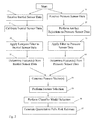
- FIG. 2 illustrates example operations that may be performed to generate a quantitative falls risk estimate based on pressure and inertial sensor data from a participant performing a standing balance trial.
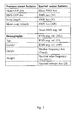
- FIG. 3 illustrates example features that may be used in a falls risk estimation model.
- FIG. 4 illustrates example variations in classification accuracy with parameters for a falls risk classifier model that is based on data collected from both male and female balance assessment trial participants and under both eyes open conditions and eyes closed conditions.
- FIG. 5 illustrates example accuracy calculations of various falls risk classifier models derived from standing balance tasks.
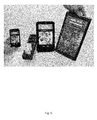
- FIG. 6 illustrates a user interface for performing and displaying data relating to postural stability and falls risk assessment.
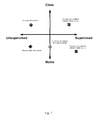
- FIG. 7 illustrates various falls risk assessment environments and their relationship to a need for supervision.
- FIG. 1 illustrates a standing balance assessment environment 100 in which an inertial (kinematic) sensor 101 and a pressure sensor matrix 103 collect kinematic and pressure data, respectively, from a standing balance assessment trial participant.
- An algorithm may process the pressure sensor data and inertial sensor data to calculate balance-related features, which may be used by falls risk estimation models to predict a risk of future falls.
- Such models may include classifier models that can be trained with values of the balance-related features and labeled with known corresponding falls history or prospective follow-up data.
- class labels may provide the basis for supervised training of the classifier models.
- the data gathering may be a part of a clinical balance assessment, or may be used as part of a daily or longitudinal monitoring program done in a person's home. The data gathering may be done with or without medical supervision.
- the pressure sensors may be configured as a pressure sensor matrix capable of measuring pressure as a function of a plurality of coordinates (e.g., X coordinate and Y coordinate) that correspond to locations on the matrix.
- the pressure sensor matrix may be a high-density pressure mat, such as the floor mat pressure sensor provided by TactexTM, which generates pressure sensor data using KINOTEX ® technology.
- the pressure matrix may be rigid, or may be flexible to assist in portability.
- the pressure sensor matrix may present an area large enough to measure how a person distributes his or her pressure over time on the matrix. Measuring the pressure distribution over time may yield, for example, a trajectory of the person's center of pressure when he or she is standing.
- the pressure sensors in the matrix may be configured to detect the presence of a threshold pressure, a pressure value, or a change in pressure value, or some combination thereof.
- the pressure sensors may produce only a binary value that indicates whether the applied pressure is greater than a threshold pressure.
- the pressure sensor may produce a pressure value in a range from 0.1 kPa to 200 kPa, or some other range.
- the range of operation for the pressure sensors may be any range configured to support detecting movement, changes in posture, or changes in balance of a human or other animal.
- changes may be recorded when a certain number of sensors (e.g., 200) are deemed to have changed in output.
- changes may be recorded periodically, such as at a sampling rate of 10 Hz.
- the inertial sensors may include an accelerometer, gyroscope, magnetometer, global positioning system (GPS) transceiver, RFID tag, or any other sensor configured to detect movement.
- inertial sensors may be sensors based on the SHIMMERTM sensor platform, which includes a 3-axis accelerometer, a battery, and electronic storage.
- a inertial sensor may be attached to the lower back of a trial participant, such as to his or her L3 lumbar.
- the accelerometer may be oriented so that the Y gyroscope sensor axis captures movement about the anatomical medio-lateral axis.
- the pressure sensor matrix and inertial sensor may be configured to communicate sensor data over a wired interface or over a wireless interface, such as WLAN or Bluetooth.
- the sensor data may be communicated to a computing platform such as a desktop, laptop, mobile phone, or other mobile device.
- the inertial sensor may be sampled through a wireless connection at a rate of 102.4 Hz.
- the standing balance assessment trial participant may be instructed to remain in a comfortable stance during each balance test and may also be instructed to gaze fixed forward. Participants may hold their arms by their side, or may extend their arms outward from their bodies. The participant may stand with both eyes open or both eyes closed. In some instances, stances may vary based on whether the participant has eyes open or eyes closed. A participant with eyes open may be instructed to stand in a semi-tandem stance (e.g., the first metatarsal head of one foot placed beside the heel of the other foot), while a participant with eyes closed may be instructed to stand in a narrow stance (e.g., heels and first metatarsal heads of left and right feet touching).
- a semi-tandem stance e.g., the first metatarsal head of one foot placed beside the heel of the other foot
- a participant with eyes closed may be instructed to stand in a narrow stance (e.g., heels and first metatarsal heads of left and right feet touching).
- Each test may last from a few seconds to a few minutes. In one example, each test may last approximately sixty seconds, and pressure sensor data may be collected during the middle thirty seconds. Multiple tests, such as repetitions of the same balance test, may be conducted with the same test participant. In one example, there may be between one to two minutes of rest between tests.
- a certain number e.g. 200
- the pressure sensor data from those or from all sensors may be captured. An example snapshot of the captured pressure sensor data is shown in Fig. 1B .
- the pressure sensor matrix may be calibrated to exclude data from pressure sensors that measure less than a threshold level of pressure.
- the pressure sensors that measure a pressure above the threshold may be considered active sensors, located in an area of the pressure sensor matrix on which the trial participant is standing.
- Center of pressure data may be calculated from the pressure sensor data.
- a center of pressure may be calculated using a center of all active tactels (CAAT) technique, in which the location of the center of pressure is calculated as the absolute center of all active pressure sensors.
- CAAT center of all active tactels
- the center of pressure data may vary based on time.
- the center of pressure may be calculated using a centroid of heel and toe points (CHAT) technique, in which locations of four points, corresponding to two heel points and two toe points, are first calculated from the active pressure sensors. The four points are used to estimate the center of pressure.
- CAAT center of all active tactels
- CHAT centroid of heel and toe points
- the center of pressure may be calculated based on a center of mass (COM) technique, in which a pressure sensor's value is treated as an amount of a user's mass distributed at the pressure sensor.
- the center of pressure is determined based on the locations of the active pressure sensors as well as based on the values measured by the pressure sensors at their respective locations.
- video data of a trial participant may be acquired during each test.
- the video data may be used to later assess the validity of other data acquired from the test.
- the pressure and inertial sensor data may be collected to determine properties of, for example, the participant's movement and center of pressure, using techniques such as those described above.
- Fig. 2 illustrates an example overview of operations in such a falls risk assessment environment.
- pressure sensor data may be collected for an interval of 30 seconds.
- inertial sensor data may be collected for an interval of 30 seconds. The intervals may be shorter, such as for a few seconds, or longer, such as for a few minutes.
- the data collection may take place at the beginning, middle, end, or some other interval of a balance assessment trial.
- artifact rejection may be performed to remove spurious pressure sensor data.
- a spike in measured pressure values may be rejected, or a series of pressure values exhibiting large fluctuations may be rejected.
- the pressure sensor data values may also be compared with video data to identify times during which, for example, a test participant was not performing the standing balance task correctly. Pressure sensor data during those times may be excluded.
- calibration may be performed on the inertial sensor data. For example, accelerometer data from an inertial sensor may be corrected for the effects of gravity, and an initial and terminal five seconds of accelerometer data may be ignored.
- the pressure sensor data and inertial sensor data may be filtered.
- a high pass filter may be applied to both sets of data to remove noise.
- a bandpass filter of 0.1-5 Hz may be applied to the accelerometer data.
- features that relate to the pressure sensor data may be derived.
- One or more of the features may be derived from, for example, pressure measurements made by pressure sensor matrix 103 or from center of pressure (COP) data calculated from such measurements.
- the one or more features may include a mean distance, or MDIST, between each COP point for a plurality of snapshots and a mean of the COP points.
- the one or more features may include a root mean squared of the distances, or RDIST, between each COP point for the plurality of snapshots and the mean COP point.
- the one or more features may include a sway length, or TOTEX, which measures a total COP path length as the COP varies across the plurality of snapshots.
- Each snapshot may include a matrix of samples taken from a sensor matrix at a given time.
- the one or more features may include a mean sway velocity, or MVELO, which measures the mean velocity of the COP over the recording period.
- the one or more features may include a mean sway area, mean sway frequency, mean sway frequency in a medio-lateral (ML) direction, mean sway frequency in an anterior-posterior (AP) direction, a 95% confidence sway circle area, and a 95% confidence sway ellipse area.
- Mean sway frequency along the AP direction may be calculated as the rotation frequency of the COP if it travelled around a circle with a radius of the mean COP distance.
- APo [ n ] represents the anterior-posterior coordinate of the COP at snapshot n of the recording period.
- MLo [ n ] represents the mediolateral coordinate of the COP at snapshot n of the recording period.
- the features described herein may be calculated relative to the mean COP so as to provide standardized center of pressure (COP) time series coordinates.
- the sway length, orTOTEX may be calculated as
- the mean sway velocity, or MVELO may be calculated as
- MVELO TOTEX / T , where T is the recording period.
- a center of pressure (COP) is described in more detail in U.S. Patent Application No. 13/198,343 .
- a COP for an instance in time may be calculated as the average position of all active sensors at that instance, which may include the position of all sensors in the matrix that experienced a pressure above a baseline threshold, or may be calculated based on an average of regional pressure centroids.
- the regional pressure centroids may include a centroid for each of the toe region and heel region for both the left and right feet.
- the COP may then be calculated as the average position of the four regional centroids.
- the COP's calculated from the two techniques may yield different coordinates, or may yield the same coordinates.
- features based on the inertial sensor data may be determined at operation 35.
- One or more of the features may be derived from, for example, acceleration or angular velocity measurements made by a gyroscope (e.g., inertial sensor 101).
- a gyroscope e.g., inertial sensor 101
- one feature may include a mean RMS of the acceleration data.
- One or more features may include a RMS of the acceleration data measured along the medio-lateral (ML) axis, vertical axis, or anterior-posterior (AP) axis.
- One feature may include a mean RMS of the angular velocity data.
- One or more features may include a RMS of the angular velocity data measured along the ML, V, or AP axis.
- One feature such as the spectral edge frequency (SEF) may measure the frequency of sway (e.g., measure the frequency domain variability of the angular velocity or acceleration signals obtained by an inertial sensor). SEF may be calculated as the frequency below which 95% of the power spectrum of the signal is contained.
- One feature may calculate the median frequency of the acceleration data (F med ). F med may be calculated as the frequency below which 50% of the power spectrum is contained.
- One feature may calculate spectral entropy of the acceleration data (H), which may indicate signal complexity of the sensor data.
- Other features for the falls risk estimation model may include demographic information, such as a patient's age, gender, height, or weight.
- the binary coded gender variable may be used if the falls risk estimation model was generated from data collected from both male and female balance assessment trial participants.
- Figure 3 summarizes the example features discussed above.
- a Romberg ratio may be calculated for each of the features discussed above. This ratio may be calculated as the ratio of a feature's value in an eyes closed condition versus the feature's value in an eyes open condition.
- the Romberg ratio may itself be used as a feature in a falls risk model.
- a feature vector may include one or more features determined at operations 35 and 80.
- the various feature vectors may divide the features along broad categories, such as features based on inertial sensor data versus features based on pressure sensor data, or such as features based on data collected from male participants versus features based on data collected from female participants. Example vectors are discussed below:
- the falls risk estimation model that is used to estimate future risk of falls may be based on any of the above vectors of features, any other vector of features, or any combination of the vectors of features.
- an optimal set of features may be determined. For example, sequential forward feature selection may be performed along with a grid search to obtain, for example, optimal support vector machine classifier parameters, such as C or ⁇ .
- the feature selection may determine an optimal set of features to be used by the falls risk estimation model.
- a falls risk estimation model may be selected for performing falls risk estimation.
- the selected model may be a classifier model, such as a support vector machine (SVM) model.
- SVM support vector machine
- the SVM may be trained to relate feature values derived from a participant with the participant's self-reported falls history or risk of falling.
- a SVM maps training vectors (x i ) into a higher dimensional space by using a kernel function.
- the kernel function may include, for example, a radial basis function (RBF), which is defined as:
- the SVM classifier function may find a linear separating hyperplane with the maximal margin in a higher dimensional space.
- the sequential forward feature selection may determine which features will be included in the SVM model, and may determine optimal SVM parameters, such as the parameter ⁇ of the radial basis function and the box-constraint parameter C.
- the box-constraint parameter represents a penalty parameter for errors in the SVM model.
- a five-fold cross validation may be performed to determine an unbiased estimate of the performance of the various classifier functions.
- a t-test may be used to determine if the output of one of the classifier models is significantly more accurate than the output of another one of the classifier models.
- a quantitative falls risk estimate may be generated by a classifier model.
- the performance of the classifier may be determined by comparing the falls risk estimate that a model generated for a participant against the participant's self-reported falls risk.
- each participant may be classified as a faller or non-faller before his or her balance assessment trial.
- the classification may be based on risk factor for falls or based on timing of falls.
- a participant based on risk factor for falls those participants who have not experienced a fall in the previous five years may be classified as a non-faller.
- Those participants who experienced two or more falls in the previous five years, or who experienced one fall with an accompanying symptom of concern e.g., fall was unexplained, fall was accompanied by syncope, presyncope or loss of consciousness, pre-fall symptoms of dizziness or light-headedness, fall was accompanied by injuries resulting in fracturing or major injury, participant had chronic pain, participant had fear of falling, participant had physical disability, concern about the fall, or depression following the fall
- a participant who had an accidental fall without such symptoms may be classified as a non-faller.
- a participant may further be classified into the following categories: not at risk, at risk, Faller 12-months, Faller 6-months, and Recurrent Faller.
- a participant who has had no falls in the last five years and no problems with balance or walking may be classified into the not at risk category. If the participant had no falls but has problems with balance and walking, the participant may be classified as being at risk. If the participant had one fall in the previous twelve months, the participant may be classified as being in the Faller 12-month category. If the participant had a fall in the previous six months, the participant may be classified as being in the Faller 6-month category. If the participant had two or more falls in the previous 12 months, the participant may be classified as being in the Recurrent Faller category.
- Data collected from the participant may be used by the falls risk estimation model to determine the participant's falls risk category.
- the estimated category may be compared against how the participant was classified from his or her self-reported falls history.
- Metrics for evaluating the performance of the falls risk estimation model include accuracy (ACC), sensitivity (SENS), specificity (SPEC), positive predictive value (PPV), and negative predictive value (NPV).
- the ACC value may be calculated as the percentage of participants who were correctly classified as a faller or non-faller when compared against their self-reported falls history.
- the SENS value may be calculated as the percentage of participants, out of those who were self-reported as fallers, who were correctly classified as fallers.
- the SPEC value may be calculated as the percentage of participants, out of those who were self-reported as non-fallers, who were correctly classified as non-fallers.
- the PPV value may be calculated as the percentage of participants, out of those estimated by the model as a faller, who were actually self-reported as fallers.
- the NPV value may be calculated as the percentage of participants, out of those classified by the model as a non-faller, who were actually self-reported as a non-faller.
- One example classifier model and falls risk estimation was obtained from a sample of 120 participants.
- the sample included 57 male participants and 63 female participants, with an average age of 73.7 years and a standard deviation of 5.8 years.
- Self-reported falls histories were collected from the participants and used to label each participant as a faller or as a non-faller.
- Example demographic characteristics of the two categories of participants are shown in Table 1.
- each participant was asked to complete six standing balance trials. Three of the trials were performed by the participant with his or her eyes open, while three of the trials were performed by the participant with his or her eyes closed. Pressure sensor data and inertial sensor data were collected from the participants during each of the trials. Example values of various calculated features are shown in Table 2. The values are divided among participants who were self-reported as fallers and participants who were self-reported as non-fallers. The values are also divided among trials in which a participant's eyes were open versus trials in which the participant's eyes were closed. The Romberg ratio R, which calculates the ratio of feature values of an eyes open trial to feature values of a eyes closed trial, are also listed below.
- results show some features having significantly different values between fallers versus non-fallers (e.g., with feature values having a p ⁇ 0.05).
- the mean sway frequency in either the ML or AP directions calculated using the COM technique, both showed significant differences among fallers and non-fallers. A significant difference may be indicated by, for example, a p ⁇ 0.05.
- the RMS of the angular velocity along the ML, V, and AP axes while the participant's eyes were open showed significant differences between fallers and non-fallers, as did the RMS of the acceleration.
- the SVM models included a model based on features values calculated from all standing balance assessment trials; a model based on feature values calculated from trials involving only male participants; and a model based on feature values calculated from trials involving only female participants.
- the model that is based on feature values calculated from all trials yielded a mean classification accuracy of 76.25%.
- the model that is based on feature values calculated from trials involving only male participants yielded a mean classification accuracy of 87.80%.
- the model based on feature values calculated from trials involving only female participants yielded a mean classification accuracy of 84%.
- Other example values of the accuracy metrics which were discussed above, are shown in Table 3.
- Figs. 4A-4C provide a graphical illustration of variation in classification accuracy of a SVM classifier model based on the selected value of the ⁇ and box constraint C parameters of the classifier model.
- the three separate models may be based on different sets of features.
- the features chosen for each model may have been determined from sequential forward feature selection.
- the selected features for the three example models are shown in Table 4.
- a classifier model may be generated based solely on pressure sensor data or based solely on inertial sensor data.
- a classifier model may be generated based solely on sensor data from trials in which participants' eyes were closed, or solely on sensor data from trials in which participants' eyes were open. Example values for accuracy metrics for such various classifier models are shown in Table 5.
- a classifier model based on sensor data from both eyes open and eyes closed trials may yield greater accuracy than a classifier model based on only one of the types of trials.
- Having two separate classifier models that were each based on sensor data collected from only male participants or based on sensor data collected from only female participants may also yield greater accuracy than having a single classifier model based on sensor data collected from all participants.
- having a classifier model that is based on both inertial sensor data and pressure sensor data may yield better accuracy than having a single model based on only pressure sensor data.
- standing balance assessment trials may be divided into those in which participants have their eyes open and those in which participants have their eyes closed.
- Fig. 7 which shows a falls assessment technology continuum
- generating the latter model may be more suitable in a supervised balance assessment environment
- generating the former model may be more suitable in an unsupervised balance assessment environment.
- the falls risk estimation may be implemented on one or more processing devices.
- Fig. 6 illustrates various mobile computing devices that may each be configured to communicate (e.g., through a wireless connection) with inertial sensors and pressure sensors, to calculate feature values, or to generate falls risk estimates.
- the various computing devices may further be configured to output instructions to participants or other persons who are estimating their future risk of falling, and may be configured to output the estimated risk.
- a method for assessing falls risk comprising:
- the classifier function is a support vector machine.
- generating the classifier function comprises determining a value of a kinematic feature and relating the value of the kinematic feature to the value indicative of whether the person has fallen, wherein the kinematic feature is related to a statistical property of the inertial sensor data.
- the kinematic feature is based on a root mean squared value of the inertial sensor data, wherein the inertial sensor data includes multi-axial acceleration data or multi-axial angular velocity data.
- the kinematic feature is based on a spectral edge frequency of the inertial sensor data, wherein the spectral edge frequency is determined based on a power spectrum of the inertial sensor data, the power spectrum being based on a frequency profile of a portion of the inertial sensor data, and wherein at least half of the power spectrum's power is at or below the spectral edge frequency.
- generating the classifier function comprises determining a value of a pressure-based feature and relating the value of the pressure-based feature to the value indicative of whether the person has fallen, wherein the pressure-based feature is related to a statistical property of the center of pressure data.
- the statistical property of the center of pressure data is indicative of how the person's center of pressure changes during an interval in which the pressure sensor data is received.
- generating the classifier function comprises relating the value indicative of whether the person has fallen with the person's age, gender, height, or weight.
- the person is part of a plurality of persons, the method comprising receiving inertial sensor data and pressure sensor data from each of the plurality of persons, wherein the classifier function is based on inertial sensor data and pressure sensor data from only the plurality of persons, and wherein the plurality of persons includes only men or only women.
- the person is part of a plurality of persons, the method comprising receiving inertial sensor data and pressure sensor data from each of the plurality of persons, wherein the classifier function is based on inertial sensor data and pressure sensor data from only the plurality of persons, the plurality of persons all having eyes open or all having eyes closed during the receiving inertial sensor data and pressure sensor data.
- a system for assessing falls risk comprising:
- the classifier function is a support vector machine.
- the one or more processors are configured to determine a value of a kinematic feature and to relate the value of the kinematic feature to the value indicative of whether the person has fallen, wherein the kinematic feature is related to a statistical property of the inertial sensor data.
- the kinematic feature is based on a root mean squared value of the inertial sensor data, wherein the inertial sensor data includes acceleration data or angular velocity data.
- the kinematic feature is based on a spectral edge frequency of the inertial sensor data, wherein the spectral edge frequency is determined based on a power spectrum of the inertial sensor data, the power spectrum being based on a power spectral density of a portion of the inertial sensor data, and wherein at least half of the signals' power is at or below the spectral edge frequency.
- the one or more processors are configured to determine a value of a pressure-based feature and to relate the value of the pressure-based feature to the value indicative of whether the person has fallen, wherein the pressure-based feature is related to a statistical property of the center of pressure data.
- the statistical property of the center of pressure data is indicative of how the person's center of pressure changes during an interval in which the pressure sensor data is received.
- the one or more processors are configured to generate the classifier function by relating the value indicative of falls risk of the person with the person's age, gender, height, or weight.
- the person is part of a plurality of persons, the one or more processors configured to receive inertial sensor data and pressure sensor data from each of the plurality of persons, wherein the classifier function is based on inertial sensor data and pressure sensor data from only the plurality of persons, and wherein the plurality of persons includes only men or only women.
- a method for assessing falls risk comprising:
Landscapes
- Health & Medical Sciences (AREA)
- Engineering & Computer Science (AREA)
- Life Sciences & Earth Sciences (AREA)
- Biomedical Technology (AREA)
- Public Health (AREA)
- Medical Informatics (AREA)
- General Health & Medical Sciences (AREA)
- Pathology (AREA)
- Molecular Biology (AREA)
- Surgery (AREA)
- Physics & Mathematics (AREA)
- Veterinary Medicine (AREA)
- Heart & Thoracic Surgery (AREA)
- Animal Behavior & Ethology (AREA)
- Biophysics (AREA)
- Physiology (AREA)
- Dentistry (AREA)
- Oral & Maxillofacial Surgery (AREA)
- Epidemiology (AREA)
- Primary Health Care (AREA)
- Signal Processing (AREA)
- Psychiatry (AREA)
- Artificial Intelligence (AREA)
- Computer Vision & Pattern Recognition (AREA)
- Business, Economics & Management (AREA)
- General Business, Economics & Management (AREA)
- Data Mining & Analysis (AREA)
- Databases & Information Systems (AREA)
- Measurement Of The Respiration, Hearing Ability, Form, And Blood Characteristics Of Living Organisms (AREA)
Applications Claiming Priority (1)
| Application Number | Priority Date | Filing Date | Title |
|---|---|---|---|
| US13/554,720 US10258257B2 (en) | 2012-07-20 | 2012-07-20 | Quantitative falls risk assessment through inertial sensors and pressure sensitive platform |
Publications (2)
| Publication Number | Publication Date |
|---|---|
| EP2687157A2 true EP2687157A2 (fr) | 2014-01-22 |
| EP2687157A3 EP2687157A3 (fr) | 2015-01-07 |
Family
ID=48900759
Family Applications (1)
| Application Number | Title | Priority Date | Filing Date |
|---|---|---|---|
| EP13177482.0A Withdrawn EP2687157A3 (fr) | 2012-07-20 | 2013-07-22 | Évaluation du risque de chutes quantitatives à travers des capteurs inertiels et une plate-forme sensible à la pression |
Country Status (3)
| Country | Link |
|---|---|
| US (1) | US10258257B2 (fr) |
| EP (1) | EP2687157A3 (fr) |
| CA (1) | CA2821588A1 (fr) |
Cited By (3)
| Publication number | Priority date | Publication date | Assignee | Title |
|---|---|---|---|---|
| RU2577945C1 (ru) * | 2015-01-19 | 2016-03-20 | Общество с ограниченной ответственностью "Научно-производственное предприятие "Навигатор здоровья", ООО "НПП "Навигатор здоровья" | Способ и устройство для измерения интервала времени удержания статического равновесия человека в ортоградной позе |
| FR3028343A1 (fr) * | 2014-11-10 | 2016-05-13 | Centre Nat Rech Scient | Procede de detection de chute d'un sujet humain et dispositif actimetrique correspondant |
| EP3422315A1 (fr) * | 2017-06-28 | 2019-01-02 | Koninklijke Philips N.V. | Procédé et appareil permettant de fournir des informations à un utilisateur |
Families Citing this family (32)
| Publication number | Priority date | Publication date | Assignee | Title |
|---|---|---|---|---|
| US12161477B1 (en) * | 2013-01-19 | 2024-12-10 | Bertec Corporation | Force measurement system |
| US11857331B1 (en) * | 2013-01-19 | 2024-01-02 | Bertec Corporation | Force measurement system |
| US11540744B1 (en) * | 2013-01-19 | 2023-01-03 | Bertec Corporation | Force measurement system |
| US10540478B2 (en) * | 2013-03-12 | 2020-01-21 | Humana Inc. | Computerized system and method for identifying members at high risk of falls and fractures |
| EP3017761B1 (fr) * | 2014-11-06 | 2021-07-21 | Fundación Tecnalia Research & Innovation | Système d'évaluation d'équilibre fonctionnel |
| WO2016092159A1 (fr) * | 2014-12-12 | 2016-06-16 | Nokia Technologies Oy | Dispositif et procédé pour déterminer un état de conscience |
| CN112043281B (zh) | 2015-06-30 | 2024-08-02 | 兹布里奥有限公司 | 使用机器学习算法识别跌倒风险 |
| US12207703B2 (en) | 2016-08-18 | 2025-01-28 | Sigmasense, Llc. | Shoe to shoe communication within a foot force detection system |
| US12226674B2 (en) | 2016-08-18 | 2025-02-18 | Sigmasense, Llc. | Power harvesting in a foot force detection system |
| US12194344B2 (en) | 2016-08-18 | 2025-01-14 | Sigmasense, Llc. | Plurality of layers of pressure sensors within a foot force detection system |
| US12121773B2 (en) | 2016-08-18 | 2024-10-22 | Sigmasense, Llc. | Personal athlete monitoring system |
| US12225979B2 (en) | 2016-08-18 | 2025-02-18 | Sigmasense, Llc. | Variable sampling rate within a foot force detection system |
| US12181352B2 (en) | 2021-06-03 | 2024-12-31 | Sigmasense, Llc. | Insole XYZ force detection system |
| US10213134B2 (en) * | 2016-08-18 | 2019-02-26 | Timothy W. Markison | Wireless in-shoe physical activity monitoring implementation |
| US20180118522A1 (en) * | 2016-10-28 | 2018-05-03 | Otis Elevator Company | Sensor on escalator landing plate |
| US11607166B2 (en) * | 2016-11-09 | 2023-03-21 | Centre National De La Recherche Scientifique | Multiparameter method for quantifying balance |
| US12254755B2 (en) | 2017-02-13 | 2025-03-18 | Starkey Laboratories, Inc. | Fall prediction system including a beacon and method of using same |
| US10624559B2 (en) | 2017-02-13 | 2020-04-21 | Starkey Laboratories, Inc. | Fall prediction system and method of using the same |
| US20210038121A1 (en) * | 2018-02-22 | 2021-02-11 | Wellnesys Inc. | System and method to monitor an exercise posture of at least one user |
| US11504071B2 (en) | 2018-04-10 | 2022-11-22 | Hill-Rom Services, Inc. | Patient risk assessment based on data from multiple sources in a healthcare facility |
| US11908581B2 (en) | 2018-04-10 | 2024-02-20 | Hill-Rom Services, Inc. | Patient risk assessment based on data from multiple sources in a healthcare facility |
| US11277697B2 (en) | 2018-12-15 | 2022-03-15 | Starkey Laboratories, Inc. | Hearing assistance system with enhanced fall detection features |
| EP3903290B1 (fr) * | 2018-12-27 | 2025-08-20 | Starkey Laboratories, Inc. | Système de gestion prédictive d'événement de chute et son procédé d'utilisation |
| US12095940B2 (en) | 2019-07-19 | 2024-09-17 | Starkey Laboratories, Inc. | Hearing devices using proxy devices for emergency communication |
| WO2021115504A1 (fr) * | 2019-12-11 | 2021-06-17 | Ged Gesellschaft Für Elektronik Und Design Mbh | Procédé pour déterminer un risque de chute individuel |
| US12582333B1 (en) * | 2020-01-04 | 2026-03-24 | Bertec Corporation | Body sway measurement system |
| CL2021000634A1 (es) | 2021-03-16 | 2021-07-23 | Univ Talca | Sistema para la detección de problemas posturales y la pérdida de equilibrio |
| CN112914574B (zh) * | 2021-03-29 | 2022-09-27 | 首都医科大学附属北京潞河医院 | 用于预测跌倒风险的方法及装置 |
| IT202100019415A1 (it) | 2021-07-27 | 2023-01-27 | Daniele Cafolla | Sistema modulare multi-sensoriale assistivo indossabile |
| JP2023135502A (ja) * | 2022-03-15 | 2023-09-28 | Untracked株式会社 | 転倒リスク評価システム、その評価方法およびその評価プログラム |
| CN114983399B (zh) * | 2022-07-18 | 2023-05-16 | 四川爱麓智能科技有限公司 | 一种行为监测识别方法和交互反馈系统 |
| FR3159313A1 (fr) * | 2024-02-19 | 2025-08-22 | L'air Liquide, Societe Anonyme Pour L'etude Et L'exploitation Des Procedes Georges Claude | Système pour déterminer un risque de chute chez un patient |
Family Cites Families (23)
| Publication number | Priority date | Publication date | Assignee | Title |
|---|---|---|---|---|
| US5388591A (en) * | 1992-12-09 | 1995-02-14 | Trustees Of Boston University | Method and apparatus for analyzing the human postural control system |
| US6063046A (en) * | 1997-04-11 | 2000-05-16 | Allum; John H. | Method and apparatus for the diagnosis and rehabilitation of balance disorders |
| US6561991B2 (en) * | 2000-12-19 | 2003-05-13 | The Research Foundation Of The State University Of New York (Suny) | Non-invasive method and system of quantifying human postural stability |
| US6852086B2 (en) * | 2001-06-18 | 2005-02-08 | Dan Atlas | Detection of signs of attempted deception and other emotional stresses by detecting changes in weight distribution of a standing or sitting person |
| FR2834197B1 (fr) * | 2001-12-28 | 2004-02-27 | Optimage | Procede et dispositif d'evaluation des forces d'equilibrage du squelette |
| WO2003065891A2 (fr) * | 2002-02-07 | 2003-08-14 | Ecole Polytechnique Federale De Lausanne (Epfl) | Dispositif de surveillance de mouvement du corps |
| EP1534133A4 (fr) * | 2002-07-11 | 2009-03-18 | Andante Medical Devices Ltd | Systeme de capteur de force utilise pour surveiller l'appui |
| JP2005224452A (ja) * | 2004-02-13 | 2005-08-25 | Big Sports:Kk | 姿勢診断設備及びそのプログラム |
| US20080108913A1 (en) * | 2006-11-06 | 2008-05-08 | Colorado Seminary, Which Owns And Operates The University Of Denver | Smart apparatus for gait monitoring and fall prevention |
| EP1970005B1 (fr) * | 2007-03-15 | 2012-10-03 | Xsens Holding B.V. | Système et procédé du suivi du mouvement en utilisant une unité d'étalonnage |
| US7526071B2 (en) * | 2007-04-06 | 2009-04-28 | Warsaw Orthopedic, Inc. | System and method for patient balance and position analysis |
| US9295412B2 (en) * | 2007-08-15 | 2016-03-29 | Integrity Tracking, Llc | Wearable health monitoring device and methods for step detection |
| WO2009029834A1 (fr) * | 2007-09-01 | 2009-03-05 | Engineering Acoustics, Inc. | Système et procédé pour un apprentissage de mouvements guidé de manière vibrotactile |
| US20090137933A1 (en) * | 2007-11-28 | 2009-05-28 | Ishoe | Methods and systems for sensing equilibrium |
| US8852128B2 (en) * | 2008-03-12 | 2014-10-07 | University Of Cincinnati | Computer system and method for assessing dynamic bone quality |
| US20100210975A1 (en) * | 2009-01-21 | 2010-08-19 | SwimSense, LLC | Multi-state performance monitoring system |
| US8823526B2 (en) * | 2009-07-02 | 2014-09-02 | The Regents Of The University Of California | Method of assessing human fall risk using mobile systems |
| WO2011016782A1 (fr) | 2009-08-05 | 2011-02-10 | Agency For Science, Technology And Research | Procédés et dispositifs de détection détat |
| US8529448B2 (en) * | 2009-12-31 | 2013-09-10 | Cerner Innovation, Inc. | Computerized systems and methods for stability—theoretic prediction and prevention of falls |
| US8758274B2 (en) * | 2010-01-08 | 2014-06-24 | Medtronic, Inc. | Automated adjustment of posture state definitions for a medical device |
| TWI404521B (zh) * | 2010-01-20 | 2013-08-11 | Univ Yuan Ze | Body balance signal measurement system and its analysis method |
| WO2012094486A1 (fr) | 2011-01-05 | 2012-07-12 | Board Of Governors For Higher Education, State Of Rhode Island And Providence Plantations | Systèmes et procédés de détection des trébuchements utilisables en association avec une jambe artificielle actionnée par un moteur |
| US20120232430A1 (en) * | 2011-03-10 | 2012-09-13 | Patrick Boissy | Universal actigraphic device and method of use therefor |
-
2012
- 2012-07-20 US US13/554,720 patent/US10258257B2/en active Active
-
2013
- 2013-07-22 CA CA2821588A patent/CA2821588A1/fr not_active Abandoned
- 2013-07-22 EP EP13177482.0A patent/EP2687157A3/fr not_active Withdrawn
Cited By (6)
| Publication number | Priority date | Publication date | Assignee | Title |
|---|---|---|---|---|
| FR3028343A1 (fr) * | 2014-11-10 | 2016-05-13 | Centre Nat Rech Scient | Procede de detection de chute d'un sujet humain et dispositif actimetrique correspondant |
| WO2016075013A1 (fr) * | 2014-11-10 | 2016-05-19 | Centre National De La Recherche Scientifique | Procédé de détection de chute d'un sujet humain et dispositif actimétrique correspondant |
| RU2577945C1 (ru) * | 2015-01-19 | 2016-03-20 | Общество с ограниченной ответственностью "Научно-производственное предприятие "Навигатор здоровья", ООО "НПП "Навигатор здоровья" | Способ и устройство для измерения интервала времени удержания статического равновесия человека в ортоградной позе |
| EP3422315A1 (fr) * | 2017-06-28 | 2019-01-02 | Koninklijke Philips N.V. | Procédé et appareil permettant de fournir des informations à un utilisateur |
| WO2019002108A1 (fr) * | 2017-06-28 | 2019-01-03 | Koninklijke Philips N.V. | Procédé et appareil pour fournir une rétroaction à un utilisateur concernant un risque de chute |
| US10930131B2 (en) | 2017-06-28 | 2021-02-23 | Koninklijke Philips N.V. | Method and apparatus for providing feedback to a user about a fall risk |
Also Published As
| Publication number | Publication date |
|---|---|
| US20140024972A1 (en) | 2014-01-23 |
| US10258257B2 (en) | 2019-04-16 |
| EP2687157A3 (fr) | 2015-01-07 |
| CA2821588A1 (fr) | 2014-01-20 |
Similar Documents
| Publication | Publication Date | Title |
|---|---|---|
| US10258257B2 (en) | Quantitative falls risk assessment through inertial sensors and pressure sensitive platform | |
| US20120253233A1 (en) | Algorithm for quantitative standing balance assessment | |
| US20150173654A1 (en) | Activity, posture and heart monitoring system and method | |
| Trojaniello et al. | Accuracy, sensitivity and robustness of five different methods for the estimation of gait temporal parameters using a single inertial sensor mounted on the lower trunk | |
| JP5674766B2 (ja) | 着用位置を検出するためのセンシングデバイス | |
| US20170007168A1 (en) | Methods and systems for providing diagnosis or prognosis of parkinson's disease using body-fixed sensors | |
| Korpan et al. | Effect of ActiGraph GT3X+ position and algorithm choice on step count accuracy in older adults | |
| US20130023798A1 (en) | Method for body-worn sensor based prospective evaluation of falls risk in community-dwelling elderly adults | |
| US20130110475A1 (en) | System and method for quantative assessment of fraility | |
| EP2688006A2 (fr) | Procédé permettant d'évaluer une fonction cognitive et de prédire un déclin cognitif par évaluation quantitative du test « se lever, marcher 3 mètres, revenir » | |
| CN104010571A (zh) | 用于监测用户的压力感受器反射的方法和装置 | |
| Similä et al. | Accelerometry-based berg balance scale score estimation | |
| TWI668674B (zh) | 以日常生活動作為判斷基準之跌倒感測系統及其方法 | |
| CN109475304A (zh) | 用于监测哮喘症状的系统和方法 | |
| US20240350035A1 (en) | System and method for quantitative gait assessment | |
| Moufawad El Achkar et al. | Classification and characterization of postural transitions using instrumented shoes | |
| Jovanov et al. | A mobile system for assessment of physiological response to posture transitions | |
| Yahalom et al. | AppTUG-A smartphone application of instrumented ‘timed up and go’for neurological disorders | |
| AU2021107366A4 (en) | System and method for determining a combined mobility score | |
| EP2026696B1 (fr) | Dispositif de surveillance d'activité | |
| Lattanzi et al. | Standing balance assessment by measurement of body center of gravity using smartphones | |
| CA3136112C (fr) | Methode et systeme de detection et d'analyse d'un syndrome de la traversee thoracobrachiale (sttb) | |
| Pooranawatthanakul et al. | Testing the validity and reliability of a new android application-based accelerometer balance assessment tool for community-dwelling older adults | |
| Nguyen et al. | An instrumented measurement scheme for the assessment of upper limb function in individuals with Friedreich Ataxia | |
| Ceaser | The estimation of caloric expenditure using three triaxial accelerometers |
Legal Events
| Date | Code | Title | Description |
|---|---|---|---|
| PUAI | Public reference made under article 153(3) epc to a published international application that has entered the european phase |
Free format text: ORIGINAL CODE: 0009012 |
|
| AK | Designated contracting states |
Kind code of ref document: A2 Designated state(s): AL AT BE BG CH CY CZ DE DK EE ES FI FR GB GR HR HU IE IS IT LI LT LU LV MC MK MT NL NO PL PT RO RS SE SI SK SM TR |
|
| AX | Request for extension of the european patent |
Extension state: BA ME |
|
| PUAL | Search report despatched |
Free format text: ORIGINAL CODE: 0009013 |
|
| AK | Designated contracting states |
Kind code of ref document: A3 Designated state(s): AL AT BE BG CH CY CZ DE DK EE ES FI FR GB GR HR HU IE IS IT LI LT LU LV MC MK MT NL NO PL PT RO RS SE SI SK SM TR |
|
| AX | Request for extension of the european patent |
Extension state: BA ME |
|
| RIC1 | Information provided on ipc code assigned before grant |
Ipc: A61B 5/103 20060101AFI20141204BHEP Ipc: A61B 5/00 20060101ALI20141204BHEP Ipc: A61B 5/11 20060101ALI20141204BHEP |
|
| 17P | Request for examination filed |
Effective date: 20150707 |
|
| RBV | Designated contracting states (corrected) |
Designated state(s): AL AT BE BG CH CY CZ DE DK EE ES FI FR GB GR HR HU IE IS IT LI LT LU LV MC MK MT NL NO PL PT RO RS SE SI SK SM TR |
|
| RAP1 | Party data changed (applicant data changed or rights of an application transferred) |
Owner name: CARE INNOVATIONS, LLC |
|
| STAA | Information on the status of an ep patent application or granted ep patent |
Free format text: STATUS: REQUEST FOR EXAMINATION WAS MADE |
|
| STAA | Information on the status of an ep patent application or granted ep patent |
Free format text: STATUS: THE APPLICATION IS DEEMED TO BE WITHDRAWN |
|
| 18D | Application deemed to be withdrawn |
Effective date: 20190201 |