EP2687190A1 - Orthopädisches Implantat - Google Patents
Orthopädisches Implantat Download PDFInfo
- Publication number
- EP2687190A1 EP2687190A1 EP13002836.8A EP13002836A EP2687190A1 EP 2687190 A1 EP2687190 A1 EP 2687190A1 EP 13002836 A EP13002836 A EP 13002836A EP 2687190 A1 EP2687190 A1 EP 2687190A1
- Authority
- EP
- European Patent Office
- Prior art keywords
- head
- implant according
- sleeve
- ceramic
- recess
- Prior art date
- Legal status (The legal status is an assumption and is not a legal conclusion. Google has not performed a legal analysis and makes no representation as to the accuracy of the status listed.)
- Withdrawn
Links
Images


Classifications
-
- A—HUMAN NECESSITIES
- A61—MEDICAL OR VETERINARY SCIENCE; HYGIENE
- A61F—FILTERS IMPLANTABLE INTO BLOOD VESSELS; PROSTHESES; DEVICES PROVIDING PATENCY TO, OR PREVENTING COLLAPSING OF, TUBULAR STRUCTURES OF THE BODY, e.g. STENTS; ORTHOPAEDIC, NURSING OR CONTRACEPTIVE DEVICES; FOMENTATION; TREATMENT OR PROTECTION OF EYES OR EARS; BANDAGES, DRESSINGS OR ABSORBENT PADS; FIRST-AID KITS
- A61F2/00—Filters implantable into blood vessels; Prostheses, i.e. artificial substitutes or replacements for parts of the body; Appliances for connecting them with the body; Devices providing patency to, or preventing collapsing of, tubular structures of the body, e.g. stents
- A61F2/02—Prostheses implantable into the body
- A61F2/30—Joints
- A61F2/32—Joints for the hip
- A61F2/36—Femoral heads ; Femoral endoprostheses
- A61F2/3609—Femoral heads or necks; Connections of endoprosthetic heads or necks to endoprosthetic femoral shafts
-
- B—PERFORMING OPERATIONS; TRANSPORTING
- B23—MACHINE TOOLS; METAL-WORKING NOT OTHERWISE PROVIDED FOR
- B23K—SOLDERING OR UNSOLDERING; WELDING; CLADDING OR PLATING BY SOLDERING OR WELDING; CUTTING BY APPLYING HEAT LOCALLY, e.g. FLAME CUTTING; WORKING BY LASER BEAM
- B23K1/00—Soldering, e.g. brazing, or unsoldering
- B23K1/0008—Soldering, e.g. brazing, or unsoldering specially adapted for particular articles or work
-
- B—PERFORMING OPERATIONS; TRANSPORTING
- B23—MACHINE TOOLS; METAL-WORKING NOT OTHERWISE PROVIDED FOR
- B23K—SOLDERING OR UNSOLDERING; WELDING; CLADDING OR PLATING BY SOLDERING OR WELDING; CUTTING BY APPLYING HEAT LOCALLY, e.g. FLAME CUTTING; WORKING BY LASER BEAM
- B23K1/00—Soldering, e.g. brazing, or unsoldering
- B23K1/19—Soldering, e.g. brazing, or unsoldering taking account of the properties of the materials to be soldered
-
- B—PERFORMING OPERATIONS; TRANSPORTING
- B23—MACHINE TOOLS; METAL-WORKING NOT OTHERWISE PROVIDED FOR
- B23K—SOLDERING OR UNSOLDERING; WELDING; CLADDING OR PLATING BY SOLDERING OR WELDING; CUTTING BY APPLYING HEAT LOCALLY, e.g. FLAME CUTTING; WORKING BY LASER BEAM
- B23K35/00—Rods, electrodes, materials, or media, for use in soldering, welding, or cutting
- B23K35/22—Rods, electrodes, materials, or media, for use in soldering, welding, or cutting characterised by the composition or nature of the material
- B23K35/24—Selection of soldering or welding materials proper
-
- B—PERFORMING OPERATIONS; TRANSPORTING
- B23—MACHINE TOOLS; METAL-WORKING NOT OTHERWISE PROVIDED FOR
- B23K—SOLDERING OR UNSOLDERING; WELDING; CLADDING OR PLATING BY SOLDERING OR WELDING; CUTTING BY APPLYING HEAT LOCALLY, e.g. FLAME CUTTING; WORKING BY LASER BEAM
- B23K35/00—Rods, electrodes, materials, or media, for use in soldering, welding, or cutting
- B23K35/22—Rods, electrodes, materials, or media, for use in soldering, welding, or cutting characterised by the composition or nature of the material
- B23K35/24—Selection of soldering or welding materials proper
- B23K35/32—Selection of soldering or welding materials proper with the principal constituent melting at more than 1550°C
- B23K35/327—Selection of soldering or welding materials proper with the principal constituent melting at more than 1550°C comprising refractory compounds, e.g. carbides
-
- A—HUMAN NECESSITIES
- A61—MEDICAL OR VETERINARY SCIENCE; HYGIENE
- A61F—FILTERS IMPLANTABLE INTO BLOOD VESSELS; PROSTHESES; DEVICES PROVIDING PATENCY TO, OR PREVENTING COLLAPSING OF, TUBULAR STRUCTURES OF THE BODY, e.g. STENTS; ORTHOPAEDIC, NURSING OR CONTRACEPTIVE DEVICES; FOMENTATION; TREATMENT OR PROTECTION OF EYES OR EARS; BANDAGES, DRESSINGS OR ABSORBENT PADS; FIRST-AID KITS
- A61F2/00—Filters implantable into blood vessels; Prostheses, i.e. artificial substitutes or replacements for parts of the body; Appliances for connecting them with the body; Devices providing patency to, or preventing collapsing of, tubular structures of the body, e.g. stents
- A61F2/02—Prostheses implantable into the body
- A61F2/30—Joints
- A61F2002/30001—Additional features of subject-matter classified in A61F2/28, A61F2/30 and subgroups thereof
- A61F2002/30316—The prosthesis having different structural features at different locations within the same prosthesis; Connections between prosthetic parts; Special structural features of bone or joint prostheses not otherwise provided for
- A61F2002/30329—Connections or couplings between prosthetic parts, e.g. between modular parts; Connecting elements
- A61F2002/30331—Connections or couplings between prosthetic parts, e.g. between modular parts; Connecting elements made by longitudinally pushing a protrusion into a complementarily-shaped recess, e.g. held by friction fit
- A61F2002/30332—Conically- or frustoconically-shaped protrusion and recess
-
- A—HUMAN NECESSITIES
- A61—MEDICAL OR VETERINARY SCIENCE; HYGIENE
- A61F—FILTERS IMPLANTABLE INTO BLOOD VESSELS; PROSTHESES; DEVICES PROVIDING PATENCY TO, OR PREVENTING COLLAPSING OF, TUBULAR STRUCTURES OF THE BODY, e.g. STENTS; ORTHOPAEDIC, NURSING OR CONTRACEPTIVE DEVICES; FOMENTATION; TREATMENT OR PROTECTION OF EYES OR EARS; BANDAGES, DRESSINGS OR ABSORBENT PADS; FIRST-AID KITS
- A61F2/00—Filters implantable into blood vessels; Prostheses, i.e. artificial substitutes or replacements for parts of the body; Appliances for connecting them with the body; Devices providing patency to, or preventing collapsing of, tubular structures of the body, e.g. stents
- A61F2/02—Prostheses implantable into the body
- A61F2/30—Joints
- A61F2002/30001—Additional features of subject-matter classified in A61F2/28, A61F2/30 and subgroups thereof
- A61F2002/30316—The prosthesis having different structural features at different locations within the same prosthesis; Connections between prosthetic parts; Special structural features of bone or joint prostheses not otherwise provided for
- A61F2002/30329—Connections or couplings between prosthetic parts, e.g. between modular parts; Connecting elements
- A61F2002/30451—Connections or couplings between prosthetic parts, e.g. between modular parts; Connecting elements soldered or brazed or welded
-
- A—HUMAN NECESSITIES
- A61—MEDICAL OR VETERINARY SCIENCE; HYGIENE
- A61F—FILTERS IMPLANTABLE INTO BLOOD VESSELS; PROSTHESES; DEVICES PROVIDING PATENCY TO, OR PREVENTING COLLAPSING OF, TUBULAR STRUCTURES OF THE BODY, e.g. STENTS; ORTHOPAEDIC, NURSING OR CONTRACEPTIVE DEVICES; FOMENTATION; TREATMENT OR PROTECTION OF EYES OR EARS; BANDAGES, DRESSINGS OR ABSORBENT PADS; FIRST-AID KITS
- A61F2/00—Filters implantable into blood vessels; Prostheses, i.e. artificial substitutes or replacements for parts of the body; Appliances for connecting them with the body; Devices providing patency to, or preventing collapsing of, tubular structures of the body, e.g. stents
- A61F2/02—Prostheses implantable into the body
- A61F2/30—Joints
- A61F2002/30001—Additional features of subject-matter classified in A61F2/28, A61F2/30 and subgroups thereof
- A61F2002/30316—The prosthesis having different structural features at different locations within the same prosthesis; Connections between prosthetic parts; Special structural features of bone or joint prostheses not otherwise provided for
- A61F2002/30329—Connections or couplings between prosthetic parts, e.g. between modular parts; Connecting elements
- A61F2002/30474—Connections or couplings between prosthetic parts, e.g. between modular parts; Connecting elements using an intermediate sleeve interposed between both prosthetic parts to be coupled
-
- A—HUMAN NECESSITIES
- A61—MEDICAL OR VETERINARY SCIENCE; HYGIENE
- A61F—FILTERS IMPLANTABLE INTO BLOOD VESSELS; PROSTHESES; DEVICES PROVIDING PATENCY TO, OR PREVENTING COLLAPSING OF, TUBULAR STRUCTURES OF THE BODY, e.g. STENTS; ORTHOPAEDIC, NURSING OR CONTRACEPTIVE DEVICES; FOMENTATION; TREATMENT OR PROTECTION OF EYES OR EARS; BANDAGES, DRESSINGS OR ABSORBENT PADS; FIRST-AID KITS
- A61F2/00—Filters implantable into blood vessels; Prostheses, i.e. artificial substitutes or replacements for parts of the body; Appliances for connecting them with the body; Devices providing patency to, or preventing collapsing of, tubular structures of the body, e.g. stents
- A61F2/02—Prostheses implantable into the body
- A61F2/30—Joints
- A61F2/32—Joints for the hip
- A61F2/36—Femoral heads ; Femoral endoprostheses
- A61F2/3609—Femoral heads or necks; Connections of endoprosthetic heads or necks to endoprosthetic femoral shafts
- A61F2002/365—Connections of heads to necks
-
- A—HUMAN NECESSITIES
- A61—MEDICAL OR VETERINARY SCIENCE; HYGIENE
- A61F—FILTERS IMPLANTABLE INTO BLOOD VESSELS; PROSTHESES; DEVICES PROVIDING PATENCY TO, OR PREVENTING COLLAPSING OF, TUBULAR STRUCTURES OF THE BODY, e.g. STENTS; ORTHOPAEDIC, NURSING OR CONTRACEPTIVE DEVICES; FOMENTATION; TREATMENT OR PROTECTION OF EYES OR EARS; BANDAGES, DRESSINGS OR ABSORBENT PADS; FIRST-AID KITS
- A61F2310/00—Prostheses classified in A61F2/28 or A61F2/30 - A61F2/44 being constructed from or coated with a particular material
- A61F2310/00005—The prosthesis being constructed from a particular material
- A61F2310/00011—Metals or alloys
- A61F2310/00017—Iron- or Fe-based alloys, e.g. stainless steel
-
- A—HUMAN NECESSITIES
- A61—MEDICAL OR VETERINARY SCIENCE; HYGIENE
- A61F—FILTERS IMPLANTABLE INTO BLOOD VESSELS; PROSTHESES; DEVICES PROVIDING PATENCY TO, OR PREVENTING COLLAPSING OF, TUBULAR STRUCTURES OF THE BODY, e.g. STENTS; ORTHOPAEDIC, NURSING OR CONTRACEPTIVE DEVICES; FOMENTATION; TREATMENT OR PROTECTION OF EYES OR EARS; BANDAGES, DRESSINGS OR ABSORBENT PADS; FIRST-AID KITS
- A61F2310/00—Prostheses classified in A61F2/28 or A61F2/30 - A61F2/44 being constructed from or coated with a particular material
- A61F2310/00005—The prosthesis being constructed from a particular material
- A61F2310/00011—Metals or alloys
- A61F2310/00023—Titanium or titanium-based alloys, e.g. Ti-Ni alloys
-
- A—HUMAN NECESSITIES
- A61—MEDICAL OR VETERINARY SCIENCE; HYGIENE
- A61F—FILTERS IMPLANTABLE INTO BLOOD VESSELS; PROSTHESES; DEVICES PROVIDING PATENCY TO, OR PREVENTING COLLAPSING OF, TUBULAR STRUCTURES OF THE BODY, e.g. STENTS; ORTHOPAEDIC, NURSING OR CONTRACEPTIVE DEVICES; FOMENTATION; TREATMENT OR PROTECTION OF EYES OR EARS; BANDAGES, DRESSINGS OR ABSORBENT PADS; FIRST-AID KITS
- A61F2310/00—Prostheses classified in A61F2/28 or A61F2/30 - A61F2/44 being constructed from or coated with a particular material
- A61F2310/00005—The prosthesis being constructed from a particular material
- A61F2310/00011—Metals or alloys
- A61F2310/00029—Cobalt-based alloys, e.g. Co-Cr alloys or Vitallium
-
- A—HUMAN NECESSITIES
- A61—MEDICAL OR VETERINARY SCIENCE; HYGIENE
- A61F—FILTERS IMPLANTABLE INTO BLOOD VESSELS; PROSTHESES; DEVICES PROVIDING PATENCY TO, OR PREVENTING COLLAPSING OF, TUBULAR STRUCTURES OF THE BODY, e.g. STENTS; ORTHOPAEDIC, NURSING OR CONTRACEPTIVE DEVICES; FOMENTATION; TREATMENT OR PROTECTION OF EYES OR EARS; BANDAGES, DRESSINGS OR ABSORBENT PADS; FIRST-AID KITS
- A61F2310/00—Prostheses classified in A61F2/28 or A61F2/30 - A61F2/44 being constructed from or coated with a particular material
- A61F2310/00005—The prosthesis being constructed from a particular material
- A61F2310/00179—Ceramics or ceramic-like structures
- A61F2310/00185—Ceramics or ceramic-like structures based on metal oxides
- A61F2310/00203—Ceramics or ceramic-like structures based on metal oxides containing alumina or aluminium oxide
-
- A—HUMAN NECESSITIES
- A61—MEDICAL OR VETERINARY SCIENCE; HYGIENE
- A61F—FILTERS IMPLANTABLE INTO BLOOD VESSELS; PROSTHESES; DEVICES PROVIDING PATENCY TO, OR PREVENTING COLLAPSING OF, TUBULAR STRUCTURES OF THE BODY, e.g. STENTS; ORTHOPAEDIC, NURSING OR CONTRACEPTIVE DEVICES; FOMENTATION; TREATMENT OR PROTECTION OF EYES OR EARS; BANDAGES, DRESSINGS OR ABSORBENT PADS; FIRST-AID KITS
- A61F2310/00—Prostheses classified in A61F2/28 or A61F2/30 - A61F2/44 being constructed from or coated with a particular material
- A61F2310/00005—The prosthesis being constructed from a particular material
- A61F2310/00179—Ceramics or ceramic-like structures
- A61F2310/00185—Ceramics or ceramic-like structures based on metal oxides
- A61F2310/00239—Ceramics or ceramic-like structures based on metal oxides containing zirconia or zirconium oxide ZrO2
-
- B—PERFORMING OPERATIONS; TRANSPORTING
- B23—MACHINE TOOLS; METAL-WORKING NOT OTHERWISE PROVIDED FOR
- B23K—SOLDERING OR UNSOLDERING; WELDING; CLADDING OR PLATING BY SOLDERING OR WELDING; CUTTING BY APPLYING HEAT LOCALLY, e.g. FLAME CUTTING; WORKING BY LASER BEAM
- B23K2103/00—Materials to be soldered, welded or cut
- B23K2103/08—Non-ferrous metals or alloys
- B23K2103/14—Titanium or alloys thereof
-
- B—PERFORMING OPERATIONS; TRANSPORTING
- B23—MACHINE TOOLS; METAL-WORKING NOT OTHERWISE PROVIDED FOR
- B23K—SOLDERING OR UNSOLDERING; WELDING; CLADDING OR PLATING BY SOLDERING OR WELDING; CUTTING BY APPLYING HEAT LOCALLY, e.g. FLAME CUTTING; WORKING BY LASER BEAM
- B23K2103/00—Materials to be soldered, welded or cut
- B23K2103/16—Composite materials
-
- B—PERFORMING OPERATIONS; TRANSPORTING
- B23—MACHINE TOOLS; METAL-WORKING NOT OTHERWISE PROVIDED FOR
- B23K—SOLDERING OR UNSOLDERING; WELDING; CLADDING OR PLATING BY SOLDERING OR WELDING; CUTTING BY APPLYING HEAT LOCALLY, e.g. FLAME CUTTING; WORKING BY LASER BEAM
- B23K2103/00—Materials to be soldered, welded or cut
- B23K2103/18—Dissimilar materials
-
- B—PERFORMING OPERATIONS; TRANSPORTING
- B23—MACHINE TOOLS; METAL-WORKING NOT OTHERWISE PROVIDED FOR
- B23K—SOLDERING OR UNSOLDERING; WELDING; CLADDING OR PLATING BY SOLDERING OR WELDING; CUTTING BY APPLYING HEAT LOCALLY, e.g. FLAME CUTTING; WORKING BY LASER BEAM
- B23K2103/00—Materials to be soldered, welded or cut
- B23K2103/18—Dissimilar materials
- B23K2103/26—Alloys of Nickel and Cobalt and Chromium
-
- B—PERFORMING OPERATIONS; TRANSPORTING
- B23—MACHINE TOOLS; METAL-WORKING NOT OTHERWISE PROVIDED FOR
- B23K—SOLDERING OR UNSOLDERING; WELDING; CLADDING OR PLATING BY SOLDERING OR WELDING; CUTTING BY APPLYING HEAT LOCALLY, e.g. FLAME CUTTING; WORKING BY LASER BEAM
- B23K2103/00—Materials to be soldered, welded or cut
- B23K2103/50—Inorganic materials other than metals or composite materials
- B23K2103/52—Ceramics
Definitions
- the invention relates to an orthopedic implant in the form of a femoral component of a hip joint endoprosthesis with a head which is placed on an anchoring shaft, which in turn is inserted into a bone and anchored in this, the head having an inner blind hole-like recess and the anchoring shaft with a pin is provided for insertion into this recess and wherein in the recess of the head a metallic sleeve is inserted, via which the head is connectable to the pin.
- the femoral component of a hip joint endoprosthesis consists essentially of a shaft for anchoring in the core of the femoral tubular bone, wherein on the proximal support of the shaft an approximately kugelkalottenartiger head to replace the diseased femoral head is applied so as to be a viable unit with the anchoring shaft forms. While some endoprostheses of this type of shaft with the head of similar material is inseparable welded together, there is another type of connection between the prosthesis head and the anchoring shaft a detachable plug connection. In this, a supporting pin in the form of a cone at the proximal end of the prosthesis anchoring shaft is arranged, on which in turn the prosthesis head is attached.
- connection between the head and the supporting pin may, as provided in this known arrangement, be releasably formed, whereby it is possible, depending on the indication depending on the indication on the supporting pin either only a head with a larger diameter to replace the diseased femoral head and thereby to implant a so-called hemiprosthesis, or by a head of smaller diameter to complete this by means of a replacement pan to a total hip endoprosthesis.
- Such hip joint endoprostheses can only be used reliably if, in addition to a perfect anchoring of the prosthesis shaft in the femur, the long-term function of the journal bearing the head and the head itself is ensured.
- prosthetic heads usually made of oxide ceramic conical connectors used to produce a mechanically strong and slip-free deadlock between the cone-shaped bearing pin of the anchoring shaft and the metal or ceramic head, the problem of loss of a mechanically secure connection and the destruction of the surface of the material pairing from the head and shaft, which can trigger corrosion processes that can challenge the long-term function of the entire prosthesis.
- insufficient fit of the ceramic head with the metallic plug can lead to increased stresses in the ceramic, with possible subsequent breakage of the implant component.
- attaching a ceramic head as part of the replacement operation to a shaft left in situ is to be viewed critically.
- the object of the invention is to form an implant of the type mentioned above such that the head and the shaft are connected to each other preoperatively such that a firm, non-detachable connection between the sleeve and the head is formed and thereby, inter alia, no abrasion of the articulating materials can arise from the head and shaft and critical stresses caused by the joining process in the head can be avoided.
- the invention solves this problem by providing that in such an implant, the sleeve is soldered into the head.
- the integrated metal sleeve critical tensions in the head, which can occur during the intraoperative joining process of the head on the usually metallic cone-shaped shank and which can lead to cracks in the head, as far as possible avoided.
- the head consists of a ceramic, for example of aluminum or zirconium dioxide.
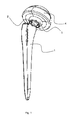
- FIGS. 1 and 2 show a femoral component of a hip joint endoprosthesis with a shaft 1 for anchoring in the core of the long bone of the femur of a patient and with a can be placed on a proximal support 2 of the shaft 1, approximately spherical cap trained head 3 to replace the diseased femoral head of the patient.
- This head 3 is inserted into a replacement socket 4 of a total hip endoprosthesis.
- the head 3 consists in the case of the embodiment shown here of an oxide ceramic, and is provided with a soldered sleeve 4, which in the case of the embodiment shown here consists of a titanium material.
- a solder is applied to the outside of the metal sleeve 5 and / or on the inner surface of a blind hole 6 in the ceramic head 3 and it is in this way after joining a solid, non-detachable connection between the ceramic head 3 and the metal sleeve 5, which may consist of a titanium material, for example, also of a cobalt-chromium alloy (CoCr) created.
- CoCr cobalt-chromium alloy
- the ceramic head 3 is replaced by a glass solder with the metal sleeve 5 connected, this compound is prepared by a solidified in a ceramic fire silicate ceramic solder. While the outside of the ceramic head 3 is not modified in this operation, the areas treated with the solder of the inner surface of the ceramic head 3 are completely covered by the metal sleeve 5, so that there is no free, interacting with the environment modified ceramic surface.
- the ceramic head 3 connected in this way firmly to the metal sleeve 5 is then attached intraoperatively directly to the metallic pin 2.
- soldered metal sleeve 5 critical stresses in the ceramic head 3, which may otherwise occur during the joining operation of the head 3 on the metallic pin 2, reliably avoided.
- the head 3 articulates with the artificial pan 4 or with a pan insert; a contact of the head 3 to the surrounding bone does not exist.
Landscapes
- Engineering & Computer Science (AREA)
- Health & Medical Sciences (AREA)
- Mechanical Engineering (AREA)
- Orthopedic Medicine & Surgery (AREA)
- Transplantation (AREA)
- Vascular Medicine (AREA)
- Cardiology (AREA)
- Oral & Maxillofacial Surgery (AREA)
- Chemical & Material Sciences (AREA)
- Biomedical Technology (AREA)
- Heart & Thoracic Surgery (AREA)
- Materials Engineering (AREA)
- Life Sciences & Earth Sciences (AREA)
- Animal Behavior & Ethology (AREA)
- General Health & Medical Sciences (AREA)
- Public Health (AREA)
- Veterinary Medicine (AREA)
- Prostheses (AREA)
Abstract
Ein orthopädisches Implantat in Form einer Hüftgelenk-Endoprothese besteht aus einem Kopf (3), der auf einen Verankerungsschaft (1) aufgesetzt ist, der seinerseits in einen Knochen einführbar und in diesem verankerbar ist. Der Kopf weist eine innere sacklochartige Ausnehmung (6) auf und der Verankerungsschaft ist mit einem Zapfen (2) zum Einstecken in diese Ausnehmung versehen. In die Ausnehmung des Kopfes ist dabei eine Hülse (5) eingelötet, über die der Kopf auf den Zapfen aufsetzbar ist. Der Kopf besteht aus einer Keramik auf der Basis von Zirkoniumdioxid, Aluminiumoxid oder Mischkeramik, während die Hülse aus einem metallischen Werkstoff besteht. Die Verbindung zwischen dem Kopf und der Hülse wird durch ein in einem keramischen Brand verfestigtes silikatisches Keramiklot hergestellt.
Description
- Die Erfindung betrifft ein orthopädisches Implantat in Form einer femoralen Komponente einer Hüftgelenk-Endoprothese mit einem Kopf, der auf einen Verankerungsschaft aufgesetzt ist, der seinerseits in einen Knochen einführbar und in diesem verankerbar ist, wobei der Kopf eine innere sacklochartige Ausnehmung aufweist und der Verankerungsschaft mit einem Zapfen zum Einstecken in diese Ausnehmung versehen ist und wobei in die Ausnehmung des Kopfes eine metallische Hülse eingesetzt ist, über die der Kopf mit dem Zapfen verbindbar ist.
- Die femorale Komponente einer Hüftgelenk-Endoprothese besteht im wesentlichen aus einem Schaft zur Verankerung im Kern des Röhrenknochens des Oberschenkels, wobei auf der proximalen Auflage des Schaftes ein angenähert kugelkalottenartiger Kopf zum Ersatz des erkrankten Hüftkopfes so aufgebracht ist, dass er mit dem Verankerungsschaft eine tragfähige Einheit bildet. Während bei manchen Endoprothesen dieser Art der Schaft mit dem Kopf aus artgleichem Material untrennbar miteinander verschweißt ist, besteht eine andere Art der Verbindung zwischen dem Prothesenkopf und dem Verankerungsschaft aus einer lösbaren Steckverbindung. Bei dieser ist ein tragender Zapfen in Form eines Konus am proximalen Ende des Prothesenverankerungsschaftes angeordnet, auf den wiederum der Prothesenkopf aufgesteckt ist. Eine solche Anordnung ist aus der
DE 2 921 529 A1 bekannt geworden. Die Verbindung zwischen dem Kopf und dem tragenden Zapfen kann, wie bei dieser bekannten Anordnung vorgesehen, lösbar ausgebildet sein, wodurch es möglich ist, während der Operation je nach Indikation auf den tragenden Zapfen entweder nur einen Kopf mit größerem Durchmesser zum Ersatz des erkrankten Hüftkopfes aufzusetzen und dadurch eine sogenannte Hemiprothese zu implantieren, oder aber durch einen Kopf kleineren Durchmessers diesen mittels einer Ersatzpfanne zu einer Total-Hüftendoprothese zu vervollständigen. - Solche Hüftgelenk-Endoprothesen sind nur dann zuverlässig einsetzbar, wenn neben einer einwandfreien Verankerung des Prothesenschaftes im Femur auch die Langzeitfunktion des den Kopf tragenden Zapfenlagers und des Kopfes selbst gewährleistet ist. So besteht insbesondere bei den für Prothesenköpfe aus Oxidkeramik üblicherweise verwendeten konischen Steckverbindungen zur Herstellung einer mechanisch festen und schlupffreien Verklemmung zwischen dem konusförmigen Lagerzapfen des Verankerungsschaftes und dem Metall- oder Keramikkopf das Problem des Verlustes einer mechanisch sicheren Verbindung sowie der Zerstörung der Oberfläche der Werkstoffpaarung aus Kopf und Schaft, wodurch Korrosionsvorgänge ausgelöst werden können, die die Langzeitfunktion der gesamten Prothese infrage stellen können. Zudem kann eine unzureichende Passung des Keramikkopfes mit dem metallischen Zapfen zu erhöhten Spannungen in der Keramik führen, mit möglichem nachfolgenden Bruch der Implantatkomponente. Des Weiteren ist das Aufstecken eines Keramikkopfes im Rahmen der Wechseloperation auf einen in-situ belassenen Schaft kritisch zu sehen.
- Aus diesem Grund stellt es eine bereits bekannte Maßnahme dar, im Keramikkopf einer Hüftgelenk-Endoprothese eine Metallhülse für das Fügen des Kopfes mit dem Zapfen vorzusehen. Dabei wird bei den bislang bekannten Anordnungen der eingangs genannten Art die Hülse entweder intraoperativ vom Operateur mit dem Kopf gefügt, oder aber sie wird präoperativ in diesen eingepreßt.
- Aufgabe der Erfindung ist es, ein Implantat der eingangs genannten Art derart auszubilden, dass der Kopf und der Schaft derart präoperativ miteinander verbunden sind, dass eine feste, nicht lösbare Verbindung zwischen der Hülse und dem Kopf entsteht und dadurch unter anderem kein Abrieb der artikulierenden Materialien von Kopf und Schaft entstehen kann und kritische, durch den Fügevorgang verursachte Spannungen im Kopf vermieden werden.
- Die Erfindung löst diese Aufgabe, indem sie vorsieht, dass bei einem derartigen Implantat die Hülse in den Kopf eingelötet ist.
- Durch die integrierte Metallhülse werden kritische Spannungen im Kopf, die beim intraoperativen Fügevorgang des Kopfes auf den in der Regel metallischen konusförmigen Schaft auftreten können und die zu Rissen im Kopf führen können, weitestgehend vermieden. Dies ist insbesondere dann von signifikanter Bedeutung, wenn der Kopf aus einer Keramik, beispielsweise aus Aluminium- oder Zirkoniumdioxid, besteht.
- Nachfolgend soll die Erfindung anhand eines in der Zeichnung dargestellten Ausführungsbeispiels näher erläutert werden. Es zeigen:
- Fig. 1
- eine Hüftgelenk-Endoprothese in perspektivischer Darstellung,
- Fig. 2
- eine Explosionsdarstellung der Anordnung gemäß
Fig. 1 - Fig. 3
- eine vergrößerte Darstellung des Kopfes der Hüftgelenk-Endoprothese gemäß
Fig. 1 und - Fig. 4
- eine Explosionsdarstellung der Anordnung gemäß
Fig. 3 . - Die Darstellung gemäß der
Figuren 1 und2 zeigt eine femorale Komponente einer Hüftgelenk-Endoprothese mit einem Schaft 1 zur Verankerung im Kern des Röhrenknochen des Oberschenkels eines Patienten sowie mit einem auf eine proximale Auflage 2 des Schaftes 1 aufsetzbaren, angenähert kugelkalottenartig ausgebildeten Kopf 3 zum Ersatz des erkrankten Hüftkopfes des Patienten. Dieser Kopf 3 ist in eine Ersatzpfanne 4 einer Total-Hüftendoprothese eingesetzt. - Der Kopf 3 besteht im Fall des hier dargestellten Ausführungsbeispiels aus einer Oxidkeramik, und ist mit einer eingelöteten Hülse 4, die im Fall des hier dargestellten Ausführungsbeispiels aus einem Titanwerkstoff besteht, versehen. Zu diesem Zweck wird auf die Außenseite der Metallhülse 5 und/oder auf die Innenfläche einer sacklochartigen Bohrung 6 im Keramikkopf 3 ein Lot aufgebracht und es wird auf diese Weise nach dem Fügen eine feste, nicht lösbare Verbindung zwischen dem Keramikkopf 3 und der Metallhülse 5, die außer aus einem Titanwerkstoff zum Beispiel auch aus einer Kobalt-Chrom-Legierung (CoCr) bestehen kann, geschaffen. Das Löten erfolgt bereits beim Hersteller der Prothese und damit bereits weit vor der Operation aufgebracht. Bei dem hier beschriebenen Ausführungsbeispiel wird der Keramikkopf 3 durch ein Glaslot mit der Metallhülse 5 verbunden, wobei diese Verbindung durch ein in einem keramischen Brand verfestigtes silikatisches Keramiklot hergestellt wird. Während die Außenseite des Keramikkopfes 3 bei diesem Arbeitsgang nicht modifiziert wird, sind die mit dem Lot behandelten Areale der inneren Oberfläche des Keramikkopfes 3 komplett von der Metallhülse 5 überdeckt, so dass keine freie, mit der Umgebung interagierende modifizierte Keramikoberfläche besteht.
- Der auf diese Weise fest mit der Metallhülse 5 verbundene Keramikkopf 3 wird anschließend intraoperativ direkt auf den metallischen Zapfen 2 aufgesteckt. Durch die eingelötete Metallhülse 5 werden kritische Spannungen im Keramikkopf 3, die ansonsten beim Fügevorgang des Kopfes 3 auf den metallischen Zapfen 2 auftreten können, zuverlässig vermieden. Der Kopf 3 artikuliert mit der künstlichen Pfanne 4 bzw. mit einem Pfanneneinsatz; ein Kontakt des Kopfes 3 zum umgebenden Knochen besteht nicht.
Claims (12)
- Orthopädisches Implantat in Form einer femoralen Komponente einer Hüftgelenk-Endoprothese mit einem Kopf, der auf einen Verankerungsschaft aufgesetzt ist, der seinerseits in einen Knochen einführbar und in diesem verankerbar ist, wobei der Kopf eine innere sacklochartige Ausnehmung aufweist und der Verankerungsschaft mit einem Zapfen zum Einstecken in diese Ausnehmung versehen ist und wobei in die Ausnehmung des Kopfes eine metallische Hülse eingesetzt ist, über die der Kopf mit dem Zapfen verbindbar ist, dadurch gekennzeichnet, dass die Hülse (5) in den Kopf (3) eingelötet ist.
- Implantat nach Anspruch 1, dadurch gekennzeichnet, dass der Kopf (3) aus einer Keramik auf der Basis von Zirkoniumdioxid besteht.
- Implantat nach Anspruch 1, dadurch gekennzeichnet, dass der Kopf (3) aus einer Keramik auf der Basis von Aluminiumoxid besteht.
- Implantat nach Anspruch 1, dadurch gekennzeichnet, dass der Kopf (3) aus einer Keramik auf der Basis von Mischkeramik besteht.
- Implantat nach einem der Ansprüche 1 bis 4, dadurch gekennzeichnet, dass die Hülse (5) aus Reintitan besteht.
- Implantat nach einem der Ansprüche 1 bis 4, dadurch gekennzeichnet, dass die Hülse (5) aus einer Titanlegierung besteht.
- Implantat nach einem der Ansprüche 1 bis 4, dadurch gekennzeichnet, dass die Hülse (5) aus einer Kobalt-Chrom-Legierung besteht.
- Implantat nach einem der Ansprüche 1 bis 7, dadurch gekennzeichnet, dass der Grundkörper (2) der femoralen Komponente (1) aus einer Titanlegierung besteht.
- Implantat nach einem der Ansprüche 1 bis 7, dadurch gekennzeichnet, dass der Grundkörper (2) der femoralen Komponente (1) aus einer Kobalt-Chrom-Legierung besteht.
- Implantat nach einem der Ansprüche 1 bis 7, dadurch gekennzeichnet, dass der Grundkörper (2) der femoralen Komponente (1) aus Edelstahl besteht.
- Implantat nach einem der Ansprüche 1 bis 10, dadurch gekennzeichnet, dass der Kopf (3) durch ein Glaslot mit der Hülse (5) verbunden ist.
- Implantat nach Anspruch 11, dadurch gekennzeichnet, dass die Verbindung durch ein in einem keramischen Brand verfestigtes silikatisches Keramiklot hergestellt ist.
Applications Claiming Priority (1)
| Application Number | Priority Date | Filing Date | Title |
|---|---|---|---|
| DE102012014345.1A DE102012014345A1 (de) | 2012-07-20 | 2012-07-20 | Orthopädisches Implantat |
Publications (1)
| Publication Number | Publication Date |
|---|---|
| EP2687190A1 true EP2687190A1 (de) | 2014-01-22 |
Family
ID=48577470
Family Applications (1)
| Application Number | Title | Priority Date | Filing Date |
|---|---|---|---|
| EP13002836.8A Withdrawn EP2687190A1 (de) | 2012-07-20 | 2013-06-01 | Orthopädisches Implantat |
Country Status (2)
| Country | Link |
|---|---|
| EP (1) | EP2687190A1 (de) |
| DE (1) | DE102012014345A1 (de) |
Families Citing this family (2)
| Publication number | Priority date | Publication date | Assignee | Title |
|---|---|---|---|---|
| DE102015016895B3 (de) | 2015-12-29 | 2017-05-24 | Zm Präzisionsdentaltechnik Gmbh | Knieendoprothese |
| DE102015016893B3 (de) * | 2015-12-29 | 2017-07-13 | Milija Mitrovic | Orthopädisches Implantat |
Citations (5)
| Publication number | Priority date | Publication date | Assignee | Title |
|---|---|---|---|---|
| DE2921529A1 (de) | 1979-05-28 | 1980-12-11 | Helmut L Hruschka | Steckverbindung fuer hueftgelenk- endoprothesen-koepfe |
| EP0406040A2 (de) * | 1989-06-28 | 1991-01-02 | La Biomecanique Integree | Kugelgelenk für Prothese |
| DE10340059A1 (de) * | 2003-07-24 | 2005-02-10 | Schröder, Ralf, Dr. | Zahnimplantat, insbesondere Grundkörper und Aufbauteil eines Zahnimplantats |
| WO2005027799A1 (en) * | 2003-09-19 | 2005-03-31 | Element Six Limited | Prosthetic joint |
| US20060188845A1 (en) * | 2003-10-01 | 2006-08-24 | Signal Medical Corporation | Implant bore insert |
-
2012
- 2012-07-20 DE DE102012014345.1A patent/DE102012014345A1/de not_active Withdrawn
-
2013
- 2013-06-01 EP EP13002836.8A patent/EP2687190A1/de not_active Withdrawn
Patent Citations (5)
| Publication number | Priority date | Publication date | Assignee | Title |
|---|---|---|---|---|
| DE2921529A1 (de) | 1979-05-28 | 1980-12-11 | Helmut L Hruschka | Steckverbindung fuer hueftgelenk- endoprothesen-koepfe |
| EP0406040A2 (de) * | 1989-06-28 | 1991-01-02 | La Biomecanique Integree | Kugelgelenk für Prothese |
| DE10340059A1 (de) * | 2003-07-24 | 2005-02-10 | Schröder, Ralf, Dr. | Zahnimplantat, insbesondere Grundkörper und Aufbauteil eines Zahnimplantats |
| WO2005027799A1 (en) * | 2003-09-19 | 2005-03-31 | Element Six Limited | Prosthetic joint |
| US20060188845A1 (en) * | 2003-10-01 | 2006-08-24 | Signal Medical Corporation | Implant bore insert |
Also Published As
| Publication number | Publication date |
|---|---|
| DE102012014345A1 (de) | 2014-01-23 |
Similar Documents
| Publication | Publication Date | Title |
|---|---|---|
| DE2535649C3 (de) | Keramische kugelförmige Hüftgelenk-Kappenprothese für eine zementfreie Implantation | |
| DE602004003624T2 (de) | Umgekehrte Prothese für das Schultergelenk | |
| DE2319098A1 (de) | Kuenstliches hueftgelenk | |
| DE2220304A1 (de) | Hueftgelenkprothese, operationsverfahren zum einsetzen dieser prothese, sowie werkzeugsatz zur ausfuehrung des operationsverfahrens | |
| DE3804239A1 (de) | Gelenkpfannenteil fuer eine gelenkprothese | |
| EP0483057B1 (de) | Zentrierelement für das Schaftende einer Gelenkendoprothese | |
| DE2854334B2 (de) | Oberschenkel-Hüftgelenk-Endoprothese | |
| DE102010044571A1 (de) | Basisimplantat | |
| EP1276440B1 (de) | Schenkelhalsprothese | |
| EP1885294B1 (de) | Schenkelhalsprothese | |
| EP3403618B1 (de) | Kupplungsvorrichtung zum verbinden von prothesenkomponenten über einen selbsthemmenden klemmsitz | |
| AT507521B1 (de) | Manipuliersystem zur auswahl | |
| WO2014166877A1 (de) | Befestigung keramischer bauteile | |
| EP3397211B1 (de) | Orthopädisches implantat | |
| EP2687190A1 (de) | Orthopädisches Implantat | |
| CN111297521A (zh) | 一种表面肩关节假体 | |
| EP2066265B1 (de) | Hüftimplantat | |
| EP2662055A1 (de) | Verstärkungsimplantat für einen langgestreckten Knochen, insbesondere Femur | |
| WO2000045750A1 (de) | Hüftendoprothese, in der mindestens die artikulationsfläche des femurkopfes ersetzt ist | |
| DE3923154A1 (de) | Endoprothese zum teilersatz des gelenkkopfes eines menschlichen knochens | |
| WO2012126449A1 (de) | Keramik-einsatz für knieendoprothesen | |
| EP3419677B1 (de) | Orthopädisches implantat | |
| EP3332746B1 (de) | Revisionsprothesenschaft für eine revisions-gelenkendoprothese | |
| EP1753477B1 (de) | Hüftgelenk-endoprothese mit hülse aus biokompatiblem kunststoff | |
| DE102005001255B4 (de) | Inverse Schultergelenk-Endoprothese mit einteiligem Mittelteil |
Legal Events
| Date | Code | Title | Description |
|---|---|---|---|
| PUAI | Public reference made under article 153(3) epc to a published international application that has entered the european phase |
Free format text: ORIGINAL CODE: 0009012 |
|
| 17P | Request for examination filed |
Effective date: 20130601 |
|
| AK | Designated contracting states |
Kind code of ref document: A1 Designated state(s): AL AT BE BG CH CY CZ DE DK EE ES FI FR GB GR HR HU IE IS IT LI LT LU LV MC MK MT NL NO PL PT RO RS SE SI SK SM TR |
|
| AX | Request for extension of the european patent |
Extension state: BA ME |
|
| STAA | Information on the status of an ep patent application or granted ep patent |
Free format text: STATUS: THE APPLICATION IS DEEMED TO BE WITHDRAWN |
|
| 18D | Application deemed to be withdrawn |
Effective date: 20140723 |