EP2687517B1 - Composé polymérisable, composition polymérisable à cristaux liquides, composé macromoléculaire et film - Google Patents
Composé polymérisable, composition polymérisable à cristaux liquides, composé macromoléculaire et film Download PDFInfo
- Publication number
- EP2687517B1 EP2687517B1 EP12757824.3A EP12757824A EP2687517B1 EP 2687517 B1 EP2687517 B1 EP 2687517B1 EP 12757824 A EP12757824 A EP 12757824A EP 2687517 B1 EP2687517 B1 EP 2687517B1
- Authority
- EP
- European Patent Office
- Prior art keywords
- compound
- group
- carbon atoms
- liquid crystalline
- film
- Prior art date
- Legal status (The legal status is an assumption and is not a legal conclusion. Google has not performed a legal analysis and makes no representation as to the accuracy of the status listed.)
- Not-in-force
Links
- 150000001875 compounds Chemical class 0.000 title claims description 229
- 239000007788 liquid Substances 0.000 title claims description 107
- 239000000203 mixture Substances 0.000 title claims description 54
- 229920002521 macromolecule Polymers 0.000 title claims description 9
- 125000004432 carbon atom Chemical group C* 0.000 claims description 63
- 125000004435 hydrogen atom Chemical group [H]* 0.000 claims description 25
- 125000000217 alkyl group Chemical group 0.000 claims description 20
- 125000002947 alkylene group Chemical group 0.000 claims description 13
- 125000001140 1,4-phenylene group Chemical group [H]C1=C([H])C([*:2])=C([H])C([H])=C1[*:1] 0.000 claims description 8
- 125000003545 alkoxy group Chemical group 0.000 claims description 8
- 125000005843 halogen group Chemical group 0.000 claims description 8
- UWCWUCKPEYNDNV-LBPRGKRZSA-N 2,6-dimethyl-n-[[(2s)-pyrrolidin-2-yl]methyl]aniline Chemical compound CC1=CC=CC(C)=C1NC[C@H]1NCCC1 UWCWUCKPEYNDNV-LBPRGKRZSA-N 0.000 claims description 6
- 125000002252 acyl group Chemical group 0.000 claims description 6
- 125000004423 acyloxy group Chemical group 0.000 claims description 6
- 125000004453 alkoxycarbonyl group Chemical group 0.000 claims description 6
- 125000003368 amide group Chemical group 0.000 claims description 6
- 125000004093 cyano group Chemical group *C#N 0.000 claims description 6
- 125000000524 functional group Chemical group 0.000 claims description 5
- 230000000379 polymerizing effect Effects 0.000 claims description 5
- 125000006165 cyclic alkyl group Chemical group 0.000 claims description 4
- 125000000956 methoxy group Chemical group [H]C([H])([H])O* 0.000 claims description 4
- 125000002496 methyl group Chemical group [H]C([H])([H])* 0.000 claims description 4
- 229910052736 halogen Inorganic materials 0.000 claims description 3
- 150000002367 halogens Chemical class 0.000 claims description 3
- 239000010408 film Substances 0.000 description 112
- 238000000034 method Methods 0.000 description 23
- 125000001424 substituent group Chemical group 0.000 description 20
- -1 aniline compound Chemical class 0.000 description 18
- 238000006243 chemical reaction Methods 0.000 description 17
- 239000000243 solution Substances 0.000 description 17
- 239000000758 substrate Substances 0.000 description 15
- 239000012530 fluid Substances 0.000 description 14
- 239000011248 coating agent Substances 0.000 description 13
- 238000000576 coating method Methods 0.000 description 13
- 229920000642 polymer Polymers 0.000 description 13
- 230000000052 comparative effect Effects 0.000 description 12
- 230000003287 optical effect Effects 0.000 description 12
- 230000005855 radiation Effects 0.000 description 12
- 239000003795 chemical substances by application Substances 0.000 description 11
- 230000007423 decrease Effects 0.000 description 11
- WYURNTSHIVDZCO-UHFFFAOYSA-N Tetrahydrofuran Chemical compound C1CCOC1 WYURNTSHIVDZCO-UHFFFAOYSA-N 0.000 description 10
- 125000003118 aryl group Chemical group 0.000 description 10
- 125000005647 linker group Chemical group 0.000 description 10
- 238000006116 polymerization reaction Methods 0.000 description 10
- ZMXDDKWLCZADIW-UHFFFAOYSA-N N,N-Dimethylformamide Chemical compound CN(C)C=O ZMXDDKWLCZADIW-UHFFFAOYSA-N 0.000 description 9
- 230000003098 cholesteric effect Effects 0.000 description 9
- 239000004973 liquid crystal related substance Substances 0.000 description 9
- 239000000463 material Substances 0.000 description 9
- 239000002904 solvent Substances 0.000 description 9
- JGFZNNIVVJXRND-UHFFFAOYSA-N N,N-Diisopropylethylamine (DIPEA) Chemical compound CCN(C(C)C)C(C)C JGFZNNIVVJXRND-UHFFFAOYSA-N 0.000 description 8
- HEDRZPFGACZZDS-MICDWDOJSA-N Trichloro(2H)methane Chemical compound [2H]C(Cl)(Cl)Cl HEDRZPFGACZZDS-MICDWDOJSA-N 0.000 description 8
- 230000015572 biosynthetic process Effects 0.000 description 8
- 229920002451 polyvinyl alcohol Polymers 0.000 description 8
- 235000019422 polyvinyl alcohol Nutrition 0.000 description 8
- 230000007704 transition Effects 0.000 description 8
- 238000004040 coloring Methods 0.000 description 7
- 230000001276 controlling effect Effects 0.000 description 7
- 238000004519 manufacturing process Methods 0.000 description 7
- 239000012788 optical film Substances 0.000 description 7
- 239000007787 solid Substances 0.000 description 7
- 238000005160 1H NMR spectroscopy Methods 0.000 description 6
- YMWUJEATGCHHMB-UHFFFAOYSA-N Dichloromethane Chemical compound ClCCl YMWUJEATGCHHMB-UHFFFAOYSA-N 0.000 description 6
- VEXZGXHMUGYJMC-UHFFFAOYSA-N Hydrochloric acid Chemical compound Cl VEXZGXHMUGYJMC-UHFFFAOYSA-N 0.000 description 6
- OKKJLVBELUTLKV-UHFFFAOYSA-N Methanol Chemical compound OC OKKJLVBELUTLKV-UHFFFAOYSA-N 0.000 description 6
- 230000008859 change Effects 0.000 description 6
- 238000003786 synthesis reaction Methods 0.000 description 6
- FYSNRJHAOHDILO-UHFFFAOYSA-N thionyl chloride Chemical compound ClS(Cl)=O FYSNRJHAOHDILO-UHFFFAOYSA-N 0.000 description 6
- VHYFNPMBLIVWCW-UHFFFAOYSA-N 4-Dimethylaminopyridine Chemical compound CN(C)C1=CC=NC=C1 VHYFNPMBLIVWCW-UHFFFAOYSA-N 0.000 description 5
- 239000004372 Polyvinyl alcohol Substances 0.000 description 5
- 230000001747 exhibiting effect Effects 0.000 description 5
- 230000007062 hydrolysis Effects 0.000 description 5
- 238000006460 hydrolysis reaction Methods 0.000 description 5
- 230000010287 polarization Effects 0.000 description 5
- FJKROLUGYXJWQN-UHFFFAOYSA-N 4-hydroxybenzoic acid Chemical compound OC(=O)C1=CC=C(O)C=C1 FJKROLUGYXJWQN-UHFFFAOYSA-N 0.000 description 4
- HEDRZPFGACZZDS-UHFFFAOYSA-N Chloroform Chemical compound ClC(Cl)Cl HEDRZPFGACZZDS-UHFFFAOYSA-N 0.000 description 4
- JUJWROOIHBZHMG-UHFFFAOYSA-N Pyridine Chemical compound C1=CC=NC=C1 JUJWROOIHBZHMG-UHFFFAOYSA-N 0.000 description 4
- PPBRXRYQALVLMV-UHFFFAOYSA-N Styrene Chemical compound C=CC1=CC=CC=C1 PPBRXRYQALVLMV-UHFFFAOYSA-N 0.000 description 4
- NIXOWILDQLNWCW-UHFFFAOYSA-M acrylate group Chemical group C(C=C)(=O)[O-] NIXOWILDQLNWCW-UHFFFAOYSA-M 0.000 description 4
- 229920001577 copolymer Polymers 0.000 description 4
- 230000002349 favourable effect Effects 0.000 description 4
- 238000005259 measurement Methods 0.000 description 4
- 230000000704 physical effect Effects 0.000 description 4
- 229920006254 polymer film Polymers 0.000 description 4
- 239000003505 polymerization initiator Substances 0.000 description 4
- ZFPGARUNNKGOBB-UHFFFAOYSA-N 1-Ethyl-2-pyrrolidinone Chemical compound CCN1CCCC1=O ZFPGARUNNKGOBB-UHFFFAOYSA-N 0.000 description 3
- ZWEHNKRNPOVVGH-UHFFFAOYSA-N 2-Butanone Chemical compound CCC(C)=O ZWEHNKRNPOVVGH-UHFFFAOYSA-N 0.000 description 3
- HQQTZCPKNZVLFF-UHFFFAOYSA-N 4h-1,2-benzoxazin-3-one Chemical group C1=CC=C2ONC(=O)CC2=C1 HQQTZCPKNZVLFF-UHFFFAOYSA-N 0.000 description 3
- IJGRMHOSHXDMSA-UHFFFAOYSA-N Atomic nitrogen Chemical compound N#N IJGRMHOSHXDMSA-UHFFFAOYSA-N 0.000 description 3
- UHOVQNZJYSORNB-UHFFFAOYSA-N Benzene Chemical compound C1=CC=CC=C1 UHOVQNZJYSORNB-UHFFFAOYSA-N 0.000 description 3
- 229920002284 Cellulose triacetate Polymers 0.000 description 3
- 229940126062 Compound A Drugs 0.000 description 3
- XEKOWRVHYACXOJ-UHFFFAOYSA-N Ethyl acetate Chemical compound CCOC(C)=O XEKOWRVHYACXOJ-UHFFFAOYSA-N 0.000 description 3
- 108010010803 Gelatin Proteins 0.000 description 3
- NLDMNSXOCDLTTB-UHFFFAOYSA-N Heterophylliin A Natural products O1C2COC(=O)C3=CC(O)=C(O)C(O)=C3C3=C(O)C(O)=C(O)C=C3C(=O)OC2C(OC(=O)C=2C=C(O)C(O)=C(O)C=2)C(O)C1OC(=O)C1=CC(O)=C(O)C(O)=C1 NLDMNSXOCDLTTB-UHFFFAOYSA-N 0.000 description 3
- NNLVGZFZQQXQNW-ADJNRHBOSA-N [(2r,3r,4s,5r,6s)-4,5-diacetyloxy-3-[(2s,3r,4s,5r,6r)-3,4,5-triacetyloxy-6-(acetyloxymethyl)oxan-2-yl]oxy-6-[(2r,3r,4s,5r,6s)-4,5,6-triacetyloxy-2-(acetyloxymethyl)oxan-3-yl]oxyoxan-2-yl]methyl acetate Chemical compound O([C@@H]1O[C@@H]([C@H]([C@H](OC(C)=O)[C@H]1OC(C)=O)O[C@H]1[C@@H]([C@@H](OC(C)=O)[C@H](OC(C)=O)[C@@H](COC(C)=O)O1)OC(C)=O)COC(=O)C)[C@@H]1[C@@H](COC(C)=O)O[C@@H](OC(C)=O)[C@H](OC(C)=O)[C@H]1OC(C)=O NNLVGZFZQQXQNW-ADJNRHBOSA-N 0.000 description 3
- 239000000654 additive Substances 0.000 description 3
- 239000007864 aqueous solution Substances 0.000 description 3
- 239000012298 atmosphere Substances 0.000 description 3
- 229910052799 carbon Inorganic materials 0.000 description 3
- 230000000694 effects Effects 0.000 description 3
- 125000003700 epoxy group Chemical group 0.000 description 3
- 229920000159 gelatin Polymers 0.000 description 3
- 239000008273 gelatin Substances 0.000 description 3
- 235000019322 gelatine Nutrition 0.000 description 3
- 235000011852 gelatine desserts Nutrition 0.000 description 3
- 238000001093 holography Methods 0.000 description 3
- 230000006872 improvement Effects 0.000 description 3
- 239000003999 initiator Substances 0.000 description 3
- VLKZOEOYAKHREP-UHFFFAOYSA-N n-Hexane Chemical compound CCCCCC VLKZOEOYAKHREP-UHFFFAOYSA-N 0.000 description 3
- 239000003960 organic solvent Substances 0.000 description 3
- 229920000139 polyethylene terephthalate Polymers 0.000 description 3
- 239000005020 polyethylene terephthalate Substances 0.000 description 3
- 229920001721 polyimide Polymers 0.000 description 3
- YLQBMQCUIZJEEH-UHFFFAOYSA-N tetrahydrofuran Natural products C=1C=COC=1 YLQBMQCUIZJEEH-UHFFFAOYSA-N 0.000 description 3
- SIRCEYNUIFMUCH-UHFFFAOYSA-N 2-(5-oxohept-6-enoxy)benzoic acid Chemical compound OC(=O)C1=CC=CC=C1OCCCCC(=O)C=C SIRCEYNUIFMUCH-UHFFFAOYSA-N 0.000 description 2
- DPELYVFAULJYNX-UHFFFAOYSA-N 2-amino-4-hydroxybenzoic acid Chemical compound NC1=CC(O)=CC=C1C(O)=O DPELYVFAULJYNX-UHFFFAOYSA-N 0.000 description 2
- 229960000549 4-dimethylaminophenol Drugs 0.000 description 2
- 229940090248 4-hydroxybenzoic acid Drugs 0.000 description 2
- CSCPPACGZOOCGX-UHFFFAOYSA-N Acetone Chemical compound CC(C)=O CSCPPACGZOOCGX-UHFFFAOYSA-N 0.000 description 2
- 229920002134 Carboxymethyl cellulose Polymers 0.000 description 2
- RTZKZFJDLAIYFH-UHFFFAOYSA-N Diethyl ether Chemical compound CCOCC RTZKZFJDLAIYFH-UHFFFAOYSA-N 0.000 description 2
- XTHFKEDIFFGKHM-UHFFFAOYSA-N Dimethoxyethane Chemical compound COCCOC XTHFKEDIFFGKHM-UHFFFAOYSA-N 0.000 description 2
- IAZDPXIOMUYVGZ-WFGJKAKNSA-N Dimethyl sulfoxide Chemical compound [2H]C([2H])([2H])S(=O)C([2H])([2H])[2H] IAZDPXIOMUYVGZ-WFGJKAKNSA-N 0.000 description 2
- IAZDPXIOMUYVGZ-UHFFFAOYSA-N Dimethylsulphoxide Chemical compound CS(C)=O IAZDPXIOMUYVGZ-UHFFFAOYSA-N 0.000 description 2
- YCKRFDGAMUMZLT-UHFFFAOYSA-N Fluorine atom Chemical compound [F] YCKRFDGAMUMZLT-UHFFFAOYSA-N 0.000 description 2
- 239000004698 Polyethylene Substances 0.000 description 2
- 239000004642 Polyimide Substances 0.000 description 2
- 239000004743 Polypropylene Substances 0.000 description 2
- 239000004990 Smectic liquid crystal Substances 0.000 description 2
- YXFVVABEGXRONW-UHFFFAOYSA-N Toluene Natural products CC1=CC=CC=C1 YXFVVABEGXRONW-UHFFFAOYSA-N 0.000 description 2
- 238000000862 absorption spectrum Methods 0.000 description 2
- DZBUGLKDJFMEHC-UHFFFAOYSA-N acridine Chemical compound C1=CC=CC2=CC3=CC=CC=C3N=C21 DZBUGLKDJFMEHC-UHFFFAOYSA-N 0.000 description 2
- 230000032683 aging Effects 0.000 description 2
- 125000004450 alkenylene group Chemical group 0.000 description 2
- 150000001350 alkyl halides Chemical class 0.000 description 2
- QVGXLLKOCUKJST-UHFFFAOYSA-N atomic oxygen Chemical compound [O] QVGXLLKOCUKJST-UHFFFAOYSA-N 0.000 description 2
- 125000004069 aziridinyl group Chemical group 0.000 description 2
- 239000001768 carboxy methyl cellulose Substances 0.000 description 2
- 235000010948 carboxy methyl cellulose Nutrition 0.000 description 2
- 239000008112 carboxymethyl-cellulose Substances 0.000 description 2
- 239000013078 crystal Substances 0.000 description 2
- 239000002178 crystalline material Substances 0.000 description 2
- 238000006210 cyclodehydration reaction Methods 0.000 description 2
- 230000007547 defect Effects 0.000 description 2
- 238000011156 evaluation Methods 0.000 description 2
- 229910052731 fluorine Inorganic materials 0.000 description 2
- 239000011737 fluorine Substances 0.000 description 2
- 239000011521 glass Substances 0.000 description 2
- 238000007756 gravure coating Methods 0.000 description 2
- 238000010438 heat treatment Methods 0.000 description 2
- 125000005842 heteroatom Chemical group 0.000 description 2
- 239000003112 inhibitor Substances 0.000 description 2
- 150000002576 ketones Chemical class 0.000 description 2
- CERQOIWHTDAKMF-UHFFFAOYSA-M methacrylate group Chemical group C(C(=C)C)(=O)[O-] CERQOIWHTDAKMF-UHFFFAOYSA-M 0.000 description 2
- 150000002894 organic compounds Chemical class 0.000 description 2
- 239000001301 oxygen Substances 0.000 description 2
- 229910052760 oxygen Inorganic materials 0.000 description 2
- 229920003229 poly(methyl methacrylate) Polymers 0.000 description 2
- 229920000515 polycarbonate Polymers 0.000 description 2
- 239000004417 polycarbonate Substances 0.000 description 2
- 229920000573 polyethylene Polymers 0.000 description 2
- 239000004926 polymethyl methacrylate Substances 0.000 description 2
- 229920000098 polyolefin Polymers 0.000 description 2
- LVTJOONKWUXEFR-FZRMHRINSA-N protoneodioscin Natural products O(C[C@@H](CC[C@]1(O)[C@H](C)[C@@H]2[C@]3(C)[C@H]([C@H]4[C@@H]([C@]5(C)C(=CC4)C[C@@H](O[C@@H]4[C@H](O[C@H]6[C@@H](O)[C@@H](O)[C@@H](O)[C@H](C)O6)[C@@H](O)[C@H](O[C@H]6[C@@H](O)[C@@H](O)[C@@H](O)[C@H](C)O6)[C@H](CO)O4)CC5)CC3)C[C@@H]2O1)C)[C@H]1[C@H](O)[C@H](O)[C@H](O)[C@@H](CO)O1 LVTJOONKWUXEFR-FZRMHRINSA-N 0.000 description 2
- UMJSCPRVCHMLSP-UHFFFAOYSA-N pyridine Natural products COC1=CC=CN=C1 UMJSCPRVCHMLSP-UHFFFAOYSA-N 0.000 description 2
- 238000004528 spin coating Methods 0.000 description 2
- 239000000126 substance Substances 0.000 description 2
- XLYOFNOQVPJJNP-UHFFFAOYSA-N water Substances O XLYOFNOQVPJJNP-UHFFFAOYSA-N 0.000 description 2
- XUKSWKGOQKREON-UHFFFAOYSA-N 1,4-diacetoxybutane Chemical compound CC(=O)OCCCCOC(C)=O XUKSWKGOQKREON-UHFFFAOYSA-N 0.000 description 1
- AUXIEQKHXAYAHG-UHFFFAOYSA-N 1-phenylcyclohexane-1-carbonitrile Chemical class C=1C=CC=CC=1C1(C#N)CCCCC1 AUXIEQKHXAYAHG-UHFFFAOYSA-N 0.000 description 1
- OOLUVSIJOMLOCB-UHFFFAOYSA-N 1633-22-3 Chemical compound C1CC(C=C2)=CC=C2CCC2=CC=C1C=C2 OOLUVSIJOMLOCB-UHFFFAOYSA-N 0.000 description 1
- RNFJDJUURJAICM-UHFFFAOYSA-N 2,2,4,4,6,6-hexaphenoxy-1,3,5-triaza-2$l^{5},4$l^{5},6$l^{5}-triphosphacyclohexa-1,3,5-triene Chemical compound N=1P(OC=2C=CC=CC=2)(OC=2C=CC=CC=2)=NP(OC=2C=CC=CC=2)(OC=2C=CC=CC=2)=NP=1(OC=1C=CC=CC=1)OC1=CC=CC=C1 RNFJDJUURJAICM-UHFFFAOYSA-N 0.000 description 1
- SMZOUWXMTYCWNB-UHFFFAOYSA-N 2-(2-methoxy-5-methylphenyl)ethanamine Chemical compound COC1=CC=C(C)C=C1CCN SMZOUWXMTYCWNB-UHFFFAOYSA-N 0.000 description 1
- QLKLYVNJRVFCHR-UHFFFAOYSA-N 2-(5-oxohept-6-enoxycarbonyloxy)benzoic acid Chemical compound OC(=O)c1ccccc1OC(=O)OCCCCC(=O)C=C QLKLYVNJRVFCHR-UHFFFAOYSA-N 0.000 description 1
- NIXOWILDQLNWCW-UHFFFAOYSA-N 2-Propenoic acid Natural products OC(=O)C=C NIXOWILDQLNWCW-UHFFFAOYSA-N 0.000 description 1
- JKRIWPXSEMPTNP-UHFFFAOYSA-N 2-hydroxylaminobenzoic acid Chemical class ONC1=CC=CC=C1C(O)=O JKRIWPXSEMPTNP-UHFFFAOYSA-N 0.000 description 1
- WLNDDIWESXCXHM-UHFFFAOYSA-N 2-phenyl-1,4-dioxane Chemical class C1OCCOC1C1=CC=CC=C1 WLNDDIWESXCXHM-UHFFFAOYSA-N 0.000 description 1
- OXPDQFOKSZYEMJ-UHFFFAOYSA-N 2-phenylpyrimidine Chemical class C1=CC=CC=C1C1=NC=CC=N1 OXPDQFOKSZYEMJ-UHFFFAOYSA-N 0.000 description 1
- MWKAGZWJHCTVJY-UHFFFAOYSA-N 3-hydroxyoctadecan-2-one Chemical compound CCCCCCCCCCCCCCCC(O)C(C)=O MWKAGZWJHCTVJY-UHFFFAOYSA-N 0.000 description 1
- RZZZQPNSNIVWAU-UHFFFAOYSA-N 4-prop-2-enoyloxybenzoic acid Chemical compound OC(=O)C1=CC=C(OC(=O)C=C)C=C1 RZZZQPNSNIVWAU-UHFFFAOYSA-N 0.000 description 1
- 229920002126 Acrylic acid copolymer Polymers 0.000 description 1
- NLZUEZXRPGMBCV-UHFFFAOYSA-N Butylhydroxytoluene Chemical compound CC1=CC(C(C)(C)C)=C(O)C(C(C)(C)C)=C1 NLZUEZXRPGMBCV-UHFFFAOYSA-N 0.000 description 1
- 0 CCC(*)(CC)c1ccc(*C(C)(C)c(c(*)c23)c(*)c(*)c2N=C(c2c(*)c(*)c(C(CC)(CC)*c4ccc(C(C)(C)*)cc4)c(*)c2*)OC3=O)cc1 Chemical compound CCC(*)(CC)c1ccc(*C(C)(C)c(c(*)c23)c(*)c(*)c2N=C(c2c(*)c(*)c(C(CC)(CC)*c4ccc(C(C)(C)*)cc4)c(*)c2*)OC3=O)cc1 0.000 description 1
- VGGSQFUCUMXWEO-UHFFFAOYSA-N Ethene Chemical compound C=C VGGSQFUCUMXWEO-UHFFFAOYSA-N 0.000 description 1
- 239000005977 Ethylene Substances 0.000 description 1
- PAYRUJLWNCNPSJ-UHFFFAOYSA-N N-phenyl amine Natural products NC1=CC=CC=C1 PAYRUJLWNCNPSJ-UHFFFAOYSA-N 0.000 description 1
- 239000000020 Nitrocellulose Substances 0.000 description 1
- XBDQKXXYIPTUBI-UHFFFAOYSA-M Propionate Chemical compound CCC([O-])=O XBDQKXXYIPTUBI-UHFFFAOYSA-M 0.000 description 1
- 239000006087 Silane Coupling Agent Substances 0.000 description 1
- XTXRWKRVRITETP-UHFFFAOYSA-N Vinyl acetate Chemical compound CC(=O)OC=C XTXRWKRVRITETP-UHFFFAOYSA-N 0.000 description 1
- 239000002250 absorbent Substances 0.000 description 1
- 230000002745 absorbent Effects 0.000 description 1
- 230000001133 acceleration Effects 0.000 description 1
- KXKVLQRXCPHEJC-UHFFFAOYSA-N acetic acid trimethyl ester Natural products COC(C)=O KXKVLQRXCPHEJC-UHFFFAOYSA-N 0.000 description 1
- 230000000996 additive effect Effects 0.000 description 1
- 125000002723 alicyclic group Chemical group 0.000 description 1
- 125000004414 alkyl thio group Chemical group 0.000 description 1
- 150000001408 amides Chemical class 0.000 description 1
- 125000003277 amino group Chemical group 0.000 description 1
- 125000002490 anilino group Chemical group [H]N(*)C1=C([H])C([H])=C([H])C([H])=C1[H] 0.000 description 1
- 238000010539 anionic addition polymerization reaction Methods 0.000 description 1
- 239000003963 antioxidant agent Substances 0.000 description 1
- 230000003078 antioxidant effect Effects 0.000 description 1
- 125000004429 atom Chemical group 0.000 description 1
- 125000005337 azoxy group Chemical group [N+]([O-])(=N*)* 0.000 description 1
- 238000007611 bar coating method Methods 0.000 description 1
- 230000008901 benefit Effects 0.000 description 1
- WPYMKLBDIGXBTP-UHFFFAOYSA-N benzoic acid Chemical class OC(=O)C1=CC=CC=C1 WPYMKLBDIGXBTP-UHFFFAOYSA-N 0.000 description 1
- ZDZHCHYQNPQSGG-UHFFFAOYSA-N binaphthyl group Chemical group C1(=CC=CC2=CC=CC=C12)C1=CC=CC2=CC=CC=C12 ZDZHCHYQNPQSGG-UHFFFAOYSA-N 0.000 description 1
- ZLSMCQSGRWNEGX-UHFFFAOYSA-N bis(4-aminophenyl)methanone Chemical compound C1=CC(N)=CC=C1C(=O)C1=CC=C(N)C=C1 ZLSMCQSGRWNEGX-UHFFFAOYSA-N 0.000 description 1
- 238000012662 bulk polymerization Methods 0.000 description 1
- 238000010538 cationic polymerization reaction Methods 0.000 description 1
- 239000012986 chain transfer agent Substances 0.000 description 1
- 229910052801 chlorine Inorganic materials 0.000 description 1
- 125000001309 chloro group Chemical group Cl* 0.000 description 1
- JNGZXGGOCLZBFB-IVCQMTBJSA-N compound E Chemical compound N([C@@H](C)C(=O)N[C@@H]1C(N(C)C2=CC=CC=C2C(C=2C=CC=CC=2)=N1)=O)C(=O)CC1=CC(F)=CC(F)=C1 JNGZXGGOCLZBFB-IVCQMTBJSA-N 0.000 description 1
- 238000009833 condensation Methods 0.000 description 1
- 230000005494 condensation Effects 0.000 description 1
- 239000000470 constituent Substances 0.000 description 1
- 230000008602 contraction Effects 0.000 description 1
- 238000001816 cooling Methods 0.000 description 1
- 238000012718 coordination polymerization Methods 0.000 description 1
- 239000003431 cross linking reagent Substances 0.000 description 1
- 125000004802 cyanophenyl group Chemical group 0.000 description 1
- 230000003247 decreasing effect Effects 0.000 description 1
- 239000013530 defoamer Substances 0.000 description 1
- 238000007607 die coating method Methods 0.000 description 1
- 239000000539 dimer Substances 0.000 description 1
- 229910001873 dinitrogen Inorganic materials 0.000 description 1
- 239000002270 dispersing agent Substances 0.000 description 1
- 238000001035 drying Methods 0.000 description 1
- 230000005684 electric field Effects 0.000 description 1
- 150000002148 esters Chemical class 0.000 description 1
- 125000001033 ether group Chemical group 0.000 description 1
- 150000002170 ethers Chemical class 0.000 description 1
- 238000001704 evaporation Methods 0.000 description 1
- 230000008020 evaporation Effects 0.000 description 1
- 238000007765 extrusion coating Methods 0.000 description 1
- 239000003063 flame retardant Substances 0.000 description 1
- 239000005357 flat glass Substances 0.000 description 1
- UOYPNWSDSPYOSN-UHFFFAOYSA-N hexahelicene Chemical compound C1=CC=CC2=C(C=3C(=CC=C4C=CC=5C(C=34)=CC=CC=5)C=C3)C3=CC=C21 UOYPNWSDSPYOSN-UHFFFAOYSA-N 0.000 description 1
- FUZZWVXGSFPDMH-UHFFFAOYSA-M hexanoate Chemical compound CCCCCC([O-])=O FUZZWVXGSFPDMH-UHFFFAOYSA-M 0.000 description 1
- NUKZAGXMHTUAFE-UHFFFAOYSA-N hexanoic acid methyl ester Natural products CCCCCC(=O)OC NUKZAGXMHTUAFE-UHFFFAOYSA-N 0.000 description 1
- 229930195733 hydrocarbon Natural products 0.000 description 1
- 150000002430 hydrocarbons Chemical class 0.000 description 1
- 125000000687 hydroquinonyl group Chemical class C1(O)=C(C=C(O)C=C1)* 0.000 description 1
- 150000005419 hydroxybenzoic acid derivatives Chemical group 0.000 description 1
- 230000001771 impaired effect Effects 0.000 description 1
- 150000002484 inorganic compounds Chemical class 0.000 description 1
- 229910010272 inorganic material Inorganic materials 0.000 description 1
- 239000005340 laminated glass Substances 0.000 description 1
- 238000002844 melting Methods 0.000 description 1
- 230000008018 melting Effects 0.000 description 1
- QSHDDOUJBYECFT-UHFFFAOYSA-N mercury Chemical compound [Hg] QSHDDOUJBYECFT-UHFFFAOYSA-N 0.000 description 1
- 229910052753 mercury Inorganic materials 0.000 description 1
- 229920003145 methacrylic acid copolymer Polymers 0.000 description 1
- QARBMVPHQWIHKH-UHFFFAOYSA-N methanesulfonyl chloride Chemical compound CS(Cl)(=O)=O QARBMVPHQWIHKH-UHFFFAOYSA-N 0.000 description 1
- 230000004048 modification Effects 0.000 description 1
- 238000012986 modification Methods 0.000 description 1
- 229920001220 nitrocellulos Polymers 0.000 description 1
- 229910052757 nitrogen Inorganic materials 0.000 description 1
- 125000006574 non-aromatic ring group Chemical group 0.000 description 1
- 150000004866 oxadiazoles Chemical class 0.000 description 1
- 125000003566 oxetanyl group Chemical group 0.000 description 1
- 125000001791 phenazinyl group Chemical class C1(=CC=CC2=NC3=CC=CC=C3N=C12)* 0.000 description 1
- OPYYWWIJPHKUDZ-UHFFFAOYSA-N phenyl cyclohexanecarboxylate Chemical class C1CCCCC1C(=O)OC1=CC=CC=C1 OPYYWWIJPHKUDZ-UHFFFAOYSA-N 0.000 description 1
- 125000000843 phenylene group Chemical group C1(=C(C=CC=C1)*)* 0.000 description 1
- DOIRQSBPFJWKBE-UHFFFAOYSA-N phthalic acid di-n-butyl ester Natural products CCCCOC(=O)C1=CC=CC=C1C(=O)OCCCC DOIRQSBPFJWKBE-UHFFFAOYSA-N 0.000 description 1
- 239000000049 pigment Substances 0.000 description 1
- 239000004014 plasticizer Substances 0.000 description 1
- 229920001707 polybutylene terephthalate Polymers 0.000 description 1
- 229920000728 polyester Polymers 0.000 description 1
- 229920006267 polyester film Polymers 0.000 description 1
- 239000011112 polyethylene naphthalate Substances 0.000 description 1
- 229920001155 polypropylene Polymers 0.000 description 1
- 229920000379 polypropylene carbonate Polymers 0.000 description 1
- 229920000915 polyvinyl chloride Polymers 0.000 description 1
- 239000004800 polyvinyl chloride Substances 0.000 description 1
- YQUVCSBJEUQKSH-UHFFFAOYSA-N protochatechuic acid Natural products OC(=O)C1=CC=C(O)C(O)=C1 YQUVCSBJEUQKSH-UHFFFAOYSA-N 0.000 description 1
- 238000010926 purge Methods 0.000 description 1
- 239000010453 quartz Substances 0.000 description 1
- 150000004053 quinones Chemical class 0.000 description 1
- 238000010526 radical polymerization reaction Methods 0.000 description 1
- 238000002310 reflectometry Methods 0.000 description 1
- 230000001105 regulatory effect Effects 0.000 description 1
- 238000010898 silica gel chromatography Methods 0.000 description 1
- VYPSYNLAJGMNEJ-UHFFFAOYSA-N silicon dioxide Inorganic materials O=[Si]=O VYPSYNLAJGMNEJ-UHFFFAOYSA-N 0.000 description 1
- 230000006641 stabilisation Effects 0.000 description 1
- 238000011105 stabilization Methods 0.000 description 1
- 239000003381 stabilizer Substances 0.000 description 1
- 150000003462 sulfoxides Chemical class 0.000 description 1
- 239000004094 surface-active agent Substances 0.000 description 1
- 239000000725 suspension Substances 0.000 description 1
- 238000012360 testing method Methods 0.000 description 1
- 239000002562 thickening agent Substances 0.000 description 1
- 239000010409 thin film Substances 0.000 description 1
- 150000001608 tolans Chemical class 0.000 description 1
- WKOLLVMJNQIZCI-UHFFFAOYSA-N vanillic acid Chemical compound COC1=CC(C(O)=O)=CC=C1O WKOLLVMJNQIZCI-UHFFFAOYSA-N 0.000 description 1
- TUUBOHWZSQXCSW-UHFFFAOYSA-N vanillic acid Natural products COC1=CC(O)=CC(C(O)=O)=C1 TUUBOHWZSQXCSW-UHFFFAOYSA-N 0.000 description 1
- 229920002554 vinyl polymer Polymers 0.000 description 1
- 229910052724 xenon Inorganic materials 0.000 description 1
- FHNFHKCVQCLJFQ-UHFFFAOYSA-N xenon atom Chemical compound [Xe] FHNFHKCVQCLJFQ-UHFFFAOYSA-N 0.000 description 1
Images

Classifications
-
- C—CHEMISTRY; METALLURGY
- C07—ORGANIC CHEMISTRY
- C07D—HETEROCYCLIC COMPOUNDS
- C07D265/00—Heterocyclic compounds containing six-membered rings having one nitrogen atom and one oxygen atom as the only ring hetero atoms
- C07D265/04—1,3-Oxazines; Hydrogenated 1,3-oxazines
- C07D265/12—1,3-Oxazines; Hydrogenated 1,3-oxazines condensed with carbocyclic rings or ring systems
- C07D265/14—1,3-Oxazines; Hydrogenated 1,3-oxazines condensed with carbocyclic rings or ring systems condensed with one six-membered ring
- C07D265/20—1,3-Oxazines; Hydrogenated 1,3-oxazines condensed with carbocyclic rings or ring systems condensed with one six-membered ring with hetero atoms directly attached in position 4
- C07D265/22—Oxygen atoms
-
- C—CHEMISTRY; METALLURGY
- C09—DYES; PAINTS; POLISHES; NATURAL RESINS; ADHESIVES; COMPOSITIONS NOT OTHERWISE PROVIDED FOR; APPLICATIONS OF MATERIALS NOT OTHERWISE PROVIDED FOR
- C09K—MATERIALS FOR MISCELLANEOUS APPLICATIONS, NOT PROVIDED FOR ELSEWHERE
- C09K2323/00—Functional layers of liquid crystal optical display excluding electroactive liquid crystal layer characterised by chemical composition
-
- C—CHEMISTRY; METALLURGY
- C09—DYES; PAINTS; POLISHES; NATURAL RESINS; ADHESIVES; COMPOSITIONS NOT OTHERWISE PROVIDED FOR; APPLICATIONS OF MATERIALS NOT OTHERWISE PROVIDED FOR
- C09K—MATERIALS FOR MISCELLANEOUS APPLICATIONS, NOT PROVIDED FOR ELSEWHERE
- C09K2323/00—Functional layers of liquid crystal optical display excluding electroactive liquid crystal layer characterised by chemical composition
- C09K2323/03—Viewing layer characterised by chemical composition
Definitions
- the present invention relates to a polymerizable compound useful for a variety of uses including materials of a variety of optical members, such as optically anisotropic films and heat shielding films.
- the invention relates to a polymerizable liquid crystalline composition, a macromolecular compound and a film for which the polymerizable compound is used.
- Non-Patent Literature 1 Non-Patent Literature 1
- Non-Patent Literature 1 D. J. Broer, G. N. Mol, J. A. M. M. Van Haaren, and J. Lub Adv. Mater., 1999,11,573
- the invention has been made to solve the above problems of the related art. That is, an object is to provide a new colorless polymerizable compound which exhibits a high ⁇ n, has an azomethine bond and is excellent in terms of durability.
- a polymerizable compound having a specific structure including a benzoxazinone ring exhibits a high ⁇ n, is colorless and excellent in terms of durability, and provided the invention.
- the present invention provides a compound represented by the formula (I):
- X 3 is preferably a hydrogen atom or a methoxy group.
- Sp is an alkylene group having 2 to 8 carbon atoms.
- R 1 and R 2 represent P-Sp-L-.
- the present invention provides a polymerizable liquid crystalline composition containing a chiral agent and a compound according to the above first aspect.
- the present invention provides a macromolecular compound obtained by polymerizing the compound according to the above first aspect.
- the present invention provides a film formed using the compound according to the above first aspect.
- the compound and the film of the invention exhibit effects of being colorless, exhibiting a high ⁇ n and being excellent in terms of durability.
- Fig. 1 illustrates absorption spectrum curves of Compound (I-1) and Compound (I-3) of the invention and Comparative Compound (R-2).
- numeric ranges expressed using "to” in the present specification include numeric values before and after "to" as the lower limit value and the upper limit value.
- the compound of the invention is a compound which has a benzoxazinone ring and an aromatic ring that directly bonds to the benzoxazinone ring, and has a mesogenic core substituted by a substituent having a polymerizable functional group.
- a liquid crystalline compound of the related art having an azomethine group in the molecule exhibits a high ⁇ n, but has a problem of coloring or durability, and is thus used in a limited range.
- the compound of the invention exhibits a sufficiently high ⁇ n and is white, which does not cause a problem of coloring.
- the compound of the invention is also favorable in terms of solubility in a solvent and compatibility with other liquid crystalline materials, and is curable through polymerization so as to be useful in a variety of uses, such as optical members.
- the compound is useful in producing an optical film, such as a phase difference film and a selective reflection film, which are required to exhibit desired optical characteristics in a thin film form.
- the alicyclic ether group and the vinyloxy group are preferable, and an epoxy group, an oxetanyl group and a vinyloxy group are particularly preferable.
- the length of a side chain of the compound of the formula (I) is short (for example, the number of carbon atoms is 1 to 3), the upper temperature limit at which a liquid crystalline phase appears is high, but the compound is easily crystallized so that the solubility decreases. Therefore, there are cases in which it is necessary to decrease the fraction of the compound from the viewpoint of solubility into or compatibility with other components (for example, a solvent or other liquid crystalline materials) included in the composition.
- the side chain when the side chain is long (for example, the number of carbon atoms is 4 to 6), the solubility becomes favorable, but the upper temperature limit at which a liquid crystalline phase appears decreases, a smectic phase easily appears, or a nematic phase range is narrowed such that there are cases in which the uniformity of orientation degrades.
- a compound having a short side chain is preferably used, and, for use for improving the brittleness of a film, a compound having a long side chain is preferably used.
- Sp in the compound of the formula (I) is preferably an alkylene group having 2 to 8 carbon atoms, and more preferably an alkylene group having 3 to 6 carbon atoms.
- L in P-Sp-L- that can be R 1 and R 2 represents -O-, -S-, -CO-, -COO-, -OCO-, -OCOO-, -CONR 5 -, -NR 5 CO-, -NR 5 - or a single bond (R 5 represents a hydrogen atom or an alkyl group having 1 to 4 carbon atoms).
- L is preferably -O-, -S-, -COO-, -OCO-or -OCOO-, and more preferably -O- or -OCOO-.
- Sp is a single bond
- L is also a single bond.
- Each of A 1 and A 2 in the formula (I) independently represents a 1,4-phenylene group.
- One or two or more hydrogen atoms in the 1,4-phenylene group represented by A 1 and A 2 may be substituted by an alkyl group having 1 to 4 carbon atoms, an alkoxy group having 1 to 4 carbon atoms, an alkoxycarbonyl group having 2 to 5 carbon atoms, an acyloxy group having 2 to 5 carbon atoms, an acyl group having 2 to 4 carbon atoms, an amide group having 2 to 5 carbon atoms, a cyano group or a halogen atom.
- Each of Z 1 and Z 2 in the formula (I) independently represents -COO-, -OCO-, -CONR 6 -, -NR 6 CO-, -OCH 2 -, -CH 2 O-, -CH 2 S-, -SCH 2 -, -CH 2 CH 2 - or a single bond (R 6 represents a hydrogen atom or an alkyl group having 1 to 4 carbon atoms).
- R 6 represents a hydrogen atom or an alkyl group having 1 to 4 carbon atoms.
- a linking group having a rigid structure is preferably used in order to stabilize the liquid crystalline phase (to improve the NI point).
- Z 1 and Z 2 are selected from the above range, and are preferably -COO- or -OCO-.
- Each of X 1 , X 2 , X 3 , X 4 , X 5 , X 6 and X 7 in the formula (I) independently represents a hydrogen atom, an alkyl group having 1 to 4 carbon atoms, an alkoxy group having 1 to 4 carbon atoms, an alkoxycarbonyl group having 2 to 5 carbon atoms, an acyloxy group having 2 to 5 carbon atoms, an acyl group having 2 to 4 carbon atoms, an amide group having 2 to 5 carbon atoms, a cyano group or a halogen atom.
- the aromatic ring desirably includes a substituent.
- the compound represented by the formula (I) preferably includes 0, 1 or 2 substituents in addition to the hydrogen atom, and more preferably includes 1 substituent.
- a substituent that satisfies both solubility and liquid crystallinity is preferably an alkyl group having 1 to 2 carbon atoms, an alkoxy group having 1 to 2 carbon atoms or a halogen atom, and more preferably a methyl group, a methoxy group or a chlorine atom.
- Each of m and n in the formula (I) independently represents 0, 1 or 2.
- the compound represented by the formula (I) is a compound in which at least 3 or 4 rings of cyclic aromatic groups are linked, which has a high NI point (the transition temperature from the nematic liquid crystalline phase to an isotropic phase), specifically, exhibits an extremely high NI point of 160°C or higher, and significantly contributes to the improvement of ⁇ n of the composition.
- a 1 and A 2 are limited to the 1,4-phenylene group as described above.
- an increase in the number of the rings leads to an increase in the melting point or viscosity, and there is another disadvantage that, in a use range in which the compound is used in an optical film, the compound is easily crystallized in a coating step, and the film uniformity degrades.
- the number of the aromatic rings is preferably 3 or 4. Therefore, m+n in the compound of the formula (I) is 1 or 2.
- a compound in which X 3 in the formula (I) is a hydrogen atom or a methoxy group can also be included in the preferable range.
- the polymerizable compound of the invention represented by the formula (I) can be manufactured using a variety of methods.
- the compound can be manufactured using a method in accordance with a reaction formula (1) described below.
- the compound A is a hydroxyanthranilic acid derivative, and a commercially available product or a derivative synthesized using a well-known method can be used.
- the compound B is a hydroxybenzoic acid derivative, and a commercially available product or a derivative synthesized using a well-known method can be used.
- unsubstituted derivatives are illustrated as examples of the compounds A and B, and it is also possible to use a commercially available product or a derivative synthesized using a well-known method which has a substituent at portions represented by X 1 , X 2 , X 3 , X 4 , X 5 , X 6 and X 7 in the reaction formula (1).
- the compound D can be synthesized with reference to the method described in [0085] to [0087] on page 10 of JP-A-2002-97170 .
- the polymerizable compound represented by the formula (I) can be synthesized through, in the reaction formula (1), condensation of the compound A and the compound B, subsequently, synthesis of the compound C through a cyclodehydration reaction, and, subsequently, a reaction between the compound C and the compound D.
- a tricyclic compound can also be synthesized by condensing the compound E which is derived from the compound D using thionyl chloride or the like with the compound A, and causing a cyclodehydration reaction.
- a polymerization inhibitor such as a hydroquinone derivative may be used.
- Examples of the polymerizable compound of the invention include a liquid crystalline compound. Since the liquid crystalline compound exhibits a high ⁇ n, it can be expected that desired optical characteristics are achieved with a thinner thickness in a film having a fixed orientation compared with a film for which a liquid crystalline compound having a smaller ⁇ n is used.
- the polymerizable compound of the invention satisfies a plurality of characteristics such as being chemically stable, easily dissolved in a solvent, easily polymerized, colorless and transparent.
- a cured film produced using the compound of the invention can satisfy a plurality of characteristics, such as exhibiting a sufficient hardness, being colorless and transparent, and favorable in terms of weather resistance and thermal resistance. Therefore, a cured film formed using the compound of the invention can be used in a variety of uses, for example, a wave plate, a polarization element, a selective reflection film, a color filter, an antireflection film, a viewing angle compensation film, holography and an oriented film which are components of an optical element.
- the invention also provides a polymerizable composition including the compound of the invention (also referred to as the composition of the invention), a macromolecular compound obtained by polymerizing the compound of the invention and a film for which the compound of the invention is used.
- the polymerizable composition including the compound of the invention preferably contains a chiral agent in addition to the compound of the invention.
- the macromolecular compound of the invention is obtained by polymerizing the compound of the invention, and may be liquid crystalline or non-liquid crystalline.
- the film of the invention is a film obtained using the compound of the invention, and is useful as materials of a variety of optical films such as a wave film and a reflection film.
- the polymerizable composition, macromolecular compound and film of the invention are particularly preferably a polymerizable composition including the compound represented by the formula (I), a macromolecular compound obtained by polymerizing the compound represented by the formula (I) and a film for which the compound represented by the formula (I) is used. Therefore, in the following description, a case in which the compound of the formula (I) is used will be mainly described as a typical example of the compound of the invention.
- An aspect of the composition of the invention is a polymerizable composition containing at least one compound of the formula (I) and at least one chiral compound.
- a film formed by making the composition of the present aspect into a cholesteric liquid crystalline phase, and then fixing the cholesteric liquid crystalline phase exhibits selective reflection characteristics with respect to light having a predetermined wavelength according to the spiral pitch, and is useful as a reflection film (for example, an infrared ray reflection film).
- a reflection film for example, an infrared ray reflection film.
- the compound of the formula (I) may be a principal component or may be used as an additive.
- the effect of the compound of the formula (I) can be obtained, and the content of the compound is preferably 10 mass% to 85 mass%, more preferably 10 mass% to 75 mass%, and still more preferably 15 mass% to 70 mass%.
- the content is not limited to the above ranges.
- a chiral compound is preferably added.
- the chiral compound may be liquid crystalline or non-liquid crystalline.
- the chiral compound can be selected from a variety of well-known chiral agents (described in, for example, Paragraph 4-3, Chapter 3, Liquid Crystalline Device Handbook; pp. 199, Chiral Agents for TN and STN; Japan Society for the Promotion of Science - 142 (C) committee (1989)).
- the chiral compound generally includes an asymmetric carbon atom, but an axial asymmetric compound or a planar asymmetric compound including no asymmetric carbon atom can be also used.
- Examples of the axial asymmetric compound or the planar asymmetric compound include binaphthyls, helicene, paracyclophane and derivatives thereof.
- the chiral compound (chiral agent) may include a polymerizable group.
- the chiral compound includes a polymerizable group and a jointly used rod-shaped liquid crystalline compound also includes a polymerizable group, it is possible to form a polymer having a repeating unit derived from the rod-shaped liquid crystalline compound and a repeating unit derived from the chiral compound using a polymerization reaction between the polymerizable chiral compound and the polymerizable rod-shaped liquid crystalline compound.
- the polymerizable group included in the polymerizable chiral compound is preferably the same group as the polymerizable group included in the polymerizable rod-shaped liquid crystalline compound. Therefore, the polymerizable group of the chiral compound is also preferably an unsaturated polymerizable group, an epoxy group or an aziridinyl group, more preferably an unsaturated polymerizable group, and particularly preferably an ethylenic unsaturated polymerizable group.
- the chiral compound is preferably a compound having a strong torsion so that a desired torsional orientation of the spiral pitch can also be achieved in a small amount.
- Examples of the above chiral agent that exhibits a strong torsion include the chiral agent described in JP-A-2003-287623 , which can be preferably used in the invention.
- the composition of the invention may contain one or more other liquid crystalline compounds together with the compound of the formula (I). Since the compound of the formula (I) also has a high compatibility with other liquid crystalline compounds, even when other liquid crystalline compounds are mixed in, it is possible to form a highly transparent film without causing the film to be oblique or the like. Since other liquid crystalline compounds can be jointly used, it is possible to provide compositions having a variety of compositions which are suitable for a variety of uses. An example of other liquid crystalline compounds that can be jointly used is a rod-shaped nematic liquid crystalline compound.
- rod-shaped nematic liquid crystalline compound examples include azomethines, azoxys, cyanobiphenyls, cyanophenyl esters, bezoic acid esters, cyclohexane carboxylic acid phenyl esters, cyanophenyl cyclohexanes, cyano-substituted phenylpyrimidines, alkoxy-substituted phenylpyrimidines, phenyl dioxanes, tolans and alkenyl cyclohexyl benzonitriles. It is possible to use not only a low-molecular-weight liquid crystalline compound but also a macromolecular liquid crystalline compound.
- the other liquid crystalline compounds that can be used in the invention may be polymerizable or non-polymerizable.
- a variety of documents (for example, Y. Goto et. al., Mol. Cryst. Liq. Cryst. 1995, Vol. 260, pp. 23-28 ) describe a rod-shaped liquid crystalline compound having no polymerizable group.
- the polymerizable rod-shaped liquid crystalline compound can be obtained by introducing a polymerizable group into the rod-shaped liquid crystalline compound.
- the polymerizable group include unsaturated polymerizable groups, epoxy groups and aziridinyl groups, and the polymerizable group is preferably an unsaturated polymerizable group and particularly preferably an ethylenic unsaturated polymerizable group.
- the polymerizable group can be introduced into the molecules of the rod-shaped liquid crystalline compound using a variety of methods.
- the number of the polymerizable groups included in the polymerizable rod-shaped liquid crystalline compound is preferably 1 to 6 and more preferably 1 to 3.
- Examples of the polymerizable rod-shaped liquid crystalline compound include compounds described in Makromol.
- WO98/52905 JP-A-1-272551 , JP-A-6-16616 , JP-A-7-110469 , JP-A-11-80081 , JP-A-2001-328973 and the like.
- Two or more polymerizable rod-shaped liquid crystalline compounds may be jointly used. When two or more polymerizable rod-shaped liquid crystalline compounds are jointly used, it is possible to decrease the orientation temperature.
- the addition amount of the other liquid crystalline compound is not particularly limited.
- the content fraction of the compound of the formula (I) maybe high, the content fraction of the other liquid crystalline compound may be high, the content fractions of the compound of the formula (I) and the other liquid crystalline compound may be the same, and can be adjusted in a preferable range depending on use.
- the composition of the invention preferably contains a polymerization initiator.
- a polymerization initiator being used is preferably a photopolymerization initiator that can initiate a polymerization reaction using the radiation of ultraviolet rays.
- the photopolymerization initiator include ⁇ -carbonyl compounds (described in the specifications of U.S. Patent No. 2367661 and U.S. Patent No. 2367670 ), acyloin ether (described in the specification of U.S. Patent No.
- the use amount of the photopolymerization initiator is preferably 0.1 mass% to 20 mass% of the composition (solid content in the case of a coating fluid), and more preferably 1 mass% to 8 mass%.
- orientation controlling agent that contributes to the stable and fast formation of a liquid crystalline phase (for example, a cholesteric liquid crystalline phase) may be added to the composition of the invention.
- orientation controlling agent include fluorine-containing (meth) acrylate-based polymers and compounds represented by the following formulae (X1) to (X3).
- the composition of the invention may contain two or more selected from the above. The above compounds can reduce or substantially horizontally orient the tilt angle of the molecules of the liquid crystalline compound in the air interface of the layer.
- horizontal orientation refers to the long axes of liquid crystalline molecules and the film surface being parallel, but the horizontal orientation does not require the long axes of liquid crystalline molecules and the film surface to be strictly parallel, and, in the specification, means an orientation in which the inclination angle from the horizontal surface is less than 20 degrees.
- orientation defects are not easily caused, and therefore the transparency in the visible light range is enhanced.
- the molecules of the liquid crystalline compound are oriented at a large tilt angle, for example, in a case in which a cholesteric liquid crystalline phase is formed, since the spiral axis deviates from the film surface normal line, the reflectivity decreases or a finger print pattern is caused, and haze increases or diffraction properties appear, which are not preferable.
- fluorine-containing (meth)acrylate-based polymers that can be used as the orientation controlling agent are described in [0018] to [0043] and the like in JP-A-2007-272185 .
- each of R 1 , R 2 and R 3 independently represents a hydrogen atom or a substituent, and X 1 , X 2 and X 3 represent a single bond or divalent linking group.
- the substituents respectively represented by R 1 to R 3 are preferably substituted or unsubstituted alkyl groups (among the alkyl groups, an unsubstituted alkyl group or a fluorine-substituted alkyl group is more preferable), aryl groups (among the aryl groups, an aryl group having a fluorine-substituted alkyl group is preferable), substituted or unsubstituted amino groups, alkoxy groups, alkylthio groups, or a halogen atom.
- the divalent linking groups respectively represented by X 1 , X 2 and X 3 are preferably alkylene groups, alkenylene groups, divalent aromatic groups, divalent hetero ring residues or divalent linking groups selected from a group consisting of -CO-, -NRa-(Ra is an alkyl group having 1 to 5 carbon atoms or a hydrogen atom), -O-, -S-, -SO-, -SO 2 - and combinations thereof.
- the divalent linking group is more preferably an alkylene group, a phenylene group, a divalent linking group selected from a group consisting of -CO-, -NRa-, -O-, -S-, and -SO 2 - or a divalent linking group that is a combination of at least two groups selected from the above group.
- the number of carbon atoms in the alkylene group is preferably 1 to 12.
- the number of carbon atoms in the alkenylene group is preferably 2 to 12.
- the number of carbon atoms in the divalent aromatic group is preferably 6 to 10.
- R represents a substituent
- m represents an integer of 0 to 5.
- a plurality of Rs may be equal or different.
- a preferable substituent as R is the same as the substituents included in the preferable range of the substituent represented by R 1 , R 2 and R 3 .
- m preferably represents an integer of 1 to 3, and particularly preferably represents 2 or 3.
- each of R 4 , R 5 , R 6 , R 7 , R 8 and R 9 independently represents a hydrogen atom or a substituent.
- the substituents respectively represented by R 4 , R 5 , R 6 , R 7 , R 8 and R 9 are preferably the same as the substituents exemplified as the preferable substituents represented by R 1 , R 2 and R 3 in the formula (XI).
- Examples of the compound represented by the formula (X1) to (X3) which can be used as the orientation controlling agent in the invention include compounds described in JP-A-2005-99248 .
- one of the compounds represented by the formulae (X1) to (X3) may be solely used, or two or more compounds may be jointly used.
- the amount of the compound represented by any one of the formulae (X1) to (X3) added to the composition is preferably 0.01 mass% to 10 mass%, more preferably 0.01 mass% to 5 mass%, and particularly preferably 0.02 mass% to 1 mass% of the mass of the compound of the formula (I).
- composition of the invention may contain one or two or more other additives such as an antioxidant, an ultraviolet absorbent, a sensitizer, a stabilizer, a plasticizer, a chain transfer agent, a polymerization inhibitor, a defoamer, a leveling agent, a thickener, a flame retardant, a surfactant, a dispersant and a coloring material such as a dye and a pigment.
- additives such as an antioxidant, an ultraviolet absorbent, a sensitizer, a stabilizer, a plasticizer, a chain transfer agent, a polymerization inhibitor, a defoamer, a leveling agent, a thickener, a flame retardant, a surfactant, a dispersant and a coloring material such as a dye and a pigment.
- composition of the invention is useful as a material of a variety of optical films, such as a phase difference film and a reflection film.
- An example of the method for manufacturing the film is a manufacturing method including at least
- the polymerizable composition of the invention is coated on the surface of the substrate or an orientation film formed on the substrate.
- the composition is preferably prepared as a coating fluid in which a material is dissolved and/or dispersed in a solvent.
- a solvent used to prepare the coating fluid an organic solvent is preferably used.
- organic solvent examples include amides (for example, N,N-dimethylformamide); sulfoxides (for example, dimethyl sulfoxide); hetero ring compounds (for example, pyridine); hydrocarbons (for example, benzene and hexane); alkyl halides (for example, chloroform and dichloromethane); esters (for example, methyl acetate and butyl acetate) ; ketones (for example, acetone, methyl ethyl ketone); ethers (for example, tetrahydrofuran and 1,2-dimethoxyethane); 1,4-butanediol diacetate; and the like.
- alkyl halides and ketones are particularly preferable. Two or more organic solvents may be jointly used.
- the coating fluid can be coated using a variety of methods, such as a wire bar coating method, an extrusion coating method, a direct gravure coating method, a reverse gravure coating method and a die coating method.
- a wire bar coating method such as a wire bar coating method, an extrusion coating method, a direct gravure coating method, a reverse gravure coating method and a die coating method.
- the composition which has been coated on the surface and become the coated film is made into a state of a liquid crystalline phase such as a cholesteric liquid crystalline phase.
- a liquid crystalline phase such as a cholesteric liquid crystalline phase.
- the composition is prepared as a coating fluid including a solvent
- the composition is made into a state of a liquid crystalline phase by drying the coated film and removing the solvent.
- the coated film may be heated as desired. For example, when the coated film is temporarily heated to a temperature of an isotropic phase, and then cooled to a liquid crystalline phase transition temperature, it is possible to stably make the composition into a state of a liquid crystalline phase.
- the liquid crystalline phase transition temperature of the composition is preferably in a range of 10°C to 250°C, and more preferably in a range of 10°C to 150°C in terms of manufacturing ability and the like.
- the liquid crystalline phase transition temperature is lower than 10°C, there is a case in which a cooling step or the like becomes necessary in order to decrease the temperature to a temperature range in which a liquid crystalline phase is exhibited.
- the liquid crystalline phase transition temperature exceeds 200°C, a high temperature is required in order to make the composition into an isotropic liquid state at a higher temperature than the temperature range in which a liquid crystalline phase is temporarily exhibited, and it becomes disadvantageous in terms of the consumption of heat energy, the deformation and modification of the substrate, and the like.
- the coated film that has been made into the state of a liquid crystalline phase is cured.
- the coated film may be cured according to any polymerization method such as a radical polymerization method, an anionic polymerization method, a cationic polymerization method or a coordination polymerization method.
- a suitable polymerization method is selected depending on the compound of the formula (I).
- a polymer having a unit derived from the compound of the formula (I) of the invention in a constituent unit can be obtained from the polymerization.
- the curing reaction is made to proceed by radiating ultraviolet rays.
- a light source such as an ultraviolet ray lamp is used.
- the curing reaction of the composition is made to proceed by radiating ultraviolet rays, and the cholesteric liquid crystalline phase is fixed, thereby forming a cured film.
- the radiation energy amount of the ultraviolet rays is not particularly limited, and, in general, preferably approximately 100 mJ/cm 2 to 800 mJ/cm 2 .
- the radiation time of ultraviolet rays on the coated film is not particularly limited, but determined from the viewpoint of both the sufficient strength and productivity of the cured film.
- ultraviolet rays may be radiated under heating conditions.
- the temperature during the radiation of ultraviolet rays is preferably maintained in a temperature range in which the liquid crystalline phase is exhibited so as to prevent the liquid crystalline phase from being disarrayed.
- the oxygen concentration in the atmosphere is preferably decreased using a method of nitrogen purging or the like.
- the liquid crystalline phase is fixed, thereby forming a cured film.
- the most typical and preferable aspect of the state of the liquid crystalline phase "being solidified” is a state in which the orientation of the compound that forms the liquid crystalline phase is held.
- the state of the liquid crystalline phase "being solidified” refers to a state in which the layer is not fluidic, generally, at 0°C to 50°C or in a temperature range of -30°C to 70°C under more severe conditions, and the fixed orientation pattern can be continuously held stably without causing a change in the orientation pattern due to an external field or an external force.
- the orientation state of the liquid crystalline phase is fixed using the curing reaction progressed by the radiation of ultraviolet rays.
- the composition in the cured film does not need to exhibit liquid crystallinity.
- the composition may lose liquid crystallinity due to an increase in the molecular weight from the curing reaction.
- the thickness of the cured film is not particularly limited. A preferable film thickness is determined depending on use or desired optical characteristics. In general, the thickness is preferably 0.05 ⁇ m to 50 ⁇ m, and more preferably 1 ⁇ m to 35 ⁇ m.
- the film of the invention may have a substrate.
- the substrate is self-supportive, and there is no limitation in the materials and optical characteristics as long as the substrate supports the cured film.
- the substrate can be selected from a glass plate, a quartz plate, a polymer film and the like. Depending on use, a high transparency with respect to ultraviolet light is required.
- Examples of polymer films that are highly transparent with respect to visible light include a variety of polymer films for optical films which are used as a member of a display apparatus, such as a liquid crystal display apparatus.
- polyester films such as polyethylene terephthalate (PET), polybutylene terephthalate and polyethylene naphthalate (PEN); polycarbonate (PC) films, polymethyl methacrylate films; polyolefin films such as polyethylene and polypropylene; polyimide films, triacetyl cellulose (TAC) films and the like.
- PET polyethylene terephthalate
- PEN polybutylene terephthalate
- PEN polyethylene naphthalate
- PC polycarbonate
- polyolefin films such as polyethylene and polypropylene
- polyimide films such as triacetyl cellulose (TAC) films and the like.
- TAC triacetyl cellulose
- the film of the invention may also include an orientation layer between the substrate and the cured film.
- the orientation layer has a function of more precisely regulating the orientation direction of the liquid crystalline compound.
- the orientation layer can be provided using means such as a rubbing treatment of an organic compound (preferably a polymer), oblique evaporation of an inorganic compound, formation of a layer having a microgroove or the like.
- orientation layers in which an orientation function is generated by supply of an electric field, supply of a magnetic field or radiation of light is also known.
- the orientation layer is preferably formed on the surface of a polymer film through a rubbing treatment.
- the material used for the orientation layer is preferably a polymer of an organic compound, and a crosslinkable polymer or a polymer that is crosslinked using a crosslinking agent is frequently used. Needless to say, a polymer having both functions also can be used.
- polymers examples include polymers, such as polymethyl methacrylate, acrylic acid/methacrylic acid copolymers, styrene/malein imide copolymers, polyvinyl alcohols and denatured polyvinyl alcohols, poly(N-methylol acrylamide), styrene/vinyl toluene copolymers, polyethylene chlorosulfonate, nitrocellulose, polyvinyl chloride, chlorinated polyolefin, polyesters, polyimides, vinyl acetate/vinyl chloride copolymers, ethylene/vinyl acetate copolymers, carboxymethyl cellulose, gelatin, polyethylene, polypropylene and polycarbonate, and compounds, such as a silane coupling agent.
- polymers such as polymethyl methacrylate, acrylic acid/methacrylic acid copolymers, styrene/malein imide copolymers, polyvinyl alcohols and denatured polyvinyl alcohols, poly(
- an example of the preferable polymer is an aqueous polymer, such as poly(N-methylol acrylamide), carboxymethyl cellulose, gelatin, polyvinyl alcohols or denatured polyvinyl alcohol, gelatin, polyvinyl alcohol and denatured polyvinyl alcohol are more preferable, and polyvinyl alcohol and denatured polyvinyl alcohol are particularly preferable.
- aqueous polymer such as poly(N-methylol acrylamide), carboxymethyl cellulose, gelatin, polyvinyl alcohols or denatured polyvinyl alcohol, gelatin, polyvinyl alcohol and denatured polyvinyl alcohol are more preferable, and polyvinyl alcohol and denatured polyvinyl alcohol are particularly preferable.
- An aspect of the film of the invention is a film in which the orientation (for example, horizontal orientation, vertical orientation, hybrid orientation and the like) of the liquid crystalline phase in the polymerizable composition of the invention is fixed, and is a film that exhibits optical anisotropy.
- the film is used as an optical compensation film or the like in a liquid crystal display apparatus and the like.
- An aspect of the film of the invention is a film in which the cholesteric liquid crystalline phase of the polymerizable composition of the invention is fixed, and is a film that exhibits selective reflection characteristics with respect to light in a predetermined wavelength range.
- the film that exhibits selective reflection characteristics in an infrared ray wavelength range (wavelength 800 nm to 1300 nm) is adhered to window glass of, for example, buildings or vehicles or combined with laminated glass, and used as a heat shielding member.
- the film of the invention can be used in a variety of uses, for example, a polarization element, a selective reflection film, a color filter, an antireflection film, a viewing angle compensation film, holography and an oriented film which are components of an optical element.
- Thionyl chloride (7.9 ml, 108.6 mmol) was added dropwise to a solution obtained by dissolving 4-hydroxybenzoic acid (10.0 g, 72.4 mmol) in tetrahydrofuran (30 ml) and N,N-dimethyl formamide (500 ⁇ l), and the resulting solution was stirred as it was at room temperature for 1 hour.
- a solution obtained by dissolving 4-hydroxyanthranilic acid (5.54 g, 36.2 mmol) in N-ethyl pyrrolidone (30 ml) was added to the solution obtained above, pyridine (6 ml) was carefully added at room temperature, and the resulting solution was stirred at room temperature for 2 hours.
- the solution was held at 5°C or lower, stirred for 2 hours, and then DIPEA (4.32 ml, 24.8 mmol) and N,N-dimethyl-4-aminopyridine (hereinafter referred to as DMAP, 0.1 g) were added.
- a solution obtained by dissolving the compound (I-1A) (3.0 g, 11.7 mmol) in N-ethyl pyrrolidone (15 ml) was added dropwise to the obtained solution, and the resulting solution was stirred at room temperature for 3 hours.
- An aqueous solution of 0.5 mol/L hydrochloric acid (100 ml) was added to a reaction fluid, and generated white solids were filtered off.
- the compound was synthesized using the same method as in Example 1 except that vanillic acid was used instead of 4-hydroxybenzoic acid.
- the yield was 4.2 g (percentage yield 41%).
- the compound was synthesized using the same method as in Example 1 except that Compound (I-3A) was used instead of Compound (I-1A).
- the yield was 1.49 g (percentage yield 78%).
- the compound was synthesized using the same method as in Example 3 except that 4-acryloylbutoxycarbonyloxy benzoic acid was used instead of 4-acryloylbutoxybenzoic acid.
- the yield was 3.6 g (percentage yield 65%).
- the ⁇ n of the respective compounds synthesized in Examples 1 to 4 was directly measured according to the method described on p. 202 of Liquid Crystal Handbook (by The liquid crystal handbook editing committee). Specifically, each of the compounds synthesized in Examples 1 to 4 was injected into a wedge-type cell, laser light having a wavelength of 550 nm was radiated on the compound, and the refraction angle of transmitted light was measured, thereby obtaining a ⁇ n. In addition, the phase transition temperature was obtained through texture observation using a polarization microscope, and the coloring of crystals was visually checked. The same measurement and checking were carried out on the following comparative compounds (R-1), (R-2) and (R-3). (R-1) is a monoazomethine compound, (R-2) is a bis azomethine compound and (R-3) is a liquid crystalline compound not including an azomethine group.
- a liquid crystalline composition coating fluid having the following composition was prepared using Compound (I-1) of the invention synthesized in Example 1.
- Compound (I-1) 100 parts by mass Air interface orientation agent (1) 0.1 parts by mass Polymerization initiator IRGACURE 819 (manufactured by Ciba Japan K.K.) 3 parts by mass Solvent: chloroform 800 parts by mass
- a polyimide oriented film SE-130 manufactured by Nissan Chemical Industries, Ltd. was coated on a washed glass substrate using a spin coating method, dried, and then fired at 250°C for 1 hour. A rubbing treatment was carried out on the substrate, thereby producing an orientation film-attached substrate.
- the liquid crystalline composition coating fluid was coated on the rubbing-treated surface of the oriented film on the substrate at room temperature using a spin coating method, the orientation was aged at 110°C for 30 seconds, and then light was radiated for 10 seconds using a high-pressure mercury lamp from which a short-wavelength component of UV had been removed at room temperature in a nitrogen gas atmosphere so as to fix the orientation, thereby producing the phase difference film of Example 5. There were no crystals precipitated in the coated film after coating until heating.
- the average inclination angle of the liquid crystal which was computed using the above apparatus, was 1 degree, and an A-plate-type phase difference film was formed.
- the ⁇ n at a wavelength of 550 nm which was computed from a phase difference measured using the above apparatus and a film thickness of the phase difference film measured using a confocal laser film thickness measuring device (FV-7510 manufactured by Keyence Corporation) was 0.258.
- ultraviolet rays of 400 W/m 2 with wavelengths of 360 nm or less cut out were radiated on the film for 1000 hours using a xenon lamp.
- the ⁇ n at a wavelength of 550 nm was measured before and after the radiation of ultraviolet rays using an AxoScan manufactured by AXOMETRIX Inc., and was 0.257.
- a ⁇ n change rate was computed from ⁇ n a before the radiation and ⁇ n b after the radiation using a formula of ( ⁇ n a - ⁇ n b ) / ⁇ n a , and was 0.004.
- Liquid crystalline composition coating fluids were prepared respectively in the same manner except that the respective compounds respectively synthesized in Examples 2 to 4 were used instead of Compound (I-1). Phase difference films of the respective examples were formed respectively in the same manner as in Example 5 using the coating fluids respectively.
- the ⁇ n of the phase difference films As well, the ⁇ n of the phase difference films, the presence of coloring after aging in a hot and humid environment and the change amount of ⁇ n after the radiation of ultraviolet rays for 1000 hours, which were obtained in the same manner as in Example 5, were summarized in the following table.
- Liquid crystalline composition coating fluids were respectively prepared in the same manner except that Comparative Compounds (R-1), (R-2) and (R-3) were used respectively instead of Compound (I-1). Phase difference films of the respective examples were respectively formed in the same manner as in Example 5 using the coating fluids respectively.
- the ⁇ n of the phase difference films As well, the ⁇ n of the phase difference films, the presence of coloring after aging in a hot and humid environment and the change amount of ⁇ n after the radiation of ultraviolet rays for 1000 hours, which were obtained in the same manner as in Example 5, were summarized in the following table.
- the phase difference film produced using the compound of the formula (I) of the invention has a large ⁇ n and is excellent in terms of hydrolysis resistance and light resistance compared with a phase difference film produced using the monoazomethine-type polymerizable liquid crystalline compound (R-1) of the related art.
- the phase difference films of the examples of the invention are all white and excellent in terms of hydrolysis resistance and light resistance.
- the compounds of the formula (I) all have a high ⁇ n.
Landscapes
- Chemical & Material Sciences (AREA)
- Organic Chemistry (AREA)
- Polarising Elements (AREA)
- Addition Polymer Or Copolymer, Post-Treatments, Or Chemical Modifications (AREA)
- Liquid Crystal Substances (AREA)
- Organic Low-Molecular-Weight Compounds And Preparation Thereof (AREA)
- Heterocyclic Carbon Compounds Containing A Hetero Ring Having Nitrogen And Oxygen As The Only Ring Hetero Atoms (AREA)
- Heterocyclic Carbon Compounds Containing A Hetero Ring Having Oxygen Or Sulfur (AREA)
Claims (10)
- Composé représenté par la formule (I)
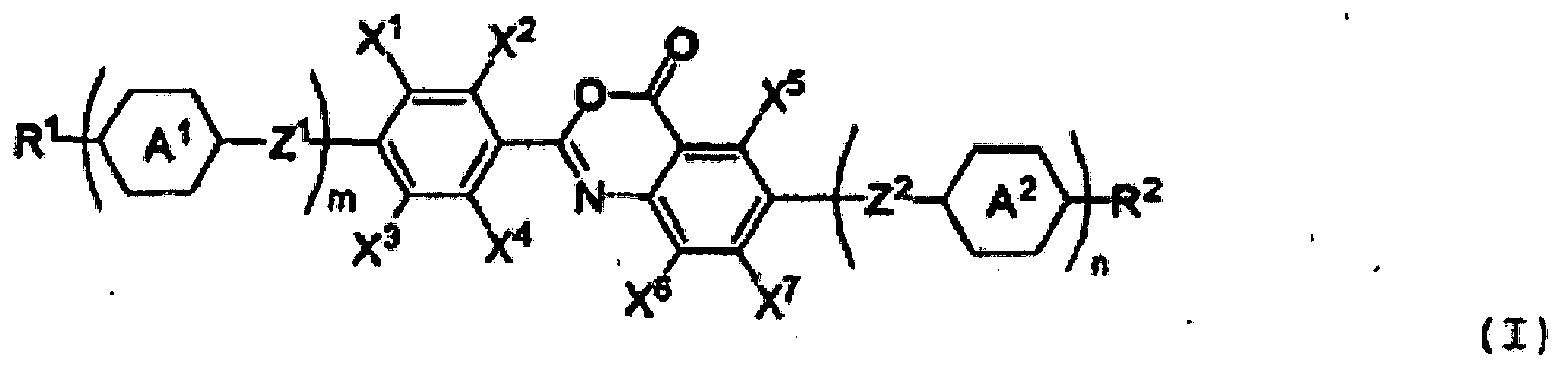 dans laquelle chacun de R1 et R2 représente indépendamment un atome d'hydrogène, un halogène, NO2, CN, NCS, un groupe alkyle linéaire, ramifié ou cyclique ayant 1 à 12 atomes de carbone (ici, parmi les -CH2- qui configurent le groupe alkyle, un -CH2- ou deux -CH2- non adjacents ou plus peut/peuvent être substitué(s) par -O-, -S-, -CO-, -COO-, -OCO-, -OCOO-, -CH=CH-, -C=C-, -CONR3-, -NR3CO-ou -NR3-) ou P-Sp-L-, et au moins un de R1 et R2 est P-Sp-L-;P représente un groupe fonctionnel polymérisable choisi parmi un groupe représenté par une des formules (P-1) à (P-5) suivantes :
 dans lesquelles chacun de R11 à R13 représente indépendamment un atome d'hydrogène ou un groupe méthyle ;Sp représente une liaison simple ou un groupe alkylène ayant 1 à 12 atomes de carbone (ici, parmi les -CH2- non terminaux qui configurent le groupe alkylène, un -CH2- non terminal ou deux -CH2- non terminaux non adjacents ou plus peut/peuvent être substitué(s) par -O-, -S-, -CO-, -COO-, -OCO-,-CH=CH-, -C≡C-, -CONR4-, -NR4CO- ou -NR4-) ;L représente O-, -S-, -CO-, -COO-, -OCO-, -OCOO-, -CONR5-, -NR5CO-, -NR5- ou une liaison simple ; lorsque Sp est une liaison simple, L est également une liaison simple ;chacun de A1 et A2 représente indépendamment un groupe 1,4-phénylène ; un ou deux ou plus atome(s) d'hydrogène dans le groupe 1,4-phénylène peut/peuvent être substitué(s) par un groupe alkyle ayant 1 à 4 atomes de carbone, un groupe alcoxy ayant 1 à 4 atomes de carbone, un groupe alcoxycarbonyle ayant 2 à 5 atomes de carbone, un groupe acyloxy ayant 2 à 5 atomes de carbone, un groupe acyle ayant 2 à 4 atomes de carbone, un groupe amide ayant 2 à 5 atomes de carbone, un groupe cyano ou un atome d'halogène ;chacun de Z1 et Z2 représente indépendamment -COO-, -OCO-, -CONR6-, -NR6CO-, -OCH2-, -CH2O-, -CH2S-, -SCH2-, -CH2CH2- ou une liaison simple ;chacun de X1, X2, X3, X4, X5, X6 et X7 représente indépendamment un atome d'hydrogène, un groupe alkyle ayant 1 à 4 atomes de carbone, un groupe alcoxy ayant 1 à 4 atomes de carbone, un groupe alcoxycarbonyle ayant 2 à 5 atomes de carbone, un groupe acyloxy ayant 2 à 5 atomes de carbone, un groupe acyle ayant 2 à 4 atomes de carbone, un groupe amide ayant 2 à 5 atomes de carbone, un groupe cyano ou un atome d'halogène ;chacun de R3, R4, R5 et R6 représente indépendamment un atome d'hydrogène ou un groupe alkyle ayant 1 à 4 atomes de carbone ; etchacun de m et n représente indépendamment 0, 1 ou 2, et m+n=1 ou 2.
 - Composé selon la revendication 1, dans lequel m=1, n=1, Z1 est -COO-, et Z2 est -OCO-.
- Composé selon la revendication 2, dans lequel X3 est un atome d'hydrogène ou un groupe méthoxy.
- Composé selon la revendication 1, dans lequel m=0, n=1, et Z2 est -OCO-.
- Composé selon la revendication 1, dans lequel m=1, n=0, et Z1 est -COO-.
- Composé selon une quelconque revendication précédente, dans lequel Sp est un groupe alkylène ayant 2 à 8 atomes de carbone.
- Composé selon une quelconque revendication précédente, dans lequel R1 et R2 représentent P-Sp-L-.
- Composition cristalline liquide polymérisable contenant le composé selon une quelconque revendication précédente et un agent chiral.
- Composé macromoléculaire obtenu par polymérisation du composé selon l'une quelconque des revendications 1 à 7.
- Film formé en utilisant le composé selon l'une quelconque des revendications 1 à 7.
Applications Claiming Priority (2)
| Application Number | Priority Date | Filing Date | Title |
|---|---|---|---|
| JP2011058442A JP5723641B2 (ja) | 2011-03-16 | 2011-03-16 | 重合性化合物、重合性液晶組成物、高分子化合物およびフィルム |
| PCT/JP2012/056502 WO2012124719A1 (fr) | 2011-03-16 | 2012-03-14 | Composé polymérisable, composition polymérisable à cristaux liquides, composé polymère et film |
Publications (3)
| Publication Number | Publication Date |
|---|---|
| EP2687517A1 EP2687517A1 (fr) | 2014-01-22 |
| EP2687517A4 EP2687517A4 (fr) | 2014-07-23 |
| EP2687517B1 true EP2687517B1 (fr) | 2015-12-09 |
Family
ID=46830785
Family Applications (1)
| Application Number | Title | Priority Date | Filing Date |
|---|---|---|---|
| EP12757824.3A Not-in-force EP2687517B1 (fr) | 2011-03-16 | 2012-03-14 | Composé polymérisable, composition polymérisable à cristaux liquides, composé macromoléculaire et film |
Country Status (5)
| Country | Link |
|---|---|
| US (1) | US8784684B2 (fr) |
| EP (1) | EP2687517B1 (fr) |
| JP (1) | JP5723641B2 (fr) |
| CN (1) | CN103443087B (fr) |
| WO (1) | WO2012124719A1 (fr) |
Families Citing this family (3)
| Publication number | Priority date | Publication date | Assignee | Title |
|---|---|---|---|---|
| US9581728B2 (en) * | 2012-12-13 | 2017-02-28 | Konica Minolta, Inc. | Retardation film, polarizing plate and liquid crystal display |
| JP6263010B2 (ja) * | 2013-12-03 | 2018-01-17 | 富士フイルム株式会社 | 重合性組成物およびフィルム、並びにそのフィルムを用いた位相差膜および反射膜 |
| JP6970873B2 (ja) * | 2015-04-28 | 2021-11-24 | パナソニックIpマネジメント株式会社 | 電解コンデンサおよびその製造方法 |
Family Cites Families (36)
| Publication number | Priority date | Publication date | Assignee | Title |
|---|---|---|---|---|
| US2367670A (en) | 1941-12-31 | 1945-01-23 | Du Pont | Cementing process |
| US2367661A (en) | 1941-12-31 | 1945-01-23 | Du Pont | Process of photopolymerization |
| US2448828A (en) | 1946-09-04 | 1948-09-07 | Du Pont | Photopolymerization |
| US2722512A (en) | 1952-10-23 | 1955-11-01 | Du Pont | Photopolymerization process |
| NL227834A (fr) | 1957-05-17 | |||
| US3046127A (en) | 1957-10-07 | 1962-07-24 | Du Pont | Photopolymerizable compositions, elements and processes |
| US3549367A (en) | 1968-05-24 | 1970-12-22 | Du Pont | Photopolymerizable compositions containing triarylimidazolyl dimers and p-aminophenyl ketones |
| US4212970A (en) | 1977-11-28 | 1980-07-15 | Fuji Photo Film Co., Ltd. | 2-Halomethyl-5-vinyl-1,3,4-oxadiazole compounds |
| JPS5928328B2 (ja) | 1977-11-29 | 1984-07-12 | 富士写真フイルム株式会社 | 光重合性組成物 |
| JPS5792312A (en) * | 1980-11-28 | 1982-06-08 | Hitachi Ltd | Liquid crystal display element |
| DE3337024A1 (de) | 1983-10-12 | 1985-04-25 | Hoechst Ag, 6230 Frankfurt | Lichtempfindliche, trichlormethylgruppen aufweisende verbindungen, verfahren zu ihrer herstellung und diese verbindungen enthaltendes lichtempfindliches gemisch |
| US4683327A (en) | 1985-06-24 | 1987-07-28 | Celanese Corporation | Anisotropic heat-curable acrylic terminated monomers |
| JPH01272551A (ja) | 1988-04-22 | 1989-10-31 | Dainippon Printing Co Ltd | 重合性2官能アクリレートモノマー |
| JP3228348B2 (ja) | 1992-07-03 | 2001-11-12 | キヤノン株式会社 | 高分子液晶化合物、液晶組成物および液晶素子 |
| JP3513888B2 (ja) | 1993-08-16 | 2004-03-31 | 大日本インキ化学工業株式会社 | 液晶表示素子及びその製造方法 |
| DE69422256D1 (de) | 1993-10-15 | 2000-01-27 | Merck Patent Gmbh | Reaktive Flüssigkristallverbindungen |
| DE4405316A1 (de) | 1994-02-19 | 1995-08-24 | Basf Ag | Neue polymerisierbare flüssigkristalline Verbindungen |
| DE4408170A1 (de) | 1994-03-11 | 1995-09-14 | Basf Ag | Neue polymerisierbare flüssigkristalline Verbindungen |
| DE19532408A1 (de) | 1995-09-01 | 1997-03-06 | Basf Ag | Polymerisierbare flüssigkristalline Verbindungen |
| GB2306470B (en) | 1995-10-05 | 1999-11-03 | Merck Patent Gmbh | Reactive liquid crystalline compound |
| DE19649056A1 (de) | 1996-11-27 | 1998-05-28 | Basf Ag | Polymerisierbare Oligomesogene |
| DE69820612T2 (de) | 1997-05-22 | 2004-10-14 | Rolic Ag | Neue polymerisierbare flüssigkristalline verbindungen |
| JP3963035B2 (ja) | 1997-09-05 | 2007-08-22 | 大日本インキ化学工業株式会社 | 液晶性(メタ)アクリレート化合物と組成物及びこれを用いた光学異方体 |
| JP4309072B2 (ja) | 2000-03-13 | 2009-08-05 | 富士フイルム株式会社 | 重合性液晶化合物および光学異方性素子 |
| JP4397550B2 (ja) | 2000-07-21 | 2010-01-13 | 富士フイルム株式会社 | 芳香族カルボン酸の製造方法 |
| JP3981638B2 (ja) | 2002-01-23 | 2007-09-26 | 日東電工株式会社 | 光学フィルム、その製造方法、およびこれを用いた位相差フィルムならびに偏光板 |
| JP4493313B2 (ja) | 2003-09-24 | 2010-06-30 | 富士フイルム株式会社 | 液晶表示装置 |
| JP2007206461A (ja) | 2006-02-02 | 2007-08-16 | Fujifilm Corp | 重合性化合物、液晶性組成物、重合体、光記録媒体用フィルタ、光記録媒体、並びに、光記録方法及び光再生方法 |
| JP2007272185A (ja) | 2006-03-10 | 2007-10-18 | Fujifilm Corp | 組成物、位相差板、液晶表示装置、平均チルト角調整剤、平均チルト角の調整方法 |
| JP2007279363A (ja) * | 2006-04-06 | 2007-10-25 | Fujifilm Corp | 重合性化合物、液晶性組成物、重合体、光記録媒体用フィルタ、光記録媒体、並びに、光記録方法及び光再生方法 |
| JP4973234B2 (ja) | 2007-02-22 | 2012-07-11 | 住友化学株式会社 | 光学フィルム |
| US20090239982A1 (en) * | 2007-03-30 | 2009-09-24 | Fujifilm Corporation | Ultraviolet Absorbent and Heterocyclic Compound |
| JP2009149754A (ja) * | 2007-12-20 | 2009-07-09 | Sumitomo Chemical Co Ltd | 重合性化合物および該重合性化合物を重合してなる光学フィルム |
| JP5250289B2 (ja) * | 2008-03-31 | 2013-07-31 | 富士フイルム株式会社 | 紫外線吸収剤組成物 |
| JP5342896B2 (ja) * | 2009-02-19 | 2013-11-13 | 富士フイルム株式会社 | ヘテロ環化合物 |
| WO2010122949A1 (fr) * | 2009-04-22 | 2010-10-28 | 三菱樹脂株式会社 | Film polyester stratifié |
-
2011
- 2011-03-16 JP JP2011058442A patent/JP5723641B2/ja active Active
-
2012
- 2012-03-14 WO PCT/JP2012/056502 patent/WO2012124719A1/fr not_active Ceased
- 2012-03-14 CN CN201280012989.7A patent/CN103443087B/zh not_active Expired - Fee Related
- 2012-03-14 EP EP12757824.3A patent/EP2687517B1/fr not_active Not-in-force
-
2013
- 2013-08-07 US US13/961,014 patent/US8784684B2/en not_active Expired - Fee Related
Also Published As
| Publication number | Publication date |
|---|---|
| JP2012193147A (ja) | 2012-10-11 |
| EP2687517A4 (fr) | 2014-07-23 |
| WO2012124719A1 (fr) | 2012-09-20 |
| CN103443087B (zh) | 2015-04-08 |
| US8784684B2 (en) | 2014-07-22 |
| US20130320260A1 (en) | 2013-12-05 |
| JP5723641B2 (ja) | 2015-05-27 |
| EP2687517A1 (fr) | 2014-01-22 |
| CN103443087A (zh) | 2013-12-11 |
Similar Documents
| Publication | Publication Date | Title |
|---|---|---|
| KR101808475B1 (ko) | 중합성 화합물, 중합성 조성물, 필름, 및 투영상 표시용 하프 미러 | |
| JP6343348B2 (ja) | 重合性化合物、ポリマー、重合性組成物、およびフィルム | |
| JP5718260B2 (ja) | 重合性液晶化合物、重合性組成物、高分子材料、及びフィルム | |
| US8771810B2 (en) | Polymerizable composition, polymer, and film | |
| TWI526457B (zh) | 在末端環結構具有側面取代基之聚合性化合物 | |
| JP5411769B2 (ja) | 重合性液晶化合物、重合性液晶組成物、高分子、及びフィルム | |
| US8765235B2 (en) | Polymerizable compound | |
| US8784684B2 (en) | Polymerizable compound, polymerizable liquid crystalline composition, macromolecular compound and film | |
| JP5813295B2 (ja) | 重合性組成物、高分子、及びフィルム | |
| JP2012184168A (ja) | 化合物、重合性組成物、高分子材料、及びフィルム | |
| JP6450464B2 (ja) | 重合性液晶化合物、重合性組成物、およびフィルム | |
| JP5705465B2 (ja) | 重合性組成物、高分子、及びフィルム | |
| JP5411771B2 (ja) | 化合物、重合性組成物、高分子、及びフィルム | |
| JP5889031B2 (ja) | 重合性液晶組成物、高分子材料とその製造方法及びフィルム | |
| WO2015083680A1 (fr) | Composition polymérisable, film, et membrane à différence de phase et membrane réfléchissante utilisant le film | |
| JP2013064890A (ja) | 重合体および赤外線反射フィルム | |
| JP6511407B2 (ja) | 重合性化合物、重合性組成物、およびフィルム |
Legal Events
| Date | Code | Title | Description |
|---|---|---|---|
| PUAI | Public reference made under article 153(3) epc to a published international application that has entered the european phase |
Free format text: ORIGINAL CODE: 0009012 |
|
| 17P | Request for examination filed |
Effective date: 20130904 |
|
| AK | Designated contracting states |
Kind code of ref document: A1 Designated state(s): AL AT BE BG CH CY CZ DE DK EE ES FI FR GB GR HR HU IE IS IT LI LT LU LV MC MK MT NL NO PL PT RO RS SE SI SK SM TR |
|
| DAX | Request for extension of the european patent (deleted) | ||
| A4 | Supplementary search report drawn up and despatched |
Effective date: 20140625 |
|
| RIC1 | Information provided on ipc code assigned before grant |
Ipc: C07D 265/22 20060101AFI20140618BHEP Ipc: C08F 20/36 20060101ALI20140618BHEP |
|
| GRAP | Despatch of communication of intention to grant a patent |
Free format text: ORIGINAL CODE: EPIDOSNIGR1 |
|
| INTG | Intention to grant announced |
Effective date: 20150626 |
|
| GRAS | Grant fee paid |
Free format text: ORIGINAL CODE: EPIDOSNIGR3 |
|
| RIN1 | Information on inventor provided before grant (corrected) |
Inventor name: SHIMAMURA SATOSHI Inventor name: ICHIHASHI MITSUYOSHI |
|
| GRAA | (expected) grant |
Free format text: ORIGINAL CODE: 0009210 |
|
| RAP1 | Party data changed (applicant data changed or rights of an application transferred) |
Owner name: FUJIFILM CORPORATION |
|
| AK | Designated contracting states |
Kind code of ref document: B1 Designated state(s): AL AT BE BG CH CY CZ DE DK EE ES FI FR GB GR HR HU IE IS IT LI LT LU LV MC MK MT NL NO PL PT RO RS SE SI SK SM TR |
|
| REG | Reference to a national code |
Ref country code: GB Ref legal event code: FG4D |
|
| REG | Reference to a national code |
Ref country code: AT Ref legal event code: REF Ref document number: 764520 Country of ref document: AT Kind code of ref document: T Effective date: 20151215 Ref country code: CH Ref legal event code: EP |
|
| REG | Reference to a national code |
Ref country code: IE Ref legal event code: FG4D |
|
| REG | Reference to a national code |
Ref country code: DE Ref legal event code: R096 Ref document number: 602012012936 Country of ref document: DE |
|
| REG | Reference to a national code |
Ref country code: LT Ref legal event code: MG4D |
|
| REG | Reference to a national code |
Ref country code: NL Ref legal event code: MP Effective date: 20151209 |
|
| PG25 | Lapsed in a contracting state [announced via postgrant information from national office to epo] |
Ref country code: ES Free format text: LAPSE BECAUSE OF FAILURE TO SUBMIT A TRANSLATION OF THE DESCRIPTION OR TO PAY THE FEE WITHIN THE PRESCRIBED TIME-LIMIT Effective date: 20151209 Ref country code: LT Free format text: LAPSE BECAUSE OF FAILURE TO SUBMIT A TRANSLATION OF THE DESCRIPTION OR TO PAY THE FEE WITHIN THE PRESCRIBED TIME-LIMIT Effective date: 20151209 Ref country code: NO Free format text: LAPSE BECAUSE OF FAILURE TO SUBMIT A TRANSLATION OF THE DESCRIPTION OR TO PAY THE FEE WITHIN THE PRESCRIBED TIME-LIMIT Effective date: 20160309 |
|
| REG | Reference to a national code |
Ref country code: AT Ref legal event code: MK05 Ref document number: 764520 Country of ref document: AT Kind code of ref document: T Effective date: 20151209 |
|
| PG25 | Lapsed in a contracting state [announced via postgrant information from national office to epo] |
Ref country code: GR Free format text: LAPSE BECAUSE OF FAILURE TO SUBMIT A TRANSLATION OF THE DESCRIPTION OR TO PAY THE FEE WITHIN THE PRESCRIBED TIME-LIMIT Effective date: 20160310 Ref country code: RS Free format text: LAPSE BECAUSE OF FAILURE TO SUBMIT A TRANSLATION OF THE DESCRIPTION OR TO PAY THE FEE WITHIN THE PRESCRIBED TIME-LIMIT Effective date: 20151209 Ref country code: FI Free format text: LAPSE BECAUSE OF FAILURE TO SUBMIT A TRANSLATION OF THE DESCRIPTION OR TO PAY THE FEE WITHIN THE PRESCRIBED TIME-LIMIT Effective date: 20151209 Ref country code: NL Free format text: LAPSE BECAUSE OF FAILURE TO SUBMIT A TRANSLATION OF THE DESCRIPTION OR TO PAY THE FEE WITHIN THE PRESCRIBED TIME-LIMIT Effective date: 20151209 Ref country code: SE Free format text: LAPSE BECAUSE OF FAILURE TO SUBMIT A TRANSLATION OF THE DESCRIPTION OR TO PAY THE FEE WITHIN THE PRESCRIBED TIME-LIMIT Effective date: 20151209 Ref country code: LV Free format text: LAPSE BECAUSE OF FAILURE TO SUBMIT A TRANSLATION OF THE DESCRIPTION OR TO PAY THE FEE WITHIN THE PRESCRIBED TIME-LIMIT Effective date: 20151209 |
|
| PG25 | Lapsed in a contracting state [announced via postgrant information from national office to epo] |
Ref country code: IS Free format text: LAPSE BECAUSE OF FAILURE TO SUBMIT A TRANSLATION OF THE DESCRIPTION OR TO PAY THE FEE WITHIN THE PRESCRIBED TIME-LIMIT Effective date: 20151209 |
|
| PG25 | Lapsed in a contracting state [announced via postgrant information from national office to epo] |
Ref country code: IT Free format text: LAPSE BECAUSE OF FAILURE TO SUBMIT A TRANSLATION OF THE DESCRIPTION OR TO PAY THE FEE WITHIN THE PRESCRIBED TIME-LIMIT Effective date: 20151209 Ref country code: CZ Free format text: LAPSE BECAUSE OF FAILURE TO SUBMIT A TRANSLATION OF THE DESCRIPTION OR TO PAY THE FEE WITHIN THE PRESCRIBED TIME-LIMIT Effective date: 20151209 |
|
| PG25 | Lapsed in a contracting state [announced via postgrant information from national office to epo] |
Ref country code: BE Free format text: LAPSE BECAUSE OF NON-PAYMENT OF DUE FEES Effective date: 20160331 Ref country code: SK Free format text: LAPSE BECAUSE OF FAILURE TO SUBMIT A TRANSLATION OF THE DESCRIPTION OR TO PAY THE FEE WITHIN THE PRESCRIBED TIME-LIMIT Effective date: 20151209 Ref country code: EE Free format text: LAPSE BECAUSE OF FAILURE TO SUBMIT A TRANSLATION OF THE DESCRIPTION OR TO PAY THE FEE WITHIN THE PRESCRIBED TIME-LIMIT Effective date: 20151209 Ref country code: PT Free format text: LAPSE BECAUSE OF FAILURE TO SUBMIT A TRANSLATION OF THE DESCRIPTION OR TO PAY THE FEE WITHIN THE PRESCRIBED TIME-LIMIT Effective date: 20160411 Ref country code: SM Free format text: LAPSE BECAUSE OF FAILURE TO SUBMIT A TRANSLATION OF THE DESCRIPTION OR TO PAY THE FEE WITHIN THE PRESCRIBED TIME-LIMIT Effective date: 20151209 Ref country code: IS Free format text: LAPSE BECAUSE OF FAILURE TO SUBMIT A TRANSLATION OF THE DESCRIPTION OR TO PAY THE FEE WITHIN THE PRESCRIBED TIME-LIMIT Effective date: 20160409 Ref country code: RO Free format text: LAPSE BECAUSE OF FAILURE TO SUBMIT A TRANSLATION OF THE DESCRIPTION OR TO PAY THE FEE WITHIN THE PRESCRIBED TIME-LIMIT Effective date: 20151209 Ref country code: AT Free format text: LAPSE BECAUSE OF FAILURE TO SUBMIT A TRANSLATION OF THE DESCRIPTION OR TO PAY THE FEE WITHIN THE PRESCRIBED TIME-LIMIT Effective date: 20151209 |
|
| REG | Reference to a national code |
Ref country code: DE Ref legal event code: R097 Ref document number: 602012012936 Country of ref document: DE |
|
| PLBE | No opposition filed within time limit |
Free format text: ORIGINAL CODE: 0009261 |
|
| STAA | Information on the status of an ep patent application or granted ep patent |
Free format text: STATUS: NO OPPOSITION FILED WITHIN TIME LIMIT |
|
| PG25 | Lapsed in a contracting state [announced via postgrant information from national office to epo] |
Ref country code: DK Free format text: LAPSE BECAUSE OF FAILURE TO SUBMIT A TRANSLATION OF THE DESCRIPTION OR TO PAY THE FEE WITHIN THE PRESCRIBED TIME-LIMIT Effective date: 20151209 Ref country code: LU Free format text: LAPSE BECAUSE OF FAILURE TO SUBMIT A TRANSLATION OF THE DESCRIPTION OR TO PAY THE FEE WITHIN THE PRESCRIBED TIME-LIMIT Effective date: 20160314 Ref country code: MC Free format text: LAPSE BECAUSE OF FAILURE TO SUBMIT A TRANSLATION OF THE DESCRIPTION OR TO PAY THE FEE WITHIN THE PRESCRIBED TIME-LIMIT Effective date: 20151209 Ref country code: PL Free format text: LAPSE BECAUSE OF FAILURE TO SUBMIT A TRANSLATION OF THE DESCRIPTION OR TO PAY THE FEE WITHIN THE PRESCRIBED TIME-LIMIT Effective date: 20151209 |
|
| REG | Reference to a national code |
Ref country code: CH Ref legal event code: PL |
|
| 26N | No opposition filed |
Effective date: 20160912 |
|
| GBPC | Gb: european patent ceased through non-payment of renewal fee |
Effective date: 20160314 |
|
| PG25 | Lapsed in a contracting state [announced via postgrant information from national office to epo] |
Ref country code: SI Free format text: LAPSE BECAUSE OF FAILURE TO SUBMIT A TRANSLATION OF THE DESCRIPTION OR TO PAY THE FEE WITHIN THE PRESCRIBED TIME-LIMIT Effective date: 20151209 |
|
| REG | Reference to a national code |
Ref country code: IE Ref legal event code: MM4A |
|
| PG25 | Lapsed in a contracting state [announced via postgrant information from national office to epo] |
Ref country code: BE Free format text: LAPSE BECAUSE OF FAILURE TO SUBMIT A TRANSLATION OF THE DESCRIPTION OR TO PAY THE FEE WITHIN THE PRESCRIBED TIME-LIMIT Effective date: 20151209 |
|
| REG | Reference to a national code |
Ref country code: FR Ref legal event code: ST Effective date: 20161130 |
|
| PG25 | Lapsed in a contracting state [announced via postgrant information from national office to epo] |
Ref country code: GB Free format text: LAPSE BECAUSE OF NON-PAYMENT OF DUE FEES Effective date: 20160314 Ref country code: CH Free format text: LAPSE BECAUSE OF NON-PAYMENT OF DUE FEES Effective date: 20160331 Ref country code: LI Free format text: LAPSE BECAUSE OF NON-PAYMENT OF DUE FEES Effective date: 20160331 Ref country code: IE Free format text: LAPSE BECAUSE OF NON-PAYMENT OF DUE FEES Effective date: 20160314 Ref country code: FR Free format text: LAPSE BECAUSE OF NON-PAYMENT OF DUE FEES Effective date: 20160331 |
|
| PG25 | Lapsed in a contracting state [announced via postgrant information from national office to epo] |
Ref country code: MT Free format text: LAPSE BECAUSE OF FAILURE TO SUBMIT A TRANSLATION OF THE DESCRIPTION OR TO PAY THE FEE WITHIN THE PRESCRIBED TIME-LIMIT Effective date: 20151209 |
|
| PG25 | Lapsed in a contracting state [announced via postgrant information from national office to epo] |
Ref country code: HU Free format text: LAPSE BECAUSE OF FAILURE TO SUBMIT A TRANSLATION OF THE DESCRIPTION OR TO PAY THE FEE WITHIN THE PRESCRIBED TIME-LIMIT; INVALID AB INITIO Effective date: 20120314 Ref country code: CY Free format text: LAPSE BECAUSE OF FAILURE TO SUBMIT A TRANSLATION OF THE DESCRIPTION OR TO PAY THE FEE WITHIN THE PRESCRIBED TIME-LIMIT Effective date: 20151209 |
|
| PG25 | Lapsed in a contracting state [announced via postgrant information from national office to epo] |
Ref country code: TR Free format text: LAPSE BECAUSE OF FAILURE TO SUBMIT A TRANSLATION OF THE DESCRIPTION OR TO PAY THE FEE WITHIN THE PRESCRIBED TIME-LIMIT Effective date: 20151209 Ref country code: HR Free format text: LAPSE BECAUSE OF FAILURE TO SUBMIT A TRANSLATION OF THE DESCRIPTION OR TO PAY THE FEE WITHIN THE PRESCRIBED TIME-LIMIT Effective date: 20151209 Ref country code: MT Free format text: LAPSE BECAUSE OF FAILURE TO SUBMIT A TRANSLATION OF THE DESCRIPTION OR TO PAY THE FEE WITHIN THE PRESCRIBED TIME-LIMIT Effective date: 20160331 Ref country code: MK Free format text: LAPSE BECAUSE OF FAILURE TO SUBMIT A TRANSLATION OF THE DESCRIPTION OR TO PAY THE FEE WITHIN THE PRESCRIBED TIME-LIMIT Effective date: 20151209 |
|
| PG25 | Lapsed in a contracting state [announced via postgrant information from national office to epo] |
Ref country code: BG Free format text: LAPSE BECAUSE OF FAILURE TO SUBMIT A TRANSLATION OF THE DESCRIPTION OR TO PAY THE FEE WITHIN THE PRESCRIBED TIME-LIMIT Effective date: 20151209 |
|
| PG25 | Lapsed in a contracting state [announced via postgrant information from national office to epo] |
Ref country code: AL Free format text: LAPSE BECAUSE OF FAILURE TO SUBMIT A TRANSLATION OF THE DESCRIPTION OR TO PAY THE FEE WITHIN THE PRESCRIBED TIME-LIMIT Effective date: 20151209 |
|
| PGFP | Annual fee paid to national office [announced via postgrant information from national office to epo] |
Ref country code: DE Payment date: 20200303 Year of fee payment: 9 |
|
| REG | Reference to a national code |
Ref country code: DE Ref legal event code: R119 Ref document number: 602012012936 Country of ref document: DE |
|
| PG25 | Lapsed in a contracting state [announced via postgrant information from national office to epo] |
Ref country code: DE Free format text: LAPSE BECAUSE OF NON-PAYMENT OF DUE FEES Effective date: 20211001 |