EP2688023A1 - Procédé de paiement par l'intermédiaire d'un dispositif mobile, dispositif mobile relatif et produit programme informatique - Google Patents
Procédé de paiement par l'intermédiaire d'un dispositif mobile, dispositif mobile relatif et produit programme informatique Download PDFInfo
- Publication number
- EP2688023A1 EP2688023A1 EP13172502.0A EP13172502A EP2688023A1 EP 2688023 A1 EP2688023 A1 EP 2688023A1 EP 13172502 A EP13172502 A EP 13172502A EP 2688023 A1 EP2688023 A1 EP 2688023A1
- Authority
- EP
- European Patent Office
- Prior art keywords
- payment
- merchant
- message
- product
- service
- Prior art date
- Legal status (The legal status is an assumption and is not a legal conclusion. Google has not performed a legal analysis and makes no representation as to the accuracy of the status listed.)
- Withdrawn
Links
Images


Classifications
-
- G—PHYSICS
- G06—COMPUTING OR CALCULATING; COUNTING
- G06Q—INFORMATION AND COMMUNICATION TECHNOLOGY [ICT] SPECIALLY ADAPTED FOR ADMINISTRATIVE, COMMERCIAL, FINANCIAL, MANAGERIAL OR SUPERVISORY PURPOSES; SYSTEMS OR METHODS SPECIALLY ADAPTED FOR ADMINISTRATIVE, COMMERCIAL, FINANCIAL, MANAGERIAL OR SUPERVISORY PURPOSES, NOT OTHERWISE PROVIDED FOR
- G06Q20/00—Payment architectures, schemes or protocols
- G06Q20/02—Payment architectures, schemes or protocols involving a neutral party, e.g. certification authority, notary or trusted third party [TTP]
Definitions
- the present invention relates to techniques for the purchase and the authorization of payments via mobile devices, such as mobile phones.
- the invention has been particularly developed in order to improve security and user experience of such payments.
- Figure 1 shows a generic architecture of a system for purchasing via mobile devices.
- a merchant 1 offers certain products or services to a user who wants to buy some of these products via his mobile device 2.
- this payment is not made directly through the telephone operator using the phone bill or the remaining credit on a prepaid card, but payment is handled via a payment operator 3, such as the service that manages the bank account or credit card of the user.
- the object of the invention is to provide an architecture that is secure, simple, efficient and interoperable for the user (buyer), addressed to a plurality of users with limited investments for merchants (sellers) and in compliance with national and international bank standards.
- the invention relates to a method for payment via a mobile device having the features specified in accompanying claim 1.
- the invention also relates to the relative mobile device, as well as to a computer-program product, loadable into the memory of at least one processor and comprising portions of software code capable of implementing the steps of the method when the product is run on at least one processor.
- a computer-program product is understood to be equivalent to a reference to a computer-readable medium containing instructions for controlling the processing system for coordinating implementation of the method according to the invention.
- the reference to "at least one processor" is evidently intended to highlight the possibility that the present invention is implemented in a modular and/or distributed form.
- the object of the invention is to provide an architecture that is secure, simple, efficient and interoperable.
- the merchant can verify the payment directly through the user's mobile device.
- the user transmits an electronic message via his mobile device authorizing the payment of at least one product and/or service.
- this message is transmitted to a payment system that manages the payments of the merchant that offers the products and may comprise, for example, a computer system of the merchant, a computer system of the user's payment institution and a management system that manages payments between multiple merchants and multiple payment institutions.
- the user receives an electronic confirmation message from the payment system indicating the result of authorization of the payment, i.e. a message that approves or denies authorization.
- the mobile device in the case wherein the message is an approval message, the mobile device generates and shows a display that contains a summary of the products and/or services paid for.
- the merchant can check the summary, validate the purchase and deliver the product and/or service.
- the mobile device is configured to detect an event that validates the payment of products and/or services, such as the pressing of a validation button and/or the movement of a finger on the display of the mobile device in a diagonal direction.
- the mobile device classifies the approval message as validated.
- the confirmation message received from the payment system is initially archived, i.e. saved, in a first register of messages, and when an approval message is validated, that message is archived, i.e. moved, to a second register of messages that can be viewed but no longer validated.
- the mobile device displays and/or reproduces a graphic or audio element and/or other visual effects, such as a word, a number, an alphanumeric sequence, an image, a sound and/or video sequence.
- a graphic or audio element and/or other visual effects such as a word, a number, an alphanumeric sequence, an image, a sound and/or video sequence.
- the element is displayed and/or reproduced when the payment is validated.
- the element is received from the payment system along with the approval message.
- the mobile device receives from the payment system, for example, along with the approval message, a univocal code that is associated with the specific payment. In this case, when the payment is validated, the mobile device transmits this univocal code to the payment system and only at this moment will receive the element to display and/or reproduce.
- the merchant is able to verify the correctness of the payment directly on the user's mobile device.
- an embodiment in the context of this description means that a particular configuration, structure or feature described in relation to the embodiment is included in at least one embodiment.
- particular shapes, structures or features may be combined in an appropriate way in one or more embodiments.
- FIG. 2 shows an embodiment of the payment system according to the present invention.
- the system comprises a plurality of merchants 1, which offer products and/or services and a plurality of payment operators 3, such as banking institutions.
- a plurality of merchants 1 which offer products and/or services
- a plurality of payment operators 3 such as banking institutions.
- two merchants 1a and 1b are shown, and two payment operators 3a and 3b.
- the system further comprises a payment management system 4 that interfaces the plurality of merchants 1 with the plurality of payment operators 3.
- the operations of the payment management system can be implemented using software code portions that are executed by a computer or a processing system with distributed architecture (known as cloud computing).
- the management system 4 is responsible for converting the communications received by the various merchants 1, and transmitting them to the respective payment operators 3. In this way, it is not necessary that each merchant 1 has to be compatible with the various communication protocols of the payment operators 3, but it is sufficient that the merchants 1 implement just a single communication protocol, i.e. the communication protocol of the management system 4.
- the operator is not necessarily the user's bank directly, but could also be another qualified payment operator allowing the registration and the subsequent use of the service to customers of non-participating banks.
- the user may record the details of his credit card and the payment service could use the credit card payment circuit.
- the mobile device 2 transmits, for example via a message of the Short Message Service (SMS), a purchase request to a merchant 1. Subsequently, the merchant 1 forwards this request to the management system 4 which converts the request and forwards the converted request to the correct payment operator 3.
- SMS Short Message Service
- the management system 4 comprises a database 40 that contains data that associates a respective payment operator with each mobile device or user.
- the management system 4 is configured to receive a payment request from a merchant 1, containing information needed to identify the device or the user requesting a purchase.
- the data which identifies the user is the number of the mobile phone or mobile device 2 which has transmitted the SMS with the purchase request, or its IMEI (International Mobile Equipment Identity) code.
- the payment operator 3 in turn can then grant or deny the payment. For example, the payment operator 3 can verify if the user has sufficient credit. Consequently, the payment operator 3 transmits a message to the merchant 1 via the management system 4 that confirms or denies the payment and the merchant can potentially deliver/supply the product/service requested.
- the payment operator 3 transmits a payment confirmation to the user 2.
- the operator 3 can send an SMS message to the user 2 that summarizes the amount charged and the details of the merchant who requested the payment.
- the management system 4 comprises a database 40 that contains data that enable association of the various mobile devices or users 2 with the respective payment operators 3.
- such an association is created by a subscription to the payment service.
- this registration is carried out by the payment operator 3 which communicates the registration data to the management system 4.
- a subscription may be done under a corresponding entry in an internet banking service, which associates a specific telephone number to a bank account, credit card or other payment method.
- the embodiments described above enable the offering of products by a plurality of merchants 1 to a plurality of users 2 via a simple centralized management system 4.
- the payment system is open, and new merchants 1 or payment operators 3 can be easily added.
- the user must authorize each payment by entering a security code.
- this mechanism may be useful to prevent payments in the case of theft of the mobile device 2 or unwanted requests for payments.
- the user receives this security code during registration with the payment operator 3.
- the user enters the same security code to authorize the payment, and the code is transmitted, together with the purchase message, to the merchant 1.
- the merchant 1 transmits this code, together with the payment request via the management system 4 to the payment operator 3, which verifies the correctness of the security code.
- this security code is transmitted in an encrypted form, for example using the MD5 or AES algorithm, or other symmetrical or asymmetrical encryption codes.
- every payment request has a new transaction code (for example, a consecutive number for purchase requests) and the security code is encrypted together with the transaction code. Therefore, the sequence of characters of the encrypted code can vary for each transaction and is usable only once, and only the payment operator 3 is able to verify the correctness of the security code.
- the user 2 first transmits a purchase request to a merchant 1 to request a desired product or service.
- the device 2 needs to know the electronic address, such as an IP address, an e-mail address, a website address or another address that allows electronic contact with the merchant, or the telephone number to which to transmit the purchase request.
- the electronic address such as an IP address, an e-mail address, a website address or another address that allows electronic contact with the merchant, or the telephone number to which to transmit the purchase request.
- each merchant 1 could develop a specific application for this purpose that knows the email address or telephone number of the merchant 1.
- this approach improves the security of the system.
- the payment is normally authorized by a security code.
- the fact that the user has to download the application onto his mobile device helps, as the user can immediately verify the reliability of the merchant.
- modern mobile phones are usually configured in order to only allow the installation of certified applications and therefore the merchant must be a trustworthy subject.
- the inventor has observed that the problems mentioned above can also be solved through a single configurable application offered, for example, directly by the administrator of the management system 4. However, as mentioned above, in this case there should be a mechanism that allows verification of the reliability of the merchant and of the product/service sold.
- Figure 3 shows a modification of the system according to Figure 2 , which allows the use of a generic application 20 on the mobile device 2.
- the merchant 1 applies a code 100 to an object 10, such as the object for sale, which identifies the merchant and the product/service offered.
- the mobile device 2 comprises a sensor 22 for detecting such an identifying code for the merchant 1.
- the senor 22 may be any sensor, such as an optical, magnetic or mechanical sensor.
- This sensor 22 can also be a transceiver, such as an RF-ID (Radio Frequency IDentification) or Bluetooth transceiver configured for detection of a code from a transponder or transceiver applied to the object 10.
- RF-ID Radio Frequency IDentification
- Bluetooth transceiver configured for detection of a code from a transponder or transceiver applied to the object 10.
- the code 100 is a QR code, which is a two-dimensional bar code, which is applied to a label.
- the sensor 22 can be a photo or video camera within the mobile device 2 which frames the label to detect the QR code.
- the device 2 is able to detect the identification code for the merchant 1 by means of the sensor 22, as well as a code that identifies the product/service.
- This code could then also directly identify the electronic address or telephone number of the merchant 1 to which to transmit the purchase request. Consequently, the user 2 may directly transmit a purchase request to the address or telephone number of the merchant 1.
- any code applied to the object 10 may be falsified by a person external to the payment system. Therefore, the user 2 could transmit a purchase request possibly also including his security code to an unauthorized subject. Consequently, this unauthorized person might even try to reuse the transmitted data improperly, for example, to damage the user.
- the code 100 applied to the object 10 is not directly used to transmit the purchase request to the merchant 1, but a further step is envisaged to verify the reliability of the alleged merchant and the relative product/service sold.
- the code applied to the object 10 includes a field that identifies a merchant and a field that identifies the object sold.
- Figure 4 shows a flow chart which summarizes the main operations performed by an application 20 installed on the mobile device 2.
- the application detects the QR code 100 applied to the object 10 at a step 2002 by means of the camera 22 of the mobile device 2.
- the application analyzes the QR code 100 and determines the identification code of the merchant and the identification code for the product/service.
- the application transmits the code of the merchant and the code of the product/service to the management system 4.
- the mobile device 2 may comprise a Wi-Fi (Wireless Fidelity) transceiver and/or a UMTS (Universal Mobile Telecommunications System), HSPA (High-Speed Packet Access), or LTE (Long Term Evolution) modem, and the communication with the management system 4 can be made via an internet connection.
- Wi-Fi Wireless Fidelity
- UMTS Universal Mobile Telecommunications System
- HSPA High-Speed Packet Access
- LTE Long Term Evolution
- the management system 4 then receives the merchant code and the product/service code. Subsequently, the management system 4 compares these codes with a database 42 which contains information on merchants that are considered to be trustworthy. For example, the data in the database 42 may be created through the enrollment and verification of merchants. In the case where the merchant has been determined to be trustworthy and the product/service is actually salable, the management system returns the logo of the merchant, his telephone number, or in general data that allow correct referral of the order to the merchant 1 and finally a description of the product/service. In the opposite case, the management system 4 transmits a message that indicates that the merchant 1 is not trustworthy, or that the product/service is not available for sale.
- the application 20 receives information from the management system 4 that enables verification on whether the merchant 1 is trustworthy and whether the product or service is salable.
- information comprises:
- the application receives the response from the management system 4 at a step 2008, and can verify at a step 2010 if the merchant is trustworthy and if the product/service salable.
- the application shows a notification at a step 2030 on the display of the mobile device 2 and the procedure terminates at a step 2020.
- the application displays at a step 2012 on the display of the device 2, a screen that summarizes the description of the product/service.
- the application may also receive other information from the management system 4, such as the product price, the quantity of pieces contained in a product unit, the price of a possible shipment, an image of the product, a logo of the vendor, etc.
- Figure 5 shows a possible display that may be visualized on a display 24 of the mobile device 2.
- the display contains:
- the arrangement of the various fields may also be configurable and the respective set-up information can be received from the service management system 4.
- the application checks if the user approves the purchase at a verification step 2014. For example, the user can approve the purchase by entering his security code in the field 256 and confirming using the button 258.
- the application 20 thus displays to a user, on a display 22, a screen according to the product information and collects any data necessary for the completion of the purchase (e.g. price, quantity, delivery address or security code).
- the application transmits, at a step 2016, the purchase request to the email address or telephone number of the merchant 1 as indicated by the management system 4 and ends at step 2020.
- the application 20 thus transmits a message to the email address or telephone number of merchant 1 authorizing the payment, or a message that requests the purchase and subsequent payment.
- this message can be transmitted to the electronic address or telephone number of the merchant 1 by means of a data stream on a telephone carrier, such as a message of the SMS service or a data session univocally identified by the telephone operator or a stream including univocal identification data of the apparatus from which the identification of the ordering user can be detected automatically.
- the QR code is not used to directly transmit a purchase request to a merchant, but an extra step is added that makes the QR code dynamic and the purchase secure.
- the QR code (including a merchant code and a product code) is used as a pointer to locate the contact details in the database 42 for transmitting the purchase message, as well as the configuration parameters for the application 20 installed on the user's mobile device.
- all the fields of the display 24 may be configurable for each combination of merchant code and product code.
- each field can be provided or not provided for the specific configuration and where required, may be viewed as a preset non-modifiable datum with a fixed or variable value, or required as a input datum by the user (possibly with a modifiable default value). For example, for products with a fixed price only, the quantity may be requested, while for certain services, such as the taxi services, the cost of the trip may be required but not the quantity.
- a field for entering a shipping address could be activated.
- the security code may also not be required (and therefore also not transmitted to the merchant) for micro-payments, or payments with a low price.
- a verification of the user may be envisaged. For example, for some products intended for a certain group of users it might be expected that the user receives information on these products only after authentication, for example through his telephone number and security code. So, in general, the level of security could be set for each merchant.
- the data of configurations for all combinations of merchant codes and product codes are archived.
- a single set of configuration parameters for all products could be provided.
- a code may also be provided that indicates to the application 20 installed on the mobile device 2 to select a specific set of preinstalled configuration parameters.
- configuration parameters for the application 20 are managed directly via a database at the merchant 1.
- the management system 4 could only verify the existence of a merchant 1 and transmit a request containing the product code to the respective merchant 1. Subsequently, the respective control parameters for the particular product received, the management system 4 may forward these configuration parameters to the mobile device 2.
- the management system 4 can also make other checks.
- the merchant 1 could configure a deadline of the period of sale for certain products. In this case, the management system 4 may determine whether such an offer is still valid or has already expired.
- the management system 4 transmits information to the mobile device which specifies the syntax of the purchase request for the specific merchant.
- the request may have the following format:
- the request may have the following format:
- the merchant 1 receives the purchase request and can transmit the respective payment request through the management system 4 to the respective payment operator 3.
- Figure 6 shows a possible implementation of the exchange of information between the merchant 1, the management system 4, and the payment operator 3.
- the user via the use of the application 20 installed on the mobile device 2, such as a mobile phone, transmits a message at a step 2016 containing a purchase request to a merchant 1.
- the application of the merchant analyzes the received message in order to verify the accuracy of the syntax.
- the application of the merchant 1 transmits an error message ERR1 to the user 2, for example via SMS.
- the application of the merchant 1 performs at a verification step 1004 the verification of availability of the product/service, and the amount to be debited.
- the application of the merchant 1 transmits an error message ERR2 to the user 2.
- the application of the merchant 1 transmits to the management system 4 at a step 1006 a message containing a request for authorization of the payment of the amount verified.
- the management system 4 receives the message and processes the request, verifying the user's subscription to the payment service, identifying the payment operator associated with the user and performing any checks needed for relaying of the transaction to the payment operator.
- the application of the management system 4 verifies whether the messages containing requests for payment authorization only arrive from specific addresses, for example in the case wherein the communication between the merchant 1, the management system 4 and the payment operator 3 are exchanged over the Internet, these addresses are the IP addresses of the merchants subscribed to the service.
- the application of the management system 4 If the user has not subscribed to the payment service (output "N" of the verification step 4002), or the application of the management system 4 is not able to find the identification of the user in the database 40, the application of the management system 4 notifies such an error to the merchant 1, and at a step 1008 the application of the merchant 1 can transmit an error message ERR3 to the user 2 which indicates the fact that the user has not been subscribed to the service.
- the application of the management system 4 records the transaction to be authorized in a pending state and forwards the request for authorization at a step 4004 to the payment operator 3 associated with the user.
- the application of the payment operator 3 processes the authorization request, forwarding it where necessary to authorizing circuits, and communicates the result of the operation to the management system 4.
- the application of the management system 4 when the outcome of the operation is received, verifies the result of the authorization.
- the application of the management system 4 notifies the error to the merchant 1, and at a step 1010 the application of the merchant 1 can transmit an error message ERR4 to the user 2 indicating that the authorization was denied.
- the application of the management system 4 updates the status of the transaction from pending to authorized and communicates the result to the merchant 1.
- step 1012 receiving a successful authorization request, the application of the merchant 1 requests entry into the accounts by transmitting an accounting request to the management system 4.
- the application of the management system 4 inserts the operation to be accounted in a pending state, and forwards it to the payment operator of 3.
- step 3004 the application of the payment operator processes the accounting request and reports the outcome of this operation to the management system 4.
- the application of the management system 4 verifies the result of the authorization.
- the application of the management system 4 notifies such an error to the merchant 1, and at a step 1014 the application of the merchant 1 can transmit an error message ERR5 to the user 2 which indicates the fact that the accounting has been denied.
- the application of the management system 4 performs the update of the accounting operation from pending to accounted for and communicates the result to the merchant 1.
- the application of the merchant 1 transmits a confirmation of the purchase OK1 at a step 1016 to the user and authorizes the delivery of products/services.
- step 1012, 4008, 3004, 4010, and 1014 are purely optional and the output "Y" of the verification step 4006 could lead directly to step 1016.
- the sales system is configured to manage a virtual shopping cart.
- Figure 7 shows a flow diagram that summarizes the main operations.
- the flow diagram is essentially based on the flow chart shown in Figure 4 and therefore all the steps that have been described previously will not be repeated.
- the application detects at a step 2002 via the camera 22 of the mobile device 2, the QR code 100 applied to the object 10, and at a step 2004, the application analyzes the QR code 100 and determines the identification code for the merchant and the identification code for the product/service.
- the application transmits the merchant code and the code of the product/service to the management system 4 and the application receives the response from the management system 4 at step 2008.
- the application 20 can verify at a verification step 2010 if the merchant is trustworthy and the product/service salable.
- the application shows on the display of the device 2 at a step 2012, a display that summarizes the description of the product/service.
- buttons such as a button with the word “Add to shopping cart” and a button labeled "Buy”.
- the application 20 then checks the user's action at a verification step 2040.
- the application transmits at a step 2042 to the management system 4 a message containing the product code, and possibly the price or quantity.
- the management system 4 initializes a temporary list of products of the user at the first entry and adds the selected product to the list.
- the user could also transmit the text directly in the purchase request in the format specified by the merchant, and the management system 4 could save the text of the various purchase messages in the list of products.
- the management system 4 returns a code that identifies the list of products of the user. Consequently, the application receives this code at a step 2044 and returns to the step 2002 so that the user can acquire other QR codes and add more products to the list.
- the application transmits the purchase request at a step 2046 to the electronic address or telephone number of the merchant 1, as indicated by the management system 4 and ends at step 2020.
- the message does not contain the product code but the code of the list of products of the user archived in the management system 4.
- the application of the merchant 1 contacts the management system 4 and requests the list of products for the code received by the user 2.
- the inventor has observed that the solutions described above (both the solutions using dedicated applications and those that use a generic application) have the disadvantage that the merchant 1 can only deliver the product or service when an approval message is received from the management system 4 at step 1016. Therefore, it is required that the merchant 1 has access to a processor, such as a desktop computer or a mobile device, which is able to receive and/or view the message generated by the management system in step 4010.
- a processor such as a desktop computer or a mobile device
- the merchant can view the confirmation message of the purchase via the user's mobile device, for example the application 20 used to acquire the product.
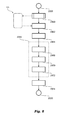
- Figure 8 shows an embodiment of a method that allows carrying out and verifying a purchase through an application installed on the user's device 2. As mentioned above, this method could also be implemented in the application 20.
- the user 2 requests the payment of a product or service at a step 2060.
- the user selects at least one product and authorizes the payment of the price by means of his mobile device.
- the user 2 selects one or more products and/or services through a dedicated application or by means of a QR code and transmits a request which authorizes the payment to the system of the merchant 1, that is, the step 2060 can include the steps 2002 to 2016 shown in Figure 4 or the steps 2002 to 2046 shown in Figure 7 .
- the system of the merchant 1 and/or the management system 4 processes the authorization request and transmits the result of the request to the device of the user 2.
- the authorization of the purchase can be carried out by the method described with reference to Figure 6 , namely the steps 1002-1016, 4002-4010 and 3002-3004.
- the method of payment could also be used which is described in the Italian patent application TO2011A000861 , the content of which is incorporated herein by reference.
- the user receives a message at a step indicated with the number "2014”, which indicates the outcome of the authorization of payment.
- the user 2 receives an OK1 message at a step in 2062 via his mobile device indicative of the approval of the purchase.
- This message can be received directly from the management system 4 or via the system of the merchant 1.
- the approval message OK1 can be any electronic message, such as a message of the short message service (SMS) or an e-mail.
- SMS short message service
- the user 2 shows the approval message OK1 to the merchant 1 (or a figure responsible for supplying the products/services).
- the user shows by means of the application installed on the device 2 a display that contains a summary of the articles purchased. Therefore, in general, the contents of the display viewed in step 2064 are determined according to the content of the approval message OK1.
- the merchant 1 can verify the validity of the purchase on the user's device 2 and can deliver the product or service at a step 2074.
- the merchant 1 can validate the purchase by means of the application installed on the user's device 2. For example, in various embodiments, the merchant 1 checks the list of products at the step 2066 and validates the purchase at a step 2068, for example, by pressing an appropriate button on the display of the mobile device and/or virtually tearing the ticket, for example, by passing his finger on the display of the user's mobile device 2 in a diagonal direction, i.e. from corner to corner.
- the application 20 is configured to detect an event at the step 2068 that indicates the validation of the purchase and the application can register the purchase as validated at a step 2070. For example, in one embodiment, when an approval message OK1 is received, this message is saved (if necessary together with the summary of the purchase) in a register of non-validated messages. In particular, in this case, the application only allows the validation of the titles in this register. Once a purchase is validated, the relevant titles are loaded into a second file or register within the application 20 and can only be viewed but no longer validated. Preferably, this validation is also communicated to the system of the merchant 1 to indicate that the product or service has been received.
- the method described above can be used to pay for a taxi ride.
- the user 2 may detect a QR code via his mobile device that identifies the number of a taxi and the relative cooperative, i.e. a merchant code and a product code.
- the application 20 could request from the management system 4 the contact details of the cooperative, and the user 2 could insert the requested price for the ride and authorize the payment by inserting his security code (step 2060).
- the application 20 receives the message OK1 confirming the authorization of the payment (step 2062), and the user 2 shows the display that demonstrates the summary of the purchase to the taxi driver (step 2064).
- the driver checks the summary (step 2066) and validates the purchase by pressing a button specifically placed on the display of the mobile device 2 (step 2068). Finally, the application registers the ride as validated and transmits a confirmation message to the system of the merchant 1 (step 2070), for example, via a message, such as a SMS message, which is transmitted to the electronic address of the merchant 1 previously received.
- a confirmation message to the system of the merchant 1 (step 2070), for example, via a message, such as a SMS message, which is transmitted to the electronic address of the merchant 1 previously received.
- the inventor has observed that the solutions described above have the drawback that the display that is shown in step 2066 to validate the purchase could be falsified.
- a specially developed application could reproduce all the steps of the original application except the steps that interact with the system of the merchant 1 and/or the management system 4, i.e. the steps required to authorize the payment.
- the application 20 receives an element that certifies the validity of the purchase, along with the message OK1 that approves the purchase, i.e. the system that generates the message OK1 also attaches an element of certification to the message.
- these elements of certifications can be one or more graphic or sound elements, and/or other visual effects, and are only known by the merchant 1 itself.
- the element of certification could be at least one of:
- the application displays this certification element at the step 2066, preferably only when validation has occurred at a step 2072. Therefore, the merchant 1 can immediately verify if the correct element is displayed or reproduced.
- the certification element is changed regularly after certain short intervals. For example, in the case of the taxi service, the certification element could be valid for a day, while for other businesses, such as restaurants or cinemas, the element could be only valid for an hour
- the certification element is a code that is not directly shown, such as a univocal code associated with the specific payment.
- the application 20 transmits this code to the system of the merchant 1 and/or to the management system 4, and receives in response a respective element to display and/or reproduce.
- the purchase can be carried out and verified via the user's mobile device 2 and no additional checking devices are required, such as readers or bar code/QR scanners that are used, for example, at airports to check a flight ticket.
- additional checking devices such as readers or bar code/QR scanners that are used, for example, at airports to check a flight ticket.
- the validity of the purchase can be verified simply by means of the user's mobile device 2 which shows or reproduces graphic, sound and/or visual elements that certify the validity of the title.
Landscapes
- Engineering & Computer Science (AREA)
- Business, Economics & Management (AREA)
- Computer Security & Cryptography (AREA)
- Accounting & Taxation (AREA)
- Strategic Management (AREA)
- Physics & Mathematics (AREA)
- General Business, Economics & Management (AREA)
- General Physics & Mathematics (AREA)
- Theoretical Computer Science (AREA)
- Financial Or Insurance-Related Operations Such As Payment And Settlement (AREA)
Applications Claiming Priority (1)
| Application Number | Priority Date | Filing Date | Title |
|---|---|---|---|
| IT000636A ITTO20120636A1 (it) | 2012-07-19 | 2012-07-19 | Procedimento per il pagamento tramite un dispositivo mobile, relativo dispositivo mobile e prodotto informatico |
Publications (1)
| Publication Number | Publication Date |
|---|---|
| EP2688023A1 true EP2688023A1 (fr) | 2014-01-22 |
Family
ID=46800303
Family Applications (1)
| Application Number | Title | Priority Date | Filing Date |
|---|---|---|---|
| EP13172502.0A Withdrawn EP2688023A1 (fr) | 2012-07-19 | 2013-06-18 | Procédé de paiement par l'intermédiaire d'un dispositif mobile, dispositif mobile relatif et produit programme informatique |
Country Status (2)
| Country | Link |
|---|---|
| EP (1) | EP2688023A1 (fr) |
| IT (1) | ITTO20120636A1 (fr) |
Citations (3)
| Publication number | Priority date | Publication date | Assignee | Title |
|---|---|---|---|---|
| US20020116329A1 (en) * | 2001-02-20 | 2002-08-22 | Serbetcioglu Bekir Sami | Systems and methods for approval of credit/debit account transactions using a wireless device |
| WO2005015452A1 (fr) * | 2003-08-08 | 2005-02-17 | Paycool, International, Ltd. | Procedes visant a faciliter la validation de transactions financieres effectuees par l'intermediaire d'un reseau de communication hertzien |
| EP2463817A1 (fr) * | 2010-12-10 | 2012-06-13 | 1356382 Alberta Ltd. | Système et procédé pour l'interopérabilité de différentes plateformes d'autorisation de paiements ou de transactions |
-
2012
- 2012-07-19 IT IT000636A patent/ITTO20120636A1/it unknown
-
2013
- 2013-06-18 EP EP13172502.0A patent/EP2688023A1/fr not_active Withdrawn
Patent Citations (3)
| Publication number | Priority date | Publication date | Assignee | Title |
|---|---|---|---|---|
| US20020116329A1 (en) * | 2001-02-20 | 2002-08-22 | Serbetcioglu Bekir Sami | Systems and methods for approval of credit/debit account transactions using a wireless device |
| WO2005015452A1 (fr) * | 2003-08-08 | 2005-02-17 | Paycool, International, Ltd. | Procedes visant a faciliter la validation de transactions financieres effectuees par l'intermediaire d'un reseau de communication hertzien |
| EP2463817A1 (fr) * | 2010-12-10 | 2012-06-13 | 1356382 Alberta Ltd. | Système et procédé pour l'interopérabilité de différentes plateformes d'autorisation de paiements ou de transactions |
Also Published As
| Publication number | Publication date |
|---|---|
| ITTO20120636A1 (it) | 2014-01-20 |
Similar Documents
| Publication | Publication Date | Title |
|---|---|---|
| US11182771B2 (en) | System for value loading onto in-vehicle device | |
| DK2622585T5 (en) | PIN verification for hubs and spokes | |
| EP2549421B1 (fr) | Procédé et appareil pour le transfert d'une quantité d'argent au moyen d'un code d'image bidimensionnel | |
| US8985445B2 (en) | Payment transaction receipt system and method | |
| US20130097079A1 (en) | Enabling payment for items using a mobile device | |
| US20160012433A1 (en) | Systems and methods for sending payment data using a mobile electronic device to transact with other computing devices | |
| WO2015148457A1 (fr) | Commerce de dispositifs au moyen d'un système informatique de confiance | |
| WO2016164648A1 (fr) | Procédés et systèmes pour l'utilisation d'un dispositif mobile pour effectuer une transaction électronique sécurisée | |
| KR20140051640A (ko) | 휴대 단말에서의 결제 수행 방법 및 장치와 그 방법에 대한 프로그램 소스를 저장한 기록 매체 | |
| KR20110124462A (ko) | 결제자의 사전 승인을 이용하는 무선 단말 결제 시스템 및 무선 단말 결제 방법 | |
| US20150019431A1 (en) | Direct debit procedure | |
| KR101398021B1 (ko) | 결제채널 관리방법 | |
| US20220156710A1 (en) | Recurring and event triggered payment methods | |
| CN102760269A (zh) | 广告购物方法、客户端及系统 | |
| KR20120076654A (ko) | 개인 휴대폰 번호를 기반으로 한 카드결제 중계 시스템 및 그 방법 | |
| KR20190103113A (ko) | 휴대 단말에서의 결제 수행 방법 및 장치와 그 방법에 대한 프로그램 소스를 저장한 기록 매체 | |
| EP2541479A1 (fr) | Procédé d'autoriser un paiement par l'intermédiaire d'un dispositif, un procédé mobiles par rapport à la gestion d'un paiement, d'un dispositif mobile, un système de gestion de paiement et produit de programme informatique | |
| EP2688023A1 (fr) | Procédé de paiement par l'intermédiaire d'un dispositif mobile, dispositif mobile relatif et produit programme informatique | |
| EP2584807B1 (fr) | Autorisation du paiement d'articles au moyen d'un dispositif mobile | |
| KR101554602B1 (ko) | 결제 서비스 시스템 및 방법 | |
| HK40065182A (en) | System for value loading onto in-vehicle device | |
| HK1189409A (en) | Payment transaction receipt system and method | |
| KR20170133703A (ko) | 인터넷을 이용한 결제 시스템 및 그 방법 |
Legal Events
| Date | Code | Title | Description |
|---|---|---|---|
| PUAI | Public reference made under article 153(3) epc to a published international application that has entered the european phase |
Free format text: ORIGINAL CODE: 0009012 |
|
| AK | Designated contracting states |
Kind code of ref document: A1 Designated state(s): AL AT BE BG CH CY CZ DE DK EE ES FI FR GB GR HR HU IE IS IT LI LT LU LV MC MK MT NL NO PL PT RO RS SE SI SK SM TR |
|
| AX | Request for extension of the european patent |
Extension state: BA ME |
|
| STAA | Information on the status of an ep patent application or granted ep patent |
Free format text: STATUS: THE APPLICATION IS DEEMED TO BE WITHDRAWN |
|
| 18D | Application deemed to be withdrawn |
Effective date: 20140723 |