EP2688328B1 - Sécurité dans un système de communication sans fil et dispositif - Google Patents
Sécurité dans un système de communication sans fil et dispositif Download PDFInfo
- Publication number
- EP2688328B1 EP2688328B1 EP12290236.4A EP12290236A EP2688328B1 EP 2688328 B1 EP2688328 B1 EP 2688328B1 EP 12290236 A EP12290236 A EP 12290236A EP 2688328 B1 EP2688328 B1 EP 2688328B1
- Authority
- EP
- European Patent Office
- Prior art keywords
- security mode
- security
- received
- message
- acknowledgement
- Prior art date
- Legal status (The legal status is an assumption and is not a legal conclusion. Google has not performed a legal analysis and makes no representation as to the accuracy of the status listed.)
- Not-in-force
Links
Images

Classifications
-
- H—ELECTRICITY
- H04—ELECTRIC COMMUNICATION TECHNIQUE
- H04W—WIRELESS COMMUNICATION NETWORKS
- H04W12/00—Security arrangements; Authentication; Protecting privacy or anonymity
- H04W12/04—Key management, e.g. using generic bootstrapping architecture [GBA]
-
- H—ELECTRICITY
- H04—ELECTRIC COMMUNICATION TECHNIQUE
- H04W—WIRELESS COMMUNICATION NETWORKS
- H04W12/00—Security arrangements; Authentication; Protecting privacy or anonymity
- H04W12/03—Protecting confidentiality, e.g. by encryption
-
- H—ELECTRICITY
- H04—ELECTRIC COMMUNICATION TECHNIQUE
- H04W—WIRELESS COMMUNICATION NETWORKS
- H04W84/00—Network topologies
- H04W84/02—Hierarchically pre-organised networks, e.g. paging networks, cellular networks, WLAN [Wireless Local Area Network] or WLL [Wireless Local Loop]
- H04W84/04—Large scale networks; Deep hierarchical networks
- H04W84/042—Public Land Mobile systems, e.g. cellular systems
-
- H—ELECTRICITY
- H04—ELECTRIC COMMUNICATION TECHNIQUE
- H04W—WIRELESS COMMUNICATION NETWORKS
- H04W92/00—Interfaces specially adapted for wireless communication networks
- H04W92/04—Interfaces between hierarchically different network devices
- H04W92/10—Interfaces between hierarchically different network devices between terminal device and access point, i.e. wireless air interface
Definitions
- the present disclosure relates generally to wireless communications and, more particularly, to implementing security in wireless communication systems and devices, for example Long Term Evolution (LTE) compliant devices.
- LTE Long Term Evolution
- 3GPP 3 rd Generation Partnership Project
- LTE Long Term Evolution
- UE user equipment
- 3GPP 3rd Generation Partnership Project
- LTE Long Term Evolution
- AS security provides integrity protection for Radio Resource Control (RRC) signaling and provides ciphering of RRC signaling (SRB) and user data (DRB).
- RRC downlink ciphering (encryption) at the eNB shall start after sending the AS security mode command message.
- RRC uplink deciphering (decryption) at the eNB shall start after receiving and successful verification of the AS security mode complete message.
- RRC uplink ciphering (encryption) at the UE shall start after sending the AS security mode complete message.
- RRC downlink deciphering (decryption) at the UE shall start after receiving and successful verification of the AS security mode command message.
- the UE If the security mode procedure is activated successfully in the UE in response to a security mode command message, the UE normally decodes subsequent messages sent by the network as ciphered messages and starts ciphering messages to be sent to the network. If the security mode procedure is not activated in the UE in response to a security mode command message, the UE can receive ciphered blocks but the UE will interpret the blocks as un-ciphered. For example, if the security mode is not activated in the UE in response to a security mode command message sent by the network, when the UE receives a ciphered message from the network, the UE may wrongly interpret it as another message and may then perform operations which are not consistent with the initial message sent by the network. In such a case, the network and the UE would be unsynchronized.
- E-UTRA Evolved Universal Terrestrial Radio Access
- RRC Radio Resource Control
- NAS Non-Access Stratum
- U.S. Publication No. 2009/0025060 A1 entitled “Method and Apparatus to Implement Security in a LTE Wireless Device” describes a method for implementing security in a LTE wireless device (UE), comprising receiving a Non-Stratum Access (NAS) message, e.g. a Packet Data Convergence Protocol (PDCP) PDU, which includes security parameters, determining whether the security parameters are correct, and performing a security procedure based on the determination.
- NAS Non-Stratum Access
- PDCP Packet Data Convergence Protocol
- the UE may disregard or drop the message, report a failure to another protocol layer, initiate re-authentication.
- US patent application publication no. US 2003/0076859 describes a method of handling channel reset conditions while processing a ciphering configuration change in a wireless communications protocol.
- the described method fulfills the gaps by clearly defining which and when a new cipher key for ciphering/ deciphering shall be applied at either the receiving side or the transmitting side of the connected stations.
- LTE Long Term Evolution
- the wireless communication device may be a portable or mobile telephone, a Personal Digital Assistant (PDA), a wireless video or multimedia device, a portable computer, a netbook, a tablet device, an embedded communication processor or similar wireless communication device.
- PDA Personal Digital Assistant
- the wireless communication device will be referred to generally as a UE for illustrative purposes and it is not intended to limit the disclosure to any particular type of wireless communication device.
- a wireless communication system 100 in accordance with an example of an embodiment of the disclosure comprises a LTE network 101 (known as the Evolved Packet System (EPS) including a core network 102, sometimes known as the Evolved Packet Core (EPC), and an Evolved UMTS Terrestrial Radio Access Network (E-UTRAN) 104.
- the E-UTRAN 104 comprises a plurality of access points (known as evolved NodeBs (eNB) in LTE) 106 for communicating with a plurality of UEs 108 (only two of which are shown in FIG. 1 ).
- eNB evolved NodeBs
- each access point 106 may be any other type of similar wireless interfacing element in a wireless communication system.
- the E-UTRAN 104 further comprises an access gateway 110 coupled to each of the plurality of eNBs 106, and for coupling to the core network 102.
- the access gateway 110 may be divided into a part that handles processing of user data and a part that handles control data or signaling.
- the LTE network 101 provides communication to UEs via a plurality of cells or serving areas (such as cells/areas 118 and 120 in FIG. 1 ), with each cell or area served by one or more eNBs 106.
- An interface for transmitting user traffic or control traffic may be used between eNBs 106.
- a UE 108 communicates with one of the eNBs 106 via a radio communication link 116 when the UE 108 is in a cell or serving area (such as cell 118,120) served by the eNB 106.
- the core network 102 comprises a serving gateway (SGW) 114 that routes and forwards user data and a Mobility Management Entity (MME) 112.
- the MME 112 is a control node for the wireless communication system 100.
- the functions of the MME 112, for example, include: it is responsible for idle mode UE location tracking and paging procedures including retransmissions; it is responsible for authorizing and facilitating the bearer activation/ deactivation process and is also responsible for choosing the SGW for a UE at the initial attach and at time of handover; it is responsible for authenticating the user (by interacting with the HSS); the Non-Access Stratum (NAS) signaling terminates at the MME and it is also responsible for generation and allocation of temporary identities to UEs; it checks the authorization of the UE to camp on the service provider's Public Land Mobile Network (PLMN) and enforces UE roaming restrictions.
- PLMN Public Land Mobile Network
- the core network 102 further comprises a packet gateway (not shown) which provides connectivity to external data networks (not shown), such as the Internet, and/or an IP Multimedia Subsystem (IMS) network, in order to provide services to or from the UE 108.
- external data networks not shown
- IMS IP Multimedia Subsystem
- the functions of the SGW 114, the MME 112 and the packet gateway (not shown) are well known in the art.
- the core network 102 includes other elements which are not shown in FIG. 1 for simplicity but which are well known in the art.
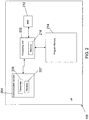
- FIG. 2 is a block diagram of a wireless communication device, such as a UE 108 shown in FIG. 1 , in accordance with an embodiment of the disclosure. As will be apparent to a person of ordinary skill in the art, FIG. 2 shows only the main functional components of an exemplary UE 108 that are necessary for an understanding of the invention.
- the UE 108 comprises a processing unit 202 for carrying out operational processing for the UE 108.
- the UE 108 also has a communication section 204 for providing wireless communication via a radio communication link with, for example, the eNB 106 of the E-UTRAN 104.
- the communication section 204 typically includes at least one antenna (not shown), at least one receiver 207 and at least one transmitter 209, at least one modulation/ demodulation section (not shown), and at least one coding/decoding section (not shown), for example, as will be known to a person of ordinary skill in the art and thus will not be described further herein.
- the communication section 204 is coupled to the processing unit 202.
- the UE 108 also has a Man Machine Interface MMI 212, including elements such as a key pad, microphone, speaker, display screen, for providing an interface between the UE 108 and the user of the UE 108.
- the MMI 212 is coupled to the processing unit 202.
- the processing unit 202 may be a single processor or may comprise two or more processors carrying out all processing required for the operation of the UE 108.
- the number of processors and the allocation of processing functions to the processing unit is a matter of design choice for a person of ordinary skill in the art.
- the UE 108 also has a program memory 214 in which are stored programs containing processor instructions for operation of the UE 108.
- the programs may contain a number of different program elements or sub-routines containing processor instructions for a variety of different tasks, for example: communicating with the user via the MMI 212; processing signaling messages received from the LTE network 101; performing neighboring coverage area measurements; implementing one or more security modes in the UE 108.
- the program memory 214 may store program elements which, when run on the processing unit 202, control the UE 108 to perform the method of implementing security in the UE in accordance with the disclosure.
- the program memory 214 may store one or more security algorithms for implementing security.
- the UE 108 may further include a memory 218 for storing information.
- the memory 218 is shown in FIG. 2 as part of the processing unit 202 but may instead be separate (e.g. part of program memory 214).
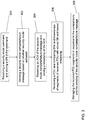
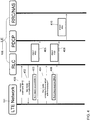
- FIG. 3 shows steps of a method of implementing security in a wireless communication device in accordance with an example embodiment of the disclosure. The method shall be described with reference to the communication system 100 of FIG. 1 and the UE 108 of FIG. 2 by way of example. Reference will also be made to FIG. 4 which shows an example message flow between the LTE network 101 and the different layers of the control plane of the UE 108 for the method of implementing security in a UE in accordance with an example embodiment of the disclosure.
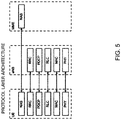
- FIG. 5 shows the control plane protocol layers between the UE 108 and eNB 106 and between the UE 108 and MME 112.
- the control plane of UE 108 includes a Radio Link Control (RLC) layer, a Packet Data Control Protocol (PDCP) layer and a Radio Resource Control (RRC)/Non-Access Stratum (NAS) layer.
- RLC Radio Link Control
- PDCP Packet Data Control Protocol
- RRC Radio Resource Control
- NAS Non-Access Stratum
- the PDCP layer performs the ciphering (encryption) and deciphering (decryption) when security is activated in the UE 108 as is well known in the art.
- the LTE network 101 can initiate a security mode procedure to activate security in the LTE network 101 and the UE 108 so as to protect messages exchanged between the UE 108 and the LTE network 101.
- the LTE network 101 sends a security mode command to the UE 108.
- the LTE network 101 starts ciphering (encrypting) messages according to the security mode on which the security mode command is based.
- the security mode command message includes information indicating the security algorithm(s) and security parameters to be used by the UE 108 in order to implement security in the UE 108 and so as to be synchronized with the security mode used in the LTE network 101.
- Access Stratum AS
- NAS Non Access Stratum
- AS Access Stratum
- ciphering mechanisms can be used to provide signaling and user data confidentiality between the UE and the EPS
- integrity and replay mechanisms can be used to provide signaling and user data integrity.
- the security algorithms currently implemented in LTE include: for encryption, EPS Encryption Algorithms (EEA) as specified in 3GPP TS 33.401, including 128-EEA0 (Null ciphering algorithm), 128-EEA1 (SNOW 3G) and 128-EEA2 (AES); and for integrity, the EPS Integrity Algorithms (EIA) as also specified in 3GPP TS 33.401, including 128-EIA1 (SNOW 3G) and 128-EIA2 (AES).
- EAE EPS Encryption Algorithms
- 128-EEA0 Null ciphering algorithm
- 128-EEA1 SNOW 3G
- 128-EEA2 AES
- EIA EPS Integrity Algorithms
- the program memory 214 may store one or more security algorithms for implementing security in the UE 108.
- the UE 108 indicates to the LTE network 101 which security algorithms it supports in the attach request it sends to the network at power-up.
- the LTE network 101 may initiate security at any time the UE 108 is in a connected state and messages between the user and the network are to be protected: for example, on RRC connection establishment, before the UE is attached or after the UE is attached.
- a UE 108 is in a connected state when a connection has been setup by the network for communication between the UE 108 and E-UTRAN 104.
- 3GPP TS 36.331 V9.10.0 & TS 33.401 V9.7.0 provide more details of security mode procedures in LTE communication systems.
- the UE 108 is connected to the LTE network 101 and receives via the receiver 207 a security mode command for activating a security mode in the UE 108.
- the security mode command is sent or encapsulated in a message which includes information identifying a sequence number SN of the security mode command message (that is, the SN of the security mode command).
- the UE 108 stores the sequence number SN of the received security mode command.
- the SN may be stored in memory 218 or program memory 214.
- the initiated security may be AS security for Radio Resource Control (RRC) signaling messages transferred through Signaling Radio Bearers (SRBs) as well as RRC user data transferred through Data Radio Bearers (DRBs).
- RRC Radio Resource Control
- SRBs Signaling Radio Bearers
- DRBs Data Radio Bearers
- a security mode complete or failure message is sent based on whether a security mode is activated in the UE 108.
- a security mode complete message is sent when a security mode is activated in the UE 108 and a security mode failure message is sent when a security mode is not activated in the UE 108.
- a security mode is activated in the UE 108, when the UE 108 determines that the UE 108 can implement the security in response to the security mode command.
- the security mode is activated in the UE 108, when the UE 108 determines that it can support the security algorithm and security parameters to be used to implement security (e.g. as indicated in the security mode command message) and the UE 108 verifies the integrity of the security mode command.
- the UE 108 determines that it cannot support the security algorithm and security parameters to be used to implement security or if the verification of the integrity of the security mode command fails, the UE 108 does not activate the security mode and sends a security mode failure message.
- the determining whether the security algorithm and security parameters are supported, verifying the integrity of the security mode command and the activating, not activating, of the security mode may be performed by the UE 108 under the control of the processing unit 202.
- the security mode complete/failure message is sent to the LTE network 101 from the UE 108 as a RLC message 402.
- the LTE network 101 On receipt of the security mode complete/failure message, the LTE network 101 sends an acknowledgement to the UE 108.
- the UE 108 receives, at step 304, the acknowledgement of the security mode complete or failure message and stores a timestamp of the acknowledgement.
- the UE 108 knows that the LTE network 101 is in a security mode consistent with the security applied by the UE 108: that is, the UE 108 and LTE network 101 are both either applying security or not.
- the timestamp may be computed by the UE 108 (e.g. by means of the processing unit 202) as an absolute time when the acknowledgement is received at the UE 108. In the example of FIG.
- the acknowledgement is sent as a RLC ACK message 404 having a timestamp T.
- the acknowledgement indicates that the LTE network 101 is synchronized with the UE 108 regarding implementing security. For example, when the LTE network 101 sends an acknowledgement in response to receiving a security mode failure message, the LTE network 101 stops ciphering messages in line with the UE 108. When the LTE network sends an acknowledgement in response to receiving a security mode complete message, the LTE network 101 continues ciphering messages in line with the UE 108.
- the UE 108 following sending of a security mode complete/failure message , on receipt of a Packet Data Unit (PDU) (e.g. sent by the LTE network 101), the UE 108, at step 306, compares the sequence numbers and timestamps of segments of the received PDU with the stored sequence number and timestamp of the acknowledgement.
- the timestamp of the acknowledgement and the timestamp of a segment of the received PDU correspond to the time of receipt at the UE 108 of the acknowledgment and the segment or information on which the segment is based.
- the UE 108 is configured to manage the received PDU segments at step 308 in response to the comparisons, and the sending of the security mode complete or security mode failure message.
- the managing of the received PDU segments may include applying or not applying security to the received PDU segments depending on the sending of the security mode complete/failure message and the sequence numbers and timestamps of the received PDU.
- the PDU is a PDCP PDU received at the PDCP layer of the UE 108 and the PDCP layer (e.g. by means of the processing unit 202) performs the comparison.
- the PDCP PDU includes RLC segments of information received in RLC messages received at the UE 108. Multiple RLC segments can form a PDCP packet. Thus, older PDCP PDUs or frames may be received later than more recent ones based on the quality of the radio link and the RLC message retransmissions.
- RLC messages 403 and 406 are received from the LTE network 101 at the RLC layer.
- the RLC layer transfers a PDCP PDU 405 and 408 based on the received RLC messages 403 and 406 to the PDCP layer.
- PDCP PDU 405 includes segments of information, which information was received in RLC message 403.
- PDCP PDU 408 includes segments of information, which information was received in RLC message 406.
- managing the received PDU segments includes: not applying security to the received PDU segments having sequence numbers greater than the sequence number of the received security mode command and timestamps greater than the timestamp of the acknowledgement; and ignoring the received PDU segments having sequence numbers greater than the sequence number of the received security mode command and timestamps less than the timestamp of the acknowledgement.
- Not applying security includes processing the received PDU segments having sequence numbers greater than the sequence number of the received security mode command and timestamps greater than the timestamp of the acknowledgement as unciphered segments.
- managing includes applying security to the received PDU segments having sequence numbers greater than the sequence number of the received security mode command and timestamps greater than the timestamp of the acknowledgement or timestamps after the security mode complete message is sent.
- Applying security includes processing the received PDU segments having sequence numbers greater than the sequence number of the received security mode command and timestamps greater than the timestamp of the acknowledgement or timestamps after the security mode complete message is sent as ciphered messages.
- managing the received PDU segments includes: not applying security to the received PDU segments having sequence numbers less than the sequence number of the received security mode command and timestamps after the security mode complete message is sent. Not applying security includes processing the received PDU segments having sequence numbers less than the sequence number of the received security mode command and timestamps after the security mode complete message is sent.
- the PDCP layer informs the RRC/NAS layers that security is to be applied or not and in the case when security is to be applied, the PDCP layer also informs the RRC/NAS layers of the security algorithms and security parameters to be applied.
- the PDCP layer transfers segments to the RRC/NAS layers as PDCP Service Data Units (SDU) (PDCP SDU 410 in the example shown in FIG. 4 ).
- SDU PDCP Service Data Units
- the SRB AS ciphered segments are deciphered (decrypted) at the RRC layer and their integrity checked.
- the UE 108 activates the security mode and starts ciphering (encrypting) messages to be sent to the LTE network 101.
- the LTE network 101 and UE 108 are in synchronization and are applying the same security.
- the prior art UEs may misinterpret messages from the LTE network 101 by not applying the same security as the LTE network 101 or may apply security to messages sent to the LTE network 101 which is not in line with the security being applied by the LTE network 101.
- the method in accordance with the disclosure can avoid or substantially reduce misunderstandings between the UE and LTE network over ciphered or un-ciphered messages transmitted between the UE and LTE network. This reduces the number of occurrences of de-synchronisation between the UE and network with respect to the security mode used. For example, the situation where the UE stays in connected mode forever because the UE cannot interpret/ decipher any message the network sends it can be avoided.
Landscapes
- Engineering & Computer Science (AREA)
- Computer Security & Cryptography (AREA)
- Computer Networks & Wireless Communication (AREA)
- Signal Processing (AREA)
- Mobile Radio Communication Systems (AREA)
Claims (15)
- Procédé de mise en oeuvre de la sécurité destinée à une utilisation dans un dispositif de communication sans fil (108), le procédé comprenant
la réception (300), au niveau du dispositif (108), d'une commande pour le mode sécurité pour activer un mode de sécurité dans le dispositif et stocker un numéro de séquence de la commande pour le mode sécurité reçue, le procédé étant caractérisé par :l'envoi (302) d'un message d'achèvement du mode de sécurité ou d'un message d'échec (402) basé sur le fait qu'un mode de sécurité est activé dans le dispositif ;la réception (304) d'un accusé de réception du message d'achèvement du mode de sécurité ou du message d'échec (402) et le stockage d'un horodatage de l'accusé de réception ;la réception (306) d'une unité de données de protocole PDU et la comparaison des numéros de séquence et des horodatages de segments de la PDU reçue avec le numéro de séquence stocké et l'horodatage de l'accusé de réception ;la gestion (308) des segments de PDU reçus en réponse aux comparaisons, et en réponse à l'envoi du message d'achèvement du mode de sécurité ou du message d'échec du mode de sécurité (402). - Procédé selon la revendication 1, lorsqu'un message d'échec du mode de sécurité (402) est envoyé, la gestion comprend :une non application de la sécurité aux segments de PDU reçus ayant des numéros de séquence supérieurs au numéro de séquence de la commande pour le mode sécurité reçue et des horodatages ultérieurs à l'horodatage de l'accusé de réception ; etl'ignorance des segments de PDU reçus ayant des numéros de séquence supérieurs au numéro de séquence de la commande pour le mode sécurité reçue et des horodatages antérieurs à l'horodatage de l'accusé de réception.
- Procédé selon la revendication 2, dans lequel la non application de la sécurité comprend le traitement des segments de PDU reçus ayant des numéros de séquence supérieurs au numéro de séquence de la commande pour le mode sécurité reçue et des horodatages ultérieurs à l'horodatage de l'accusé de réception sous forme de segments non numérotés.
- Procédé selon la revendication 1, 2 ou 3, lorsqu'un message d'achèvement du mode de sécurité (402) est envoyé, la gestion comprend :
l'application de la sécurité aux segments de PDU reçus ayant des numéros de séquence supérieurs au numéro de séquence de la commande pour le mode sécurité reçue et des horodatages ultérieurs à l'horodatage de l'accusé de réception ou des horodatages après que le message d'achèvement du mode de sécurité (402) ait été envoyé. - Procédé selon la revendication 4, dans lequel l'application de la sécurité comprend le traitement des segments de PDU reçus ayant des numéros de séquence supérieurs au numéro de séquence de la commande pour le mode sécurité reçue et des horodatages ultérieurs à l'horodatage de l'accusé de réception ou des horodatages après que le message d'achèvement du mode de sécurité (402) ait été envoyé sous forme de messages numérotés.
- Procédé selon une quelconque revendication précédente, dans lequel la commande pour le mode sécurité est encapsulée dans un message RLC (400) et le stockage d'un numéro de séquence comprend un stockage d'un numéro de séquence RLC du message RLC.
- Procédé selon une quelconque revendication précédente, dans lequel la PDU reçue est une PDU PDCP.
- Dispositif de communication sans fil (108) incluant :un émetteur (209) ;un récepteur (207) pour la réception d'une commande pour le mode sécurité pour activer un mode de sécurité dans le dispositif (108) ;une unité de traitement (202) couplé de manière communicative à l'émetteur (209) et au récepteur (207), le dispositif de communication sans fil étant caractérisé par une unité de traitement étant configurée pour :stocker un numéro de séquence de la commande pour le mode sécurité reçue ;envoyer un message d'achèvement du mode de sécurité ou d'échec (402) basé sur le fait qu'un mode de sécurité est activé dans le dispositif (108) ;recevoir un accusé de réception du message d'achèvement du mode de sécurité ou d'échec (402) et stocker un horodatage de l'accusé de réception ;recevoir une PDU et comparer les numéros de séquence et les horodatages de segments de la PDU reçue avec le numéro de séquence stocké et l'horodatage de l'accusé de réception ;gérer les segments de PDU reçus en réponse aux comparaisons, et en réponse à l'envoi du message d'achèvement du mode de sécurité ou d'échec du mode de sécurité (402).
- Dispositif de communication sans fil selon la revendication 8, dans lequel l'unité de traitement (202) est configurée pour gérer les segments de PDU reçus lorsqu'un message d'échec du mode de sécurité (402) est envoyé :en n'appliquant pas la sécurité aux segments de PDU reçus ayant des numéros de séquence supérieurs au numéro de séquence de la commande pour le mode sécurité reçue et des horodatages ultérieurs à l'horodatage de l'accusé de réception ; eten ignorant les segments de PDU reçus ayant des numéros de séquence supérieurs au numéro de séquence de la commande pour le mode sécurité reçue et des horodatages antérieurs à l'horodatage de l'accusé de réception.
- Dispositif de communication sans fil selon la revendication 9, dans lequel l'unité de traitement (202) est configurée pour traiter les segments de PDU reçus ayant des numéros de séquence supérieurs au numéro de séquence de la commande pour le mode sécurité reçue et des horodatages ultérieurs à l'horodatage de l'accusé de réception sous forme de segments non numérotés.
- Dispositif de communication sans fil selon la revendication 8, 9, ou 10, dans lequel l'unité de traitement (202) est configurée pour gérer les segments de PDU reçus lorsqu'un message d'achèvement du mode de sécurité (402) est envoyé :
en appliquant la sécurité aux segments de PDU reçus ayant des numéros de séquence supérieurs au numéro de séquence de la commande pour le mode sécurité reçue et des horodatages ultérieurs à l'horodatage de l'accusé de réception ou des horodatages après que le message d'achèvement du mode de sécurité (402) ait été envoyé. - Dispositif de communication sans fil selon la revendication 11, dans lequel l'unité de traitement (202) est configurée pour traiter les segments de PDU reçus ayant des numéros de séquence supérieurs au numéro de séquence de la commande pour le mode sécurité reçue et des horodatages ultérieurs à l'horodatage de l'accusé de réception ou des horodatages après que le message d'achèvement du mode de sécurité (402) ait été envoyé sous forme de messages numérotés.
- Dispositif de communication sans fil selon l'une quelconque des revendications 8 à 12, dans lequel la commande pour le mode sécurité est encapsulée dans un message RLC (400) et le numéro de séquence est un numéro de séquence RLC du message RLC encapsulant la commande pour le mode sécurité.
- Dispositif de communication sans fil selon l'une quelconque des revendications 8 à 13, dans lequel la PDU reçue est une PDU PDCP.
- Dispositif de communication sans fil selon l'une quelconque des revendications 8 à 14, dans lequel l'unité de traitement (202) est configurée pour gérer les segments de PDU reçus lorsqu'un message d'échec du mode de sécurité (402) ou un message d'achèvement du mode de sécurité (402) est envoyé :
en n'appliquant pas la sécurité aux segments de PDU reçus ayant des numéros de séquence inférieurs au numéro de séquence de la commande pour le mode sécurité reçue et des horodatages après que le message d'échec du mode de sécurité (402) ou le message d'achèvement du mode de sécurité (402) ait été envoyé.
Priority Applications (2)
| Application Number | Priority Date | Filing Date | Title |
|---|---|---|---|
| EP12290236.4A EP2688328B1 (fr) | 2012-07-17 | 2012-07-17 | Sécurité dans un système de communication sans fil et dispositif |
| US13/914,688 US8995664B2 (en) | 2012-07-17 | 2013-06-11 | Security in wireless communication system and device |
Applications Claiming Priority (1)
| Application Number | Priority Date | Filing Date | Title |
|---|---|---|---|
| EP12290236.4A EP2688328B1 (fr) | 2012-07-17 | 2012-07-17 | Sécurité dans un système de communication sans fil et dispositif |
Publications (2)
| Publication Number | Publication Date |
|---|---|
| EP2688328A1 EP2688328A1 (fr) | 2014-01-22 |
| EP2688328B1 true EP2688328B1 (fr) | 2018-10-03 |
Family
ID=46785331
Family Applications (1)
| Application Number | Title | Priority Date | Filing Date |
|---|---|---|---|
| EP12290236.4A Not-in-force EP2688328B1 (fr) | 2012-07-17 | 2012-07-17 | Sécurité dans un système de communication sans fil et dispositif |
Country Status (2)
| Country | Link |
|---|---|
| US (1) | US8995664B2 (fr) |
| EP (1) | EP2688328B1 (fr) |
Families Citing this family (7)
| Publication number | Priority date | Publication date | Assignee | Title |
|---|---|---|---|---|
| EP3576447A1 (fr) * | 2013-06-28 | 2019-12-04 | NEC Corporation | Sécurité pour une communication de groupe prose |
| US10136311B2 (en) | 2013-12-13 | 2018-11-20 | M87, Inc. | Methods and systems of secure connections for joining hybrid cellular and non-cellular networks |
| CN115474245B (zh) | 2015-06-30 | 2025-06-13 | 华为技术有限公司 | 一种数据传输方法、无线网络节点和通信系统 |
| US9992810B2 (en) * | 2015-08-26 | 2018-06-05 | Samsung Electronics Co., Ltd | Method for providing integrity protection in a dual SIM dual standby device |
| CN107592620A (zh) * | 2017-08-31 | 2018-01-16 | 努比亚技术有限公司 | 一种网络信令交互的方法、终端及计算机可读存储介质 |
| US11570616B2 (en) | 2019-08-08 | 2023-01-31 | Mediatek Inc. | Provide EPS security capability and receive eps security algorithm information in 5GS |
| WO2021066529A1 (fr) * | 2019-10-01 | 2021-04-08 | Samsung Electronics Co., Ltd. | Procédés et appareil de commande de permissions d'un ue permettant d'accéder à un réseau |
Family Cites Families (31)
| Publication number | Priority date | Publication date | Assignee | Title |
|---|---|---|---|---|
| JPH1173398A (ja) * | 1997-06-03 | 1999-03-16 | Toshiba Corp | 分散ネットワークコンピューティングシステム、同システムに用いられる情報交換装置、同システムに用いられるセキュリティ機能を有する情報交換方法、この方法を格納したコンピュータ読取り可能な記憶媒体 |
| EP1104213A3 (fr) * | 1999-11-29 | 2003-05-21 | Philips Intellectual Property & Standards GmbH | Réseau sans fil avec une procédure de modification de clefs |
| US20030076859A1 (en) * | 2001-10-23 | 2003-04-24 | Jiang Sam Shiaw-Shiang | Modification of ciphering activation time by RLC reset procedure during ciphering configuration change procedure in a wireless communications protocol |
| US7020455B2 (en) * | 2001-11-28 | 2006-03-28 | Telefonaktiebolaget L M Ericsson (Publ) | Security reconfiguration in a universal mobile telecommunications system |
| US20030221098A1 (en) * | 2002-05-22 | 2003-11-27 | Kun-Huei Chen | Method for automatically updating a network ciphering key |
| DE602004000677T2 (de) * | 2003-08-15 | 2007-05-10 | Research In Motion Ltd., Waterloo | Bestimmung der Aktivierungszeit für eine Aufwärtsrichtungsverschlüsselung in einem UMTS Teilnehmergerät |
| US20060050679A1 (en) * | 2004-09-09 | 2006-03-09 | Sam Shiaw-Shiang Jiang | Method for On-Line Recovery of Parameter Synchronization for Ciphering Applications |
| US7450721B2 (en) * | 2004-09-24 | 2008-11-11 | Research In Motion Limited | Methods and apparatus for reducing airlink congestion and processing time associated with ciphering information in wireless network |
| US7412600B2 (en) * | 2005-10-28 | 2008-08-12 | Cisco Technology, Inc. | Approaches for automatically switching message authentication keys |
| US20070155339A1 (en) * | 2006-01-04 | 2007-07-05 | Innovative Sonic Limited | Method and apparatus for initialization of integrity protection |
| US20070153793A1 (en) * | 2006-01-04 | 2007-07-05 | Innovative Sonic Limited | Method and apparatus of modifying integrity protection configuration in a mobile user equipment of a wireless communications system |
| US8140851B1 (en) * | 2006-02-24 | 2012-03-20 | Cisco Technology, Inc. | Approaches for automatically switching message authentication keys |
| JP2007235353A (ja) * | 2006-02-28 | 2007-09-13 | Fujitsu Ltd | 移動無線端末および無線制御システム |
| US8948393B2 (en) * | 2006-04-28 | 2015-02-03 | Qualcomm Incorporated | Uninterrupted transmission during a change in ciphering configuration |
| TW200743342A (en) * | 2006-05-10 | 2007-11-16 | Innovative Sonic Ltd | Method and apparatus for setting ciphering activation time in wireless communications system |
| CN1983924A (zh) * | 2006-05-30 | 2007-06-20 | 华为技术有限公司 | 一种解密密码切换方法、解密装置及终端设备 |
| US20080083011A1 (en) * | 2006-09-29 | 2008-04-03 | Mcalister Donald | Protocol/API between a key server (KAP) and an enforcement point (PEP) |
| US8699711B2 (en) * | 2007-07-18 | 2014-04-15 | Interdigital Technology Corporation | Method and apparatus to implement security in a long term evolution wireless device |
| KR101392697B1 (ko) | 2007-08-10 | 2014-05-19 | 엘지전자 주식회사 | 이동통신 시스템에서의 보안 오류 검출방법 및 장치 |
| US8532614B2 (en) | 2007-10-25 | 2013-09-10 | Interdigital Patent Holdings, Inc. | Non-access stratum architecture and protocol enhancements for long term evolution mobile units |
| KR20090043465A (ko) | 2007-10-29 | 2009-05-06 | 엘지전자 주식회사 | 무선 베어러 타입에 따른 오류 해결 방법 |
| JP5289460B2 (ja) * | 2007-11-30 | 2013-09-11 | サムスン エレクトロニクス カンパニー リミテッド | 近距離通信ネットワークにおける安全な通信のためのシステム及び方法 |
| GB2457066A (en) * | 2008-01-31 | 2009-08-05 | Nec Corp | Method of setting up radio bearers in a mobile communications system |
| KR20100069382A (ko) * | 2008-12-16 | 2010-06-24 | 한국전자통신연구원 | 시스템 동기를 이용한 트래픽 암호화 키 갱신 장치 및 방법 |
| GB2469291B (en) * | 2009-04-07 | 2011-08-10 | Nec Corp | Packet data network communications device and method |
| US20110119487A1 (en) * | 2009-11-13 | 2011-05-19 | Velocite Systems, LLC | System and method for encryption rekeying |
| US8630416B2 (en) * | 2009-12-21 | 2014-01-14 | Intel Corporation | Wireless device and method for rekeying with reduced packet loss for high-throughput wireless communications |
| US9294270B2 (en) * | 2010-01-05 | 2016-03-22 | Cisco Technology, Inc. | Detection of stale encryption policy by group members |
| WO2011134906A1 (fr) * | 2010-04-26 | 2011-11-03 | Research In Motion Limited | Appareil et procédé de mise en œuvre d'une configuration de mode de sécurité dans un dispositif de communication sans fil |
| US20120159151A1 (en) * | 2010-12-21 | 2012-06-21 | Tektronix, Inc. | Evolved Packet System Non Access Stratum Deciphering Using Real-Time LTE Monitoring |
| US8611541B2 (en) * | 2011-01-17 | 2013-12-17 | Samsung Electronics Co., Ltd | Method and apparatus for applying a ciphering configuration in a wireless communication network |
-
2012
- 2012-07-17 EP EP12290236.4A patent/EP2688328B1/fr not_active Not-in-force
-
2013
- 2013-06-11 US US13/914,688 patent/US8995664B2/en active Active
Non-Patent Citations (1)
| Title |
|---|
| None * |
Also Published As
| Publication number | Publication date |
|---|---|
| US8995664B2 (en) | 2015-03-31 |
| US20140026180A1 (en) | 2014-01-23 |
| EP2688328A1 (fr) | 2014-01-22 |
Similar Documents
| Publication | Publication Date | Title |
|---|---|---|
| US11653199B2 (en) | Multi-RAT access stratum security | |
| US11997738B2 (en) | Systems and methods for the handling of data radio bearer integrity protection failure in NR | |
| KR101078615B1 (ko) | 무선 원격통신에서의 암호화 | |
| US9999086B2 (en) | Packet data transfer re-establishment | |
| EP3322252B1 (fr) | Procédés de communication, dispositif côté réseau, et équipement utilisateur | |
| EP2203008B1 (fr) | Procédé de gestion de la configuration de sécurité dans des systèmes de communication sans fil et dispositif de communication associé | |
| EP2688328B1 (fr) | Sécurité dans un système de communication sans fil et dispositif | |
| US20220345883A1 (en) | Security key updates in dual connectivity | |
| AU2024200711B2 (en) | Managing security keys in a communication system | |
| US20250202939A1 (en) | Initial security activation for medium access control layer | |
| EP4128993B1 (fr) | Communication de données dans un état inactif | |
| CN109246696A (zh) | 密钥处理方法以及相关装置 | |
| US20250048366A1 (en) | Managing small data communication | |
| US20240172176A1 (en) | Managing downlink early data transmission | |
| CN118044327A (zh) | 在用户设备和核心网之间传送早期数据和非早期数据 | |
| JP2024026229A (ja) | Slユニキャストにおけるセキュリティの改善 | |
| US12574723B2 (en) | Early data communication in an inactive state | |
| US20240114586A1 (en) | Handling communication errors during early data communication | |
| CN113692778A (zh) | 恢复通信网络中的无线电连接 | |
| US20240188164A1 (en) | Managing radio connections during early data commuinication via a distributed base station | |
| US20240155726A1 (en) | Managing data communication in a distributed base station | |
| GB2626414A (en) | Improvements in and relating to coverage in a telecommunication network | |
| CN118525536A (zh) | 管理小数据通信 |
Legal Events
| Date | Code | Title | Description |
|---|---|---|---|
| PUAI | Public reference made under article 153(3) epc to a published international application that has entered the european phase |
Free format text: ORIGINAL CODE: 0009012 |
|
| AK | Designated contracting states |
Kind code of ref document: A1 Designated state(s): AL AT BE BG CH CY CZ DE DK EE ES FI FR GB GR HR HU IE IS IT LI LT LU LV MC MK MT NL NO PL PT RO RS SE SI SK SM TR |
|
| AX | Request for extension of the european patent |
Extension state: BA ME |
|
| 17P | Request for examination filed |
Effective date: 20140722 |
|
| RBV | Designated contracting states (corrected) |
Designated state(s): AL AT BE BG CH CY CZ DE DK EE ES FI FR GB GR HR HU IE IS IT LI LT LU LV MC MK MT NL NO PL PT RO RS SE SI SK SM TR |
|
| RAP1 | Party data changed (applicant data changed or rights of an application transferred) |
Owner name: GOOGLE TECHNOLOGY HOLDINGS LLC |
|
| REG | Reference to a national code |
Ref country code: DE Ref legal event code: R079 Ref document number: 602012051715 Country of ref document: DE Free format text: PREVIOUS MAIN CLASS: H04W0012040000 Ipc: H04W0084040000 |
|
| GRAP | Despatch of communication of intention to grant a patent |
Free format text: ORIGINAL CODE: EPIDOSNIGR1 |
|
| STAA | Information on the status of an ep patent application or granted ep patent |
Free format text: STATUS: GRANT OF PATENT IS INTENDED |
|
| RIC1 | Information provided on ipc code assigned before grant |
Ipc: H04W 92/10 20090101ALI20180409BHEP Ipc: H04W 12/04 20090101ALI20180409BHEP Ipc: H04W 84/04 20090101AFI20180409BHEP |
|
| INTG | Intention to grant announced |
Effective date: 20180426 |
|
| GRAS | Grant fee paid |
Free format text: ORIGINAL CODE: EPIDOSNIGR3 |
|
| GRAA | (expected) grant |
Free format text: ORIGINAL CODE: 0009210 |
|
| STAA | Information on the status of an ep patent application or granted ep patent |
Free format text: STATUS: THE PATENT HAS BEEN GRANTED |
|
| AK | Designated contracting states |
Kind code of ref document: B1 Designated state(s): AL AT BE BG CH CY CZ DE DK EE ES FI FR GB GR HR HU IE IS IT LI LT LU LV MC MK MT NL NO PL PT RO RS SE SI SK SM TR |
|
| REG | Reference to a national code |
Ref country code: GB Ref legal event code: FG4D |
|
| REG | Reference to a national code |
Ref country code: CH Ref legal event code: EP Ref country code: AT Ref legal event code: REF Ref document number: 1050092 Country of ref document: AT Kind code of ref document: T Effective date: 20181015 |
|
| REG | Reference to a national code |
Ref country code: DE Ref legal event code: R096 Ref document number: 602012051715 Country of ref document: DE Ref country code: IE Ref legal event code: FG4D |
|
| REG | Reference to a national code |
Ref country code: NL Ref legal event code: MP Effective date: 20181003 |
|
| REG | Reference to a national code |
Ref country code: LT Ref legal event code: MG4D |
|
| REG | Reference to a national code |
Ref country code: AT Ref legal event code: MK05 Ref document number: 1050092 Country of ref document: AT Kind code of ref document: T Effective date: 20181003 |
|
| PG25 | Lapsed in a contracting state [announced via postgrant information from national office to epo] |
Ref country code: NL Free format text: LAPSE BECAUSE OF FAILURE TO SUBMIT A TRANSLATION OF THE DESCRIPTION OR TO PAY THE FEE WITHIN THE PRESCRIBED TIME-LIMIT Effective date: 20181003 |
|
| PG25 | Lapsed in a contracting state [announced via postgrant information from national office to epo] |
Ref country code: ES Free format text: LAPSE BECAUSE OF FAILURE TO SUBMIT A TRANSLATION OF THE DESCRIPTION OR TO PAY THE FEE WITHIN THE PRESCRIBED TIME-LIMIT Effective date: 20181003 Ref country code: AT Free format text: LAPSE BECAUSE OF FAILURE TO SUBMIT A TRANSLATION OF THE DESCRIPTION OR TO PAY THE FEE WITHIN THE PRESCRIBED TIME-LIMIT Effective date: 20181003 Ref country code: IS Free format text: LAPSE BECAUSE OF FAILURE TO SUBMIT A TRANSLATION OF THE DESCRIPTION OR TO PAY THE FEE WITHIN THE PRESCRIBED TIME-LIMIT Effective date: 20190203 Ref country code: CZ Free format text: LAPSE BECAUSE OF FAILURE TO SUBMIT A TRANSLATION OF THE DESCRIPTION OR TO PAY THE FEE WITHIN THE PRESCRIBED TIME-LIMIT Effective date: 20181003 Ref country code: NO Free format text: LAPSE BECAUSE OF FAILURE TO SUBMIT A TRANSLATION OF THE DESCRIPTION OR TO PAY THE FEE WITHIN THE PRESCRIBED TIME-LIMIT Effective date: 20190103 Ref country code: BG Free format text: LAPSE BECAUSE OF FAILURE TO SUBMIT A TRANSLATION OF THE DESCRIPTION OR TO PAY THE FEE WITHIN THE PRESCRIBED TIME-LIMIT Effective date: 20190103 Ref country code: PL Free format text: LAPSE BECAUSE OF FAILURE TO SUBMIT A TRANSLATION OF THE DESCRIPTION OR TO PAY THE FEE WITHIN THE PRESCRIBED TIME-LIMIT Effective date: 20181003 Ref country code: FI Free format text: LAPSE BECAUSE OF FAILURE TO SUBMIT A TRANSLATION OF THE DESCRIPTION OR TO PAY THE FEE WITHIN THE PRESCRIBED TIME-LIMIT Effective date: 20181003 Ref country code: LT Free format text: LAPSE BECAUSE OF FAILURE TO SUBMIT A TRANSLATION OF THE DESCRIPTION OR TO PAY THE FEE WITHIN THE PRESCRIBED TIME-LIMIT Effective date: 20181003 Ref country code: LV Free format text: LAPSE BECAUSE OF FAILURE TO SUBMIT A TRANSLATION OF THE DESCRIPTION OR TO PAY THE FEE WITHIN THE PRESCRIBED TIME-LIMIT Effective date: 20181003 Ref country code: HR Free format text: LAPSE BECAUSE OF FAILURE TO SUBMIT A TRANSLATION OF THE DESCRIPTION OR TO PAY THE FEE WITHIN THE PRESCRIBED TIME-LIMIT Effective date: 20181003 |
|
| PG25 | Lapsed in a contracting state [announced via postgrant information from national office to epo] |
Ref country code: SE Free format text: LAPSE BECAUSE OF FAILURE TO SUBMIT A TRANSLATION OF THE DESCRIPTION OR TO PAY THE FEE WITHIN THE PRESCRIBED TIME-LIMIT Effective date: 20181003 Ref country code: RS Free format text: LAPSE BECAUSE OF FAILURE TO SUBMIT A TRANSLATION OF THE DESCRIPTION OR TO PAY THE FEE WITHIN THE PRESCRIBED TIME-LIMIT Effective date: 20181003 Ref country code: AL Free format text: LAPSE BECAUSE OF FAILURE TO SUBMIT A TRANSLATION OF THE DESCRIPTION OR TO PAY THE FEE WITHIN THE PRESCRIBED TIME-LIMIT Effective date: 20181003 Ref country code: PT Free format text: LAPSE BECAUSE OF FAILURE TO SUBMIT A TRANSLATION OF THE DESCRIPTION OR TO PAY THE FEE WITHIN THE PRESCRIBED TIME-LIMIT Effective date: 20190203 Ref country code: GR Free format text: LAPSE BECAUSE OF FAILURE TO SUBMIT A TRANSLATION OF THE DESCRIPTION OR TO PAY THE FEE WITHIN THE PRESCRIBED TIME-LIMIT Effective date: 20190104 |
|
| REG | Reference to a national code |
Ref country code: DE Ref legal event code: R097 Ref document number: 602012051715 Country of ref document: DE |
|
| PG25 | Lapsed in a contracting state [announced via postgrant information from national office to epo] |
Ref country code: DK Free format text: LAPSE BECAUSE OF FAILURE TO SUBMIT A TRANSLATION OF THE DESCRIPTION OR TO PAY THE FEE WITHIN THE PRESCRIBED TIME-LIMIT Effective date: 20181003 Ref country code: IT Free format text: LAPSE BECAUSE OF FAILURE TO SUBMIT A TRANSLATION OF THE DESCRIPTION OR TO PAY THE FEE WITHIN THE PRESCRIBED TIME-LIMIT Effective date: 20181003 |
|
| PLBE | No opposition filed within time limit |
Free format text: ORIGINAL CODE: 0009261 |
|
| STAA | Information on the status of an ep patent application or granted ep patent |
Free format text: STATUS: NO OPPOSITION FILED WITHIN TIME LIMIT |
|
| PG25 | Lapsed in a contracting state [announced via postgrant information from national office to epo] |
Ref country code: SM Free format text: LAPSE BECAUSE OF FAILURE TO SUBMIT A TRANSLATION OF THE DESCRIPTION OR TO PAY THE FEE WITHIN THE PRESCRIBED TIME-LIMIT Effective date: 20181003 Ref country code: EE Free format text: LAPSE BECAUSE OF FAILURE TO SUBMIT A TRANSLATION OF THE DESCRIPTION OR TO PAY THE FEE WITHIN THE PRESCRIBED TIME-LIMIT Effective date: 20181003 Ref country code: RO Free format text: LAPSE BECAUSE OF FAILURE TO SUBMIT A TRANSLATION OF THE DESCRIPTION OR TO PAY THE FEE WITHIN THE PRESCRIBED TIME-LIMIT Effective date: 20181003 Ref country code: SK Free format text: LAPSE BECAUSE OF FAILURE TO SUBMIT A TRANSLATION OF THE DESCRIPTION OR TO PAY THE FEE WITHIN THE PRESCRIBED TIME-LIMIT Effective date: 20181003 |
|
| 26N | No opposition filed |
Effective date: 20190704 |
|
| PG25 | Lapsed in a contracting state [announced via postgrant information from national office to epo] |
Ref country code: SI Free format text: LAPSE BECAUSE OF FAILURE TO SUBMIT A TRANSLATION OF THE DESCRIPTION OR TO PAY THE FEE WITHIN THE PRESCRIBED TIME-LIMIT Effective date: 20181003 |
|
| PGFP | Annual fee paid to national office [announced via postgrant information from national office to epo] |
Ref country code: FR Payment date: 20190725 Year of fee payment: 8 |
|
| PG25 | Lapsed in a contracting state [announced via postgrant information from national office to epo] |
Ref country code: MC Free format text: LAPSE BECAUSE OF FAILURE TO SUBMIT A TRANSLATION OF THE DESCRIPTION OR TO PAY THE FEE WITHIN THE PRESCRIBED TIME-LIMIT Effective date: 20181003 |
|
| REG | Reference to a national code |
Ref country code: CH Ref legal event code: PL |
|
| PG25 | Lapsed in a contracting state [announced via postgrant information from national office to epo] |
Ref country code: TR Free format text: LAPSE BECAUSE OF FAILURE TO SUBMIT A TRANSLATION OF THE DESCRIPTION OR TO PAY THE FEE WITHIN THE PRESCRIBED TIME-LIMIT Effective date: 20181003 |
|
| REG | Reference to a national code |
Ref country code: BE Ref legal event code: MM Effective date: 20190731 |
|
| PG25 | Lapsed in a contracting state [announced via postgrant information from national office to epo] |
Ref country code: LU Free format text: LAPSE BECAUSE OF NON-PAYMENT OF DUE FEES Effective date: 20190717 Ref country code: BE Free format text: LAPSE BECAUSE OF NON-PAYMENT OF DUE FEES Effective date: 20190731 Ref country code: CH Free format text: LAPSE BECAUSE OF NON-PAYMENT OF DUE FEES Effective date: 20190731 Ref country code: LI Free format text: LAPSE BECAUSE OF NON-PAYMENT OF DUE FEES Effective date: 20190731 |
|
| PG25 | Lapsed in a contracting state [announced via postgrant information from national office to epo] |
Ref country code: IE Free format text: LAPSE BECAUSE OF NON-PAYMENT OF DUE FEES Effective date: 20190717 |
|
| PG25 | Lapsed in a contracting state [announced via postgrant information from national office to epo] |
Ref country code: FR Free format text: LAPSE BECAUSE OF NON-PAYMENT OF DUE FEES Effective date: 20200731 |
|
| PG25 | Lapsed in a contracting state [announced via postgrant information from national office to epo] |
Ref country code: CY Free format text: LAPSE BECAUSE OF FAILURE TO SUBMIT A TRANSLATION OF THE DESCRIPTION OR TO PAY THE FEE WITHIN THE PRESCRIBED TIME-LIMIT Effective date: 20181003 |
|
| PG25 | Lapsed in a contracting state [announced via postgrant information from national office to epo] |
Ref country code: MT Free format text: LAPSE BECAUSE OF FAILURE TO SUBMIT A TRANSLATION OF THE DESCRIPTION OR TO PAY THE FEE WITHIN THE PRESCRIBED TIME-LIMIT Effective date: 20181003 Ref country code: HU Free format text: LAPSE BECAUSE OF FAILURE TO SUBMIT A TRANSLATION OF THE DESCRIPTION OR TO PAY THE FEE WITHIN THE PRESCRIBED TIME-LIMIT; INVALID AB INITIO Effective date: 20120717 |
|
| PG25 | Lapsed in a contracting state [announced via postgrant information from national office to epo] |
Ref country code: MK Free format text: LAPSE BECAUSE OF FAILURE TO SUBMIT A TRANSLATION OF THE DESCRIPTION OR TO PAY THE FEE WITHIN THE PRESCRIBED TIME-LIMIT Effective date: 20181003 |
|
| P01 | Opt-out of the competence of the unified patent court (upc) registered |
Effective date: 20230510 |
|
| PGFP | Annual fee paid to national office [announced via postgrant information from national office to epo] |
Ref country code: DE Payment date: 20240729 Year of fee payment: 13 |
|
| PGFP | Annual fee paid to national office [announced via postgrant information from national office to epo] |
Ref country code: GB Payment date: 20240729 Year of fee payment: 13 |
|
| REG | Reference to a national code |
Ref country code: DE Ref legal event code: R119 Ref document number: 602012051715 Country of ref document: DE |
|
| GBPC | Gb: european patent ceased through non-payment of renewal fee |
Effective date: 20250717 |
|
| PG25 | Lapsed in a contracting state [announced via postgrant information from national office to epo] |
Ref country code: GB Free format text: LAPSE BECAUSE OF NON-PAYMENT OF DUE FEES Effective date: 20250717 |
|
| PG25 | Lapsed in a contracting state [announced via postgrant information from national office to epo] |
Ref country code: DE Free format text: LAPSE BECAUSE OF NON-PAYMENT OF DUE FEES Effective date: 20260203 |