EP2689748B1 - Lentille intraoculaire et son procédé de fabrication - Google Patents
Lentille intraoculaire et son procédé de fabrication Download PDFInfo
- Publication number
- EP2689748B1 EP2689748B1 EP12760887.5A EP12760887A EP2689748B1 EP 2689748 B1 EP2689748 B1 EP 2689748B1 EP 12760887 A EP12760887 A EP 12760887A EP 2689748 B1 EP2689748 B1 EP 2689748B1
- Authority
- EP
- European Patent Office
- Prior art keywords
- lens
- spherical aberration
- intraocular lens
- aberration
- optical
- Prior art date
- Legal status (The legal status is an assumption and is not a legal conclusion. Google has not performed a legal analysis and makes no representation as to the accuracy of the status listed.)
- Active
Links
Images



Classifications
-
- A—HUMAN NECESSITIES
- A61—MEDICAL OR VETERINARY SCIENCE; HYGIENE
- A61F—FILTERS IMPLANTABLE INTO BLOOD VESSELS; PROSTHESES; DEVICES PROVIDING PATENCY TO, OR PREVENTING COLLAPSING OF, TUBULAR STRUCTURES OF THE BODY, e.g. STENTS; ORTHOPAEDIC, NURSING OR CONTRACEPTIVE DEVICES; FOMENTATION; TREATMENT OR PROTECTION OF EYES OR EARS; BANDAGES, DRESSINGS OR ABSORBENT PADS; FIRST-AID KITS
- A61F2/00—Filters implantable into blood vessels; Prostheses, i.e. artificial substitutes or replacements for parts of the body; Appliances for connecting them with the body; Devices providing patency to, or preventing collapsing of, tubular structures of the body, e.g. stents
- A61F2/02—Prostheses implantable into the body
- A61F2/14—Eye parts, e.g. lenses or corneal implants; Artificial eyes
-
- A—HUMAN NECESSITIES
- A61—MEDICAL OR VETERINARY SCIENCE; HYGIENE
- A61F—FILTERS IMPLANTABLE INTO BLOOD VESSELS; PROSTHESES; DEVICES PROVIDING PATENCY TO, OR PREVENTING COLLAPSING OF, TUBULAR STRUCTURES OF THE BODY, e.g. STENTS; ORTHOPAEDIC, NURSING OR CONTRACEPTIVE DEVICES; FOMENTATION; TREATMENT OR PROTECTION OF EYES OR EARS; BANDAGES, DRESSINGS OR ABSORBENT PADS; FIRST-AID KITS
- A61F2/00—Filters implantable into blood vessels; Prostheses, i.e. artificial substitutes or replacements for parts of the body; Appliances for connecting them with the body; Devices providing patency to, or preventing collapsing of, tubular structures of the body, e.g. stents
- A61F2/02—Prostheses implantable into the body
- A61F2/14—Eye parts, e.g. lenses or corneal implants; Artificial eyes
- A61F2/16—Intraocular lenses
- A61F2/1613—Intraocular lenses having special lens configurations, e.g. multipart lenses; having particular optical properties, e.g. pseudo-accommodative lenses, lenses having aberration corrections, diffractive lenses, lenses for variably absorbing electromagnetic radiation, lenses having variable focus
- A61F2/1637—Correcting aberrations caused by inhomogeneities; correcting intrinsic aberrations, e.g. of the cornea, of the surface of the natural lens, aspheric, cylindrical, toric lenses
-
- A—HUMAN NECESSITIES
- A61—MEDICAL OR VETERINARY SCIENCE; HYGIENE
- A61F—FILTERS IMPLANTABLE INTO BLOOD VESSELS; PROSTHESES; DEVICES PROVIDING PATENCY TO, OR PREVENTING COLLAPSING OF, TUBULAR STRUCTURES OF THE BODY, e.g. STENTS; ORTHOPAEDIC, NURSING OR CONTRACEPTIVE DEVICES; FOMENTATION; TREATMENT OR PROTECTION OF EYES OR EARS; BANDAGES, DRESSINGS OR ABSORBENT PADS; FIRST-AID KITS
- A61F2/00—Filters implantable into blood vessels; Prostheses, i.e. artificial substitutes or replacements for parts of the body; Appliances for connecting them with the body; Devices providing patency to, or preventing collapsing of, tubular structures of the body, e.g. stents
- A61F2/02—Prostheses implantable into the body
- A61F2/14—Eye parts, e.g. lenses or corneal implants; Artificial eyes
- A61F2/16—Intraocular lenses
-
- B—PERFORMING OPERATIONS; TRANSPORTING
- B29—WORKING OF PLASTICS; WORKING OF SUBSTANCES IN A PLASTIC STATE IN GENERAL
- B29D—PRODUCING PARTICULAR ARTICLES FROM PLASTICS OR FROM SUBSTANCES IN A PLASTIC STATE
- B29D11/00—Producing optical elements, e.g. lenses or prisms
- B29D11/02—Artificial eyes from organic plastic material
- B29D11/023—Implants for natural eyes
-
- G—PHYSICS
- G02—OPTICS
- G02C—SPECTACLES; SUNGLASSES OR GOGGLES INSOFAR AS THEY HAVE THE SAME FEATURES AS SPECTACLES; CONTACT LENSES
- G02C7/00—Optical parts
- G02C7/02—Lenses; Lens systems ; Methods of designing lenses
- G02C7/024—Methods of designing ophthalmic lenses
- G02C7/027—Methods of designing ophthalmic lenses considering wearer's parameters
-
- A—HUMAN NECESSITIES
- A61—MEDICAL OR VETERINARY SCIENCE; HYGIENE
- A61F—FILTERS IMPLANTABLE INTO BLOOD VESSELS; PROSTHESES; DEVICES PROVIDING PATENCY TO, OR PREVENTING COLLAPSING OF, TUBULAR STRUCTURES OF THE BODY, e.g. STENTS; ORTHOPAEDIC, NURSING OR CONTRACEPTIVE DEVICES; FOMENTATION; TREATMENT OR PROTECTION OF EYES OR EARS; BANDAGES, DRESSINGS OR ABSORBENT PADS; FIRST-AID KITS
- A61F2/00—Filters implantable into blood vessels; Prostheses, i.e. artificial substitutes or replacements for parts of the body; Appliances for connecting them with the body; Devices providing patency to, or preventing collapsing of, tubular structures of the body, e.g. stents
- A61F2/02—Prostheses implantable into the body
- A61F2/14—Eye parts, e.g. lenses or corneal implants; Artificial eyes
- A61F2/16—Intraocular lenses
- A61F2/1613—Intraocular lenses having special lens configurations, e.g. multipart lenses; having particular optical properties, e.g. pseudo-accommodative lenses, lenses having aberration corrections, diffractive lenses, lenses for variably absorbing electromagnetic radiation, lenses having variable focus
-
- A—HUMAN NECESSITIES
- A61—MEDICAL OR VETERINARY SCIENCE; HYGIENE
- A61F—FILTERS IMPLANTABLE INTO BLOOD VESSELS; PROSTHESES; DEVICES PROVIDING PATENCY TO, OR PREVENTING COLLAPSING OF, TUBULAR STRUCTURES OF THE BODY, e.g. STENTS; ORTHOPAEDIC, NURSING OR CONTRACEPTIVE DEVICES; FOMENTATION; TREATMENT OR PROTECTION OF EYES OR EARS; BANDAGES, DRESSINGS OR ABSORBENT PADS; FIRST-AID KITS
- A61F2240/00—Manufacturing or designing of prostheses classified in groups A61F2/00 - A61F2/26 or A61F2/82 or A61F9/00 or A61F11/00 or subgroups thereof
- A61F2240/001—Designing or manufacturing processes
Definitions
- the present invention relates to a method for manufacturing an intraocular lens for use in the human eye, particularly an intraocular lens of a novel structure which can improve QOV (quality of vision).
- the human lens of the human eye may have a decrease in characteristics such as modulation ability, transparency and the like due to aging, disease or the like, and along with that, problems such as refractive error, cataracts or the like occur and visual performance decreases.
- an intraocular lens has been proposed from the past. This intraocular lens is typically inserted within the capsule in place of the human lens after the intracapsular human lens of the human eye is extracted and removed.
- the spherical lens power is set, and an intraocular lens of a spherical lens power suited for the patient was selected and used considering the corneal curvature, ocular axis length and the like.
- Patent Document 1 Japanese Patent No. 4459501 (Patent Document 1), proposed is an intraocular lens that gives wave aberration of the reverse code value to the wave aberration in the human eyes of a specified population.
- Patent Document 1 proposes an intraocular lens that gives wave aberration of the reverse code value to the wave aberration in the human eyes of a specified population.
- this intraocular lens it was difficult to say that an efficient method had been established regarding selection of the specified population, measurement of the wave aberration, setting of the reverse code value wave aberration to the intraocular lens and the like, and putting this to practical use was extremely difficult.
- Patent Document 2 Japanese Patent application of Publication No. 2006-517676 (Patent Document 2) as a method of improving the QOV in relation to residual irregular astigmatism is the provision of a corrective lens that uses a chart for which the level of effect on the QOV is actually measured for each order of the high-order aberration expressed by Zernike polynomials, the orders of high-order aberration important for improvement of QOV is specified, and the specified high-order aberrations are offset to achieve zero.
- Patent Document 2 when a corrective lens is provided with a plurality of orders of high-order aberrations as the subject, and all of those high-order aberrations are offset to reach zero, the corrective lens design and manufacturing are extremely complex and they have to be made to order, so they are not very practical, and the same kinds of problems as those of Patent Document 1 are unavoidable. Meanwhile, when providing a corrective lens that has only one high-order aberration (e.g. spherical aberration) as the subject and offsetting that to reach zero, the adverse effect due to other remaining high-order aberrations (e.g. coma aberration) is large, and it was difficult to realize good vision.
- high-order aberration e.g. spherical aberration
- the present invention was created with the circumstances noted above as the background, and its object is to provide a manufacturing method for an intraocular lens of a novel structure that is able to effectively improve quality of vision (QOV), as well as being easy to apply to patients and having a high level of practicality.
- QOV quality of vision
- the present invention provides an intraocular lens manufacturing method including (a) an optical characteristics setting step of setting in an optical portion a spherical aberration of a size corresponding to a coma aberration remaining in a human eye of a patient from which a human lens was extracted, and of a size for which the spherical aberration remaining in that human eye of that patient will not be offset and will be made to remain; (b) a lens shape setting step of determining a lens shape of the optical portion wherein the spherical aberration set at the optical characteristics setting step is provided as a corrective optical characteristic for a residual irregular astigmatism in that human eye of that patient; and (c) a lens forming step of forming an intraocular lens having optical characteristics in which a high-order aberration of that optical portion is rotationally symmetrical around an optical axis, by means of forming the optical portion to have the lens shape determined by the lens shape setting step.
- the intraocular lens of the present invention has a prerequisite of allowing coma aberration to remain in the eye of the patient, and in regards to this point, is completely different from the concept of prior art corrective lenses like that in Patent Document 1 which has the object of eliminating high-order aberration as much as possible. Then, on top of that, by actively giving spherical aberration of a size corresponding to the coma aberration to the intraocular lens, the decrease in QOV due to coma aberration is reduced.
- the present invention is focused on coma aberration among the high-order aberrations when improving vision, and in fact does not give corrective optical characteristics that offset the coma aberration, but rather is based on new knowledge of improving vision by giving spherical aberration of a size corresponding to the coma aberration as the corrective optical characteristic.
- it is not possible to avoid design and manufacturing being extremely difficult for improving vision as long as it is based on the prior art concept of simply achieving zero by offsetting all or specific high-order aberrations in order to suppress a decrease in vision due to high-order aberration as noted in Patent Documents 1 and 2 described previously.
- the present invention is established on a novel technical concept that is completely different from the past, which is to reduce the adverse effect due to coma aberration which is not rotationally symmetrical in relation to the optical center axis, by using spherical aberration which is rotationally symmetrical in relation to the optical center axis.
- the spherical aberration given to the lens used as the corrective optical characteristic is nothing more than an optical characteristic corresponding to the coma aberration, and therefore it goes without saying that it does not achieve zero by offsetting the coma aberration, and it does not achieve zero by offsetting spherical aberration, either. It should be understood that this is technology of a completely different perspective from that of the past, which makes having coma aberration and spherical aberration remain be something affirmative.
- the intraocular lens for which spherical aberration is set according to the present invention is formed having optical characteristics that are rotationally symmetrical around the optical axis, so it is not necessary to specify a position in the circumference direction such as during the manufacturing process or when inserting in the eye, so manufacturing and handling are easy, which makes it easy to put this to practical use.
- the present invention to deal with the decrease in QOV due to coma aberration remaining in the human eye from which the human lens was extracted, the fact that it is effective to actively give spherical aberration using the intraocular lens has been objectively confirmed by comparison between examples and comparative examples in the embodiment described later.
- at least the subjective focal depth is made deeper by giving spherical aberration, and it is thought that this is an item for which one technical basis is acknowledged.
- the QOV improvement effect exhibited by the intraocular lens according to the present invention is also clear from the example data described later.
- the spherical aberration with the intraocular lens of the present invention is set at a size corresponding to the coma aberration, and if the coma aberration is large, then large spherical aberration is set, and if the coma aberration is small, then small spherical aberration is set.
- the specific correlation of the setting value of the spherical aberration of the intraocular lens in relation to the coma aberration remaining in the eye of the patient can be determined considering not only objective optical characteristics of the patient's eye, but also subjective vision preferences of the patient or the like.
- the spherical aberration set for the intraocular lens of the present invention is designed considering the spherical aberration remaining in the human eye with the human lens extracted.
- the spherical aberration of the optical portion with the intraocular lens is preferably set with an RMS value that satisfies any of the following formulas in relation to the coma aberration remaining in the eye after the human lens is extracted (RMS value).
- the RMS value is the value (unit: ⁇ m) for which the wave aberration in the pupil area of the human eye optical system is put into numerical form (displayed as root mean square) using a wave aberration analysis device (wave sensor).
- wave sensor wave aberration analysis device
- the optical characteristics of the human eye tend to change as age increases.
- using the optical characteristics of the cornea or the like, for example it is possible to estimate the coma aberration remaining in the patient after the human lens is extracted according to the age of the patient.
- setting the spherical aberration set for the optical portion in the intraocular lens (RMS value) using the patient age corresponding to the coma aberration as an index based on the following formulas is also effective for obtaining good QOV.
- Intraocular lens spherical aberration A + B ⁇ Patient age ⁇ 0.4 ⁇ A ⁇ m ⁇ ⁇ 0.1 0.003 ⁇ B ⁇ m ⁇ 0.004
- the QOV is improved by applying spherical aberration, which is an optical characteristic that is rotationally symmetrical around the optical axis, in relation to coma aberration having a big adverse effect on QOV and for which it is difficult to realize an intraocular lens having optical characteristics that offset the coma aberration. Accordingly, it is possible to realize an intraocular lens of a novel structure for which design, manufacturing, and handling are easy, and practical usability is excellent.
- FIG. 1 an intraocular lens 10 is shown as an embodiment of the present invention.
- This intraocular lens 10 is constituted including an optical portion 12 that gives optical characteristics constituting the lens main unit, and a pair of support units 14, 14 extending out from the optical portion 12.
- the optical portion 12 is equipped with a front surface and back surface for which respectively roughly spherical convex surface shapes are the lens surfaces, these front and back surfaces are refractive surfaces, and designated optical characteristics are set.
- the geometric center axis of the optical portion 12 and the optical axis are set to be the same, and this is used as a lens center axis 15.
- the pair of support units 14, 14 are formed extending out facing the direction mutually opposite from two locations positioned facing mutually opposite in the radial direction of the outer circumference edge part on the optical portion 12.
- the tip part of each support unit 14 is a free edge that extends curving in the circumference direction of the optical portion 12.
- this intraocular lens 10 is installed in place of the human lens by being inserted inside a human lens capsule 18 after removal of the human lens for a human eye 16 of the patient.
- the tip part of the support units 14, 14 abut the circumference edge part of the human lens capsule 18, and the optical portion 12 is held in a designated position of the center inside the human lens capsule 18.
- the material of the intraocular lens 10 is not limited by the present invention, and it is possible to use polymethyl methacrylate (PMMA), silicone rubber or the like known from the past as the material of the optical portion 12. It is also possible to use known various synthetic resin materials for the support units 14, 14 as well, but it is also possible to have a one piece structure with the optical portion 12 and the support units 14, 14 formed as an integrated unit.
- PMMA polymethyl methacrylate
- silicone rubber silicone rubber
- the intraocular lens 10 of this embodiment spherical aberration is actively given to the optical portion 12.
- the intraocular lens 10 of the present invention has as the optical characteristics spherical aberration in addition to the spherical lens power (D) that replaces the human lens.
- the value of the spherical lens power (D) is determined based on the ocular axis length and corneal shape of the patient, and typically a value of approximately +10 to 25D is set. In most cases, the spherical lens power is set as a single focal point, but it is also acceptable to have multiple focal points set.
- the spherical aberration for the optical portion 12 of the intraocular lens 10 is set at a size corresponding to the value of the coma aberration remaining in the human eye 16 of the patient for which the human lens was extracted, and of a size such that the spherical aberration will not be offset and will be made to remain in the human eye 16 of the patient.
- the spherical aberration is set for the optical portion 12 of the intraocular lens so that the size of the coma aberration is roughly the same level as the spherical aberration.
- the manufacturing method of the intraocular lens 10 with this embodiment is constituted including the optical characteristics setting step.
- the coma aberration and the spherical aberration values can both be represented by RMS values ( ⁇ m).
- the volume of skew in the light ray direction by the actual wave surface in relation to the virtual wave surface orthogonal to the light rays expresses each aberration as a value expressed in root mean square on that virtual wave surface.
- the coma aberration existing in the human eye 16 of the patient in which the intraocular lens 10 is inserted is almost all according to the cornea with the present invention using the intraocular lens 10 having optical characteristics rotationally symmetrical around the optical axis.
- the coma aberration of the cornea of the patient can be found based on cornea topography measurement values obtained using, for example, a keratometer, a reflex keratometer, or a wave surface sensor.
- the C 3 1 and C 3 -1 terms are the horizontal coma aberration and vertical coma aberration with Zernike polynomials obtained by performing wave aberration analysis, for example, and the coma aberration is expressed as a synthetic vector volume of the horizontal coma aberration and the vertical coma aberration.
- the spherical aberration of the intraocular lens 10 itself is determined considering the spherical aberration of the cornea of the patient.
- the spherical aberration of the cornea of the patient can be found based on measurement values by the same kind of measurement devices as the coma aberration noted above. For example, the C 4 0 term with a Zernike polynomial obtained by performing wave aberration analysis is used as the spherical aberration. Therefore, the spherical aberration value set for the intraocular lens 10 can be found based on the formula below.
- Intraocular lens spherical aberration ⁇ Coma aberration remaining in the eye after lens extraction
- Cornea spherical aberration Coma aberration remaining in the eye after lens extraction
- “Intraocular lens spherical aberration” is not necessarily optimally perfectly matched to the right side of the equation ("coma aberration remaining in the eye after lens extraction” - “cornea spherical aberration”).
- the vision (QOV) is a subjective item and there is a big individual difference, and for example the intraocular lens spherical aberration judged to be optimum may be different between a patient who senses that having a big difference in sharpness due to a difference in the distance from the subject item is not desirable, and a patient who thinks he'd like to observe only objects of a specified distance at the highest level of sharpness.
- the corneal spherical aberration of the human eye 16 almost doesn't change at all with aging, and it is possible to estimate the average spherical aberration across all ages to be 0.27 ⁇ m (RMS).
- RMS value the preferable setting range of the spherical aberration
- the coma aberration remaining in the eye after lens extraction is almost all due to the cornea, and as shown in FIG. 4 , that cornea coma aberration changes as a linear function according to aging in a range of roughly 0.2 to 0.3 ⁇ m.
- the preferable setting range of the spherical aberration (RMS value) with the optical portion 12 of the intraocular lens 10 set during the optical characteristics setting process described previously can be expressed using the following formulas for which A and B are each constants.
- Intraocular lens spherical aberration A + B ⁇ Patient age ⁇ 0.4 ⁇ A ⁇ m ⁇ ⁇ 0.1 0.003 ⁇ B ⁇ m ⁇ 0.004
- the spherical aberration value for the optical portion 12 of the intraocular lens 10 set during the optical characteristics setting process described previously within a specific range determined based on the human eye optical characteristics of the population when a plurality of healthy persons in the same age level as the patient is set as the population.
- the difference between the average value of the spherical aberration measurement data of the human eye (entire eye optical system including the cornea and the human lens) with the population noted above and the spherical aberration of the cornea of the patient is set as the spherical aberration of the intraocular lens 10 used for that patient.
- the fact that the intraocular lens 10 spherical aberration set in this way is roughly equal to the spherical aberration that the human lens has in the human eye of a healthy person which is the population noted above was discovered by the inventor of the present invention.
- the spherical aberration determined considering the coma aberration and the spherical aberration remaining in the human eye 16 of the patient for which the human lens was extracted specifically, the spherical aberration having the corrective optical characteristics for residual irregular astigmatism set with the optical characteristics setting process described previously and the spherical lens power corresponding to the spherical power remaining in the human eye 16 of the patient for which the human lens was extracted are both set as optical characteristics that are rotationally symmetrical around the optical axis, and by doing this, the lens shape setting process that determines the target optical characteristics (lens shape) of the intraocular lens 10 is performed.
- the specific shape of the intraocular lens 10 can be set using various types of well known lens design software using a ray tracing algorithm based on Snell's Law, for example.
- the shape of this intraocular lens 10 is specified by a multi-linear function or the like as the radial direction cross section shape of the lens front and back, for example.
- the optical portion 12 of the lens shape based on the design information determined with the lens shape setting process described previously is formed by a lens forming process using a specific lens material and using a well known molding method, lathe turning method or the like, and the intraocular lens 10 having the target optical characteristics is manufactured.
- the intraocular lens 10 for which the shape was determined in this way is roughly in a disk shape, and is equipped with rotationally symmetrical optical characteristics with the lens center axis 15 as the rotational center axis.
- the high-order aberration is rotationally symmetrical around the lens center axis 15, and since asymmetrical optical characteristics are not set in the circumference direction around the lens center axis 15 such as coma aberration or the like, in typical cases when a prerequisite is using a uniform lens material, the lens front and back shape is also a rotating body shape with the lens center axis 15 as the rotation center axis.
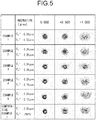
- FIG. 5 shows the simulation results when the intraocular lens manufactured according to the present invention was used for a 60 year old patient.
- optical design software ZEMAX product name, made by Zemax Development Corp. of the U.S.
- an item with coma aberration vertical coma aberration volume of the C 3 -1 term with a Zernike polynomial
- optical characteristics of the eye optical system correlating to the optical area applicable to a pupil of 6 mm were evaluated with a Landolt ring simulation optical image.
- examples 1 through 5 and comparative example 1 all correlate to a human eye in which the intraocular lens is inserted, and are thought to be items for which coma aberration of 0.24 ⁇ m remains. Then, for each model of these examples 1 through 5 and comparative example 1, with the point for which the focal point position by spherical lens power is optimum (0.00 D) as a reference, a simulation optical image of each position when the focal point position is skewed in the near direction by a distance correlating to 0.50 D and 1.00 D from there was obtained, and the vision (QOV) was assessed using those.
- 0.00 D the point for which the focal point position by spherical lens power is optimum
- the example 3 correlates to a case when the spherical aberration of the intraocular lens was set considering the spherical aberration of the cornea so that spherical aberration of the same RMS value as the coma aberration remaining in the human eye is set.
- FIG. 6 shows the simulation results when using an intraocular lens manufactured according to the present invention for a 20 year old patient.
- ZEMAX vertical coma aberration volume of the C 3 -1 term with the Zernike polynomial
- comparative example 2 correlates to a case of offsetting the cornea spherical aberration with the intraocular lens spherical aberration and having the spherical aberration of the eye optical system be zero.
- examples 6 through 8 all of these correlate to cases for which an intraocular lens was inserted with optical characteristics for which spherical aberration of the eye optical system was set actively according to the present invention.
- example 7 is an item for which spherical aberration of roughly the same RMS value as the coma aberration of the eye optical system was set.
- a case when spherical aberration corresponding to the remaining coma aberration is actively set can be understood to be advantageous in ensuring overall quality of vision by being able to suppress changes in vision (image quality) that come with changes in the focal point position.
Landscapes
- Health & Medical Sciences (AREA)
- Ophthalmology & Optometry (AREA)
- Engineering & Computer Science (AREA)
- General Health & Medical Sciences (AREA)
- Animal Behavior & Ethology (AREA)
- Cardiology (AREA)
- Biomedical Technology (AREA)
- Heart & Thoracic Surgery (AREA)
- Vascular Medicine (AREA)
- Life Sciences & Earth Sciences (AREA)
- Oral & Maxillofacial Surgery (AREA)
- Transplantation (AREA)
- Public Health (AREA)
- Veterinary Medicine (AREA)
- Physics & Mathematics (AREA)
- General Physics & Mathematics (AREA)
- Optics & Photonics (AREA)
- Manufacturing & Machinery (AREA)
- Mechanical Engineering (AREA)
- Prostheses (AREA)
Claims (4)
- Procédé de fabrication de lentille intraoculaire comprenant :une étape de configuration des caractéristiques optiques destinée à définir, dans une partie optique (12), une aberration sphérique d'une taille correspondant à une aberration de coma restant dans un oeil humain d'un patient duquel un cristallin humain a été extrait, et d'une taille pour laquelle l'aberration sphérique restant dans cet oeil humain de ce patient ne sera pas compensée et sera maintenue ;une étape de configuration de la forme de la lentille destinée à déterminer une forme de lentille de la partie optique (12), où l'aberration sphérique définie à l'étape de configuration des caractéristiques optiques est pourvue en tant que caractéristique optique correctrice pour un astigmatisme irrégulier résiduel dans cet oeil humain de ce patient ; etune étape de formation de lentille destinée à former une lentille intraoculaire (10) ayant des caractéristiques optiques où une aberration d'ordre supérieur de cette partie optique (12) est symétrique en rotation autour d'un axe optique, au moyen d'une formation de la partie optique (12) afin qu'elle ait la forme de lentille déterminée par l'étape de configuration de forme de la lentille.
- Procédé de fabrication de lentille intraoculaire selon la revendication 1, dans lequel, à l'étape de configuration des caractéristiques optiques, l'aberration sphérique de la partie optique (12) est définie avec une valeur efficace qui satisfait les deux formules suivantes :aberration sphérique de lentille intraoculaire ≥ aberration de coma restant dans l'oeil après extraction du cristallin - 0,37 µm ; etaberration sphérique de lentille intraoculaire ≤ aberration de coma restant dans l'oeil après extraction du cristallin - 0,17 µm.
- Procédé de fabrication de lentille intraoculaire selon la revendication 1 ou la revendication 2, dans lequel, à l'étape de configuration des caractéristiques optiques, l'aberration sphérique définie pour la partie optique (12) est définie avec une valeur efficace qui satisfait toutes les formules suivantes, où A et B sont des constantes :


- Procédé de fabrication de lentille intraoculaire selon l'une quelconque des revendications 1 à 3, dans lequel, à l'étape de configuration des caractéristiques optiques, l'aberration sphérique définie pour la partie optique (12) est définie au moyen d'une différence entre une valeur moyenne de données de mesures d'aberrations sphériques d'oeil humain d'une population d'une même tranche d'âge que le patient et l'aberration sphérique d'une cornée du patient.
Priority Applications (2)
| Application Number | Priority Date | Filing Date | Title |
|---|---|---|---|
| PL16205428T PL3170475T3 (pl) | 2011-03-24 | 2012-03-23 | Soczewka wewnątrzgałkowa |
| EP16205428.2A EP3170475B1 (fr) | 2011-03-24 | 2012-03-23 | Lentille intraoculaire |
Applications Claiming Priority (2)
| Application Number | Priority Date | Filing Date | Title |
|---|---|---|---|
| JP2011065836 | 2011-03-24 | ||
| PCT/JP2012/002054 WO2012127881A1 (fr) | 2011-03-24 | 2012-03-23 | Lentille intraoculaire et son procédé de fabrication |
Related Child Applications (2)
| Application Number | Title | Priority Date | Filing Date |
|---|---|---|---|
| EP16205428.2A Division EP3170475B1 (fr) | 2011-03-24 | 2012-03-23 | Lentille intraoculaire |
| EP16205428.2A Division-Into EP3170475B1 (fr) | 2011-03-24 | 2012-03-23 | Lentille intraoculaire |
Publications (3)
| Publication Number | Publication Date |
|---|---|
| EP2689748A1 EP2689748A1 (fr) | 2014-01-29 |
| EP2689748A4 EP2689748A4 (fr) | 2014-11-26 |
| EP2689748B1 true EP2689748B1 (fr) | 2017-02-22 |
Family
ID=46879052
Family Applications (2)
| Application Number | Title | Priority Date | Filing Date |
|---|---|---|---|
| EP12760887.5A Active EP2689748B1 (fr) | 2011-03-24 | 2012-03-23 | Lentille intraoculaire et son procédé de fabrication |
| EP16205428.2A Active EP3170475B1 (fr) | 2011-03-24 | 2012-03-23 | Lentille intraoculaire |
Family Applications After (1)
| Application Number | Title | Priority Date | Filing Date |
|---|---|---|---|
| EP16205428.2A Active EP3170475B1 (fr) | 2011-03-24 | 2012-03-23 | Lentille intraoculaire |
Country Status (13)
| Country | Link |
|---|---|
| US (3) | US9808340B2 (fr) |
| EP (2) | EP2689748B1 (fr) |
| JP (1) | JP5986985B2 (fr) |
| KR (1) | KR101837379B1 (fr) |
| CN (1) | CN103458828B (fr) |
| AU (1) | AU2012232611B2 (fr) |
| BR (1) | BR112013024276B1 (fr) |
| ES (2) | ES2709173T3 (fr) |
| IL (1) | IL228429A0 (fr) |
| PL (1) | PL3170475T3 (fr) |
| RU (1) | RU2601692C2 (fr) |
| SG (1) | SG193526A1 (fr) |
| WO (1) | WO2012127881A1 (fr) |
Families Citing this family (10)
| Publication number | Priority date | Publication date | Assignee | Title |
|---|---|---|---|---|
| WO2012127538A1 (fr) * | 2011-03-24 | 2012-09-27 | 株式会社メニコン | Lentille de contact et procédé de fabrication pour celle-ci |
| SG193526A1 (en) * | 2011-03-24 | 2013-10-30 | Kowa Co | Intraocular lens and manufacturing method thereof |
| TWI588560B (zh) | 2012-04-05 | 2017-06-21 | 布萊恩荷登視覺協會 | 用於屈光不正之鏡片、裝置、方法及系統 |
| US9201250B2 (en) | 2012-10-17 | 2015-12-01 | Brien Holden Vision Institute | Lenses, devices, methods and systems for refractive error |
| SG11201502115RA (en) | 2012-10-17 | 2015-05-28 | Holden Brien Vision Inst | Lenses, devices, methods and systems for refractive error |
| CN106388974A (zh) * | 2016-12-09 | 2017-02-15 | 天津世纪康泰生物医学工程有限公司 | 中间视觉完全矫正型非球面人工晶状体 |
| US11000363B2 (en) * | 2017-05-02 | 2021-05-11 | Alcon Inc. | Accommodating intraocular lens devices, systems, and methods using an opaque frame |
| CN111051965B (zh) * | 2017-09-01 | 2022-03-25 | 株式会社实瞳 | 眼用镜片和使用眼用镜片的成像方法 |
| BR202018002611U2 (pt) * | 2018-02-07 | 2019-08-27 | Nathan Jose De Souza | disposição aplicada em lente intra-ocular com hápticos alongados e agulhados |
| CN120381352B (zh) * | 2025-06-30 | 2025-10-28 | 晶天医疗科技有限公司 | 一种全自由散光矫正人工晶状体 |
Family Cites Families (19)
| Publication number | Priority date | Publication date | Assignee | Title |
|---|---|---|---|---|
| US5777719A (en) * | 1996-12-23 | 1998-07-07 | University Of Rochester | Method and apparatus for improving vision and the resolution of retinal images |
| MXPA02011538A (es) * | 2000-05-23 | 2003-06-06 | Pharmacia Groningen Bv | Metodos para obtener lentes oftalmicas que brinden al ojo reduccion de aberraciones. |
| US6609793B2 (en) * | 2000-05-23 | 2003-08-26 | Pharmacia Groningen Bv | Methods of obtaining ophthalmic lenses providing the eye with reduced aberrations |
| US6554425B1 (en) * | 2000-10-17 | 2003-04-29 | Johnson & Johnson Vision Care, Inc. | Ophthalmic lenses for high order aberration correction and processes for production of the lenses |
| US6905209B2 (en) | 2000-10-18 | 2005-06-14 | Kabushiki Kaisha Topcon | Optical characteristics measuring device |
| JP4652558B2 (ja) | 2000-10-18 | 2011-03-16 | 株式会社トプコン | 光学特性測定装置 |
| US7078665B2 (en) | 2002-07-09 | 2006-07-18 | Wavefront Sciences, Inc. | System and method of wavefront sensing for determining a location of focal spot |
| GB0303193D0 (en) | 2003-02-12 | 2003-03-19 | Guillon Michael | Methods & lens |
| WO2004090611A2 (fr) * | 2003-03-31 | 2004-10-21 | Bausch & Lomb Incorporated | Lentilles intraoculaires et procede pour diminuer les aberrations dans un systeme oculaire |
| ES2706313T3 (es) | 2005-02-11 | 2019-03-28 | Bausch & Lomb | Lentes asféricas y familia de lentes |
| EP2018595B1 (fr) * | 2006-05-16 | 2022-07-06 | Essilor International | Correction d'aberration d'ordre élevé pour optimisation de la fonction de vision humaine |
| US7879089B2 (en) * | 2006-05-17 | 2011-02-01 | Alcon, Inc. | Correction of higher order aberrations in intraocular lenses |
| US7689806B2 (en) * | 2006-07-14 | 2010-03-30 | Q | Method and system to indicate an exception-triggering page within a microprocessor |
| DE112008000078A5 (de) | 2007-01-25 | 2009-12-24 | Rodenstock Gmbh | Verfahren zur Optimierung eines Brillenglases |
| US8529559B2 (en) * | 2007-10-29 | 2013-09-10 | Junzhong Liang | Methods and devices for refractive treatments of presbyopia |
| US20090160075A1 (en) * | 2007-12-21 | 2009-06-25 | Simpson Michael J | Methods for fabricating customized intraocular lenses |
| US7998198B2 (en) * | 2008-02-07 | 2011-08-16 | Novartis Ag | Accommodative IOL with dynamic spherical aberration |
| WO2011025846A1 (fr) * | 2009-08-27 | 2011-03-03 | Novartis Ag | Optimisation d'aberrations optiques dans des lentilles optiques |
| SG193526A1 (en) * | 2011-03-24 | 2013-10-30 | Kowa Co | Intraocular lens and manufacturing method thereof |
-
2012
- 2012-03-23 SG SG2013070263A patent/SG193526A1/en unknown
- 2012-03-23 ES ES16205428T patent/ES2709173T3/es active Active
- 2012-03-23 CN CN201280015005.0A patent/CN103458828B/zh active Active
- 2012-03-23 KR KR1020137024875A patent/KR101837379B1/ko active Active
- 2012-03-23 WO PCT/JP2012/002054 patent/WO2012127881A1/fr not_active Ceased
- 2012-03-23 EP EP12760887.5A patent/EP2689748B1/fr active Active
- 2012-03-23 AU AU2012232611A patent/AU2012232611B2/en not_active Ceased
- 2012-03-23 ES ES12760887.5T patent/ES2623757T3/es active Active
- 2012-03-23 US US14/002,831 patent/US9808340B2/en active Active
- 2012-03-23 EP EP16205428.2A patent/EP3170475B1/fr active Active
- 2012-03-23 BR BR112013024276-0A patent/BR112013024276B1/pt not_active IP Right Cessation
- 2012-03-23 PL PL16205428T patent/PL3170475T3/pl unknown
- 2012-03-23 RU RU2013147408/14A patent/RU2601692C2/ru active
- 2012-03-23 JP JP2013505827A patent/JP5986985B2/ja active Active
-
2013
- 2013-09-15 IL IL228429A patent/IL228429A0/en active IP Right Grant
-
2017
- 2017-09-28 US US15/718,675 patent/US20180014927A1/en not_active Abandoned
-
2019
- 2019-05-28 US US16/424,051 patent/US11020219B2/en active Active
Non-Patent Citations (1)
| Title |
|---|
| None * |
Also Published As
| Publication number | Publication date |
|---|---|
| RU2601692C2 (ru) | 2016-11-10 |
| US11020219B2 (en) | 2021-06-01 |
| AU2012232611A1 (en) | 2013-09-26 |
| AU2012232611B2 (en) | 2016-05-26 |
| JPWO2012127881A1 (ja) | 2014-07-24 |
| WO2012127881A1 (fr) | 2012-09-27 |
| HK1192135A1 (zh) | 2014-08-15 |
| EP2689748A4 (fr) | 2014-11-26 |
| ES2709173T3 (es) | 2019-04-15 |
| CN103458828A (zh) | 2013-12-18 |
| BR112013024276A2 (pt) | 2016-12-27 |
| EP3170475B1 (fr) | 2018-10-31 |
| PL3170475T3 (pl) | 2019-04-30 |
| US20180014927A1 (en) | 2018-01-18 |
| SG193526A1 (en) | 2013-10-30 |
| KR101837379B1 (ko) | 2018-03-13 |
| IL228429A0 (en) | 2013-12-31 |
| EP2689748A1 (fr) | 2014-01-29 |
| ES2623757T3 (es) | 2017-07-12 |
| BR112013024276B1 (pt) | 2020-12-15 |
| US9808340B2 (en) | 2017-11-07 |
| KR20140008409A (ko) | 2014-01-21 |
| RU2013147408A (ru) | 2015-04-27 |
| US20190274824A1 (en) | 2019-09-12 |
| US20140039616A1 (en) | 2014-02-06 |
| EP3170475A1 (fr) | 2017-05-24 |
| CN103458828B (zh) | 2015-12-02 |
| JP5986985B2 (ja) | 2016-09-06 |
Similar Documents
| Publication | Publication Date | Title |
|---|---|---|
| US11020219B2 (en) | Intraocular lens and manufacturing method thereof | |
| JP4800921B2 (ja) | 視力向上のためのカスタムレンズ及びそれに対応するレンズの設計方法 | |
| JP6346088B2 (ja) | 近視の進行を治療するための眼科用レンズ | |
| JP5657266B2 (ja) | 不正乱視矯正用コンタクトレンズ | |
| KR101842378B1 (ko) | 난시를 교정하기 위한 안경 렌즈 | |
| JP6516968B2 (ja) | 屈折異常のレベルに基づく瞳孔の大きさの補正を用いた老眼用レンズ | |
| EP2690487B1 (fr) | Procédé de fabrication d'une lentille de contact | |
| JP2007152093A (ja) | 角膜内インレー | |
| KR20140098006A (ko) | 근시 진행을 예방하고/하거나 늦추기 위한 비대칭 렌즈 설계 및 방법 | |
| Alejandre et al. | Optical evaluation of intracorneal ring segment surgery in keratoconus | |
| JP2025013999A (ja) | 反転可能なレンズ及び設計方法 | |
| HK1192135B (en) | Intraocular lens and manufacturing method therefor | |
| Eshbaugh et al. | Optics of refractive surgery |
Legal Events
| Date | Code | Title | Description |
|---|---|---|---|
| PUAI | Public reference made under article 153(3) epc to a published international application that has entered the european phase |
Free format text: ORIGINAL CODE: 0009012 |
|
| 17P | Request for examination filed |
Effective date: 20130918 |
|
| AK | Designated contracting states |
Kind code of ref document: A1 Designated state(s): AL AT BE BG CH CY CZ DE DK EE ES FI FR GB GR HR HU IE IS IT LI LT LU LV MC MK MT NL NO PL PT RO RS SE SI SK SM TR |
|
| DAX | Request for extension of the european patent (deleted) | ||
| A4 | Supplementary search report drawn up and despatched |
Effective date: 20141024 |
|
| RIC1 | Information provided on ipc code assigned before grant |
Ipc: A61F 2/16 20060101AFI20141020BHEP |
|
| 17Q | First examination report despatched |
Effective date: 20151029 |
|
| GRAP | Despatch of communication of intention to grant a patent |
Free format text: ORIGINAL CODE: EPIDOSNIGR1 |
|
| INTG | Intention to grant announced |
Effective date: 20160906 |
|
| GRAS | Grant fee paid |
Free format text: ORIGINAL CODE: EPIDOSNIGR3 |
|
| GRAA | (expected) grant |
Free format text: ORIGINAL CODE: 0009210 |
|
| RAP1 | Party data changed (applicant data changed or rights of an application transferred) |
Owner name: KOWA COMPANY, LTD. |
|
| AK | Designated contracting states |
Kind code of ref document: B1 Designated state(s): AL AT BE BG CH CY CZ DE DK EE ES FI FR GB GR HR HU IE IS IT LI LT LU LV MC MK MT NL NO PL PT RO RS SE SI SK SM TR |
|
| REG | Reference to a national code |
Ref country code: GB Ref legal event code: FG4D |
|
| REG | Reference to a national code |
Ref country code: CH Ref legal event code: EP |
|
| REG | Reference to a national code |
Ref country code: AT Ref legal event code: REF Ref document number: 868682 Country of ref document: AT Kind code of ref document: T Effective date: 20170315 |
|
| REG | Reference to a national code |
Ref country code: IE Ref legal event code: FG4D |
|
| REG | Reference to a national code |
Ref country code: FR Ref legal event code: PLFP Year of fee payment: 6 |
|
| REG | Reference to a national code |
Ref country code: DE Ref legal event code: R096 Ref document number: 602012028944 Country of ref document: DE |
|
| REG | Reference to a national code |
Ref country code: CH Ref legal event code: NV Representative=s name: TROESCH SCHEIDEGGER WERNER AG, CH |
|
| REG | Reference to a national code |
Ref country code: NL Ref legal event code: FP |
|
| REG | Reference to a national code |
Ref country code: LT Ref legal event code: MG4D |
|
| REG | Reference to a national code |
Ref country code: ES Ref legal event code: FG2A Ref document number: 2623757 Country of ref document: ES Kind code of ref document: T3 Effective date: 20170712 |
|
| PG25 | Lapsed in a contracting state [announced via postgrant information from national office to epo] |
Ref country code: NO Free format text: LAPSE BECAUSE OF FAILURE TO SUBMIT A TRANSLATION OF THE DESCRIPTION OR TO PAY THE FEE WITHIN THE PRESCRIBED TIME-LIMIT Effective date: 20170522 Ref country code: FI Free format text: LAPSE BECAUSE OF FAILURE TO SUBMIT A TRANSLATION OF THE DESCRIPTION OR TO PAY THE FEE WITHIN THE PRESCRIBED TIME-LIMIT Effective date: 20170222 Ref country code: LT Free format text: LAPSE BECAUSE OF FAILURE TO SUBMIT A TRANSLATION OF THE DESCRIPTION OR TO PAY THE FEE WITHIN THE PRESCRIBED TIME-LIMIT Effective date: 20170222 Ref country code: GR Free format text: LAPSE BECAUSE OF FAILURE TO SUBMIT A TRANSLATION OF THE DESCRIPTION OR TO PAY THE FEE WITHIN THE PRESCRIBED TIME-LIMIT Effective date: 20170523 Ref country code: HR Free format text: LAPSE BECAUSE OF FAILURE TO SUBMIT A TRANSLATION OF THE DESCRIPTION OR TO PAY THE FEE WITHIN THE PRESCRIBED TIME-LIMIT Effective date: 20170222 |
|
| PG25 | Lapsed in a contracting state [announced via postgrant information from national office to epo] |
Ref country code: PT Free format text: LAPSE BECAUSE OF FAILURE TO SUBMIT A TRANSLATION OF THE DESCRIPTION OR TO PAY THE FEE WITHIN THE PRESCRIBED TIME-LIMIT Effective date: 20170622 Ref country code: BG Free format text: LAPSE BECAUSE OF FAILURE TO SUBMIT A TRANSLATION OF THE DESCRIPTION OR TO PAY THE FEE WITHIN THE PRESCRIBED TIME-LIMIT Effective date: 20170522 Ref country code: LV Free format text: LAPSE BECAUSE OF FAILURE TO SUBMIT A TRANSLATION OF THE DESCRIPTION OR TO PAY THE FEE WITHIN THE PRESCRIBED TIME-LIMIT Effective date: 20170222 Ref country code: RS Free format text: LAPSE BECAUSE OF FAILURE TO SUBMIT A TRANSLATION OF THE DESCRIPTION OR TO PAY THE FEE WITHIN THE PRESCRIBED TIME-LIMIT Effective date: 20170222 Ref country code: SE Free format text: LAPSE BECAUSE OF FAILURE TO SUBMIT A TRANSLATION OF THE DESCRIPTION OR TO PAY THE FEE WITHIN THE PRESCRIBED TIME-LIMIT Effective date: 20170222 |
|
| PG25 | Lapsed in a contracting state [announced via postgrant information from national office to epo] |
Ref country code: SK Free format text: LAPSE BECAUSE OF FAILURE TO SUBMIT A TRANSLATION OF THE DESCRIPTION OR TO PAY THE FEE WITHIN THE PRESCRIBED TIME-LIMIT Effective date: 20170222 Ref country code: EE Free format text: LAPSE BECAUSE OF FAILURE TO SUBMIT A TRANSLATION OF THE DESCRIPTION OR TO PAY THE FEE WITHIN THE PRESCRIBED TIME-LIMIT Effective date: 20170222 Ref country code: RO Free format text: LAPSE BECAUSE OF FAILURE TO SUBMIT A TRANSLATION OF THE DESCRIPTION OR TO PAY THE FEE WITHIN THE PRESCRIBED TIME-LIMIT Effective date: 20170222 Ref country code: CZ Free format text: LAPSE BECAUSE OF FAILURE TO SUBMIT A TRANSLATION OF THE DESCRIPTION OR TO PAY THE FEE WITHIN THE PRESCRIBED TIME-LIMIT Effective date: 20170222 |
|
| REG | Reference to a national code |
Ref country code: DE Ref legal event code: R097 Ref document number: 602012028944 Country of ref document: DE |
|
| PG25 | Lapsed in a contracting state [announced via postgrant information from national office to epo] |
Ref country code: DK Free format text: LAPSE BECAUSE OF FAILURE TO SUBMIT A TRANSLATION OF THE DESCRIPTION OR TO PAY THE FEE WITHIN THE PRESCRIBED TIME-LIMIT Effective date: 20170222 Ref country code: MC Free format text: LAPSE BECAUSE OF FAILURE TO SUBMIT A TRANSLATION OF THE DESCRIPTION OR TO PAY THE FEE WITHIN THE PRESCRIBED TIME-LIMIT Effective date: 20170222 Ref country code: PL Free format text: LAPSE BECAUSE OF FAILURE TO SUBMIT A TRANSLATION OF THE DESCRIPTION OR TO PAY THE FEE WITHIN THE PRESCRIBED TIME-LIMIT Effective date: 20170222 Ref country code: SM Free format text: LAPSE BECAUSE OF FAILURE TO SUBMIT A TRANSLATION OF THE DESCRIPTION OR TO PAY THE FEE WITHIN THE PRESCRIBED TIME-LIMIT Effective date: 20170222 |
|
| REG | Reference to a national code |
Ref country code: IE Ref legal event code: MM4A |
|
| PLBE | No opposition filed within time limit |
Free format text: ORIGINAL CODE: 0009261 |
|
| STAA | Information on the status of an ep patent application or granted ep patent |
Free format text: STATUS: NO OPPOSITION FILED WITHIN TIME LIMIT |
|
| 26N | No opposition filed |
Effective date: 20171123 |
|
| PG25 | Lapsed in a contracting state [announced via postgrant information from national office to epo] |
Ref country code: LU Free format text: LAPSE BECAUSE OF NON-PAYMENT OF DUE FEES Effective date: 20170323 |
|
| PG25 | Lapsed in a contracting state [announced via postgrant information from national office to epo] |
Ref country code: IE Free format text: LAPSE BECAUSE OF NON-PAYMENT OF DUE FEES Effective date: 20170323 Ref country code: SI Free format text: LAPSE BECAUSE OF FAILURE TO SUBMIT A TRANSLATION OF THE DESCRIPTION OR TO PAY THE FEE WITHIN THE PRESCRIBED TIME-LIMIT Effective date: 20170222 |
|
| REG | Reference to a national code |
Ref country code: BE Ref legal event code: MM Effective date: 20170331 |
|
| REG | Reference to a national code |
Ref country code: FR Ref legal event code: PLFP Year of fee payment: 7 |
|
| PG25 | Lapsed in a contracting state [announced via postgrant information from national office to epo] |
Ref country code: BE Free format text: LAPSE BECAUSE OF NON-PAYMENT OF DUE FEES Effective date: 20170331 |
|
| PG25 | Lapsed in a contracting state [announced via postgrant information from national office to epo] |
Ref country code: MT Free format text: LAPSE BECAUSE OF NON-PAYMENT OF DUE FEES Effective date: 20170323 |
|
| REG | Reference to a national code |
Ref country code: AT Ref legal event code: UEP Ref document number: 868682 Country of ref document: AT Kind code of ref document: T Effective date: 20170222 |
|
| PG25 | Lapsed in a contracting state [announced via postgrant information from national office to epo] |
Ref country code: HU Free format text: LAPSE BECAUSE OF FAILURE TO SUBMIT A TRANSLATION OF THE DESCRIPTION OR TO PAY THE FEE WITHIN THE PRESCRIBED TIME-LIMIT; INVALID AB INITIO Effective date: 20120323 |
|
| PG25 | Lapsed in a contracting state [announced via postgrant information from national office to epo] |
Ref country code: CY Free format text: LAPSE BECAUSE OF NON-PAYMENT OF DUE FEES Effective date: 20170222 |
|
| PG25 | Lapsed in a contracting state [announced via postgrant information from national office to epo] |
Ref country code: MK Free format text: LAPSE BECAUSE OF FAILURE TO SUBMIT A TRANSLATION OF THE DESCRIPTION OR TO PAY THE FEE WITHIN THE PRESCRIBED TIME-LIMIT Effective date: 20170222 |
|
| PG25 | Lapsed in a contracting state [announced via postgrant information from national office to epo] |
Ref country code: TR Free format text: LAPSE BECAUSE OF FAILURE TO SUBMIT A TRANSLATION OF THE DESCRIPTION OR TO PAY THE FEE WITHIN THE PRESCRIBED TIME-LIMIT Effective date: 20170222 |
|
| PG25 | Lapsed in a contracting state [announced via postgrant information from national office to epo] |
Ref country code: AL Free format text: LAPSE BECAUSE OF FAILURE TO SUBMIT A TRANSLATION OF THE DESCRIPTION OR TO PAY THE FEE WITHIN THE PRESCRIBED TIME-LIMIT Effective date: 20170222 Ref country code: IS Free format text: LAPSE BECAUSE OF FAILURE TO SUBMIT A TRANSLATION OF THE DESCRIPTION OR TO PAY THE FEE WITHIN THE PRESCRIBED TIME-LIMIT Effective date: 20170622 |
|
| PGFP | Annual fee paid to national office [announced via postgrant information from national office to epo] |
Ref country code: ES Payment date: 20250403 Year of fee payment: 14 |
|
| PGFP | Annual fee paid to national office [announced via postgrant information from national office to epo] |
Ref country code: CH Payment date: 20250401 Year of fee payment: 14 |
|
| REG | Reference to a national code |
Ref country code: CH Ref legal event code: U11 Free format text: ST27 STATUS EVENT CODE: U-0-0-U10-U11 (AS PROVIDED BY THE NATIONAL OFFICE) Effective date: 20260401 |
|
| PGFP | Annual fee paid to national office [announced via postgrant information from national office to epo] |
Ref country code: GB Payment date: 20260209 Year of fee payment: 15 |
|
| PGFP | Annual fee paid to national office [announced via postgrant information from national office to epo] |
Ref country code: DE Payment date: 20260318 Year of fee payment: 15 |
|
| PGFP | Annual fee paid to national office [announced via postgrant information from national office to epo] |
Ref country code: AT Payment date: 20260318 Year of fee payment: 15 |
|
| PGFP | Annual fee paid to national office [announced via postgrant information from national office to epo] |
Ref country code: IT Payment date: 20260319 Year of fee payment: 15 |
|
| PGFP | Annual fee paid to national office [announced via postgrant information from national office to epo] |
Ref country code: NL Payment date: 20260317 Year of fee payment: 15 |
|
| PGFP | Annual fee paid to national office [announced via postgrant information from national office to epo] |
Ref country code: FR Payment date: 20260317 Year of fee payment: 15 |