EP2689804A2 - Pflegende Haarfärbemittel mit Silicon(en) und Polymer(en) - Google Patents
Pflegende Haarfärbemittel mit Silicon(en) und Polymer(en) Download PDFInfo
- Publication number
- EP2689804A2 EP2689804A2 EP13177193.3A EP13177193A EP2689804A2 EP 2689804 A2 EP2689804 A2 EP 2689804A2 EP 13177193 A EP13177193 A EP 13177193A EP 2689804 A2 EP2689804 A2 EP 2689804A2
- Authority
- EP
- European Patent Office
- Prior art keywords
- amino
- acid
- weight
- hydroxyethyl
- butyl
- Prior art date
- Legal status (The legal status is an assumption and is not a legal conclusion. Google has not performed a legal analysis and makes no representation as to the accuracy of the status listed.)
- Ceased
Links
- 229920000642 polymer Polymers 0.000 title claims abstract description 51
- 229920001296 polysiloxane Polymers 0.000 title claims description 40
- 239000000118 hair dye Substances 0.000 title description 3
- 230000001681 protective effect Effects 0.000 title description 2
- 239000000203 mixture Substances 0.000 claims abstract description 134
- MHAJPDPJQMAIIY-UHFFFAOYSA-N Hydrogen peroxide Chemical compound OO MHAJPDPJQMAIIY-UHFFFAOYSA-N 0.000 claims abstract description 62
- 239000000975 dye Substances 0.000 claims abstract description 54
- 230000003647 oxidation Effects 0.000 claims abstract description 36
- 238000007254 oxidation reaction Methods 0.000 claims abstract description 36
- 239000002243 precursor Substances 0.000 claims abstract description 35
- 239000000982 direct dye Substances 0.000 claims abstract description 26
- 125000002914 sec-butyl group Chemical group [H]C([H])([H])C([H])([H])C([H])(*)C([H])([H])[H] 0.000 claims abstract description 18
- 125000001495 ethyl group Chemical group [H]C([H])([H])C([H])([H])* 0.000 claims abstract description 12
- 125000000959 isobutyl group Chemical group [H]C([H])([H])C([H])(C([H])([H])[H])C([H])([H])* 0.000 claims abstract description 12
- 125000001449 isopropyl group Chemical group [H]C([H])([H])C([H])(*)C([H])([H])[H] 0.000 claims abstract description 12
- 125000004108 n-butyl group Chemical group [H]C([H])([H])C([H])([H])C([H])([H])C([H])([H])* 0.000 claims abstract description 12
- 125000004123 n-propyl group Chemical group [H]C([H])([H])C([H])([H])C([H])([H])* 0.000 claims abstract description 12
- -1 alkylene radical Chemical class 0.000 claims description 106
- 210000004209 hair Anatomy 0.000 claims description 67
- 150000001875 compounds Chemical class 0.000 claims description 53
- 239000000835 fiber Substances 0.000 claims description 41
- 239000007800 oxidant agent Substances 0.000 claims description 40
- 229920001577 copolymer Polymers 0.000 claims description 33
- 150000003839 salts Chemical class 0.000 claims description 30
- 125000004432 carbon atom Chemical group C* 0.000 claims description 29
- NIXOWILDQLNWCW-UHFFFAOYSA-N 2-Propenoic acid Natural products OC(=O)C=C NIXOWILDQLNWCW-UHFFFAOYSA-N 0.000 claims description 24
- CERQOIWHTDAKMF-UHFFFAOYSA-N Methacrylic acid Chemical compound CC(=C)C(O)=O CERQOIWHTDAKMF-UHFFFAOYSA-N 0.000 claims description 23
- 238000002360 preparation method Methods 0.000 claims description 23
- 238000004043 dyeing Methods 0.000 claims description 21
- SMZOUWXMTYCWNB-UHFFFAOYSA-N 2-(2-methoxy-5-methylphenyl)ethanamine Chemical compound COC1=CC=C(C)C=C1CCN SMZOUWXMTYCWNB-UHFFFAOYSA-N 0.000 claims description 20
- 230000001590 oxidative effect Effects 0.000 claims description 20
- GHMLBKRAJCXXBS-UHFFFAOYSA-N resorcinol Chemical compound OC1=CC=CC(O)=C1 GHMLBKRAJCXXBS-UHFFFAOYSA-N 0.000 claims description 20
- 125000000129 anionic group Chemical group 0.000 claims description 19
- KJCVRFUGPWSIIH-UHFFFAOYSA-N 1-naphthol Chemical compound C1=CC=C2C(O)=CC=CC2=C1 KJCVRFUGPWSIIH-UHFFFAOYSA-N 0.000 claims description 18
- 125000002496 methyl group Chemical group [H]C([H])([H])* 0.000 claims description 16
- 238000000034 method Methods 0.000 claims description 15
- OBCSAIDCZQSFQH-UHFFFAOYSA-N 2-methyl-1,4-phenylenediamine Chemical compound CC1=CC(N)=CC=C1N OBCSAIDCZQSFQH-UHFFFAOYSA-N 0.000 claims description 14
- CWLKGDAVCFYWJK-UHFFFAOYSA-N 3-aminophenol Chemical compound NC1=CC=CC(O)=C1 CWLKGDAVCFYWJK-UHFFFAOYSA-N 0.000 claims description 14
- PLIKAWJENQZMHA-UHFFFAOYSA-N 4-aminophenol Chemical compound NC1=CC=C(O)C=C1 PLIKAWJENQZMHA-UHFFFAOYSA-N 0.000 claims description 14
- KDBUTNSQYYLYOY-UHFFFAOYSA-N 2-(4,5-diaminopyrazol-1-yl)ethanol Chemical compound NC=1C=NN(CCO)C=1N KDBUTNSQYYLYOY-UHFFFAOYSA-N 0.000 claims description 13
- 239000003581 cosmetic carrier Substances 0.000 claims description 12
- 239000000126 substance Substances 0.000 claims description 12
- IIVWHGMLFGNMOW-UHFFFAOYSA-N 2-methylpropane Chemical compound C[C](C)C IIVWHGMLFGNMOW-UHFFFAOYSA-N 0.000 claims description 11
- OSCJHTSDLYVCQC-UHFFFAOYSA-N 2-ethylhexyl 4-[[4-[4-(tert-butylcarbamoyl)anilino]-6-[4-(2-ethylhexoxycarbonyl)anilino]-1,3,5-triazin-2-yl]amino]benzoate Chemical compound C1=CC(C(=O)OCC(CC)CCCC)=CC=C1NC1=NC(NC=2C=CC(=CC=2)C(=O)NC(C)(C)C)=NC(NC=2C=CC(=CC=2)C(=O)OCC(CC)CCCC)=N1 OSCJHTSDLYVCQC-UHFFFAOYSA-N 0.000 claims description 10
- 230000008859 change Effects 0.000 claims description 10
- BMTSZVZQNMNPCT-UHFFFAOYSA-N 2-aminopyridin-3-ol Chemical compound NC1=NC=CC=C1O BMTSZVZQNMNPCT-UHFFFAOYSA-N 0.000 claims description 9
- ZTMADXFOCUXMJE-UHFFFAOYSA-N 2-methylbenzene-1,3-diol Chemical compound CC1=C(O)C=CC=C1O ZTMADXFOCUXMJE-UHFFFAOYSA-N 0.000 claims description 9
- MWKPYVXITDAZLL-UHFFFAOYSA-N 4-[3-(2,4-diaminophenoxy)propoxy]benzene-1,3-diamine Chemical compound NC1=CC(N)=CC=C1OCCCOC1=CC=C(N)C=C1N MWKPYVXITDAZLL-UHFFFAOYSA-N 0.000 claims description 9
- DBFYESDCPWWCHN-UHFFFAOYSA-N 5-amino-2-methylphenol Chemical compound CC1=CC=C(N)C=C1O DBFYESDCPWWCHN-UHFFFAOYSA-N 0.000 claims description 9
- 238000004806 packaging method and process Methods 0.000 claims description 8
- 230000003766 combability Effects 0.000 claims description 7
- 229910052739 hydrogen Inorganic materials 0.000 claims description 7
- 125000002924 primary amino group Chemical group [H]N([H])* 0.000 claims description 7
- 230000008569 process Effects 0.000 claims description 7
- CBCKQZAAMUWICA-UHFFFAOYSA-N 1,4-phenylenediamine Chemical compound NC1=CC=C(N)C=C1 CBCKQZAAMUWICA-UHFFFAOYSA-N 0.000 claims description 6
- GHVHDYYKJYXFGU-UHFFFAOYSA-N Beta-Orcinol Chemical compound CC1=CC(O)=C(C)C(O)=C1 GHVHDYYKJYXFGU-UHFFFAOYSA-N 0.000 claims description 6
- 230000006378 damage Effects 0.000 claims description 6
- CSFWPUWCSPOLJW-UHFFFAOYSA-N lawsone Chemical compound C1=CC=C2C(=O)C(O)=CC(=O)C2=C1 CSFWPUWCSPOLJW-UHFFFAOYSA-N 0.000 claims description 6
- OIPPWFOQEKKFEE-UHFFFAOYSA-N orcinol Chemical compound CC1=CC(O)=CC(O)=C1 OIPPWFOQEKKFEE-UHFFFAOYSA-N 0.000 claims description 6
- DMUXRIHPNREBPF-UHFFFAOYSA-N 2-[2-[2-[2-(2,5-diaminophenoxy)ethoxy]ethoxy]ethoxy]benzene-1,4-diamine Chemical compound NC1=CC=C(N)C(OCCOCCOCCOC=2C(=CC=C(N)C=2)N)=C1 DMUXRIHPNREBPF-UHFFFAOYSA-N 0.000 claims description 5
- XMVBHZBLHNOQON-UHFFFAOYSA-N 2-butyl-1-octanol Chemical compound CCCCCCC(CO)CCCC XMVBHZBLHNOQON-UHFFFAOYSA-N 0.000 claims description 5
- JQVAPEJNIZULEK-UHFFFAOYSA-N 4-chlorobenzene-1,3-diol Chemical compound OC1=CC=C(Cl)C(O)=C1 JQVAPEJNIZULEK-UHFFFAOYSA-N 0.000 claims description 5
- QGNGOGOOPUYKMC-UHFFFAOYSA-N 4-hydroxy-6-methylaniline Chemical compound CC1=CC(O)=CC=C1N QGNGOGOOPUYKMC-UHFFFAOYSA-N 0.000 claims description 5
- FRASJONUBLZVQX-UHFFFAOYSA-N 1,4-dioxonaphthalene Natural products C1=CC=C2C(=O)C=CC(=O)C2=C1 FRASJONUBLZVQX-UHFFFAOYSA-N 0.000 claims description 4
- BOKGTLAJQHTOKE-UHFFFAOYSA-N 1,5-dihydroxynaphthalene Chemical compound C1=CC=C2C(O)=CC=CC2=C1O BOKGTLAJQHTOKE-UHFFFAOYSA-N 0.000 claims description 4
- XAWPKHNOFIWWNZ-UHFFFAOYSA-N 1h-indol-6-ol Chemical compound OC1=CC=C2C=CNC2=C1 XAWPKHNOFIWWNZ-UHFFFAOYSA-N 0.000 claims description 4
- BXBOXUNPNIJELB-UHFFFAOYSA-N 2,6-dimethoxypyridine-3,5-diamine Chemical compound COC1=NC(OC)=C(N)C=C1N BXBOXUNPNIJELB-UHFFFAOYSA-N 0.000 claims description 4
- SYRZWFBWUASJJI-UHFFFAOYSA-N 3-amino-2,4-dichlorophenol Chemical compound NC1=C(Cl)C=CC(O)=C1Cl SYRZWFBWUASJJI-UHFFFAOYSA-N 0.000 claims description 4
- XYRDGCCCBJITBH-UHFFFAOYSA-N 3-amino-2-chloro-6-methylphenol Chemical compound CC1=CC=C(N)C(Cl)=C1O XYRDGCCCBJITBH-UHFFFAOYSA-N 0.000 claims description 4
- ZQBHGSSAKLGUBH-UHFFFAOYSA-N 4,5,6-triamino-1h-pyrimidin-2-one Chemical compound NC1=NC(=O)NC(N)=C1N ZQBHGSSAKLGUBH-UHFFFAOYSA-N 0.000 claims description 4
- NLMQHXUGJIAKTH-UHFFFAOYSA-N 4-hydroxyindole Chemical compound OC1=CC=CC2=C1C=CN2 NLMQHXUGJIAKTH-UHFFFAOYSA-N 0.000 claims description 4
- ATCBPVDYYNJHSG-UHFFFAOYSA-N 6-methoxy-2-n-methylpyridine-2,3-diamine Chemical compound CNC1=NC(OC)=CC=C1N ATCBPVDYYNJHSG-UHFFFAOYSA-N 0.000 claims description 4
- 239000000987 azo dye Substances 0.000 claims description 4
- 230000003806 hair structure Effects 0.000 claims description 4
- DFQICHCWIIJABH-UHFFFAOYSA-N naphthalene-2,7-diol Chemical compound C1=CC(O)=CC2=CC(O)=CC=C21 DFQICHCWIIJABH-UHFFFAOYSA-N 0.000 claims description 4
- 239000000049 pigment Substances 0.000 claims description 4
- PZRKPUQWIFJRKZ-UHFFFAOYSA-N pyrimidine-2,4,5,6-tetramine Chemical compound NC1=NC(N)=C(N)C(N)=N1 PZRKPUQWIFJRKZ-UHFFFAOYSA-N 0.000 claims description 4
- FBMQNRKSAWNXBT-UHFFFAOYSA-N 1,4-diaminoanthracene-9,10-dione Chemical compound O=C1C2=CC=CC=C2C(=O)C2=C1C(N)=CC=C2N FBMQNRKSAWNXBT-UHFFFAOYSA-N 0.000 claims description 3
- NLXFWUZKOOWWFD-UHFFFAOYSA-N 1-(2-hydroxyethylamino)-4-(methylamino)anthracene-9,10-dione Chemical compound O=C1C2=CC=CC=C2C(=O)C2=C1C(NCCO)=CC=C2NC NLXFWUZKOOWWFD-UHFFFAOYSA-N 0.000 claims description 3
- ICVRBKCRXNVOJC-UHFFFAOYSA-N 1-amino-4-(methylamino)anthracene-9,10-dione Chemical compound O=C1C2=CC=CC=C2C(=O)C2=C1C(N)=CC=C2NC ICVRBKCRXNVOJC-UHFFFAOYSA-N 0.000 claims description 3
- ZEXQZDBPFALETL-UHFFFAOYSA-N 2-(2,4-diamino-6-chloro-3-nitrophenyl)ethanol Chemical compound NC1=CC(Cl)=C(CCO)C(N)=C1[N+]([O-])=O ZEXQZDBPFALETL-UHFFFAOYSA-N 0.000 claims description 3
- STNOBKHYSBEHCH-UHFFFAOYSA-N 2-(2-amino-4-nitrophenyl)ethylurea Chemical compound NC(=O)NCCC1=CC=C([N+]([O-])=O)C=C1N STNOBKHYSBEHCH-UHFFFAOYSA-N 0.000 claims description 3
- LGZSBRSLVPLNTM-UHFFFAOYSA-N 2-(4-amino-2-methyl-5-nitroanilino)ethanol Chemical compound CC1=CC(N)=C([N+]([O-])=O)C=C1NCCO LGZSBRSLVPLNTM-UHFFFAOYSA-N 0.000 claims description 3
- YESOPQNVGIQNEV-UHFFFAOYSA-N 2-(4-amino-2-nitroanilino)benzoic acid Chemical compound [O-][N+](=O)C1=CC(N)=CC=C1NC1=CC=CC=C1C(O)=O YESOPQNVGIQNEV-UHFFFAOYSA-N 0.000 claims description 3
- VLZVIIYRNMWPSN-UHFFFAOYSA-N 2-Amino-4-nitrophenol Chemical compound NC1=CC([N+]([O-])=O)=CC=C1O VLZVIIYRNMWPSN-UHFFFAOYSA-N 0.000 claims description 3
- FHHDPRNJLKDPEV-UHFFFAOYSA-N 2-[2-amino-4-(2-hydroxyethyl)-3-nitrophenyl]ethanol Chemical compound NC1=C(CCO)C=CC(CCO)=C1[N+]([O-])=O FHHDPRNJLKDPEV-UHFFFAOYSA-N 0.000 claims description 3
- NZKTVPCPQIEVQT-UHFFFAOYSA-N 2-[4-[(4-aminophenyl)diazenyl]-n-(2-hydroxyethyl)anilino]ethanol Chemical compound C1=CC(N)=CC=C1N=NC1=CC=C(N(CCO)CCO)C=C1 NZKTVPCPQIEVQT-UHFFFAOYSA-N 0.000 claims description 3
- CDFNUSAXZDSXKF-UHFFFAOYSA-N 2-chloro-6-(ethylamino)-4-nitrophenol Chemical compound CCNC1=CC([N+]([O-])=O)=CC(Cl)=C1O CDFNUSAXZDSXKF-UHFFFAOYSA-N 0.000 claims description 3
- HVHNMNGARPCGGD-UHFFFAOYSA-N 2-nitro-p-phenylenediamine Chemical compound NC1=CC=C(N)C([N+]([O-])=O)=C1 HVHNMNGARPCGGD-UHFFFAOYSA-N 0.000 claims description 3
- SIYKOUNMJAUPEV-UHFFFAOYSA-N 3-amino-2-(2-hydroxyethyl)-4,6-dinitrophenol Chemical compound NC1=C(CCO)C(O)=C([N+]([O-])=O)C=C1[N+]([O-])=O SIYKOUNMJAUPEV-UHFFFAOYSA-N 0.000 claims description 3
- HSDSBIUUVWRHTM-UHFFFAOYSA-N 4-(2-nitroanilino)phenol Chemical compound C1=CC(O)=CC=C1NC1=CC=CC=C1[N+]([O-])=O HSDSBIUUVWRHTM-UHFFFAOYSA-N 0.000 claims description 3
- VTXBLQLZQLHDIL-UHFFFAOYSA-N 4-(3-hydroxypropylamino)-3-nitrophenol Chemical compound OCCCNC1=CC=C(O)C=C1[N+]([O-])=O VTXBLQLZQLHDIL-UHFFFAOYSA-N 0.000 claims description 3
- XPLTXYDVYDWSSO-UHFFFAOYSA-N 4-(ethylamino)-3-nitrobenzoic acid Chemical compound CCNC1=CC=C(C(O)=O)C=C1[N+]([O-])=O XPLTXYDVYDWSSO-UHFFFAOYSA-N 0.000 claims description 3
- HLIGKHFHQXRAOX-UHFFFAOYSA-N 4-amino-2-[(5-amino-2-hydroxyphenyl)methyl]phenol Chemical compound NC1=CC=C(O)C(CC=2C(=CC=C(N)C=2)O)=C1 HLIGKHFHQXRAOX-UHFFFAOYSA-N 0.000 claims description 3
- IQXUIDYRTHQTET-UHFFFAOYSA-N 4-amino-3-nitrophenol Chemical compound NC1=CC=C(O)C=C1[N+]([O-])=O IQXUIDYRTHQTET-UHFFFAOYSA-N 0.000 claims description 3
- YGRFRBUGAPOJDU-UHFFFAOYSA-N 5-(2-hydroxyethylamino)-2-methylphenol Chemical compound CC1=CC=C(NCCO)C=C1O YGRFRBUGAPOJDU-UHFFFAOYSA-N 0.000 claims description 3
- ZVDCYZVYRXZJQF-UHFFFAOYSA-N 6-nitro-1,2,3,4-tetrahydroquinoxaline Chemical compound N1CCNC2=CC([N+](=O)[O-])=CC=C21 ZVDCYZVYRXZJQF-UHFFFAOYSA-N 0.000 claims description 3
- TWLMSPNQBKSXOP-UHFFFAOYSA-N 6358-09-4 Chemical compound NC1=CC([N+]([O-])=O)=CC(Cl)=C1O TWLMSPNQBKSXOP-UHFFFAOYSA-N 0.000 claims description 3
- CQPFMGBJSMSXLP-ZAGWXBKKSA-M Acid orange 7 Chemical compound OC1=C(C2=CC=CC=C2C=C1)/N=N/C1=CC=C(C=C1)S(=O)(=O)[O-].[Na+] CQPFMGBJSMSXLP-ZAGWXBKKSA-M 0.000 claims description 3
- AOMZHDJXSYHPKS-DROYEMJCSA-L Amido Black 10B Chemical compound [Na+].[Na+].[O-]S(=O)(=O)C1=CC2=CC(S([O-])(=O)=O)=C(\N=N\C=3C=CC=CC=3)C(O)=C2C(N)=C1\N=N\C1=CC=C(N(=O)=O)C=C1 AOMZHDJXSYHPKS-DROYEMJCSA-L 0.000 claims description 3
- KZQYIMCESJLPQH-UHFFFAOYSA-N Demethylated antipyrine Chemical compound N1C(C)=CC(=O)N1C1=CC=CC=C1 KZQYIMCESJLPQH-UHFFFAOYSA-N 0.000 claims description 3
- MIWUTEVJIISHCP-UHFFFAOYSA-N HC Blue No. 2 Chemical compound OCCNC1=CC=C(N(CCO)CCO)C=C1[N+]([O-])=O MIWUTEVJIISHCP-UHFFFAOYSA-N 0.000 claims description 3
- 229940019789 acid black 52 Drugs 0.000 claims description 3
- 229940099540 acid violet 43 Drugs 0.000 claims description 3
- 150000004056 anthraquinones Chemical class 0.000 claims description 3
- LQJVOKWHGUAUHK-UHFFFAOYSA-L disodium 5-amino-4-hydroxy-3-phenyldiazenylnaphthalene-2,7-disulfonate Chemical compound [Na+].[Na+].OC1=C2C(N)=CC(S([O-])(=O)=O)=CC2=CC(S([O-])(=O)=O)=C1N=NC1=CC=CC=C1 LQJVOKWHGUAUHK-UHFFFAOYSA-L 0.000 claims description 3
- 235000012701 green S Nutrition 0.000 claims description 3
- WDPIZEKLJKBSOZ-UHFFFAOYSA-M green s Chemical compound [Na+].C1=CC(N(C)C)=CC=C1C(C=1C2=CC=C(C=C2C=C(C=1O)S([O-])(=O)=O)S([O-])(=O)=O)=C1C=CC(=[N+](C)C)C=C1 WDPIZEKLJKBSOZ-UHFFFAOYSA-M 0.000 claims description 3
- SXQCTESRRZBPHJ-UHFFFAOYSA-M lissamine rhodamine Chemical compound [Na+].C=12C=CC(=[N+](CC)CC)C=C2OC2=CC(N(CC)CC)=CC=C2C=1C1=CC=C(S([O-])(=O)=O)C=C1S([O-])(=O)=O SXQCTESRRZBPHJ-UHFFFAOYSA-M 0.000 claims description 3
- NYGZLYXAPMMJTE-UHFFFAOYSA-M metanil yellow Chemical compound [Na+].[O-]S(=O)(=O)C1=CC=CC(N=NC=2C=CC(NC=3C=CC=CC=3)=CC=2)=C1 NYGZLYXAPMMJTE-UHFFFAOYSA-M 0.000 claims description 3
- FYTRVVJHEWUARG-UHFFFAOYSA-N n-(2-aminophenyl)nitramide Chemical class NC1=CC=CC=C1N[N+]([O-])=O FYTRVVJHEWUARG-UHFFFAOYSA-N 0.000 claims description 3
- DZQXQAXLDXJEAG-UHFFFAOYSA-N n-(2-hydroxyphenyl)nitramide Chemical class OC1=CC=CC=C1N[N+]([O-])=O DZQXQAXLDXJEAG-UHFFFAOYSA-N 0.000 claims description 3
- CTIQLGJVGNGFEW-UHFFFAOYSA-L naphthol yellow S Chemical compound [Na+].[Na+].C1=C(S([O-])(=O)=O)C=C2C([O-])=C([N+]([O-])=O)C=C([N+]([O-])=O)C2=C1 CTIQLGJVGNGFEW-UHFFFAOYSA-L 0.000 claims description 3
- 230000004792 oxidative damage Effects 0.000 claims description 3
- QXYMVUZOGFVPGH-UHFFFAOYSA-N picramic acid Chemical compound NC1=CC([N+]([O-])=O)=CC([N+]([O-])=O)=C1O QXYMVUZOGFVPGH-UHFFFAOYSA-N 0.000 claims description 3
- GTKIEPUIFBBXJQ-UHFFFAOYSA-M sodium;2-[(4-hydroxy-9,10-dioxoanthracen-1-yl)amino]-5-methylbenzenesulfonate Chemical compound [Na+].[O-]S(=O)(=O)C1=CC(C)=CC=C1NC1=CC=C(O)C2=C1C(=O)C1=CC=CC=C1C2=O GTKIEPUIFBBXJQ-UHFFFAOYSA-M 0.000 claims description 3
- FTUYQIPAPWPHNC-UHFFFAOYSA-M sodium;4-[[4-[benzyl(ethyl)amino]phenyl]-[4-[benzyl(ethyl)azaniumylidene]cyclohexa-2,5-dien-1-ylidene]methyl]benzene-1,3-disulfonate Chemical compound [Na+].C=1C=C(C(=C2C=CC(C=C2)=[N+](CC)CC=2C=CC=CC=2)C=2C(=CC(=CC=2)S([O-])(=O)=O)S([O-])(=O)=O)C=CC=1N(CC)CC1=CC=CC=C1 FTUYQIPAPWPHNC-UHFFFAOYSA-M 0.000 claims description 3
- UJMBCXLDXJUMFB-GLCFPVLVSA-K tartrazine Chemical compound [Na+].[Na+].[Na+].[O-]C(=O)C1=NN(C=2C=CC(=CC=2)S([O-])(=O)=O)C(=O)C1\N=N\C1=CC=C(S([O-])(=O)=O)C=C1 UJMBCXLDXJUMFB-GLCFPVLVSA-K 0.000 claims description 3
- 235000012756 tartrazine Nutrition 0.000 claims description 3
- 239000004149 tartrazine Substances 0.000 claims description 3
- YXFVVABEGXRONW-UHFFFAOYSA-N toluene Substances CC1=CC=CC=C1 YXFVVABEGXRONW-UHFFFAOYSA-N 0.000 claims description 3
- UJMBCXLDXJUMFB-UHFFFAOYSA-K trisodium;5-oxo-1-(4-sulfonatophenyl)-4-[(4-sulfonatophenyl)diazenyl]-4h-pyrazole-3-carboxylate Chemical compound [Na+].[Na+].[Na+].[O-]C(=O)C1=NN(C=2C=CC(=CC=2)S([O-])(=O)=O)C(=O)C1N=NC1=CC=C(S([O-])(=O)=O)C=C1 UJMBCXLDXJUMFB-UHFFFAOYSA-K 0.000 claims description 3
- OQWWMUWGSBRNMA-UHFFFAOYSA-N 1-(2,4-diaminophenoxy)ethanol Chemical compound CC(O)OC1=CC=C(N)C=C1N OQWWMUWGSBRNMA-UHFFFAOYSA-N 0.000 claims description 2
- 229940113489 2,4-diaminophenoxyethanol Drugs 0.000 claims description 2
- UHUGKDBDBPOVTJ-UHFFFAOYSA-N 2-(2,3-diamino-4-methoxyphenyl)ethanol;sulfuric acid Chemical compound OS(O)(=O)=O.COC1=CC=C(CCO)C(N)=C1N UHUGKDBDBPOVTJ-UHFFFAOYSA-N 0.000 claims description 2
- JILWUYWXYQTKLL-UHFFFAOYSA-N 2-(3-amino-4-methyl-2-nitrophenyl)ethanol Chemical compound CC1=CC=C(CCO)C([N+]([O-])=O)=C1N JILWUYWXYQTKLL-UHFFFAOYSA-N 0.000 claims description 2
- LGGKGPQFSCBUOR-UHFFFAOYSA-N 2-(4-chloro-2-nitroanilino)ethanol Chemical compound OCCNC1=CC=C(Cl)C=C1[N+]([O-])=O LGGKGPQFSCBUOR-UHFFFAOYSA-N 0.000 claims description 2
- CUPNSOVJUGIWJS-UHFFFAOYSA-N 2-[4-hydrazinyl-n-(2-hydroxyethyl)anilino]ethanol Chemical compound NNC1=CC=C(N(CCO)CCO)C=C1 CUPNSOVJUGIWJS-UHFFFAOYSA-N 0.000 claims description 2
- MPGFDYDCTBHZQG-UHFFFAOYSA-N 2-amino-4-(2-hydroxyethyl)-3-nitrophenol Chemical compound NC1=C(O)C=CC(CCO)=C1[N+]([O-])=O MPGFDYDCTBHZQG-UHFFFAOYSA-N 0.000 claims description 2
- MXCDRFGKHNFKIP-UHFFFAOYSA-N 2-hydroxy-5-[(4-sulfophenyl)diazenyl]benzoic acid Chemical compound C1=C(O)C(C(=O)O)=CC(N=NC=2C=CC(=CC=2)S(O)(=O)=O)=C1 MXCDRFGKHNFKIP-UHFFFAOYSA-N 0.000 claims description 2
- SRJCJJKWVSSELL-UHFFFAOYSA-N 2-methylnaphthalen-1-ol Chemical compound C1=CC=CC2=C(O)C(C)=CC=C21 SRJCJJKWVSSELL-UHFFFAOYSA-N 0.000 claims description 2
- HWWIVWKTKZAORO-UHFFFAOYSA-N 3,4-dihydro-2h-1,4-benzoxazin-6-ol Chemical compound O1CCNC2=CC(O)=CC=C21 HWWIVWKTKZAORO-UHFFFAOYSA-N 0.000 claims description 2
- XDHQHBSDKYPJRG-UHFFFAOYSA-N 3-[2-nitro-4-(trifluoromethyl)anilino]propane-1,2-diol Chemical compound OCC(O)CNC1=CC=C(C(F)(F)F)C=C1[N+]([O-])=O XDHQHBSDKYPJRG-UHFFFAOYSA-N 0.000 claims description 2
- HEVTVENFBFXVGR-UHFFFAOYSA-N 3-amino-4-chloro-2-methylphenol Chemical compound CC1=C(N)C(Cl)=CC=C1O HEVTVENFBFXVGR-UHFFFAOYSA-N 0.000 claims description 2
- UNBOSJFEZZJZLR-UHFFFAOYSA-N 4-(4-nitrophenylazo)aniline Chemical compound C1=CC(N)=CC=C1N=NC1=CC=C([N+]([O-])=O)C=C1 UNBOSJFEZZJZLR-UHFFFAOYSA-N 0.000 claims description 2
- GZGZVOLBULPDFD-UHFFFAOYSA-N HC Red No. 3 Chemical compound NC1=CC=C(NCCO)C([N+]([O-])=O)=C1 GZGZVOLBULPDFD-UHFFFAOYSA-N 0.000 claims description 2
- PNENOUKIPPERMY-UHFFFAOYSA-N HC Yellow No. 4 Chemical compound OCCNC1=CC=C([N+]([O-])=O)C=C1OCCO PNENOUKIPPERMY-UHFFFAOYSA-N 0.000 claims description 2
- 230000003068 static effect Effects 0.000 claims description 2
- YHVFCJRQQPILPJ-UHFFFAOYSA-N 5-hydroxy-3,4-dimethyl-1h-pyridin-2-one Chemical compound CC=1C(O)=CNC(=O)C=1C YHVFCJRQQPILPJ-UHFFFAOYSA-N 0.000 claims 1
- 229920005573 silicon-containing polymer Polymers 0.000 abstract description 3
- 125000002947 alkylene group Chemical group 0.000 abstract description 2
- 125000003545 alkoxy group Chemical group 0.000 abstract 2
- 125000004469 siloxy group Chemical group [SiH3]O* 0.000 abstract 2
- 125000000999 tert-butyl group Chemical group [H]C([H])([H])C(*)(C([H])([H])[H])C([H])([H])[H] 0.000 abstract 1
- 239000003795 chemical substances by application Substances 0.000 description 74
- LFQSCWFLJHTTHZ-UHFFFAOYSA-N Ethanol Chemical compound CCO LFQSCWFLJHTTHZ-UHFFFAOYSA-N 0.000 description 34
- 239000003086 colorant Substances 0.000 description 30
- 239000003921 oil Substances 0.000 description 30
- 235000019198 oils Nutrition 0.000 description 30
- 238000004040 coloring Methods 0.000 description 20
- 239000002537 cosmetic Substances 0.000 description 20
- 239000000178 monomer Substances 0.000 description 19
- QGZKDVFQNNGYKY-UHFFFAOYSA-N Ammonia Chemical compound N QGZKDVFQNNGYKY-UHFFFAOYSA-N 0.000 description 17
- 239000001993 wax Substances 0.000 description 15
- 239000002253 acid Substances 0.000 description 14
- 150000002148 esters Chemical class 0.000 description 13
- 239000000047 product Substances 0.000 description 13
- 239000002562 thickening agent Substances 0.000 description 13
- RBUQOUQQUQCSAU-UHFFFAOYSA-N 2-(4-aminoanilino)ethanol Chemical compound NC1=CC=C(NCCO)C=C1 RBUQOUQQUQCSAU-UHFFFAOYSA-N 0.000 description 12
- AVKBLCWBDLLVRL-UHFFFAOYSA-N 2-(methoxymethyl)benzene-1,4-diamine Chemical compound COCC1=CC(N)=CC=C1N AVKBLCWBDLLVRL-UHFFFAOYSA-N 0.000 description 12
- 125000000217 alkyl group Chemical group 0.000 description 12
- 125000002091 cationic group Chemical group 0.000 description 12
- 150000007513 acids Chemical class 0.000 description 11
- XLYOFNOQVPJJNP-UHFFFAOYSA-N water Substances O XLYOFNOQVPJJNP-UHFFFAOYSA-N 0.000 description 11
- HZAXFHJVJLSVMW-UHFFFAOYSA-N 2-Aminoethan-1-ol Chemical compound NCCO HZAXFHJVJLSVMW-UHFFFAOYSA-N 0.000 description 9
- 229940018563 3-aminophenol Drugs 0.000 description 9
- PEDCQBHIVMGVHV-UHFFFAOYSA-N Glycerine Chemical compound OCC(O)CO PEDCQBHIVMGVHV-UHFFFAOYSA-N 0.000 description 9
- KWYUFKZDYYNOTN-UHFFFAOYSA-M Potassium hydroxide Chemical compound [OH-].[K+] KWYUFKZDYYNOTN-UHFFFAOYSA-M 0.000 description 9
- HEMHJVSKTPXQMS-UHFFFAOYSA-M Sodium hydroxide Chemical compound [OH-].[Na+] HEMHJVSKTPXQMS-UHFFFAOYSA-M 0.000 description 9
- 239000003925 fat Substances 0.000 description 9
- 235000019197 fats Nutrition 0.000 description 9
- CDAWCLOXVUBKRW-UHFFFAOYSA-N 2-aminophenol Chemical compound NC1=CC=CC=C1O CDAWCLOXVUBKRW-UHFFFAOYSA-N 0.000 description 8
- 229910021529 ammonia Inorganic materials 0.000 description 8
- 150000004665 fatty acids Chemical class 0.000 description 8
- 150000002191 fatty alcohols Chemical class 0.000 description 8
- 229920006395 saturated elastomer Polymers 0.000 description 8
- 239000003945 anionic surfactant Substances 0.000 description 7
- 230000000694 effects Effects 0.000 description 7
- 239000000194 fatty acid Substances 0.000 description 7
- 230000003699 hair surface Effects 0.000 description 7
- GLDOVTGHNKAZLK-UHFFFAOYSA-N octadecan-1-ol Chemical compound CCCCCCCCCCCCCCCCCCO GLDOVTGHNKAZLK-UHFFFAOYSA-N 0.000 description 7
- WCPGNFONICRLCL-UHFFFAOYSA-N 2-(2,4-diaminophenoxy)ethanol Chemical compound NC1=CC=C(OCCO)C(N)=C1 WCPGNFONICRLCL-UHFFFAOYSA-N 0.000 description 6
- SBUMIGFDXJIPLE-UHFFFAOYSA-N 2-(3-amino-4-methoxyanilino)ethanol Chemical compound COC1=CC=C(NCCO)C=C1N SBUMIGFDXJIPLE-UHFFFAOYSA-N 0.000 description 6
- JIGUQPWFLRLWPJ-UHFFFAOYSA-N Ethyl acrylate Chemical compound CCOC(=O)C=C JIGUQPWFLRLWPJ-UHFFFAOYSA-N 0.000 description 6
- 230000003113 alkalizing effect Effects 0.000 description 6
- KRKNYBCHXYNGOX-UHFFFAOYSA-N citric acid Chemical compound OC(=O)CC(O)(C(O)=O)CC(O)=O KRKNYBCHXYNGOX-UHFFFAOYSA-N 0.000 description 6
- 239000013065 commercial product Substances 0.000 description 6
- 235000014113 dietary fatty acids Nutrition 0.000 description 6
- 235000013870 dimethyl polysiloxane Nutrition 0.000 description 6
- 229930195729 fatty acid Natural products 0.000 description 6
- 230000003700 hair damage Effects 0.000 description 6
- 239000002736 nonionic surfactant Substances 0.000 description 6
- 229920000435 poly(dimethylsiloxane) Polymers 0.000 description 6
- 239000004094 surface-active agent Substances 0.000 description 6
- 150000001298 alcohols Chemical class 0.000 description 5
- 239000006103 coloring component Substances 0.000 description 5
- 239000004205 dimethyl polysiloxane Substances 0.000 description 5
- 229910052757 nitrogen Inorganic materials 0.000 description 5
- BARWIPMJPCRCTP-CLFAGFIQSA-N oleyl oleate Chemical compound CCCCCCCC\C=C/CCCCCCCCOC(=O)CCCCCCC\C=C/CCCCCCCC BARWIPMJPCRCTP-CLFAGFIQSA-N 0.000 description 5
- WQGWDDDVZFFDIG-UHFFFAOYSA-N pyrogallol Chemical compound OC1=CC=CC(O)=C1O WQGWDDDVZFFDIG-UHFFFAOYSA-N 0.000 description 5
- 239000007787 solid Substances 0.000 description 5
- 235000015112 vegetable and seed oil Nutrition 0.000 description 5
- WZCQRUWWHSTZEM-UHFFFAOYSA-N 1,3-phenylenediamine Chemical compound NC1=CC=CC(N)=C1 WZCQRUWWHSTZEM-UHFFFAOYSA-N 0.000 description 4
- VHUUQVKOLVNVRT-UHFFFAOYSA-N Ammonium hydroxide Chemical compound [NH4+].[OH-] VHUUQVKOLVNVRT-UHFFFAOYSA-N 0.000 description 4
- 102000011782 Keratins Human genes 0.000 description 4
- 108010076876 Keratins Proteins 0.000 description 4
- ATUOYWHBWRKTHZ-UHFFFAOYSA-N Propane Chemical compound CCC ATUOYWHBWRKTHZ-UHFFFAOYSA-N 0.000 description 4
- PPBRXRYQALVLMV-UHFFFAOYSA-N Styrene Chemical compound C=CC1=CC=CC=C1 PPBRXRYQALVLMV-UHFFFAOYSA-N 0.000 description 4
- 206010044625 Trichorrhexis Diseases 0.000 description 4
- 239000000908 ammonium hydroxide Substances 0.000 description 4
- 239000002280 amphoteric surfactant Substances 0.000 description 4
- GGNQRNBDZQJCCN-UHFFFAOYSA-N benzene-1,2,4-triol Chemical compound OC1=CC=C(O)C(O)=C1 GGNQRNBDZQJCCN-UHFFFAOYSA-N 0.000 description 4
- 239000000539 dimer Substances 0.000 description 4
- 238000009472 formulation Methods 0.000 description 4
- 125000002887 hydroxy group Chemical group [H]O* 0.000 description 4
- 230000006872 improvement Effects 0.000 description 4
- 150000002476 indolines Chemical class 0.000 description 4
- JVTAAEKCZFNVCJ-UHFFFAOYSA-N lactic acid Chemical compound CC(O)C(O)=O JVTAAEKCZFNVCJ-UHFFFAOYSA-N 0.000 description 4
- 125000005395 methacrylic acid group Chemical group 0.000 description 4
- VNWKTOKETHGBQD-UHFFFAOYSA-N methane Chemical compound C VNWKTOKETHGBQD-UHFFFAOYSA-N 0.000 description 4
- 238000002156 mixing Methods 0.000 description 4
- OENHRRVNRZBNNS-UHFFFAOYSA-N naphthalene-1,8-diol Chemical compound C1=CC(O)=C2C(O)=CC=CC2=C1 OENHRRVNRZBNNS-UHFFFAOYSA-N 0.000 description 4
- PNJWIWWMYCMZRO-UHFFFAOYSA-N pent‐4‐en‐2‐one Natural products CC(=O)CC=C PNJWIWWMYCMZRO-UHFFFAOYSA-N 0.000 description 4
- 125000001453 quaternary ammonium group Chemical group 0.000 description 4
- 150000003254 radicals Chemical class 0.000 description 4
- 239000002453 shampoo Substances 0.000 description 4
- 229920002545 silicone oil Polymers 0.000 description 4
- HLZKNKRTKFSKGZ-UHFFFAOYSA-N tetradecan-1-ol Chemical compound CCCCCCCCCCCCCCO HLZKNKRTKFSKGZ-UHFFFAOYSA-N 0.000 description 4
- 239000002888 zwitterionic surfactant Substances 0.000 description 4
- JDTDIZGWSVNMDX-UHFFFAOYSA-N 1-(5-amino-2-hydroxyphenyl)ethane-1,2-diol Chemical compound NC1=CC=C(O)C(C(O)CO)=C1 JDTDIZGWSVNMDX-UHFFFAOYSA-N 0.000 description 3
- RAXXELZNTBOGNW-UHFFFAOYSA-N 1H-imidazole Chemical compound C1=CNC=N1 RAXXELZNTBOGNW-UHFFFAOYSA-N 0.000 description 3
- JAHNSTQSQJOJLO-UHFFFAOYSA-N 2-(3-fluorophenyl)-1h-imidazole Chemical compound FC1=CC=CC(C=2NC=CN=2)=C1 JAHNSTQSQJOJLO-UHFFFAOYSA-N 0.000 description 3
- ISCYHXYLVTWDJT-UHFFFAOYSA-N 2-[4-amino-n-(2-hydroxyethyl)anilino]ethanol Chemical compound NC1=CC=C(N(CCO)CCO)C=C1 ISCYHXYLVTWDJT-UHFFFAOYSA-N 0.000 description 3
- YVHADNHJPSBNRQ-UHFFFAOYSA-N 4-[4-(4-aminophenyl)-1,4-diazepan-1-yl]aniline Chemical compound C1=CC(N)=CC=C1N1CCN(C=2C=CC(N)=CC=2)CCC1 YVHADNHJPSBNRQ-UHFFFAOYSA-N 0.000 description 3
- PZKNKZNLQYKXFV-UHFFFAOYSA-N 4-amino-2-(aminomethyl)phenol Chemical compound NCC1=CC(N)=CC=C1O PZKNKZNLQYKXFV-UHFFFAOYSA-N 0.000 description 3
- KRQUHMFZMVSALZ-UHFFFAOYSA-N 4-amino-2-(diethylaminomethyl)phenol Chemical compound CCN(CC)CC1=CC(N)=CC=C1O KRQUHMFZMVSALZ-UHFFFAOYSA-N 0.000 description 3
- KIEGFAYDOKCBOK-UHFFFAOYSA-N 6-hydroxy-4,5-dimethyl-1h-pyridin-2-one Chemical compound CC1=CC(=O)NC(O)=C1C KIEGFAYDOKCBOK-UHFFFAOYSA-N 0.000 description 3
- QTBSBXVTEAMEQO-UHFFFAOYSA-N Acetic acid Chemical compound CC(O)=O QTBSBXVTEAMEQO-UHFFFAOYSA-N 0.000 description 3
- HRPVXLWXLXDGHG-UHFFFAOYSA-N Acrylamide Chemical compound NC(=O)C=C HRPVXLWXLXDGHG-UHFFFAOYSA-N 0.000 description 3
- UHOVQNZJYSORNB-UHFFFAOYSA-N Benzene Chemical compound C1=CC=CC=C1 UHOVQNZJYSORNB-UHFFFAOYSA-N 0.000 description 3
- LYCAIKOWRPUZTN-UHFFFAOYSA-N Ethylene glycol Chemical compound OCCO LYCAIKOWRPUZTN-UHFFFAOYSA-N 0.000 description 3
- DBVJJBKOTRCVKF-UHFFFAOYSA-N Etidronic acid Chemical compound OP(=O)(O)C(O)(C)P(O)(O)=O DBVJJBKOTRCVKF-UHFFFAOYSA-N 0.000 description 3
- WQZGKKKJIJFFOK-GASJEMHNSA-N Glucose Natural products OC[C@H]1OC(O)[C@H](O)[C@@H](O)[C@@H]1O WQZGKKKJIJFFOK-GASJEMHNSA-N 0.000 description 3
- WHNWPMSKXPGLAX-UHFFFAOYSA-N N-Vinyl-2-pyrrolidone Chemical compound C=CN1CCCC1=O WHNWPMSKXPGLAX-UHFFFAOYSA-N 0.000 description 3
- 229920002125 Sokalan® Polymers 0.000 description 3
- 239000004480 active ingredient Substances 0.000 description 3
- 239000003513 alkali Substances 0.000 description 3
- 125000003277 amino group Chemical group 0.000 description 3
- CBTVGIZVANVGBH-UHFFFAOYSA-N aminomethyl propanol Chemical compound CC(C)(N)CO CBTVGIZVANVGBH-UHFFFAOYSA-N 0.000 description 3
- 235000013871 bee wax Nutrition 0.000 description 3
- 239000012166 beeswax Substances 0.000 description 3
- WQZGKKKJIJFFOK-VFUOTHLCSA-N beta-D-glucose Chemical compound OC[C@H]1O[C@@H](O)[C@H](O)[C@@H](O)[C@@H]1O WQZGKKKJIJFFOK-VFUOTHLCSA-N 0.000 description 3
- 239000007844 bleaching agent Substances 0.000 description 3
- 238000005282 brightening Methods 0.000 description 3
- 239000000969 carrier Substances 0.000 description 3
- 239000004359 castor oil Substances 0.000 description 3
- 235000019438 castor oil Nutrition 0.000 description 3
- 239000003093 cationic surfactant Substances 0.000 description 3
- 210000001520 comb Anatomy 0.000 description 3
- 230000003750 conditioning effect Effects 0.000 description 3
- 239000006071 cream Substances 0.000 description 3
- 125000004122 cyclic group Chemical group 0.000 description 3
- 239000003995 emulsifying agent Substances 0.000 description 3
- RTZKZFJDLAIYFH-UHFFFAOYSA-N ether Substances CCOCC RTZKZFJDLAIYFH-UHFFFAOYSA-N 0.000 description 3
- 239000008103 glucose Substances 0.000 description 3
- 235000011187 glycerol Nutrition 0.000 description 3
- ZEMPKEQAKRGZGQ-XOQCFJPHSA-N glycerol triricinoleate Natural products CCCCCC[C@@H](O)CC=CCCCCCCCC(=O)OC[C@@H](COC(=O)CCCCCCCC=CC[C@@H](O)CCCCCC)OC(=O)CCCCCCCC=CC[C@H](O)CCCCCC ZEMPKEQAKRGZGQ-XOQCFJPHSA-N 0.000 description 3
- 125000000623 heterocyclic group Chemical group 0.000 description 3
- 229930195733 hydrocarbon Natural products 0.000 description 3
- 150000002475 indoles Chemical class 0.000 description 3
- FQPSGWSUVKBHSU-UHFFFAOYSA-N methacrylamide Chemical compound CC(=C)C(N)=O FQPSGWSUVKBHSU-UHFFFAOYSA-N 0.000 description 3
- LVHBHZANLOWSRM-UHFFFAOYSA-N methylenebutanedioic acid Natural products OC(=O)CC(=C)C(O)=O LVHBHZANLOWSRM-UHFFFAOYSA-N 0.000 description 3
- GOQYKNQRPGWPLP-UHFFFAOYSA-N n-heptadecyl alcohol Natural products CCCCCCCCCCCCCCCCCO GOQYKNQRPGWPLP-UHFFFAOYSA-N 0.000 description 3
- 229940083082 pyrimidine derivative acting on arteriolar smooth muscle Drugs 0.000 description 3
- 150000003230 pyrimidines Chemical class 0.000 description 3
- 230000009467 reduction Effects 0.000 description 3
- 239000011734 sodium Substances 0.000 description 3
- 229910052708 sodium Inorganic materials 0.000 description 3
- 229920001059 synthetic polymer Polymers 0.000 description 3
- 150000003626 triacylglycerols Chemical class 0.000 description 3
- VKZRWSNIWNFCIQ-WDSKDSINSA-N (2s)-2-[2-[[(1s)-1,2-dicarboxyethyl]amino]ethylamino]butanedioic acid Chemical compound OC(=O)C[C@@H](C(O)=O)NCCN[C@H](C(O)=O)CC(O)=O VKZRWSNIWNFCIQ-WDSKDSINSA-N 0.000 description 2
- GHOKWGTUZJEAQD-ZETCQYMHSA-N (D)-(+)-Pantothenic acid Chemical compound OCC(C)(C)[C@@H](O)C(=O)NCCC(O)=O GHOKWGTUZJEAQD-ZETCQYMHSA-N 0.000 description 2
- BJEPYKJPYRNKOW-REOHCLBHSA-N (S)-malic acid Chemical compound OC(=O)[C@@H](O)CC(O)=O BJEPYKJPYRNKOW-REOHCLBHSA-N 0.000 description 2
- GEYOCULIXLDCMW-UHFFFAOYSA-N 1,2-phenylenediamine Chemical compound NC1=CC=CC=C1N GEYOCULIXLDCMW-UHFFFAOYSA-N 0.000 description 2
- MHANKXPPKNGTID-UHFFFAOYSA-N 1,3-bis(2,5-diaminophenoxy)propan-2-ol Chemical compound NC1=CC=C(N)C(OCC(O)COC=2C(=CC=C(N)C=2)N)=C1 MHANKXPPKNGTID-UHFFFAOYSA-N 0.000 description 2
- DMBUODUULYCPAK-UHFFFAOYSA-N 1,3-bis(docosanoyloxy)propan-2-yl docosanoate Chemical compound CCCCCCCCCCCCCCCCCCCCCC(=O)OCC(OC(=O)CCCCCCCCCCCCCCCCCCCCC)COC(=O)CCCCCCCCCCCCCCCCCCCCC DMBUODUULYCPAK-UHFFFAOYSA-N 0.000 description 2
- VIXBPSTZNCRCJE-UHFFFAOYSA-N 1,3-bis[4-amino-n-(2-hydroxyethyl)anilino]propan-2-ol Chemical compound C1=CC(N)=CC=C1N(CCO)CC(O)CN(CCO)C1=CC=C(N)C=C1 VIXBPSTZNCRCJE-UHFFFAOYSA-N 0.000 description 2
- AZQWKYJCGOJGHM-UHFFFAOYSA-N 1,4-benzoquinone Chemical compound O=C1C=CC(=O)C=C1 AZQWKYJCGOJGHM-UHFFFAOYSA-N 0.000 description 2
- IYNWDOLJDNUWPD-UHFFFAOYSA-N 1-(2,5-diaminophenyl)ethane-1,2-diol Chemical compound NC1=CC=C(N)C(C(O)CO)=C1 IYNWDOLJDNUWPD-UHFFFAOYSA-N 0.000 description 2
- KBPLFHHGFOOTCA-UHFFFAOYSA-N 1-Octanol Chemical compound CCCCCCCCO KBPLFHHGFOOTCA-UHFFFAOYSA-N 0.000 description 2
- WNWHHMBRJJOGFJ-UHFFFAOYSA-N 16-methylheptadecan-1-ol Chemical compound CC(C)CCCCCCCCCCCCCCCO WNWHHMBRJJOGFJ-UHFFFAOYSA-N 0.000 description 2
- XDOFQFKRPWOURC-UHFFFAOYSA-N 16-methylheptadecanoic acid Chemical compound CC(C)CCCCCCCCCCCCCCC(O)=O XDOFQFKRPWOURC-UHFFFAOYSA-N 0.000 description 2
- ORVPXPKEZLTMNW-UHFFFAOYSA-N 1h-indol-7-ol Chemical compound OC1=CC=CC2=C1NC=C2 ORVPXPKEZLTMNW-UHFFFAOYSA-N 0.000 description 2
- OWWAUBQOFLVUMS-UHFFFAOYSA-N 2,3-dihydro-1h-indol-4-ol Chemical compound OC1=CC=CC2=C1CCN2 OWWAUBQOFLVUMS-UHFFFAOYSA-N 0.000 description 2
- JWLQULBRUJIEHY-UHFFFAOYSA-N 2,3-dihydro-1h-indol-6-ol Chemical compound OC1=CC=C2CCNC2=C1 JWLQULBRUJIEHY-UHFFFAOYSA-N 0.000 description 2
- OVSKIKFHRZPJSS-UHFFFAOYSA-N 2,4-D Chemical compound OC(=O)COC1=CC=C(Cl)C=C1Cl OVSKIKFHRZPJSS-UHFFFAOYSA-N 0.000 description 2
- SYEYEGBZVSWYPK-UHFFFAOYSA-N 2,5,6-triamino-4-hydroxypyrimidine Chemical compound NC1=NC(N)=C(N)C(O)=N1 SYEYEGBZVSWYPK-UHFFFAOYSA-N 0.000 description 2
- ILDXSRFKXABMHH-UHFFFAOYSA-N 2-(2-aminophenyl)ethanol Chemical compound NC1=CC=CC=C1CCO ILDXSRFKXABMHH-UHFFFAOYSA-N 0.000 description 2
- XULHFMYCBKQGEE-UHFFFAOYSA-N 2-hexyl-1-Decanol Chemical compound CCCCCCCCC(CO)CCCCCC XULHFMYCBKQGEE-UHFFFAOYSA-N 0.000 description 2
- KMUBFTBPGVULKC-UHFFFAOYSA-N 2-hexyldecyl dodecanoate Chemical compound CCCCCCCCCCCC(=O)OCC(CCCCCC)CCCCCCCC KMUBFTBPGVULKC-UHFFFAOYSA-N 0.000 description 2
- BANXPJUEBPWEOT-UHFFFAOYSA-N 2-methyl-Pentadecane Chemical compound CCCCCCCCCCCCCC(C)C BANXPJUEBPWEOT-UHFFFAOYSA-N 0.000 description 2
- LEEDMQGKBNGPDN-UHFFFAOYSA-N 2-methylnonadecane Chemical compound CCCCCCCCCCCCCCCCCC(C)C LEEDMQGKBNGPDN-UHFFFAOYSA-N 0.000 description 2
- GTJOHISYCKPIMT-UHFFFAOYSA-N 2-methylundecane Chemical compound CCCCCCCCCC(C)C GTJOHISYCKPIMT-UHFFFAOYSA-N 0.000 description 2
- ICIDSZQHPUZUHC-UHFFFAOYSA-N 2-octadecoxyethanol Chemical compound CCCCCCCCCCCCCCCCCCOCCO ICIDSZQHPUZUHC-UHFFFAOYSA-N 0.000 description 2
- LEACJMVNYZDSKR-UHFFFAOYSA-N 2-octyldodecan-1-ol Chemical compound CCCCCCCCCCC(CO)CCCCCCCC LEACJMVNYZDSKR-UHFFFAOYSA-N 0.000 description 2
- UIVPNOBLHXUKDX-UHFFFAOYSA-N 3,5,5-trimethylhexyl 3,5,5-trimethylhexanoate Chemical compound CC(C)(C)CC(C)CCOC(=O)CC(C)CC(C)(C)C UIVPNOBLHXUKDX-UHFFFAOYSA-N 0.000 description 2
- YCRGIOIOENCYMG-UHFFFAOYSA-N 3-(cyclopentylamino)phenol Chemical compound OC1=CC=CC(NC2CCCC2)=C1 YCRGIOIOENCYMG-UHFFFAOYSA-N 0.000 description 2
- ASHGTJPOSUFTGB-UHFFFAOYSA-N 3-methoxyphenol Chemical compound COC1=CC=CC(O)=C1 ASHGTJPOSUFTGB-UHFFFAOYSA-N 0.000 description 2
- FZQCIWKUHYZRGY-UHFFFAOYSA-N 4-(2-methoxyethoxy)-5-methylbenzene-1,3-diamine Chemical compound COCCOC1=C(C)C=C(N)C=C1N FZQCIWKUHYZRGY-UHFFFAOYSA-N 0.000 description 2
- QZHXKQKKEBXYRG-UHFFFAOYSA-N 4-n-(4-aminophenyl)benzene-1,4-diamine Chemical compound C1=CC(N)=CC=C1NC1=CC=C(N)C=C1 QZHXKQKKEBXYRG-UHFFFAOYSA-N 0.000 description 2
- SGNZYJXNUURYCH-UHFFFAOYSA-N 5,6-dihydroxyindole Chemical compound C1=C(O)C(O)=CC2=C1NC=C2 SGNZYJXNUURYCH-UHFFFAOYSA-N 0.000 description 2
- WDQMXRWYXILWPT-UHFFFAOYSA-N 5-amino-4-chloro-2-methylphenol Chemical compound CC1=CC(Cl)=C(N)C=C1O WDQMXRWYXILWPT-UHFFFAOYSA-N 0.000 description 2
- 0 CC(C)(N)O[Si](C)(*OCCC(CCN(*)*)O)C(C)(C)N Chemical compound CC(C)(N)O[Si](C)(*OCCC(CCN(*)*)O)C(C)(C)N 0.000 description 2
- 239000004215 Carbon black (E152) Substances 0.000 description 2
- VEXZGXHMUGYJMC-UHFFFAOYSA-M Chloride anion Chemical compound [Cl-] VEXZGXHMUGYJMC-UHFFFAOYSA-M 0.000 description 2
- XMSXQFUHVRWGNA-UHFFFAOYSA-N Decamethylcyclopentasiloxane Chemical compound C[Si]1(C)O[Si](C)(C)O[Si](C)(C)O[Si](C)(C)O[Si](C)(C)O1 XMSXQFUHVRWGNA-UHFFFAOYSA-N 0.000 description 2
- FEWJPZIEWOKRBE-JCYAYHJZSA-N Dextrotartaric acid Chemical compound OC(=O)[C@H](O)[C@@H](O)C(O)=O FEWJPZIEWOKRBE-JCYAYHJZSA-N 0.000 description 2
- LCGLNKUTAGEVQW-UHFFFAOYSA-N Dimethyl ether Chemical compound COC LCGLNKUTAGEVQW-UHFFFAOYSA-N 0.000 description 2
- IUMSDRXLFWAGNT-UHFFFAOYSA-N Dodecamethylcyclohexasiloxane Chemical compound C[Si]1(C)O[Si](C)(C)O[Si](C)(C)O[Si](C)(C)O[Si](C)(C)O[Si](C)(C)O1 IUMSDRXLFWAGNT-UHFFFAOYSA-N 0.000 description 2
- KCXVZYZYPLLWCC-UHFFFAOYSA-N EDTA Chemical compound OC(=O)CN(CC(O)=O)CCN(CC(O)=O)CC(O)=O KCXVZYZYPLLWCC-UHFFFAOYSA-N 0.000 description 2
- 229920001875 Ebonite Polymers 0.000 description 2
- 229930091371 Fructose Natural products 0.000 description 2
- RFSUNEUAIZKAJO-ARQDHWQXSA-N Fructose Chemical compound OC[C@H]1O[C@](O)(CO)[C@@H](O)[C@@H]1O RFSUNEUAIZKAJO-ARQDHWQXSA-N 0.000 description 2
- 239000005715 Fructose Substances 0.000 description 2
- AEMRFAOFKBGASW-UHFFFAOYSA-N Glycolic acid Chemical compound OCC(O)=O AEMRFAOFKBGASW-UHFFFAOYSA-N 0.000 description 2
- 240000000950 Hippophae rhamnoides Species 0.000 description 2
- 235000003145 Hippophae rhamnoides Nutrition 0.000 description 2
- UFHFLCQGNIYNRP-UHFFFAOYSA-N Hydrogen Chemical compound [H][H] UFHFLCQGNIYNRP-UHFFFAOYSA-N 0.000 description 2
- DGAQECJNVWCQMB-PUAWFVPOSA-M Ilexoside XXIX Chemical compound C[C@@H]1CC[C@@]2(CC[C@@]3(C(=CC[C@H]4[C@]3(CC[C@@H]5[C@@]4(CC[C@@H](C5(C)C)OS(=O)(=O)[O-])C)C)[C@@H]2[C@]1(C)O)C)C(=O)O[C@H]6[C@@H]([C@H]([C@@H]([C@H](O6)CO)O)O)O.[Na+] DGAQECJNVWCQMB-PUAWFVPOSA-M 0.000 description 2
- SIKJAQJRHWYJAI-UHFFFAOYSA-N Indole Chemical compound C1=CC=C2NC=CC2=C1 SIKJAQJRHWYJAI-UHFFFAOYSA-N 0.000 description 2
- SGVYKUFIHHTIFL-UHFFFAOYSA-N Isobutylhexyl Natural products CCCCCCCC(C)C SGVYKUFIHHTIFL-UHFFFAOYSA-N 0.000 description 2
- KFZMGEQAYNKOFK-UHFFFAOYSA-N Isopropanol Chemical compound CC(C)O KFZMGEQAYNKOFK-UHFFFAOYSA-N 0.000 description 2
- XUMBMVFBXHLACL-UHFFFAOYSA-N Melanin Chemical compound O=C1C(=O)C(C2=CNC3=C(C(C(=O)C4=C32)=O)C)=C2C4=CNC2=C1C XUMBMVFBXHLACL-UHFFFAOYSA-N 0.000 description 2
- BAPJBEWLBFYGME-UHFFFAOYSA-N Methyl acrylate Chemical compound COC(=O)C=C BAPJBEWLBFYGME-UHFFFAOYSA-N 0.000 description 2
- QPCDCPDFJACHGM-UHFFFAOYSA-N N,N-bis{2-[bis(carboxymethyl)amino]ethyl}glycine Chemical compound OC(=O)CN(CC(O)=O)CCN(CC(=O)O)CCN(CC(O)=O)CC(O)=O QPCDCPDFJACHGM-UHFFFAOYSA-N 0.000 description 2
- LRHPLDYGYMQRHN-UHFFFAOYSA-N N-Butanol Chemical compound CCCCO LRHPLDYGYMQRHN-UHFFFAOYSA-N 0.000 description 2
- 229910019142 PO4 Inorganic materials 0.000 description 2
- 235000019482 Palm oil Nutrition 0.000 description 2
- NBIIXXVUZAFLBC-UHFFFAOYSA-N Phosphoric acid Chemical compound OP(O)(O)=O NBIIXXVUZAFLBC-UHFFFAOYSA-N 0.000 description 2
- 229920003171 Poly (ethylene oxide) Polymers 0.000 description 2
- GOOHAUXETOMSMM-UHFFFAOYSA-N Propylene oxide Chemical group CC1CO1 GOOHAUXETOMSMM-UHFFFAOYSA-N 0.000 description 2
- JUJWROOIHBZHMG-UHFFFAOYSA-N Pyridine Chemical compound C1=CC=NC=C1 JUJWROOIHBZHMG-UHFFFAOYSA-N 0.000 description 2
- CDBYLPFSWZWCQE-UHFFFAOYSA-L Sodium Carbonate Chemical compound [Na+].[Na+].[O-]C([O-])=O CDBYLPFSWZWCQE-UHFFFAOYSA-L 0.000 description 2
- 229920002472 Starch Polymers 0.000 description 2
- FEWJPZIEWOKRBE-UHFFFAOYSA-N Tartaric acid Natural products [H+].[H+].[O-]C(=O)C(O)C(O)C([O-])=O FEWJPZIEWOKRBE-UHFFFAOYSA-N 0.000 description 2
- XSQUKJJJFZCRTK-UHFFFAOYSA-N Urea Chemical compound NC(N)=O XSQUKJJJFZCRTK-UHFFFAOYSA-N 0.000 description 2
- YFCGDEUVHLPRCZ-UHFFFAOYSA-N [dimethyl(trimethylsilyloxy)silyl]oxy-dimethyl-trimethylsilyloxysilane Chemical compound C[Si](C)(C)O[Si](C)(C)O[Si](C)(C)O[Si](C)(C)C YFCGDEUVHLPRCZ-UHFFFAOYSA-N 0.000 description 2
- 230000002378 acidificating effect Effects 0.000 description 2
- 239000000654 additive Substances 0.000 description 2
- POJWUDADGALRAB-UHFFFAOYSA-N allantoin Chemical compound NC(=O)NC1NC(=O)NC1=O POJWUDADGALRAB-UHFFFAOYSA-N 0.000 description 2
- BJEPYKJPYRNKOW-UHFFFAOYSA-N alpha-hydroxysuccinic acid Natural products OC(=O)C(O)CC(O)=O BJEPYKJPYRNKOW-UHFFFAOYSA-N 0.000 description 2
- 150000001412 amines Chemical class 0.000 description 2
- 150000001413 amino acids Chemical class 0.000 description 2
- ROOXNKNUYICQNP-UHFFFAOYSA-N ammonium persulfate Chemical compound [NH4+].[NH4+].[O-]S(=O)(=O)OOS([O-])(=O)=O ROOXNKNUYICQNP-UHFFFAOYSA-N 0.000 description 2
- 229920006318 anionic polymer Polymers 0.000 description 2
- 125000003118 aryl group Chemical group 0.000 description 2
- QVGXLLKOCUKJST-UHFFFAOYSA-N atomic oxygen Chemical group [O] QVGXLLKOCUKJST-UHFFFAOYSA-N 0.000 description 2
- 239000002585 base Substances 0.000 description 2
- WPYMKLBDIGXBTP-UHFFFAOYSA-N benzoic acid group Chemical group C(C1=CC=CC=C1)(=O)O WPYMKLBDIGXBTP-UHFFFAOYSA-N 0.000 description 2
- 230000015572 biosynthetic process Effects 0.000 description 2
- CDQSJQSWAWPGKG-UHFFFAOYSA-N butane-1,1-diol Chemical compound CCCC(O)O CDQSJQSWAWPGKG-UHFFFAOYSA-N 0.000 description 2
- 235000013877 carbamide Nutrition 0.000 description 2
- 150000001732 carboxylic acid derivatives Chemical class 0.000 description 2
- 150000001735 carboxylic acids Chemical class 0.000 description 2
- OGEBRHQLRGFBNV-RZDIXWSQSA-N chembl2036808 Chemical class C12=NC(NCCCC)=NC=C2C(C=2C=CC(F)=CC=2)=NN1C[C@H]1CC[C@H](N)CC1 OGEBRHQLRGFBNV-RZDIXWSQSA-N 0.000 description 2
- 235000015165 citric acid Nutrition 0.000 description 2
- MRUAUOIMASANKQ-UHFFFAOYSA-N cocamidopropyl betaine Chemical compound CCCCCCCCCCCC(=O)NCCC[N+](C)(C)CC([O-])=O MRUAUOIMASANKQ-UHFFFAOYSA-N 0.000 description 2
- 229940080421 coco glucoside Drugs 0.000 description 2
- 235000019864 coconut oil Nutrition 0.000 description 2
- 239000003240 coconut oil Substances 0.000 description 2
- 239000008139 complexing agent Substances 0.000 description 2
- MWKFXSUHUHTGQN-UHFFFAOYSA-N decan-1-ol Chemical compound CCCCCCCCCCO MWKFXSUHUHTGQN-UHFFFAOYSA-N 0.000 description 2
- 229940008099 dimethicone Drugs 0.000 description 2
- 235000019820 disodium diphosphate Nutrition 0.000 description 2
- GYQBBRRVRKFJRG-UHFFFAOYSA-L disodium pyrophosphate Chemical compound [Na+].[Na+].OP([O-])(=O)OP(O)([O-])=O GYQBBRRVRKFJRG-UHFFFAOYSA-L 0.000 description 2
- 229940038485 disodium pyrophosphate Drugs 0.000 description 2
- 239000006185 dispersion Substances 0.000 description 2
- NOPFSRXAKWQILS-UHFFFAOYSA-N docosan-1-ol Chemical compound CCCCCCCCCCCCCCCCCCCCCCO NOPFSRXAKWQILS-UHFFFAOYSA-N 0.000 description 2
- UKMSUNONTOPOIO-UHFFFAOYSA-N docosanoic acid Chemical compound CCCCCCCCCCCCCCCCCCCCCC(O)=O UKMSUNONTOPOIO-UHFFFAOYSA-N 0.000 description 2
- LQZZUXJYWNFBMV-UHFFFAOYSA-N dodecan-1-ol Chemical compound CCCCCCCCCCCCO LQZZUXJYWNFBMV-UHFFFAOYSA-N 0.000 description 2
- POULHZVOKOAJMA-UHFFFAOYSA-N dodecanoic acid Chemical compound CCCCCCCCCCCC(O)=O POULHZVOKOAJMA-UHFFFAOYSA-N 0.000 description 2
- DUYCTCQXNHFCSJ-UHFFFAOYSA-N dtpmp Chemical compound OP(=O)(O)CN(CP(O)(O)=O)CCN(CP(O)(=O)O)CCN(CP(O)(O)=O)CP(O)(O)=O DUYCTCQXNHFCSJ-UHFFFAOYSA-N 0.000 description 2
- NFDRPXJGHKJRLJ-UHFFFAOYSA-N edtmp Chemical compound OP(O)(=O)CN(CP(O)(O)=O)CCN(CP(O)(O)=O)CP(O)(O)=O NFDRPXJGHKJRLJ-UHFFFAOYSA-N 0.000 description 2
- 239000000839 emulsion Substances 0.000 description 2
- 230000009969 flowable effect Effects 0.000 description 2
- 239000012530 fluid Substances 0.000 description 2
- BXWNKGSJHAJOGX-UHFFFAOYSA-N hexadecan-1-ol Chemical compound CCCCCCCCCCCCCCCCO BXWNKGSJHAJOGX-UHFFFAOYSA-N 0.000 description 2
- IPCSVZSSVZVIGE-UHFFFAOYSA-N hexadecanoic acid Chemical compound CCCCCCCCCCCCCCCC(O)=O IPCSVZSSVZVIGE-UHFFFAOYSA-N 0.000 description 2
- UQEAIHBTYFGYIE-UHFFFAOYSA-N hexamethyldisiloxane Chemical compound C[Si](C)(C)O[Si](C)(C)C UQEAIHBTYFGYIE-UHFFFAOYSA-N 0.000 description 2
- 229920001519 homopolymer Polymers 0.000 description 2
- 239000001257 hydrogen Substances 0.000 description 2
- BTFJIXJJCSYFAL-UHFFFAOYSA-N icosan-1-ol Chemical compound CCCCCCCCCCCCCCCCCCCCO BTFJIXJJCSYFAL-UHFFFAOYSA-N 0.000 description 2
- 150000002484 inorganic compounds Chemical class 0.000 description 2
- VKPSKYDESGTTFR-UHFFFAOYSA-N isododecane Natural products CC(C)(C)CC(C)CC(C)(C)C VKPSKYDESGTTFR-UHFFFAOYSA-N 0.000 description 2
- 229940100554 isononyl isononanoate Drugs 0.000 description 2
- CJBFZKZYIPBBTO-UHFFFAOYSA-N isotetradecane Natural products CCCCCCCCCCCC(C)C CJBFZKZYIPBBTO-UHFFFAOYSA-N 0.000 description 2
- 239000004310 lactic acid Substances 0.000 description 2
- 235000014655 lactic acid Nutrition 0.000 description 2
- VGSVNUGKHOVSPK-UHFFFAOYSA-N leukoaminochrome Chemical compound C1=C(O)C(O)=CC2=C1NCC2 VGSVNUGKHOVSPK-UHFFFAOYSA-N 0.000 description 2
- 239000001630 malic acid Substances 0.000 description 2
- 235000011090 malic acid Nutrition 0.000 description 2
- 229940043348 myristyl alcohol Drugs 0.000 description 2
- ZUVBIBLYOCVYJU-UHFFFAOYSA-N naphthalene-1,7-diol Chemical compound C1=CC=C(O)C2=CC(O)=CC=C21 ZUVBIBLYOCVYJU-UHFFFAOYSA-N 0.000 description 2
- 150000002790 naphthalenes Chemical class 0.000 description 2
- 230000007935 neutral effect Effects 0.000 description 2
- QJGQUHMNIGDVPM-UHFFFAOYSA-N nitrogen group Chemical group [N] QJGQUHMNIGDVPM-UHFFFAOYSA-N 0.000 description 2
- 239000010466 nut oil Substances 0.000 description 2
- CXQXSVUQTKDNFP-UHFFFAOYSA-N octamethyltrisiloxane Chemical compound C[Si](C)(C)O[Si](C)(C)O[Si](C)(C)C CXQXSVUQTKDNFP-UHFFFAOYSA-N 0.000 description 2
- 150000002894 organic compounds Chemical class 0.000 description 2
- 150000004989 p-phenylenediamines Chemical class 0.000 description 2
- 239000002540 palm oil Substances 0.000 description 2
- 235000021317 phosphate Nutrition 0.000 description 2
- 150000003013 phosphoric acid derivatives Chemical class 0.000 description 2
- 229910052615 phyllosilicate Inorganic materials 0.000 description 2
- 235000013855 polyvinylpyrrolidone Nutrition 0.000 description 2
- 229920000036 polyvinylpyrrolidone Polymers 0.000 description 2
- BWHMMNNQKKPAPP-UHFFFAOYSA-L potassium carbonate Chemical compound [K+].[K+].[O-]C([O-])=O BWHMMNNQKKPAPP-UHFFFAOYSA-L 0.000 description 2
- 239000001294 propane Substances 0.000 description 2
- 150000003217 pyrazoles Chemical class 0.000 description 2
- LDIJKUBTLZTFRG-UHFFFAOYSA-N pyrazolo[1,5-a]pyrimidine Chemical class N1=CC=CN2N=CC=C21 LDIJKUBTLZTFRG-UHFFFAOYSA-N 0.000 description 2
- XSCHRSMBECNVNS-UHFFFAOYSA-N quinoxaline Chemical compound N1=CC=NC2=CC=CC=C21 XSCHRSMBECNVNS-UHFFFAOYSA-N 0.000 description 2
- 239000002994 raw material Substances 0.000 description 2
- YGSDEFSMJLZEOE-UHFFFAOYSA-N salicylic acid Chemical compound OC(=O)C1=CC=CC=C1O YGSDEFSMJLZEOE-UHFFFAOYSA-N 0.000 description 2
- 210000004761 scalp Anatomy 0.000 description 2
- 239000001488 sodium phosphate Substances 0.000 description 2
- 229910000162 sodium phosphate Inorganic materials 0.000 description 2
- 238000010186 staining Methods 0.000 description 2
- 235000019698 starch Nutrition 0.000 description 2
- 239000008107 starch Substances 0.000 description 2
- 229940100459 steareth-20 Drugs 0.000 description 2
- 125000001424 substituent group Chemical group 0.000 description 2
- 239000000758 substrate Substances 0.000 description 2
- 239000011975 tartaric acid Substances 0.000 description 2
- 235000002906 tartaric acid Nutrition 0.000 description 2
- UFTFJSFQGQCHQW-UHFFFAOYSA-N triformin Chemical compound O=COCC(OC=O)COC=O UFTFJSFQGQCHQW-UHFFFAOYSA-N 0.000 description 2
- LWIHDJKSTIGBAC-UHFFFAOYSA-K tripotassium phosphate Chemical compound [K+].[K+].[K+].[O-]P([O-])([O-])=O LWIHDJKSTIGBAC-UHFFFAOYSA-K 0.000 description 2
- RYFMWSXOAZQYPI-UHFFFAOYSA-K trisodium phosphate Chemical compound [Na+].[Na+].[Na+].[O-]P([O-])([O-])=O RYFMWSXOAZQYPI-UHFFFAOYSA-K 0.000 description 2
- AQLJVWUFPCUVLO-UHFFFAOYSA-N urea hydrogen peroxide Chemical compound OO.NC(N)=O AQLJVWUFPCUVLO-UHFFFAOYSA-N 0.000 description 2
- 239000011782 vitamin Substances 0.000 description 2
- 235000013343 vitamin Nutrition 0.000 description 2
- 229940088594 vitamin Drugs 0.000 description 2
- 229930003231 vitamin Natural products 0.000 description 2
- 229920001285 xanthan gum Polymers 0.000 description 2
- WTVHAMTYZJGJLJ-UHFFFAOYSA-N (+)-(4S,8R)-8-epi-beta-bisabolol Natural products CC(C)=CCCC(C)C1(O)CCC(C)=CC1 WTVHAMTYZJGJLJ-UHFFFAOYSA-N 0.000 description 1
- RGZSQWQPBWRIAQ-CABCVRRESA-N (-)-alpha-Bisabolol Chemical compound CC(C)=CCC[C@](C)(O)[C@H]1CCC(C)=CC1 RGZSQWQPBWRIAQ-CABCVRRESA-N 0.000 description 1
- NKNCGBHPGCHYCQ-UHFFFAOYSA-N (2,5-diaminophenyl)methanol Chemical compound NC1=CC=C(N)C(CO)=C1 NKNCGBHPGCHYCQ-UHFFFAOYSA-N 0.000 description 1
- LHGUPKWTLOUVPW-UHFFFAOYSA-N (4,5-diamino-1-methylpyrazol-3-yl)methanol Chemical compound CN1N=C(CO)C(N)=C1N LHGUPKWTLOUVPW-UHFFFAOYSA-N 0.000 description 1
- DPTWQNJCRFZYPL-UHFFFAOYSA-N (4,5-diamino-1-propan-2-ylpyrazol-3-yl)methanol Chemical compound CC(C)N1N=C(CO)C(N)=C1N DPTWQNJCRFZYPL-UHFFFAOYSA-N 0.000 description 1
- WRIDQFICGBMAFQ-UHFFFAOYSA-N (E)-8-Octadecenoic acid Natural products CCCCCCCCCC=CCCCCCCC(O)=O WRIDQFICGBMAFQ-UHFFFAOYSA-N 0.000 description 1
- DFIIJEHQGUKXKU-UHFFFAOYSA-N 1,3-bis(2-ethylhexyl)cyclohexane Chemical compound CCCCC(CC)CC1CCCC(CC(CC)CCCC)C1 DFIIJEHQGUKXKU-UHFFFAOYSA-N 0.000 description 1
- XYAQUYKPDDPZHG-UHFFFAOYSA-N 1-(4-aminoanilino)propan-2-ol Chemical compound CC(O)CNC1=CC=C(N)C=C1 XYAQUYKPDDPZHG-UHFFFAOYSA-N 0.000 description 1
- HXKKHQJGJAFBHI-UHFFFAOYSA-N 1-aminopropan-2-ol Chemical compound CC(O)CN HXKKHQJGJAFBHI-UHFFFAOYSA-N 0.000 description 1
- DURPTKYDGMDSBL-UHFFFAOYSA-N 1-butoxybutane Chemical compound CCCCOCCCC DURPTKYDGMDSBL-UHFFFAOYSA-N 0.000 description 1
- QFFLWFJPXWCDFQ-UHFFFAOYSA-N 1-butyl-2,3-dihydroindole-5,6-diol Chemical compound OC1=C(O)C=C2N(CCCC)CCC2=C1 QFFLWFJPXWCDFQ-UHFFFAOYSA-N 0.000 description 1
- ODEFWHTWLAESJT-UHFFFAOYSA-N 1-butylindole-5,6-diol Chemical compound OC1=C(O)C=C2N(CCCC)C=CC2=C1 ODEFWHTWLAESJT-UHFFFAOYSA-N 0.000 description 1
- OSSNTDFYBPYIEC-UHFFFAOYSA-N 1-ethenylimidazole Chemical compound C=CN1C=CN=C1 OSSNTDFYBPYIEC-UHFFFAOYSA-N 0.000 description 1
- JOLQKTGDSGKSKJ-UHFFFAOYSA-N 1-ethoxypropan-2-ol Chemical compound CCOCC(C)O JOLQKTGDSGKSKJ-UHFFFAOYSA-N 0.000 description 1
- YWVXDPWCLPPBSF-UHFFFAOYSA-N 1-ethyl-2,3-dihydroindole-5,6-diol Chemical compound OC1=C(O)C=C2N(CC)CCC2=C1 YWVXDPWCLPPBSF-UHFFFAOYSA-N 0.000 description 1
- IWQLRGUKRBIQOV-UHFFFAOYSA-N 1-ethylindole-5,6-diol Chemical compound OC1=C(O)C=C2N(CC)C=CC2=C1 IWQLRGUKRBIQOV-UHFFFAOYSA-N 0.000 description 1
- OREUKLHWMRALGC-UHFFFAOYSA-N 1-methyl-2,3-dihydroindole-5,6-diol Chemical compound OC1=C(O)C=C2N(C)CCC2=C1 OREUKLHWMRALGC-UHFFFAOYSA-N 0.000 description 1
- KQGOJGSMIRVVJL-UHFFFAOYSA-N 1-n-methyl-4-n-[4-[4-(methylamino)anilino]butyl]benzene-1,4-diamine Chemical compound C1=CC(NC)=CC=C1NCCCCNC1=CC=C(NC)C=C1 KQGOJGSMIRVVJL-UHFFFAOYSA-N 0.000 description 1
- ZQCIPRGNRQXXSK-UHFFFAOYSA-N 1-octadecoxypropan-2-ol Chemical compound CCCCCCCCCCCCCCCCCCOCC(C)O ZQCIPRGNRQXXSK-UHFFFAOYSA-N 0.000 description 1
- RZRNAYUHWVFMIP-KTKRTIGZSA-N 1-oleoylglycerol Chemical compound CCCCCCCC\C=C/CCCCCCCC(=O)OCC(O)CO RZRNAYUHWVFMIP-KTKRTIGZSA-N 0.000 description 1
- SVCXUHURTDIETO-UHFFFAOYSA-N 1-propyl-2,3-dihydroindole-5,6-diol Chemical compound OC1=C(O)C=C2N(CCC)CCC2=C1 SVCXUHURTDIETO-UHFFFAOYSA-N 0.000 description 1
- KGZSAZJZJMJKRX-UHFFFAOYSA-N 1-propylindole-5,6-diol Chemical compound OC1=C(O)C=C2N(CCC)C=CC2=C1 KGZSAZJZJMJKRX-UHFFFAOYSA-N 0.000 description 1
- HANWHVWXFQSQGJ-UHFFFAOYSA-N 1-tetradecoxytetradecane Chemical compound CCCCCCCCCCCCCCOCCCCCCCCCCCCCC HANWHVWXFQSQGJ-UHFFFAOYSA-N 0.000 description 1
- WAYINTBTZWQNSN-UHFFFAOYSA-N 11-methyldodecyl 3,5,5-trimethylhexanoate Chemical compound CC(C)CCCCCCCCCCOC(=O)CC(C)CC(C)(C)C WAYINTBTZWQNSN-UHFFFAOYSA-N 0.000 description 1
- 229940114069 12-hydroxystearate Drugs 0.000 description 1
- ZONJATNKKGGVSU-UHFFFAOYSA-N 14-methylpentadecanoic acid Chemical compound CC(C)CCCCCCCCCCCCC(O)=O ZONJATNKKGGVSU-UHFFFAOYSA-N 0.000 description 1
- LGEZTMRIZWCDLW-UHFFFAOYSA-N 14-methylpentadecyl octadecanoate Chemical compound CCCCCCCCCCCCCCCCCC(=O)OCCCCCCCCCCCCCC(C)C LGEZTMRIZWCDLW-UHFFFAOYSA-N 0.000 description 1
- IHWDSEPNZDYMNF-UHFFFAOYSA-N 1H-indol-2-amine Chemical compound C1=CC=C2NC(N)=CC2=C1 IHWDSEPNZDYMNF-UHFFFAOYSA-N 0.000 description 1
- LHGQFZQWSOXLEW-UHFFFAOYSA-N 1h-pyrazole-4,5-diamine Chemical compound NC=1C=NNC=1N LHGQFZQWSOXLEW-UHFFFAOYSA-N 0.000 description 1
- 229940043268 2,2,4,4,6,8,8-heptamethylnonane Drugs 0.000 description 1
- OBTGBAVJKZORLW-UHFFFAOYSA-N 2,3-dihydro-1,4-benzodioxine-5,8-diamine Chemical compound O1CCOC2=C1C(N)=CC=C2N OBTGBAVJKZORLW-UHFFFAOYSA-N 0.000 description 1
- UBTQTHRBXZXHAD-UHFFFAOYSA-N 2,3-dihydro-1h-indol-7-ol Chemical compound OC1=CC=CC2=C1NCC2 UBTQTHRBXZXHAD-UHFFFAOYSA-N 0.000 description 1
- WLFGGJFWKXTOGJ-UHFFFAOYSA-N 2,3-dihydroindol-1-amine Chemical compound C1=CC=C2N(N)CCC2=C1 WLFGGJFWKXTOGJ-UHFFFAOYSA-N 0.000 description 1
- GZVVXXLYQIFVCA-UHFFFAOYSA-N 2,3-dimethylbenzene-1,4-diamine Chemical compound CC1=C(C)C(N)=CC=C1N GZVVXXLYQIFVCA-UHFFFAOYSA-N 0.000 description 1
- SWELIMKTDYHAOY-UHFFFAOYSA-N 2,4-diamino-6-hydroxypyrimidine Chemical compound NC1=CC(=O)N=C(N)N1 SWELIMKTDYHAOY-UHFFFAOYSA-N 0.000 description 1
- BWAPJIHJXDYDPW-UHFFFAOYSA-N 2,5-dimethyl-p-phenylenediamine Chemical compound CC1=CC(N)=C(C)C=C1N BWAPJIHJXDYDPW-UHFFFAOYSA-N 0.000 description 1
- BRMHZFZMBVIHMO-UHFFFAOYSA-N 2,5-dimethylpyrazole-3,4-diamine Chemical compound CC1=NN(C)C(N)=C1N BRMHZFZMBVIHMO-UHFFFAOYSA-N 0.000 description 1
- MRQOOXQWSNRMAM-UHFFFAOYSA-N 2,5-dimethylpyrazolo[1,5-a]pyrimidine-3,7-diamine Chemical compound NC1=CC(C)=NC2=C(N)C(C)=NN21 MRQOOXQWSNRMAM-UHFFFAOYSA-N 0.000 description 1
- KEEQZNSCYCPKOJ-UHFFFAOYSA-N 2,6-diethylbenzene-1,4-diamine Chemical compound CCC1=CC(N)=CC(CC)=C1N KEEQZNSCYCPKOJ-UHFFFAOYSA-N 0.000 description 1
- MJAVQHPPPBDYAN-UHFFFAOYSA-N 2,6-dimethylbenzene-1,4-diamine Chemical compound CC1=CC(N)=CC(C)=C1N MJAVQHPPPBDYAN-UHFFFAOYSA-N 0.000 description 1
- VFFKUMJVZWLOQM-UHFFFAOYSA-N 2,6-dimethylpyrazolo[1,5-a]pyrimidine-3,7-diamine Chemical compound NC1=C(C)C=NC2=C(N)C(C)=NN21 VFFKUMJVZWLOQM-UHFFFAOYSA-N 0.000 description 1
- LGZOJZFHAJJLCF-UHFFFAOYSA-N 2,7-dimethylpyrazolo[1,5-a]pyrimidine-3,5-diamine Chemical compound CC1=CC(N)=NC2=C(N)C(C)=NN21 LGZOJZFHAJJLCF-UHFFFAOYSA-N 0.000 description 1
- LCPVQAHEFVXVKT-UHFFFAOYSA-N 2-(2,4-difluorophenoxy)pyridin-3-amine Chemical compound NC1=CC=CN=C1OC1=CC=C(F)C=C1F LCPVQAHEFVXVKT-UHFFFAOYSA-N 0.000 description 1
- KULOFVMDAJSPOK-UHFFFAOYSA-N 2-(2,5-diaminophenoxy)ethanol Chemical compound NC1=CC=C(N)C(OCCO)=C1 KULOFVMDAJSPOK-UHFFFAOYSA-N 0.000 description 1
- OUNZARDETXBPIX-UHFFFAOYSA-N 2-(2-dodecoxyethoxy)acetic acid Chemical compound CCCCCCCCCCCCOCCOCC(O)=O OUNZARDETXBPIX-UHFFFAOYSA-N 0.000 description 1
- PVLQNEPQDXRGDX-UHFFFAOYSA-N 2-(2-hydroxyethyl)naphthalen-1-ol Chemical compound C1=CC=CC2=C(O)C(CCO)=CC=C21 PVLQNEPQDXRGDX-UHFFFAOYSA-N 0.000 description 1
- QBOQGVXXIUOJRM-UHFFFAOYSA-N 2-(4,5-diamino-3-methylpyrazol-1-yl)ethanol Chemical compound CC1=NN(CCO)C(N)=C1N QBOQGVXXIUOJRM-UHFFFAOYSA-N 0.000 description 1
- WFXLRLQSHRNHCE-UHFFFAOYSA-N 2-(4-amino-n-ethylanilino)ethanol Chemical compound OCCN(CC)C1=CC=C(N)C=C1 WFXLRLQSHRNHCE-UHFFFAOYSA-N 0.000 description 1
- GEDBTTQRNHWAQC-UHFFFAOYSA-N 2-(4-methoxyphenyl)pyridine-3,4-diamine Chemical compound C1=CC(OC)=CC=C1C1=NC=CC(N)=C1N GEDBTTQRNHWAQC-UHFFFAOYSA-N 0.000 description 1
- SCZQUWZLEIYDBD-UHFFFAOYSA-N 2-(4-methyl-2-nitroanilino)ethanol Chemical compound CC1=CC=C(NCCO)C([N+]([O-])=O)=C1 SCZQUWZLEIYDBD-UHFFFAOYSA-N 0.000 description 1
- RYVFEFXJFWSQHB-UHFFFAOYSA-N 2-(hydroxymethyl)naphthalen-1-ol Chemical compound C1=CC=CC2=C(O)C(CO)=CC=C21 RYVFEFXJFWSQHB-UHFFFAOYSA-N 0.000 description 1
- XPOISKDNBQOOGA-UHFFFAOYSA-N 2-(n-amino-2-chloroanilino)ethanol Chemical compound OCCN(N)C1=CC=CC=C1Cl XPOISKDNBQOOGA-UHFFFAOYSA-N 0.000 description 1
- CPFBBXIHNLVSFN-UHFFFAOYSA-N 2-(n-amino-2-methylanilino)ethanol Chemical compound CC1=CC=CC=C1N(N)CCO CPFBBXIHNLVSFN-UHFFFAOYSA-N 0.000 description 1
- 229920000536 2-Acrylamido-2-methylpropane sulfonic acid Polymers 0.000 description 1
- GHCFWKFREBNSPC-UHFFFAOYSA-N 2-Amino-4-methylpyrimidine Chemical compound CC1=CC=NC(N)=N1 GHCFWKFREBNSPC-UHFFFAOYSA-N 0.000 description 1
- XHZPRMZZQOIPDS-UHFFFAOYSA-N 2-Methyl-2-[(1-oxo-2-propenyl)amino]-1-propanesulfonic acid Chemical compound OS(=O)(=O)CC(C)(C)NC(=O)C=C XHZPRMZZQOIPDS-UHFFFAOYSA-N 0.000 description 1
- ATBJHESGXAEWOU-UHFFFAOYSA-N 2-[(3-aminopyrazolo[1,5-a]pyrimidin-7-yl)-(2-hydroxyethyl)amino]ethanol Chemical compound OCCN(CCO)C1=CC=NC2=C(N)C=NN21 ATBJHESGXAEWOU-UHFFFAOYSA-N 0.000 description 1
- RHIPXPBQVGXJNL-UHFFFAOYSA-N 2-[(3-aminopyrazolo[1,5-a]pyrimidin-7-yl)amino]ethanol Chemical compound OCCNC1=CC=NC2=C(N)C=NN21 RHIPXPBQVGXJNL-UHFFFAOYSA-N 0.000 description 1
- DEZOGYCXWGTILF-UHFFFAOYSA-N 2-[(4-chlorophenyl)methyl]pyrazole-3,4-diamine Chemical compound NC1=C(N)C=NN1CC1=CC=C(Cl)C=C1 DEZOGYCXWGTILF-UHFFFAOYSA-N 0.000 description 1
- ZQLZWNDBBQUIEY-UHFFFAOYSA-N 2-[(7-aminopyrazolo[1,5-a]pyrimidin-3-yl)-(2-hydroxyethyl)amino]ethanol Chemical compound NC1=CC=NC2=C(N(CCO)CCO)C=NN12 ZQLZWNDBBQUIEY-UHFFFAOYSA-N 0.000 description 1
- HARBPHQCTIDSBX-UHFFFAOYSA-N 2-[(7-aminopyrazolo[1,5-a]pyrimidin-3-yl)amino]ethanol Chemical compound NC1=CC=NC2=C(NCCO)C=NN12 HARBPHQCTIDSBX-UHFFFAOYSA-N 0.000 description 1
- KWVPFECTOKLOBL-KTKRTIGZSA-N 2-[(z)-octadec-9-enoxy]ethanol Chemical compound CCCCCCCC\C=C/CCCCCCCCOCCO KWVPFECTOKLOBL-KTKRTIGZSA-N 0.000 description 1
- YBRJTUFWBLSLHY-UHFFFAOYSA-N 2-[2-(2-octadecanoyloxyethoxy)ethoxy]ethyl octadecanoate Chemical compound CCCCCCCCCCCCCCCCCC(=O)OCCOCCOCCOC(=O)CCCCCCCCCCCCCCCCC YBRJTUFWBLSLHY-UHFFFAOYSA-N 0.000 description 1
- CZCCHIDOMPOGLB-UHFFFAOYSA-N 2-[2-[2-(2-hexoxyethoxy)ethoxy]ethoxy]acetic acid Chemical compound CCCCCCOCCOCCOCCOCC(O)=O CZCCHIDOMPOGLB-UHFFFAOYSA-N 0.000 description 1
- VOQAOTALYZIMDB-UHFFFAOYSA-N 2-[2-[2-(2-hydroxyethoxy)ethoxy]ethoxy]ethyl hydrogen sulfate Chemical compound OCCOCCOCCOCCOS(O)(=O)=O VOQAOTALYZIMDB-UHFFFAOYSA-N 0.000 description 1
- KGULFLCOPRYBEV-KTKRTIGZSA-N 2-[2-[2-[(z)-octadec-9-enoxy]ethoxy]ethoxy]ethanol Chemical compound CCCCCCCC\C=C/CCCCCCCCOCCOCCOCCO KGULFLCOPRYBEV-KTKRTIGZSA-N 0.000 description 1
- NLMKTBGFQGKQEV-UHFFFAOYSA-N 2-[2-[2-[2-[2-[2-[2-[2-[2-[2-[2-[2-[2-[2-[2-[2-[2-[2-[2-(2-hexadecoxyethoxy)ethoxy]ethoxy]ethoxy]ethoxy]ethoxy]ethoxy]ethoxy]ethoxy]ethoxy]ethoxy]ethoxy]ethoxy]ethoxy]ethoxy]ethoxy]ethoxy]ethoxy]ethoxy]ethanol Chemical compound CCCCCCCCCCCCCCCCOCCOCCOCCOCCOCCOCCOCCOCCOCCOCCOCCOCCOCCOCCOCCOCCOCCOCCOCCOCCO NLMKTBGFQGKQEV-UHFFFAOYSA-N 0.000 description 1
- FLCAOAGLACNSPB-UHFFFAOYSA-N 2-[4-amino-n-[2-[4-amino-n-(2-hydroxyethyl)anilino]ethyl]anilino]ethanol Chemical compound C1=CC(N)=CC=C1N(CCO)CCN(CCO)C1=CC=C(N)C=C1 FLCAOAGLACNSPB-UHFFFAOYSA-N 0.000 description 1
- BCQDCROHHKDXAT-UHFFFAOYSA-N 2-[4-amino-n-[4-[4-amino-n-(2-hydroxyethyl)anilino]butyl]anilino]ethanol Chemical compound C1=CC(N)=CC=C1N(CCO)CCCCN(CCO)C1=CC=C(N)C=C1 BCQDCROHHKDXAT-UHFFFAOYSA-N 0.000 description 1
- GTMWPZKEYRLDJV-UHFFFAOYSA-N 2-[n-(2-hydroxyethyl)-4-(2-methoxyethylamino)-3-nitroanilino]ethanol;hydrochloride Chemical compound Cl.COCCNC1=CC=C(N(CCO)CCO)C=C1[N+]([O-])=O GTMWPZKEYRLDJV-UHFFFAOYSA-N 0.000 description 1
- MHOFGBJTSNWTDT-UHFFFAOYSA-M 2-[n-ethyl-4-[(6-methoxy-3-methyl-1,3-benzothiazol-3-ium-2-yl)diazenyl]anilino]ethanol;methyl sulfate Chemical compound COS([O-])(=O)=O.C1=CC(N(CCO)CC)=CC=C1N=NC1=[N+](C)C2=CC=C(OC)C=C2S1 MHOFGBJTSNWTDT-UHFFFAOYSA-M 0.000 description 1
- SWFNPENEBHAHEB-UHFFFAOYSA-N 2-amino-4-chlorophenol Chemical compound NC1=CC(Cl)=CC=C1O SWFNPENEBHAHEB-UHFFFAOYSA-N 0.000 description 1
- KWXIPEYKZKIAKR-UHFFFAOYSA-N 2-amino-4-hydroxy-6-methylpyrimidine Chemical compound CC1=CC(O)=NC(N)=N1 KWXIPEYKZKIAKR-UHFFFAOYSA-N 0.000 description 1
- BMRXXBXPVJOAMM-UHFFFAOYSA-N 2-amino-5-chloropyridin-3-ol Chemical compound NC1=NC=C(Cl)C=C1O BMRXXBXPVJOAMM-UHFFFAOYSA-N 0.000 description 1
- HCPJEHJGFKWRFM-UHFFFAOYSA-N 2-amino-5-methylphenol Chemical compound CC1=CC=C(N)C(O)=C1 HCPJEHJGFKWRFM-UHFFFAOYSA-N 0.000 description 1
- ZMXYNJXDULEQCK-UHFFFAOYSA-N 2-amino-p-cresol Chemical compound CC1=CC=C(O)C(N)=C1 ZMXYNJXDULEQCK-UHFFFAOYSA-N 0.000 description 1
- AJZRIOLJTXDFDY-UHFFFAOYSA-N 2-benzyl-5-methylpyrazole-3,4-diamine Chemical compound NC1=C(N)C(C)=NN1CC1=CC=CC=C1 AJZRIOLJTXDFDY-UHFFFAOYSA-N 0.000 description 1
- MGLZGLAFFOMWPB-UHFFFAOYSA-N 2-chloro-1,4-phenylenediamine Chemical compound NC1=CC=C(N)C(Cl)=C1 MGLZGLAFFOMWPB-UHFFFAOYSA-N 0.000 description 1
- SWZVJOLLQTWFCW-UHFFFAOYSA-N 2-chlorobenzene-1,3-diol Chemical compound OC1=CC=CC(O)=C1Cl SWZVJOLLQTWFCW-UHFFFAOYSA-N 0.000 description 1
- LRFYRWUMJLXTJH-UHFFFAOYSA-N 2-ethyl-5-(4-methoxyphenyl)pyrazole-3,4-diamine Chemical compound NC1=C(N)N(CC)N=C1C1=CC=C(OC)C=C1 LRFYRWUMJLXTJH-UHFFFAOYSA-N 0.000 description 1
- MEKRUGGNBTYVRV-UHFFFAOYSA-N 2-ethyl-5-methylpyrazole-3,4-diamine Chemical compound CCN1N=C(C)C(N)=C1N MEKRUGGNBTYVRV-UHFFFAOYSA-N 0.000 description 1
- YIWUKEYIRIRTPP-UHFFFAOYSA-N 2-ethylhexan-1-ol Chemical compound CCCCC(CC)CO YIWUKEYIRIRTPP-UHFFFAOYSA-N 0.000 description 1
- UADWUILHKRXHMM-UHFFFAOYSA-N 2-ethylhexyl benzoate Chemical compound CCCCC(CC)COC(=O)C1=CC=CC=C1 UADWUILHKRXHMM-UHFFFAOYSA-N 0.000 description 1
- LWLRMRFJCCMNML-UHFFFAOYSA-N 2-ethylhexyl dodecanoate Chemical compound CCCCCCCCCCCC(=O)OCC(CC)CCCC LWLRMRFJCCMNML-UHFFFAOYSA-N 0.000 description 1
- SFAAOBGYWOUHLU-UHFFFAOYSA-N 2-ethylhexyl hexadecanoate Chemical compound CCCCCCCCCCCCCCCC(=O)OCC(CC)CCCC SFAAOBGYWOUHLU-UHFFFAOYSA-N 0.000 description 1
- OPJWPPVYCOPDCM-UHFFFAOYSA-N 2-ethylhexyl octadecanoate Chemical compound CCCCCCCCCCCCCCCCCC(=O)OCC(CC)CCCC OPJWPPVYCOPDCM-UHFFFAOYSA-N 0.000 description 1
- FXFTWEVIIHVHDS-UHFFFAOYSA-N 2-fluorobenzene-1,4-diamine Chemical compound NC1=CC=C(N)C(F)=C1 FXFTWEVIIHVHDS-UHFFFAOYSA-N 0.000 description 1
- IKVCSHRLYCDSFD-UHFFFAOYSA-N 2-hexadecanoyloxyethyl hexadecanoate Chemical compound CCCCCCCCCCCCCCCC(=O)OCCOC(=O)CCCCCCCCCCCCCCC IKVCSHRLYCDSFD-UHFFFAOYSA-N 0.000 description 1
- MWKPHOIHTLQZIY-UHFFFAOYSA-N 2-hexyldecyl octadecanoate Chemical compound CCCCCCCCCCCCCCCCCC(=O)OCC(CCCCCC)CCCCCCCC MWKPHOIHTLQZIY-UHFFFAOYSA-N 0.000 description 1
- 125000000954 2-hydroxyethyl group Chemical group [H]C([*])([H])C([H])([H])O[H] 0.000 description 1
- LYEBIHUMFJCIMG-UHFFFAOYSA-N 2-methyl-5-phenylpyrazole-3,4-diamine Chemical compound NC1=C(N)N(C)N=C1C1=CC=CC=C1 LYEBIHUMFJCIMG-UHFFFAOYSA-N 0.000 description 1
- XOAXOKSJNVLLHZ-UHFFFAOYSA-N 2-methylpyrazole-3,4-diamine Chemical compound CN1N=CC(N)=C1N XOAXOKSJNVLLHZ-UHFFFAOYSA-N 0.000 description 1
- GFKHZYMALAAJBX-UHFFFAOYSA-N 2-n,2-n-dimethylpyrimidine-2,4,5,6-tetramine Chemical compound CN(C)C1=NC(N)=C(N)C(N)=N1 GFKHZYMALAAJBX-UHFFFAOYSA-N 0.000 description 1
- RUDXBXPTJPNTSO-UHFFFAOYSA-N 2-octyldodecyl hexadecanoate Chemical compound CCCCCCCCCCCCCCCC(=O)OCC(CCCCCCCC)CCCCCCCCCC RUDXBXPTJPNTSO-UHFFFAOYSA-N 0.000 description 1
- WNYJRJRHKRZXEO-UHFFFAOYSA-N 2-propan-2-ylbenzene-1,4-diamine Chemical compound CC(C)C1=CC(N)=CC=C1N WNYJRJRHKRZXEO-UHFFFAOYSA-N 0.000 description 1
- CTGVWWNOCSCKKI-UHFFFAOYSA-N 2-tert-butyl-5-methylpyrazole-3,4-diamine Chemical compound CC1=NN(C(C)(C)C)C(N)=C1N CTGVWWNOCSCKKI-UHFFFAOYSA-N 0.000 description 1
- LQJBNNIYVWPHFW-UHFFFAOYSA-N 20:1omega9c fatty acid Natural products CCCCCCCCCCC=CCCCCCCCC(O)=O LQJBNNIYVWPHFW-UHFFFAOYSA-N 0.000 description 1
- HEMGYNNCNNODNX-UHFFFAOYSA-N 3,4-diaminobenzoic acid Chemical compound NC1=CC=C(C(O)=O)C=C1N HEMGYNNCNNODNX-UHFFFAOYSA-N 0.000 description 1
- YRLORWPBJZEGBX-UHFFFAOYSA-N 3,4-dihydro-2h-1,4-benzoxazine Chemical compound C1=CC=C2NCCOC2=C1 YRLORWPBJZEGBX-UHFFFAOYSA-N 0.000 description 1
- XMROXKQCNKMNBG-UHFFFAOYSA-N 3-(4-aminoanilino)propane-1,2-diol Chemical compound NC1=CC=C(NCC(O)CO)C=C1 XMROXKQCNKMNBG-UHFFFAOYSA-N 0.000 description 1
- WAVOOWVINKGEHS-UHFFFAOYSA-N 3-(diethylamino)phenol Chemical compound CCN(CC)C1=CC=CC(O)=C1 WAVOOWVINKGEHS-UHFFFAOYSA-N 0.000 description 1
- CTGSQPRDMHCIMM-UHFFFAOYSA-N 3-(ethylamino)-4-methylphenol Chemical compound CCNC1=CC(O)=CC=C1C CTGSQPRDMHCIMM-UHFFFAOYSA-N 0.000 description 1
- XSBKXUJEVYHSNO-UHFFFAOYSA-N 3-amino-2,6-dimethylphenol Chemical compound CC1=CC=C(N)C(C)=C1O XSBKXUJEVYHSNO-UHFFFAOYSA-N 0.000 description 1
- BGMAIXRJQFTHIH-UHFFFAOYSA-N 3-amino-4H-pyrazolo[1,5-a]pyrimidin-5-one Chemical compound C1=CC(O)=NC2=C(N)C=NN21 BGMAIXRJQFTHIH-UHFFFAOYSA-N 0.000 description 1
- CAPZHZNRBKNRGW-UHFFFAOYSA-N 3-amino-5-(2-hydroxyethyl)-2-methylphenol Chemical compound CC1=C(N)C=C(CCO)C=C1O CAPZHZNRBKNRGW-UHFFFAOYSA-N 0.000 description 1
- MXRGSJAOLKBZLU-UHFFFAOYSA-N 3-ethenylazepan-2-one Chemical compound C=CC1CCCCNC1=O MXRGSJAOLKBZLU-UHFFFAOYSA-N 0.000 description 1
- AXNUJYHFQHQZBE-UHFFFAOYSA-N 3-methylbenzene-1,2-diamine Chemical compound CC1=CC=CC(N)=C1N AXNUJYHFQHQZBE-UHFFFAOYSA-N 0.000 description 1
- XXBAQTDVRLRXEV-UHFFFAOYSA-N 3-tetradecoxypropan-1-ol Chemical compound CCCCCCCCCCCCCCOCCCO XXBAQTDVRLRXEV-UHFFFAOYSA-N 0.000 description 1
- GTMGVQMKCNOYJY-UHFFFAOYSA-N 4,5-diamino-1-ethyl-2-methyl-3h-pyrazol-3-ol Chemical compound CCN1N(C)C(O)C(N)=C1N GTMGVQMKCNOYJY-UHFFFAOYSA-N 0.000 description 1
- BGNGWHSBYQYVRX-UHFFFAOYSA-N 4-(dimethylamino)benzaldehyde Chemical compound CN(C)C1=CC=C(C=O)C=C1 BGNGWHSBYQYVRX-UHFFFAOYSA-N 0.000 description 1
- JFMGYULNQJPJCY-UHFFFAOYSA-N 4-(hydroxymethyl)-1,3-dioxolan-2-one Chemical compound OCC1COC(=O)O1 JFMGYULNQJPJCY-UHFFFAOYSA-N 0.000 description 1
- NZDXSXLYLMHYJA-UHFFFAOYSA-M 4-[(1,3-dimethylimidazol-1-ium-2-yl)diazenyl]-n,n-dimethylaniline;chloride Chemical compound [Cl-].C1=CC(N(C)C)=CC=C1N=NC1=[N+](C)C=CN1C NZDXSXLYLMHYJA-UHFFFAOYSA-M 0.000 description 1
- KEVCVWPVGPWWOI-UHFFFAOYSA-N 4-[(1,3-dimethylimidazol-1-ium-2-yl)diazenyl]aniline;chloride Chemical compound [Cl-].CN1C=C[N+](C)=C1N=NC1=CC=C(N)C=C1 KEVCVWPVGPWWOI-UHFFFAOYSA-N 0.000 description 1
- AXDJCCTWPBKUKL-UHFFFAOYSA-N 4-[(4-aminophenyl)-(4-imino-3-methylcyclohexa-2,5-dien-1-ylidene)methyl]aniline;hydron;chloride Chemical compound Cl.C1=CC(=N)C(C)=CC1=C(C=1C=CC(N)=CC=1)C1=CC=C(N)C=C1 AXDJCCTWPBKUKL-UHFFFAOYSA-N 0.000 description 1
- DSVRZWSDAPTPDQ-UHFFFAOYSA-N 4-amino-2-(2-hydroxyethoxy)phenol Chemical compound NC1=CC=C(O)C(OCCO)=C1 DSVRZWSDAPTPDQ-UHFFFAOYSA-N 0.000 description 1
- WSEFOZIMAJPJHW-UHFFFAOYSA-N 4-amino-2-(hydroxymethyl)phenol Chemical compound NC1=CC=C(O)C(CO)=C1 WSEFOZIMAJPJHW-UHFFFAOYSA-N 0.000 description 1
- UGQGQNKOSVSKEG-UHFFFAOYSA-N 4-amino-2-(hydroxymethylamino)phenol Chemical compound NC1=CC=C(O)C(NCO)=C1 UGQGQNKOSVSKEG-UHFFFAOYSA-N 0.000 description 1
- RGKJLNMYCNSVKZ-UHFFFAOYSA-N 4-amino-2-(methoxymethyl)phenol Chemical compound COCC1=CC(N)=CC=C1O RGKJLNMYCNSVKZ-UHFFFAOYSA-N 0.000 description 1
- UPHYVIFVOBTQNW-UHFFFAOYSA-N 4-amino-2-[(2-hydroxyethylamino)methyl]phenol Chemical compound NC1=CC=C(O)C(CNCCO)=C1 UPHYVIFVOBTQNW-UHFFFAOYSA-N 0.000 description 1
- GMNKPLHGHUSMSQ-UHFFFAOYSA-N 4-amino-2-[[4-[(5-amino-2-hydroxyphenyl)methyl]piperazin-1-yl]methyl]phenol Chemical compound NC1=CC=C(O)C(CN2CCN(CC=3C(=CC=C(N)C=3)O)CC2)=C1 GMNKPLHGHUSMSQ-UHFFFAOYSA-N 0.000 description 1
- ZYZQSCWSPFLAFM-UHFFFAOYSA-N 4-amino-2-chlorophenol Chemical compound NC1=CC=C(O)C(Cl)=C1 ZYZQSCWSPFLAFM-UHFFFAOYSA-N 0.000 description 1
- MXJQJURZHQZLNN-UHFFFAOYSA-N 4-amino-2-fluorophenol Chemical compound NC1=CC=C(O)C(F)=C1 MXJQJURZHQZLNN-UHFFFAOYSA-N 0.000 description 1
- HDGMAACKJSBLMW-UHFFFAOYSA-N 4-amino-2-methylphenol Chemical compound CC1=CC(N)=CC=C1O HDGMAACKJSBLMW-UHFFFAOYSA-N 0.000 description 1
- MNPLTKHJEAFOCA-UHFFFAOYSA-N 4-amino-3-fluorophenol Chemical compound NC1=CC=C(O)C=C1F MNPLTKHJEAFOCA-UHFFFAOYSA-N 0.000 description 1
- KGEXISHTCZHGFT-UHFFFAOYSA-N 4-azaniumyl-2,6-dichlorophenolate Chemical compound NC1=CC(Cl)=C(O)C(Cl)=C1 KGEXISHTCZHGFT-UHFFFAOYSA-N 0.000 description 1
- DBCAQXHNJOFNGC-UHFFFAOYSA-N 4-bromo-1,1,1-trifluorobutane Chemical compound FC(F)(F)CCCBr DBCAQXHNJOFNGC-UHFFFAOYSA-N 0.000 description 1
- HBTAOSGHCXUEKI-UHFFFAOYSA-N 4-chloro-n,n-dimethyl-3-nitrobenzenesulfonamide Chemical compound CN(C)S(=O)(=O)C1=CC=C(Cl)C([N+]([O-])=O)=C1 HBTAOSGHCXUEKI-UHFFFAOYSA-N 0.000 description 1
- HIQIXEFWDLTDED-UHFFFAOYSA-N 4-hydroxy-1-piperidin-4-ylpyrrolidin-2-one Chemical compound O=C1CC(O)CN1C1CCNCC1 HIQIXEFWDLTDED-UHFFFAOYSA-N 0.000 description 1
- BPSGVKFIQZZFNH-UHFFFAOYSA-N 4-hydroxy-2-methyl-1h-pyrimidin-6-one Chemical compound CC1=NC(O)=CC(=O)N1 BPSGVKFIQZZFNH-UHFFFAOYSA-N 0.000 description 1
- ZFIQGRISGKSVAG-UHFFFAOYSA-N 4-methylaminophenol Chemical compound CNC1=CC=C(O)C=C1 ZFIQGRISGKSVAG-UHFFFAOYSA-N 0.000 description 1
- POKISONDDBRXBK-UHFFFAOYSA-N 4-n,4-n,2-trimethylbenzene-1,4-diamine Chemical compound CN(C)C1=CC=C(N)C(C)=C1 POKISONDDBRXBK-UHFFFAOYSA-N 0.000 description 1
- XBTWVJKPQPQTDW-UHFFFAOYSA-N 4-n,4-n-diethyl-2-methylbenzene-1,4-diamine Chemical compound CCN(CC)C1=CC=C(N)C(C)=C1 XBTWVJKPQPQTDW-UHFFFAOYSA-N 0.000 description 1
- QNGVNLMMEQUVQK-UHFFFAOYSA-N 4-n,4-n-diethylbenzene-1,4-diamine Chemical compound CCN(CC)C1=CC=C(N)C=C1 QNGVNLMMEQUVQK-UHFFFAOYSA-N 0.000 description 1
- UOWYGPTYSRURDP-UHFFFAOYSA-N 4-n,4-n-dipropylbenzene-1,4-diamine Chemical compound CCCN(CCC)C1=CC=C(N)C=C1 UOWYGPTYSRURDP-UHFFFAOYSA-N 0.000 description 1
- XCJRRZLPXALCIP-UHFFFAOYSA-N 4-n-(2-methoxyethyl)benzene-1,4-diamine Chemical compound COCCNC1=CC=C(N)C=C1 XCJRRZLPXALCIP-UHFFFAOYSA-N 0.000 description 1
- CDUWBJWAFZKYOF-UHFFFAOYSA-N 4-n-(3-imidazol-1-ylpropyl)-2-methylbenzene-1,4-diamine Chemical compound C1=C(N)C(C)=CC(NCCCN2C=NC=C2)=C1 CDUWBJWAFZKYOF-UHFFFAOYSA-N 0.000 description 1
- OAQDBKQAJRFJIY-UHFFFAOYSA-N 4-n-[2-(4-amino-n-ethyl-3-methylanilino)ethyl]-4-n-ethyl-2-methylbenzene-1,4-diamine Chemical compound C=1C=C(N)C(C)=CC=1N(CC)CCN(CC)C1=CC=C(N)C(C)=C1 OAQDBKQAJRFJIY-UHFFFAOYSA-N 0.000 description 1
- OOPWJBCZQDTTNE-UHFFFAOYSA-N 4-n-[4-(4-aminoanilino)butyl]benzene-1,4-diamine Chemical compound C1=CC(N)=CC=C1NCCCCNC1=CC=C(N)C=C1 OOPWJBCZQDTTNE-UHFFFAOYSA-N 0.000 description 1
- BBTNLADSUVOPPN-UHFFFAOYSA-N 5,6-diaminouracil Chemical compound NC=1NC(=O)NC(=O)C=1N BBTNLADSUVOPPN-UHFFFAOYSA-N 0.000 description 1
- JDWYRSDDJVCWPB-UHFFFAOYSA-N 5,6-dihydroxy-2,3-dihydro-1h-indole-2-carboxylic acid Chemical compound OC1=C(O)C=C2NC(C(=O)O)CC2=C1 JDWYRSDDJVCWPB-UHFFFAOYSA-N 0.000 description 1
- YFTGOBNOJKXZJC-UHFFFAOYSA-N 5,6-dihydroxyindole-2-carboxylic acid Chemical compound OC1=C(O)C=C2NC(C(=O)O)=CC2=C1 YFTGOBNOJKXZJC-UHFFFAOYSA-N 0.000 description 1
- DMBUAGDHNUPLRA-UHFFFAOYSA-N 5,6-dimethylpyrazolo[1,5-a]pyrimidine-3,7-diamine Chemical compound NC1=C(C)C(C)=NC2=C(N)C=NN21 DMBUAGDHNUPLRA-UHFFFAOYSA-N 0.000 description 1
- RGJZYQQJISIEFA-UHFFFAOYSA-N 5-(2-aminoethyl)-1,3-dimethyl-3h-pyrazole-2,4-diamine Chemical compound CC1N(N)N(C)C(CCN)=C1N RGJZYQQJISIEFA-UHFFFAOYSA-N 0.000 description 1
- DDQAFFLMUSVRSQ-UHFFFAOYSA-N 5-(methylamino)benzene-1,3-diol Chemical compound CNC1=CC(O)=CC(O)=C1 DDQAFFLMUSVRSQ-UHFFFAOYSA-N 0.000 description 1
- SPNBXQUPIHKTMI-UHFFFAOYSA-N 5-amino-2-(1-hydroxyethoxy)phenol Chemical compound CC(O)OC1=CC=C(N)C=C1O SPNBXQUPIHKTMI-UHFFFAOYSA-N 0.000 description 1
- MUHQJMUYRYHUIW-UHFFFAOYSA-N 5-amino-4-methoxy-2-methylphenol Chemical compound COC1=CC(C)=C(O)C=C1N MUHQJMUYRYHUIW-UHFFFAOYSA-N 0.000 description 1
- CMYXTZPTHYRATM-UHFFFAOYSA-N 5-hydrazinyl-1,3-dimethylpyrazol-4-amine Chemical compound CC1=NN(C)C(NN)=C1N CMYXTZPTHYRATM-UHFFFAOYSA-N 0.000 description 1
- JSVCLRZBHIRDNZ-UHFFFAOYSA-N 5-methyl-2-phenylpyrazole-3,4-diamine Chemical compound NC1=C(N)C(C)=NN1C1=CC=CC=C1 JSVCLRZBHIRDNZ-UHFFFAOYSA-N 0.000 description 1
- CGTQMHXEGLHVFE-UHFFFAOYSA-N 5-methyl-2-propan-2-ylpyrazole-3,4-diamine Chemical compound CC(C)N1N=C(C)C(N)=C1N CGTQMHXEGLHVFE-UHFFFAOYSA-N 0.000 description 1
- NYEINRQDXMWWDE-UHFFFAOYSA-N 5-tert-butyl-2-methylpyrazole-3,4-diamine Chemical compound CN1N=C(C(C)(C)C)C(N)=C1N NYEINRQDXMWWDE-UHFFFAOYSA-N 0.000 description 1
- LNDZXOWGUAIUBG-UHFFFAOYSA-N 6-aminouracil Chemical compound NC1=CC(=O)NC(=O)N1 LNDZXOWGUAIUBG-UHFFFAOYSA-N 0.000 description 1
- JJHVYGVVMBYCMQ-UHFFFAOYSA-N 6-hydroxy-4-methyl-1h-pyridin-2-one Chemical compound CC=1C=C(O)NC(=O)C=1 JJHVYGVVMBYCMQ-UHFFFAOYSA-N 0.000 description 1
- ATNZJTUJPNJYQS-UHFFFAOYSA-N 6-methoxy-2-(2-methoxyethyl)pyridine-3,4-diamine Chemical compound COCCC1=NC(OC)=CC(N)=C1N ATNZJTUJPNJYQS-UHFFFAOYSA-N 0.000 description 1
- WEPOCTWSRWLQLL-UHFFFAOYSA-N 6-methoxypyridine-2,3-diamine Chemical compound COC1=CC=C(N)C(N)=N1 WEPOCTWSRWLQLL-UHFFFAOYSA-N 0.000 description 1
- SJIDAAGFCNIAJP-UHFFFAOYSA-N 6-methylheptyl octadecanoate Chemical compound CCCCCCCCCCCCCCCCCC(=O)OCCCCCC(C)C SJIDAAGFCNIAJP-UHFFFAOYSA-N 0.000 description 1
- XUVVLJKRLAXOKZ-UHFFFAOYSA-N 7-methyloctyl octadecanoate Chemical compound CCCCCCCCCCCCCCCCCC(=O)OCCCCCCC(C)C XUVVLJKRLAXOKZ-UHFFFAOYSA-N 0.000 description 1
- XGRCGWLFRPCJOC-UHFFFAOYSA-N 7-n,7-n,2,5-tetramethylpyrazolo[1,5-a]pyrimidine-3,7-diamine Chemical compound CN(C)C1=CC(C)=NC2=C(N)C(C)=NN12 XGRCGWLFRPCJOC-UHFFFAOYSA-N 0.000 description 1
- KGKQNDQDVZQTAG-UHFFFAOYSA-N 8-methylnonyl 2,2-dimethylpropanoate Chemical compound CC(C)CCCCCCCOC(=O)C(C)(C)C KGKQNDQDVZQTAG-UHFFFAOYSA-N 0.000 description 1
- QSBYPNXLFMSGKH-UHFFFAOYSA-N 9-Heptadecensaeure Natural products CCCCCCCC=CCCCCCCCC(O)=O QSBYPNXLFMSGKH-UHFFFAOYSA-N 0.000 description 1
- GJCOSYZMQJWQCA-UHFFFAOYSA-N 9H-xanthene Chemical compound C1=CC=C2CC3=CC=CC=C3OC2=C1 GJCOSYZMQJWQCA-UHFFFAOYSA-N 0.000 description 1
- 244000215068 Acacia senegal Species 0.000 description 1
- 229920001817 Agar Polymers 0.000 description 1
- POJWUDADGALRAB-PVQJCKRUSA-N Allantoin Natural products NC(=O)N[C@@H]1NC(=O)NC1=O POJWUDADGALRAB-PVQJCKRUSA-N 0.000 description 1
- 235000019489 Almond oil Nutrition 0.000 description 1
- GUBGYTABKSRVRQ-XLOQQCSPSA-N Alpha-Lactose Chemical compound O[C@@H]1[C@@H](O)[C@@H](O)[C@@H](CO)O[C@H]1O[C@@H]1[C@@H](CO)O[C@H](O)[C@H](O)[C@H]1O GUBGYTABKSRVRQ-XLOQQCSPSA-N 0.000 description 1
- 235000009328 Amaranthus caudatus Nutrition 0.000 description 1
- 240000001592 Amaranthus caudatus Species 0.000 description 1
- QGZKDVFQNNGYKY-UHFFFAOYSA-O Ammonium Chemical compound [NH4+] QGZKDVFQNNGYKY-UHFFFAOYSA-O 0.000 description 1
- 244000144730 Amygdalus persica Species 0.000 description 1
- 229920000945 Amylopectin Polymers 0.000 description 1
- 229920000856 Amylose Polymers 0.000 description 1
- 235000021357 Behenic acid Nutrition 0.000 description 1
- 239000005711 Benzoic acid Substances 0.000 description 1
- 235000012284 Bertholletia excelsa Nutrition 0.000 description 1
- 244000205479 Bertholletia excelsa Species 0.000 description 1
- BVKZGUZCCUSVTD-UHFFFAOYSA-M Bicarbonate Chemical class OC([O-])=O BVKZGUZCCUSVTD-UHFFFAOYSA-M 0.000 description 1
- 235000016401 Camelina Nutrition 0.000 description 1
- 244000197813 Camelina sativa Species 0.000 description 1
- GHOKWGTUZJEAQD-UHFFFAOYSA-N Chick antidermatitis factor Natural products OCC(C)(C)C(O)C(=O)NCCC(O)=O GHOKWGTUZJEAQD-UHFFFAOYSA-N 0.000 description 1
- 235000005979 Citrus limon Nutrition 0.000 description 1
- 244000131522 Citrus pyriformis Species 0.000 description 1
- 240000000560 Citrus x paradisi Species 0.000 description 1
- 235000013162 Cocos nucifera Nutrition 0.000 description 1
- 244000060011 Cocos nucifera Species 0.000 description 1
- 244000007835 Cyamopsis tetragonoloba Species 0.000 description 1
- 229920000858 Cyclodextrin Polymers 0.000 description 1
- SNPLKNRPJHDVJA-ZETCQYMHSA-N D-panthenol Chemical compound OCC(C)(C)[C@@H](O)C(=O)NCCCO SNPLKNRPJHDVJA-ZETCQYMHSA-N 0.000 description 1
- 208000001840 Dandruff Diseases 0.000 description 1
- JDRSMPFHFNXQRB-CMTNHCDUSA-N Decyl beta-D-threo-hexopyranoside Chemical compound CCCCCCCCCCO[C@@H]1O[C@H](CO)C(O)[C@H](O)C1O JDRSMPFHFNXQRB-CMTNHCDUSA-N 0.000 description 1
- 229920001353 Dextrin Polymers 0.000 description 1
- 239000004375 Dextrin Substances 0.000 description 1
- XTJFFFGAUHQWII-UHFFFAOYSA-N Dibutyl adipate Chemical compound CCCCOC(=O)CCCCC(=O)OCCCC XTJFFFGAUHQWII-UHFFFAOYSA-N 0.000 description 1
- PYGXAGIECVVIOZ-UHFFFAOYSA-N Dibutyl decanedioate Chemical group CCCCOC(=O)CCCCCCCCC(=O)OCCCC PYGXAGIECVVIOZ-UHFFFAOYSA-N 0.000 description 1
- IAYPIBMASNFSPL-UHFFFAOYSA-N Ethylene oxide Chemical compound C1CO1 IAYPIBMASNFSPL-UHFFFAOYSA-N 0.000 description 1
- 241000206672 Gelidium Species 0.000 description 1
- 235000019500 Grapefruit seed oil Nutrition 0.000 description 1
- 238000007869 Guerbet synthesis reaction Methods 0.000 description 1
- 229920000084 Gum arabic Polymers 0.000 description 1
- 229920000569 Gum karaya Polymers 0.000 description 1
- 235000019487 Hazelnut oil Nutrition 0.000 description 1
- 244000020551 Helianthus annuus Species 0.000 description 1
- 235000003222 Helianthus annuus Nutrition 0.000 description 1
- CMBYOWLFQAFZCP-UHFFFAOYSA-N Hexyl dodecanoate Chemical compound CCCCCCCCCCCC(=O)OCCCCCC CMBYOWLFQAFZCP-UHFFFAOYSA-N 0.000 description 1
- CPELXLSAUQHCOX-UHFFFAOYSA-N Hydrogen bromide Chemical class Br CPELXLSAUQHCOX-UHFFFAOYSA-N 0.000 description 1
- GUBGYTABKSRVRQ-QKKXKWKRSA-N Lactose Natural products OC[C@H]1O[C@@H](O[C@H]2[C@H](O)[C@@H](O)C(O)O[C@@H]2CO)[C@H](O)[C@@H](O)[C@H]1O GUBGYTABKSRVRQ-QKKXKWKRSA-N 0.000 description 1
- 239000004166 Lanolin Substances 0.000 description 1
- 239000005639 Lauric acid Substances 0.000 description 1
- OYHQOLUKZRVURQ-HZJYTTRNSA-N Linoleic acid Chemical compound CCCCC\C=C/C\C=C/CCCCCCCC(O)=O OYHQOLUKZRVURQ-HZJYTTRNSA-N 0.000 description 1
- 229920000161 Locust bean gum Polymers 0.000 description 1
- 235000018330 Macadamia integrifolia Nutrition 0.000 description 1
- 235000003800 Macadamia tetraphylla Nutrition 0.000 description 1
- 240000000912 Macadamia tetraphylla Species 0.000 description 1
- FYYHWMGAXLPEAU-UHFFFAOYSA-N Magnesium Chemical compound [Mg] FYYHWMGAXLPEAU-UHFFFAOYSA-N 0.000 description 1
- 229920000877 Melamine resin Polymers 0.000 description 1
- VVQNEPGJFQJSBK-UHFFFAOYSA-N Methyl methacrylate Chemical compound COC(=O)C(C)=C VVQNEPGJFQJSBK-UHFFFAOYSA-N 0.000 description 1
- BZORFPDSXLZWJF-UHFFFAOYSA-N N,N-dimethyl-1,4-phenylenediamine Chemical compound CN(C)C1=CC=C(N)C=C1 BZORFPDSXLZWJF-UHFFFAOYSA-N 0.000 description 1
- VXOSJAYSAUDUOR-UHFFFAOYSA-N N-methyl-5,6-dihydroxyindole Chemical compound OC1=C(O)C=C2N(C)C=CC2=C1 VXOSJAYSAUDUOR-UHFFFAOYSA-N 0.000 description 1
- PKACFTKQQUDJDA-UHFFFAOYSA-N OC1=CC=NC2=C(N)C=NN21 Chemical compound OC1=CC=NC2=C(N)C=NN21 PKACFTKQQUDJDA-UHFFFAOYSA-N 0.000 description 1
- 239000005642 Oleic acid Substances 0.000 description 1
- ZQPPMHVWECSIRJ-UHFFFAOYSA-N Oleic acid Natural products CCCCCCCCC=CCCCCCCCC(O)=O ZQPPMHVWECSIRJ-UHFFFAOYSA-N 0.000 description 1
- 102000015636 Oligopeptides Human genes 0.000 description 1
- 108010038807 Oligopeptides Proteins 0.000 description 1
- 235000021314 Palmitic acid Nutrition 0.000 description 1
- 235000019483 Peanut oil Nutrition 0.000 description 1
- 235000019495 Pecan oil Nutrition 0.000 description 1
- 241000170793 Phalaris canariensis Species 0.000 description 1
- 229920000691 Poly[bis(2-chloroethyl) ether-alt-1,3-bis[3-(dimethylamino)propyl]urea] Polymers 0.000 description 1
- 239000002202 Polyethylene glycol Substances 0.000 description 1
- 229920002367 Polyisobutene Polymers 0.000 description 1
- NKSOSPOXQKNIKJ-CLFAGFIQSA-N Polyoxyethylene dioleate Chemical compound CCCCCCCC\C=C/CCCCCCCC(=O)OCCOC(=O)CCCCCCC\C=C/CCCCCCCC NKSOSPOXQKNIKJ-CLFAGFIQSA-N 0.000 description 1
- 239000004372 Polyvinyl alcohol Substances 0.000 description 1
- ZLMJMSJWJFRBEC-UHFFFAOYSA-N Potassium Chemical compound [K] ZLMJMSJWJFRBEC-UHFFFAOYSA-N 0.000 description 1
- 239000004111 Potassium silicate Substances 0.000 description 1
- OFOBLEOULBTSOW-UHFFFAOYSA-N Propanedioic acid Natural products OC(=O)CC(O)=O OFOBLEOULBTSOW-UHFFFAOYSA-N 0.000 description 1
- 108010009736 Protein Hydrolysates Proteins 0.000 description 1
- 235000006040 Prunus persica var persica Nutrition 0.000 description 1
- 244000294611 Punica granatum Species 0.000 description 1
- 235000014360 Punica granatum Nutrition 0.000 description 1
- CZPWVGJYEJSRLH-UHFFFAOYSA-N Pyrimidine Chemical compound C1=CN=CN=C1 CZPWVGJYEJSRLH-UHFFFAOYSA-N 0.000 description 1
- 235000019484 Rapeseed oil Nutrition 0.000 description 1
- 235000001537 Ribes X gardonianum Nutrition 0.000 description 1
- 235000001535 Ribes X utile Nutrition 0.000 description 1
- 235000016919 Ribes petraeum Nutrition 0.000 description 1
- 244000281247 Ribes rubrum Species 0.000 description 1
- 235000002355 Ribes spicatum Nutrition 0.000 description 1
- 235000005066 Rosa arkansana Nutrition 0.000 description 1
- 241000109365 Rosa arkansana Species 0.000 description 1
- 240000000111 Saccharum officinarum Species 0.000 description 1
- 235000007201 Saccharum officinarum Nutrition 0.000 description 1
- 244000147370 Sclerocarya caffra Species 0.000 description 1
- 235000001836 Sclerocarya caffra Nutrition 0.000 description 1
- 244000044822 Simmondsia californica Species 0.000 description 1
- 235000004433 Simmondsia californica Nutrition 0.000 description 1
- 239000004115 Sodium Silicate Substances 0.000 description 1
- 235000021355 Stearic acid Nutrition 0.000 description 1
- 241000934878 Sterculia Species 0.000 description 1
- CZMRCDWAGMRECN-UGDNZRGBSA-N Sucrose Chemical compound O[C@H]1[C@H](O)[C@@H](CO)O[C@@]1(CO)O[C@@H]1[C@H](O)[C@@H](O)[C@H](O)[C@@H](CO)O1 CZMRCDWAGMRECN-UGDNZRGBSA-N 0.000 description 1
- 229930006000 Sucrose Natural products 0.000 description 1
- 235000019486 Sunflower oil Nutrition 0.000 description 1
- YSMRWXYRXBRSND-UHFFFAOYSA-N TOTP Chemical compound CC1=CC=CC=C1OP(=O)(OC=1C(=CC=CC=1)C)OC1=CC=CC=C1C YSMRWXYRXBRSND-UHFFFAOYSA-N 0.000 description 1
- QPMIVFWZGPTDPN-UHFFFAOYSA-N Tetrabromophenol blue Chemical compound C1=C(Br)C(O)=C(Br)C=C1C1(C=2C=C(Br)C(O)=C(Br)C=2)C(C(Br)=C(Br)C(Br)=C2Br)=C2S(=O)(=O)O1 QPMIVFWZGPTDPN-UHFFFAOYSA-N 0.000 description 1
- 229920001615 Tragacanth Polymers 0.000 description 1
- GSEJCLTVZPLZKY-UHFFFAOYSA-N Triethanolamine Chemical compound OCCN(CCO)CCO GSEJCLTVZPLZKY-UHFFFAOYSA-N 0.000 description 1
- PHYFQTYBJUILEZ-UHFFFAOYSA-N Trioleoylglycerol Natural products CCCCCCCCC=CCCCCCCCC(=O)OCC(OC(=O)CCCCCCCC=CCCCCCCCC)COC(=O)CCCCCCCC=CCCCCCCCC PHYFQTYBJUILEZ-UHFFFAOYSA-N 0.000 description 1
- 229920001938 Vegetable gum Polymers 0.000 description 1
- QYKIQEUNHZKYBP-UHFFFAOYSA-N Vinyl ether Chemical class C=COC=C QYKIQEUNHZKYBP-UHFFFAOYSA-N 0.000 description 1
- 235000019498 Walnut oil Nutrition 0.000 description 1
- BZUVPTAFNJMPEZ-CLFAGFIQSA-N [(z)-docos-13-enyl] (z)-docos-13-enoate Chemical compound CCCCCCCC\C=C/CCCCCCCCCCCCOC(=O)CCCCCCCCCCC\C=C/CCCCCCCC BZUVPTAFNJMPEZ-CLFAGFIQSA-N 0.000 description 1
- TXZRBCSUYLEATA-GALHSAGASA-N [(z)-docos-13-enyl] (z)-octadec-9-enoate Chemical compound CCCCCCCC\C=C/CCCCCCCCCCCCOC(=O)CCCCCCC\C=C/CCCCCCCC TXZRBCSUYLEATA-GALHSAGASA-N 0.000 description 1
- SZAMSYKZCSDVBH-CLFAGFIQSA-N [(z)-octadec-9-enyl] (z)-docos-13-enoate Chemical compound CCCCCCCC\C=C/CCCCCCCCCCCC(=O)OCCCCCCCC\C=C/CCCCCCCC SZAMSYKZCSDVBH-CLFAGFIQSA-N 0.000 description 1
- RFQSMLBZXQOMKK-UHFFFAOYSA-N [3-[(4,8-diamino-6-bromo-1,5-dioxonaphthalen-2-yl)amino]phenyl]-trimethylazanium;chloride Chemical compound [Cl-].C[N+](C)(C)C1=CC=CC(NC=2C(C3=C(N)C=C(Br)C(=O)C3=C(N)C=2)=O)=C1 RFQSMLBZXQOMKK-UHFFFAOYSA-N 0.000 description 1
- HSWXSHNPRUMJKI-UHFFFAOYSA-N [8-[(2-methoxyphenyl)hydrazinylidene]-7-oxonaphthalen-2-yl]-trimethylazanium;chloride Chemical compound [Cl-].COC1=CC=CC=C1N\N=C/1C2=CC([N+](C)(C)C)=CC=C2C=CC\1=O HSWXSHNPRUMJKI-UHFFFAOYSA-N 0.000 description 1
- CMPPYVDBIJWGCB-UHFFFAOYSA-N [8-[(4-amino-3-nitrophenyl)hydrazinylidene]-7-oxonaphthalen-2-yl]-trimethylazanium;chloride Chemical compound [Cl-].C12=CC([N+](C)(C)C)=CC=C2C=CC(=O)\C1=N\NC1=CC=C(N)C([N+]([O-])=O)=C1 CMPPYVDBIJWGCB-UHFFFAOYSA-N 0.000 description 1
- UXEAWNJALIUYRH-UHFFFAOYSA-N [8-[(4-aminophenyl)hydrazinylidene]-7-oxonaphthalen-2-yl]-trimethylazanium;chloride Chemical compound [Cl-].C12=CC([N+](C)(C)C)=CC=C2C=CC(=O)\C1=N/NC1=CC=C(N)C=C1 UXEAWNJALIUYRH-UHFFFAOYSA-N 0.000 description 1
- 235000010489 acacia gum Nutrition 0.000 description 1
- 239000000205 acacia gum Substances 0.000 description 1
- 235000011054 acetic acid Nutrition 0.000 description 1
- 239000002535 acidifier Substances 0.000 description 1
- 229920006322 acrylamide copolymer Polymers 0.000 description 1
- 125000005396 acrylic acid ester group Chemical group 0.000 description 1
- 230000009471 action Effects 0.000 description 1
- 239000013543 active substance Substances 0.000 description 1
- 239000000443 aerosol Substances 0.000 description 1
- 235000010419 agar Nutrition 0.000 description 1
- 230000001476 alcoholic effect Effects 0.000 description 1
- 235000010443 alginic acid Nutrition 0.000 description 1
- 229920000615 alginic acid Polymers 0.000 description 1
- 229910052783 alkali metal Inorganic materials 0.000 description 1
- 150000001340 alkali metals Chemical class 0.000 description 1
- 229910052784 alkaline earth metal Inorganic materials 0.000 description 1
- 150000001342 alkaline earth metals Chemical class 0.000 description 1
- 125000002877 alkyl aryl group Chemical group 0.000 description 1
- 125000005907 alkyl ester group Chemical group 0.000 description 1
- 150000008051 alkyl sulfates Chemical class 0.000 description 1
- 230000029936 alkylation Effects 0.000 description 1
- 238000005804 alkylation reaction Methods 0.000 description 1
- 229960000458 allantoin Drugs 0.000 description 1
- 239000008168 almond oil Substances 0.000 description 1
- RGZSQWQPBWRIAQ-LSDHHAIUSA-N alpha-Bisabolol Natural products CC(C)=CCC[C@@](C)(O)[C@@H]1CCC(C)=CC1 RGZSQWQPBWRIAQ-LSDHHAIUSA-N 0.000 description 1
- WQZGKKKJIJFFOK-PHYPRBDBSA-N alpha-D-galactose Chemical compound OC[C@H]1O[C@H](O)[C@H](O)[C@@H](O)[C@H]1O WQZGKKKJIJFFOK-PHYPRBDBSA-N 0.000 description 1
- DTOSIQBPPRVQHS-PDBXOOCHSA-N alpha-linolenic acid Chemical compound CC\C=C/C\C=C/C\C=C/CCCCCCCC(O)=O DTOSIQBPPRVQHS-PDBXOOCHSA-N 0.000 description 1
- 235000020661 alpha-linolenic acid Nutrition 0.000 description 1
- 229910000147 aluminium phosphate Inorganic materials 0.000 description 1
- 235000012735 amaranth Nutrition 0.000 description 1
- 239000004178 amaranth Substances 0.000 description 1
- OYTKINVCDFNREN-UHFFFAOYSA-N amifampridine Chemical compound NC1=CC=NC=C1N OYTKINVCDFNREN-UHFFFAOYSA-N 0.000 description 1
- 229960004012 amifampridine Drugs 0.000 description 1
- 229910001870 ammonium persulfate Inorganic materials 0.000 description 1
- 239000012164 animal wax Substances 0.000 description 1
- 150000001450 anions Chemical class 0.000 description 1
- 239000000420 anogeissus latifolia wall. gum Substances 0.000 description 1
- 239000001000 anthraquinone dye Substances 0.000 description 1
- 239000003963 antioxidant agent Substances 0.000 description 1
- 229940054051 antipsychotic indole derivative Drugs 0.000 description 1
- 239000008365 aqueous carrier Substances 0.000 description 1
- 239000010478 argan oil Substances 0.000 description 1
- 239000000305 astragalus gummifer gum Substances 0.000 description 1
- 235000021302 avocado oil Nutrition 0.000 description 1
- 239000008163 avocado oil Substances 0.000 description 1
- 239000010480 babassu oil Substances 0.000 description 1
- HNYOPLTXPVRDBG-UHFFFAOYSA-N barbituric acid Chemical compound O=C1CC(=O)NC(=O)N1 HNYOPLTXPVRDBG-UHFFFAOYSA-N 0.000 description 1
- RQPZNWPYLFFXCP-UHFFFAOYSA-L barium dihydroxide Chemical compound [OH-].[OH-].[Ba+2] RQPZNWPYLFFXCP-UHFFFAOYSA-L 0.000 description 1
- 229910001863 barium hydroxide Inorganic materials 0.000 description 1
- 229940116224 behenate Drugs 0.000 description 1
- UKMSUNONTOPOIO-UHFFFAOYSA-M behenate Chemical compound CCCCCCCCCCCCCCCCCCCCCC([O-])=O UKMSUNONTOPOIO-UHFFFAOYSA-M 0.000 description 1
- 229940116226 behenic acid Drugs 0.000 description 1
- 239000000440 bentonite Substances 0.000 description 1
- 229910000278 bentonite Inorganic materials 0.000 description 1
- SVPXDRXYRYOSEX-UHFFFAOYSA-N bentoquatam Chemical compound O.O=[Si]=O.O=[Al]O[Al]=O SVPXDRXYRYOSEX-UHFFFAOYSA-N 0.000 description 1
- 235000010233 benzoic acid Nutrition 0.000 description 1
- 150000001558 benzoic acid derivatives Chemical class 0.000 description 1
- SAOKZLXYCUGLFA-UHFFFAOYSA-N bis(2-ethylhexyl) adipate Chemical compound CCCCC(CC)COC(=O)CCCCC(=O)OCC(CC)CCCC SAOKZLXYCUGLFA-UHFFFAOYSA-N 0.000 description 1
- WMNULTDOANGXRT-UHFFFAOYSA-N bis(2-ethylhexyl) butanedioate Chemical compound CCCCC(CC)COC(=O)CCC(=O)OCC(CC)CCCC WMNULTDOANGXRT-UHFFFAOYSA-N 0.000 description 1
- JIQQDZLFBDITIG-UHFFFAOYSA-N bis(2-hexyldecyl) butanedioate Chemical compound CCCCCCCCC(CCCCCC)COC(=O)CCC(=O)OCC(CCCCCC)CCCCCCCC JIQQDZLFBDITIG-UHFFFAOYSA-N 0.000 description 1
- ZFMQKOWCDKKBIF-UHFFFAOYSA-N bis(3,5-difluorophenyl)phosphane Chemical compound FC1=CC(F)=CC(PC=2C=C(F)C=C(F)C=2)=C1 ZFMQKOWCDKKBIF-UHFFFAOYSA-N 0.000 description 1
- MQKXWEJVDDRQKK-UHFFFAOYSA-N bis(6-methylheptyl) butanedioate Chemical compound CC(C)CCCCCOC(=O)CCC(=O)OCCCCCC(C)C MQKXWEJVDDRQKK-UHFFFAOYSA-N 0.000 description 1
- 229940036350 bisabolol Drugs 0.000 description 1
- HHGZABIIYIWLGA-UHFFFAOYSA-N bisabolol Natural products CC1CCC(C(C)(O)CCC=C(C)C)CC1 HHGZABIIYIWLGA-UHFFFAOYSA-N 0.000 description 1
- 238000004061 bleaching Methods 0.000 description 1
- 235000021324 borage oil Nutrition 0.000 description 1
- 239000010474 borage seed oil Substances 0.000 description 1
- 229910021538 borax Inorganic materials 0.000 description 1
- UDSAIICHUKSCKT-UHFFFAOYSA-N bromophenol blue Chemical compound C1=C(Br)C(O)=C(Br)C=C1C1(C=2C=C(Br)C(O)=C(Br)C=2)C2=CC=CC=C2S(=O)(=O)O1 UDSAIICHUKSCKT-UHFFFAOYSA-N 0.000 description 1
- BTBAANGSAVTDSG-UHFFFAOYSA-N butan-2-yl octanoate;2-butyloctanoic acid Chemical compound CCCCCCCC(=O)OC(C)CC.CCCCCCC(C(O)=O)CCCC BTBAANGSAVTDSG-UHFFFAOYSA-N 0.000 description 1
- HOWJQLVNDUGZBI-UHFFFAOYSA-N butane;propane Chemical compound CCC.CCCC HOWJQLVNDUGZBI-UHFFFAOYSA-N 0.000 description 1
- ULBTUVJTXULMLP-UHFFFAOYSA-N butyl octadecanoate Chemical compound CCCCCCCCCCCCCCCCCC(=O)OCCCC ULBTUVJTXULMLP-UHFFFAOYSA-N 0.000 description 1
- AXCZMVOFGPJBDE-UHFFFAOYSA-L calcium dihydroxide Chemical compound [OH-].[OH-].[Ca+2] AXCZMVOFGPJBDE-UHFFFAOYSA-L 0.000 description 1
- 239000000920 calcium hydroxide Substances 0.000 description 1
- 229910001861 calcium hydroxide Inorganic materials 0.000 description 1
- 239000004204 candelilla wax Substances 0.000 description 1
- 235000013868 candelilla wax Nutrition 0.000 description 1
- 229940073532 candelilla wax Drugs 0.000 description 1
- 239000004202 carbamide Substances 0.000 description 1
- BVKZGUZCCUSVTD-UHFFFAOYSA-N carbonic acid Chemical compound OC(O)=O BVKZGUZCCUSVTD-UHFFFAOYSA-N 0.000 description 1
- 150000004649 carbonic acid derivatives Chemical class 0.000 description 1
- 150000007942 carboxylates Chemical class 0.000 description 1
- 125000002843 carboxylic acid group Chemical group 0.000 description 1
- 239000004203 carnauba wax Substances 0.000 description 1
- 235000013869 carnauba wax Nutrition 0.000 description 1
- 235000010418 carrageenan Nutrition 0.000 description 1
- 239000000679 carrageenan Substances 0.000 description 1
- 229920001525 carrageenan Polymers 0.000 description 1
- 229940113118 carrageenan Drugs 0.000 description 1
- 229920006317 cationic polymer Polymers 0.000 description 1
- 239000001913 cellulose Substances 0.000 description 1
- 229920002678 cellulose Polymers 0.000 description 1
- 229940106189 ceramide Drugs 0.000 description 1
- 150000001783 ceramides Chemical class 0.000 description 1
- 229940073642 ceteareth-30 Drugs 0.000 description 1
- 229940081733 cetearyl alcohol Drugs 0.000 description 1
- 229940056318 ceteth-20 Drugs 0.000 description 1
- 229960000541 cetyl alcohol Drugs 0.000 description 1
- 239000002738 chelating agent Substances 0.000 description 1
- 229940073507 cocamidopropyl betaine Drugs 0.000 description 1
- 229940071160 cocoate Drugs 0.000 description 1
- 230000000052 comparative effect Effects 0.000 description 1
- 239000007799 cork Substances 0.000 description 1
- 235000005687 corn oil Nutrition 0.000 description 1
- 239000002285 corn oil Substances 0.000 description 1
- 235000012343 cottonseed oil Nutrition 0.000 description 1
- 239000002385 cottonseed oil Substances 0.000 description 1
- 229920006037 cross link polymer Polymers 0.000 description 1
- 238000004132 cross linking Methods 0.000 description 1
- 239000003431 cross linking reagent Substances 0.000 description 1
- LDHQCZJRKDOVOX-NSCUHMNNSA-N crotonic acid Chemical compound C\C=C\C(O)=O LDHQCZJRKDOVOX-NSCUHMNNSA-N 0.000 description 1
- 229940097362 cyclodextrins Drugs 0.000 description 1
- INSRQEMEVAMETL-UHFFFAOYSA-N decane-1,1-diol Chemical compound CCCCCCCCCC(O)O INSRQEMEVAMETL-UHFFFAOYSA-N 0.000 description 1
- 229940073499 decyl glucoside Drugs 0.000 description 1
- SASYSVUEVMOWPL-NXVVXOECSA-N decyl oleate Chemical compound CCCCCCCCCCOC(=O)CCCCCCC\C=C/CCCCCCCC SASYSVUEVMOWPL-NXVVXOECSA-N 0.000 description 1
- 235000019425 dextrin Nutrition 0.000 description 1
- GUJOJGAPFQRJSV-UHFFFAOYSA-N dialuminum;dioxosilane;oxygen(2-);hydrate Chemical compound O.[O-2].[O-2].[O-2].[Al+3].[Al+3].O=[Si]=O.O=[Si]=O.O=[Si]=O.O=[Si]=O GUJOJGAPFQRJSV-UHFFFAOYSA-N 0.000 description 1
- 150000005690 diesters Chemical class 0.000 description 1
- 125000004177 diethyl group Chemical group [H]C([H])([H])C([H])([H])* 0.000 description 1
- MTHSVFCYNBDYFN-UHFFFAOYSA-N diethylene glycol Chemical group OCCOCCO MTHSVFCYNBDYFN-UHFFFAOYSA-N 0.000 description 1
- 229940031578 diisopropyl adipate Drugs 0.000 description 1
- 229940031569 diisopropyl sebacate Drugs 0.000 description 1
- TVWTZAGVNBPXHU-FOCLMDBBSA-N dioctyl (e)-but-2-enedioate Chemical compound CCCCCCCCOC(=O)\C=C\C(=O)OCCCCCCCC TVWTZAGVNBPXHU-FOCLMDBBSA-N 0.000 description 1
- TVWTZAGVNBPXHU-NXVVXOECSA-N dioctyl (z)-but-2-enedioate Chemical compound CCCCCCCCOC(=O)\C=C/C(=O)OCCCCCCCC TVWTZAGVNBPXHU-NXVVXOECSA-N 0.000 description 1
- CNHQWLUGXFIDAT-UHFFFAOYSA-N dioctyl 2-hydroxybutanedioate Chemical compound CCCCCCCCOC(=O)CC(O)C(=O)OCCCCCCCC CNHQWLUGXFIDAT-UHFFFAOYSA-N 0.000 description 1
- PKPOVTYZGGYDIJ-UHFFFAOYSA-N dioctyl carbonate Chemical compound CCCCCCCCOC(=O)OCCCCCCCC PKPOVTYZGGYDIJ-UHFFFAOYSA-N 0.000 description 1
- MIMDHDXOBDPUQW-UHFFFAOYSA-N dioctyl decanedioate Chemical compound CCCCCCCCOC(=O)CCCCCCCCC(=O)OCCCCCCCC MIMDHDXOBDPUQW-UHFFFAOYSA-N 0.000 description 1
- 235000011180 diphosphates Nutrition 0.000 description 1
- XFKBBSZEQRFVSL-UHFFFAOYSA-N dipropan-2-yl decanedioate Chemical compound CC(C)OC(=O)CCCCCCCCC(=O)OC(C)C XFKBBSZEQRFVSL-UHFFFAOYSA-N 0.000 description 1
- 150000002016 disaccharides Chemical class 0.000 description 1
- 229940047642 disodium cocoamphodiacetate Drugs 0.000 description 1
- 229940079857 disodium cocoamphodipropionate Drugs 0.000 description 1
- KJDVLQDNIBGVMR-UHFFFAOYSA-L disodium;3-[2-aminoethyl-[2-(2-carboxylatoethoxy)ethyl]amino]propanoate Chemical compound [Na+].[Na+].[O-]C(=O)CCN(CCN)CCOCCC([O-])=O KJDVLQDNIBGVMR-UHFFFAOYSA-L 0.000 description 1
- VTIIJXUACCWYHX-UHFFFAOYSA-L disodium;carboxylatooxy carbonate Chemical compound [Na+].[Na+].[O-]C(=O)OOC([O-])=O VTIIJXUACCWYHX-UHFFFAOYSA-L 0.000 description 1
- TVQLLNFANZSCGY-UHFFFAOYSA-N disodium;dioxido(oxo)tin Chemical compound [Na+].[Na+].[O-][Sn]([O-])=O TVQLLNFANZSCGY-UHFFFAOYSA-N 0.000 description 1
- 229960000735 docosanol Drugs 0.000 description 1
- 229940079593 drug Drugs 0.000 description 1
- 239000003814 drug Substances 0.000 description 1
- 235000013399 edible fruits Nutrition 0.000 description 1
- 230000009982 effect on human Effects 0.000 description 1
- 229910001651 emery Inorganic materials 0.000 description 1
- 239000003623 enhancer Substances 0.000 description 1
- 230000032050 esterification Effects 0.000 description 1
- 238000005886 esterification reaction Methods 0.000 description 1
- 238000006266 etherification reaction Methods 0.000 description 1
- 238000007046 ethoxylation reaction Methods 0.000 description 1
- SUPCQIBBMFXVTL-UHFFFAOYSA-N ethyl 2-methylprop-2-enoate Chemical compound CCOC(=O)C(C)=C SUPCQIBBMFXVTL-UHFFFAOYSA-N 0.000 description 1
- STVZJERGLQHEKB-UHFFFAOYSA-N ethylene glycol dimethacrylate Substances CC(=C)C(=O)OCCOC(=O)C(C)=C STVZJERGLQHEKB-UHFFFAOYSA-N 0.000 description 1
- 235000008995 european elder Nutrition 0.000 description 1
- 235000008524 evening primrose extract Nutrition 0.000 description 1
- 239000010475 evening primrose oil Substances 0.000 description 1
- 229940089020 evening primrose oil Drugs 0.000 description 1
- 210000003746 feather Anatomy 0.000 description 1
- 239000006260 foam Substances 0.000 description 1
- 238000005187 foaming Methods 0.000 description 1
- 229930182830 galactose Natural products 0.000 description 1
- 239000000499 gel Substances 0.000 description 1
- 239000011521 glass Substances 0.000 description 1
- 229930182478 glucoside Natural products 0.000 description 1
- 150000008131 glucosides Chemical class 0.000 description 1
- 229940088638 glycereth-7 Drugs 0.000 description 1
- 125000003976 glyceryl group Chemical group [H]C([*])([H])C(O[H])([H])C(O[H])([H])[H] 0.000 description 1
- 150000002334 glycols Chemical class 0.000 description 1
- 239000008169 grapeseed oil Substances 0.000 description 1
- 150000002357 guanidines Chemical class 0.000 description 1
- 229920000591 gum Polymers 0.000 description 1
- 235000019314 gum ghatti Nutrition 0.000 description 1
- 230000003648 hair appearance Effects 0.000 description 1
- 230000037308 hair color Effects 0.000 description 1
- 239000010468 hazelnut oil Substances 0.000 description 1
- KWLMIXQRALPRBC-UHFFFAOYSA-L hectorite Chemical compound [Li+].[OH-].[OH-].[Na+].[Mg+2].O1[Si]2([O-])O[Si]1([O-])O[Si]([O-])(O1)O[Si]1([O-])O2 KWLMIXQRALPRBC-UHFFFAOYSA-L 0.000 description 1
- 229910000271 hectorite Inorganic materials 0.000 description 1
- 239000010460 hemp oil Substances 0.000 description 1
- IUJAMGNYPWYUPM-UHFFFAOYSA-N hentriacontane Chemical compound CCCCCCCCCCCCCCCCCCCCCCCCCCCCCCC IUJAMGNYPWYUPM-UHFFFAOYSA-N 0.000 description 1
- PMMXXYHTOMKOAZ-UHFFFAOYSA-N hexadecyl 7-methyloctanoate Chemical compound CCCCCCCCCCCCCCCCOC(=O)CCCCCC(C)C PMMXXYHTOMKOAZ-UHFFFAOYSA-N 0.000 description 1
- PMYUVOOOQDGQNW-UHFFFAOYSA-N hexasodium;trioxido(trioxidosilyloxy)silane Chemical class [Na+].[Na+].[Na+].[Na+].[Na+].[Na+].[O-][Si]([O-])([O-])O[Si]([O-])([O-])[O-] PMYUVOOOQDGQNW-UHFFFAOYSA-N 0.000 description 1
- 150000002430 hydrocarbons Chemical class 0.000 description 1
- 150000003840 hydrochlorides Chemical class 0.000 description 1
- KDNFLUWYIMPBSA-UHFFFAOYSA-N hydrogen peroxide;1,3,5-triazine-2,4,6-triamine Chemical compound OO.NC1=NC(N)=NC(N)=N1 KDNFLUWYIMPBSA-UHFFFAOYSA-N 0.000 description 1
- 229920013821 hydroxy alkyl cellulose Polymers 0.000 description 1
- 125000004356 hydroxy functional group Chemical group O* 0.000 description 1
- 125000004464 hydroxyphenyl group Chemical group 0.000 description 1
- VKOBVWXKNCXXDE-UHFFFAOYSA-N icosanoic acid Chemical compound CCCCCCCCCCCCCCCCCCCC(O)=O VKOBVWXKNCXXDE-UHFFFAOYSA-N 0.000 description 1
- PZOUSPYUWWUPPK-UHFFFAOYSA-N indole Natural products CC1=CC=CC2=C1C=CN2 PZOUSPYUWWUPPK-UHFFFAOYSA-N 0.000 description 1
- RKJUIXBNRJVNHR-UHFFFAOYSA-N indolenine Natural products C1=CC=C2CC=NC2=C1 RKJUIXBNRJVNHR-UHFFFAOYSA-N 0.000 description 1
- 239000004615 ingredient Substances 0.000 description 1
- 229910010272 inorganic material Inorganic materials 0.000 description 1
- 229910052500 inorganic mineral Inorganic materials 0.000 description 1
- 230000007794 irritation Effects 0.000 description 1
- 229940078545 isocetyl stearate Drugs 0.000 description 1
- 229940078546 isoeicosane Drugs 0.000 description 1
- QXJSBBXBKPUZAA-UHFFFAOYSA-N isooleic acid Natural products CCCCCCCC=CCCCCCCCCC(O)=O QXJSBBXBKPUZAA-UHFFFAOYSA-N 0.000 description 1
- KUVMKLCGXIYSNH-UHFFFAOYSA-N isopentadecane Natural products CCCCCCCCCCCCC(C)C KUVMKLCGXIYSNH-UHFFFAOYSA-N 0.000 description 1
- 229940093629 isopropyl isostearate Drugs 0.000 description 1
- 229940074928 isopropyl myristate Drugs 0.000 description 1
- XUGNVMKQXJXZCD-UHFFFAOYSA-N isopropyl palmitate Chemical compound CCCCCCCCCCCCCCCC(=O)OC(C)C XUGNVMKQXJXZCD-UHFFFAOYSA-N 0.000 description 1
- 229940075495 isopropyl palmitate Drugs 0.000 description 1
- 229940089456 isopropyl stearate Drugs 0.000 description 1
- 239000012182 japan wax Substances 0.000 description 1
- 229940119170 jojoba wax Drugs 0.000 description 1
- 235000010494 karaya gum Nutrition 0.000 description 1
- 239000000231 karaya gum Substances 0.000 description 1
- 229940039371 karaya gum Drugs 0.000 description 1
- 239000008101 lactose Substances 0.000 description 1
- 235000019388 lanolin Nutrition 0.000 description 1
- 229940039717 lanolin Drugs 0.000 description 1
- 239000004816 latex Substances 0.000 description 1
- 229920000126 latex Polymers 0.000 description 1
- PYIDGJJWBIBVIA-UYTYNIKBSA-N lauryl glucoside Chemical compound CCCCCCCCCCCCO[C@@H]1O[C@H](CO)[C@@H](O)[C@H](O)[C@H]1O PYIDGJJWBIBVIA-UYTYNIKBSA-N 0.000 description 1
- 229940048848 lauryl glucoside Drugs 0.000 description 1
- 235000020778 linoleic acid Nutrition 0.000 description 1
- OYHQOLUKZRVURQ-IXWMQOLASA-N linoleic acid Natural products CCCCC\C=C/C\C=C\CCCCCCCC(O)=O OYHQOLUKZRVURQ-IXWMQOLASA-N 0.000 description 1
- 229960004488 linolenic acid Drugs 0.000 description 1
- KQQKGWQCNNTQJW-UHFFFAOYSA-N linolenic acid Natural products CC=CCCC=CCC=CCCCCCCCC(O)=O KQQKGWQCNNTQJW-UHFFFAOYSA-N 0.000 description 1
- 235000021388 linseed oil Nutrition 0.000 description 1
- 239000000944 linseed oil Substances 0.000 description 1
- 239000007788 liquid Substances 0.000 description 1
- 235000010420 locust bean gum Nutrition 0.000 description 1
- 239000000711 locust bean gum Substances 0.000 description 1
- 230000005923 long-lasting effect Effects 0.000 description 1
- 229940018564 m-phenylenediamine Drugs 0.000 description 1
- 229910052749 magnesium Inorganic materials 0.000 description 1
- 239000011777 magnesium Substances 0.000 description 1
- 229940091250 magnesium supplement Drugs 0.000 description 1
- 230000014759 maintenance of location Effects 0.000 description 1
- VZCYOOQTPOCHFL-UPHRSURJSA-N maleic acid Chemical compound OC(=O)\C=C/C(O)=O VZCYOOQTPOCHFL-UPHRSURJSA-N 0.000 description 1
- 239000011976 maleic acid Substances 0.000 description 1
- FPYJFEHAWHCUMM-UHFFFAOYSA-N maleic anhydride Chemical compound O=C1OC(=O)C=C1 FPYJFEHAWHCUMM-UHFFFAOYSA-N 0.000 description 1
- 239000000463 material Substances 0.000 description 1
- JDSHMPZPIAZGSV-UHFFFAOYSA-N melamine Chemical compound NC1=NC(N)=NC(N)=N1 JDSHMPZPIAZGSV-UHFFFAOYSA-N 0.000 description 1
- 238000002844 melting Methods 0.000 description 1
- 230000008018 melting Effects 0.000 description 1
- 125000005397 methacrylic acid ester group Chemical group 0.000 description 1
- 125000000956 methoxy group Chemical group [H]C([H])([H])O* 0.000 description 1
- 229920000609 methyl cellulose Polymers 0.000 description 1
- 239000001923 methylcellulose Substances 0.000 description 1
- 239000011707 mineral Substances 0.000 description 1
- 150000007522 mineralic acids Chemical class 0.000 description 1
- 150000002762 monocarboxylic acid derivatives Chemical class 0.000 description 1
- 125000000896 monocarboxylic acid group Chemical group 0.000 description 1
- 150000002772 monosaccharides Chemical class 0.000 description 1
- 239000012170 montan wax Substances 0.000 description 1
- 229910052901 montmorillonite Inorganic materials 0.000 description 1
- 210000004400 mucous membrane Anatomy 0.000 description 1
- HYDJHCUXQSESEO-UHFFFAOYSA-N n-(2-chloro-3-hydroxy-4-methylphenyl)-2,2,2-trifluoroacetamide Chemical compound CC1=CC=C(NC(=O)C(F)(F)F)C(Cl)=C1O HYDJHCUXQSESEO-UHFFFAOYSA-N 0.000 description 1
- WQEPLUUGTLDZJY-UHFFFAOYSA-N n-Pentadecanoic acid Natural products CCCCCCCCCCCCCCC(O)=O WQEPLUUGTLDZJY-UHFFFAOYSA-N 0.000 description 1
- MLKPMOZMNCKWGN-UHFFFAOYSA-N n-[2-(2,5-diaminophenoxy)ethyl]acetamide Chemical compound CC(=O)NCCOC1=CC(N)=CC=C1N MLKPMOZMNCKWGN-UHFFFAOYSA-N 0.000 description 1
- LLLILZLFKGJCCV-UHFFFAOYSA-M n-methyl-n-[(1-methylpyridin-1-ium-4-yl)methylideneamino]aniline;methyl sulfate Chemical compound COS([O-])(=O)=O.C=1C=CC=CC=1N(C)\N=C\C1=CC=[N+](C)C=C1 LLLILZLFKGJCCV-UHFFFAOYSA-M 0.000 description 1
- NXPPAOGUKPJVDI-UHFFFAOYSA-N naphthalene-1,2-diol Chemical compound C1=CC=CC2=C(O)C(O)=CC=C21 NXPPAOGUKPJVDI-UHFFFAOYSA-N 0.000 description 1
- FZZQNEVOYIYFPF-UHFFFAOYSA-N naphthalene-1,6-diol Chemical compound OC1=CC=CC2=CC(O)=CC=C21 FZZQNEVOYIYFPF-UHFFFAOYSA-N 0.000 description 1
- JRNGUTKWMSBIBF-UHFFFAOYSA-N naphthalene-2,3-diol Chemical compound C1=CC=C2C=C(O)C(O)=CC2=C1 JRNGUTKWMSBIBF-UHFFFAOYSA-N 0.000 description 1
- IPSIPYMEZZPCPY-UHFFFAOYSA-N new fuchsin Chemical compound [Cl-].C1=CC(=[NH2+])C(C)=CC1=C(C=1C=C(C)C(N)=CC=1)C1=CC=C(N)C(C)=C1 IPSIPYMEZZPCPY-UHFFFAOYSA-N 0.000 description 1
- MGFYIUFZLHCRTH-UHFFFAOYSA-N nitrilotriacetic acid Chemical compound OC(=O)CN(CC(O)=O)CC(O)=O MGFYIUFZLHCRTH-UHFFFAOYSA-N 0.000 description 1
- 125000000449 nitro group Chemical group [O-][N+](*)=O 0.000 description 1
- 125000004433 nitrogen atom Chemical group N* 0.000 description 1
- QIQXTHQIDYTFRH-UHFFFAOYSA-N octadecanoic acid Chemical compound CCCCCCCCCCCCCCCCCC(O)=O QIQXTHQIDYTFRH-UHFFFAOYSA-N 0.000 description 1
- OQCDKBAXFALNLD-UHFFFAOYSA-N octadecanoic acid Natural products CCCCCCCC(C)CCCCCCCCC(O)=O OQCDKBAXFALNLD-UHFFFAOYSA-N 0.000 description 1
- HMMGMWAXVFQUOA-UHFFFAOYSA-N octamethylcyclotetrasiloxane Chemical compound C[Si]1(C)O[Si](C)(C)O[Si](C)(C)O[Si](C)(C)O1 HMMGMWAXVFQUOA-UHFFFAOYSA-N 0.000 description 1
- ZQPPMHVWECSIRJ-KTKRTIGZSA-N oleic acid Chemical compound CCCCCCCC\C=C/CCCCCCCC(O)=O ZQPPMHVWECSIRJ-KTKRTIGZSA-N 0.000 description 1
- 235000021313 oleic acid Nutrition 0.000 description 1
- BARWIPMJPCRCTP-UHFFFAOYSA-N oleic acid oleyl ester Natural products CCCCCCCCC=CCCCCCCCCOC(=O)CCCCCCCC=CCCCCCCCC BARWIPMJPCRCTP-UHFFFAOYSA-N 0.000 description 1
- 229940095127 oleth-20 Drugs 0.000 description 1
- 229940075643 oleth-3 Drugs 0.000 description 1
- 229940120511 oleyl erucate Drugs 0.000 description 1
- 229920001542 oligosaccharide Polymers 0.000 description 1
- 150000002482 oligosaccharides Chemical class 0.000 description 1
- 235000008390 olive oil Nutrition 0.000 description 1
- 239000004006 olive oil Substances 0.000 description 1
- 239000003605 opacifier Chemical group 0.000 description 1
- 150000007524 organic acids Chemical class 0.000 description 1
- 239000001301 oxygen Substances 0.000 description 1
- 229910052760 oxygen Inorganic materials 0.000 description 1
- 125000004430 oxygen atom Chemical group O* 0.000 description 1
- ATGUVEKSASEFFO-UHFFFAOYSA-N p-aminodiphenylamine Chemical compound C1=CC(N)=CC=C1NC1=CC=CC=C1 ATGUVEKSASEFFO-UHFFFAOYSA-N 0.000 description 1
- 230000020477 pH reduction Effects 0.000 description 1
- 239000003973 paint Substances 0.000 description 1
- 239000003346 palm kernel oil Substances 0.000 description 1
- 235000019865 palm kernel oil Nutrition 0.000 description 1
- 229940101267 panthenol Drugs 0.000 description 1
- 229940115458 pantolactone Drugs 0.000 description 1
- SERHXTVXHNVDKA-UHFFFAOYSA-N pantolactone Chemical compound CC1(C)COC(=O)C1O SERHXTVXHNVDKA-UHFFFAOYSA-N 0.000 description 1
- SIEVQTNTRMBCHO-UHFFFAOYSA-N pantolactone Natural products CC1(C)OC(=O)CC1O SIEVQTNTRMBCHO-UHFFFAOYSA-N 0.000 description 1
- 229940055726 pantothenic acid Drugs 0.000 description 1
- 235000019161 pantothenic acid Nutrition 0.000 description 1
- 239000011713 pantothenic acid Substances 0.000 description 1
- 235000020957 pantothenol Nutrition 0.000 description 1
- 239000011619 pantothenol Substances 0.000 description 1
- FJKROLUGYXJWQN-UHFFFAOYSA-N papa-hydroxy-benzoic acid Natural products OC(=O)C1=CC=C(O)C=C1 FJKROLUGYXJWQN-UHFFFAOYSA-N 0.000 description 1
- 239000012188 paraffin wax Substances 0.000 description 1
- 239000000312 peanut oil Substances 0.000 description 1
- 239000010470 pecan oil Substances 0.000 description 1
- 235000010987 pectin Nutrition 0.000 description 1
- 239000001814 pectin Substances 0.000 description 1
- 229920001277 pectin Polymers 0.000 description 1
- WXZMFSXDPGVJKK-UHFFFAOYSA-N pentaerythritol Chemical compound OCC(CO)(CO)CO WXZMFSXDPGVJKK-UHFFFAOYSA-N 0.000 description 1
- 229960003330 pentetic acid Drugs 0.000 description 1
- 239000002304 perfume Substances 0.000 description 1
- 150000003904 phospholipids Chemical class 0.000 description 1
- PTMHPRAIXMAOOB-UHFFFAOYSA-N phosphoramidic acid Chemical class NP(O)(O)=O PTMHPRAIXMAOOB-UHFFFAOYSA-N 0.000 description 1
- 239000000419 plant extract Substances 0.000 description 1
- 229920003023 plastic Polymers 0.000 description 1
- 239000004033 plastic Substances 0.000 description 1
- 229920000058 polyacrylate Polymers 0.000 description 1
- 229920001281 polyalkylene Polymers 0.000 description 1
- 229920001223 polyethylene glycol Polymers 0.000 description 1
- 238000006116 polymerization reaction Methods 0.000 description 1
- 229920005862 polyol Polymers 0.000 description 1
- 150000003077 polyols Chemical class 0.000 description 1
- 150000008442 polyphenolic compounds Chemical class 0.000 description 1
- 235000013824 polyphenols Nutrition 0.000 description 1
- 229920002451 polyvinyl alcohol Polymers 0.000 description 1
- 239000001267 polyvinylpyrrolidone Substances 0.000 description 1
- 229910052700 potassium Inorganic materials 0.000 description 1
- 239000011591 potassium Substances 0.000 description 1
- 229910000027 potassium carbonate Inorganic materials 0.000 description 1
- USHAGKDGDHPEEY-UHFFFAOYSA-L potassium persulfate Chemical compound [K+].[K+].[O-]S(=O)(=O)OOS([O-])(=O)=O USHAGKDGDHPEEY-UHFFFAOYSA-L 0.000 description 1
- 229910000160 potassium phosphate Inorganic materials 0.000 description 1
- 235000011009 potassium phosphates Nutrition 0.000 description 1
- NNHHDJVEYQHLHG-UHFFFAOYSA-N potassium silicate Chemical compound [K+].[K+].[O-][Si]([O-])=O NNHHDJVEYQHLHG-UHFFFAOYSA-N 0.000 description 1
- 229910052913 potassium silicate Inorganic materials 0.000 description 1
- 235000019353 potassium silicate Nutrition 0.000 description 1
- 229940078491 ppg-15 stearyl ether Drugs 0.000 description 1
- 229940116987 ppg-3 myristyl ether Drugs 0.000 description 1
- 238000004321 preservation Methods 0.000 description 1
- PZQSQRCNMZGWFT-QXMHVHEDSA-N propan-2-yl (z)-octadec-9-enoate Chemical compound CCCCCCCC\C=C/CCCCCCCC(=O)OC(C)C PZQSQRCNMZGWFT-QXMHVHEDSA-N 0.000 description 1
- NEOZOXKVMDBOSG-UHFFFAOYSA-N propan-2-yl 16-methylheptadecanoate Chemical compound CC(C)CCCCCCCCCCCCCCC(=O)OC(C)C NEOZOXKVMDBOSG-UHFFFAOYSA-N 0.000 description 1
- ZPWFUIUNWDIYCJ-UHFFFAOYSA-N propan-2-yl octadecanoate Chemical compound CCCCCCCCCCCCCCCCCC(=O)OC(C)C ZPWFUIUNWDIYCJ-UHFFFAOYSA-N 0.000 description 1
- 239000003380 propellant Substances 0.000 description 1
- 125000001436 propyl group Chemical group [H]C([*])([H])C([H])([H])C([H])([H])[H] 0.000 description 1
- QQONPFPTGQHPMA-UHFFFAOYSA-N propylene Natural products CC=C QQONPFPTGQHPMA-UHFFFAOYSA-N 0.000 description 1
- 125000004805 propylene group Chemical group [H]C([H])([H])C([H])([*:1])C([H])([H])[*:2] 0.000 description 1
- 239000003531 protein hydrolysate Substances 0.000 description 1
- 239000001944 prunus armeniaca kernel oil Substances 0.000 description 1
- JEXVQSWXXUJEMA-UHFFFAOYSA-N pyrazol-3-one Chemical compound O=C1C=CN=N1 JEXVQSWXXUJEMA-UHFFFAOYSA-N 0.000 description 1
- FFNJDUZBKSGSIV-UHFFFAOYSA-N pyrazolo[1,5-a]pyrimidine-3,5-diamine Chemical compound C1=CC(N)=NC2=C(N)C=NN21 FFNJDUZBKSGSIV-UHFFFAOYSA-N 0.000 description 1
- PNFZIEOWPDFJBH-UHFFFAOYSA-N pyrazolo[1,5-a]pyrimidine-3,7-diamine Chemical compound NC1=CC=NC2=C(N)C=NN21 PNFZIEOWPDFJBH-UHFFFAOYSA-N 0.000 description 1
- UMJSCPRVCHMLSP-UHFFFAOYSA-N pyridine Natural products COC1=CC=CN=C1 UMJSCPRVCHMLSP-UHFFFAOYSA-N 0.000 description 1
- VHNQIURBCCNWDN-UHFFFAOYSA-N pyridine-2,6-diamine Chemical compound NC1=CC=CC(N)=N1 VHNQIURBCCNWDN-UHFFFAOYSA-N 0.000 description 1
- WLFXSECCHULRRO-UHFFFAOYSA-N pyridine-2,6-diol Chemical compound OC1=CC=CC(O)=N1 WLFXSECCHULRRO-UHFFFAOYSA-N 0.000 description 1
- 150000003222 pyridines Chemical class 0.000 description 1
- CSNFMBGHUOSBFU-UHFFFAOYSA-N pyrimidine-2,4,5-triamine Chemical compound NC1=NC=C(N)C(N)=N1 CSNFMBGHUOSBFU-UHFFFAOYSA-N 0.000 description 1
- MISVBCMQSJUHMH-UHFFFAOYSA-N pyrimidine-4,6-diamine Chemical compound NC1=CC(N)=NC=N1 MISVBCMQSJUHMH-UHFFFAOYSA-N 0.000 description 1
- 229940079877 pyrogallol Drugs 0.000 description 1
- 150000003856 quaternary ammonium compounds Chemical class 0.000 description 1
- 239000010666 rose oil Substances 0.000 description 1
- CQRYARSYNCAZFO-UHFFFAOYSA-N salicyl alcohol Chemical compound OCC1=CC=CC=C1O CQRYARSYNCAZFO-UHFFFAOYSA-N 0.000 description 1
- 229960004889 salicylic acid Drugs 0.000 description 1
- 235000003441 saturated fatty acids Nutrition 0.000 description 1
- 150000004671 saturated fatty acids Chemical class 0.000 description 1
- 235000011803 sesame oil Nutrition 0.000 description 1
- 239000008159 sesame oil Substances 0.000 description 1
- 230000009528 severe injury Effects 0.000 description 1
- 238000007493 shaping process Methods 0.000 description 1
- 239000012176 shellac wax Substances 0.000 description 1
- 229910052710 silicon Inorganic materials 0.000 description 1
- 239000010703 silicon Substances 0.000 description 1
- 229910000029 sodium carbonate Inorganic materials 0.000 description 1
- FQENQNTWSFEDLI-UHFFFAOYSA-J sodium diphosphate Chemical compound [Na+].[Na+].[Na+].[Na+].[O-]P([O-])(=O)OP([O-])([O-])=O FQENQNTWSFEDLI-UHFFFAOYSA-J 0.000 description 1
- 229940057950 sodium laureth sulfate Drugs 0.000 description 1
- 229960001922 sodium perborate Drugs 0.000 description 1
- 229940045872 sodium percarbonate Drugs 0.000 description 1
- CHQMHPLRPQMAMX-UHFFFAOYSA-L sodium persulfate Substances [Na+].[Na+].[O-]S(=O)(=O)OOS([O-])(=O)=O CHQMHPLRPQMAMX-UHFFFAOYSA-L 0.000 description 1
- NTHWMYGWWRZVTN-UHFFFAOYSA-N sodium silicate Chemical compound [Na+].[Na+].[O-][Si]([O-])=O NTHWMYGWWRZVTN-UHFFFAOYSA-N 0.000 description 1
- 229910052911 sodium silicate Inorganic materials 0.000 description 1
- 229940079864 sodium stannate Drugs 0.000 description 1
- 235000010339 sodium tetraborate Nutrition 0.000 description 1
- RPACBEVZENYWOL-XFULWGLBSA-M sodium;(2r)-2-[6-(4-chlorophenoxy)hexyl]oxirane-2-carboxylate Chemical compound [Na+].C=1C=C(Cl)C=CC=1OCCCCCC[C@]1(C(=O)[O-])CO1 RPACBEVZENYWOL-XFULWGLBSA-M 0.000 description 1
- SXHLENDCVBIJFO-UHFFFAOYSA-M sodium;2-[2-(2-dodecoxyethoxy)ethoxy]ethyl sulfate Chemical compound [Na+].CCCCCCCCCCCCOCCOCCOCCOS([O-])(=O)=O SXHLENDCVBIJFO-UHFFFAOYSA-M 0.000 description 1
- MWNQXXOSWHCCOZ-UHFFFAOYSA-L sodium;oxido carbonate Chemical compound [Na+].[O-]OC([O-])=O MWNQXXOSWHCCOZ-UHFFFAOYSA-L 0.000 description 1
- YKLJGMBLPUQQOI-UHFFFAOYSA-M sodium;oxidooxy(oxo)borane Chemical compound [Na+].[O-]OB=O YKLJGMBLPUQQOI-UHFFFAOYSA-M 0.000 description 1
- 235000012424 soybean oil Nutrition 0.000 description 1
- 239000003549 soybean oil Substances 0.000 description 1
- 239000012177 spermaceti Substances 0.000 description 1
- 229940084106 spermaceti Drugs 0.000 description 1
- 239000003381 stabilizer Substances 0.000 description 1
- 125000005402 stannate group Chemical group 0.000 description 1
- 239000008117 stearic acid Substances 0.000 description 1
- 238000003756 stirring Methods 0.000 description 1
- 239000005720 sucrose Substances 0.000 description 1
- QAOWNCQODCNURD-UHFFFAOYSA-L sulfate group Chemical group S(=O)(=O)([O-])[O-] QAOWNCQODCNURD-UHFFFAOYSA-L 0.000 description 1
- BDHFUVZGWQCTTF-UHFFFAOYSA-M sulfonate Chemical compound [O-]S(=O)=O BDHFUVZGWQCTTF-UHFFFAOYSA-M 0.000 description 1
- 150000003467 sulfuric acid derivatives Chemical class 0.000 description 1
- 239000002600 sunflower oil Substances 0.000 description 1
- TUNFSRHWOTWDNC-HKGQFRNVSA-N tetradecanoic acid Chemical compound CCCCCCCCCCCCC[14C](O)=O TUNFSRHWOTWDNC-HKGQFRNVSA-N 0.000 description 1
- 235000019818 tetrasodium diphosphate Nutrition 0.000 description 1
- 230000008719 thickening Effects 0.000 description 1
- 239000010496 thistle oil Substances 0.000 description 1
- VZCYOOQTPOCHFL-UHFFFAOYSA-N trans-butenedioic acid Natural products OC(=O)C=CC(O)=O VZCYOOQTPOCHFL-UHFFFAOYSA-N 0.000 description 1
- LDHQCZJRKDOVOX-UHFFFAOYSA-N trans-crotonic acid Natural products CC=CC(O)=O LDHQCZJRKDOVOX-UHFFFAOYSA-N 0.000 description 1
- 229940098780 tribehenin Drugs 0.000 description 1
- GSEJCLTVZPLZKY-UHFFFAOYSA-O triethanolammonium Chemical class OCC[NH+](CCO)CCO GSEJCLTVZPLZKY-UHFFFAOYSA-O 0.000 description 1
- 229940098385 triisostearin Drugs 0.000 description 1
- DWKARHJHPSUOBW-UHFFFAOYSA-N trimethyl-[3-[(2e)-2-(3-methyl-5-oxo-1-phenylpyrazol-4-ylidene)hydrazinyl]phenyl]azanium;chloride Chemical compound [Cl-].CC1=NN(C=2C=CC=CC=2)C(O)=C1N=NC1=CC=CC([N+](C)(C)C)=C1 DWKARHJHPSUOBW-UHFFFAOYSA-N 0.000 description 1
- AAAQKTZKLRYKHR-UHFFFAOYSA-N triphenylmethane Chemical compound C1=CC=CC=C1C(C=1C=CC=CC=1)C1=CC=CC=C1 AAAQKTZKLRYKHR-UHFFFAOYSA-N 0.000 description 1
- BSVBQGMMJUBVOD-UHFFFAOYSA-N trisodium borate Chemical compound [Na+].[Na+].[Na+].[O-]B([O-])[O-] BSVBQGMMJUBVOD-UHFFFAOYSA-N 0.000 description 1
- 235000021122 unsaturated fatty acids Nutrition 0.000 description 1
- 150000004670 unsaturated fatty acids Chemical class 0.000 description 1
- 150000003672 ureas Chemical class 0.000 description 1
- 229940099259 vaseline Drugs 0.000 description 1
- 239000012178 vegetable wax Substances 0.000 description 1
- LLWJPGAKXJBKKA-UHFFFAOYSA-N victoria blue B Chemical compound [Cl-].C1=CC(N(C)C)=CC=C1C(C=1C=CC(=CC=1)N(C)C)=C(C=C1)C2=CC=CC=C2C1=[NH+]C1=CC=CC=C1 LLWJPGAKXJBKKA-UHFFFAOYSA-N 0.000 description 1
- ROVRRJSRRSGUOL-UHFFFAOYSA-N victoria blue bo Chemical compound [Cl-].C12=CC=CC=C2C(NCC)=CC=C1C(C=1C=CC(=CC=1)N(CC)CC)=C1C=CC(=[N+](CC)CC)C=C1 ROVRRJSRRSGUOL-UHFFFAOYSA-N 0.000 description 1
- 229920001567 vinyl ester resin Polymers 0.000 description 1
- 125000000391 vinyl group Chemical group [H]C([*])=C([H])[H] 0.000 description 1
- 150000003722 vitamin derivatives Chemical class 0.000 description 1
- 239000008170 walnut oil Substances 0.000 description 1
- 238000005406 washing Methods 0.000 description 1
- 239000010497 wheat germ oil Substances 0.000 description 1
- 230000002087 whitening effect Effects 0.000 description 1
- 210000002268 wool Anatomy 0.000 description 1
- UHVMMEOXYDMDKI-JKYCWFKZSA-L zinc;1-(5-cyanopyridin-2-yl)-3-[(1s,2s)-2-(6-fluoro-2-hydroxy-3-propanoylphenyl)cyclopropyl]urea;diacetate Chemical compound [Zn+2].CC([O-])=O.CC([O-])=O.CCC(=O)C1=CC=C(F)C([C@H]2[C@H](C2)NC(=O)NC=2N=CC(=CC=2)C#N)=C1O UHVMMEOXYDMDKI-JKYCWFKZSA-L 0.000 description 1
Classifications
-
- A—HUMAN NECESSITIES
- A61—MEDICAL OR VETERINARY SCIENCE; HYGIENE
- A61K—PREPARATIONS FOR MEDICAL, DENTAL OR TOILETRY PURPOSES
- A61K8/00—Cosmetics or similar toiletry preparations
- A61K8/18—Cosmetics or similar toiletry preparations characterised by the composition
- A61K8/72—Cosmetics or similar toiletry preparations characterised by the composition containing organic macromolecular compounds
- A61K8/84—Cosmetics or similar toiletry preparations characterised by the composition containing organic macromolecular compounds obtained by reactions otherwise than those involving only carbon-carbon unsaturated bonds
- A61K8/89—Polysiloxanes
- A61K8/896—Polysiloxanes containing atoms other than silicon, carbon, oxygen and hydrogen, e.g. dimethicone copolyol phosphate
- A61K8/898—Polysiloxanes containing atoms other than silicon, carbon, oxygen and hydrogen, e.g. dimethicone copolyol phosphate containing nitrogen, e.g. amodimethicone, trimethyl silyl amodimethicone or dimethicone propyl PG-betaine
-
- A—HUMAN NECESSITIES
- A61—MEDICAL OR VETERINARY SCIENCE; HYGIENE
- A61K—PREPARATIONS FOR MEDICAL, DENTAL OR TOILETRY PURPOSES
- A61K8/00—Cosmetics or similar toiletry preparations
- A61K8/18—Cosmetics or similar toiletry preparations characterised by the composition
- A61K8/72—Cosmetics or similar toiletry preparations characterised by the composition containing organic macromolecular compounds
- A61K8/84—Cosmetics or similar toiletry preparations characterised by the composition containing organic macromolecular compounds obtained by reactions otherwise than those involving only carbon-carbon unsaturated bonds
- A61K8/86—Polyethers
-
- A—HUMAN NECESSITIES
- A61—MEDICAL OR VETERINARY SCIENCE; HYGIENE
- A61Q—SPECIFIC USE OF COSMETICS OR SIMILAR TOILETRY PREPARATIONS
- A61Q5/00—Preparations for care of the hair
- A61Q5/10—Preparations for permanently dyeing the hair
-
- A—HUMAN NECESSITIES
- A61—MEDICAL OR VETERINARY SCIENCE; HYGIENE
- A61K—PREPARATIONS FOR MEDICAL, DENTAL OR TOILETRY PURPOSES
- A61K2800/00—Properties of cosmetic compositions or active ingredients thereof or formulation aids used therein and process related aspects
- A61K2800/40—Chemical, physico-chemical or functional or structural properties of particular ingredients
- A61K2800/59—Mixtures
- A61K2800/594—Mixtures of polymers
Definitions
- the invention relates to a composition for the color change of keratinic fibers, which contains at least one silicone and at least one polymer in a cosmetic carrier in addition to at least one coloring compound.
- the compositions according to the invention are particularly suitable for the reduction of hair damage and for improving the hair surface in oxidative dyeing on human hair.
- the invention relates to the use of the agent for reducing hair damage and for improving the hair surface. Changing the shape and color of the hair is an important area of modern cosmetics. This allows the hair's appearance to be adapted to current fashion trends as well as to the individual wishes of the individual. In addition to the desired dyeing and shaping performance, these agents should cause the least possible damage to the hair.
- oxidation colorants For permanent, intensive colorations with corresponding fastness properties, so-called oxidation colorants are used. Such colorants usually contain oxidation dye precursors, so-called developer components and coupler components, which under the influence of oxidizing agents or of atmospheric oxygen form the actual dyes with one another. The oxidation stains are characterized by excellent, long lasting staining results. For temporary dyeings usually dyeing or tinting agents are used which contain as coloring component so-called substantive dyes. These are dye molecules that attach directly to the substrate and do not require an oxidative process to form the paint.
- the object of the present invention is therefore the provision of cosmetic agents for the color change of keratinic fibers, which compensate for the disadvantages described above and which have a reduced hair damage.
- Such reduced hair damage can be detected on the hair surface, for example, by reducing hair breakage or split ends or improving combability.
- color-modifying agents which, in addition to a color-modifying component, contain at least one silicone and at least one polymer avoid the abovementioned disadvantages. Due to the nourishing effect when using the composition according to the invention the hair damage can be significantly improved thereby.
- compositions according to the invention are primarily suitable for dyeing keratin fibers, in principle there is nothing to prevent their use in other fields as well.
- the agents according to the invention contain the active ingredients in a cosmetic carrier.
- this cosmetic carrier is aqueous, alcoholic or aqueous-alcoholic.
- hair coloring such carriers are, for example, creams, emulsions, gels or surfactant-containing foaming solutions, such as shampoos, foam aerosols or other preparations which are suitable for use on the hair.
- aqueous-alcoholic carriers are water-containing compositions containing 3 to 70% by weight of a C 1 -C 4 -alcohol, based on the total weight of the application mixture, in particular ethanol or isopropanol.
- an aqueous carrier contains at least 30% by weight, in particular at least 50% by weight, of water, based on the total weight of the application mixture.
- Dyeing agents according to the invention contain at least one substantive dye and / or oxidation dye precursors. Agents which simultaneously have a coloring and whitening action usually contain both oxidants and at least one substantive dye and / or oxidation dye precursors. If only substantive dyes are present, for example, the formulation of a dyeing shampoo is possible.
- Preferred agents of the invention are colorants, i. Means for changing the color of keratinic fibers.
- the so-called oxidation dyes are particularly preferred.
- the oxidation colorants of the invention contain at least one coupler and at least one developer component. Coupler and developer components are also referred to as oxidation dye precursors.
- the oxidation colorants according to the invention may also contain substantive dyes as nuances.
- oxidation dye precursors and / or direct dyes.
- compositions according to the invention contain as care substance for preventing or compensating for moisture loss and for improving the mechanical properties, in particular for preventing or compensating brittleness of the keratinic fibers and for protecting the scalp, at least one silicone containing structural units of the formula (I) and at least one polymer containing Structural units of the formula (II).
- compositions according to the invention are characterized in that they contain at least one silicone which contains structural units of the formula (I-1).
- compositions according to the invention are characterized in that they contain at least one silicone, the structural units of the formula (Ia) contains, where m stands for an integer between 2 and 200.
- X is a substituted or unsubstituted alkylene radical having 1, 2, 3, 4, 5, 6, 7, or 8 C atoms.
- X particularly preferably represents one of the groupings -CH 2 -, - (CH 2 ) 2 - or - (CH 2 ) 3 -, very preferably the latter group, so that preferred compositions according to the invention contain at least one silicone, the structural units of the formula (Ib) contains, where m stands for an integer between 2 and 200.
- the polymers c) contained in the agents according to the invention contain structural units of the formula (II) in the R 3 is -H or -CH 3 , k is an integer from 1 to 30, preferably 10, 11, 12, 13, 14, 15, 16, 17 or 18, n is an integer between 2 and 200.
- R3 is -H, so that preferred compositions according to the invention are characterized in that they contain at least one polymer which contains structural units of the formula (IIa) in which n is an integer between 2 and 200 and k is the number 10, 11, 12, 13, 14, 15 or 16, preferably 14.
- the silicones b) present in the agents according to the invention may contain, in addition to structural units of the formula (I), further structural blocks. Preference is given to individual structural units or blocks of polydimethylsiloxane which can terminate or separate from one another the structural units of the formula (I) or blocks thereof.
- compositions according to the invention comprise at least one silicone of the formula (IIIa) in the R4 and R5 are independently selected from -H, -CH 3, -OH, -OCH 3, m and n are integers between 0 and 200, with the proviso that m + n is not 0, o, p and q are integers between 0 and 200, with the proviso that o + p + q is not equal to 0 is.
- the silicone (s) b) or silicone (s) of the formulas (III) or (IIIa) or (IIIb) to (IIIi) is preferably used in the compositions according to the invention in amounts of up to 10% by weight. , in each case based on the total composition used.
- Preferred compositions according to the invention are characterized in that, based on their weight, they are more preferably 0.00001 to 5% by weight, preferably 0.0001 to 3.5% by weight, particularly preferably 0.001 to 2% by weight 0.01 to 1 wt .-% and in particular 0.1 to 0.5 wt .-% of / the silicone (s / e), containing structural units of the formula (I).
- the polymer (s) c) is preferably used in the agents according to the invention in amounts of up to 10% by weight, based in each case on the entire composition.
- Preferred compositions according to the invention are characterized in that they-based on their weight-0.00001 to 5 wt .-%, preferably 0.0001 to 3.5 wt .-%, particularly preferably 0.001 to 2 wt .-%, more preferably 0.01 to 1 wt .-% and in particular 0.1 to 0.5 wt .-% of the / of the polymer (s / e), containing structural units of the formula (II), contain.
- compositions which are preferred according to the invention are therefore characterized in that they contain, based on their weight, from 0.00001 to 5% by weight, preferably from 0.0001 to 3.5% by weight, particularly preferably from 0.001 to 2% by weight preferably 0.01 to 1 wt .-% and in particular 0.1 to 0.5 wt .-% of 2-butyloctan-1-ol (INCI name: Butyloctanol) included.
- compositions according to the invention also contain a coloring compound selected from oxidation dye precursors and / or substantive dyes and / or hydrogen peroxide.
- agents according to the invention contain as coloring components at least one oxidation dye precursor.
- the oxidation dye precursors are preferably used in an amount of 0.005 to 25 wt .-%, preferably from 0.05 to 20 wt .-% and particularly preferably from 0.1 to 15 wt .-%, each based on the ready-to-use oxidation colorant.
- compositions of the invention contain at least one developer type and / or type of coupler oxidation dye precursor.
- colorants of the present invention contain at least one developer type oxidation dye precursor and at least one coupler type oxidation dye precursor.
- the developer and coupler components are usually used in free form. In the case of substances having amino groups, however, it may be preferable to use them in salt form, in particular in the form of the hydrochlorides and hydrobromides or the sulfates.
- Inventive developer components are selected from p-phenylenediamine, binuclear developer components, p-aminophenol, o-aminophenol, heterocyclic developer components and / or the derivatives of the above classes of substances.
- the developer components are preferably used in an amount of 0.05 to 10 wt .-%, preferably 0.1 to 5 wt .-%, each based on the ready-to-use oxidation colorant.
- Preferred p-phenylenediamines are selected from one or more compounds of the group formed from p-phenylenediamine, p-toluenediamine, 2-chloro-p-phenylenediamine, 2,3-dimethyl-p-phenylenediamine, 2,6-dimethyl -p-phenylenediamine, 2,6-diethyl-p-phenylenediamine, 2,5-dimethyl-p-phenylenediamine, N, N-dimethyl-p-phenylenediamine, N, N-diethyl-p-phenylenediamine, N, N-dipropyl -p-phenylenediamine, 4-amino-3-methyl- (N, N-diethyl) aniline, N, N-bis (2-hydroxyethyl) -p-phenylenediamine, 4-N, N-bis (2-hydroxyethyl ) amino-2-methylaniline, 4-N, N-bis (2-
- developer component compounds which contain at least two aromatic nuclei which are substituted by amino and / or hydroxyl groups.
- preferred binuclear developer components are selected from at least one of the following compounds: N, N'-bis (2-hydroxyethyl) -N, N'-bis (4'-aminophenyl) -1,3-diamino-propane-2 ol, N, N'-bis (2-hydroxyethyl) -N, N'-bis (4'-aminophenyl) ethylenediamine, N, N'-bis (4'-aminophenyl) tetramethylenediamine, N, N ' Bis (2-hydroxyethyl) -N, N'-bis (4'-aminophenyl) tetramethylenediamine, N, N'-bis [4- (methylamino) phenyl] tetramethylenediamine, N, N'-diethyl-N
- binuclear developer components are selected from N, N'-bis (2-hydroxyethyl) -N, N'-bis (4-aminophenyl) -1,3-diamino-propan-2-ol, bis (2-hydroxy) hydroxy-5-aminophenyl) methane, 1,3-bis (2,5-diaminophenoxy) propan-2-ol, N, N'-bis (4-aminophenyl) -1,4-diazacycloheptane, 1,10- Bis- (2,5-diaminophenyl) -1,4,7,10-tetraoxa-decane or one of the physiologically acceptable salts of these compounds.
- p-aminophenol derivative or one of its physiologically tolerable salts.
- Particularly preferred p-aminophenols are p-aminophenol, N-methyl-p-aminophenol, 4-amino-3-methylphenol, 4-amino-3-fluorophenol, 2-hydroxymethylamino-4-aminophenol, 4-amino-3-ol hydroxymethylphenol, 4-amino-2- (2-hydroxyethoxy) phenol, 4-amino-2-methylphenol, 4-amino-2-hydroxymethylphenol, 4-amino-2-methoxymethylphenol, 4-amino-2-aminomethylphenol, 4-amino -2 - [(2-hydroxyethyl) aminomethyl] phenol, 4-amino-2- (1,2-dihydroxyethyl) phenol, 4-amino-2-fluorophenol, 4-amino-2-chlorophenol, 4-amino-2 , 6-dichlorophenol, 4-amino-2 , 4-amino-2 , 6-dich
- Particularly preferred compounds are p-aminophenol, 4-amino-3-methylphenol, 4-amino-2-aminomethylphenol, 4-amino-2- (1,2-dihydroxyethyl) phenol and 4-amino-2- (diethylaminomethyl) phenol or one of the physiologically acceptable salts of these compounds.
- the developer component may be selected from o-aminophenol and its derivatives such as 2-amino-4-methylphenol, 2-amino-5-methylphenol or 2-amino-4-chlorophenol.
- the developer component may be selected from heterocyclic developer components, such as pyrimidine derivatives, pyrazole derivatives, pyrazolopyrimidine derivatives or their physiologically acceptable salts.
- Preferred pyrimidine derivatives are the compounds 2,4,5,6-tetraaminopyrimidine, 4-hydroxy-2,5,6-triaminopyrimidine, 2-hydroxy-4,5,6-triamino-pyrimidine, 2-dimethylamino-4,5,6 triaminopyrimidine, 2,4-dihydroxy-5,6-diaminopyrimidine and 2,5,6-triaminopyrimidine.
- Preferred pyrazole derivatives are the compounds selected from 4,5-diamino-1-methylpyrazole, 4,5-diamino-1- (2-hydroxyethyl) pyrazole, 3,4-diaminopyrazole, 4,5-diamino-1- ( 4'-chlorobenzyl) pyrazole, 4,5-diamino-1,3-dimethylpyrazole, 4,5-diamino-3-methyl-1-phenylpyrazole, 4,5-diamino-1-methyl-3-phenylpyrazole, 4-amino 1,3-dimethyl-5-hydrazinopyrazole, 1-benzyl-4,5-diamino-3-methylpyrazole, 4,5-diamino-3-t-butyl-1-methylpyrazole, 4,5-diamino-1-t -butyl-3-methylpyrazole, 4,5-diamino-1- (2-hydroxyethyl) -3-methyl
- Preferred pyrazolopyrimidine derivatives are, in particular, the derivatives of pyrazolo [1,5-a] pyrimidine and its tautomeric forms, provided that a tautomeric equilibrium exists.
- the pyrazolo [1,5-a] -pyrimidines are in particular selected from pyrazolo [1,5-a] pyrimidine-3,7-diamine, 2,5-dimethylpyrazolo [1,5-a] pyrimidine-3,7 -diamine, pyrazolo [1,5-a] pyrimidine-3,5-diamine, 2,7-dimethylpyrazolo [1,5-a] pyrimidine-3,5-diamine, 3-aminopyrazolo [1,5-a ] pyrimidin-7-ol, 3-aminopyrazolo [1,5-a] pyrimidin-5-ol, 2- (3-aminopyrazolo [1,5-a] pyrimidin-7-ylamin
- Particularly preferred developer components are selected from at least one compound from the group formed from p-phenylenediamine, p-toluenediamine, 2- (2-hydroxy-ethyl) -p-phenylenediamine, 2- (1,2-dihydroxyethyl) - p-phenylenediamine, N, N-bis (2-hydroxyethyl) -p-phenylenediamine, 2-methoxymethyl-p-phenylenediamine, N- (4-amino-3-methylphenyl) -N- [3- (1H-imidazole) 1-yl) propyl] amine, N, N'-bis (2-hydroxyethyl) -N, N'-bis (4-aminophenyl) -1,3-diamino-propan-2-ol, bis (2 -hydroxy-5-aminophenyl) methane, 1,3-bis (2,5-diaminophenoxy) -propan-2-ol, N
- Coupler components do not form a significant color within the framework of the oxidative dyeing alone, but always require the presence of developer components. Therefore, it is according to the invention preferably that when using at least one coupler component additionally at least one developer component is used.
- Coupler components according to the invention are preferably selected from m-aminophenol, m-diaminobenzene, o-diaminobenzene, o-aminophenol, naphthalene derivatives having at least one hydroxyl group, di- or trihydroxybenzene, pyridine, pyrimidine, monohydroxy- or monoaminoindole, monohydroxy- or monoaminoindoline, pyrazolone , Benzomorpholine, quinoxaline and / or the derivatives of the preceding classes of substances.
- the coupler components are preferably used in an amount of 0.005 to 10 wt .-%, preferably 0.1 to 5 wt .-%, each based on the ready-to-use colorant.
- the inventively preferred m-aminophenols or derivatives thereof are selected from at least one compound selected from the group consisting of m-aminophenol, 5-amino-2-methylphenol, N-cyclopentyl-3-aminophenol, 3-amino-2- chloro-6-methylphenol, 2-hydroxy-4-amino-phenoxyethanol, 2,6-dimethyl-3-aminophenol, 3-trifluoroacetylamino-2-chloro-6-methylphenol, 5-amino-4-chloro-2-methylphenol, 5-amino-4-methoxy-2-methylphenol, 5- (2'-hydroxyethyl) amino-2-methylphenol, 3-diethylaminophenol, N-cyclopentyl-3-aminophenol, 1,3-dihydroxy-5-methylamino-benzene, 3-ethylamino-4-methylphenol, 2,4-dichloro-3-aminophenol and the physiologically acceptable salts of the abovementioned compounds.
- the inventively preferred m-diaminobenzenes or their derivatives are selected from at least one compound from the group formed from m-phenylenediamine, 2- (2,4-di-aminophenoxy) ethanol, 1,3-bis (2,4 -diaminophenoxy) propane, 1-methoxy-2-amino-4- (2'-hydroxyethylamino) benzene, 1,3-bis (2,4-diaminophenyl) propane, 2,6-bis (2'-hydroxyethylamino) 1-methylbenzene, 2 - ( ⁇ 3 - [(2-hydroxyethyl) amino] -4-methoxy-5-methylphenyl ⁇ amino) ethanol, 2 - ( ⁇ 3 - [(2-hydroxyethyl) amino] 2-methoxy-5-methylphenyl ⁇ amino) ethanol, 2- ( ⁇ 3 - [(2-hydroxyethyl) amino] -4,5-dimethylphenyl ⁇ amino) ethanol, 2- [3-
- inventively preferred o-diaminobenzenes or derivatives thereof are selected from at least one compound from the group which is formed from 3,4-diaminobenzoic acid and 2,3-diamino-1-methylbenzene and the physiologically acceptable salts of said compounds.
- Preferred di- or trihydroxybenzenes and their derivatives are selected from at least one compound of the group formed from resorcinol, resorcinol monomethyl ether, 2-methylresorcinol, 5-methylresorcinol, 2,5-dimethylresorcinol, 2-chlororesorcinol, 4-chlororesorcinol, pyrogallol and 1 , 2,4-trihydroxybenzene.
- the inventively preferred pyridine derivatives are selected from at least one compound of the group formed from 2,6-dihydroxypyridine, 2-amino-3-hydroxypyridine, 2-amino-5-chloro-3-hydroxypyridine, 3-amino-2-methylamino 6-methoxypyridine, 2,6-dihydroxy-3,4-dimethylpyridine, 2,6-dihydroxy-4-methylpyridine, 2,6-diaminopyridine, 2,3-diamino-6-methoxypyridine, 3,5-diamino-2 , 6-dimethoxypyridine, 3,4-diaminopyridine, 2- (2-methoxyethyl) amino-3-amino-6-methoxypyridine, 2- (4'-methoxyphenyl) amino-3-aminopyridine, and the physiologically acceptable salts of the aforementioned compounds.
- Preferred naphthalene derivatives having at least one hydroxy group are selected from at least one compound of the group formed from 1-naphthol, 2-methyl-1-naphthol, 2-hydroxymethyl-1-naphthol, 2-hydroxyethyl-1-naphthol, 1.3 Dihydroxynaphthalene, 1,5-dihydroxynaphthalene, 1,6-dihydroxynaphthalene, 1,7-dihydroxynaphthalene, 1,8-dihydroxynaphthalene, 2,7-dihydroxynaphthalene and 2,3-dihydroxynaphthalene.
- inventively preferred indole derivatives are selected from at least one compound of the group which is formed from 4-hydroxyindole, 6-hydroxyindole and 7-hydroxyindole and the physiologically acceptable salts of the aforementioned compounds.
- inventively preferred indoline derivatives are selected from at least one compound of the group which is formed from 4-hydroxyindoline, 6-hydroxyindoline and 7-hydroxyindo-lin and the physiologically acceptable salts of the aforementioned compounds.
- Preferred pyrimidine derivatives are selected from at least one compound of the group formed from 4,6-diaminopyrimidine, 4-amino-2,6-dihydroxypyrimidine, 2,4-diamino-6-hydroxypyrimidine, 2,4,6-trihydroxypyrimidine, 2 -Amino-4-methylpyrimidine, 2-amino-4-hydroxy-6-methylpyrimidine and 4,6-dihydroxy-2-methylpyrimidine and the physiologically acceptable salts of the aforementioned compounds.
- coupler components according to the invention are selected from 3-amino-phenol, 5-amino-2-methylphenol, 3-amino-2-chloro-6-methylphenol, 2-hydroxy-4-aminophenoxy-ethanol, 5-amino-4-chloro 2-methylphenol, 5- (2-hydroxyethyl) amino-2-methylphenol, 2,4-dichloro-3-aminophenol, 2-aminophenol, 3-phenylenediamine, 2- (2,4-diaminophenoxy) ethanol, 1, 3-Bis- (2,4-diaminophenoxy) propane, 1-methoxy-2-amino-4- (2-hydroxyethylamino) benzene, 1,3-bis- (2,4-diamino-phenyl) propane, 2,6 Bis (2'-hydroxyethylamino) -1-methylbenzene, 2 - ( ⁇ 3 - [(2-hydroxyethyl) amino] -4-methoxy-5-methylphenyl ⁇ amino) ethanol, 2 -
- developer components and coupler components are generally used in approximately molar amounts to each other.
- a certain excess of individual oxidation dye precursors is not disadvantageous, so that developer components and coupler components in a molar ratio of 1: 0.5 to 1: 3, in particular 1: 1 to 1: 2 , can stand.
- Developer-type and coupler-type oxidation dye precursors are particularly preferably used in certain combinations.
- other dye precursors can also be combined with the oxidation dye precursors mentioned as combination and / or their physiologically tolerated salts.
- Preferred agents therefore contain, as the oxidation dye product, at least one of the combinations selected from p-toluenediamine / resorcinol; p-toluenediamine / 2-methylresorcinol; p-toluenediamine / 5-amino-2-methylphenol; p-toluenediamine / 3-aminophenol; p-toluenediamine / 2- (2,4-diaminophenoxy) ethanol; p-toluenediamine / 1,3-bis (2,4-diaminophenoxy) propane; p-toluenediamine / 1-methoxy-2-amino-4- (2-hydroxyethylamino) -benzene; p-tolu
- compositions according to the invention are characterized in that they comprise as oxidation dye precursor at least one developer component and / or at least one coupler component, preferred developer components being selected p-phenylenediamine, p-toluenediamine, N, N-bis (2-hydroxyethyl) amino-p-phenylenediamine, 1,3-bis - [(2-hydroxyethyl-4'-aminophenyl) amino] -propane-2 -ol, 1,10-bis- (2 ', 5'-diaminophenyl) -1,4,7,10-tetraoxadecane, 4-aminophenol, 4-amino-3-methylphenol, bis (5-amino-2-) hydroxyphenyl) methane, 2,4,5,6-tetraaminopyrimidine, 2-hydroxy-4,5,6-triaminopyrimidine, 4,5-diamino-1- (2-hydroxyethyl) pyrazole and preferred coupler components selected
- the agents according to the invention contain further coloring components.
- compositions according to the invention can contain as coloring component, in particular for shading, at least one substantive dye.
- these are dyes that raise directly on the hair and do not require an oxidative process to form the color.
- Direct dyes are usually nitrophenylenediamines, nitroaminophenols, azo dyes, anthraquinones or indophenols.
- the substantive dyes are each preferably used in an amount of 0.001 to 5 wt .-%, based on the total agent. The total amount of substantive dyes is preferably at most 3% by weight.
- Direct dyes are known as anionic, cationic and nonionic substantive dyes.
- Preferred anionic substantive dyes are those under the international designations or trade names Acid Yellow 1, Yellow 10, Acid Yellow 23, Acid Yellow 36, Acid Orange 7, Acid Red 33, Acid Red 52, Pigment Red 57: 1, Acid Blue 7, Acid Green 50, Acid Violet 43, Acid Black 1, Acid Black 52, bromophenol blue and tetrabromophenol blue known compounds.
- Preferred cationic substantive dyes are cationic triphenylmethane dyes such as Basic Blue 7, Basic Blue 26, Basic Violet 2 and Basic Violet 14, aromatic systems substituted with a quaternary nitrogen group such as Basic Yellow 57, Basic Red 76, Basic Blue 99 , Basic Blue 347, Basic Brown 16 and Basic Brown 17, cationic anthraquinone dyes such as HC Blue 16 (Bluequat B), as well as substantive dyes containing a heterocycle having at least one quaternary nitrogen atom, in particular Basic Yellow 87, Basic Orange 31 and Basic Red 51.
- the cationic substantive dyes sold under the trademark Arianor are also particularly preferred cationic substantive dyes in accordance with the invention.
- Suitable nonionic substantive dyes are in particular nonionic nitro and quinone dyes and neutral azo dyes.
- Preferred nonionic substantive dyes are HC Yellow 2, HC Yellow 4, HC Yellow 5, HC Yellow 1, HC Orange 1, HC Red 1, HC Red 1, HC Red 1, HC Red 1, HC Red 1, HC Red 1, HC Red 1, HC Red 1, HC Red 1, HC Red 1 11, HC Red 13, HC Red BN, HC Blue 2, HC Blue 11, HC Blue 12, Disperse Blue 3, HC Violet 1, Disperse Violet 1, Disperse Violet 4, Disperse Black 9 known compounds, and 1,4-diamino 2-nitrobenzene, 2-amino-4-nitrophenol, 1,4-bis (2-hydroxyethyl) amino-2-nitrobenzene, 3-nitro-4- (2-hydroxyethyl) aminophenol, 2- (2-hydroxyethyl) amino-4,6-dinitrophenol, 4 - [(2-hydroxyethyl) amino] -3-nitro-1-methylbenzene, 1-
- compositions according to the invention are characterized in that they comprise at least one substantive dye selected from nitrophenylenediamines, nitroaminophenols, azo dyes, anthraquinones or indophenols, preferably from the group of the dyes HC Yellow 2, HC Yellow known under the international names or trade names HC Yellow 5, HC Yellow 6, HC Yellow 12, Acid Yellow 1, Acid Yellow 10, Acid Yellow 23, Acid Yellow 36, HC Orange 1, Disperse Orange 3, Acid Orange 7, HC Red 1, HC Red 3, HC Red 10, HC Red 11, HC Red 13, Acid Red 33, Acid Red 52, HC Red BN, Pigment Red 57: 1, HC Blue 2, HC Blue 12, Disperse Blue 3, Acid Blue 7, Acid Green 50, HC Violet 1, Disperse Violet 1, Disperse Violet 4, Acid Violet 43, Disperse Black 9, Acid Black 1, and Acid Black 52 known compounds as well as 1,4-diamino-2-nitrobenzene, 2-amino-4-nitrophenol, 1 , 4-bis ( ⁇ -hydroxyethyl) amino acids
- At least one dye precursor of naturally-analogous dyes is added as the coloring component.
- the dyestuff precursors of naturally-analogous dyes are preferably indoles and indolines which have at least two groups selected from hydroxy and / or amino groups, preferably as a substituent on the six-membered ring. These groups may carry further substituents, e.g. Example in the form of etherification or esterification of the hydroxy group or alkylation of the amino group.
- the colorants contain at least one indole and / or indoline derivative.
- Compositions according to the invention which comprise precursors of naturally-analogous dyes are preferably used as air-oxidative colorants. Consequently, in this embodiment said compositions are not added with an additional oxidizing agent.
- the dye precursors of naturally-analogous dyes are each preferably in an amount of 0.001 to 5 wt .-%, in particular 0.1 to 3.5 wt .-%, based on the Total weight of funds used.
- Preferred derivatives of indoline are 5,6-dihydroxyindoline, N-methyl-5,6-dihydroxyindoline, N-ethyl-5,6-dihydroxyindoline, N-propyl-5,6-dihydroxyindoline, N-butyl-5,6-dihydroxyindoline and 5,6-dihydroxyindoline-2-carboxylic acid, and more preferably 5,6-dihydroxyindoline.
- Preferred derivatives of indole are 5,6-dihydroxyindole, N-methyl-5,6-dihydroxyindole, N-ethyl-5,6-dihydroxy-indole, N-propyl-5,6-dihydroxyindole, N-butyl-5,6 dihydroxyindole, 5,6-dihydroxyindole-2-carboxylic acid and in particular 5,6-dihydroxyindole.
- compositions according to the invention can also be provided as brightening agents (hereinafter also referred to as bleaching agents) and / or as colorants.
- Brightening agents hereinafter also referred to as bleaching agents
- colorants Agents which simultaneously dye and brighten are also referred to as lightening dyes.
- Brightening agents according to the invention comprise at least one oxidizing agent selected from hydrogen peroxide and its addition compounds to solid carriers.
- hydrogen peroxide itself is preferably used.
- the hydrogen peroxide is used as a solution or in the form of a solid addition compound of hydrogen peroxide to inorganic or organic compounds, such as sodium perborate, sodium percarbonate, magnesium percarbonate, sodium percarbamide, polyvinylpyrrolidone n H 2 O 2 (n is a positive integer greater than 0), urea peroxide and melamine peroxide, used.
- aqueous hydrogen peroxide solutions are aqueous hydrogen peroxide solutions.
- concentration of a hydrogen peroxide solution is determined on the one hand by the legal requirements and on the other hand by the desired effect; preferably 6- to 12-percent solutions in water are used.
- preferred means for dyeing and / or lightening keratinischer fibers are characterized in that they 0.5 to 15 wt .-%, preferably 1 to 12.5 wt .-%, particularly preferably 1 to 10 wt .-% and in particular 1 to 8 wt .-% hydrogen peroxide (calculated as 100% H 2 O 2 ) included.
- compositions according to the invention are characterized in that they are formulated as bleaching agents or developers and, based on their weight, from 0.5 to 15% by weight, preferably from 0.75 to 10% by weight, particularly preferably from 1 to 7, 5 wt .-%, more preferably 1.25 to 7 wt .-% and in particular 1.5 to 6.0 wt .-% hydrogen peroxide (calculated as 100% H 2 O 2 ) included.
- the agents according to the invention are preferably formulated as flowable preparations.
- the means should be formulated so that the agent can be well applied and distributed well on the one hand, on the other hand, however, is sufficiently viscous that the agent remains at the site of action during the exposure time and does not run.
- agents contain at least one thickener.
- the thickener is an anionic, synthetic polymer.
- anionic polymers are acrylic acid and / or methacrylic acid polymers or copolymers which are preferred in the compositions according to the invention in an amount from 0.1 to 10 wt .-%, particularly preferably from 1 to 5 wt .-%, each based on the weight of the composition contained.
- the thickener is a cationic synthetic polymer.
- Preferred cationic groups are quaternary ammonium groups.
- those polymers in which the quaternary ammonium group is bonded via a C 1 -C 4 -hydrocarbon group to a polymer main chain constructed from acrylic acid, methacrylic acid or derivatives thereof have proven to be particularly suitable.
- Such polymers can also be used as copolymers with nonionic monomer units, preferably acrylamide, methacrylamide, acrylic acid-C 1 -C 4 -alkyl ester and methacrylic acid-C 1 -C 4 -alkyl ester.
- Nonionic, fully synthetic polymers, such as polyvinyl alcohol or polyvinylpyrrolidinone, are also useful as thickeners of the invention. Preference is furthermore given to using naturally occurring, optionally modified thickening agents.
- guar gums such as gum arabic, ghatti gum, karaya gum, tragacanth gum, carrageenan gum, agar agar, locust bean gum, pectins, alginates, starch, starch fractions and derivatives such as Amylose, amylopectin and dextrins, cellulose derivatives such as methylcellulose, carboxyalkylcelluloses and hydroxyalkylcelluloses.
- inorganic thickeners phyllosilicates (polymeric, crystalline sodium disilicates) have proven to be particularly suitable in the context of the invention.
- clays preferably magnesium aluminum silicates, such as, for example, bentonite, especially smectites, such as montmorillonite or hectorite, which may optionally also be suitably modified, and synthetic sheet silicates are preferred.
- bentonite especially smectites, such as montmorillonite or hectorite, which may optionally also be suitably modified, and synthetic sheet silicates are preferred.
- compositions according to the invention additionally contain at least one amphoteric polymer.
- the amphoteric polymer can be constructed by polymerization of ethylenic monomers, which can be used both from different, cationic group-carrying monomers and various monomers carrying anionic groups and optionally also nonionic monomers.
- Preferred cationic monomers are dialkyldiallylammonium compounds, quaternary alkyl-vinyl-imidazolium compounds and (meth) acrylic acid esters or (meth) acrylic acid amides having trialkylammonioalkyl radicals.
- Preferred anionic monomers are physiologically acceptable salts of acrylic acid or methacrylic acid.
- Suitable nonionic monomers which may additionally be used are vinylcaprolactam, vinylpyrrolidinone, vinylimidazole, acrylamide and methacrylamide.
- the agent additionally comprises at least one amphoteric polymer which is derived from at least one cationic monomer having quaternary ammonium groups of the general formula (I), in which R 1 and R 2 independently of one another represent hydrogen or a methyl group, R 3, R 4 and R 5 independently of one another represent alkyl groups having 1 to 4 carbon atoms, Y denotes an NH group or an oxygen atom, p denotes an integer from 2 to 5 and A - is a physiologically acceptable anion of an organic or inorganic acid, and of at least one anionic monomer selected from acrylic acid and / or methacrylic acid and / or a physiologically acceptable salt thereof.
- R 1 and R 2 independently of one another represent hydrogen or a methyl group
- R 3, R 4 and R 5 independently of one another represent alkyl groups having 1 to 4 carbon atoms
- Y denotes an NH group or an oxygen atom
- p denotes an integer from 2 to 5
- a - is a physiologically acceptable ani
- the group Y is NH.
- p preferably represents the number 3.
- R 1 and R 2 are preferably hydrogen.
- R3, R4 and R5 are preferably methyl.
- a - is preferably chloride.
- amphoteric polymers are sold under the INCI name "Acrylamidopropyltrimonium Chloride / Acrylates Copolymer”.
- amphoteric polymers are preferably present in a total amount of from 0.01 to 5% by weight, preferably from 0.05 to 3% by weight and very particularly preferably from 0.1 to 2% by weight, based on the total amount of the ready-to-use agent, used.
- compositions according to the invention additionally comprise as surface-active substance an emulsifier or a surfactant, surface-active substances being referred to as surfactants or as emulsifiers, depending on the field of application.
- surfactants or as emulsifiers, depending on the field of application.
- anionic and nonionic surfactants and emulsifiers are preferred.
- a further embodiment of the present invention is therefore characterized in that the agent additionally contains at least one nonionic and / or anionic surfactant.
- Suitable anionic surfactants in preparations according to the invention are all anionic surfactants suitable for use on the human body.
- Preferred anionic surfactants are alkyl sulfates, alkyl ether sulfates, each having 10 to 18 carbon atoms in the alkyl group, and polyalkoxylated ether carboxylic acids having 6 to 20 carbon atoms in the alkyl group and up to 12 glycol ether groups in the molecule.
- Examples of preferred compounds of the polyalkoxylated ether carboxylic acid type are sold under the tradenames Akypo TEC (1NCl designation: Oleth-10 Carboxylic Acid, Capryleth-9 Carboxylic Acid, Hexeth-4 Carboxylic Acid), Akypo RLM 38 (1NCl designation: LAURETH-5 Carboxylic Acid), Akypo RO 90 (lNCl designation: Oleth-10 Carboxylic Acid), Akypo Soft 100 (lNCl designation: Sodium laureth-11 carboxylate), Akypo RO 20 (lNCl designation: Oleth-3 Carboxylic Acid), Akypo Soft 45 HP (lNCl designation: Sodium Laureth-6 Carboxylate) or Akypo RLM 45 (lNCl designation: Laureth-6 Carboxylic Acid).
- the anionic surfactants are used preferably in a total amount of from 0.1 to 30% by weight, preferably from 1 to 25% by weight and very particularly preferably from 1 to 15% by weight, based on the total amount of the ready-to-use agent.
- Nonionic surfactant type have also proven particularly advantageous.
- Such compounds are, for example, adducts of polyethylene oxide with fatty alcohols, wherein addition products of polyethylene oxide to fatty alcohols are particularly preferred which have an average degree of ethoxylation of 10 to 45, in particular from 12 to 30, such as steareth-20, coceth-15, oleth-20 or also Ceteareth-30, as well as Alkylpolyglucoside according to the general formula RO- (Z) n , wherein R is alkyl, Z is for sugar and n is the number of sugar units.
- a further embodiment of the first subject of the invention is characterized in that the agent as additional nonionic surfactant at least one alkyl polyglucoside of the formula R'O- (Z) n , wherein R 'is a C 10 -C 20 alkyl chain, Z is a sugar residue 5 or 6 carbon atoms and n is a number from 1 to 15.
- Examples of such compounds bear the INCI names Decyl Glucoside, Lauryl Glucoside, Cetearyl Glucoside and Coco Glucoside.
- Agents preferred according to the invention contain, as nonionic surfactant, the adduct of coconut fatty alcohol with (poly) glucose, which is known under the INCI name coco-glucosides.
- Such a product is sold, inter alia, under the trade name Lamesoft PO 65 (lNCl designation: Coco-Glucoside, Glyceryl Oleate, Aqua).
- the nonionic surfactants are used preferably in a total amount of from 0.1 to 30% by weight, preferably from 1 to 20% by weight and very particularly preferably from 1 to 10% by weight, based on the total amount of the ready-to-use agent.
- the development of the color can in principle be done with atmospheric oxygen.
- a chemical oxidizing agent is used, especially if, in addition to the coloring, a lightening effect on human hair is desired.
- a further embodiment of the invention is therefore an agent which additionally contains an oxidizing agent selected from hydrogen peroxide and its solid addition products of organic and inorganic compounds.
- Suitable solid addition products according to the invention are in particular the addition products of urea, melamine, polyvinylpyrrolidinone and sodium borate in question.
- Hydrogen peroxide is preferably used as oxidizing agent.
- the amount of hydrogen peroxide in the ready-to-use agent is preferably from 0.5 to 12% by weight, preferably from 0.8 to 6% by weight, in each case based on the ready-to-use agent.
- the actual colorant is expediently immediately before use by mixing a preparation according to the invention, comprising in a cosmetic carrier at least one coloring compound, and a preparation containing the additional oxidizing agent, in particular hydrogen peroxide.
- the agent according to the invention may in this case be the combination of the at least one silicone b) containing structural units of the formula (I) according to one of claims 1, 2, 4 or 5 and the at least one polymer c) comprising structural units of the formula (II) according to any of claims 1, 3 or 6, in the formulation with the coloring compounds and / or in the oxidizing agent preparation.
- the preparation with the coloring compounds preferably contains the combination of the at least one silicone b) containing structural units of the formula (I) according to one of claims 1, 2, 4 or 5 and the at least one polymer c) comprising structural units of the formula ( II) according to any one of claims 1, 3 or 6.
- the aforementioned oxidizing agent composition of the compositions of the invention has a pH in the range of 2 to 6, preferably in the range of 3 to 5.5, in order to store the oxidizing agent stable.
- the oxidizer composition additionally comprises at least one anionic polymeric thickener selected from homo- or copolymers of acrylic acid and / or methacrylic acid.
- the oxidizer composition has an acidic pH, but the use mixture has an alkaline pH, the polymeric thickener undergoes a pH change which deprotonates the carboxylic acid groups of acrylic or methacrylic acid units, causing gelling and hence an increase in viscosity causes.
- uncrosslinked copolymers of at least one monomer selected from among acrylic acid, methacrylic acid, acrylic acid-C 1 -C 6 -alkyl esters and methacrylic acid-C 1 -C 6 -alkyl esters, and at least one monomer selected from the esters of ethylenic are also preferred unsaturated acid and an alkoxylated fatty alcohol.
- Suitable ethylenically unsaturated acids are, in particular, acrylic acid, methacrylic acid and itaconic acid; suitable alkoxylated fatty alcohols are in particular steareth-20 or ceteth-20.
- non-crosslinked copolymers which are also known as associative thickeners are, for example, sold by Rohm & Haas under the trade name Aculyn ® 22 and by Akzo Nobel under the trade names Structure ® 2001 Structure ® 3,001th
- Particularly preferred crosslinked anionic copolymers are, for example, copolymers of acrylic acid, methacrylic acid, acrylic acid-C 1 -C 6 -alkyl esters or methacrylic acid-C 1 -C 6 -alkyl esters, as sold under the INCI declaration Acrylates Copolymers. Preference is given to the combination of methacrylic acid and ethyl acrylate with crosslinking, multifunctional monomers.
- a preferred commercial product for example Aculyn ® 33 and Aculyn ® 33A from Rohm & Haas.
- compositions according to the invention are formulated as bleaching agents or developers and contain, in each case based on their weight, from 0.5 to 15% by weight, preferably from 0.75 to 10% by weight, particularly preferably from 1 to 7.5% by weight. -%, more preferably 1.25 to 7 wt .-% and in particular 1.5 to 6.0 wt .-% hydrogen peroxide (calculated as 100% H 2 O 2 ) and additionally at least one anionic acrylic acid and / or methacrylic acid Polymer or copolymer in a total amount of 0.1 to 5 wt .-%, particularly preferably from 1 to 4 wt .-% and in particular from 2 to 3 wt .-%.
- the agents if appropriate also preparation containing coloring compounds, and / or the oxidizing agent preparations of oxidative colorants contain at least one stabilizer or complexing agent.
- Common and preferred chelating agents in the context of the present invention are, for example, polycarboxylic acids, nitrogen-containing mono- or polycarboxylic acids, in particular ethylenediaminetetraacetic acid (EDTA), ethylenediamine disuccinic acid (EDDS), diethylenetriaminepentaacetic acid and its salts, in particular pentasodium pentetates and nitrilotriacetic acid (NTA), geminal diphosphonic acids, in particular 1-hydroxyethane-1,1-diphosphonic acid (HEDP), aminophosphonic acids, such as Ethylenediaminetetra (methylenephosphonic acid) (EDTMP) and diethylenetriaminepenta- (methylenephosphonic acid) (DTPMP), phosphonopolycarboxylic acids such as 2-
- compositions of the invention contain other auxiliaries and additives.
- the flowable preparations preferably additionally contain, as further surface-active substance, a cationic, amphoteric and / or zwitterionic surfactant.
- Zwitterionic surfactants are those surface-active compounds which carry at least one quaternary ammonium group and at least one carboxylate, sulfonate or sulfate group in the molecule.
- a preferred zwitterionic surfactant is the fatty acid amide derivative known by the INCI name Cocamidopropyl Betaine.
- the agent further contains at least one amphoteric surfactant.
- amphoteric surfactants are sold under the INCI name Disodium Cocoamphodipropionate with the trade names Miranol C2M SF conc. (Rhodia), Amphoterge K-2 (Lonza) and Monateric CEM-38 (Unichema) and designation Disodium Cocoamphodiacetate with the trade names Dehyton (BASF), Miranol C2M (Rhodia) and Ampholak XCO 30 (Akzo Nobel).
- the zwitterionic and amphoteric surfactants are preferably present in a total amount of from 0.1 to 15% by weight, preferably 0.5 to 10% by weight and very particularly preferably from 1 to 5% by weight, based on the total amount of the ready-to-use agent, used.
- cationic surfactants of the quaternary ammonium compound type are contained in the agents according to the invention preferably in amounts of 0.05 to 10 wt .-%, based on the total agent. Amounts of 0.1 to 5 wt .-% are particularly preferred.
- the conditioning effect, the reduction of hair damage and / or the achieved coloring result of the compositions according to the invention can be further improved if additionally at least one fat and / or at least one oil in a total amount of 0.1 to 90 wt. %, preferably 1.0 to 80 wt .-%, particularly preferably 5.0 to 60 wt .-%, most preferably 10 to 45 wt .-%, each based on the weight of the composition is included.
- the oxidizing agent-free hair color-changing composition according to the invention comprises at least one fat and / or at least one oil in a total amount of 0.1 to 90 wt.%, Preferably 1.0 to 80 Wt .-%, particularly preferably 5.0 to 60 wt .-%, most preferably 10 to 45 wt .-%, each based on their weight.
- the oxidizing agent composition contains at least one fat and / or at least one oil in a total amount of 0.1 to 90 wt.%, Preferably 1.0 to 80 wt.%, Particularly preferably 5.0 to 60 wt .-%, most preferably 10 to 45 wt .-%, each based on their weight.
- the ready-to-use hair color-changing agent ie the mixture of hair color-changing composition and oxidizing agent composition, contains at least one fat and / or at least one oil in a total amount of 0.1 to 90% by weight, preferably 1.0 to 80 wt .-%, particularly preferably 5.0 to 60 wt .-%, most preferably 10 to 45 wt .-%, each based on the weight of the ready hair color-changing agent.
- oils that are suitable and approved for use in cosmetics.
- preferred cosmetic oils are selected from natural and synthetic hydrocarbons, particularly preferably of paraffin oils, C 18 -C 30 isoparaffins, in particular isoeicosane, polyisobutenes and polydecenes, for example, under the designation Emery ® 3004, 3006, 3010 or under the name Ethylflo ® ® from Albemarle or Nexbase 2004G from Nestle are available, further selected from C 8 -C 16 isoparaffins, in particular isododecane, isododecane, isotetradecane, and isohexadecane and mixtures thereof, and 1,3-di- (2-ethylhexyl) -cyclohexane ( available, for.
- Further inventively preferred cosmetic oils are selected from the benzoic acid esters of linear or branched C 8-22 -alkanols. Particularly preferred are benzoic C12-C15 alkyl esters, z. B. available as a commercial product Finsolv ® TN, benzoic acid isostearyl, z. B. available as a commercial product Finsolv ® SB, ethylhexyl benzoate, z. B. available as a commercial product Finsolv ® EB, and Benzoeklareoctyldocecylester, z. B. available as a commercial product Finsolv ® BOD.
- Further inventively preferred cosmetic oils are selected from fatty alcohols having 6 to 30 carbon atoms, which are unsaturated or branched and saturated or branched and unsaturated.
- the branched alcohols are also often referred to as Guerbet alcohols, since they are obtainable by the Guerbet reaction.
- Preferred oils are alcohol 2-hexyldecanol (Eutanol ® G 16) 2-octyldodecanol (Eutanol ® G), 2-ethylhexyl alcohol and isostearyl alcohol.
- oils such as amaranth seed oil, apricot kernel oil, argan oil, avocado oil, babassu oil, cottonseed oil, borage seed oil, camelina oil, thistle oil, peanut oil, pomegranate seed oil, grapefruit seed oil, hemp oil, hazelnut oil, elderflower seed oil, currant seed oil, jojoba oil, linseed oil, macadamia nut oil, corn oil, almond oil , Marula oil, evening primrose oil, olive oil, palm oil, palm kernel oil, Brazil nut oil, pecan oil, peach kernel rapeseed oil, castor oil, sea buckthorn oil, sea buckthorn seed oil, sesame oil, soybean oil, sunflower oil, grape seed oil, walnut oil, wild rose oil, wheat germ oil, and the liquid portions of coconut oil and the like.
- natural oils such as amaranth seed oil, apricot kernel oil, argan oil, avocado oil, babassu oil, cottonseed oil, borage seed oil, camelina oil,
- Further cosmetic oils which are particularly preferred according to the invention are selected from the dicarboxylic esters of linear or branched C 2 -C 10 -alkanols, in particular diisopropyl adipate, di-n-butyl adipate, di- (2-ethylhexyl) adipate, dioctyl adipate, diethyl / di-n- butyl / dioctyl sebacate, diisopropyl sebacate, dioctyl malate, dioctyl maleate, dicaprylyl maleate, diisooctyl succinate, di-2-ethylhexyl succinate and di- (2-hexyldecyl) succinate.
- dicarboxylic esters of linear or branched C 2 -C 10 -alkanols in particular diisopropyl adipate, di-n-butyl adipate, di- (2
- Further cosmetic oils which are particularly preferred according to the invention are selected from the esters of linear or branched saturated or unsaturated fatty alcohols having 2 to 30 carbon atoms with linear or branched saturated or unsaturated fatty acids having 2 to 30 carbon atoms which may be hydroxylated.
- These include 2-hexyldecyl stearate (Eutanol ® G 16 S), 2-hexyldecyl laurate, isodecyl neopentanoate, isononyl isononanoate, 2-ethylhexyl palmitate (Cegesoft ® C 24) and 2-ethylhexyl stearate (Cetiol ® 868).
- cosmetic oils are selected from the addition products of 1 to 5 propylene oxide units of mono- or polyhydric C 8-22 alkanols, such as octanol, decanol, decanediol, lauryl alcohol, myristyl alcohol and stearyl alcohol, eg. B. PPG-2 myristyl ether and PPG-3 myristyl ether (Witconol APM ®).
- propylene oxide units of mono- or polyhydric C 8-22 alkanols such as octanol, decanol, decanediol, lauryl alcohol, myristyl alcohol and stearyl alcohol, eg. B. PPG-2 myristyl ether and PPG-3 myristyl ether (Witconol APM ®).
- Further inventively preferred cosmetic oils are selected from the addition products of at least 6 ethylene oxide and / or propylene oxide units of mono- or polyhydric C 3-22 alkanols such as glycerol, butanol, butanediol, myristyl alcohol and stearyl alcohol, which may be esterified if desired, for , As PPG-14 butyl ether (Ucon Fluid ® AP), PPG-9-butyl ether (Breox B25 ®), PPG-10 butanediol (Macol ® 57), PPG-15-Stea-rylether (Arlamol ® E) and Glycereth -7 diisononanoate.
- PPG-14 butyl ether Ucon Fluid ® AP
- PPG-9-butyl ether Breox B25 ®
- PPG-10 butanediol Macol ® 57
- PPG-15-Stea-rylether Arlamol ® E
- compositions according to the invention are selected from the C 8 -C 22 -fatty alcohol esters of monohydric or polyhydric C 2 -C 7 -hydroxycarboxylic acids, in particular the esters of glycolic acid, lactic acid, malic acid, tartaric acid, Citric acid and salicylic acid.
- esters based on linear C 14/15 alkanols, eg. B.
- C 12- C 15 alkyl lactate, and branched in the 2-position C 12/13 alkanols are under the trademark Cosmacol ® by the company Nordmann, Rassmann GmbH & Co, Hamburg, to refer, in particular the commercial products Cosmacol ® ESI , Cosmacol® ® EMI and Cosmacol® ® EIT.
- Further preferred cosmetic oils according to the invention are selected from the symmetrical, unsymmetrical or cyclic esters of carbonic acid with C 3-22 -alkanols, C 3-22 -alkanediols or C 3-22 -alkanetriols, eg. B.
- Dicaprylylcarbonat (Cetiol ® CC) or the esters according to the teaching of DE 19756454 A1 , in particular glycerin carbonate.
- Other cosmetic oils which may be preferred according to the invention are selected from the esters of dimers of unsaturated C 12 -C 22 -fatty acids (dimer fatty acids) with monovalent linear, branched or cyclic C 2 -C 18 -alkanols or with polyvalent linear or branched C 2 -C 6 -alkanols.
- Other cosmetic oils which are suitable according to the invention are selected from the silicone oils to which z.
- Dialkyl and alkylaryl siloxanes such as cyclopentasiloxane, cyclohexasiloxane, dimethylpolysiloxane and methylphenylpolysiloxane, but also hexamethyldisiloxane, octamethyltrisiloxane and decamethyltetrasiloxane.
- Preferred may be volatile silicone oils, which may be cyclic, such as. For example, octamethylcyclotetrasiloxane, decamethylcyclopentasiloxane and dodecamethylcyclohexasiloxane and mixtures thereof, as described for. B.
- volatile linear silicone oils in particular hexamethyldisiloxane (L 2 ), octamethyltrisiloxane (L 3 ), decamethyltetrasiloxane (L 4 ) as well as any mixtures of two and three of L 2 , L 3 and / or L 4 , preferably mixtures such as those described, for example , B. in the commercial products DC 2-1184, Dow Corning ® 200 (0.65 cSt), and Dow Corning ® 200 (1.5 cSt) from Dow Corning are included.
- Preferred nonvolatile silicone oils are selected from higher molecular weight linear dimethylpolysiloxanes, commercially available e.g. Dow Corning® 190, Dow Corning® 200 fluid having kinematic viscosities (25 ° C) in the range of 5-100 cSt, preferably 5-50 cSt or even 5-10 cSt, and dimethylpolysiloxane having a kinematic viscosity (e.g. 25 ° C) of about 350 cSt.
- Further preferred oils are branched and / or unsaturated carboxylic acids having 8-24 C atoms, in particular having 16-22 C atoms, in the alkyl or alkylene group, in particular isostearic acid, isopalmitic acid, oleic acid, linoleic acid and linolenic acid, and also mixtures of these acids.
- Preferred fats according to the invention are linear saturated alkanols having 12-30 carbon atoms, in particular having 16-22 carbon atoms, in particular cetyl alcohol, stearyl alcohol, arachidyl alcohol, behenyl alcohol and lanolin alcohol or mixtures of these alcohols, furthermore carboxylic acids having 8-24 carbon atoms, in particular 16-22 carbon atoms C atoms, in the alkyl group, in particular lauric acid, myristic acid, palmitic acid, stearic acid, arachic acid and behenic acid, and esters which are solid at 20 ° C and 1013 bar, in particular natural vegetable waxes, for.
- the agents according to the invention may contain further active ingredients, auxiliaries and additives, for example nonionic polymers, cationic polymers, zwitterionic polymers, anionic polymers, structurants such as glucose, maleic acid and lactic acid, hair conditioning compounds such as phospholipids, fiber-structure-improving active ingredients, in particular mono-, di and oligosaccharides such as glucose, galactose, fructose, fructose and lactose, defoamers such as silicones, dyes for staining the agent, anti-dandruff agents, drugs such as amino acids, oligopeptides and protein hydrolysates, polyphenols and (pseudo) ceramides, panthenol, pantothenic acid, pantolactone, allantoin, Pyrrolidinonecarboxylic acids and salts thereof and also bisabolol, vitamins, provitamins and vitamin precursors, in particular those of groups A, B 3 , B 5
- the ready-to-use agent has a pH between 6.0 and 12.0, preferably between 7.0 and 11.5, particularly preferably between 8.0 and 11.0.
- the pH values are pH values which were measured at a temperature of 22 ° C.
- the pH is adjusted with pH adjusters.
- the acidification and alkalizing agents common to the person skilled in the art are familiar.
- the alkalizing agents which can be used for adjusting the pH are typically selected from inorganic salts, in particular the alkali metals and alkaline earth metals, organic alkalizing agents, in particular amines, basic amino acids and alkanolamines, and ammonia.
- Acidifying agents which are preferred according to the invention are pleasure acids, such as, for example, citric acid, acetic acid, malic acid or tartaric acid, and also dilute mineral acids.
- the use of ammonia as the alkalizing agent is particularly preferred because it can be used to achieve particularly good dyeing results. However, the ammonia gas released on the hair after application can lead to odor nuisance and, in the worst case, to irritation of the mucous membranes.
- compositions according to the invention therefore contain 2-aminoethane-1-ol as alkalizing agent.
- the alkalizing agents preference is given to mixtures of the alkalizing agents, in particular mixtures of 2-aminoethane-1-ol and 2-amino-2-methylpropan-1-ol, mixtures of ammonia (or ammonium hydroxide) and 2-aminoethane-1-ol, mixtures from ammonia (or ammonium hydroxide), 2-aminoethane-1-ol and sodium hydroxide, mixtures of ammonia (or ammonium hydroxide), 2-aminoethane-1-ol and potassium hydroxide and mixtures of ammonia (or ammonium hydroxide), 2-aminoethane 1-ol, potassium hydroxide and sodium hydroxide.
- the preparation of the color change agents according to the invention is subject in principle to no restrictions.
- the agents according to the invention can be formulated as 1-component agents, which are optionally mixed with a second preparation containing, for example, an oxidizing agent immediately before use.
- a second preparation containing, for example, an oxidizing agent immediately before use.
- the means according to the invention are therefore made up in such a way that one of the components essential to the invention is packaged separately. According to the invention, it does not initially matter which of the components according to the invention is packaged separately.
- Agents preferred according to the invention are characterized in that the agent is prepared immediately before use by mixing at least two preparations, wherein the at least two preparations are provided in at least two separate prefabricated containers, and wherein a container contains a colorant, which in a cosmetic carrier at least a coloring compound, in particular an oxidation dye precursor, and additionally the combination of the at least one silicone b), containing structural units of the formula (I) according to one of claims 1, 2, 4 or 5, and the at least one polymer c), containing structural units of Formula (II) according to any one of claims 1, 3 or 6, and another container contains an oxidizing agent preparation containing at least one oxidizing agent.
- a container contains a colorant, which in a cosmetic carrier at least a coloring compound, in particular an oxidation dye precursor, and additionally the combination of the at least one silicone b), containing structural units of the formula (I) according to one of claims 1, 2, 4 or 5, and the at least one polymer c), containing structural units of Formula (II) according to any one of
- the ready-to-use colorant preferably has a pH of between 5.0 and 12.0, preferably between 6.0 and 11.0.
- container is understood to mean an envelope which is present in the form of an optionally resealable bottle, a tube, a can, a sachet, a sachet or similar wrappings.
- the wrapping material according to the invention are no limits. However, these are preferably casings made of glass or plastic.
- the multicomponent packaging unit according to the invention contains at least one further hair treatment agent in a separate container, in particular a conditioning agent.
- the packaging unit application aids, such as combs, brushes or brushes, personal protective clothing, especially disposable gloves, and optionally include instructions for use.
- kit-of-parts what has been said about the agents according to the invention applies mutatis mutandis.
- the agent according to the invention if appropriate after mixing with an oxidizing agent preparation, is used in processes for coloring keratinic fibers, in particular human hair and preferably human scalp hair, on living users.
- Such methods for changing the color of human hair are characterized in that an inventive composition according to the above specifications is applied to the hair, for a contact time of 2 to 45 minutes, preferably 15 to 30 minutes left on the hair, and then the hair is rinsed ,
- a preferred embodiment of the method according to the invention for coloring keratinic fibers is when a composition in a cosmetic carrier comprising at least one oxidation dye precursor and additionally the combination of the at least one silicone b) containing structural units of the formula (I) according to one of claims 1, 2, 4 or 5, and the at least one polymer c) containing structural units of the formula (II) according to any one of claims 1, 3 or 6, mixed with an oxidizing agent composition containing hydrogen peroxide to form a homogeneous ready-for-use composition applied to the hair is left on the hair for an exposure time of 2 to 120 minutes, preferably from 3 to 45 minutes, and then the hair is rinsed out.
- a preferred embodiment of the method according to the invention for coloring keratinic fibers is when a composition in a cosmetic carrier comprising at least one oxidation dye precursor and additionally the combination of the at least one silicone b) containing structural units of the formula (I) according to one of claims 1, 2, 4 or 5, and the at least one polymer c) containing structural units of the formula (II) according to any one of claims 1, 3 or 6, with an oxidizing agent composition containing hydrogen peroxide, preferably according to claim 9 or 13, to a homogeneous composition ready for use mixed, this is applied to the hair, is left on the hair for an exposure time of 2 to 120 minutes, preferably from 3 to 45 minutes, and then the hair is rinsed out.
- a further preferred embodiment of the method according to the invention for coloring keratinic fibers is when a composition in a cosmetic carrier comprising at least one oxidation dye precursor and additionally the combination of the at least one silicone b) containing structural units of the formula (I) according to one of claims 1 , 2, 4 or 5, and the at least one polymer c) containing structural units of the formula (II) according to any one of claims 1, 3 or 6, with an oxidizing agent composition comprising hydrogen peroxide and at least one anionic acrylic acid and / or methacrylic acid polymer or -Copolymerisat in a total amount of 0.1 to 5 wt .-%, particularly preferably from 1 to 4 wt .-% and in particular from 2 to 3 wt .-%, each based on the total weight of color change composition and oxidizing agent composition, to a homogenous ready-to-use composition mixed, this on the Hair is applied, is left on the hair for an exposure time of 2 to 120 minutes, preferably from 3 to 45 minutes
- a further preferred embodiment of the method for coloring keratinic fibers is when a composition in a cosmetic carrier containing at least one oxidation dye precursor, with an oxidizing agent composition containing hydrogen peroxide and additionally the combination of the at least one silicone b) containing structural units of the formula (I ) according to any one of claims 1, 2, 4 or 5, and the at least one polymer c) containing structural units of the formula (II) according to any one of claims 1, 3 or 6, blended into a homogeneous ready-for-use composition applied to the hair is left on the hair for an exposure time of 2 to 120 minutes, preferably from 3 to 45 minutes, and then the hair is rinsed out.
- a further preferred embodiment of the method for coloring keratinic fibers is when a composition in a cosmetic carrier containing at least one oxidation dye precursor having an oxidizing agent composition comprising hydrogen peroxide further comprises the combination of the at least one silicone b) containing structural units of the formula (I ) according to any one of claims 1, 2, 4 or 5, and the at least one polymer c) containing structural units of the formula (II) according to any one of claims 1, 3 or 6 and additionally at least one anionic acrylic acid and / or methacrylic acid polymer or copolymer in a total amount of from 0.1 to 5% by weight, more preferably from 1 to 4% by weight and especially from 2 to 3% by weight, based in each case on the total color change composition and oxidizing agent composition, of a homogeneous composition ready for use mixed, this is applied to the hair, is left on the hair for an exposure time of 2 to 120 minutes, preferably from 3 to 45 minutes, and then the hair is rinsed out.
- a preferred embodiment of the method for coloring keratinous fibers is when a composition in a cosmetic carrier containing at least one oxidation dye precursor and additionally at least one silicone and at least one polymer mixed with an oxidant preparation containing hydrogen peroxide to a homogeneous composition, this on the Hair is applied, is left on the hair for an exposure time of 2 to 120 minutes, preferably from 3 to 45 minutes, and then the hair is rinsed out.
- the application temperatures in the color change of keratinic fibers according to the invention can be in a range between 15 and 45 ° C.
- the hair dye is removed by rinsing the hair to be dyed.
- the washing with a shampoo can be omitted if a strong surfactant-containing carrier, eg. As a dyeing shampoo was used.
- Another subject of the invention is the use of the means of the first subject of the invention for improving the hair surface and for reducing the damage to the hair structure in the oxidative color change of human hair.
- the fat base was melted together at 80 ° C and dispersed with a portion of the amount of water. Subsequently, the remaining recipe ingredients were incorporated with stirring in order. It was then made up to 100% by weight with water and the formulation was stirred cold.
- the comparison compositions V2 to V4 contain conventional care substances (PQ-2 or PQ-39 or silicone).
- the tresses were rinsed with water for 2 minutes and the water-wet tresses were combed 10 times automatically with hard rubber combs (Hercules shegemann) and the work to be done was determined. In each case 12 strands of hair were treated and measured. The value for the combing work was the arithmetic mean.
- the tresses were rinsed with water for 2 minutes and the air-dried tresses were combed 10x automatically with hard rubber combs (Hercules shegemann) and the work to be done was determined. In each case 12 strands of hair were treated and measured. The value for the combing work was the arithmetic mean.
Landscapes
- Life Sciences & Earth Sciences (AREA)
- Health & Medical Sciences (AREA)
- Animal Behavior & Ethology (AREA)
- General Health & Medical Sciences (AREA)
- Public Health (AREA)
- Veterinary Medicine (AREA)
- Birds (AREA)
- Epidemiology (AREA)
- Cosmetics (AREA)
Abstract
Description
- Gegenstand der Erfindung ist ein Mittel zur Farbveränderung von keratinischen Fasern, welches in einem kosmetischen Träger neben mindestens einer farbgebenden Verbindung mindestens ein Silicon und mindestens ein Polymer enthält. Die erfindungsgemäßen Mittel eignen sich insbesondere zur Reduktion der Haarschädigung und zur Verbesserung der Haaroberfläche bei der oxidativen Färbung am menschlichen Haar. Darüber hinaus betrifft die Erfindung die Verwendung des Mittels zur Verringerung der Haarschädigung und zur Verbesserung der Haaroberfläche. Die Veränderung von Form und Farbe der Haare stellt einen wichtigen Bereich der modernen Kosmetik dar. Dadurch kann das Erscheinungsbild der Haare sowohl aktuellen Modeströmungen als auch den individuellen Wünschen der einzelnen Person angepasst werden. Diese Mittel sollen neben der gewünschten Färbe- und Formleistung möglichst minimale Schädigungen auf dem Haar hervorrufen. Zur Bereitstellung farbverändernder kosmetischer Mittel, insbesondere für die Haut oder keratinhaltige Fasern wie beispielsweise menschliche Haare, kennt der Fachmann je nach Anforderungen an die Färbung diverse Färbesysteme. Für permanente, intensive Färbungen mit entsprechenden Echtheitseigenschaften werden so genannte Oxidationsfärbemittel verwendet. Solche Färbemittel enthalten üblicherweise Oxidationsfarbstoffvorprodukte, so genannte Entwicklerkomponenten und Kupplerkomponenten, die unter dem Einfluss von Oxidationsmitteln oder von Luftsauerstoff untereinander die eigentlichen Farbstoffe ausbilden. Die Oxidationsfärbemittel zeichnen sich durch hervorragende, lang anhaltende Färbeergebnisse aus. Für temporäre Färbungen werden üblicherweise Färbe- oder Tönungsmittel verwendet, die als färbende Komponente so genannte direktziehende Farbstoffe enthalten. Hierbei handelt es sich um Farbstoffmoleküle, die direkt auf das Substrat aufziehen und keinen oxidativen Prozess zur Ausbildung der Farbe benötigen. Schließlich hat ein weiteres Färbeverfahren große Beachtung gefunden, bei dem Vorstufen des natürlichen Haarfarbstoffes Melanin auf das Substrat, z. B. Haare, aufgebracht werden, wobei diese dann im Rahmen oxidativer Prozesse im Haar naturanaloge Farbstoffe ausbilden. Oxidative Färbemittel enthalten in der Regel Wasserstoffperoxid als Oxidationsmittel. Dies führt neben dem gewünschten kosmetischen Effekt zu oxidativen Schädigungen der Haaroberfläche. Auch führt der üblicherweise in solchen Mitteln basisch eingestellte pH-Wert dazu, dass die Struktur des Haares oxidativ geschädigt wird. Je nach Ausprägung des Schädigungsgrades reicht dieser von rauem, sprödem und schwieriger auskämmbarem Haar über eine verminderte Widerstandsfähigkeit und Reißfestigkeit des Haares bis hin zu Haarbruch. Je größer die Menge des eingesetzten Wasserstoffperoxids ist, desto stärkere Schädigungen werden in der Regel auf der Keratinfaser hervorgerufen. Insbesondere Spliss oder gar Bruch der Faser sind vom Verbraucher höchst unerwünschte Begleiterscheinungen einer Blondierung, die insbesondere bei mehrfacher Wiederholung des oxidativen Färbeprozesses auftreten können. Es ist daher besonders wünschenswert, Färbemittel bereitzustellen, die neben einer guten Färbeleistung einen positiven Beitrag zur Verbesserung der Faserstruktur leisten und damit gleichzeitig als Pflege- oder Konditioniermittel wirken. Somit könnte auf die sonst häufig erforderliche, zusätzliche pflegende Nachbehandlung verzichtet werden, die sowohl hinsichtlich Anwendungskomforts als zusätzlichen Behandlungsschritt als auch hinsichtlich Verpackungsökonomie mit Nachteilen behaftet ist. In der Vergangenheit erwiesen sich Versuche, handelsübliche Pflegestoffe in Färbemittel einzuarbeiten, häufig als unzureichend und wenig erfolgreich, da übliche Pflegestoffe für keratinische Fasern, insbesondere unter den harschen oxidativen Färbebedingungen, in Färbemittel häufig nur mangelnde Stabilität besitzen und dadurch nur eingeschränkt Wirkung zeigen. Es besteht somit weiterhin ein großer Verbesserungsbedarf für solche weniger schädigenden oder pflegenden Färbemittel. Weiterhin kann auch eine Verringerung der notwendigen Anwendungsmenge des Färbemittels zu einer Verbesserung der Faserbelastung führen. Es ist daher nicht nur aus ökonomischen Gesichtspunkten wünschenswert, Färbemittel mit einem verbesserten Färbevermögen, insbesondere einem verbesserten Farbaufzug auf die keratinische Faser, verbesserten Farberhalt und Homogenität der Färbung, bereitzustellen.
- Aufgabe der vorliegenden Erfindung ist daher die Bereitstellung kosmetischer Mittel zur Farbveränderung keratinischer Fasern, die die oben beschriebenen Nachteile ausgleichen und die eine verringerte Haarschädigung aufweisen. Eine solche verringerte Haarschädigung lässt sich an der Haaroberfläche beispielsweise durch eine Verringerung von Haarbruch oder Spliss oder Verbesserung der Kämmbarkeit nachweisen.
- In nicht vorhersehbarer Weise konnte nun gefunden werden, dass farbverändernde Mittel, die neben einer farbverändernden Komponente mindestens ein Silicon und mindestens ein Polymer enthalten, die oben genannten Nachteile vermeiden. Bedingt durch die pflegende Wirkung bei Anwendung des erfindungsgemäßen Mittels kann die Haarschädigung hierdurch deutlich verbessert werden.
- Ein erster Gegenstand der Erfindung ist daher eine Zusammensetzung zur Farbveränderung keratinischer Fasern, enthaltend
- a) mindestens eine Verbindung aus der Gruppe der Oxidationsfarbstoffvorprodukte, der direktziehenden Farbstoffe, Wasserstoffperoxid oder deren Mischungen
- b) mindestens ein Silicon, enthaltend Struktureinheiten der Formel (I)

- X
- für einen substituierten oder unsubstituierten Alkylenrest mit 1, 2, 3, 4, 5, 6, 7 oder 8 C-Atomen steht,
- Y
- für einen substituierten oder unsubstituierten Alkylenrest mit 1, 2, 3, 4, 5, 6, 7 oder 8 C-Atomen steht,
- Q
- für einen substituierten oder unsubstituierten Alkylenrest mit 1, 2, 3, 4, 5, 6, 7 oder 8 C-Atomen steht,
- R1
- für einen substituierten oder unsubstituierten Methyl-, Ethyl-, n-Propyl-, Isopropyl-, n-Butyl-, sec-Butyl, Isobutyl- oder tert-Butylrest steht,
- R2
- für einen substituierten oder unsubstituierten Methyl-, Ethyl-, n-Propyl-, Isopropyl-, n-Butyl-, sec-Butyl, Isobutyl- oder tert-Butylrest steht,
- m
- für ganze Zahlen zwischen 2 und 200 steht.
- c) mindestens ein Polymer, enthaltend Struktureinheiten der Formel (II)

- R3
- für-H oder-CH3 steht,
- k
- für eine ganze Zahl von 1 bis 30, vorzugsweise für 10, 11, 12, 13, 14, 15, 16, 17 oder 18 steht
- m
- für ganze Zahlen zwischen 2 und 200 steht.
- Unter keratinischen Fasern oder auch Keratinfasern sind dabei Pelze, Wolle, Federn und insbesondere menschliche Haare zu verstehen. Obwohl die erfindungsgemäßen Mittel in erster Linie zum Färben von Keratinfasern geeignet sind, steht prinzipiell einer Verwendung auch auf anderen Gebieten nichts entgegen.
- Die erfindungsgemäßen Mittel enthalten die Wirkstoffe in einem kosmetischen Träger. Dieser kosmetische Träger ist im Sinne der Erfindung ist wässrig, alkoholisch oder wässrig-alkoholisch. Zum Zwecke der Haarfärbung sind solche Träger beispielsweise Cremes, Emulsionen, Gele oder auch tensidhaltige schäumende Lösungen, wie beispielsweise Shampoos, Schaumaerosole oder andere Zubereitungen, die für die Anwendung auf dem Haar geeignet sind. Unter wässrig-alkoholischen Trägern sind im Sinne der vorliegenden Erfindung wasserhaltige Zusammensetzungen, enthaltend 3 bis 70 Gew.-% eines C1-C4-Alkohols, bezogen auf das Gesamtgewicht der Anwendungsmischung, insbesondere Ethanol bzw. Isopropanol, zu verstehen. Ein wässriger Träger enthält im Sinne der Erfindung mindestens 30 Gew.-%, insbesondere mindestens 50 Gew.-% Wasser, bezogen auf das Gesamtgewicht der Anwendungsmischung.
- Erfindungsgemäße Mittel zum Färben enthalten mindestens einen direktziehenden Farbstoff und/oder Oxidationsfarbstoffvorprodukte. Mittel, die gleichzeitig färbend und aufhellend wirken, enthalten meist sowohl Oxidationsmittel als auch mindestens einen direktziehende Farbstoff und/oder Oxidationsfarbstoffvorprodukte. Sind nur direktziehende Farbstoffe vorhanden, ist beispielsweise auch die Formulierung eines Färbeshampoos möglich.
- Bevorzugte erfindungsgemäße Mittel sind Färbemittel, d.h. Mittel zur Veränderung der Farbe keratinischer Fasern. Unter diesen sind insbesondere die so genannten Oxidationsfärbemittel bevorzugt. Die erfindungsgemäßen Oxidationsfärbemittel enthalten mindestens eine Kuppler- und mindestens eine Entwicklerkomponente. Kuppler- und Entwicklerkomponenten werden auch als Oxidationsfarbstoffvorprodukte bezeichnet. Zudem können die erfindungsgemäßen Oxidationsfärbemittel auch noch direktziehende Farbstoffe als Nuanceure enthalten.
- Erfindungsgemäß bevorzugte Mittel zum Färben und/oder Aufhellen keratinischer Fasern sind demnach dadurch gekennzeichnet, dass sie zusätzlich - bezogen auf ihr Gewicht - 0,001 bis 5 Gew.-% eines oder mehrerer Oxidationsfarbstoffvorprodukte und/oder direktziehender Farbstoffe enthalten. Diese werden weiter unten detailliert beschrieben.
- Die erfindungsgemäßen Mittel enthalten als Pflegesubstanz zur Verhinderung oder zum Ausgleich von Feuchtigkeitsverlust und zur Verbesserung der mechanischen Eigenschaften, insbesondere zur Verhinderung oder zum Ausgleich von Sprödigkeit der keratinischen Fasern sowie zur Kopfhautschonung mindestens ein Silicon enthaltend Struktureinheiten der Formel (I) und mindestens ein Polymer, enthaltend Struktureinheiten der Formel (II).
- In der Formel für die Struktureinheit (I) stehen X, Y und Q unabhängig voneinander für einen substituierten oder unsubstituierten Alkylenrest mit 1, 2, 3, 4, 5, 6, 7, oder 8 C-Atomen. Bevorzugte Reste X, Y und Q sind unsubstituiert, d.h. es handelt sich vorzugsweise um reine Kohlenwasserstoffreste. Unter diesen sind die linearen Kohlenwasserstoffreste bevorzugt, d. h. bevorzugte Reste X, Y und Q sind unabhängig voneinander ausgewählt aus -CH2-, -(CH2)2-, -(CH2)3-, -(CH2)4-, -(CH2)5-, -(CH2)6-, -(CH2)7- oder -(CH2)8-. Besonders bevorzugt steht Y für eine der Gruppierungen -CH2-, -(CH2)2- oder -(CH2)3- und Q für eine der Gruppierungen -CH2-, -(CH2)2- oder -(CH2)3-, so dass bevorzugte erfindungsgemäße Zusammensetzungen mindestens ein Silicon enthalten, das Struktureinheiten der Formel (I-1) bis (I-9) aufweist:


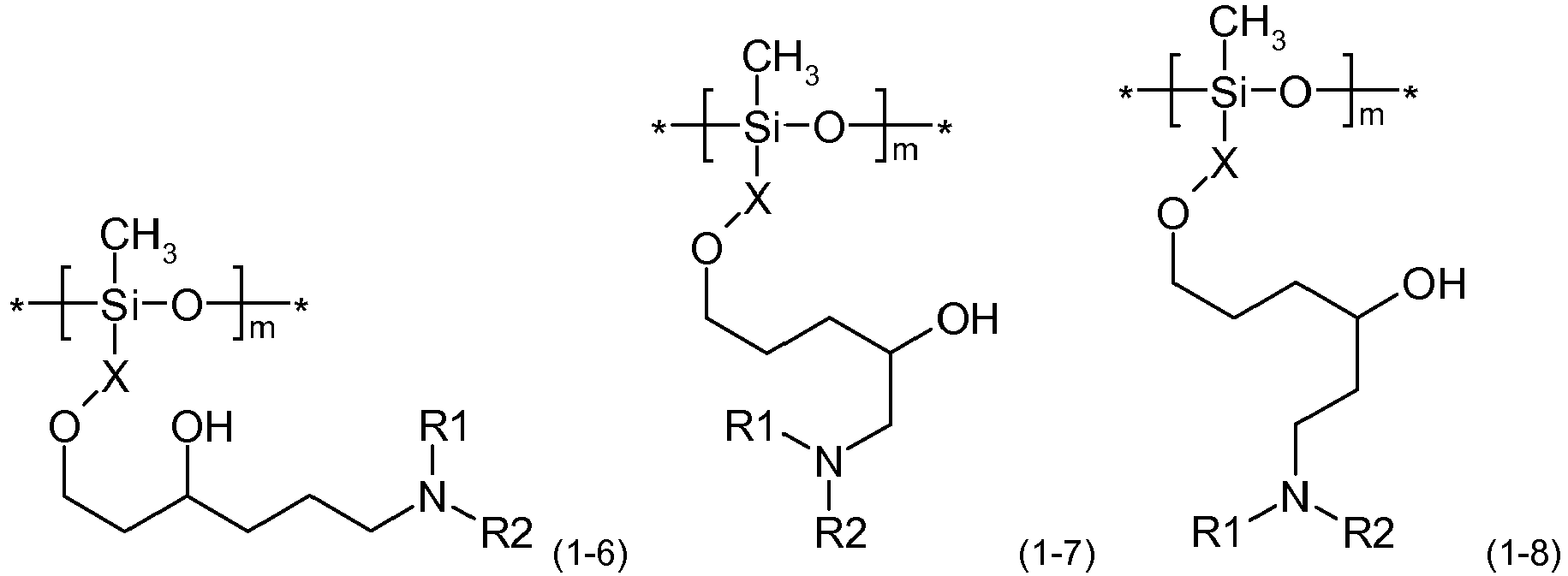

- X
- für einen substituierten oder unsubstituierten Alkylenrest mit 1, 2, 3, 4, 5, 6, 7, oder 8 C-Atomen steht,
- R1
- für einen substituierten oder unsubstituierten Methyl-, Ethyl-, n-Propyl-, Isopropyl-, n-Butyl-, sec-Butyl, Isobutyl- oder tert-Butylrest steht,
- R2
- für einen substituierten oder unsubstituierten Methyl-, Ethyl-, n-Propyl-, Isopropyl-, n-Butyl-, sec-Butyl, Isobutyl- oder tert-Butylrest steht,
- m
- für eine ganze Zahl zwischen 2 und 200 steht.
- Ganz besonders bevorzugt gilt Y = Q = -CH2-, so dass bevorzugte erfindungsgemäße Zusammensetzungen dadurch gekennzeichnet sind, dass sie mindestens ein Silicon enthalten, das Struktureinheiten der Formel (I-1) enthalten.
- Die Reste R1 und R2 stehen unabhängig voneinander für einen substituierten oder unsubstituierten Methyl-, Ethyl-, n-Propyl-, Isopropyl-, n-Butyl-, sec-Butyl, Isobutyl- oder tert-Butylrest. Ganz besonders bevorzugt gilt R1 = R2.
- R1 und R2 sind vorzugsweise ausgewählt aus -CH3, -CH2OH, CH2CH2-OH und -CH2-CH(OH)CH3, so dass bevorzugte erfindungsgemäße Zusammensetzungen mindestens ein Silicon enthalten, das Struktureinheiten der Formel (I-10) bis (I-45) aufweist


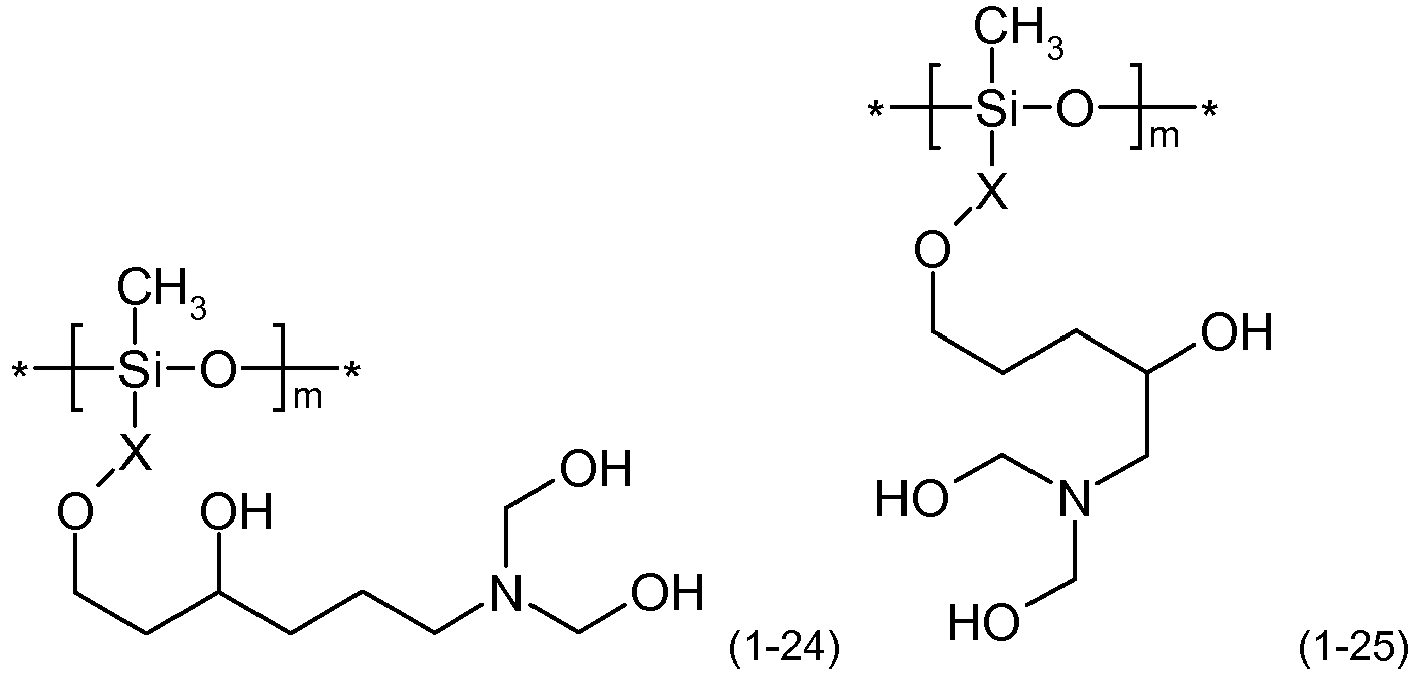


- X
- für einen substituierten oder unsubstituierten Alkylenrest mit 1, 2, 3, 4, 5, 6, 7, oder 8 C-Atomen steht,
- Ganz besonders bevorzugt gilt R1 = R2 = -CH2-CH(OH)CH3, so dass bevorzugte erfindungsgemäße Zusammensetzungen dadurch gekennzeichnet sind, dass sie mindestens ein Silicon enthalten, das Struktureinheiten der Formel (la)

- In Formel (la) steht X wie in Formel (I) für einen substituierten oder unsubstituierten Alkylenrest mit 1, 2, 3, 4, 5, 6, 7, oder 8 C-Atomen. Besonders bevorzugt steht X für eine der Gruppierungen -CH2-, -(CH2)2- oder -(CH2)3-, äußerst bevorzugt für die letztgenannte Gruppe, so dass bevorzugte erfindungsgemäße Zusammensetzungen mindestens ein Silicon enthalten, das Struktureinheiten der Formel (Ib)

- Die in den erfindungsgemäßen Mitteln enthaltenen Polymere c) enthalten Struktureinheiten der Formel (II)

R3 für -H oder-CH3 steht,
k für eine ganze Zahl von 1 bis 30, vorzugsweise für 10, 11, 12, 13, 14, 15, 16, 17 oder 18 steht, n für eine ganze Zahl zwischen 2 und 200 steht. - Vorzugsweise steht R3 für -H, so dass bevorzugte erfindungsgemäße Zusammensetzungen dadurch gekennzeichnet sind, dass sie mindestens ein Polymer enthalten, das Struktureinheiten der Formel (IIa)

- Die in den erfindungsgemäßen Mitteln enthaltenen Polymere c) können ausschließlich Struktureinheiten der Formel (II) enthalten (Homopolymere), sie können aber auch Copolymerisate sein, die weitere Monomereinheiten aufweisen Bei den Copolymerisaten haben sich folgende Copolymere als besonders geeignet erwiesen:
- Copolymere mit Struktureinheiten der Formel (IIa) und Acrylsäure-Struktureinheiten,
- Copolymere mit Struktureinheiten der Formel (IIa) und Methacrylsäure-Struktureinheiten,
- Copolymere mit Struktureinheiten der Formel (IIa) und Methylacrylat-Struktureinheiten,
- Copolymere mit Struktureinheiten der Formel (IIa) und Ethylacrylat-Struktureinheiten,
- Copolymere mit Struktureinheiten der Formel (IIa) und Methylmethacrylat-Struktureinheiten,
- Copolymere mit Struktureinheiten der Formel (IIa) und Ethylmethacrylat-Struktureinheiten, wobei die Säuregruppen ganz oder vollständig neutralisiert sein können.
- Die in den erfindungsgemäßen Mitteln enthaltenen Silicone b) können außer Struktureinheiten der Formel (I) weitere Strukturblöcke enthalten. Bevorzugt sind einzelne Struktureinheiten oder Blöcke aus Polydimethylsiloxan, die die Struktureinheiten der Formel (I) oder Blöcke daraus terminieren oder voneinander trennen können.
- Erfindungsgemäß bevorzugte Zusammensetzungen enthalten daher mindestens ein Silicon der Formel (III)

- X
- für einen substituierten oder unsubstituierten Alkylenrest mit 1, 2, 3, 4, 5, 6, 7 oder 8 C-Atomen steht,
- Y
- für einen substituierten oder unsubstituierten Alkylenrest mit 1, 2, 3, 4, 5, 6, 7 oder 8 C-Atomen steht,
- Q
- für einen substituierten oder unsubstituierten Alkylenrest mit 1, 2, 3, 4, 5, 6, 7 oder 8 C-Atomen steht,
- R1
- für einen substituierten oder unsubstituierten Methyl-, Ethyl-, n-Propyl-, Isopropyl-, n-Butyl-, sec-Butyl, Isobutyl- oder tert-Butylrest steht,
- R2
- für einen substituierten oder unsubstituierten Methyl-, Ethyl-, n-Propyl-, Isopropyl-, n-Butyl-, sec-Butyl, Isobutyl- oder tert-Butylrest steht,
- R3
- für -H oder-CH3 steht,
- R4
- und R5 unabhängig voneinander ausgewählt sind aus -H, -CH3, -OH, -OCH3,
- k
- für eine ganze Zahl von 1 bis 30, vorzugsweise für 10, 11, 12, 13, 14, 15, 16, 17 oder 18 steht,
- m und n
- für ganze Zahlen zwischen 0 und 200 stehen, mit der Maßgabe, dass m + n ungleich 0 ist,
- o, p und q
- für ganze Zahlen zwischen 0 und 200 stehen, mit der Maßgabe, dass o + p + q ungleich 0 ist.
- In Formel (III) gelten analog die vorstehend genannten bevorzugten Ausführungsformen, so dass bevorzugte erfindungsgemäße Zusammensetzungen mindestens ein Silicon der Formel (IIIa) enthalten

R4 und R5 unabhängig voneinander ausgewählt sind aus -H, -CH3, -OH, -OCH3,
m und n für ganze Zahlen zwischen 0 und 200 stehen, mit der Maßgabe, dass m + n ungleich 0 ist, o, p und q für ganze Zahlen zwischen 0 und 200 stehen, mit der Maßgabe, dass o + p + q ungleich 0 ist. - In erfindungsgemäß bevorzugten Siliconen der Formel (III) bzw. (IIIa) gilt R4 = -H oder -CH3 oder -OH oder -OCH3 und R5 = -H oder -CH3, so dass weiter bevorzugte erfindungsgemäße Zusammensetzungen mindestens ein Silicon der Formel (IIIb) und/oder (IIIc) und/oder (IIId) und/oder (IIIe) und/oder (IIIf) und/oder (IIIg) und/oder (IIIh) und/oder (IIIi) enthalten:


m und n für ganze Zahlen zwischen 0 und 200 stehen, mit der Maßgabe, dass m + n ungleich 0 ist o, p und q für ganze Zahlen zwischen 0 und 200 stehen, mit der Maßgabe, dass o + p + q ungleich 0 ist. - Das bzw. die Silicon(e) b) bzw. Silicon(e) der Formeln (III) bzw. (IIIa) bzw. (IIIb) bis (IIIi) wird in den erfindungsgemäßen Mitteln vorzugsweise in Mengen bis zu 10 Gew.-%, jeweils bezogen auf die gesamte Zusammensetzung, eingesetzt. Bevorzugte erfindungsgemäße Zusammensetzungen sind dadurch gekennzeichnet, dass sie - bezogen auf ihr Gewicht - 0,00001 bis 5 Gew.-%, vorzugsweise 0,0001 bis 3,5 Gew.-%, besonders bevorzugt 0,001 bis 2 Gew.-%, weiter bevorzugt 0,01 bis 1 Gew.-% und insbesondere 0,1 bis 0,5 Gew.-% des/der Silicon(s/e), enthaltend Struktureinheiten der Formel (I), enthalten.
- Das bzw. die Polymer(e) c) wird in den erfindungsgemäßen Mitteln vorzugsweise in Mengen bis zu 10 Gew.-%, jeweils bezogen auf die gesamte Zusammensetzung, eingesetzt. Bevorzugte erfindungsgemäße Zusammensetzungen sind dadurch gekennzeichnet, dass sie - bezogen auf ihr Gewicht - 0,00001 bis 5 Gew.-%, vorzugsweise 0,0001 bis 3,5 Gew.-%, besonders bevorzugt 0,001 bis 2 Gew.-%, weiter bevorzugt 0,01 bis 1 Gew.-% und insbesondere 0,1 bis 0,5 Gew.-% des/der Polymer(s/e), enthaltend Struktureinheiten der Formel (II), enthalten.
- Es hat sich gezeigt, dass ein Zusatz an Butyloctanol die erfindungsgemäße Mischung aus Silicon(en) und Polymer(en) in den erfindungsgemäßen Zusammensetzung stabilisieren kann, so dass die Pflegeffekte weiter verstärkt werden. Erfindungsgemäß bevorzugte Zusammensetzungen sind daher dadurch gekennzeichnet, dass sie - bezogen auf ihr Gewicht - 0,00001 bis 5 Gew.-%, vorzugsweise 0,0001 bis 3,5 Gew.-%, besonders bevorzugt 0,001 bis 2 Gew.-%, weiter bevorzugt 0,01 bis 1 Gew.-% und insbesondere 0,1 bis 0,5 Gew.-% 2-Butyloctan-1-ol (INCI-Bezeichnung: Butyloctanol) enthalten.
- Die erfindungsgemäßen Mittel enthalten weiterhin eine farbgebende Verbindung, ausgewählt aus Oxidationsfarbstoffvorprodukten und/oder direktziehenden Farbstoffen und/oder Wasserstoffperoxid.
- In einer bevorzugten Ausführungsform enthalten erfindungsgemäße Mittel als farbgebende Komponenten mindestens ein Oxidationsfarbstoffvorprodukt.
- Die Oxidationsfarbstoffvorprodukte werden bevorzugt in einer Menge von 0,005 bis 25 Gew.-%, bevorzugt von 0,05 bis 20 Gew.-% und besonders bevorzugt von 0,1 bis 15 Gew.-%, jeweils bezogen auf das anwendungsbereite Oxidationsfärbemittel, verwendet.
- In einer bevorzugten Ausführungsform enthalten die erfindungsgemäßen Mittel mindestens ein Oxidationsfarbstoffvorprodukt vom Entwicklertyp und/oder Kupplertyp. Vorzugsweise enthalten die erfindungsgemäßen Färbemittel mindestens ein Oxidationsfarbstoffvorprodukt vom Entwicklertyp und mindestens ein Oxidationsfarbstoffvorprodukt vom Kupplertyp.
- Die Entwickler- und Kupplerkomponenten werden üblicherweise in freier Form eingesetzt. Bei Substanzen mit Aminogruppen kann es aber bevorzugt sein, sie in Salzform, insbesondere in Form der Hydrochloride und Hydrobromide oder der Sulfate, einzusetzen.
- Erfindungsgemäße Entwicklerkomponenten werden ausgewählt aus p-Phenylendiamin, zweikernigen Entwicklerkomponenten, p-Aminophenol, o-Aminophenol, heterocyclischen Entwicklerkomponenten und/oder den Derivaten vorstehender Substanzklassen. Die Entwicklerkomponenten werden bevorzugt in einer Menge von 0,05 bis 10 Gew.-%, vorzugsweise 0,1 bis 5 Gew.-%, jeweils bezogen auf das anwendungsbereite Oxidationsfärbemittel, verwendet.
- Bevorzugte p-Phenylendiamine werden ausgewählt aus einer oder mehrerer Verbindungen der Gruppe, die gebildet wird, aus p-Phenylendiamin, p-Toluylendiamin, 2-Chlor-p-phenylendiamin, 2,3-Dimethyl-p-phenylendiamin, 2,6-Dimethyl-p-phenylendiamin, 2,6-Diethyl-p-phenylendiamin, 2,5-Dimethyl-p-phenylendiamin, N,N-Dimethyl-p-phenylendiamin, N,N-Diethyl-p-phenylendiamin, N,N-Dipropyl-p-phenylendiamin, 4-Amino-3-methyl-(N,N-diethyl)anilin, N,N-Bis-(2-hydroxyethyl)-p-phenylendiamin, 4-N,N-Bis-(2-hydroxyethyl)amino-2-methylanilin, 4-N,N-Bis-(2-hydroxyethyl)-amino-2-chloranilin, 2-(2-Hydroxyethyl)-p-phenylendiamin, 2-(1,2-Dihydroxyethyl)-p-phenylen-diamin, 2-Fluor-p-phenylendiamin, 2-Isopropyl-p-phenylendiamin, N-(2-Hydroxypropyl)-p-phenylen-diamin, 2-Hydroxymethyl-p-phenylendiamin, N,N-Dimethyl-3-methyl-p-phenylendiamin, N-Ethyl-N-2-hydroxyethyl-p-phenylendiamin, N-(2,3-Dihydroxypropyl)-p-phenylendiamin, N-(4'-Aminophenyl)-p-phenylendiamin, N-Phenyl-p-phenylendiamin, 2-(2-Hydroxyethyloxy)-p-phenylendiamin, 2-Methoxymethyl-p-phenylendiamin, 2-(2-Acetylaminoethyloxy)-p-phenylendiamin, N-(2-Methoxyethyl)-p-phenylendiamin, N-(4-Amino-3-methylphenyl)-N-[3-(1H-imidazol-1-yl)propyl]amin, 5,8-Diaminoben-zo-1,4-dioxan sowie ihren physiologisch verträglichen Salzen. Erfindungsgemäß besonders bevorzugte p-Phenylendiaminderivate sind ausgewählt aus mindestens einer Verbindung der Gruppe p-Phenylendiamin, p-Toluylendiamin, 2-(2-Hydroxyethyl)-p-phenylendiamin, 2-(1,2-Dihydroxyethyl)-p-phenylendiamin, N,N-Bis-(2-hydroxyethyl)-p-phenylendiamin, N-(4-Amino-3-methylphenyl)-N-[3-(1H-imidazol-1-yl)propyl]amin, 2-Methoxymethyl-p-phenylendiamin sowie den physiologisch verträglichen Salzen dieser Verbindungen.
- Es kann erfindungsgemäß weiterhin bevorzugt sein, als Entwicklerkomponente Verbindungen einzusetzen, die mindestens zwei aromatische Kerne enthalten, die mit Amino- und/oder Hydroxylgruppen substituiert sind. Bevorzugte zweikernige Entwicklerkomponenten werden insbesondere aus mindestens einer der folgenden Verbindungen ausgewählt: N,N'-Bis-(2-hydroxyethyl)-N,N'-bis-(4'-aminophenyl)-1,3-diamino-propan-2-ol, N,N'-Bis-(2-hydroxyethyl)-N,N'-bis-(4'-aminophenyl)-ethylendiamin, N,N'-Bis-(4'-aminophenyl)tetramethylendiamin, N,N'-Bis-(2-hydroxyethyl)-N,N'-bis-(4'-aminophenyl)tetramethylendiamin, N,N'-Bis-[4-(methylamino)phenyl]tetramethylendiamin, N,N'-Diethyl-N,N'-bis-(4'-amino-3'-methylphenyl)ethylendiamin, Bis-(2-hydroxy-5-aminophenyl)methan, N,N'-Bis-(4'-aminophenyl)-1,4-diazacycloheptan, N,N'-Bis-(2-hydroxy-5-aminobenzyl)piperazin, N-(4'-Aminophenyl)-p-phenylendiamin und 1,10-Bis-(2',5'-diaminophenyl)-1,4,7,10-tetraoxadecan sowie ihre physiologisch verträglichen Salze. Besonders bevorzugte zweikernige Entwicklerkomponenten werden ausgewählt unter N,N'-Bis-(2-hydroxyethyl)-N,N'-bis-(4-aminophenyl)-1,3-diamino-propan-2-ol, Bis-(2-hydroxy-5-aminophenyl)methan, 1,3-Bis-(2,5-diaminophenoxy)propan-2-ol, N,N'-Bis-(4-aminophenyl)-1,4-diazacycloheptan, 1,10-Bis-(2,5-diaminophenyl)-1,4,7,10-tetraoxa-decan oder einem der physiologisch verträglichen Salze dieser Verbindungen.
- Weiterhin kann es erfindungsgemäß bevorzugt sein, als Entwicklerkomponente ein p-Aminophenolderivat oder eines seiner physiologisch verträglichen Salze einzusetzen. Bevorzugte p-Aminophenole sind insbesondere p-Aminophenol, N-Methyl-p-aminophenol, 4-Amino-3-methyl-phenol, 4-Amino-3-fluorphenol, 2-Hydroxymethylamino-4-aminophenol, 4-Amino-3-hydroxymethylphenol, 4-Amino-2-(2-hydroxyethoxy)phenol, 4-Amino-2-methylphenol, 4-Amino-2-hydroxymethylphenol, 4-Amino-2-methoxymethylphenol, 4-Amino-2-aminomethylphenol, 4-Amino-2-[(2-hydroxyethyl)-aminomethyl]phenol, 4-Amino-2-(1,2-dihydroxyethyl)phenol, 4-Amino-2-fluorphenol, 4-Amino-2-chlorphenol, 4-Amino-2,6-dichlorphenol, 4-Amino-2-(diethylaminomethyl)phenol sowie ihre physiologisch verträglichen Salze. Besonders bevorzugte Verbindungen sind p-Aminophenol, 4-Amino-3-methylphenol, 4-Amino-2-aminomethylphenol, 4-Amino-2-(1,2-dihydroxyethyl)phenol und 4-Amino-2-(diethylaminomethyl)phenol oder einem der physiologisch verträglichen Salze dieser Verbindungen.
- Ferner kann die Entwicklerkomponente ausgewählt sein aus o-Aminophenol und seinen Derivaten, wie beispielsweise 2-Amino-4-methylphenol, 2-Amino-5-methylphenol oder 2-Amino-4-chlorphenol. Weiterhin kann die Entwicklerkomponente ausgewählt sein aus heterocyclischen Entwicklerkomponenten, wie beispielsweise aus Pyrimidinderivaten, Pyrazolderivaten, Pyrazolopyrimidin-Derivaten bzw. ihren physiologisch verträglichen Salzen. Bevorzugte Pyrimidinderivate sind die Verbindungen 2,4,5,6-Tetraaminopyrimidin, 4-Hydroxy-2,5,6-triaminopyrimidin, 2-Hydroxy-4,5,6-triamino-pyrimidin, 2-Dimethylamino-4,5,6-triaminopyrimidin, 2,4-Dihydroxy-5,6-diaminopyrimidin und 2,5,6-Triaminopyrimidin. Bevorzugte Pyrazolderivate sind die Verbindungen, die ausgewählt werden unter 4,5-Diamino-1-methylpyrazol, 4,5-Diamino-1-(2-hydroxyethyl)pyrazol, 3,4-Diaminopyrazol, 4,5-Diamino-1-(4'-chlorbenzyl)pyrazol, 4,5-Diamino-1,3-dimethylpyrazol, 4,5-Diamino-3-methyl-1-phenylpyrazol, 4,5-Diamino-1-methyl-3-phenylpyrazol, 4-Amino-1,3-dimethyl-5-hydrazinopyrazol, 1-Benzyl-4,5-diamino-3-methylpyrazol, 4,5-Diamino-3-t-butyl-1-methylpyrazol, 4,5-Diamino-1-t-butyl-3-methylpyrazol, 4,5-Diamino-1-(2-hydroxyethyl)-3-methylpyrazol, 4,5-Diamino-1-ethyl-3-methylpyrazol, 4,5-Diamino-1-ethyl-3-(4'-methoxyphenyl)pyrazol, 4,5-Diamino-1-ethyl-3-hydroxy-methylpyrazol, 4,5-Diamino-3-hydroxymethyl-1-methylpyrazol, 4,5-Diamino-3-hydroxymethyl-1-isopropylpyrazol, 4,5-Diamino-3-methyl-1-isopropylpyrazol, 4-Amino-5-(2-aminoethyl)amino-1,3-dimethylpyrazol, sowie deren physiologisch verträglichen Salze.
- Bevorzugte Pyrazolopyrimidinderivate sind insbesondere die Derivate des Pyrazolo[1,5-a]pyrimidin und dessen tautomeren Formen, sofern ein tautomeres Gleichgewicht besteht. Die Pyrazolo[1,5-a]-pyrimidinen sind insbesondere ausgewählt aus Pyrazolo[1,5-a]pyrimidin-3,7-diamin, 2,5-Dimethyl-pyrazolo[1,5-a]pyrimidin-3,7-diamin, Pyrazolo[1,5-a]pyrimidin-3,5-diamin, 2,7-Dimethyl-pyrazolo [1,5-a]pyrimidin-3,5-diamin, 3-Aminopyrazolo[1,5-a]pyrimidin-7-ol, 3-Aminopyrazolo[1,5-a]pyrimidin-5-ol, 2-(3-Aminopyrazolo[1,5-a]pyrimidin-7-ylamino)ethanol, 2-(7-Aminopyrazolo[1,5-a]pyrimidin-3-ylamino)ethanol, 2-[(3-Aminopyrazolo[1,5-a]pyrimidin-7-yl)-(2-hydroxyethyl)amino]ethanol, 2-[(7-Aminopyrazolo[1,5-a]pyrimidin-3-yl)-(2-hydroxyethyl)amino]ethanol; 5,6-Dimethylpyrazolo[1,5-a]pyrimidin-3,7-diamin, 2,6-Dimethylpyrazolo[1,5-a]pyrimidin-3,7-diamin, 3-Amino-7-dimethylamino-2,5-dimethylpyrazolo[1,5-a]pyrimidin sowie ihren physiologisch verträglichen Salzen und ihren tautomeren Formen, wenn ein tautomeres Gleichgewicht vorhanden ist.
- Besonders bevorzugte Entwicklerkomponenten werden ausgewählt, aus mindestens einer Verbindung aus der Gruppe, die gebildet wird aus p-Phenylendiamin, p-Toluylendiamin, 2-(2-Hydroxy-ethyl)-p-phenylendiamin, 2-(1,2-Dihydroxyethyl)-p-phenylendiamin, N,N-Bis-(2-hydroxyethyl)-p-phenylendiamin, 2-Methoxymethyl-p-phenylendiamin, N-(4-Amino-3-methylphenyl)-N-[3-(1H-imidazol-1-yl)propyl]amin, N,N'-Bis-(2-hydroxyethyl)-N,N'-bis-(4-aminophenyl)-1,3-diamino-propan-2-ol, Bis-(2-hydroxy-5-aminophenyl)methan, 1,3-Bis-(2,5-diaminophenoxy)-propan-2-ol, N,N'-Bis-(4-aminophenyl)-1,4-diazacycloheptan, 1,10-Bis-(2,5-diaminophenyl)-1,4,7,10-tetraoxadecan, p-Aminophenol, 4-Amino-3-methylphenol, 4-Amino-2-aminomethylphenol, 4-Amino-2-(1,2-dihydroxy-ethyl)phenol und 4-Amino-2-(diethylaminomethyl)phenol, 4,5-Diamino-1-(2-hydroxyethyl)pyrazol, 2,4,5,6-Tetraaminopyrimidin, 4-Hydroxy-2,5,6-triaminopyrimidin, 2-Hydroxy-4,5,6-triaminopyrimidin, sowie den physiologisch verträglichen Salzen dieser Verbindungen.
- Kupplerkomponenten bilden im Rahmen der oxidativen Färbung allein keine signifikante Färbung aus, sondern benötigen stets die Gegenwart von Entwicklerkomponenten. Daher ist es erfindungsgemäß bevorzugt, dass bei Verwendung mindestens einer Kupplerkomponente zusätzlich mindestens eine Entwicklerkomponente zum Einsatz kommt.
- Erfindungsgemäße Kupplerkomponenten werden bevorzugt ausgewählt aus m-Aminophenol, m-Diaminobenzol, o-Diaminobenzol, o-Aminophenol, Naphthalinderivaten mit mindestens einer Hydroxygruppe, Di- beziehungsweise Trihydroxybenzol, Pyridin, Pyrimidin, Monohydroxy- bzw. Monoaminoindol, Monohydroxy- bzw. Monoaminoindolin, Pyrazolon, Benzomorpholin, Chinoxalin und/oder den Derivaten der vorstehenden Substanzklassen. Die Kupplerkomponenten werden bevorzugt in einer Menge von 0,005 bis 10 Gew.-%, vorzugsweise 0,1 bis 5 Gew.-%, jeweils bezogen auf das anwendungsbereite Färbemittel, verwendet.
- Die erfindungsgemäß bevorzugten m-Aminophenole bzw. deren Derivate werden ausgewählt aus mindestens einer Verbindung aus der Gruppe, die gebildet wird aus m-Aminophenol, 5-Amino-2-methylphenol, N-Cyclopentyl-3-aminophenol, 3-Amino-2-chlor-6-methylphenol, 2-Hydroxy-4-amino-phenoxyethanol, 2,6-Dimethyl-3-aminophenol, 3-Trifluoroacetylamino-2-chlor-6-methylphenol, 5-Amino-4-chlor-2-methylphenol, 5-Amino-4-methoxy-2-methylphenol, 5-(2'-Hydroxyethyl)amino-2-methylphenol, 3-Diethylaminophenol, N-Cyclopentyl-3-aminophenol, 1,3-Dihydroxy-5-methylamino-benzol, 3-Ethylamino-4-methylphenol, 2,4-Dichlor-3-aminophenol und den physiologisch verträglichen Salzen der vorstehend genannten Verbindungen.
- Die erfindungsgemäß bevorzugten m-Diaminobenzole bzw. deren Derivate werden ausgewählt aus mindestens einer Verbindung aus der Gruppe, die gebildet wird aus m-Phenylendiamin, 2-(2,4-Di-aminophenoxy)ethanol, 1,3-Bis(2,4-diaminophenoxy)propan, 1-Methoxy-2-amino-4-(2'-hydroxy-ethylamino)benzol, 1,3-Bis(2,4-diaminophenyl)propan, 2,6-Bis(2'-hydroxyethylamino)-1-methyl-benzol, 2-({3-[(2-Hydroxyethyl)amino]-4-methoxy-5-methylphenyl}amino)ethanol, 2-({3-[(2-Hydroxy-ethyl)amino]-2-methoxy-5-methylphenyl}amino)ethanol, 2-({3-[(2-Hydroxyethyl)amino]-4,5-dimethylphenyl}amino)ethanol, 2-[3-Morpholin-4-ylphenyl)amino]ethanol, 3-Amino-4-(2-methoxy-ethoxy)-5-methylphenylamin, 1-Amino-3-bis-(2'-hydroxyethyl)aminobenzol und den physiologisch verträglichen Salzen der genannten Verbindungen.
- Die erfindungsgemäß bevorzugten o-Diaminobenzole bzw. deren Derivate werden ausgewählt aus mindestens einer Verbindung aus der Gruppe, die gebildet wird aus 3,4-Diaminobenzoesäure und 2,3-Diamino-1-methylbenzol und den physiologisch verträglichen Salzen der genannten Verbindungen.
- Bevorzugte Di- beziehungsweise Trihydroxybenzole und deren Derivate werden ausgewählt aus mindestens einer Verbindung der Gruppe, die gebildet wird aus Resorcin, Resorcinmonomethylether, 2-Methylresorcin, 5-Methylresorcin, 2,5-Dimethylresorcin, 2-Chlorresorcin, 4-Chlorresorcin, Pyrogallol und 1,2,4-Trihydroxybenzol.
- Die erfindungsgemäß bevorzugten Pyridinderivate werden ausgewählt aus mindestens einer Verbindung der Gruppe, die gebildet wird aus 2,6-Dihydroxypyridin, 2-Amino-3-hydroxypyridin, 2-Amino-5-chlor-3-hydroxypyridin, 3-Amino-2-methylamino-6-methoxypyridin, 2,6-Dihydroxy-3,4-dimethylpyridin, 2,6-Dihydroxy-4-methylpyridin, 2,6-Diaminopyridin, 2,3-Diamino-6-methoxypyridin, 3,5-Diamino-2,6-dimethoxypyridin, 3,4-Diaminopyridin, 2-(2-Methoxyethyl)amino-3-amino-6-methoxypyridin, 2-(4'-Methoxyphenyl)amino-3-aminopyridin, und den physiologisch verträglichen Salzen der vorgenannten Verbindungen.
- Bevorzugte Naphthalinderivate mit mindestens einer Hydroxygruppe werden ausgewählt aus mindestens einer Verbindung der Gruppe, die gebildet wird aus 1-Naphthol, 2-Methyl-1-naphthol, 2-Hydroxymethyl-1-naphthol, 2-Hydroxyethyl-1-naphthol, 1,3-Dihydroxynaphthalin, 1,5-Dihydroxy-naphthalin, 1,6-Dihydroxynaphthalin, 1,7-Dihydroxynaphthalin, 1,8-Dihydroxynaphthalin, 2,7-Dihydroxynaphthalin und 2,3-Dihydroxynaphthalin.
- Die erfindungsgemäß bevorzugten Indolderivate werden ausgewählt aus mindestens einer Verbindung der Gruppe, die gebildet wird aus 4-Hydroxyindol, 6-Hydroxyindol und 7-Hydroxyindol und den physiologisch verträglichen Salzen der vorgenannten Verbindungen.
- Die erfindungsgemäß bevorzugten Indolinderivate werden ausgewählt aus mindestens einer Verbindung der Gruppe, die gebildet wird aus 4-Hydroxyindolin, 6-Hydroxyindolin und 7-Hydroxyindo-lin und den physiologisch verträglichen Salzen der vorgenannten Verbindungen.
- Bevorzugte Pyrimidinderivate werden ausgewählt aus mindestens einer Verbindung der Gruppe, die gebildet wird aus 4,6-Diaminopyrimidin, 4-Amino-2,6-dihydroxypyrimidin, 2,4-Diamino-6-hydroxypyrimidin, 2,4,6-Trihydroxypyrimidin, 2-Amino-4-methylpyrimidin, 2-Amino-4-hydroxy-6-methylpyrimidin und 4,6-Dihydroxy-2-methylpyrimidin und den physiologisch verträglichen Salzen der vorgenannten Verbindungen.
- Erfindungsgemäß besonders bevorzugte Kupplerkomponenten werden ausgewählt unter 3-Amino-phenol, 5-Amino-2-methylphenol, 3-Amino-2-chlor-6-methylphenol, 2-Hydroxy-4-aminophenoxy-ethanol, 5-Amino-4-chlor-2-methylphenol, 5-(2-Hydroxyethyl)-amino-2-methylphenol, 2,4-Dichlor-3-aminophenol, 2-Aminophenol, 3-Phenylendiamin, 2-(2,4-Diaminophenoxy)ethanol, 1,3-Bis-(2,4-diaminophenoxy)propan, 1-Methoxy-2-amino-4-(2-hydroxyethylamino)benzol, 1,3-Bis-(2,4-diamino-phenyl)propan, 2,6-Bis-(2'-hydroxyethylamino)-1-methylbenzol, 2-({3-[(2-Hydroxyethyl)amino]-4-methoxy-5-methylphenyl}amino)ethanol, 2-({3-[(2-Hydroxyethyl)amino]-2-methoxy-5-methyl-phenyl}amino)ethanol, 2-({3-[(2-Hydroxyethyl)amino]-4,5-dimethylphenyl}amino)ethanol, 2-[3-Morpholin-4-ylphenyl)amino]ethanol, 3-Amino-4-(2-methoxyethoxy)-5-methylphenylamin, 1-Amino-3-bis-(2-hydroxyethyl)aminobenzol, Resorcin, 2-Methylresorcin, 4-Chlorresorcin, 1,2,4-Trihydroxy-benzol, 2-Amino-3-hydroxypyridin, 3-Amino-2-methylamino-6-methoxypyridin, 2,6-Dihydroxy-3,4-dimethylpyridin, 3,5-Diamino-2,6-dimethoxypyridin, 1-Phenyl-3-methylpyrazol-5-on, 1-Naphthol, 1,5-Dihydroxynaphthalin, 2,7-Dihydroxynaphthalin, 1,7-Dihydroxynaphthalin, 1,8-Dihydroxy-naphthalin, 4-Hydroxyindol, 6-Hydroxyindol, 7-Hydroxyindol, 4-Hydroxyindolin, 6-Hydroxyindolin, 7-Hydroxyindolin oder Gemischen dieser Verbindungen oder den physiologisch verträglichen Salzen der vorgenannten Verbindungen.
- Dabei werden Entwicklerkomponenten und Kupplerkomponenten im Allgemeinen in etwa molaren Mengen zueinander eingesetzt. Wenn sich auch der molare Einsatz als zweckmäßig erwiesen hat, so ist ein gewisser Überschuss einzelner Oxidationsfarbstoffvorprodukte nicht nachteilig, so dass Entwicklerkomponenten und Kupplerkomponenten in einem Mol-Verhältnis von 1 zu 0,5 bis 1 zu 3, insbesondere 1 zu 1 bis 1 zu 2, stehen können.
- Oxidationsfarbstoffvorprodukte vom Entwicklertyp und vom Kupplertyp werden besonders bevorzugt in bestimmten Kombinationen eingesetzt. Mit den als Kombination genannten Oxidationsfarbstoffvorprodukten und/oder deren physiologisch verträglichen Salzen können jedoch auch noch weitere Farbstoffvorprodukte kombiniert werden. Bevorzugte Mittel enthalten daher als Oxidationsfarbstoffprodukt zumindest eine der Kombinationen, ausgewählt aus p-Toluylendiamin / Resorcin; p-Toluylendiamin / 2-Methylresorcin; p-Toluylendiamin / 5-Amino-2-methylphenol; p-Toluylendiamin / 3-Aminophenol; p-Toluylendiamin / 2-(2,4-Diaminophenoxy)ethanol; p-Toluylendiamin / 1,3-Bis(2,4-diaminophenoxy)propan; p-Toluylendiamin / 1-Methoxy-2-amino-4-(2-hydroxyethylamino)-benzol; p-Toluylendiamin / 2-Amino-3-hydroxypyridin; p-Toluylendiamin / 1-Naphthol; 2-(2-Hydroxy-ethyl)-p-phenylendiamin / Resorcin; 2-(2-Hydroxyethyl)-p-phenylendiamin / 2-Methylresorcin; 2-(2-Hydroxyethyl)-p-phenylendiamin / 5-Amino-2-methylphenol; 2-(2-Hydroxyethyl)-p-phenylendiamin / 3-Aminophenol; 2-(2-Hydroxyethyl)-p-phenylendiamin / 2-(2,4-Diaminophenoxy)ethanol; 2-(2-Hydroxyethyl)-p-phenylendiamin / 1,3-Bis-(2,4-diaminophenoxy)propan; 2-(2-Hydroxyethyl)-p-phenylendiamin / 1-Methoxy-2-amino-4-(2-hydroxyethylamino)benzol; 2-(2-Hydroxyethyl)-p-phenylen-diamin / 2-Amino-3-hydroxypyridin; 2-(2-Hydroxyethyl)-p-phenylendiamin / 1-Naphthol; 2-Methoxy-methyl-p-phenylendiamin / Resorcin; 2-Methoxymethyl-p-phenylendiamin / 2-Methylresorcin; 2-Methoxymethyl-p-phenylendiamin / 5-Amino-2-methylphenol; 2-Methoxymethyl-p-phenylendiamin / 3-Aminophenol; 2-Methoxymethyl-p-phenylendiamin / 2-(2,4-Diaminophenoxy)ethanol; 2-Methoxy-methyl-p-phenylendiamin / 1,3-Bis(2,4-diaminophenoxy)propan; 2-Methoxymethyl-p-phenylendiamin / 1-Methoxy-2-amino-4-(2-hydroxyethylamino)benzol; 2-Methoxymethyl-p-phenylendiamin / 2-Amino-3-hydroxypyridin; 2-Methoxymethyl-p-phenylendiamin / 1-Naphthol; N-(4-Amino-3-methyl-phenyl)-N-[3-(1H-imidazol-1-yl)propyl]amin / Resorcin; N-(4-Amino-3-methylphenyl)-N-[3-(1H-imidazol-1-yl)propyl]amin / 2-Methylresorcin; N-(4-Amino-3-methylphenyl)-N-[3-(1 H-imidazol-1-yl)propyl]amin / 5-Amino-2-methylphenol; N-(4-Amino-3-methylphenyl)-N-[3-(1H-imidazol-1-yl)propyl]-amin / 3-Aminophenol; N-(4-Amino-3-methylphenyl)-N-[3-(1H-imidazol-1-yl)propyl]amin / 2-(2,4-Diaminophenoxy)ethanol; N-(4-Amino-3-methylphenyl)-N-[3-(1H-imidazol-1-yl)propyl]amin / 1,3-Bis(2,4-diaminophenoxy)propan; N-(4-Amino-3-methylphenyl)-N-[3-(1H-imidazol-1-yl)propyl]amin / 1-Methoxy-2-amino-4-(2-hydroxyethylamino)benzol; N-(4-Amino-3-methylphenyl)-N-[3-(1H-imidazol-1-yl)propyl]amin / 2-Amino-3-hydroxypyridin; N-(4-Amino-3-methylphenyl)-N-[3-(1H-imidazol-1-yl)propyl]amin / 1-Naphthol; 4,5-Diamino-1-(2-hydroxyethyl)pyrazol / Resorcin; 4,5-Diamino-1-(2-hydroxyethyl)pyrazol / 2-Methylresorcin; 4,5-Diamino-1-(2-hydroxyethyl)pyrazol / 5-Amino-2-methylphenol; 4,5-Diamino-1-(2-hydroxyethyl)pyrazol / 3-Aminophenol; 4,5-Diamino-1-(2-hydroxy-ethyl)pyrazol / 2-(2,4-Diaminophenoxy)ethanol; 4,5-Diamino-1-(2-hydroxyethyl)pyrazol / 1,3-Bis(2,4-diaminophenoxy)propan; 4,5-Diamino-1-(2-hydroxyethyl)pyrazol / 1-Methoxy-2-amino-4-(2-hydroxyethylamino)benzol; 4,5-Diamino-1-(2-hydroxyethyl)pyrazol / 2-Amino-3-hydroxypyridin sowie 4,5-Diamino-1-(2-hydroxyethyl)pyrazol / 1-Naphthol.
- Besonders bevorzugte erfindungsgemäße Zusammensetzung sind dadurch gekennzeichnet, dass sie als Oxidationsfarbstoffvorprodukt mindestens eine Entwicklerkomponente und/oder mindestens eine Kupplerkomponente enthalten, wobei bevorzugte Entwicklerkomponenten ausgewählt sind aus p-Phenylendiamin, p-Toluylendiamin, , N,N-Bis-(2-hydroxyethyl)amino-p-phenylendiamin, 1,3-Bis-[(2-hydroxyethyl-4'-aminophenyl)amino]-propan-2-ol, 1,10-Bis-(2',5'- diaminophenyl)-1,4,7,10-tetraoxadecan, 4-Aminophenol, 4- Amino-3-methylphenol, Bis-(5- amino-2-hydroxyphenyl)methan, 2,4,5,6- Tetraaminopyrimidin, 2-Hydroxy-4,5,6- triaminopyrimidin, 4,5-Diamino-1-(2-hydroxyethyl)-pyrazol und bevorzugte Kupplerkomponenten ausgewählt sind aus Resorcin, 2-Methylresorcin, 5-Methyl-resorcin, 2,5-Dimethylresorcin, 4-Chlorresorcin, Resorcinmonomethylether, 5-Aminophenol, 5-Amino-2-methylphenol, 5-(2-Hydroxyethyl)amino-2-methylphenol, 3-Amino-4-chlor-2-methylphenol, 3-Amino-2-chlor-6-methylphenol, 3-Amino-2,4-Dichlorphenol, 2,4-Diaminophenoxyethanol, 2-Amino-4-(2'-hydroxyethyl)amino-anisolsulfat, 1,3-Bis-(2,4-diaminophenoxy)propan, 2-Amino-3-hydroxypyridin, 2-Methylamino-3-amino-6-methoxypyridin, 2,6-Dihydroxy-3,4-dimethylpyridin, 3,5-Diamino-2,6-dimethoxypyridin, 1-Naphthol, 2-Methyl-1-naphthol, 1,5-Dihydroxynaphthalin, 2,7-Dihydroxynaphthalin, 1-Phenyl-3-methylpyrazol-5-on, 2,6-Bis-[(2'-hydroxyethyl)amino]-toluol, 4-Hydroxyindol, 6-Hydroxyindol, 6-Hydroxybenzomorpholin.
- Um eine ausgewogene und subtile Nuancenausbildung zu erzielen, ist es erfindungsgemäß vorteilhaft, wenn die erfindungsgemäßen Mittel weitere farbgebende Komponenten enthalten.
- Weiterhin können die erfindungsgemäßen Mittel als farbgebende Komponente, insbesondere zur Nuancierung, mindestens einen direktziehenden Farbstoff enthalten. Dabei handelt sich um Farbstoffe, die direkt auf das Haar aufziehen und keinen oxidativen Prozess zur Ausbildung der Farbe benötigen. Direktziehende Farbstoffe sind üblicherweise Nitrophenylendiamine, Nitroaminophenole, Azofarbstoffe, Anthrachinone oder Indophenole. Die direktziehenden Farbstoffe werden jeweils bevorzugt in einer Menge von 0,001 bis 5 Gew.-%, bezogen auf das gesamte Mittel, eingesetzt. Die Gesamtmenge an direktziehenden Farbstoffen beträgt vorzugsweise höchstens 3 Gew.-%. Direktziehende Farbstoffe sind als anionische, kationische und nichtionische direktziehende Farbstoffe bekannt.
- Bevorzugte anionische direktziehende Farbstoffe sind die unter den internationalen Bezeichnungen bzw. Handelsnamen Acid Yellow 1, Yellow 10, Acid Yellow 23, Acid Yellow 36, Acid Orange 7, Acid Red 33, Acid Red 52, Pigment Red 57:1, Acid Blue 7, Acid Green 50, Acid Violet 43, Acid Black 1, Acid Black 52, Bromphenolblau und Tetrabromphenolblau bekannten Verbindungen.
- Bevorzugte kationische direktziehende Farbstoffe sind kationische Triphenylmethanfarbstoffe, wie beispielsweise Basic Blue 7, Basic Blue 26, Basic Violet 2 und Basic Violet 14, aromatische Systeme, die mit einer quaternären Stickstoffgruppe substituiert sind, wie beispielsweise Basic Yellow 57, Basic Red 76, Basic Blue 99, Basic Blue 347, Basic Brown 16 und Basic Brown 17, kationische Anthrachinonfarbstoffe wie HC Blue 16 (Bluequat B), sowie direktziehende Farbstoffe, die einen Heterocyclus enthalten, der mindestens ein quaternäres Stickstoffatom aufweist, insbesondere Basic Yellow 87, Basic Orange 31 und Basic Red 51. Die kationischen direktziehenden Farbstoffe, die unter dem Warenzeichen Arianor vertrieben werden, sind erfindungsgemäß ebenfalls besonders bevorzugte kationische direktziehende Farbstoffe.
- Als nichtionische direktziehende Farbstoffe eignen sich insbesondere nichtionische Nitro- und Chinonfarbstoffe und neutrale Azofarbstoffe. Bevorzugte nichtionische direktziehende Farbstoffe sind die unter den internationalen Bezeichnungen bzw. Handelsnamen HC Yellow 2, HC Yellow 4, HC Yellow 5, HC Yellow 6, HC Yellow 12, HC Orange 1, Disperse Orange 3, HC Red 1, HC Red 3, HC Red 10, HC Red 11, HC Red 13, HC Red BN, HC Blue 2, HC Blue 11, HC Blue 12, Disperse Blue 3, HC Violet 1, Disperse Violet 1, Disperse Violet 4, Disperse Black 9 bekannten Verbindungen, sowie 1,4-Diamino-2-nitrobenzol, 2-Amino-4-nitrophenol, 1,4-Bis-(2-hydroxyethyl)amino-2-nitrobenzol, 3-Nitro-4-(2-hydroxyethyl)aminophenol, 2-(2-Hydroxyethyl)amino-4,6-dinitrophenol, 4-[(2-Hydroxyethyl)amino]-3-nitro-1-methylbenzol, 1-Amino-4-(2-hydroxyethyl)amino-5-chlor-2-nitrobenzol, 4-Amino-3-nitrophenol, 1-(2'-Ureidoethyl)amino-4-nitrobenzol, 2-[(4-Amino-2-nitrophenyl)-amino]benzoesäure, 6-Nitro-1,2,3,4-tetrahydrochinoxalin, 2-Hydroxy-1,4-naphthochinon, Pikraminsäure und deren Salze, 2-Amino-6-chloro-4-nitrophenol, 4-Ethylamino-3-nitrobenzoesäure und 2-Chlor-6-ethylamino-4-nitrophenol.
- Besonders bevorzugte erfindungsgemäße Zusammensetzung sind dadurch gekennzeichnet, dass sie mindestens einen direktziehenden Farbstoff enthalten, der ausgewählt ist aus Nitrophenylendiaminen, Nitroaminophenolen, Azofarbstoffen, Anthrachinonen oder Indophenolen, vorzugsweise aus der Gruppe der unter den internationalen Bezeichnungen bzw. Handelsnamen bekannten Farbstoffe HC Yellow 2, HC Yellow 4, HC Yellow 5, HC Yellow 6, HC Yellow 12, Acid Yellow 1, Acid Yellow 10, Acid Yellow 23, Acid Yellow 36, HC Orange 1, Disperse Orange 3, Acid Orange 7, HC Red 1, HC Red 3, HC Red 10, HC Red 11, HC Red 13, Acid Red 33, Acid Red 52, HC Red BN, Pigment Red 57:1, HC Blue 2, HC Blue 12, Disperse Blue 3, Acid Blue 7, Acid Green 50, HC Violet 1, Disperse Violet 1, Disperse Violet 4, Acid Violet 43, Disperse Black 9, Acid Black 1, und Acid Black 52 bekannten Verbindungen sowie 1,4-Diamino-2-nitrobenzol, 2-Amino-4-nitrophenol, 1,4-Bis-(β-hydroxyethyl)-amino-2-nitrobenzol, 3-Nitro-4-(β-hydroxyethyl)-aminophenol, 2-(2-Hydroxy-ethyl)amino-4,6-dinitrophenol, 1-(2'-Hydroxyethyl)amino-4-methyl-2-nitrobenzol, 1-Amino-4-(2-hydroxyethyl)-amino-5-chlor-2-nitrobenzol, 4-Amino-3-nitrophenol, 1-(2-Ureidoethyl)amino-4-nitrobenzol, 4-Amino-2-nitrodiphenylamin-2'-carbonsäure, 6-Nitro-1,2,3,4-tetrahydrochinoxalin, 2-Hydroxy-1,4-naphthochinon, Pikraminsäure und deren Salze, 2-Amino-6-chloro-4-nitrophenol, 4-Ethylamino-3-nitrobenzoesäure und 2-Chloro-6-ethylamino-1-hydroxy-4-nitrobenzol.
- In einer weiteren Ausführungsform der vorliegenden Erfindung wird als farbgebende Komponente mindestens eine Farbstoffvorstufe naturanaloger Farbstoffe zugegeben.
- Als Farbstoffvorstufen naturanaloger Farbstoffe werden bevorzugt solche Indole und Indoline eingesetzt, die mindestens zwei Gruppen ausgewählt aus Hydroxy- und/oder oder Aminogruppen, bevorzugt als Substituent am Sechsring, aufweisen. Diese Gruppen können weitere Substituenten tragen, z. B. in Form einer Veretherung oder Veresterung der Hydroxygruppe oder eine Alkylierung der Aminogruppe. In einer weiteren Ausführungsform enthalten die Färbemittel mindestens ein Indol- und/oder Indolinderivat. Erfindungsgemäße Zusammensetzungen, die Vorstufen naturanaloger Farbstoffe enthalten, werden bevorzugt als luftoxidative Färbemittel verwendet. In dieser Ausführungsform werden die besagten Zusammensetzungen folglich nicht mit einem zusätzlichen Oxidationsmittel versetzt. Die Farbstoffvorstufen naturanaloger Farbstoffe werden jeweils bevorzugt in einer Menge von 0,001 bis 5 Gew.-%, insbesondere 0,1 bis 3,5 Gew.-%, bezogen auf das Gesamtgewicht der Mittel, eingesetzt.
- Bevorzugte Derivate des Indolins sind 5,6-Dihydroxyindolin, N-Methyl-5,6-dihydroxyindolin, N-Ethyl-5,6-dihydroxyindolin, N-Propyl-5,6-dihydroxyindolin, N-Butyl-5,6-dihydroxyindolin sowie 5,6-Dihydroxyindolin-2-carbonsäure und besonders bevorzugt 5,6-Dihydroxyindolin. Bevorzugte Derivate des Indols sind 5,6-Dihydroxyindol, N-Methyl-5,6-dihydroxyindol, N-Ethyl-5,6-dihydroxy-indol, N-Propyl-5,6-dihydroxyindol, N-Butyl-5,6-dihydroxyindol, 5,6-Dihydroxyindol-2-carbonsäure sowie insbesondere 5,6-Dihydroxyindol.
- Die erfindungsgemäßen Mittel können auch als Aufhellmittel (nachfolgend auch als Blondiermittel bezeichnet) und/oder als Färbemittel bereitgestellt werden. Mittel, welche gleichzeitig färbend und aufhellend wirken, werden auch als aufhellende Färbemittel bezeichnet.
- Aufhellende erfindungsgemäße Mittel enthalten mindestens ein Oxidationsmittel, ausgewählt aus Wasserstoffperoxid und dessen Anlagerungsverbindungen an feste Träger. Als erfindungsgemäßes Oxidationsmittel wird bevorzugt Wasserstoffperoxid selbst verwendet. Das Wasserstoffperoxid wird als Lösung oder in Form einer festen Anlagerungsverbindung von Wasserstoffperoxid an anorganische oder organische Verbindungen, wie beispielsweise Natriumperborat, Natriumpercarbonat, Magnesiumpercarbonat, Natriumpercarbamid, Polyvinylpyrrolidon n H2O2 (n ist eine positive ganze Zahl größer 0), Harnstoffperoxid und Melaminperoxid, eingesetzt.
- Erfindungsgemäß ganz besonders bevorzugt sind wässrige Wasserstoffperoxid-Lösungen. Die Konzentration einer Wasserstoffperoxid-Lösung wird einerseits von den gesetzlichen Vorgaben und andererseits von dem gewünschten Effekt bestimmt; vorzugsweise werden 6- bis 12-prozen-tige Lösungen in Wasser verwendet. Erfindungsgemäß bevorzugte Mittel zum Färben und/oder Aufhellen keratinischer Fasern sind dadurch gekennzeichnet, dass sie 0,5 bis 15 Gew.-%, vorzugsweise 1 bis 12,5 Gew.-%, besonders bevorzugt 1 bis 10 Gew.-% und insbesondere 1 bis 8 Gew.-% Wasserstoffperoxid (berechnet als 100%iges H2O2) enthalten.
- Besonders bevorzugte erfindungsgemäße Zusammensetzungen sind dadurch gekennzeichnet, dass sie als Blondiermittel oder Entwickler konfektioniert sind und - bezogen auf sein Gewicht - 0,5 bis 15 Gew.-%, vorzugsweise 0,75 bis 10 Gew.-%, besonders bevorzugt 1 bis 7,5 Gew.-%, weiter bevorzugt 1,25 bis 7 Gew.-% und insbesondere 1,5 bis 6,0 Gew.-% Wasserstoffperoxid (berechnet als 100 %iges H2O2) enthalten.
- Bevorzugt werden die erfindungsgemäßen Mittel als fließfähige Zubereitungen formuliert. Dabei sollten die Mittel so formuliert werden, dass das Mittel sich einerseits gut am Anwendungsort auftragen und verteilen lässt, andererseits jedoch ausreichend viskos ist, dass das Mittel während der Einwirkzeit am Wirkort verbleibt und nicht verläuft.
- Es hat sich daher erfindungsgemäß als vorteilhaft erwiesen, wenn Mittel mindestens ein Verdickungsmittel enthalten. Bezüglich dieser Verdickungsmittel bestehen keine prinzipiellen Einschränkungen. Es können sowohl organische als auch rein anorganische Verdickungsmittel zum Einsatz kommen. Bevorzugt handelt es sich bei dem Verdickungsmittel um ein anionisches, synthetisches Polymer. Bevorzugte anionische Polymere sind Acrylsäure- und/oder Methacrylsäure-Polymere oder -Copolymerisate, die in den erfindungsgemäßen Mitteln bevorzugt in einer Menge von 0,1 bis 10 Gew.-%, besonders bevorzugt von 1 bis 5 Gew.-%, jeweils bezogen auf das Gewicht des Mittels, enthalten sind. Weiterhin bevorzugt handelt es sich bei dem Verdickungsmittel um ein kationisches synthetisches Polymer. Bevorzugte kationische Gruppen sind quartäre Ammoniumgruppen. Insbesondere solche Polymere, bei denen die quartäre Ammoniumgruppe über eine C1-C4-Kohlenwasserstoffgruppe an eine aus Acrylsäure, Methacrylsäure oder deren Derivaten aufgebaute Polymerhauptkette gebunden sind, haben sich als besonders geeignet erwiesen. Solche Polymere können auch als Copolymere mit nichtionogenen Monomereinheiten, bevorzugt Acrylamid, Methacrylamid, Acrylsäure-C1-C4-Alkylester und Methacrylsäure-C1-C4-Alkylester, eingesetzt werden. Nichtionische, vollsynthetische Polymere, wie beispielsweise Polyvinylalkohol oder Polyvinylpyrrolidinon, sind ebenfalls als erfindungsgemäße Verdickungsmittel einsetzbar. Weiterhin bevorzugt werden natürlich vorkommende, gegebenenfalls modifizierte Verdickungsmittel eingesetzt. Dazu zählen z.B. Guargums, Skleroglucangums oder Xanthangums, pflanzliche Gums, wie Gummi arabicum, Ghatti-Gummi, Karaya-Gummi, Tragant-Gummi, Carrageen-Gummi, Agar-Agar, Johannisbrotkernmehl, Pektine, Alginate, Stärke, Stärke-Fraktionen und Derivate wie Amylose, Amylopektin und Dextrine, Cellulosederivate, wie beispielsweise Methylcellulose, Carboxyalkylcellulosen und Hydroxyalkylcellulosen. Als anorganische Verdickungsmittel haben sich Schichtsilikate (polymere, kristalline Natriumdisilicate) als besonders geeignet im Sinne der Erfindung erwiesen. Insbesondere Tone, vorzugsweise Magnesium Aluminium Silicate, wie beispielsweise Bentonit, besonders Smektite, wie Montmorillonit oder Hectorit, die gegebenenfalls auch geeignet modifiziert sein können, und synthetische Schichtsilikate sind bevorzugt.
- Besonders vorteilhafte Verdickungsmittel sind dabei solche, die neben der Verdickungsleistung zusätzlich einen Beitrag zu den gewünschten Eigenschaften der Mittel, wie beispielsweise der Pflegevermögen, leisten. Es zeigte sich, dass gerade amphotere Polymere diese Eigenschaft in besonderem Maße aufweisen. In einer bevorzugten Ausführungsform enthalten die erfindungsgemäßen Mittel jedoch zusätzlich mindestens ein amphoteres Polymer. Dabei kann das amphotere Polymer durch Polymerisation ethylenischer Monomere aufgebaut sein, wobei sowohl aus verschiedenen, kationische Gruppen tragenden Monomeren sowie verschiedenen, anionische Gruppen tragenden Monomeren und gegebenenfalls auch nichtionische Monomeren eingesetzt werden können. Bevorzugte kationische Monomere sind dabei Dialkyldiallylammonium-Verbindungen, quaternäre Alkyl-Vinyl-Imidazolium-Verbindungen sowie (Meth-)Acrylsäureester oder (Meth-)Acrylsäureamide mit Trialkylammonioalkyl-Resten. Bevorzugte anionische Monomere sind dabei physiologisch verträgliche Salze der Acrylsäure oder Methacrylsäure. Geeignete, gegebenenfalls zusätzlich einzusetzende nichtionische Monomere sind Vinylcaprolactam, Vinylpyrrolidinon, Vinylimidazol, Acrylamid und Methacrylamid.
- In einer bevorzugten Ausführungsform des ersten Erfindungsgegenstands enthält das Mittel zusätzlich mindestens ein amphoteres Polymer, welches sich ableitet von mindestens einem kationischen Monomer mit quartären Ammoniumgruppen der allgemeinen Formel (I),
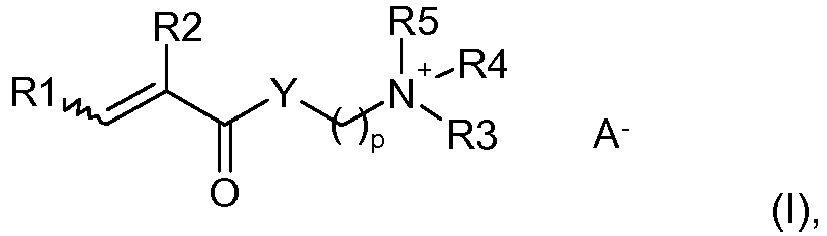
- Darin steht besonders bevorzugt in Formel (I) die Gruppe Y für NH. p steht bevorzugt für die Zahl 3. R1 und R2 stehen bevorzugt für Wasserstoff. R3, R4 und R5 stehen bevorzugt für Methyl. A- steht bevorzugt für Chlorid.
- Besonders bevorzugte amphotere Polymere werden unter der INCI-Bezeichnung "Acrylamidopropyltrimonium Chloride/Acrylates Copolymer" vertrieben.
- Die amphoteren Polymere werden in bevorzugt in einer Gesamtmenge von 0,01 bis 5 Gew.%, bevorzugt 0,05 bis 3 Gew.% und ganz besonders bevorzugt von 0,1 bis 2 Gew.%, bezogen auf die Gesamtmenge des anwendungsbereiten Mittels, eingesetzt.
- Üblicherweise enthalten die erfindungsgemäßen Mittel zusätzlich als oberflächenaktive Substanz ein Emulgator bzw. ein Tensid, wobei oberflächenaktive Substanzen je nach Anwendungsgebiet als Tenside oder als Emulgatoren bezeichnet werden. Bevorzugt sind dabei insbesondere anionischen und nichtionischen Tenside und Emulgatoren.
- Eine weitere Ausführungsform der vorliegenden Erfindung ist daher dadurch gekennzeichnet, dass das Mittel zusätzlich mindestens ein nichtionisches und/oder anionisches Tensid enthält.
- Als anionische Tenside eignen sich in erfindungsgemäßen Zubereitungen alle für die Verwendung am menschlichen Körper geeigneten anionischen oberflächenaktiven Stoffe.
- Bevorzugte anionische Tenside sind Alkylsulfate, Alkylethersulfate, jeweils mit 10 bis 18 C-Atomen in der Alkylgruppe, und polyalkoxylierte Ethercarbonsäuren mit 6 bis 20 C-Atomen in der Alkylgruppe und bis zu 12 Glykolethergruppen im Molekül.
- Eine weitere Ausführungsform des ersten Erfindungsgegenstands ist dabei dadurch gekennzeichnet, dass das Mittel als zusätzliches anionisches Tensid mindestens eine Ethercarbonsäure der Formel RO(CH2CH2O)xCH2COOH und/oder eines ihrer physiologisch verträglichen Salze enthält, worin R für eine C6-C20-Alkylkette steht und x = 0 oder eine Zahl 1 bis 16 ist.
- Beispiele bevorzugter Verbindungen vom Typ der polyalkoxylierten Ethercarbonsäuren werden unter den Handelsnamen Akypo TEC (lNCl-Bezeichnung: Oleth-10 Carboxylic Acid, Capryleth-9 Carboxylic Acid, Hexeth-4 Carboxylic Acid), Akypo RLM 38 (lNCl-Bezeichnung: LAURETH-5 Carboxylic Acid), Akypo RO 90 (lNCl-Bezeichnung: Oleth-10 Carboxylic Acid), Akypo Soft 100 (lNCl-Bezeichnung: Sodium Laureth-11 Carboxylate), Akypo RO 20 (lNCl-Bezeichnung: Oleth-3 Carboxylic Acid), Akypo Soft 45 HP (lNCl-Bezeichnung: Sodium Laureth-6 Carboxylate) oder Akypo RLM 45 (lNCl-Bezeichnung: Laureth-6 Carboxylic Acid) vertrieben.
- Die anionischen Tenside werden in bevorzugt in einer Gesamtmenge von 0,1 bis 30 Gew.%, bevorzugt 1 bis 25 Gew.% und ganz besonders bevorzugt von 1 bis 15 Gew.%, bezogen auf die Gesamtmenge des anwendungsbereiten Mittels, eingesetzt.
- Als besonders vorteilhaft haben sich außerdem oberflächenaktive Verbindungen vom Typ nichtionischer Tenside herausgestellt. Solche Verbindungen sind beispielsweise Anlagerungsprodukte von Polyethylenoxid an Fettalkohole, wobei Anlagerungsprodukte von Polyethylenoxid an Fettalkohole besonders bevorzugt sind, die einen durchschnittlichen Ethoxylierungsgrad von 10 bis 45, insbesondere von 12 bis 30 aufweisen, wie beispielsweise Steareth-20, Coceth-15, Oleth-20 oder auch Ceteareth-30, sowie Alkylpolyglucoside entsprechend der allgemeinen Formel RO-(Z)n, wobei R für Alkyl, Z für Zucker sowie n für die Anzahl der Zuckereinheiten steht.
- Eine weitere Ausführungsform des ersten Erfindungsgegenstands ist dabei dadurch gekennzeichnet, dass das Mittel als zusätzliches nichtionisches Tensid mindestens ein Alkylpolyglucosid der Formel R'O-(Z)n, worin R' für eine C10-C20-Alkylkette, Z für einen Zuckerrest mit 5 oder 6 Kohlenstoffatomen und n für eine Zahl von 1 bis 15 steht.
- Beispiele solcher Verbindungen tragen die INCI-Bezeichnungen Decyl Glucoside, Lauryl Glucoside, Cetearyl Glucoside und Coco-Glucoside.
- Erfindungsgemäß bevorzugte Mittel enthalten als nichtionisches Tensid das Anlagerungsprodukt von Cocos-Fettalkohol an (Poly-)glucose, welches unter der lNCl-Bezeichnung Coco-Glucoside bekannt ist. Ein solches Produkt wird unter anderem unter dem Handelsnamen Lamesoft PO 65 (lNCl-Bezeichnung: Coco-Glucoside, Glyceryl Oleate, Aqua) vertrieben.
- Die nichtionischen Tenside werden in bevorzugt in einer Gesamtmenge von 0,1 bis 30 Gew.%, bevorzugt 1 bis 20 Gew.% und ganz besonders bevorzugt von 1 bis 10 Gew.%, bezogen auf die Gesamtmenge des anwendungsbereiten Mittels, eingesetzt.
- Im Falle der oxidativen Färbungen kann die Entwicklung der Farbe grundsätzlich mit Luftsauerstoff erfolgen. Bevorzugt wird jedoch ein chemisches Oxidationsmittel eingesetzt, besonders dann, wenn neben der Färbung ein Aufhelleffekt an menschlichem Haar gewünscht ist.
- Eine weitere Ausführungsform der Erfindung ist daher ein Mittel, welches zusätzlich ein Oxidationsmittel, ausgewählt aus Wasserstoffperoxid sowie seinen festen Anlagerungsprodukten an organische und anorganische Verbindungen, enthält. Als feste Anlagerungsprodukte kommen erfindungsgemäß insbesondere die Anlagerungsprodukte an Harnstoff, Melamin, Polyvinylpyrrolidinon sowie Natriumborat in Frage.
- Bevorzugt wird als Oxidationsmittel Wasserstoffperoxid eingesetzt. Bevorzugt beträgt die Menge an Wasserstoffperoxid im anwendungsbereiten Mittel 0,5 bis 12 Gew.-%, bevorzugt 0,8 bis 6 Gew.-%, jeweils bezogen auf das anwendungsbereite Mittel.
- Bei einer Anwendung von zusätzlichen Oxidationsmitteln wird das eigentliche Färbemittel zweckmäßigerweise unmittelbar vor der Anwendung durch Mischung einer erfindungsgemäßen Zubereitung, enthaltend in einem kosmetischen Träger mindestens eine farbgebende Verbindung, sowie einer Zubereitung, enthaltend das zusätzliche Oxidationsmittel, insbesondere Wasserstoffperoxid, hergestellt. Das erfindungsgemäße Mittel kann dabei die Kombination aus dem mindestens einen Silicon b), enthaltend Struktureinheiten der Formel (I) gemäß einem der Ansprüche 1, 2, 4 oder 5, und dem mindestens einen Polymer c), enthaltend Struktureinheiten der Formel (II) gemäß einem der Ansprüche 1, 3 oder 6, in der Zubereitung mit den farbgebenden Verbindungen und/oder in der Oxidationsmittelzubereitung enthalten. Bevorzugt enthält die Zubereitung mit den farbgebenden Verbindungen die Kombination aus dem mindestens einen Silicon b), enthaltend Struktureinheiten der Formel (I) gemäß einem der Ansprüche 1, 2, 4 oder 5, und dem mindestens einen Polymer c), enthaltend Struktureinheiten der Formel (II) gemäß einem der Ansprüche 1, 3 oder 6.
- Die vorgenannte Oxidationsmittelzusammensetzung der erfindungsgemäßen Zusammensetzungen weist einen pH-Wert im Bereich von 2 bis 6, bevorzugt im Bereich von 3 bis 5,5, auf, um das Oxidationsmittel stabil lagern zu können. Damit man nach dem Vermischen der Oxidationsmittelzusammensetzung mit der farbgebenden Zusammensetzung ein anwendungsbereites Mittel mit einer ausreichend hohen Viskosität erhält, die sich gut auf das Haar auftragen lässt und nicht vom Haar abtropft, enthält einer weiteren bevorzugten Ausführungsform die Oxidationsmittelzusammensetzung zusätzlich mindestens ein anionisches polymeres Verdickungsmittel, ausgewählt aus Homo-oder Copolymeren von Acrylsäure und/oder Methacrylsäure.
- Da die Oxidationsmittelzusammensetzung einen sauren pH-Wert besitzt, die Anwendungsmischung jedoch einen alkalischen pH-Wert aufweist, unterliegt das polymere Verdickungsmittel einer pH-Wertveränderung, durch die die Carbonsäuregruppen von Acrylsäure- oder Methacrylsäure-Einheiten deprotoniert werden, was eine Gelbildung und damit eine Viskositätserhöhung bewirkt.
- Neben Acrylsäure und Methacrylsäure sind Crotonsäure, Itaconsäure, Maleinsäureanhydrid und 2-Acrylamido-2-methylpropansulfonsäure weitere Beispiele für anionische Monomere, aus denen die polymeren anionischen Verdickungsmittel bestehen können. Dabei können die sauren Gruppen auch als Natrium-, Kalium-, Ammonium-, Mono- oder Triethanolammonium-Salz vorliegen. Bevorzugte anionische Homopolymere sind unvernetzte und vernetzte Polyacrylsäuren; besonders bevorzugt sind vernetzte Polyacrylsäuren. Dabei können Allylether von Pentaerythrit, von Sucrose und von Propylen bevorzugte Vernetzungsagentien sein. Solche Verbindungen sind beispielsweise unter dem Warenzeichnen Carbopol® im Handel erhältlich. Innerhalb dieser Ausführungsform kann es weiterhin bevorzugt sein, Copolymere aus mindestens einem anionischen Monomer und mindestens einem nichtionogenen Monomer einzusetzen. Bezüglich der anionischen Monomere wird auf die oben aufgeführten Substanzen verwiesen. Bevorzugte nichtionogene Monomere sind Acrylamid, Methacrylamid, Acrylsäureester, Methacrylsäureester, Itaconsäuremono- und -diester, Vinylpyrrolidinon, Vinylether und Vinylester. Bevorzugt kann die erfindungsgemäße Oxidationsmittelzubereitung zusätzlich mindestens ein anionisches Acrylsäure- und/oder Methacrylsäure-Polymerisat oder -Copolymerisat enthalten. Bevorzugte Polymerisate dieser Art sind (Gew.-%-Angaben beziehen sich auf das Gewicht des Polymers):
- vernetzte Polymerisate aus 10 bis 60 Gew.-% Acrylsäure-C1-C4-Alkylester, 25 bis 70 Gew.-% Methacrylsäure und ggf. bis zu 40 Gew.-% eines weiteren Comonomeren,
- vernetzte Mischpolymerisate aus 50 bis 75 Gew.-% Ethylacrylat, 25 bis 35 Gew.-% Acrylsäure und 0 bis 25 Gew.-% anderer Comonomeren, als Dispersion im Handel erhältlich, z.B. unter der Handelsbezeichnung Latekoll® D (BASF),
- Copolymerisate aus 50 bis 60 Gew.-% Ethylacrylat, 30 bis 40 Gew.-% Methacrylsäure und 5 bis 15 Gew.-% Acrylsäure, vernetzt mit Ethylenglycoldimethacrylat.
- Bevorzugt sind aber auch unvernetzte Copolymere aus mindestens einem Monomer, ausgewählt aus Acrylsäure, Methacrylsäure, Acrylsäure-C1-C6-Alkylestern und Methacrylsäure-C1-C6-Alkyl-estern, und mindestens einem Monomer, ausgewählt aus den Estern einer ethylenisch ungesättigten Säure und einem alkoxylierten Fettalkohol. Geeignete ethylenisch ungesättigte Säuren sind insbesondere Acrylsäure, Methacrylsäure und Itaconsäure; geeignete alkoxylierte Fettalkohole sind insbesondere Steareth-20 oder Ceteth-20. Derartige unvernetzte Copolymere, die auch als Assoziativ-verdicker bezeichnet werden, werden beispielsweise von der Firma Rohm & Haas unter der Handelsbezeichnung Aculyn® 22 sowie von der Firma Akzo Nobel unter den Handelsbezeichnungen Structure® 2001 und Structure® 3001 vertrieben.
- Besonders bevorzugte vernetzte anionische Copolymere sind beispielsweise Copolymere aus Acrylsäure, Methacrylsäure, Acrylsäure-C1-C6-Alkylestern oder Methacrylsäure-C1-C6-Alkylestern, wie sie unter der INCI-Deklaration Acrylates Copolymers vertrieben werden. Bevorzugt ist dabei die Kombination aus Methacrylsäure und Ethylacrylat mit vernetzenden, multifunktionalen Monomeren. Ein bevorzugtes Handelsprodukt dafür ist beispielsweise Aculyn® 33 bzw. Aculyn® 33A der Firma Rohm & Haas.
- Bevorzugte erfindungsgemäße Oxidationsmittelzusammensetzungen (= Entwickler) oder bevorzugte erfindungsgemäße Mehrkomponentenverpackungseinheit (Kit-of-Parts), sind dadurch gekennzeichnet, dass mindestens ein anionisches Acrylsäure- und/oder Methacrylsäure-Polymerisat oder -Copolymerisat in einer Gesamtmenge von 0,1 bis 5 Gew.-%, besonders bevorzugt von 1 bis 4 Gew.-% und insbesondere von 2 bis 3 Gew.-%, jeweils bezogen auf das Gewicht der Oxidationsmittelzusammensetzung (II), enthalten ist.
- Weitere bevorzugte erfindungsgemäße Zusammensetzungen sind als Blondiermittel oder Entwickler konfektioniert ist und enthalten, jeweils bezogen auf ihr Gewicht - 0,5 bis 15 Gew.-%, vorzugsweise 0,75 bis 10 Gew.-%, besonders bevorzugt 1 bis 7,5 Gew.-%, weiter bevorzugt 1,25 bis 7 Gew.-% und insbesondere 1,5 bis 6,0 Gew.-% Wasserstoffperoxid (berechnet als 100 %iges H2O2) und zusätzlich mindestens ein anionisches Acrylsäure- und/oder Methacrylsäure-Polymerisat oder -Copolymerisat in einer Gesamtmenge von 0,1 bis 5 Gew.-%, besonders bevorzugt von 1 bis 4 Gew.-% und insbesondere von 2 bis 3 Gew.-%.
- Weiterhin hat es sich als vorteilhaft erweisen, wenn die Mittel, gegebenenfalls auch Zubereitung, enthaltend farbgebende Verbindungen, und/oder die Oxidationsmittelzubereitungen von oxidativen Färbemitteln mindestens einen Stabilisator oder Komplexbildner enthalten. Gebräuchliche und im Rahmen der vorliegenden Erfindung bevorzugte Chelatkomplexbildner sind beispielsweise Polycarbonsäuren, stickstoffhaltige Mono- oder Polycarbonsäuren, insbesondere Ethylendiamintetraessigsäure (EDTA), Ethylendiamindibernsteinsäure (EDDS), Diethylentriaminpentaessigsäure und ihre Salze, insbesondere Pentasodium Pentetate und Nitrilotriessigsäure (NTA), geminale Diphosphonsäuren, insbesondere 1-Hydroxyethan-1,1-diphosphonsäure (HEDP), Aminophosphonsäuren wie Ethylendiamintetra(methylenphosphonsäure) (EDTMP) und Diethylentriaminpenta-(methylenphosphonsäure) (DTPMP), Phosphonopolycarbonsäuren wie 2-Phosphonobutan-1,2,4-tricarbonsäure sowie Cyclodextrine, Alkalistannate (Natriumstannat), Alkalipyrophosphate (Tetra-natriumpyrophosphat, Dinatriumpyrophosphat), Alkaliphosphate (Natriumphosphat), und Phosphorsäure. Erfindungsgemäß bevorzugt enthalten die Mittel Komplexbildner zu 0,01 bis 3 Gew.-%, bevorzugt 0,05 bis 1 Gew.-%, jeweils bezogen auf das Gesamtgewicht des erfindungsgemäßen Mittels.
- Die erfindungsgemäßen Mittel enthalten weitere Hilfs- und Zusatzstoffe. Bevorzugt enthalten die fließfähigen Zubereitungen zusätzlich als weitere oberflächenaktive Substanz ein kationisches, amphoteres und/oder zwitterionisches Tensid.
- Als zwitterionische Tenside werden solche oberflächenaktiven Verbindungen bezeichnet, die im Molekül mindestens eine quartäre Ammoniumgruppe und mindestens eine Carboxylat-, Sulfonat-oder Sulfat-Gruppe tragen. Ein bevorzugtes zwitterionisches Tensid ist das unter der INCI-Bezeichnung Cocamidopropyl Betaine bekannte Fettsäureamid-Derivat.
- In einer weiteren, bevorzugten Ausführungsform der vorliegenden Erfindung enthält das Mittel weiterhin mindestens ein amphoteres Tensid. Besonders bevorzugte amphotere Tenside werden unter der lNCl-Bezeichnung Disodium Cocoamphodipropionate mit den Handelsnamen Miranol C2M SF conc. (Rhodia), Amphoterge K-2 (Lonza) und Monateric CEM-38 (Unichema) und Bezeichnung Disodium Cocoamphodiacetate mit den Handelsnamen Dehyton (BASF), Miranol C2M (Rhodia) und Ampholak XCO 30 (Akzo Nobel) vermarktet.
- Die zwitterionischen und amphoteren Tenside werden in bevorzugt in einer Gesamtmenge von 0,1 bis 15 Gew.%, bevorzugt 0,5 bis 10 Gew.% und ganz besonders bevorzugt von 1 bis 5 Gew.%, bezogen auf die Gesamtmenge des anwendungsbereiten Mittels, eingesetzt.
- Erfindungsgemäß bevorzugt sind ebenfalls kationische Tenside vom Typ der quartären Ammoniumverbindungen, der Esterquats und der Amidoamine. Die kationischen Tenside sind in den erfindungsgemäßen Mitteln bevorzugt in Mengen von 0,05 bis 10 Gew.-%, bezogen auf das gesamte Mittel, enthalten. Mengen von 0,1 bis 5 Gew.-% sind besonders bevorzugt.
- Weiterhin wurde überraschend festgestellt, dass die konditionierende Wirkung, die Verringerung der Haarschädigung und/oder der erzielte Färbeergebnis der erfindungsgemäßen Zusammensetzungen weiter verbessert werden kann, wenn zusätzlich mindestens ein Fett und/oder mindestens ein Öl in einer Gesamtmenge von 0,1 bis 90 Gew.-%, bevorzugt 1,0 bis 80 Gew.-%, besonders bevorzugt 5,0 bis 60 Gew.-%, außerordentlich bevorzugt 10 bis 45 Gew.-%, jeweils bezogen auf das Gewicht der Zusammensetzung, enthalten ist. Besonders bevorzugt ist es, wenn die Oxidationsmittel-freie erfindungsgemäße haarfarbverändernde Zusammensetzung mindestens ein Fett und/oder mindestens ein Öl in einer Gesamtmenge von 0,1 bis 90 Gew.-%, bevorzugt 1,0 bis 80 Gew.-%, besonders bevorzugt 5,0 bis 60 Gew.-%, außerordentlich bevorzugt 10 bis 45 Gew.-%, jeweils bezogen auf ihr Gewicht, enthält. In einer anderen bevorzugten Ausführungsform enthält die Oxidationsmittelzusammensetzung mindestens ein Fett und/oder mindestens ein Öl in einer Gesamtmenge von 0,1 bis 90 Gew.-%, bevorzugt 1,0 bis 80 Gew.-%, besonders bevorzugt 5,0 bis 60 Gew.-%, außerordentlich bevorzugt 10 bis 45 Gew.-%, jeweils bezogen auf ihr Gewicht. In einer dritten, erfindungsgemäß ebenfalls bevorzugten Ausführungsform enthält das anwendungsbereite haarfarbverändernde Mittel, also die Mischung aus haarfarbverändernder Zusammensetzung und Oxidationsmittelzusammensetzung, mindestens ein Fett und/oder mindestens ein Öl in einer Gesamtmenge von 0,1 bis 90 Gew.-%, bevorzugt 1,0 bis 80 Gew.-%, besonders bevorzugt 5,0 bis 60 Gew.-%, außerordentlich bevorzugt 10 bis 45 Gew.-%, jeweils bezogen auf das Gewicht des anwendungsbereiten haarfarbverändernden Mittels. In einer weiteren erfindungsgemäß ebenfalls bevorzugten Ausführungsform ist die Kombination aus dem mindestens einen Silicon b), enthaltend Struktureinheiten der Formel (I) gemäß einem der Ansprüche 1, 2, 4 oder 5, und dem mindestens einen Polymer c), enthaltend Struktureinheiten der Formel (II) gemäß einem der Ansprüche 1, 3 oder 6, in der Oxidationsmittel-freien haarfarbverändernden Zusammensetzung und zusätzlich mindestens ein Fett und/oder mindestens ein Öl in einer Gesamtmenge von 0,1 bis 90 Gew.-%, bevorzugt 1,0 bis 80 Gew.-%, besonders bevorzugt 5,0 bis 60 Gew.-%, außerordentlich bevorzugt 10 bis 45 Gew.-%, jeweils bezogen auf das Gewicht der Oxidationsmittel-freien haarfarbverändernden Zusammensetzung, enthalten. Der Begriff Öl meint "kosmetisches" Öl, also Öle, die zur Anwendung in Kosmetika geeignet und zugelassen sind. Erfindungsgemäß bevorzugte kosmetische Öle sind ausgewählt aus natürlichen und synthetischen Kohlenwasserstoffen, besonders bevorzugt aus Paraffinölen, C18-C30-Isoparaffinen, insbesondere Isoeicosan, Polyisobutene und Polydecene, die beispielsweise unter der Bezeichnung Emery® 3004, 3006, 3010 oder unter der Bezeichnung Ethylflo® von Albemarle oder Nexbase® 2004G von Nestle erhältlich sind, weiterhin ausgewählt aus C8-C16-Isoparaffinen, insbesondere aus Isodecan, Isododecan, Isotetradecan und Isohexadecan sowie Mischungen hiervon, sowie 1,3-Di-(2-ethylhexyl)-cyclohexan (erhältlich z. B. unter dem Handelsnamen Cetiol®S von BASF). Weitere erfindungsgemäß bevorzugte kosmetische Öle sind ausgewählt aus den Benzoesäureestern von linearen oder verzweigten C8-22-Alkanolen. Besonders bevorzugt sind Benzoesäure-C12-C15-alkylester, z. B. erhältlich als Handelsprodukt Finsolv® TN, Benzoesäureisostearylester, z. B. erhältlich als Handelsprodukt Finsolv® SB, Ethylhexylbenzoat, z. B. erhältlich als Handelsprodukt Finsolv® EB, und Benzoesäureoctyldocecylester, z. B. erhältlich als Handelsprodukt Finsolv® BOD. Weitere erfindungsgemäß bevorzugte kosmetische Öle sind ausgewählt aus Fettalkoholen mit 6 - 30 Kohlenstoffatomen, die ungesättigt oder verzweigt und gesättigt oder verzweigt und ungesättigt sind. Die verzweigten Alkohole werden häufig auch als Guerbet-Alkohole bezeichnet, da sie nach der Guerbet-Reaktion erhältlich sind. Bevorzugte Alkoholöle sind 2-Hexyldecanol (Eutanol® G 16), 2-Octyldodecanol (Eutanol® G), 2-Ethylhexylalkohol und Isostearylalkohol. Weitere bevorzugte kosmetische Öle sind ausgewählt aus Mischungen aus Guerbetalkoholen und Guerbetalkoholestern, z.B. dem Handelsprodukt Cetiol® PGL (2-Hexyldecanol und 2-Hexyldecyllaurat). Weitere erfindungsgemäß bevorzugte kosmetische Öle sind ausgewählt aus den Triglyceriden (= Dreifachestern des Glycerins) von linearen oder verzweigten, gesättigten oder ungesättigten, gegebenenfalls hydroxylierten C8-30-Fettsäuren. Besonders bevorzugt kann die Verwendung natürlicher Öle, z.B. Amaranthsamenöl, Aprikosenkernöl, Arganöl, Avocadoöl, Babassuöl, Baumwollsaatöl, Borretschsamenöl, Camelinaöl, Distelöl, Erdnussöl, Granatapfelkernöl, Grapefruitsamenöl, Hanföl, Haselnussöl, Holundersamenöl, Johannisbeersamenöl, Jojobaöl, Leinöl, Macadamianussöl, Maiskeimöl, Mandelöl, Marulaöl, Nachtkerzenöl, Olivenöl, Palmöl, Palmkernöl, Paranussöl, Pekannussöl, Pfirsichkernöl Rapsöl, Rizinusöl, Sanddornfruchtfleischöl, Sanddornkernöl, Sesamöl, Sojaöl, Sonnenblumenöl, Traubenkernöl, Walnussöl, Wildrosenöl, Weizenkeimöl, und die flüssigen Anteile des Kokosöls und dergleichen sein. Bevorzugt sind aber auch synthetische Triglyceridöle, insbesondere Capric/ Caprylic Triglycerides, z. B. die Handelsprodukte Myritol® 318, Myritol® 331 (BASF) oder Miglyol® 812 (Hüls) mit unverzweigten Fettsäureresten sowie Glyceryltriisostearin mit verzweigten Fettsäureresten. Weitere erfindungsgemäß besonders bevorzugte kosmetische Öle sind ausgewählt aus den Dicarbonsäureestern von linearen oder verzweigten C2-C10-Alkanolen, insbesondere Diisopropyladipat, Di-n-butyladipat, Di-(2-ethylhexyl)adipat, Dioctyladipat, Diethyl-/Di-n-butyl/ Dioctylsebacat, Diisopropylsebacat, Dioctylmalat, Dioctylmaleat, Dicaprylylmaleat, Diisooctylsuccinat, Di-2-ethylhexylsuccinat und Di-(2-hexyldecyl)-succinat. Weitere erfindungsgemäß besonders bevorzugte kosmetische Öle sind ausgewählt aus den Estern der linearen oder verzweigten gesättigten oder ungesättigten Fettalkohole mit 2 - 30 Kohlenstoffatomen mit linearen oder verzweigten gesättigten oder ungesättigten Fettsäuren mit 2 - 30 Kohlenstoffatomen, die hydroxyliert sein können. Dazu zählen 2-Hexyldecylstearat (Eutanol® G 16 S), 2-Hexyldecyllaurat, Isodecylneopentanoat, Isononylisononanoat, 2-Ethylhexylpalmitat (Cegesoft® C 24) und 2-Ethylhexylstearat (Cetiol® 868). Ebenfalls bevorzugt sind Isopropylmyristat, Isopropylpalmitat, Isopropylstearat, Isopropylisostearat, Isopropyloleat, Isooctylstearat, Isononylstearat, Isocetylstearat, Isononylisononanoat, Isotridecylisononanoat, Cetearylisononanoat, 2-Ethylhexyllaurat, 2-Ethylhexylisostearat, 2-Ethylhexylcocoat, 2-Octyldodecylpalmitat, Butyl-octansäure-2-butyloctanoat, Diisotridecylacetat, n-Butylstearat, n-Hexyllaurat, n-Decyloleat, Oleyloleat, Oleylerucat, Erucyloleat, Erucylerucat, Ethylenglycoldioleat und Ethylenglycoldipalmitat. Weitere erfindungsgemäß bevorzugte kosmetische Öle sind ausgewählt aus den Anlagerungsprodukten von 1 bis 5 Propylenoxid-Einheiten an ein- oder mehrwertige C8-22-Alkanole, wie Octanol, Decanol, Decandiol, Laurylalkohol, Myristylalkohol und Stearylalkohol, z. B. PPG-2-Myristylether und PPG-3-Myristylether (Witconol® APM). Weitere erfindungsgemäß bevorzugte kosmetische Öle sind ausgewählt aus den Anlagerungsprodukten von mindestens 6 Ethylenoxid- und/oder Propylenoxid-Einheiten an ein- oder mehrwertige C3-22-Alkanole wie Glycerin, Butanol, Butandiol, Myristylalkohol und Stearylalkohol, die gewünschtenfalls verestert sein können, z. B. PPG-14-Butylether (Ucon Fluid® AP), PPG-9-Butylether (Breox® B25), PPG-10-Butandiol (Macol® 57), PPG-15-Stea-rylether (Arlamol® E) und Glycereth-7-diisononanoat. Weitere erfindungsgemäß bevorzugte kosmetische Öle sind ausgewählt aus den C8-C22-Fettalkoholestern einwertiger oder mehrwertiger C2-C7-Hydroxycarbonsäuren, insbesondere die Ester der Glycolsäure, Milchsäure, Äpfelsäure, Weinsäure, Citronensäure und Salicylsäure. Solche Ester auf Basis von linearen C14/15-Alkanolen, z. B. C12-C15-Alkyllactat, und von in 2-Position verzweigten C12/13-Alkanolen sind unter dem Warenzeichen Cosmacol® von der Firma Nordmann, Rassmann GmbH & Co, Hamburg, zu beziehen, insbesondere die Handelsprodukte Cosmacol® ESI, Cosmacol® EMI und Cosmacol® ETI. Weitere erfindungsgemäß bevorzugte kosmetische Öle sind ausgewählt aus den symmetrischen, unsymmetrischen oder cyclischen Estern der Kohlensäure mit C3-22-Alkanolen, C3-22-Alkandiolen oder C3-22-Alkantriolen, z. B. Dicaprylylcarbonat (Cetiol® CC) oder die Ester gemäß der Lehre der
DE 19756454 A1 , insbesondere Glycerincarbonat. Weitere kosmetische Öle, die erfindungsgemäß bevorzugt sein können, sind ausgewählt aus den Estern von Dimeren ungesättigter C12-C22-Fettsäuren (Dimerfettsäuren) mit einwertigen linearen, verzweigten oder cyclischen C2-C18-Alkanolen oder mit mehrwertigen linearen oder verzweigten C2-C6-Alkanolen. Weitere kosmetische Öle, die erfindungsgemäß geeignet sind, sind ausgewählt aus den Siliconölen, zu denen z. B. Dialkyl- und Alkylarylsiloxane, wie beispielsweise Cyclopentasiloxan, Cyclohexasiloxan, Dimethylpolysiloxan und Methylphenylpolysiloxan, aber auch Hexamethyldisiloxan, Octamethyltrisiloxan und Decamethyltetrasiloxan zählen. Bevorzugt können flüchtige Siliconöle sein, die cyclisch sein können, wie z. B. Octamethylcyclotetrasiloxan, Decamethylcyclopentasiloxan und Dodecamethylcyclohexasiloxan sowie Mischungen hiervon, wie sie z. B. in den Handelsprodukten DC 244, 245, 344 und 345 von Dow Corning enthalten sind. Ebenfalls geeignet sind flüchtige lineare Siliconöle, insbesondere Hexamethyldisiloxan (L2), Octamethyltrisiloxan (L3), Decamethyltetrasiloxan (L4) sowie beliebige Zweier- und Dreiermischungen aus L2, L3 und/ oder L4, bevorzugt solche Mischungen, wie sie z. B. in den Handelsprodukten DC 2-1184, Dow Corning® 200 (0,65 cSt) und Dow Corning® 200 (1,5 cSt) von Dow Corning enthalten sind. Bevorzugte nichtflüchtige Siliconöle sind ausgewählt aus höhermolekularen linearen Dimethylpolysiloxanen, im Handel erhältlich z. B. unter der Bezeichnung Dow Corning® 190, Dow Corning® 200 Fluid mit kinematischen Viskositäten (25°C) im Bereich von 5 - 100 cSt, bevorzugt 5 - 50 cSt oder auch 5 - 10 cSt, und Dimethylpolysiloxan mit einer kinematischen Viskosität (25°C) von etwa 350 cSt. Weitere bevorzugte Öle sind verzweigte und/oder ungesättigte Carbonsäuren mit 8 - 24 C-Atomen, insbesondere mit 16 - 22 C-Atomen, in der Alkyl- oder Alkylengruppe, insbesondere Isostearinsäure, Isopalmitinsäure, Ölsäure, Linolsäure und Linolensäure, sowie Mischungen dieser Säuren. - Es kann erfindungsgemäß außerordentlich bevorzugt sein, Mischungen der vorgenannten Öle einzusetzen.
- Erfindungsgemäß bevorzugte Fette sind lineare gesättigte Alkanole mit 12 - 30 Kohlenstoffatomen, insbesondere mit 16 - 22 Kohlenstoffatomen, insbesondere Cetylalkohol, Stearylalkohol, Arachidylalkohol, Behenylalkohol und Lanolinalkohol oder Gemische dieser Alkohole, weiterhin Carbonsäuren mit 8 - 24 C-Atomen, insbesondere mit 16 - 22 C-Atomen, in der Alkylgruppe, insbesondere Laurinsäure, Myrisinsäure, Palmitinsäure, Stearinsäure, Arachinsäure und Behensäure, sowie Ester, die bei 20°C und 1013 bar fest sind, insbesondere natürliche pflanzliche Wachse, z. B. Candelillawachs, Carnaubawachs, Japanwachs, Zuckerrohrwachs, Ouricourywachs, Korkwachs, Sonnenblumenwachs, Fruchtwachse wie Orangenwachse, Zitronenwachse, Grapefruitwachs, und tierische Wachse, z. B. Bienenwachs, Schellackwachs und Walrat, Vaseline, hydrierte oder gehärtete Wachse, Montanesterwachse, hydrierte Jojobawachse und Sasolwachse, Polyalkylenwachse, Polyethylenglycolwachse, C20-C40-Dialkylester von Dimersäuren, C30-50-Alkylbienenwachs, Alkyl-und Alkylarylester von Dimerfettsäuren, Ester aus einem gesättigten, einwertigen C16-C60-Alkohol und einer gesättigten C8-C36-Monocarbonsäure, C16-36-Alkylstearate, C18-38-Alkylhydroxystearoyl-stearate, C20-40-Alkylerucate, Cetearylbehenat, Triglyceride gesättigter und gegebenenfalls hydroxylierter C12-30-Fettsäuren, wie gehärtete Triglyceridfette (hydriertes Palmöl, hydriertes Kokosöl, hydriertes Rizinusöl), Glyceryltribehenat (Tribehenin) oder Glyceryltri-12-hydroxystearat, weiterhin synthetische Vollester aus Fettsäuren und Glycolen oder Polyolen mit 2 - 6 Kohlenstoffatomen, solange sie einen Schmelzpunkt oberhalb von 20 °C aufweisen, beispielsweise bevorzugt C18 - C36 Acid Triglyceride (z. B. Syncrowax® HGL-C) und hydriertes Rizinusöl.
- Ferner können die erfindungsgemäßen Mittel weitere Wirk-, Hilfs- und Zusatzstoffe enthalten, wie beispielsweise nichtionische Polymere, kationische Polymere, zwitterionische Polymere, anionische Polymere, Strukturanten wie Glucose, Maleinsäure und Milchsäure, haarkonditionierende Verbindungen wie Phospholipide, faserstrukturverbessernde Wirkstoffe, insbesondere Mono-, Di-und Oligosaccharide wie beispielsweise Glucose, Galactose, Fructose, Fruchtzucker und Lactose, Entschäumer wie Silikone, Farbstoffe zum Anfärben des Mittels, Antischuppenwirkstoffe, Wirkstoffe wie Aminosäuren, Oligopeptide und Proteinhydrolysate, Polyphenole und (Pseudo)Ceramide, Panthenol, Pantothensäure, Pantolacton, Allantoin, Pyrrolidinoncarbonsäuren und deren Salze sowie Bisabolol, Vitamine, Provitamine und Vitaminvorstufen, insbesondere solche der Gruppen A, B3, B5, B6, C, E, F und H, Pflanzenextrakte, Fette und Wachse wie Bienenwachs, Montanwachs und Paraffine, Quell- und Penetrationsstoffe wie Glycerin, Propylenglykolmonoethylether, Carbonate, Hydrogencarbonate, Guanidine, Harnstoffe sowie primäre, sekundäre und tertiäre Phosphate, Trübungsmittel wie Latex, Styrol/PVP- und Styrol/Acrylamid-Copolymere, Perlglanzmittel wie Ethylenglykolmono- und -distearat sowie PEG-3-distearat, Pigmente, Aufhellverstärker (wie Natriumpersulfat, Kaliumpersulfat oder Ammoniumpersulfat), Treibmittel wie Propan-Butan-Gemische, N2O, Dimethylether, CO2 und Luft und Antioxidantien.
- Die Auswahl dieser weiteren Stoffe wird der Fachmann gemäß der gewünschten Eigenschaften der Mittel treffen. Bezüglich weiterer fakultativer Komponenten sowie der eingesetzten Mengen dieser Komponenten wird ausdrücklich auf die dem Fachmann bekannten einschlägigen Handbücher, z. B. Kh. Schrader, Grundlagen und Rezepturen der Kosmetika, 2. Auflage, Hüthig Buch Verlag, Heidelberg, 1989, verwiesen.
- Aus Gründen der Faserschonung ist es wünschenswert, wenn die Mittel zur Farbveränderung der Haare einen möglichst neutralen pH-Wert besitzen. Zur verbesserten Farbausbildung ist jedoch ein alkalischer pH-Wert vorteilhaft. Eine weitere bevorzugte Ausführungsform der vorliegenden Erfindung besteht darin, dass das anwendungsbereite Mittel einen pH-Wert zwischen 6,0 und 12,0, bevorzugt zwischen 7,0 und 11,5, insbesondere bevorzugt zwischen 8,0 und 11,0 besitzt. Bei den pH-Werten im Sinne der vorliegenden Erfindung handelt es sich um pH-Werte, die bei einer Temperatur von 22°C gemessen wurden. Üblicherweise wird der pH-Wert mit pH-Stellmitteln einge-stellt. Zur Einstellung des pH-Werts sind dem Fachmann in der Kosmetik gängige Acidifizierungs-und Alkalisierungsmittel geläufig. Die zur Einstellung des pH-Wertes verwendbaren Alkalisierungs-mittel werden typischerweise gewählt aus anorganischen Salzen, insbesondere der Alkali- und Erdalkalimetalle, organischen Alkalisierungsmitteln, insbesondere Aminen, basische Aminosäuren und Alkanolaminen, und Ammoniak. Erfindungsgemäß bevorzugte Acidifizierungsmittel sind Genuss-Säuren, wie beispielsweise Zitronensäure, Essigsäure, Äpfelsäure oder Weinsäure, sowie verdünnte Mineralsäuren. Erfindungsgemäß bevorzugte Alkalisierungsmittel sind ausgewählt aus der Gruppe, die gebildet wird aus Natriumhydroxid, Kaliumhydroxid, Calciumhydroxid, Bariumhydroxid, Natriumphosphat, Kaliumphosphat, Natriumsilicat, Kaliumsilicat, Natriumcarbonat, Kaliumcarbonat, 2-Aminoethan-1-ol (= Monoethanolamin), Triethanolamin, Ammoniak, 1-Amino-propan-2-ol und 2-Amino-2-methylpropan-1-ol. Die Verwendung von Ammoniak als Alkalisierungsmittel ist besonders bevorzugt, da sich hiermit besonders gute Färbeergebnisse erzielen lassen. Das nach der Applikation auf das Haar freigesetzte Ammoniakgas kann allerdings zu Geruchsbelästigung und darüber hinaus schlimmstenfalls zur Reizung der Schleimhäute führen. Weitere bevorzugte erfindungsgemäße Zusammensetzungen enthalten daher 2-Aminoethan-1-ol als Alkalisierungsmittel. Je nach Bedarf sind Mischungen der Alkalisierungsmittel bevorzugt, insbesondere Mischungen aus 2-Aminoethan-1-ol und 2-Amino-2-methylpropan-1-ol, Mischungen aus Ammoniak (bzw. Ammoniumhydroxid) und 2-Aminoethan-1-ol, Mischungen aus Ammoniak (bzw. Ammoniumhydroxid), 2-Aminoethan-1-ol und Natriumhydroxid, Mischungen aus Ammoniak (bzw. Ammoniumhydroxid), 2-Aminoethan-1-ol und Kaliumhydroxid sowie Mischungen aus Ammoniak (bzw. Ammoniumhydroxid), 2-Aminoethan-1-ol, Kaliumhydroxid und Natriumhydroxid.
- Die Konfektionierung der erfindungsgemäßen Farbveränderungsmittel unterliegt prinzipiell keinerlei Beschränkungen. Die erfindungsgemäßen Mittel können als 1-Komponentenmittel konfektioniert werden, die gegebenenfalls unmittelbar vor der Anwendung mit einer zweiten Zubereitung, enthaltend beispielsweise ein Oxidationsmittel, vermischt werden. Es hat sich aber in einigen Fällen auch als bevorzugt erwiesen, wenn das Produkt als 2-Komponentenmittel konfektioniert ist. Im Rahmen einer bevorzugten Ausführungsform werden die erfindungsgemäßen Mittel daher derart konfektioniert, dass eine der erfindungswesentlichen Komponenten separat verpackt ist. Dabei spielt es erfindungsgemäß zunächst keine Rolle, welche der erfindungsgemäßen Komponenten separat verpackt wird.
- Erfindungsgemäß bevorzugte Mittel sind dadurch gekennzeichnet, dass das Mittel unmittelbar vor der Anwendung durch Vermischen mindestens zweier Zubereitungen hergestellt wird, wobei die mindestens zwei Zubereitungen in mindestens zwei getrennt konfektionierten Containern bereitgestellt werden, und wobei ein Container ein Färbemittel enthält, welches in einem kosmetischen Träger mindestens eine farbgebende Verbindung, insbesondere ein Oxidationsfarbstoffvorprodukt, und zusätzlich die Kombination aus dem mindestens einen Silicon b), enthaltend Struktureinheiten der Formel (I) gemäß einem der Ansprüche 1, 2, 4 oder 5, und dem mindestens einen Polymer c), enthaltend Struktureinheiten der Formel (II) gemäß einem der Ansprüche 1, 3 oder 6, enthält, und ein weiterer Container eine Oxidationsmittelzubereitung, enthaltend mindestens ein Oxidationsmittel, enthält.
- Das anwendungsbereite Färbemittel besitzt dabei bevorzugt einen pH-Wert zwischen 5,0 und 12,0, bevorzugt zwischen 6,0 und 11,0.
- Ein weiterer Gegenstand der vorliegenden Erfindung ist daher eine Mehrkomponentenverpackungseinheit (Kit-of-Parts), umfassend mindestens zwei getrennt konfektionierte Container, wobei
- (i) ein Container (I) als Farbstoffzubereitung ein Mittel des ersten Erfindungsgegenstands, das heißt, eine Zusammensetzung nach einem der Ansprüche 1 bis 9 oder 12,
- (ii) und ein weiterer Container (II) eine Oxidationsmittelzusammensetzung, enthaltend mindestens ein chemisches Oxidationsmittel, insbesondere Wasserstoffperoxid, enthält.
- Die Zubereitungen der Mehrkomponentenverpackungseinheit sind in getrennt voneinander konfektionierten Containern enthalten. Unter Container wird im Rahmen der vorliegenden Erfindung eine Umhüllung verstanden, die in Form einer gegebenenfalls wieder verschließbaren Flasche, einer Tube, einer Dose, eines Tütchens, eines Sachets oder ähnlichen Umhüllungen vorliegt. Dem Umhüllungsmaterial sind erfindungsgemäß keine Grenzen gesetzt. Bevorzugt handelt es sich jedoch dabei um Umhüllungen aus Glas oder Kunststoff.
- Es kann erfindungsgemäß vorteilhaft sein, wenn die erfindungsgemäße Mehrkomponentenverpackungseinheit mindestens ein weiteres Haarbehandlungsmittel in einem getrennten Container enthält, insbesondere ein Konditioniermittel. Darüber hinaus kann die Verpackungseinheit Applikationshilfen, wie Kämme, Bürsten oder Pinsel, persönliche Schutzkleidung, insbesondere Ein-Weg-Handschuhe, sowie gegebenenfalls eine Gebrauchsanleitung umfassen. Bezüglich weiterer bevorzugter Ausführungsformen der Mehrkomponentenverpackungseinheit (Kit-of-Parts) gilt mutatis mutandis das zu den erfindungsgemäßen Mitteln Gesagte.
- Der erfindungsgemäßen Mittel werden, gegebenenfalls nach Vermischen mit einer Oxidationsmittelzubereitung in Verfahren zur Färbung keratinischer Fasern, insbesondere menschlicher Haare und bevorzugt menschlicher Kopfhaare am lebenden Anwender eingesetzt.
- Solche Verfahren zur Farbveränderung menschlicher Haare sind dadurch gekennzeichnet, dass ein erfindungsgemäßes Mittel gemäß obiger Vorgaben auf das Haar aufgetragen wird, für eine Einwirkzeit von 2 bis 45 min, bevorzugt von 15 bis 30 min auf dem Haar belassen wird, und anschließend das Haar ausgespült wird.
- Eine bevorzugte Ausführungsform des erfindungsgemäßen Verfahrens zur Färbung keratinischer Fasern liegt vor, wenn eine Zusammensetzung in einem kosmetischen Träger, enthaltend mindestens ein Oxidationsfarbstoffvorprodukt und zusätzlich die Kombination aus dem mindestens einen Silicon b), enthaltend Struktureinheiten der Formel (I) gemäß einem der Ansprüche 1, 2, 4 oder 5, und dem mindestens einen Polymer c), enthaltend Struktureinheiten der Formel (II) gemäß einem der Ansprüche 1, 3 oder 6, mit einer Oxidationsmittelzusammensetzung, enthaltend Wasserstoffperoxid, zu einer homogenen anwendungsbereiten Zusammensetzung vermischt, diese auf das Haar aufgebracht wird, für eine Einwirkzeit von 2 bis 120 min, bevorzugt von 3 bis 45 min auf dem Haar belassen wird, und anschließend das Haar ausgespült wird.
- Eine bevorzugte Ausführungsform des erfindungsgemäßen Verfahrens zur Färbung keratinischer Fasern liegt vor, wenn eine Zusammensetzung in einem kosmetischen Träger, enthaltend mindestens ein Oxidationsfarbstoffvorprodukt und zusätzlich die Kombination aus dem mindestens einen Silicon b), enthaltend Struktureinheiten der Formel (I) gemäß einem der Ansprüche 1, 2, 4 oder 5, und dem mindestens einen Polymer c), enthaltend Struktureinheiten der Formel (II) gemäß einem der Ansprüche 1, 3 oder 6, mit einer Oxidationsmittelzusammensetzung, enthaltend Wasserstoffperoxid, bevorzugt gemäß Anspruch 9 oder 13, zu einer homogenen anwendungsbereiten Zusammensetzung vermischt, diese auf das Haar aufgebracht wird, für eine Einwirkzeit von 2 bis 120 min, bevorzugt von 3 bis 45 min auf dem Haar belassen wird, und anschließend das Haar ausgespült wird.
- Eine weitere bevorzugte Ausführungsform des erfindungsgemäßen Verfahrens zur Färbung keratinischer Fasern liegt vor, wenn eine Zusammensetzung in einem kosmetischen Träger, enthaltend mindestens ein Oxidationsfarbstoffvorprodukt und zusätzlich die Kombination aus dem mindestens einen Silicon b), enthaltend Struktureinheiten der Formel (I) gemäß einem der Ansprüche 1, 2, 4 oder 5, und dem mindestens einen Polymer c), enthaltend Struktureinheiten der Formel (II) gemäß einem der Ansprüche 1, 3 oder 6, mit einer Oxidationsmittelzusammensetzung, enthaltend Wasserstoffperoxid und mindestens ein anionisches Acrylsäure- und/oder Methacrylsäure-Polymerisat oder -Copolymerisat in einer Gesamtmenge von 0,1 bis 5 Gew.-%, besonders bevorzugt von 1 bis 4 Gew.-% und insbesondere von 2 bis 3 Gew.-%, jeweils bezogen auf das Gesamtgewicht aus Farbveränderungszusammensetzung und Oxidationsmittelzusammensetzung, zu einer homogenen anwendungsbereiten Zusammensetzung vermischt, diese auf das Haar aufgebracht wird, für eine Einwirkzeit von 2 bis 120 min, bevorzugt von 3 bis 45 min auf dem Haar belassen wird, und anschließend das Haar ausgespült wird.
- Eine weitere bevorzugte Ausführungsform des Verfahrens zur Färbung keratinischer Fasern liegt vor, wenn eine Zusammensetzung in einem kosmetischen Träger, enthaltend mindestens ein Oxidationsfarbstoffvorprodukt, mit einer Oxidationsmittelzusammensetzung, enthaltend Wasserstoffperoxid und zusätzlich die Kombination aus dem mindestens einen Silicon b), enthaltend Struktureinheiten der Formel (I) gemäß einem der Ansprüche 1, 2, 4 oder 5, und dem mindestens einen Polymer c), enthaltend Struktureinheiten der Formel (II) gemäß einem der Ansprüche 1, 3 oder 6, zu einer homogenen anwendungsbereiten Zusammensetzung vermischt, diese auf das Haar aufgebracht wird, für eine Einwirkzeit von 2 bis 120 min, bevorzugt von 3 bis 45 min auf dem Haar belassen wird, und anschließend das Haar ausgespült wird.
- Eine weitere bevorzugte Ausführungsform des Verfahrens zur Färbung keratinischer Fasern liegt vor, wenn eine Zusammensetzung in einem kosmetischen Träger, enthaltend mindestens ein Oxidationsfarbstoffvorprodukt, mit einer Oxidationsmittelzusammensetzung, enthaltend Wasserstoffperoxid, weiterhin die Kombination aus dem mindestens einen Silicon b), enthaltend Struktureinheiten der Formel (I) gemäß einem der Ansprüche 1, 2, 4 oder 5, und dem mindestens einen Polymer c), enthaltend Struktureinheiten der Formel (II) gemäß einem der Ansprüche 1, 3 oder 6 und zusätzlich mindestens ein anionisches Acrylsäure- und/oder Methacrylsäure-Polymerisat oder -Copolymerisat in einer Gesamtmenge von 0,1 bis 5 Gew.-%, besonders bevorzugt von 1 bis 4 Gew.-% und insbesondere von 2 bis 3 Gew.-%, jeweils bezogen auf das Gesamtgewicht aus Farbveränderungszusammensetzung und Oxidationsmittelzusammensetzung, zu einer homogenen anwendungsbereiten Zusammensetzung vermischt, diese auf das Haar aufgebracht wird, für eine Einwirkzeit von 2 bis 120 min, bevorzugt von 3 bis 45 min auf dem Haar belassen wird, und anschließend das Haar ausgespült wird.
- Eine bevorzugte Ausführungsform des Verfahrens zur Färbung keratinischer Fasern liegt vor, wenn eine Zusammensetzung in einem kosmetischen Träger, enthaltend mindestens ein Oxidationsfarbstoffvorprodukt und zusätzlich mindestens ein Silicon und mindestens ein Polymer, mit einer Oxidationsmittelzubereitung, enthaltend Wasserstoffperoxid, zu einer homogenen Zusammensetzung vermischt, diese auf das Haar aufgebracht wird, für eine Einwirkzeit von 2 bis 120 min, bevorzugt von 3 bis 45 min auf dem Haar belassen wird, und anschließend das Haar ausgespült wird. Die Anwendungstemperaturen bei der erfindungsgemäßen Farbveränderung keratinischer Fasern können in einem Bereich zwischen 15 und 45°C liegen. Nach einer Einwirkungszeit wird das Haarfärbemittel durch Ausspülen von dem zu färbenden Haar entfernt. Das Nachwaschen mit einem Shampoo kann entfallen, wenn ein stark tensidhaltiger Träger, z. B. ein Färbeshampoo, verwendet wurde.
- Bezüglich weiterer bevorzugter Ausführungsformen der erfindungsgemäßen Verfahren gilt mutatis mutandis das zu den erfindungsgemäßen Mitteln Gesagte.
- Durch Anwendung der erfindungsgemäßen Mittel zur oxidativen Färbung menschlicher Haare wird eine verbesserte Haaroberfläche gegenüber vergleichbaren oxidativen Färbemitteln erzielt. Ebenso werden eine vergleichsweise verringerte Haarstrukturschädigung, eine verbesserte Haaroberfläche und damit eine verbesserte Pflege der Haarfasern beobachtet. Diese Wirkungen lassen sich durch einen verbesserten Glanz und durch eine verbesserte Kämmbarkeit der gefärbten Haare darstellen. Ein weiterer Erfindungsgegenstand ist daher die Verwendung von Mischungen aus Silicon(en) b) und Polymer(en) c) wie vorstehend beschrieben
- zur Verbesserung des Glanzes gefärbter keratinischer Fasern und/oder
- zum Schutz der keratinischen Fasern vor oxidativen Schädigungen und/oder
- zur Erhöhung der Waschbeständigkeit gefärbter keratinischer Fasern und/oder
- zur Verbesserung der Kämmbarkeiten gefärbter keratinischer Fasern und/oder
- zur Verbesserung des Griffs gefärbter keratinischer Fasern und/oder
- zur Verbesserung der statischen Eigenschaften gefärbter keratinischer Fasern
- zur Verringerung der Schädigung der Haarstruktur bei der oxidativen Farbveränderung menschlicher Haare.
- Ein weiterer Erfindungsgegenstand ist die Verwendung der Mittel des ersten Erfindungsgegenstandes zur Verbesserung der Haaroberfläche und zur Verringerung der Schädigung der Haarstruktur bei der oxidativen Farbveränderung menschlicher Haare.
- Bezüglich weiterer bevorzugter Ausführungsformen der erfindungsgemäßen Verwendungen gilt mutatis mutandis das zu den erfindungsgemäßen Mitteln Gesagte.
-
Rohstoff E V1 V2 V3 V4 Lanette D [1] 17,9 17,9 17,9 17,9 17,9 2-Octyldodecanol 2,3 2,3 2,3 2,3 2,3 Xanthan 0,05 0,05 0,05 0,05 0,05 Glycerinmonostearat 6,0 6,0 6,0 6,0 6,0 Kokosamidopropylbetain, 40%ig 2,0 2,0 2,0 2,0 2,0 Monoethanolamin 4,5 4,5 4,5 4,5 4,5 2-Amino-2-methylpropanol 0,1 0,1 0,1 0,1 0,1 p-Toluylendiaminsulfat 1,25 1,25 1,25 1,25 1,25 Resorcin 0,35 0,35 0,35 0,35 0,35 3-Aminophenol 0,1 0,1 0,1 0,1 0,1 4-Chlorresorcin 0,25 0,25 0,25 0,25 0,25 1:1 Silikon-Polymer-Mischung [2] 1,0 - - - - Polyquaternium-2 - - 1,0 - - Polyquaternium-39 - - - 1,0 - Dimethicon - - - - 1,0 Parfum qs qs qs qs qs Wasser, entsalzt ad 100 [1] C16-C18-Fettalkohol (INCI-Bezeichnung: Cetearyl alcohol) (BASF)
[2] enthaltend Struktureinheiten der Formeln (Ib) und (IIa) mit k=14 - Die Fettbasis wurde jeweils zusammen bei 80 °C aufgeschmolzen und mit einem Teil der Wassermenge dispergiert. Anschließend wurden die restlichen Rezepturbestandteile unter Rühren der Reihe nach eingearbeitet. Dann wurde mit Wasser auf 100 Gew.-% aufgefüllt und die Formulierung kalt gerührt.
- Die erfindungsgemäße Zusammensetzung E enthält ein Silicon mit Struktureinheiten der Formel (Ib) und ein Polymer mit Struktureinheiten der Formel (IIa) mit k=14, während die Vergleichszusammensetzung V1 keinen Pflegestoff enthält. Die Vergleichzusammensetzungen V2 bis V4 enthalten übliche Pflegestoffe (PQ-2 bzw. PQ-39 bzw. Silikon).
-
Rohstoff Gew.-% Dipicolinsäure 0,10 Dinatriumpyrophosphat 0,03 HEDP, 60% 1,50 Texapon NSO [3] 2,00 Dow Corning DB 110 A [4] 0,07 Aculyn 33A [5] 15,00 Ammoniak, 25 % 0,65 Wasserstoffperoxid, 50 % 12,00 Wasser, vollentsalzt ad 100 [3] Laurylalkohol-diglykolethersulfat, Na-Salz (ca. 28%, lNCl-Bezeichnung: Sodium Laureth Sulfate) (BASF)
[4] nicht-ionische Silikonemulsion (INCI-Bezeichnung: Dimethicon) (Dow Corning)
[5] Acrylpolymer (ca. 28% in Wasser; lNCl-Bezeichnung: Acrylates Copolymer) (Rohm & Haas) Die Färbecremes wurden vor der Anwendung mit der Entwicklerlösung EW im Gewichtsverhältnis von 1:1 versetzt und innig vermischt. Pro Gramm Haarsträhne (Kerling International, Backnang (DE); europäisches, natürliches Humanhaar 9/0 bzw. 7/0) wurden 4 g des frisch hergestellten, anwendungsbereiten Färbemittels aufgetragen. Die Einwirkzeit betrug 30 min bei 35°C für die Färbemittel. Danach wurden die Strähnen 30 s lang mit warmem Wasser ausgespült und luftgetrocknet. - Zur Beurteilung der Nasskämmarbeit wurden jeweils 12 Haarsträhnen (Kerling International (Backnang), Euro-Naturhaar 7/0) mit einem anwendungsbereiten Mittel ausgefärbt.
- Nach Anwendung der Färbemittel wurden die Strähnen mit Wasser für 2 min gespült und die wassernassen Strähnen 10x automatisch mit Hartgummikämmen (Hercules Sägemann) gekämmt und die aufzuwendende Arbeit bestimmt. Es wurden jeweils 12 Haarsträhnen behandelt und gemessen. Als Wert für die Kämmarbeit wurde jeweils das arithmetische Mittel gebildet.
- Folgende Ergebnisse wurden erhalten (Tabelle 3):
eingesetztes Färbemittel Naßkämmarbeit [mJ] E1 + EW (erfindungsgemäß) 274 V1 + EW (Vergleich) 668 V2 + EW (Vergleich) 651 V3 + EW (Vergleich) 672 V4 + EW (Vergleich) 642 - Die Ergebnisse zeigen eine deutliche Verbesserung der Nasskämmbarkeit durch die erfindungsgemäßen Färbemittel.
- Zur Beurteilung der Trockenkämmarbeit wurden jeweils 12 Haarsträhnen (Kerling International (Backnang), Euro-Naturhaar 7/0) mit einem anwendungsbereiten Mittel ausgefärbt.
- Nach Anwendung der Färbemittel wurden die Strähnen mit Wasser für 2 min gespült und die luftgetrockneten Strähnen 10x automatisch mit Hartgummikämmen (Hercules Sägemann) gekämmt und die aufzuwendende Arbeit bestimmt. Es wurden jeweils 12 Haarsträhnen behandelt und gemessen. Als Wert für die Kämmarbeit wurde jeweils das arithmetische Mittel gebildet.
- Folgende Ergebnisse wurden erhalten (Tabelle 4):
eingesetztes Färbemittel Trockenkämmarbeit [mJ] E1 + EW (erfindungsgemäß) 156 V1 + EW (Vergleich) 241 V2 + EW (Vergleich) 272 V3 + EW (Vergleich) 232 V4 + EW (Vergleich) 274 - Die Ergebnisse zeigen eine deutliche Verbesserung der Trockenkämmbarkeit durch die erfindungsgemäßen Färbemittel.
Claims (15)
- Zusammensetzung zur Farbveränderung keratinischer Fasern, enthaltenda) mindestens eine Verbindung aus der Gruppe der Oxidationsfarbstoffvorprodukte, der direktziehenden Farbstoffe, Wasserstoffperoxid oder deren Mischungenb) mindestens ein Silicon, enthaltend Struktureinheiten der Formel (I)
 X für einen substituierten oder unsubstituierten Alkylenrest mit 1, 2, 3, 4, 5, 6, 7, oder 8 C-Atomen steht,Y für einen substituierten oder unsubstituierten Alkylenrest mit 1, 2, 3, 4, 5, 6, 7, oder 8 C-Atomen steht,Q für einen substituierten oder unsubstituierten Alkylenrest mit 1, 2, 3, 4, 5, 6, 7, oder 8 C-Atomen steht,R1 für einen substituierten oder unsubstituierten Methyl-, Ethyl-, n-Propyl-, Isopropyl-, n-Butyl-, sec-Butyl, Isobutyl- oder tert-Butylrest steht,R2 für einen substituierten oder unsubstituierten Methyl-, Ethyl-, n-Propyl-, Isopropyl-, n-Butyl-, sec-Butyl, Isobutyl- oder tert-Butylrest steht,m für ganze Zahlen zwischen 2 und 200 steht.c) mindestens ein Polymer, enthaltend Struktureinheiten der Formel (II)
 R3 für -H oder -CH3 steht,k für eine ganze Zahl von 1 bis 30, vorzugsweise für 10, 11, 12, 13, 14, 15, 16, 17 oder 18 stehtm für ganze Zahlen zwischen 2 und 200 steht.
 - Zusammensetzung nach Anspruch 1, dadurch gekennzeichnet, dass sie mindestens ein Silicon enthält, das Struktureinheiten der Formel (la)

- Zusammensetzung nach einem der Ansprüche 1 oder 2, dadurch gekennzeichnet, dass sie mindestens ein Polymer enthält, das Struktureinheiten der Formel (IIa)

- Zusammensetzung nach einem der Ansprüche 1 bis 3, dadurch gekennzeichnet, dass sie mindestens ein Silicon der Formel (III) enthält
 X für einen substituierten oder unsubstituierten Alkylenrest mit 1, 2, 3, 4, 5, 6, 7 oder 8 C-Atomen steht,Y für einen substituierten oder unsubstituierten Alkylenrest mit 1, 2, 3, 4, 5, 6, 7 oder 8 C-Atomen steht,Q für einen substituierten oder unsubstituierten Alkylenrest mit 1, 2, 3, 4, 5, 6, 7 oder 8 C-Atomen steht,R1 für einen substituierten oder unsubstituierten Methyl-, Ethyl-, n-Propyl-, Isopropyl-, n-Butyl-, sec-Butyl, Isobutyl- oder tert-Butylrest steht,R2 für einen substituierten oder unsubstituierten Methyl-, Ethyl-, n-Propyl-, Isopropyl-, n-Butyl-, sec-Butyl, Isobutyl- oder tert-Butylrest steht,R3 für -H oder -CH3 steht,R4 und R5 unabhängig voneinander ausgewählt sind aus -H, -CH3, -OH, -OCH3,k für eine ganze Zahl von 1 bis 30, vorzugsweise für 10, 11, 12, 13, 14, 15, 16, 17 oder 18 stehtm und n für ganze Zahlen zwischen 0 und 200 stehen, mit der Maßgabe, dass m + n ungleich 0 isto, p und q für ganze Zahlen zwischen 0 und 200 stehen, mit der Maßgabe, dass o + p + q ungleich 0 ist.
 - Zusammensetzung nach einem der Ansprüche 1 bis 4, dadurch gekennzeichnet, dass sie - bezogen auf ihr Gewicht - 0,00001 bis 5 Gew.-%, vorzugsweise 0,0001 bis 3,5 Gew.-%, besonders bevorzugt 0,001 bis 2 Gew.-%, weiter bevorzugt 0,01 bis 1 Gew.-% und insbesondere 0,1 bis 0,5 Gew.-% des/der Silicon(s/e), enthaltend Struktureinheiten der Formel (I), enthält.
- Zusammensetzung nach einem der Ansprüche 1 bis 5, dadurch gekennzeichnet, dass sie - bezogen auf ihr Gewicht - 0,00001 bis 5 Gew.-%, vorzugsweise 0,0001 bis 3,5 Gew.-%, besonders bevorzugt 0,001 bis 2 Gew.-%, weiter bevorzugt 0,01 bis 1 Gew.-% und insbesondere 0,1 bis 0,5 Gew.-% des/der Polymer(s/e), enthaltend Struktureinheiten der Formel (II), enthält.
- Zusammensetzung nach einem der Ansprüche 1 bis 6, dadurch gekennzeichnet, dass sie - bezogen auf ihr Gewicht - 0,00001 bis 5 Gew.-%, vorzugsweise 0,0001 bis 3,5 Gew.-%, besonders bevorzugt 0,001 bis 2 Gew.-%, weiter bevorzugt 0,01 bis 1 Gew.-% und insbesondere 0,1 bis 0,5 Gew.-% 2-Butyloctan-1-ol (INCI-Bezeichnung: Butyloctanol) enthält.
- Zusammensetzung nach einem der Ansprüche 1 bis 7, dadurch gekennzeichnet, dass es als Oxidationsfarbstoffvorprodukt mindestens eine Entwicklerkomponente und/oder mindestens eine Kupplerkomponente enthält, wobei bevorzugte Entwicklerkomponenten ausgewählt sind aus p-Phenylendiamin, p-Toluylendiamin, N,N-Bis-(2-hydroxyethyl)amino-p-phenylendiamin, 1,3-Bis-[(2-hydroxyethyl-4'-aminophenyl)amino]-propan-2-ol, 1,10-Bis-(2',5'- diaminophenyl)-1,4,7,10-tetraoxadecan, 4-Aminophenol, 4- Amino-3-methylphenol, Bis-(5- amino-2-hydroxy-phenyl)methan, 2,4,5,6- Tetraaminopyrimidin, 2-Hydroxy-4,5,6- triaminopyrimidin, 4,5-Diamino-1-(2-hydroxyethyl)-pyrazol und bevorzugte Kupplerkomponenten ausgewählt sind aus Resorcin, 2-Methylresorcin, 5-Methyl-resorcin, 2,5-Dimethylresorcin, 4-Chlorresorcin, Resorcinmonomethylether, 5-Aminophenol, 5-Amino-2-methylphenol, 5-(2-Hydroxyethyl)-amino-2-methylphenol, 3- Amino-4-chlor-2-methylphenol, 3-Amino-2-chlor-6-methylphenol, 3-Amino-2,4-Dichlorphenol, 2,4-Diaminophenoxyethanol, 2-Amino-4-(2'-hydroxyethyl)amino-anisolsulfat, 1,3-Bis-(2,4-diaminophenoxy)propan, 2-Amino-3-hydroxypyridin, 2-Methylamino-3-amino-6-methoxypyridin, 2,6-Dihydroxy-3,4-dimethylpyridin, 3,5-Diamino-2,6-dimethoxy-pyridin, 1-Naphthol, 2-Methyl-1-naphthol, 1,5-Dihydroxynaphthalin, 2,7-Dihydroxynaphthalin, 1-Phenyl-3-methylpyrazol-5-on, 2,6-Bis-[(2'-hydroxyethyl)amino]-toluol, 4-Hydroxyindol, 6-Hydroxyindol, 6-Hydroxybenzomorpholin.
- Zusammensetzung nach einem der Ansprüche 1 bis 8, dadurch gekennzeichnet, dass es mindestens einen direktziehenden Farbstoff enthält, der ausgewählt ist aus Nitrophenylendiaminen, Nitroaminophenolen, Azofarbstoffen, Anthrachinonen oder Indophenolen, vorzugsweise aus der Gruppe der unter den internationalen Bezeichnungen bzw. Handelsnamen bekannten Farbstoffe HC Yellow 2, HC Yellow 4, HC Yellow 5, HC Yellow 6, HC Yellow 12, Acid Yellow 1, Acid Yellow 10, Acid Yellow 23, Acid Yellow 36, HC Orange 1, Disperse Orange 3, Acid Orange 7, HC Red 1, HC Red 3, HC Red 10, HC Red 11, HC Red 13, Acid Red 33, Acid Red 52, HC Red BN, Pigment Red 57:1, HC Blue 2, HC Blue 12, Disperse Blue 3, Acid Blue 7, Acid Green 50, HC Violet 1, Disperse Violet 1, Disperse Violet 4, Acid Violet 43, Disperse Black 9, Acid Black 1, und Acid Black 52 bekannten Verbindungen sowie 1,4-Diamino-2-nitro-benzol, 2-Amino-4-nitrophenol, 1,4-Bis-(β-hydroxyethyl)-amino-2-nitrobenzol, 3-Nitro-4-(β-hydroxyethyl)-aminophenol, 2-(2-Hydroxyethyl)amino-4,6-dinitrophenol, 1-(2'-Hydroxyethyl)-amino-4-methyl-2-nitrobenzol, 1-Amino-4-(2-hydroxyethyl)-amino-5-chlor-2-nitrobenzol, 4-Amino-3-nitrophenol, 1-(2-Ureidoethyl)amino-4-nitrobenzol, 4-Amino-2-nitrodiphenylamin-2'-carbonsäure, 6-Nitro-1,2,3,4-tetrahydrochinoxalin, 2-Hydroxy-1,4-naphthochinon, Pikraminsäure und deren Salze, 2-Amino-6-chloro-4-nitrophenol, 4-Ethylamino-3-nitrobenzoesäure und 2-Chloro-6-ethylamino-1-hydroxy-4-nitrobenzol.
- Zusammensetzung nach einem der Ansprüche 1 bis 9, dadurch gekennzeichnet, dass es als Blondiermittel oder Entwickler konfektioniert ist und - bezogen auf sein Gewicht - 0,5 bis 15 Gew.-%, vorzugsweise 0,75 bis 10 Gew.-%, besonders bevorzugt 1 bis 7,5 Gew.-%, weiter bevorzugt 1,25 bis 7 Gew.-% und insbesondere 1,5 bis 6,0 Gew.-% Wasserstoffperoxid (berechnet als 100 %iges H2O2) enthält.
- Verwendung von Mischungen aus Silicon(en) b) und Polymer(en) c) nach Anspruch 1 zur- zur Verbesserung des Glanzes gefärbter keratinischer Fasern und/oder- zum Schutz der keratinischen Fasern vor oxidativen Schädigungen und/oder- zur Erhöhung der Waschbeständigkeit gefärbter keratinischer Fasern und/oder- zur Verbesserung der Kämmbarkeiten gefärbter keratinischer Fasern und/oder- zur Verbesserung des Griffs gefärbter keratinischer Fasern und/oder- zur Verbesserung der statischen Eigenschaften gefärbter keratinischer Fasern- zur Verringerung der Schädigung der Haarstruktur bei der oxidativen Farbveränderung menschlicher Haare.
- Zusammensetzung nach einem der Ansprüche 1 bis 10, dadurch gekennzeichnet, dass zusätzlich mindestens ein Fett und/oder mindestens ein Öl in einer Gesamtmenge von 0,1 bis 90 Gew.-%, bevorzugt 1,0 bis 80 Gew.-%, besonders bevorzugt 5,0 bis 60 Gew.-%, außerordentlich bevorzugt 10 bis 45 Gew.-%, jeweils bezogen auf das Gewicht der Zusammensetzung, enthalten ist.
- Zusammensetzung nach Anspruch 10, dadurch gekennzeichnet, dass es als Blondiermittel oder Entwickler konfektioniert ist und zusätzlich mindestens ein anionisches Acrylsäure-und/oder Methacrylsäure-Polymerisat oder -Copolymerisat in einer Gesamtmenge von 0,1 bis 5 Gew.-%, besonders bevorzugt von 1 bis 4 Gew.-% und insbesondere von 2 bis 3 Gew.-%, jeweils bezogen auf das Gewicht der Zusammensetzung, enthalten ist.
- Mehrkomponentenverpackungseinheit (Kit-of-Parts), umfassend mindestens zwei getrennt konfektionierte Container, wobeii) ein Container (I) als Farbstoffzubereitung eine Zusammensetzung nach einem der Ansprüche 1 bis 9 oder 12
undii) ein weiterer Container (II) eine Oxidationsmittelzusammensetzung, enthaltend mindestens ein chemisches Oxidationsmittel, insbesondere Wasserstoffperoxid, enthält. - Verfahren zur Färbung keratinischer Fasern bei dem eine Zusammensetzung in einem kosmetischen Träger, enthaltend mindestens ein Oxidationsfarbstoffvorprodukt und zusätzlich die Kombination aus dem mindestens einen Silicon b), enthaltend Struktureinheiten der Formel (I) gemäß einem der Ansprüche 1, 2, 4 oder 5, und dem mindestens einen Polymer c), enthaltend Struktureinheiten der Formel (II) gemäß einem der Ansprüche 1, 3 oder 6, mit einer Oxidationsmittelzusammensetzung, enthaltend Wasserstoffperoxid, bevorzugt gemäß Anspruch 10 oder 13, zu einer homogenen anwendungsbereiten Zusammensetzung vermischt, diese auf das Haar aufgebracht wird, für eine Einwirkzeit von 2 bis 120 min, bevorzugt von 3 bis 45 min auf dem Haar belassen wird, und anschließend das Haar ausgespült wird.
Applications Claiming Priority (1)
| Application Number | Priority Date | Filing Date | Title |
|---|---|---|---|
| DE201210213248 DE102012213248A1 (de) | 2012-07-27 | 2012-07-27 | Pflegende Haarfärbemittel mit Silicon(en) und Polymer(en) |
Publications (2)
| Publication Number | Publication Date |
|---|---|
| EP2689804A2 true EP2689804A2 (de) | 2014-01-29 |
| EP2689804A3 EP2689804A3 (de) | 2015-05-06 |
Family
ID=48795496
Family Applications (1)
| Application Number | Title | Priority Date | Filing Date |
|---|---|---|---|
| EP20130177193 Ceased EP2689804A3 (de) | 2012-07-27 | 2013-07-19 | Pflegende Haarfärbemittel mit Silicon(en) und Polymer(en) |
Country Status (2)
| Country | Link |
|---|---|
| EP (1) | EP2689804A3 (de) |
| DE (1) | DE102012213248A1 (de) |
Citations (1)
| Publication number | Priority date | Publication date | Assignee | Title |
|---|---|---|---|---|
| DE19756454C1 (de) | 1997-12-18 | 1999-06-17 | Henkel Kgaa | Verwendung von Glycerincarbonat |
Family Cites Families (5)
| Publication number | Priority date | Publication date | Assignee | Title |
|---|---|---|---|---|
| DE19942565A1 (de) * | 1999-09-07 | 2001-03-29 | Basf Ag | Silikonhaltige Polymerisate, deren Herstellung und Verwendung |
| EP1678239A1 (de) * | 2003-10-07 | 2006-07-12 | Clariant International Ltd. | Aminofunktionelle silikonwachse |
| WO2008015785A1 (en) * | 2006-07-31 | 2008-02-07 | Kao Corporation | Hair dye composition |
| JP5702918B2 (ja) * | 2009-06-01 | 2015-04-15 | ホーユー株式会社 | 毛髪化粧料組成物 |
| WO2012018750A1 (en) * | 2010-08-03 | 2012-02-09 | Dow Corning Corporation | Silicone gum emulsions |
-
2012
- 2012-07-27 DE DE201210213248 patent/DE102012213248A1/de not_active Withdrawn
-
2013
- 2013-07-19 EP EP20130177193 patent/EP2689804A3/de not_active Ceased
Patent Citations (1)
| Publication number | Priority date | Publication date | Assignee | Title |
|---|---|---|---|---|
| DE19756454C1 (de) | 1997-12-18 | 1999-06-17 | Henkel Kgaa | Verwendung von Glycerincarbonat |
Also Published As
| Publication number | Publication date |
|---|---|
| EP2689804A3 (de) | 2015-05-06 |
| DE102012213248A1 (de) | 2014-01-30 |
Similar Documents
| Publication | Publication Date | Title |
|---|---|---|
| EP2429482B1 (de) | Färbemittel mit tensid/emulgator-kombination | |
| EP2559456A2 (de) | Mittel zum Behandeln und/oder Färben keratinischer Fasern, enthaltend spezifische Aminosilikone und Alkalisierungsmittel | |
| EP2477701B1 (de) | Schonende färbe- und aufhellmittel mit verbesserter aufhellleistung | |
| DE102013225924A1 (de) | Oxidatives Haarfärbeverfahren unter Einsatz von Pflegestoffen und minimaler Farbverschiebung | |
| EP2356978B1 (de) | Färbemittel mit bestimmten Aminosäuren | |
| EP2689773A2 (de) | Pflegende Haarfärbemittel mit Silicon-Blockcopolymeren | |
| WO2010102928A2 (de) | Haarbehandlungsmittel mit gelee royale | |
| DE102011085416A1 (de) | Farbintensivierung durch Haarfärbemittel mit Polysaccharid-Kombination | |
| EP2427173B1 (de) | Kopfhautberuhigendes haarfärbe/wellmittel enthaltend boerhavia extrakt | |
| DE102012222286A1 (de) | Haarfärbe- und/oder Haarverformungsmittel mit Carboxymethylcysteinsalzen | |
| DE102009047720A1 (de) | Pflegende Haarfarbe | |
| EP2314351B1 (de) | Haarfärbemittel mit verbesserter Hautverträglickeit | |
| DE102009054569A1 (de) | Pflegende Haarbehandlungsmittel zur Farbveränderung | |
| EP2689803A2 (de) | Pflegende Haarfärbemittel mit Blockcopolymeren | |
| DE102015222985A1 (de) | Verbesserung der Waschechtheit | |
| DE102011085173A1 (de) | Intensive Haarfärbemittel mit Zuckerzusatz | |
| DE102013226582A1 (de) | Oxidatives Haarfärbeverfahren unter Zusatz von Pflegestoffen | |
| EP2689804A2 (de) | Pflegende Haarfärbemittel mit Silicon(en) und Polymer(en) | |
| DE102009001483A1 (de) | Haarbehandlungsmittel mit Kirschkernöl/-blütenextrakt | |
| EP2347752A2 (de) | Haarfärbemittel und Haarwellmittel mit verbesserter Hautverträglichkeit | |
| DE102011084706A1 (de) | Pflegende Haarfärbemittel | |
| DE102011084708A1 (de) | Pflegende Haarfärbemittel | |
| DE102009047721A1 (de) | Pflegende Haarfärbemittel | |
| DE102009054493A1 (de) | Schonende Haarbehandlungsmittel zur Farbveränderung | |
| DE102009002286A1 (de) | Haarfärbe/wellmittel mit verbesserter Hautverträglichkeit |
Legal Events
| Date | Code | Title | Description |
|---|---|---|---|
| PUAI | Public reference made under article 153(3) epc to a published international application that has entered the european phase |
Free format text: ORIGINAL CODE: 0009012 |
|
| 17P | Request for examination filed |
Effective date: 20130719 |
|
| AK | Designated contracting states |
Kind code of ref document: A2 Designated state(s): AL AT BE BG CH CY CZ DE DK EE ES FI FR GB GR HR HU IE IS IT LI LT LU LV MC MK MT NL NO PL PT RO RS SE SI SK SM TR |
|
| AX | Request for extension of the european patent |
Extension state: BA ME |
|
| PUAL | Search report despatched |
Free format text: ORIGINAL CODE: 0009013 |
|
| AK | Designated contracting states |
Kind code of ref document: A3 Designated state(s): AL AT BE BG CH CY CZ DE DK EE ES FI FR GB GR HR HU IE IS IT LI LT LU LV MC MK MT NL NO PL PT RO RS SE SI SK SM TR |
|
| AX | Request for extension of the european patent |
Extension state: BA ME |
|
| RIC1 | Information provided on ipc code assigned before grant |
Ipc: A61K 8/86 20060101ALI20150401BHEP Ipc: A61Q 5/10 20060101AFI20150401BHEP Ipc: A61K 8/898 20060101ALI20150401BHEP |
|
| 17Q | First examination report despatched |
Effective date: 20150511 |
|
| STAA | Information on the status of an ep patent application or granted ep patent |
Free format text: STATUS: THE APPLICATION HAS BEEN REFUSED |
|
| 18R | Application refused |
Effective date: 20160623 |