EP2689841A2 - Catalyseur - Google Patents
Catalyseur Download PDFInfo
- Publication number
- EP2689841A2 EP2689841A2 EP13176242.9A EP13176242A EP2689841A2 EP 2689841 A2 EP2689841 A2 EP 2689841A2 EP 13176242 A EP13176242 A EP 13176242A EP 2689841 A2 EP2689841 A2 EP 2689841A2
- Authority
- EP
- European Patent Office
- Prior art keywords
- catalyst
- wire
- networks
- noble metal
- catalyst according
- Prior art date
- Legal status (The legal status is an assumption and is not a legal conclusion. Google has not performed a legal analysis and makes no representation as to the accuracy of the status listed.)
- Granted
Links
Images


Classifications
-
- B—PERFORMING OPERATIONS; TRANSPORTING
- B01—PHYSICAL OR CHEMICAL PROCESSES OR APPARATUS IN GENERAL
- B01J—CHEMICAL OR PHYSICAL PROCESSES, e.g. CATALYSIS OR COLLOID CHEMISTRY; THEIR RELEVANT APPARATUS
- B01J23/00—Catalysts comprising metals or metal oxides or hydroxides, not provided for in group B01J21/00
- B01J23/38—Catalysts comprising metals or metal oxides or hydroxides, not provided for in group B01J21/00 of noble metals
- B01J23/40—Catalysts comprising metals or metal oxides or hydroxides, not provided for in group B01J21/00 of noble metals of the platinum group metals
- B01J23/46—Ruthenium, rhodium, osmium or iridium
- B01J23/464—Rhodium
-
- B—PERFORMING OPERATIONS; TRANSPORTING
- B01—PHYSICAL OR CHEMICAL PROCESSES OR APPARATUS IN GENERAL
- B01J—CHEMICAL OR PHYSICAL PROCESSES, e.g. CATALYSIS OR COLLOID CHEMISTRY; THEIR RELEVANT APPARATUS
- B01J23/00—Catalysts comprising metals or metal oxides or hydroxides, not provided for in group B01J21/00
- B01J23/38—Catalysts comprising metals or metal oxides or hydroxides, not provided for in group B01J21/00 of noble metals
- B01J23/40—Catalysts comprising metals or metal oxides or hydroxides, not provided for in group B01J21/00 of noble metals of the platinum group metals
- B01J23/42—Platinum
-
- B—PERFORMING OPERATIONS; TRANSPORTING
- B01—PHYSICAL OR CHEMICAL PROCESSES OR APPARATUS IN GENERAL
- B01J—CHEMICAL OR PHYSICAL PROCESSES, e.g. CATALYSIS OR COLLOID CHEMISTRY; THEIR RELEVANT APPARATUS
- B01J35/00—Catalysts, in general, characterised by their form or physical properties
- B01J35/50—Catalysts, in general, characterised by their form or physical properties characterised by their shape or configuration
- B01J35/58—Fabrics or filaments
-
- C—CHEMISTRY; METALLURGY
- C01—INORGANIC CHEMISTRY
- C01B—NON-METALLIC ELEMENTS; COMPOUNDS THEREOF; METALLOIDS OR COMPOUNDS THEREOF NOT COVERED BY SUBCLASS C01C
- C01B21/00—Nitrogen; Compounds thereof
- C01B21/20—Nitrogen oxides; Oxyacids of nitrogen; Salts thereof
- C01B21/24—Nitric oxide (NO)
- C01B21/26—Preparation by catalytic or non-catalytic oxidation of ammonia
- C01B21/265—Preparation by catalytic or non-catalytic oxidation of ammonia characterised by the catalyst
-
- C—CHEMISTRY; METALLURGY
- C01—INORGANIC CHEMISTRY
- C01C—AMMONIA; CYANOGEN; COMPOUNDS THEREOF
- C01C3/00—Cyanogen; Compounds thereof
- C01C3/02—Preparation, separation or purification of hydrogen cyanide
- C01C3/0208—Preparation in gaseous phase
- C01C3/0212—Preparation in gaseous phase from hydrocarbons and ammonia in the presence of oxygen, e.g. the Andrussow-process
- C01C3/0216—Preparation in gaseous phase from hydrocarbons and ammonia in the presence of oxygen, e.g. the Andrussow-process characterised by the catalyst used
-
- D—TEXTILES; PAPER
- D04—BRAIDING; LACE-MAKING; KNITTING; TRIMMINGS; NON-WOVEN FABRICS
- D04B—KNITTING
- D04B1/00—Weft knitting processes for the production of fabrics or articles not dependent on the use of particular machines; Fabrics or articles defined by such processes
- D04B1/14—Other fabrics or articles characterised primarily by the use of particular thread materials
-
- D—TEXTILES; PAPER
- D04—BRAIDING; LACE-MAKING; KNITTING; TRIMMINGS; NON-WOVEN FABRICS
- D04B—KNITTING
- D04B21/00—Warp knitting processes for the production of fabrics or articles not dependent on the use of particular machines; Fabrics or articles defined by such processes
- D04B21/14—Fabrics characterised by the incorporation by knitting, in one or more thread, fleece, or fabric layers, of reinforcing, binding, or decorative threads; Fabrics incorporating small auxiliary elements, e.g. for decorative purposes
-
- D—TEXTILES; PAPER
- D10—INDEXING SCHEME ASSOCIATED WITH SUBLASSES OF SECTION D, RELATING TO TEXTILES
- D10B—INDEXING SCHEME ASSOCIATED WITH SUBLASSES OF SECTION D, RELATING TO TEXTILES
- D10B2101/00—Inorganic fibres
- D10B2101/20—Metallic fibres
-
- D—TEXTILES; PAPER
- D10—INDEXING SCHEME ASSOCIATED WITH SUBLASSES OF SECTION D, RELATING TO TEXTILES
- D10B—INDEXING SCHEME ASSOCIATED WITH SUBLASSES OF SECTION D, RELATING TO TEXTILES
- D10B2403/00—Details of fabric structure established in the fabric forming process
- D10B2403/02—Cross-sectional features
- D10B2403/024—Fabric incorporating additional compounds
- D10B2403/0242—Fabric incorporating additional compounds enhancing chemical properties
Definitions
- the present invention relates to a catalyst, comprising a plurality of successively arranged catalyst networks of a first noble metal-containing wire, in each of which a second noble metal-containing wire is embedded, which gives the respective catalyst network a preferred direction.
- Catalysts in the context of the invention are noble metal catalysts which are used in particular for gas reactions. They are used, for example, in the production of hydrocyanic acid by the Andrussow process or in the production of nitric acid by the Ostwald process. In order to provide a large catalytically active surface area for these reactions, the catalysts generally have a spatial, gas-permeable structure.
- the noble metal catalysts consist of catalyst networks, which are formed, for example in the form of knitted fabrics, knitted fabrics or woven from precious metal wire. Therefore, in addition to the bending and tensile strengths and the ductility of the noble metal wires and the wire diameter plays a role limiting the geometric shape of the catalyst network role.
- the wire diameter plays a role limiting the geometric shape of the catalyst network role.
- platinum-rhodium, platinum-palladium-rhodium, palladium-nickel, palladium-copper and palladium-nickel-copper alloys only noble metal wires with diameters between 50 to 120 ⁇ m and tensile strengths between 900 and 1050 N / mm 2 .
- these properties of the noble metal wires are also other constructive catalyst properties, such as the catalyst mass per surface unit or the number of meshes per surface unit in set certain limits. An optimization of the reaction process to be catalysed on the basis of these constructive catalyst properties is therefore only possible to a limited extent.
- the catalyst networks are usually incorporated in the reaction zone of a flow reactor, wherein often a plurality of catalyst networks are arranged one behind the other.
- a flow reactor for the catalytic oxidation of ammonia in which the catalyst is formed as a pack of a plurality of parallel catalyst networks.
- the packing is arranged in the reaction zone in such a way that the planes formed by the catalyst networks run perpendicular to the flow direction of a fluid containing the reactants to be reacted.
- the cross-flow arrangement of the catalyst pack creates a flow resistance that depends, inter alia, on the porosity of the catalyst pack.
- a decrease in porosity and an increase in flow resistance which prevents a uniform, constant time flow and a reproducible average product yield is impaired.
- the invention has for its object to provide a catalyst which ensures a high and stable in time product yield and thereby has a long service life.
- This object is achieved on the basis of a catalyst of the type mentioned in the present invention, that the catalyst networks are arranged one behind the other, that include the preferred directions of adjacent catalyst networks an angle between 0 ° and 180 °.
- the catalyst according to the invention comprises a plurality of catalyst nets arranged one behind the other from first wire containing precious metal, into each of which a second noble metal-containing wire is embedded.
- a wire containing precious metal is understood to mean a wire which consists of noble metal or contains a considerable amount (> 50% by weight) of noble metal. For the sake of simplicity, such wires are also referred to below as "precious metal wire” for short.
- the admitting of the second noble metal wire is carried out to form a joint, preferably by sewing the second noble metal wire with the catalyst network. This gives the respective catalyst network a three-dimensional structure.
- the recessed second wire gives the respective catalyst network a preferred direction which extends in both directions along the longitudinal axis of the recessed second wire.
- the arrangement of several catalyst networks in succession is also referred to as "catalyst packing".
- the preferred directions include an angle not equal to zero, which is also referred to below as an "angularly offset arrangement".
- the catalyst networks Due to the staggered arrangement of the catalyst networks, a high mechanical stability of the catalyst packing is achieved. This is important if the catalyst networks are arranged transversely to the flow direction of a fluid flowing through the catalyst. The arrangement of the catalyst networks transversely to the flow direction, the catalyst networks act as a flow resistance. This results - seen in the flow direction - before the catalyst, a pressure which leads to a compression of the catalyst networks or the catalyst packing, so that the void volume is reduced within the catalyst pack. As a result, the flow of the fluid is gradually changed and the average product yield and the life of the catalyst impaired.
- Each of the catalyst nets has seen transversely to the preferred direction, alternately depressions and elevations.
- these recesses and elevations extend in the same direction, so that a complementary arrangement of depressions and elevations of adjacent catalyst networks is favored when a pressure acts on the catalyst networks.
- Such a complementary arrangement results in a relatively large compaction of the catalyst networks, which is favored by a continuous pressure load.
- the second wire has at least one helically shaped longitudinal section.
- the second wire may comprise one or more helical lengths or be formed over its entire length as a helically bent wire.
- the second wire has at least one helically shaped longitudinal section, it is possible to set both the active catalyst surface and the mass of the catalyst based on a surface unit of the catalyst network via the wire thickness or via the number of turns of the helical longitudinal section.
- the second wire has a helical structure over its entire length. Such a wire is easy to manufacture and process due to its uniform structure.
- helically shaped and linear lengths of the second wire alternate so that adjustment of the catalyst properties can be made by a suitable choice of the length of the respective length.
- the helical length section creates a bulkier structure.
- the preferred directions of adjacent catalyst networks and the helical lengths of adjacent catalyst networks run in the same direction, so that they can slide into each other, which also occurs a compaction of the catalyst networks.
- the adjacent catalyst networks are angularly offset, this compression effect is reduced.
- the second wire is made of a platinum metal or an alloy thereof.
- Platinum metals are used as catalysts, for example in the production of nitric acid by the Ostwald process or in the synthesis of hydrocyanic acid by the Andrussow process. They have sufficient ductility, as well as bending and tensile strengths to be processed into catalyst networks in the form of crocheted, knitted or woven fabrics can.
- the second wire is made of a platinum metal or an alloy thereof, it has a catalytic activity and is also due to its material properties suitable to be embedded in the catalyst network.
- the platinum metals include platinum, iridium, osmium, ruthenium, rhodium or palladium.
- the second wire has a wire diameter in the range between 40 microns and 100 microns.
- the second wire is embedded in the catalyst network and should as far as possible have catalytic activity itself, a high surface area flexible noble metal wire is desirable. Since the flexibility and the surface of the wire depend on the wire diameter, thin wires are generally desirable. It has therefore been proven that the second wire has a wire diameter between 40 microns and 100 microns. A second wire with a diameter of less than 40 microns can easily tear and is expensive to process. Wire diameters of more than 100 ⁇ m cause low flexibility.
- the preferred directions of adjacent catalyst nets enclose an angle between 45 ° and 135 °, preferably an angle between 60 ° and 80 °.
- the angular offset arrangement of adjacent catalyst networks influences not only the mechanical stability but also the flow properties of the catalyst packing. Due to the fact that the preferred directions of adjacent catalyst nets enclose an angle between 45 ° and 135 °, a particularly high mechanical stability of the catalyst packing is ensured.
- the second noble-metal-containing wires of adjacent catalyst networks which determine the preferred directions, intersect.
- compression of the catalyst packing is counteracted and on the other hand - for example, in contrast to a nearly parallel arrangement - the formation of zones of different gas permeability avoided.
- such an arrangement of the second noble metal-containing wires contributes to an effective turbulence of the fluid stream flowing through the catalyst and to an adjustment of the flow velocity for the fluid, so that a particularly efficient catalysis is made possible.
- a particularly preferred modification of the catalyst according to the invention is provided in that the preferred directions of adjacent catalyst nets are orthogonal to one another.
- a catalyst in which the preferred directions of adjacent catalyst nets are orthogonal to each other, allows a particularly effective mechanical stabilization of the catalyst packing. He is also easy to produce with little material loss. This is especially true when the catalyst networks have a square shape. In this case, the orthogonality of the preferential directions of adjacent catalyst nets can be achieved by mutual rotation without loss of material at the edges.
- the first noble-metal-containing wire is made of the same material as the second wire.
- both wires are made of the same material
- the composition of both wires can be optimally adapted to the process to be catalyzed.
- both wires have optimal catalytic activity.
- the first noble metal-containing wire has a wire diameter in the range between 40 microns and 100 microns.
- the first noble metal-containing wire used to produce the catalyst mesh is as thin as possible and advantageously has a wire diameter in the range of 40 microns to 100 microns, more preferably from 50 microns to 80 microns.
- a two-dimensional intermediate network made of a third wire containing precious metal is provided between adjacent catalyst nets.
- An intermediate network introduced between adjacent catalyst networks additionally counteracts compression of adjacent catalyst networks under pressure.
- the intermediate web is a two-dimensional net, which is produced for example by textile processing techniques such as knitting, knitting or weaving of precious metal-containing wires and which has no preferred direction.
- the intermediate web also exhibits a catalytic activity.
- the intermediate network preferably has a limited flexibility compared to other networks.
- the fact that the intermediate network is introduced between adjacent catalyst networks a compression of the catalyst networks under pressure load is in addition counteracted. It preferably has an average mesh size in the range of 0.4 to 2.0 mm.
- An intermediate net with a mean mesh size of less than 0.4 mm causes a high gas resistance and thus generates additional compression forces.
- An intermediate mesh with an average mesh size of more than 2 mm has only a comparatively small catalytically active surface.
- the third noble-metal-containing wire is made of a platinum metal or of an alloy thereof.
- the third wire is made of a platinum metal or an alloy thereof, it may also have a catalytic activity.
- the third noble metal-containing wire is made of an alloy of a platinum metal; it contains a significant proportion (> 50 wt .-%) of platinum metals.
- the inter-network wire has a diameter in the range of 30 .mu.m to 100 .mu.m.
- the flexibility of the intermediate network depends, for example, on the diameter of the inter-network wire. With a wire diameter of less than 30 microns loses the stabilizing effect of the intermediate network. An intermediate network with a wire diameter of more than 100 microns has a low catalytic surface and has only a low catalytic activity per weight of the noble metal used.
- the catalyst nets each have a network basic structure made of the first noble metal-containing wire with a net direction, in each of which the second noble metal-containing wire is embedded, and that the net directions adjacent catalyst networks run parallel to each other.
- the catalyst nets have a net-like basic structure, which is produced for example by knitting, knitting or weaving; they lay one Net area fixed. Due to the production, the network basic structures of the catalyst networks regularly have a network direction. For example, the mesh direction in a fabric is determined by the warp threads or knitwear by the processing direction of the thread.
- the arrangement of adjacent network basic structures influences the flow characteristics of the catalyst. Because the network directions of adjacent network basic structures run parallel to one another, they form a low flow resistance for a fluid flowing through them.
- a catalyst packing with a plurality of catalyst networks arranged parallel to one another with parallel network directions is simple and inexpensive to manufacture.
- the network basic structures have openings through which gas flows through the catalyst network.
- adjacent network basic structures are arranged such that the openings of adjacent networks lie on a perpendicular to the network surface. This allows a good flow and a low flow resistance.
- the mesh primitives may be arranged to be offset from each other in the plane.
- a second noble-metal-containing wire is embedded in the network basic structure, which gives the catalyst network a "preferred direction".
- This preferred direction corresponds to the course of the noble metal wire; it is independent of the network direction, which results from the basic structure of the network.
- adjacent catalyst networks include an angle, a high mechanical stability of the catalyst is possible and ensures good flow characteristics.
- the net basic structure is a woven fabric with warp threads and weft threads, in which the net direction is determined by the warp threads.
- a fabric made of a wire containing precious metal is easy and inexpensive to manufacture. It is formed by warp threads and weft threads. Preferably, the warp threads and the weft threads are made of the noble metal-containing wire.
- the Warp threads of a fabric run parallel to each other and thus define a net direction. The weft threads are connected by crossing with the warp threads, that is, they run alternately above and below the warp threads.
- the net basic structure is a knitted fabric, in which the net direction is determined by a longitudinal thread of the knitted fabric.
- the net basic structure is a knitted fabric, in which the net direction is determined by a transverse thread of the knitted fabric.
- Knitted fabrics and knits are summarized under the generic term knitwear.
- the textile surface formation is achieved by mesh-like entanglement of one or more thread systems.
- Knitted fabrics and knits are simple and inexpensive to manufacture and have a high elasticity. They differ in the yarn feed during production. Knitted fabrics are made of a cross-thread system; in knitted fabrics, the stitches are produced within a longitudinal thread system. The direction of the thread feed defines a net direction.
- FIG. 1 schematically shows a first embodiment of the catalyst 15 according to the invention, in which adjacent catalyst nets 1, 2 are arranged one behind the other.
- the catalyst is suitable for the production of hydrocyanic acid by the Andrussow method; it is flowed through in the hydrogen cyanide production of a preheated, gaseous ammonia-methane-air mixture.
- the flow direction is perpendicular to the mesh plane and is shown by the arrows 16, 17.
- the catalyst net 1 has a base structure 10 in the form of a textile fabric with a net direction 10a which has been produced by machining metal wires.
- the knitted fabric has stitches with a mean mesh size of 0.8 mm.
- the metal wires are made of a platinum-rhodium alloy (90/10). They have a diameter of 76 microns and a weight of 90.8 mg / m.
- a plurality of flexible wires 3 are inserted at a regular distance from each other, so that a three-dimensional catalyst network 1 is obtained.
- the wires 3 are also made of platinum-rhodium alloy (90/10); they have a wire diameter of 76 microns and a weight of 90.8 mg / m.
- the wires 3 are spirally bent over their entire length, as this the enlarged section 5 shows.
- the outer diameter of the spiral is 350 microns and the number of turns 3 per mm. By way of example, the number of spiral turns per unit length makes it possible to adjust the available wire surface.
- the basic structure 20 of the catalyst net 2 is made exactly like the basic structure 10 of the catalyst net 1, so that it has the same physical and chemical properties.
- the base structure 20 a plurality of mutually parallel helically curved wires 3 are embedded.
- the chemical composition of the wires 3 corresponds to that of the basic structure 10.
- the network direction 10a of the basic structure 10 and the network direction 20a of the basic structure 20 run parallel to one another.
- the catalyst nets 1, 2 have a preferred direction which can extend in the direction of the wires 3 running parallel to one another and in the opposite direction.
- FIG. 1 are the preferred directions 6, 7 represented by arrows.
- FIG. 2 A second embodiment of the catalyst 100 according to the invention with a plurality of catalyst networks arranged one behind the other is shown in FIG FIG. 2 shown.
- the catalyst also comprises several catalyst networks. For simplicity shows FIG. 2 only two adjacent catalyst networks 101, 102 with parallel network directions 110a, 120a. All adjacent catalyst networks of the catalyst are related to each other as in FIG. 2 shown arranged.
- the catalyst nets 101, 102 are based on the same basic structures 110, 120, which are produced by machine-knitting noble metal-containing wires.
- the precious metal-containing wires are made of a PdNi5 alloy.
- the Wires have a wire diameter of 80 microns.
- the knit comprises stitches with a mean mesh size of 0.6 mm.
- noble metal-containing wires 104 are embedded, which are made of a palladium / nickel alloy (95/5).
- the noble metal-containing wires 104 have alternately linear and helically bent lengths.
- the length of the linear length sections is about 5 mm, the length of the helically bent length sections in the bent state is about 10 mm.
- the two catalyst networks 101, 102 differ only in that the noble metal-containing wires 104 are embedded in the basic structures 101, 102 in different directions.
- the recessed wires 104 each give the respective basic structure 110, 120 a preferred direction. Exemplary are also in FIG. 2 the preferred directions 106, 107 represented by arrows.
- the adjacent catalyst nets 101, 102 are arranged one behind the other in such a way that the preferred directions 106, 107 enclose an angle ( ⁇ ) of 63 °.
- FIG. 3 shows an embodiment of the inventive catalyst 300, in which an intermediate network 303 is provided between adjacent catalyst networks 1, 2.
- the catalyst networks correspond to the catalyst networks 1, 2 FIG. 1 , They are arranged such that their network directions 10a, 20a are parallel to each other and their preferred directions 6, 7 are perpendicular to each other. Between the two catalyst nets 1, 2 an intermediate network 300 is produced by machining a noble metal-containing wire, which has a smaller average mesh size than the two catalyst nets 1, 2. The average mesh size is about 0.5 mm.
- the precious metal-containing Intermesh wire is made of a PtRh5Pd5 alloy and has a wire diameter of 50 ⁇ m.
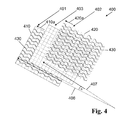
- FIG. 4 a further embodiment of the inventive catalyst 400 is shown. Also in this catalyst, an intermediate network 403 is provided between adjacent catalyst networks 401, 402.
- the catalyst nets 401, 402 is based on a two-dimensional basic structure 410, 420 in the form of a textile fabric, which was produced by machining of noble metal wires.
- the knitted fabric has stitches with a mean mesh size of 1.0 mm.
- the metal wires are made of a PtRh alloy 95/5. They have a diameter of 61 microns and a weight of 60 mg / m.
- a plurality of flexible wires 430 are embedded in the two-dimensional basic structures 410, 420 at a regular distance from each other, so that three-dimensional catalyst networks 401, 402 are obtained.
- the wires 430 are made of PtRh alloy (90/10); they have a wire diameter of 70 microns and a weight of 77 mg / m.
- the two adjacent catalyst nets 401, 402 are arranged such that the network directions 410a, 410 are parallel and the preferred directions 406, 407 are at an angle of 6 ° to each other. In another embodiment (not shown), the preferred directions are at an angle of 70 ° to each other.
- an intermediate net 403 having an average mesh width of 0.8 mm is produced by machining a noble metal-containing wire.
- the precious metal-containing wire of the 403 Intermediate Net is made of a PtRh10 alloy and has a wire diameter of 76 ⁇ m.
- the catalyst nets were made of PtRh10 wire with a wire diameter of 76 ⁇ m.
- a helically formed second PtRh10 wire is embedded in the catalyst networks.
- the wire diameter of the second wire is 76 ⁇ m.
Landscapes
- Chemical & Material Sciences (AREA)
- Organic Chemistry (AREA)
- Chemical Kinetics & Catalysis (AREA)
- Engineering & Computer Science (AREA)
- Materials Engineering (AREA)
- Inorganic Chemistry (AREA)
- Health & Medical Sciences (AREA)
- General Health & Medical Sciences (AREA)
- Toxicology (AREA)
- Textile Engineering (AREA)
- Catalysts (AREA)
Priority Applications (2)
| Application Number | Priority Date | Filing Date | Title |
|---|---|---|---|
| US13/949,311 US9056307B2 (en) | 2012-07-24 | 2013-07-24 | Catalyst |
| US13/949,430 US9126187B2 (en) | 2012-07-24 | 2013-07-24 | Catalyst |
Applications Claiming Priority (1)
| Application Number | Priority Date | Filing Date | Title |
|---|---|---|---|
| DE102012106732.5A DE102012106732A1 (de) | 2012-07-24 | 2012-07-24 | Katalysator |
Publications (3)
| Publication Number | Publication Date |
|---|---|
| EP2689841A2 true EP2689841A2 (fr) | 2014-01-29 |
| EP2689841A3 EP2689841A3 (fr) | 2014-06-04 |
| EP2689841B1 EP2689841B1 (fr) | 2016-09-07 |
Family
ID=48790232
Family Applications (1)
| Application Number | Title | Priority Date | Filing Date |
|---|---|---|---|
| EP13176242.9A Active EP2689841B1 (fr) | 2012-07-24 | 2013-07-12 | Catalyseur |
Country Status (3)
| Country | Link |
|---|---|
| US (2) | US9126187B2 (fr) |
| EP (1) | EP2689841B1 (fr) |
| DE (1) | DE102012106732A1 (fr) |
Cited By (3)
| Publication number | Priority date | Publication date | Assignee | Title |
|---|---|---|---|---|
| US9782754B2 (en) | 2012-07-26 | 2017-10-10 | Saudi Basic Industries Corporation | Alkane dehydrogenation catalyst and process for its preparation |
| EP3680214A1 (fr) * | 2019-01-14 | 2020-07-15 | Heraeus Deutschland GmbH & Co KG | Système de catalyseur ainsi que procédé de combustion catalytique d'ammoniac en oxyde d'azote dans une installation à moyenne pression |
| US12378115B2 (en) | 2019-01-14 | 2025-08-05 | Heraeus Deutschland GmbH & Co., KG | Catalyst system and method for the catalytic combustion of ammonia to form nitrogen oxides in a medium-pressure system |
Families Citing this family (6)
| Publication number | Priority date | Publication date | Assignee | Title |
|---|---|---|---|---|
| DE102012106732A1 (de) | 2012-07-24 | 2014-01-30 | Heraeus Materials Technology Gmbh & Co. Kg | Katalysator |
| DE102013101749A1 (de) * | 2013-02-21 | 2014-08-21 | Heraeus Materials Technology Gmbh & Co. Kg | Katalysator |
| WO2015022247A1 (fr) * | 2013-08-16 | 2015-02-19 | Basf Se | Dispositif en forme de corbeille muni d'une isolation de paroi |
| JP6623557B2 (ja) * | 2015-05-27 | 2019-12-25 | 株式会社島津製作所 | Icp分析装置 |
| US10143998B2 (en) * | 2016-02-05 | 2018-12-04 | Rohm And Haas Company | Activation energy reducers for catalytic oxidation of gaseous mixtures |
| EP4282525B1 (fr) * | 2022-05-25 | 2024-07-03 | Heraeus Precious Metals GmbH & Co. KG | Système de catalyseur pour un réacteur à circulation, ainsi que procédé d'oxydation catalytique d'ammoniac |
Citations (2)
| Publication number | Priority date | Publication date | Assignee | Title |
|---|---|---|---|---|
| US5669680A (en) | 1994-04-15 | 1997-09-23 | Berco S.P.A. | Tracked running gear assembly in particular for small excavators |
| DE60201502T2 (de) | 2001-02-08 | 2005-11-17 | Umicore Ag & Co. Kg | Dreidimensionale, in zwei oder mehreren schichten gestrickte katalysatornetze |
Family Cites Families (11)
| Publication number | Priority date | Publication date | Assignee | Title |
|---|---|---|---|---|
| GB337680A (en) * | 1929-07-25 | 1930-11-06 | Carlo Toniolo | Improvements in or relating to wire-gauze catalysers |
| US2274684A (en) * | 1940-11-16 | 1942-03-03 | Metal Textile Corp | Filter medium and filter body made therefrom |
| US3993600A (en) * | 1973-08-23 | 1976-11-23 | Matthey Bishop, Inc. | Catalyst support assembly |
| GB2064975B (en) * | 1979-10-18 | 1984-03-14 | Johnson Matthey Co Ltd | Fibrous catalytic materials |
| GB8630728D0 (en) * | 1986-12-23 | 1987-02-04 | Johnson Matthey Plc | Ammonia oxidation catalyst pack |
| EP0364153B1 (fr) * | 1988-10-12 | 1992-03-04 | Johnson Matthey Public Limited Company | Tissu métallique |
| FR2694306B1 (fr) * | 1992-07-31 | 1994-10-21 | Louyot Comptoir Lyon Alemand | Fils comprenant un élément hélicoïdal, leurs assemblages et l'utilisation desdits assemblages comme catalyseur et/ou pour récupérer des métaux précieux. |
| US6073467A (en) * | 1994-04-06 | 2000-06-13 | Degussa Aktiengesellschaft | Catalyst gauzes for gaseous reactions |
| RU2212272C1 (ru) * | 2002-11-26 | 2003-09-20 | Федеральное государственное унитарное предприятие Московский завод по обработке специальных сплавов | Платиноидный катализатор в форме проволочной сетки |
| GB0315643D0 (en) * | 2003-04-29 | 2003-08-13 | Johnson Matthey Plc | Improved catalyst charge design |
| DE102012106732A1 (de) | 2012-07-24 | 2014-01-30 | Heraeus Materials Technology Gmbh & Co. Kg | Katalysator |
-
2012
- 2012-07-24 DE DE102012106732.5A patent/DE102012106732A1/de not_active Withdrawn
-
2013
- 2013-07-12 EP EP13176242.9A patent/EP2689841B1/fr active Active
- 2013-07-24 US US13/949,430 patent/US9126187B2/en active Active
- 2013-07-24 US US13/949,311 patent/US9056307B2/en active Active
Patent Citations (2)
| Publication number | Priority date | Publication date | Assignee | Title |
|---|---|---|---|---|
| US5669680A (en) | 1994-04-15 | 1997-09-23 | Berco S.P.A. | Tracked running gear assembly in particular for small excavators |
| DE60201502T2 (de) | 2001-02-08 | 2005-11-17 | Umicore Ag & Co. Kg | Dreidimensionale, in zwei oder mehreren schichten gestrickte katalysatornetze |
Cited By (8)
| Publication number | Priority date | Publication date | Assignee | Title |
|---|---|---|---|---|
| US9782754B2 (en) | 2012-07-26 | 2017-10-10 | Saudi Basic Industries Corporation | Alkane dehydrogenation catalyst and process for its preparation |
| EP3680214A1 (fr) * | 2019-01-14 | 2020-07-15 | Heraeus Deutschland GmbH & Co KG | Système de catalyseur ainsi que procédé de combustion catalytique d'ammoniac en oxyde d'azote dans une installation à moyenne pression |
| WO2020148144A1 (fr) | 2019-01-14 | 2020-07-23 | Heraeus Deutschland GmbH & Co. KG | Système catalyseur et procédé de combustion catalytique d'ammoniac en oxydes d'azote dans une installation moyenne pression |
| CN113302150A (zh) * | 2019-01-14 | 2021-08-24 | 贺利氏德国有限两合公司 | 用于在中压系统中催化燃烧氨以形成氮氧化物的催化剂系统和方法 |
| CN113302150B (zh) * | 2019-01-14 | 2022-08-16 | 贺利氏德国有限两合公司 | 用于在中压系统中催化燃烧氨以形成氮氧化物的催化剂系统和方法 |
| AU2020208734B2 (en) * | 2019-01-14 | 2023-11-02 | Heraeus Deutschland GmbH & Co. KG | Catalyst system and method for the catalytic combustion of ammonia to form nitrogen oxides in a medium-pressure system |
| US12109553B2 (en) | 2019-01-14 | 2024-10-08 | Heraeus Deutschland Gmbh & Co Kg | Catalyst system and method for the catalytic combustion of ammonia to form nitrogen oxides in a medium-pressure system |
| US12378115B2 (en) | 2019-01-14 | 2025-08-05 | Heraeus Deutschland GmbH & Co., KG | Catalyst system and method for the catalytic combustion of ammonia to form nitrogen oxides in a medium-pressure system |
Also Published As
| Publication number | Publication date |
|---|---|
| EP2689841A3 (fr) | 2014-06-04 |
| EP2689841B1 (fr) | 2016-09-07 |
| US20140031201A1 (en) | 2014-01-30 |
| US20140031202A1 (en) | 2014-01-30 |
| US9056307B2 (en) | 2015-06-16 |
| US9126187B2 (en) | 2015-09-08 |
| DE102012106732A1 (de) | 2014-01-30 |
Similar Documents
| Publication | Publication Date | Title |
|---|---|---|
| EP2689841B1 (fr) | Catalyseur | |
| DE69309470T2 (de) | Fäden aus einem spiralförmigen element, deren anordnung und verwendung dieser anordnung als katalysator bzw. zur zurückgewinnung von edelmetallen | |
| DE60201502T2 (de) | Dreidimensionale, in zwei oder mehreren schichten gestrickte katalysatornetze | |
| EP3680015B1 (fr) | Système de catalyseur ainsi que procédé de combustion catalytique d'ammoniac en oxyde d'azote dans une installation moyenne pression | |
| EP2640504B1 (fr) | Réacteur chimique comprenant une matière à mailles en fil tricoté comme dispositif de retenue pour particules | |
| EP4139045B1 (fr) | Réseau métallique précieux destiné à la catalyse des réactions en phase gazeuse | |
| WO2014128216A1 (fr) | Catalyseur présentant une structure tridimensionnelle à bosses en forme d'hexagone | |
| WO2020148144A1 (fr) | Système catalyseur et procédé de combustion catalytique d'ammoniac en oxydes d'azote dans une installation moyenne pression | |
| DE4411774C1 (de) | Katalysatornetze für Gasreaktionen | |
| EP4215661B1 (fr) | Procédé de fabrication de filets en métal précieux sur des tricoteuses rectilignes | |
| EP4215662B1 (fr) | Procédé de fabrication de filets en métal noble sur des machines à tricoter rectilignes | |
| EP4247554B1 (fr) | Grille métallique précieux pour la catalyse des réactions en phase gazeuse | |
| EP4344773A1 (fr) | Système catalytique comprenant un réseau catalytique comprenant un fil de métal noble pour grandes campagnes dans l'oxydation d'ammoniac | |
| EP4282525B1 (fr) | Système de catalyseur pour un réacteur à circulation, ainsi que procédé d'oxydation catalytique d'ammoniac | |
| WO2022029042A1 (fr) | Treillis de structure tertiaire destinés à la conversion catalytique de fluides | |
| DE102023129020A1 (de) | Verwendung von Edelmetallnetzen zur Oxidation von Ammoniak | |
| EP4566707A1 (fr) | Système catalytique pour un réacteur à écoulement et procédé d'oxydation catalytique d'ammoniac | |
| EP4282527A1 (fr) | Système de catalyseur pour un réacteur à circulation, ainsi que procédé d'oxydation catalytique d'ammoniac | |
| EP4407083A1 (fr) | Guide-fil pour machine à tricoter pour des réseaux de métaux précieux | |
| DE202024101437U1 (de) | Gestrickte Netzpackung für die Ammoniakumsetzung | |
| DE202023002903U1 (de) | Fadenführer für eine Strickmaschine für Edelmetallnetze | |
| DE102011016044A1 (de) | Verfahren zur Herstellung von Formdrähten mit hoher Drahtoberfläche und Katalysatornetzen aus Formdrähten | |
| EP4464828A1 (fr) | Procédé de fabrication de filets de métal noble sur des métiers à tricoter rectilignes | |
| EP4282526A1 (fr) | Réseau catalytique doté d'un fil en métal précieux à partir d'un alliage de métal précieux renforcé par phase dispersée | |
| DE9407536U1 (de) | Katalysatornetz für Gasreaktionen |
Legal Events
| Date | Code | Title | Description |
|---|---|---|---|
| PUAI | Public reference made under article 153(3) epc to a published international application that has entered the european phase |
Free format text: ORIGINAL CODE: 0009012 |
|
| 17P | Request for examination filed |
Effective date: 20130712 |
|
| AK | Designated contracting states |
Kind code of ref document: A2 Designated state(s): AL AT BE BG CH CY CZ DE DK EE ES FI FR GB GR HR HU IE IS IT LI LT LU LV MC MK MT NL NO PL PT RO RS SE SI SK SM TR |
|
| AX | Request for extension of the european patent |
Extension state: BA ME |
|
| PUAL | Search report despatched |
Free format text: ORIGINAL CODE: 0009013 |
|
| AK | Designated contracting states |
Kind code of ref document: A3 Designated state(s): AL AT BE BG CH CY CZ DE DK EE ES FI FR GB GR HR HU IE IS IT LI LT LU LV MC MK MT NL NO PL PT RO RS SE SI SK SM TR |
|
| AX | Request for extension of the european patent |
Extension state: BA ME |
|
| RIC1 | Information provided on ipc code assigned before grant |
Ipc: B01J 23/42 20060101AFI20140429BHEP Ipc: B01J 23/46 20060101ALI20140429BHEP Ipc: C01B 21/38 20060101ALI20140429BHEP Ipc: B01J 35/06 20060101ALI20140429BHEP Ipc: C01B 21/26 20060101ALI20140429BHEP |
|
| RAP1 | Party data changed (applicant data changed or rights of an application transferred) |
Owner name: HERAEUS DEUTSCHLAND GMBH & CO. KG |
|
| GRAP | Despatch of communication of intention to grant a patent |
Free format text: ORIGINAL CODE: EPIDOSNIGR1 |
|
| INTG | Intention to grant announced |
Effective date: 20160323 |
|
| GRAS | Grant fee paid |
Free format text: ORIGINAL CODE: EPIDOSNIGR3 |
|
| GRAA | (expected) grant |
Free format text: ORIGINAL CODE: 0009210 |
|
| AK | Designated contracting states |
Kind code of ref document: B1 Designated state(s): AL AT BE BG CH CY CZ DE DK EE ES FI FR GB GR HR HU IE IS IT LI LT LU LV MC MK MT NL NO PL PT RO RS SE SI SK SM TR |
|
| REG | Reference to a national code |
Ref country code: GB Ref legal event code: FG4D Free format text: NOT ENGLISH |
|
| REG | Reference to a national code |
Ref country code: CH Ref legal event code: EP |
|
| REG | Reference to a national code |
Ref country code: IE Ref legal event code: FG4D Free format text: LANGUAGE OF EP DOCUMENT: GERMAN |
|
| REG | Reference to a national code |
Ref country code: AT Ref legal event code: REF Ref document number: 826339 Country of ref document: AT Kind code of ref document: T Effective date: 20161015 |
|
| REG | Reference to a national code |
Ref country code: DE Ref legal event code: R096 Ref document number: 502013004336 Country of ref document: DE |
|
| REG | Reference to a national code |
Ref country code: LT Ref legal event code: MG4D |
|
| REG | Reference to a national code |
Ref country code: NL Ref legal event code: MP Effective date: 20160907 |
|
| PG25 | Lapsed in a contracting state [announced via postgrant information from national office to epo] |
Ref country code: RS Free format text: LAPSE BECAUSE OF FAILURE TO SUBMIT A TRANSLATION OF THE DESCRIPTION OR TO PAY THE FEE WITHIN THE PRESCRIBED TIME-LIMIT Effective date: 20160907 Ref country code: HR Free format text: LAPSE BECAUSE OF FAILURE TO SUBMIT A TRANSLATION OF THE DESCRIPTION OR TO PAY THE FEE WITHIN THE PRESCRIBED TIME-LIMIT Effective date: 20160907 Ref country code: LT Free format text: LAPSE BECAUSE OF FAILURE TO SUBMIT A TRANSLATION OF THE DESCRIPTION OR TO PAY THE FEE WITHIN THE PRESCRIBED TIME-LIMIT Effective date: 20160907 Ref country code: NO Free format text: LAPSE BECAUSE OF FAILURE TO SUBMIT A TRANSLATION OF THE DESCRIPTION OR TO PAY THE FEE WITHIN THE PRESCRIBED TIME-LIMIT Effective date: 20161207 Ref country code: FI Free format text: LAPSE BECAUSE OF FAILURE TO SUBMIT A TRANSLATION OF THE DESCRIPTION OR TO PAY THE FEE WITHIN THE PRESCRIBED TIME-LIMIT Effective date: 20160907 |
|
| PG25 | Lapsed in a contracting state [announced via postgrant information from national office to epo] |
Ref country code: ES Free format text: LAPSE BECAUSE OF FAILURE TO SUBMIT A TRANSLATION OF THE DESCRIPTION OR TO PAY THE FEE WITHIN THE PRESCRIBED TIME-LIMIT Effective date: 20160907 Ref country code: NL Free format text: LAPSE BECAUSE OF FAILURE TO SUBMIT A TRANSLATION OF THE DESCRIPTION OR TO PAY THE FEE WITHIN THE PRESCRIBED TIME-LIMIT Effective date: 20160907 Ref country code: GR Free format text: LAPSE BECAUSE OF FAILURE TO SUBMIT A TRANSLATION OF THE DESCRIPTION OR TO PAY THE FEE WITHIN THE PRESCRIBED TIME-LIMIT Effective date: 20161208 Ref country code: SE Free format text: LAPSE BECAUSE OF FAILURE TO SUBMIT A TRANSLATION OF THE DESCRIPTION OR TO PAY THE FEE WITHIN THE PRESCRIBED TIME-LIMIT Effective date: 20160907 Ref country code: LV Free format text: LAPSE BECAUSE OF FAILURE TO SUBMIT A TRANSLATION OF THE DESCRIPTION OR TO PAY THE FEE WITHIN THE PRESCRIBED TIME-LIMIT Effective date: 20160907 |
|
| PG25 | Lapsed in a contracting state [announced via postgrant information from national office to epo] |
Ref country code: EE Free format text: LAPSE BECAUSE OF FAILURE TO SUBMIT A TRANSLATION OF THE DESCRIPTION OR TO PAY THE FEE WITHIN THE PRESCRIBED TIME-LIMIT Effective date: 20160907 Ref country code: RO Free format text: LAPSE BECAUSE OF FAILURE TO SUBMIT A TRANSLATION OF THE DESCRIPTION OR TO PAY THE FEE WITHIN THE PRESCRIBED TIME-LIMIT Effective date: 20160907 |
|
| PG25 | Lapsed in a contracting state [announced via postgrant information from national office to epo] |
Ref country code: SM Free format text: LAPSE BECAUSE OF FAILURE TO SUBMIT A TRANSLATION OF THE DESCRIPTION OR TO PAY THE FEE WITHIN THE PRESCRIBED TIME-LIMIT Effective date: 20160907 Ref country code: CZ Free format text: LAPSE BECAUSE OF FAILURE TO SUBMIT A TRANSLATION OF THE DESCRIPTION OR TO PAY THE FEE WITHIN THE PRESCRIBED TIME-LIMIT Effective date: 20160907 Ref country code: PT Free format text: LAPSE BECAUSE OF FAILURE TO SUBMIT A TRANSLATION OF THE DESCRIPTION OR TO PAY THE FEE WITHIN THE PRESCRIBED TIME-LIMIT Effective date: 20170109 Ref country code: IS Free format text: LAPSE BECAUSE OF FAILURE TO SUBMIT A TRANSLATION OF THE DESCRIPTION OR TO PAY THE FEE WITHIN THE PRESCRIBED TIME-LIMIT Effective date: 20170107 Ref country code: PL Free format text: LAPSE BECAUSE OF FAILURE TO SUBMIT A TRANSLATION OF THE DESCRIPTION OR TO PAY THE FEE WITHIN THE PRESCRIBED TIME-LIMIT Effective date: 20160907 Ref country code: SK Free format text: LAPSE BECAUSE OF FAILURE TO SUBMIT A TRANSLATION OF THE DESCRIPTION OR TO PAY THE FEE WITHIN THE PRESCRIBED TIME-LIMIT Effective date: 20160907 Ref country code: BG Free format text: LAPSE BECAUSE OF FAILURE TO SUBMIT A TRANSLATION OF THE DESCRIPTION OR TO PAY THE FEE WITHIN THE PRESCRIBED TIME-LIMIT Effective date: 20161207 |
|
| REG | Reference to a national code |
Ref country code: DE Ref legal event code: R097 Ref document number: 502013004336 Country of ref document: DE |
|
| PG25 | Lapsed in a contracting state [announced via postgrant information from national office to epo] |
Ref country code: IT Free format text: LAPSE BECAUSE OF FAILURE TO SUBMIT A TRANSLATION OF THE DESCRIPTION OR TO PAY THE FEE WITHIN THE PRESCRIBED TIME-LIMIT Effective date: 20160907 |
|
| PLBE | No opposition filed within time limit |
Free format text: ORIGINAL CODE: 0009261 |
|
| STAA | Information on the status of an ep patent application or granted ep patent |
Free format text: STATUS: NO OPPOSITION FILED WITHIN TIME LIMIT |
|
| REG | Reference to a national code |
Ref country code: FR Ref legal event code: PLFP Year of fee payment: 5 |
|
| PG25 | Lapsed in a contracting state [announced via postgrant information from national office to epo] |
Ref country code: DK Free format text: LAPSE BECAUSE OF FAILURE TO SUBMIT A TRANSLATION OF THE DESCRIPTION OR TO PAY THE FEE WITHIN THE PRESCRIBED TIME-LIMIT Effective date: 20160907 |
|
| 26N | No opposition filed |
Effective date: 20170608 |
|
| PG25 | Lapsed in a contracting state [announced via postgrant information from national office to epo] |
Ref country code: SI Free format text: LAPSE BECAUSE OF FAILURE TO SUBMIT A TRANSLATION OF THE DESCRIPTION OR TO PAY THE FEE WITHIN THE PRESCRIBED TIME-LIMIT Effective date: 20160907 |
|
| REG | Reference to a national code |
Ref country code: CH Ref legal event code: PL |
|
| REG | Reference to a national code |
Ref country code: IE Ref legal event code: MM4A |
|
| PG25 | Lapsed in a contracting state [announced via postgrant information from national office to epo] |
Ref country code: LI Free format text: LAPSE BECAUSE OF NON-PAYMENT OF DUE FEES Effective date: 20170731 Ref country code: IE Free format text: LAPSE BECAUSE OF NON-PAYMENT OF DUE FEES Effective date: 20170712 Ref country code: CH Free format text: LAPSE BECAUSE OF NON-PAYMENT OF DUE FEES Effective date: 20170731 |
|
| REG | Reference to a national code |
Ref country code: BE Ref legal event code: MM Effective date: 20170731 |
|
| PG25 | Lapsed in a contracting state [announced via postgrant information from national office to epo] |
Ref country code: LU Free format text: LAPSE BECAUSE OF NON-PAYMENT OF DUE FEES Effective date: 20170712 |
|
| REG | Reference to a national code |
Ref country code: FR Ref legal event code: PLFP Year of fee payment: 6 |
|
| PG25 | Lapsed in a contracting state [announced via postgrant information from national office to epo] |
Ref country code: BE Free format text: LAPSE BECAUSE OF NON-PAYMENT OF DUE FEES Effective date: 20170731 |
|
| PG25 | Lapsed in a contracting state [announced via postgrant information from national office to epo] |
Ref country code: MT Free format text: LAPSE BECAUSE OF FAILURE TO SUBMIT A TRANSLATION OF THE DESCRIPTION OR TO PAY THE FEE WITHIN THE PRESCRIBED TIME-LIMIT Effective date: 20160907 |
|
| PG25 | Lapsed in a contracting state [announced via postgrant information from national office to epo] |
Ref country code: AL Free format text: LAPSE BECAUSE OF FAILURE TO SUBMIT A TRANSLATION OF THE DESCRIPTION OR TO PAY THE FEE WITHIN THE PRESCRIBED TIME-LIMIT Effective date: 20160907 |
|
| PG25 | Lapsed in a contracting state [announced via postgrant information from national office to epo] |
Ref country code: MC Free format text: LAPSE BECAUSE OF FAILURE TO SUBMIT A TRANSLATION OF THE DESCRIPTION OR TO PAY THE FEE WITHIN THE PRESCRIBED TIME-LIMIT Effective date: 20160907 Ref country code: HU Free format text: LAPSE BECAUSE OF FAILURE TO SUBMIT A TRANSLATION OF THE DESCRIPTION OR TO PAY THE FEE WITHIN THE PRESCRIBED TIME-LIMIT; INVALID AB INITIO Effective date: 20130712 |
|
| REG | Reference to a national code |
Ref country code: AT Ref legal event code: MM01 Ref document number: 826339 Country of ref document: AT Kind code of ref document: T Effective date: 20180712 |
|
| PG25 | Lapsed in a contracting state [announced via postgrant information from national office to epo] |
Ref country code: CY Free format text: LAPSE BECAUSE OF NON-PAYMENT OF DUE FEES Effective date: 20160907 |
|
| PG25 | Lapsed in a contracting state [announced via postgrant information from national office to epo] |
Ref country code: MK Free format text: LAPSE BECAUSE OF FAILURE TO SUBMIT A TRANSLATION OF THE DESCRIPTION OR TO PAY THE FEE WITHIN THE PRESCRIBED TIME-LIMIT Effective date: 20160907 |
|
| PG25 | Lapsed in a contracting state [announced via postgrant information from national office to epo] |
Ref country code: AT Free format text: LAPSE BECAUSE OF NON-PAYMENT OF DUE FEES Effective date: 20180712 |
|
| PG25 | Lapsed in a contracting state [announced via postgrant information from national office to epo] |
Ref country code: TR Free format text: LAPSE BECAUSE OF FAILURE TO SUBMIT A TRANSLATION OF THE DESCRIPTION OR TO PAY THE FEE WITHIN THE PRESCRIBED TIME-LIMIT Effective date: 20160907 |
|
| P01 | Opt-out of the competence of the unified patent court (upc) registered |
Effective date: 20230530 |
|
| PGFP | Annual fee paid to national office [announced via postgrant information from national office to epo] |
Ref country code: DE Payment date: 20250722 Year of fee payment: 13 |
|
| PGFP | Annual fee paid to national office [announced via postgrant information from national office to epo] |
Ref country code: GB Payment date: 20250722 Year of fee payment: 13 |
|
| PGFP | Annual fee paid to national office [announced via postgrant information from national office to epo] |
Ref country code: FR Payment date: 20250725 Year of fee payment: 13 |