EP2692945B1 - Procédé pour produire de la pâte et du papier - Google Patents
Procédé pour produire de la pâte et du papier Download PDFInfo
- Publication number
- EP2692945B1 EP2692945B1 EP12763869.0A EP12763869A EP2692945B1 EP 2692945 B1 EP2692945 B1 EP 2692945B1 EP 12763869 A EP12763869 A EP 12763869A EP 2692945 B1 EP2692945 B1 EP 2692945B1
- Authority
- EP
- European Patent Office
- Prior art keywords
- pulp
- fiber fraction
- screen
- long fiber
- short fiber
- Prior art date
- Legal status (The legal status is an assumption and is not a legal conclusion. Google has not performed a legal analysis and makes no representation as to the accuracy of the status listed.)
- Not-in-force
Links
- 238000004519 manufacturing process Methods 0.000 title claims description 22
- 239000000835 fiber Substances 0.000 claims description 227
- 238000005194 fractionation Methods 0.000 claims description 58
- 238000000034 method Methods 0.000 claims description 56
- 239000007787 solid Substances 0.000 claims description 48
- 239000000356 contaminant Substances 0.000 claims description 38
- 239000013055 pulp slurry Substances 0.000 claims description 36
- 239000010893 paper waste Substances 0.000 claims description 30
- 229920001131 Pulp (paper) Polymers 0.000 claims description 25
- 238000005188 flotation Methods 0.000 claims description 24
- 239000000123 paper Substances 0.000 description 39
- 239000000976 ink Substances 0.000 description 36
- XEEYBQQBJWHFJM-UHFFFAOYSA-N Iron Chemical compound [Fe] XEEYBQQBJWHFJM-UHFFFAOYSA-N 0.000 description 26
- 238000011282 treatment Methods 0.000 description 26
- 230000000052 comparative effect Effects 0.000 description 25
- 239000000853 adhesive Substances 0.000 description 22
- 230000001070 adhesive effect Effects 0.000 description 22
- 239000002245 particle Substances 0.000 description 17
- VTYYLEPIZMXCLO-UHFFFAOYSA-L Calcium carbonate Chemical compound [Ca+2].[O-]C([O-])=O VTYYLEPIZMXCLO-UHFFFAOYSA-L 0.000 description 16
- 230000007423 decrease Effects 0.000 description 16
- -1 defoamers Substances 0.000 description 14
- VYPSYNLAJGMNEJ-UHFFFAOYSA-N Silicium dioxide Chemical compound O=[Si]=O VYPSYNLAJGMNEJ-UHFFFAOYSA-N 0.000 description 13
- 229910052742 iron Inorganic materials 0.000 description 13
- 239000002994 raw material Substances 0.000 description 13
- XLYOFNOQVPJJNP-UHFFFAOYSA-N water Substances O XLYOFNOQVPJJNP-UHFFFAOYSA-N 0.000 description 13
- HEMHJVSKTPXQMS-UHFFFAOYSA-M Sodium hydroxide Chemical compound [OH-].[Na+] HEMHJVSKTPXQMS-UHFFFAOYSA-M 0.000 description 12
- 239000002699 waste material Substances 0.000 description 11
- 239000000203 mixture Substances 0.000 description 10
- 239000003795 chemical substances by application Substances 0.000 description 8
- 229920000642 polymer Polymers 0.000 description 8
- 125000000129 anionic group Chemical group 0.000 description 7
- 229910000019 calcium carbonate Inorganic materials 0.000 description 7
- 230000018044 dehydration Effects 0.000 description 7
- 238000006297 dehydration reaction Methods 0.000 description 7
- 239000002761 deinking Substances 0.000 description 7
- MHAJPDPJQMAIIY-UHFFFAOYSA-N Hydrogen peroxide Chemical compound OO MHAJPDPJQMAIIY-UHFFFAOYSA-N 0.000 description 6
- GWEVSGVZZGPLCZ-UHFFFAOYSA-N Titan oxide Chemical compound O=[Ti]=O GWEVSGVZZGPLCZ-UHFFFAOYSA-N 0.000 description 6
- 230000008901 benefit Effects 0.000 description 6
- 230000014759 maintenance of location Effects 0.000 description 6
- 238000002156 mixing Methods 0.000 description 6
- 239000000126 substance Substances 0.000 description 6
- 239000004115 Sodium Silicate Substances 0.000 description 5
- 238000011156 evaluation Methods 0.000 description 5
- 239000000945 filler Substances 0.000 description 5
- 239000000463 material Substances 0.000 description 5
- 239000002002 slurry Substances 0.000 description 5
- NTHWMYGWWRZVTN-UHFFFAOYSA-N sodium silicate Chemical compound [Na+].[Na+].[O-][Si]([O-])=O NTHWMYGWWRZVTN-UHFFFAOYSA-N 0.000 description 5
- 229910052911 sodium silicate Inorganic materials 0.000 description 5
- 229920002472 Starch Polymers 0.000 description 4
- 239000002253 acid Substances 0.000 description 4
- 125000002091 cationic group Chemical group 0.000 description 4
- 239000000975 dye Substances 0.000 description 4
- 238000002474 experimental method Methods 0.000 description 4
- 239000011256 inorganic filler Substances 0.000 description 4
- 229910003475 inorganic filler Inorganic materials 0.000 description 4
- NLYAJNPCOHFWQQ-UHFFFAOYSA-N kaolin Chemical compound O.O.O=[Al]O[Si](=O)O[Si](=O)O[Al]=O NLYAJNPCOHFWQQ-UHFFFAOYSA-N 0.000 description 4
- 229920002401 polyacrylamide Polymers 0.000 description 4
- 238000012216 screening Methods 0.000 description 4
- 239000000377 silicon dioxide Substances 0.000 description 4
- 235000011121 sodium hydroxide Nutrition 0.000 description 4
- 235000019698 starch Nutrition 0.000 description 4
- 239000005995 Aluminium silicate Substances 0.000 description 3
- OYPRJOBELJOOCE-UHFFFAOYSA-N Calcium Chemical compound [Ca] OYPRJOBELJOOCE-UHFFFAOYSA-N 0.000 description 3
- 241000196324 Embryophyta Species 0.000 description 3
- LFQSCWFLJHTTHZ-UHFFFAOYSA-N Ethanol Chemical compound CCO LFQSCWFLJHTTHZ-UHFFFAOYSA-N 0.000 description 3
- 239000000654 additive Substances 0.000 description 3
- 235000012211 aluminium silicate Nutrition 0.000 description 3
- 239000011575 calcium Substances 0.000 description 3
- 229910052791 calcium Inorganic materials 0.000 description 3
- OSGAYBCDTDRGGQ-UHFFFAOYSA-L calcium sulfate Chemical compound [Ca+2].[O-]S([O-])(=O)=O OSGAYBCDTDRGGQ-UHFFFAOYSA-L 0.000 description 3
- 239000007788 liquid Substances 0.000 description 3
- 239000011859 microparticle Substances 0.000 description 3
- 238000010298 pulverizing process Methods 0.000 description 3
- 230000000717 retained effect Effects 0.000 description 3
- 238000000926 separation method Methods 0.000 description 3
- 239000000725 suspension Substances 0.000 description 3
- 238000012360 testing method Methods 0.000 description 3
- 239000004408 titanium dioxide Substances 0.000 description 3
- 238000005406 washing Methods 0.000 description 3
- RSWGJHLUYNHPMX-UHFFFAOYSA-N Abietic-Saeure Natural products C12CCC(C(C)C)=CC2=CCC2C1(C)CCCC2(C)C(O)=O RSWGJHLUYNHPMX-UHFFFAOYSA-N 0.000 description 2
- 229920002873 Polyethylenimine Polymers 0.000 description 2
- KHPCPRHQVVSZAH-HUOMCSJISA-N Rosin Natural products O(C/C=C/c1ccccc1)[C@H]1[C@H](O)[C@@H](O)[C@@H](O)[C@@H](CO)O1 KHPCPRHQVVSZAH-HUOMCSJISA-N 0.000 description 2
- XLOMVQKBTHCTTD-UHFFFAOYSA-N Zinc monoxide Chemical compound [Zn]=O XLOMVQKBTHCTTD-UHFFFAOYSA-N 0.000 description 2
- 239000002390 adhesive tape Substances 0.000 description 2
- 239000000440 bentonite Substances 0.000 description 2
- 229910000278 bentonite Inorganic materials 0.000 description 2
- SVPXDRXYRYOSEX-UHFFFAOYSA-N bentoquatam Chemical compound O.O=[Si]=O.O=[Al]O[Al]=O SVPXDRXYRYOSEX-UHFFFAOYSA-N 0.000 description 2
- 238000004061 bleaching Methods 0.000 description 2
- 229920006317 cationic polymer Polymers 0.000 description 2
- 229920002678 cellulose Polymers 0.000 description 2
- 239000001913 cellulose Substances 0.000 description 2
- 239000000701 coagulant Substances 0.000 description 2
- 239000012141 concentrate Substances 0.000 description 2
- 239000011096 corrugated fiberboard Substances 0.000 description 2
- 235000014113 dietary fatty acids Nutrition 0.000 description 2
- 238000007865 diluting Methods 0.000 description 2
- 230000000694 effects Effects 0.000 description 2
- 239000003623 enhancer Substances 0.000 description 2
- 239000000194 fatty acid Substances 0.000 description 2
- 229930195729 fatty acid Natural products 0.000 description 2
- 239000011121 hardwood Substances 0.000 description 2
- 239000010954 inorganic particle Substances 0.000 description 2
- 230000007935 neutral effect Effects 0.000 description 2
- 239000012766 organic filler Substances 0.000 description 2
- 229920000768 polyamine Polymers 0.000 description 2
- 238000002360 preparation method Methods 0.000 description 2
- 125000001453 quaternary ammonium group Chemical group 0.000 description 2
- 229920005989 resin Polymers 0.000 description 2
- 239000011347 resin Substances 0.000 description 2
- 239000011122 softwood Substances 0.000 description 2
- 239000000454 talc Substances 0.000 description 2
- 229910052623 talc Inorganic materials 0.000 description 2
- 239000002562 thickening agent Substances 0.000 description 2
- KHPCPRHQVVSZAH-UHFFFAOYSA-N trans-cinnamyl beta-D-glucopyranoside Natural products OC1C(O)C(O)C(CO)OC1OCC=CC1=CC=CC=C1 KHPCPRHQVVSZAH-UHFFFAOYSA-N 0.000 description 2
- 238000011144 upstream manufacturing Methods 0.000 description 2
- HRPVXLWXLXDGHG-UHFFFAOYSA-N Acrylamide Chemical compound NC(=O)C=C HRPVXLWXLXDGHG-UHFFFAOYSA-N 0.000 description 1
- 229920002134 Carboxymethyl cellulose Polymers 0.000 description 1
- 102000004190 Enzymes Human genes 0.000 description 1
- 108090000790 Enzymes Proteins 0.000 description 1
- BRLQWZUYTZBJKN-UHFFFAOYSA-N Epichlorohydrin Chemical compound ClCC1CO1 BRLQWZUYTZBJKN-UHFFFAOYSA-N 0.000 description 1
- 229920002907 Guar gum Polymers 0.000 description 1
- 240000000797 Hibiscus cannabinus Species 0.000 description 1
- 229920000881 Modified starch Polymers 0.000 description 1
- 239000004820 Pressure-sensitive adhesive Substances 0.000 description 1
- 229920002125 Sokalan® Polymers 0.000 description 1
- 150000007513 acids Chemical class 0.000 description 1
- 150000003926 acrylamides Chemical class 0.000 description 1
- 150000001298 alcohols Chemical class 0.000 description 1
- 150000004996 alkyl benzenes Chemical class 0.000 description 1
- 150000008051 alkyl sulfates Chemical class 0.000 description 1
- 125000002947 alkylene group Chemical group 0.000 description 1
- WNROFYMDJYEPJX-UHFFFAOYSA-K aluminium hydroxide Chemical compound [OH-].[OH-].[OH-].[Al+3] WNROFYMDJYEPJX-UHFFFAOYSA-K 0.000 description 1
- 239000002280 amphoteric surfactant Substances 0.000 description 1
- 239000003945 anionic surfactant Substances 0.000 description 1
- AYJRCSIUFZENHW-DEQYMQKBSA-L barium(2+);oxomethanediolate Chemical compound [Ba+2].[O-][14C]([O-])=O AYJRCSIUFZENHW-DEQYMQKBSA-L 0.000 description 1
- 210000000988 bone and bone Anatomy 0.000 description 1
- 239000004067 bulking agent Substances 0.000 description 1
- AXCZMVOFGPJBDE-UHFFFAOYSA-L calcium dihydroxide Chemical compound [OH-].[OH-].[Ca+2] AXCZMVOFGPJBDE-UHFFFAOYSA-L 0.000 description 1
- 239000000920 calcium hydroxide Substances 0.000 description 1
- 229910001861 calcium hydroxide Inorganic materials 0.000 description 1
- 125000003178 carboxy group Chemical group [H]OC(*)=O 0.000 description 1
- 239000001768 carboxy methyl cellulose Substances 0.000 description 1
- 235000010948 carboxy methyl cellulose Nutrition 0.000 description 1
- 239000008112 carboxymethyl-cellulose Substances 0.000 description 1
- 239000003093 cationic surfactant Substances 0.000 description 1
- 150000001768 cations Chemical class 0.000 description 1
- 210000004027 cell Anatomy 0.000 description 1
- 239000004927 clay Substances 0.000 description 1
- 229910052570 clay Inorganic materials 0.000 description 1
- 239000011248 coating agent Substances 0.000 description 1
- 238000000576 coating method Methods 0.000 description 1
- 239000008119 colloidal silica Substances 0.000 description 1
- 239000003086 colorant Substances 0.000 description 1
- 238000007796 conventional method Methods 0.000 description 1
- 229920001577 copolymer Polymers 0.000 description 1
- 230000003247 decreasing effect Effects 0.000 description 1
- 230000001419 dependent effect Effects 0.000 description 1
- 238000010586 diagram Methods 0.000 description 1
- QGBSISYHAICWAH-UHFFFAOYSA-N dicyandiamide Chemical compound NC(N)=NC#N QGBSISYHAICWAH-UHFFFAOYSA-N 0.000 description 1
- 238000009826 distribution Methods 0.000 description 1
- 230000009977 dual effect Effects 0.000 description 1
- 239000000839 emulsion Substances 0.000 description 1
- 238000005265 energy consumption Methods 0.000 description 1
- 238000005516 engineering process Methods 0.000 description 1
- UYMKPFRHYYNDTL-UHFFFAOYSA-N ethenamine Chemical compound NC=C UYMKPFRHYYNDTL-UHFFFAOYSA-N 0.000 description 1
- 150000004665 fatty acids Chemical class 0.000 description 1
- 238000001914 filtration Methods 0.000 description 1
- 239000007850 fluorescent dye Substances 0.000 description 1
- 239000006081 fluorescent whitening agent Substances 0.000 description 1
- 239000003292 glue Substances 0.000 description 1
- 239000000665 guar gum Substances 0.000 description 1
- 235000010417 guar gum Nutrition 0.000 description 1
- 229960002154 guar gum Drugs 0.000 description 1
- 229920006158 high molecular weight polymer Polymers 0.000 description 1
- 230000002209 hydrophobic effect Effects 0.000 description 1
- 238000004898 kneading Methods 0.000 description 1
- 239000002655 kraft paper Substances 0.000 description 1
- ZLNQQNXFFQJAID-UHFFFAOYSA-L magnesium carbonate Chemical compound [Mg+2].[O-]C([O-])=O ZLNQQNXFFQJAID-UHFFFAOYSA-L 0.000 description 1
- 239000001095 magnesium carbonate Substances 0.000 description 1
- 229910000021 magnesium carbonate Inorganic materials 0.000 description 1
- VTHJTEIRLNZDEV-UHFFFAOYSA-L magnesium dihydroxide Chemical compound [OH-].[OH-].[Mg+2] VTHJTEIRLNZDEV-UHFFFAOYSA-L 0.000 description 1
- 239000000347 magnesium hydroxide Substances 0.000 description 1
- 229910001862 magnesium hydroxide Inorganic materials 0.000 description 1
- 210000001724 microfibril Anatomy 0.000 description 1
- 239000011707 mineral Chemical class 0.000 description 1
- 235000010755 mineral Nutrition 0.000 description 1
- 235000019426 modified starch Nutrition 0.000 description 1
- 239000000178 monomer Substances 0.000 description 1
- 239000002121 nanofiber Substances 0.000 description 1
- 229920005615 natural polymer Polymers 0.000 description 1
- 239000002736 nonionic surfactant Substances 0.000 description 1
- 238000011369 optimal treatment Methods 0.000 description 1
- 239000003960 organic solvent Substances 0.000 description 1
- 230000001590 oxidative effect Effects 0.000 description 1
- 239000003002 pH adjusting agent Substances 0.000 description 1
- 239000005011 phenolic resin Substances 0.000 description 1
- 239000000049 pigment Substances 0.000 description 1
- 239000004584 polyacrylic acid Substances 0.000 description 1
- 229920005990 polystyrene resin Polymers 0.000 description 1
- 239000000843 powder Substances 0.000 description 1
- 229940088417 precipitated calcium carbonate Drugs 0.000 description 1
- 238000012545 processing Methods 0.000 description 1
- 102000004169 proteins and genes Human genes 0.000 description 1
- 108090000623 proteins and genes Proteins 0.000 description 1
- 238000004064 recycling Methods 0.000 description 1
- 238000011160 research Methods 0.000 description 1
- 150000003839 salts Chemical class 0.000 description 1
- 238000004513 sizing Methods 0.000 description 1
- 229910001575 sodium mineral Chemical class 0.000 description 1
- 230000002269 spontaneous effect Effects 0.000 description 1
- 229920001909 styrene-acrylic polymer Polymers 0.000 description 1
- 229940014800 succinic anhydride Drugs 0.000 description 1
- 150000003457 sulfones Chemical class 0.000 description 1
- 239000004094 surface-active agent Substances 0.000 description 1
- 229920001059 synthetic polymer Polymers 0.000 description 1
- 238000012546 transfer Methods 0.000 description 1
- 239000002966 varnish Substances 0.000 description 1
- 239000002023 wood Substances 0.000 description 1
- UGZADUVQMDAIAO-UHFFFAOYSA-L zinc hydroxide Chemical compound [OH-].[OH-].[Zn+2] UGZADUVQMDAIAO-UHFFFAOYSA-L 0.000 description 1
- 229940007718 zinc hydroxide Drugs 0.000 description 1
- 229910021511 zinc hydroxide Inorganic materials 0.000 description 1
- 239000011787 zinc oxide Substances 0.000 description 1
- XOOUIPVCVHRTMJ-UHFFFAOYSA-L zinc stearate Chemical compound [Zn+2].CCCCCCCCCCCCCCCCCC([O-])=O.CCCCCCCCCCCCCCCCCC([O-])=O XOOUIPVCVHRTMJ-UHFFFAOYSA-L 0.000 description 1
Images
Classifications
-
- D—TEXTILES; PAPER
- D21—PAPER-MAKING; PRODUCTION OF CELLULOSE
- D21C—PRODUCTION OF CELLULOSE BY REMOVING NON-CELLULOSE SUBSTANCES FROM CELLULOSE-CONTAINING MATERIALS; REGENERATION OF PULPING LIQUORS; APPARATUS THEREFOR
- D21C5/00—Other processes for obtaining cellulose, e.g. cooking cotton linters ; Processes characterised by the choice of cellulose-containing starting materials
- D21C5/02—Working-up waste paper
- D21C5/025—De-inking
-
- D—TEXTILES; PAPER
- D21—PAPER-MAKING; PRODUCTION OF CELLULOSE
- D21C—PRODUCTION OF CELLULOSE BY REMOVING NON-CELLULOSE SUBSTANCES FROM CELLULOSE-CONTAINING MATERIALS; REGENERATION OF PULPING LIQUORS; APPARATUS THEREFOR
- D21C5/00—Other processes for obtaining cellulose, e.g. cooking cotton linters ; Processes characterised by the choice of cellulose-containing starting materials
- D21C5/02—Working-up waste paper
-
- D—TEXTILES; PAPER
- D21—PAPER-MAKING; PRODUCTION OF CELLULOSE
- D21D—TREATMENT OF THE MATERIALS BEFORE PASSING TO THE PAPER-MAKING MACHINE
- D21D5/00—Purification of the pulp suspension by mechanical means; Apparatus therefor
- D21D5/02—Straining or screening the pulp
-
- D—TEXTILES; PAPER
- D21—PAPER-MAKING; PRODUCTION OF CELLULOSE
- D21D—TREATMENT OF THE MATERIALS BEFORE PASSING TO THE PAPER-MAKING MACHINE
- D21D99/00—Subject matter not provided for in other groups of this subclass
-
- D—TEXTILES; PAPER
- D21—PAPER-MAKING; PRODUCTION OF CELLULOSE
- D21H—PULP COMPOSITIONS; PREPARATION THEREOF NOT COVERED BY SUBCLASSES D21C OR D21D; IMPREGNATING OR COATING OF PAPER; TREATMENT OF FINISHED PAPER NOT COVERED BY CLASS B31 OR SUBCLASS D21G; PAPER NOT OTHERWISE PROVIDED FOR
- D21H11/00—Pulp or paper, comprising cellulose or lignocellulose fibres of natural origin only
- D21H11/14—Secondary fibres
-
- D—TEXTILES; PAPER
- D21—PAPER-MAKING; PRODUCTION OF CELLULOSE
- D21H—PULP COMPOSITIONS; PREPARATION THEREOF NOT COVERED BY SUBCLASSES D21C OR D21D; IMPREGNATING OR COATING OF PAPER; TREATMENT OF FINISHED PAPER NOT COVERED BY CLASS B31 OR SUBCLASS D21G; PAPER NOT OTHERWISE PROVIDED FOR
- D21H15/00—Pulp or paper, comprising fibres or web-forming material characterised by features other than their chemical constitution
- D21H15/02—Pulp or paper, comprising fibres or web-forming material characterised by features other than their chemical constitution characterised by configuration
-
- Y—GENERAL TAGGING OF NEW TECHNOLOGICAL DEVELOPMENTS; GENERAL TAGGING OF CROSS-SECTIONAL TECHNOLOGIES SPANNING OVER SEVERAL SECTIONS OF THE IPC; TECHNICAL SUBJECTS COVERED BY FORMER USPC CROSS-REFERENCE ART COLLECTIONS [XRACs] AND DIGESTS
- Y02—TECHNOLOGIES OR APPLICATIONS FOR MITIGATION OR ADAPTATION AGAINST CLIMATE CHANGE
- Y02W—CLIMATE CHANGE MITIGATION TECHNOLOGIES RELATED TO WASTEWATER TREATMENT OR WASTE MANAGEMENT
- Y02W30/00—Technologies for solid waste management
- Y02W30/50—Reuse, recycling or recovery technologies
- Y02W30/64—Paper recycling
Definitions
- the present invention relates to processes for preparing pulp and paper.
- the present invention relates to techniques for efficiently preparing recycled pulp by fractionating a pulp slurry into a long fiber fraction relatively rich in long fibers and a short fiber fraction relatively rich in fines in the production process of the recycled pulp.
- the present invention also relates to processes for effectively preparing high-quality recycled pulp by subjecting each fraction to a suitable treatment for it. Further, the present invention relates to processes for preparing paper by incorporating the recycled pulp thus obtained.
- inks and adhesive contaminants contained in the waste paper must be efficiently removed from fibers.
- inks are removed by washing or flotation after treating fibers with a mechanical ink-detachment machine to promote stripping of the inks because the inks stick to the fibers and ash.
- adhesive contaminants it is known that they are most effectively removed by treating a low-consistency pulp slurry using a screen having a narrow slit width.
- Patent document 1 proposes a method for obtaining recycled pulp by fractionating fibers into a long fiber fraction and a short fiber fraction using an inward flow screen, treating the long fiber fraction by a fine screening process and the short fiber fraction by flotation, then combining both fractions and treating them with a cleaner followed by dehydration. This method is said to be advantageous in that the facility can be downsized by subjecting the long fiber fraction to no flotation.
- this method had the disadvantages that it requires a large screen to fractionate fibers at low consistency of approximately 1% because it uses an inward flow screen liable to be clogged with raw materials and that if one intends to remove inks during the flotation process of the short fiber fraction rich in inks, the flotation yield decreases, but if one intends to maintain a good yield, ink removal is not promoted and brightness decreases because the inks stick to fines and ash.
- Patent document 2 proposes a method comprising defibering unsorted waste paper and treating it through a coarse screen followed by flotation, and then fractionating the resulting suspension using a screen having a slit width of 0.05 to 0.12 mm.
- This method required a large flotation facility to treat a large volume because fractionation is preceded by flotation. For example, 4 tons/hour or more of solids must be treated to obtain 100 BD tons/day of recycled pulp, which means that a large flotation facility capable of treating a slurry at 400 tons/hour or more is required in the case of flotation at a consistency of approximately 1% by weight known to ensure a good flotation efficiency.
- Patent document 3 proposes a method comprising fractionating a pulp into a fine fraction and a coarse fraction using a pressure sorter, screw press or hydrocyclone, and separately subjecting both fractions to flotation under different conditions.
- this method had the disadvantages that when a screw press is used, fractionation conditions are difficult to control, and that when a hydrocyclone is used, separation takes place at low consistency so that the separation efficiency is poor despite a large facility involving high energy consumption.
- This method also had the disadvantage that when a pressure sorter is used, the yield decreases and the cost increases because both fractions are subjected to flotation most responsible for yield losses in the production process of recycled pulp.
- the present invention aims to overcome the disadvantages associated with known techniques and to provide techniques for preparing high-quality recycled pulp while downsizing the production facility of the recycled pulp and achieving energy saving by fractionating a pulp slurry containing waste paper pulp into a long fiber fraction and a short fiber fraction by a specific method and subjecting each fraction to a suitable treatment for it in the production process of the recycled pulp.
- a pulp slurry of defibered waste paper having a relatively high consistency can be efficiently fractionated by using a specific screen without diluting the pulp slurry to a solids content of approximately 1% by weight as conventionally.
- the electric power and water consumed in the facility can be reduced because the facility is downsized as compared with those of existing production processes of recycled pulp by separately subjecting the long fiber fraction and the short fiber fraction thus obtained to optimal treatments and omitting unnecessary treatments.
- long fibers can be subjected to treatments such as dehydration and bleaching after fines have been removed from them, whereby the treatment efficiency of recycled pulp also improves, which leads to reduction of chemicals such as bleaching chemicals.
- recycled pulp can be prepared with comparable or higher quality at lower cost as compared with conventional techniques and the resulting recycled pulp can be further used to efficiently prepare high-quality paper.
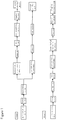
- Figure 1 is a diagram showing an embodiment of a flow chart of a pulp treatment process (Flow I: Examples, Flow II: Comparative example).
- waste pulp refers to pulp recycled from waste paper and includes waste paper pulp obtained by defibering waste paper and deinked pulp obtained by defibering waste paper and then removing inks.
- Waste papers used as raw materials include, for example, newspapers, advertising leaflets, magazines, books, waste office papers, sealed letters, heat-sensitive transfer papers, carbonless copy papers, corrugated fiberboards, white boards, and printed papers generated from photocopiers and office automation equipment.
- Waste magazine papers containing adhesive matters such as pressure sensitive adhesives, adhesives, adhesive tapes, bookbinding glue of magazines and the like can also be used as raw materials of recycled pulp of the present invention.
- waste papers used as raw materials of recycled pulp may contain inorganic particles called ash.
- ash refers to inorganic particles in general remaining after incineration of fillers, pigments and the like internally added or coated during the preparation of paper. For example, it means to include, but not limited to, calcium carbonate, talc, kaolin, titanium dioxide and the like.
- Recycled pulp can contain sodium hydroxide, sodium silicate and other alkaline chemicals, deinking agents, oxidizing bleaches, and reducing bleaches, as appropriate. Further, dyes, fluorescent whitening agents, pH modifiers, defoamers, pitch control agents, slime control agents and the like can also be added as appropriate.
- deinking agents can be used, examples of which include, but not limited to, known or novel surfactants such as nonionic surfactants, anionic surfactants, cationic surfactants and amphoteric surfactants, e.g., fatty acid salts, higher alkyl sulfates, alkyl benzene sulfonates, higher alcohols, alkyl phenols, alkylene oxide adducts of fatty acids or the like, as well as organic solvents, proteins, enzymes, natural polymers, synthetic polymers and the like. These may be used alone or as a mixture of two or more of them.
- surfactants such as nonionic surfactants, anionic surfactants, cationic surfactants and amphoteric surfactants, e.g., fatty acid salts, higher alkyl sulfates, alkyl benzene sulfonates, higher alcohols, alkyl phenols, alkylene oxide adducts of fatty acids or
- a pulp slurry having a solids content of 1.5% by weight or more containing waste paper pulp is fractionated into a long fiber fraction and a short fiber fraction using an outward flow slit screen having openings with a width of 0.1 mm to 0.3 mm.
- the pulp fractionating means that can be used in the present invention may be any outward flow type slit screen (outward flow slit screen), and preferably includes, for example, MaxFlow screens from Aikawa Iron Works Co., Ltd. and the like.
- outward flow screen refers to a screen in which a raw material to be treated passes through openings of a screen basket in the direction from the interior to the exterior. Raw materials readily pass through this type of screen because its openings have a larger outside area than the inside area so that the external pressure tends to be lower than the internal pressure and a centrifugal force acts outward.
- the term “inward flow screen” refers to a screen in which a raw material passes through openings of a screen basket in the direction from the exterior to the interior, and which is unsuitable because it is harder to allow materials to pass through than the outward flow screen used in the present invention and it is liable to be clogged especially at such a high consistency as a solids content of 1.5% by weight or more.
- inward flow screens have been considered to allow more precise fiber fractionation than outward flow screens, but a pulp slurry having a high solids content is treated using an outward flow screen in the present invention.
- a slit screen having slit-like openings is used for fractionation according to the present invention.
- Conventionally, hole screens having round openings have been typically used for fiber fractionation, but a slit screen is used in the present invention. If the hole size of round openings decreases, the open area of the basket decreases so that a large facility is required and such a screen is liable to be clogged with raw materials and contaminants, which makes it difficult to treat high-consistency slurries. If the hole size increases, adhesive contaminants or the like are not sufficiently separated so that the object of the present invention is not fulfilled.
- the slit width is 0.1 to 0.3 mm, preferably 0.13 to 0.2 mm, more preferably 0.13 to 0.15 mm. Screens having a slit width smaller than 0.1 mm are liable to be clogged so that they are difficult to employ at a solids content of 1.5% by weight or more, and very difficult at 2.0% by weight or more as used in the present invention. If the slit width exceeds 0.3 mm, however, adhesive contaminants are not sufficiently separated so that much adhesive contaminants remain especially on the short fiber side and the quality of the finished pulp obtained from the short fiber fraction is degraded unless it undergoes fine screening.
- the fractionation conditions in the present invention are not specifically limited so far as the pulp slurry to be treated has a solids content of 1.5% by weight or more.
- the pulp slurry is screened at a consistency of 1.5% by weight or more and less than 4.0%, more preferably at a consistency of 1.8% by weight or more and less than 3.5%, even more preferably at a consistency of 2.2% by weight or more and less than 3.0%.
- a pulp slurry of defibered waste paper can be treated through the outward flow screen described above after it is passed through a coarse screen without being diluted to a solids content of approximately 1% by weight.
- the fractionation efficiency improves but the advantages of energy saving and facility downsizing as achieved in the present invention cannot be achieved because a large fractionation facility is required and the consistency of the resulting short fiber fraction (accept side) decreases, which also requires a large post-treatment facility such as a large concentrator.
- slurries having a consistency of 4% or more are not suitable because they are difficult to fractionate by screening and tend to cause problems such as clogging.
- a long fiber fraction having a consistency of 2.0% by weight or more can be obtained immediately after fractionation so that the long fiber fraction can be efficiently concentrated using a medium to high consistency concentrator without passing through a low-consistency concentrator, and the long fiber fraction can be stripped of inks very efficiently using an ink-detachment machine after it is concentrated to 25% by weight or more, for example.
- Operating conditions of the screen in the present invention differ in optimal ranges from operating conditions of typical so-called fine screens.
- a preferred passing flow rate through the outward flow screen of the present invention is lower than those of typical fine screens, preferably in the range of 0.6 to 1.2 m/s, more preferably in the range of 0.7 to 1.0 m/s.
- the circumferential speed of the agitator within the screen is higher than usual, preferably 14 to 20 m/s, more preferably 16 to 19 m/s.
- long fiber fraction refers to a fraction that is recovered as a reject side when a pulp slurry is treated through a screen and that is rich in relatively long fibers contained in the pulp slurry before treatment.
- short fiber fraction refers to a fraction that is recovered as an accept side of the screen and that is rich in relatively short fibers, fines and ash contained in the pulp slurry before treatment.
- fractionation takes place at a fractionation ratio of solids of the resulting long fiber fraction/short fiber fraction of 10:90 to 60:40, and the benefits of the present invention are more remarkable at a fractionation ratio of 20:80 to 50:50, especially remarkable at 30:70 to 50:50.
- the part of long fibers in the fractionation ratio of the long fiber fraction/short fiber fraction is smaller than 10:90, the benefits from separately subjecting the fractions to post-treatments decrease because the screening effect is merely on the same level as those obtained by so-called fine screens or the like used for contaminant-removal and the amount of fibers fractionated into the long fiber fraction is small.
- Ratios of long fibers higher than 60:40 are not suitable because the reject side of the screen must be in excess of the accept side, which causes problems such as tendency to clogging of slits and plugging of reject pipes.
- fractionation also takes place to attain a difference in Canadian standard freeness of 100 to 300 ml between the resulting long fiber fraction and short fiber fraction, and the benefits of the present invention are especially remarkable when the difference in Canadian standard freeness is 150 to 200 ml.
- Differences in freeness of less than 100 ml are not suitable because fractionation between long fibers and short fibers does not work so well and accordingly, inks and adhesive contaminants are not separated well so that the finished pulp declines in quality.
- the long fibers are not sufficiently deinked or the short fibers are not sufficiently cleared of adhesive contaminants.
- differences in freeness of 300 ml or more reduce the benefits from preliminarily fractionating a pulp slurry and separately treating the fractions because only long fibers must be removed so that the part of long fibers in the fractionation ratio is too small.
- the present invention it is especially effective and convenient for preparing high-quality finished long fiber pulp to subject the long fiber fraction resulting from the fractionation as described above to pulverization of dirt using a high-consistency ink-detachment machine and to adhesive contaminant removal using a fine screen because the long fiber fraction contains much coarse dirt and adhesive contaminant particles in addition to relatively long fibers but less fine ink particles and ash.
- recycled pulp may be obtained by subjecting the long fiber fraction to an ink detachment step and a contaminant removal step.
- a pulp slurry is fractionated at a solids content of 1.5% by weight or more using the screen described above to give a long fiber fraction having a consistency of 2.0% by weight or more immediately after fractionation so that the long fiber fraction can be efficiently concentrated by using a medium to high consistency concentrator without passing through a low-consistency concentrator, and after the long fiber fraction is dehydrated to, for example, a solids content of 25% or more, it can be stripped of inks very efficiently by pulverizing the inks and coarse dirt particles sticking to long fibers using a high consistency ink-detachment machine or the like, and finished long fiber pulp can be efficiently obtained by, for example, further diluting the long fiber fraction to a solids content of 0.5 to 1.2% and treating it through a fine screen to separate/remove contaminants.
- low-consistency concentrator refers to a predehydrator that dehydrates/concentrates a pulp having a consistency of approximately 1% to a consistency of approximately 3% by weight or more.
- examples include a filtration/dehydration system using a pulp mat such as disk extractor or disk thickener, and a system based on spontaneous dehydration mechanism using a filter or dehydration element such as SP filter or trommel filter. All these systems have the disadvantages that they must have high capacity for treating low-consistency slurries and that they are costly to maintain due to clogging of disks or filters or the like.
- fractionation takes place at a solids content of 1.5% by weight or more using the screen described above to concentrate the reject of the screen and therefore the long fiber fraction discharged as the reject has high consistency so that they can be post-treated without using a low-consistency concentrator, whereby facility downsizing and energy saving can be achieved.
- the term "medium to high consistency dehydrator” refers to an apparatus that dehydrates a pulp having a consistency of approximately 2 to 3% by weight to approximately 10% by weight or an apparatus that dehydrates a pulp having a consistency of approximately 10% by weight to approximately 25 to 30% by weight, such as screw thickener, inclined extractor, screw press or power press.
- the high-consistency ink-detachment machine in the present invention may include a low-speed kneader, high-speed dispersers or the like. Kneaders that can be used include single shaft, twin-shaft and four-shaft kneaders, as well as those having two or more kneading elements. Dispersers that can be used include disk and conical dispersers.
- contaminants can be separated/removed from the long fiber fraction after fractionation by using again a slit screen.
- the long fiber fraction is more likely to have been polluted with much adhesive contaminants during fractionation because this fraction corresponds to the reject of the screen.
- the contaminants should preferably be separated using a screen having a slit width of 0.1 to 0.2 mm, preferably 0.13 to 0.15 mm.
- the long fiber fraction is screened at a feed consistency of 0.5 to 1.2% by weight, more preferably 0.6 to 1.0% by weight, especially preferably 0.6 to 0.8% by weight because it contains high proportions of long fibers and coarse contaminants.
- feed consistency is less than 0.5% by weight, the production cost disadvantageously increases because a large treatment facility is needed. If it is higher than 1.2% by weight, the screen is liable to be clogged with raw materials containing high proportions of long fibers and large amounts of long fibers are discharged so that the retention decreases and the cost increases.
- the production efficiency can be improved by dispensing with the necessity of subjecting the whole pulp slurry to flotation most responsible for yield losses in the production process of recycled pulp and the necessity of ink-removal by flotation is eliminated by removing contaminant from the long fiber fraction through a screen having a slit width of 0.1 to 0.2 mm, whereby facility downsizing and energy saving can be achieved while maintaining the quality of the finished pulp.
- recycled pulp may be obtained by subjecting the short fiber fraction to an ink removal step.
- a finished short fiber pulp containing low levels of residual inks can be obtained by subjecting the short fiber fraction to ink detachment at a solids content of 5% by weight or less and then ink-removal by dehydration and washing and/or flotation.
- the method of ink-detachment at a solids content of 5% or less is not specifically limited, and known ink-detachment methods can be applied, but a preferred embodiment can employ a method by which cavitation bubbles are aggressively introduced into a pulp slurry to strip fibers and ash of inks by using the energy released when the microbubbles collapse.
- the method for aggressively introducing cavitation bubbles is not specifically limited, and includes the method described in Japanese Patent No. 4291819 , for example.
- pulp fibers can be stripped of inks by generating cavitation bubbles using liquid jets and bringing them into contact with a pulp suspension.
- the short fiber fraction rather than the whole pulp slurry can be subjected to flotation most responsible for yield losses in the production process of recycled pulp, whereby facility downsizing and energy saving can be achieved while maintaining the quality of the finished pulp.
- the finished long fiber pulp and finished short fiber pulp obtained by the present invention can be separately incorporated as raw materials to prepare paper. Further, they can be mixed in a given ratio to provide characteristic papers as compared with conventional papers obtained from unfractionated whole pulp. For example, papers containing higher proportions of the finished long fiber pulp have higher bulkiness and higher tear strength. On the other hand, papers containing higher proportions of the finished short fiber pulp have higher density, higher tensile strength (breaking length) and higher smoothness and air resistance.
- a stock containing these finished long fiber pulp and/or finished short fiber pulp mixed with other raw materials may be used to prepare paper.
- the other raw materials include, but not limited to, softwood or hardwood kraft pulp (NKP or LKP); mechanical pulps using softwood or hardwood such as e.g., groundwood pulp (GP), refiner groundwood pulp (RGP), thermomechanical pulp (TMP), chemithermomechanical pulp (CTMP), chemigroundwood pulp (CGP), semichemical pulp (SCP) and the like; waste paper pulp obtained by defibering corrugated fiberboard; coated broke obtained by defibering broke including coated paper, coating base paper and other paper; and mixtures of two or more of these pulps.
- GP groundwood pulp
- RGP refiner groundwood pulp
- TMP thermomechanical pulp
- CGP chemithermomechanical pulp
- CGP chemigroundwood pulp
- SCP semichemical pulp
- multilayer paper can also be prepared in a multilayer paper machine by incorporating the finished long fiber pulp or finished short fiber pulp obtained by the present invention or both in any ratio into the stock of each layer.
- the finished long fiber pulp or finished short fiber pulp obtained by the present invention can be separately combined with chemicals and/or fillers to make paper.
- characteristic papers such as high-ash but high-strength paper can be prepared by adding starches or paper strength additives to the finished long fiber pulp while adding fillers and then retention aids, coagulants, paper strength additives and starches to the short fiber pulp and incorporating both to prepare paper.
- Chemicals to be added include sizing agents such as rosin emulsion, neutral rosin, alkyl ketene dimer, alkenyl succinic anhydride, and styrene-acrylic copolymers; dry-strength enhancers such as resins containing a cationic, zwitterionic or anionic polyacrylamide, polyvinylamine or polyacrylic acid, and guar gum; wet-strength enhancers such as cationic, zwitterionic or anionic modified starches, polyamidoamine-epichlorohydrin and carboxymethyl cellulose; conventionally used internal additives such as drainage aids, colorants, dyes and fluorescent dyes; as well as bulking agents for increasing the bulk (i.e., decreasing the density) of paper.
- sizing agents such as rosin emulsion, neutral rosin, alkyl ketene dimer, alkenyl succinic anhydride, and styrene-
- coagulants include cationic polymers such as polyethyleneimines and modified polyethyleneimines containing a tertiary and/or quaternary ammonium group, polyalkyleneimines, dicyandiamide polymers, polyamines, polyamine/epichlorohydrin polymers, and dialkyldiallyl quaternary ammonium monomers, dialkylaminoalkyl acrylates, dialkylaminoalkyl methacrylates, dialkylaminoalkyl acrylamide/acrylamide polymers, dialkylaminoalkyl methacrylamide/acrylamide polymers, monoamine/epihalohydrin polymers, polyvinylamines and vinylamine-containing polymers as well as mixtures thereof; cation-rich zwitterionic polymers having an anionic group such as carboxyl or sulfone copolymerized in the molecules of the polymers mentioned above; and mixtures of a cationic polymer with an anionic or zwitterionic polymer.
- retention aids may include retention aid systems called dual polymers or micropolymers combining at least one or more cationic or anionic chemicals with a cationic, zwitterionic or anionic high-molecular weight polymer, especially a polyacrylamide-based material or a copolymer containing such a material; as well as retention aid systems combining at least one or more anionic inorganic microparticles such as bentonite, colloidal silica, polysilicic acid, microgels of polysilicic acid or polysilicic acid salts and aluminum-modified products thereof, and organic microparticles of crosslinked/polymerized acrylamide having a particle size of 100 ⁇ m or less called micropolymers. Further, multi-component retention aid systems combining these systems may also be used.
- fillers may include any particles commonly known as inorganic fillers and organic fillers and are not specifically limited.
- inorganic fillers include calcium carbonate (precipitated calcium carbonate, ground calcium carbonate, synthetic calcium carbonate), magnesium carbonate, barium carbonate, aluminum hydroxide, calcium hydroxide, magnesium hydroxide, zinc hydroxide, clay (kaolin, calcined kaolin, delaminated kaolin), talc, zinc oxide, zinc stearate, titanium dioxide, silica prepared from sodium silicate and mineral acids (white carbon, silica/calcium carbonate complexes, silica/titanium dioxide complexes), terra alba, bentonite, kieselguhr, calcium sulfate, inorganic fillers using ash recycled from deinking processes, and inorganic fillers using a complex of the ash with silica or calcium carbonate formed during the recycling process, and the like.
- Calcium carbonate-silica complexes include calcium carbonate and/or precipitated calcium carbonate-silica complexes, which may be used in combination with amorphous silica such as white carbon.
- typical fillers in neutral and alkaline papermaking such as calcium carbonate and precipitated calcium carbonate-silica complexes are preferably used.
- Organic fillers include urea-formalin resins, polystyrene resins, phenol resins, hollow microparticles, acrylamide complexes, wood-derived materials (fines, microfibrils, kenaf powder), modified/insolubilized starches, ungelatinized starches, etc. They may be used alone or as a combination of two or more of them.
- cellulose nanofibers or finely divided cellulose or modified products thereof may also be added.
- the long fiber and short fiber fractions obtained were evaluated for consistency and freeness, the electric power required for fractionation (power consumption rate), as well as water consumption as described below. Further, the fibers before fractionation and the long fiber and short fiber fractions were analyzed for ash content, average fiber length, fiber size composition and the number of adhesive contaminant particles. Further, handsheets having a basis weight of 60 g/m 2 were prepared according to JIS P 8209 using a cylinder handsheet machine, and determined for the number of dirt particles, brightness, and ink levels.
- the electric power required for fractionation was calculated from the motor load and the throughput per hour during operation of the screen and reported as power consumption rate. As this value increase, the production cost increases.
- the length weighted average fiber length was determined using a fiber tester (from Lorentzen & Wettre).
- the fiber composition was determined according to JIS P 8207:1976 using 24-mesh, 42-mesh, 80-mesh and 150-mesh screens.
- 24 mesh on indicates the proportion of fibers retained on the 24-mesh screen.
- 42 mesh on indicates the proportion of fibers passing through the 24-mesh screen but retained on the 42-mesh screen (and so on for 80 mesh on and 150 mesh on).
- 150 mesh pass indicates the proportion of fibers passing through the 150-mesh screen.
- Dirt particles of 0.05 mm 2 or more on five different handsheets were counted by image processing using a contaminant analyzer (Spec* Scan 2000 from Apogee Technologies Inc.) and the number of dirt particles per m 2 was calculated.
- waste newspaper and waste magazine paper were introduced into a high-consistency pulper at a weight ratio of 7:3 and defibered at a temperature of 40°C for 15 minutes in the presence of 1% by weight (net) of caustic soda, 1% by weight (gross) of sodium silicate, 0.5% (net) of hydrogen peroxide and 0.2% (gross) of a higher alcohol deinking agent based on the input solids content.
- the pulp obtained after defibration was treated at a solids content of 2.5% by weight using a coarse screen having a slit width of 0.2 mm to remove contaminants such as coarse adhesive contaminants, thereby giving a pulp slurry containing waste paper pulp (waste paper pulp slurry A).
- waste paper pulp slurry A adjusted to a solids content of 1.9% by weight was fractionated into a long fiber fraction and a short fiber fraction using an outward flow slit screen. Specifically, it was treated using an outward flow slit screen (MaxFlow:MAX1-400 screen) from Aikawa Iron Works Co., Ltd. under conditions of a slit width of 0.15 mm, a passing flow rate of 1.0 m/s, and a circumferential speed of the agitator of 16 m/s to give a long fiber fraction and a short fiber fraction.
- the long fiber fraction here corresponds to the reject side of the screen while the short fiber fraction corresponds to the accept side, and the solids content ratio (fractionation ratio) between the long fiber fraction and the short fiber fraction was 21:79.
- Example 1 The same procedure as described in Example 1 was followed except that the fractionation ratio between the long fiber fraction and the short fiber fraction was adjusted to 47:53 by controlling the feed flow rate and the reject flow rate of the fractionating screen.
- waste paper pulp slurry A was adjusted to a solids content of 1.6% by weight and treated under conditions of a slit width of 0.13 mm, a passing flow rate of 0.9 m/s, and a circumferential speed of the agitator of 14 m/s, and the fractionation ratio between the long fiber fraction and the short fiber fraction was adjusted to 22:78 by controlling the feed flow rate and the reject flow rate of the fractionating screen.
- Example 3 The same procedure as described in Example 3 was followed except that the slurry was treated under conditions of a passing flow rate of 0.7 m/s, and a circumferential speed of the agitator of 13 m/s, and the fractionation ratio between the long fiber fraction and the short fiber fraction was adjusted to 26:74 by controlling the feed flow rate and the reject flow rate of the fractionating screen.
- waste newspaper and waste magazine paper were introduced into a high-consistency pulper at a weight ratio of 8:2 and defibered at a temperature of 40°C for 15 minutes in the presence of 1% by weight (net) of caustic soda, 1% by weight (gross) of sodium silicate, 0.17% (net) of hydrogen peroxide and 0.18% (gross) of a higher alcohol deinking agent based on the input solids content.
- the pulp obtained after defibration was treated at a solids content of 3.3% by weight using a coarse screen having a slit width of 0.2 mm to remove contaminants such as coarse adhesive contaminants, thereby giving a pulp slurry containing waste paper pulp (waste paper pulp slurry B).
- Waste paper pulp slurry B adjusted to a solids content of 2.4% by weight was fractionated using the same outward flow slit screen as used in Example 1 under conditions of a slit width of 0.13 mm, a passing flow rate of 0.8 m/s, and a circumferential speed of the agitator of 18 m/s (the fractionation ratio between the long fiber fraction and the short fiber fraction was 24:76).
- Example 1 The same procedure as described in Example 1 was followed except that the fractionation ratio between the long fiber fraction and the short fiber fraction was adjusted to 65:35 by controlling the feed flow rate and the reject flow rate of the fractionating screen.
- Example 2 The same procedure as described in Example 1 was followed except that the solids content of waste paper pulp slurry A was adjusted to 1.3% by weight and that the fractionation ratio between the long fiber fraction and the short fiber fraction was adjusted to 22:78 by controlling the feed flow rate and the reject flow rate of the fractionating screen.
- Fractionation was preceded by ink-removal using flotation. Specifically, waste paper pulp B of Example 5 was treated by flotation at a solids content of 1%, 40°C using MAC Cell flotator from Aikawa Iron Works Co., Ltd. to give a flotation accept material. Then, the accept having a solids content of 0.8% by weight was fractionated into a long fiber fraction and a short fiber fraction at a fractionation ratio of 39:61 using the same outward flow slit screen as used in Example 1 under conditions of a slit width of 0.13 mm, a passing flow rate of 0.8 m/s, and a circumferential speed of the agitator of 16.5 m/s.
- waste newspaper and waste magazine paper were introduced into a high-consistency pulper at a weight ratio of 8:2 and defibered at a temperature of 40°C for 15 minutes in the presence of 1% by weight (net) of caustic soda, 1% by weight (gross) of sodium silicate, 0.5% (net) of hydrogen peroxide and 0.2% (gross) of a higher alcohol deinking agent based on the input solids content.
- the pulp obtained after defibration was treated at a solids content of 2.3% by weight using a coarse screen having a slit width of 0.2 mm to remove contaminants such as coarse adhesive contaminants, and further flotated at a solids content of 1.2%, 40°C to remove inks, thereby giving a pulp slurry containing waste paper pulp (waste paper pulp slurry C).
- Waste paper pulp slurry C adjusted to a solids content of 0.9% by weight was fractionated into a long fiber fraction and a short fiber fraction using an inward flow slit screen. Specifically, it was fractionated into a long fiber fraction and a short fiber fraction at a fractionation ratio of 64:36 using an inward flow slit screen (FH-400) from Aikawa Iron Works Co., Ltd. under conditions of a slit width of 0.10 mm, a passing flow rate of 1.0 m/s, and a circumferential speed of the agitator of 16.5 m/s.
- FH-400 inward flow slit screen
- Comparative examples 2-5 show that when the feed consistency in the fractionating screen is lower than 1.5% by weight, the consistency of the long fiber fraction decreases, which requires larger post-treatment facilities so that the production cost increases. Further, water consumption increases so that the production cost disadvantageously increases.
- a comparison of Examples 1-8 vs. Comparative examples 1 and 4 shows that when the fractionation ratio of the long fiber fraction is higher than 60%, the difference in freeness between the long fiber fraction and the short fiber fraction becomes less than 100 ml so that the difference in fiber size composition decreases and the distribution of dirt and inks also decreases, which requires a dirt pulverization step for removing ink from both fractions, whereby the production cost increases.
- Example 8 shows that when fractionation is preceded by flotation, the feed consistency for the subsequent fractionation decreases, the electric power required for the treatment increases, and water consumption increases. Further, the consistency of the long fiber fraction decreases, which requires larger post-treatment facilities so that the production cost increases.
- waste paper pulp slurry A was fractionated into a long fiber fraction and a short fiber fraction (fractionation ratio 21:79).
- the long fiber and short fiber fractions were each treated according to Flow I in Figure 1 .
- the long fiber fraction was dehydrated to a solids content of about 30% by weight by medium to high consistency dehydration using an inclined extractor and a screw press, and then contaminants were dispersed at a solids content of 26%, 57°C under a load of 50 kwh/t using a conical disperser (ConiDisc disperser from Aikawa Iron Works Co., Ltd.).
- the treated pulp was diluted to a consistency of 0.7% by weight and removed from contaminant using a fine screen (GFFH screen having a slit width of 0.15 mm from Aikawa Iron Works Co., Ltd.), and further treated in a low-consistency concentrator and a washer/dehydrator to give a finished long fiber pulp (finished long fiber pulp A).
- GFFH screen having a slit width of 0.15 mm from Aikawa Iron Works Co., Ltd.
- the short fiber fraction was concentrated to a solids content of 2.6% by weight using a low-consistency concentrator, and then subjected to ink-detachment with cavitation bubbles using a cavitator (from Nippon Paper Industries Co., Ltd.).
- the cavitation treatment involved one pass jet cavitation treatment by injecting liquid jets at a pressure (upstream pressure) of 8 MPa through a nozzle having a nozzle diameter of 0.2 mm into the pulp slurry in a target container (at a pressure (downstream pressure) of 0.34 MPa in the target container) to generate cavitation bubbles and bringing the cavitation bubbles into contact with the pulp.
- the treated pulp was diluted to a consistency of 1.2% by weight, and flotated using a pressure flotator to give a finished short fiber pulp (finished short fiber pulp A).
- the resulting finished long fiber pulp A and finished short fiber pulp A were analyzed for freeness, ash content, average fiber length, fiber size composition, the number of dirt particles, brightness, ink levels, and the number of adhesive contaminant particles in the same manner as in Experiment 1. Further, the integral electric power required for obtaining each finished pulp from the waste paper defibration step shown in Flow I was calculated from the electric power consumed for various post-fractionation treatments in proportion to the fractionation ratio, and reported as integral power consumption rate. Further, the amount of water required for the most water-consuming treatment in the steps shown in Flow I was reported as maximum water consumption.
- a short fiber pulp was obtained in the same manner as in Example 9 except that the short fiber fraction was not subjected to cavitation (finished short fiber pulp B).
- a handsheet was prepared by blending finished long fiber pulp A and finished short fiber pulp A in a ratio of 20/80 and evaluated in the same manner as in Examples 9 and 10.
- the blending ratio of the pulps was selected to correspond to the fractionation ratio of Example 9 (21:79).
- a finished long fiber pulp was obtained in the same manner as in Example 9 except that the long fiber fraction obtained in Example 8 was subjected to ink-detachment at a solids content of 30%, 86°C under a load of 60kwh/t using a four-shaft kneader (UV -Breaker from Aikawa Iron Works Co., Ltd.) in place of the conical disperser in the treatments of the long fiber fraction shown in Flow I in Figure 1 (finished long fiber pulp B).
- a four-shaft kneader UV -Breaker from Aikawa Iron Works Co., Ltd.
- a finished short fiber pulp C was obtained in the same manner as in Example 9 except that the short fiber fraction obtained in Example 8 was subjected to one pass jet cavitation at a solids content of 2.1% by weight using a cavitator with a nozzle diameter of 0.2 mm at a liquid jet pressure (upstream pressure) of 6 MPa and a pressure in the target container (downstream pressure) of 0.2 MPa in place of the low-consistency concentrator in the treatments of the short fiber fraction shown in Flow I in Figure 1 (finished short fiber pulp C).
- a finished short fiber pulp was obtained in the same manner as in Example 9 except that the short fiber fraction obtained in Example 8 was concentrated to a solids content of 3.3% by weight using a low-consistency concentrator, followed by cavitation and then ink-removal using a washer/dehydrator in place of the flotator in the treatments of the short fiber fraction shown in Flow I in Figure 1 (finished short fiber pulp D).
- waste paper pulp slurry A obtained in Example 1 was treated according to a standard process for preparing deinked pulp shown in Flow II in Figure 1 without undergoing fractionation to give a finished pulp (finished conventional pulp). Specifically, waste paper pulp slurry A was flotated at a solids content of 1% using an open flotator (Hyper-Cell from Aikawa Iron Works Co., Ltd.) and removed from contaminant at a consistency of 0.8% using a fine screen (GFFH screen having a slit width of 0.15 mm from Aikawa Iron Works Co., Ltd.).
- open flotator Hyper-Cell from Aikawa Iron Works Co., Ltd.
- GFFH screen fine screen having a slit width of 0.15 mm from Aikawa Iron Works Co., Ltd.
- the treated pulp was dehydrated to a solids content of about 30% by weight using a low-consistency concentrator followed by an inclined extractor and a screw press, and then contaminants were dispersed at a solids content of 29%, 57°C under a load of 50 kwh/t using a conical disperser (ConiDisc disperser from Aikawa Iron Works Co., Ltd.).
- the treated pulp was diluted to a consistency of 3.4% by weight, and then treated in a washer/dehydrator to give a finished conventional pulp.
- the resulting finished conventional pulp was analyzed for freeness, ash content, average fiber length, fiber size composition, the number of dirt particles, brightness, ink levels, and the number of adhesive contaminant particles in the same manner as in Experiment 1. Further, the integral electric power required for obtaining the finished pulp from the waste paper defibration process shown in Flow II was calculated from the electric power consumed for various treatments and reported as integral power consumption rate. Further, the amount of water required for the most water-consuming treatment in the steps shown in Flow II was reported as maximum water consumption.
- a finished long fiber pulp was obtained in the same manner as in Example 9 except that the long fiber fraction obtained in Comparative example 5 was concentrated to a solids content of 3.2% by weight using a low-consistency concentrator, then dehydrated using a medium to high consistency dehydrator, and then subjected to ink-detachment using a four-shaft kneader in the same manner as in Example 17 (finished long fiber pulp C).
- Comparative example 8 shows that more characteristic pulps can be obtained by using the technique of the present invention as compared with Comparative example 8 omitting fractionation.
- the paper obtained from a finished long fiber pulp of the present invention has lower density, higher bulkiness, and higher tear strength, and the papers obtained from finished short fiber pulps of the present invention have higher smoothness and higher air resistance, as compared with the paper obtained from the pulp of Comparative example 8.
- Comparative example 8 shows that pulps and papers having a comparable level of quality to that of Comparative example 8 omitting fractionation can be obtained with lower power consumption rate and lower water consumption by incorporating again fractionated pulps.
- Examples 11-13 and Examples 14-16 show that pulps can be obtained with varying levels of density, strength and smoothness by incorporating a finished long fiber pulp and a finished short fiber pulp obtained by the present invention at varying ratios as compared with the pulp of Comparative example 8 omitting fractionation. Especially, this benefit is remarkable in Examples 11-13 involving cavitation.
Landscapes
- Engineering & Computer Science (AREA)
- Mechanical Engineering (AREA)
- Paper (AREA)
Claims (10)
- Procédé pour préparer des fractions de pâte recyclée, comprenant le fractionnement d'une pâte liquide ayant une teneur en solides de 2,2 % en poids ou plus contenant de la pâte de vieux papiers en une fraction de fibres longues et une fraction de fibres courtes en utilisant un tamis à fentes à flux sortant ayant des ouvertures avec une largeur de fente de 0,1 mm à 0,3 mm et un agitateur au sein du tamis, dans lequel le rapport de la teneur en solides de la fraction de fibres longues et de la fraction de fibres courtes est de 10:90 à 60:40, dans lequel la différence d'égouttage selon la norme canadienne entre la fraction de fibres longues et la fraction de fibres courtes est de 100 ml à 300 ml, dans lequel le fractionnement est effectué de sorte que le débit de passage à travers le tamis à fentes à flux sortant est de 0,6 à 1,2 m/s, et dans lequel la vitesse circonférentielle de l'agitateur au sein du tamis est de 14 à 20 m/s.
- Procédé selon la revendication 1 comprenant le fait de soumettre la fraction de fibres longues à une étape de désencrage et à une étape d'élimination des contaminants.
- Procédé selon la revendication 2 dans lequel la fraction de fibres longues a une teneur en solides de 2,0 % en poids ou plus immédiatement après le fractionnement, et dans lequel la fraction est déshydratée jusqu'à une teneur en solides de 25 % en poids ou plus et puis soumise à l'étape de désencrage et à l'étape d'élimination des contaminants à une teneur en solides de 0,5 à 1,2 % en poids en utilisant un tamis ayant une largeur de fente de 0,1 à 0,2 mm.
- Procédé selon l'une quelconque des revendications 1 à 3 dans lequel la fraction de fibres longues n'est pas soumise à une étape d'élimination de l'encre par flottation.
- Procédé selon l'une quelconque des revendications 1 à 4 comprenant le fait de soumettre la fraction de fibres courtes à une étape d'élimination de l'encre.
- Procédé selon la revendication 5 dans lequel la fraction de fibres courtes est soumise à une étape de désencrage à une teneur en solides de 5 % ou moins et puis soumise à l'étape d'élimination de l'encre.
- Procédé selon la revendication 6 dans lequel l'étape de désencrage comprend le fait d'amener des bulles de cavitation en contact avec la pâte.
- Procédé selon l'une quelconque des revendications 1 à 7 dans lequel la fraction de fibres courtes n'est pas soumise à une étape d'élimination des contaminants en utilisant un tamis.
- Procédé pour préparer du papier comprenant le procédé selon l'une quelconque des revendications 1 à 8.
- Procédé selon l'une quelconque des revendications 1 à 9, dans lequel la largeur de fente du tamis à fentes est d'au moins 0,13 mm.
Applications Claiming Priority (2)
| Application Number | Priority Date | Filing Date | Title |
|---|---|---|---|
| JP2011077950 | 2011-03-31 | ||
| PCT/JP2012/051383 WO2012132513A1 (fr) | 2011-03-31 | 2012-01-24 | Procédé pour produire de la pâte et du papier |
Publications (3)
| Publication Number | Publication Date |
|---|---|
| EP2692945A1 EP2692945A1 (fr) | 2014-02-05 |
| EP2692945A4 EP2692945A4 (fr) | 2014-11-19 |
| EP2692945B1 true EP2692945B1 (fr) | 2018-06-06 |
Family
ID=46930281
Family Applications (1)
| Application Number | Title | Priority Date | Filing Date |
|---|---|---|---|
| EP12763869.0A Not-in-force EP2692945B1 (fr) | 2011-03-31 | 2012-01-24 | Procédé pour produire de la pâte et du papier |
Country Status (5)
| Country | Link |
|---|---|
| US (1) | US8926793B2 (fr) |
| EP (1) | EP2692945B1 (fr) |
| JP (1) | JP5442165B2 (fr) |
| CA (1) | CA2831570C (fr) |
| WO (1) | WO2012132513A1 (fr) |
Families Citing this family (12)
| Publication number | Priority date | Publication date | Assignee | Title |
|---|---|---|---|---|
| EP2692945B1 (fr) * | 2011-03-31 | 2018-06-06 | Nippon Paper Industries Co., Ltd. | Procédé pour produire de la pâte et du papier |
| JP5952030B2 (ja) * | 2011-03-31 | 2016-07-13 | 日本製紙株式会社 | 紙の製造方法 |
| GB201304717D0 (en) | 2013-03-15 | 2013-05-01 | Imerys Minerals Ltd | Paper composition |
| CN109722936B (zh) * | 2014-02-27 | 2022-01-18 | 艺康美国股份有限公司 | 利用杀生物剂在造纸中保护回收纤维的方法以及利用回收纤维造纸的方法 |
| TWI654141B (zh) | 2014-03-31 | 2019-03-21 | 日商日本製紙股份有限公司 | Calcium carbonate microparticles and method of producing the same |
| US10041209B1 (en) | 2015-08-21 | 2018-08-07 | Pulmac Systems International, Inc. | System for engineering fibers to improve paper production |
| US10941520B2 (en) | 2015-08-21 | 2021-03-09 | Pulmac Systems International, Inc. | Fractionating and refining system for engineering fibers to improve paper production |
| US11214925B2 (en) | 2015-08-21 | 2022-01-04 | Pulmac Systems International, Inc. | Method of preparing recycled cellulosic fibers to improve paper production |
| JP6635889B2 (ja) * | 2016-07-15 | 2020-01-29 | 日本製紙株式会社 | 古紙パルプの製造方法 |
| FI130796B1 (fi) * | 2021-11-30 | 2024-03-25 | Valmet Technologies Oy | Menetelmä eri pituisten tekstiilikuitujen käsittelemiseksi |
| CN114525698A (zh) * | 2021-12-28 | 2022-05-24 | 玖龙纸业(东莞)有限公司 | 一种提高灰底涂布白板纸芯层结合力的装置和方法 |
| CN120666592A (zh) * | 2025-07-11 | 2025-09-19 | 江门市桥裕纸业有限公司 | 一种高耐折瓦楞原纸的生产工艺 |
Family Cites Families (24)
| Publication number | Priority date | Publication date | Assignee | Title |
|---|---|---|---|---|
| FR2603917B1 (fr) * | 1986-09-15 | 1991-08-30 | Lamort E & M | Procede et installation de traitement de vieux papiers imprimes |
| DE3827336A1 (de) * | 1988-08-12 | 1990-02-15 | Escher Wyss Gmbh | Verfahren zur behandlung der kurzfaserfraktion nach abtrennen der langfaserfraktion aus einem sekundaerfasergemisch, insbesondere zur herstellung von faltschachtelkartons |
| JP2986525B2 (ja) * | 1990-10-01 | 1999-12-06 | 相川鉄工株式会社 | 再生紙用脱墨方法 |
| SE501273C2 (sv) * | 1993-05-14 | 1994-12-19 | Knutsilplaotar Ab | Siltrumma för silning av suspensioner av lignocellulosahaltigt fibermaterial |
| US5503709A (en) * | 1994-07-27 | 1996-04-02 | Burton; Steven W. | Environmentally improved process for preparing recycled lignocellulosic materials for bleaching |
| JPH08260372A (ja) * | 1995-03-28 | 1996-10-08 | Aikawa Iron Works Co Ltd | 抄紙機の濾水性改善方法 |
| KR100288123B1 (ko) * | 1998-06-27 | 2001-05-02 | 김충섭 | 부상부유 및 니딩 처리를 이용한 골판지 고지의 재생방법 |
| SE513596C2 (sv) * | 1999-02-22 | 2000-10-09 | Stora Kopparbergs Bergslags Ab | Metod vid tillverkning av papper eller kartong |
| US7168570B2 (en) * | 2001-10-24 | 2007-01-30 | Advanced Fiber Technologies | Screen cylinder with performance boosting configuration |
| DE10244521B3 (de) * | 2002-09-25 | 2004-02-19 | Voith Paper Patent Gmbh | Verfahren zur Aufbereitung von Altpapier |
| JP2004131892A (ja) | 2002-10-11 | 2004-04-30 | Daio Paper Corp | 古紙パルプの製造方法および紙 |
| US6730223B1 (en) * | 2002-11-01 | 2004-05-04 | Comprehensive Resources, Recovery & Reuse, Inc. | Apparatus, system and method for treating waste material |
| JP2004169213A (ja) * | 2002-11-20 | 2004-06-17 | Daio Paper Corp | 古紙パルプ混合クラフトパルプの製造方法及び同製造方法によって得られる古紙パルプ混合クラフトパルプ |
| US20040256065A1 (en) * | 2003-06-18 | 2004-12-23 | Aziz Ahmed | Method for producing corn stalk pulp and paper products from corn stalk pulp |
| EP1652999B1 (fr) | 2003-07-31 | 2016-04-06 | Nippon Paper Industries Co., Ltd. | Procede pour produire de la pate a papier recyclee, procede pour modifier la surface de la fibre de pate a papier et le contaminant, appareil de traitement de la pate a papier |
| EP1728918A3 (fr) | 2005-05-12 | 2006-12-13 | Voith Patent GmbH | Procédé pour séparer des impuretés d'une suspension aqueuse de fibres |
| ES2343897T3 (es) * | 2005-12-17 | 2010-08-12 | Voith Patent Gmbh | Procedimiento para retirar materias perturbadoras de una suspension acuosa de material fibroso. |
| DE102006020215A1 (de) * | 2006-05-02 | 2007-11-08 | Voith Patent Gmbh | Verfahren zum Fraktionieren und Bearbeiten einer Papierfasersuspension |
| FI118809B (fi) * | 2006-09-11 | 2008-03-31 | M Real Oyj | Menetelmä kuitutuotteen valmistamiseksi |
| JP5210297B2 (ja) * | 2007-03-20 | 2013-06-12 | 日本製紙株式会社 | 印刷古紙の脱墨方法 |
| DE102008063785A1 (de) * | 2008-12-18 | 2010-06-24 | Voith Patent Gmbh | Verfahren zur Aufbereitung von Altpapier enthaltenden Rohstoffen zu einer zur Erzeugung graphischer Papiere geeigneten Faserstoffsuspension |
| JP5123404B2 (ja) * | 2011-01-20 | 2013-01-23 | 日本製紙株式会社 | パルプの調成方法 |
| JP5952030B2 (ja) * | 2011-03-31 | 2016-07-13 | 日本製紙株式会社 | 紙の製造方法 |
| EP2692945B1 (fr) * | 2011-03-31 | 2018-06-06 | Nippon Paper Industries Co., Ltd. | Procédé pour produire de la pâte et du papier |
-
2012
- 2012-01-24 EP EP12763869.0A patent/EP2692945B1/fr not_active Not-in-force
- 2012-01-24 JP JP2013507216A patent/JP5442165B2/ja not_active Expired - Fee Related
- 2012-01-24 US US14/008,239 patent/US8926793B2/en not_active Expired - Fee Related
- 2012-01-24 WO PCT/JP2012/051383 patent/WO2012132513A1/fr not_active Ceased
- 2012-01-24 CA CA2831570A patent/CA2831570C/fr not_active Expired - Fee Related
Non-Patent Citations (1)
| Title |
|---|
| None * |
Also Published As
| Publication number | Publication date |
|---|---|
| US20140020856A1 (en) | 2014-01-23 |
| US8926793B2 (en) | 2015-01-06 |
| JPWO2012132513A1 (ja) | 2014-07-24 |
| EP2692945A1 (fr) | 2014-02-05 |
| CA2831570C (fr) | 2018-12-04 |
| CA2831570A1 (fr) | 2012-10-04 |
| EP2692945A4 (fr) | 2014-11-19 |
| WO2012132513A1 (fr) | 2012-10-04 |
| JP5442165B2 (ja) | 2014-03-12 |
Similar Documents
| Publication | Publication Date | Title |
|---|---|---|
| EP2692945B1 (fr) | Procédé pour produire de la pâte et du papier | |
| JP6285479B2 (ja) | 紙の製造方法 | |
| USRE36424E (en) | Method for producing pulp from printed unselected waste paper | |
| SE517297C2 (sv) | Metod vid produktion av mekanisk massa från ett cellulosainnehållande material, massa framställd enligt metoden samt kartong producerad av massan | |
| Grossmann et al. | Paper recycling | |
| US5895556A (en) | Waste paper treatment process | |
| JP6635889B2 (ja) | 古紙パルプの製造方法 | |
| US20070023329A1 (en) | Method for selective removal of ray cells from cellulose pulp | |
| JP6875828B2 (ja) | 脱墨フロス由来のパルプ繊維を含む紙 | |
| US6187135B1 (en) | Process for making recycled paper having improving strength properties | |
| CA1229955A (fr) | Production de pate a papier a partir de rebuts imprimes tout-venant | |
| CN120457252A (zh) | 将剥离衬纸玻璃纸和sck再生成高质量纸浆 | |
| Blechschmidt et al. | Fibrous materials for paper and board manufacture | |
| US11560672B2 (en) | Methods for deinking UV prints | |
| WO2021228486A1 (fr) | Procédé de production de produits de papier | |
| Kumar | Deinking pulp fractionation: characterization and separation of fines by screening | |
| Engstrand et al. | 15 Paper Recycling | |
| Holik et al. | Stock preparation | |
| Kumar et al. | Fractionation by micro-hole pressure screening and hydrocyclone applied to deinking line rationalization and future manufacturing concept | |
| CN120457253A (zh) | 包含再生纤维的玻璃纸 | |
| JP2020165021A (ja) | 脱墨パルプの製造方法 | |
| JP2004131892A (ja) | 古紙パルプの製造方法および紙 | |
| Woodward | Controlling contaminants in the production and use of deinked pulp | |
| McKinney | 3 Wastepaper preparation and contamination | |
| Jain et al. | Enzymatic Deinking of Mixed Office Waste Paper: An Overview |
Legal Events
| Date | Code | Title | Description |
|---|---|---|---|
| PUAI | Public reference made under article 153(3) epc to a published international application that has entered the european phase |
Free format text: ORIGINAL CODE: 0009012 |
|
| 17P | Request for examination filed |
Effective date: 20131004 |
|
| AK | Designated contracting states |
Kind code of ref document: A1 Designated state(s): AL AT BE BG CH CY CZ DE DK EE ES FI FR GB GR HR HU IE IS IT LI LT LU LV MC MK MT NL NO PL PT RO RS SE SI SK SM TR |
|
| DAX | Request for extension of the european patent (deleted) | ||
| A4 | Supplementary search report drawn up and despatched |
Effective date: 20141022 |
|
| RIC1 | Information provided on ipc code assigned before grant |
Ipc: D21H 11/14 20060101ALI20141016BHEP Ipc: D21D 5/02 20060101AFI20141016BHEP Ipc: D21D 99/00 20060101ALI20141016BHEP Ipc: D21C 5/02 20060101ALI20141016BHEP |
|
| STAA | Information on the status of an ep patent application or granted ep patent |
Free format text: STATUS: EXAMINATION IS IN PROGRESS |
|
| 17Q | First examination report despatched |
Effective date: 20170320 |
|
| GRAP | Despatch of communication of intention to grant a patent |
Free format text: ORIGINAL CODE: EPIDOSNIGR1 |
|
| STAA | Information on the status of an ep patent application or granted ep patent |
Free format text: STATUS: GRANT OF PATENT IS INTENDED |
|
| INTG | Intention to grant announced |
Effective date: 20180103 |
|
| RIN1 | Information on inventor provided before grant (corrected) |
Inventor name: GOTO, SHISEI Inventor name: OHTAKE, HIROKI Inventor name: NODA, TAKAHARU Inventor name: HOSAKA, TATSUMI |
|
| GRAS | Grant fee paid |
Free format text: ORIGINAL CODE: EPIDOSNIGR3 |
|
| GRAA | (expected) grant |
Free format text: ORIGINAL CODE: 0009210 |
|
| STAA | Information on the status of an ep patent application or granted ep patent |
Free format text: STATUS: THE PATENT HAS BEEN GRANTED |
|
| AK | Designated contracting states |
Kind code of ref document: B1 Designated state(s): AL AT BE BG CH CY CZ DE DK EE ES FI FR GB GR HR HU IE IS IT LI LT LU LV MC MK MT NL NO PL PT RO RS SE SI SK SM TR |
|
| REG | Reference to a national code |
Ref country code: GB Ref legal event code: FG4D |
|
| REG | Reference to a national code |
Ref country code: CH Ref legal event code: EP Ref country code: AT Ref legal event code: REF Ref document number: 1006209 Country of ref document: AT Kind code of ref document: T Effective date: 20180615 |
|
| REG | Reference to a national code |
Ref country code: IE Ref legal event code: FG4D |
|
| REG | Reference to a national code |
Ref country code: DE Ref legal event code: R096 Ref document number: 602012047186 Country of ref document: DE |
|
| REG | Reference to a national code |
Ref country code: SE Ref legal event code: TRGR |
|
| REG | Reference to a national code |
Ref country code: NL Ref legal event code: MP Effective date: 20180606 |
|
| REG | Reference to a national code |
Ref country code: LT Ref legal event code: MG4D |
|
| PG25 | Lapsed in a contracting state [announced via postgrant information from national office to epo] |
Ref country code: NO Free format text: LAPSE BECAUSE OF FAILURE TO SUBMIT A TRANSLATION OF THE DESCRIPTION OR TO PAY THE FEE WITHIN THE PRESCRIBED TIME-LIMIT Effective date: 20180906 Ref country code: BG Free format text: LAPSE BECAUSE OF FAILURE TO SUBMIT A TRANSLATION OF THE DESCRIPTION OR TO PAY THE FEE WITHIN THE PRESCRIBED TIME-LIMIT Effective date: 20180906 Ref country code: ES Free format text: LAPSE BECAUSE OF FAILURE TO SUBMIT A TRANSLATION OF THE DESCRIPTION OR TO PAY THE FEE WITHIN THE PRESCRIBED TIME-LIMIT Effective date: 20180606 Ref country code: CY Free format text: LAPSE BECAUSE OF FAILURE TO SUBMIT A TRANSLATION OF THE DESCRIPTION OR TO PAY THE FEE WITHIN THE PRESCRIBED TIME-LIMIT Effective date: 20180606 Ref country code: LT Free format text: LAPSE BECAUSE OF FAILURE TO SUBMIT A TRANSLATION OF THE DESCRIPTION OR TO PAY THE FEE WITHIN THE PRESCRIBED TIME-LIMIT Effective date: 20180606 |
|
| PG25 | Lapsed in a contracting state [announced via postgrant information from national office to epo] |
Ref country code: LV Free format text: LAPSE BECAUSE OF FAILURE TO SUBMIT A TRANSLATION OF THE DESCRIPTION OR TO PAY THE FEE WITHIN THE PRESCRIBED TIME-LIMIT Effective date: 20180606 Ref country code: HR Free format text: LAPSE BECAUSE OF FAILURE TO SUBMIT A TRANSLATION OF THE DESCRIPTION OR TO PAY THE FEE WITHIN THE PRESCRIBED TIME-LIMIT Effective date: 20180606 Ref country code: GR Free format text: LAPSE BECAUSE OF FAILURE TO SUBMIT A TRANSLATION OF THE DESCRIPTION OR TO PAY THE FEE WITHIN THE PRESCRIBED TIME-LIMIT Effective date: 20180907 Ref country code: RS Free format text: LAPSE BECAUSE OF FAILURE TO SUBMIT A TRANSLATION OF THE DESCRIPTION OR TO PAY THE FEE WITHIN THE PRESCRIBED TIME-LIMIT Effective date: 20180606 |
|
| REG | Reference to a national code |
Ref country code: AT Ref legal event code: MK05 Ref document number: 1006209 Country of ref document: AT Kind code of ref document: T Effective date: 20180606 |
|
| PG25 | Lapsed in a contracting state [announced via postgrant information from national office to epo] |
Ref country code: NL Free format text: LAPSE BECAUSE OF FAILURE TO SUBMIT A TRANSLATION OF THE DESCRIPTION OR TO PAY THE FEE WITHIN THE PRESCRIBED TIME-LIMIT Effective date: 20180606 |
|
| PG25 | Lapsed in a contracting state [announced via postgrant information from national office to epo] |
Ref country code: PL Free format text: LAPSE BECAUSE OF FAILURE TO SUBMIT A TRANSLATION OF THE DESCRIPTION OR TO PAY THE FEE WITHIN THE PRESCRIBED TIME-LIMIT Effective date: 20180606 Ref country code: AT Free format text: LAPSE BECAUSE OF FAILURE TO SUBMIT A TRANSLATION OF THE DESCRIPTION OR TO PAY THE FEE WITHIN THE PRESCRIBED TIME-LIMIT Effective date: 20180606 Ref country code: EE Free format text: LAPSE BECAUSE OF FAILURE TO SUBMIT A TRANSLATION OF THE DESCRIPTION OR TO PAY THE FEE WITHIN THE PRESCRIBED TIME-LIMIT Effective date: 20180606 Ref country code: IS Free format text: LAPSE BECAUSE OF FAILURE TO SUBMIT A TRANSLATION OF THE DESCRIPTION OR TO PAY THE FEE WITHIN THE PRESCRIBED TIME-LIMIT Effective date: 20181006 Ref country code: RO Free format text: LAPSE BECAUSE OF FAILURE TO SUBMIT A TRANSLATION OF THE DESCRIPTION OR TO PAY THE FEE WITHIN THE PRESCRIBED TIME-LIMIT Effective date: 20180606 Ref country code: CZ Free format text: LAPSE BECAUSE OF FAILURE TO SUBMIT A TRANSLATION OF THE DESCRIPTION OR TO PAY THE FEE WITHIN THE PRESCRIBED TIME-LIMIT Effective date: 20180606 Ref country code: SK Free format text: LAPSE BECAUSE OF FAILURE TO SUBMIT A TRANSLATION OF THE DESCRIPTION OR TO PAY THE FEE WITHIN THE PRESCRIBED TIME-LIMIT Effective date: 20180606 |
|
| PG25 | Lapsed in a contracting state [announced via postgrant information from national office to epo] |
Ref country code: SM Free format text: LAPSE BECAUSE OF FAILURE TO SUBMIT A TRANSLATION OF THE DESCRIPTION OR TO PAY THE FEE WITHIN THE PRESCRIBED TIME-LIMIT Effective date: 20180606 Ref country code: IT Free format text: LAPSE BECAUSE OF FAILURE TO SUBMIT A TRANSLATION OF THE DESCRIPTION OR TO PAY THE FEE WITHIN THE PRESCRIBED TIME-LIMIT Effective date: 20180606 |
|
| REG | Reference to a national code |
Ref country code: DE Ref legal event code: R097 Ref document number: 602012047186 Country of ref document: DE |
|
| PLBE | No opposition filed within time limit |
Free format text: ORIGINAL CODE: 0009261 |
|
| STAA | Information on the status of an ep patent application or granted ep patent |
Free format text: STATUS: NO OPPOSITION FILED WITHIN TIME LIMIT |
|
| 26N | No opposition filed |
Effective date: 20190307 |
|
| PG25 | Lapsed in a contracting state [announced via postgrant information from national office to epo] |
Ref country code: SI Free format text: LAPSE BECAUSE OF FAILURE TO SUBMIT A TRANSLATION OF THE DESCRIPTION OR TO PAY THE FEE WITHIN THE PRESCRIBED TIME-LIMIT Effective date: 20180606 Ref country code: DK Free format text: LAPSE BECAUSE OF FAILURE TO SUBMIT A TRANSLATION OF THE DESCRIPTION OR TO PAY THE FEE WITHIN THE PRESCRIBED TIME-LIMIT Effective date: 20180606 |
|
| REG | Reference to a national code |
Ref country code: DE Ref legal event code: R119 Ref document number: 602012047186 Country of ref document: DE |
|
| PG25 | Lapsed in a contracting state [announced via postgrant information from national office to epo] |
Ref country code: MC Free format text: LAPSE BECAUSE OF FAILURE TO SUBMIT A TRANSLATION OF THE DESCRIPTION OR TO PAY THE FEE WITHIN THE PRESCRIBED TIME-LIMIT Effective date: 20180606 |
|
| REG | Reference to a national code |
Ref country code: CH Ref legal event code: PL |
|
| GBPC | Gb: european patent ceased through non-payment of renewal fee |
Effective date: 20190124 |
|
| PG25 | Lapsed in a contracting state [announced via postgrant information from national office to epo] |
Ref country code: LU Free format text: LAPSE BECAUSE OF NON-PAYMENT OF DUE FEES Effective date: 20190124 |
|
| REG | Reference to a national code |
Ref country code: BE Ref legal event code: MM Effective date: 20190131 |
|
| REG | Reference to a national code |
Ref country code: IE Ref legal event code: MM4A |
|
| PG25 | Lapsed in a contracting state [announced via postgrant information from national office to epo] |
Ref country code: FR Free format text: LAPSE BECAUSE OF NON-PAYMENT OF DUE FEES Effective date: 20190131 Ref country code: DE Free format text: LAPSE BECAUSE OF NON-PAYMENT OF DUE FEES Effective date: 20190801 |
|
| PG25 | Lapsed in a contracting state [announced via postgrant information from national office to epo] |
Ref country code: AL Free format text: LAPSE BECAUSE OF FAILURE TO SUBMIT A TRANSLATION OF THE DESCRIPTION OR TO PAY THE FEE WITHIN THE PRESCRIBED TIME-LIMIT Effective date: 20180606 Ref country code: BE Free format text: LAPSE BECAUSE OF NON-PAYMENT OF DUE FEES Effective date: 20190131 |
|
| PG25 | Lapsed in a contracting state [announced via postgrant information from national office to epo] |
Ref country code: GB Free format text: LAPSE BECAUSE OF NON-PAYMENT OF DUE FEES Effective date: 20190124 Ref country code: LI Free format text: LAPSE BECAUSE OF NON-PAYMENT OF DUE FEES Effective date: 20190131 Ref country code: CH Free format text: LAPSE BECAUSE OF NON-PAYMENT OF DUE FEES Effective date: 20190131 |
|
| PG25 | Lapsed in a contracting state [announced via postgrant information from national office to epo] |
Ref country code: IE Free format text: LAPSE BECAUSE OF NON-PAYMENT OF DUE FEES Effective date: 20190124 |
|
| PG25 | Lapsed in a contracting state [announced via postgrant information from national office to epo] |
Ref country code: TR Free format text: LAPSE BECAUSE OF FAILURE TO SUBMIT A TRANSLATION OF THE DESCRIPTION OR TO PAY THE FEE WITHIN THE PRESCRIBED TIME-LIMIT Effective date: 20180606 |
|
| PGFP | Annual fee paid to national office [announced via postgrant information from national office to epo] |
Ref country code: SE Payment date: 20200122 Year of fee payment: 9 Ref country code: FI Payment date: 20200120 Year of fee payment: 9 |
|
| PG25 | Lapsed in a contracting state [announced via postgrant information from national office to epo] |
Ref country code: MT Free format text: LAPSE BECAUSE OF NON-PAYMENT OF DUE FEES Effective date: 20190124 Ref country code: PT Free format text: LAPSE BECAUSE OF FAILURE TO SUBMIT A TRANSLATION OF THE DESCRIPTION OR TO PAY THE FEE WITHIN THE PRESCRIBED TIME-LIMIT Effective date: 20181008 |
|
| PG25 | Lapsed in a contracting state [announced via postgrant information from national office to epo] |
Ref country code: HU Free format text: LAPSE BECAUSE OF FAILURE TO SUBMIT A TRANSLATION OF THE DESCRIPTION OR TO PAY THE FEE WITHIN THE PRESCRIBED TIME-LIMIT; INVALID AB INITIO Effective date: 20120124 |
|
| REG | Reference to a national code |
Ref country code: FI Ref legal event code: MAE |
|
| REG | Reference to a national code |
Ref country code: SE Ref legal event code: EUG |
|
| PG25 | Lapsed in a contracting state [announced via postgrant information from national office to epo] |
Ref country code: FI Free format text: LAPSE BECAUSE OF NON-PAYMENT OF DUE FEES Effective date: 20210124 |
|
| PG25 | Lapsed in a contracting state [announced via postgrant information from national office to epo] |
Ref country code: SE Free format text: LAPSE BECAUSE OF NON-PAYMENT OF DUE FEES Effective date: 20210125 |
|
| PG25 | Lapsed in a contracting state [announced via postgrant information from national office to epo] |
Ref country code: MK Free format text: LAPSE BECAUSE OF FAILURE TO SUBMIT A TRANSLATION OF THE DESCRIPTION OR TO PAY THE FEE WITHIN THE PRESCRIBED TIME-LIMIT Effective date: 20180606 |