EP2696286A2 - Elektronische Vorrichtung und Verfahren zur Ressourcenzuweisung für virtuelle Maschinen - Google Patents
Elektronische Vorrichtung und Verfahren zur Ressourcenzuweisung für virtuelle Maschinen Download PDFInfo
- Publication number
- EP2696286A2 EP2696286A2 EP13178816.8A EP13178816A EP2696286A2 EP 2696286 A2 EP2696286 A2 EP 2696286A2 EP 13178816 A EP13178816 A EP 13178816A EP 2696286 A2 EP2696286 A2 EP 2696286A2
- Authority
- EP
- European Patent Office
- Prior art keywords
- specified resources
- resources
- virtual machine
- usage
- specified
- Prior art date
- Legal status (The legal status is an assumption and is not a legal conclusion. Google has not performed a legal analysis and makes no representation as to the accuracy of the status listed.)
- Withdrawn
Links
Images



Classifications
-
- G—PHYSICS
- G06—COMPUTING OR CALCULATING; COUNTING
- G06F—ELECTRIC DIGITAL DATA PROCESSING
- G06F9/00—Arrangements for program control, e.g. control units
- G06F9/06—Arrangements for program control, e.g. control units using stored programs, i.e. using an internal store of processing equipment to receive or retain programs
- G06F9/44—Arrangements for executing specific programs
- G06F9/455—Emulation; Interpretation; Software simulation, e.g. virtualisation or emulation of application or operating system execution engines
- G06F9/45533—Hypervisors; Virtual machine monitors
-
- G—PHYSICS
- G06—COMPUTING OR CALCULATING; COUNTING
- G06F—ELECTRIC DIGITAL DATA PROCESSING
- G06F9/00—Arrangements for program control, e.g. control units
- G06F9/06—Arrangements for program control, e.g. control units using stored programs, i.e. using an internal store of processing equipment to receive or retain programs
- G06F9/46—Multiprogramming arrangements
- G06F9/50—Allocation of resources, e.g. of the central processing unit [CPU]
- G06F9/5005—Allocation of resources, e.g. of the central processing unit [CPU] to service a request
- G06F9/5011—Allocation of resources, e.g. of the central processing unit [CPU] to service a request the resources being hardware resources other than CPUs, Servers and Terminals
-
- G—PHYSICS
- G06—COMPUTING OR CALCULATING; COUNTING
- G06F—ELECTRIC DIGITAL DATA PROCESSING
- G06F9/00—Arrangements for program control, e.g. control units
- G06F9/06—Arrangements for program control, e.g. control units using stored programs, i.e. using an internal store of processing equipment to receive or retain programs
- G06F9/46—Multiprogramming arrangements
- G06F9/50—Allocation of resources, e.g. of the central processing unit [CPU]
- G06F9/5061—Partitioning or combining of resources
- G06F9/5077—Logical partitioning of resources; Management or configuration of virtualized resources
Definitions
- Embodiments of the present disclosure relate to cloud computing technology, and particularly to an electronic device and method for allocating resources for virtual machines.
- Cloud computing technology provides services to client users with a lower cost. Because the client users do not need to buy much hardware, the client users can obtain the services by employing virtual machines from a cloud computing provider.
- the user can specify and buy resources of the virtual machines with a corresponding price. Then, the cloud computing provider allocates the specified resources to the user and makes a charge according to the price.
- the cloud computing provider allocates the specified resources to the user and makes a charge according to the price.
- the user employs the virtual machines, he/she may not actually know the amount of resources really needed for completing the services. Therefore, a more efficient method for allocating resources of virtual machines is desired.
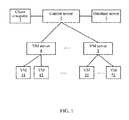
- FIG. 1 is a schematic block diagram of a control server connecting with a plurality of virtual machine servers, client computers, and database servers.
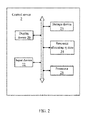
- FIG. 2 is a block diagram of one embodiment of the control server including a resource allocating system.
- FIG. 3 is a schematic block diagram of function modules of the resource allocating system included in the control server.
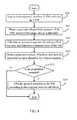
- FIG. 4 is a flowchart of one embodiment of a method for allocating resources for virtual machines using the control server.
- FIG. 5 is a schematic diagram of a master/slave architecture of the plurality of database servers.
- FIG. 6 is a schematic diagram of distributed parallel computing using the plurality of database servers.
- FIG. 1 is a schematic block diagram of a control server 2 connected to a plurality of virtual machine (VM) servers, client computers, and database servers.
- the control server 2 is connected to the VM servers (e.g., a VM server 4 and a VM server 5), the client computers (only client computer 1 is shown in FIG. 1 ), and the database servers (only one database server 3 is shown in FIG. 1 ) through a network.
- the network may be an intranet, the Internet or other suitable communication network, such as general packet radio service (GPRS), WIFI/wireless local area network (WIFI/WLAN), third generation/wideband code division multiple access (3G/WCDMA), or 3.5G/high-speed downlink packet access (3.5G/HSDPA).
- GPRS general packet radio service
- WIFI/WLAN WIFI/wireless local area network
- 3G/WCDMA third generation/wideband code division multiple access
- 3.5G/HSDPA 3.5G/high-speed downlink packet access
- Each of the VM servers includes a VM monitoring program, which obtains usage rates of specified resources of the VMs installed on the VM server after a preset time interval (e.g., ten minutes), and sends the usage rates of the specified resources to the control server 2.
- the usage rates of the specified resources may include, but are not limited to, a central processing unit (CPU) usage rate (CPU%), a memory usage rate (Memory%), and a hard disk usage rate (Disk%) of the VM servers occupied by the virtual machines.
- the VM server 4 obtains the usage rates of the CPU of the virtual machines 41 and 42
- the VM server 5 obtains the usage rates of the CPU of the virtual machines 51 and 52.
- the specified resources may be reduced or increased.
- the control server 2 stores the usage rates of the specified resources of the virtual machines into different data tables in the database servers 3 according to a name of each virtual machine.
- the usage rates of the specified resources of VM 41 are stored in a first data sheet "41 "
- the usage rates of the specified resources of VM 42 are stored in a second data sheet "42.”
- the data sheet includes a plurality of columns, such as a name of the virtual machine, an identifier (ID) of the virtual machine, a CPU usage rate, a memory usage rate, and a hard disk usage rate of the virtual machine, and a storing time of the usage rates of the specified resources.
- ID identifier
- the plurality of database servers 3 provide a function of distributed parallel computing.
- the plurality of database servers 3 are distributed in a master/slave architecture.
- One of the database servers 3 is the master server, and the other database servers 3 are slave servers.
- the master server controls the computing of the slave servers, collects computing results from the slave servers, and transmits the collected computing results to the control server 2 for further processing.
- FIG. 2 is a block diagram of one embodiment of the control server 2 including a resource allocating system 24.
- the control server 2 further includes a display device 20, an input device 22, a storage device 23, and at least one processor 25.
- FIG. 1 illustrates only one example of the control server 2 that may include more or fewer components than illustrated, or have a different configuration of the various components in other embodiments.
- the display device 20 displays the usage rates of the specified resources of the virtual machines
- the input device 22 may be a mouse or a keyboard used for input.
- the storage device 23 may be a non-volatile computer storage chip that can be electrically erased and reprogrammed, such as a hard disk or a flash memory card.
- the resource allocating system 24 is used to dynamically update resource allocation of the virtual machines for the client computer 1 according to a change of the usage rates of specified resources of the virtual machines.
- the resource allocating system 24 may include computerized instructions in the form of one or more programs that are executed by the at least one processor 25 and stored in the storage device 23 (or memory). A detailed description of the resource allocating system 24 is given in the following paragraphs.
- FIG. 3 is a block diagram of function modules of the resource allocating system 24 included in the control server 2.
- the resource allocating system 24 may include one or more modules, for example, a data obtaining module 240, a calculating module 241, a proposing module 242, and an allocating module 243.
- module refers to logic embodied in hardware or firmware, or to a collection of software instructions, written in a programming language.
- One or more software instructions in the modules may be embedded in firmware, such as in an EPROM.
- the modules described herein may be implemented as either software and/or hardware modules and may be stored in any type of non-transitory computer-readable medium or other storage device. Some non-limiting examples of non-transitory computer-readable medium include flash memory and hard disk drives.
- FIG. 4 is a flowchart of one embodiment of a method for allocating resources for virtual machines using the control server 2. Depending on the embodiment, additional steps may be added, others removed, and the ordering of the steps may be changed.
- a user logs on a management interface of the virtual machines through the client computer 1, and starts up a virtual machine (e.g., VM 41).
- the user may select a resource allocation, a price to pay, and a security mechanism of the virtual machine.
- the data obtaining module 240 obtains usage rates of specified resources of the virtual machine, and stores the usage rates of the specified resources of the virtual machine in a data table.
- the usage rates of the specified resources of the virtual machine are sampled by the VM server 4 and transmitted to the control server 2 through the network.
- the data obtaining module 240 may obtain the usage rates of the specified resources of the virtual machine after a preset time interval (e.g., one minute), the usage rates of the specified resources may include the CPU usage rate, the memory usage rate, and the hard disk usage rate.
- the calculating module 241 calculates an average usage rate of each specified resource of the virtual machine after a preset cycle time (e.g., one hour), and determines a resource-utilization level (hereinafter referred to as "resource level") of the virtual machine according to the average usage rate of each specified resource of the virtual machine.
- the resource level of the virtual machine is determined by a plurality of usage levels of the average usage rates of the specified resources (hereinafter referred to as "usage levels of the specified resources”) of the virtual machine.
- the calculating module 241 calculates the average usage rate of each specified resource of the virtual machine using a distributed parallel computing method.
- the calculating module 241 splits the data of the usage rates of the specified resources of the virtual machine into different groups according to a sequence of the times when data is obtained (obtaining time), assigns the data of the usage rates of the specified resources in each group into a database server 3, and calculates a sum of the usage rates of each specified resource in each group.
- the calculating module 241 splits the data of the usage rates into different groups of “split 1 ", “split 2 ", and “split m “, where each group includes ten usage rates of the specified resources at ten time points.
- the first group “split 1 " includes the usage rates of the specified resources (the CPU, the memory, and the hard disk) from a time point "time 1 " to time point "time 10 "
- the second group “split 2 " includes the usage rates of the specified resources from a time point "time 11 " to time point "time 20 ".
- the data in the first group "split 1 " may be assigned to a first slave server 1 for calculating a sum of the usage rates of each specified resource in the first group
- the data in the second group "split 2 " may be assigned to a second slave server 2 for calculating a sum of the usage rates of each specified resource in the second group. Then, the results of calculation for each specified resource are returned to the control server 2.
- the calculating module 241 calculates a total sum of the usage rates of each specified resource in the different groups, divides the total sum by a number of the usage rates of each specified resource, and obtains an average usage rate of each specified resource of the virtual machine, such as an average usage rate of the CPU, an average usage rate of the memory, and an average usage rate of the hard disk.
- n represents the number of the usage rates of each specified resource
- "i” represents the time point
- “C i” represents the usage rate of the CPU at the time point "i”
- “M i” represents the usage rate of the memory at the time point "i”
- “D i” represents the usage rate of the hard disk at the time point "i”.
- C”' represents the average usage rate of the CPU
- “M”' represents the average usage rate of the memory
- D represents the average usage rate of the hard disk.
- the specified resources include three types, such as the CPU, the memory, and the hard disk.
- the average usage rates of each specified resource are divided into three usage levels by two threshold values.
- a method for determining the resource level of the virtual machine according to different combinations of the usage levels of each specified resource is as follows.
- the usage level of the first type of the specified resources is determined to be a first level, which may be recorded using a symbol "I".
- the usage level of the first type of the specified resources is determined to be a second level, which may be recorded using a symbol "II".
- the usage level of the first type of the specified resources is determined to be a third level, which may be recorded using a character "III".
- the usage level of the second type of the specified resources is determined to be a first level, which may be recorded using a symbol "A".
- the usage level of the second type of the specified resources is determined to be a second level, which may be recorded using a symbol "B".
- the usage level of the second type of the specified resources is determined to be a third level, which may be recorded using a character "C".
- the usage level of the third type of the specified resources is determined to be a first level, which may be recorded using a symbol "i".
- the usage level of the third type of the specified resources is determined to be a second level, which may be recorded using a symbol "ii".
- the usage level of the third type of the specified resources is determined to be a third level, which may be recorded using a character "iii".
- the average usage rate of each specified resource is divided into three usage levels by the two threshold values.
- the average usage rate of the CPU is divided into three usage levels of I, II, and III
- the average usage rate of the memory is divided into three usage levels of A, B, and C
- the average usage rate of the hard disk is divided into three usage levels i, ii, and iii.
- a proposed resource allocation corresponding to each resource level is pre-determined.
- a proposed lower resource level allocates less resources, and a proposed higher resource level allocates more resources.
- Spec(I, A, i) represents that the average usage rates of the three types of the specified resources are low, thus, less resources for the virtual machine are proposed to the user.
- Spec(III, C, iii) represents that the average usage rates of the three types of the specified resources are high, thus more resources for the virtual machine are proposed to the user.
- the usage levels of the specified resources may be increased or decreased by increasing the threshold values or decreasing the threshold values, so that different resource levels of the virtual machine are determined.
- step S13 the proposing module 242 obtains a proposed resource allocation corresponding to the resource level of the virtual machine, and sends the proposed resource allocation (proposal) to the client computer 1 that uses the virtual machine.
- the resource level "Spec(SpecCPU , SpecMEM , SpecDisk)" of the virtual machine is determined as Spec(I, C, i).
- the user may select updated resources of the virtual machine from the proposed resource allocation through the management interface of VM, or input updated resources manually according to the proposed resource allocation, or let the proposing module 242 determine updated resources automatically from the proposed resource allocation.
- the user may select the updated resources when the virtual machine is running (Hot Plug), or after the virtual machine stops running.
- step S15 the allocating module 243 allocates the updated resources to the virtual machine according to the proposed resource allocation. For example, if the user selects the updated resources of (500MB, 3.2GB, 20GB) from the proposed resource allocation, the allocating module 243 allocates the updated resources of (500MB, 3.2GB, 20GB) to the virtual machine. If the user lets the control server 2 (e.g., the proposing module 242) determine the updated resources automatically, the allocating module 243 determines the updated resources from the proposed resource allocation according to a preset sequence (e.g., a size of the resources in an ascending order) or randomly.
- a preset sequence e.g., a size of the resources in an ascending order
- the initial value of the resource allocation (e.g., 2.5GB, 4GB, 200GB) is not replaced by the updated resources (500MB, 3.2GB, 20GB), both of them are stored in the storage device 23 of the control device 2.
- merely one database server 3 is used, the control server 2 and the database server 3 are combined into one server or other suitable electronic device.
- VM server 4 may be used, the control server 2 and the VM server 4 can be combined into one server.
- the embodiments described herein can be implemented in hardware, software, firmware, middleware, microcode, or any combination thereof.
- the invention may take the form of a computer program containing one or more sequences of machine-readable instructions which, when executed by a computer, causes the computer to perform one or more method described above.
- machine-readable medium can include, without being limited to, wireless channels and various other media capable of storing, containing, and/or carrying instruction(s) and/or data.
- a code segment can represent a procedure, a function, a subprogram, a program, a routine, a subroutine, a module, a software package, a class, or any combination of instructions, data structures, or program statements.
- a code segment can be coupled to another code segment or a hardware circuit by passing and/or receiving information, data, arguments, parameters, or memory contents. Information, arguments, parameters, data, etc.
- the techniques described herein can be implemented with modules (e.g., procedures, functions, and so on) that perform the functions described herein.
- the software codes can be stored in memory units and executed by processors.
- the memory unit can be implemented within the processor or external to the processor, in which case it can be communicatively coupled to the processor via various means as is known in the art.
- the processing units can be implemented within one or more application specific integrated circuits (ASICs), digital signal processors (DSPs), digital signal processing devices (DSPDs), programmable logic devices (PLDs), field programmable gate arrays (FPGAs), processors, controllers, micro-controllers, microprocessors, other electronic units designed to perform the functions described herein, or a combination thereof.
- ASICs application specific integrated circuits
- DSPs digital signal processors
- DSPDs digital signal processing devices
- PLDs programmable logic devices
- FPGAs field programmable gate arrays
- processors controllers, micro-controllers, microprocessors, other electronic units designed to perform the functions described herein, or a combination thereof.
- All of the processes described above may be embodied in, and fully automated via, functional code modules executed by one or more general purpose electronic devices or processors.
- the code modules may be stored in any type of non-transitory machine-readable medium or other storage device. Some or all of the methods may alternatively be
Landscapes
- Engineering & Computer Science (AREA)
- Software Systems (AREA)
- Theoretical Computer Science (AREA)
- Physics & Mathematics (AREA)
- General Engineering & Computer Science (AREA)
- General Physics & Mathematics (AREA)
- Debugging And Monitoring (AREA)
Applications Claiming Priority (1)
| Application Number | Priority Date | Filing Date | Title |
|---|---|---|---|
| TW101128335A TW201407476A (zh) | 2012-08-06 | 2012-08-06 | 虛擬機資源配置系統及方法 |
Publications (1)
| Publication Number | Publication Date |
|---|---|
| EP2696286A2 true EP2696286A2 (de) | 2014-02-12 |
Family
ID=48985955
Family Applications (1)
| Application Number | Title | Priority Date | Filing Date |
|---|---|---|---|
| EP13178816.8A Withdrawn EP2696286A2 (de) | 2012-08-06 | 2013-07-31 | Elektronische Vorrichtung und Verfahren zur Ressourcenzuweisung für virtuelle Maschinen |
Country Status (4)
| Country | Link |
|---|---|
| US (1) | US20140040895A1 (de) |
| EP (1) | EP2696286A2 (de) |
| JP (1) | JP2014032674A (de) |
| TW (1) | TW201407476A (de) |
Cited By (1)
| Publication number | Priority date | Publication date | Assignee | Title |
|---|---|---|---|---|
| WO2016029974A1 (en) * | 2014-08-29 | 2016-03-03 | Nec Europe Ltd. | Method for operating a virtual network infrastructure |
Families Citing this family (17)
| Publication number | Priority date | Publication date | Assignee | Title |
|---|---|---|---|---|
| US9495195B2 (en) * | 2013-10-04 | 2016-11-15 | Hitachi, Ltd. | Resource migration between virtual containers based on utilization rate and performance degradation |
| FR3016986A1 (fr) * | 2014-01-30 | 2015-07-31 | Orange | Procede de detection d'attaques dans une architecture informatique dans le nuage |
| US10423456B2 (en) * | 2014-07-31 | 2019-09-24 | Hewlett Packard Enterprise Development Lp | Dynamic adjustment of resource utilization thresholds |
| JP6426408B2 (ja) * | 2014-09-03 | 2018-11-21 | 株式会社東芝 | 電子機器、方法及びプログラム |
| US9886296B2 (en) * | 2014-12-01 | 2018-02-06 | International Business Machines Corporation | Managing hypervisor weights in a virtual environment |
| US9921866B2 (en) | 2014-12-22 | 2018-03-20 | Intel Corporation | CPU overprovisioning and cloud compute workload scheduling mechanism |
| US9817688B2 (en) * | 2015-02-18 | 2017-11-14 | Red Hat Israel, Ltd. | Identifying and preventing removal of virtual hardware |
| CN106155764A (zh) * | 2015-04-23 | 2016-11-23 | 阿里巴巴集团控股有限公司 | 调度虚拟机输入输出资源的方法及装置 |
| US20180246763A1 (en) * | 2015-09-25 | 2018-08-30 | Hitachi, Ltd. | Computer system management method and computer system |
| CN107656807B (zh) * | 2016-07-26 | 2021-06-29 | 华为技术有限公司 | 一种虚拟资源的自动弹性伸缩方法及装置 |
| TWI607382B (zh) * | 2016-09-05 | 2017-12-01 | Chunghwa Telecom Co Ltd | Method and system for adjusting virtual resources |
| CN108399102A (zh) | 2017-02-08 | 2018-08-14 | 阿里巴巴集团控股有限公司 | 一种资源分配方法和装置 |
| CN109767073A (zh) * | 2018-12-15 | 2019-05-17 | 深圳壹账通智能科技有限公司 | 项目预算的计算方法、装置、计算机设备及存储介质 |
| CN111522843B (zh) * | 2020-06-01 | 2023-06-27 | 北京创鑫旅程网络技术有限公司 | 数据平台的控制方法、系统、设备及存储介质 |
| US20230089581A1 (en) * | 2021-03-16 | 2023-03-23 | Nerdio, Inc. | Systems and methods of auto-scaling a virtual desktop environment |
| US20220326976A1 (en) * | 2021-04-09 | 2022-10-13 | Pensando Systems Inc. | Methods and systems for a data driven policy-based approach to improve upgrade efficacy |
| CN120123101A (zh) * | 2025-05-09 | 2025-06-10 | 中国交通信息科技集团有限公司 | 一种两类虚拟机的混合分配方法及系统 |
Family Cites Families (5)
| Publication number | Priority date | Publication date | Assignee | Title |
|---|---|---|---|---|
| JP5101140B2 (ja) * | 2007-03-20 | 2012-12-19 | 株式会社日立製作所 | システムリソース制御装置及び制御方法 |
| JP4982578B2 (ja) * | 2010-02-22 | 2012-07-25 | 西日本電信電話株式会社 | リソース割当装置、リソース割当方法、およびリソース割当制御プログラム |
| JP2011221581A (ja) * | 2010-04-02 | 2011-11-04 | Hitachi Ltd | 計算機システムの管理方法、計算機システム管理端末および計算機管理システム |
| US8832687B2 (en) * | 2011-04-20 | 2014-09-09 | Red Hat Israel, Ltd. | Managing quotas in a distributed virtualization environment |
| US20130080841A1 (en) * | 2011-09-23 | 2013-03-28 | Sungard Availability Services | Recover to cloud: recovery point objective analysis tool |
-
2012
- 2012-08-06 TW TW101128335A patent/TW201407476A/zh unknown
-
2013
- 2013-07-31 US US13/955,000 patent/US20140040895A1/en not_active Abandoned
- 2013-07-31 EP EP13178816.8A patent/EP2696286A2/de not_active Withdrawn
- 2013-08-02 JP JP2013161215A patent/JP2014032674A/ja active Pending
Non-Patent Citations (1)
| Title |
|---|
| None |
Cited By (2)
| Publication number | Priority date | Publication date | Assignee | Title |
|---|---|---|---|---|
| WO2016029974A1 (en) * | 2014-08-29 | 2016-03-03 | Nec Europe Ltd. | Method for operating a virtual network infrastructure |
| US10798018B2 (en) | 2014-08-29 | 2020-10-06 | Nec Corporation | Method for operating a virtual network infrastructure |
Also Published As
| Publication number | Publication date |
|---|---|
| TW201407476A (zh) | 2014-02-16 |
| US20140040895A1 (en) | 2014-02-06 |
| JP2014032674A (ja) | 2014-02-20 |
Similar Documents
| Publication | Publication Date | Title |
|---|---|---|
| EP2696286A2 (de) | Elektronische Vorrichtung und Verfahren zur Ressourcenzuweisung für virtuelle Maschinen | |
| US10613907B2 (en) | Resource substitution and reallocation in a virtual computing environment | |
| US9514037B1 (en) | Test program scheduling based on analysis of test data sets | |
| US9852035B2 (en) | High availability dynamic restart priority calculator | |
| US9483288B2 (en) | Method and system for running a virtual appliance | |
| EP3223491B1 (de) | Verfahren und vorrichtung zum mapping virtueller datenzentrumsressourcen | |
| US9430153B2 (en) | Garbage collection and other management of memory heaps | |
| US20150309828A1 (en) | Hypervisor manager for virtual machine management | |
| CN106326002B (zh) | 资源调度方法、装置及设备 | |
| US20140373010A1 (en) | Intelligent resource management for virtual machines | |
| RU2015114568A (ru) | Автоматизированное профилирование использования ресурса | |
| US9483393B1 (en) | Discovering optimized experience configurations for a software application | |
| US10411977B2 (en) | Visualization of workload distribution on server resources | |
| US12001868B2 (en) | VM migration system and VM migration method | |
| CN104461698A (zh) | 虚拟磁盘动态挂载的方法、管理装置及分布式存储系统 | |
| US9710379B2 (en) | Tuning utilization and heap memory size for real-time garbage collection | |
| WO2017166643A1 (zh) | 一种任务资源的量化方法和装置 | |
| CN103593224A (zh) | 虚拟机资源配置系统及方法 | |
| US20140196027A1 (en) | Low-risk server consolidation | |
| US9910706B2 (en) | Managing asset placement with respect to a shared pool of configurable computing resources | |
| US20160139963A1 (en) | Virtual computing power management | |
| US10901803B2 (en) | Allocation of resources among logical partitions | |
| CN103605480B (zh) | Web服务器及其磁盘资源访问控制方法 | |
| CN113821157B (zh) | 一种本地磁盘挂载方法、装置、设备及存储介质 | |
| CN115145725A (zh) | 一种云设备分配方法、装置、电子设备和存储介质 |
Legal Events
| Date | Code | Title | Description |
|---|---|---|---|
| AK | Designated contracting states |
Kind code of ref document: A2 Designated state(s): AL AT BE BG CH CY CZ DE DK EE ES FI FR GB GR HR HU IE IS IT LI LT LU LV MC MK MT NL NO PL PT RO RS SE SI SK SM TR |
|
| AX | Request for extension of the european patent |
Extension state: BA ME |
|
| PUAI | Public reference made under article 153(3) epc to a published international application that has entered the european phase |
Free format text: ORIGINAL CODE: 0009012 |
|
| STAA | Information on the status of an ep patent application or granted ep patent |
Free format text: STATUS: THE APPLICATION IS DEEMED TO BE WITHDRAWN |
|
| 18D | Application deemed to be withdrawn |
Effective date: 20160202 |