EP2696309A2 - Dispositif d'accès universel - Google Patents
Dispositif d'accès universel Download PDFInfo
- Publication number
- EP2696309A2 EP2696309A2 EP13163831.4A EP13163831A EP2696309A2 EP 2696309 A2 EP2696309 A2 EP 2696309A2 EP 13163831 A EP13163831 A EP 13163831A EP 2696309 A2 EP2696309 A2 EP 2696309A2
- Authority
- EP
- European Patent Office
- Prior art keywords
- rfid
- protocol
- access device
- rfid reader
- location
- Prior art date
- Legal status (The legal status is an assumption and is not a legal conclusion. Google has not performed a legal analysis and makes no representation as to the accuracy of the status listed.)
- Granted
Links
Images

Classifications
-
- G—PHYSICS
- G06—COMPUTING OR CALCULATING; COUNTING
- G06K—GRAPHICAL DATA READING; PRESENTATION OF DATA; RECORD CARRIERS; HANDLING RECORD CARRIERS
- G06K7/00—Methods or arrangements for sensing record carriers, e.g. for reading patterns
- G06K7/10—Methods or arrangements for sensing record carriers, e.g. for reading patterns by electromagnetic radiation, e.g. optical sensing; by corpuscular radiation
- G06K7/10009—Methods or arrangements for sensing record carriers, e.g. for reading patterns by electromagnetic radiation, e.g. optical sensing; by corpuscular radiation sensing by radiation using wavelengths larger than 0.1 mm, e.g. radio-waves or microwaves
- G06K7/10297—Methods or arrangements for sensing record carriers, e.g. for reading patterns by electromagnetic radiation, e.g. optical sensing; by corpuscular radiation sensing by radiation using wavelengths larger than 0.1 mm, e.g. radio-waves or microwaves arrangements for handling protocols designed for non-contact record carriers such as RFIDs NFCs, e.g. ISO/IEC 14443 and 18092
-
- G—PHYSICS
- G06—COMPUTING OR CALCULATING; COUNTING
- G06K—GRAPHICAL DATA READING; PRESENTATION OF DATA; RECORD CARRIERS; HANDLING RECORD CARRIERS
- G06K19/00—Record carriers for use with machines and with at least a part designed to carry digital markings
- G06K19/06—Record carriers for use with machines and with at least a part designed to carry digital markings characterised by the kind of the digital marking, e.g. shape, nature, code
- G06K19/067—Record carriers with conductive marks, printed circuits or semiconductor circuit elements, e.g. credit or identity cards also with resonating or responding marks without active components
- G06K19/07—Record carriers with conductive marks, printed circuits or semiconductor circuit elements, e.g. credit or identity cards also with resonating or responding marks without active components with integrated circuit chips
- G06K19/0723—Record carriers with conductive marks, printed circuits or semiconductor circuit elements, e.g. credit or identity cards also with resonating or responding marks without active components with integrated circuit chips the record carrier comprising an arrangement for non-contact communication, e.g. wireless communication circuits on transponder cards, non-contact smart cards or RFIDs
- G06K19/0725—Record carriers with conductive marks, printed circuits or semiconductor circuit elements, e.g. credit or identity cards also with resonating or responding marks without active components with integrated circuit chips the record carrier comprising an arrangement for non-contact communication, e.g. wireless communication circuits on transponder cards, non-contact smart cards or RFIDs the arrangement being a circuit for emulating a plurality of record carriers, e.g. a single RFID tag capable of representing itself to a reader as a cloud of RFID tags
Definitions
- the present disclosure relates to providing a universal access device.
- a communication protocol can be a way of organizing a wireless conversation between a number of devices (e.g., access card, tag, reader, access device, etc.).
- the communication protocol can include an air interface type (e.g., how the data is transferred, etc.), an access control (e.g., which device initiates the communication, etc.), and/or data definitions (e.g., type of data associated with a tag, interpretation of the data sent, etc.).
- the various protocols typically require that a reader and a tag (e.g., access card, etc.) utilize the same communication protocol. If the communication protocol is not the same, the data to be sent may not be sent properly or not be sent at all.
- a reader and a tag e.g., access card, etc.
- the data to be sent can be a unique identifier (e.g., access data, electronic product code (EPC), etc.).
- the unique identifier can be verified by the reader to determine a number of characteristics of the data (e.g., type of card, issuer of the card, user of the card, etc.).
- a particular unique identifier can instruct a particular action of the reader. For example, a particular unique identifier can allow access to a restricted area by instructing the reader to unlock a door to the restricted area.
- one or more embodiments can include storing access data for each of a number RFID readers, wherein each of the RFID readers accepts a particular RFID protocol.
- One or more embodiments can also include selecting a particular RFID protocol for one of the number of RFID readers while the universal access device is within an activation zone of the RFID reader.
- one or more embodiments can include providing the access data for the particular RFID reader via the particular RFID protocol.
- a universal access device can include a computing device, as described herein, that can store access data (e.g., pass codes, identity information, security information, etc.) for a number of RFID readers.
- the universal access device can be used to determine a particular protocol (e.g., near field communication (NFC), ISO/IEC 14443, Prox, DESfire, IClass, etc.) of a reader (e.g., RFID reader, access reader, etc.).
- NFC near field communication
- ISO/IEC 14443 ISO/IEC 14443, Prox, DESfire, IClass, etc.
- a user may use a number of different RFID readers that each utilize a different communication protocol.
- Each RFID reader may be located at a particular location (e.g., geographical location, location within a compound, etc.) and can be used for a particular purpose (e.g., access an area of a location, etc.).
- the protocol and the location can be saved as a profile by a user of the universal access device, along with the data that is pertinent to that location.
- the universal access device can determine (e.g., retrieve, etc.) the access data that corresponds to the particular location and transmit the access data to the reader using the particular protocol.
- the universal access device can enable a user to access and transmit access data to a number of different readers when the number of different readers utilize different access data and/or different protocols.
- a or "a number of” something can refer to one or more such things.
- a number of objects can refer to one or more objects.
- FIG. 1 illustrates an example universal access device 100 in accordance with one or more embodiments of the present disclosure.
- the universal access device 100 can include a portable computing device 102 (e.g., cell phone, smart phone, personal digital assistant (PDA), etc.).
- a portable computing device 102 e.g., cell phone, smart phone, personal digital assistant (PDA), etc.
- the portable computing device 102 can include an antenna 110.
- the antenna 110 is shown in Figure 1 as an exterior antenna for illustrative purposes only.
- the antenna 110 can be an internal antenna within the portable computing device 102.
- the antenna 110 can also be an existing antenna within the portable computing device 102 (e.g., cellular antenna, Bluetooth antenna, etc.).
- the antenna 110 can also include an additional antenna to the existing antenna within the portable computing device 102 that is configured to provide wireless signals that may not be capable of being produced by the existing antenna within the portable computing device.
- the antenna 110 can also be connected through a connection port 112 (e.g., universal serial bus (USB), mini-USB, micro-USB, dock connector, etc.) of the portable computing device 102.
- the universal access device 100 can utilize the antenna 110 of a portable computing device 102 to determine a RFID protocol for a number of RFID readers.
- Each protocol for the number of RFID readers can be different.
- a first RFID reader can utilize ISO 14443B and a second RFID reader can utilize ISO 18000-6C.
- the universal access device 100 can determine a protocol for each of the number of RFID readers.
- the universal access device 100 can be placed within an activation zone (e.g., relatively close proximity, area that is able to transfer data, area that is able to produce current for a smart card, etc.) of a RFID reader and through communication with the RFID reader, the universal access device 100 can determine the particular RFID protocol of the RFID reader.
- an activation zone e.g., relatively close proximity, area that is able to transfer data, area that is able to produce current for a smart card, etc.
- Each protocol can have a number of unique features that can be utilized by the universal access device 100 to determine the RFID protocol.
- the universal access device 100 can determine what frequency a particular RFID reader uses to communicate with an access device (e.g., tag, smart card, etc.).
- the universal access device 100 can determine if the particular RFID reader powers an access device within the activation zone.
- the universal access device 100 can determine a sequence of communication between a particular RFID reader and an access device.
- the universal access device 100 can determine a data type (e.g., file format, etc.) used for a particular RFID protocol.
- the universal access device 100 can compare the number of unique features of the particular RFID reader to a number of stored RFID protocol features. For example, the universal access device 100 can determine a frequency, a power capability, data type, communication type, and/or a sequence of communication for a particular RFID reader and compare the unique features of a number of stored RFID reader features to determine the RFID protocol for the particular RFID reader. This can enable the universal access device to communicate with the reader.
- the access data can be used by the RFID reader to identify a user, grant access, etc.
- the universal access device 100 can determine a corresponding (e.g., required, etc.) access data for the determined RFID protocol.
- the access data can be provided by the user, by the owner of the system being accessed upon registration, or by other means.
- the universal access device 100 can select corresponding access data for a determined RFID protocol and the location, and transfer the access data to the RFID reader utilizing the determined RFID protocol.
- the universal access device can also transfer the access data in a particular format for the determined RFID protocol.
- the universal access device 100 can also determine a current location (e.g., geographic location, etc.) of the user.
- the universal access device 100 can be a portable computing device 102 with a global positioning system (GPS) or other location device.
- GPS global positioning system
- the universal access device 100 can utilize the determined RFID protocol and a current location of the user to determine access data for a particular RFID reader.
- the universal access device 100 can include stored access data for a corresponding RFID protocol and a corresponding geographic location.
- the universal access device 100 can determine if the determined RFID protocol and the current location correspond to stored access data. If the determined RFID protocol and the current location correspond to a stored access data, the universal access device 100 can transfer the corresponding access data to the RFID reader using the determined RFID protocol.
- a number of locations (e.g., geographic descriptions, geographic locations, etc.) with corresponding access data and a corresponding RFID protocol can be stored in the memory of the portable computing device 102.
- a profile can be created and stored in memory for a particular location with a particular RFID reader.
- the particular location can be given a name (e.g., home, office, auxiliary (AUX), hotel, etc.).
- the name of the particular location can be displayed by the universal access device 100 and allow the user to select a particular location with a corresponding RFID reader.
- the profile for the location can also include a particular protocol for the RFID reader at the particular location. For example, if the protocol for a user's home profile is near field communication (NFC), then NFC can be stored as the corresponding protocol for the home profile. In this example, when the user selects the home profile, the universal access device can utilize NFC to transfer access data corresponding to the home profile.
- NFC near field communication
- the profile for the location can also include access data for the RFID reader at the particular location.
- access data can include a password or passkey that can enable the RFID reader to perform an action (e.g., unlock a door, grant access to a restricted area, etc.).
- the access data can be sent to the RFID reader using the RFID protocol corresponding to the profile for the location.
- the access data can be stored in memory of the universal access device 100 in a particular format corresponding to the protocol for the corresponding RFID protocol.
- the portable computing device 102 can also include a user interface 103 (e.g., display, touch sensitive display, selection tool, etc.).
- the user interface 103 can include various information and selectable options based on a determined RFID protocol. For example, if the universal access device 100 determines that the RFID protocol is ISO 18000-6C, the user interface 103 can display the protocol ID at 104. The protocol ID 104 can inform the user of the general protocol that a particular RFID reader utilizes.
- the user interface 103 can include a list of selectable options.
- each of a number of options can include a heading that can notify the user of the selectable option.
- a heading of a number of locations 106 can be utilized to indicate to a user that the determined protocol listed in the protocol ID 104 is utilized by the RFID readers at the displayed list of locations.
- the heading of a number of locations 106 can include a list of selectable locations 108-1, 108-2, ..., 108-N.
- a particular RFID protocol can be used a first location HOME 108-1 and a second location OFFICE 108-2.
- the access data associated with the first location HOME 108-1 and the second location OFFICE 108-2 can be different.
- the user can select the location that the user is attempting to send the access data.
- the user can select HOME 108-1 and the universal access device 100 can transmit the access data corresponding to HOME 108-1 utilizing the protocol corresponding to HOME 108-1.
- the format of the access data can also be different for the first location HOME 108-1 and the second location OFFICE 108-2.
- a number of other locations can be added and stored to memory by the user as selectable profiles.
- a user can add a selectable profile for a particular protocol (e.g., AUX-1 108-3, Hotel 108-4, etc.)
- the number of selectable profiles can be short-term profiles that are for a relatively short time period (e.g., hours, days, weeks, etc.).
- the selectable profiles can be locations where the access data can change frequently. For example, a user can visit many hotels with that use the same RFID protocol for their rooms.
- a user can change the access data for a profile (e.g., HOTEL 108-1) when the user checks in or receives the access data from the hotel.
- the access data for a particular RFID reader can be changed on a periodic basis (e.g., every week, every month, etc.). In this example, the user would be able to change the access data for the profile of the location at the periodic times.
- the universal access device can transmit the access data that corresponds to the profile of the selected location utilizing the RFID protocol for the selected location.
- the universal access device 100 can utilize the RFID protocol by following the indicated sequence of the RFID protocol.
- the universal access device can also utilize the same and/or similar frequency of the RFID protocol by changing a current of the sending antenna 110.
- the universal access device can also utilize multiple antennas 110 to send access data utilizing various frequencies. Furthermore, the universal access device can reformat the access data to correspond to a particular RFID protocol.
- the universal access device 100 can provide access to several restricted areas within the same complex, thereby eliminating the need for multiple access cards and identification cards.
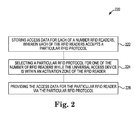
- Figure 2 illustrates a flow diagram of a method for providing a universal access device (e.g., universal access device 100, etc.) in accordance with one or more embodiments of the present disclosure.
- a universal access device e.g., universal access device 100, etc.
- the universal access device can store access data on a computer readable medium for each of a number of RFID readers, wherein each of the RFID readers accepts a particular RFID protocol.
- Each of the RFID readers, as described herein, can utilize a different RFID protocol.
- a particular RFID reader that utilizes a particular RFID protocol may not be able to communicate with other devices (e.g., access devices, tags, etc.) that utilize a different protocol.
- the universal access device can store the access data for each of the corresponding number of RFID readers in a profile as described herein.
- the profile can also include other information about the number of RFID readers.
- the profile for a particular RFID reader can include a profile name, a description of the RFID protocol, access data for the particular RFID reader, format of the access data, a description of the location of the RFID reader, geographic coordinates, geographic location, etc.
- a particular RFID protocol for one of the number of RFID readers is determined while the universal access device is within an activation zone of the RFID reader.
- the activation zone of the RFID reader can include an area that can transfer information and/or electrical power to a tag (e.g., access card, smart card, etc.).
- the activation zone of the RFID reader can be utilized by the universal access device to determine the particular RFID protocol.
- the activation zone for some RFID readers can be a relatively close proximity (e.g., 1-3 inches, etc.).
- the activation zone of the particular RFID reader may enable the universal access device to determine part of the particular RFID protocol.
- the particular RFID protocol could start by enabling a smart card to send a first signal to the RFID reader.
- the universal access device can determine that a first signal can be sent to the RFID reader and based on the interaction with the RFID reader, the universal access device can determine the RFID protocol of the RFID reader for that location (e.g., geographic location, location within a compound, etc.).
- the activation zone of the particular RFID reader can be utilized by the universal access device to attempt communication using a variety of RFID protocols. By using a variety of RFID protocols and monitoring a response to the interaction, the universal access device can determine a particular RFID protocol.
- the access data for the particular RFID reader is provided to the particular RFID reader via the particular RFID protocol.
- the access data that corresponds to the particular RFID reader can be sent to the RFID reader using the determined RFID protocol as described herein.
- the RFID protocol can be simulated utilizing a number of different techniques. For example, the current sent through an antenna can change the frequency of the communication and replicate a frequency of the determined protocol. In other embodiments, multiple antennas can be utilized to send access data with different frequencies based on the determined RFID protocol
- the information stored in the profile for each of the number of RFID readers can enable the universal access device to determine a RFID protocol and corresponding access data.
- the universal access device can determine information about the geographic location of the RFID reader and the RFID protocol of the RFID reader.
- the universal access device can utilize the geographic location and the RFID protocol to determine corresponding access data for the RFID reader.
- the universal access device can transfer the corresponding access data to the RFID reader utilizing the protocol of the RFID reader.
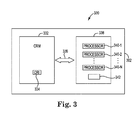
- FIG. 3 illustrates a block diagram 330 of an example of a computer-readable medium (CRM) 332 in communication with processing resources 340-1, 340-2, ..., 340-N for providing a universal access device in accordance with one or more embodiments of the present disclosure.
- CRM computer-readable medium
- the computing device can also include a CRM 332 in communication with processing resources 340-1, 340-2, ..., 340-N.
- CRM 332 can be in communication with a device 338 (e.g., a portable computing device, a smart card using logic with a selection tool, among others) having processor resources 340-1, 340-2, ..., 340-N.
- the device 338 can be in communication with a tangible non-transitory CRM 332 storing a set of computer-readable instructions (CRI) 334 executable by one or more of the processor resources 340-1, 340-2, ..., 340-N, as described herein.
- CRM computer-readable instructions
- the CRI 334 can also be stored in remote memory managed by a server and represent an installation package that can be downloaded, installed, and executed.
- the device 338 can include memory resources 793, and the processor resources 340-1, 340-2, ..., 340-N can be coupled to the memory resources 342.
- Processor resources 340-1, 340-2, ..., 340-N can execute CRI 334 that can be stored on an internal or external non-transitory CRM 332.
- the processor resources 340-1, 340-2, ..., 340-N can execute CRI 334 to perform various functions.
- the processor resources 340-1, 340-2, ..., 340-N can execute CRI 334 to determine a protocol of a RFID reader.
- a non-transitory CRM e.g., CRM 332), as used herein, can include volatile and/or non-volatile memory.
- Volatile memory can include memory that depends upon power to store information, such as various types of dynamic random access memory (DRAM), among others.
- DRAM dynamic random access memory
- Non-volatile memory can include memory that does not depend upon power to store information.
- Examples of non-volatile memory can include solid state media such as flash memory, electrically erasable programmable read-only memory (EEPROM), phase change random access memory (PCRAM), magnetic memory such as a hard disk, tape drives, floppy disk, and/or tape memory, optical discs, digital versatile discs (DVD), Bluray discs (BD), compact discs (CD), and/or a solid state drive (SSD), etc., as well as other types of computer-readable media.
- solid state media such as flash memory, electrically erasable programmable read-only memory (EEPROM), phase change random access memory (PCRAM), magnetic memory such as a hard disk, tape drives, floppy disk, and/or tape memory, optical discs, digital versatile discs (DVD), Bluray discs (BD), compact discs (CD), and/or a solid state drive (SSD), etc., as well as other types of computer-readable media.
- the non-transitory CRM 332 can also include distributed storage media.
- the CRM 332 can be distributed among various locations.
- the non-transitory CRM 332 can be integral, or communicatively coupled, to a computing device, in a wired and/or a wireless manner.
- the non-transitory CRM 332 can be an internal memory, a portable memory, a portable disk, or a memory associated with another computing resource (e.g., enabling CRIs to be transferred and/or executed across a network such as the Internet).
- the CRM 332 can be in communication with the processor resources 340-1, 340-2, ..., 340-N via a communication path 336.
- the communication path 336 can be local or remote to a machine (e.g., a computer) associated with the processor resources 340-1, 340-2, ..., 340-N.
- Examples of a local communication path 336 can include an electronic bus internal to a machine (e.g., a computer, a portable computing device, etc.) where the CRM 332 is one of volatile, non-volatile, fixed, and/or removable storage medium in communication with the processor resources 340-1, 340-2, ..., 340-N via the electronic bus.
- Examples of such electronic buses can include Industry Standard Architecture (ISA), Peripheral Component Interconnect (PCI), Advanced Technology Attachment (ATA), Small Computer System Interface (SCSI), Universal Serial Bus (USB), among other types of electronic buses and variants thereof.
- the communication path 336 can be such that the CRM 332 is remote from the processor resources e.g., 340-1, 340-2, ..., 340-N, such as in a network relationship between the CRM 332 and the processor resources (e.g., 340-1, 340-2, ..., 340-N). That is, the communication path 336 can be a network relationship. Examples of such a network relationship can include a local area network (LAN), wide area network (WAN), personal area network (PAN), and the Internet, among others.
- the CRM 332 can be associated with a first computing device and the processor resources 340-1, 340-2, ..., 340-N can be associated with a second computing device (e.g., a Java ® server, etc.).
- a processing resource 340-1, 340-2, ..., 340-N can be in communication with a CRM 332, wherein the CRM 332 includes a set of instructions and wherein the processing resource 340-1, 340-2, ..., 340-N is designed to carry out the set of instructions for providing access data for a particular RFID reader via a particular RFID protocol.
- the processor resources 340-1, 340-2, ..., 340-N coupled to the memory 334 can store a number of user identified RFID receiver locations, wherein each location has corresponding access data.
- the processor resources 340-1, 340-2, ..., 340-N coupled to the memory 334 can determine a RFID protocol for a particular RFID receiver location.
- the processor resources 340-1, 340-2, ..., 340-N coupled to the memory 334 can also display a list of user identified RFID receiver locations that match the RFID protocol for the particular location.
- the processor resources 340-1, 340-2, ..., 340-N coupled to the memory 334 can also enable a user to select one of the identified locations.
- the processor resources 340-1, 340-2, ..., 340-N coupled to the memory 334 can transfer the corresponding access data for the selected location using the determined RFID protocol for the particular RFID receiver location.
- logic is an alternative or additional processing resource to execute the actions and/or functions, etc., described herein, which includes hardware (e.g., various forms of transistor logic, application specific integrated circuits (ASICs), etc.), as opposed to computer executable instructions (e.g., software, firmware, etc.) stored in memory and executable by a processor.
- hardware e.g., various forms of transistor logic, application specific integrated circuits (ASICs), etc.
- computer executable instructions e.g., software, firmware, etc.
Landscapes
- Engineering & Computer Science (AREA)
- Physics & Mathematics (AREA)
- Toxicology (AREA)
- General Physics & Mathematics (AREA)
- Theoretical Computer Science (AREA)
- Health & Medical Sciences (AREA)
- Computer Networks & Wireless Communication (AREA)
- Microelectronics & Electronic Packaging (AREA)
- Computer Hardware Design (AREA)
- Computer Security & Cryptography (AREA)
- Electromagnetism (AREA)
- General Health & Medical Sciences (AREA)
- Artificial Intelligence (AREA)
- Computer Vision & Pattern Recognition (AREA)
- Mobile Radio Communication Systems (AREA)
Applications Claiming Priority (1)
| Application Number | Priority Date | Filing Date | Title |
|---|---|---|---|
| US13/545,631 US8803666B2 (en) | 2012-07-10 | 2012-07-10 | Universal access device |
Publications (3)
| Publication Number | Publication Date |
|---|---|
| EP2696309A2 true EP2696309A2 (fr) | 2014-02-12 |
| EP2696309A3 EP2696309A3 (fr) | 2015-12-23 |
| EP2696309B1 EP2696309B1 (fr) | 2018-07-11 |
Family
ID=48141770
Family Applications (1)
| Application Number | Title | Priority Date | Filing Date |
|---|---|---|---|
| EP13163831.4A Revoked EP2696309B1 (fr) | 2012-07-10 | 2013-04-15 | Dispositif d'accès universel |
Country Status (3)
| Country | Link |
|---|---|
| US (1) | US8803666B2 (fr) |
| EP (1) | EP2696309B1 (fr) |
| CN (2) | CN108460309A (fr) |
Cited By (2)
| Publication number | Priority date | Publication date | Assignee | Title |
|---|---|---|---|---|
| EP2696309B1 (fr) | 2012-07-10 | 2018-07-11 | Honeywell International Inc. | Dispositif d'accès universel |
| CN112787690A (zh) * | 2019-11-06 | 2021-05-11 | 爱视购科技有限公司 | 识别装置以及识别设定系统 |
Families Citing this family (11)
| Publication number | Priority date | Publication date | Assignee | Title |
|---|---|---|---|---|
| WO2004114239A2 (fr) * | 2003-06-13 | 2004-12-29 | Wildseed Ltd. | Identification de frequence radio emulee |
| US10019706B2 (en) * | 2012-11-27 | 2018-07-10 | Geotoll, Inc. | Method and apparatus for providing a toll service and flexible toll device |
| WO2014173298A1 (fr) * | 2013-04-25 | 2014-10-30 | 飞天诚信科技股份有限公司 | Procédé de gestion d'une application sur carte |
| US10375047B2 (en) * | 2013-09-30 | 2019-08-06 | Schneider Electric Industries Sas | Cloud-authenticated site resource management devices, apparatuses, methods and systems |
| US10956896B2 (en) * | 2013-11-27 | 2021-03-23 | Geotoll, Inc. | Method and apparatus for providing a toll service and flexible toll device |
| US20160275767A1 (en) * | 2015-03-16 | 2016-09-22 | Menonthemoon Pty Ltd. | Intelligent beacon and system including same |
| US9960962B2 (en) * | 2015-06-10 | 2018-05-01 | Johnson Controls Technology Company | Building automation system with smart communications controller for building equipment |
| CN108712394B (zh) * | 2018-04-26 | 2021-10-08 | 深圳市盛路物联通讯技术有限公司 | 一种射频识别方法及标签 |
| US12111905B2 (en) * | 2018-05-22 | 2024-10-08 | Info Wise Limited | Wireless access tag system and method |
| CN114444643B (zh) * | 2019-04-17 | 2024-08-06 | 苹果公司 | 无线可定位标签 |
| JP7486047B2 (ja) * | 2020-06-01 | 2024-05-17 | 株式会社リコー | 画像読取装置及び画像形成装置 |
Family Cites Families (14)
| Publication number | Priority date | Publication date | Assignee | Title |
|---|---|---|---|---|
| US7155411B1 (en) | 2000-09-28 | 2006-12-26 | Microsoft Corporation | Integrating payment accounts and an electronic wallet |
| US20040075675A1 (en) | 2002-10-17 | 2004-04-22 | Tommi Raivisto | Apparatus and method for accessing services via a mobile terminal |
| WO2004114239A2 (fr) * | 2003-06-13 | 2004-12-29 | Wildseed Ltd. | Identification de frequence radio emulee |
| GB0416922D0 (en) * | 2004-07-29 | 2004-09-01 | Innovision Res & Tech Plc | Multi-tag emulator |
| US7205882B2 (en) | 2004-11-10 | 2007-04-17 | Corestreet, Ltd. | Actuating a security system using a wireless device |
| CN100450091C (zh) * | 2005-11-18 | 2009-01-07 | 上海宽鑫信息科技有限公司 | 现场对象汇聚路由器及其自组网内数据传输方法 |
| US8410908B2 (en) * | 2005-12-30 | 2013-04-02 | Nokia Corporation | Method and device for emulating multiple RFID tags within a single mobile electronic device |
| US7952464B2 (en) * | 2006-10-05 | 2011-05-31 | Intermec Ip Corp. | Configurable RFID tag with protocol and band selection |
| US9641661B2 (en) | 2007-12-21 | 2017-05-02 | Qualcomm Incorporated | Method and apparatus to establish a communication connection |
| US8141784B2 (en) * | 2009-09-25 | 2012-03-27 | Hand Held Products, Inc. | Encoded information reading terminal with user-configurable multi-protocol wireless communication interface |
| US8788418B2 (en) * | 2010-03-02 | 2014-07-22 | Gonow Technologies, Llc | Portable E-wallet and universal card |
| KR101514029B1 (ko) * | 2010-12-31 | 2015-04-21 | 주식회사 케이티 | 사용자 단말을 이용한 출입 인증 방법 및 장치 |
| US8977195B2 (en) * | 2011-01-06 | 2015-03-10 | Texas Insruments Incorporated | Multiple NFC card applications in multiple execution environments |
| US8803666B2 (en) | 2012-07-10 | 2014-08-12 | Honeywell International Inc. | Universal access device |
-
2012
- 2012-07-10 US US13/545,631 patent/US8803666B2/en active Active
-
2013
- 2013-04-15 EP EP13163831.4A patent/EP2696309B1/fr not_active Revoked
- 2013-05-09 CN CN201810251178.1A patent/CN108460309A/zh active Pending
- 2013-05-09 CN CN201310169090.2A patent/CN103544508B/zh not_active Expired - Fee Related
Non-Patent Citations (1)
| Title |
|---|
| None |
Cited By (3)
| Publication number | Priority date | Publication date | Assignee | Title |
|---|---|---|---|---|
| EP2696309B1 (fr) | 2012-07-10 | 2018-07-11 | Honeywell International Inc. | Dispositif d'accès universel |
| CN112787690A (zh) * | 2019-11-06 | 2021-05-11 | 爱视购科技有限公司 | 识别装置以及识别设定系统 |
| EP3819826A1 (fr) * | 2019-11-06 | 2021-05-12 | YesGo Tech Corporation | Dispositif unique émulant différents dispositifs d'identification |
Also Published As
| Publication number | Publication date |
|---|---|
| CN108460309A (zh) | 2018-08-28 |
| EP2696309A3 (fr) | 2015-12-23 |
| US8803666B2 (en) | 2014-08-12 |
| EP2696309B1 (fr) | 2018-07-11 |
| CN103544508B (zh) | 2018-04-03 |
| US20140015638A1 (en) | 2014-01-16 |
| CN103544508A (zh) | 2014-01-29 |
Similar Documents
| Publication | Publication Date | Title |
|---|---|---|
| US8803666B2 (en) | Universal access device | |
| US11995634B2 (en) | Systems and methods for providing near field communications | |
| EP2940640A1 (fr) | Méthode de commande de dispositif de paiement permettant de sélectionner le moyen de paiement | |
| US20150170448A1 (en) | Entry lock control and operation system | |
| US9477917B1 (en) | System and method of context specific identity in a radio frequency identity (RFID) chip | |
| EP2648428B1 (fr) | Dispositif de terminal d'utilisateur et procédé de fourniture d'informations l'utilisant | |
| EP3986004B1 (fr) | Dispositif nfc et son procédé de fonctionnement | |
| EP3897004B1 (fr) | Procédé de réglage de connectivité bluetooth pour accélérer des contrôles d'accès | |
| EP2887272B1 (fr) | NFC hybride et carte sans contact passif RFID | |
| CN105574749A (zh) | 一种安全元件se中卡片应用的选择方法、装置及系统 | |
| EP3841677A1 (fr) | Dispositif, procédé et système de communication en champ proche (nfc) passif | |
| KR20180053734A (ko) | 보안 요소에서 애플리케이션들을 관리하기 위한 방법 | |
| US20140201078A1 (en) | Payment system, payment terminal, payment method, payment program, and computer-readable recording medium for recording same program | |
| US10672007B2 (en) | Payment system, payment terminal, payment method, payment program, and computer-readable recording medium for recording same program | |
| US20160164724A1 (en) | Installation of networkable devices | |
| KR101754398B1 (ko) | 스마트폰의 자원을 이용한 매장 식별 방법 | |
| CN113055844B (zh) | 一种基于动态侦测的信息通知方法及系统 | |
| KR20120008412A (ko) | 통신 상태 판별을 통한 스마트폰 애플리케이션 로딩 방법과 이를 위한 스마트폰 및 프로그램 | |
| KR101803524B1 (ko) | 동선을 이용한 애플리케이션 로딩 방법 | |
| JP2018106674A (ja) | 情報管理装置、及びプログラム | |
| US10896299B2 (en) | Information processing device and information processing method | |
| US20180101835A1 (en) | Zone-based mobile device configuration for hospitality deployment | |
| KR20120008415A (ko) | 픽셀 매트릭스 판별을 통한 스마트폰 애플리케이션 로딩 방법과 이를 위한 스마트폰 및 프로그램 | |
| KR20120008154A (ko) | 다중 상태 판별을 통한 스마트폰 애플리케이션 로딩 방법과 이를 위한 스마트폰 및 프로그램 | |
| KR20120008411A (ko) | 최단 동선 연결을 이용한 스마트폰 애플리케이션 로딩 방법과 이를 위한 스마트폰 및 프로그램 |
Legal Events
| Date | Code | Title | Description |
|---|---|---|---|
| 17P | Request for examination filed |
Effective date: 20130415 |
|
| AK | Designated contracting states |
Kind code of ref document: A2 Designated state(s): AL AT BE BG CH CY CZ DE DK EE ES FI FR GB GR HR HU IE IS IT LI LT LU LV MC MK MT NL NO PL PT RO RS SE SI SK SM TR |
|
| AX | Request for extension of the european patent |
Extension state: BA ME |
|
| PUAI | Public reference made under article 153(3) epc to a published international application that has entered the european phase |
Free format text: ORIGINAL CODE: 0009012 |
|
| PUAL | Search report despatched |
Free format text: ORIGINAL CODE: 0009013 |
|
| RAP1 | Party data changed (applicant data changed or rights of an application transferred) |
Owner name: HONEYWELL INTERNATIONAL INC. |
|
| AK | Designated contracting states |
Kind code of ref document: A3 Designated state(s): AL AT BE BG CH CY CZ DE DK EE ES FI FR GB GR HR HU IE IS IT LI LT LU LV MC MK MT NL NO PL PT RO RS SE SI SK SM TR |
|
| AX | Request for extension of the european patent |
Extension state: BA ME |
|
| RIC1 | Information provided on ipc code assigned before grant |
Ipc: G06K 7/10 20060101AFI20151119BHEP Ipc: G06K 19/07 20060101ALI20151119BHEP |
|
| 17Q | First examination report despatched |
Effective date: 20160119 |
|
| GRAP | Despatch of communication of intention to grant a patent |
Free format text: ORIGINAL CODE: EPIDOSNIGR1 |
|
| STAA | Information on the status of an ep patent application or granted ep patent |
Free format text: STATUS: GRANT OF PATENT IS INTENDED |
|
| INTG | Intention to grant announced |
Effective date: 20180110 |
|
| GRAJ | Information related to disapproval of communication of intention to grant by the applicant or resumption of examination proceedings by the epo deleted |
Free format text: ORIGINAL CODE: EPIDOSDIGR1 |
|
| STAA | Information on the status of an ep patent application or granted ep patent |
Free format text: STATUS: EXAMINATION IS IN PROGRESS |
|
| GRAS | Grant fee paid |
Free format text: ORIGINAL CODE: EPIDOSNIGR3 |
|
| INTC | Intention to grant announced (deleted) | ||
| STAA | Information on the status of an ep patent application or granted ep patent |
Free format text: STATUS: GRANT OF PATENT IS INTENDED |
|
| GRAS | Grant fee paid |
Free format text: ORIGINAL CODE: EPIDOSNIGR3 |
|
| GRAP | Despatch of communication of intention to grant a patent |
Free format text: ORIGINAL CODE: EPIDOSNIGR1 |
|
| GRAA | (expected) grant |
Free format text: ORIGINAL CODE: 0009210 |
|
| STAA | Information on the status of an ep patent application or granted ep patent |
Free format text: STATUS: THE PATENT HAS BEEN GRANTED |
|
| INTG | Intention to grant announced |
Effective date: 20180531 |
|
| AK | Designated contracting states |
Kind code of ref document: B1 Designated state(s): AL AT BE BG CH CY CZ DE DK EE ES FI FR GB GR HR HU IE IS IT LI LT LU LV MC MK MT NL NO PL PT RO RS SE SI SK SM TR |
|
| REG | Reference to a national code |
Ref country code: GB Ref legal event code: FG4D |
|
| REG | Reference to a national code |
Ref country code: CH Ref legal event code: EP |
|
| REG | Reference to a national code |
Ref country code: AT Ref legal event code: REF Ref document number: 1017657 Country of ref document: AT Kind code of ref document: T Effective date: 20180715 |
|
| REG | Reference to a national code |
Ref country code: IE Ref legal event code: FG4D |
|
| REG | Reference to a national code |
Ref country code: DE Ref legal event code: R096 Ref document number: 602013039974 Country of ref document: DE |
|
| REG | Reference to a national code |
Ref country code: SE Ref legal event code: TRGR |
|
| REG | Reference to a national code |
Ref country code: NL Ref legal event code: MP Effective date: 20180711 |
|
| REG | Reference to a national code |
Ref country code: LT Ref legal event code: MG4D |
|
| REG | Reference to a national code |
Ref country code: AT Ref legal event code: MK05 Ref document number: 1017657 Country of ref document: AT Kind code of ref document: T Effective date: 20180711 |
|
| PG25 | Lapsed in a contracting state [announced via postgrant information from national office to epo] |
Ref country code: NL Free format text: LAPSE BECAUSE OF FAILURE TO SUBMIT A TRANSLATION OF THE DESCRIPTION OR TO PAY THE FEE WITHIN THE PRESCRIBED TIME-LIMIT Effective date: 20180711 |
|
| PG25 | Lapsed in a contracting state [announced via postgrant information from national office to epo] |
Ref country code: FI Free format text: LAPSE BECAUSE OF FAILURE TO SUBMIT A TRANSLATION OF THE DESCRIPTION OR TO PAY THE FEE WITHIN THE PRESCRIBED TIME-LIMIT Effective date: 20180711 Ref country code: AT Free format text: LAPSE BECAUSE OF FAILURE TO SUBMIT A TRANSLATION OF THE DESCRIPTION OR TO PAY THE FEE WITHIN THE PRESCRIBED TIME-LIMIT Effective date: 20180711 Ref country code: PL Free format text: LAPSE BECAUSE OF FAILURE TO SUBMIT A TRANSLATION OF THE DESCRIPTION OR TO PAY THE FEE WITHIN THE PRESCRIBED TIME-LIMIT Effective date: 20180711 Ref country code: LT Free format text: LAPSE BECAUSE OF FAILURE TO SUBMIT A TRANSLATION OF THE DESCRIPTION OR TO PAY THE FEE WITHIN THE PRESCRIBED TIME-LIMIT Effective date: 20180711 Ref country code: IS Free format text: LAPSE BECAUSE OF FAILURE TO SUBMIT A TRANSLATION OF THE DESCRIPTION OR TO PAY THE FEE WITHIN THE PRESCRIBED TIME-LIMIT Effective date: 20181111 Ref country code: RS Free format text: LAPSE BECAUSE OF FAILURE TO SUBMIT A TRANSLATION OF THE DESCRIPTION OR TO PAY THE FEE WITHIN THE PRESCRIBED TIME-LIMIT Effective date: 20180711 Ref country code: GR Free format text: LAPSE BECAUSE OF FAILURE TO SUBMIT A TRANSLATION OF THE DESCRIPTION OR TO PAY THE FEE WITHIN THE PRESCRIBED TIME-LIMIT Effective date: 20181012 Ref country code: NO Free format text: LAPSE BECAUSE OF FAILURE TO SUBMIT A TRANSLATION OF THE DESCRIPTION OR TO PAY THE FEE WITHIN THE PRESCRIBED TIME-LIMIT Effective date: 20181011 Ref country code: BG Free format text: LAPSE BECAUSE OF FAILURE TO SUBMIT A TRANSLATION OF THE DESCRIPTION OR TO PAY THE FEE WITHIN THE PRESCRIBED TIME-LIMIT Effective date: 20181011 |
|
| PG25 | Lapsed in a contracting state [announced via postgrant information from national office to epo] |
Ref country code: AL Free format text: LAPSE BECAUSE OF FAILURE TO SUBMIT A TRANSLATION OF THE DESCRIPTION OR TO PAY THE FEE WITHIN THE PRESCRIBED TIME-LIMIT Effective date: 20180711 Ref country code: HR Free format text: LAPSE BECAUSE OF FAILURE TO SUBMIT A TRANSLATION OF THE DESCRIPTION OR TO PAY THE FEE WITHIN THE PRESCRIBED TIME-LIMIT Effective date: 20180711 Ref country code: LV Free format text: LAPSE BECAUSE OF FAILURE TO SUBMIT A TRANSLATION OF THE DESCRIPTION OR TO PAY THE FEE WITHIN THE PRESCRIBED TIME-LIMIT Effective date: 20180711 Ref country code: ES Free format text: LAPSE BECAUSE OF FAILURE TO SUBMIT A TRANSLATION OF THE DESCRIPTION OR TO PAY THE FEE WITHIN THE PRESCRIBED TIME-LIMIT Effective date: 20180711 |
|
| REG | Reference to a national code |
Ref country code: DE Ref legal event code: R026 Ref document number: 602013039974 Country of ref document: DE |
|
| PLBI | Opposition filed |
Free format text: ORIGINAL CODE: 0009260 |
|
| PLAX | Notice of opposition and request to file observation + time limit sent |
Free format text: ORIGINAL CODE: EPIDOSNOBS2 |
|
| PG25 | Lapsed in a contracting state [announced via postgrant information from national office to epo] |
Ref country code: RO Free format text: LAPSE BECAUSE OF FAILURE TO SUBMIT A TRANSLATION OF THE DESCRIPTION OR TO PAY THE FEE WITHIN THE PRESCRIBED TIME-LIMIT Effective date: 20180711 Ref country code: CZ Free format text: LAPSE BECAUSE OF FAILURE TO SUBMIT A TRANSLATION OF THE DESCRIPTION OR TO PAY THE FEE WITHIN THE PRESCRIBED TIME-LIMIT Effective date: 20180711 Ref country code: IT Free format text: LAPSE BECAUSE OF FAILURE TO SUBMIT A TRANSLATION OF THE DESCRIPTION OR TO PAY THE FEE WITHIN THE PRESCRIBED TIME-LIMIT Effective date: 20180711 Ref country code: EE Free format text: LAPSE BECAUSE OF FAILURE TO SUBMIT A TRANSLATION OF THE DESCRIPTION OR TO PAY THE FEE WITHIN THE PRESCRIBED TIME-LIMIT Effective date: 20180711 |
|
| 26 | Opposition filed |
Opponent name: DORMAKABA DEUTSCHLAND GMBH Effective date: 20190411 |
|
| PG25 | Lapsed in a contracting state [announced via postgrant information from national office to epo] |
Ref country code: DK Free format text: LAPSE BECAUSE OF FAILURE TO SUBMIT A TRANSLATION OF THE DESCRIPTION OR TO PAY THE FEE WITHIN THE PRESCRIBED TIME-LIMIT Effective date: 20180711 Ref country code: SM Free format text: LAPSE BECAUSE OF FAILURE TO SUBMIT A TRANSLATION OF THE DESCRIPTION OR TO PAY THE FEE WITHIN THE PRESCRIBED TIME-LIMIT Effective date: 20180711 Ref country code: SK Free format text: LAPSE BECAUSE OF FAILURE TO SUBMIT A TRANSLATION OF THE DESCRIPTION OR TO PAY THE FEE WITHIN THE PRESCRIBED TIME-LIMIT Effective date: 20180711 |
|
| PGFP | Annual fee paid to national office [announced via postgrant information from national office to epo] |
Ref country code: DE Payment date: 20190430 Year of fee payment: 7 |
|
| PLBB | Reply of patent proprietor to notice(s) of opposition received |
Free format text: ORIGINAL CODE: EPIDOSNOBS3 |
|
| PG25 | Lapsed in a contracting state [announced via postgrant information from national office to epo] |
Ref country code: SI Free format text: LAPSE BECAUSE OF FAILURE TO SUBMIT A TRANSLATION OF THE DESCRIPTION OR TO PAY THE FEE WITHIN THE PRESCRIBED TIME-LIMIT Effective date: 20180711 |
|
| PGFP | Annual fee paid to national office [announced via postgrant information from national office to epo] |
Ref country code: IE Payment date: 20190718 Year of fee payment: 7 Ref country code: SE Payment date: 20190729 Year of fee payment: 7 |
|
| REG | Reference to a national code |
Ref country code: CH Ref legal event code: PL |
|
| REG | Reference to a national code |
Ref country code: BE Ref legal event code: MM Effective date: 20190430 |
|
| GBPC | Gb: european patent ceased through non-payment of renewal fee |
Effective date: 20190415 |
|
| PG25 | Lapsed in a contracting state [announced via postgrant information from national office to epo] |
Ref country code: MC Free format text: LAPSE BECAUSE OF FAILURE TO SUBMIT A TRANSLATION OF THE DESCRIPTION OR TO PAY THE FEE WITHIN THE PRESCRIBED TIME-LIMIT Effective date: 20180711 Ref country code: LU Free format text: LAPSE BECAUSE OF NON-PAYMENT OF DUE FEES Effective date: 20190415 |
|
| RDAF | Communication despatched that patent is revoked |
Free format text: ORIGINAL CODE: EPIDOSNREV1 |
|
| REG | Reference to a national code |
Ref country code: DE Ref legal event code: R064 Ref document number: 602013039974 Country of ref document: DE Ref country code: DE Ref legal event code: R103 Ref document number: 602013039974 Country of ref document: DE |
|
| PG25 | Lapsed in a contracting state [announced via postgrant information from national office to epo] |
Ref country code: LI Free format text: LAPSE BECAUSE OF NON-PAYMENT OF DUE FEES Effective date: 20190430 Ref country code: CH Free format text: LAPSE BECAUSE OF NON-PAYMENT OF DUE FEES Effective date: 20190430 Ref country code: GB Free format text: LAPSE BECAUSE OF NON-PAYMENT OF DUE FEES Effective date: 20190415 |
|
| PG25 | Lapsed in a contracting state [announced via postgrant information from national office to epo] |
Ref country code: FR Free format text: LAPSE BECAUSE OF NON-PAYMENT OF DUE FEES Effective date: 20190430 Ref country code: BE Free format text: LAPSE BECAUSE OF NON-PAYMENT OF DUE FEES Effective date: 20190430 |
|
| PG25 | Lapsed in a contracting state [announced via postgrant information from national office to epo] |
Ref country code: TR Free format text: LAPSE BECAUSE OF FAILURE TO SUBMIT A TRANSLATION OF THE DESCRIPTION OR TO PAY THE FEE WITHIN THE PRESCRIBED TIME-LIMIT Effective date: 20180711 |
|
| RDAG | Patent revoked |
Free format text: ORIGINAL CODE: 0009271 |
|
| STAA | Information on the status of an ep patent application or granted ep patent |
Free format text: STATUS: PATENT REVOKED |
|
| REG | Reference to a national code |
Ref country code: FI Ref legal event code: MGE |
|
| 27W | Patent revoked |
Effective date: 20200125 |
|
| PG25 | Lapsed in a contracting state [announced via postgrant information from national office to epo] |
Ref country code: PT Free format text: LAPSE BECAUSE OF FAILURE TO SUBMIT A TRANSLATION OF THE DESCRIPTION OR TO PAY THE FEE WITHIN THE PRESCRIBED TIME-LIMIT Effective date: 20181111 |
|
| REG | Reference to a national code |
Ref country code: SE Ref legal event code: ECNC |
|
| PG25 | Lapsed in a contracting state [announced via postgrant information from national office to epo] |
Ref country code: HU Free format text: LAPSE BECAUSE OF FAILURE TO SUBMIT A TRANSLATION OF THE DESCRIPTION OR TO PAY THE FEE WITHIN THE PRESCRIBED TIME-LIMIT; INVALID AB INITIO Effective date: 20130415 |
|
| PG25 | Lapsed in a contracting state [announced via postgrant information from national office to epo] |
Ref country code: MK Free format text: LAPSE BECAUSE OF FAILURE TO SUBMIT A TRANSLATION OF THE DESCRIPTION OR TO PAY THE FEE WITHIN THE PRESCRIBED TIME-LIMIT Effective date: 20180711 |
|
| PG25 | Lapsed in a contracting state [announced via postgrant information from national office to epo] |
Ref country code: CY Free format text: LAPSE BECAUSE OF FAILURE TO SUBMIT A TRANSLATION OF THE DESCRIPTION OR TO PAY THE FEE WITHIN THE PRESCRIBED TIME-LIMIT Effective date: 20180711 |
|
| PG25 | Lapsed in a contracting state [announced via postgrant information from national office to epo] |
Ref country code: MT Free format text: LAPSE BECAUSE OF FAILURE TO SUBMIT A TRANSLATION OF THE DESCRIPTION OR TO PAY THE FEE WITHIN THE PRESCRIBED TIME-LIMIT Effective date: 20180711 |