EP2696352A2 - Composition de pâte d'argent pour former une électrode, et procédé pour sa préparation - Google Patents
Composition de pâte d'argent pour former une électrode, et procédé pour sa préparation Download PDFInfo
- Publication number
- EP2696352A2 EP2696352A2 EP12768065.0A EP12768065A EP2696352A2 EP 2696352 A2 EP2696352 A2 EP 2696352A2 EP 12768065 A EP12768065 A EP 12768065A EP 2696352 A2 EP2696352 A2 EP 2696352A2
- Authority
- EP
- European Patent Office
- Prior art keywords
- silver paste
- paste composition
- carbon black
- forming
- electrode
- Prior art date
- Legal status (The legal status is an assumption and is not a legal conclusion. Google has not performed a legal analysis and makes no representation as to the accuracy of the status listed.)
- Granted
Links
Images


Classifications
-
- H—ELECTRICITY
- H01—ELECTRIC ELEMENTS
- H01B—CABLES; CONDUCTORS; INSULATORS; SELECTION OF MATERIALS FOR THEIR CONDUCTIVE, INSULATING OR DIELECTRIC PROPERTIES
- H01B1/00—Conductors or conductive bodies characterised by the conductive materials; Selection of materials as conductors
- H01B1/02—Conductors or conductive bodies characterised by the conductive materials; Selection of materials as conductors mainly consisting of metals or alloys
-
- H—ELECTRICITY
- H01—ELECTRIC ELEMENTS
- H01B—CABLES; CONDUCTORS; INSULATORS; SELECTION OF MATERIALS FOR THEIR CONDUCTIVE, INSULATING OR DIELECTRIC PROPERTIES
- H01B1/00—Conductors or conductive bodies characterised by the conductive materials; Selection of materials as conductors
- H01B1/20—Conductive material dispersed in non-conductive organic material
-
- H—ELECTRICITY
- H01—ELECTRIC ELEMENTS
- H01B—CABLES; CONDUCTORS; INSULATORS; SELECTION OF MATERIALS FOR THEIR CONDUCTIVE, INSULATING OR DIELECTRIC PROPERTIES
- H01B1/00—Conductors or conductive bodies characterised by the conductive materials; Selection of materials as conductors
- H01B1/14—Conductive material dispersed in non-conductive inorganic material
- H01B1/16—Conductive material dispersed in non-conductive inorganic material the conductive material comprising metals or alloys
-
- H—ELECTRICITY
- H01—ELECTRIC ELEMENTS
- H01B—CABLES; CONDUCTORS; INSULATORS; SELECTION OF MATERIALS FOR THEIR CONDUCTIVE, INSULATING OR DIELECTRIC PROPERTIES
- H01B1/00—Conductors or conductive bodies characterised by the conductive materials; Selection of materials as conductors
- H01B1/14—Conductive material dispersed in non-conductive inorganic material
- H01B1/18—Conductive material dispersed in non-conductive inorganic material the conductive material comprising carbon-silicon compounds, carbon or silicon
-
- H—ELECTRICITY
- H01—ELECTRIC ELEMENTS
- H01B—CABLES; CONDUCTORS; INSULATORS; SELECTION OF MATERIALS FOR THEIR CONDUCTIVE, INSULATING OR DIELECTRIC PROPERTIES
- H01B1/00—Conductors or conductive bodies characterised by the conductive materials; Selection of materials as conductors
- H01B1/20—Conductive material dispersed in non-conductive organic material
- H01B1/22—Conductive material dispersed in non-conductive organic material the conductive material comprising metals or alloys
-
- H—ELECTRICITY
- H01—ELECTRIC ELEMENTS
- H01B—CABLES; CONDUCTORS; INSULATORS; SELECTION OF MATERIALS FOR THEIR CONDUCTIVE, INSULATING OR DIELECTRIC PROPERTIES
- H01B1/00—Conductors or conductive bodies characterised by the conductive materials; Selection of materials as conductors
- H01B1/20—Conductive material dispersed in non-conductive organic material
- H01B1/24—Conductive material dispersed in non-conductive organic material the conductive material comprising carbon-silicon compounds, carbon or silicon
-
- H—ELECTRICITY
- H10—SEMICONDUCTOR DEVICES; ELECTRIC SOLID-STATE DEVICES NOT OTHERWISE PROVIDED FOR
- H10F—INORGANIC SEMICONDUCTOR DEVICES SENSITIVE TO INFRARED RADIATION, LIGHT, ELECTROMAGNETIC RADIATION OF SHORTER WAVELENGTH OR CORPUSCULAR RADIATION
- H10F10/00—Individual photovoltaic cells, e.g. solar cells
-
- H—ELECTRICITY
- H10—SEMICONDUCTOR DEVICES; ELECTRIC SOLID-STATE DEVICES NOT OTHERWISE PROVIDED FOR
- H10F—INORGANIC SEMICONDUCTOR DEVICES SENSITIVE TO INFRARED RADIATION, LIGHT, ELECTROMAGNETIC RADIATION OF SHORTER WAVELENGTH OR CORPUSCULAR RADIATION
- H10F77/00—Constructional details of devices covered by this subclass
- H10F77/20—Electrodes
- H10F77/206—Electrodes for devices having potential barriers
- H10F77/211—Electrodes for devices having potential barriers for photovoltaic cells
-
- H—ELECTRICITY
- H10—SEMICONDUCTOR DEVICES; ELECTRIC SOLID-STATE DEVICES NOT OTHERWISE PROVIDED FOR
- H10F—INORGANIC SEMICONDUCTOR DEVICES SENSITIVE TO INFRARED RADIATION, LIGHT, ELECTROMAGNETIC RADIATION OF SHORTER WAVELENGTH OR CORPUSCULAR RADIATION
- H10F77/00—Constructional details of devices covered by this subclass
- H10F77/20—Electrodes
- H10F77/206—Electrodes for devices having potential barriers
- H10F77/211—Electrodes for devices having potential barriers for photovoltaic cells
- H10F77/215—Geometries of grid contacts
-
- Y—GENERAL TAGGING OF NEW TECHNOLOGICAL DEVELOPMENTS; GENERAL TAGGING OF CROSS-SECTIONAL TECHNOLOGIES SPANNING OVER SEVERAL SECTIONS OF THE IPC; TECHNICAL SUBJECTS COVERED BY FORMER USPC CROSS-REFERENCE ART COLLECTIONS [XRACs] AND DIGESTS
- Y02—TECHNOLOGIES OR APPLICATIONS FOR MITIGATION OR ADAPTATION AGAINST CLIMATE CHANGE
- Y02E—REDUCTION OF GREENHOUSE GAS [GHG] EMISSIONS, RELATED TO ENERGY GENERATION, TRANSMISSION OR DISTRIBUTION
- Y02E10/00—Energy generation through renewable energy sources
- Y02E10/50—Photovoltaic [PV] energy
Definitions
- the present invention relates to a silver paste composition for forming an electrode and a preparation method thereof. More particularly, the present invention relates to a silver paste composition for forming an electrode, which allows formation of an electrode for a solar cell showing more improved printability, excellent electrical properties, and energy conversion efficiency and a preparation method thereof, a front electrode for a solar cell and a silicon solar cell that are formed from the silver paste composition.
- a typical metal paste includes a conductive metal, a glass frit and an organic binder, and the conductive metal includes silver, aluminum or the like.
- the conductive metal paste is mainly used to mount a hybrid IC or a semiconductor IC, or to form various condensers or electrodes, and recently has the expanded application range to high-tech electronic products such as PCBs, ELs, touch panels, RFIDs, LCDs, PDPs or solar cells. With expansion and development of the related industry, demand for the conductive metal paste is increasing.
- the solar cell is classified into a solar heat cell that produces vapor required to run a turbine using a solar heat, and a solar light cell that converts photons into an electrical energy using properties of a semiconductor.
- the solar light cell (hereinafter, referred to as a solar cell) is represented as a solar cell.
- the solar cell is largely divided into a silicon solar cell, a compound semiconductor solar cell, and a tandem solar cell according to the raw material.
- the silicon solar cell leads the solar cell market.
- FIG. 1 is a cross-sectional view showing a basic structure of a silicon solar cell.
- the silicon solar cell includes a substrate 101 composed of a p-type silicon semiconductor, and an emitter layer 102 composed of an n-type silicon semiconductor. A p-n junction is formed at an interface between the substrate 101 and the emitter layer 102 in the similar way to a diode.
- FIG. 2 is a schematic view showing constitution of a front electrode in the structure of the solar cell.
- a silver electrode is mainly formed as a front electrode on the front surface of a substrate of a solar cell, and an aluminium electrode and a silver electrode are formed as a back electrode on the back surface of a substrate.
- the front electrode is, not shown in the drawing, connected to the emitter layer through an antireflection film upon formation of the silicon solar cell.
- electrons and holes create in the silicon semiconductors doped with impurities by the photovoltaic effect.
- electrons are created in the emitter layer 102 composed of an n-type silicon semiconductor as a plurality of carriers and holes are created in the substrate 101 composed of a p-type silicon semiconductor as a plurality of carriers.
- the electrons and holes created by the photovoltaic effect are drawn toward the n-type silicon semiconductor and p-type silicon semiconductor, and move to a front electrode 103 on the emitter layer 102 and a back electrode 104 below the substrate 101, respectively. Then, these electrodes 103, 104 are connected by a wire, so that the current flows.
- a conductive metal paste is used to form a front or back electrode in a solar cell, in addition to various electrodes of other electronic products as mentioned above.
- the front electrode of a commercial crystalline silicon solar cell is formed by a screen printing process.
- contact properties between the front silver electrode and the silicon emitter layer should be more improved.
- the front electrode having a thinner line width and a taller line height should be formed.
- silver included in the first electrode should be stably recrystallized on the emitter layer of the solar cell.
- the front electrode is formed using the known silver paste, it is difficult to fully improve contact properties between the front silver electrode and the silicon emitter layer, and there is a limit in formation of the front electrode having a thinner line width and a taller line height. Therefore, there is a limit in improvement of energy conversion efficiency of the solar cell. In particular, recent studies have focused on energy conversion efficiency even for a 0.1 % increase.
- the present invention provides a silver paste composition for forming an electrode, which allows formation of an electrode for a solar cell showing more improved printability and excellent electrical properties and energy conversion properties, and a preparation method thereof.
- the present invention provides a front electrode for a solar cell and a silicon solar cell, which are formed from the silver paste composition.
- the present invention provides a silver paste composition for forming an electrode, comprising a silver powder, a glass frit powder, an organic binder, and carbon black, in which the carbon black has a surface oxygen/carbon atomic ratio (O/C ratio) of approximately 0.4 or higher, for example, approximately 0.4 to 0.45.
- O/C ratio surface oxygen/carbon atomic ratio
- the present invention provides a method for preparing the silver paste composition for forming an electrode, comprising the steps of preparing a silver paste mixture that includes a silver powder, a glass frit powder, an organic binder, and secondary particle-type carbon black having a surface oxygen/carbon atomic ratio (O/C ratio) of approximately 0.4 or higher and a diameter of 1 to 5 ⁇ m; and dispersing the silver paste mixture.
- a silver paste mixture that includes a silver powder, a glass frit powder, an organic binder, and secondary particle-type carbon black having a surface oxygen/carbon atomic ratio (O/C ratio) of approximately 0.4 or higher and a diameter of 1 to 5 ⁇ m
- the present invention provides a front electrode for a solar cell, which is formed from the above described silver paste composition.
- the present invention provides a silicon solar cell, comprising a silicon semiconductor substrate; an emitter layer formed on the substrate; an antireflection film formed on the emitter layer; a front electrode connected to the emitter layer through the antireflection film; and a back electrode connected to a back surface of the substrate, in which the front electrode is formed by applying the above described silver paste composition on the antireflection film in a predetermined pattern and sintering the silver paste composition.
- the silver paste composition for forming an electrode of the present invention includes carbon black having specific physical properties to more improve contact properties between silver and silicon when it is printed to form the electrode for a solar cell.
- the silver paste composition shows excellent printability, and allows formation of the electrode for the solar cell having a thinner line width and a taller line height.
- the silver paste composition can be used to form the solar cell having more improved electrical properties and energy conversion properties, and to effectively form the electrode thereof.
- a silver paste composition for forming an electrode comprising a silver powder, a glass frit powder, an organic binder, and carbon black, in which the carbon black has a surface oxygen/carbon atomic ratio (O/C ratio) of approximately 0.4 or higher.
- the silver paste composition of one embodiment includes carbon black having the surface oxygen/carbon atomic ratio of approximately 0.4 or higher, for example, approximately 0.35 to 0.50, approximately 0.4 to 0.45, or approximately 0.41 to 0.44.
- the oxygen/carbon atomic ratio can be measured and examined by relative intensity of atomic oxygen and carbon peaks (oxygen atom: O 1s peak; carbon atom: C 1s peak) in XPS (x-ray photoelectron spectroscopy) spectrum of the surface of carbon black.
- the carbon black having a relatively high oxygen/carbon atomic ratio is included to more improve contact properties between silver and silicone of a substrate, when the front electrode for the solar cell is formed by printing and sintering the silver paste composition.
- the carbon black having the specific properties allows the glass frit powder to effectively melt on the surface of silver powder upon sintering, and thus silver particles are melted at a lower temperature and diffused into the emitter layer.
- more stable fire-through occurs upon the sintering, thereby more improving contact properties between silver and silicon and forming a stable ohmic-contact between the substrate and the front electrode. Consequently, fill factors of the solar cell are improved, and the solar cell having more improved electrical characteristics and energy conversion properties can be provided.
- the silver paste composition of one embodiment has improved rheological characteristics, because it includes the above described carbon black.
- printability can be more improved through screen printing, and the electrode having a thinner line width and a taller line height can be effectively formed.
- the silicon solar cell having more excellent properties and the front electrode thereof can be effectively formed using the silver paste composition of one embodiment.
- the carbon black has too low surface oxygen/carbon atomic ratio, it is difficult to improve the electrical characteristics and energy conversion efficiency of the solar cell, like the known solar cell and the front electrode thereof.
- the carbon black has too high surface oxygen/carbon atomic ratio, rheological characteristics of the silver paste is deteriorated, which is not suitable for screen printing, and fire-through becomes unstable upon sintering for the formation of the electrode and it is difficult to improve the fill factors.
- the carbon black may be in the form of secondary particles formed by attachment or aggregation of a plurality of primary particles.
- the carbon black may have a diameter of approximately 0.02 to 2 ⁇ m, or approximately 0.03 to 1 ⁇ m, or approximately 30 to 800nm.
- the primary particle of the carbon black may be defmed as a carbon black particle in the form of a single particle, and the secondary particle may be defmed by attachment or aggregation of a plurality of single particles (namely, primary particle) of the carbon black.
- the diameter can be defined by the largest linear distance between any two points on the surface of each secondary particle. The diameter of the secondary particle-type carbon black may be determined by analyzing the carbon black using SEM images.
- the carbon black is included in the silver paste composition in the form of the primary particle or has a too small diameter, it is difficult to prepare the silver paste composition having a viscosity within a proper range, and printability and processibility of the silver paste composition may be reduced. If the carbon black has a too large diameter, the carbon black is not sufficiently dispersed in the silver paste composition, but included in the form of large aggregates. Thus, it is difficult to improve the electrical characteristics by the carbon black, and printability of the silver paste composition may be reduced.
- the primary particles of carbon black are aggregated to form secondary particles of the carbon black (commercially available or directly synthesized), and the carbon black is mixed with other ingredients to form a silver paste mixture, and then individual ingredients are dispersed while fine pulverization of the secondary particles of the carbon black is adjusted during a dispersing process, which will be described in more detail, hereinbelow.
- the carbon black is subjected to surface heat treatment, surface plasma treatment, or surface acid treatment so as to control the amount of oxygen-containing functional groups created on the surface of carbon black.
- surface heat treatment surface plasma treatment, or surface acid treatment so as to control the amount of oxygen-containing functional groups created on the surface of carbon black.
- the carbon black may be included in an amount of approximately 1 to 10% by weight, or approximately 2 to 8% by weight, or approximately 3 to 7% by weight, based on the total weight of the silver paste composition. If the content of the carbon black is too low, the silver paste composition may have low thixotropic index (T. I) to reduce printability or processibility, and sufficient improvement of electrical characteristics by the carbon black may not be achieved. On the contrary, if the content of the carbon black is too high, printability or processibility may be reduced during screen printing, and mask clogging may occur.
- T. I thixotropic index
- the silver paste composition of one embodiment includes a silver powder as a conductive powder.
- particle form and diameter of the silver powder can be adjusted considering the conditions, under which stable fire-through occurs upon sintering for the electrode formation and the final sintering occurs uniformly.
- the silver powder may include a non-spherical silver powder such as flakes, but preferably a spherical silver powder having a mean diameter of approximately 1 to 3 ⁇ m or approximately 2 to 3 ⁇ m.
- the mean diameter of the silver powder is too small, ohmic-contact may not sufficiently occur. If the mean diameter of the silver powder is too large, viscosity of the silver paste composition becomes low, and thus the line height of the electrode cannot be sufficiently increased.
- the silver powder may be included in an amount of approximately 70 to 90% by weight or approximately 75 to 85% by weight, based on the total weight of the silver paste composition. If the content of the silver powder is too high, flowability and printability of the silver paste composition may be deteriorated. If the content of the silver powder is too low, resistance of the electrode may increase to deteriorate the electrical characteristics.
- the silver paste composition of one embodiment includes a glass frit powder.
- the glass frit powder is melted onto the surface of the silver powder upon sintering, and functions to make contact between silver and silicone of the substrate.
- any glass frit powder generally used in the paste for forming an electrode may be used without limitation as the glass frit powder.
- the glass frit powder may include, for example, a lead-containing glass frit powder containing PbO or a Bi-based lead-free glass frit powder containing no Pb.
- the lead-containing glass frit powder may be more preferably used.
- Examples of the lead-containing glass frit powder may include PbO-ZnO-Al 2 O 3 -TiO 2 , PbO-SiO 2 -B 2 O 3 , PbO-SiO 2 -B 2 O 3 -ZnO, or PbO-SiO 2 -B 2 O 3 -Al 2 O 3 -ZnO, and examples of the lead-free glass frit powder may include Bi 2 O 3 -B 2 O 3 -SiO 2 , Bi 2 O 3 -B 2 O 3 -ZnO or Bi 2 O 3 -TlOx-B 2 O 3 -SiO 2 .
- a variety of glass frit powder may be used, and mixtures of two or more thereof or mixtures of the lead-containing glass frit powder and the lead-free glass frit powder may be used.
- the silver paste composition of one embodiment includes an organic binder.
- the organic binder is used for the purpose of dispersing the ingredients uniformly.
- Any organic binder generally used for the preparation of conductive paste compositions may be used without limitations as the organic binder.
- the organic binder may include mixtures of two or more selected from the group consisting of cellulose resins, acrylic resins, butyl carbitol, and terpineol, but is not limited thereto.
- the organic binder may be used by dissolving ethyl cellulose or acrylic resin in one or more organic solvents selected from the group consisting of butyl carbitol and terpineol.
- the contents of the above described glass frit powder and organic binder may be adjusted within a proper range, so that the silver paste composition of one embodiment has viscosity and properties suitable for the screen printing and electrode formation, and flowability is optimized to form an electrode having a higher line height.
- the glass frit powder may be included in an amount of approximately 1 to 5% by weight or approximately 2 to 3% by weight, based on the total weight of the silver paste composition.
- the organic binder is in the form of a resin dissolved in an organic solvent
- the liquid organic binder may be included in an amount of approximately 5 to 15% by weight or approximately 8 to 12% by weight, based on the total weight of the silver paste composition.
- the contents of the resin and the organic solvent that are used to obtain the liquid organic binder are not particularly limited, but they may be included so that the resin can be properly dissolved and the liquid organic binder is able to properly disperse other ingredients.
- the silver paste composition of one embodiment may further include an additive.
- the silver paste composition may further include, for example, conductive metal particles, an anti-foaming agent, a dispersing agent, or a plasticizer, in addition to the silver powder.
- the type or content of each additive is well-known to those skilled in the art, and the silver paste composition may further include an organic solvent, if necessary.
- the above described silver paste composition of one embodiment may show a viscosity of approximately 100,000 to 400,000 cP or approximately 200,000 to 300,000 cP (brookfield viscometer, spindle 14, measurement temperature 25C, rotation speed 10 rpm). As the silver paste composition has the above viscosity, it exhibits more excellent printability. In addition, the silver paste composition can be used to form an electrode having a thinner line width and a taller line height.
- This preparation method may include the steps of preparing a silver paste that includes the silver powder, the glass frit powder, the organic binder, and the secondary particle-type carbon black having the surface oxygen/carbon atomic ratio (O/C ratio) of approximately 0.4 or higher and a diameter of 1 to 5 ⁇ m; and dispersing the silver paste.
- This preparation method may include the steps of preparing a silver paste that includes the silver powder, the glass frit powder, the organic binder, and the secondary particle-type carbon black having the surface oxygen/carbon atomic ratio (O/C ratio) of approximately 0.4 or higher and a diameter of 1 to 5 ⁇ m; and dispersing the silver paste.
- O/C ratio surface oxygen/carbon atomic ratio
- this preparation method may further include the steps of forming carbon black having the surface oxygen/carbon atomic ratio (O/C ratio) of approximately 0.4 or higher by surface-treatment of the primary particle-type carbon black having a diameter of approximately 20 to 50 nm; and aggregating the surface-treated carbon black to prepare the secondary particle-type carbon black having a diameter of approximately 1 to 5 ⁇ m, before preparation of the paste.
- O/C ratio surface oxygen/carbon atomic ratio
- the carbon black After preparing the carbon black having the surface oxygen/carbon atomic ratio (O/C ratio) of approximately 0.4 or higher by surface-treatment of the primary particle-type carbon black, the carbon black is aggregated to prepare the secondary particle-type carbon black, which is then mixed with other ingredients, and pulverized and dispersed, thereby effectively preparing the silver paste composition exhibiting excellent printability, electrical characteristics and energy conversion properties.
- O/C ratio surface oxygen/carbon atomic ratio
- the primary particle-type carbon black is subjected to heat, plasma, or acid surface-treatment so as to increase the number of oxygen atom exposed on the surface of carbon black.
- the primary particle-type carbon black may have a diameter of approximately 20 to 50 nm or approximately 20 to 30 nm. After proper surface-treatment, it is aggregated into the secondary particle-type carbon black.
- the carbon black is put in an ultrasonic plasma treatment device, and plasma surface-treatment may be performed for approximately 100 to 130 min or approximately 110 to 120 min by applying an electric power of approximately 5 to 20 W, or the carbon black is put in a furnace, and heat surface-treatment may be performed at a temperature of approximately 600 to 1000°C or approximately 700 to 900°C for approximately 10 min to 1 hr or approximately 20 to 50 min.
- the primary particle-type carbon black may have a BET specific surface area of approximately 100 to 200 n 2 /g or approximately 100 to 150 m 2 /g, and this primary particle-type carbon black is used to perform the proper surface-treatment, thereby preparing carbon black satisfying the above described oxygen/carbon atomic ratio.
- this primary particle-type carbon black is used to perform the proper surface-treatment, thereby preparing carbon black satisfying the above described oxygen/carbon atomic ratio.
- it enables the carbon black to be more favorably dispersed in the final silver paste composition, and enables the silver paste composition to show more improved printability.
- the primary particle-type carbon black is aggregated to prepare the secondary particle-type carbon black have a diameter of approximately 1 to 5 ⁇ m or approximately 2 to 4 ⁇ m.
- This aggregation may be performed in a predetermined solvent according to the well-known method.
- the secondary particle-type carbon black is mixed with other ingredients to prepare a paste mixture, and the silver paste composition is prepared by pulverization and dispersion. Finally, it is easier to adjust the proper viscosity of the silver paste composition, and the final silver paste composition can have more improved printability and processibility.
- the secondary particle-type carbon black is mixed with other ingredients such as the silver powder, the glass frit powder, the organic binder, etc., so as to form the silver paste mixture.
- This silver paste mixture is dispersed to prepare the silver paste composition.
- individual ingredients may be mixed in a typical mixer, and they are added to the mixer and properly mixed.
- the diameter of the carbon black can be adjusted to approximately 0.02 to 2 ⁇ m, approximately 0.03 to 1 ⁇ m, or approximately 30 to 800 nm, and individual ingredients included in the carbon black are uniformly dispersed to prepare the silver paste composition of one embodiment.
- rheological characteristics associated with viscosity and adhesion of the silver paste composition can be also improved. Therefore, the obtained silver paste composition of one embodiment is used to prepare the electrode having a thinner line width and a taller line height. Also, the silver paste composition shows more improved printability and processibility.
- the dispersion process may be performed by repeating for three to six times using a 3 roll mill, a ball mill or a hammer mill, but is not limited thereto.
- a front electrode for a solar cell which is formed from the above described silver paste composition, and a silicon solar cell including the same.
- the silicon solar cell includes a silicon semiconductor substrate; an emitter layer formed on the substrate; an antireflection film formed on the emitter layer; a front electrode connected to the emitter layer through the antireflection film; and a back electrode connected to a back surface of the substrate, in which the front electrode is formed by applying the above described silver paste composition of one embodiment on the antireflection film in a predetermined pattern and sintering the silver paste composition.
- the silicon solar cell includes the front electrode that includes the pattern having a thin line width of approximately 60 to 90 ⁇ m, or approximately 70 to 80 ⁇ m, or approximately 60 to 70 ⁇ m and a tall line height of 20 to 35 ⁇ m, or approximately 25 to 30 ⁇ m, or approximately 20 to 25 ⁇ m. Owing to the tall line height, resistance of the front electrode can be reduced, and electrical characteristics can be improved.
- the solar cell As described above, as the electrode is formed by using the silver paste composition that includes carbon black satisfying the predetermined physical properties (for example, surface oxygen/carbon atomic ratio or proper particle form or diameter range), the solar cell has more improved contact properties between silver of the front electrode and silicone of the emitter layer, and thus shows excellent energy conversion efficiency.
- the predetermined physical properties for example, surface oxygen/carbon atomic ratio or proper particle form or diameter range
- the formation of the front electrode using the silver paste composition may include a process of printing the silver paste composition on a substrate in a predetermined pattern and sintering the silver paste composition.
- the substrate may include an antireflection film and an emitter layer.
- the substrate may be a substrate that is used in the manufacture of the typical semiconductor devices, and for example, a silicon substrate may be properly used.
- the silver paste composition of one embodiment may be printed by applying a screen printing method, a doctor blade printing method, an offset printing method or an ink-jet printing method, and preferably the screen printing method.
- the silver paste composition may be sintered in a wide range of peak temperature of approximately 700 to 900°C or approximately 750 to 850°C for about 30 sec to 1 min for stable recrystallization of silver powder on the emitter layer.
- peak temperature approximately 700 to 900°C or approximately 750 to 850°C for about 30 sec to 1 min for stable recrystallization of silver powder on the emitter layer.
- the silicon solar cell may include a silicon substrate 201, an emitter layer (not shown) formed on the substrate 201, an antireflection film 202 formed on the emitter layer, a front electrode 203 connected to an upper surface of the emitter layer through the antireflection film 202, and a back electrode 205 connected to a back surface of the substrate 201.
- a p+ back surface field (BSF) layer 204 may be formed at an interface between the back electrode and the substrate, and the back electrode may include a predetermined silver electrode pattern 206.
- the substrate 201 may be doped with a Group 3 element in the periodic table, for example, B, Ga, and In, as a p-type impurity.
- the emitter layer may be doped with a Group 5 element in the periodic table, for example, P, As, and Sb, as an n-type impurity.
- a p-n junction is formed at an interface between the substrate 201 and the emitter layer.
- the p-n junction may be formed at an interface between the substrate 201 doped with an n-type impurity and the emitter layer doped with a p-type impurity.
- the antireflection film 202 passivates a defect (for example, a dangling bond) that exists on the surface of or in the bulk of the emitter layer and reduces the incident light on a front surface of the substrate 201. If a defect of the emitter layer is passivated, a recombination site of a hydrophobic carrier is removed to increase an open-circuit voltage of the solar cell. As solar reflectivity decreases, an amount of light reaching the p-n junction increases and then a short-circuit current of the solar cell increases. Accordingly, a conversion efficiency of the solar cell increases as much as increases in the open-circuit voltage and the short-circuit current of the solar cell by the antireflection film 202.
- a defect for example, a dangling bond
- the antireflection film 202 may have, for example, a monolayered or multilayered structure of two or more materials selected from the group consisting of a silicon nitride film, a silicon nitride film including hydrogen (SiNx), a silicon oxide film, a silicon oxide nitride film, MgF 2 , ZnS, MgF 2 , TiO 2 and CeO 2 , but is not limited thereto.
- the antireflection film 202 may be formed by vacuum deposition, chemical vapor deposition, spin coating, screen printing or spray coating. However, the method of forming the antireflection film 202 according to the present invention is not limited thereto.
- the front and back electrodes 203 and 205 are metal electrodes made from silver and aluminium, respectively.
- the front electrode 203 may be formed using the silver paste composition of one embodiment.
- the back electrode 205 may be formed using the typical aluminium paste composition and silver paste composition for the back electrode.
- the front and back electrodes 203 and 205 may be formed by various well-known techniques, but is preferably formed by screen printing. Specifically, the front electrode 203 is formed by applying the above described silver paste composition of one embodiment on a front electrode forming area by screen printing, and performing a thermal treatment. Then, the front electrode is connected to the emitter layer 202 by a punch through (or fire-through) across the antireflection film 202.
- the back electrode 205 is formed by applying an aluminium paste composition for the back electrode including aluminium, quartz silica and an organic binder on the back surface of the substrate 201 by screen printing, and performing a thermal treatment.
- aluminium constituting the electrode is dispersed through the back surface of the substrate 201, so that the back surface field layer 204 may be formed at an interface between the back electrode 205 and the substrate 201.
- the BSF layer prevents a carrier from moving to the back surface of the substrate 201 and recombining with the substrate 201, thereby increasing the open-circuit voltage and fidelity and improving the conversion efficiency of the solar cell.
- a back Ag pad may be formed as a back silver electrode pattern 206 in a predetermined pattern by the typical deposition or screening printing method.
- primary particle-type carbon black (product name; MA100, BET specific surface area: approximately 100 m 2 /g) having a diameter of 20 to 30 nm was placed in an ultrasonic plasma treatment device, and surface heat treatment was performed at an electric power of 10 W for 120 min to form carbon black having a surface oxygen/carbon atomic ratio (O/C ratio) of 0.42.
- the oxygen/carbon atomic ratio was measured and examined by relative intensity of atomic oxygen and carbon peaks (oxygen atom: O 1s peak; carbon atom: C 1s peak) in XPS spectrum of carbon black, as described in Experimental Example 2.
- the primary particle-type carbon black was aggregated to form secondary particle-type carbon black having a diameter of 1 to 5 ⁇ m.
- a spherical silver powder having a mean diameter of 1 to 3 ⁇ m 80% by weight of a spherical silver powder having a mean diameter of 1 to 3 ⁇ m, 3% by weight of a glass frit powder (Bi 2 O 3 -B 2 O 3 -SiO 2 having a mean diameter of 10 ⁇ m), and 11.5% by weight of a binder solution prepared by dissolving 10 g of an organic binder (ethyl cellulose) in 61 g of butyl carbitol were mixed, and 5.5% by weight of the above secondary particle-type carbon black were mixed therewith to prepare a silver paste. Then, particles in the silver paste were dispersed by a three roll mill to prepare a silver paste composition including secondary particle-type carbon black having a diameter of approximately 100 nm to 1 ⁇ m. The final silver paste composition had a viscosity of 250,000 cP.
- a silver paste composition was prepared in the same manner as in Example 1, except that PbO-ZnO-Al 2 O 3 -TiO 2 including PbO and having a mean diameter of 10 ⁇ m was used as the glass frit powder.
- the carbon black in the silver paste composition was found to be in a form of the secondary particles having a diameter of approximately 200 nm to 800 nm.
- the final silver paste composition had a viscosity of 260,000 cP.
- a silver paste composition was prepared in the same manner as in Example 1, except that 2.7% by weight of PbO-ZnO-Al 2 O 3 -TiO 2 including PbO and having a mean diameter of 10 ⁇ m was used as the first glass frit powder, and 0.3% by weight of Bi 2 O 3 -TIOx-B 2 O 3 -SiO 2 having a mean diameter of 10 ⁇ m was used as the second glass frit powder.
- the carbon black in the silver paste composition was found to be in a form of the secondary particles having a diameter of approximately 400 nm to 1.2 m.
- the final silver paste composition had a viscosity of 230,000 cP.
- a silver paste composition was prepared in the same manner as in Example 1, except that 80% by weight of spherical silver powder having a mean diameter of 2 to 3 ⁇ m was used as the silver powder.
- the carbon black in the silver paste composition was found to be in a form of the secondary particles having a diameter of approximately 300 nm to 900 nm.
- the final silver paste composition had a viscosity of 270,000 cP.
- primary particle-type carbon black (product name; MA77; BET specific surface area: approximately 100 m 2 /g) having a diameter of 20 to 30 nm was put in a furnace, and heat treatment was performed at 800°C for 30 min to form carbon black having a surface oxygen/carbon atomic ratio (O/C ratio) of 0.41.
- a silver paste composition was prepared in the same manner as in Example 1.
- the carbon black in the silver paste composition was found to be in a form of the secondary particles having a diameter of approximately 300 nm to 1 m
- the final silver paste composition had a viscosity of 240,000 cP.
- a silver paste composition was prepared in the same manner as in Example 1, except that carbon black was not subjected to ultrasonic plasma treatment.
- the surface oxygen/carbon atomic ratio (O/C ratio) of the carbon black was analyzed by XPS, as described in Experimental Example 2.
- a silicon solar cell having a structure of FIG. 2 was manufactured by the typical method, in which the silicon solar cell includes a silicon semiconductor substrate 201, an emitter layer formed on the substrate 201, an antireflection film 202 formed on the emitter layer, a front electrode 203 connected to an upper surface of the emitter layer through the antireflection film 202, and a back electrode 205 connected to a back surface of the substrate 201.
- the front electrode when the front electrode is formed, the silver paste compositions of Examples 1 to 5 and Comparative Example 1 were applied onto the substrate by screen printing, and sintered. The sintering process was performed at a temperature of 600 to 800°C for 30 sec.
- Example 1 35.12 0.6297 79.76 17.64 73 29
- Example 2 35.30 0.6300 79.70 17.72 72
- Example 3 35.21 0.6325 79.72 17.75 75
- Example 4 35.38 0.6329 79.81 17.87 78
- Example 5 35.13 0.6318 79.87 17.73 79 25
- Comparative Example 1 35.20 0.6280 79.00 17.46 83
- the solar cells were found to show more excellent energy conversion efficiency (light conversion efficiency). In particular, considering that even a 0.1% increase in energy conversion efficiency is not easy, the improvement in energy conversion efficiency in Examples was very significant.
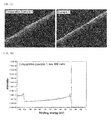
- FIGs. 4a and 4b show graphs of carbon black used in Comparative Example 1 and Example 1, analyzed by XPS (Instrument name: ESCALab250). As shown in FIGs. 4a and 4b , it was found that the carbon black of Example 1 had the higher number of surface oxygen atoms than that of carbon atoms and thus had the oxygen/carbon atomic ratio of approximately 0.42, and the carbon black of Comparative Example 1 had the oxygen/carbon atomic ratio of approximately ⁇ 0.01.
- FIG. 5 is a graph showing a comparison of energy conversion (light conversion) efficiency between each 6 of the solar cells of Example 1 and Comparative Example 1, which were manufactured under different heat treatment conditions. As shown in FIG. 5 , the Example 1 showed the narrow line width and excellent ohmic contact, thereby improving FF values, and thus it showed more excellent energy conversion efficiency than the solar cell of Comparative Example 1.
Landscapes
- Chemical & Material Sciences (AREA)
- Dispersion Chemistry (AREA)
- Physics & Mathematics (AREA)
- Spectroscopy & Molecular Physics (AREA)
- Inorganic Chemistry (AREA)
- Conductive Materials (AREA)
- Photovoltaic Devices (AREA)
Applications Claiming Priority (3)
| Application Number | Priority Date | Filing Date | Title |
|---|---|---|---|
| KR20110032244 | 2011-04-07 | ||
| KR1020120035794A KR101497038B1 (ko) | 2011-04-07 | 2012-04-06 | 전극 형성용 은 페이스트 조성물 및 이의 제조 방법 |
| PCT/KR2012/002645 WO2012138186A2 (fr) | 2011-04-07 | 2012-04-06 | Composition de pâte d'argent pour former une électrode, et procédé pour sa préparation |
Publications (3)
| Publication Number | Publication Date |
|---|---|
| EP2696352A2 true EP2696352A2 (fr) | 2014-02-12 |
| EP2696352A4 EP2696352A4 (fr) | 2014-09-10 |
| EP2696352B1 EP2696352B1 (fr) | 2015-12-09 |
Family
ID=47284095
Family Applications (1)
| Application Number | Title | Priority Date | Filing Date |
|---|---|---|---|
| EP12768065.0A Active EP2696352B1 (fr) | 2011-04-07 | 2012-04-06 | Composition de pâte d'argent pour former une électrode, et procédé pour sa préparation |
Country Status (6)
| Country | Link |
|---|---|
| US (1) | US20140020751A1 (fr) |
| EP (1) | EP2696352B1 (fr) |
| KR (1) | KR101497038B1 (fr) |
| CN (1) | CN103582916B (fr) |
| TW (1) | TWI489492B (fr) |
| WO (1) | WO2012138186A2 (fr) |
Families Citing this family (10)
| Publication number | Priority date | Publication date | Assignee | Title |
|---|---|---|---|---|
| CN104078090B (zh) * | 2013-03-28 | 2016-09-07 | 比亚迪股份有限公司 | 一种晶体硅太阳能电池用导电浆料及其制备方法 |
| JP2015228191A (ja) * | 2014-06-03 | 2015-12-17 | カシオ計算機株式会社 | コンテンツ出力システム、コンテンツ出力方法、コンテンツ出力プログラム、および通信端末 |
| TW201618319A (zh) * | 2014-11-07 | 2016-05-16 | Taiwan Carbon Nano Technology Corp | 用於太陽能電池製程之導電助劑及使用該導電助劑的導電漿料 |
| CN107170508B (zh) * | 2017-05-14 | 2019-01-18 | 马鞍山市泰博化工科技有限公司 | 一种导电银浆的制备方法 |
| KR101975497B1 (ko) * | 2017-05-30 | 2019-05-07 | 주식회사 대유플러스 | 난연성 도료 조성물 제조방법 |
| EP3687716A1 (fr) * | 2017-09-25 | 2020-08-05 | Eastman Kodak Company | Procédé de fabrication de dispersions contenant de l'argent avec des bases azotées |
| US20190092647A1 (en) * | 2017-09-25 | 2019-03-28 | Eastman Kodak Company | Non-aqueous silver-containing dispersions |
| KR102178011B1 (ko) * | 2018-11-30 | 2020-11-12 | 엘에스니꼬동제련 주식회사 | 응집도를 조절하는 은 분말의 제조방법 |
| CN111128434A (zh) * | 2019-12-16 | 2020-05-08 | 中国人民解放军国防科技大学 | 一种银电极及其制备方法 |
| CN114550970B (zh) * | 2022-02-11 | 2022-10-14 | 上海银浆科技有限公司 | 用于硅太阳能电池的正面银浆及其制法、硅太阳能电池的正面电极、硅太阳能电池 |
Family Cites Families (23)
| Publication number | Priority date | Publication date | Assignee | Title |
|---|---|---|---|---|
| US3091069A (en) * | 1960-01-14 | 1963-05-28 | Research Corp | Apparatus and method for production of carbon black |
| US4184640A (en) * | 1978-05-05 | 1980-01-22 | Williams Robert M | Coal grinding apparatus for direct fired burners |
| JPS61123665A (ja) * | 1984-11-19 | 1986-06-11 | Matsushita Electric Ind Co Ltd | 導電性樹脂組成物の製造方法 |
| US5154886A (en) * | 1987-10-08 | 1992-10-13 | At&T Bell Laboratories | Protection of devices |
| TWI326297B (en) * | 2005-03-21 | 2010-06-21 | Inktec Co Ltd | Conductive ink composition and preparing method thereof |
| WO2007007802A1 (fr) * | 2005-07-13 | 2007-01-18 | Taiyo Ink Mfg. Co., Ltd. | Composition de pâte d’argent, procédé de traçage d’un motif électriquement conducteur l'utilisant, et son motif électriquement conducteur |
| US7608784B2 (en) * | 2006-07-13 | 2009-10-27 | E. I. Du Pont De Nemours And Company | Photosensitive conductive paste for electrode formation and electrode |
| CN101192628B (zh) * | 2006-11-30 | 2010-10-13 | 比亚迪股份有限公司 | 半导体电极及制法和含有该半导体电极的太阳能电池 |
| WO2009011281A1 (fr) * | 2007-07-19 | 2009-01-22 | Sekisui Chemical Co., Ltd. | Ruban de découpage en puces/fixage de puce et procédé de fabrication de puce semi-conductrice |
| US8309844B2 (en) * | 2007-08-29 | 2012-11-13 | Ferro Corporation | Thick film pastes for fire through applications in solar cells |
| US8236598B2 (en) * | 2007-08-31 | 2012-08-07 | Ferro Corporation | Layered contact structure for solar cells |
| KR20090030995A (ko) * | 2007-09-21 | 2009-03-25 | 엘지마이크론 주식회사 | 전도성 페이스트 조성물 |
| KR101156122B1 (ko) * | 2009-05-26 | 2012-06-20 | 주식회사 엘지화학 | 전극형성용 금속 페이스트 조성물 및 이를 이용한 은-탄소 복합체 전극과 실리콘 태양전지 |
| KR101278976B1 (ko) * | 2008-06-04 | 2013-07-02 | 주식회사 엘지화학 | 전극형성용 금속 페이스트 조성물 및 그 제조 방법과 그를이용한 실리콘 태양전지 |
| CN102057443A (zh) * | 2008-06-04 | 2011-05-11 | Lg化学株式会社 | 用于形成电极的金属膏组合物以及使用该组合物的银-碳复合电极和硅太阳能电池 |
| CN101620938B (zh) * | 2008-07-05 | 2011-12-14 | 比亚迪股份有限公司 | 一种半导体电极及制法和含有该半导体电极的太阳能电池 |
| CN101633788B (zh) * | 2008-07-22 | 2012-03-07 | 比亚迪股份有限公司 | 一种聚合物基正温度系数热敏电阻复合材料及其制备方法 |
| US7976734B2 (en) * | 2008-09-10 | 2011-07-12 | E.I. Du Pont De Nemours And Company | Solar cell electrodes |
| KR20100064633A (ko) * | 2008-12-05 | 2010-06-15 | 삼성전자주식회사 | 전기 흡착 탈이온화용 전극 및 이를 구비하는 전기 흡착 탈이온 장치와 전기이중층 커패시터 |
| KR20100069950A (ko) * | 2008-12-17 | 2010-06-25 | 에스에스씨피 주식회사 | 태양전지용 전극, 그 제조방법 및 태양전지 |
| WO2010103998A1 (fr) * | 2009-03-11 | 2010-09-16 | 信越化学工業株式会社 | Feuille de connexion pour électrode de cellule de batterie solaire, procédé de fabrication de module de cellule solaire et module de cellule solaire |
| EP2417607A1 (fr) * | 2009-04-08 | 2012-02-15 | E. I. du Pont de Nemours and Company | Electrode pour cellule solaire |
| CN101609849B (zh) * | 2009-07-13 | 2010-11-03 | 中南大学 | 太阳能电池正面电极用银导体浆料及其制备工艺 |
-
2012
- 2012-04-06 TW TW101112236A patent/TWI489492B/zh active
- 2012-04-06 CN CN201280027854.8A patent/CN103582916B/zh active Active
- 2012-04-06 KR KR1020120035794A patent/KR101497038B1/ko active Active
- 2012-04-06 EP EP12768065.0A patent/EP2696352B1/fr active Active
- 2012-04-06 US US14/008,312 patent/US20140020751A1/en not_active Abandoned
- 2012-04-06 WO PCT/KR2012/002645 patent/WO2012138186A2/fr not_active Ceased
Also Published As
| Publication number | Publication date |
|---|---|
| EP2696352B1 (fr) | 2015-12-09 |
| TW201303895A (zh) | 2013-01-16 |
| CN103582916B (zh) | 2016-06-01 |
| TWI489492B (zh) | 2015-06-21 |
| EP2696352A4 (fr) | 2014-09-10 |
| WO2012138186A2 (fr) | 2012-10-11 |
| KR20120115128A (ko) | 2012-10-17 |
| KR101497038B1 (ko) | 2015-03-02 |
| CN103582916A (zh) | 2014-02-12 |
| US20140020751A1 (en) | 2014-01-23 |
| WO2012138186A3 (fr) | 2013-01-10 |
Similar Documents
| Publication | Publication Date | Title |
|---|---|---|
| EP2696352B1 (fr) | Composition de pâte d'argent pour former une électrode, et procédé pour sa préparation | |
| JP5542212B2 (ja) | 銀ペースト組成物及びそれを用いた太陽電池 | |
| US20110073180A1 (en) | Lead free glass frit powder for manufacturing silicon solar cell, its producing method, metal paste composition containing the same and silicon solar cell | |
| JP2012502503A (ja) | 太陽電池電極 | |
| US20120000523A1 (en) | Metal paste composition for forming electrode and silver-carbon composite electrode and silicon solar cell using the same | |
| KR20100127619A (ko) | 전극형성용 금속 페이스트 조성물 및 이를 이용한 은-탄소 복합체 전극과 실리콘 태양전지 | |
| TW201735054A (zh) | 用於太陽能電池之無鉛導電糊料 | |
| TWI657119B (zh) | 用於太陽能電池之背面電極糊料組成物 | |
| US9640298B2 (en) | Silver paste composition for forming an electrode, and silicon solar cell using same | |
| TWI655784B (zh) | 用於太陽能電池的前電極和包括其的太陽能電池 | |
| KR101278976B1 (ko) | 전극형성용 금속 페이스트 조성물 및 그 제조 방법과 그를이용한 실리콘 태양전지 | |
| KR20140048465A (ko) | 전극형성용 페이스트 조성물, 이를 이용한 실리콘 태양전지 | |
| KR20140048464A (ko) | 전극형성용 페이스트 조성물, 이를 이용한 실리콘 태양전지 | |
| KR20130063266A (ko) | 전극형성용 은 페이스트 조성물, 이를 이용한 실리콘 태양전지 | |
| KR101094197B1 (ko) | 태양전지 전극용 전도성 은 페이스트 및 그 제조방법 | |
| KR20130067693A (ko) | 전극형성용 은 페이스트 조성물, 이를 이용한 실리콘 태양전지 | |
| CN105047250B (zh) | 铝膏组合物及使用该组合物之太阳能电池组件 | |
| KR101416335B1 (ko) | 전극형성용 금속 페이스트 조성물 | |
| KR20120002974A (ko) | 전극형성용 금속 페이스트 조성물 및 그 제조 방법과 그를 이용한 실리콘 태양전지 |
Legal Events
| Date | Code | Title | Description |
|---|---|---|---|
| PUAI | Public reference made under article 153(3) epc to a published international application that has entered the european phase |
Free format text: ORIGINAL CODE: 0009012 |
|
| 17P | Request for examination filed |
Effective date: 20130925 |
|
| AK | Designated contracting states |
Kind code of ref document: A2 Designated state(s): AL AT BE BG CH CY CZ DE DK EE ES FI FR GB GR HR HU IE IS IT LI LT LU LV MC MK MT NL NO PL PT RO RS SE SI SK SM TR |
|
| DAX | Request for extension of the european patent (deleted) | ||
| A4 | Supplementary search report drawn up and despatched |
Effective date: 20140812 |
|
| RIC1 | Information provided on ipc code assigned before grant |
Ipc: H01B 1/02 20060101ALI20140806BHEP Ipc: H01B 1/22 20060101ALI20140806BHEP Ipc: H01B 1/20 20060101AFI20140806BHEP Ipc: H01L 31/042 20140101ALI20140806BHEP Ipc: H01B 1/04 20060101ALI20140806BHEP |
|
| RIC1 | Information provided on ipc code assigned before grant |
Ipc: H01B 1/22 20060101ALI20150528BHEP Ipc: H01B 1/20 20060101AFI20150528BHEP Ipc: H01L 31/042 20140101ALI20150528BHEP Ipc: H01B 1/04 20060101ALI20150528BHEP Ipc: H01B 1/02 20060101ALI20150528BHEP |
|
| GRAP | Despatch of communication of intention to grant a patent |
Free format text: ORIGINAL CODE: EPIDOSNIGR1 |
|
| INTG | Intention to grant announced |
Effective date: 20150702 |
|
| GRAS | Grant fee paid |
Free format text: ORIGINAL CODE: EPIDOSNIGR3 |
|
| GRAA | (expected) grant |
Free format text: ORIGINAL CODE: 0009210 |
|
| AK | Designated contracting states |
Kind code of ref document: B1 Designated state(s): AL AT BE BG CH CY CZ DE DK EE ES FI FR GB GR HR HU IE IS IT LI LT LU LV MC MK MT NL NO PL PT RO RS SE SI SK SM TR |
|
| REG | Reference to a national code |
Ref country code: GB Ref legal event code: FG4D |
|
| REG | Reference to a national code |
Ref country code: AT Ref legal event code: REF Ref document number: 764882 Country of ref document: AT Kind code of ref document: T Effective date: 20151215 Ref country code: CH Ref legal event code: EP |
|
| REG | Reference to a national code |
Ref country code: IE Ref legal event code: FG4D |
|
| REG | Reference to a national code |
Ref country code: DE Ref legal event code: R096 Ref document number: 602012012965 Country of ref document: DE |
|
| REG | Reference to a national code |
Ref country code: LT Ref legal event code: MG4D |
|
| REG | Reference to a national code |
Ref country code: NL Ref legal event code: MP Effective date: 20151209 |
|
| PG25 | Lapsed in a contracting state [announced via postgrant information from national office to epo] |
Ref country code: LT Free format text: LAPSE BECAUSE OF FAILURE TO SUBMIT A TRANSLATION OF THE DESCRIPTION OR TO PAY THE FEE WITHIN THE PRESCRIBED TIME-LIMIT Effective date: 20151209 Ref country code: NO Free format text: LAPSE BECAUSE OF FAILURE TO SUBMIT A TRANSLATION OF THE DESCRIPTION OR TO PAY THE FEE WITHIN THE PRESCRIBED TIME-LIMIT Effective date: 20160309 Ref country code: ES Free format text: LAPSE BECAUSE OF FAILURE TO SUBMIT A TRANSLATION OF THE DESCRIPTION OR TO PAY THE FEE WITHIN THE PRESCRIBED TIME-LIMIT Effective date: 20151209 |
|
| REG | Reference to a national code |
Ref country code: AT Ref legal event code: MK05 Ref document number: 764882 Country of ref document: AT Kind code of ref document: T Effective date: 20151209 |
|
| PG25 | Lapsed in a contracting state [announced via postgrant information from national office to epo] |
Ref country code: GR Free format text: LAPSE BECAUSE OF FAILURE TO SUBMIT A TRANSLATION OF THE DESCRIPTION OR TO PAY THE FEE WITHIN THE PRESCRIBED TIME-LIMIT Effective date: 20160310 Ref country code: FI Free format text: LAPSE BECAUSE OF FAILURE TO SUBMIT A TRANSLATION OF THE DESCRIPTION OR TO PAY THE FEE WITHIN THE PRESCRIBED TIME-LIMIT Effective date: 20151209 Ref country code: LV Free format text: LAPSE BECAUSE OF FAILURE TO SUBMIT A TRANSLATION OF THE DESCRIPTION OR TO PAY THE FEE WITHIN THE PRESCRIBED TIME-LIMIT Effective date: 20151209 Ref country code: SE Free format text: LAPSE BECAUSE OF FAILURE TO SUBMIT A TRANSLATION OF THE DESCRIPTION OR TO PAY THE FEE WITHIN THE PRESCRIBED TIME-LIMIT Effective date: 20151209 Ref country code: NL Free format text: LAPSE BECAUSE OF FAILURE TO SUBMIT A TRANSLATION OF THE DESCRIPTION OR TO PAY THE FEE WITHIN THE PRESCRIBED TIME-LIMIT Effective date: 20151209 Ref country code: RS Free format text: LAPSE BECAUSE OF FAILURE TO SUBMIT A TRANSLATION OF THE DESCRIPTION OR TO PAY THE FEE WITHIN THE PRESCRIBED TIME-LIMIT Effective date: 20151209 |
|
| PG25 | Lapsed in a contracting state [announced via postgrant information from national office to epo] |
Ref country code: IS Free format text: LAPSE BECAUSE OF FAILURE TO SUBMIT A TRANSLATION OF THE DESCRIPTION OR TO PAY THE FEE WITHIN THE PRESCRIBED TIME-LIMIT Effective date: 20151209 |
|
| PG25 | Lapsed in a contracting state [announced via postgrant information from national office to epo] |
Ref country code: IT Free format text: LAPSE BECAUSE OF FAILURE TO SUBMIT A TRANSLATION OF THE DESCRIPTION OR TO PAY THE FEE WITHIN THE PRESCRIBED TIME-LIMIT Effective date: 20151209 Ref country code: CZ Free format text: LAPSE BECAUSE OF FAILURE TO SUBMIT A TRANSLATION OF THE DESCRIPTION OR TO PAY THE FEE WITHIN THE PRESCRIBED TIME-LIMIT Effective date: 20151209 |
|
| PG25 | Lapsed in a contracting state [announced via postgrant information from national office to epo] |
Ref country code: EE Free format text: LAPSE BECAUSE OF FAILURE TO SUBMIT A TRANSLATION OF THE DESCRIPTION OR TO PAY THE FEE WITHIN THE PRESCRIBED TIME-LIMIT Effective date: 20151209 Ref country code: SK Free format text: LAPSE BECAUSE OF FAILURE TO SUBMIT A TRANSLATION OF THE DESCRIPTION OR TO PAY THE FEE WITHIN THE PRESCRIBED TIME-LIMIT Effective date: 20151209 Ref country code: BE Free format text: LAPSE BECAUSE OF NON-PAYMENT OF DUE FEES Effective date: 20160430 Ref country code: IS Free format text: LAPSE BECAUSE OF FAILURE TO SUBMIT A TRANSLATION OF THE DESCRIPTION OR TO PAY THE FEE WITHIN THE PRESCRIBED TIME-LIMIT Effective date: 20160409 Ref country code: RO Free format text: LAPSE BECAUSE OF FAILURE TO SUBMIT A TRANSLATION OF THE DESCRIPTION OR TO PAY THE FEE WITHIN THE PRESCRIBED TIME-LIMIT Effective date: 20151209 Ref country code: SM Free format text: LAPSE BECAUSE OF FAILURE TO SUBMIT A TRANSLATION OF THE DESCRIPTION OR TO PAY THE FEE WITHIN THE PRESCRIBED TIME-LIMIT Effective date: 20151209 Ref country code: AT Free format text: LAPSE BECAUSE OF FAILURE TO SUBMIT A TRANSLATION OF THE DESCRIPTION OR TO PAY THE FEE WITHIN THE PRESCRIBED TIME-LIMIT Effective date: 20151209 Ref country code: PT Free format text: LAPSE BECAUSE OF FAILURE TO SUBMIT A TRANSLATION OF THE DESCRIPTION OR TO PAY THE FEE WITHIN THE PRESCRIBED TIME-LIMIT Effective date: 20160411 |
|
| REG | Reference to a national code |
Ref country code: DE Ref legal event code: R097 Ref document number: 602012012965 Country of ref document: DE |
|
| PLBE | No opposition filed within time limit |
Free format text: ORIGINAL CODE: 0009261 |
|
| STAA | Information on the status of an ep patent application or granted ep patent |
Free format text: STATUS: NO OPPOSITION FILED WITHIN TIME LIMIT |
|
| PG25 | Lapsed in a contracting state [announced via postgrant information from national office to epo] |
Ref country code: PL Free format text: LAPSE BECAUSE OF FAILURE TO SUBMIT A TRANSLATION OF THE DESCRIPTION OR TO PAY THE FEE WITHIN THE PRESCRIBED TIME-LIMIT Effective date: 20151209 Ref country code: DK Free format text: LAPSE BECAUSE OF FAILURE TO SUBMIT A TRANSLATION OF THE DESCRIPTION OR TO PAY THE FEE WITHIN THE PRESCRIBED TIME-LIMIT Effective date: 20151209 |
|
| 26N | No opposition filed |
Effective date: 20160912 |
|
| PG25 | Lapsed in a contracting state [announced via postgrant information from national office to epo] |
Ref country code: SI Free format text: LAPSE BECAUSE OF FAILURE TO SUBMIT A TRANSLATION OF THE DESCRIPTION OR TO PAY THE FEE WITHIN THE PRESCRIBED TIME-LIMIT Effective date: 20151209 |
|
| REG | Reference to a national code |
Ref country code: CH Ref legal event code: PL |
|
| GBPC | Gb: european patent ceased through non-payment of renewal fee |
Effective date: 20160406 |
|
| PG25 | Lapsed in a contracting state [announced via postgrant information from national office to epo] |
Ref country code: BE Free format text: LAPSE BECAUSE OF FAILURE TO SUBMIT A TRANSLATION OF THE DESCRIPTION OR TO PAY THE FEE WITHIN THE PRESCRIBED TIME-LIMIT Effective date: 20151209 Ref country code: LU Free format text: LAPSE BECAUSE OF FAILURE TO SUBMIT A TRANSLATION OF THE DESCRIPTION OR TO PAY THE FEE WITHIN THE PRESCRIBED TIME-LIMIT Effective date: 20160406 |
|
| REG | Reference to a national code |
Ref country code: IE Ref legal event code: MM4A |
|
| REG | Reference to a national code |
Ref country code: FR Ref legal event code: ST Effective date: 20161230 |
|
| PG25 | Lapsed in a contracting state [announced via postgrant information from national office to epo] |
Ref country code: GB Free format text: LAPSE BECAUSE OF NON-PAYMENT OF DUE FEES Effective date: 20160406 Ref country code: FR Free format text: LAPSE BECAUSE OF NON-PAYMENT OF DUE FEES Effective date: 20160502 Ref country code: CH Free format text: LAPSE BECAUSE OF NON-PAYMENT OF DUE FEES Effective date: 20160430 Ref country code: LI Free format text: LAPSE BECAUSE OF NON-PAYMENT OF DUE FEES Effective date: 20160430 |
|
| PG25 | Lapsed in a contracting state [announced via postgrant information from national office to epo] |
Ref country code: IE Free format text: LAPSE BECAUSE OF NON-PAYMENT OF DUE FEES Effective date: 20160406 |
|
| PG25 | Lapsed in a contracting state [announced via postgrant information from national office to epo] |
Ref country code: CY Free format text: LAPSE BECAUSE OF FAILURE TO SUBMIT A TRANSLATION OF THE DESCRIPTION OR TO PAY THE FEE WITHIN THE PRESCRIBED TIME-LIMIT Effective date: 20151209 Ref country code: HU Free format text: LAPSE BECAUSE OF FAILURE TO SUBMIT A TRANSLATION OF THE DESCRIPTION OR TO PAY THE FEE WITHIN THE PRESCRIBED TIME-LIMIT; INVALID AB INITIO Effective date: 20120406 |
|
| PG25 | Lapsed in a contracting state [announced via postgrant information from national office to epo] |
Ref country code: MC Free format text: LAPSE BECAUSE OF FAILURE TO SUBMIT A TRANSLATION OF THE DESCRIPTION OR TO PAY THE FEE WITHIN THE PRESCRIBED TIME-LIMIT Effective date: 20151209 Ref country code: HR Free format text: LAPSE BECAUSE OF FAILURE TO SUBMIT A TRANSLATION OF THE DESCRIPTION OR TO PAY THE FEE WITHIN THE PRESCRIBED TIME-LIMIT Effective date: 20151209 Ref country code: TR Free format text: LAPSE BECAUSE OF FAILURE TO SUBMIT A TRANSLATION OF THE DESCRIPTION OR TO PAY THE FEE WITHIN THE PRESCRIBED TIME-LIMIT Effective date: 20151209 Ref country code: MK Free format text: LAPSE BECAUSE OF FAILURE TO SUBMIT A TRANSLATION OF THE DESCRIPTION OR TO PAY THE FEE WITHIN THE PRESCRIBED TIME-LIMIT Effective date: 20151209 Ref country code: MT Free format text: LAPSE BECAUSE OF NON-PAYMENT OF DUE FEES Effective date: 20160430 |
|
| PG25 | Lapsed in a contracting state [announced via postgrant information from national office to epo] |
Ref country code: BG Free format text: LAPSE BECAUSE OF FAILURE TO SUBMIT A TRANSLATION OF THE DESCRIPTION OR TO PAY THE FEE WITHIN THE PRESCRIBED TIME-LIMIT Effective date: 20151209 |
|
| PG25 | Lapsed in a contracting state [announced via postgrant information from national office to epo] |
Ref country code: AL Free format text: LAPSE BECAUSE OF FAILURE TO SUBMIT A TRANSLATION OF THE DESCRIPTION OR TO PAY THE FEE WITHIN THE PRESCRIBED TIME-LIMIT Effective date: 20151209 |
|
| PGFP | Annual fee paid to national office [announced via postgrant information from national office to epo] |
Ref country code: DE Payment date: 20250320 Year of fee payment: 14 |