EP2696518A2 - Procédé de transmission de données et équipement utilisateur - Google Patents
Procédé de transmission de données et équipement utilisateur Download PDFInfo
- Publication number
- EP2696518A2 EP2696518A2 EP12768305.0A EP12768305A EP2696518A2 EP 2696518 A2 EP2696518 A2 EP 2696518A2 EP 12768305 A EP12768305 A EP 12768305A EP 2696518 A2 EP2696518 A2 EP 2696518A2
- Authority
- EP
- European Patent Office
- Prior art keywords
- access
- network
- data
- information
- transmitted
- Prior art date
- Legal status (The legal status is an assumption and is not a legal conclusion. Google has not performed a legal analysis and makes no representation as to the accuracy of the status listed.)
- Withdrawn
Links
Images




Classifications
-
- H—ELECTRICITY
- H04—ELECTRIC COMMUNICATION TECHNIQUE
- H04W—WIRELESS COMMUNICATION NETWORKS
- H04W48/00—Access restriction; Network selection; Access point selection
- H04W48/18—Selecting a network or a communication service
-
- H—ELECTRICITY
- H04—ELECTRIC COMMUNICATION TECHNIQUE
- H04L—TRANSMISSION OF DIGITAL INFORMATION, e.g. TELEGRAPHIC COMMUNICATION
- H04L12/00—Data switching networks
- H04L12/54—Store-and-forward switching systems
- H04L12/56—Packet switching systems
- H04L12/5691—Access to open networks; Ingress point selection, e.g. ISP selection
- H04L12/5692—Selection among different networks
-
- H—ELECTRICITY
- H04—ELECTRIC COMMUNICATION TECHNIQUE
- H04W—WIRELESS COMMUNICATION NETWORKS
- H04W48/00—Access restriction; Network selection; Access point selection
- H04W48/08—Access restriction or access information delivery, e.g. discovery data delivery
-
- H—ELECTRICITY
- H04—ELECTRIC COMMUNICATION TECHNIQUE
- H04W—WIRELESS COMMUNICATION NETWORKS
- H04W8/00—Network data management
- H04W8/22—Processing or transfer of terminal data, e.g. status or physical capabilities
-
- H—ELECTRICITY
- H04—ELECTRIC COMMUNICATION TECHNIQUE
- H04W—WIRELESS COMMUNICATION NETWORKS
- H04W88/00—Devices specially adapted for wireless communication networks, e.g. terminals, base stations or access point devices
- H04W88/02—Terminal devices
- H04W88/06—Terminal devices adapted for operation in multiple networks or having at least two operational modes, e.g. multi-mode terminals
-
- H—ELECTRICITY
- H04—ELECTRIC COMMUNICATION TECHNIQUE
- H04W—WIRELESS COMMUNICATION NETWORKS
- H04W28/00—Network traffic management; Network resource management
- H04W28/02—Traffic management, e.g. flow control or congestion control
- H04W28/0289—Congestion control
Definitions
- the present invention relates to a server responsible for a control plane within a mobile communication network and a method of the server controlling service.
- LTE/SAE Long Term Evolution/System Architecture Evolution
- SAE that has been in progress based on 3GPP SA WG2 is research regarding network technology for purposes of determining the structure of a network and supporting mobility between heterogeneous networks, simultaneously with the LTE task of a 3GPP TSG RAN and is one of the recent important standardization issues of 3GPP.
- a task has been in progress for the purpose of an optimized packet-based system with minimized transmission delay through the further improved data transfer capability as a task for developing the 3GPP system into a system that supports various radio access technologies based on an IP.
- An SAE higher level reference model defined in 3GPP SA WG2 includes a non-roaming case and roaming cases including various scenarios, and reference can be made to 3GPP standard document TS 23.401 and TS 23.402 for detailed contents of the SAE higher level reference model.
- a simple reconfiguration of the SAE higher level reference model is shown in a network configuration of FIG. 1 .
- FIG. 1 shows the structure of an evolved mobile communication network.
- the network configuration is based on the eNodeB of an evolved UTRAN and a 2 tier model of a gateway of a core network.
- An eNodeB 20 includes the functions of the NodeB and RNC of an existing UMTS system although not precisely matched, and the gateway can be seen to have the SGSN/GGSN functions of the existing system.
- a control plane and a user plane between an access network and a core network are exchanged through different interfaces.
- one lu interface is present between the RNC and the SGSN.
- MME Mobility Management Entity
- the GW include a Serving-GW (hereinafter referred to as an 'S-GW') 52 and a Packet Data Network GW (hereinafter referred to as a ⁇ PDN-GW' or a 'P-GW') 53.
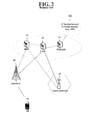
- FIG. 2 is a diagram showing a relationship between an (e)NodeB and a Home (e)NodeB.
- a femto base station such as a Home (e)NodeB 30, from among approaches for increasing the cell capacity using a small cell as described above.
- the Home (e)Node 30 started being researched on the basis of RAN WG3 of a 3GPP Home (e)NodeB and has recently been researched in earnest even in SA WG.
- An (e)NodeB 20 shown in FIG. 2 can correspond to a macro base station, and the Home (e)NodeB 30 shown in FIG. 2 can become a femto base station.
- This specification is described based on the terms of 3GPP, and an (e)NodeB is used when describing a NodeB or an eNodeB.
- the Home (e)NodeB is used when describing both a Home NodeB and a Home eNodeB.
- Interfaces indicated by dotted lines are for transmitting control signals between the (e)NodeB 20 and the Home (e)NodeB 30, and the MME 510. Furthermore, interfaces indicated by solid lines are for transmitting the data of a user plane.
- FIG. 3 shows problems according to the prior art.
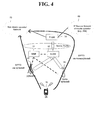
- FIG. 4 shows a concept of Selected IP Traffic Offload (SIPTO).
- FIG. 4 illustratively shows a mobile communication system, such as an Evolved Packet System (EPS).
- the EPS system includes an (e)NodeB 20, an MME 51, an S-GW 52, and a P-GW 53. Furthermore, a Home (e)NodeB 30 is shown.
- EPS Evolved Packet System
- IPTO Selected IP Traffic Offload
- the UE 10 when the UE 10 receives grant to access the (e)NodeB 20 or the Home (e)NodeB 30, the UE 10 can generate a session that passes through the wired network 70, such as a public telecommunication network, through the (e)NodeB 20 or the Home (e)NodeB 30 and perform IP network service through the session.
- the wired network 70 such as a public telecommunication network
- service provider policy and subscription information can be taken into consideration.
- a gateway installed in a location close to the (e)NodeB 20 or the Home (e)NodeB 30 may be used as a local gateway responsible for some of the functions of a GGSN in the case of a gateway, that is, a UMTS, or a local gateway responsible for some of the functions of a PDN Gateway (P-GW) in the case of an EPS.
- P-GW PDN Gateway
- Such a local gateway is called a local GGSN or a local P-GW.
- the function of the local GGSN or the local P-GW is similar to that of the GGSN or P-GW.
- SIPTO technology has proposed a concept in which the data of UE is offloaded to a wired network, such as a public telecommunication network, through the (e)NodeB 20 or the Home (e)NodeB 30.
- the prior art has proposed a concept in which the data of UE transmitted through one IP interface (Wi-Fi access or APN) is entirely offloaded to a wired network.
- Wi-Fi access or APN Wi-Fi access
- a problem in that reliability is not guaranteed may be caused because the data of UE is offloaded to a wired network although the data requires high reliability.
- an object of one disclosure of the present invention is to solve the above-described problems.
- the method may include receiving information on an inter-system routing policy from a server.
- the information may include filter rule information, and the filter rule information may include one or more of domain information and content type information and a list in which access technologies or access networks supported by the user equipment are classified according to priorities.
- the method may include transmitting data traffic to be transmitted using one or more access technologies or networks determined based on the filter rule information.
- data traffic to be transmitted through the any one access technology or network may correspond to data to be transferred using an Access Point Name (APN) defined in the routing policy.
- API Access Point Name
- the access technology or the access network may be either a mobile communication network or a Wi-Fi network.
- the server may be an Access Network Discovery and Selection Function (ANDSF) server.
- ANDSF Access Network Discovery and Selection Function
- the transmitting step may include checking packets of the data to be transmitted; classifying the checked data packets according to the filter rule information; and sending the classified data using the access technologies.
- the data traffic to be transmitted through the any one access technology or network may correspond to data traffic that is matched with the content type or matched with the domain information.
- the filter rule information may be defined according to each filter set of IP flows.
- the user equipment may include a reception unit configured to receive information about an inter-system routing policy from a server.
- the information may include filter rule information, and the filter rule information may include one or more of domain information and content type information and a list in which access technologies or access networks supported by the user equipment are classified according to priorities.
- the user equipment may further include a transmission unit configured to transmit data traffic to be transmitted using one or more access technologies or networks determined based on the filter rule information.
- the data traffic transmitted through the any one access technology or network may correspond to data transferred using an Access Point Name (APN) defined in the routing policy.
- API Access Point Name
- UE can efficiently offload traffic according to several types of access. That is, in accordance with the disclosure of this specification, traffic can be effectively offloaded according to several types of access using the type of content type or a media type.
- the present invention is described on the basis of a Universal Mobile Telecommunication System (UMTS) and an Evolved Packet Core (EPC), but the present invention is not limited to only the communication systems and can also be applied to all communication systems and methods to which the technical spirit of the present invention can be applied.
- UMTS Universal Mobile Telecommunication System
- EPC Evolved Packet Core
- first and the second used in this specification may be used to describe a variety of elements, but the elements should not be limited by the terms. The terms are used to only distinguish one element from the other element. For example, a first element may be named a second element and likewise a second element may be named a first element without departing from the scope of the present invention.
- UE User Equipment
- ME Mobile Equipment
- the UE may be a portable device, such as a notebook, a mobile phone, a PDA, a smart phone, or a multimedia device, or may be a device that cannot be carried, such as a PC or a device mounted on a vehicle.
- UMTS An abbreviation of a Universal Mobile Telecommunication System, and an UMTS means a 3rd mobile communication network.
- EPS An abbreviation of Evolved Packet System, and an EPS means a core network which supports a Long Term Evolution (LTE) network.
- LTE Long Term Evolution
- UMTS is an evolved form of network
- PDN Public Data Network
- Access Point Name The name of an access point managed in a network, which is provided to UE. That is, the APN indicates the name (character string) of a PDN. A corresponding PDN for transmitting and receiving data is determined based on the name of an access point.
- Access control A control procedure for allowing whether or not to allow UE to use an access system, such as a Home(e)NodeB, or moving UE to another access system.
- Tunnel Endpoint Identifier an endpoint ID of a tunnel set between nodes within a network.
- the TEID is set in each section in a bearer unit of each terminal.
- NodeB A base station of an UMTS network, which is installed outdoors.
- the NodeB has cell coverage corresponding to that of a macro cell.
- eNodeB A base station of an Evolved Packet System (EPS), which is installed outdoors.
- EPS Evolved Packet System
- the eNodeB has cell coverage corresponding to that of a macro cell.
- e)NodeB A term that denotes a NodeB and an eNodeB.
- the Home NodeB A base station of an UMTS network, which is installed indoors.
- the Home NodeB has cell coverage corresponding to that of a femto cell.
- the Home eNodeB A base station of an EPS network, which is installed indoors.
- the Home eNodeB has cell coverage corresponding to that of a femto cell.
- eNodeB A term that denotes a Home NodeB and a Home eNodeB.
- Home (e)NodeB gateway a gateway connected with one or more Home (e)NodeBs and functioning to interface with a core network.
- a Home (e)NodeB Subsystem A form in which a wireless network is managed by binding a Home (e)NodeB and a Home (e)NodeB Gateway together as one set.
- the Home (e)NodeB subsystem and the Home (e)NodeB can be considered to be one set form because they manage a wireless network and function to operate in conjunction with a core network. Accordingly, hereinafter, terms: a Home (e)NodeB and a Home (e)NodeB subsystem are mixed and used.
- MME An abbreviation of a Mobility Management Entity, which functions to control each entity within an EPS in order to provide a session and mobility to UE.
- CSG Closed Subscriber Group
- e Home (e)NodeBs.
- Home (e)NodeBs belonging to a CSG have the same CSG ID.
- Each user receives a use grant according to each CSG.
- Closed access mode It means that a Home (e)NodeB operates as a CSG cell.
- the closed access mode means that access is allowed for only UE allowed to a corresponding cell. That is, UE having a right to specific CSG IDs supported by a Home (e)NodeB can access the specific CSG IDs.
- Open access mode It means that a Home (e)NodeB operates like a normal cell (or non-CSG cell) without a concept of a CSG. That is, the open access mode means that a Home (e)NodeB operates likes a normal (e)NodeB.
- Hybrid access mode It means that a Home (e)NodeB operates as a CSG cell and allows even a non-CSG subscriber to access thereto. Access is allowed for UE having a specific CSG ID that can be supported for a corresponding cell, Home (e)NodeB service can be provided to the UE, and even UE not having a CSG right is allowed for access.
- SIPTO Selected IP Traffic Offload
- SIPTO femto (orfemto SIPTO): Technology in which when UE tries to send specific IP traffic through a Home(e)NodeB, the specific IP traffic is offloaded to a wired network, such as the Internet, not the network (e.g., 3GPP or 3GPP2) of a mobile communication service provider
- SIPTO macro Technology in which when UE tries to send specific IP traffic through an (e)NodeB, the specific IP traffic is offloaded to a wired network, such as the Internet, not the network (e.g., 3GPP or 3GPP2) of a mobile communication service provider
- LIPA Local IP Access
- a gateway for enabling LIPA or SIPTO through a Home(e)NodeB that is, for enabling data to be transmitted over a home network or a wired network directly without passing through a core network.
- the local gateway is placed between the Home(e)NodeB and the wired network, a bearer is generated between the Home(e)NodeB and the wired network or a bearer is generated between the Home (e)NodeB and a local network, and data is transmitted through the generated bearer.
- a session is a passage for data transmission, and a PDN, a bearer, or an IP flow unit can become a unit of the session.
- a difference between units, as defined in 3GPP, can be classified into the entire target network unit (APN or PDN unit), a unit classified according to QoS (i.e., a bearer unit) within the target network unit, and a target IP address unit.
- PDN connection A connection from UE to a PDN, that is, association (connection) between UE represented as an IP address and a PDN represented as an APN.
- the PDN connection means a connection (UE-PDN GW) between entities within a core network so that a session can be formed.
- Condition information for UE which is used to manage the UE in a network, that is, condition information including a UE ID, mobility (a current location, etc.), and the attributes (QoS, priority, etc.) of a session
- Local PDN An individual and independent network, such as a home network or a company network, not an external PDN
- Local Home(e)NodeB network It means a network for access to a local PDN and includes a Home(e)NodeB and an L-GW.
- Local network A network including a local Home (e)NodeB network and a local PDN
- DIDA Technology in which each datum is classified in order to select preference access in the form of data identification for an access network discovery selection function
- the present invention proposes technology in which the data of UE is offloaded to a wired network without passing through the core network of a service provider in a mobile communication system based on 3GPP Universal Mobile Telecommunication System (UMTS)/Evolved Packet System (EPS). Furthermore, there are proposed technologies, such as IFOM and MAPCON for supporting multiple radio access. That is, there are proposed technology in which data is transmitted through respective PDN connections for 3GPP access and Wi-Fi access (MAPCON) and technology in which data is transmitted by binding 3GPP access and Wi-Fi access into one PDN or a P-GW.
- UMTS Universal Mobile Telecommunication System
- EPS Evolved Packet System
- control over the operations is performed through a core network, a base station, UE or the like.
- the data of a user is not offloaded to a random network, but a radio access network is selected by taking the type of service, the location of a server, the type of transmitted data, etc. into consideration, and the data of a user is selectively offloaded.
- FIG. 5 illustrates an architecture proposed by this specification.
- FIG. 5 is an exemplary diagram showing an example of IFOM technology.
- LTE Long Term Evolution
- IFOM in IFOM, the same PDN connection is provided through other several pieces of accesses.
- Such IFOM provides offloading to a seamless WLAN.
- IFOM provides the transfer of the IP flows of the same one PDN connection from one type of access to another type of access.
- FIG. 6 is an exemplary diagram showing an example of MAPCON technology.
- IP flows shown in FIG. 6 are connected with other APNs through another access system.
- UE 100 can generate a new PDN connection on access that has not been used. Alternatively, the UE 100 can generate a new PDN connection in access selected from several types of access that have been previously used. Alternatively, the UE 100 may transfer some of or all PDN connections already connected thereto to another access.
- a service provider may control routing for PDN connections that are activated in several pieces of available access.
- FIG. 7 shows an example of an IP flow according to MAPCON technology
- FIG. 8 shows another example of an IP flow according to MAPCON technology.
- the UE 100 when UE 100 belongs to a base station, for example, both the coverage of an (e)NodeB 200 and the coverage of an AP 400, the UE 100 can transfer several PDN connections, for example, some of IP flows through 3GPP access using the base station, for example, the (e)NodeB 200 and transfer some IP flows through non-3GPP access using the AP 400.
- the UE 100 can transfer a connection for a voice call that requires a real-time property or a connection for data that requires reliability through 3GPP access using the base station, for example, the (e)NodeB 200 and transfer a connection for video data that does not require a real-time property or a connection for normal data that does not require reliability through non-3GPP access using the AP 400.
- a connection through non-3GPP access using the AP 400 can be changed so that the connection passes through 3GPP access using the base station, for example, the (e)NodeB 200.
- the UE 100 can transfer a connection for specific data through 3GPP access using a base station, for example, an (e)NodeB 200 and transfer a connection for other data through non-3GPP access using the AP 400.
- UE 100 may change some connections through 3GPP access using a base station, for example, an (e)NodeB 200 so that the some connections pass through non-3GPP access using the AP 400. That is, the UE can transfer the connections.
- a base station for example, an (e)NodeB 200
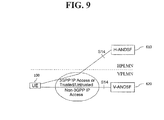
- FIG. 9 shows a network control entity for providing IFOM or MAPCON.
- a network control entity for providing IFOM or MAPCON may be present in the Home PLMN (hereinafter referred to as an 'HPLMN') of UE 100 or in a Visited PLMN (hereinafter referred to as a 'VPLMN').
- the ANDSF performs a network discovery function and a data management and control function for providing selected assistance data according to a service provider policy.
- the ANDSF may respond to a request from UE regarding access network discovery information and also transmit information if necessary although there is no request from UE.
- the ANDSF can provide information about an inter-system mobility policy, information for access network discovery, and information about inter-system routing, for example, a routing rule.
- the information about routing for example, the routing rule can include AccessTechnology, AccessId, AccessNetworkPriority, and so on.
- Types of categories that can be now supported are as follows.
- a scheme for supplement the ANDSF may include a scheme for adding data classification categories. This is described as follows below.
- an ANDSF functions to provide UE with policy information so that the UE can operate when accessing the home network of a service provider or a visited network (V-ANDSF), such as (H-ANDSF) roaming.
- V-ANDSF visited network
- the ANDSF includes information about data classification in the policy information and provides the policy information to the UE.
- the UE selects radio access or a network interface (PDN connection) according to at least one of the data classification information, included in the policy information, and several criteria.
- a criterion for the selection can be determined with reference to policy data, such as the Inter-System Routing Policy (ISRP) of the ANDSF.
- ISRP Inter-System Routing Policy
- a current format is as follows.
- An indication ⁇ X> means an extension and is a form that continues to be hierarchically extended.
- Categories that are now applied basically include ForFlowBased and ForServiceBased. For example, for ForFlowbased, if an address type and a range of address range port numbers of a source and target are determined and TimeOfDay of RoutingCriteria is determined to 3 o'clock-6 o'clock, it means that data transmitted within the corresponding address range is transmitted to a specific APN between 3 o'clock and 6 o'clock. It means that corresponding data is transmitted through predetermined access according to priority or the configuration of a service provider/UE.
- the categories proposed so far are limited to the above categories. That is, precise data of address information and the port number of service are predetermined.
- Internet data is provided in the form of a web-based document that uses an http protocol through a service provider, such as Google or YouTube.
- the Internet data can include various media.
- this specification proposes a media type (content type), a domain name, and a transmission type in order to classify data so that data can be effectively classified into several categories within a PDN and a transmission interface (radio access or an APN) can be properly selected.
- this specification proposes that one of at least 3 categories be added.
- a category for a media type may be added.
- a category for a domain name may be added.
- a category for a transmission type may be added.
- the following categories can be combined with several categories within an ISRP, that is, subcategories, such as IPFlow, RoutingCriteria, and RoutingRule, or other several categories and can be used to classify data.
- subcategories such as IPFlow, RoutingCriteria, and RoutingRule, or other several categories and can be used to classify data.
- IFOM is supported when a user accesses YouTube over an Internet PDN.
- YouTube a video player, video, related text documents, and sync data are transmitted.
- media are classified and transmitted according to a user's preference or a policy of a service provider, the same effects can be obtained at the lowest cost. That is, video can be transmitted over a wired network, text can be transmitted over a mobile network, and the video and text can be combined and played back.
- the data needs to be classified according to media types.
- the data can be classified by adding a category according to a media type to ISRP.
- a category for a media type can be added as follows.
- Such a category may be placed at the top, but may be placed in FlowBased or ServiceBased. That is, the category of the media type may be present within FlowBased or ServiceBased as IPFlow or a routing rule 'RoutingCriteria'.
- the category of the media type is as follows. [Table 2] ⁇ X>/ISRP/ ⁇ X>/ForFlowBased/ ⁇ X>/IPFlow/ ⁇ X>/MediaType ⁇ X>/ISRP/ ⁇ X>/ForServiceBased/ ⁇ X>/RoutingCriteria/ ⁇ X>/MediaType
- the element MediaType can be defined as one or more of several media types defined in the Multipurpose Internet Mail Extensions (MIME) type.
- MIME Multipurpose Internet Mail Extensions
- the media type MediaType can be one or more of Type application, Type audio, Type image, Type message, Type model, Type multipart, Type text, Type video, Type vnd, and Type x.
- the domain name can be a Fully Qualified Domain Name (FQDN).
- FQDN Fully Qualified Domain Name
- a category for a domain name can be added as follows.
- the category of the transmission type can be added according to the following format.
- a media transmission method can be classified into streaming, downloading, etc.
- the media transmission method can be classified according to an application or specific service.
- streaming the selection of radio access is important because it is excellent when streaming is not stopped in terms of a service characteristic and user experience.
- the element TransmissionType can be streaming, downloading, a short message, etc.
- the transmission type category may be placed at the top, but may be placed in FlowBased or ServiceBased. That is, the category of the media type may be present as IPFlow or a routing rule (RoutingCriteria) within FlowBased or ServiceBased.
- the category of the media type can be added as follows. [Table 6] ⁇ X>/ISRP/ ⁇ X>/ForFlowBased/ ⁇ X>/IPFlow/ ⁇ X>/TransmissionType
- Wi-Fi, Wimax, and cellular need to become candidates for the preferred interface.
- LTE or UMTS, HSPA cellular
- APNs can generate various paths, such as a fixed network and a mobile communication network. Accordingly, APN information or each piece of the above-described access may be added to the routing rule. All the candidates may be represented using a separate category. This is as follows, for example.
- UE receives the above ISRP information through an ANDSF.
- the UE can perform several types of radio access, such as access through WIFI or a femto cell and access through a macro cell (LTE, 3G, etc.).
- the UE classifies contents of each ISRP according to a criterion, selects a preferred interface, and sends the data through a corresponding PDN connection (a network path defined by an APN) or corresponding access based on the selection.
- the Internet was conventionally used through one PDN. If offloading to another access is possible, a configuration is possible so that some data is offloaded to another access and important data is served over a mobile communication network.
- a corresponding flow can be transmitted over a mobile communication network, and the remaining flows can be transmitted over a fixed network.
- video data can be transmitted over Wi-Fi, and the remaining data can be transmitted over a mobile network.
- UE can classify data by performing a packet check, a meta data check, and filtering.
- Each category can be indicated within a packet or over a packet header part.
- UE can check a category added within a packet or a packet header by an application. That is, since parts corresponding to a media type, a domain name, and a transmission type can be recorded on respective packets, whether the media type, the domain name, and the transmission type belong to what categories can be checked by reading the respective packets when sending data. This may be configured in an API form.
- meta data can be checked as described above.
- an application or a platform (refer to an OS) can be aware of the pieces of information.
- a media type is recorded on the header of a media file to be transmitted, and an application can be aware of information about the media type by parsing and reading a header.
- the media type is information that can be aware when an application opens a file or control signals, pieces of content information, and pieces of media information are exchanged between a server and a client. That is, when the server sends the file to the client, the server can be aware that the file includes what media or whether downloading/streaming are possible or not.
- the information is transferred to the UE using a method, such as an API.
- all packets corresponding to the target address send data through preferred access or over a PDN according to the criteria of an ISRP.
- a corresponding server can be accessed again, if necessary, through the preferred access or over the PDN, and a path can be changed.
- filtering can be performed using a method, such as AND/OR.
- rule can be described using logical operators of AND and OR.
- the rule can be as follows.
- the UE When UE receives information about www.example.com within an IP filter and an ISRP having a WLAN as preferred access technology, the UE can transfer the entire traffic toward to www.example.com over a WLAN.
- IP filters may perform a configuration so that only data toward a specific port of www.example.com is transmitted over a WLAN.
- an ISRF based on an application is also possible.
- an ID of the application can be used.
- the UE when UE receives an ISRP including an ID of an application within a filter, the UE can direct all data, generated from applications having the ID, toward a WLAN, for example.
- the UE when UE receives an ISRP including a content type within a filter, the UE can direct data having the content type toward a WLAN, for example.
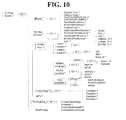
- FIG. 10 shows an example in which categories are newly added.
- the flow-based rule can include IPFlow node, Routing Criteria node, Routing Rule node, and Rule priority node.
- a Content type node can be newly added to the IPFlow node.
- the IPFlow node can further include Address Type node, Start Source IP address node, End source IP address node, Start Dest IP address node, End Dest IP address node, Protocol Type node, Start Source Port Number node, End Source Port Number node, Start Dest Port Number node, End Dest Port Number node, and Qos node.
- the Routing Criteria node can include Validity Area node, Time of Day node, and APN node.
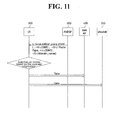
- FIG. 11 shows a network control entity for providing IFOM or MAPCON.
- an ANDSF 600 transfers configuration information, that is, an ISRP, to UE 100.
- configuration information that is, an ISRP
- one or more of a media type, a domain name, and a transmission type newly proposed by the present invention can be added to the configuration information and transmitted.
- ⁇ X>/ISRP/ ... ⁇ X>/MediaType or ⁇ X>/ISRP/ ... ⁇ X>/domain_name, and ⁇ X>/ISRP/ ... ⁇ X>/TransmissionType can be added to the configuration information.
- the UE 100 generates data through an application operation.
- the application or a platform (OS) thereof transfers an application ID, a media type (i.e., content type), a transmission type, and address information about an FQDN form to the UE.
- OS platform
- the UE 100 classifies the data using the received configuration information, for example, a category of the ISRP.
- the UE selects corresponding access or PDN connection (APN).
- PDN access or PDN connection
- the UE 100 classifies pieces of IP flow traffic into detailed classes based on the received configuration information and selects and sends access or a PDN suitable for the classified data.
- data can be classified according to their categories and transferred through preferred access. If new access is possible after a movement, data can be transferred through the new access according to priority or preference.
- the data is classified into specific classes by taking each application or the attributes of data (a content type, a media type, a transfer address, etc.) into consideration, and an interface thereof, that is, WIFI or an APN, is described by taking the classified classes and possible access into consideration.
- the UE 100 sends data through corresponding access based on the determination.
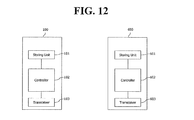
- FIG. 12 is a block diagram showing the construction of UE 100 and an ANDSF 600 according to the present invention.
- the ANDSF 600 can transfer a list of ISRPs to the UE.
- the ISRP can include pieces of the following information.
- the UE 100 includes a storing unit 101, a controller 102, and a transceiver 103. Furthermore, the ANDSF 600 includes a storing unit 601, a controller 602, and a transceiver 603.
- the storing units 101 and 601 store the methods shown in FIGS. 5 to 10 .
- the controllers 102 and 112 control the storing units 101 and 601 and the transceivers 103 and 603. More particularly, the controllers 102 and 602 execute the methods stored in the respective storing units 101 and 601. Furthermore, the controllers 102 and 602 send the above-described signals through the respective transceivers 103 and 603.
Landscapes
- Engineering & Computer Science (AREA)
- Computer Networks & Wireless Communication (AREA)
- Signal Processing (AREA)
- Databases & Information Systems (AREA)
- Computer Security & Cryptography (AREA)
- Mobile Radio Communication Systems (AREA)
Applications Claiming Priority (7)
| Application Number | Priority Date | Filing Date | Title |
|---|---|---|---|
| US201161472151P | 2011-04-05 | 2011-04-05 | |
| US201161477611P | 2011-04-21 | 2011-04-21 | |
| US201161499115P | 2011-06-20 | 2011-06-20 | |
| US201161502340P | 2011-06-29 | 2011-06-29 | |
| US201161540483P | 2011-09-28 | 2011-09-28 | |
| KR1020120033488A KR101417256B1 (ko) | 2011-04-05 | 2012-03-30 | 데이터 전송 방법 및 사용자 장치 |
| PCT/KR2012/002468 WO2012138091A2 (fr) | 2011-04-05 | 2012-04-02 | Procédé de transmission de données et équipement utilisateur |
Publications (2)
| Publication Number | Publication Date |
|---|---|
| EP2696518A2 true EP2696518A2 (fr) | 2014-02-12 |
| EP2696518A4 EP2696518A4 (fr) | 2014-09-10 |
Family
ID=47283180
Family Applications (1)
| Application Number | Title | Priority Date | Filing Date |
|---|---|---|---|
| EP12768305.0A Withdrawn EP2696518A4 (fr) | 2011-04-05 | 2012-04-02 | Procédé de transmission de données et équipement utilisateur |
Country Status (4)
| Country | Link |
|---|---|
| US (1) | US9338688B2 (fr) |
| EP (1) | EP2696518A4 (fr) |
| KR (1) | KR101417256B1 (fr) |
| WO (1) | WO2012138091A2 (fr) |
Cited By (1)
| Publication number | Priority date | Publication date | Assignee | Title |
|---|---|---|---|---|
| CN108886822A (zh) * | 2016-07-04 | 2018-11-23 | 华为技术有限公司 | 传输数据的方法和设备 |
Families Citing this family (29)
| Publication number | Priority date | Publication date | Assignee | Title |
|---|---|---|---|---|
| US10237217B1 (en) * | 2013-08-02 | 2019-03-19 | Sprint Communications Company L.P. | Controlling access to content based on access network type |
| KR102071695B1 (ko) * | 2011-07-12 | 2020-01-31 | 인터디지탈 패튼 홀딩스, 인크 | 다중 rat 액세스 모드 동작을 위한 방법 및 장치 |
| US9526022B2 (en) * | 2012-08-03 | 2016-12-20 | Intel Corporation | Establishing operating system and application-based routing policies in multi-mode user equipment |
| WO2014022776A1 (fr) | 2012-08-03 | 2014-02-06 | Intel Corporation | Procédé et système pour permettre des communications de dispositif à dispositif |
| US9554296B2 (en) | 2012-08-03 | 2017-01-24 | Intel Corporation | Device trigger recall/replace feature for 3GPP/M2M systems |
| US9036603B2 (en) | 2012-08-03 | 2015-05-19 | Intel Corporation | Network assistance for device-to-device discovery |
| US9191828B2 (en) | 2012-08-03 | 2015-11-17 | Intel Corporation | High efficiency distributed device-to-device (D2D) channel access |
| US8913518B2 (en) | 2012-08-03 | 2014-12-16 | Intel Corporation | Enhanced node B, user equipment and methods for discontinuous reception in inter-ENB carrier aggregation |
| EP2938128A4 (fr) * | 2012-12-19 | 2016-08-17 | Lg Electronics Inc | Procédé de traitement sélectif du trafic dans un système de communication sans fil prenant en charge un réseau à accès multiples, et appareil prenant en charge ce dernier |
| US9647818B2 (en) | 2013-01-03 | 2017-05-09 | Intel IP Corporation | Apparatus and method for single-tone device discovery in wireless communication networks |
| JP6122149B2 (ja) | 2013-01-20 | 2017-04-26 | エルジー エレクトロニクス インコーポレイティド | 無線lanにオフロードされたトラフィックに対するハンドオーバ決定方法及び端末 |
| KR20150117257A (ko) * | 2013-01-31 | 2015-10-19 | 엘지전자 주식회사 | 무선 통신 시스템에서 트래픽 조종 방법 및 이를 지원하는 장치 |
| US9967727B2 (en) * | 2013-02-22 | 2018-05-08 | Intel IP Corporation | Systems and methods for access network selection and traffic routing |
| ES2667804T3 (es) | 2013-03-29 | 2018-05-14 | Intel IP Corporation | Control de las directrices de selección de WLAN en escenarios de itinerancia |
| ES2695176T3 (es) | 2013-03-29 | 2019-01-02 | Intel Ip Corp | Ciclos de recepción discontinua (DRX) de búsqueda extendidos en redes de comunicación inalámbrica |
| WO2014158235A1 (fr) | 2013-03-29 | 2014-10-02 | Intel IP Corporation | Équipement d'utilisateur et procédé d'accès distribué à des canaux pour des communications 2d2 |
| US9191178B2 (en) | 2013-04-04 | 2015-11-17 | Intel IP Corporation | Enhanced node B and method for RRC connection establishment for small data transfers |
| KR20140136365A (ko) | 2013-05-20 | 2014-11-28 | 삼성전자주식회사 | 효과적인 무선 랜 선택 방법 및 장치 |
| WO2014191032A1 (fr) * | 2013-05-29 | 2014-12-04 | Telefonaktiebolaget L M Ericsson (Publ) | Identification d'un équipement utilisateur dans un réseau de communication |
| US9942835B2 (en) | 2013-07-03 | 2018-04-10 | Lg Electronics Inc. | Method of selecting access |
| US9479298B2 (en) | 2013-07-08 | 2016-10-25 | Intel IP Corporation | Demodulation reference signals (DMRS)for side information for interference cancellation |
| EP3018935B1 (fr) * | 2013-08-16 | 2020-10-21 | Huawei Technologies Co., Ltd. | Procédé et dispositif de transmission de données |
| US9380494B2 (en) | 2013-09-27 | 2016-06-28 | Intel IP Corporation | Systems, methods and devices for traffic offloading |
| US9642060B2 (en) | 2013-12-20 | 2017-05-02 | Industrial Technology Research Institute | Communication methods of IP flow mobility with radio access network level enhancement |
| CN105981432B (zh) * | 2014-02-09 | 2019-06-28 | Lg 电子株式会社 | 用于在无线通信系统中导向业务的方法和使用该方法的装置 |
| US9980299B2 (en) | 2014-03-24 | 2018-05-22 | Intel IP Corporation | Use of an OMA management object to support application-specific congestion control in mobile networks |
| KR101579070B1 (ko) | 2014-08-11 | 2016-01-04 | 주식회사 이노와이어리스 | 펨토셀을 이용한 코어 네트워크 무선 데이터의 오프로딩 방법 |
| CN107547443A (zh) * | 2016-06-24 | 2018-01-05 | 北京佰才邦技术有限公司 | 一种服务提供商标识类型指示方法、装置和相关设备 |
| KR102216546B1 (ko) * | 2018-05-10 | 2021-02-16 | 주식회사 케이티 | 어플리케이션별 사설망 서비스 제공 방법 및 이를 구현한 통신망 시스템, 그리고 단말에서의 트래픽 전송 방법 |
Family Cites Families (8)
| Publication number | Priority date | Publication date | Assignee | Title |
|---|---|---|---|---|
| US20030114158A1 (en) * | 2001-12-18 | 2003-06-19 | Lauri Soderbacka | Intersystem handover of a mobile terminal |
| WO2007079773A1 (fr) * | 2006-01-10 | 2007-07-19 | Telefonaktiebolaget L M Ericsson (Publ) | Procede et dispositifs de filtrage de paquet de donnees dans une transmission |
| KR100931789B1 (ko) | 2007-12-27 | 2009-12-14 | 주식회사 케이티 | 멀티호밍 기반의 이종 무선 네트워크 인터페이스 등록 방법, 이종 무선 네트워크 인터페이스 해지 방법, 이종 무선 네트워크 인터페이스 결정 방법 |
| US8185628B2 (en) * | 2008-03-07 | 2012-05-22 | At&T Mobility Ii Llc | Enhanced policy capabilities for mobile data services |
| CN105025531B (zh) * | 2009-01-09 | 2018-12-28 | 交互数字专利控股公司 | Wtru及其实施的方法 |
| WO2010109862A1 (fr) * | 2009-03-27 | 2010-09-30 | パナソニック株式会社 | Procédé de routage, système de routage, noeud mobile, agent domestique et station de base domestique |
| US20130188491A1 (en) * | 2010-10-06 | 2013-07-25 | Telefonaktiebolaget L M Ericsson (Publ) | Uplink Traffic Separation in an Edge Node of a Communication Network |
| US20120188949A1 (en) * | 2011-01-20 | 2012-07-26 | Motorola-Mobility, Inc. | Wireless communication device, wireless communication system, and method of routing data in a wireless communication system |
-
2012
- 2012-03-30 KR KR1020120033488A patent/KR101417256B1/ko not_active Expired - Fee Related
- 2012-04-02 US US14/007,318 patent/US9338688B2/en not_active Expired - Fee Related
- 2012-04-02 WO PCT/KR2012/002468 patent/WO2012138091A2/fr not_active Ceased
- 2012-04-02 EP EP12768305.0A patent/EP2696518A4/fr not_active Withdrawn
Cited By (1)
| Publication number | Priority date | Publication date | Assignee | Title |
|---|---|---|---|---|
| CN108886822A (zh) * | 2016-07-04 | 2018-11-23 | 华为技术有限公司 | 传输数据的方法和设备 |
Also Published As
| Publication number | Publication date |
|---|---|
| WO2012138091A3 (fr) | 2013-01-10 |
| US9338688B2 (en) | 2016-05-10 |
| KR20120113664A (ko) | 2012-10-15 |
| WO2012138091A2 (fr) | 2012-10-11 |
| KR101417256B1 (ko) | 2014-07-08 |
| US20140022898A1 (en) | 2014-01-23 |
| EP2696518A4 (fr) | 2014-09-10 |
Similar Documents
| Publication | Publication Date | Title |
|---|---|---|
| US9338688B2 (en) | Method for transmitting data and user equipment | |
| US9686710B2 (en) | Method for obtaining policy information for making traffic detour | |
| US11576043B2 (en) | Session management method and SMF node | |
| US9661559B2 (en) | Method and apparatus for selecting wireless access using application identification information in wireless communication system | |
| TWI463893B (zh) | 處理存取網路探索及選擇功能的方法及其通訊裝置 | |
| AU2010284785B2 (en) | Server for control plane at mobile communication network and method for controlling SIPTO based session | |
| CN103444213B (zh) | 在移动通信网络中用于控制面的服务器和用于使能服务器控制服务的方法 | |
| KR101630998B1 (ko) | 멀티 홈 단말 | |
| US9055507B2 (en) | Telecommunication networks | |
| US9179288B2 (en) | Server in charge of control plane within mobile communication network and method for controlling service in server | |
| US9414281B2 (en) | Data transmission method, offloading point device, user equipment, and system | |
| US8824365B2 (en) | Method for establishing connection by HNB | |
| US20130208661A1 (en) | Method in a network node of a wireless communications network | |
| US20110116469A1 (en) | Local internet protocol access/selected internet protocol traffic offload packet encapsulation to support seamless mobility | |
| EP2472957A2 (fr) | Réseau de télécommunications | |
| GB2481719A (en) | Controlling resources in a mobile telecommunications network by performing self organising network functions | |
| US9942835B2 (en) | Method of selecting access | |
| Capelo | Novas soluções de mobilidade em redes 3GPP |
Legal Events
| Date | Code | Title | Description |
|---|---|---|---|
| PUAI | Public reference made under article 153(3) epc to a published international application that has entered the european phase |
Free format text: ORIGINAL CODE: 0009012 |
|
| 17P | Request for examination filed |
Effective date: 20131105 |
|
| AK | Designated contracting states |
Kind code of ref document: A2 Designated state(s): AL AT BE BG CH CY CZ DE DK EE ES FI FR GB GR HR HU IE IS IT LI LT LU LV MC MK MT NL NO PL PT RO RS SE SI SK SM TR |
|
| DAX | Request for extension of the european patent (deleted) | ||
| A4 | Supplementary search report drawn up and despatched |
Effective date: 20140813 |
|
| RIC1 | Information provided on ipc code assigned before grant |
Ipc: H04W 28/02 20090101AFI20140807BHEP |
|
| 17Q | First examination report despatched |
Effective date: 20170201 |
|
| STAA | Information on the status of an ep patent application or granted ep patent |
Free format text: STATUS: THE APPLICATION IS DEEMED TO BE WITHDRAWN |
|
| 18D | Application deemed to be withdrawn |
Effective date: 20170613 |