EP2696599B1 - Kompression beabstandeter Quellen für Hörgeräte - Google Patents
Kompression beabstandeter Quellen für Hörgeräte Download PDFInfo
- Publication number
- EP2696599B1 EP2696599B1 EP13178787.1A EP13178787A EP2696599B1 EP 2696599 B1 EP2696599 B1 EP 2696599B1 EP 13178787 A EP13178787 A EP 13178787A EP 2696599 B1 EP2696599 B1 EP 2696599B1
- Authority
- EP
- European Patent Office
- Prior art keywords
- signals
- sound
- individual
- signal
- components
- Prior art date
- Legal status (The legal status is an assumption and is not a legal conclusion. Google has not performed a legal analysis and makes no representation as to the accuracy of the status listed.)
- Revoked
Links
Images




Classifications
-
- H—ELECTRICITY
- H04—ELECTRIC COMMUNICATION TECHNIQUE
- H04R—LOUDSPEAKERS, MICROPHONES, GRAMOPHONE PICK-UPS OR LIKE ACOUSTIC ELECTROMECHANICAL TRANSDUCERS; ELECTRIC HEARING AIDS; PUBLIC ADDRESS SYSTEMS
- H04R25/00—Electric hearing aids
- H04R25/35—Electric hearing aids using translation techniques
- H04R25/356—Amplitude, e.g. amplitude shift or compression
-
- H—ELECTRICITY
- H04—ELECTRIC COMMUNICATION TECHNIQUE
- H04R—LOUDSPEAKERS, MICROPHONES, GRAMOPHONE PICK-UPS OR LIKE ACOUSTIC ELECTROMECHANICAL TRANSDUCERS; ELECTRIC HEARING AIDS; PUBLIC ADDRESS SYSTEMS
- H04R25/00—Electric hearing aids
- H04R25/55—Electric hearing aids using an external connection, either wireless or wired
- H04R25/552—Binaural
-
- H—ELECTRICITY
- H04—ELECTRIC COMMUNICATION TECHNIQUE
- H04S—STEREOPHONIC SYSTEMS
- H04S2420/00—Techniques used stereophonic systems covered by H04S but not provided for in its groups
- H04S2420/01—Enhancing the perception of the sound image or of the spatial distribution using head related transfer functions [HRTF's] or equivalents thereof, e.g. interaural time difference [ITD] or interaural level difference [ILD]
Definitions
- This patent application pertains to apparatus and processes for compression of spaced sources for hearing assistance devices.
- Hearing assistance devices such as hearing aids, include electronic instruments worn in or around the ear that compensate for hearing losses by amplifying and processing sound.
- the electronic circuitry of the device is contained within a housing that is commonly either placed in the external ear canal and/or behind the ear.
- Transducers for converting sound to an electrical signal and vice-versa may be integrated into the housing or external to it.
- Hearing aids may be designed to compensate for such hearing deficits by amplifying received sound in a frequency-specific manner, thus acting as a kind of acoustic equalizer that compensates for the abnormal frequency response of the impaired ear. Adjusting a hearing aid's frequency specific amplification characteristics to achieve a desired level of compensation for an individual patient is referred to as fitting the hearing aid.
- One common way of fitting a hearing aid is to measure hearing loss, apply a fitting algorithm, and fine-tune the hearing aid parameters.
- Hearing assistance devices also use a dynamic range adjustment, called dynamic range compression, which controls the level of sound sent to the ear of the patient to normalize the loudness of sound in specific frequency regions.
- the gain that is provided at a given frequency is controlled by the level of sound in that frequency region (the amount of frequency specificity is determined by the filters in the multiband compression design).
- compression adjusts the level of a sound at a given frequency such that its loudness is similar to that for a normal hearing person without a hearing aid.
- the prescription can break down when there are two or more simultaneous sounds in the same frequency region.
- the two sounds may be at two different levels, and therefore each should receive different gain for each to be perceived at their own necessary loudness. Because only one gain value can be prescribed by the hearing aid, however, at most one sound can receive the appropriate gain, providing the second sound with the less than desired sound level and resulting loudness.
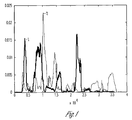
- FIG. 1 shows the levels of two different sounds out of a filter centered at 1 kHz-in this example, the two sounds are two different speech samples.
- the samples are overlaid on FIG. 1 and one is in a thick dark line 1 and the second is in a thin line 2.
- FIG. 2 shows the gains that would be applied to those two different sounds at 1 kHz if they were to be presented to a hypothetical multiband dynamic range compressor. Notice that the ideal gain for each speech sample is different. Again, the samples from the thick dark line 1 are shown in comparison to those of the thin line 2.
- FIG. 3 shows the two gains from FIG. 1 represented by the thick dark line 1 and the thin line 2, but with a line of intermediate thickness 3 which shows the gain that is applied when the two sounds are mixed together before being sent to the multiband compressor. Notice that when the two sounds are mixed together, neither receives the exact gain that should be prescribed for each separately; in fact, there are times when the gain should be high for one speech sample, but it is low because the gain is controlled by the level of the mix of the two sounds, not the level of each sound individually. This can cause artificial envelope fluctuations in each sound, described as comodulation or cross modulation by Stone and Moore ( Stone, M. A., and Moore, B. C. (2008). "Effects of spectro-temporal modulation changes produced by multi-channel compression on intelligibility in a competing-speech task," J Acoust Soc Am 123, 1063-1076 .)
- the impact is three-fold: the loudness of that instrument is not normal for the hearing aid listener (it may be too soft, for example), distortion to the temporal envelope of that instrument can occur, and interaural-level difference (ILD) cues for sound source localization and segregation can be distorted, making the perceived auditory image of that instrument fluctuate in a way that was not in the original recording.
- ILD interaural-level difference
- EP 2131610A discloses an apparatus for processing sound for a hearing assistance device placed at a wearer's ear, the apparatus comprising: a receiver adapted to receive signals from a sound environment; a unit for applying head-related-transfer-functions to the received signals, a compressor adapted to independently compress each of the individual sound source components, a mixer connected to the compressor, the mixer adapted to mix the compressed sound source components to produce a mixed output signal; and a speaker connected to the mixer, the speaker integrated with the hearing assistance device and adapted to output the mixed output signal at the wearer's ear.
- the invention is in the apparatus of Claim 1 and the method of Claim 11.
- This application relates to a system for compression for hearing assistance devices by application of compression to individual sound sources before applying a head-related transfer function (HRTF) to prevent compression and cross modulation of ILD cues for localization, according to one example.
- HRTF head-related transfer function
- Variations of the present system use coordinated compression to left and right individual source signals after application of HRTFs.
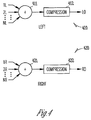
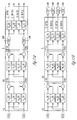
- FIG. 4 illustrates a system for processing left and right stereo signals from a plurality of sound sources in order to produce mixed left and right sound output signals that can be used by left and right hearing assistance devices.
- the figure shows separate left 410 and right 420 channels where a plurality of left sound sources 1 L, 2L, ... , NL are mixed by mixer 411 to make a composite signal that is compressed using compressor 412 to produce the left output signal LO.
- FIG. 4 also shows in the right channel 420 a plurality of right sound sources 1 R, 2R, ... , NR that are mixed by mixer 421 to make a composite right signal that is compressed by compressor 422 to produce a right signal RO.
- the separate sound sources can be right and left tracks of individual instruments.
- the tracks include vocals or other sounds.
- the system provides compression after the mixing which can result in over-attenuation of desired sounds, which is an undesired side effect of the signal processing.
- track 1 included bass guitar and track 2 included a lead guitar
- the louder instrument would dominate the signal strength in the channel at any given time and may result in over-attenuation of the weaker signal when compression is applied to the composite signal.
- left and right signals are compressed independently, level difference between the left and right output signals LO and RO are compressed, i.e., ILD cues are reduced.
- FIG. 5 illustrates a system for processing left and right stereo signals from a plurality of sound sources by applying compression before mixing to produce mixed left and right sound output signals that can be used by left and right hearing assistance devices, according to one embodiment of the present subject matter.
- This embodiment applies compression (512 for the left channel 510 and 522 for the right channel 520) to each signal independently to assist in preserving the ability to mix each signal accordingly (using mixers 510 and 521, respectively).
- This approach allows each sound source 1 L, 2L, ... , NL and 1 R, 2R, ... , NL to be added to the composite signal as desired.
- two or more sound sources are input into the mixer. These may be right and left components of an instrumental input, vocal input, or other sound input.
- Level difference between the left and right output signals LO and RO are compressed, i.e., ILD cues are reduced, because left and right signals are compressed independently.
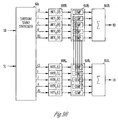
- FIG. 6 shows one example of a signal processor that includes a surround sound synthesizer for producing the surround sound signals from the left and right stereo signals where compression is applied to the surround sound signals before mixing to produce mixed left and right sound output signals that can be used by left and right hearing assistance devices.
- a surround sound synthesizer 601 receives a right stereo signal SR and a left stereo signal SL and converts the signals into LS, L, C, R, and RS signals.
- the HRTFs are not used and the signal passes from the surround sound synthesizer 601 to the compression stages 610R and 610L before being sent to the mixers 611 R and 611L.
- the signals are processed by right and left head-related transfer functions (HRTFs) 608R and 608L.
- the resulting signals are then sent through compression stages 610R and 610L before being sent through mixers 611 R and 611 L.
- the resulting outputs RO and LO are used by the hearing assistance device to provide stereo sound reception.
- Level difference between the left and right output signals LO and RO are compressed, i.e., ILD cues are reduced, because left and right signals are compressed independently.
- surround sound systems include, but are not limited to Dolby 5.1, 6.1, and 7.1 systems, and the application ofHRTFs is optional.
- the examples provided herein are intended to be demonstrative and not limiting, exclusive, or exhaustive.
- One advantage of the system of FIG. 6 is that the center channel, which frequently is dominated by vocals, can be separated compressed from the other channels, which are largely dominated by the music. Such compression and mixing avoids cross modulation of gain.
- the level of compression is commensurate with that found in hearing assistance devices, such as hearing aids. Other levels of compression are possible.
- ILD cues Independent dynamic-range compression of stereo signals diminishes ILD cues for localization. Particularly in complex situations with multiple sources, preserving ILD cues is beneficial.
- the present subject matter preserves source-specific ILD cues by preventing compression and cross modulation of the ILDs, while providing optimal gain for each individual source.
- FIG. 9A shows a modification of FIG. 6 above, including independently compressing individual sound sources before applying HRTFs to prevent compression and cross modulation of ILDs, according to one embodiment of the present invention:
- the present subject matter applies compression 609 separately to each individual source in a mixture, without compressing its ILD.
- the five surround sound signals LS, L, C, R, and RS represent estimates of individual source signals. These estimated source signals are first independently compressed which prevents cross modulation between the waveforms of these sources. Then, head-related transfer functions (HRTFs) are applied to the compressed source signals. Since the HRTFs are applied after compression, the ILDs are neither compressed nor cross modulated.
- HRTFs head-related transfer functions
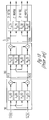
- FIG. 9B An alternate example is shown in FIG. 9B including applying coordinated compression to individual left and right signal sources after applying HRTFs to prevent compression and cross modulation of ILDs.
- coordinated compression i.e., identical gain
- HRTFs a feature vector that maps the gains to the left and right signals.
- Coordinated compression prevents compression and cross modulation of the ILDs. This holds true for simple coordinated compression of the mixture as well.
- optimal gain is applied to each individual source. High-level sources, for example, will not suppress the gain for low-level sources.
- FIG. 10 shows a system with separate source signals and separate microphone signals.
- s1 and s2 represent the true separate source signals and x1 and x2 two (hearing-aid) microphone signals.
- Blind source separation (BSS) provides the estimates y1 and y2 of these source signals.
- Application of the (room) transfer functions H nm tilde yields separate stereo output signals for the two sources.
- Signals "z1 left” and "z1 right,” for example, represent the estimated left and right microphone signals for the single source s1.
- FIG. 11A shows a modification of FIG. 10 above, representing one embodiment of the present subject matter. Compression 1109 is applied separately to the estimated source signals y1 and y2, before application of the transfer functions H nm tilde .
- FIG. 11 B applies coordinated compression 1109 to the stereo source signals, similar to the embodiment in FIG. 9B . Again, ILDs are preserved while optimal gain is applied to each of the sources.
- FIG. 7 shows one embodiment for separating a stereo signal into three channels for a more source-specific compression. Often in music, the signal for the singer is equally applied to both the left and right channel, centering the perceptual image of the singer.
- FIG. 7 is one example of how to combine the original channels before compression and how to mix the post-compressed signals back into a stereo signal, but other approaches exist.
- FIG. 7 shows the left (A+S) signal 701 and the right (B+S) signal 702 applied to multipliers (which multiply by 1 ⁇ 2) and summed by summers to create the CA, CB, and 2CS signals.
- the CS signal is obtained using multiplier 705.
- the CA, CB and CS signals are compressed by compressors 706, 708, and 707, respectively, and summed by summers 710 and 712.
- the resulting outputs are multiplied by 2/3 by multipliers 714 and 715 to provide the compressed left and compressed right signals, as shown in FIG. 7 .
- multipliers 714 and 715 are multiplied by 2/3 by multipliers 714 and 715 to provide the compressed left and compressed right signals, as shown in FIG. 7 .
- FIG. 8 represents a general way of isolating a stereo signal into individual components that can then be separately compressed and recombined to create a stereo signal.
- There are known ways of taking a stereo signal and extracting the center channel in a more complex way than shown in FIG. 8 e.g., U.S. Pat. No. 6,405,163 , and U.S. Patent Application Publication Number 2007/0076902 ).
- Techniques can also be applied to monaural signals to separate the signal into individual instruments. With either approach, the sounds are separated into individual sound source signals, and each source is compressed; the individually compressed sources are then combined to create either the monaural or stereo signal for listening by the hearing impaired listener.
- Left stereo signal 801 and right stereo signal 802 are sent through a process 803 that separates individual sound sources. Each source is sent to a compressor 804 and then mixed with mixer 806 to provide left 807 and right 808 stereo signals according to one embodiment of the present subject matter.
- the present subject matter can be embodied in a number of different applications.
- the mixing can be performed in a computer programmed to mix the tracks and perform compression as set forth herein.
- the mixing is done in a fitting system.
- fitting systems include, but are not limited to, the fitting systems set forth in U.S. Patent Application Ser. No. 11/935,935, filed Nov. 6, 2007 , and entitled: SIMULATED SURROUND SOUND HEARING AID FITTING SYSTEM.
- the mixing is done using the processor of the hearing assistance device.
- that processing can be done by the digital signal processor of the hearing aid or by another set of logic programmed to perform the mixing function provided herein.
- Other applications and processes are possible without departing from the scope of the present subject matter.
- the apparatus and processes set forth herein may be embodied in digital hardware, analog hardware, and/or combinations thereof. It is also understood that in various embodiments, the apparatus and processes set forth herein may be embodied in hardware, software, firmware, and/or combinations thereof.
Landscapes
- Health & Medical Sciences (AREA)
- General Health & Medical Sciences (AREA)
- Neurosurgery (AREA)
- Otolaryngology (AREA)
- Physics & Mathematics (AREA)
- Engineering & Computer Science (AREA)
- Acoustics & Sound (AREA)
- Signal Processing (AREA)
- Stereophonic System (AREA)
Claims (14)
- Vorrichtung zum Verarbeiten von Klang für ein Hörhilfegerät, das an einem Ohr eines Trägers platziert ist, wobei die Vorrichtung umfasst:einen Empfänger, der dafür eingerichtet ist, Signale aus einer Klangumgebung zu empfangen;einen mit dem Empfänger verbundenen Prozessor (610L, 610R), wobei der Prozessor dafür eingerichtet ist, individuelle Klangquellenkomponenten der empfangenen Signale zu verarbeiten, wobei der Prozessor ferner dafür eingerichtet ist, auf die individuellen Klangquellenkomponenten eine kopfbezogene Übertragungsfunktion anzuwenden;einen mit dem Prozessor verbundenen Kompressor (609), wobei der Kompressor dafür eingerichtet ist, vor der Anwendung der kopfbezogenen Übertragungsfunktion jede der individuellen Klangquellenkomponenten unabhängig voneinander zu komprimieren;einen mit dem Kompressor verbundenen Mischer (611L, 611R), wobei der Mischer dafür eingerichtet ist, die komprimierten Klangquellenkomponenten zu mischen, um ein gemischtes Ausgangssignal zu erzeugen; undeinen mit dem Mischer verbundenen Lautsprecher, wobei der Lautsprecher mit dem Hörhilfegerät integriert und dafür eingerichtet ist, das gemischte Ausgangssignal an das Ohr des Hörers auszugeben.
- Vorrichtung nach Anspruch 1, dafür eingerichtet, die kopfbezogene Übertragungsfunktion für jede der individuellen Klangquellenkomponenten in einem individuellen Empfangswinkel anzuwenden.
- Vorrichtung nach einem der vorhergehenden Ansprüche, worin der Empfänger dafür eingerichtet ist, Klangsignale mit einem stereorechten, SR, und einem stereolinken, SL, Klangsignal zu empfangen.
- Vorrichtung nach Anspruch 3, worin der Prozessor dafür eingerichtet ist, die SR- und SL-Signale zu verarbeiten, um Signale für linkes Umfeld, LS, links, L, Mitte, C, rechts, R, und rechtes Umfeld, RS, zu erzeugen.
- Vorrichtung nach Anspruch 4, worin der Prozessor ferner dafür eingerichtet ist, eine verarbeitete Version für jedes der LS-, L-, C-, R- und RS-Signale durch Anwendung einer kopfbezogenen Übertragungsfunktion in einem individuellen Empfangswinkel für jedes der LS-, L-, C-, R- und RS-Signale zu erzeugen.
- Vorrichtung nach Anspruch 5, worin der Kompressor dafür eingerichtet ist, die verarbeitete Version für jedes der LS-, L-, C-, R- und RS-Signale zu komprimieren.
- Vorrichtung nach Anspruch 6, worin der Mischer dafür eingerichtet ist, die verarbeitete und komprimierte Version der LS-, L-, C-, R- und RS-Signale zu mischen, um eines oder beide von einem rechten Ausgangssignal, RO, und einem linken Ausgangssignal, LO, zu erzeugen.
- Vorrichtung nach Anspruch 7, worin das Hörhilfegerät ein rechtes Hörhilfegerät, das einen rechten Lautsprecher aufweist, und ein linkes Hörhilfegerät, das einen linken Lautsprecher aufweist, aufweist und worin das RO-Signal dafür eingerichtet ist, durch den rechten Lautsprecher verwendet zu werden, und das LO-Signal dafür eingerichtet ist, durch den linken Lautsprecher verwendet zu werden.
- Vorrichtung nach einem der vorhergehenden Ansprüche, worin der Prozessor einen Synthesizer aufweist.
- Vorrichtung nach Anspruch 9, worin der Synthesizer einen Raumklang-Synthesizer aufweist.
- Verfahren, umfassend:Empfangen von Stereo-Umfeldsignalen aus einer Klangumgebung;Verarbeiten der empfangenen Signale, um individuelle Klangquellenkomponenten zu isolieren;voneinander unabhängiges Komprimieren der individuellen Klangquellenkomponenten, um Kreuzmodulation zwischen Wellenformen der Quellenkomponenten zu vermeiden; undnach dem Komprimieren der Komponenten erfolgendes Anwenden einer kopfbezogenen Übertragungsfunktion auf die komprimierten individuellen Klangquellenkomponenten.
- Verfahren nach Anspruch 11, worin das Empfangen von Stereo-Umfeldsignalen einschließt: Empfangen mindestens eines linken Klangsignals und mindestens eines rechten Klangsignals.
- Verfahren nach Anspruch 11 oder 12, worin das Verarbeiten der empfangenen Signale, Komponenten zu isolieren, einschließt: Verarbeiten, um Stimmen- und Instrumentenkomponenten aus Musiksignalen zu isolieren.
- Verfahren nach einem der Ansprüche 11 bis 13, worin das Anwenden der kopfbezogenen Übertragungsfunktion einschließt: Anwenden der Übertragungsfunktion in einem individuellen Empfangswinkel für jede der individuellen Klangquellenkomponenten.
Applications Claiming Priority (1)
| Application Number | Priority Date | Filing Date | Title |
|---|---|---|---|
| US13/568,618 US9185500B2 (en) | 2008-06-02 | 2012-08-07 | Compression of spaced sources for hearing assistance devices |
Publications (3)
| Publication Number | Publication Date |
|---|---|
| EP2696599A2 EP2696599A2 (de) | 2014-02-12 |
| EP2696599A3 EP2696599A3 (de) | 2015-03-11 |
| EP2696599B1 true EP2696599B1 (de) | 2016-05-25 |
Family
ID=48914103
Family Applications (1)
| Application Number | Title | Priority Date | Filing Date |
|---|---|---|---|
| EP13178787.1A Revoked EP2696599B1 (de) | 2012-08-07 | 2013-07-31 | Kompression beabstandeter Quellen für Hörgeräte |
Country Status (2)
| Country | Link |
|---|---|
| EP (1) | EP2696599B1 (de) |
| DK (1) | DK2696599T3 (de) |
Cited By (1)
| Publication number | Priority date | Publication date | Assignee | Title |
|---|---|---|---|---|
| US11558699B2 (en) | 2020-03-11 | 2023-01-17 | Sonova Ag | Hearing device component, hearing device, computer-readable medium and method for processing an audio-signal for a hearing device |
Families Citing this family (2)
| Publication number | Priority date | Publication date | Assignee | Title |
|---|---|---|---|---|
| EP3994867A4 (de) | 2019-07-03 | 2023-07-26 | The Board Of Trustees Of The University Of Illinois | Trennung von raum-zeit-signalen mit bewegten und asynchronen arrays |
| DE102020202483A1 (de) | 2020-02-26 | 2021-08-26 | Sivantos Pte. Ltd. | Hörsystem mit mindestens einem im oder am Ohr des Nutzers getragenen Hörinstrument sowie Verfahren zum Betrieb eines solchen Hörsystems |
Citations (4)
| Publication number | Priority date | Publication date | Assignee | Title |
|---|---|---|---|---|
| WO2007106553A1 (en) | 2006-03-15 | 2007-09-20 | Dolby Laboratories Licensing Corporation | Binaural rendering using subband filters |
| US7391877B1 (en) | 2003-03-31 | 2008-06-24 | United States Of America As Represented By The Secretary Of The Air Force | Spatial processor for enhanced performance in multi-talker speech displays |
| EP2131610A1 (de) | 2008-06-02 | 2009-12-09 | Starkey Laboratories, Inc. | Kompression und Mischen für Hörgeräte |
| US20120093320A1 (en) | 2010-10-13 | 2012-04-19 | Microsoft Corporation | System and method for high-precision 3-dimensional audio for augmented reality |
Family Cites Families (2)
| Publication number | Priority date | Publication date | Assignee | Title |
|---|---|---|---|---|
| US6405163B1 (en) | 1999-09-27 | 2002-06-11 | Creative Technology Ltd. | Process for removing voice from stereo recordings |
| US7912232B2 (en) | 2005-09-30 | 2011-03-22 | Aaron Master | Method and apparatus for removing or isolating voice or instruments on stereo recordings |
-
2013
- 2013-07-31 DK DK13178787.1T patent/DK2696599T3/en active
- 2013-07-31 EP EP13178787.1A patent/EP2696599B1/de not_active Revoked
Patent Citations (4)
| Publication number | Priority date | Publication date | Assignee | Title |
|---|---|---|---|---|
| US7391877B1 (en) | 2003-03-31 | 2008-06-24 | United States Of America As Represented By The Secretary Of The Air Force | Spatial processor for enhanced performance in multi-talker speech displays |
| WO2007106553A1 (en) | 2006-03-15 | 2007-09-20 | Dolby Laboratories Licensing Corporation | Binaural rendering using subband filters |
| EP2131610A1 (de) | 2008-06-02 | 2009-12-09 | Starkey Laboratories, Inc. | Kompression und Mischen für Hörgeräte |
| US20120093320A1 (en) | 2010-10-13 | 2012-04-19 | Microsoft Corporation | System and method for high-precision 3-dimensional audio for augmented reality |
Non-Patent Citations (2)
| Title |
|---|
| "MPEG surround", MPEG SURROUND, 2017, XP055359050, Retrieved from the Internet <URL:http://www.mpegsurround.com/tech.html> |
| "MPEG Surround", WIKIPEDIA, THE FREE ENCYCLOPEDIA, 2017, XP055359045 |
Cited By (1)
| Publication number | Priority date | Publication date | Assignee | Title |
|---|---|---|---|---|
| US11558699B2 (en) | 2020-03-11 | 2023-01-17 | Sonova Ag | Hearing device component, hearing device, computer-readable medium and method for processing an audio-signal for a hearing device |
Also Published As
| Publication number | Publication date |
|---|---|
| EP2696599A2 (de) | 2014-02-12 |
| DK2696599T3 (en) | 2016-08-29 |
| EP2696599A3 (de) | 2015-03-11 |
Similar Documents
| Publication | Publication Date | Title |
|---|---|---|
| US9185500B2 (en) | Compression of spaced sources for hearing assistance devices | |
| EP2131610B1 (de) | Kompression und Mischen für Hörgeräte | |
| US9924283B2 (en) | Enhanced dynamics processing of streaming audio by source separation and remixing | |
| US7440575B2 (en) | Equalization of the output in a stereo widening network | |
| Moore et al. | Benefits of linear amplification and multichannel compression for speech comprehension in backgrounds with spectral and temporal dips | |
| EP2099236B1 (de) | Simuliertes Surround-Sound-Hörgerät-Anpassungssystem | |
| EP3061268B1 (de) | Verfahren und mobile vorrichtung zur verarbeitung eines audiosignals | |
| EP3020212B1 (de) | Vorverarbeitung eines kanalisierten musiksignals | |
| DK2663094T3 (en) | Method and apparatus for processing audio signals | |
| US9516431B2 (en) | Spatial enhancement mode for hearing aids | |
| EP2747458B1 (de) | Verbesserte Dynamikverarbeitung von Streaming von Audio durch Quellentrennung und Neumischung | |
| US20100322446A1 (en) | Spatial Audio Object Coding (SAOC) Decoder and Postprocessor for Hearing Aids | |
| DK2696599T3 (en) | Compression of different sources of hearing aids | |
| US20080152152A1 (en) | Sound Image Localization Apparatus | |
| US10313805B2 (en) | Binaurally coordinated frequency translation in hearing assistance devices | |
| CN110915241B (zh) | 子带空间音频增强 | |
| EP2101517B1 (de) | Audioprozessor zur Umwandlung eines Monosignals in ein Stereosignal | |
| WO2022043906A1 (en) | Assistive listening system and method | |
| WO2021057214A1 (zh) | 一种声场扩展方法、计算机设备以及计算机可读存储介质 | |
| JP2012156610A (ja) | 信号処理装置 |
Legal Events
| Date | Code | Title | Description |
|---|---|---|---|
| 17P | Request for examination filed |
Effective date: 20130731 |
|
| AK | Designated contracting states |
Kind code of ref document: A2 Designated state(s): AL AT BE BG CH CY CZ DE DK EE ES FI FR GB GR HR HU IE IS IT LI LT LU LV MC MK MT NL NO PL PT RO RS SE SI SK SM TR |
|
| AX | Request for extension of the european patent |
Extension state: BA ME |
|
| PUAI | Public reference made under article 153(3) epc to a published international application that has entered the european phase |
Free format text: ORIGINAL CODE: 0009012 |
|
| PUAL | Search report despatched |
Free format text: ORIGINAL CODE: 0009013 |
|
| AK | Designated contracting states |
Kind code of ref document: A3 Designated state(s): AL AT BE BG CH CY CZ DE DK EE ES FI FR GB GR HR HU IE IS IT LI LT LU LV MC MK MT NL NO PL PT RO RS SE SI SK SM TR |
|
| AX | Request for extension of the european patent |
Extension state: BA ME |
|
| RIC1 | Information provided on ipc code assigned before grant |
Ipc: H04R 25/00 20060101AFI20150130BHEP |
|
| GRAP | Despatch of communication of intention to grant a patent |
Free format text: ORIGINAL CODE: EPIDOSNIGR1 |
|
| INTG | Intention to grant announced |
Effective date: 20151124 |
|
| GRAS | Grant fee paid |
Free format text: ORIGINAL CODE: EPIDOSNIGR3 |
|
| GRAA | (expected) grant |
Free format text: ORIGINAL CODE: 0009210 |
|
| AK | Designated contracting states |
Kind code of ref document: B1 Designated state(s): AL AT BE BG CH CY CZ DE DK EE ES FI FR GB GR HR HU IE IS IT LI LT LU LV MC MK MT NL NO PL PT RO RS SE SI SK SM TR |
|
| REG | Reference to a national code |
Ref country code: GB Ref legal event code: FG4D |
|
| REG | Reference to a national code |
Ref country code: CH Ref legal event code: EP |
|
| REG | Reference to a national code |
Ref country code: IE Ref legal event code: FG4D Ref country code: AT Ref legal event code: REF Ref document number: 803184 Country of ref document: AT Kind code of ref document: T Effective date: 20160615 |
|
| REG | Reference to a national code |
Ref country code: DE Ref legal event code: R096 Ref document number: 602013007826 Country of ref document: DE |
|
| REG | Reference to a national code |
Ref country code: CH Ref legal event code: NV Representative=s name: MARKS AND CLERK (LUXEMBOURG) LLP, CH |
|
| REG | Reference to a national code |
Ref country code: FR Ref legal event code: PLFP Year of fee payment: 4 |
|
| REG | Reference to a national code |
Ref country code: DK Ref legal event code: T3 Effective date: 20160828 |
|
| REG | Reference to a national code |
Ref country code: NL Ref legal event code: FP |
|
| REG | Reference to a national code |
Ref country code: LT Ref legal event code: MG4D |
|
| PG25 | Lapsed in a contracting state [announced via postgrant information from national office to epo] |
Ref country code: NO Free format text: LAPSE BECAUSE OF FAILURE TO SUBMIT A TRANSLATION OF THE DESCRIPTION OR TO PAY THE FEE WITHIN THE PRESCRIBED TIME-LIMIT Effective date: 20160825 Ref country code: LT Free format text: LAPSE BECAUSE OF FAILURE TO SUBMIT A TRANSLATION OF THE DESCRIPTION OR TO PAY THE FEE WITHIN THE PRESCRIBED TIME-LIMIT Effective date: 20160525 Ref country code: FI Free format text: LAPSE BECAUSE OF FAILURE TO SUBMIT A TRANSLATION OF THE DESCRIPTION OR TO PAY THE FEE WITHIN THE PRESCRIBED TIME-LIMIT Effective date: 20160525 |
|
| REG | Reference to a national code |
Ref country code: AT Ref legal event code: MK05 Ref document number: 803184 Country of ref document: AT Kind code of ref document: T Effective date: 20160525 |
|
| PG25 | Lapsed in a contracting state [announced via postgrant information from national office to epo] |
Ref country code: LV Free format text: LAPSE BECAUSE OF FAILURE TO SUBMIT A TRANSLATION OF THE DESCRIPTION OR TO PAY THE FEE WITHIN THE PRESCRIBED TIME-LIMIT Effective date: 20160525 Ref country code: PT Free format text: LAPSE BECAUSE OF FAILURE TO SUBMIT A TRANSLATION OF THE DESCRIPTION OR TO PAY THE FEE WITHIN THE PRESCRIBED TIME-LIMIT Effective date: 20160926 Ref country code: RS Free format text: LAPSE BECAUSE OF FAILURE TO SUBMIT A TRANSLATION OF THE DESCRIPTION OR TO PAY THE FEE WITHIN THE PRESCRIBED TIME-LIMIT Effective date: 20160525 Ref country code: ES Free format text: LAPSE BECAUSE OF FAILURE TO SUBMIT A TRANSLATION OF THE DESCRIPTION OR TO PAY THE FEE WITHIN THE PRESCRIBED TIME-LIMIT Effective date: 20160525 Ref country code: SE Free format text: LAPSE BECAUSE OF FAILURE TO SUBMIT A TRANSLATION OF THE DESCRIPTION OR TO PAY THE FEE WITHIN THE PRESCRIBED TIME-LIMIT Effective date: 20160525 Ref country code: GR Free format text: LAPSE BECAUSE OF FAILURE TO SUBMIT A TRANSLATION OF THE DESCRIPTION OR TO PAY THE FEE WITHIN THE PRESCRIBED TIME-LIMIT Effective date: 20160826 |
|
| PG25 | Lapsed in a contracting state [announced via postgrant information from national office to epo] |
Ref country code: IT Free format text: LAPSE BECAUSE OF FAILURE TO SUBMIT A TRANSLATION OF THE DESCRIPTION OR TO PAY THE FEE WITHIN THE PRESCRIBED TIME-LIMIT Effective date: 20160525 Ref country code: BE Free format text: LAPSE BECAUSE OF NON-PAYMENT OF DUE FEES Effective date: 20160731 |
|
| PG25 | Lapsed in a contracting state [announced via postgrant information from national office to epo] |
Ref country code: EE Free format text: LAPSE BECAUSE OF FAILURE TO SUBMIT A TRANSLATION OF THE DESCRIPTION OR TO PAY THE FEE WITHIN THE PRESCRIBED TIME-LIMIT Effective date: 20160525 Ref country code: RO Free format text: LAPSE BECAUSE OF FAILURE TO SUBMIT A TRANSLATION OF THE DESCRIPTION OR TO PAY THE FEE WITHIN THE PRESCRIBED TIME-LIMIT Effective date: 20160525 Ref country code: CZ Free format text: LAPSE BECAUSE OF FAILURE TO SUBMIT A TRANSLATION OF THE DESCRIPTION OR TO PAY THE FEE WITHIN THE PRESCRIBED TIME-LIMIT Effective date: 20160525 Ref country code: SK Free format text: LAPSE BECAUSE OF FAILURE TO SUBMIT A TRANSLATION OF THE DESCRIPTION OR TO PAY THE FEE WITHIN THE PRESCRIBED TIME-LIMIT Effective date: 20160525 |
|
| REG | Reference to a national code |
Ref country code: DE Ref legal event code: R026 Ref document number: 602013007826 Country of ref document: DE |
|
| PG25 | Lapsed in a contracting state [announced via postgrant information from national office to epo] |
Ref country code: PL Free format text: LAPSE BECAUSE OF FAILURE TO SUBMIT A TRANSLATION OF THE DESCRIPTION OR TO PAY THE FEE WITHIN THE PRESCRIBED TIME-LIMIT Effective date: 20160525 Ref country code: SM Free format text: LAPSE BECAUSE OF FAILURE TO SUBMIT A TRANSLATION OF THE DESCRIPTION OR TO PAY THE FEE WITHIN THE PRESCRIBED TIME-LIMIT Effective date: 20160525 Ref country code: AT Free format text: LAPSE BECAUSE OF FAILURE TO SUBMIT A TRANSLATION OF THE DESCRIPTION OR TO PAY THE FEE WITHIN THE PRESCRIBED TIME-LIMIT Effective date: 20160525 Ref country code: BE Free format text: LAPSE BECAUSE OF FAILURE TO SUBMIT A TRANSLATION OF THE DESCRIPTION OR TO PAY THE FEE WITHIN THE PRESCRIBED TIME-LIMIT Effective date: 20160525 |
|
| REG | Reference to a national code |
Ref country code: NL Ref legal event code: MM Effective date: 20160801 |
|
| PLBI | Opposition filed |
Free format text: ORIGINAL CODE: 0009260 |
|
| PLAX | Notice of opposition and request to file observation + time limit sent |
Free format text: ORIGINAL CODE: EPIDOSNOBS2 |
|
| PG25 | Lapsed in a contracting state [announced via postgrant information from national office to epo] |
Ref country code: MC Free format text: LAPSE BECAUSE OF FAILURE TO SUBMIT A TRANSLATION OF THE DESCRIPTION OR TO PAY THE FEE WITHIN THE PRESCRIBED TIME-LIMIT Effective date: 20160525 |
|
| 26 | Opposition filed |
Opponent name: GN HEARING A/S / WIDEX A/S / OTICON A/S Effective date: 20170224 |
|
| PG25 | Lapsed in a contracting state [announced via postgrant information from national office to epo] |
Ref country code: NL Free format text: LAPSE BECAUSE OF NON-PAYMENT OF DUE FEES Effective date: 20160801 |
|
| REG | Reference to a national code |
Ref country code: IE Ref legal event code: MM4A |
|
| PG25 | Lapsed in a contracting state [announced via postgrant information from national office to epo] |
Ref country code: SI Free format text: LAPSE BECAUSE OF FAILURE TO SUBMIT A TRANSLATION OF THE DESCRIPTION OR TO PAY THE FEE WITHIN THE PRESCRIBED TIME-LIMIT Effective date: 20160525 |
|
| REG | Reference to a national code |
Ref country code: FR Ref legal event code: PLFP Year of fee payment: 5 |
|
| PG25 | Lapsed in a contracting state [announced via postgrant information from national office to epo] |
Ref country code: IE Free format text: LAPSE BECAUSE OF NON-PAYMENT OF DUE FEES Effective date: 20160731 |
|
| PLBB | Reply of patent proprietor to notice(s) of opposition received |
Free format text: ORIGINAL CODE: EPIDOSNOBS3 |
|
| PG25 | Lapsed in a contracting state [announced via postgrant information from national office to epo] |
Ref country code: LU Free format text: LAPSE BECAUSE OF NON-PAYMENT OF DUE FEES Effective date: 20160731 |
|
| PLAB | Opposition data, opponent's data or that of the opponent's representative modified |
Free format text: ORIGINAL CODE: 0009299OPPO |
|
| R26 | Opposition filed (corrected) |
Opponent name: GN HEARING A/S / WIDEX A/S / OTICON A/S Effective date: 20170224 |
|
| PG25 | Lapsed in a contracting state [announced via postgrant information from national office to epo] |
Ref country code: CY Free format text: LAPSE BECAUSE OF FAILURE TO SUBMIT A TRANSLATION OF THE DESCRIPTION OR TO PAY THE FEE WITHIN THE PRESCRIBED TIME-LIMIT Effective date: 20160525 Ref country code: HU Free format text: LAPSE BECAUSE OF FAILURE TO SUBMIT A TRANSLATION OF THE DESCRIPTION OR TO PAY THE FEE WITHIN THE PRESCRIBED TIME-LIMIT; INVALID AB INITIO Effective date: 20130731 |
|
| REG | Reference to a national code |
Ref country code: FR Ref legal event code: PLFP Year of fee payment: 6 |
|
| PG25 | Lapsed in a contracting state [announced via postgrant information from national office to epo] |
Ref country code: HR Free format text: LAPSE BECAUSE OF FAILURE TO SUBMIT A TRANSLATION OF THE DESCRIPTION OR TO PAY THE FEE WITHIN THE PRESCRIBED TIME-LIMIT Effective date: 20160525 Ref country code: MK Free format text: LAPSE BECAUSE OF FAILURE TO SUBMIT A TRANSLATION OF THE DESCRIPTION OR TO PAY THE FEE WITHIN THE PRESCRIBED TIME-LIMIT Effective date: 20160525 Ref country code: IS Free format text: LAPSE BECAUSE OF FAILURE TO SUBMIT A TRANSLATION OF THE DESCRIPTION OR TO PAY THE FEE WITHIN THE PRESCRIBED TIME-LIMIT Effective date: 20160525 Ref country code: TR Free format text: LAPSE BECAUSE OF FAILURE TO SUBMIT A TRANSLATION OF THE DESCRIPTION OR TO PAY THE FEE WITHIN THE PRESCRIBED TIME-LIMIT Effective date: 20160525 Ref country code: MT Free format text: LAPSE BECAUSE OF NON-PAYMENT OF DUE FEES Effective date: 20160731 |
|
| PG25 | Lapsed in a contracting state [announced via postgrant information from national office to epo] |
Ref country code: BG Free format text: LAPSE BECAUSE OF FAILURE TO SUBMIT A TRANSLATION OF THE DESCRIPTION OR TO PAY THE FEE WITHIN THE PRESCRIBED TIME-LIMIT Effective date: 20160525 |
|
| APAH | Appeal reference modified |
Free format text: ORIGINAL CODE: EPIDOSCREFNO |
|
| APBM | Appeal reference recorded |
Free format text: ORIGINAL CODE: EPIDOSNREFNO |
|
| APBP | Date of receipt of notice of appeal recorded |
Free format text: ORIGINAL CODE: EPIDOSNNOA2O |
|
| PG25 | Lapsed in a contracting state [announced via postgrant information from national office to epo] |
Ref country code: AL Free format text: LAPSE BECAUSE OF FAILURE TO SUBMIT A TRANSLATION OF THE DESCRIPTION OR TO PAY THE FEE WITHIN THE PRESCRIBED TIME-LIMIT Effective date: 20160525 |
|
| APBM | Appeal reference recorded |
Free format text: ORIGINAL CODE: EPIDOSNREFNO |
|
| APBP | Date of receipt of notice of appeal recorded |
Free format text: ORIGINAL CODE: EPIDOSNNOA2O |
|
| APBQ | Date of receipt of statement of grounds of appeal recorded |
Free format text: ORIGINAL CODE: EPIDOSNNOA3O |
|
| APAL | Date of receipt of statement of grounds of an appeal modified |
Free format text: ORIGINAL CODE: EPIDOSCNOA3O |
|
| APBQ | Date of receipt of statement of grounds of appeal recorded |
Free format text: ORIGINAL CODE: EPIDOSNNOA3O |
|
| PGFP | Annual fee paid to national office [announced via postgrant information from national office to epo] |
Ref country code: DK Payment date: 20200720 Year of fee payment: 8 Ref country code: FR Payment date: 20200715 Year of fee payment: 8 Ref country code: GB Payment date: 20200720 Year of fee payment: 8 Ref country code: DE Payment date: 20200714 Year of fee payment: 8 |
|
| PGFP | Annual fee paid to national office [announced via postgrant information from national office to epo] |
Ref country code: CH Payment date: 20200715 Year of fee payment: 8 |
|
| APBU | Appeal procedure closed |
Free format text: ORIGINAL CODE: EPIDOSNNOA9O |
|
| REG | Reference to a national code |
Ref country code: DE Ref legal event code: R064 Ref document number: 602013007826 Country of ref document: DE Ref country code: DE Ref legal event code: R103 Ref document number: 602013007826 Country of ref document: DE |
|
| RDAF | Communication despatched that patent is revoked |
Free format text: ORIGINAL CODE: EPIDOSNREV1 |
|
| RDAG | Patent revoked |
Free format text: ORIGINAL CODE: 0009271 |
|
| STAA | Information on the status of an ep patent application or granted ep patent |
Free format text: STATUS: PATENT REVOKED |
|
| REG | Reference to a national code |
Ref country code: CH Ref legal event code: PL |
|
| REG | Reference to a national code |
Ref country code: FI Ref legal event code: MGE |
|
| 27W | Patent revoked |
Effective date: 20210502 |
|
| GBPR | Gb: patent revoked under art. 102 of the ep convention designating the uk as contracting state |
Effective date: 20210502 |