EP2698345A1 - Gemischtes Sulphat mit Lithium-Eisenphosphat - Google Patents
Gemischtes Sulphat mit Lithium-Eisenphosphat Download PDFInfo
- Publication number
- EP2698345A1 EP2698345A1 EP12180402.5A EP12180402A EP2698345A1 EP 2698345 A1 EP2698345 A1 EP 2698345A1 EP 12180402 A EP12180402 A EP 12180402A EP 2698345 A1 EP2698345 A1 EP 2698345A1
- Authority
- EP
- European Patent Office
- Prior art keywords
- lithium
- metal phosphate
- iron
- carbon
- mixed lithium
- Prior art date
- Legal status (The legal status is an assumption and is not a legal conclusion. Google has not performed a legal analysis and makes no representation as to the accuracy of the status listed.)
- Withdrawn
Links
- GELKBWJHTRAYNV-UHFFFAOYSA-K lithium iron phosphate Chemical compound [Li+].[Fe+2].[O-]P([O-])([O-])=O GELKBWJHTRAYNV-UHFFFAOYSA-K 0.000 title claims abstract description 28
- 229910021653 sulphate ion Inorganic materials 0.000 title abstract description 15
- QAOWNCQODCNURD-UHFFFAOYSA-L Sulfate Chemical compound [O-]S([O-])(=O)=O QAOWNCQODCNURD-UHFFFAOYSA-L 0.000 title abstract description 14
- 229910019142 PO4 Inorganic materials 0.000 claims abstract description 73
- 229910016630 LixFe1−yMy Inorganic materials 0.000 claims abstract description 28
- 239000000203 mixture Substances 0.000 claims abstract description 24
- 238000000034 method Methods 0.000 claims abstract description 23
- 229910052749 magnesium Inorganic materials 0.000 claims abstract description 12
- 229910001416 lithium ion Inorganic materials 0.000 claims abstract description 8
- 229910052751 metal Inorganic materials 0.000 claims abstract description 8
- 239000002184 metal Substances 0.000 claims abstract description 8
- 229910052782 aluminium Inorganic materials 0.000 claims abstract description 7
- 229910052759 nickel Inorganic materials 0.000 claims abstract description 7
- 229910052748 manganese Inorganic materials 0.000 claims abstract description 6
- 229910052758 niobium Inorganic materials 0.000 claims abstract description 6
- HBBGRARXTFLTSG-UHFFFAOYSA-N Lithium ion Chemical group [Li+] HBBGRARXTFLTSG-UHFFFAOYSA-N 0.000 claims abstract description 5
- 229910052726 zirconium Inorganic materials 0.000 claims abstract description 5
- 229910052788 barium Inorganic materials 0.000 claims abstract description 4
- 229910052796 boron Inorganic materials 0.000 claims abstract description 4
- 229910052793 cadmium Inorganic materials 0.000 claims abstract description 4
- 229910052804 chromium Inorganic materials 0.000 claims abstract description 4
- 229910052802 copper Inorganic materials 0.000 claims abstract description 4
- 229910052745 lead Inorganic materials 0.000 claims abstract description 4
- 229910052750 molybdenum Inorganic materials 0.000 claims abstract description 4
- 229910052707 ruthenium Inorganic materials 0.000 claims abstract description 4
- 229910052712 strontium Inorganic materials 0.000 claims abstract description 4
- 229910052718 tin Inorganic materials 0.000 claims abstract description 4
- 229910052719 titanium Inorganic materials 0.000 claims abstract description 4
- 229910052720 vanadium Inorganic materials 0.000 claims abstract description 4
- XEEYBQQBJWHFJM-UHFFFAOYSA-N iron Substances [Fe] XEEYBQQBJWHFJM-UHFFFAOYSA-N 0.000 claims description 46
- OKTJSMMVPCPJKN-UHFFFAOYSA-N Carbon Chemical compound [C] OKTJSMMVPCPJKN-UHFFFAOYSA-N 0.000 claims description 38
- 229910052799 carbon Inorganic materials 0.000 claims description 33
- 239000002245 particle Substances 0.000 claims description 29
- 239000000725 suspension Substances 0.000 claims description 20
- 229910001463 metal phosphate Inorganic materials 0.000 claims description 19
- QSNQXZYQEIKDPU-UHFFFAOYSA-N [Li].[Fe] Chemical compound [Li].[Fe] QSNQXZYQEIKDPU-UHFFFAOYSA-N 0.000 claims description 18
- INHCSSUBVCNVSK-UHFFFAOYSA-L lithium sulfate Chemical group [Li+].[Li+].[O-]S([O-])(=O)=O INHCSSUBVCNVSK-UHFFFAOYSA-L 0.000 claims description 11
- 238000000227 grinding Methods 0.000 claims description 10
- 239000007858 starting material Substances 0.000 claims description 10
- 238000006243 chemical reaction Methods 0.000 claims description 8
- 239000006185 dispersion Substances 0.000 claims description 7
- 229910052725 zinc Inorganic materials 0.000 claims description 7
- 229910052791 calcium Inorganic materials 0.000 claims description 4
- 239000006258 conductive agent Substances 0.000 claims description 3
- 239000002244 precipitate Substances 0.000 claims description 3
- 238000004519 manufacturing process Methods 0.000 abstract description 3
- 239000006182 cathode active material Substances 0.000 abstract 1
- 239000011701 zinc Substances 0.000 description 28
- 239000000463 material Substances 0.000 description 26
- 239000011777 magnesium Substances 0.000 description 22
- WMFOQBRAJBCJND-UHFFFAOYSA-M Lithium hydroxide Chemical compound [Li+].[OH-] WMFOQBRAJBCJND-UHFFFAOYSA-M 0.000 description 20
- 229910052744 lithium Inorganic materials 0.000 description 20
- XLYOFNOQVPJJNP-UHFFFAOYSA-N water Chemical compound O XLYOFNOQVPJJNP-UHFFFAOYSA-N 0.000 description 20
- WHXSMMKQMYFTQS-UHFFFAOYSA-N Lithium Chemical compound [Li] WHXSMMKQMYFTQS-UHFFFAOYSA-N 0.000 description 18
- 230000015572 biosynthetic process Effects 0.000 description 14
- 238000003786 synthesis reaction Methods 0.000 description 13
- 229910001868 water Inorganic materials 0.000 description 13
- 230000007812 deficiency Effects 0.000 description 11
- 239000000243 solution Substances 0.000 description 11
- IJGRMHOSHXDMSA-UHFFFAOYSA-N Atomic nitrogen Chemical compound N#N IJGRMHOSHXDMSA-UHFFFAOYSA-N 0.000 description 10
- 150000001875 compounds Chemical class 0.000 description 9
- 238000009826 distribution Methods 0.000 description 8
- 239000000047 product Substances 0.000 description 8
- NBIIXXVUZAFLBC-UHFFFAOYSA-N Phosphoric acid Chemical compound OP(O)(O)=O NBIIXXVUZAFLBC-UHFFFAOYSA-N 0.000 description 7
- 230000000052 comparative effect Effects 0.000 description 7
- 239000011572 manganese Substances 0.000 description 7
- 238000001556 precipitation Methods 0.000 description 7
- 239000011248 coating agent Substances 0.000 description 6
- 238000000576 coating method Methods 0.000 description 6
- 239000012153 distilled water Substances 0.000 description 6
- 239000007789 gas Substances 0.000 description 6
- 238000010335 hydrothermal treatment Methods 0.000 description 6
- 230000001681 protective effect Effects 0.000 description 6
- 239000002253 acid Substances 0.000 description 5
- 239000007864 aqueous solution Substances 0.000 description 5
- 239000013078 crystal Substances 0.000 description 5
- 229910052757 nitrogen Inorganic materials 0.000 description 5
- 239000000843 powder Substances 0.000 description 5
- CSNNHWWHGAXBCP-UHFFFAOYSA-L Magnesium sulfate Chemical compound [Mg+2].[O-][S+2]([O-])([O-])[O-] CSNNHWWHGAXBCP-UHFFFAOYSA-L 0.000 description 4
- 239000011149 active material Substances 0.000 description 4
- 238000001035 drying Methods 0.000 description 4
- 239000011159 matrix material Substances 0.000 description 4
- 238000005259 measurement Methods 0.000 description 4
- PXHVJJICTQNCMI-UHFFFAOYSA-N nickel Substances [Ni] PXHVJJICTQNCMI-UHFFFAOYSA-N 0.000 description 4
- 239000002243 precursor Substances 0.000 description 4
- 239000007787 solid Substances 0.000 description 4
- NWONKYPBYAMBJT-UHFFFAOYSA-L zinc sulfate Chemical compound [Zn+2].[O-]S([O-])(=O)=O NWONKYPBYAMBJT-UHFFFAOYSA-L 0.000 description 4
- 229910000368 zinc sulfate Inorganic materials 0.000 description 4
- 239000011686 zinc sulphate Substances 0.000 description 4
- CSCPPACGZOOCGX-UHFFFAOYSA-N Acetone Chemical compound CC(C)=O CSCPPACGZOOCGX-UHFFFAOYSA-N 0.000 description 3
- 239000001828 Gelatine Substances 0.000 description 3
- GUBGYTABKSRVRQ-QKKXKWKRSA-N Lactose Natural products OC[C@H]1O[C@@H](O[C@H]2[C@H](O)[C@@H](O)C(O)O[C@@H]2CO)[C@H](O)[C@@H](O)[C@H]1O GUBGYTABKSRVRQ-QKKXKWKRSA-N 0.000 description 3
- 229910052493 LiFePO4 Inorganic materials 0.000 description 3
- 239000005030 aluminium foil Substances 0.000 description 3
- 229910000147 aluminium phosphate Inorganic materials 0.000 description 3
- 238000000149 argon plasma sintering Methods 0.000 description 3
- 239000003637 basic solution Substances 0.000 description 3
- 239000011575 calcium Substances 0.000 description 3
- 239000007833 carbon precursor Substances 0.000 description 3
- 239000010406 cathode material Substances 0.000 description 3
- 229920000159 gelatin Polymers 0.000 description 3
- 235000019322 gelatine Nutrition 0.000 description 3
- 229910002804 graphite Inorganic materials 0.000 description 3
- 239000010439 graphite Substances 0.000 description 3
- 238000001027 hydrothermal synthesis Methods 0.000 description 3
- 239000012535 impurity Substances 0.000 description 3
- BAUYGSIQEAFULO-UHFFFAOYSA-L iron(2+) sulfate (anhydrous) Chemical compound [Fe+2].[O-]S([O-])(=O)=O BAUYGSIQEAFULO-UHFFFAOYSA-L 0.000 description 3
- 229910000359 iron(II) sulfate Inorganic materials 0.000 description 3
- 229960001375 lactose Drugs 0.000 description 3
- 239000008101 lactose Substances 0.000 description 3
- 238000002156 mixing Methods 0.000 description 3
- 239000011164 primary particle Substances 0.000 description 3
- XKRFYHLGVUSROY-UHFFFAOYSA-N Argon Chemical compound [Ar] XKRFYHLGVUSROY-UHFFFAOYSA-N 0.000 description 2
- KMTRUDSVKNLOMY-UHFFFAOYSA-N Ethylene carbonate Chemical compound O=C1OCCO1 KMTRUDSVKNLOMY-UHFFFAOYSA-N 0.000 description 2
- FUJCRWPEOMXPAD-UHFFFAOYSA-N Li2O Inorganic materials [Li+].[Li+].[O-2] FUJCRWPEOMXPAD-UHFFFAOYSA-N 0.000 description 2
- 229910018586 Lix(MnyFe1-y)PO4 Inorganic materials 0.000 description 2
- 229910018653 Lix(MnyFe1−y)PO4 Inorganic materials 0.000 description 2
- FYYHWMGAXLPEAU-UHFFFAOYSA-N Magnesium Chemical compound [Mg] FYYHWMGAXLPEAU-UHFFFAOYSA-N 0.000 description 2
- 229910019500 Mg0.05PO4 Inorganic materials 0.000 description 2
- SECXISVLQFMRJM-UHFFFAOYSA-N N-Methylpyrrolidone Chemical compound CN1CCCC1=O SECXISVLQFMRJM-UHFFFAOYSA-N 0.000 description 2
- HCHKCACWOHOZIP-UHFFFAOYSA-N Zinc Chemical compound [Zn] HCHKCACWOHOZIP-UHFFFAOYSA-N 0.000 description 2
- 239000006230 acetylene black Substances 0.000 description 2
- 239000007900 aqueous suspension Substances 0.000 description 2
- 239000011230 binding agent Substances 0.000 description 2
- 150000001768 cations Chemical class 0.000 description 2
- 239000007795 chemical reaction product Substances 0.000 description 2
- 239000002482 conductive additive Substances 0.000 description 2
- XUCJHNOBJLKZNU-UHFFFAOYSA-M dilithium;hydroxide Chemical compound [Li+].[Li+].[OH-] XUCJHNOBJLKZNU-UHFFFAOYSA-M 0.000 description 2
- IEJIGPNLZYLLBP-UHFFFAOYSA-N dimethyl carbonate Chemical compound COC(=O)OC IEJIGPNLZYLLBP-UHFFFAOYSA-N 0.000 description 2
- 238000007598 dipping method Methods 0.000 description 2
- 239000007772 electrode material Substances 0.000 description 2
- 239000012065 filter cake Substances 0.000 description 2
- 238000001914 filtration Methods 0.000 description 2
- 229910052742 iron Inorganic materials 0.000 description 2
- 229910000399 iron(III) phosphate Inorganic materials 0.000 description 2
- 239000003273 ketjen black Substances 0.000 description 2
- XGZVUEUWXADBQD-UHFFFAOYSA-L lithium carbonate Chemical compound [Li+].[Li+].[O-]C([O-])=O XGZVUEUWXADBQD-UHFFFAOYSA-L 0.000 description 2
- 229910052808 lithium carbonate Inorganic materials 0.000 description 2
- KWGKDLIKAYFUFQ-UHFFFAOYSA-M lithium chloride Chemical compound [Li+].[Cl-] KWGKDLIKAYFUFQ-UHFFFAOYSA-M 0.000 description 2
- IIPYXGDZVMZOAP-UHFFFAOYSA-N lithium nitrate Chemical compound [Li+].[O-][N+]([O-])=O IIPYXGDZVMZOAP-UHFFFAOYSA-N 0.000 description 2
- 229910052943 magnesium sulfate Inorganic materials 0.000 description 2
- 239000012528 membrane Substances 0.000 description 2
- VNWKTOKETHGBQD-UHFFFAOYSA-N methane Chemical compound C VNWKTOKETHGBQD-UHFFFAOYSA-N 0.000 description 2
- 238000010899 nucleation Methods 0.000 description 2
- 230000006911 nucleation Effects 0.000 description 2
- 230000003647 oxidation Effects 0.000 description 2
- 238000007254 oxidation reaction Methods 0.000 description 2
- 238000002360 preparation method Methods 0.000 description 2
- 238000000197 pyrolysis Methods 0.000 description 2
- 238000003756 stirring Methods 0.000 description 2
- -1 sulphate compound Chemical class 0.000 description 2
- 238000007704 wet chemistry method Methods 0.000 description 2
- GUBGYTABKSRVRQ-XLOQQCSPSA-N Alpha-Lactose Chemical compound O[C@@H]1[C@@H](O)[C@@H](O)[C@@H](CO)O[C@H]1O[C@@H]1[C@@H](CO)O[C@H](O)[C@H](O)[C@H]1O GUBGYTABKSRVRQ-XLOQQCSPSA-N 0.000 description 1
- WSVLPVUVIUVCRA-KPKNDVKVSA-N Alpha-lactose monohydrate Chemical compound O.O[C@@H]1[C@@H](O)[C@@H](O)[C@@H](CO)O[C@H]1O[C@@H]1[C@@H](CO)O[C@H](O)[C@H](O)[C@H]1O WSVLPVUVIUVCRA-KPKNDVKVSA-N 0.000 description 1
- WQZGKKKJIJFFOK-QTVWNMPRSA-N D-mannopyranose Chemical compound OC[C@H]1OC(O)[C@@H](O)[C@@H](O)[C@@H]1O WQZGKKKJIJFFOK-QTVWNMPRSA-N 0.000 description 1
- 238000013313 FeNO test Methods 0.000 description 1
- RFSUNEUAIZKAJO-ARQDHWQXSA-N Fructose Chemical compound OC[C@H]1O[C@](O)(CO)[C@@H](O)[C@@H]1O RFSUNEUAIZKAJO-ARQDHWQXSA-N 0.000 description 1
- 229930091371 Fructose Natural products 0.000 description 1
- 239000005715 Fructose Substances 0.000 description 1
- 229910021577 Iron(II) chloride Inorganic materials 0.000 description 1
- 229910006101 Li(Mn,Fe)PO4 Inorganic materials 0.000 description 1
- 229910003528 Li(Ni,Co,Al)O2 Inorganic materials 0.000 description 1
- 229910008225 Li1+x(Ni,Mn,Co)1−xO2 Inorganic materials 0.000 description 1
- 229910032387 LiCoO2 Inorganic materials 0.000 description 1
- 229910011279 LiCoPO4 Inorganic materials 0.000 description 1
- 229910001305 LiMPO4 Inorganic materials 0.000 description 1
- 229910003005 LiNiO2 Inorganic materials 0.000 description 1
- 229910013084 LiNiPO4 Inorganic materials 0.000 description 1
- 229910001290 LiPF6 Inorganic materials 0.000 description 1
- 229910002097 Lithium manganese(III,IV) oxide Inorganic materials 0.000 description 1
- 229910016599 LixFe Inorganic materials 0.000 description 1
- 229910016051 LixMPO4 Inorganic materials 0.000 description 1
- 239000002033 PVDF binder Substances 0.000 description 1
- NBIIXXVUZAFLBC-UHFFFAOYSA-L Phosphate ion(2-) Chemical compound OP([O-])([O-])=O NBIIXXVUZAFLBC-UHFFFAOYSA-L 0.000 description 1
- 229920002472 Starch Polymers 0.000 description 1
- 229910000831 Steel Inorganic materials 0.000 description 1
- CZMRCDWAGMRECN-UGDNZRGBSA-N Sucrose Chemical compound O[C@H]1[C@H](O)[C@@H](CO)O[C@@]1(CO)O[C@@H]1[C@H](O)[C@@H](O)[C@H](O)[C@@H](CO)O1 CZMRCDWAGMRECN-UGDNZRGBSA-N 0.000 description 1
- 229930006000 Sucrose Natural products 0.000 description 1
- NINIDFKCEFEMDL-UHFFFAOYSA-N Sulfur Chemical compound [S] NINIDFKCEFEMDL-UHFFFAOYSA-N 0.000 description 1
- QAOWNCQODCNURD-UHFFFAOYSA-N Sulfuric acid Chemical compound OS(O)(=O)=O QAOWNCQODCNURD-UHFFFAOYSA-N 0.000 description 1
- 239000005864 Sulphur Substances 0.000 description 1
- QCWXUUIWCKQGHC-UHFFFAOYSA-N Zirconium Chemical compound [Zr] QCWXUUIWCKQGHC-UHFFFAOYSA-N 0.000 description 1
- 238000005054 agglomeration Methods 0.000 description 1
- 230000002776 aggregation Effects 0.000 description 1
- WQZGKKKJIJFFOK-PHYPRBDBSA-N alpha-D-galactose Chemical compound OC[C@H]1O[C@H](O)[C@H](O)[C@@H](O)[C@H]1O WQZGKKKJIJFFOK-PHYPRBDBSA-N 0.000 description 1
- 239000003125 aqueous solvent Substances 0.000 description 1
- 229910052786 argon Inorganic materials 0.000 description 1
- 239000012298 atmosphere Substances 0.000 description 1
- 239000006227 byproduct Substances 0.000 description 1
- 229910021386 carbon form Inorganic materials 0.000 description 1
- 239000003575 carbonaceous material Substances 0.000 description 1
- 239000011362 coarse particle Substances 0.000 description 1
- 239000004020 conductor Substances 0.000 description 1
- 238000010281 constant-current constant-voltage charging Methods 0.000 description 1
- 230000001276 controlling effect Effects 0.000 description 1
- 238000001816 cooling Methods 0.000 description 1
- 238000002425 crystallisation Methods 0.000 description 1
- 230000008025 crystallization Effects 0.000 description 1
- 230000001186 cumulative effect Effects 0.000 description 1
- 230000006735 deficit Effects 0.000 description 1
- 239000008367 deionised water Substances 0.000 description 1
- 229910021641 deionized water Inorganic materials 0.000 description 1
- NBIIXXVUZAFLBC-UHFFFAOYSA-M dihydrogenphosphate Chemical compound OP(O)([O-])=O NBIIXXVUZAFLBC-UHFFFAOYSA-M 0.000 description 1
- 238000002848 electrochemical method Methods 0.000 description 1
- 239000003792 electrolyte Substances 0.000 description 1
- 230000005284 excitation Effects 0.000 description 1
- VEPSWGHMGZQCIN-UHFFFAOYSA-H ferric oxalate Chemical compound [Fe+3].[Fe+3].[O-]C(=O)C([O-])=O.[O-]C(=O)C([O-])=O.[O-]C(=O)C([O-])=O VEPSWGHMGZQCIN-UHFFFAOYSA-H 0.000 description 1
- 239000010408 film Substances 0.000 description 1
- 239000011888 foil Substances 0.000 description 1
- 229930182830 galactose Natural products 0.000 description 1
- 238000010438 heat treatment Methods 0.000 description 1
- 239000008240 homogeneous mixture Substances 0.000 description 1
- 238000002354 inductively-coupled plasma atomic emission spectroscopy Methods 0.000 description 1
- 239000011261 inert gas Substances 0.000 description 1
- NMCUIPGRVMDVDB-UHFFFAOYSA-L iron dichloride Chemical compound Cl[Fe]Cl NMCUIPGRVMDVDB-UHFFFAOYSA-L 0.000 description 1
- WBJZTOZJJYAKHQ-UHFFFAOYSA-K iron(3+) phosphate Chemical compound [Fe+3].[O-]P([O-])([O-])=O WBJZTOZJJYAKHQ-UHFFFAOYSA-K 0.000 description 1
- PVFSDGKDKFSOTB-UHFFFAOYSA-K iron(3+);triacetate Chemical compound [Fe+3].CC([O-])=O.CC([O-])=O.CC([O-])=O PVFSDGKDKFSOTB-UHFFFAOYSA-K 0.000 description 1
- 229910000155 iron(II) phosphate Inorganic materials 0.000 description 1
- NPFOYSMITVOQOS-UHFFFAOYSA-K iron(III) citrate Chemical compound [Fe+3].[O-]C(=O)CC(O)(CC([O-])=O)C([O-])=O NPFOYSMITVOQOS-UHFFFAOYSA-K 0.000 description 1
- JEIPFZHSYJVQDO-UHFFFAOYSA-N iron(III) oxide Inorganic materials O=[Fe]O[Fe]=O JEIPFZHSYJVQDO-UHFFFAOYSA-N 0.000 description 1
- 238000002955 isolation Methods 0.000 description 1
- 229960001021 lactose monohydrate Drugs 0.000 description 1
- 239000007788 liquid Substances 0.000 description 1
- 229910000625 lithium cobalt oxide Inorganic materials 0.000 description 1
- 150000002642 lithium compounds Chemical class 0.000 description 1
- 229910002102 lithium manganese oxide Inorganic materials 0.000 description 1
- 229910001386 lithium phosphate Inorganic materials 0.000 description 1
- LRVBJNJRKRPPCI-UHFFFAOYSA-K lithium;nickel(2+);phosphate Chemical class [Li+].[Ni+2].[O-]P([O-])([O-])=O LRVBJNJRKRPPCI-UHFFFAOYSA-K 0.000 description 1
- BFZPBUKRYWOWDV-UHFFFAOYSA-N lithium;oxido(oxo)cobalt Chemical compound [Li+].[O-][Co]=O BFZPBUKRYWOWDV-UHFFFAOYSA-N 0.000 description 1
- VLXXBCXTUVRROQ-UHFFFAOYSA-N lithium;oxido-oxo-(oxomanganiooxy)manganese Chemical compound [Li+].[O-][Mn](=O)O[Mn]=O VLXXBCXTUVRROQ-UHFFFAOYSA-N 0.000 description 1
- URIIGZKXFBNRAU-UHFFFAOYSA-N lithium;oxonickel Chemical compound [Li].[Ni]=O URIIGZKXFBNRAU-UHFFFAOYSA-N 0.000 description 1
- 150000002736 metal compounds Chemical class 0.000 description 1
- 239000010955 niobium Substances 0.000 description 1
- 239000012299 nitrogen atmosphere Substances 0.000 description 1
- 125000001190 organyl group Chemical group 0.000 description 1
- NBIIXXVUZAFLBC-UHFFFAOYSA-K phosphate Chemical compound [O-]P([O-])([O-])=O NBIIXXVUZAFLBC-UHFFFAOYSA-K 0.000 description 1
- 239000010452 phosphate Substances 0.000 description 1
- 235000021317 phosphate Nutrition 0.000 description 1
- 229920000058 polyacrylate Polymers 0.000 description 1
- 229920005862 polyol Polymers 0.000 description 1
- 150000003077 polyols Chemical class 0.000 description 1
- 229920002981 polyvinylidene fluoride Polymers 0.000 description 1
- 238000005086 pumping Methods 0.000 description 1
- 230000001105 regulatory effect Effects 0.000 description 1
- 238000001507 sample dispersion Methods 0.000 description 1
- 238000004626 scanning electron microscopy Methods 0.000 description 1
- 238000004062 sedimentation Methods 0.000 description 1
- 238000005245 sintering Methods 0.000 description 1
- 229910052566 spinel group Inorganic materials 0.000 description 1
- 239000008107 starch Substances 0.000 description 1
- 235000019698 starch Nutrition 0.000 description 1
- 239000010959 steel Substances 0.000 description 1
- 239000005720 sucrose Substances 0.000 description 1
- 150000003467 sulfuric acid derivatives Chemical class 0.000 description 1
- RBTVSNLYYIMMKS-UHFFFAOYSA-N tert-butyl 3-aminoazetidine-1-carboxylate;hydrochloride Chemical compound Cl.CC(C)(C)OC(=O)N1CC(N)C1 RBTVSNLYYIMMKS-UHFFFAOYSA-N 0.000 description 1
- 239000010409 thin film Substances 0.000 description 1
- 229910000319 transition metal phosphate Inorganic materials 0.000 description 1
- TWQULNDIKKJZPH-UHFFFAOYSA-K trilithium;phosphate Chemical compound [Li+].[Li+].[Li+].[O-]P([O-])([O-])=O TWQULNDIKKJZPH-UHFFFAOYSA-K 0.000 description 1
- 238000002604 ultrasonography Methods 0.000 description 1
- 238000001291 vacuum drying Methods 0.000 description 1
- 239000007966 viscous suspension Substances 0.000 description 1
- 239000012905 visible particle Substances 0.000 description 1
- 229920003169 water-soluble polymer Polymers 0.000 description 1
Images

Classifications
-
- H—ELECTRICITY
- H01—ELECTRIC ELEMENTS
- H01M—PROCESSES OR MEANS, e.g. BATTERIES, FOR THE DIRECT CONVERSION OF CHEMICAL ENERGY INTO ELECTRICAL ENERGY
- H01M4/00—Electrodes
- H01M4/02—Electrodes composed of, or comprising, active material
- H01M4/62—Selection of inactive substances as ingredients for active masses, e.g. binders, fillers
- H01M4/624—Electric conductive fillers
- H01M4/625—Carbon or graphite
-
- C—CHEMISTRY; METALLURGY
- C01—INORGANIC CHEMISTRY
- C01B—NON-METALLIC ELEMENTS; COMPOUNDS THEREOF; METALLOIDS OR COMPOUNDS THEREOF NOT COVERED BY SUBCLASS C01C
- C01B25/00—Phosphorus; Compounds thereof
- C01B25/16—Oxyacids of phosphorus; Salts thereof
- C01B25/26—Phosphates
- C01B25/45—Phosphates containing plural metal, or metal and ammonium
-
- H—ELECTRICITY
- H01—ELECTRIC ELEMENTS
- H01M—PROCESSES OR MEANS, e.g. BATTERIES, FOR THE DIRECT CONVERSION OF CHEMICAL ENERGY INTO ELECTRICAL ENERGY
- H01M4/00—Electrodes
- H01M4/02—Electrodes composed of, or comprising, active material
- H01M4/36—Selection of substances as active materials, active masses, active liquids
- H01M4/58—Selection of substances as active materials, active masses, active liquids of inorganic compounds other than oxides or hydroxides, e.g. sulfides, selenides, tellurides, halogenides or LiCoFy; of polyanionic structures, e.g. phosphates, silicates or borates
- H01M4/5825—Oxygenated metallic salts or polyanionic structures, e.g. borates, phosphates, silicates, olivines
-
- C—CHEMISTRY; METALLURGY
- C01—INORGANIC CHEMISTRY
- C01P—INDEXING SCHEME RELATING TO STRUCTURAL AND PHYSICAL ASPECTS OF SOLID INORGANIC COMPOUNDS
- C01P2002/00—Crystal-structural characteristics
- C01P2002/50—Solid solutions
- C01P2002/52—Solid solutions containing elements as dopants
-
- C—CHEMISTRY; METALLURGY
- C01—INORGANIC CHEMISTRY
- C01P—INDEXING SCHEME RELATING TO STRUCTURAL AND PHYSICAL ASPECTS OF SOLID INORGANIC COMPOUNDS
- C01P2004/00—Particle morphology
- C01P2004/60—Particles characterised by their size
-
- C—CHEMISTRY; METALLURGY
- C01—INORGANIC CHEMISTRY
- C01P—INDEXING SCHEME RELATING TO STRUCTURAL AND PHYSICAL ASPECTS OF SOLID INORGANIC COMPOUNDS
- C01P2004/00—Particle morphology
- C01P2004/60—Particles characterised by their size
- C01P2004/62—Submicrometer sized, i.e. from 0.1-1 micrometer
-
- C—CHEMISTRY; METALLURGY
- C01—INORGANIC CHEMISTRY
- C01P—INDEXING SCHEME RELATING TO STRUCTURAL AND PHYSICAL ASPECTS OF SOLID INORGANIC COMPOUNDS
- C01P2006/00—Physical properties of inorganic compounds
- C01P2006/40—Electric properties
-
- H—ELECTRICITY
- H01—ELECTRIC ELEMENTS
- H01M—PROCESSES OR MEANS, e.g. BATTERIES, FOR THE DIRECT CONVERSION OF CHEMICAL ENERGY INTO ELECTRICAL ENERGY
- H01M4/00—Electrodes
- H01M4/02—Electrodes composed of, or comprising, active material
- H01M4/36—Selection of substances as active materials, active masses, active liquids
- H01M4/362—Composites
- H01M4/366—Composites as layered products
-
- Y—GENERAL TAGGING OF NEW TECHNOLOGICAL DEVELOPMENTS; GENERAL TAGGING OF CROSS-SECTIONAL TECHNOLOGIES SPANNING OVER SEVERAL SECTIONS OF THE IPC; TECHNICAL SUBJECTS COVERED BY FORMER USPC CROSS-REFERENCE ART COLLECTIONS [XRACs] AND DIGESTS
- Y02—TECHNOLOGIES OR APPLICATIONS FOR MITIGATION OR ADAPTATION AGAINST CLIMATE CHANGE
- Y02E—REDUCTION OF GREENHOUSE GAS [GHG] EMISSIONS, RELATED TO ENERGY GENERATION, TRANSMISSION OR DISTRIBUTION
- Y02E60/00—Enabling technologies; Technologies with a potential or indirect contribution to GHG emissions mitigation
- Y02E60/10—Energy storage using batteries
Definitions
- the present invention relates to a novel sulphate containing lithium-iron phosphate, a process for producing it as well as its use as cathode material in a secondary lithium-ion battery.
- Lithium iron phosphate compared with conventional lithium compounds based on spinels or layered oxides, such as lithium manganese oxide, lithium cobalt oxide and lithium nickel oxide, offers higher safety properties in the delithiated state such as are required in particular for the use of batteries in future in electric cars, electrically powered tools etc.
- lithium hydroxide concentration Excess of total lithium
- lithium hydroxide being usually the preferred lithium source
- Li/ M /P ratio of 3 / 1 / 1 is adopted for wet syntheses of electroactive LiFePO 4 . Even with a slight Li deficit x i.e. with a Li/ M /P ratio of 3-x / 1 / 1, sub-stoichiometric Li 1-2x Fe x FePO 4 compounds are obtained having a low specific capacity ( Chem. Mater. 2009, 21, 1636-1644 ).
- the object of the present invention was therefore to provide suitable impurity free and stoichiometric lithium-iron-phosphates used as cathode material and to avoid a large lithium deficiency in the stoichiometry.
- the sulphate containing mixed lithium iron phosphate according to the invention has a higher specific capacity than a sulphate free lithium iron phosphate and has a very low lithium deficiency if at all as well as a small primary particle size.
- the increase in specific capacity is in the range of about 5 to 15 % compared to prior art materials synthesized by a wet route.
- the total sulphur content as measured by ICP is in the range between 0.01 and 0.16 wt% based on the total material weight.
- the obtained material according to the invention has a controlled stoichiometry and even a small Li deficiency can be controlled and regulated according to the derived specific electronic properties of the material.
- the lithium-iron phosphate according to the invention may be doped or non-doped.
- a or the lithium-iron phosphate means within the scope of this invention therefore both a doped or non-doped lithium iron phosphate.
- Non-doped means pure, in particular phase-pure lithium iron phosphate having the formula Li x Fe(PO 4 ) u (SO 4 ) v wherein x, u and v have the same meanings as above.
- a “doped" lithium iron phosphate or lithium iron metal phosphate means a compound of the formula Li x Fe 1-y M y (PO 4 ) u (SO 4 ) v wherein x, y, u and v have the same meanings as above and wherein an additional metal M is present.
- M may be selected from the group consisting of Co, Ni, Al, Mg, Sn, Pb, Nb ,B, Cu, Cr, Mo, Ru, V, Ga, Ca, Sr, Ba, Ti, Zr, Cd, Mn and mixtures thereof.
- M represents Co, Mg, Nb, Ni, Al, Zn, Ca and mixtures thereof and y has a value of ⁇ 0.5 and ⁇ 0.001.
- Exemplary non limiting stoichiometric formulae are Li x Fe 1-y Mg y (PO 4 ) u (SO 4 ) v , Li x Fe 1-y Nb y (PO 4 ) u (SO 4 ) v , Li x Fe 1-y CO y (PO 4 ) u (SO 4 ) v , Li x Fe 1-y Zn y (PO 4 ) u (SO 4 ) v , Li x Fe 1-y Al y (PO 4 ) u (SO 4 ) v , Li x Fe 1-y (Zn,Mg) y (PO 4 ) u (SO 4 ) v with x, y, z and v having the same meanings as recited above with the values for y as defined in the foregoing paragraph.
- the metal M is Zn, Mg, Ca, Al or combinations thereof, in particular Mg and/or Zn.
- the atomic ratio Li/ ⁇ Fe + M is in the range of between 0.9 to 1.5. It has been found that mixed sulphate containing lithium iron phosphates satisfying this requirement provide an especially high capacity. In further embodiments this value is in the range of 0.9 to 1.2.
- the sulphate containing lithium-iron phosphate additionally comprises carbon.
- the carbon is preferably evenly distributed throughout the substituted lithium iron metal phosphate.
- the carbon forms a type of matrix in which the lithium- iron metal phosphate according to the invention is embedded. It makes no difference for the meaning of the term "matrix” used here whether e.g. the carbon particles serve as "nucleation sites" for the Li x Fe 1-y M y (PO 4 ) u (SO 4 ) v according to the invention, i.e.
- the carbon is evenly distributed in the sulphate containing lithium-iron phosphate Li x Fe 1-y M y (PO 4 )(SO 4 ) v according to the invention and forms a type of (three-dimensional) matrix.
- the presence of carbon or a carbon matrix may make obsolete the further addition of electrically conductive additives such as e.g. conductive carbon black, graphite etc. when using the Li x Fe 1-y M y (PO 4 ) u (SO 4 ) v according to the invention as electrode material.
- the proportion of carbon relative to the sulphate containing lithium- iron phosphate is ⁇ wt.-%, in further embodiments ⁇ 2.5 wt.-%, in still further embodiments ⁇ 2.2 wt.-% and in still further embodiments ⁇ 2.0 wt.-%.
- a sulphate containing lithium-iron phosphate Li x Fe 1-y M y (PO 4 ) u (SO 4 ) v according to the invention is preferably contained as active material in a cathode for a secondary lithium-ion battery.
- this cathode can also contain a sulphate containing lithium-iron phosphate according to the invention without further addition of a further conductive material such as e.g. conductive carbon black, acetylene black, Ketjen black, graphite etc.
- the cathode according to the invention contains a further lithium-metal-oxygen compound.
- This addition increases the energy density by up to approx. 10 - 15%, depending on the type of the further mixed lithium metal compound compared with cathodes which contain only the Li x Fe 1-y M y (PO 4 ) u (SO 4 ) v according to the invention as the sole active material.
- the further lithium-metal-oxygen compound is preferably selected from substituted or non-substituted LiCoO 2 , LiMn 2 O 4 , Li 1+x (Ni,Mn,Co) 1-x O 2 , Li(Ni,Co,Al)O 2 and LiNiO 2 , as well as Li(Mn,Fe)PO 4 , LiFePO 4 , LiCoPO 4 , LiNiPO 4 and mixtures thereof.
- the object of the present invention is further achieved by a process for producing a mixed lithium-iron phosphate according to the invention with the general formula Li x Fe 1-y M y (PO 4 ) u (SO 4 ) v comprising the following steps:
- step b. The treatment in step b. is preferably carried out until the D 90 value of the particles in the mixture is less than 50 ⁇ m, preferably at most 25 ⁇ m.
- hydrophilic conditions means for the purpose of the present invention temperatures of 100°C to 200°C, preferably 100°C to 170°C and quite particularly preferably 120°C to 170°C as well as a pressure of 1 bar to 40 bar vapour pressure.
- the synthesis at the quite particularly preferred temperature of 120 - 170°C, in particular at 160 ⁇ 5°C leads to an increase in the specific capacity of the thus-obtained Li x Fe 1-y M y (PO 4 ) u (SO 4 ) v according to the invention compared with reaction at more than 160°C ⁇ 5°C.
- the synthesis takes place in aqueous solution/suspension.
- the pH of the reaction solution i.e. after precipitation of the product Li x Fe 1-y M y (PO 4 ) (SO 4 ) v
- the reaction itself takes place in a non-basic environment.
- the process according to the invention makes possible in particular the synthesis of phase-pure Li x Fe 1-y M y (PO 4 ) u (SO 4 ) v which is free of impurities as determined by means of XRD And has a higher capacity as a non sulphate containing lithium-iron phosphate.
- a further aspect of the present invention is the provision of Li x Fe 1-y M y (PO 4 ) u (SO 4 ) v which can be obtained by the process according to the invention.
- the dispersion or grinding treatment begins before or during the suspension formation and is continued until the suspension/precipitation is finished.
- the dispersion or grinding treatment starts before the suspension/precipitation of the mixture in order to bring about an increased nucleation and in order to prevent the formation of large crystals and crystal agglomerates.
- the Li x Fe 1-y M y (PO 4 ) u (SO 4 ) v obtained according to the invention is separated off by filtration and/or centrifuging as well as dried and, in preferred embodiments of the invention, disagglomerated, e.g. by grinding with an air-jet mill.
- the Li x Fe 1-y M y (PO 4 ) u (SO 4 ) v obtained after the hydrothermal treatment may also be mixed with a carbon-containing material as defined above or impregnated with an aqueous solution of same. This can take place either directly after the isolation (filtration) of the Li x Fe 1-y M y (PO 4 ) u (SO 4 ) v or after it has been dried or disagglomerated.
- the mixture of Li x Fe 1-y M y (PO 4 ) u (SO 4 ) v and a carbon precursor compound (which was added e.g. during the process) or the Li x Fe 1-y M y (PO 4 ) u (SO 4 ) v impregnated with the carbon precursor compound is then dried and heated at a temperature between 500°C and 850°C, wherein the carbon precursor compound is pyrolyzed to pure carbon which then wholly or at least partly covers the Li x Fe 1-y M y (PO 4 ) u (SO 4 ) v particles as a layer (coating).
- the pyrolysis can be followed by a grinding or disagglomeration treatment but the grinding step is not mandatory.
- the Li x Fe 1-y M y (PO 4 ) u (SO 4 ) v obtained according to the invention is preferably dried under protective gas, in air or under vacuum at temperatures of from 50°C to 200°C, preferably under protective gas and the pyrolysis preferably likewise under protective gas, preferably nitrogen.
- the at least one Li + source, the Fe 2+ sources as well as the optional M y+ source(s) are preferably used in the form of aqueous solutions and the PO 4 3- and SO 4 2- sources in the form of a liquid, e.g. as H 3 PO 4 or H 2 SO 4 an aqueous solution or suspension of a solid phosphate and/or sulphate compound.
- the Li + source is first dissolved in an aqueous solvent, the Fe 2+ and the M y+ sources as well as the PO 4 3- and SO 4 2- source are then added and mixed under inert gas atmosphere. The reaction then takes place under hydrothermal conditions and preferably under protective gas.
- Li 2 O, LiCl, LiNO 3 , LiOH, Li 2 SO 4 or Li 2 CO 3 preferably LiOH , Li 2 O, Li 2 SO 4 or Li 2 CO 3 , is used as lithium source.
- a second lithium source is used which is different from the first one.
- the second lithium source is Li 2 SO 4 providing a cheap and simple source for sulphate.
- the Fe source is preferably an Fe 2+ salt, in particular FeSO 4 , FeCl 2 , FeNO 3 , Fe 3 (PO 4 ) 2 or an Fe organyl salt or an iron carboxylate like iron oxalate, iron citrate, iron acetate etc.
- the corresponding metal sulphates in particular of Mg, Zn and Ca may be used as source for the metal cation M y+ .
- phosphoric acid a metal phosphate, hydrogen phosphate or dihydrogen phosphate is preferably used as PO 4 3- source.
- the particle-size distributions for the mixtures or suspensions and of the produced material is determined using the light scattering method using commercially available devices. This method is known per se to a person skilled in the art, wherein reference is also made in particular to the disclosure in JP 2002-151082 and WO 02/083555 .
- the particle-size distributions were determined by a laser diffraction measurement apparatus (Mastersizer S, Malvern Instruments GmbH,dorfberg, DE) and the manufacturer's software (version 2.19) with a Malvern Small Volume Sample Dispersion Unit, DIF 2002 as measuring unit.
- the following measuring conditions were selected: compressed range; active beam length 2.4 mm; measuring range: 300 RF; 0.05 to 900 ⁇ m.
- the sample preparation and measurement took place according to the manufacturer's instructions.
- the D 90 value gives the value at which 90% of the particles in the measured sample have a smaller or the same particle diameter. Accordingly, the D 50 value and the D 10 value give the value at which 50% and 10% respectively of the particles in the measured sample have a smaller or the same particle diameter.
- the values mentioned in the present description are valid for the D 10 values, D 50 values, the D 90 values as well as the difference between the D 90 and D 10 values relative to the volume proportion of the respective particles in the total volume. Accordingly, the D 10 , D 50 and D 90 values mentioned herein give the values at which 10 volume-% and 50 volume-% and 90 volume-% respectively of the particles in the measured sample have a smaller or the same particle diameter. If these values are obtained, particularly advantageous materials are provided according to the invention and negative influences of relatively coarse particles (with relatively larger volume proportion) on the processability and the electrochemical product properties are avoided.
- the values mentioned in the present description are valid for the D 10 values, the D 50 values, the D 90 values as well as the difference between the D 90 and the D 10 values relative to both percentage and volume percent of the particles.
- compositions e.g. electrode materials
- the above light scattering method can lead to misleading interpretations as the Li x Fe 1-y M y (PO 4 ) u (SO 4 ) v primary particles can form agglomerates within the suspension.
- the primary particle-size distribution of the material according to the invention can be directly determined as follows for such compositions using SEM photographs:
- the described process was also applied to battery electrodes containing the material according to the invention. In this case, however, instead of a powder sample a fresh cut or fracture surface of the electrode is secured to the sample holder and examined under a SEM.
- the material is precipitated from an aqueous Fe 2+ precursor solution.
- the reaction and drying/sintering is therefore preferably to be carried out under protective gas or vacuum in order to avoid a partial oxidation of Fe 2+ to Fe 3+ with formation of by-products such as Fe 2 O 3 or FePO 4 .
- the basic solution was introduced into the laboratory autoclave (capacity: 4 litres) at 600 rpm stirrer speed, the autoclave loaded with approx. 6 - 7 bar nitrogen via the dipping tube and relieved again via the vent valve. The procedure was repeated three times.
- a disperser (IKA, ULTRATURRAX® UTL 25 Basic Inline with dispersion chamber DK 25.11) was connected to the autoclave between vent valve and bottom outlet valve in order to carry out the dispersion or grinding treatment.
- the pumping direction of the disperser was bottom outlet valve - disperser - vent valve.
- the disperser was started on the middle power level (13,500 rpm) according to the manufacturer's instructions.
- the prepared acid solution was then pumped with a membrane pump via the dipping tube into the autoclave (stroke 100%, 180 strokes/minute; corresponds to the maximum capacity of the pump) and reflushed with approx. 500 to 600 ml distilled water.
- the pumping-in lasted for approx. 20 minutes, wherein the temperature of the resultant suspension increased to approx. 40°C. After pumping-in of the acid solution, a deposit precipitated out.
- the disperser which was started before the addition of the acid solution, was used for a total of approx. 1 hour for intensive mixing or grinding of the resultant, viscous suspension (after pumping-in of the acid solution at 50°C).
- the use of a disperser brings an intensive mixing and the agglomeration of the precipitated viscous pre-mixture.
- a homogeneous mixture of many small, approximately equally-sized crystal nuclei formed in the disperser as a result of the pre-grinding or intensive mixing.
- These crystal nuclei crystallized during the subsequent hydrothermal treatment (see below) to very uniformly grown crystals of the end-product with a very narrow particle-size distribution.
- the power and energy input via the dispersion treatment was respectively more than 7 kW/m 3 and more than 7 kWh/m 3 of the treated precursor mixture/suspension.
- Each freshly produced suspension was subjected to hydrothermal treatment in the laboratory autoclave. Before heating the suspension, the autoclave was flushed with nitrogen in order to expel any air present from the autoclave before the hydrothermal process.
- the product according to the invention formed starting from hydrothermal temperatures of approximately 100 to 120°C.
- the hydrothermal treatment was preferably carried out for 2 hours at 130°C.
- Li 0.80 Fe 0.90 Zn 0.10 PO 4 was then dried in air or in the drying oven for example at mild temperatures (40°C) without visible oxidation.
- the atomic ratio Li/ ⁇ Fe + M was 0.80 indicating a lithium deficiency.
- the thus-obtained material was pumped under nitrogen atmosphere through the bottom outlet valve of the autoclave into a pressure filter (Seitz filter).
- the membrane pump setting was such that a pressure of 5 bar was not exceeded.
- the filter cake was subsequently washed with distilled water until the conductivity of the wash water had fallen below 42 ⁇ S/cm.
- Example 2 The synthesis was carried out as in Example 1, except that 10.4 g MgSO 4 *7 H 2 O was used as starting material in the corresponding molar weight quantities instead of ZnSO 4 .
- the atomic ratio Li/ ⁇ Fe + M was 0.87 indicating a lithium deficiency.
- the atomic ratio Li/ ⁇ Fe + M measured by ICP was 0.99 indicating no lithium deficiency.
- Li x Fe 0.93 Zn 0.07 PO 4 (SO 4 ) 0.01 ((atomic ratio Li/ ⁇ Fe + M : 0.981); Li x Fe 0.95 Zn 0.05 PO 4 (SO 4 ) 0.01 (atomic ratio Li/ ⁇ Fe + M : 0.984); Li x Fe 0.97 Zn 0.03 PO4(SO 4 ) 0.01 (atomic ratio Li/ ⁇ Fe + M : 0.992); Li x Fe 0.93 Zn 0.07 PO 4 (SO 4 ) 0.006 (atomic ratio Li/ ⁇ Fe + M : 0.945); Li x Fe 0.95 Zn 0.05 PO 4 (SO 4 ) 0.006 (atomic ratio Li/ ⁇ Fe + M : 0.961); Li x Fe 0.97 Zn 0.03 PO 4 (SO 4 ) 0.006 (atomic ratio Li/ ⁇ Fe+M : 0.952)
- Li x Fe 0.93 Mg 0.07 PO 4 (SO 4 ) 0.01 ((atomic ratio Li/ ⁇ Fe + M : 0.981); Li x Fe 0.95 Mg 0.05 PO 4 (SO 4 ) 0.01 (atomic ratio Li/ ⁇ Fe + M : 0.983); Li x Fe 0.97 Mg 0.03 PO 4 (SO 4 ) 0.01 (atomic ratio Li/ ⁇ Fe + M : 0.986); Li x Fe 0.93 Mg 0.07 PO 4 (SO 4 ) 0.006 (atomic ratio Li/ ⁇ Fe + M : 0.958); Li x Fe 0.95 Mg 0.05 PO 4 (SO 4 ) 0.006 (atomic ratio Li/ ⁇ Fe + M : 0.946); Li x Fe 0.97 Mg 0.03 PO 4 (SO 4 ) 0.006 (atomic ratio Li/ ⁇ Fe + M : 0.955)
- the proportion of carbon in the product according to the invention was between 0.2 and 4 wt.-%.
- the SEM analysis of the particle-size distribution produced the following values: D 50 ⁇ 0.5 ⁇ m, difference between D 90 and D 10 value: ⁇ 1 ⁇ m.
- the synthesis of the materials according to the invention was carried out as described in the comparative examples and in the examples, except that gelatine was also then added (9 g gelatine per 100 g starting product) during the precipitation step a).
- the end-product contained approx. 2.3 wt.-% carbon.
- Electrode compositions as disclosed for example in Anderson et al., Electrochem. and Solid State Letters 3 (2) 2000, pages 66-68 were produced.
- the electrode compositions usually consisted of 90 parts by weight active material, 5 parts by weight Super P carbon (Timcal) as conductive additive and 5-% polyvinylidene fluoride (Solvay) as binder.
- the active material was mixed, together with the binder (or, for the electrodes of the state of the art, with the added conductive agent), in N-methylpyrrolidone, applied to a pretreated (primer) aluminium foil by means of a doctor blade and the N-methylpyrrolidone was evaporated at 105°C under vacuum.
- the electrodes were then cut out (13 mm diameter) and roll-coated with a roller at room temperature.
- the starting nip width was e.g. 0.1 mm and the desired electrode thickness progressively adjusted in steps of 5-10 ⁇ m. 4 rolled coats were applied at each step and the foil was rotated by 180°. After this treatment, the thickness of the coating was between 20-25 ⁇ m.
- the primer on the aluminium foil consisted of a thin carbon coating which improves the adhesion of the cathode film on the aluminium foil.
- the charge procedure was carried out in CCCV mode, i.e. cycles with a constant current at the C/10 rate followed by a constant voltage portion at the voltage limits (4.1 volt versus Li/Li + ) until the current fell approximately to the C/100 rate, in order to complete the charge.
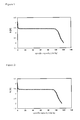
- Figure 1 shows the discharge curves at C/10 and at room temperature for a half cell containing Li 0.80 Fe 0.90 Zn 0.10 PO 4 (Comparative Example 1) in the positive electrode.
- the ratio Li/ ⁇ Fe + Mn + M was 0.80 which is an indicator for Li deficiency.
- Figure 2 shows the discharge curves at C/10 and at room temperature for a half cell containing Li 0.78 Fe 0.90 Mg 0.10 PO 4 (Comparative Example 2) in the positive electrode.
- the ratio Li/ ⁇ Fe + Mn + M was 0. 78 which is an indicator for Li deficiency.
- Figure 3 shows the discharge curves at C/10 and at room temperature for an electrode containing Li 0.99 Fe 0.90 Zn 0.10 PO 4 (SO 4 ) 0.006 (Example 1) in the positive electrode.
- Figure 4 the discharge curves at C/10 and at room temperature for an electrode containing Li 0.98 Mn 0.56 Fe 0.33 Zn 0.10 PO 4 (SO 4 ) 0.01 (Example 2) in the positive electrode.
- Example 1 and Example 2 both have a Li/ ⁇ Fe + Mn + M ratio of 0.99.
Landscapes
- Chemical & Material Sciences (AREA)
- Chemical Kinetics & Catalysis (AREA)
- Electrochemistry (AREA)
- General Chemical & Material Sciences (AREA)
- Inorganic Chemistry (AREA)
- Organic Chemistry (AREA)
- Crystallography & Structural Chemistry (AREA)
- Battery Electrode And Active Subsutance (AREA)
Priority Applications (1)
| Application Number | Priority Date | Filing Date | Title |
|---|---|---|---|
| EP12180402.5A EP2698345A1 (de) | 2012-08-14 | 2012-08-14 | Gemischtes Sulphat mit Lithium-Eisenphosphat |
Applications Claiming Priority (1)
| Application Number | Priority Date | Filing Date | Title |
|---|---|---|---|
| EP12180402.5A EP2698345A1 (de) | 2012-08-14 | 2012-08-14 | Gemischtes Sulphat mit Lithium-Eisenphosphat |
Publications (1)
| Publication Number | Publication Date |
|---|---|
| EP2698345A1 true EP2698345A1 (de) | 2014-02-19 |
Family
ID=46982399
Family Applications (1)
| Application Number | Title | Priority Date | Filing Date |
|---|---|---|---|
| EP12180402.5A Withdrawn EP2698345A1 (de) | 2012-08-14 | 2012-08-14 | Gemischtes Sulphat mit Lithium-Eisenphosphat |
Country Status (1)
| Country | Link |
|---|---|
| EP (1) | EP2698345A1 (de) |
Cited By (4)
| Publication number | Priority date | Publication date | Assignee | Title |
|---|---|---|---|---|
| CN108946694A (zh) * | 2018-08-14 | 2018-12-07 | 南通百川新材料有限公司 | 一种电池级磷酸铁的水热合成方法 |
| CN114824242A (zh) * | 2022-05-10 | 2022-07-29 | 哈尔滨工业大学(威海) | 一种金属氧化物包覆锂离子电池正极材料的制备方法 |
| CN115340075A (zh) * | 2022-05-18 | 2022-11-15 | 四川大学 | 一种采用氧化铁和稀磷酸制备电池级磷酸铁的方法 |
| WO2023207121A1 (zh) * | 2022-04-25 | 2023-11-02 | 湖北万润新能源科技股份有限公司 | 一种高压实磷酸铁锂正极材料及其制备方法,其正极和电池 |
Citations (11)
| Publication number | Priority date | Publication date | Assignee | Title |
|---|---|---|---|---|
| US5910382A (en) | 1996-04-23 | 1999-06-08 | Board Of Regents, University Of Texas Systems | Cathode materials for secondary (rechargeable) lithium batteries |
| EP1084182A1 (de) | 1998-05-29 | 2001-03-21 | Solutia Inc. | Nukleierung von polyamiden in gegenwart von hypophosphit |
| JP2002151082A (ja) | 2000-11-10 | 2002-05-24 | Kansai Research Institute | 鉄リン酸リチウム及びその製造方法並びにこれを用いた二次電池 |
| WO2002083555A2 (de) | 2001-04-10 | 2002-10-24 | Zentrum Für Sonnenenergie- Und Wasserstoff-Forschung Baden-Württemberg, Gemeinnützige Stiftung | Binäre, ternäre und quaternäre lithiumphosphate, verfahren zu ihrer herstellung und ihre verwendung |
| US6514640B1 (en) | 1996-04-23 | 2003-02-04 | Board Of Regents, The University Of Texas System | Cathode materials for secondary (rechargeable) lithium batteries |
| US20040072069A1 (en) * | 2002-10-15 | 2004-04-15 | Hong Young Sik | Cathode active material for lithium secondary cell and method for manufacturing the same |
| WO2005051840A1 (de) | 2003-11-14 | 2005-06-09 | Süd-Chemie AG | Lithiummetallphosphate, verfahren zu deren herstellung und deren verwendung als elektrodenmaterialen |
| WO2009009758A2 (en) | 2007-07-12 | 2009-01-15 | A123 Systems, Inc. | Multifunctional mixed metal olivines for lithium ion batteries |
| FR2932396A1 (fr) * | 2008-06-11 | 2009-12-18 | Centre Nat Rech Scient | Procede de preparation d'oxydes inorganiques par voie solvothermale |
| US20100297496A1 (en) * | 2006-10-30 | 2010-11-25 | Nathalie Ravet | Carbon-treated complex oxides and method for making the same |
| EP2522625A1 (de) * | 2011-05-13 | 2012-11-14 | Shin-Etsu Chemical Co., Ltd. | Herstellung von teilchenförmigen Positivelektrodenmaterial für Lithiumionzellen |
-
2012
- 2012-08-14 EP EP12180402.5A patent/EP2698345A1/de not_active Withdrawn
Patent Citations (12)
| Publication number | Priority date | Publication date | Assignee | Title |
|---|---|---|---|---|
| US5910382A (en) | 1996-04-23 | 1999-06-08 | Board Of Regents, University Of Texas Systems | Cathode materials for secondary (rechargeable) lithium batteries |
| US6514640B1 (en) | 1996-04-23 | 2003-02-04 | Board Of Regents, The University Of Texas System | Cathode materials for secondary (rechargeable) lithium batteries |
| EP1084182A1 (de) | 1998-05-29 | 2001-03-21 | Solutia Inc. | Nukleierung von polyamiden in gegenwart von hypophosphit |
| JP2002151082A (ja) | 2000-11-10 | 2002-05-24 | Kansai Research Institute | 鉄リン酸リチウム及びその製造方法並びにこれを用いた二次電池 |
| WO2002083555A2 (de) | 2001-04-10 | 2002-10-24 | Zentrum Für Sonnenenergie- Und Wasserstoff-Forschung Baden-Württemberg, Gemeinnützige Stiftung | Binäre, ternäre und quaternäre lithiumphosphate, verfahren zu ihrer herstellung und ihre verwendung |
| US20040072069A1 (en) * | 2002-10-15 | 2004-04-15 | Hong Young Sik | Cathode active material for lithium secondary cell and method for manufacturing the same |
| WO2005051840A1 (de) | 2003-11-14 | 2005-06-09 | Süd-Chemie AG | Lithiummetallphosphate, verfahren zu deren herstellung und deren verwendung als elektrodenmaterialen |
| US20070054187A1 (en) * | 2003-11-14 | 2007-03-08 | Süd-Chemie AG | Lithium metal phosphates, method for producing the same and use thereof as electrode material |
| US20100297496A1 (en) * | 2006-10-30 | 2010-11-25 | Nathalie Ravet | Carbon-treated complex oxides and method for making the same |
| WO2009009758A2 (en) | 2007-07-12 | 2009-01-15 | A123 Systems, Inc. | Multifunctional mixed metal olivines for lithium ion batteries |
| FR2932396A1 (fr) * | 2008-06-11 | 2009-12-18 | Centre Nat Rech Scient | Procede de preparation d'oxydes inorganiques par voie solvothermale |
| EP2522625A1 (de) * | 2011-05-13 | 2012-11-14 | Shin-Etsu Chemical Co., Ltd. | Herstellung von teilchenförmigen Positivelektrodenmaterial für Lithiumionzellen |
Non-Patent Citations (10)
| Title |
|---|
| ANDERSON ET AL., ELECTROCHEM. AND SOLID STATE LETTERS, vol. 3, no. 2, 2000, pages 66 - 68 |
| CHEM. MATER, vol. 21, 2009, pages 1636 - 1644 |
| CHEM. MATER., vol. 21, 2009, pages 1636 - 1644 |
| GOODENOUGH ET AL., J. ELECTROCHEM. SOC., vol. 144, 1997, pages 1188 - 1194 |
| HERLE ET AL., NATURE MATERIALS, vol. 3, 2004, pages 147 - 151 |
| LOSEY ET AL., THE CANADIAN MINERALOGIST, vol. 42, 2004, pages 1105 - 1115 |
| MORGAN ET AL., ELECTROCHEM. SOLID STATE LETT., vol. 7, no. 2, 2004, pages A30 - A32 |
| N. RAVET ET AL., MEETING OF ELECTROCHEMICAL SOCIETY, HONOLULU, 17 October 1999 (1999-10-17) |
| NANJUNDASWAMY K S ET AL: "Synthesis, redox potential evaluation and electrochemical characteristics of NASICON-related-3D framework compounds", SOLID STATE IONICS, NORTH HOLLAND PUB. COMPANY. AMSTERDAM; NL, NL, vol. 92, no. 1, 1 November 1996 (1996-11-01), pages 1 - 10, XP004062920, ISSN: 0167-2738, DOI: 10.1016/S0167-2738(96)00472-9 * |
| YAMADA ET AL., CHEM. MATER., vol. 18, 2004, pages 804 - 813 |
Cited By (5)
| Publication number | Priority date | Publication date | Assignee | Title |
|---|---|---|---|---|
| CN108946694A (zh) * | 2018-08-14 | 2018-12-07 | 南通百川新材料有限公司 | 一种电池级磷酸铁的水热合成方法 |
| WO2023207121A1 (zh) * | 2022-04-25 | 2023-11-02 | 湖北万润新能源科技股份有限公司 | 一种高压实磷酸铁锂正极材料及其制备方法,其正极和电池 |
| CN114824242A (zh) * | 2022-05-10 | 2022-07-29 | 哈尔滨工业大学(威海) | 一种金属氧化物包覆锂离子电池正极材料的制备方法 |
| CN114824242B (zh) * | 2022-05-10 | 2023-09-15 | 哈尔滨工业大学(威海) | 一种金属氧化物包覆锂离子电池正极材料的制备方法 |
| CN115340075A (zh) * | 2022-05-18 | 2022-11-15 | 四川大学 | 一种采用氧化铁和稀磷酸制备电池级磷酸铁的方法 |
Similar Documents
| Publication | Publication Date | Title |
|---|---|---|
| US9577244B2 (en) | Substituted lithium-manganese metal phosphate | |
| EP2885247B1 (de) | Gemischtes sulphat mit lithium-mangan-eisen-metallphosphat | |
| JP5992335B2 (ja) | 置換されたリン酸金属リチウムマンガン | |
| US7807121B2 (en) | Lithium metal phosphates, method for producing the same and use thereof as electrode material | |
| EP2130248B1 (de) | Zimmertemperatur-einphasen-li-einfüge-/-extraktionsmaterial zur verwendung in einer batterie auf li-basis | |
| EP2698345A1 (de) | Gemischtes Sulphat mit Lithium-Eisenphosphat | |
| HK1181028A (en) | Substituted lithium-manganese metal phosphate |
Legal Events
| Date | Code | Title | Description |
|---|---|---|---|
| AK | Designated contracting states |
Kind code of ref document: A1 Designated state(s): AL AT BE BG CH CY CZ DE DK EE ES FI FR GB GR HR HU IE IS IT LI LT LU LV MC MK MT NL NO PL PT RO RS SE SI SK SM TR |
|
| AX | Request for extension of the european patent |
Extension state: BA ME |
|
| PUAI | Public reference made under article 153(3) epc to a published international application that has entered the european phase |
Free format text: ORIGINAL CODE: 0009012 |
|
| STAA | Information on the status of an ep patent application or granted ep patent |
Free format text: STATUS: THE APPLICATION IS DEEMED TO BE WITHDRAWN |
|
| 18D | Application deemed to be withdrawn |
Effective date: 20140820 |