EP2700489B1 - Appareil et procédé de traitement de pelletisation contrôlée - Google Patents
Appareil et procédé de traitement de pelletisation contrôlée Download PDFInfo
- Publication number
- EP2700489B1 EP2700489B1 EP13005394.5A EP13005394A EP2700489B1 EP 2700489 B1 EP2700489 B1 EP 2700489B1 EP 13005394 A EP13005394 A EP 13005394A EP 2700489 B1 EP2700489 B1 EP 2700489B1
- Authority
- EP
- European Patent Office
- Prior art keywords
- melt
- extruder
- temperature
- pelletizer
- cooler
- Prior art date
- Legal status (The legal status is an assumption and is not a legal conclusion. Google has not performed a legal analysis and makes no representation as to the accuracy of the status listed.)
- Active
Links
Images


Classifications
-
- B—PERFORMING OPERATIONS; TRANSPORTING
- B29—WORKING OF PLASTICS; WORKING OF SUBSTANCES IN A PLASTIC STATE IN GENERAL
- B29B—PREPARATION OR PRETREATMENT OF THE MATERIAL TO BE SHAPED; MAKING GRANULES OR PREFORMS; RECOVERY OF PLASTICS OR OTHER CONSTITUENTS OF WASTE MATERIAL CONTAINING PLASTICS
- B29B9/00—Making granules
- B29B9/02—Making granules by dividing preformed material
- B29B9/06—Making granules by dividing preformed material in the form of filamentary material, e.g. combined with extrusion
- B29B9/065—Making granules by dividing preformed material in the form of filamentary material, e.g. combined with extrusion under-water, e.g. underwater pelletizers
-
- B—PERFORMING OPERATIONS; TRANSPORTING
- B29—WORKING OF PLASTICS; WORKING OF SUBSTANCES IN A PLASTIC STATE IN GENERAL
- B29B—PREPARATION OR PRETREATMENT OF THE MATERIAL TO BE SHAPED; MAKING GRANULES OR PREFORMS; RECOVERY OF PLASTICS OR OTHER CONSTITUENTS OF WASTE MATERIAL CONTAINING PLASTICS
- B29B13/00—Conditioning or physical treatment of the material to be shaped
- B29B13/04—Conditioning or physical treatment of the material to be shaped by cooling
-
- B—PERFORMING OPERATIONS; TRANSPORTING
- B29—WORKING OF PLASTICS; WORKING OF SUBSTANCES IN A PLASTIC STATE IN GENERAL
- B29B—PREPARATION OR PRETREATMENT OF THE MATERIAL TO BE SHAPED; MAKING GRANULES OR PREFORMS; RECOVERY OF PLASTICS OR OTHER CONSTITUENTS OF WASTE MATERIAL CONTAINING PLASTICS
- B29B9/00—Making granules
- B29B9/10—Making granules by moulding the material, i.e. treating it in the molten state
-
- B—PERFORMING OPERATIONS; TRANSPORTING
- B29—WORKING OF PLASTICS; WORKING OF SUBSTANCES IN A PLASTIC STATE IN GENERAL
- B29B—PREPARATION OR PRETREATMENT OF THE MATERIAL TO BE SHAPED; MAKING GRANULES OR PREFORMS; RECOVERY OF PLASTICS OR OTHER CONSTITUENTS OF WASTE MATERIAL CONTAINING PLASTICS
- B29B9/00—Making granules
- B29B9/12—Making granules characterised by structure or composition
-
- B—PERFORMING OPERATIONS; TRANSPORTING
- B29—WORKING OF PLASTICS; WORKING OF SUBSTANCES IN A PLASTIC STATE IN GENERAL
- B29B—PREPARATION OR PRETREATMENT OF THE MATERIAL TO BE SHAPED; MAKING GRANULES OR PREFORMS; RECOVERY OF PLASTICS OR OTHER CONSTITUENTS OF WASTE MATERIAL CONTAINING PLASTICS
- B29B9/00—Making granules
- B29B9/16—Auxiliary treatment of granules
-
- B—PERFORMING OPERATIONS; TRANSPORTING
- B29—WORKING OF PLASTICS; WORKING OF SUBSTANCES IN A PLASTIC STATE IN GENERAL
- B29C—SHAPING OR JOINING OF PLASTICS; SHAPING OF MATERIAL IN A PLASTIC STATE, NOT OTHERWISE PROVIDED FOR; AFTER-TREATMENT OF THE SHAPED PRODUCTS, e.g. REPAIRING
- B29C48/00—Extrusion moulding, i.e. expressing the moulding material through a die or nozzle which imparts the desired form; Apparatus therefor
- B29C48/03—Extrusion moulding, i.e. expressing the moulding material through a die or nozzle which imparts the desired form; Apparatus therefor characterised by the shape of the extruded material at extrusion
- B29C48/04—Particle-shaped
-
- B—PERFORMING OPERATIONS; TRANSPORTING
- B29—WORKING OF PLASTICS; WORKING OF SUBSTANCES IN A PLASTIC STATE IN GENERAL
- B29C—SHAPING OR JOINING OF PLASTICS; SHAPING OF MATERIAL IN A PLASTIC STATE, NOT OTHERWISE PROVIDED FOR; AFTER-TREATMENT OF THE SHAPED PRODUCTS, e.g. REPAIRING
- B29C48/00—Extrusion moulding, i.e. expressing the moulding material through a die or nozzle which imparts the desired form; Apparatus therefor
- B29C48/25—Component parts, details or accessories; Auxiliary operations
- B29C48/36—Means for plasticising or homogenising the moulding material or forcing it through the nozzle or die
- B29C48/365—Means for plasticising or homogenising the moulding material or forcing it through the nozzle or die using pumps, e.g. piston pumps
- B29C48/37—Gear pumps
-
- B—PERFORMING OPERATIONS; TRANSPORTING
- B29—WORKING OF PLASTICS; WORKING OF SUBSTANCES IN A PLASTIC STATE IN GENERAL
- B29C—SHAPING OR JOINING OF PLASTICS; SHAPING OF MATERIAL IN A PLASTIC STATE, NOT OTHERWISE PROVIDED FOR; AFTER-TREATMENT OF THE SHAPED PRODUCTS, e.g. REPAIRING
- B29C48/00—Extrusion moulding, i.e. expressing the moulding material through a die or nozzle which imparts the desired form; Apparatus therefor
- B29C48/25—Component parts, details or accessories; Auxiliary operations
- B29C48/36—Means for plasticising or homogenising the moulding material or forcing it through the nozzle or die
- B29C48/375—Plasticisers, homogenisers or feeders comprising two or more stages
- B29C48/39—Plasticisers, homogenisers or feeders comprising two or more stages a first extruder feeding the melt into an intermediate location of a second extruder
-
- B—PERFORMING OPERATIONS; TRANSPORTING
- B29—WORKING OF PLASTICS; WORKING OF SUBSTANCES IN A PLASTIC STATE IN GENERAL
- B29C—SHAPING OR JOINING OF PLASTICS; SHAPING OF MATERIAL IN A PLASTIC STATE, NOT OTHERWISE PROVIDED FOR; AFTER-TREATMENT OF THE SHAPED PRODUCTS, e.g. REPAIRING
- B29C48/00—Extrusion moulding, i.e. expressing the moulding material through a die or nozzle which imparts the desired form; Apparatus therefor
- B29C48/25—Component parts, details or accessories; Auxiliary operations
- B29C48/78—Thermal treatment of the extrusion moulding material or of preformed parts or layers, e.g. by heating or cooling
- B29C48/793—Thermal treatment of the extrusion moulding material or of preformed parts or layers, e.g. by heating or cooling upstream of the plasticising zone, e.g. heating in the hopper
- B29C48/797—Cooling
-
- B—PERFORMING OPERATIONS; TRANSPORTING
- B29—WORKING OF PLASTICS; WORKING OF SUBSTANCES IN A PLASTIC STATE IN GENERAL
- B29C—SHAPING OR JOINING OF PLASTICS; SHAPING OF MATERIAL IN A PLASTIC STATE, NOT OTHERWISE PROVIDED FOR; AFTER-TREATMENT OF THE SHAPED PRODUCTS, e.g. REPAIRING
- B29C48/00—Extrusion moulding, i.e. expressing the moulding material through a die or nozzle which imparts the desired form; Apparatus therefor
- B29C48/25—Component parts, details or accessories; Auxiliary operations
- B29C48/78—Thermal treatment of the extrusion moulding material or of preformed parts or layers, e.g. by heating or cooling
- B29C48/80—Thermal treatment of the extrusion moulding material or of preformed parts or layers, e.g. by heating or cooling at the plasticising zone, e.g. by heating cylinders
- B29C48/83—Heating or cooling the cylinders
- B29C48/834—Cooling
-
- B—PERFORMING OPERATIONS; TRANSPORTING
- B29—WORKING OF PLASTICS; WORKING OF SUBSTANCES IN A PLASTIC STATE IN GENERAL
- B29C—SHAPING OR JOINING OF PLASTICS; SHAPING OF MATERIAL IN A PLASTIC STATE, NOT OTHERWISE PROVIDED FOR; AFTER-TREATMENT OF THE SHAPED PRODUCTS, e.g. REPAIRING
- B29C48/00—Extrusion moulding, i.e. expressing the moulding material through a die or nozzle which imparts the desired form; Apparatus therefor
- B29C48/25—Component parts, details or accessories; Auxiliary operations
- B29C48/88—Thermal treatment of the stream of extruded material, e.g. cooling
- B29C48/919—Thermal treatment of the stream of extruded material, e.g. cooling using a bath, e.g. extruding into an open bath to coagulate or cool the material
-
- B—PERFORMING OPERATIONS; TRANSPORTING
- B29—WORKING OF PLASTICS; WORKING OF SUBSTANCES IN A PLASTIC STATE IN GENERAL
- B29B—PREPARATION OR PRETREATMENT OF THE MATERIAL TO BE SHAPED; MAKING GRANULES OR PREFORMS; RECOVERY OF PLASTICS OR OTHER CONSTITUENTS OF WASTE MATERIAL CONTAINING PLASTICS
- B29B9/00—Making granules
- B29B9/16—Auxiliary treatment of granules
- B29B2009/165—Crystallizing granules
-
- B—PERFORMING OPERATIONS; TRANSPORTING
- B29—WORKING OF PLASTICS; WORKING OF SUBSTANCES IN A PLASTIC STATE IN GENERAL
- B29C—SHAPING OR JOINING OF PLASTICS; SHAPING OF MATERIAL IN A PLASTIC STATE, NOT OTHERWISE PROVIDED FOR; AFTER-TREATMENT OF THE SHAPED PRODUCTS, e.g. REPAIRING
- B29C48/00—Extrusion moulding, i.e. expressing the moulding material through a die or nozzle which imparts the desired form; Apparatus therefor
- B29C48/25—Component parts, details or accessories; Auxiliary operations
- B29C48/88—Thermal treatment of the stream of extruded material, e.g. cooling
- B29C48/911—Cooling
-
- B—PERFORMING OPERATIONS; TRANSPORTING
- B29—WORKING OF PLASTICS; WORKING OF SUBSTANCES IN A PLASTIC STATE IN GENERAL
- B29K—INDEXING SCHEME ASSOCIATED WITH SUBCLASSES B29B, B29C OR B29D, RELATING TO MOULDING MATERIALS OR TO MATERIALS FOR MOULDS, REINFORCEMENTS, FILLERS OR PREFORMED PARTS, e.g. INSERTS
- B29K2101/00—Use of unspecified macromolecular compounds as moulding material
- B29K2101/12—Thermoplastic materials
-
- B—PERFORMING OPERATIONS; TRANSPORTING
- B29—WORKING OF PLASTICS; WORKING OF SUBSTANCES IN A PLASTIC STATE IN GENERAL
- B29K—INDEXING SCHEME ASSOCIATED WITH SUBCLASSES B29B, B29C OR B29D, RELATING TO MOULDING MATERIALS OR TO MATERIALS FOR MOULDS, REINFORCEMENTS, FILLERS OR PREFORMED PARTS, e.g. INSERTS
- B29K2105/00—Condition, form or state of moulded material or of the material to be shaped
- B29K2105/0005—Condition, form or state of moulded material or of the material to be shaped containing compounding ingredients
-
- B—PERFORMING OPERATIONS; TRANSPORTING
- B29—WORKING OF PLASTICS; WORKING OF SUBSTANCES IN A PLASTIC STATE IN GENERAL
- B29K—INDEXING SCHEME ASSOCIATED WITH SUBCLASSES B29B, B29C OR B29D, RELATING TO MOULDING MATERIALS OR TO MATERIALS FOR MOULDS, REINFORCEMENTS, FILLERS OR PREFORMED PARTS, e.g. INSERTS
- B29K2105/00—Condition, form or state of moulded material or of the material to be shaped
- B29K2105/0094—Condition, form or state of moulded material or of the material to be shaped having particular viscosity
-
- B—PERFORMING OPERATIONS; TRANSPORTING
- B29—WORKING OF PLASTICS; WORKING OF SUBSTANCES IN A PLASTIC STATE IN GENERAL
- B29K—INDEXING SCHEME ASSOCIATED WITH SUBCLASSES B29B, B29C OR B29D, RELATING TO MOULDING MATERIALS OR TO MATERIALS FOR MOULDS, REINFORCEMENTS, FILLERS OR PREFORMED PARTS, e.g. INSERTS
- B29K2105/00—Condition, form or state of moulded material or of the material to be shaped
- B29K2105/0097—Glues or adhesives, e.g. hot melts or thermofusible adhesives
Definitions
- the present invention generally relates to an apparatus and process which can provide careful regulation of the thermal, shear, and rheological components of materials in a pelletization process.
- the materials being pelletized are prepared or formulated in a mixing device such as a vessel or extruder and subsequently processed through a heat exchanger and extruder to achieve the proper temperature for that pelletization without detrimental phase separation or die freeze off and which provides uniform pellet geometries and acceptably low pellet moisture levels.
- the apparatus and method of this invention has application for narrow-range melting compounds, high melt flow formulations, low melting temperature materials, and polymeric mixtures, formulations, dispersions, or solutions of which waxes, asphalts, adhesives including hot melt adhesives, high melt flow polyolefins including polypropylenes and copolymers, and gum base formulations are exemplary.
- Pelletization of materials and particularly polymeric materials has been well-known in the art for many years and has been integral to the operations of the assignee of the present invention from as early as U. S. Patent No. 4,123,207 issued October 31, 1978 .
- Processing polymeric materials through heat exchangers and extruders have similar early histories in the literature and have been used in association with pelletizers in various arrangements throughout that period.
- Processing pellets through centrifugal dryers to obtain suitably low moisture pellets is readily established in the literature and has been instrumental to the present assignee from as early as U. S. Patent No. 3,458,045 issued July 29, 1969 . Modifications and improvements of these processes have been demonstrated through subsequent issuance of U. S. Patent Nos.
- the material, or materials, to be pelletized in accordance with the present invention are charged into a vessel or an extruder to be melted, sheared, and/or mixed.
- the vessel may be at atmospheric pressure, pressurized, or under vacuum and may be unpurged or purged with air or an inert gas such as nitrogen, argon, or the like. Pressure, vacuum, and purging may be applied sequentially or continuously in any combination and order.
- the requisite energy converts the formulation to a molten or semi-solid mixture or liquid which flows suitably by gravity or under pressure when released in batch processing or continuous flow processing.
- the applied energy may be thermal and/or mechanical in the form of low, medium, or high shear as necessitated by the formulation requirements which directly and significantly impacts the temperature of the molten, semi-solid or liquid material.
- the material mixed or blended in the vessel optionally may flow into and through a booster pump and/or is pressurized sufficiently to flow through a coarse filter apparatus as required.
- the diverter valve may be placed after the melt cooler rather than as described above with similar capabilities as described therein.
- the material to be pelletized after exiting from the melt cooler or heat exchanger, is fed to a cooling extruder.
- the cooling extruder provides for more efficient mixing while at the same time providing additional and controlled cooling of the molten, semi-solid mixture or liquid material.
- the combination of the melt cooler and the cooling extruder surprisingly allows for precooling of the molten material which reduces the total energy, including the thermal energy, contained within that material more effectively than can be achieved by an extruder operating alone.
- the cooling extruder optionally allows purging, devolatilization, or addition of other chemicals or materials inclusive of which may be impurities, by-products, degradation products, volatiles or thermally sensitive components as required by or as a consequence of the formulation and processing.
- Control of the cooling temperature and thorough mixing during the melt cooler and cooling extruder sequence are necessary to insure uniform homogeneity of the material or mixture being processed and to reduce the temperature to, or near to, that at which pelletization occurs. This lowering of the temperature serves to reduce or eliminate the likelihood that phase separation or die freeze-off will result during extrusion/pelletization.
- the molten, semi-solid mixture or liquid material or materials leaving the cooling extruder continues through the processing or may be discharged out of the system through the diverter valve. Continuation of the flow proceeds toward the pelletization unit and passes through a melt pump to pressurize the flow sufficient to pass optionally through a secondary melt cooler or directly into the pelletization unit. Additionally, a melt pump may be necessary following the secondary melt cooler to insure adequate pressurization for the extrusional pelletization.
- the pressurized melt proceeds through the thermally regulated die toward the water box of the underwater pelletizer or other equivalent pelletization unit known to those skilled in the art.
- the uniformly dispersed fluid material passes through the die and is cut by rotating blades in the pelletizing unit.
- Water which is thermally controlled removes the pellets from the cutter blade and transports them through the agglomerate catcher for removal of coarsely aggregated or agglomerated pellets, through the dewatering device, and into the centrifugal dryer or fluidized bed to remove excipient surface moisture from the pellets.
- the pellets may pass through the pellet discharge chute either for collection or may proceed to additional processing including pellet coating, crystallization, or further cooling as required to achieve the desired product.
- additional processing including pellet coating, crystallization, or further cooling as required to achieve the desired product.
- coating, enhanced crystallization, cooling operations, or other processing appropriate to the pelletized material may be performed after pelletization and before introduction of the pellet into the drying process as well.
- cooling extruder any known or available extruder can be used as the cooling extruder.
- the cooling extruder may be a single, twin, or multiple screw design, or a ring extruder for example.
- the cooling extruder is preferably a single screw and more preferably a twin screw.
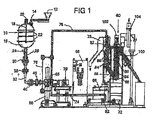
- Figure 1 illustrates a basic prior art system including a mixing vessel, pelletizer, and centrifugal dryer.
- Material or component materials to be pelletized are fed into the thermally regulated mixer or blender, generally designated by reference numeral 10, manually as a solid or liquid, or by a feed screw 12, pump, or similar device through or attached to the vessel orifice 14.
- the vessel chamber 16 may be atmospheric or purged with air or an inert gas, preferably nitrogen or argon. Liquids may be drawn into the chamber 16 by siphoning with a partial vacuum. This may be useful for reactive or moisture-sensitive components. Components may be added in portions with mixing and warming to temperature as required. Mixing is achieved by rotation of the rotor 18 by motor 20.
- mixing blades 22 exemplary of which may be propeller or boat style, ploughshare style, delta or sigma style in single, double or multiple configurations, and helical or helical dispersion blades.
- the mixer may be a ribbon blender, Banbury-type blender, horizontal mixer, vertical mixer, planetary mixer or equivalent device known to those skilled in the art.
- the booster pump 30 may be a centrifugal or positive displacement reciprocating or rotary pump, and preferably is a rotary pump which may be a peristaltic, vane, screw, lobe, progressive cavity, or gear pump, and more preferably is a gear pump.
- the gear pump may be high precision, or even more preferably open clearance, and generates an intermediate pressure, typically up to 500 psi and preferably less than 150 psi.
- the pump pressure is sufficient to force the melt through the coarse filter 35 which is preferably a candle filter, basket filter, or screen changer, and is more preferably a basket filter of 20 mesh or coarser.
- the coarse filter 35 removes larger particles, agglomerates, or granular material from the melt as it flows through the pipe 32 to and through melt pump 40 which generates pressures on the melt, preferably at least 200 psi and more preferably from 500 psi to 2000 psi.
- the melt pump 40 may be a centrifugal or positive displacement reciprocating or rotary pump, and preferably is a rotary pump which may be a peristaltic, vane, screw, lobe, progressive cavity, or gear pump, and more preferably is a gear pump. Seals must be compatible with the material being processed, chemically and mechanically, the details of which are well understood by those skilled in the art.
- the pressurized melt passes through a second filter 45 which is preferably a basket filter or screen changer, and is more preferably a screen changer of 200 mesh or coarser, and even more preferably a multilayer screen changer of two or more screens of differing mesh, most preferably a series of filters exemplary of which is 20 mesh, 40 mesh, and 80 mesh.
- the screen changer may be manual, plate, slide plate, single or dual bolt, and may be continuous or discontinuous.
- the melt passes into and through the diverter valve 60 wherein the melt may be diverted to waste, to a recycle stream back to the vessel 16, or may continue to the extrusion die 65.
- the extrusion die contains a multiplicity of orifices of number and geometry appropriate to the flow rate, throughput, and melt material as is known to those skilled in the art.
- Pelletization of the melt is achieved by an underwater, hot face, strand, water ring or similar pelletizer, and preferably by an underwater pelletizer 70 of construction by or similar to designs marketed by Gala Industries, Inc., (Eagle Rock, VA), the assignee of the present invention (hereinafter "Gala").
- the pelletizer motor rotates a series of blades which cut the strands of melt into small pellets.
- the pellets so made are conveyed out of the water box by a rapid flow of thermally controlled water provided by the pump 72 through the conduit 74 and out through the effluent pipe 78.
- a series of valves and piping form a bypass loop 76 that allows the water to be shunted past the water box when the molten material is not being pelletized.
- the temperature of the water, the rotational rate of the cutter blades, and the flow rate of the melt through the die contribute to the production of proper pellet geometries.
- the temperature of the pellets, both in the interior and the exterior or shell, also influence the formation of the pellets as well as the drying of the pellets.
- the flow rate of the water through the pipe 78 should be sufficiently rapid to convey the pellets to the dryer, generally designated by reference numeral 80, with controlled loss of heat from the pellets.
- the dryer 80 is preferably a centrifugal pellet dryer as manufactured by Gala.
- Drying of the pellets with controlled loss of heat is achieved by passing the pellet and water slurry through an agglomerate catcher 75 which contains a round wire grid or coarse screen 82 to remove oversize chunks or agglomerates of pellets.
- the slurry optionally passes through a dewatering device 84, or series of dewatering devices, containing baffles 86 and an angular feed screen 88 which collectively reduce the water content, preferably 90 per cent, and more preferably 98 per cent or more.
- the water removed passes through the fines removal screen 92 into a water tank or reservoir 90 and is available for recycling or disposal.
- the pellets immediately transfer to the inlet at the base of the centrifugal dryer 80 where they are lifted rotationally upward by a rotating rotor with lifters 94 and are propelled outwardly against a foraminous screen 96, preferably a perforated plate or pierced screen, concentrically surrounding the rotor / lifter assembly 94 and contained within the housing 98.
- a foraminous screen 96 preferably a perforated plate or pierced screen, concentrically surrounding the rotor / lifter assembly 94 and contained within the housing 98.
- Motor 102 rotates the rotor / lifter assembly 94 and countercurrent air flow is provided by blower 104 in models of centrifugal dryers marketed by Gala as previously noted.
- control system 95 Power for all processes is provided by control system 95.
- the dried pellets pass out the chute 100 for storage or may be further processed with coatings, additional crystallization, or further cooled as is well understood by those skilled in the art.
- the design and operation of the pelletizer and centrifugal dryer are detailed in the aforementioned patents by Gala.
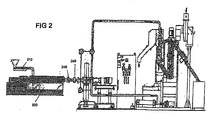
- an extruder 200 with one or more feed units 212 is utilized to mix and heat the melt material to be pelletized.
- the extruder 200 optionally may be a single, twin, or multiple screw design, a ring extruder for example, and is preferably a single screw and more preferably a twin screw.
- the sections of the screw must feed, mix, and convey the melt material simultaneously providing sufficient energy, thermal and mechanical, to melt, mix, and uniformly disperse the melt material or materials to be pelletized.
- the twin screw or multiple screw is capable of being purged by air or preferably an inert gas, such as nitrogen, or may be evacuated at one or more ports to remove gases, volatiles, or impurities.
- Multiple feeding and injection ports may be added along the barrel of the screw as required to allow addition of ingredients, solid or liquid, to the melt in process. Configuration of the screw must be satisfactory to achieve an appropriate level of feeding, mixing, melting, blending, and throughput and is well understood by those skilled in the art.
- melt pump 240 and/or a screen changer 245 comparable to melt pump 40 and screen changer 45, respectively, as described for Figure 1 .
- Pressure generated by the extruder 200 or by the extruder 200 and melt pump 240 must be sufficient to extrude the melt through the die and pelletization system which follow the equipment described for Figure 1 .
- Designs illustrated in Figure 1 and Figure 2 require the components upstream of the extrusion die 65 in Figure 1 and analogously in Figure 2 to provide sufficient energy to mix, melt, and extrude the melt.
- FIG. 3 A present commercial design which interjects cooling into the apparatus illustrated in Figure 1 is shown in Figure 3 .
- the components described in Figure 1 are identified with numerically the same number and fulfill all conditions and preferences of the Figure 1 illustration.
- a melt cooler 250 is introduced into the process following the melt pump 40 and screen changer 45.
- the melt pump 40 must generate sufficient pressure to force the melt through the melt cooler 250 and on through the extrusion die 65 and for the subsequent processing described for Figure 1 .
- the melt cooler 250 is a heat exchanger of the coil type, scrape wall, plate and frame, shell and tube design with or without static mixers, or U-style tube design with or without static mixers, and preferably is a shell and tube design which includes static mixing blades within the individual tubes to further mix the material and bring more of the material in intimate contact with the wall of the tube outside of which is a flow of oil or water coolant circulating within the shell housing, preferably in a countercurrent flow pattern as is understood by those skilled in the art.
- the temperature and flow rate of the circulating medium is carefully regulated by a control unit, not shown.
- This unit is capable of reducing the temperature of the melt prepared in vessel 10 to that which will allow extrusion of the melt through the die plate 65 with reduced likelihood of wrap around the die face by the cutter, improved pellet geometry, lower pellet temperature, and less aggregation and agglomeration of the pellets.
- the material or materials to be pelletized are charged into vessel 10 and progresses through the system analogous to that described in connection with Figure 1 and as modified by incorporation of the melt cooler 250 as described in detail in connection with Figure 3 .
- Reference numbers and process preferences remain the same as for those similarly numbered components illustrated and described in connection with the prior drawing figures.
- the material or materials are mixed in the mixer 10 commonly with high shear and subsequently are high in temperature as well.
- the melt flows through pipe 26 to booster pump 30 and is moderately pressurized to insure flow into and through the coarse filter 35.
- Coarsely filtered flow proceeds through pipe 32 to melt pump 40 and is pressurized sufficiently to progress through screen changer 45 and melt cooler 250 where the temperature is reduced in accordance with the previous descriptions associated with Figures 1 and 3 .
- cooling extruder 300 To maximize the dispersive homogeneity of the melt, it passes into a cooling extruder 300, which can be the same as previously described extruder 200 in connection with Figure 2 .
- the screw configuration of cooling extruder 300 should provide rigorous mixing and propagation through the distal zones or sections from the inlet where the further cooling is achieved. Addition of thermally sensitive ingredients may be accomplished through one or more side feeders 310, illustrated separately from extruder 300 to indicate the variability in positioning relative to that extruder.
- the side feed or side feeders 310 may provide additional solid, semi-solid or liquid materials to the mix such as rheological additives, miscibilizing agents, surfactants, expanding agents, catalysts, inhibitors, antioxidants, chain extenders, nucleation agents, flavors, fragrances, colorants, devolatilizing agents, chemical scavengers, or additives appropriate to the application and well known to those skilled in the art.
- rheological additives such as rheological additives, miscibilizing agents, surfactants, expanding agents, catalysts, inhibitors, antioxidants, chain extenders, nucleation agents, flavors, fragrances, colorants, devolatilizing agents, chemical scavengers, or additives appropriate to the application and well known to those skilled in the art.
- a melt pump 340 and screen changer 345 may be positioned following the effluent orifice of the extruder 300 and prior to the inlet to the extrusion die 65. This allows pressure to be increased as necessary to achieve appropriate pelletization of the uniformly
- extruder 400 is designed with screw objectives of shear mixing and melting.
- the melt passes through the outlet of the extruder through a diverter valve 460, comparable to diverter valve 60 described in connection with Figure 1 , and then through a booster pump 440 and coarse filter 445 into the melt cooler 450.
- melt cooler 450 Descriptions and preferences follow from analogous components, 40 and 45, as well as for melt cooler 450 versus 250, and differ only in that, although meeting the preference criteria described in connection with previous figures, they may or may not be identical to components 40, 45 or 250 in this preferred embodiment.
- the cooled melt proceeds to the cooling extruder 300 and processes in accordance with the description previously provided in connection with Figure 4 . Inclusion and positioning of the diverter valve 460, booster pump 440, and coarse filter 445 are optional.
- FIG. 6 illustrates a composite of components from the Figures 4 and 5 embodiments.
- Mixing vessel 10 and/or extruder 400 with feed 412 may serve as the shear mixer and feed through a common diverter valve 560 into a melt pump 40 and screen changer 45.
- the melt proceeds through melt cooler 450 and into cooling extruder 300 and diverter 460 as previously described in connection with Figure 5 .
- Diverter 560 differs only in that it must provide two inlets as well as a waste/recycle and outlet position. From the outlet of the extruder 300 and diverter 460 the material optionally may pass through a melt pump 540 and screen changer 545 into a secondary melt cooler 550 for additional regulation of the temperature of the melt and final mixing.
- An additional melt pump 555 optionally provides further pressurization as the melt proceeds to the extrusion die 65 and through pelletization and drying as described previously. Additional pressurizations before the screen changers and melt coolers are preferable to insure proper flow of the melt through those devices. Pressure limitations of 2000 psi are commercially common and therefore limit pressurization prior to extrusion. The addition of melt pump 555 provides additional pressurization capabilities which may be necessary to proper extrusion through the die 65.
- pellets with minimum surface moisture content reflect the use of a preferred centrifugal dryer to produce pellets with minimum surface moisture content.
- Pellets with high tack, high friability or brittleness, low melting or softening temperatures, or low deformation temperatures optionally may be processed through vibratory dewatering devices, fluidized beds, or other comparable devices not illustrated and well known to those skilled in the art to achieve the desired level of surface moisture.
- pellets Prior to or subsequent to the drying operations alternatively, pellets may be coated, crystallized, or cooled by processes, techniques, and equipment readily available commercially.
- a polyolefin copolymer was processed utilizing the apparatus illustrated in Figure 4 .
- the temperature in mixing vessel 10 to achieve formulation was 93.3°C (200 °F) to 315.5°C (600 °F), preferably 93.3°C (200 °F) to 260°C (500 °F), more preferably from 93.3°C (200 °F) to 204.4°C (400 °F), and most preferably from 148.8°C (300 °F) to 204.4°C (400 °F).
- the pour temperature of the melt from the vessel 10 was 93.3°C (200 °F) to 315.5°C (600 °F) preferably 93.3°C (200 °F) to 260°C (500 °F), more preferably from 93.3°C (200 °F) to 204.4°C (400 °F), and most preferably from 148.8°C (300 °F) to 4.4°C (400 °F).
- the temperature of the melt after the melt cooler 250 was 37.7°C (100 °F) to 287.7°C (550 °F), preferably 37.7°C (100 °F) to 232.2°C (450 °F), more preferably from 37.7°C (100 °F) to 176.6°C (350 °F), and most preferably from 93.3°C (200 °F) to 148.8°C (300 °F).
- the temperature of the melt at the die plate 65 was reduced to 23.8°C (75 °F) to 204.4°C (400 °F), preferably 23.8°C (75 °F) to 148.8°C (300 °F), more preferably from 37.7°C (100 °F) to 121.1°C (250 °F), and most preferably from 65.5°C (150 °F) to 121.1°C (250 °F).
- the water temperature for the underwater pelletization was regulated at 4.4°C (40 °F) to 93.3°C (200 °F), preferably 4.4°C (40 °F) to 65.5°C (150 °F), more preferably from 4.4°C (40 °F) to 37.7°C (100 °F), and most preferably from 4.4 (40 °F) to 26.6°C (80 °F) to insure proper pellet geometry, sufficiently low temperature for pelletization without deformation, reduced likelihood of freeze-off at the die, and to avoid wrapping the extrudate around the face of the die by rotation of the cutter.
- Asphalt to be pelletized in accordance with the apparatus and method of the present invention may be naturally occurring or synthetic including, for example, formulations comprised of bitumen, plasticizers, a binder, and/or a polymeric resin base.
- Bitumen exemplarily may be derived from crude oil, petroleum pitch, plastic residues from distillation of coal tar, mineral waxes, bituminous schists, bituminous sands, bituminous coal, and asphalt dispersions.
- Adhesives to be processed in accordance with the apparatus and method of the present invention include those containing a polymeric base or binder, tackifier, wax, fillers, additives and the like.
- Gum bases similarly contain a polymeric base which is capable of mastication, polymeric gum base, emulsifiers, softeners or plasticizers, texturizing agents, fillers, flavors, and fragrances. Thermally and oxidatively sensitive medicaments and medicating agents are also contained within the scope of applications for the present invention.
- Polymeric bases and gum bases may include acrylonitrile-butadiene-styrene elastomers, alkyds, amorphous polyalphaolefins or APAO, atatic polypropylene, balata, butadiene rubber, chicle, crumb rubber, ethylene-acrylic acid copolymers, ethylene-cyclopentadiene copolymers, ethylene-methacrylate copolymers, ethylene-propylene-diene monomer or EPDM, ethylene-vinyl acetate copolymers, ethylene-vinyl alcohol copolymers, guayule, gutta hang kang, guttapercha, halobutyl rubber, high density polyethylene or HDPE, isobutylene rubber, isobutylene - isoprene copolymeric rubber, isotactic polybutene, polypropylene, and polystyrene, jelutong gum, lechi caspi, low density poly
- Tackifiers, and resins, often as plasticizers and softeners, for processing in accordance with the present invention include hydrocarbons which are aliphatic, cycloaliphatic, and aromatic, mixed aliphatic/aromatic hydrocarbons, natural and partially hydrogenated rosin esters, natural and partially hydrogenated wood rosins, glycerol rosin esters, glycerol tall oil ester, maleic-modified rosin, pentaerythritol rosin esters, polyterpenes, terpenes, a-pinene, b-pinene, and d-limonene, phenolic modified terpenes, polyethylene grease, polyvinylacetate, mineral oils including paraffinic and naphthionic, and styrene-terpene copolymers, as well as other liquid plasticizers well known to those skilled in the art.
- hydrocarbons which are aliphatic, cycloaliphatic, and aromatic, mixed ali
- Waxes individually or formulationally, which may be processed in accordance with the present invention, include beeswax, candelilla wax, carnauba, ceresin wax, China wax, Fischer-Tropsch waxes including oxidized forms, high density low molecular weight polyethylene or HDLMWPE, hydroxystearamide wax, japan wax, lardeceine, lignite wax, microcrystalline wax, ozokerite, paraffin or petroleum wax, polyethylene wax, polyolefin wax, rice bran wax, sugarcane wax, and vegetable waxes including those from canola, coconut, corn, cottonseed, crambe, linseed, palm, palm kernel, peanut, rape, or soybean.
- candelilla wax carnauba, ceresin wax, China wax
- Fischer-Tropsch waxes including oxidized forms, high density low molecular weight polyethylene or HDLMWPE, hydroxystearamide wax, japan wax, lardeceine, lignite wax, microcrystalline wax
- High melt flow polymerics for processing in accordance with the present invention, include low viscosity molten polyolefins and preferably include polypropylene and vinylic copolymers thereof including ethylene, butylene, cyclic vinylics by way of example.
- Emulsifiers, colorants, fillers, flavorants, perfumants, and other additives appropriate to the formulation and known to those skilled in the art can be used as desired in accordance with the present invention.
- melt as used in the claims following hereafter, and as used previously herein, is intended to encompass all extrudable forms of a material or materials, including but not limited to molten, semi-solid, mixed or liquid material or materials.
Landscapes
- Engineering & Computer Science (AREA)
- Mechanical Engineering (AREA)
- Physics & Mathematics (AREA)
- Thermal Sciences (AREA)
- Processing And Handling Of Plastics And Other Materials For Molding In General (AREA)
- Glanulating (AREA)
- Accessories For Mixers (AREA)
- Processes Of Treating Macromolecular Substances (AREA)
Claims (15)
- Procédé destiné à granuler des matériaux qui sont sinon difficiles à granuler dans une ligne de traitement à granulateur, comportant les étapes de formation de chaudes à granuler, d'alimentation des chaudes dans un granulateur possédant une filière d'extrusion et de granulation des chaudes, et de séchage desdits granulés dans un dispositif dessiccateur,
caractérisé en ce que
lesdites chaudes comportent au moins deux matériaux à mélanger et sont d'abord passées à travers un refroidisseur de chaudes afin de réduire la température des chaudes pour permettre l'extrusion des chaudes, les chaudes refroidies étant ensuite passées à travers une extrudeuse de refroidissement située en aval du refroidisseur de chaudes, l'extrudeuse de refroidissement comportant au moins une vis qui augmente l'homogénéité dispersive des chaudes tandis que les chaudes sont refroidies encore dans l'extrudeuse de refroidissement à une température appropriée en vue de la granulation d'extrusion. - Procédé selon la revendication 1, dans lequel l'étape de granulation est effectuée dans un granulateur immergé, d'aplanissement à chaud, sur bande ou à anneau d'eau, et dans lequel ladite au moins une vis malaxe lesdits deux matériaux pour réduire ou éliminer la séparation de phases des au moins deux matériaux qui sont mélangés.
- Procédé selon la revendication 1, dans lequel l'étape de passage des chaudes à travers l'extrudeuse de refroidissement comporte l'addition d'ingrédients thermiquement sensibles à travers un ou plusieurs chargeurs de ladite extrudeuse de refroidissement, lesdits ingrédients sensibles étant solides ou liquides et choisis dans le groupe constitué d'additifs rhéologiques, d'agents miscibilisants, de surfacteurs, de porogènes, de catalyseurs, d'inhibiteurs, d'antioxydants, d'agents d'allongement de chaîne, d'agents de nucléation, de matières odoriférantes, de parfums, de colorants, d'agents dévolatilisants, de nettoyants chimiques ou d'additifs appropriés à l'application pour les matériaux qui sont granulés.
- Procédé selon la revendication 1, dans lequel, avant le passage desdites chaudes à travers ledit refroidisseur de chaudes, les chaudes sont passées à travers une première extrudeuse en vue du mélange par cisaillement et de la fonte, et lesdites chaudes étant de préférence passées à travers une vanne de dérivation afin de dévier lesdites chaudes de la ligne de traitement quand cela est souhaité.
- Procédé selon la revendication 1, dans lequel une température desdites chaudes pendant l'étape de formation est située entre environ 93,3 °C (200 °F) et environ 315,5 °C (600 °F), et de préférence entre environ 148,8 °C (300 °F) et environ 204,4 °C (400 °F), une température des chaudes après le refroidisseur de chaudes est située entre environ 37,7 °C (100 °F) et environ 287,7 °C (550 °F), et de préférence entre environ 37,7 °C (100 °F) et environ 176,6 °C (350 °F), et une température des chaudes au niveau de la filière, après le passage à travers l'extrudeuse de refroidissement, est située entre environ 23,8 °C (75 °F) et environ 204,4 °C (400 °F), et de préférence entre environ 65,5 °C (150 °F) et environ 121,1 °C (250 °F).
- Procédé selon la revendication 1, dans lequel après le passage desdites chaudes à travers ladite extrudeuse de refroidissement, les chaudes sont passées à travers un échangeur thermique situé en aval de ladite extrudeuse de refroidissement en vue de la régulation supplémentaire de la température et du mélange final des chaudes avant l'admission dans ladite filière d'extrusion du granulateur ou, après le passage desdites chaudes à travers ladite extrudeuse de refroidissement, les chaudes sont par ailleurs pressurisées et passées à travers un changeur à crible avant l'admission dans ladite filière d'extrusion du granulateur.
- Appareil destiné à granuler des matériaux qui sont sinon difficiles à granuler dans une ligne de traitement à granulateur, comportant un batteur-broyeur primaire (10) et/ou une extrudeuse (400) en vue de la formation de chaudes à granuler, un granulateur (70) possédant une filière d'extrusion (65), un composant de séchage, de préférence un dessiccateur centrifuge (80), et des tuyauteries, des pompes (30, 40, 340, 540) et des filtres (35, 45, 345) appropriés,
caractérisé en ce que
un refroidisseur de chaudes (250, 450) est situé en aval dudit batteur-broyeur et/ou de ladite extrudeuse pour recevoir les chaudes formées, lesdites chaudes comportant au moins deux matériaux à mélanger, ledit refroidisseur de chaude réduisant une température desdites chaudes reçues à une température permettant l'extrusion des chaudes ; et
une extrudeuse de refroidissement (300) est située en aval dudit refroidisseur de chaudes afin de recevoir les chaudes après le refroidisseur de chaudes, l'extrudeuse de refroidissement comportant au moins une vis qui augmente l'homgénéité dispersive des chaudes tandis que les chaudes sont refroidies encore dans l'extrudeuse de refroidissement à une température appropriée en vue de la granulation d'extrusion, ladite extrudeuse de refroidissement étant de préférence une vis simple, jumelle, multiple ou une extrudeuse circulaire. - Appareil selon la revendication 7, dans lequel le batteur-broyeur primaire (10) et/ou une extrudeuse (400) est configuré(e) de sorte que la température des chaudes quand elles sont formées est située entre environ 93,3 °C (200 °F) et environ 315,5 °C (600 °F), et de préférence entre environ 148,8 °C (300 °F) et environ 204,4 °C (400 °F), le refroidisseur de chaudes est configuré de sorte que la température des chaudes après le passage à travers le refroidisseur de chaudes est située entre environ 37,7 °C (100 °F) et environ 287,7 °C (550 °F), et de préférence entre environ 37,7 °C (100 °F) et environ 176,6 °C (350 °F), et l'extrudeuse de refroidissement est configurée de sorte que la température des chaudes après avoir été refroidies encore dans l'extrudeuse de refroidissement est située entre environ 23,8 °C (75 °F) et environ 204,4 °C (400 °F), et de préférence entre environ 65,5 °C (150 °F) et environ 121,1 °C (250 °F), en vue de la granulation d'extrusion.
- Appareil selon la revendication 7, dans lequel le granulateur est un granulateur immergé et une température de l'eau pour le granulateur immergé est située entre environ 4,4 (40 °F) et environ 93,3 °C (200 °F).
- Appareil selon la revendication 7, dans lequel le granulateur est un granulateur immergé, d'aplanissement à chaud, sur bande ou à anneau d'eau, et dans lequel ladite au moins une vis réduit ou élimine la séparation de phases des au moins deux matériaux qui sont mélangés.
- Appareil selon la revendication 7, dans lequel le refroidisseur de chaudes présente une enveloppe de type coque et au moins un tube avec des lames de malaxage statiques à l'intérieur dudit au moins un tube afin de malaxer encore le matériau mélangé et d'amener une plus grande quantité du matériau mélangé en contact avec une paroi de l'au moins un tube à l'extérieur duquel il y a un écoulement d'huile ou d'eau de refroidissement circulant à l'intérieur de l'enveloppe de type coque, ladite huile ou eau de refroidissement circulant à l'intérieur de l'enveloppe de type coque dans une configuration d'écoulement à contre-courant de l'écoulement de chaudes.
- Appareil selon la revendication 7, dans lequel ladite ligne de traitement comporte une vanne de dérivation afin de dévier les chaudes de la ligne de traitement quand cela est souhaité, ladite vanne de dérivation étant de préférence avant ladite filière.
- Appareil selon la revendication 7, dans lequel ladite ligne de traitement comporte un échangeur thermique après ladite extrudeuse de refroidissement en vue de la régulation supplémentaire de la température du matériau et du mélange final avant l'admission dans ladite filière d'extrusion du granulateur, et ladite ligne de traitement comporte de préférence en outre une ou plusieurs pompes suffisantes pour pressuriser les chaudes afin d'assurer leur passage à travers l'extrudeuse de refroidissement et à travers ladite filière d'extrusion dudit granulateur.
- Appareil selon la revendication 7, dans lequel ladite extrudeuse de refroidissement comporte un ou plusieurs chargeurs en vue de l'addition d'un ou de plusieurs ingrédients thermiquement sensibles.
- Appareil selon la revendication 7, dans lequel ladite ligne de traitement comporte une première extrudeuse positionnée en amont dudit refroidisseur de chaudes, lesdites chaudes passant à travers ladite première extrudeuse en vue du mélange par cisaillement et de la fonte avant de passer dans ledit refroidisseur de chaudes, ledit refroidisseur de chaudes étant de préférence une conception de type à bobine, à paroi de raclage, à plaque et à cadre, ou une conception à coque et à tube avec ou sans batteurs-broyeurs statiques, ou une conception à tube de style U avec ou sans batteurs-broyeurs statiques.
Applications Claiming Priority (2)
| Application Number | Priority Date | Filing Date | Title |
|---|---|---|---|
| US73994305P | 2005-11-28 | 2005-11-28 | |
| EP06844552.7A EP1954470B1 (fr) | 2005-11-28 | 2006-11-24 | Appareil et procede destines au traitement controle de pelletisation |
Related Parent Applications (2)
| Application Number | Title | Priority Date | Filing Date |
|---|---|---|---|
| EP06844552.7A Division EP1954470B1 (fr) | 2005-11-28 | 2006-11-24 | Appareil et procede destines au traitement controle de pelletisation |
| EP06844552.7A Division-Into EP1954470B1 (fr) | 2005-11-28 | 2006-11-24 | Appareil et procede destines au traitement controle de pelletisation |
Publications (2)
| Publication Number | Publication Date |
|---|---|
| EP2700489A1 EP2700489A1 (fr) | 2014-02-26 |
| EP2700489B1 true EP2700489B1 (fr) | 2015-05-27 |
Family
ID=38092709
Family Applications (2)
| Application Number | Title | Priority Date | Filing Date |
|---|---|---|---|
| EP13005394.5A Active EP2700489B1 (fr) | 2005-11-28 | 2006-11-24 | Appareil et procédé de traitement de pelletisation contrôlée |
| EP06844552.7A Active EP1954470B1 (fr) | 2005-11-28 | 2006-11-24 | Appareil et procede destines au traitement controle de pelletisation |
Family Applications After (1)
| Application Number | Title | Priority Date | Filing Date |
|---|---|---|---|
| EP06844552.7A Active EP1954470B1 (fr) | 2005-11-28 | 2006-11-24 | Appareil et procede destines au traitement controle de pelletisation |
Country Status (16)
| Country | Link |
|---|---|
| US (3) | US8303871B2 (fr) |
| EP (2) | EP2700489B1 (fr) |
| JP (1) | JP5203213B2 (fr) |
| KR (1) | KR101357647B1 (fr) |
| CN (1) | CN101484304B (fr) |
| AU (1) | AU2006320722B2 (fr) |
| BR (1) | BRPI0619067A2 (fr) |
| CA (1) | CA2631160C (fr) |
| EA (1) | EA013915B1 (fr) |
| MY (1) | MY151448A (fr) |
| NO (1) | NO20082603L (fr) |
| TN (1) | TNSN08232A1 (fr) |
| TW (1) | TWI400279B (fr) |
| UA (1) | UA92767C2 (fr) |
| WO (1) | WO2007064580A2 (fr) |
| ZA (1) | ZA200804531B (fr) |
Cited By (1)
| Publication number | Priority date | Publication date | Assignee | Title |
|---|---|---|---|---|
| US11065798B2 (en) | 2015-09-11 | 2021-07-20 | Colormatrix Holdings, Inc. | Apparatus and method for injecting a fluid formulation into a melted polymeric material |
Families Citing this family (49)
| Publication number | Priority date | Publication date | Assignee | Title |
|---|---|---|---|---|
| EP2700489B1 (fr) * | 2005-11-28 | 2015-05-27 | Gala Industries, Inc. | Appareil et procédé de traitement de pelletisation contrôlée |
| JP5726406B2 (ja) | 2006-03-09 | 2015-06-03 | ガラ・インダストリーズ・インコーポレイテッドGala Industries, Inc. | ワックス及びワックス状の材料を造粒する装置及び方法 |
| US8969435B2 (en) * | 2007-08-28 | 2015-03-03 | Gala Industries, Inc. | Method and apparatus for enhanced minimal shear molding utilizing extrusional, pelletization, and melt rheological control of pellets and micropellets and molded objects made therefrom |
| US9259857B2 (en) | 2008-02-12 | 2016-02-16 | Gala Industries, Inc. | Method and apparatus to condition polymers utilizing multiple processing systems |
| US8080196B2 (en) | 2008-02-12 | 2011-12-20 | Gala Industries, Inc. | Method and apparatus to achieve crystallization of polymers utilizing multiple processing systems |
| KR101591121B1 (ko) | 2008-05-16 | 2016-02-02 | 갈라 인더스트리스 인코포레이티드 | 중공 펠렛의 압출을 위한 방법 및 장치 |
| US9815223B2 (en) | 2008-05-16 | 2017-11-14 | Gala Industries, Inc. | Method and device for extrusion of hollow pellets |
| TWI432306B (zh) * | 2008-07-08 | 2014-04-01 | Gala Inc | 利用熱及大氣壓控制之熱塑材料給料系統以達成配方及反應聚合作用之方法及裝置 |
| US8256519B2 (en) * | 2008-07-17 | 2012-09-04 | John Daniel Friedemann | System and method for sub-cooling hydrocarbon production fluid for transport |
| KR101009513B1 (ko) * | 2009-02-02 | 2011-01-18 | 김진덕 | 필터링 기능을 구비한 폐합성수지 재활용 장치 |
| US9925694B2 (en) | 2009-02-24 | 2018-03-27 | Gala Industries, Inc. | Continuous bagging processes and systems |
| JP6063125B2 (ja) * | 2009-02-24 | 2017-01-18 | ガラ・インダストリーズ・インコーポレイテッドGala Industries, Inc. | 連続的袋詰め方法及びシステム |
| JP5680635B2 (ja) * | 2009-06-22 | 2015-03-04 | ガラ・インダストリーズ・インコーポレイテッドGala Industries, Inc. | 処理能力が向上したペレット化、乾燥、及び袋詰めの連続システム |
| US8709315B2 (en) * | 2009-08-18 | 2014-04-29 | Exxonmobil Chemical Patents Inc. | Process for making thermoplastic polymer pellets |
| WO2011139698A1 (fr) * | 2010-04-26 | 2011-11-10 | Gala Industries, Inc. | Procédé continu pour le fractionnement, la combinaison et la recombinaison de composants asphaltiques pour le bouletage et le conditionnement d'asphalte et de produits à base d'asphalte |
| SE535262C2 (sv) * | 2010-05-25 | 2012-06-05 | Sweden Power Chippers Ab | Metod för pelletering |
| DE102011004429A1 (de) * | 2011-02-18 | 2012-08-23 | Coperion Gmbh | Vorrichtung zur Herstellung von Granulaten aus polymeren Werkstoffen |
| EP2704891A4 (fr) * | 2011-05-03 | 2014-09-10 | Gala Inc | Procédé et appareil de bouletage fluidique, de transport et de traitement de matières |
| GB201113776D0 (en) | 2011-08-10 | 2011-09-21 | British American Tobacco Co | Capsule formation |
| GB201113775D0 (en) | 2011-08-10 | 2011-09-21 | British American Tobacco Co | Capsule formation |
| US9687010B2 (en) | 2012-03-14 | 2017-06-27 | Mccormick & Company, Incorporated | Extrusion encapsulation of actives at an increased load, using surface active plant extracts |
| US9364985B2 (en) * | 2012-05-24 | 2016-06-14 | Henkel IP & Holding GmbH | Process for preparing flowable amorphous poly-alpha olefin adhesive pellets |
| CN102722195B (zh) * | 2012-06-29 | 2014-05-28 | 江苏申久化纤有限公司 | 一种切粒机切粒水温度控制系统及方法 |
| CN102837377B (zh) * | 2012-08-07 | 2015-09-02 | 合肥会通中科材料有限公司 | 一种用于聚合物挤出发泡的水下造粒装置 |
| JP6006653B2 (ja) * | 2013-02-04 | 2016-10-12 | 出光興産株式会社 | ポリカーボネート樹脂用押出造粒装置およびポリカーボネート樹脂押出造粒方法 |
| US9630347B2 (en) * | 2013-03-15 | 2017-04-25 | Gala Industries, Inc. | Cutter hub pin drive mechanism and quick disconnect hub for an underfluid pelletizer |
| WO2014198779A1 (fr) * | 2013-06-13 | 2014-12-18 | Basf Se | Procédé de fabrication de granulés expansés |
| CA2939431C (fr) * | 2014-03-04 | 2020-09-22 | Microsoft Techology Licensing, Llc | Mode de basculement et de saut de blocs dans une prediction intra de copie de bloc |
| US10308816B2 (en) | 2014-05-05 | 2019-06-04 | Potters Industries, Llc | Coatings for pelletized thermoplastic pavement marking compositions |
| WO2016044394A1 (fr) * | 2014-09-16 | 2016-03-24 | Gala Industries, Inc. | Systèmes et procédés de séchage de granulés et autres matériaux |
| CN107107388B (zh) * | 2014-12-18 | 2021-03-19 | 陶氏环球技术有限责任公司 | 用于处理低粘度聚合物的系统和方法 |
| KR102330520B1 (ko) * | 2015-01-21 | 2021-11-24 | 마그 갈라 인코포레이티드 | 연속 배깅 공정들 및 시스템 |
| US10428217B2 (en) * | 2015-03-17 | 2019-10-01 | Steven D. Arnold | Liquid pothole filler composition and method |
| US10494200B2 (en) * | 2016-04-25 | 2019-12-03 | Chevron Phillips Chemical Company Lp | Measurement of product pellets flow rate |
| BR112019026838B1 (pt) | 2017-06-26 | 2023-03-14 | Basell Polyolefine Gmbh | Método para a preparação de péletes de polímero seco tendo um teor reduzido de hidrocarboneto e processo para fabricação de péletes de ldpe |
| US12098233B2 (en) | 2018-05-31 | 2024-09-24 | Dow Global Technologies Llc | Devolatilizer design |
| WO2019232185A1 (fr) | 2018-05-31 | 2019-12-05 | Dow Global Technologies Llc | Procédé et système pour la production de polymère |
| KR102788721B1 (ko) * | 2018-05-31 | 2025-04-02 | 다우 글로벌 테크놀로지스 엘엘씨 | 장치 및 그 사용 방법 |
| CN109456784B (zh) * | 2018-12-24 | 2024-05-14 | 北京紫瑞天成科技有限公司 | 一种浇注钢带式沥青造粒的生产机组 |
| KR102172420B1 (ko) | 2019-04-16 | 2020-10-30 | 주식회사 세프라 | 결정화도 조절이 가능한 펠렛 압출제조공정 및 이에 제조된 펠렛 |
| CN110841556A (zh) * | 2019-10-09 | 2020-02-28 | 江苏国朗机械制造有限公司 | 一种热熔式混合制粒机 |
| KR102375162B1 (ko) * | 2020-03-27 | 2022-03-16 | 김용동 | 필름의 생분해성 원료 펠렛형 가공물을 제조하기 위한 시스템 및 이로부터 취득된 펠렛형 가공물의 방습용 코팅장치를 이용한 방습 방법 |
| DE102020117680A1 (de) * | 2020-07-03 | 2022-01-05 | Nordson Corporation | Pelletier-Einrichtung zur Herstellung von Polymer-Pellets |
| RU2750253C1 (ru) * | 2020-11-12 | 2021-06-24 | Общество с ограниченной ответственностью Научно Исследовательская Компания «ПОФ ПЛЮС» | Устройство для кристаллизации полимерных материалов |
| BR112022023709A2 (pt) * | 2021-02-15 | 2022-12-20 | T En Zimmer Gmbh | Método e dispositivo para a produção de pelotas de poliamida 6 |
| CN112936644A (zh) * | 2021-03-01 | 2021-06-11 | 河北北联重工机械科技有限公司 | 一种eps颗粒生产设备 |
| KR102514587B1 (ko) * | 2021-11-30 | 2023-03-28 | 주식회사 루소 | 재활용 플라스틱 원료 패커 시스템 |
| CN114192069A (zh) * | 2021-12-09 | 2022-03-18 | 清华大学 | 一种用于制备地下水缓释材料的石蜡包埋装置系统及其工艺方法 |
| JP2023146089A (ja) * | 2022-03-29 | 2023-10-12 | 愛三工業株式会社 | 成形体の製造方法 |
Family Cites Families (68)
| Publication number | Priority date | Publication date | Assignee | Title |
|---|---|---|---|---|
| FR956934A (fr) * | 1946-12-14 | 1950-02-10 | ||
| US3341892A (en) * | 1965-02-23 | 1967-09-19 | Midland Ross Corp | Pelletizing apparatus |
| US3458045A (en) | 1966-08-26 | 1969-07-29 | Gala Inc | Centrifugal pellet drier |
| FR2011458A1 (fr) * | 1968-06-22 | 1970-02-27 | Albert Ag Chem Werke | |
| US3751377A (en) * | 1971-08-19 | 1973-08-07 | Dow Chemical Co | Method for the preparation of plastic foam |
| JPS4879864A (fr) * | 1972-01-28 | 1973-10-26 | ||
| US3822108A (en) * | 1972-03-20 | 1974-07-02 | Fmc Corp | Heating system for extrusion of thermoplastics |
| US4123207A (en) | 1976-03-29 | 1978-10-31 | Gala Industries, Inc. | Underwater pelletizer and heat exchanger die plate |
| US4104481A (en) * | 1977-06-05 | 1978-08-01 | Comm/Scope Company | Coaxial cable with improved properties and process of making same |
| US4331623A (en) * | 1978-09-22 | 1982-05-25 | El Paso Polyolefins Company | Polymer flow through die |
| US4251198A (en) | 1979-04-27 | 1981-02-17 | Gala Industries, Inc. | Cutter hub with replaceable knife blades for underwater pelletizer |
| US4447325A (en) | 1981-01-27 | 1984-05-08 | Gala Industries, Inc. | Vertical pre-dewatering screen |
| US4621678A (en) * | 1982-09-13 | 1986-11-11 | Cosden Technology, Inc. | Heat exchanger apparatus for extruding thermoplastic compositions |
| US4448737A (en) * | 1982-12-30 | 1984-05-15 | Mobil Oil Corporation | Method and apparatus for producing foamed products from a mix of reclaimed plastic foam material and foamable virgin plastic resin |
| US4565015A (en) | 1983-07-27 | 1986-01-21 | Gala Industries, Inc. | Centrifugal pellet dryer |
| US4500271A (en) | 1983-12-06 | 1985-02-19 | Gala Industries, Inc. | Underwater pelletizer with adjustable blade assembly |
| US4617227A (en) | 1985-03-12 | 1986-10-14 | Uniroyal Chemical Company, Inc. | Asphalt elastomeric blends |
| US4746478A (en) * | 1985-07-24 | 1988-05-24 | Sekisui Kaseihin Kogyo Kabushiki Kaisha | Method and apparatus for production of foamed thermoplastic material |
| US4728276A (en) | 1986-01-31 | 1988-03-01 | Gala Industries, Inc. | Underwater pelletizer |
| DE3722050A1 (de) * | 1987-07-03 | 1989-01-19 | Berstorff Gmbh Masch Hermann | Verfahren und extruderanlage zum herstellen eines aufschaeumbaren kunststoffgemisches |
| US4822546A (en) * | 1987-08-06 | 1989-04-18 | Exxon Chemical Patents Inc. | Die design for underwater pelletization of high flow rate polymers |
| EP0305692B1 (fr) * | 1987-09-02 | 1992-05-06 | HERMANN BERSTORFF Maschinenbau GmbH | Procédé de fabrication en continu de mélanges du caoutchouc et de mélanges contenant des additifs à base des polymères |
| JP2601336B2 (ja) * | 1988-11-11 | 1997-04-16 | 株式会社興人 | 混練押出装置 |
| US5041251A (en) * | 1989-07-27 | 1991-08-20 | Eastman Kodak Company | Pourable particles of normally tacky plastic materials and process for their preparation |
| US5059103A (en) | 1990-07-30 | 1991-10-22 | Gala Industries, Inc. | Underwater pelletizer |
| WO1992002348A1 (fr) | 1990-08-01 | 1992-02-20 | H.B. Fuller Licensing And Financing Inc. | Procede de conditionnement d'une composition adhesive et article conditionne correspondant |
| US5019610A (en) | 1990-10-18 | 1991-05-28 | Sherex Chemical Company, Inc. | Process for the production of polymer-modified asphalts and asphalts emulsions |
| US5298263A (en) | 1991-06-19 | 1994-03-29 | Wm. Wrigley Jr. Company | Chewing gum coated with palatinose or palatinose oligosaccharide |
| US5265347A (en) | 1992-09-04 | 1993-11-30 | Gala Industries, Inc. | Centrifugal pellet dryer |
| CA2125894C (fr) * | 1993-06-16 | 1998-11-24 | Anthony Charles Neubauer | Systeme pour le traitement en continu de matieres thermoplastiques synthetiques |
| CA2199608C (fr) | 1994-09-13 | 2001-10-23 | Joo Song | Procede de fabrication en continu de base pour gomme a macher |
| US5482722A (en) | 1994-09-26 | 1996-01-09 | Opta Food Ingredients, Inc. | Confections comprising a proteinaceous chewable base |
| US5638606A (en) | 1996-03-06 | 1997-06-17 | Gala Industries, Inc. | Spider and lifter assembly for centrifugal pellet dryer |
| US6120899A (en) | 1997-10-08 | 2000-09-19 | H. B. Fuller Licensing & Financing Inc. | Hot melt adhesive pellet comprising continuous coating of pelletizing aid |
| DE19735809A1 (de) * | 1997-08-18 | 1999-02-25 | Basf Ag | Kontinuierliches Verfahren zur Herstellung von Amino- und/oder Phenoplasten |
| GB2328439B (en) | 1997-08-19 | 2001-09-05 | Fibrescreed Ltd | Synthetic asphalt |
| US5987852A (en) | 1998-02-17 | 1999-11-23 | Croda Adhesives, Inc. | Method for the tack-free packaging of a hot-melt pressure sensitive adhesive |
| TW446733B (en) | 1998-03-05 | 2001-07-21 | Japan Elastomer Co Ltd | Block copolymer composition for modifying asphalt and asphalt composition comprising the same |
| US6057390A (en) | 1998-06-03 | 2000-05-02 | Ashland Inc. | Crosslinkable polymer-modified asphalt and its method of preparation |
| US5936015A (en) | 1998-10-16 | 1999-08-10 | Creanova Inc. | Rubber-modified asphalt paving binder |
| US6237244B1 (en) | 1998-10-19 | 2001-05-29 | Gala Industries, Inc. | Centrifugal pellet dryer for small applications |
| US6485664B1 (en) * | 1999-01-20 | 2002-11-26 | Bp Corporation North America Inc. | Extrusion crystallization of an olefin polymer |
| GB9921933D0 (en) | 1999-09-17 | 1999-11-17 | Univ Gent | Solid shaped articles comprising biologically active substances and a method for their production |
| US6551087B1 (en) * | 1999-09-21 | 2003-04-22 | Gala Industries, Inc. | Flow guide for underwater pelletizer |
| US6807748B2 (en) | 1999-10-19 | 2004-10-26 | Gala Industries, Inc. | Centrifugal pellet dryer |
| US6926916B1 (en) | 1999-11-12 | 2005-08-09 | The Procter & Gamble Company | Chewing gum compositions |
| DE10028810A1 (de) | 2000-06-10 | 2001-12-20 | Henkel Kgaa | Polyurethan-Zusammensetzungen auf der Basis von Polyester-Block-Copolymeren |
| US6872784B2 (en) | 2000-12-29 | 2005-03-29 | Kimberly-Clark Worldwide, Inc. | Modified rubber-based adhesives |
| JP3656957B2 (ja) * | 2001-01-16 | 2005-06-08 | 株式会社神戸製鋼所 | 二軸連続混練機とこれによる混練方法 |
| CN1320062C (zh) | 2001-01-19 | 2007-06-06 | 埃克森美孚化学专利公司 | 热熔粘合剂 |
| US20020176905A1 (en) | 2001-03-22 | 2002-11-28 | Fridley Michael A. | Self-aligning cutter hub assembly |
| US7118362B2 (en) * | 2001-05-23 | 2006-10-10 | A San Chemicals, Co., Ltd. | Pellet-type foams of non-crosslinked polypropylene resin having lower melting point and process and device for producing the same and molded foams therefrom |
| US6818236B2 (en) | 2001-06-16 | 2004-11-16 | The Goodyear Tire & Rubber Company | Chewing gum SBR |
| US6739457B2 (en) | 2001-08-17 | 2004-05-25 | Gala Industries, Inc. | Deflector for centrifugal pellet dryer screen |
| JP3738422B2 (ja) * | 2001-12-14 | 2006-01-25 | 株式会社日本製鋼所 | 造粒用混練押出機 |
| ITRM20020626A1 (it) | 2001-12-28 | 2003-06-29 | Goodyear Tire & Rubber | Base per gomma da masticare. |
| JP3995940B2 (ja) * | 2002-01-11 | 2007-10-24 | チッソ株式会社 | 被混練材料の混練方法 |
| US6987142B2 (en) | 2002-02-07 | 2006-01-17 | Kraton Polymers U.S. Llc | Adhesives and sealants from controlled distribution block copolymers |
| US6713540B2 (en) | 2002-03-08 | 2004-03-30 | Polimeri Europa Americas, Inc. | Method for crosslinking asphalt compositions and the product resulting therefrom |
| US6890982B2 (en) | 2002-06-11 | 2005-05-10 | Marcus Oil And Chemical-Corp. | Wax for hot melt adhesive applications |
| US6914102B2 (en) | 2002-12-16 | 2005-07-05 | E. I. Du Pont De Nemours And Company | Thermoreactive hot-melt adhesives |
| US6930148B2 (en) | 2003-04-08 | 2005-08-16 | Texas Petrochemicals Lp | Enhanced polyisobutylene modified hot melt adhesive formulation |
| US7202290B2 (en) | 2003-11-12 | 2007-04-10 | Eastman Chemical Company | Modified asphalt compositions |
| JP2005161781A (ja) * | 2003-12-05 | 2005-06-23 | Japan Steel Works Ltd:The | 混練押出造粒方法および装置 |
| WO2005072927A1 (fr) * | 2004-01-16 | 2005-08-11 | Jean-Pierre Ibar | Melanges miscibles de polymeres normalement immiscibles |
| DE102004012579A1 (de) * | 2004-03-12 | 2005-09-29 | Bühler AG | Verfahren zur Herstellung eines teilkristallinen Polykondensates |
| EP2700489B1 (fr) * | 2005-11-28 | 2015-05-27 | Gala Industries, Inc. | Appareil et procédé de traitement de pelletisation contrôlée |
| JP5726406B2 (ja) * | 2006-03-09 | 2015-06-03 | ガラ・インダストリーズ・インコーポレイテッドGala Industries, Inc. | ワックス及びワックス状の材料を造粒する装置及び方法 |
-
2006
- 2006-11-24 EP EP13005394.5A patent/EP2700489B1/fr active Active
- 2006-11-24 AU AU2006320722A patent/AU2006320722B2/en not_active Ceased
- 2006-11-24 EA EA200801466A patent/EA013915B1/ru not_active IP Right Cessation
- 2006-11-24 EP EP06844552.7A patent/EP1954470B1/fr active Active
- 2006-11-24 CN CN2006800445988A patent/CN101484304B/zh active Active
- 2006-11-24 US US12/226,615 patent/US8303871B2/en active Active
- 2006-11-24 CA CA2631160A patent/CA2631160C/fr active Active
- 2006-11-24 KR KR1020087015600A patent/KR101357647B1/ko active Active
- 2006-11-24 JP JP2008543366A patent/JP5203213B2/ja not_active Expired - Fee Related
- 2006-11-24 UA UAA200808531A patent/UA92767C2/ru unknown
- 2006-11-24 WO PCT/US2006/045375 patent/WO2007064580A2/fr not_active Ceased
- 2006-11-24 MY MYPI20081790 patent/MY151448A/en unknown
- 2006-11-24 BR BRPI0619067-7A patent/BRPI0619067A2/pt not_active IP Right Cessation
- 2006-11-27 TW TW095143731A patent/TWI400279B/zh not_active IP Right Cessation
-
2008
- 2008-05-23 TN TNP2008000232A patent/TNSN08232A1/en unknown
- 2008-05-26 ZA ZA200804531A patent/ZA200804531B/xx unknown
- 2008-06-11 NO NO20082603A patent/NO20082603L/no not_active Application Discontinuation
-
2012
- 2012-11-05 US US13/668,421 patent/US20140001669A1/en not_active Abandoned
-
2014
- 2014-06-03 US US14/294,788 patent/US20170239843A9/en not_active Abandoned
Cited By (1)
| Publication number | Priority date | Publication date | Assignee | Title |
|---|---|---|---|---|
| US11065798B2 (en) | 2015-09-11 | 2021-07-20 | Colormatrix Holdings, Inc. | Apparatus and method for injecting a fluid formulation into a melted polymeric material |
Also Published As
| Publication number | Publication date |
|---|---|
| TWI400279B (zh) | 2013-07-01 |
| US8303871B2 (en) | 2012-11-06 |
| ZA200804531B (en) | 2009-05-27 |
| WO2007064580A3 (fr) | 2009-04-02 |
| CA2631160C (fr) | 2013-10-15 |
| CN101484304A (zh) | 2009-07-15 |
| US20170239843A9 (en) | 2017-08-24 |
| US20090273112A1 (en) | 2009-11-05 |
| UA92767C2 (ru) | 2010-12-10 |
| WO2007064580A2 (fr) | 2007-06-07 |
| US20150021807A1 (en) | 2015-01-22 |
| NO20082603L (no) | 2008-08-21 |
| CN101484304B (zh) | 2013-04-24 |
| AU2006320722A1 (en) | 2007-06-07 |
| TNSN08232A1 (en) | 2009-10-30 |
| EA013915B1 (ru) | 2010-08-30 |
| KR101357647B1 (ko) | 2014-02-03 |
| KR20080071198A (ko) | 2008-08-01 |
| TW200726792A (en) | 2007-07-16 |
| US20140001669A1 (en) | 2014-01-02 |
| BRPI0619067A2 (pt) | 2011-09-20 |
| JP5203213B2 (ja) | 2013-06-05 |
| EP1954470A2 (fr) | 2008-08-13 |
| CA2631160A1 (fr) | 2007-06-07 |
| EP1954470B1 (fr) | 2014-04-30 |
| AU2006320722B2 (en) | 2012-04-19 |
| MY151448A (en) | 2014-05-30 |
| JP2009526626A (ja) | 2009-07-23 |
| EP2700489A1 (fr) | 2014-02-26 |
| EP1954470A4 (fr) | 2013-02-20 |
| EA200801466A1 (ru) | 2008-12-30 |
Similar Documents
| Publication | Publication Date | Title |
|---|---|---|
| EP1954470B1 (fr) | Appareil et procede destines au traitement controle de pelletisation | |
| AU2007223849B2 (en) | Apparatus and method for pelletizing wax and wax-like materials | |
| US8969435B2 (en) | Method and apparatus for enhanced minimal shear molding utilizing extrusional, pelletization, and melt rheological control of pellets and micropellets and molded objects made therefrom | |
| CN101842206B (zh) | 聚合物原料的造粒方法和设备 | |
| US20110120498A1 (en) | Process for Purging an Extrusion Apparatus | |
| WO2012151424A1 (fr) | Procédé et appareil de bouletage fluidique, de transport et de traitement de matières | |
| KR0180314B1 (ko) | 프라스틱제조용 안료 또는 사제조용 원료와 같은 공업용 원료의 입화 장치 |
Legal Events
| Date | Code | Title | Description |
|---|---|---|---|
| PUAI | Public reference made under article 153(3) epc to a published international application that has entered the european phase |
Free format text: ORIGINAL CODE: 0009012 |
|
| 17P | Request for examination filed |
Effective date: 20131115 |
|
| AC | Divisional application: reference to earlier application |
Ref document number: 1954470 Country of ref document: EP Kind code of ref document: P |
|
| AK | Designated contracting states |
Kind code of ref document: A1 Designated state(s): AT BE BG CH CY CZ DE DK EE ES FI FR GB GR HU IE IS IT LI LT LU LV MC NL PL PT RO SE SI SK TR |
|
| GRAP | Despatch of communication of intention to grant a patent |
Free format text: ORIGINAL CODE: EPIDOSNIGR1 |
|
| INTG | Intention to grant announced |
Effective date: 20150109 |
|
| GRAS | Grant fee paid |
Free format text: ORIGINAL CODE: EPIDOSNIGR3 |
|
| GRAA | (expected) grant |
Free format text: ORIGINAL CODE: 0009210 |
|
| AC | Divisional application: reference to earlier application |
Ref document number: 1954470 Country of ref document: EP Kind code of ref document: P |
|
| AK | Designated contracting states |
Kind code of ref document: B1 Designated state(s): AT BE BG CH CY CZ DE DK EE ES FI FR GB GR HU IE IS IT LI LT LU LV MC NL PL PT RO SE SI SK TR |
|
| REG | Reference to a national code |
Ref country code: GB Ref legal event code: FG4D |
|
| REG | Reference to a national code |
Ref country code: CH Ref legal event code: EP |
|
| REG | Reference to a national code |
Ref country code: AT Ref legal event code: REF Ref document number: 728591 Country of ref document: AT Kind code of ref document: T Effective date: 20150615 |
|
| REG | Reference to a national code |
Ref country code: IE Ref legal event code: FG4D |
|
| REG | Reference to a national code |
Ref country code: DE Ref legal event code: R096 Ref document number: 602006045572 Country of ref document: DE |
|
| REG | Reference to a national code |
Ref country code: CH Ref legal event code: NV Representative=s name: BOVARD AG, CH |
|
| REG | Reference to a national code |
Ref country code: NL Ref legal event code: T3 |
|
| REG | Reference to a national code |
Ref country code: LT Ref legal event code: MG4D |
|
| PG25 | Lapsed in a contracting state [announced via postgrant information from national office to epo] |
Ref country code: ES Free format text: LAPSE BECAUSE OF FAILURE TO SUBMIT A TRANSLATION OF THE DESCRIPTION OR TO PAY THE FEE WITHIN THE PRESCRIBED TIME-LIMIT Effective date: 20150527 Ref country code: PT Free format text: LAPSE BECAUSE OF FAILURE TO SUBMIT A TRANSLATION OF THE DESCRIPTION OR TO PAY THE FEE WITHIN THE PRESCRIBED TIME-LIMIT Effective date: 20150928 Ref country code: FI Free format text: LAPSE BECAUSE OF FAILURE TO SUBMIT A TRANSLATION OF THE DESCRIPTION OR TO PAY THE FEE WITHIN THE PRESCRIBED TIME-LIMIT Effective date: 20150527 Ref country code: LT Free format text: LAPSE BECAUSE OF FAILURE TO SUBMIT A TRANSLATION OF THE DESCRIPTION OR TO PAY THE FEE WITHIN THE PRESCRIBED TIME-LIMIT Effective date: 20150527 |
|
| REG | Reference to a national code |
Ref country code: FR Ref legal event code: PLFP Year of fee payment: 10 |
|
| PG25 | Lapsed in a contracting state [announced via postgrant information from national office to epo] |
Ref country code: LV Free format text: LAPSE BECAUSE OF FAILURE TO SUBMIT A TRANSLATION OF THE DESCRIPTION OR TO PAY THE FEE WITHIN THE PRESCRIBED TIME-LIMIT Effective date: 20150527 Ref country code: IS Free format text: LAPSE BECAUSE OF FAILURE TO SUBMIT A TRANSLATION OF THE DESCRIPTION OR TO PAY THE FEE WITHIN THE PRESCRIBED TIME-LIMIT Effective date: 20150927 Ref country code: GR Free format text: LAPSE BECAUSE OF FAILURE TO SUBMIT A TRANSLATION OF THE DESCRIPTION OR TO PAY THE FEE WITHIN THE PRESCRIBED TIME-LIMIT Effective date: 20150828 Ref country code: BG Free format text: LAPSE BECAUSE OF FAILURE TO SUBMIT A TRANSLATION OF THE DESCRIPTION OR TO PAY THE FEE WITHIN THE PRESCRIBED TIME-LIMIT Effective date: 20150827 |
|
| PG25 | Lapsed in a contracting state [announced via postgrant information from national office to epo] |
Ref country code: DK Free format text: LAPSE BECAUSE OF FAILURE TO SUBMIT A TRANSLATION OF THE DESCRIPTION OR TO PAY THE FEE WITHIN THE PRESCRIBED TIME-LIMIT Effective date: 20150527 Ref country code: EE Free format text: LAPSE BECAUSE OF FAILURE TO SUBMIT A TRANSLATION OF THE DESCRIPTION OR TO PAY THE FEE WITHIN THE PRESCRIBED TIME-LIMIT Effective date: 20150527 |
|
| PG25 | Lapsed in a contracting state [announced via postgrant information from national office to epo] |
Ref country code: PL Free format text: LAPSE BECAUSE OF FAILURE TO SUBMIT A TRANSLATION OF THE DESCRIPTION OR TO PAY THE FEE WITHIN THE PRESCRIBED TIME-LIMIT Effective date: 20150527 Ref country code: RO Free format text: LAPSE BECAUSE OF NON-PAYMENT OF DUE FEES Effective date: 20150527 Ref country code: SK Free format text: LAPSE BECAUSE OF FAILURE TO SUBMIT A TRANSLATION OF THE DESCRIPTION OR TO PAY THE FEE WITHIN THE PRESCRIBED TIME-LIMIT Effective date: 20150527 |
|
| PGFP | Annual fee paid to national office [announced via postgrant information from national office to epo] |
Ref country code: CZ Payment date: 20151124 Year of fee payment: 10 |
|
| REG | Reference to a national code |
Ref country code: DE Ref legal event code: R097 Ref document number: 602006045572 Country of ref document: DE |
|
| PLBE | No opposition filed within time limit |
Free format text: ORIGINAL CODE: 0009261 |
|
| STAA | Information on the status of an ep patent application or granted ep patent |
Free format text: STATUS: NO OPPOSITION FILED WITHIN TIME LIMIT |
|
| 26N | No opposition filed |
Effective date: 20160301 |
|
| PG25 | Lapsed in a contracting state [announced via postgrant information from national office to epo] |
Ref country code: SI Free format text: LAPSE BECAUSE OF FAILURE TO SUBMIT A TRANSLATION OF THE DESCRIPTION OR TO PAY THE FEE WITHIN THE PRESCRIBED TIME-LIMIT Effective date: 20150527 |
|
| PG25 | Lapsed in a contracting state [announced via postgrant information from national office to epo] |
Ref country code: LU Free format text: LAPSE BECAUSE OF FAILURE TO SUBMIT A TRANSLATION OF THE DESCRIPTION OR TO PAY THE FEE WITHIN THE PRESCRIBED TIME-LIMIT Effective date: 20151124 Ref country code: MC Free format text: LAPSE BECAUSE OF FAILURE TO SUBMIT A TRANSLATION OF THE DESCRIPTION OR TO PAY THE FEE WITHIN THE PRESCRIBED TIME-LIMIT Effective date: 20150527 |
|
| GBPC | Gb: european patent ceased through non-payment of renewal fee |
Effective date: 20151124 |
|
| REG | Reference to a national code |
Ref country code: IE Ref legal event code: MM4A |
|
| PG25 | Lapsed in a contracting state [announced via postgrant information from national office to epo] |
Ref country code: IE Free format text: LAPSE BECAUSE OF NON-PAYMENT OF DUE FEES Effective date: 20151124 Ref country code: GB Free format text: LAPSE BECAUSE OF NON-PAYMENT OF DUE FEES Effective date: 20151124 |
|
| REG | Reference to a national code |
Ref country code: FR Ref legal event code: PLFP Year of fee payment: 11 |
|
| PGFP | Annual fee paid to national office [announced via postgrant information from national office to epo] |
Ref country code: DE Payment date: 20161121 Year of fee payment: 11 |
|
| PGFP | Annual fee paid to national office [announced via postgrant information from national office to epo] |
Ref country code: BE Payment date: 20161118 Year of fee payment: 11 |
|
| REG | Reference to a national code |
Ref country code: AT Ref legal event code: UEP Ref document number: 728591 Country of ref document: AT Kind code of ref document: T Effective date: 20150527 |
|
| PG25 | Lapsed in a contracting state [announced via postgrant information from national office to epo] |
Ref country code: HU Free format text: LAPSE BECAUSE OF FAILURE TO SUBMIT A TRANSLATION OF THE DESCRIPTION OR TO PAY THE FEE WITHIN THE PRESCRIBED TIME-LIMIT; INVALID AB INITIO Effective date: 20061124 |
|
| PG25 | Lapsed in a contracting state [announced via postgrant information from national office to epo] |
Ref country code: SE Free format text: LAPSE BECAUSE OF FAILURE TO SUBMIT A TRANSLATION OF THE DESCRIPTION OR TO PAY THE FEE WITHIN THE PRESCRIBED TIME-LIMIT Effective date: 20150527 Ref country code: CY Free format text: LAPSE BECAUSE OF FAILURE TO SUBMIT A TRANSLATION OF THE DESCRIPTION OR TO PAY THE FEE WITHIN THE PRESCRIBED TIME-LIMIT Effective date: 20150527 |
|
| PG25 | Lapsed in a contracting state [announced via postgrant information from national office to epo] |
Ref country code: CZ Free format text: LAPSE BECAUSE OF NON-PAYMENT OF DUE FEES Effective date: 20161124 |
|
| REG | Reference to a national code |
Ref country code: FR Ref legal event code: PLFP Year of fee payment: 12 |
|
| PGFP | Annual fee paid to national office [announced via postgrant information from national office to epo] |
Ref country code: FR Payment date: 20171121 Year of fee payment: 12 |
|
| REG | Reference to a national code |
Ref country code: DE Ref legal event code: R119 Ref document number: 602006045572 Country of ref document: DE |
|
| REG | Reference to a national code |
Ref country code: BE Ref legal event code: FP Effective date: 20150807 Ref country code: BE Ref legal event code: MM Effective date: 20171130 |
|
| PG25 | Lapsed in a contracting state [announced via postgrant information from national office to epo] |
Ref country code: DE Free format text: LAPSE BECAUSE OF NON-PAYMENT OF DUE FEES Effective date: 20180602 |
|
| PG25 | Lapsed in a contracting state [announced via postgrant information from national office to epo] |
Ref country code: BE Free format text: LAPSE BECAUSE OF NON-PAYMENT OF DUE FEES Effective date: 20171130 |
|
| PG25 | Lapsed in a contracting state [announced via postgrant information from national office to epo] |
Ref country code: FR Free format text: LAPSE BECAUSE OF NON-PAYMENT OF DUE FEES Effective date: 20181130 |
|
| PGFP | Annual fee paid to national office [announced via postgrant information from national office to epo] |
Ref country code: NL Payment date: 20191120 Year of fee payment: 14 |
|
| PGFP | Annual fee paid to national office [announced via postgrant information from national office to epo] |
Ref country code: CH Payment date: 20201118 Year of fee payment: 15 |
|
| REG | Reference to a national code |
Ref country code: NL Ref legal event code: MM Effective date: 20201201 |
|
| PG25 | Lapsed in a contracting state [announced via postgrant information from national office to epo] |
Ref country code: NL Free format text: LAPSE BECAUSE OF NON-PAYMENT OF DUE FEES Effective date: 20201201 |
|
| PG25 | Lapsed in a contracting state [announced via postgrant information from national office to epo] |
Ref country code: TR Free format text: LAPSE BECAUSE OF NON-PAYMENT OF DUE FEES Effective date: 20191124 |
|
| REG | Reference to a national code |
Ref country code: CH Ref legal event code: PL |
|
| PG25 | Lapsed in a contracting state [announced via postgrant information from national office to epo] |
Ref country code: LI Free format text: LAPSE BECAUSE OF NON-PAYMENT OF DUE FEES Effective date: 20220701 Ref country code: CH Free format text: LAPSE BECAUSE OF NON-PAYMENT OF DUE FEES Effective date: 20220701 |
|
| PGFP | Annual fee paid to national office [announced via postgrant information from national office to epo] |
Ref country code: AT Payment date: 20251120 Year of fee payment: 20 |
|
| PGFP | Annual fee paid to national office [announced via postgrant information from national office to epo] |
Ref country code: IT Payment date: 20251125 Year of fee payment: 20 |