EP2700699A1 - Verfahren zur Herstellung von Brennstoff und Brennstoff - Google Patents
Verfahren zur Herstellung von Brennstoff und Brennstoff Download PDFInfo
- Publication number
- EP2700699A1 EP2700699A1 EP12184201.7A EP12184201A EP2700699A1 EP 2700699 A1 EP2700699 A1 EP 2700699A1 EP 12184201 A EP12184201 A EP 12184201A EP 2700699 A1 EP2700699 A1 EP 2700699A1
- Authority
- EP
- European Patent Office
- Prior art keywords
- fuel
- ppm
- waste
- calorific value
- batch
- Prior art date
- Legal status (The legal status is an assumption and is not a legal conclusion. Google has not performed a legal analysis and makes no representation as to the accuracy of the status listed.)
- Withdrawn
Links
Images
Classifications
-
- C—CHEMISTRY; METALLURGY
- C10—PETROLEUM, GAS OR COKE INDUSTRIES; TECHNICAL GASES CONTAINING CARBON MONOXIDE; FUELS; LUBRICANTS; PEAT
- C10G—CRACKING HYDROCARBON OILS; PRODUCTION OF LIQUID HYDROCARBON MIXTURES, e.g. BY DESTRUCTIVE HYDROGENATION, OLIGOMERISATION, POLYMERISATION; RECOVERY OF HYDROCARBON OILS FROM OIL-SHALE, OIL-SAND, OR GASES; REFINING MIXTURES MAINLY CONSISTING OF HYDROCARBONS; REFORMING OF NAPHTHA; MINERAL WAXES
- C10G1/00—Production of liquid hydrocarbon mixtures from oil-shale, oil-sand, or non-melting solid carbonaceous or similar materials, e.g. wood, coal
- C10G1/10—Production of liquid hydrocarbon mixtures from oil-shale, oil-sand, or non-melting solid carbonaceous or similar materials, e.g. wood, coal from rubber or rubber waste
-
- C—CHEMISTRY; METALLURGY
- C10—PETROLEUM, GAS OR COKE INDUSTRIES; TECHNICAL GASES CONTAINING CARBON MONOXIDE; FUELS; LUBRICANTS; PEAT
- C10B—DESTRUCTIVE DISTILLATION OF CARBONACEOUS MATERIALS FOR PRODUCTION OF GAS, COKE, TAR, OR SIMILAR MATERIALS
- C10B53/00—Destructive distillation, specially adapted for particular solid raw materials or solid raw materials in special form
-
- C—CHEMISTRY; METALLURGY
- C10—PETROLEUM, GAS OR COKE INDUSTRIES; TECHNICAL GASES CONTAINING CARBON MONOXIDE; FUELS; LUBRICANTS; PEAT
- C10B—DESTRUCTIVE DISTILLATION OF CARBONACEOUS MATERIALS FOR PRODUCTION OF GAS, COKE, TAR, OR SIMILAR MATERIALS
- C10B53/00—Destructive distillation, specially adapted for particular solid raw materials or solid raw materials in special form
- C10B53/07—Destructive distillation, specially adapted for particular solid raw materials or solid raw materials in special form of solid raw materials consisting of synthetic polymeric materials, e.g. tyres
-
- C—CHEMISTRY; METALLURGY
- C10—PETROLEUM, GAS OR COKE INDUSTRIES; TECHNICAL GASES CONTAINING CARBON MONOXIDE; FUELS; LUBRICANTS; PEAT
- C10L—FUELS NOT OTHERWISE PROVIDED FOR; NATURAL GAS; SYNTHETIC NATURAL GAS OBTAINED BY PROCESSES NOT COVERED BY SUBCLASSES C10G OR C10K; LIQUIFIED PETROLEUM GAS; USE OF ADDITIVES TO FUELS OR FIRES; FIRE-LIGHTERS
- C10L1/00—Liquid carbonaceous fuels
- C10L1/10—Liquid carbonaceous fuels containing additives
-
- C—CHEMISTRY; METALLURGY
- C10—PETROLEUM, GAS OR COKE INDUSTRIES; TECHNICAL GASES CONTAINING CARBON MONOXIDE; FUELS; LUBRICANTS; PEAT
- C10L—FUELS NOT OTHERWISE PROVIDED FOR; NATURAL GAS; SYNTHETIC NATURAL GAS OBTAINED BY PROCESSES NOT COVERED BY SUBCLASSES C10G OR C10K; LIQUIFIED PETROLEUM GAS; USE OF ADDITIVES TO FUELS OR FIRES; FIRE-LIGHTERS
- C10L1/00—Liquid carbonaceous fuels
- C10L1/10—Liquid carbonaceous fuels containing additives
- C10L1/12—Inorganic compounds
- C10L1/1208—Inorganic compounds elements
-
- C—CHEMISTRY; METALLURGY
- C10—PETROLEUM, GAS OR COKE INDUSTRIES; TECHNICAL GASES CONTAINING CARBON MONOXIDE; FUELS; LUBRICANTS; PEAT
- C10L—FUELS NOT OTHERWISE PROVIDED FOR; NATURAL GAS; SYNTHETIC NATURAL GAS OBTAINED BY PROCESSES NOT COVERED BY SUBCLASSES C10G OR C10K; LIQUIFIED PETROLEUM GAS; USE OF ADDITIVES TO FUELS OR FIRES; FIRE-LIGHTERS
- C10L1/00—Liquid carbonaceous fuels
- C10L1/10—Liquid carbonaceous fuels containing additives
- C10L1/14—Organic compounds
- C10L1/16—Hydrocarbons
- C10L1/1616—Hydrocarbons fractions, e.g. lubricants, solvents, naphta, bitumen, tars, terpentine
-
- C—CHEMISTRY; METALLURGY
- C10—PETROLEUM, GAS OR COKE INDUSTRIES; TECHNICAL GASES CONTAINING CARBON MONOXIDE; FUELS; LUBRICANTS; PEAT
- C10L—FUELS NOT OTHERWISE PROVIDED FOR; NATURAL GAS; SYNTHETIC NATURAL GAS OBTAINED BY PROCESSES NOT COVERED BY SUBCLASSES C10G OR C10K; LIQUIFIED PETROLEUM GAS; USE OF ADDITIVES TO FUELS OR FIRES; FIRE-LIGHTERS
- C10L10/00—Use of additives to fuels or fires for particular purposes
- C10L10/04—Use of additives to fuels or fires for particular purposes for minimising corrosion or incrustation
-
- C—CHEMISTRY; METALLURGY
- C10—PETROLEUM, GAS OR COKE INDUSTRIES; TECHNICAL GASES CONTAINING CARBON MONOXIDE; FUELS; LUBRICANTS; PEAT
- C10L—FUELS NOT OTHERWISE PROVIDED FOR; NATURAL GAS; SYNTHETIC NATURAL GAS OBTAINED BY PROCESSES NOT COVERED BY SUBCLASSES C10G OR C10K; LIQUIFIED PETROLEUM GAS; USE OF ADDITIVES TO FUELS OR FIRES; FIRE-LIGHTERS
- C10L10/00—Use of additives to fuels or fires for particular purposes
- C10L10/06—Use of additives to fuels or fires for particular purposes for facilitating soot removal
-
- C—CHEMISTRY; METALLURGY
- C10—PETROLEUM, GAS OR COKE INDUSTRIES; TECHNICAL GASES CONTAINING CARBON MONOXIDE; FUELS; LUBRICANTS; PEAT
- C10L—FUELS NOT OTHERWISE PROVIDED FOR; NATURAL GAS; SYNTHETIC NATURAL GAS OBTAINED BY PROCESSES NOT COVERED BY SUBCLASSES C10G OR C10K; LIQUIFIED PETROLEUM GAS; USE OF ADDITIVES TO FUELS OR FIRES; FIRE-LIGHTERS
- C10L10/00—Use of additives to fuels or fires for particular purposes
- C10L10/08—Use of additives to fuels or fires for particular purposes for improving lubricity; for reducing wear
-
- C—CHEMISTRY; METALLURGY
- C10—PETROLEUM, GAS OR COKE INDUSTRIES; TECHNICAL GASES CONTAINING CARBON MONOXIDE; FUELS; LUBRICANTS; PEAT
- C10L—FUELS NOT OTHERWISE PROVIDED FOR; NATURAL GAS; SYNTHETIC NATURAL GAS OBTAINED BY PROCESSES NOT COVERED BY SUBCLASSES C10G OR C10K; LIQUIFIED PETROLEUM GAS; USE OF ADDITIVES TO FUELS OR FIRES; FIRE-LIGHTERS
- C10L10/00—Use of additives to fuels or fires for particular purposes
- C10L10/18—Use of additives to fuels or fires for particular purposes use of detergents or dispersants for purposes not provided for in groups C10L10/02 - C10L10/16
-
- F—MECHANICAL ENGINEERING; LIGHTING; HEATING; WEAPONS; BLASTING
- F23—COMBUSTION APPARATUS; COMBUSTION PROCESSES
- F23G—CREMATION FURNACES; CONSUMING WASTE PRODUCTS BY COMBUSTION
- F23G5/00—Incineration of waste; Incinerator constructions; Details, accessories or control therefor
- F23G5/006—General arrangement of incineration plant, e.g. flow sheets
-
- F—MECHANICAL ENGINEERING; LIGHTING; HEATING; WEAPONS; BLASTING
- F23—COMBUSTION APPARATUS; COMBUSTION PROCESSES
- F23G—CREMATION FURNACES; CONSUMING WASTE PRODUCTS BY COMBUSTION
- F23G5/00—Incineration of waste; Incinerator constructions; Details, accessories or control therefor
- F23G5/008—Incineration of waste; Incinerator constructions; Details, accessories or control therefor adapted for burning two or more kinds, e.g. liquid and solid, of waste being fed through separate inlets
-
- F—MECHANICAL ENGINEERING; LIGHTING; HEATING; WEAPONS; BLASTING
- F23—COMBUSTION APPARATUS; COMBUSTION PROCESSES
- F23G—CREMATION FURNACES; CONSUMING WASTE PRODUCTS BY COMBUSTION
- F23G5/00—Incineration of waste; Incinerator constructions; Details, accessories or control therefor
- F23G5/44—Details; Accessories
- F23G5/46—Recuperation of heat
-
- C—CHEMISTRY; METALLURGY
- C10—PETROLEUM, GAS OR COKE INDUSTRIES; TECHNICAL GASES CONTAINING CARBON MONOXIDE; FUELS; LUBRICANTS; PEAT
- C10L—FUELS NOT OTHERWISE PROVIDED FOR; NATURAL GAS; SYNTHETIC NATURAL GAS OBTAINED BY PROCESSES NOT COVERED BY SUBCLASSES C10G OR C10K; LIQUIFIED PETROLEUM GAS; USE OF ADDITIVES TO FUELS OR FIRES; FIRE-LIGHTERS
- C10L2200/00—Components of fuel compositions
- C10L2200/02—Inorganic or organic compounds containing atoms other than C, H or O, e.g. organic compounds containing heteroatoms or metal organic complexes
- C10L2200/0204—Metals or alloys
- C10L2200/0209—Group I metals: Li, Na, K, Rb, Cs, Fr, Cu, Ag, Au
-
- C—CHEMISTRY; METALLURGY
- C10—PETROLEUM, GAS OR COKE INDUSTRIES; TECHNICAL GASES CONTAINING CARBON MONOXIDE; FUELS; LUBRICANTS; PEAT
- C10L—FUELS NOT OTHERWISE PROVIDED FOR; NATURAL GAS; SYNTHETIC NATURAL GAS OBTAINED BY PROCESSES NOT COVERED BY SUBCLASSES C10G OR C10K; LIQUIFIED PETROLEUM GAS; USE OF ADDITIVES TO FUELS OR FIRES; FIRE-LIGHTERS
- C10L2270/00—Specifically adapted fuels
- C10L2270/02—Specifically adapted fuels for internal combustion engines
- C10L2270/026—Specifically adapted fuels for internal combustion engines for diesel engines, e.g. automobiles, stationary, marine
-
- F—MECHANICAL ENGINEERING; LIGHTING; HEATING; WEAPONS; BLASTING
- F23—COMBUSTION APPARATUS; COMBUSTION PROCESSES
- F23G—CREMATION FURNACES; CONSUMING WASTE PRODUCTS BY COMBUSTION
- F23G2206/00—Waste heat recuperation
- F23G2206/20—Waste heat recuperation using the heat in association with another installation
- F23G2206/202—Waste heat recuperation using the heat in association with another installation with an internal combustion engine
-
- F—MECHANICAL ENGINEERING; LIGHTING; HEATING; WEAPONS; BLASTING
- F23—COMBUSTION APPARATUS; COMBUSTION PROCESSES
- F23G—CREMATION FURNACES; CONSUMING WASTE PRODUCTS BY COMBUSTION
- F23G2206/00—Waste heat recuperation
- F23G2206/20—Waste heat recuperation using the heat in association with another installation
- F23G2206/203—Waste heat recuperation using the heat in association with another installation with a power/heat generating installation
-
- F—MECHANICAL ENGINEERING; LIGHTING; HEATING; WEAPONS; BLASTING
- F23—COMBUSTION APPARATUS; COMBUSTION PROCESSES
- F23G—CREMATION FURNACES; CONSUMING WASTE PRODUCTS BY COMBUSTION
- F23G2900/00—Special features of, or arrangements for incinerators
- F23G2900/55—Controlling; Monitoring or measuring
- F23G2900/55011—Detecting the properties of waste to be incinerated, e.g. heating value, density
-
- Y—GENERAL TAGGING OF NEW TECHNOLOGICAL DEVELOPMENTS; GENERAL TAGGING OF CROSS-SECTIONAL TECHNOLOGIES SPANNING OVER SEVERAL SECTIONS OF THE IPC; TECHNICAL SUBJECTS COVERED BY FORMER USPC CROSS-REFERENCE ART COLLECTIONS [XRACs] AND DIGESTS
- Y02—TECHNOLOGIES OR APPLICATIONS FOR MITIGATION OR ADAPTATION AGAINST CLIMATE CHANGE
- Y02E—REDUCTION OF GREENHOUSE GAS [GHG] EMISSIONS, RELATED TO ENERGY GENERATION, TRANSMISSION OR DISTRIBUTION
- Y02E20/00—Combustion technologies with mitigation potential
- Y02E20/12—Heat utilisation in combustion or incineration of waste
-
- Y—GENERAL TAGGING OF NEW TECHNOLOGICAL DEVELOPMENTS; GENERAL TAGGING OF CROSS-SECTIONAL TECHNOLOGIES SPANNING OVER SEVERAL SECTIONS OF THE IPC; TECHNICAL SUBJECTS COVERED BY FORMER USPC CROSS-REFERENCE ART COLLECTIONS [XRACs] AND DIGESTS
- Y02—TECHNOLOGIES OR APPLICATIONS FOR MITIGATION OR ADAPTATION AGAINST CLIMATE CHANGE
- Y02E—REDUCTION OF GREENHOUSE GAS [GHG] EMISSIONS, RELATED TO ENERGY GENERATION, TRANSMISSION OR DISTRIBUTION
- Y02E50/00—Technologies for the production of fuel of non-fossil origin
- Y02E50/30—Fuel from waste, e.g. synthetic alcohol or diesel
-
- Y—GENERAL TAGGING OF NEW TECHNOLOGICAL DEVELOPMENTS; GENERAL TAGGING OF CROSS-SECTIONAL TECHNOLOGIES SPANNING OVER SEVERAL SECTIONS OF THE IPC; TECHNICAL SUBJECTS COVERED BY FORMER USPC CROSS-REFERENCE ART COLLECTIONS [XRACs] AND DIGESTS
- Y02—TECHNOLOGIES OR APPLICATIONS FOR MITIGATION OR ADAPTATION AGAINST CLIMATE CHANGE
- Y02P—CLIMATE CHANGE MITIGATION TECHNOLOGIES IN THE PRODUCTION OR PROCESSING OF GOODS
- Y02P20/00—Technologies relating to chemical industry
- Y02P20/141—Feedstock
- Y02P20/143—Feedstock the feedstock being recycled material, e.g. plastics
Definitions
- the present invention relates to a method for producing fuel and fuel.
- German patent no. DE10049377 describes a method for producing fuel for diesel engines in a catalytic depolymerisation process using a catalyst consisting of aluminium silicate with added sodium.
- a US patent no. US7473348 describes a method for manufacturing of a fuel for diesel fuels in a catalytic depolymerisation process, whereby hydrocarbon-containing waste is mixed with oil, which is heated using thermal energy obtained from the kinetic energy of oil flow, thus increasing the thermal efficiency of the process.
- a US patent application US2007/0131585 describes a method for manufacturing of a fuel for diesel fuels in a catalytic depolymerisation process, where thermal efficiency of the process is increased by using high-speed chamber mixer.
- a Polish patent application no. P.389069 describes a method for manufacturing a fuel for diesel engines in a catalytic depolymerisation process, wherein batch material processed in a separation and evaporation block coupled with a mixing turbine, in which the catalytic depolymerisation is performed, and the depolymerised material is distilled in a distilled to obtain fuel for diesel engines, wherein the batch material is subject to preprocessing, wherein the batch material is dried in a dryer until its moisture content is reduced below 30% and the temperature is reduced below 900C, and such prepared material is input to a separation and evaporation block.
- EP2161299 describes a method for catalytic depolymerisation of waste plastic material, preferably polyolefin waste.
- Plastic waste is characterized by a relatively high and constant calorific value, therefore the calorific value of the batch material in the invention according to EP2161299 is relatively constant and high and does not need to be further controlled.
- the produced fuel is stored on petrol stations in large tanks, wherein the fuel stays for long periods, up to several months, depending on the turnover of that station.
- a British patent GB1020495 discloses a liquid fuel comprising, as an antimicrobial agent, dissolved from 0,01 to 0,02 ppm (parts per million) of colloidal metallic silver, one or more soluble silver salts having antimicrobial properties or a mixture of colloidally dissolved silver and such salt or salts.
- silver is added to the fuel via a filtering means with silver. This is quite troublesome, as it requires pumps for pumping the fuel through filtering means.
- contaminated fuel especially with organic impurities which cannot be avoided in fuel tanks, may obstruct sensitive elements of the engine, in particular fuel injectors.
- the aim of the present invention is to further improve the process of manufacturing fuel from municipal waste of a variable calorific value in a process of catalytic depolymerisation, in order to efficiently produce fuel which can be safely stored for longer periods in fuel tanks without the risk of contamination of the fuel from organic contaminants from the tank, such that the process does not require problematic pumping of the fuel via filtration means. Moreover, it would be advantageous to avoid contamination of engine elements, in particular fuel injectors, by organic impurities which may be left in the fuel when the concentration of antimicrobial component is small.
- the object of the present invention is a method for manufacturing of fuel for diesel engines in a process of catalytic depolymerisation, wherein a batch material is processed in a separation and evaporation block connected with a mixing turbine wherein catalytic depolymerisation is conducted, and then the depolymerised material is distilled in a distiller to obtain the fuel, wherein part of the obtained fuel is used to supply a combustion-electric generator.
- the batch material is constituted by municipal waste, which is sorted to at least two types of waste, which are shredded to a fraction below 10 mm, wherein the calorific value of the wastes is periodically analyzed and on the basis of this analysis the proportions of wastes to be mixed in the mixer are adjusted to obtain an input mixture having a calorific value from 10 MJ/kg to 15 MJ/kg, and then the batch mixture is input to a separation and evaporation block, wherein to the produced fuel there is added a colloidal solution of silver nanoparticles having a diameter from 3nm to 8nm in petrol or diesel oil, in the amount providing the concentration of the silver nanoparticles in fuel at the level from 2 ppm to 20 ppm by weight and a colloidal solution of copper nanoparticles having a particle size from 10 nm to 50 nm in paraffinic, napthene and aromatic hydrocarbons having a boiling temperature from 180 to 350°C in an amount providing concentration of copper nanoparticles in the fuel at the level from 20
- the object of the invention is also fuel obtained by the method according to the invention.
- the method according to the invention allows for effective control of the manufacturing of fuel in a process of catalytic depolymerisation from waste, which can be further safely stored in fuel tanks for longer periods of time, reducing the amount of organic contaminants in the tank.
- Fuel of this type can be used for continuous sale, in particular in case of fuel containing nanosilver particles having a size from 6nm to 8nm in the amount of about 2ppm.
- the fuel with a higher concentration of nanosilver particles having a size from 3nm to 8nm in amount of about 20 ppm can be used periodically, for example every 3 months, to fill fuel tanks at petrol stations wherein there are usually stored fuels which do not reduce the growth of organic matter in the tank.
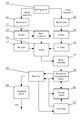
- Fig. 1 presents the diagram of the system of manufacturing fuel.
- the batch material, from which according to the invention fuel for diesel engines is obtained, is municipal and/or organic waste.
- the waste is sorted in a sorting station 10, wherein they are separated to at least two lines, for example organic waste.
- Each type of waste is stored in a separate buffer tank 11, 12. From the buffer tanks 11, 12 the waste is fed by conveyors 13, 14 to shredders 15, 16, in which they are reduced to a small granulation, preferably below 10 mm.
- the shredded waste of different types are then mixed in a mixer 18 and fed to the following part of the line, including blocks 19-23, where the main process of catalytic depolymerisation is performed.
- Samples of material fed from the shredders 15, 16 to the mixer 18 are analyzed in a batch analyzer 17, wherein the calorific value of the samples is analyzed.
- the proportions of the inputs from the shredders 15, 16 to the crusher are adjusted, so as to obtain a desired calorific value of the material fed to the input chamber 19.
- This is particularly essential to provide the most optimal process of the catalytic depolymerisation, as the input materials due to their waste character may be characterized by a high variability of the parameters, depending on the place from which waste is collected (and therefore the main components of the waste), level of disintegration or the content of moisture.
- the analysis of the batch material is performed periodically, for example at the beginning of every working shift or once per day.
- the proportions of the materials are adjusted to obtain an average calorific value of the batch input to the chamber 19 at the level from 10 to 15 MJ/kg.
- the material from the input chamber 19 is fed via the separation and evaporation block 20 to a mixing turbine, wherein it is subject to catalytic depolymerisation.
- a process of material exchange between the block 20 and the mixing turbine 21 is conducted.
- the depolymerised material undergoes thermal treatment in the evaporator sector of the block 20 in order to separate water, and then it is distilled in a distiller 23, which outputs fuel.
- Part of the fuel is transported to a generator 22 comprising a combustion engine powered by the fuel and electric generator, which supplies the blocks 20, 21, 23 with electricity and thermal energy.
- the fuel from the distiller 23 is then mixed in a treatment station 24 with:
- nanosilver particles By adding nanosilver particles to the fuel in the amount of 2ppm by weight, the growth of organic matter, such as fingi or algae, on the internal walls of the fuel tank is reduced.
- organic matter such as fingi or algae
- higher concentrations of silver nanoparticles having a size from 3nm to 8nm can be used, for example 10 ppm or 20 ppm by weight. Use of even higher concentration is not economical.
- a colloidal solution of silver nanoparticles there can be used for example a product NanoAg 100K made by Amepox, Lodz, Tru.
- Addition of copper Cu nanoparticles contributes to reducing the friction coefficient, and therefore providing better lubrication of fuel injectors in the engine, therefore possible organic impurities in the fuel can be more easily pushed through sensitive elements of the engine.
- a solution of copper nanoparticles there can be used a product NanoCu 1000W made by Amepox, Lodz, Tru.
Landscapes
- Chemical & Material Sciences (AREA)
- Engineering & Computer Science (AREA)
- Oil, Petroleum & Natural Gas (AREA)
- Organic Chemistry (AREA)
- Combustion & Propulsion (AREA)
- Chemical Kinetics & Catalysis (AREA)
- General Chemical & Material Sciences (AREA)
- Mechanical Engineering (AREA)
- General Engineering & Computer Science (AREA)
- Materials Engineering (AREA)
- Inorganic Chemistry (AREA)
- Life Sciences & Earth Sciences (AREA)
- Wood Science & Technology (AREA)
- Liquid Carbonaceous Fuels (AREA)
- Catalysts (AREA)
- Solid Fuels And Fuel-Associated Substances (AREA)
Applications Claiming Priority (1)
| Application Number | Priority Date | Filing Date | Title |
|---|---|---|---|
| PL400488A PL400488A1 (pl) | 2012-08-23 | 2012-08-23 | Sposób wytwarzania paliwa oraz paliwo |
Publications (1)
| Publication Number | Publication Date |
|---|---|
| EP2700699A1 true EP2700699A1 (de) | 2014-02-26 |
Family
ID=46832281
Family Applications (1)
| Application Number | Title | Priority Date | Filing Date |
|---|---|---|---|
| EP12184201.7A Withdrawn EP2700699A1 (de) | 2012-08-23 | 2012-09-13 | Verfahren zur Herstellung von Brennstoff und Brennstoff |
Country Status (2)
| Country | Link |
|---|---|
| EP (1) | EP2700699A1 (de) |
| PL (1) | PL400488A1 (de) |
Citations (10)
| Publication number | Priority date | Publication date | Assignee | Title |
|---|---|---|---|---|
| GB1020495A (en) | 1963-03-05 | 1966-02-16 | Grace W R & Co | Hydrocarbon fuels |
| DE10049377A1 (de) | 2000-10-05 | 2002-04-18 | Evk Dr Oberlaender Gmbh & Co K | Katalytische Erzeugung von Dieselöl und Benzinen aus kohlenwasserstoffhaltigen Abfällen und Ölen |
| US20070131585A1 (en) | 2005-11-29 | 2007-06-14 | Christian Koch | High-speed chamber mixer for catalytic oil suspensions as a reactor for the depolymerization and polymerization of hydrocarbon-containing residues in the oil circulation to obtain middle distillate |
| US20090000186A1 (en) * | 2007-06-28 | 2009-01-01 | James Kenneth Sanders | Nano-sized metal and metal oxide particles for more complete fuel combustion |
| US7473348B2 (en) | 2003-12-02 | 2009-01-06 | Alphakat Gmbh | Diesel oil from residues by catalytic depolymerization with energy input from a pump-agitator system |
| US20090118380A1 (en) * | 2006-03-31 | 2009-05-07 | Eni S.P.A. | Process for the preparation of water-in-oil and oil-in-water nanoemulsions |
| EP2161299A1 (de) | 2008-09-04 | 2010-03-10 | Adam Handerek | Thermokatalytische Depolymerisation von Kunststoffabfällen, Anlage für thermokatalytische Depolymerisation von Kunststoffabfällen und Reaktor für thermokatalytische Depolymerisation von Kunststoffabfällen |
| US20100133085A1 (en) * | 2006-12-19 | 2010-06-03 | Richard Hutchins | System And Method For Recycling Of Carbon-Containing Materials |
| WO2011004075A1 (en) * | 2009-07-08 | 2011-01-13 | Preseco Oy | Method for thermal treatment of organic matter of low calorific value |
| PL389069A1 (pl) | 2009-09-18 | 2011-03-28 | Ekotrend Spółka Z Ograniczoną Odpowiedzialnością | Sposób i układ do wytwarzania paliwa do silników wysokoprężnych w procesie katalitycznej depolimeryzacji oraz paliwo do silników wysokoprężnych |
-
2012
- 2012-08-23 PL PL400488A patent/PL400488A1/pl unknown
- 2012-09-13 EP EP12184201.7A patent/EP2700699A1/de not_active Withdrawn
Patent Citations (10)
| Publication number | Priority date | Publication date | Assignee | Title |
|---|---|---|---|---|
| GB1020495A (en) | 1963-03-05 | 1966-02-16 | Grace W R & Co | Hydrocarbon fuels |
| DE10049377A1 (de) | 2000-10-05 | 2002-04-18 | Evk Dr Oberlaender Gmbh & Co K | Katalytische Erzeugung von Dieselöl und Benzinen aus kohlenwasserstoffhaltigen Abfällen und Ölen |
| US7473348B2 (en) | 2003-12-02 | 2009-01-06 | Alphakat Gmbh | Diesel oil from residues by catalytic depolymerization with energy input from a pump-agitator system |
| US20070131585A1 (en) | 2005-11-29 | 2007-06-14 | Christian Koch | High-speed chamber mixer for catalytic oil suspensions as a reactor for the depolymerization and polymerization of hydrocarbon-containing residues in the oil circulation to obtain middle distillate |
| US20090118380A1 (en) * | 2006-03-31 | 2009-05-07 | Eni S.P.A. | Process for the preparation of water-in-oil and oil-in-water nanoemulsions |
| US20100133085A1 (en) * | 2006-12-19 | 2010-06-03 | Richard Hutchins | System And Method For Recycling Of Carbon-Containing Materials |
| US20090000186A1 (en) * | 2007-06-28 | 2009-01-01 | James Kenneth Sanders | Nano-sized metal and metal oxide particles for more complete fuel combustion |
| EP2161299A1 (de) | 2008-09-04 | 2010-03-10 | Adam Handerek | Thermokatalytische Depolymerisation von Kunststoffabfällen, Anlage für thermokatalytische Depolymerisation von Kunststoffabfällen und Reaktor für thermokatalytische Depolymerisation von Kunststoffabfällen |
| WO2011004075A1 (en) * | 2009-07-08 | 2011-01-13 | Preseco Oy | Method for thermal treatment of organic matter of low calorific value |
| PL389069A1 (pl) | 2009-09-18 | 2011-03-28 | Ekotrend Spółka Z Ograniczoną Odpowiedzialnością | Sposób i układ do wytwarzania paliwa do silników wysokoprężnych w procesie katalitycznej depolimeryzacji oraz paliwo do silników wysokoprężnych |
Also Published As
| Publication number | Publication date |
|---|---|
| PL400488A1 (pl) | 2014-03-03 |
Similar Documents
| Publication | Publication Date | Title |
|---|---|---|
| Bian et al. | Enhancement of waste activated sludge dewaterability by ultrasound-activated persulfate oxidation: operation condition, sludge properties, and mechanisms | |
| CN104903244B (zh) | 原油、污泥和乳状液的处理方法 | |
| CN101597541B (zh) | 废油无酸碱快速再生方法 | |
| CN103361165B (zh) | 用于轧钢过程中产生的废乳化液的再生设备和方法 | |
| CN101805644B (zh) | 利用废油加工液体燃料油的方法 | |
| CN101613620A (zh) | 一种油品净化工艺 | |
| CN103642539A (zh) | 一种船用燃料油的调和方法 | |
| Sharma et al. | Organic pollutant removal from edible oil process wastewater using electrocoagulation | |
| Gao et al. | Efficient treatment of crude oil-contaminated hydrodesulphurization catalyst by using surfactant/solvent mixture | |
| EP2700700A1 (de) | Verfahren zur Herstellung von Brennstoff und Brennstoff | |
| CN102260584B (zh) | 一种工业废润滑油再生工艺 | |
| KR20150056471A (ko) | 슬러지와 폐수를 포함하는 pome의 용매추출을 이용한 처리방법 | |
| WO2015132804A2 (en) | Process for removal of water (both bound and unbound) from petroleum sludges and emulsions with a view to retrieve original hydrocarbons present therein | |
| CN203333614U (zh) | 用于轧钢过程中产生的废乳化液的再生设备 | |
| CN103108688A (zh) | 通过实施天然絮凝剂的压载絮凝来处理水的方法 | |
| CN102452783B (zh) | 提高泥浆浓度的复合剂和提高泥浆浓度的方法 | |
| JP2004522136A (ja) | 液状廃棄物の効率的処理 | |
| CN105950212A (zh) | 一种老化污油处理工艺 | |
| Pan et al. | Oil removal in tight-emulsified petroleum waste water by flocculation | |
| CN110282855A (zh) | 污油油泥脱水脱固处理装置及其处理工艺 | |
| CN110407423B (zh) | 一种含油污泥的资源化回收处理装置 | |
| CN103865658A (zh) | 一种生物柴油及其生产方法 | |
| Li et al. | Ultrasonic enhanced Fe-C/PDS system for sludge dewatering and carbon source release: synergy of oxidation and cracking processes | |
| CN115785997A (zh) | 一种利用船舱清洗废油生产船用燃料油或调油料的方法 | |
| CN107418617A (zh) | 一种重质高酸乳化老化原油的化学处理方法 |
Legal Events
| Date | Code | Title | Description |
|---|---|---|---|
| PUAI | Public reference made under article 153(3) epc to a published international application that has entered the european phase |
Free format text: ORIGINAL CODE: 0009012 |
|
| AK | Designated contracting states |
Kind code of ref document: A1 Designated state(s): AL AT BE BG CH CY CZ DE DK EE ES FI FR GB GR HR HU IE IS IT LI LT LU LV MC MK MT NL NO PL PT RO RS SE SI SK SM TR |
|
| AX | Request for extension of the european patent |
Extension state: BA ME |
|
| STAA | Information on the status of an ep patent application or granted ep patent |
Free format text: STATUS: THE APPLICATION IS DEEMED TO BE WITHDRAWN |
|
| 18D | Application deemed to be withdrawn |
Effective date: 20140827 |