EP2701111A1 - Gruppenzusammensetzungsbasiertes Empfehlungssystem und Verfahren - Google Patents
Gruppenzusammensetzungsbasiertes Empfehlungssystem und Verfahren Download PDFInfo
- Publication number
- EP2701111A1 EP2701111A1 EP12181792.8A EP12181792A EP2701111A1 EP 2701111 A1 EP2701111 A1 EP 2701111A1 EP 12181792 A EP12181792 A EP 12181792A EP 2701111 A1 EP2701111 A1 EP 2701111A1
- Authority
- EP
- European Patent Office
- Prior art keywords
- users
- groups
- group
- aggregate
- items
- Prior art date
- Legal status (The legal status is an assumption and is not a legal conclusion. Google has not performed a legal analysis and makes no representation as to the accuracy of the status listed.)
- Withdrawn
Links
Images

Classifications
-
- G—PHYSICS
- G06—COMPUTING OR CALCULATING; COUNTING
- G06Q—INFORMATION AND COMMUNICATION TECHNOLOGY [ICT] SPECIALLY ADAPTED FOR ADMINISTRATIVE, COMMERCIAL, FINANCIAL, MANAGERIAL OR SUPERVISORY PURPOSES; SYSTEMS OR METHODS SPECIALLY ADAPTED FOR ADMINISTRATIVE, COMMERCIAL, FINANCIAL, MANAGERIAL OR SUPERVISORY PURPOSES, NOT OTHERWISE PROVIDED FOR
- G06Q30/00—Commerce
- G06Q30/02—Marketing; Price estimation or determination; Fundraising
- G06Q30/0241—Advertisements
- G06Q30/0251—Targeted advertisements
-
- G—PHYSICS
- G06—COMPUTING OR CALCULATING; COUNTING
- G06Q—INFORMATION AND COMMUNICATION TECHNOLOGY [ICT] SPECIALLY ADAPTED FOR ADMINISTRATIVE, COMMERCIAL, FINANCIAL, MANAGERIAL OR SUPERVISORY PURPOSES; SYSTEMS OR METHODS SPECIALLY ADAPTED FOR ADMINISTRATIVE, COMMERCIAL, FINANCIAL, MANAGERIAL OR SUPERVISORY PURPOSES, NOT OTHERWISE PROVIDED FOR
- G06Q30/00—Commerce
- G06Q30/06—Buying, selling or leasing transactions
- G06Q30/0601—Electronic shopping [e-shopping]
- G06Q30/0631—Recommending goods or services
-
- H—ELECTRICITY
- H04—ELECTRIC COMMUNICATION TECHNIQUE
- H04N—PICTORIAL COMMUNICATION, e.g. TELEVISION
- H04N21/00—Selective content distribution, e.g. interactive television or video on demand [VOD]
- H04N21/40—Client devices specifically adapted for the reception of or interaction with content, e.g. set-top-box [STB]; Operations thereof
- H04N21/45—Management operations performed by the client for facilitating the reception of or the interaction with the content or administrating data related to the end-user or to the client device itself, e.g. learning user preferences for recommending movies, resolving scheduling conflicts
- H04N21/466—Learning process for intelligent management, e.g. learning user preferences for recommending movies
- H04N21/4668—Learning process for intelligent management, e.g. learning user preferences for recommending movies for recommending content, e.g. movies
-
- H—ELECTRICITY
- H04—ELECTRIC COMMUNICATION TECHNIQUE
- H04N—PICTORIAL COMMUNICATION, e.g. TELEVISION
- H04N21/00—Selective content distribution, e.g. interactive television or video on demand [VOD]
- H04N21/40—Client devices specifically adapted for the reception of or interaction with content, e.g. set-top-box [STB]; Operations thereof
- H04N21/47—End-user applications
- H04N21/475—End-user interface for inputting end-user data, e.g. personal identification number [PIN], preference data
- H04N21/4756—End-user interface for inputting end-user data, e.g. personal identification number [PIN], preference data for rating content, e.g. scoring a recommended movie
-
- H—ELECTRICITY
- H04—ELECTRIC COMMUNICATION TECHNIQUE
- H04N—PICTORIAL COMMUNICATION, e.g. TELEVISION
- H04N21/00—Selective content distribution, e.g. interactive television or video on demand [VOD]
- H04N21/40—Client devices specifically adapted for the reception of or interaction with content, e.g. set-top-box [STB]; Operations thereof
- H04N21/47—End-user applications
- H04N21/482—End-user interface for programme selection
- H04N21/4826—End-user interface for programme selection using recommendation lists, e.g. of programmes or channels sorted out according to their score
Definitions
- the invention relates to a recommender system and method, and to an electronic data access system and method that uses this recommender system and method.
- US 7,756,753 discloses a recommender system.
- Recommender systems can be part of electronic program guide based television viewing systems, audio or video on demand systems or search engines for example.
- the recommender system may be used to display a sorted list of selected television programs, electronic movies/music or electronic documents on the Internet, with controls to start play or retrieval of the television programs, movies or electronic documents. More generally, the recommender system computes user specific score values for individual items such as television programs, movies/music or electronic documents, the score values being useful to select and/or sort the items for display in the recommendation list.
- the term score value (or more briefly score) will be used for a value that is used to select and/or sort items.
- the score values may be predictions of user rating values (or more briefly (user) ratings), a term that will be used for user dependent input about items.
- User rating values may be obtained directly, by explicit user input, or indirectly from observation of user behavior in relation to an item. Rating values may be values from a continuous range of numbers, from a set of integer numbers or indications of options from a discrete ordered set of options. Such indications may represent user selections from options with a set of labels like good/ reasonable/ mediocre/ bad for example.
- score value computation by content based scoring and collaborative filtering can be distinguished.
- content based scoring involves computation of the score value by weighing objective (i.e. user independent) values of attributes of items using user specific weights. The weights may be based on user input of a user profile, or accumulated from user rating values.
- Another alternative is to compute the score value of an item based on similarity with other items and the user's rating values of these other items.
- Collaborative filtering makes use of rating values from different individual users. This involves two steps: selection of users that are most similar to the current user and generation of the score value for an item for the current user from ratings of that item from similar users. In the first step the recommender system may select the most similar users on the basis of correlation between the rating values for a reference set of items from the current user and other users.
- Group preferences can be handled by treating the group as another individual user and collecting a user profile or rating values from the group as a whole.
- the collection of a user profile or rating values from the group as a whole presents considerable overhead.
- US 7,756,753 addresses the problem of computing a recommendation list for a group (referred to as a community recommendation).
- Wish lists from the individual group user in the group are used to define rating values, the wish lists indicating items that are desirable to the individual users, e.g. in the form of a rental queue of movies that the user wants to rent. Higher rating values are given to items that appear on the wish lists or more users.
- Joint recommendations are generated by passing a list of weighted items from the rental queue to the recommendations engine. The recommendations engine then generates a list of additional items that are collectively similar/related to the combined list but are not included in either rental queue.
- W003105082 addresses the observation that combining the recommendation scores from different recommenders could enhance the recommendation made to a user. Accordingly, it provides for a plurality of fuzzy aggregation connectives are used to perform the fusion of recommenders for providing an enhanced efficiency for coming up with final recommendations of items such as TV shows, books to buy/read, movies to watch.
- W003105082 mentions a scenario wherein the recommenders are TV recommenders developed for different people. Each recommender is based on one person's preferences. When those people want to watch together, one final recommendation is needed. This recommendation is obtained by fusing the recommendations from individuals.
- a recommender system is provided.
- recommendations to be made for a group of persons are obtained using parameters that have been stored for other, similar groups.
- the users of the group are paired to users of the other groups. Correlations between rating values from the paired users are computed.
- the correlations for the different users in the group are aggregated.
- the aggregate may be used as a similarity score between groups.
- aggregation of the correlations comprises summing the correlations.
- the similarity score may be used to form parameters for the group by selecting or weighing parameters of the other groups according to their similarity score.
- the parameters may be rating values provided by the other groups that may be used to predict ratings values for the group.
- the parameters may be attribute values from the other groups that may be used to predict attribute values for the group, which can be used to evaluate items.
- users in the group are paired to users in the other group in a plurality of different ways and aggregates of the correlations are computed for each way of pairing. A maximum of these aggregates may then be used as a similarity score. In this way uneven group composition can be automatically accounted for.
- the selected or weighed other groups are used in collaborative filtering, wherein rating values for an item from the other groups are used to determine a recommendation score value from the rating values from groups that have been found to be similar on the basis of the correlations.
- a selection or weight of similar groups may be used to aggregate other parameters of the similar groups, such as attribute values.
- the item may be an electronic data item from a storage system, such as a video program.
- recommendations score values for a plurality of items may be determined. These may be used to select and/or sort items in a recommendation list. The resulting list may be used to generate a control screen for receiving user selections of the items, for example in order to start play of a data item in response to reception of the selection.
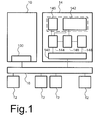
- Figure 1 shows an electronic data access system, comprising a data store system 10, a plurality of user terminals 12, a recommender system 14 and a communication network 16 coupling the data store system 10, a plurality of user terminals 12, a recommender system 14.
- a plurality of user terminals 12 is shown, it should be appreciated that the distribution system may have only single user terminal 12, which could be coupled directly to recommender system 14, or even contain recommender system 14.
- User terminal 12 may comprise a network interface for communication with data store system 10 and recommender system 14.
- user terminal 12 may comprise a display screen for displaying recommendations from recommender system 14 and selected video data from data store system 10.
- Data store system 10 may comprise a plurality of servers, or it may be a single storage device.
- Data store system 10 comprises a network interface unit 100 configured to supply selectable electronic data items from electronic storage devices in data store system 10 to user terminals 12. Selection may be based on addresses of the items.
- Recommender system 14 comprises a network interface unit 140 for communication with user terminals 12, a rating storage system 142 for storing user's rating values, a user correlation module 144, a score value composition module 146, an item selection module 148 and a group composition storage system 145.
- User correlation module 144 and score value composition module 146 may be implemented using a programmable computer system and software modules with instructions for the programmable computer system to make it perform the functions of user correlation module 144 and score value composition module 146.
- User correlation module 144 has inputs coupled to network interface 140, rating storage 142 and group composition storage system 145.
- Score value composition module 146 has inputs coupled to user correlation module 144 and rating storage 142.
- Item selection module 148 has an input coupled to score value composition module 146 and an output coupled to network interface 140.
- Rating storage system 142 comprises stored information about rating values for data items from data store system 10 from users and groups of users.
- Group composition storage system 145 comprises stored information about the composition of groups.
- Data representing a table of records (g, i1, i2) may be stored for example, with fields for an identifier g of a group and identifiers i1 and i2 of members of the group.
- rating storage system 142 and group composition storage system 145 may be implemented using a common storage system containing both rating values and group composition data.
- the storage system or systems may be a single memory device, or a combination of such devices.
- Rating storage system 142 and group composition storage system 145 will also be referred to as rating storage 142 and group composition storage 145.
- a user terminal 12 sends a request message to recommender system 14, requesting a recommendation of data items in data store system 10.
- the request identifies a user or group of users, for example by including identifiers of the users in the request message.
- User terminal 12 may have an input to receive such identifiers, for example by reading user's smart cards, biometric recognition etc.
- user terminal 12 may be associated with a predetermined group.
- recommender system 14 computes rating values of data items for the user or group of users.
- Recommender system 14 selects and optionally sorts a subset of the data items based on the rating values.
- Recommender system 14 transmits information indicating the selected data items, optionally the rating values and address information for retrieving the selected data items from data store system 10 to the user terminal 12 that sent the requests.
- the user terminal 12 displays a list of the selected data items and waits for selection of a data item from the list.
- Upon receiving a selection user terminal 12 uses the address of the selected data item to retrieve the data item from storage system 10.
- the data item may contain video data for example, storage system 10 starting delivery of a video stream to user terminal 12 in response to the retrieval.
- User terminal 12 displays the retrieved data item.
- rating storage 142 stores rating values R(i, m) for items indexed by item identifiers m, from users indexed by user identifiers i.
- rating storage 142 stores rating values R(g, m) for the items indexed by m, from groups of users indexed by group identifiers g.
- Group composition storage system 145 stores information that identifies the identifiers of the members of each group g. For groups that consist of pairs of users, records (g, i1, i2) may be stored for example, containing a group identifier g and the identifiers i1, i2 of the users in the group.
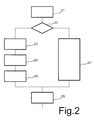
- Figure 2 shows a flow chart of computation of rating values of data items for a group of users by recommender system 14.
- user correlation module 144 receives an identifier of a user or identifiers of the users in a group from a user terminal 12 via network interface 140.
- user correlation module 144 may retrieve stored identifiers of the group members based on a group identifier, or information about the user terminal.
- user correlation module 144 proceeds to a first branch if there is only one user and to a second branch if a group of users was received.
- the first branch corresponds to conventional collaborative filtering.
- the first branch comprises a third step 23 wherein user correlation module 144 retrieves rating values for a set of reference items S from the user from rating storage 142.
- the first branch comprises a fourth step 24, wherein user correlation module 144 retrieves rating vectors RV(j) for the set of reference items S from other users j (j unequal i) from rating storage 142.
- User correlation module 144 computes correlations C(RV(i), RV(j)) between these vectors RV(j) and the rating vector RV(i) from the user i.
- a known Pearson correlation may be used for example.
- the Pearson correlation is computed by (a) computing a sum of products (R(i,m)-Av(m))*(R(j,m)-Av(m)), summed over m, where Av(m) is the average rating value for the item m taken over all users, (b) computing a product of sums of (R(i,m)-Av(m)) 2 and (R(j,m)-Av(m)) 2 , summed over m, and (c) dividing the sum of product by a square root of the product of sums.
- other types of correlation may be used.
- the first branch comprises a fifth step 25, wherein user correlation module 144 selects a predetermined number of users j having the highest correlations with the user i, that is, with higher correlations than any other users j'.
- user correlation module 144 may select users j having correlations above a threshold value, for example a predetermined threshold value.
- the threshold may be adapted, dependent on the computed correlations.
- score value composition module 146 executes a sixth step 26, wherein score value composition module 146 computes score values for other items n than the items m in the reference set. To compute a score value for an item n, score value composition module 146 retrieves the rating values R(j, n) for that item n from the users j having the highest correlations. Correlation module 144 aggregates these rating values R(j, n), for example by averaging over the users j.
- fifth step 25 comprises selecting a predetermined number of users and sixth step 26 comprises aggregating over the selected users
- weights W(j) may be assigned to the different users dependent on the correlation values (higher weights being assigned when the score values indicate more correlation) and the assigned weights W(j) may be used to aggregate rating values for an item R(j,n) weighted by these weighting values.
- the selection of a predetermined number of users with the highest correlation can be said to be a form of weighting, with zero weight being assigned to users outside said predetermined number.
- Different weights may be assigned also to different users within the predetermined number.
- user correlation module 144 proceeds to the second branch if a group of users g was received in first step 21.
- the second branch comprises a seventh step 27, wherein a set of most similar groups g' is selected, that are most similar to g.
- recommender system 14 proceeds to sixth step 26.
- score value composition module 146 retrieves the rating values for that item n from the most similar users groups g'. Score value composition module 146 aggregates these rating values.
- Figure 3 shows a flow chart of the computation of the set of most similar groups in seventh step 27.
- user correlation module 144 retrieves rating vectors RV(i) for each of the plurality users i in the group g. This step is similar to third step 23 of the branch for single users, except that a plurality of rating vectors is retrieved.
- user correlation module 144 selects another group of users g'.
- user correlation module 144 retrieves rating vectors RV(j) for the set of reference items S from users in the other group g' from rating storage 142.
- the similarity is the maximum of two sub-similarities, obtained using a same computation, which forms a sum of the correlations between the rating vectors.
- the sub-similarities are obtained by applying the computation with users i1, i2 being correlated with users j1, j2 respectively on one hand and correlated with users j2, j1 respectively on the other hand.
- correlation module 144 tests whether a further group can be found. If so, correlation module 144 repeats the computation of third and fourth step 33, 34 for the other group.
- correlation module 144 executes a sixth step 36 wherein correlation module 144 selects a predetermined number of groups g' with the highest similarity scores, or groups g' having similarity scores above a threshold value.
- This step is similar to fifth step 25 of figure 2 for individual users, except that similarity scores T(g, g') are used instead of correlations.
- the predetermined number is one, only the most similar group being selected. Alternatively, the predetermined number may be greater than one. This makes it possible to obtain ratings values for more items.
- recommender system 14 proceeds to sixth step 26 of figure 2 , wherein score value composition module 146 retrieves the rating values for an item n from the most similar groups g'. Score value composition module 146 aggregates these rating values.
- the operation of score value composition module 146 for groups is similar to that for individual users, except that rating values from user groups g' are retrieved and aggregated rather than from individual users. As is known per se for individual users, the rating values from different groups may be normalized before they are aggregated.
- selection of similar groups may be adapted to the number of rating values from the groups that are available, a large number of similar groups being selected when less rating values are available. This makes it possible to obtain ratings values for more items.
- Recommender system 14 may repeat the computation of score values for a plurality of different items n. It should be noted that for each item this needs to be done only once for the group and not once for each individual user in the group, which reduces the time and bandwidth needed to access the rating values.
- item selection module 148 uses these computed score values to select a predetermined number of items with the highest computed score values, i.e. higher score values than the score values for any other items. In another embodiment item selection module 148 uses these computed score values to select items with score values that exceed a threshold.
- item selection module 148 may sort the items in order of the score values. Item selection module 148 sends information that identifies the selected and optionally sorted items to user terminal 12, together with address information for retrieving the items from data store system 10. Item selection module 148 may comprise an address storage system that comprises addresses associated with identifiers of the items for this purpose. The address storage system may be part of a storage system, e.g. a storage device that also contains rating storage system 142 and group composition storage system 145. The selected and optionally sorted items may be used to construct an interface screen display, for example in the form of a list of hyperlinks, or image areas..
- User terminal 12 may be configured to allow user selection of these hyperlinks or area, for example by means of cursor movement commands and a command that confirms selection. User terminal 12 may be configured to retrieve the selected item from data store system 10, using an address or identifier supplied by recommender system 14.
- recommender system 14 comprises programs of instructions for a programmable computer system to make that programmable computer system execute that described steps.
- Machine readable code of these programs of instructions may be provided stored in a computer readable medium such as a semi-conductor memory, a magnetic or optical disk etc.
- the similarity scores may be used in other ways.
- the similarity scores may be used for the computation of values of attributes of a group g from stored values of the attributes of other groups g'.
- a storage system wherein such attributes are stored may be provided.
- an average, possibly a weighted average, of the attribute values of other groups g' that have been selected in sixth step 36 may be computed. Instead it may be determined which value of an attribute is stored for a majority of the selected other groups g' and that value may be used for the group g.
- the recommender system may be configured to determine such attribute values and use them to weigh further attribute values for a data item, in a process to form a score for that data item for the group g.
- the attribute values that have been determined in this way may be used to control parameter settings of user terminal, for example to select whether subtitles should be displayed, or to set a sound volume.
- execution of second step 32 of figure 3 by user correlation module 144 comprises comparing the size of the group and the other groups and selecting another group g' only if it has thethe same size as the group g.
- the similarity score may be computed as a maximum of sub-similarity scores obtained by pairing the users in the group g in different ways to users in the group g' and summing the correlations between the paired users.
- third and fourth steps 33, 34 may not be necessary. In an embodiment only a predetermined number of other groups may be considered in third and fourth steps 33, 34, which may selected at random for example.
- profile information may be provided for each group. This may include a code for a group type for example, or values of attributes of the group and/or its members. In this case groups g' may be selected based on group type information, for example by matching type codes, or comparing attributes. In an embodiment, third and fourth steps 33, 34 are executed only for the selected groups g'.
- the similarity score T (g, g') is a maximum of terms obtained by pairing users in different ways, it should be appreciated that alternatively a single predetermined pairing may be used.
- the information that identifies the users in a group may comprise information that identify roles of the different users in the groups. records (g, i, r) may be provided for example, indicating that the user with identifier i is a member of the group with identifier g in the role indicated by a code r. The role may indicate whether the user i is the man or the woman in a male-female couple for example. When role information is provided, it may suffice to compute similarity score as the sum of correlations for group members with corresponding roles.
- a weighted sum may be used, predetermined weights may be stored for different users in the group for this purpose. For example, if the group contains a parent and a child, a greater weight may be prestored for the child than for the parent or vice versa.
- the similarity score T (g, g') is determined from a maximum of sums of correlations for different user pairings
- T (g, g') is determined from a maximum of sums of correlations for different user pairings
- an average may be used.
- recommender system 14 is a server that may be located remotely from a user terminal 12 where the recommendation is used. However, in an alternatively embodiment recommender system 14 may be part of a user terminal 12. In a further embodiment, the storage systems for rating and/or group composition may be remote from the terminal, the recommender system 14 in the terminal accessing these storage systems via the network.
Landscapes
- Engineering & Computer Science (AREA)
- Business, Economics & Management (AREA)
- Finance (AREA)
- Accounting & Taxation (AREA)
- Development Economics (AREA)
- Strategic Management (AREA)
- Multimedia (AREA)
- Signal Processing (AREA)
- Databases & Information Systems (AREA)
- Economics (AREA)
- Marketing (AREA)
- Physics & Mathematics (AREA)
- General Business, Economics & Management (AREA)
- General Physics & Mathematics (AREA)
- Theoretical Computer Science (AREA)
- Human Computer Interaction (AREA)
- Entrepreneurship & Innovation (AREA)
- Game Theory and Decision Science (AREA)
- Software Systems (AREA)
- Information Retrieval, Db Structures And Fs Structures Therefor (AREA)
Priority Applications (3)
| Application Number | Priority Date | Filing Date | Title |
|---|---|---|---|
| EP12181792.8A EP2701111A1 (de) | 2012-08-24 | 2012-08-24 | Gruppenzusammensetzungsbasiertes Empfehlungssystem und Verfahren |
| PCT/NL2013/050616 WO2014031002A1 (en) | 2012-08-24 | 2013-08-26 | Group composition based recommender system and method |
| US14/423,644 US20150186934A1 (en) | 2012-08-24 | 2013-08-26 | Group composition based recommender system and method |
Applications Claiming Priority (1)
| Application Number | Priority Date | Filing Date | Title |
|---|---|---|---|
| EP12181792.8A EP2701111A1 (de) | 2012-08-24 | 2012-08-24 | Gruppenzusammensetzungsbasiertes Empfehlungssystem und Verfahren |
Publications (1)
| Publication Number | Publication Date |
|---|---|
| EP2701111A1 true EP2701111A1 (de) | 2014-02-26 |
Family
ID=46800045
Family Applications (1)
| Application Number | Title | Priority Date | Filing Date |
|---|---|---|---|
| EP12181792.8A Withdrawn EP2701111A1 (de) | 2012-08-24 | 2012-08-24 | Gruppenzusammensetzungsbasiertes Empfehlungssystem und Verfahren |
Country Status (3)
| Country | Link |
|---|---|
| US (1) | US20150186934A1 (de) |
| EP (1) | EP2701111A1 (de) |
| WO (1) | WO2014031002A1 (de) |
Cited By (2)
| Publication number | Priority date | Publication date | Assignee | Title |
|---|---|---|---|---|
| EP3096276A1 (de) * | 2015-05-20 | 2016-11-23 | Thomson Licensing | Verfahren zum betreiben eines empfehlersystems und entsprechendes system |
| WO2016207308A1 (en) * | 2015-06-26 | 2016-12-29 | British Telecommunications Public Limited Company | Digital content provision |
Families Citing this family (5)
| Publication number | Priority date | Publication date | Assignee | Title |
|---|---|---|---|---|
| US10133878B2 (en) * | 2014-07-30 | 2018-11-20 | Microsoft Technology Licensing, Llc | Stochastic privacy |
| US10368114B2 (en) * | 2015-08-04 | 2019-07-30 | Pandora Media, Llc | Media channel creation based on free-form media input seeds |
| CN109816187B (zh) * | 2017-11-21 | 2022-09-23 | 财付通支付科技有限公司 | 信息处理方法、装置、计算机设备和存储介质 |
| EP3598373A1 (de) * | 2018-07-18 | 2020-01-22 | Seulo Palvelut Oy | Bestimmung der produktrelevanz |
| JP7819049B2 (ja) * | 2022-07-08 | 2026-02-24 | キヤノン株式会社 | 情報処理装置及びその制御方法とプログラム |
Citations (2)
| Publication number | Priority date | Publication date | Assignee | Title |
|---|---|---|---|---|
| WO2003105082A2 (en) | 2002-06-10 | 2003-12-18 | Koninklijke Philips Electronics N.V. | Decision fusion of recommender scores through fuzzy aggregation connectives |
| US7756753B1 (en) | 2006-02-17 | 2010-07-13 | Amazon Technologies, Inc. | Services for recommending items to groups of users |
Family Cites Families (1)
| Publication number | Priority date | Publication date | Assignee | Title |
|---|---|---|---|---|
| US4996642A (en) * | 1987-10-01 | 1991-02-26 | Neonics, Inc. | System and method for recommending items |
-
2012
- 2012-08-24 EP EP12181792.8A patent/EP2701111A1/de not_active Withdrawn
-
2013
- 2013-08-26 US US14/423,644 patent/US20150186934A1/en not_active Abandoned
- 2013-08-26 WO PCT/NL2013/050616 patent/WO2014031002A1/en not_active Ceased
Patent Citations (2)
| Publication number | Priority date | Publication date | Assignee | Title |
|---|---|---|---|---|
| WO2003105082A2 (en) | 2002-06-10 | 2003-12-18 | Koninklijke Philips Electronics N.V. | Decision fusion of recommender scores through fuzzy aggregation connectives |
| US7756753B1 (en) | 2006-02-17 | 2010-07-13 | Amazon Technologies, Inc. | Services for recommending items to groups of users |
Non-Patent Citations (2)
| Title |
|---|
| ADOMAVICIUS G ET AL: "Toward the Next Generation of Recommender Systems: A Survey of the State-of-the-Art and Possible Extensions", IEEE TRANSACTIONS ON KNOWLEDGE AND DATA ENGINEERING, IEEE SERVICE CENTER, LOS ALAMITOS, CA, US, vol. 17, no. 6, 1 June 2005 (2005-06-01), pages 734 - 749, XP011130675, ISSN: 1041-4347, DOI: 10.1109/TKDE.2005.99 * |
| GEDIMINAS ADOMAVICIUS; ALEXANDER TUZHILIN: "Towards the next generation of recommender systems: A survey of the state-of-the- art and possible extensions", IEEE TRANSACTIONS ON KNOWLEDGE AND DATA ENGINEERING, 2005, pages 17 |
Cited By (3)
| Publication number | Priority date | Publication date | Assignee | Title |
|---|---|---|---|---|
| EP3096276A1 (de) * | 2015-05-20 | 2016-11-23 | Thomson Licensing | Verfahren zum betreiben eines empfehlersystems und entsprechendes system |
| WO2016207308A1 (en) * | 2015-06-26 | 2016-12-29 | British Telecommunications Public Limited Company | Digital content provision |
| US10893312B2 (en) | 2015-06-26 | 2021-01-12 | British Telecommunications Public Limited Company | Digital content provision |
Also Published As
| Publication number | Publication date |
|---|---|
| US20150186934A1 (en) | 2015-07-02 |
| WO2014031002A1 (en) | 2014-02-27 |
Similar Documents
| Publication | Publication Date | Title |
|---|---|---|
| EP2701111A1 (de) | Gruppenzusammensetzungsbasiertes Empfehlungssystem und Verfahren | |
| CN105677715B (zh) | 一种基于多用户的视频推荐方法及装置 | |
| JP5126633B2 (ja) | アイテム選択装置、アイテム選択方法およびコンピュータプログラム | |
| CN102934113B (zh) | 信息提供系统、信息提供方法、信息提供设备 | |
| EP2249261A1 (de) | Empfehlungsverfahren und -system | |
| CN107808314B (zh) | 用户推荐方法及装置 | |
| WO2011011398A2 (en) | Systems and methods for utilizing and searching social network information | |
| US11455675B2 (en) | System and method of providing object for service of service provider | |
| US8655982B2 (en) | Information searching apparatus, number deciding method, information searching program, information searching system and recording medium | |
| CN109636530B (zh) | 产品确定方法、装置、电子设备及计算机可读存储介质 | |
| CN109213933B (zh) | 内容项推荐方法、装置、设备及存储介质 | |
| US20210365995A1 (en) | Advertisement and reward system based on instant messenger | |
| CN115455280A (zh) | 一种推荐列表确定方法和服务器 | |
| CN114513687A (zh) | 服务器及媒资推荐方法 | |
| US9237365B2 (en) | Pay-per-view portal | |
| CN110147500B (zh) | 一种信息推荐方法及装置 | |
| US20170365014A1 (en) | Systems, methods and non-transitory computer readable storage media for tracking and evaluating predictions regarding relationships | |
| JP6581263B1 (ja) | 情報処理装置、情報処理方法、プログラム | |
| WO2020135420A1 (zh) | 对用户进行分类的方法和装置 | |
| CN113709507A (zh) | 一种视频推荐方法、装置、电子设备及存储介质 | |
| JP5397217B2 (ja) | 通信制御装置、情報処理装置、通信制御システム、通信制御方法、情報処理方法、及びサービスの提供方法 | |
| CN110851724A (zh) | 基于自媒体号等级的文章推荐方法及相关产品 | |
| JP2007094560A (ja) | サービス提供方法、サービス提供システム、サービス提供装置、サービス提供端末及びサービス提供プログラム | |
| JP5958578B2 (ja) | 情報選択装置、情報選択方法、およびコンピュータプログラム | |
| Cremonesi et al. | Evaluating top-n recommendations" when the best are gone" |
Legal Events
| Date | Code | Title | Description |
|---|---|---|---|
| PUAI | Public reference made under article 153(3) epc to a published international application that has entered the european phase |
Free format text: ORIGINAL CODE: 0009012 |
|
| AK | Designated contracting states |
Kind code of ref document: A1 Designated state(s): AL AT BE BG CH CY CZ DE DK EE ES FI FR GB GR HR HU IE IS IT LI LT LU LV MC MK MT NL NO PL PT RO RS SE SI SK SM TR |
|
| AX | Request for extension of the european patent |
Extension state: BA ME |
|
| STAA | Information on the status of an ep patent application or granted ep patent |
Free format text: STATUS: THE APPLICATION IS DEEMED TO BE WITHDRAWN |
|
| 18D | Application deemed to be withdrawn |
Effective date: 20140827 |