EP2701151A2 - Enregistreur multipiste - Google Patents
Enregistreur multipiste Download PDFInfo
- Publication number
- EP2701151A2 EP2701151A2 EP13175446.7A EP13175446A EP2701151A2 EP 2701151 A2 EP2701151 A2 EP 2701151A2 EP 13175446 A EP13175446 A EP 13175446A EP 2701151 A2 EP2701151 A2 EP 2701151A2
- Authority
- EP
- European Patent Office
- Prior art keywords
- track
- type
- audio data
- changing
- setting
- Prior art date
- Legal status (The legal status is an assumption and is not a legal conclusion. Google has not performed a legal analysis and makes no representation as to the accuracy of the status listed.)
- Withdrawn
Links
Images



Classifications
-
- G—PHYSICS
- G11—INFORMATION STORAGE
- G11B—INFORMATION STORAGE BASED ON RELATIVE MOVEMENT BETWEEN RECORD CARRIER AND TRANSDUCER
- G11B20/00—Signal processing not specific to the method of recording or reproducing; Circuits therefor
- G11B20/00992—Circuits for stereophonic or quadraphonic recording or reproducing
-
- G—PHYSICS
- G11—INFORMATION STORAGE
- G11B—INFORMATION STORAGE BASED ON RELATIVE MOVEMENT BETWEEN RECORD CARRIER AND TRANSDUCER
- G11B27/00—Editing; Indexing; Addressing; Timing or synchronising; Monitoring; Measuring tape travel
- G11B27/02—Editing, e.g. varying the order of information signals recorded on, or reproduced from, record carriers
- G11B27/031—Electronic editing of digitised analogue information signals, e.g. audio or video signals
- G11B27/034—Electronic editing of digitised analogue information signals, e.g. audio or video signals on discs
-
- G—PHYSICS
- G11—INFORMATION STORAGE
- G11B—INFORMATION STORAGE BASED ON RELATIVE MOVEMENT BETWEEN RECORD CARRIER AND TRANSDUCER
- G11B27/00—Editing; Indexing; Addressing; Timing or synchronising; Monitoring; Measuring tape travel
- G11B27/10—Indexing; Addressing; Timing or synchronising; Measuring tape travel
- G11B27/34—Indicating arrangements
Definitions
- the invention relates to a multitrack recorder that records a sound signal in a plurality of tracks.
- a hitherto-known multitrack recorder records a sound signal into a plurality of tracks.
- a multitrack recorder makes it possible to record a rhythm guitar part in a track 1 and a lead guitar part in a track 2 by use of; for instance, an electric guitar and a vocal sound in a track 3 by use of a built-in microphone and mix down them to thereby generate and record a stereo signal.
- 2002-124022-A discloses a technique for storing edited track data as new track data that are independent of raw track data every time audio data stored on a track are edited.
- Patent No. 4122936 discloses a technique for establishing an association between a recorded source file (an audio data file stored on a track) and a file name of a source file to be newly recorded, thereby facilitating searching for a target file among a plurality of files being edited. Even if operation ends in a failure or recording operation is unsuccessful, the technique enables easy restoration of desired audio data.
- the multitrack recorder be able to record a sound signal in as many tracks as possible.
- limiting the number of tracks might be unavoidable. Measures that are conceivable in the circumstances are to limit the number of tracks to a certain number; for instance, four and make some of the tracks assignable to either a monaural type or a stereo type rather than fixing the tracks solely to monaural types to enhance user's convenience.
- processing of the track is also switched according to the type (the monaural type or the stereo type) of the track.
- the type the monaural type or the stereo type
- a type of a track must also be changed according to a type of the audio data.
- an operation cancel function intended for use in a case where one track is switchable between a stereo type and a monaural type has not hitherto been available. Therefore, when the related-art operation cancel function is applied directly to such a case, a problem occurs, such as a loss of consistency between a type of audio data to be stored on each track and a type of the track.
- the invention provides a multitrack recorder capable of always maintaining consistency between a type of a track and a type of audio data to be recorded.
- a multitrack recorder of the invention is directed toward a multitrack recorder that records audio data onto a plurality of tracks, comprising: a track type setting unit that sets one track or more of a plurality of tracks to either a monaural type or a stereo type; and an operation cancel unit that stores an operation history and that cancels operations subsequent to specified operation, wherein the operation cancel unit has a storage unit that stores a history of track-type changing-and-setting operation and operation entailing erasure or changing of audio data stored on each track and that stores specifics of the track-type changing-and-setting operation and the audio data erased or changed along with performance of operation in association with each operation; and a change unit that changes audio data stored on each track and a type of the track to audio data that were stored on each track before performance of the specified operation and a type of the track.
- the track type setting unit erases audio data stored on a corresponding track along with performance of the track-type changing-and-setting operation, and the storage unit stores specifics of the change in track type and audio data erased by track-type changing-and-setting operation in association with the track-type changing-and-setting operation.
- FIG. 1 is a block diagram of a multitrack recorder 1 of the embodiment.
- a sound signal input circuit 10 has a plurality of input ports and is provided with inputs of sound signals from a plurality of sound generators (sources). Exemplifications of the plurality of sound signals include a guitar sound, a vocal sound, a drum sound, and the like.
- the sound signal input circuit 10 has two built-in microphones and two input ports and is provided with inputs of sound signals. The built-in microphones and the input ports are switchable.
- a sound signal input by way of the sound signal input circuit 10 is fed to a DSP (Digital Signal Processor) 14 by way of a bus 16.
- DSP Digital Signal Processor
- the DSP 14 subjects sound signals of a plurality of channels, which are fed from the sound signal input circuit 10, to various digital processing; for instance, effect processing, equalizing, or mixing, and are recorded in the recorder 34 by way of the bus 18.
- a recording medium of the recorder 34 is an optical disc, including a CD-R/RW and a DVD-R/RW, aharddiscdrive, a flash memory medium, and the like.
- Processing of the DSP 14 also includes processing for controlling PAN and a volume level of each of the sound signals according to manipulation of operation knobs 20.
- the operation knobs 20 are disposed on an operation surface of the multitrack recorder 1.
- the operation knobs 20 are made up of various key switches, a selection button, a menu button, a determination button, a PAN knob, a level knob, and others.
- the user assigns an individual sound signal to at least one track of a plurality of tracks by manipulating the operation knobs 20.
- a detection circuit 22 detects a state of manipulation of the operation knobs 20.
- the detection circuit 22 supplies a manipulation status detection signal pertaining to the operation knobs 20 to the CPU 32 by way of the bus 18.
- the CPU 32 collectively controls an entirety of the multitrack recorder. According to a program stored in flash ROM 28, the CPU 32 performs various processing by use of RAM 30 serving as working memory. Specifically, respective sound signals of a plurality of channels are assigned to at least any of the plurality of tracks according to the operation status detection signal from the detection circuit 22. For instance, when there are tracks from a track 1 to a track 4, a channel A is assigned to the track 1; a channel B is assigned to the track 2; and a channel C is assigned to the track 4. In the embodiment, a correlation between channels and tracks resulting from assignment of the respective channels to the respective tracks is referred to as "assignment information.”
- the CPU 32 supplies various information to a display circuit 26.
- the display circuit 26 displays various information on a display section 24.
- the CPU 32 commands the display circuit 26 to display a variety of menu screens and a setting screen in compliance with user's manipulation of the operation knobs 20. According to information from the CPU 32, the display circuit 26 displays the menu screen and the setting screen on the display section 24.
- the menu screens include one for assigning each of the tracks 1 through 4 to either a monaural type or a stereo type. In the embodiment, at least any of the tracks 1 through 4 is configured so as to be selectable between a monaural type and a stereo type. The user sets a desired track to either a monaural type or a stereo type.
- the track 1 and the track 2 are set to monaural types, and the track 3 and the track 4 can be set to either a monaural type or a stereo type.
- the setting screen includes one for replicating (cloning or copying) the sound signal recorded in a certain track to another track. The user manipulates the operation knobs 20 on the setting screen, thereby selecting a source track and a destination track.
- the CPU 32 commands the display circuit 26 to display a level of the sound signal assigned to each of the tracks in the form of a bar chart (a level meter), and the display circuit 26 displays a level meter image on the display section 24 in accordance with information from the CPU 32.
- the CPU 32 reads a sound signal recorded in the recorder 34 in conformance with the operation status detection signal from the detection circuit 22 and feeds the signal to the DSP 14.
- the DSP 14 outputs a sound signal to the outside by way of the bus and the sound signal output circuit 12.
- the sound output circuit 12 has various output ports, such as an analogue output port and a digital output port.
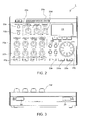
- FIG. 2 shows a plan view of the multitrack recorder 1 of the embodiment.
- FIGs. 3 and 4 show a front view and a rear view of the multitrack recorder, respectively.
- the operation surface of the multitrack recorder 1 is provided with the variety of operation knobs 20 and the display section 24.
- the operation knobs 20 include an input setting key 20a, an assign key 20b, an input channel level knob 20c, a master level knob 20d, a PAN knob 20e, a level knob 20f, a recording function key 20g, a home key 20h, a menu key 20i, a data wheel 20j, a stop key 20k, a playback key 20m, a record key 20n, and an UN/REDO key 20p.
- the input setting key 20a is one for selecting an input source. The user performs switching whether to use a built-in microphone or an input port as an input source, by manipulating the key.
- the assign key 20b is one for assigning an input sound signal to each of the tracks 1 through 4. The user manipulates the key, to thus assign and record a sound signal to each track.
- the input channel level knob 20c is one for controlling a level of each of the input sources.
- the user controls a level of each of the input sources by manipulating the knob. For instance, when the input source is set to a built-in microphone, a level of a sound signal input from the built-in microphone is controlled by use of the knob.
- the master level knob 20d is one for controlling a monitor level of a stereo output signal.
- the PAN knob 20e is one provided for each of the track 1 to the track 4 and controlling a normal position (PAN) for stereo mix of the sound signal of each of the tracks.
- the level knob 20f is provided for each of the track 1 to the track 4 and controlling a level of a sound signal of each of the tracks.
- the recording function key 20g is provided for each of the track 1 to the track 4.
- a track of interest shifts to a record standby state by user's manipulation of the recording function key 20g.
- the playback key 20m and the record key 20n are manipulated in the record standby state, a sound signal is recorded in the track that is in the record standby state.
- the home key 20h is one for displaying a home screen on the display section 24.
- the home screen is a basic screen of the multitrack recorder 1 and appears immediately after power of the multitrack recorder 1 is turned on.
- the home screen is displayed on the display section 24.
- the home screen displays a recorder motor and its power status, a transport status of the recorder, a time counter of the recorder, a status and a level meter of each of the tracks 1 to 4, stereo output level meters, and others.
- the menu key 20i is one for displaying a menu screen on the display section 24.
- the menu screen includes information, track edition, a data backup, a tuner, and others.
- the track edition includes a clone track, cleanout, silence, a cut, open, and others.
- the clone track is a menu for replicating a track
- cleanout is a menu for deleting a track.
- Silence is a menu for partially deleting a track.
- Cut is a menu for partially deleting a track.
- Open is a menu for inserting silence.
- the data wheel 20j is one for changing a value of each of the parameters or selecting an item by means of menu manipulation.
- the UN/REDO key 20p is a key for canceling operation performed immediately before (UNDO) and canceling UNDO operation (REDO).
- a history screen showing an operation history appears on the display section 24 by pressing the UN/REDO key 20p with the stop key 20k pressed.
- Multi-UNDO operation for canceling operations subsequent to desired operation is performed by selecting the desired operation from the history screen.
- built-in microphones 36 and 38 are disposed on both sides of the front of the multitrack recorder 1.
- the built-in microphones 36 and 38 are usually used as right and left microphones; namely, the built-in microphone 36 for an L channel and the built-in microphone 38 for an R channel, during stereo recording operation.
- use of the built-in microphones 36 and 38 is not limited to the way mentioned above. Only either the built-in microphone 36 or the built-in microphone 38 can be used. Alternatively, the built-in microphone 36 can be used for an R channel, and the built-in microphone 38 can be used for an L channel. Levels of the sound signals input from the built-in microphones 36 and 38 are controlled by means of the input channel level knob 20c.
- input ports 40 and 42 are provided on a rear surface of the multitrack recorder 1. Levels of sound signals input by way of the input ports 40 and 42 are likewise controlled with the input channel level knob 20c.
- the user can select a desired channel and a desired track by use of the operation knobs 20 and assign a sound signal to a desired track.
- the input port 40 is selected as a channel A, and a guitar sound signal is input.
- the input port 42 is selected as a channel B, and a drum sound signal is input. Assignment is set as follows by use of the assign key 20b.
- Assignment information is stored in the RAM 30.
- the user sets the track 3 and the track 4 by switching them to a monaural type or a stereo type, by use of the operation knobs 20. For instance, the following are set:
- each of the track 3 and the track 4 is made up of two channels.
- the track is set to a monaural type, only one of the two channels is enabled.
- both of the two channels are enabled and set as an L channel and an R channel. Accordingly, when the track 3 is set to a stereo type, an L channel sound signal and an R channel sound signal are recorded in the track 3.
- FIG. 5 shows an exemplification of a screen that appears on the display section 24 when the user selects a track type by manipulating the menu key 20i and the data wheel 20j.
- the CPU 32 displays on the display section 24 a setting screen as to whether to set the track 3 and the track 4 to a monaural type or a stereo type. Alternatives, or monaural and stereo, for the respective tracks 3 and 4 are displayed on the screen.
- the user manipulates the data wheel 20j, to thus make a choice.
- FIG. 5 shows a case where the user sets the track 3 to a stereo type and the track 4 to a monaural type.
- audio data stored on the respective tracks are erased.
- audio data stored in the track 3 are erased. The reason for this is to maintain consistency between a type of the recorded audio data and the track type.
- processing pertaining to recording, playback, and copy of the track and various information display modes of the track are naturally changed.
- an L audio signal and an R audio signal can be recorded as mutually-independent audio signals on the track.
- the track is changed to a monaural type, only the L-channel signal or the R-channel signal can be recorded as an audio signal.
- the multitrack recorder of the embodiment is allowed to select only a track that is of the same type as that of a source track as a target track at the time of copying of a track (audio data of one stereo track, however, can be copied to two monaural tracks that are previously paired up with each other).
- track 3 is of a stereo type and track 4 is of a monaural type
- the multitrack recorder is set so as to be able to select only either track 1 or 2 as a target track when track 4 is selected as a source track.
- the multitrack recorder can select only a pair consisting of tracks 1 and 2 as a target track and is inhibited from selecting track 1, track 2, or track 4 alone.
- stereo audio data Sst are not erased when track 3 is set to a monaural type after the stereo audio data Sst have been stored on track 3 set to a stereo type.
- the stereo audio data Sst remains on the monaural track 3 in this case.
- a target track for track 3 is limited to a track of a monaural type that is the same as the current type of track 3.
- the audio data Sst actually stored on track 3 are of a stereo type, a problem of loss of either the L or R audio signal will arise when such audio data are copied to one monaural track.
- audio data in a corresponding track are also erased when a track type is switched.
- the multitrack recorder of the embodiment has the UNDO function (an operation cancel function) for recovering a status achieved before operation specified among a round of operations.
- the UNDO function is broadly divided into single UNDO processing for canceling an immediately-preceding operation and multi-UNDO processing for selecting a time of operation desired to be recovered from an operation history.
- Single UNDO processing can be performed by pressing the UN/REDO key 20p in the middle of an operation. As a result of performance of single UNDO processing, the immediately-preceding operation is canceled, to thus recover a status achieved before performance of the operation.
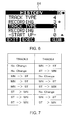
- FIG. 6 is a view showing an example history screen displayed on the display section 24.
- the history screen shows an operation history.
- operations located at higher positions are more recent operations, and the operation located at the top is the most recent operation.
- the symbol "RECORDING" inFIG. 6 denotes operation for recording data onto a track
- the symbol "TRACK TYPE" in FIG. 6 denotes a track-type changing-and-setting operation.
- an operation that can be canceled includes an operation entailing erasure or changing of audio data to be stored andatrack-typechanging-and-settingoperation.
- an operation entailing erasure or changing of audio data includes, for instance, recording audio data onto each track, mixdown recording for mixing audio data of a plurality of tracks and storing resultant data as single stereo track data, capturing WAVE data from an external device, like a personal computer, track editing (inserting periods of silence, partial cutting, partial elimination, track duplication, and track clearance) to which audio data stored on a track are to be subjected, and a track-type changing-and-setting operation. These operations can be subjected to UNDO processing.
- the CPU 32 stores a history of track-type changing-and-setting operations and operations entailing erasure or changing of audio data to be stored on each track as a history list in the RAM 30. Every time an operation, such as track recording, mixdown recording, capturing WAVE data, track editing, and changing of a track type, is performed, the CPU 32 additionally writes the operation into the history list stored in the RAM 30.
- the CPU 32 also stores audio data to be erased or changed along with performance of various operations, specifics of track-type changing-and-setting operations, and information relevant to operations in association with an operation. Further, when the operation is canceled by UNDO processing, the CPU 32 erases the thus-canceled operation from the history list.
- Data/information relevant to each operation, which will be stored in the RAM 30 in preparation for UNDO processing, is as follows.
- track recording the CPU 32 stores in the RAM 30 a number of a track to be subjected to recording, audio data already recorded on the track before recording an operation (audio data which will be erased by overwrite recording), and time to record the audio data in association with the track recording operation.
- mixdown recording the CPU 32 stores in the RAM 30 a history of mixed data on the stereo track in association with the mixdown recording operation.
- the CPU 32 stores in the RAM 30 a number of a track on which the WAVE data have been captured and the resultantly-captured data.
- the CPU 32 stores in the RAM 30 a number of the track subjected to editing, a type of editing performed, and raw data.
- the CPU 32 stores in the RAM 30 a pattern of track type change and audio data to be erased along with the changing of a track type.
- the tracks 3 and 4 are switchable (between a monaural type and a stereo type) in terms of a track type.
- FIG. 7 shows eight conceivable types of changing patterns for the two tracks.
- symbol MN denotes a monaural type
- ST denotes a stereo type.
- Information whose form is other than the foregoing changing patterns can also be stored, so long as a track type achieved when operation is performed can be grasped.
- a track type achieved when operation is performed can be grasped.
- FIG. 7 both a track type achieved before a track-type changing-and-setting operation and a track type achieved after the track-type changing-and-setting operation are stored.
- a track type acquired at the time of a track-type changing-and-setting operation can be grasped by counting the number of times "Changed" has been made since start-up of the multitrack recorder, so long as a setting on a track type acquired at start-up of the multitrack recorder is stored.
- the audio data stored in the thus-changed track are erased.
- the CPU 32 stores the audio data which will be erased along with changing of the track type in the RAM 30.
- the CPU 32 restores audio data and changes the track type on the basis of the thus-stored pieces of information.
- UNDO processing of the setting on a track type change recovering the status achieved before setting of a track type change is performed, as well as restoring the erased audio data. The reason for this is to maintain consistency between the audio data to be stored and a type of each track.
- a track-type changing-and-setting operation is performed to thereby change the track 3, where monaural audio data Smn are recorded, from a monaural type to a stereo type.
- the monaural audio data Smn stored in the track 3 are erased along with performance of the track-typesetting-and-changingoperation.
- the track-type changing-and-setting operation is canceled by means of UNDO processing, the once-erased audio data Smn are restored, and a recovery is made to the status in which the monaural audio data Smn are recorded on the track 3. If the type of the track 3 is left as a stereo type without being recovered to the monaural type, the monaural audio data Smn will come to be recorded on the stereo-type track 3.
- the track-type changing-and-setting operation is stored as one operation history.
- a cancel command is issued by means of UNDO processing, the track type achieved before the change was made is recovered, in addition to restoration of the erased audio data.
- FIG. 8 is a table showing an example of a particular operation history.
- operation h0 to operation h4 are assumed to be performed in this sequence.
- a track-type changing-and-setting operation is performed to thereby change track 3 from a stereo type to a monaural type and change track 4 from a stereo type to a monaural type.
- (monaural) audio data Smn are recorded on track 3.
- a track-type changing-and-setting operation is performed to thereby change track 3 from a monaural type to a stereo type (without changing track 4) .
- the (stereo) audio data Sst are recorded on track 3.
- a track-type changing-and-setting operation is performed to thereby change track 3 from a stereo type to a monaural type (without changing track 4).
- both track 3 and track 4 are of a monaural type.
- the latest operation h4 is canceled, and a recovery is made to the status achieved immediately before the operation h4 (i.e., the status achieved immediately after the operation h3).
- the operation h4 is canceled, and a recovery is made to the status achieved immediately before the operation h4 (i.e., the status achieved immediately after the operation h3).
- a recovery is made to the status in which the (stereo) audio data Sst erased along with performance of the track-type changing-and-setting operation in relation to the operation h4 are stored on track 3. Since changing of a track type performed in relation to the operation h4 is also erased, a recovery is made to the status achieved before the operation h4, namely the status in which track 3 is of a stereo type and in which track 4 is of a monaural type. Specifically, a status is achieved in which the stereo-type audio data Sst are stored in the stereo-type track 3.
- the operations h2, h3, and h4 are erased, and a recovery is made to the status achieved immediately before the operation h2 (the status achieved immediately after the operation h1). Specifically, a recovery is made to the status in which the (monaural) audio data Smn erased along with performance of the track-type changing-and-setting operation in relation to the operation h2 are stored on the track 3.
- a recovery is made to the status before the operation h2, namely the status in which track 3 is of a monaural type and in which track 4 is of a monaural type. Specifically, a recovery is made to the state in which the monaural audio data Smn are stored on the monaural-type track 3.
- the track-type changing-and-setting operation is also stored as one operation history in the embodiment.
- the audio data erased along with performance of the changing-and-setting operation are restored, and the track type changed along with performance of the changing-and-setting operation is also recovered to the track type achieved before the changing-and-setting operation. Therefore, in the embodiment, consistency between the type (stereo/monaural) of the restored audio data and the type (stereo/monaural) of the track where the sound is to be recorded can be maintained at all times.
- the user can smoothly perform subsequent operations after UNDO processing without resetting the track types, and others, according to the type (stereo/monaural) of the restored audio data.
- two tracks (tracks 3 and 4) of the four tracks are made switchable between a monaural type and a stereo type. However, the number of track combinations can also be changed as necessary.
- assignment setting operation in addition to the track-type changing-and-setting operation and operation entailing erasure and changing of audio data, another operation, for instance, assignment setting operation, can also be taken as a target of UNDO processing.
- the assignment setting is for assigning either the channel A or B as an input source to each of the tracks. Although two channels can be assigned to a stereo track, only one channel is assigned to a monaural track. In order to maintain combinations "stereo track - two channels" and "monaural track - one channel,” the assignment setting operation can also be stored as a target operation of UNDO processing so that when cancellation is commanded, a recovery can be made to a status achieved before performance of the assignment setting operation.
- a track type change history is stored as a set of change histories of a plurality of tracks (track 3 and track 4) in the embodiment, a track type change history can also be stored for each track.
- the multitrack recorder having track 1 through track 4 is exemplified.
- the invention is not limited to such a multitrack recorder and can also be applied likewise to a multitrack recorder having five tracks or more or a multitrack recorder having three or less tracks.
Landscapes
- Engineering & Computer Science (AREA)
- Signal Processing (AREA)
- Multimedia (AREA)
- Signal Processing For Digital Recording And Reproducing (AREA)
- Management Or Editing Of Information On Record Carriers (AREA)
- Signal Processing Not Specific To The Method Of Recording And Reproducing (AREA)
Applications Claiming Priority (1)
| Application Number | Priority Date | Filing Date | Title |
|---|---|---|---|
| JP2012185869A JP6106989B2 (ja) | 2012-08-24 | 2012-08-24 | マルチトラックレコーダ |
Publications (2)
| Publication Number | Publication Date |
|---|---|
| EP2701151A2 true EP2701151A2 (fr) | 2014-02-26 |
| EP2701151A3 EP2701151A3 (fr) | 2014-06-25 |
Family
ID=48746355
Family Applications (1)
| Application Number | Title | Priority Date | Filing Date |
|---|---|---|---|
| EP13175446.7A Withdrawn EP2701151A3 (fr) | 2012-08-24 | 2013-07-06 | Enregistreur multipiste |
Country Status (4)
| Country | Link |
|---|---|
| US (1) | US8953419B2 (fr) |
| EP (1) | EP2701151A3 (fr) |
| JP (1) | JP6106989B2 (fr) |
| CN (1) | CN103632694B (fr) |
Families Citing this family (2)
| Publication number | Priority date | Publication date | Assignee | Title |
|---|---|---|---|---|
| JP6102123B2 (ja) * | 2012-08-24 | 2017-03-29 | ティアック株式会社 | マルチトラックレコーダ |
| CN110085268B (zh) * | 2019-05-10 | 2021-02-19 | 深圳市智微智能科技股份有限公司 | Android广告机双MIC实时切换的方法、系统、广告机及存储介质 |
Citations (2)
| Publication number | Priority date | Publication date | Assignee | Title |
|---|---|---|---|---|
| JP2002124022A (ja) | 2000-10-18 | 2002-04-26 | Yamaha Corp | オーディオデータ記録再生装置 |
| JP4122936B2 (ja) | 2002-11-05 | 2008-07-23 | ヤマハ株式会社 | ミキシング記録装置およびその制御方法を実現するためのプログラム |
Family Cites Families (5)
| Publication number | Priority date | Publication date | Assignee | Title |
|---|---|---|---|---|
| JP3353382B2 (ja) * | 1993-04-23 | 2002-12-03 | ソニー株式会社 | 記録又は再生装置、及びメモリ制御装置 |
| US7343210B2 (en) * | 2003-07-02 | 2008-03-11 | James Devito | Interactive digital medium and system |
| KR20060043990A (ko) * | 2004-11-11 | 2006-05-16 | 주식회사 대우일렉트로닉스 | Mp3 결합형 dvd-rw 시스템 |
| CN201331913Y (zh) * | 2008-11-24 | 2009-10-21 | 康佳集团股份有限公司 | 可播放屏保文件的刻录机 |
| US9240215B2 (en) * | 2011-09-20 | 2016-01-19 | Apple Inc. | Editing operations facilitated by metadata |
-
2012
- 2012-08-24 JP JP2012185869A patent/JP6106989B2/ja active Active
-
2013
- 2013-01-29 US US13/752,833 patent/US8953419B2/en active Active
- 2013-07-06 EP EP13175446.7A patent/EP2701151A3/fr not_active Withdrawn
- 2013-08-23 CN CN201310373502.4A patent/CN103632694B/zh active Active
Patent Citations (2)
| Publication number | Priority date | Publication date | Assignee | Title |
|---|---|---|---|---|
| JP2002124022A (ja) | 2000-10-18 | 2002-04-26 | Yamaha Corp | オーディオデータ記録再生装置 |
| JP4122936B2 (ja) | 2002-11-05 | 2008-07-23 | ヤマハ株式会社 | ミキシング記録装置およびその制御方法を実現するためのプログラム |
Also Published As
| Publication number | Publication date |
|---|---|
| JP2014044762A (ja) | 2014-03-13 |
| JP6106989B2 (ja) | 2017-04-05 |
| US8953419B2 (en) | 2015-02-10 |
| CN103632694B (zh) | 2016-06-08 |
| EP2701151A3 (fr) | 2014-06-25 |
| US20140056115A1 (en) | 2014-02-27 |
| CN103632694A (zh) | 2014-03-12 |
Similar Documents
| Publication | Publication Date | Title |
|---|---|---|
| CN113079419A (zh) | 应用程序的视频处理方法和电子设备 | |
| US8953419B2 (en) | Multitrack recorder | |
| JP2013110585A (ja) | 音響機器 | |
| CN103632703B (zh) | 多轨录音机 | |
| JP5125527B2 (ja) | 多重録音装置 | |
| JP6264059B2 (ja) | データ記録装置 | |
| JP6503652B2 (ja) | 録音装置 | |
| US8792310B2 (en) | Multitrack recorder | |
| JP5338416B2 (ja) | 音響装置 | |
| JP5181685B2 (ja) | 多重録音装置 | |
| EP2701148A2 (fr) | Enregistreur multipiste | |
| JP2006228098A (ja) | データ処理方法、携帯型再生装置およびコンピュータ | |
| JP2004302300A (ja) | 情報処理方法 | |
| JP3866056B2 (ja) | オーディオ信号再生装置およびオーディオ信号再生方法 | |
| KR100765767B1 (ko) | 서라운드 모드 편집 방법 및 그를 적용한 오디오/비디오시스템 | |
| US20110307086A1 (en) | Method, apparatus and recording medium for playing sound source | |
| Petelin et al. | Cool Edit Pro2 in Use | |
| JP2000156071A (ja) | オ―ディオダビングシステム及び記録媒体 | |
| JP2001358676A (ja) | コンピュータによる自動放送システム | |
| JP2007057584A (ja) | オーディオ装置および音響効果設定方法 | |
| JPH0376086A (ja) | ステレオ再生装置 | |
| JP2006277826A (ja) | 情報記録装置 |
Legal Events
| Date | Code | Title | Description |
|---|---|---|---|
| PUAI | Public reference made under article 153(3) epc to a published international application that has entered the european phase |
Free format text: ORIGINAL CODE: 0009012 |
|
| AK | Designated contracting states |
Kind code of ref document: A2 Designated state(s): AL AT BE BG CH CY CZ DE DK EE ES FI FR GB GR HR HU IE IS IT LI LT LU LV MC MK MT NL NO PL PT RO RS SE SI SK SM TR |
|
| AX | Request for extension of the european patent |
Extension state: BA ME |
|
| RIC1 | Information provided on ipc code assigned before grant |
Ipc: G11B 27/034 20060101AFI20140403BHEP Ipc: G11B 27/34 20060101ALI20140403BHEP |
|
| PUAL | Search report despatched |
Free format text: ORIGINAL CODE: 0009013 |
|
| AK | Designated contracting states |
Kind code of ref document: A3 Designated state(s): AL AT BE BG CH CY CZ DE DK EE ES FI FR GB GR HR HU IE IS IT LI LT LU LV MC MK MT NL NO PL PT RO RS SE SI SK SM TR |
|
| AX | Request for extension of the european patent |
Extension state: BA ME |
|
| RIC1 | Information provided on ipc code assigned before grant |
Ipc: G11B 27/34 20060101ALI20140519BHEP Ipc: G11B 27/034 20060101AFI20140519BHEP |
|
| 17P | Request for examination filed |
Effective date: 20150105 |
|
| RBV | Designated contracting states (corrected) |
Designated state(s): AL AT BE BG CH CY CZ DE DK EE ES FI FR GB GR HR HU IE IS IT LI LT LU LV MC MK MT NL NO PL PT RO RS SE SI SK SM TR |
|
| 17Q | First examination report despatched |
Effective date: 20150413 |
|
| RIC1 | Information provided on ipc code assigned before grant |
Ipc: G11B 27/34 20060101ALI20170516BHEP Ipc: G11B 27/034 20060101ALI20170516BHEP Ipc: G11B 20/00 20060101AFI20170516BHEP |
|
| GRAP | Despatch of communication of intention to grant a patent |
Free format text: ORIGINAL CODE: EPIDOSNIGR1 |
|
| INTG | Intention to grant announced |
Effective date: 20170623 |
|
| STAA | Information on the status of an ep patent application or granted ep patent |
Free format text: STATUS: THE APPLICATION IS DEEMED TO BE WITHDRAWN |
|
| 18D | Application deemed to be withdrawn |
Effective date: 20171104 |