EP2702116B1 - Composite et utilisation pour la libération contrôlée d'agents de traitement de puits - Google Patents
Composite et utilisation pour la libération contrôlée d'agents de traitement de puits Download PDFInfo
- Publication number
- EP2702116B1 EP2702116B1 EP12719850.5A EP12719850A EP2702116B1 EP 2702116 B1 EP2702116 B1 EP 2702116B1 EP 12719850 A EP12719850 A EP 12719850A EP 2702116 B1 EP2702116 B1 EP 2702116B1
- Authority
- EP
- European Patent Office
- Prior art keywords
- well treatment
- composite
- metal oxide
- well
- treatment agent
- Prior art date
- Legal status (The legal status is an assumption and is not a legal conclusion. Google has not performed a legal analysis and makes no representation as to the accuracy of the status listed.)
- Active
Links
Images

Classifications
-
- C—CHEMISTRY; METALLURGY
- C09—DYES; PAINTS; POLISHES; NATURAL RESINS; ADHESIVES; COMPOSITIONS NOT OTHERWISE PROVIDED FOR; APPLICATIONS OF MATERIALS NOT OTHERWISE PROVIDED FOR
- C09K—MATERIALS FOR MISCELLANEOUS APPLICATIONS, NOT PROVIDED FOR ELSEWHERE
- C09K8/00—Compositions for drilling of boreholes or wells; Compositions for treating boreholes or wells, e.g. for completion or for remedial operations
- C09K8/60—Compositions for stimulating production by acting on the underground formation
- C09K8/80—Compositions for reinforcing fractures, e.g. compositions of proppants used to keep the fractures open
-
- C—CHEMISTRY; METALLURGY
- C04—CEMENTS; CONCRETE; ARTIFICIAL STONE; CERAMICS; REFRACTORIES
- C04B—LIME, MAGNESIA; SLAG; CEMENTS; COMPOSITIONS THEREOF, e.g. MORTARS, CONCRETE OR LIKE BUILDING MATERIALS; ARTIFICIAL STONE; CERAMICS; REFRACTORIES; TREATMENT OF NATURAL STONE
- C04B35/00—Shaped ceramic products characterised by their composition; Ceramics compositions; Processing powders of inorganic compounds preparatory to the manufacturing of ceramic products
- C04B35/01—Shaped ceramic products characterised by their composition; Ceramics compositions; Processing powders of inorganic compounds preparatory to the manufacturing of ceramic products based on oxide ceramics
- C04B35/10—Shaped ceramic products characterised by their composition; Ceramics compositions; Processing powders of inorganic compounds preparatory to the manufacturing of ceramic products based on oxide ceramics based on aluminium oxide
-
- C—CHEMISTRY; METALLURGY
- C04—CEMENTS; CONCRETE; ARTIFICIAL STONE; CERAMICS; REFRACTORIES
- C04B—LIME, MAGNESIA; SLAG; CEMENTS; COMPOSITIONS THEREOF, e.g. MORTARS, CONCRETE OR LIKE BUILDING MATERIALS; ARTIFICIAL STONE; CERAMICS; REFRACTORIES; TREATMENT OF NATURAL STONE
- C04B38/00—Porous mortars, concrete, artificial stone or ceramic ware; Preparation thereof
- C04B38/009—Porous or hollow ceramic granular materials, e.g. microballoons
-
- C—CHEMISTRY; METALLURGY
- C04—CEMENTS; CONCRETE; ARTIFICIAL STONE; CERAMICS; REFRACTORIES
- C04B—LIME, MAGNESIA; SLAG; CEMENTS; COMPOSITIONS THEREOF, e.g. MORTARS, CONCRETE OR LIKE BUILDING MATERIALS; ARTIFICIAL STONE; CERAMICS; REFRACTORIES; TREATMENT OF NATURAL STONE
- C04B40/00—Processes, in general, for influencing or modifying the properties of mortars, concrete or artificial stone compositions, e.g. their setting or hardening ability
- C04B40/06—Inhibiting the setting, e.g. mortars of the deferred action type containing water in breakable containers ; Inhibiting the action of active ingredients
- C04B40/0641—Mechanical separation of ingredients, e.g. accelerator in breakable microcapsules
-
- C—CHEMISTRY; METALLURGY
- C09—DYES; PAINTS; POLISHES; NATURAL RESINS; ADHESIVES; COMPOSITIONS NOT OTHERWISE PROVIDED FOR; APPLICATIONS OF MATERIALS NOT OTHERWISE PROVIDED FOR
- C09K—MATERIALS FOR MISCELLANEOUS APPLICATIONS, NOT PROVIDED FOR ELSEWHERE
- C09K8/00—Compositions for drilling of boreholes or wells; Compositions for treating boreholes or wells, e.g. for completion or for remedial operations
- C09K8/52—Compositions for preventing, limiting or eliminating depositions, e.g. for cleaning
- C09K8/536—Compositions for preventing, limiting or eliminating depositions, e.g. for cleaning characterised by their form or by the form of their components, e.g. encapsulated material
-
- C—CHEMISTRY; METALLURGY
- C09—DYES; PAINTS; POLISHES; NATURAL RESINS; ADHESIVES; COMPOSITIONS NOT OTHERWISE PROVIDED FOR; APPLICATIONS OF MATERIALS NOT OTHERWISE PROVIDED FOR
- C09K—MATERIALS FOR MISCELLANEOUS APPLICATIONS, NOT PROVIDED FOR ELSEWHERE
- C09K8/00—Compositions for drilling of boreholes or wells; Compositions for treating boreholes or wells, e.g. for completion or for remedial operations
- C09K8/54—Compositions for in situ inhibition of corrosion in boreholes or wells
-
- C—CHEMISTRY; METALLURGY
- C09—DYES; PAINTS; POLISHES; NATURAL RESINS; ADHESIVES; COMPOSITIONS NOT OTHERWISE PROVIDED FOR; APPLICATIONS OF MATERIALS NOT OTHERWISE PROVIDED FOR
- C09K—MATERIALS FOR MISCELLANEOUS APPLICATIONS, NOT PROVIDED FOR ELSEWHERE
- C09K8/00—Compositions for drilling of boreholes or wells; Compositions for treating boreholes or wells, e.g. for completion or for remedial operations
- C09K8/60—Compositions for stimulating production by acting on the underground formation
- C09K8/62—Compositions for forming crevices or fractures
- C09K8/70—Compositions for forming crevices or fractures characterised by their form or by the form of their components, e.g. foams
-
- C—CHEMISTRY; METALLURGY
- C09—DYES; PAINTS; POLISHES; NATURAL RESINS; ADHESIVES; COMPOSITIONS NOT OTHERWISE PROVIDED FOR; APPLICATIONS OF MATERIALS NOT OTHERWISE PROVIDED FOR
- C09K—MATERIALS FOR MISCELLANEOUS APPLICATIONS, NOT PROVIDED FOR ELSEWHERE
- C09K8/00—Compositions for drilling of boreholes or wells; Compositions for treating boreholes or wells, e.g. for completion or for remedial operations
- C09K8/60—Compositions for stimulating production by acting on the underground formation
- C09K8/80—Compositions for reinforcing fractures, e.g. compositions of proppants used to keep the fractures open
- C09K8/805—Coated proppants
-
- C—CHEMISTRY; METALLURGY
- C09—DYES; PAINTS; POLISHES; NATURAL RESINS; ADHESIVES; COMPOSITIONS NOT OTHERWISE PROVIDED FOR; APPLICATIONS OF MATERIALS NOT OTHERWISE PROVIDED FOR
- C09K—MATERIALS FOR MISCELLANEOUS APPLICATIONS, NOT PROVIDED FOR ELSEWHERE
- C09K8/00—Compositions for drilling of boreholes or wells; Compositions for treating boreholes or wells, e.g. for completion or for remedial operations
- C09K8/60—Compositions for stimulating production by acting on the underground formation
- C09K8/92—Compositions for stimulating production by acting on the underground formation characterised by their form or by the form of their components, e.g. encapsulated material
-
- E—FIXED CONSTRUCTIONS
- E21—EARTH OR ROCK DRILLING; MINING
- E21B—EARTH OR ROCK DRILLING; OBTAINING OIL, GAS, WATER, SOLUBLE OR MELTABLE MATERIALS OR A SLURRY OF MINERALS FROM WELLS
- E21B43/00—Methods or apparatus for obtaining oil, gas, water, soluble or meltable materials or a slurry of minerals from wells
- E21B43/16—Enhanced recovery methods for obtaining hydrocarbons
-
- E—FIXED CONSTRUCTIONS
- E21—EARTH OR ROCK DRILLING; MINING
- E21B—EARTH OR ROCK DRILLING; OBTAINING OIL, GAS, WATER, SOLUBLE OR MELTABLE MATERIALS OR A SLURRY OF MINERALS FROM WELLS
- E21B43/00—Methods or apparatus for obtaining oil, gas, water, soluble or meltable materials or a slurry of minerals from wells
- E21B43/25—Methods for stimulating production
- E21B43/26—Methods for stimulating production by forming crevices or fractures
- E21B43/267—Methods for stimulating production by forming crevices or fractures reinforcing fractures by propping
-
- C—CHEMISTRY; METALLURGY
- C09—DYES; PAINTS; POLISHES; NATURAL RESINS; ADHESIVES; COMPOSITIONS NOT OTHERWISE PROVIDED FOR; APPLICATIONS OF MATERIALS NOT OTHERWISE PROVIDED FOR
- C09K—MATERIALS FOR MISCELLANEOUS APPLICATIONS, NOT PROVIDED FOR ELSEWHERE
- C09K2208/00—Aspects relating to compositions of drilling or well treatment fluids
- C09K2208/32—Anticorrosion additives
-
- E—FIXED CONSTRUCTIONS
- E21—EARTH OR ROCK DRILLING; MINING
- E21B—EARTH OR ROCK DRILLING; OBTAINING OIL, GAS, WATER, SOLUBLE OR MELTABLE MATERIALS OR A SLURRY OF MINERALS FROM WELLS
- E21B43/00—Methods or apparatus for obtaining oil, gas, water, soluble or meltable materials or a slurry of minerals from wells
- E21B43/25—Methods for stimulating production
- E21B43/26—Methods for stimulating production by forming crevices or fractures
Definitions
- Composites containing at least one well treatment agent and a calcined porous metal oxide may be used in well treatment operations in order to slowly release the well treatment into the surrounding environment.
- Fluids produced from wells typically contain a complex mixture of components including aliphatic hydrocarbons, aromatics, hetero-atomic molecules, anionic and cationic salts, acids, sands, silts and clays.
- the nature of these fluids combined with the severe conditions of heat, pressure, and turbulence to which they are often subjected, are contributory factors to scale formation, salt formation, paraffin deposition, emulsification (both water-in-oil and oil-in-water), gas hydrate formation, corrosion, asphaltene precipitation and paraffin formation in oil and/or gas production wells and surface equipment.
- Such conditions decrease permeability of the subterranean formation and thus reduce well productivity.
- such conditions shorten the lifetime of production equipment. In order to clean deposits from wells and equipment it is necessary to stop the production which is both time-consuming and costly.
- Well treatment agents are often used in production wells to prevent the deleterious effects caused by such deposits and precipitates. For instance, scaling in the formation (as well as in production lines downhole) is often controlled by the use of scale inhibitors.
- a liquid well treatment agent may be forced into the formation by application of hydraulic pressure from the surface which forces the treatment agent into the targeted zone. In most cases, such treatments are performed at downhole injection pressures below that of the formation fracture pressure.
- the delivery method may consist of placing a solid well treatment agent into the producing formation in conjunction with a hydraulic fracturing operation. This method is often preferred because it puts the treatment agent in contact with the fluids contained in the formation before such fluids enter the wellbore where deleterious effects are commonly encountered.
- a principal disadvantage of such methods is the difficulty in releasing the well treatment agent into the well over a sustained period of time. As a result, treatments must repeatedly be undertaken to ensure that the requisite level of treatment agent is continuously present in the well. Such treatments result in lost production revenue due to down time.
- Treatment methods have therefore been sought for introducing well treatment agents into oil and/or gas wells wherein the treatment agent may be released over a sustained period of time and wherein continuous attention of operators over prolonged periods is unnecessary.
- U.S. Patent No. 7,491,682 and U.S. Patent No. 7,493,955 disclose methods of treating a well by use of a composite containing a well treatment agent adsorbed onto high surface area solid carrier materials. Such composites may be used for the slow release of well treatment agents into the formation and the environs. They have been used in various formations including deepwater, tight gas and coal bed methane formations.
- U.S. Patent No. 7,686,081 and U.S. Patent Publication No. 2010/0175875 disclose recharging such particles once they are depleted.
- US 5964291 discloses a method for treating a well, comprising a fracturing treatment where the proppant particles comprise rounded beads of a porous inorganic material which contains a leachable water-soluble treatment agent.
- the proppant particles can be used together with non-porous proppants.
- Such composites however, often have an inherent drawback in that they do not exhibit the requisite strength of proppants and thus must usually be mixed at less than 10% by weight of the proppant in the fracture or sand control treatment. Higher loadings result in crushing of the composites translating into a loss of pack conductivity.
- the invention provides a well treatment composite comprising a well treatment agent and calcined porous metal oxide wherein the porosity and permeability of the calcined porous metal oxide is such that the well treatment agent is adsorbed into the interstitial spaces of the porous metal oxide and further wherein:
- a well treatment composite may be used in stimulation of a well by being introduced into a subterranean formation or into the wellbore penetrating the subterranean formation.
- the well treatment composite exhibits the strength of a conventional proppant yet allows for the slow release of one or more well treatment agents into the formation and/or wellbore.
- the well treatment composite may be used as the proppant per se.
- the well treatment composite may be used in stimulation treatments as a component of a fracturing fluid or acidizing fluid, such as a matrix acidizing fluid.
- the composite has particular applicability in completion fluids containing zinc bromide, calcium bromide calcium chloride and sodium bromide brines. Such fluids may be introduced down the annulus of the well and, when desired, flushed with produced water.
- the well treatment composite has a nano-sized calcined porous substrate (adsorbent) of high surface area onto which is applied the well treatment agent.
- adsorbent nano-sized calcined porous substrate
- the well treatment agent is slowly released from the adsorbent and may be slowly released into a proppant pack.
- the substrates are calcined metal oxides and include alumina, zirconium oxide and titanium oxide.
- the composites of the invention are used in wells in order inhibit the formation of scales, control the formation of scales or retard the release of scale inhibitors into the well.
- the composite may be used in completion or production services.
- the composites of the invention may be used in the well to remove undesired contaminants from or control the formation of undesired contaminants onto tubular surface equipment within the wellbore.
- the well treatment composite for use in the treatment of wells or a subterranean formation is characterized by a calcined porous metal oxide substrate prepared from nano-sized material onto which may be adsorbed at least one well treatment agent.
- the porosity and permeability of the calcined porous substrate is such that the well treatment agent may also be absorbed into the interstitial spaces of the porous substrate.
- the surface area of the calcined porous metal oxide substrate is between from 1 m 2 /g to 4 m 2 /g, preferably between from 1.5 m 2 /g to 4 m 2 /g, the diameter of the calcined porous metal oxide substrate is between from 0.1 to 3 mm, preferably between from 150 to 1780 micrometers, and the pore volume of the calcined porous metal oxide substrate is between from 0.01 to 0.10 g/cc.
- the well treatment agent is generally capable of being dissolved at a generally constant rate over an extended period of time in the aqueous fluid water or hydrocarbon liquid contained in the subterranean formation.
- the specific gravity of the well treatment composite is less than or equal to 3.75 g/cc.
- the porous metal oxide is typically spherical and insoluble in well fluids under subterranean conditions, such as at temperatures less than about 250° C. and pressures less than about 80 MPa.
- the porous substrate is a metal oxide, such as alumina, zirconium oxide and titanium oxide.
- the porous substrate is alumina.
- the adsorbent may be prepared by:
- the metal oxide hydrosol may optionally contain a silica-containing substance which in their non-soluble form is coprecipitated with the metal oxide particles.
- the silica-containing substance is preferably a low density silica, such as that prepared by hydrolysis of silicon tetrachloride in an oxyhydrogen flame and known under the designation pyrogenic silica.
- spherical metal oxide adsorbent may be prepared from a concentrated metal oxide hydrosol of a pH value in the range of about 3 to about 5 which, in turn, is prepared by dissolving metal in hydrochloric acid and/or metal chloride in aqueous solution or by dissolving metal hydroxychloride in water, the concentration of which is adjusted so that metal oxide derived from the sol amounts to 15 to 35% by weight, preferably to 20 to 30% by weight of the mass of the calcined particles.
- Metal oxide hydrate and/or activated metal is then added to the hydrosol in an amount so that the metal oxide content amounts to 65 to 85% by weight, preferably 70 to 80% by weight of the calcined particles.
- pyrogenic silica may be added to the hydrosol such that the SiO 2 content of the calcined particles amounts to 10 to 40% by weight.
- a soft to medium-hard wood flour may then added to the mixture, the wood flour being ground to a finer particle size such that it is present in a quantity of 5 to 35% by weight, preferably 10 to 25% by weight relative to the mass of the calcined particles.
- the hydrosol containing the wood flour may then be mixed with a concentrated aqueous solution of hexamethylene tetramine and then sprayed or dropped into a column filled with the mineral oil of a temperature of 60° C to 100° C.
- the gel particles are then allowed to remain at the temperature of precipitation for a period of time from 4 to 16 hours; thereafter the gel particles are aged for 2 to 8 hours in aqueous ammonia solution, washed with water, dried at 100° C to 150° C, or preferably at from about 120° C to about 200° C, preheated to 250° C to 400° C and calcined at a temperature of 600° C to about 1000° C.
- the adsorbent when the metal oxide adsorbent is alumina adsorbent, the adsorbent may be prepared by hydrolyzing aluminum alkoxides to render nano sized alumina, drying to remove water and then introducing the dried aluminum in a dispersed form into an oil at a temperature of from about 60° to 100° C, whereby gel particles are formed. The gel particles are then aged in the liquid and subsequently in an aqueous ammonia solution, recovered and then calcined. Nano sized alumina may be produced having an average diameter in the range from about 0.4 mm to about 1 mm.
- the amount of well treatment agent in the composite is normally from about 1 to 50 weight percent, preferably from about 14 to about 40 weight percent.
- the well treatment agent is preferably water soluble or soluble in aliphatic and aromatic hydrocarbons.
- the well treatment agent may desorb into its respective solubilizing liquid.
- a solid well treatment is an inhibitor for scales, corrosion, salts or biocidal action
- the treatment agent may desorb into produced water.
- the well treatment agent may remain intact on the solid adsorbent.
- solid inhibitors for paraffin or asphaltene may desorb into the hydrocarbon phase of produced fluid.
- the well treatment agent is at least one member selected from the group consisting of demulsifying agents (both water-in-oil and oil-in-water), corrosion inhibitors, scale inhibitors, paraffin inhibitors, gas hydrate inhibitors, salt formation inhibitors, asphaltene inhibitors, foaming agents, oxygen scavengers, biocides, emulsifiers and surfactants.
- Adsorption of the well treatment agent onto the adsorbent reduces (or eliminates) the amount of well treatment agent required to be in solution. Since the well treatment agent is adsorbent onto a substrate, only a small amount of well treatment agent may be released into the aqueous medium.
- the well treatment agent is preferably a liquid material. If the well treatment agent is a solid, it can be dissolved in a suitable solvent, thus making it a liquid.
- the composites defined herein are used in well treatment compositions such as fluids used for the treatment of gas wells or oils wells wherein it is desired to inhibit the formation of undesired contaminants, control the formation of undesired contaminants or retard the release of undesired contaminants into the well.
- the composite may be used in completion or production services.
- the composites of the invention may be used in the well to remove undesired contaminants from or control the formation of undesired contaminates onto tubular surface equipment within the wellbore.
- the well treatment composite of the invention effectively inhibits, controls, prevents or treats the formation of inorganic scale formations being deposited in subterranean formations, such as wellbores, oil wells, gas wells, water wells and geothermal wells.
- the composites of the invention are particularly efficacious in the treatment of scales of calcium, barium, magnesium salts and the like, including barium sulfate, calcium sulfate, and calcium carbonate scales.
- the composites may further have applicability in the treatment of other inorganic scales, such as zinc sulfide, iron sulfide, etc.
- the well treatment composite may also be used to control and/or prevent the undesired formation of salts, paraffins, gas hydrates, asphaltenes as well as corrosion in formations or on surface equipment.
- suitable treatment agents include foaming agents, oxygen scavengers, biocides, emulsifiers (both water-in-oil and oil-in-water) and surfactants as well as other agents may be employed with the adsorbent when it is desired to slowly release such agents into the production well.
- Suitable scale inhibitors are anionic scale inhibitors.
- Preferred scale inhibitors include strong acidic materials such as a phosphonic acid, a phosphoric acid or a phosphorous acid, phosphate esters, phosphonate/phosphonic acids, the various aminopoly carboxylic acids, chelating agents, and polymeric inhibitors and salts thereof. Included are organo phosphonates, organo phosphates and phosphate esters as well as the corresponding acids and salts thereof.
- Phosphonate/phosphonic acid type scale inhibitors are often preferred in light of their effectiveness to control scales at relatively low concentration.
- Polymeric scale inhibitors such as polyacrylamides, salts of acrylamido-methyl propane sulfonate/acrylic acid copolymer (AMPS/AA), phosphinated maleic copolymer (PHOS/MA) or sodium salt of polymaleic acid/acrylic acid/acrylamido-methyl propane sulfonate terpolymers (PMA/AMPS), are also effective scale inhibitors. Sodium salts are preferred.
- chelating agents including diethylenetriaminepentamethylene phosphonic acid and ethylenediaminetetra acetic acid.
- the well treatment agent may further be any of the fructans or fructan derivatives, such as inulin and inulin derivatives, as disclosed in U.S. Patent Publication No. 2009/0325825 .
- demulsifying agents that are useful include, but are not limited to, condensation polymers of alkylene oxides and glycols, such as ethylene oxide and propylene oxide condensation polymers of di-propylene glycol as well as trimethylol propane; and alkyl substituted phenol formaldehyde resins, bis-phenyl diepoxides, and esters and diesters of the such di-functional products.
- non-ionic demulsifiers are oxyalkylated phenol formaldehyde resins, oxyalkylated amines and polyamines, di-epoxidized oxyalkylated polyethers, etc.
- Suitable oil-in-water demulsifiers include poly triethanolamine methyl chloride quaternary, melamine acid colloid, aminomethylated polyacrylamide etc.
- Paraffin inhibitors useful for the practice of the present invention include, but are not limited to, ethylene/vinyl acetate copolymers, acrylates (such as polyacrylate esters and methacrylate esters of fatty alcohols), and olefin/maleic esters.
- Exemplary corrosion inhibitors useful for the practice of the invention include but are not limited to fatty imidazolines, alkyl pyridines, alkyl pyridine quaternaries, fatty amine quaternaries and phosphate salts of fatty imidazolines.
- Gas hydrate treating chemicals or inhibitors that are useful for the practice of the present invention include but are not limited to polymers and homopolymers and copolymers of vinyl pyrrolidone, vinyl caprolactam and amine based hydrate inhibitors such as those disclosed in U.S. Patent Publication Nos. 2006/0223713 and 2009/0325823 .
- Exemplary asphaltene treating chemicals include but are not limited to fatty ester homopolymers and copolymers (such as fatty esters of acrylic and methacrylic acid polymers and copolymers) and sorbitan monooleate.
- Suitable foaming agents include, but are not limited to, oxyalkylated sulfates or ethoxylated alcohol sulfates, or mixtures thereof.
- Exemplary surfactants include cationic, amphoteric, anionic and nonionic surfactants. Included as cationic surfactants are those containing a quaternary ammonium moiety (such as a linear quaternary amine, a benzyl quaternary amine or a quaternary ammonium halide), a quaternary sulfonium moiety or a quaternary phosphonium moiety or mixtures thereof. Suitable surfactants containing a quaternary group include quaternary ammonium halide or quaternary amine, such as quaternary ammonium chloride or a quaternary ammonium bromide.
- amphoteric surfactants are glycinates, amphoacetates, propionates, betaines and mixtures thereof.
- the cationic or amphoteric surfactant may have a hydrophobic tail (which may be saturated or unsaturated) such as a C12-C18 carbon chain length. Further, the hydrophobic tail may be obtained from a natural oil from plants such as one or more of coconut oil, rapeseed oil and palm oil.
- Preferred surfactants include N,N,N trimethyl-1-octadecammonium chloride: N,N,N trimethyl-1-hexadecammonium chloride; and N,N,N trimethyl-1-soyaammonium chloride, and mixtures thereof.
- Suitable anionic surfactants are sulfonates (like sodium xylene sulfonate and sodium naphthalene sulfonate), phosphonates, ethoxysulfates and mixtures thereof.
- oxygen scavengers include triazines, maleimides, formaldehydes, amines, carboxamides, alkylcarboxyl-azo compounds cumine-peroxide compounds morpholino and amino derivatives morpholine and piperazine derivatives, amine oxides, alkanolamines, aliphatic and aromatic polyamines.
- the composite of the invention does not require excessive amounts of well treatment agents.
- the amount of well treatment agent in the composite is that amount sufficient to effectuate the desired result over a sustained period of time and may be as low as 1 ppm.
- the well treatment agent When placed into a well, the well treatment agent slowly dissolves at a generally constant rate over an extended period of time in the water or hydrocarbons which are contained in the formation and/or well.
- the composite therefore permits a continuous supply of the well treatment agent into the targeted area.
- the lifetime of a single treatment using the composite of the invention is between six and twelve months and may be in excess of 3 years depending upon the volume of water or hydrocarbons produced in the production well and the amount of well treatment agent bound to the calcined porous metal oxide.
- Adsorption of the well treatment agent onto the porous metal oxide and into the interstitial spaces of the oxide reduces (or eliminates) the amount of well treatment agent required to be in solution. In light of the physical interaction between the well treatment agent and porous metal oxide, only a small amount of well treatment agent may be released into the aqueous or hydrocarbon medium.
- the amount of scale inhibitor released from the composite is that amount required to prevent, or to at least substantially reduce the degree of, scale formation.
- the amount of scale inhibitor released from the well treatment composite may be as low as 0.1 ppm. Costs of operation are therefore significantly lowered.
- the well treatment agent slowly desorbs.
- the composites are characterized by time-release capabilities. Gradual desorption of the well treatment agents insures that they are available to produced fluids for extended periods of time, typically extending for periods of time greater than a year and even as long as five years.
- the resulting concentration of the well treatment agent in the wellbore is between from about 1 to about 50 ppm and may be as low as 1 ppm. Such small amounts of well treatment agent may be sufficient for up to 1,000 pore volumes.
- the composites of the invention may be employed with carrier or treatment fluids in order to facilitate placement of the composite to a desired location within the formation.
- any carrier fluid suitable for transporting the composite may be used.
- Well treatment compositions containing the composite may be gelled or non-gelled.
- the well treatment composites described herein may be introduced or pumped into a well as neutrally buoyant particles in, for example, a saturated sodium chloride solution carrier fluid or a carrier fluid that is any other completion or workover brine known in the art.
- Suitable carrier fluids include or may be used in combination with fluids have gelling agents, cross-linking agents, gel breakers, surfactants, foaming agents, demulsifiers, buffers, clay stabilizers, acids, or mixtures thereof.
- the carrier fluid may be a brine (such as a saturated potassium chloride or sodium chloride solution), salt water, fresh water, a liquid hydrocarbon, or a gas such as nitrogen or carbon dioxide.
- the amount of composite present in the well treating composition is typically between from about 15 ppm to about 100,000 ppm depending upon the severity of the scale deposition. Suitable compositions include fracturing fluids, completion fluids, acidizing compositions, etc.
- Well treatment compositions containing the composites may be used in treatment operations near the wellbore in nature (affecting near wellbore regions) and may be directed toward improving wellbore productivity and/or controlling the production of fracture proppant or formation sand.
- Particular examples include gravel packing and, frac-packs and water packs.
- such particles may be employed alone as a fracture proppant/sand control particulate, or in mixtures in amounts and with types of fracture proppant/sand control materials, such as conventional fracture or sand control particulates.
- the composite may be used in conjunction with a proppant or sand control particulate.
- Such proppants or sand control particulates may be a conventional particulate material employed in hydraulic fracturing or sand control operations, e.g., sand ((having an apparent specific gravity (ASG), API RP 60, of 2.65)) or bauxite (having an ASG of 3.55).
- the proppant or sand control particulate may be "relatively lightweight", defined as a particulate that has an ASG (API RP 56) that is less than about 2.45, more preferably less than or equal to 2.0, even more preferably less than or equal to 1.75, most preferably less than or equal to 1.25.
- Such different types of particulates may be selected, for example, to achieve a blend of different specific gravities or densities relative to the selected carrier fluid.
- a blend of three different particles may be selected for use in a water fracture treatment to form a blend of well treatment particulates having three different specific gravities, such as an ASG of the first type of particle from about 1 to less about 1.5; an ASG of the second type of particle from greater than about 1.5 to about 2.0; and ASG of the third type of particle from about greater than about 2.0 to about 3.0; or in one specific embodiment the three types of particles having respective specific gravities of about 2.65, about 1.7 and about 1.2.
- at least one of the types of selected well treatment particulates may be selected to be substantially neutrally buoyant in the selected carrier or treatment fluid.
- the well treatment composition may contain between from about 1 to about 99% by weight of proppant.
- the composite defined herein is sufficiently strong at high pressures to be used as a proppant in hydraulic fracturing operations including temperatures in excess of 250° C. and pressures in excess of 80 MPa.
- the porous particulate when used in hydraulic fracturing and/or sand control treatments, may be selected so to exhibit crush resistance under conditions as high as 10,000 psi (68.9 MPa) closure stress, API RP 56 or API RP 60, generally between from about 250 (1.7 MPa) to about 8,000 psi (55.2 MPa) closure stress.
- the composites of the invention are particularly effective in hydraulic fracturing as well as sand control fluids such as water, salt brine, slickwater such as slick water fracture treatments at relatively low concentrations to achieve partial monolayer fractures, low concentration polymer gel fluids (linear or crosslinked), foams (with gas) fluid, liquid gas such as liquid carbon dioxide fracture treatments for deeper proppant penetration, treatments for water sensitive zones, and treatments for gas storage wells.
- sand control fluids such as water, salt brine, slickwater such as slick water fracture treatments at relatively low concentrations to achieve partial monolayer fractures, low concentration polymer gel fluids (linear or crosslinked), foams (with gas) fluid, liquid gas such as liquid carbon dioxide fracture treatments for deeper proppant penetration, treatments for water sensitive zones, and treatments for gas storage wells.
- the composite When used in hydraulic fracturing, the composite may be injected into a subterranean formation in conjunction with a hydraulic fracturing fluid at pressures sufficiently high enough to cause the formation or enlargement of fractures. Since the particulates may withstand temperatures greater than about 370°C. and closure stresses greater than about 8000 psi (55.2 MPa), they may be employed as the proppant particulate. Alternatively, the composite may be employed in conjunction with a conventional proppant. Since the porous particulate of the composite is insoluble, the composite may continue to function as a proppant even after the well treatment agent has been completely leached out of the composite.
- Fluids containing the well treatment composites may be used to optimize hydraulic fracture geometries and enhance well productivity.
- the fluids may be used to achieve increased propped fracture length in relatively tight gas formations.
- Choice of different particulate materials and amounts thereof to employ in such blends may be made based on one or more well treatment considerations including, but not limited to, objective/s of well treatment, such as for sand control and/or for creation of propped fractures, well treatment fluid characteristics, such as apparent specific gravity and/or rheology of carrier fluid, well and formation conditions such as depth of formation, formation porosity/permeability, formation closure stress, type of optimization desired for geometry of downhole-placed particulates such as optimized fracture pack propped length, optimized sand control pack height, optimized fracture pack and/or sand control pack conductivity and combinations thereof.
- the fracturing fluid, to be used with the composite exhibits high viscosity, so as to be capable of carrying effective volumes of one or more proppants. It may include aqueous gels and hydrocarbon
- the composite may further be advantageously employed in liquefied gas and foamed gas carrier fluids, such as liquid CO 2 , CO 2 /N 2 , and foamed N 2 in CO 2 based systems.
- liquid CO 2 based fracturing job characteristics such as proppant amounts, proppant sizes, mixing and pumping methodologies, using relatively lightweight porous ceramic materials may be the same as employed for conventional proppants.
- a gravel pack operation may be carried out on a wellbore that penetrates a subterranean formation to prevent or substantially reduce the production of formation particles into the wellbore from the formation during production of formation fluids.
- the subterranean formation may be completed so as to be in communication with the interior of the wellbore by any suitable method known in the art, for example by perforations in a cased wellbore, and/or by an open hole section.
- a screen assembly such as is known in the art may be placed or otherwise disposed within the wellbore so that at least a portion of the screen assembly is disposed adjacent the subterranean formation.
- a slurry including the composite and a carrier fluid may then be introduced into the wellbore and placed adjacent the subterranean formation by circulation or other suitable method so as to form a fluid-permeable pack in an annular area between the exterior of the screen and the interior of the wellbore that is capable of reducing or substantially preventing the passage of formation particles from the subterranean formation into the wellbore during production of fluids from the formation, while at the same time allowing passage of formation fluids from the subterranean formation through the screen into the wellbore.
- the slurry may contain all or only a portion of the composite; the balance of the slurry may be another material, such as a conventional gravel pack particulate.
- the composite may be used in any method in which a pack of particulate material is formed within a wellbore that it is permeable to fluids produced from a wellbore, such as oil, gas, or water, but that substantially prevents or reduces production of formation materials, such as formation sand, from the formation into the wellbore.
- a gravel pack screen may be introduced into a wellbore at pressures below, at or above the fracturing pressure of the formation, such as frac pack, and/or may be employed in conjunction with resins such as sand consolidation resins if so desired.
- the composite is typically sufficiently strong to be used as a proppant during a hydraulic fracturing operation at high pressures. They may further be used in conjunction with other well treatment agents including non-porous proppant materials, such as sand.
- the fluid When used in fracturing, the fluid may or may not contain a proppant.
- the calcined porous metal oxide of the composite may be reactivated or recharged with the well treatment agent after at least a portion of the well treatment agent has been depleted.
- Such processes are disclosed in U.S. Patent No. 7,686,081 and U.S. Patent Publication no. 2010/0175875 .
- an initial charge of the composite may be injected into the well bore in a conventional method, whether for fracturing or for gravel packing.
- conventional methods include truck treating, continuous injection, or high pressure pumping, for example.
- the downhole matrix formed within the formation after the initial charge is comprised of the well treatment agent on a water-insoluble adsorbent as part of the sand matrix.
- the composite is placed adjacent to a subterranean formation to form a fluid-permeable matrix capable of reducing or substantially preventing the passage of formation particles from the subterranean formation into the well bore while at the same time allowing passage of formation fluids from the subterranean formation into the well bore.
- the screening device When a screening device is employed, the screening device is placed in the wellbore before the injection of the composite. The mixture is injected such that it is packed around the exterior of the screening device to provide a fluid-permeable matrix around the screening device which is capable of reducing or substantially preventing the passage of formation particles from the subterranean formation into the wellbore while at the same time allowing passage of formation fluids from the subterranean formation into the wellbore.
- the screen itself can be packed with the well treatment composite.
- Additional amount fluid containing the well treatment agent may be injected into the formation anytime after the initial charge of well treatment agent in the composite has at least partially depleted.
- the additional well treatment agent is introduced when the well treatment agent adsorbed onto the adsorbent or within the interstitial spaces of the composite has been substantially depleted and the performance level of the well treatment agent in the composite has become unacceptable.
- the injection of additional well treatment agent may be carried out in the same manner by which the initial composite was charged into the wellbore, and can be carried out in any conventional method of injecting fluids into a wellbore of an oil or gas well, as mentioned above.
- the fluid which is injected will typically be comprised of the desired well treatment agent(s) in a solution which further comprises a solvent.
- the relative amounts of the solvent and treatment agent of the solution to be injected into the wellbore will of course vary depending upon the agent and solvent involved, but will typically be of a solvent to treatment agent ratio in the range of about 10:90 to about 95:5, by weight.
- the solvent in one embodiment is xylene, toluene, or a heavy aromatic distillate or a mixture thereof.
- the relative amounts of each solvent component can vary, but will be typically in variable weight ratios (xylene:toluene:heavy aromatic distillate) such as 10:70:20, 20:70:10, 70:20:10 or 20:10:70.
- the solvent can be water (for water soluble well treatment agents).
- the wellbore is pressurized for a time and under conditions sufficient to reactivate the downhole matrix in the formation.
- This pressurization of material in the wellbore and formation fracture is commonly referred to as a "squeeze.”
- Reactivation of the treatment agent downhole may occur through the squeeze process as long as the activity of the treatment agent in the in-place matrix is increased relative to the treatment agent activity of the matrix just prior to injecting the solution.
- the determination of whether the treatment agent activity has increased relative to the activity of that agent just prior to injection of the solution and completion of the squeeze may be made through conventional residual analysis and comparison of the same before and after the squeeze, and conventional analysis of the physical well parameters, e.g., the production rate of the well and well pressure.
- the pressure to which the wellbore is pressurized in the squeeze process typically will be a pressure below the fracturing pressure, and when applicable, below the pressure that would cause the gravel pack to break up.
- the pressure is in a range of about 500 (3.4 MPa) to about 15000 psia (103.4 MPa).
- the duration for which the pressure condition is applied to the well will vary, depending upon the ease of fracturing, but will typically be in the range of about 2 to about 10 hours.
- the well treatment composite may be used to prepack a screen for use in gravel packed wells.
- the composite is preferably placed as close to the point of equilibrium as possible in order to ensure the continuous release of the well treatment agent throughout the producing flow stream.
- the well treatment composite may be used as a preventative measure by stopping precipitation and deposition of the well treatment agent before it starts.
- the well treatment composites in prepacked screens may be used to increase the amount of solid substrate exposed during sand control.
- screens prepacked with the well treatment composite may reduce intervention costs for remediation and further increases the effectiveness of the operation .
- the screen used is of a size to reduce plugging by formation fines migration.
- Example 1 (Reference) In accordance with the procedure set forth in U.S. Patent No. 4,013,587 , alumina spheres were prepared by hydrolyzing aluminum alkoxide. The resulting spheres were then dried to remove the water. The dried aluminum was then dispersed into an oil at about 90° C. Gel particles were formed.
- Water insoluble spherical particles of greater than 95% alumina were recovered as Sample A.
- the spherical alumina beads consisted of bohemite alumina (non calcined) having a 1 mm diameter, a pore volume of 0.5 cc/g and a surface area of 216 m 2 /g.
- Sample A was calcined at 1200° C for 2 hours to render spherical beads of 1 mm diameter (Sample B) composed of alpha/delta theta alumina and having a pore volume of 0.08 cc/g and a surface area of 3 m 2 /g.
- Sample A A portion of Sample A was calcined at 1400° C for 2 hours to render spherical beads of 1 mm diameter (Sample C) composed of alpha alumina and having a pore volume of 0.03cc/g and a surface area of 4 m 2 /g.
- Example 2 Each of Sample A, Sample B and Sample C were added at different weight percent loadings to commercial lightweight ceramic proppant, commercially available as CARBO LITE® from Carbo Ceramics Inc. of Dallas, Texas, and the crush was determined according to ISO13503-2: Measurement of Properties of Proppants used in Hydraulic Fracturing and Gravel Packing Operations) The results are shown in Table I below wherein the Comparative Sample is a 10/50 mesh diatomaceous earth (Celite MP-79): Table I Comparative Sample Sample A Sample B Sample C STRESS, psi* CONCENTRATION CRUSH % CRUSH % CRUSH % CRUSH % 4 0% 0.24 0.15 0.15 0.15 2% NA 0.68 0.36 0.32 0 4% NA 0.83 0.24 0.34 10% 5.88 3.16 0.61 0.39 0 0% 0.92 0.92 0.92 0.92 0 2% 2.77 2.09 1.09 1.09 4% 5.08 4.18 1.09 0.90 6 10% 11.49 9.57 1.48 1.46
- Example 3 Scale inhibitor amino tri(methylene phosphonic acid) (ATMP), commercially available as Dequest 2000 from ThermPhos International BV was adsorbed onto each of Sample A, Sample B and Sample C to render Samples FBG-90706-4A (comparative), FBG-90706-4B and FBG-90706-4C respectively.
- ATMP Scale inhibitor amino tri(methylene phosphonic acid)
- Sample B was adsorbed 0.362 g of H 2 O/g of sample
- Sample C adsorbed 0.415 g of H 2 O/g of sample.
- Dequest 2000 was added to each sample. Due to the low adsorbency compared to diatomaceous earth, two additions were followed to prepare the samples. In the first addition for Sample A, only 0.32 g of Dequest 2000/g of Sample A could be added. In the second addition, 0.25 g of Dequest 2000/g of Sample A could be added. This results in a product which contains about 22 % active content.
- the method used to prepare the diatomaceous earth based product set forth in U.S. Patent No. 7,493,955 was adapted to these alumina samples. For Sample B, only 0.31 g of Dequest 2000/g of Sample B could be added followed by 0.13 g of Dequest 2000/g of Sample B in the second addition.
- Example 5 Five alumina samples labeled 23A, 23B, 23C, 23D and 23E were prepared.
- 23-A comparative was the same as Sample A (1mm alumina bead, not calcined); 23-B was the same as Sample B (1 mm alumina beads calcined at 1200° C for 2 hours) and 23-C was the same as Sample C (1 mm alumina bead calcined at 1400° C for 2 hours).
- Samples 23D and 23E were prepared using the same protocols as Sample B and Sample C, respectively, except the diameter of the spherical beads was adjusted to 0.8 mm.
- Each of 23A, 23B, 23C, 23D and 23E were heated to 225° F (107°C) and cooled to room temperature in a desiccator before the addition of the ATMP solution.
- a 55% by weight solution of ATMP was prepared.
- Three additions were made to each sample and the amount that was able to be adsorbed is set forth in Table III below:
- Table III Alumina g Alumina g 1 st Addition g 2 nd Addition g 3 rd Addition % ATMP by weight sample 23A (comparative) 50.001 3.00 3.25 0.84 7.2 23B 50.005 9.43 6.52 1.34 16.0 23C 50.004 5.29 1.83 0.70 7.9 23D 50.008 9.81 9.10 3.98 20.1 23E 50.006 9.93 3.80 2.02 14.8
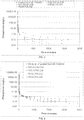
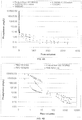
- Example 6 The elution of Samples 23B, 23C, 23D, 23E and the Comparative Sample of Example 2 were performed as set forth by the method in Example 4 with 2% of the particles by weight of the sand in the column. The results are shown in FIG. 2 . The results are similar to those illustrated in FIG. 1A and FIG. 1B . Since there is commercial interest in using higher percentage of the particles in a proppant pack, the elution studies were performed on the samples at 50% of the particles in the sand pack and the results are shown in FIG. 3. FIG. 3 indicates much slower release and longer period of effective inhibition.
- Example 7 (Reference) Four samples were prepared of two different sizes (0.8 mm and 1.0 mm diameter before calcining) in accordance with the procedure set forth in Example 1. The four samples were labeled as CO10118 (0.8 mm), CO10118 (1 mm), CO10524 (0.8 mm) and CO10593 (1 mm). Sample CO10118 (0.8 mm), after calcining, had a size of 25 mesh (0.71 mm) and a surface area of 1 m 2 /g; sample CO10118 (1 mm), after calcining, had a size of 30 mesh (0.59 mm) and a surface area of less than 1 m 2 /g.
- Sample CO10524 after calcining, had a size of 30 mesh (0.59 mm) and a surface area of 5.6 m 2 /g and sample CO10593, after calcining, had a size of 20 mesh (0.84 mm) and a surface area of 7.3 m 2 /g.
- Crush analysis was conducted on each of the samples as well as on ECONOPROP®, a commercial proppant available from Carbo Ceramics Inc. Further, two other samples labeled 25 mesh APA1.0/3C 12853 (surface area 3.1 m 2 /g) and 30 mesh APA0.8/3C 12852 were also prepared. The crush data on these is presented also in Table 4.
- Example 8 Scale Inhibitor amino tri(methylene phosphonic acid) (ATMP), commercially available as Dequest 2000 from ThermPhos International BV was adsorbed onto the four samples of Example 7 and resultant materials were labeled FBG-100824A, FBG-100824B, FBG-100824C and FBG-100824D, respectively. The procedure for the preparation of these samples is set forth above in Example 3.
- ATMP Scale Inhibitor amino tri(methylene phosphonic acid)
- Example 9 The elution of each of samples of Example 8 was performed in accordance with the procedures set forth in Examples 4 and 6 with 50% of the particles by weight of the sand in the column. The results are set forth in FIG. 4A and FIG. 4B and are compared to the results of 2% of loading of the composite exemplified in U.S. Patent No. 7,493,955 . The results are similar to those of Example 6 and show that the amount of composite may be tailored with the amount of proppant depending on the amount of water produced from the well and how long protection is desired. As illustrated, 2% of the particles in the sand and 50% particles in the sand may be used for the same purpose.
Landscapes
- Chemical & Material Sciences (AREA)
- Engineering & Computer Science (AREA)
- Life Sciences & Earth Sciences (AREA)
- General Life Sciences & Earth Sciences (AREA)
- Materials Engineering (AREA)
- Organic Chemistry (AREA)
- Ceramic Engineering (AREA)
- Mining & Mineral Resources (AREA)
- Geology (AREA)
- Structural Engineering (AREA)
- Fluid Mechanics (AREA)
- Environmental & Geological Engineering (AREA)
- Geochemistry & Mineralogy (AREA)
- Physics & Mathematics (AREA)
- Analytical Chemistry (AREA)
- Manufacturing & Machinery (AREA)
- Solid-Sorbent Or Filter-Aiding Compositions (AREA)
- Wood Science & Technology (AREA)
- Dispersion Chemistry (AREA)
- Treatment Of Liquids With Adsorbents In General (AREA)
Claims (9)
- Composite de traitement de puits comprenant un agent de traitement de puits et un oxyde métallique poreux calciné dans lequel la porosité et la perméabilité de l'oxyde métallique poreux calciné sont telles que l'agent de traitement de puits est adsorbé dans les espaces interstitiels de l'oxyde métallique poreux et dans lequel en outre :(a) la surface spécifique de l'oxyde métallique poreux calciné est comprise entre 1 m2/g et 4 m2/g ;(b) le diamètre de l'oxyde métallique poreux calciné est compris entre 0,1 et 3mm;(c) le volume de pores de l'oxyde métallique poreux calciné est compris entre 0,01 et 0,10 cm3/g ;dans lequel l'agent de traitement de puits est choisi dans le groupe constitué d'agents désémulsifiants (à la fois eau-dans-huile et huile-dans-eau), inhibiteurs de tartre, inhibiteurs de corrosion, inhibiteurs de paraffine, inhibiteurs de formation de sel, inhibiteurs d'hydrates de gaz, inhibiteurs d'asphaltène, piégeurs d'oxygène, biocides, agent moussant, émulsifiants (à la fois eau-dans-huile et huile-dans-eau) et agents tensioactifs ;
dans lequel l'oxyde métallique poreux calciné est choisi parmi l'alumine, l'oxyde de zirconium et l'oxyde de titane ; et
dans lequel la quantité d'agent de traitement de puits dans le composite va de 1 à 50 pour cent en poids. - Composite de traitement de puits selon la revendication 1, dans lequel au moins l'un des énoncés suivants prévaut :(d) la masse volumique apparente du composite est comprise entre 75 et 150 livres/pied3 (1201 à 2403 kg/m3) ;(e) la gravité spécifique du composite de traitement de puits est inférieure ou égale à 3,75 g/cm3.
- Composite de traitement de puits selon la revendication 1, dans lequel l'adsorbant contient en outre de la silice.
- Composite de traitement de puits selon la revendication 1, dans lequel l'oxyde métallique poreux calciné est de l'alumine.
- Composite de traitement de puits selon l'une quelconque des revendications 1 à 4, dans lequel l'agent de traitement de puits est hydrosoluble ou soluble dans des hydrocarbures aliphatiques et aromatiques.
- Composite de traitement de puits selon une quelconque revendication précédente, comprenant en outre de 1 à 99 % en poids d'un agent de soutènement.
- Utilisation du composite de traitement de puits selon l'une quelconque des revendications 1 à 6 dans des opérations de traitement de puits afin de libérer lentement le traitement de puits dans le milieu ambiant.
- Utilisation selon la revendication 7, dans laquelle l'opération de traitement de puits est un contrôle du sable.
- Utilisation selon la revendication 7, dans laquelle le composite de traitement de puits est utilisé en tant qu'agent de soutènement dans des opérations de fracturation hydraulique.
Applications Claiming Priority (2)
| Application Number | Priority Date | Filing Date | Title |
|---|---|---|---|
| US13/094,186 US9029300B2 (en) | 2011-04-26 | 2011-04-26 | Composites for controlled release of well treatment agents |
| PCT/US2012/034507 WO2012148819A1 (fr) | 2011-04-26 | 2012-04-20 | Composites pour la libération contrôlée d'agents de traitement de puits |
Publications (2)
| Publication Number | Publication Date |
|---|---|
| EP2702116A1 EP2702116A1 (fr) | 2014-03-05 |
| EP2702116B1 true EP2702116B1 (fr) | 2020-03-25 |
Family
ID=46046322
Family Applications (1)
| Application Number | Title | Priority Date | Filing Date |
|---|---|---|---|
| EP12719850.5A Active EP2702116B1 (fr) | 2011-04-26 | 2012-04-20 | Composite et utilisation pour la libération contrôlée d'agents de traitement de puits |
Country Status (13)
| Country | Link |
|---|---|
| US (2) | US9029300B2 (fr) |
| EP (1) | EP2702116B1 (fr) |
| CN (1) | CN103492526A (fr) |
| AR (1) | AR086048A1 (fr) |
| BR (1) | BR112013027230B1 (fr) |
| CA (1) | CA2831800C (fr) |
| CO (1) | CO6791604A2 (fr) |
| DK (1) | DK2702116T3 (fr) |
| MX (1) | MX366177B (fr) |
| MY (1) | MY184548A (fr) |
| RU (1) | RU2600116C2 (fr) |
| SG (1) | SG194642A1 (fr) |
| WO (1) | WO2012148819A1 (fr) |
Families Citing this family (55)
| Publication number | Priority date | Publication date | Assignee | Title |
|---|---|---|---|---|
| US10822536B2 (en) | 2010-07-19 | 2020-11-03 | Baker Hughes, A Ge Company, Llc | Method of using a screen containing a composite for release of well treatment agent into a well |
| US9976070B2 (en) * | 2010-07-19 | 2018-05-22 | Baker Hughes, A Ge Company, Llc | Method of using shaped compressed pellets in well treatment operations |
| US9670400B2 (en) | 2011-03-11 | 2017-06-06 | Carbo Ceramics Inc. | Proppant particles formed from slurry droplets and methods of use |
| US10077395B2 (en) | 2011-03-11 | 2018-09-18 | Carbo Ceramics Inc. | Proppant particles formed from slurry droplets and methods of use |
| US9580642B2 (en) | 2011-11-22 | 2017-02-28 | Baker Hughes Incorporated | Method for improving isolation of flow to completed perforated intervals |
| CA2852295C (fr) | 2011-11-22 | 2017-03-21 | Baker Hughes Incorporated | Procede d'utilisation de traceurs a liberation controlee |
| KR20150040309A (ko) | 2012-08-01 | 2015-04-14 | 옥세인 머티리얼스, 인크. | 합성 프로판트 및 단분산 프로판트 및 그의 제조 방법 |
| US20140190692A1 (en) * | 2013-01-04 | 2014-07-10 | Independence Oilfield Chemicals | Production-treating chemicals added to polymer slurries used in treatment of oil and gas wells |
| CA2849415C (fr) | 2013-04-24 | 2017-02-28 | Robert D. Skala | Procedes de fracturation de formations souterraines |
| NO340689B1 (no) * | 2013-06-24 | 2017-05-29 | Inst Energiteknik | Sporingsstoffer |
| US10822917B2 (en) | 2013-09-17 | 2020-11-03 | Baker Hughes, A Ge Company, Llc | Method of cementing a well using delayed hydratable polymeric viscosifying agents |
| US10844270B2 (en) | 2013-09-17 | 2020-11-24 | Baker Hughes, A Ge Company, Llc | Method of enhancing stability of cement slurries in well cementing operations |
| US10081762B2 (en) | 2013-09-17 | 2018-09-25 | Baker Hughes, A Ge Company, Llc | Well treatment methods and fluids containing synthetic polymer |
| GB2520019A (en) * | 2013-11-06 | 2015-05-13 | Statoil Petroleum As | Functionalized proppants |
| CN103773356B (zh) * | 2014-01-21 | 2016-11-16 | 成都新柯力化工科技有限公司 | 一种页岩气开采用颗粒料及其制备方法 |
| US10287865B2 (en) | 2014-05-19 | 2019-05-14 | Baker Hughes, A Ge Company, Llc | Use of an acid soluble or degradable solid particulate and an acid liberating or acid generating composite in the stimulation of a subterranean formation |
| WO2015200665A1 (fr) * | 2014-06-27 | 2015-12-30 | Imerys Oilfield Minerals, Inc. | Système de distribution chimique à base d'agent de soutènement |
| WO2016003304A1 (fr) * | 2014-06-30 | 2016-01-07 | Шлюмберже Канада Лимитед | Agent de soutènement composite, procédé de fabrication d'agent de soutènement composite, et procédés de son utilisation |
| EP3186331B1 (fr) * | 2014-07-23 | 2022-05-04 | Baker Hughes Holdings LLC | Composite comportant un agent de traitement de puits et/ou un traceur collés sur un substrat calciné constitué d'un noyau revêtu d'oxyde métallique et son procédé d'utilisation |
| AU2015296528A1 (en) | 2014-07-31 | 2017-03-09 | Carbo Ceramics Inc. | Methods and systems for infusing porous ceramic proppant with a chemical treatment agent |
| US9656237B2 (en) | 2014-07-31 | 2017-05-23 | Baker Hughes Incorporated | Method of scavenging hydrogen sulfide and mercaptans using well treatment composites |
| MX2017013417A (es) * | 2015-04-20 | 2018-01-30 | Baker Hughes A Ge Co Llc | Pelotillas comprimidas moldeadas para liberacion lenta de agentes de tratamiento de pozos en un pozo y metodos para utilizarlas. |
| US10280737B2 (en) | 2015-06-15 | 2019-05-07 | Baker Hughes, A Ge Company, Llc | Methods of using carbon quantum dots to enhance productivity of fluids from wells |
| CN107787351A (zh) * | 2015-06-30 | 2018-03-09 | 陶氏环球技术有限责任公司 | 用于受控释放的涂层 |
| CN105152367A (zh) * | 2015-10-10 | 2015-12-16 | 无棣华信石油技术服务有限公司 | 一种环保型油田回注水缓蚀阻垢剂及其制备方法 |
| CA2963758C (fr) | 2016-04-08 | 2019-07-23 | Baker Hughes Incorporated | Materiau de traitement de puits destine a la liberation lente de biocide |
| US10641083B2 (en) | 2016-06-02 | 2020-05-05 | Baker Hughes, A Ge Company, Llc | Method of monitoring fluid flow from a reservoir using well treatment agents |
| US9926485B2 (en) | 2016-06-03 | 2018-03-27 | Tomson Technologies | Nanoparticle carrier platform and methods for controlled release of subterranean well treatment additives |
| US10413966B2 (en) | 2016-06-20 | 2019-09-17 | Baker Hughes, A Ge Company, Llc | Nanoparticles having magnetic core encapsulated by carbon shell and composites of the same |
| US10400152B2 (en) * | 2016-08-19 | 2019-09-03 | Baker Hughes, A Ge Company, Llc | Liquid loaded powders made from hybrid calcium carbonate for oil and gas drilling fluids |
| CN106593358B (zh) * | 2017-02-09 | 2022-12-30 | 中国石油化工股份有限公司 | 一种抽油井中接力式释放药剂的装置 |
| WO2018208587A1 (fr) | 2017-05-11 | 2018-11-15 | Baker Hughes, A Ge Company, Llc | Procédé d'utilisation d'agents de traitement de puits réticulés pour une libération lente dans un puits |
| US12060523B2 (en) | 2017-07-13 | 2024-08-13 | Baker Hughes Holdings Llc | Method of introducing oil-soluble well treatment agent into a well or subterranean formation |
| WO2019013799A1 (fr) | 2017-07-13 | 2019-01-17 | Baker Hughes, A Ge Company, Llc | Système de distribution d'agents de traitement de puits oléo-solubles et procédés d'utilisation de celui-ci |
| EP3704206A1 (fr) | 2017-11-03 | 2020-09-09 | Baker Hughes Holdings Llc | Procédés de traitement mettant en oeuvre des fluides aqueux contenant des agents de traitement solubles dans l'huile |
| WO2020028375A1 (fr) | 2018-07-30 | 2020-02-06 | Baker Hughes, A Ge Company, Llc | Compositions de traitement de puits à libération retardée et procédés d'utilisation de celles-ci |
| US11028309B2 (en) | 2019-02-08 | 2021-06-08 | Baker Hughes Oilfield Operations Llc | Method of using resin coated sized particulates as spacer fluid |
| CA3135350A1 (fr) | 2019-03-29 | 2020-10-08 | Tomson Technologies Llc | Inhibiteur de tartre colloidal a liberation prolongee |
| CN110157401A (zh) * | 2019-05-06 | 2019-08-23 | 中国石油天然气股份有限公司 | 一种可控长效缓释阻垢剂胶囊的制备方法 |
| CN110259427B (zh) * | 2019-07-10 | 2023-05-26 | 河南理工大学 | 水力压裂液、瓦斯抽采系统及瓦斯抽采方法 |
| CN110643345B (zh) * | 2019-10-16 | 2021-12-14 | 北京弘毅恩泽能源技术有限公司 | 用于酸压的吸附缓释酸体系及其制备方法 |
| US10961444B1 (en) | 2019-11-01 | 2021-03-30 | Baker Hughes Oilfield Operations Llc | Method of using coated composites containing delayed release agent in a well treatment operation |
| EP4182399B1 (fr) * | 2020-07-16 | 2025-09-03 | Omya International AG | Minéraux de métal alcalinoterreux en tant que supports de tensioactifs dans des fluides de forage |
| MX2023004759A (es) | 2020-10-26 | 2023-05-10 | Ecolab Usa Inc | Agente de control de escamas de calcita para pozos geotermicos. |
| US12404439B2 (en) | 2021-03-29 | 2025-09-02 | Championx Llc | Extended release asphaltene inhibitor composition |
| CA3217398A1 (fr) | 2021-05-11 | 2022-11-17 | Dragan Stojkovic | Granules composites de polyolefine-coke utilises comme agent de soutenement pour fracturation hydraulique |
| CN113403052A (zh) * | 2021-06-16 | 2021-09-17 | 陕西丰登石化有限公司 | 一种油井防腐阻垢缓释颗粒及其制备方法 |
| CA3245321A1 (fr) | 2022-03-04 | 2023-09-07 | ExxonMobil Technology and Engineering Company | Agents de soutènement obtenus par réticulation de résines aromatiques mixtes |
| US12168913B2 (en) | 2022-05-12 | 2024-12-17 | Baker Hughes Oilfield Operations Llc | Methods for transporting scale removal agents into a well |
| CN117736718B (zh) * | 2022-09-22 | 2026-03-13 | 中国石油天然气股份有限公司 | 一种覆膜长效型多孔陶粒阻垢支撑剂、制备方法及应用 |
| US20250145879A1 (en) | 2023-11-08 | 2025-05-08 | Baker Hughes Oilfield Operations Llc | Method of Detecting Flow Assurance Using a Tagged Asphaltene Inhibitor |
| WO2025137094A1 (fr) * | 2023-12-21 | 2025-06-26 | Championx Llc | Compositions de traitement comportant des particules d'alumine |
| US12540273B2 (en) | 2024-01-19 | 2026-02-03 | ExxonMobil Technology and Engineering Company | Proppant particles formed from fluid coke and flexicoke, fracturing fluids comprising such proppant particles, and methods related thereto |
| US12521764B2 (en) | 2024-06-19 | 2026-01-13 | ExxonMobil Technology and Engineering Company | Methods for preparing petroleum coke proppant particles for hydraulic fracturing |
| US20260049537A1 (en) * | 2024-08-19 | 2026-02-19 | Saudi Arabian Oil Company | Scale treatment in a heterogeneous reservoir using a non-newtonian fluid |
Family Cites Families (36)
| Publication number | Priority date | Publication date | Assignee | Title |
|---|---|---|---|---|
| FR2299911A1 (fr) | 1975-02-04 | 1976-09-03 | Kali Chemie Ag | Procede de fabrication de particules spheriques contenant de l'alumine et produits obtenus |
| US4390456A (en) | 1979-08-08 | 1983-06-28 | W. R. Grace & Co. | Spheroidal alumina particles and catalysts employing the particles as a support |
| US4522731A (en) * | 1982-10-28 | 1985-06-11 | Dresser Industries, Inc. | Hydraulic fracturing propping agent |
| GB9503949D0 (en) | 1995-02-28 | 1995-04-19 | Atomic Energy Authority Uk | Oil well treatment |
| GB9611422D0 (en) | 1996-05-31 | 1996-08-07 | Bp Exploration Operating | Coated scale inhibitors |
| US7426961B2 (en) | 2002-09-03 | 2008-09-23 | Bj Services Company | Method of treating subterranean formations with porous particulate materials |
| GB0028264D0 (en) | 2000-11-20 | 2001-01-03 | Norske Stats Oljeselskap | Well treatment |
| GB0028269D0 (en) | 2000-11-20 | 2001-01-03 | Norske Stats Oljeselskap | Well treatment |
| US7140438B2 (en) | 2003-08-14 | 2006-11-28 | Halliburton Energy Services, Inc. | Orthoester compositions and methods of use in subterranean applications |
| US20080287324A1 (en) | 2002-03-01 | 2008-11-20 | Cesi Chemical, Inc., A Flotek Company | Process for well cleaning |
| US7135231B1 (en) * | 2003-07-01 | 2006-11-14 | Fairmont Minerals, Ltd. | Process for incremental coating of proppants for hydraulic fracturing and proppants produced therefrom |
| US7871702B2 (en) | 2003-07-30 | 2011-01-18 | Halliburton Energy Services, Inc. | Particulates comprising silica and alumina, and methods of utilizing these particulates in subterranean applications |
| US20050028976A1 (en) | 2003-08-05 | 2005-02-10 | Nguyen Philip D. | Compositions and methods for controlling the release of chemicals placed on particulates |
| US20060065396A1 (en) | 2004-08-13 | 2006-03-30 | Dawson Jeffrey C | Compositions containing water control treatments and formation damage control additives, and methods for their use |
| US7491682B2 (en) | 2004-12-15 | 2009-02-17 | Bj Services Company | Method of inhibiting or controlling formation of inorganic scales |
| US8012533B2 (en) * | 2005-02-04 | 2011-09-06 | Oxane Materials, Inc. | Composition and method for making a proppant |
| EA012634B1 (ru) * | 2005-02-04 | 2009-12-30 | Оксан Материалз, Инк. | Композиция и способ получения проппанта |
| US7615172B2 (en) | 2005-03-01 | 2009-11-10 | Carbo Ceramics, Inc. | Methods for producing sintered particles from a slurry of an alumina-containing raw material |
| US20060223713A1 (en) | 2005-04-05 | 2006-10-05 | Bj Services Company | Method of completing a well with hydrate inhibitors |
| US20060272816A1 (en) | 2005-06-02 | 2006-12-07 | Willberg Dean M | Proppants Useful for Prevention of Scale Deposition |
| US7598209B2 (en) | 2006-01-26 | 2009-10-06 | Bj Services Company | Porous composites containing hydrocarbon-soluble well treatment agents and methods for using the same |
| US8562900B2 (en) * | 2006-09-01 | 2013-10-22 | Imerys | Method of manufacturing and using rod-shaped proppants and anti-flowback additives |
| US8183184B2 (en) | 2006-09-05 | 2012-05-22 | University Of Kansas | Polyelectrolyte complexes for oil and gas applications |
| US7490667B2 (en) * | 2006-10-02 | 2009-02-17 | Fairmount Minerals, Inc. | Proppants with soluble composite coatings |
| RU2344155C2 (ru) * | 2006-12-27 | 2009-01-20 | Шлюмбергер Текнолоджи Б.В. | Проппант на основе алюмосиликатов, способ его получения и способ его применения |
| US7918281B2 (en) | 2007-03-06 | 2011-04-05 | Baker Hughes Incorporated | Method of treating flow conduits and vessels with foamed composition |
| US20080217012A1 (en) | 2007-03-08 | 2008-09-11 | Bj Services Company | Gelled emulsions and methods of using the same |
| US7737091B2 (en) * | 2007-08-28 | 2010-06-15 | Imerys | Proppants and anti-flowback additives made from sillimanite minerals, methods of manufacture, and methods of use |
| CA2643872C (fr) | 2007-11-16 | 2012-08-21 | Bj Services Company | Procede de traitement des formations souterraines par hydrolyse in situ d'esters d'acide organique |
| US7968500B2 (en) | 2008-06-25 | 2011-06-28 | Baker Hughes Incorporated | Gas hydrate protection with heat producing two-component gas hydrate inhibitors |
| US7977283B2 (en) | 2008-06-27 | 2011-07-12 | Baker Hughes Incorporated | Method of minimizing or reducing salt deposits by use of a fluid containing a fructan and derivatives thereof |
| US8336624B2 (en) | 2008-10-30 | 2012-12-25 | Baker Hughes Incorporated | Squeeze process for reactivation of well treatment fluids containing a water-insoluble adsorbent |
| US7686081B1 (en) | 2008-10-30 | 2010-03-30 | Bj Services Company | Squeeze process for reactivation of well treatment fluids containing diatomaceous earth |
| US9010430B2 (en) | 2010-07-19 | 2015-04-21 | Baker Hughes Incorporated | Method of using shaped compressed pellets in treating a well |
| US8664168B2 (en) | 2011-03-30 | 2014-03-04 | Baker Hughes Incorporated | Method of using composites in the treatment of wells |
| US9102860B2 (en) | 2011-06-16 | 2015-08-11 | Baker Hughes Incorporated | Method of inhibiting or controlling release of well treatment agent |
-
2011
- 2011-04-26 US US13/094,186 patent/US9029300B2/en active Active
-
2012
- 2012-04-20 BR BR112013027230-9A patent/BR112013027230B1/pt active IP Right Grant
- 2012-04-20 MY MYPI2013702010A patent/MY184548A/en unknown
- 2012-04-20 CN CN201280020200.2A patent/CN103492526A/zh active Pending
- 2012-04-20 DK DK12719850.5T patent/DK2702116T3/da active
- 2012-04-20 WO PCT/US2012/034507 patent/WO2012148819A1/fr not_active Ceased
- 2012-04-20 CA CA2831800A patent/CA2831800C/fr active Active
- 2012-04-20 SG SG2013079546A patent/SG194642A1/en unknown
- 2012-04-20 MX MX2013012367A patent/MX366177B/es active IP Right Grant
- 2012-04-20 RU RU2013152253/03A patent/RU2600116C2/ru active
- 2012-04-20 EP EP12719850.5A patent/EP2702116B1/fr active Active
- 2012-04-24 AR ARP120101417A patent/AR086048A1/es active IP Right Grant
-
2013
- 2013-10-08 CO CO13238682A patent/CO6791604A2/es not_active Application Discontinuation
-
2015
- 2015-05-05 US US14/704,739 patent/US9574130B2/en active Active
Non-Patent Citations (1)
| Title |
|---|
| None * |
Also Published As
| Publication number | Publication date |
|---|---|
| MX366177B (es) | 2019-07-01 |
| DK2702116T3 (da) | 2020-06-08 |
| CO6791604A2 (es) | 2013-11-14 |
| MY184548A (en) | 2021-04-01 |
| US20120273197A1 (en) | 2012-11-01 |
| RU2600116C2 (ru) | 2016-10-20 |
| SG194642A1 (en) | 2013-12-30 |
| CA2831800C (fr) | 2016-07-12 |
| US20150232741A1 (en) | 2015-08-20 |
| CN103492526A (zh) | 2014-01-01 |
| BR112013027230A2 (pt) | 2016-12-27 |
| RU2013152253A (ru) | 2015-06-10 |
| CA2831800A1 (fr) | 2012-11-01 |
| AU2012249983A1 (en) | 2013-10-24 |
| US9574130B2 (en) | 2017-02-21 |
| BR112013027230B1 (pt) | 2021-01-26 |
| WO2012148819A1 (fr) | 2012-11-01 |
| AR086048A1 (es) | 2013-11-13 |
| EP2702116A1 (fr) | 2014-03-05 |
| MX2013012367A (es) | 2014-02-03 |
| US9029300B2 (en) | 2015-05-12 |
Similar Documents
| Publication | Publication Date | Title |
|---|---|---|
| EP2702116B1 (fr) | Composite et utilisation pour la libération contrôlée d'agents de traitement de puits | |
| EP3186331B1 (fr) | Composite comportant un agent de traitement de puits et/ou un traceur collés sur un substrat calciné constitué d'un noyau revêtu d'oxyde métallique et son procédé d'utilisation | |
| US9976070B2 (en) | Method of using shaped compressed pellets in well treatment operations | |
| EP3286278B1 (fr) | Pastilles comprimées ayant une forme permettant la libération lente d'agents de traitement de puits dans un puits et leurs procédés d'utilisation | |
| US10822536B2 (en) | Method of using a screen containing a composite for release of well treatment agent into a well | |
| US10989040B2 (en) | Method of using controlled release tracers | |
| AU2012249983B2 (en) | Composites for controlled release of well treatment agents |
Legal Events
| Date | Code | Title | Description |
|---|---|---|---|
| PUAI | Public reference made under article 153(3) epc to a published international application that has entered the european phase |
Free format text: ORIGINAL CODE: 0009012 |
|
| 17P | Request for examination filed |
Effective date: 20131001 |
|
| AK | Designated contracting states |
Kind code of ref document: A1 Designated state(s): AL AT BE BG CH CY CZ DE DK EE ES FI FR GB GR HR HU IE IS IT LI LT LU LV MC MK MT NL NO PL PT RO RS SE SI SK SM TR |
|
| DAX | Request for extension of the european patent (deleted) | ||
| 17Q | First examination report despatched |
Effective date: 20151030 |
|
| STAA | Information on the status of an ep patent application or granted ep patent |
Free format text: STATUS: EXAMINATION IS IN PROGRESS |
|
| GRAP | Despatch of communication of intention to grant a patent |
Free format text: ORIGINAL CODE: EPIDOSNIGR1 |
|
| STAA | Information on the status of an ep patent application or granted ep patent |
Free format text: STATUS: GRANT OF PATENT IS INTENDED |
|
| INTG | Intention to grant announced |
Effective date: 20191018 |
|
| RAP1 | Party data changed (applicant data changed or rights of an application transferred) |
Owner name: BAKER HUGHES, A GE COMPANY, LLC |
|
| GRAS | Grant fee paid |
Free format text: ORIGINAL CODE: EPIDOSNIGR3 |
|
| GRAA | (expected) grant |
Free format text: ORIGINAL CODE: 0009210 |
|
| STAA | Information on the status of an ep patent application or granted ep patent |
Free format text: STATUS: THE PATENT HAS BEEN GRANTED |
|
| AK | Designated contracting states |
Kind code of ref document: B1 Designated state(s): AL AT BE BG CH CY CZ DE DK EE ES FI FR GB GR HR HU IE IS IT LI LT LU LV MC MK MT NL NO PL PT RO RS SE SI SK SM TR |
|
| REG | Reference to a national code |
Ref country code: GB Ref legal event code: FG4D |
|
| REG | Reference to a national code |
Ref country code: AT Ref legal event code: REF Ref document number: 1248531 Country of ref document: AT Kind code of ref document: T Effective date: 20200415 Ref country code: IE Ref legal event code: FG4D |
|
| REG | Reference to a national code |
Ref country code: DE Ref legal event code: R096 Ref document number: 602012068712 Country of ref document: DE |
|
| REG | Reference to a national code |
Ref country code: DK Ref legal event code: T3 Effective date: 20200603 |
|
| PG25 | Lapsed in a contracting state [announced via postgrant information from national office to epo] |
Ref country code: RS Free format text: LAPSE BECAUSE OF FAILURE TO SUBMIT A TRANSLATION OF THE DESCRIPTION OR TO PAY THE FEE WITHIN THE PRESCRIBED TIME-LIMIT Effective date: 20200325 Ref country code: FI Free format text: LAPSE BECAUSE OF FAILURE TO SUBMIT A TRANSLATION OF THE DESCRIPTION OR TO PAY THE FEE WITHIN THE PRESCRIBED TIME-LIMIT Effective date: 20200325 |
|
| REG | Reference to a national code |
Ref country code: NO Ref legal event code: T2 Effective date: 20200325 |
|
| PG25 | Lapsed in a contracting state [announced via postgrant information from national office to epo] |
Ref country code: HR Free format text: LAPSE BECAUSE OF FAILURE TO SUBMIT A TRANSLATION OF THE DESCRIPTION OR TO PAY THE FEE WITHIN THE PRESCRIBED TIME-LIMIT Effective date: 20200325 Ref country code: BG Free format text: LAPSE BECAUSE OF FAILURE TO SUBMIT A TRANSLATION OF THE DESCRIPTION OR TO PAY THE FEE WITHIN THE PRESCRIBED TIME-LIMIT Effective date: 20200625 Ref country code: GR Free format text: LAPSE BECAUSE OF FAILURE TO SUBMIT A TRANSLATION OF THE DESCRIPTION OR TO PAY THE FEE WITHIN THE PRESCRIBED TIME-LIMIT Effective date: 20200626 Ref country code: LV Free format text: LAPSE BECAUSE OF FAILURE TO SUBMIT A TRANSLATION OF THE DESCRIPTION OR TO PAY THE FEE WITHIN THE PRESCRIBED TIME-LIMIT Effective date: 20200325 Ref country code: SE Free format text: LAPSE BECAUSE OF FAILURE TO SUBMIT A TRANSLATION OF THE DESCRIPTION OR TO PAY THE FEE WITHIN THE PRESCRIBED TIME-LIMIT Effective date: 20200325 |
|
| REG | Reference to a national code |
Ref country code: NL Ref legal event code: MP Effective date: 20200325 |
|
| REG | Reference to a national code |
Ref country code: LT Ref legal event code: MG4D |
|
| PG25 | Lapsed in a contracting state [announced via postgrant information from national office to epo] |
Ref country code: NL Free format text: LAPSE BECAUSE OF FAILURE TO SUBMIT A TRANSLATION OF THE DESCRIPTION OR TO PAY THE FEE WITHIN THE PRESCRIBED TIME-LIMIT Effective date: 20200325 |
|
| PG25 | Lapsed in a contracting state [announced via postgrant information from national office to epo] |
Ref country code: RO Free format text: LAPSE BECAUSE OF FAILURE TO SUBMIT A TRANSLATION OF THE DESCRIPTION OR TO PAY THE FEE WITHIN THE PRESCRIBED TIME-LIMIT Effective date: 20200325 Ref country code: SK Free format text: LAPSE BECAUSE OF FAILURE TO SUBMIT A TRANSLATION OF THE DESCRIPTION OR TO PAY THE FEE WITHIN THE PRESCRIBED TIME-LIMIT Effective date: 20200325 Ref country code: IS Free format text: LAPSE BECAUSE OF FAILURE TO SUBMIT A TRANSLATION OF THE DESCRIPTION OR TO PAY THE FEE WITHIN THE PRESCRIBED TIME-LIMIT Effective date: 20200725 Ref country code: CZ Free format text: LAPSE BECAUSE OF FAILURE TO SUBMIT A TRANSLATION OF THE DESCRIPTION OR TO PAY THE FEE WITHIN THE PRESCRIBED TIME-LIMIT Effective date: 20200325 Ref country code: EE Free format text: LAPSE BECAUSE OF FAILURE TO SUBMIT A TRANSLATION OF THE DESCRIPTION OR TO PAY THE FEE WITHIN THE PRESCRIBED TIME-LIMIT Effective date: 20200325 Ref country code: SM Free format text: LAPSE BECAUSE OF FAILURE TO SUBMIT A TRANSLATION OF THE DESCRIPTION OR TO PAY THE FEE WITHIN THE PRESCRIBED TIME-LIMIT Effective date: 20200325 Ref country code: PT Free format text: LAPSE BECAUSE OF FAILURE TO SUBMIT A TRANSLATION OF THE DESCRIPTION OR TO PAY THE FEE WITHIN THE PRESCRIBED TIME-LIMIT Effective date: 20200818 Ref country code: LT Free format text: LAPSE BECAUSE OF FAILURE TO SUBMIT A TRANSLATION OF THE DESCRIPTION OR TO PAY THE FEE WITHIN THE PRESCRIBED TIME-LIMIT Effective date: 20200325 |
|
| REG | Reference to a national code |
Ref country code: DE Ref legal event code: R119 Ref document number: 602012068712 Country of ref document: DE |
|
| REG | Reference to a national code |
Ref country code: AT Ref legal event code: MK05 Ref document number: 1248531 Country of ref document: AT Kind code of ref document: T Effective date: 20200325 |
|
| REG | Reference to a national code |
Ref country code: CH Ref legal event code: PL |
|
| PG25 | Lapsed in a contracting state [announced via postgrant information from national office to epo] |
Ref country code: MC Free format text: LAPSE BECAUSE OF FAILURE TO SUBMIT A TRANSLATION OF THE DESCRIPTION OR TO PAY THE FEE WITHIN THE PRESCRIBED TIME-LIMIT Effective date: 20200325 |
|
| PG25 | Lapsed in a contracting state [announced via postgrant information from national office to epo] |
Ref country code: ES Free format text: LAPSE BECAUSE OF FAILURE TO SUBMIT A TRANSLATION OF THE DESCRIPTION OR TO PAY THE FEE WITHIN THE PRESCRIBED TIME-LIMIT Effective date: 20200325 Ref country code: AT Free format text: LAPSE BECAUSE OF FAILURE TO SUBMIT A TRANSLATION OF THE DESCRIPTION OR TO PAY THE FEE WITHIN THE PRESCRIBED TIME-LIMIT Effective date: 20200325 Ref country code: DE Free format text: LAPSE BECAUSE OF NON-PAYMENT OF DUE FEES Effective date: 20201103 Ref country code: LU Free format text: LAPSE BECAUSE OF NON-PAYMENT OF DUE FEES Effective date: 20200420 Ref country code: CH Free format text: LAPSE BECAUSE OF NON-PAYMENT OF DUE FEES Effective date: 20200430 Ref country code: LI Free format text: LAPSE BECAUSE OF NON-PAYMENT OF DUE FEES Effective date: 20200430 |
|
| REG | Reference to a national code |
Ref country code: BE Ref legal event code: MM Effective date: 20200430 |
|
| PLBE | No opposition filed within time limit |
Free format text: ORIGINAL CODE: 0009261 |
|
| STAA | Information on the status of an ep patent application or granted ep patent |
Free format text: STATUS: NO OPPOSITION FILED WITHIN TIME LIMIT |
|
| PG25 | Lapsed in a contracting state [announced via postgrant information from national office to epo] |
Ref country code: PL Free format text: LAPSE BECAUSE OF FAILURE TO SUBMIT A TRANSLATION OF THE DESCRIPTION OR TO PAY THE FEE WITHIN THE PRESCRIBED TIME-LIMIT Effective date: 20200325 Ref country code: BE Free format text: LAPSE BECAUSE OF NON-PAYMENT OF DUE FEES Effective date: 20200430 |
|
| 26N | No opposition filed |
Effective date: 20210112 |
|
| PG25 | Lapsed in a contracting state [announced via postgrant information from national office to epo] |
Ref country code: IE Free format text: LAPSE BECAUSE OF NON-PAYMENT OF DUE FEES Effective date: 20200420 Ref country code: FR Free format text: LAPSE BECAUSE OF NON-PAYMENT OF DUE FEES Effective date: 20200525 |
|
| PG25 | Lapsed in a contracting state [announced via postgrant information from national office to epo] |
Ref country code: SI Free format text: LAPSE BECAUSE OF FAILURE TO SUBMIT A TRANSLATION OF THE DESCRIPTION OR TO PAY THE FEE WITHIN THE PRESCRIBED TIME-LIMIT Effective date: 20200325 |
|
| PG25 | Lapsed in a contracting state [announced via postgrant information from national office to epo] |
Ref country code: TR Free format text: LAPSE BECAUSE OF FAILURE TO SUBMIT A TRANSLATION OF THE DESCRIPTION OR TO PAY THE FEE WITHIN THE PRESCRIBED TIME-LIMIT Effective date: 20200325 Ref country code: MT Free format text: LAPSE BECAUSE OF FAILURE TO SUBMIT A TRANSLATION OF THE DESCRIPTION OR TO PAY THE FEE WITHIN THE PRESCRIBED TIME-LIMIT Effective date: 20200325 Ref country code: CY Free format text: LAPSE BECAUSE OF FAILURE TO SUBMIT A TRANSLATION OF THE DESCRIPTION OR TO PAY THE FEE WITHIN THE PRESCRIBED TIME-LIMIT Effective date: 20200325 |
|
| PG25 | Lapsed in a contracting state [announced via postgrant information from national office to epo] |
Ref country code: MK Free format text: LAPSE BECAUSE OF FAILURE TO SUBMIT A TRANSLATION OF THE DESCRIPTION OR TO PAY THE FEE WITHIN THE PRESCRIBED TIME-LIMIT Effective date: 20200325 Ref country code: AL Free format text: LAPSE BECAUSE OF FAILURE TO SUBMIT A TRANSLATION OF THE DESCRIPTION OR TO PAY THE FEE WITHIN THE PRESCRIBED TIME-LIMIT Effective date: 20200325 |
|
| P01 | Opt-out of the competence of the unified patent court (upc) registered |
Effective date: 20230526 |
|
| PGFP | Annual fee paid to national office [announced via postgrant information from national office to epo] |
Ref country code: GB Payment date: 20260319 Year of fee payment: 15 |
|
| PGFP | Annual fee paid to national office [announced via postgrant information from national office to epo] |
Ref country code: NO Payment date: 20260320 Year of fee payment: 15 Ref country code: DK Payment date: 20260319 Year of fee payment: 15 |
|
| PGFP | Annual fee paid to national office [announced via postgrant information from national office to epo] |
Ref country code: IT Payment date: 20260319 Year of fee payment: 15 |