EP2703092A1 - Procédé de réglage de différents degrés de brillance pour laques durcies par radiation et leur utilisation - Google Patents
Procédé de réglage de différents degrés de brillance pour laques durcies par radiation et leur utilisation Download PDFInfo
- Publication number
- EP2703092A1 EP2703092A1 EP12182410.6A EP12182410A EP2703092A1 EP 2703092 A1 EP2703092 A1 EP 2703092A1 EP 12182410 A EP12182410 A EP 12182410A EP 2703092 A1 EP2703092 A1 EP 2703092A1
- Authority
- EP
- European Patent Office
- Prior art keywords
- radiation
- wave
- short
- gloss
- substrate
- Prior art date
- Legal status (The legal status is an assumption and is not a legal conclusion. Google has not performed a legal analysis and makes no representation as to the accuracy of the status listed.)
- Withdrawn
Links
Images

Classifications
-
- B—PERFORMING OPERATIONS; TRANSPORTING
- B05—SPRAYING OR ATOMISING IN GENERAL; APPLYING FLUENT MATERIALS TO SURFACES, IN GENERAL
- B05D—PROCESSES FOR APPLYING FLUENT MATERIALS TO SURFACES, IN GENERAL
- B05D3/00—Pretreatment of surfaces to which liquids or other fluent materials are to be applied; After-treatment of applied coatings, e.g. intermediate treating of an applied coating preparatory to subsequent applications of liquids or other fluent materials
- B05D3/06—Pretreatment of surfaces to which liquids or other fluent materials are to be applied; After-treatment of applied coatings, e.g. intermediate treating of an applied coating preparatory to subsequent applications of liquids or other fluent materials by exposure to radiation
- B05D3/061—Pretreatment of surfaces to which liquids or other fluent materials are to be applied; After-treatment of applied coatings, e.g. intermediate treating of an applied coating preparatory to subsequent applications of liquids or other fluent materials by exposure to radiation using U.V.
- B05D3/065—After-treatment
- B05D3/067—Curing or cross-linking the coating
-
- B—PERFORMING OPERATIONS; TRANSPORTING
- B05—SPRAYING OR ATOMISING IN GENERAL; APPLYING FLUENT MATERIALS TO SURFACES, IN GENERAL
- B05D—PROCESSES FOR APPLYING FLUENT MATERIALS TO SURFACES, IN GENERAL
- B05D5/00—Processes for applying liquids or other fluent materials to surfaces to obtain special surface effects, finishes or structures
- B05D5/06—Processes for applying liquids or other fluent materials to surfaces to obtain special surface effects, finishes or structures to obtain multicolour or other optical effects
-
- B—PERFORMING OPERATIONS; TRANSPORTING
- B05—SPRAYING OR ATOMISING IN GENERAL; APPLYING FLUENT MATERIALS TO SURFACES, IN GENERAL
- B05D—PROCESSES FOR APPLYING FLUENT MATERIALS TO SURFACES, IN GENERAL
- B05D2201/00—Polymeric substrate or laminate
-
- B—PERFORMING OPERATIONS; TRANSPORTING
- B05—SPRAYING OR ATOMISING IN GENERAL; APPLYING FLUENT MATERIALS TO SURFACES, IN GENERAL
- B05D—PROCESSES FOR APPLYING FLUENT MATERIALS TO SURFACES, IN GENERAL
- B05D2202/00—Metallic substrate
-
- B—PERFORMING OPERATIONS; TRANSPORTING
- B05—SPRAYING OR ATOMISING IN GENERAL; APPLYING FLUENT MATERIALS TO SURFACES, IN GENERAL
- B05D—PROCESSES FOR APPLYING FLUENT MATERIALS TO SURFACES, IN GENERAL
- B05D3/00—Pretreatment of surfaces to which liquids or other fluent materials are to be applied; After-treatment of applied coatings, e.g. intermediate treating of an applied coating preparatory to subsequent applications of liquids or other fluent materials
- B05D3/02—Pretreatment of surfaces to which liquids or other fluent materials are to be applied; After-treatment of applied coatings, e.g. intermediate treating of an applied coating preparatory to subsequent applications of liquids or other fluent materials by baking
- B05D3/0209—Multistage baking
-
- B—PERFORMING OPERATIONS; TRANSPORTING
- B05—SPRAYING OR ATOMISING IN GENERAL; APPLYING FLUENT MATERIALS TO SURFACES, IN GENERAL
- B05D—PROCESSES FOR APPLYING FLUENT MATERIALS TO SURFACES, IN GENERAL
- B05D3/00—Pretreatment of surfaces to which liquids or other fluent materials are to be applied; After-treatment of applied coatings, e.g. intermediate treating of an applied coating preparatory to subsequent applications of liquids or other fluent materials
- B05D3/04—Pretreatment of surfaces to which liquids or other fluent materials are to be applied; After-treatment of applied coatings, e.g. intermediate treating of an applied coating preparatory to subsequent applications of liquids or other fluent materials by exposure to gases
- B05D3/0486—Operating the coating or treatment in a controlled atmosphere
-
- B—PERFORMING OPERATIONS; TRANSPORTING
- B05—SPRAYING OR ATOMISING IN GENERAL; APPLYING FLUENT MATERIALS TO SURFACES, IN GENERAL
- B05D—PROCESSES FOR APPLYING FLUENT MATERIALS TO SURFACES, IN GENERAL
- B05D7/00—Processes, other than flocking, specially adapted for applying liquids or other fluent materials to particular surfaces or for applying particular liquids or other fluent materials
- B05D7/06—Processes, other than flocking, specially adapted for applying liquids or other fluent materials to particular surfaces or for applying particular liquids or other fluent materials to wood
Definitions
- the invention relates to a method for setting different degrees of gloss in radiation-cured paints, the resulting radiation-cured paints with different degrees of gloss, suitable radiation-curable coating formulations, and the use of the resulting paints for modifying, e.g. Coating or gradual matting of surfaces of substrates such as plastic sheets or foils, in particular polycarbonate and / or polyester sheets or sheets.
- an anti-glare effect is required at the same time high transparency.
- Anti-glare means that a punctiform beam of light striking the front of a surface of, for example, a display, rather than being reflected as such, is scattered back in various directions to prevent dazzling of the display user.
- lacquers have the task not only to protect surfaces but also to design, so there are requirements for a certain degree of gloss for certain design applications.
- decorative foils are mentioned, which are used, inter alia, in the furniture industry but also in the vehicle interior.
- a specific structure can be imprinted on the surface of a substrate or of a lacquer applied thereon by means of a textured roller.
- Disadvantage of this technique is that usually only a single gloss value or a very narrow range can be realized by a roller and you needed many different rollers for different gloss levels that are expensive to manufacture.
- Another approach is to adjust the gloss level based on a self-assembly of the surface structure of the paint formulation.
- a radiation-induced folding of a wet paint by short-wave ultraviolet (UV) radiation is an option, which can be cured in a subsequent step.
- Short-wave UV or vacuum UV (VUV) radiation is used in paint curing to obtain hard, highly cross-linked, chemical-resistant surfaces.
- VUV radiation effects a microplating of the surface and thus matting of the surface to typically 5 to 25 highlights. It is true that with increasing the radiation dose, a stronger microfolding and thus a higher matting of the paint surface are obtained becomes.
- DE 10 2006 042 063 A1 describes a method for adjusting the degree of gloss and the feel of surfaces of radiation-curable paints and lacquers by photochemical microfilling using short-wavelength monochromatic UV radiation.
- the degree of gloss is adjusted exclusively by varying the residence time between the beginning of folding (short-wave UV radiation) and completion by complete curing by means of long-wave UV radiation.
- the belt speed or the distance between the two radiation sources is varied.
- the coatings generally UV-curable formulations based on acrylates, methacrylates, vinyl ethers, epoxies, styrene or the like are described in layer thicknesses greater than or equal to 30 microns.
- DE 10 207 401 A1 relates to an organosilicon nano- and / or microhybrid capsule-containing composition for scratch- or abrasion-resistant coatings, wherein the organosilicon nano- or micro-hybrid system consists of small metal oxide cores A and a substantially complete, organosilicon sheath B, the method for producing an organosilicon nano - And / or microhybrid capsules containing pasty composition and the use of these for the production of paint for producing a scratch and abrasion resistant coating on a substrate.
- the influence of the surface gloss is not the subject of the disclosure.
- the UV radiation dose hereinafter referred to as the short-wave UV radiation dose, describes the energy input to the irradiation surface and is the product of radiation intensity of the radiation source and the irradiation duration, which is given by the belt speed.
- radiation dose mJ / cm ⁇ 2 radiation intensity ⁇ a ⁇ ⁇ t mW / cm ⁇ 2 x time s
- the VUV radiation intensity and thus also the radiation dose are controlled by the number of radiation sources, the lamp power of the radiation source (s) via the input current intensity and / or the signal intensity of the radiation source (s) and / or via diaphragms therebetween Varnish varies.
- the gloss level increases with increasing short-wave UV radiation dose. This means that the setting of the gloss level is not as in DE 10 2006 042 063 A1 described based on the termination of the initiated by the short-wave UV radiation micro-folding process by means of premature curing by the long-wave UV radiation.
- the belt speed must be correspondingly low, or else the distance between the short-wave radiation source (s) and the long-wave radiation source be large enough, so the reaction time after receiving the short-wave UV radiation dose be sufficiently large. This is adjustable by the skilled person.
- VUV light Under VUV light is understood light of a wavelength of about 100 - 200 nm according to DIN 5031-7: 1984-01 (DIN 5031, Part 7, January 1984, radiation physics in the optical field and lighting technology, naming the wavelength ranges).
- UV light of the wavelength of ⁇ 120 nm to ⁇ 230 nm preferably of ⁇ 150 nm to ⁇ 225 nm, particularly preferably of 172 nm, is irradiated.
- Radiation sources suitable according to the invention are excimer UV lamps which emit UV light in the range from ⁇ 120 nm to ⁇ 230 nm, preferably from ⁇ 150 nm to ⁇ 225 nm, particularly preferably 172 nm.
- the radiation dose can be further increased, especially at high belt speeds, by means of a plurality of lamps connected in series.
- Preferred radiation doses are those from 0 to 60 mJ / cm 2 , more preferably from 0 to 55 mJ / cm, 0.3 to 50.8 mJ / cm 2 for at least two lamps and those from 0 to 35 mJ / cm 2 from 0 to 25, more preferably from 0 to 15 mJ / cm 2 for at least one lamp.
- Irradiation under short-wave UV light must be performed under an oxygen-depleted atmosphere or with complete exclusion of oxygen, i. under an inert gas atmosphere.
- the irradiation is particularly preferably carried out under short-wave UV light under an inert gas atmosphere.
- Inert gas is understood to mean a gas which, under the curing conditions used, is not decomposed by the short-wave UV radiation, does not inhibit the curing and does not react with the applied coating compositions according to the invention.
- nitrogen, carbon dioxide, combustion gases, helium, neon or argon are used.
- This nitrogen should contain only minimal amounts of foreign gases such as oxygen. Purity grades of ⁇ 300 ppm oxygen are preferably used.
- the final curing of the short-wave pre-irradiated paint formulation is effected by means of actinic radiation such as UV radiation, in particular in comparison to the short-wave UV radiation of longer-wave UV radiation, such as UVC radiation.
- actinic radiation such as UV radiation
- high and medium pressure mercury lamps are used as UV radiation sources, whereby the mercury vapor may be doped with further elements such as gallium or iron.
- UV-emitting LEDs, laser-pulsed lamps known as UV flashlamps are suitable.
- the irradiation may optionally also in the absence of oxygen, for. B. under inert gas atmosphere or oxygen-reduced atmosphere.
- the radiation dose is 80 to 4000 mJ / cm 2 , preferably from 80 to 2000 mJ / cm 2 , more preferably from 80 to 600 mJ / cm 2 .
- the determination of the short-wave UV radiation dose is carried out by means of methods known to the person skilled in the art, for example ozonolysis dosimetry.
- Suitable binders according to a) are polymers and / or oligomers which contain at least one, in particular at least two double bonds activatable with UV radiation. These polymers and / or oligomers usually have a number average molecular weight of from 250 to 50,000 g / mol, preferably from 500 to 25,000 g / mol, in particular from 700 to 5,000 g / mol. Preferably, they have a double bond equivalent weight of 100 to 4000 g / mol, more preferably from 300 to 2000 g / mol.
- the binder Preferably, they are used in an amount of 5 to 99 wt .-%, preferably 10 to 90 wt .-%, particularly preferably 20 to 80 wt .-%, each based on the solids content of the coating compositions of the invention.
- the determination of the number average molecular weight of the binder is carried out by means of gel permeation chromatography using polystyrene as standard and tetrahydrofuran as the mobile phase.
- (Meth) acrylate in the context of this invention refers to corresponding acrylate or methacrylate functions or to a mixture of both.
- Suitable radiation-curable binders originate from the oligomer and / or polymer classes of (meth) acryl-functional (meth) acrylic copolymers, polyether (meth) acrylates, polyester (meth) acrylates, epoxy (meth) acrylates, urethane (meth) acrylates, amino ( meth) acrylates, melamine (meth) acrylates, silicon (meth) acrylates and phosphazene (meth) acrylates. Binders which are free of aromatic structural units are preferably used.
- urethane (meth) acrylates Preference is given to using urethane (meth) acrylates, phosphazene (meth) acrylates and / or polyester (meth) acrylates, more preferably urethane (meth) acrylates, very particularly preferably aliphatic urethane (meth) acrylates.
- reactive diluents b low molecular weight double bond-containing monomers, so-called reactive diluents b), can be added to the binders described above.
- Suitable reactive diluents b) containing at least one, in particular at least two, with UV radiation containable bond (s) are olefinically unsaturated monomers, preferably vinyl aromatic monomers and acrylates, in particular acrylates, having at least one free-radically polymerizable double bond and preferably having at least two free-radically polymerizable double bonds.
- Suitable reactive diluents are discussed in detail Rompp Lexikon Lacke and printing inks, Georg Thieme publishing house, Stuttgart, New York, 1998 "reactive diluents", pages 491 and 492 described.
- esters of acrylic acid or methacrylic acid may be mentioned as reactive diluents.
- Suitable alcohols are, for example, the isomeric butanols, pentanols, hexanols, heptanols, octanols, nonanols and decanols, furthermore cycloaliphatic alcohols such as isobornol, cyclohexanol and alkylated cyclohexanols, dicyclopentanol, arylaliphatic alcohols such as phenoxyethanol and nonylphenylethanol, and tetrahydrofurfuryl alcohols.
- Suitable dihydric alcohols are, for example, alcohols such as ethylene glycol, 1,2-propanediol, 1,3-propanediol, diethylene glycol, dipropylene glycol, the isomeric butanediols, neopentyl glycol, 1,6-hexanediol, 2-ethylhexanediol and tripropylene glycol or alkoxylated derivatives of these alcohols.
- Preferred dihydric alcohols are 1,6-hexanediol, dipropylene glycol and tripropylene glycol.
- Suitable trihydric alcohols are glycerol or trimethylolpropane or their alkoxylated derivatives. Quaternary alcohols are pentaerythritol or its alkoxylated derivatives. A suitable hexahydric alcohol is dipentaerythritol or its alkoxylated derivatives. Particularly preferred are the alkoxylated derivatives of said dihydric to hexahydric alcohols.
- the coating compositions according to the invention comprise one or more photoinitiators c).
- the photoinitiator is formed by high-energy electromagnetic radiation, such as visible light or, in particular, UV radiation, e.g. Light of the wavelength 200 to 700 nm or by irradiation with high-energy electrons (electron radiation) activates and thereby initiates the polymerization via the UV radiation-activatable groups contained in the coating compositions according to the invention.
- the photoinitiator is selected from the group consisting of unimolecular (type I) and bimolecular (type II) photoinitiators.
- Suitable photoinitiators of type I are aromatic ketone compounds such as benzophenones in combination with tertiary amines, alkylbenzophenones, 4,4'-bis (dimethylamino) benzophenone (Michler's ketone), anthrone and halogenated benzophenones or mixtures of the types mentioned.
- benzoins benzoin derivatives, especially benzoin ethers, benzil ketals, acylphosphine oxides, especially 2,4,6-trimethylbenzoyldiphenylphosphine oxide, bisacylphosphine oxides, phenylglyoxylic acid esters, camphorquinone, ⁇ aminoalkylphenones, ⁇ , ⁇ dialkoxyacetophenones and ⁇ -hydroxyalkylphenones, are suitable.
- the coating compositions may contain additives d).
- suitable additives are light stabilizers, such as UV absorbers and reversible free-radical scavengers (HALS), antioxidants, deaerating agents, wetting agents, emulsifiers, slip additives, polymerization inhibitors, adhesion promoters, leveling agents, film-forming auxiliaries, rheology aids, such as thickeners and pseudo-so-called "sag control agents" (SCA ), Flame retardants, corrosion inhibitors, waxes, siccatives and biocides.
- HALS reversible free-radical scavengers
- SCA pseudo-so-called "sag control agents”
- the coating compositions may also be pigmented according to e).
- they then contain at least one pigment selected from the group consisting of organic and inorganic, transparent and opaque, color and / or effect as well as electrically conductive pigments.
- Suitable pigments e) and fillers f) are described, for example, in Lückert, Pigments and Filler Tables, Popp réelle, Langenhagen, 1994 ,
- solvents g) can be added to the coating compositions.
- Suitable solvents are inert to the functional groups present on the coating agent from the time of addition to the end of the process.
- Suitable are e.g. solvents used in paint technology, such as hydrocarbons, alcohols, ketones and esters, e.g. Toluene, xylene, isooctane, acetone, butanone, methyl isobutyl ketone, ethyl acetate, butyl acetate, tetrahydrofuran, N-methylpyrrolidone, dimethylacetamide, dimethylformamide.
- solvents used in paint technology such as hydrocarbons, alcohols, ketones and esters, e.g. Toluene, xylene, isooctane, acetone, butanone, methyl isobutyl ketone, ethyl acetate, butyl acetate, tetrahydrofur
- the coating formulations also contain nanoparticles h), preferably ceramic nanoparticles.
- Suitable nanoparticles are z.
- silica or organosilicon nano and / or microhybrid capsules having an inorganic core and an organic shell, such as described in DE 10 207 401 A1 Alternatively, urea-methanal condensates or mixtures based on polyamide 12 can be used.
- nanoparticles are used in amounts of from 0.1 to 15% by weight, preferably from 2 to 12% by weight, particularly preferably 3 to 10% by weight is used.
- the ceramic nanoparticles with which the degree of gloss can be adjusted over a particularly wide range, are introduced unmodified into the formulation for smaller concentrations, such as, for example, 3% by weight, and form a stable suspension. Only for a composition with a nanoparticle content of greater than or equal to 10% by weight of silanized particles according to DE 10 207 401 A1 used to ensure the stability of the suspension.
- the coating composition is applied to a suitable substrate by methods known to those skilled in the art.
- the coating composition is applied to the substrate in layer thicknesses of ⁇ 2 ⁇ m to ⁇ 20 ⁇ m, preferably 3 ⁇ m to ⁇ 15 ⁇ m, particularly preferably 5 ⁇ m to ⁇ 12 ⁇ m.
- Suitable substrates for the process according to the invention are, for example, mineral substrates, wood, wood-based materials, metal, fiber-bonded materials or plastic.
- a substrate according to the invention of the paint is, in one embodiment of the invention, a plastic, in particular a plastic sheet or film, of a thermoplastic polymer, for example polyamides (PA), polylactate (PLA), polyacrylate, polymethyl methacrylate (PMMA), polycarbonate (PC) , Polyesters such as polyethylene terephthalate (PET), polyethylene (PE), polypropylene (PP), cycloolefin copolymers (COC), polystyrene (PS), polysulfones, polyetheretherketone (PEEK) and polyvinyl chloride (PVC).
- a thermoplastic polymer for example polyamides (PA), polylactate (PLA), polyacrylate, polymethyl methacrylate (PMMA), polycarbonate (PC) , Polyesters such as polyethylene terephthalate (PET), polyethylene (PE), polypropylene (PP), cycloolefin copolymers (COC), polystyrene (PS), polysul
- Suitable polycarbonates for the preparation of the substrates according to the invention are all known polycarbonates. These are homopolycarbonates, copolycarbonates and thermoplastic polyestercarbonates. Preferred is a polycarbonate sheet or film, a polyester sheet or film, or a coextruded polycarbonate / polyester sheet or film
- the suitable polycarbonates preferably have average molecular weights Mw of from 18,000 to 40,000, preferably from 26,000 to 36,000 and in particular from 28,000 to 35,000, determined by measuring the relative solution viscosity in dichloromethane or in mixtures of equal amounts by weight phenol / o-dichlorobenzene calibrated by light scattering.
- the polycarbonates are preferably prepared by the phase boundary process or the melt transesterification process and will be described below by way of example using the phase boundary process.
- Suitable diphenols are for example in the US Pat. No. 2,999,835 . 3 148 172 . 2 991 273 . 3 271 367 . 4 982 014 and 2,999,846 , in the German publications 1 570 703 . 2 063 050 . 2 036 052 . 2 211 956 and 3,832,396 , the French patent 1 561 518 in the monograph " H. Schnell, Chemistry and Physics of Polycarbonates, Interscience Publishers, New York 1964, p28ff; S.102ff " , and in " DG Legrand, JT Bendler, Handbook of Polycarbonates Science and Technology, Marcel Dekker New York 2000, p. 72ff . "described.
- copolycarbonates Both homopolycarbonates and copolycarbonates are suitable.
- copolycarbonates according to the invention it is also possible to use from 1 to 25% by weight, preferably from 2.5 to 25% by weight (based on the total amount of diphenols to be used) of hydroxyl-aryloxy endblocked polydiorganosiloxanes. These are known (see, for example, from U.S. Patent 3,419,634 ) or produced by literature methods.
- the preparation of polydiorganosiloxane-containing copolycarbonates is z. In DE-OS 33 34 782 described.
- Aromatic dicarboxylic acid dihalides for the preparation of aromatic polyester carbonates are preferably the diacid dichlorides of isophthalic acid, terephthalic acid, diphenyl ether-4,4'-dicarboxylic acid and naphthalene-2,6-dicarboxylic acid.
- the aromatic polyester carbonates may be both linear and branched in a known manner (see also DE-OS 29 40 024 and DE-OS 30 07 934 ).
- the polydiorganosiloxane-polycarbonate block polymers may also be a blend of polydiorganosiloxane-polycarbonate block copolymers with conventional polysiloxane-free thermoplastic polycarbonates, the total content of polydiorganosiloxane structural units in this blend being about 2.5 to 25 weight percent.
- Such polydiorganosiloxane-polycarbonate block copolymers are, for example U.S. Patent 3,189,662 .
- Preferred polydiorganosiloxane-polycarbonate block copolymers are prepared by reacting alpha, omega-Bishydroxyaryloxyend phenomenon-containing polydiorganosiloxanes together with other diphenols, optionally with the use of branching agents in the usual amounts, for. B. by the two-phase interface method (see H. Schnell, Chemistry and Physics of Polycarbonate Polymer Rev. Vol. IX, page 27 et seq., Interscience Publishers New York 1964 ), wherein in each case the ratio of the bifunctional phenolic reactants is chosen so that it results in the inventive content of aromatic carbonate structural units and diorganosiloxy units.
- Such alpha, omega-Bishydroxyaryloxyend note brave polydiorganosiloxanes are for example US 3 419 634 known.
- thermoplastic polymers may contain anti-aging agents that substantially increase stability.
- substances such as carbon black, diatomaceous earth, kaolin, clays, CaF 2 , CaCO 3 , aluminum oxides, glass fibers and inorganic pigments are added both as fillers and as a nucleating agent.
- the plastic sheets or foils are transparent.
- Suitable plastics for transparent sheets or films according to the invention are all transparent thermoplastics: polyacrylates, polymethyl methacrylates (PMMA, Plexiglas® from Röhm), cycloolefin copolymers (COC, Topas® from Ticona); Zenoex® from Nippon Zeon or Apel® from Japan Synthetic Rubber), polysulfones (Ultrason® from BASF or Udel® from Solvay), polyesters such as PET or PEN, polycarbonate, polycarbonate / Polyester blends, eg PC / PET, polycarbonate / polycyclohexylmethanol cyclohexanedicarboxylate (PCCD, Xylecs® from GE) and polycarbonate / polybutylene terephthalate (PBT) blends.
- PMMA polymethyl methacrylates
- COC Topas® from Ticona
- Zenoex® from Nippon Zeon or Apel® from Japan Synthetic Rubber
- the adhesion or adhesion of the hardened lacquer to the substrate must have a cross hatch value of 0 according to DIN EN ISO 2409: 2007.
- the level of the VUV radiation dose is determined by the rate of passage of the wet paint formulation below the radiation source (s), ie the belt speed, and by the intensity of the radiation sources.
- the belt speed is kept constant and the UV radiation intensity and thus the UV radiation dose is gradually increased.
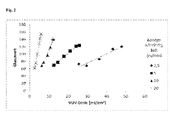
- the tape speed is kept constant as an influencing parameter, an increase of the short-wave UV radiation dose for the paint formulations according to the invention at all belt speeds (2.5-20 m / min and a doubling per step) results in an approximately linear increase in the gloss level up to one the respective paint formulation individually different, maximum value.
- the plot of the short-wave UV radiation dose against the gloss level obtained gives the correlation curve. As the belt speed increases, the slope m of the correlation curves increases steadily (s. Fig. 1 and 2 and examples).
- both the gloss level range is extended to as many as 120 gloss points and the surface quality, such as e.g. the abrasion resistance improved with increased gloss.
- an array with at least two Xe 2 excimer lamps is installed.
- only the power of the at least first lamp is varied between 10 and 100% and the power of the at least second lamp is 100 % constant.
- the variation of the short-wave UV radiation dose is achieved by means of apertures with openings of 10% - 80%.
- the color proofing apparatus used is a printability tester "Printability Tester for Offset Inks" C1 Series 425.1 V 1995 from IGT.
- a belt system to be used according to the invention is known to a person skilled in the art. According to the invention, the irradiation of the wet paint is carried out on a belt system operated with nitrogen.
- the inventive setting of the gloss level is not based as in DE 10 2006 042 063 A1 described on the termination of the short-wave UV-initiated micro-folding process by means of premature curing by the long-wave UV radiation.
- the reaction time after application of the short-wave UV radiation dose must be sufficiently high, ie the belt speed must be sufficiently low or the distance between the short-wave radiation source (s) and the longer-wave radiation source must be large enough.
- This is basically adjustable by a person skilled in the art, preferably a distance of 80 cm between VUV and UV radiation sources in the exemplified system at belt speeds of 2.5 to 20 m / min and short-wave UV radiation doses of 0 to 60 mJ / cm 2 .
- a likewise variation of the method according to the invention is the keeping constant of the VUV radiation dose with variation of the belt speed and radiation source intensity for the adjustment of the gloss levels. Again, it must be ensured that the reaction time after application of the short-wave UV radiation dose is sufficiently large.
- the substrate coated with wet coating formulation is removed in the oven to homogenize the surface prior to irradiation.
- the surface is homogenized.
- the gloss is measured in accordance with the provisions of DIN 67 530: 1982, DIN ISO 2813: 1999, ASTM D 523-08 and D 2457-08. The degree of gloss is measured at a test angle of 60 °.
- the lacquer obtained by the process according to the invention also has an advantageously high contact transparency. Furthermore, the resulting paint surfaces show good resistance to solvents (one minute with solvent vapors such as alcohols, acetates and aromatic solvents with a layer thickness of 4 microns). A satisfactory solvent resistance even against ketones such as acetone is achieved at layer thicknesses of 10 microns.
- Substrates equipped with a specific degree of gloss according to the invention can be used according to the invention for decorating or designing functional surfaces; be used for equipment of automotive, aircraft, rail vehicle or watercraft interior areas or come for use in or on electrical appliances, preferably household electrical appliances or consumer electronics devices, such as decorative films or display foils.
- a preferred use is as an antiglare film for e.g. Displays, touchscreens or photovoltaic cells.
- Example 1 Adjustment of the gloss value by varying the VUV dose for a paint formulation of Desmolux® U 680 H and Desmolux® XP 2740 without addition of nanoparticles
- the paint formulation consisting of 88.0% by weight of Desmolux® U 680 H, 5% by weight of Desmolux® XP 2740, 5% by weight of HDDA and 2% by weight of photoinitiator was introduced into a vessel and stirred at room temperature with a stirrer at 2500 rpm / min for at least 5 min homogenized.
- This lacquer was then applied to polycarbonate strips with a dimension of 3 ⁇ 18 cm 2 using a color proofing device CD Series 425.1 V 1995 from IGT at room temperature in a layer thickness of 2 to 10 ⁇ m over an applicator roll with a contact pressure of 100 N.
- the wet film was immediately exposed in a belt system first short-wave (VUV) and then long-wave UV radiation.
- the radiation dose of the first xenon excimer lamp was varied while the second was kept constant.
- the radiation dose impinging on the substrate can be set by means of the number of lamps, the input current intensity and the signal intensity of the excimer lamp (s) as well as by means of diaphragms between the radiation source and the substrate.
- the radiation dose was varied over the input and signal strength of the excimer lamp (s).
- the dosimeter FlatLog V 1.30 with a VUV sensor from Jenoptik Polymer Systems GmbH was used to determine the dose.
- the long-wave UV radiation was produced by a Hg amalgam lamp (Print Concept type PC-2-W-1000-1 ⁇ 1) with an emission wavelength of 254 nm and an intensity of 550 to 1000 mJ / cm 2 .
- the space around and between the two lamps was cooled and rendered inert by means of a stream of nitrogen.
- the residual oxygen content was ⁇ 12 ppm.
- the distance of the excimer and UV lamps was fixed at 0.8 m in the belt system.
- the dose of short-wave VUV radiation was varied at constant belt speed.
- the variation of the VUV dose was then repeated for other belt speeds.
- the gloss value of the cured coatings was measured with the gloss meter microTRI-gloss in a daylight box , both from the BYK Additives and Instruments.
- Table 1 summarizes the gloss values found as a function of the irradiated VUV dose for different belt speeds.
- Table 1 summarizes the gloss values found as a function of the irradiated VUV dose for different belt speeds.
- Example 2 Adjustment of the gloss value by varying the VUV dose for a paint formulation of Desmolux® U 680 H and Desmolux® XP 2740 with addition of 1% by weight of Aerosil 380
- the paint formulation consisting of 87.1% by weight of Desmolux® U 680 H, 4.95% by weight of Desmolux® XP 2740, 4.95% by weight of HDDA and 2% by weight of photoinitiator and 1% by weight of Aerosil 380 was mixed in a Prepared vessel and homogenized at room temperature with a stirrer at 2500 rev / min for at least 5 min. This paint was then applied according to Example 1 on a polycarbonate substrate and the wet paint formulation film was first exposed in a belt plant short-wave (VUV) and then long-wave UV radiation. Table 2 and Table 3 summarize the gloss values found as a function of the irradiated VUV dose for different belt speeds.
- VUV belt plant short-wave
- Table 2 Gloss value as a function of the VUV dose for the paint formulation of Desmolux® U 680 H and Desmolux® XP 2740 with addition of 1% by weight of Aerosil 380, obtained by irradiation with a xenon excimer lamp.
- Example 3 Adjustment of the gloss value by varying the VUV radiation dose for a paint formulation of Desmolux® U 680 H and Genomer® 4316 with addition of 1% by weight of Aerosil 380
- the paint formulation consisting of 92.85% by weight of Desmolux® U 680 H, 4.85% by weight of Genomer® 4316 and 2% by weight of photoinitiator and 1% by weight of Aerosil 380 was introduced into a vessel and added at room temperature with a stirrer Homogenized at 2500 rpm for at least 5 min. This paint was then applied according to Example 1 on a polycarbonate substrate and the wet paint formulation film was first exposed in a belt plant short-wave (VUV) and then long-wave UV radiation. In Table 4 and 0, the gloss values found are in Dependence of irradiated VUV dose for different tape speeds combined.
- VUV belt plant short-wave
- Example 4 Adjustment of the gloss value by varying the VUV dose for a paint formulation of Desmolux® U 680 H and Desmolux® XP 2740 with addition of 10% by weight of Aerosil 380
- the paint formulation consists of 74.71% by weight of Desmolux® U 680 H, 4.24% by weight of Desmolux® XP 2740, 4.24% by weight of HDDA, 4.9% by weight of Dynasilan VTMO, 0.1% by weight. 4-Metoxy-anisole, 0.01% by weight of maleic anhydride, 9.8% by weight of Aerosil 380 and 2% by weight of photoinitiator.
- the liquid coating components were - except the photoinitiator - presented in a vessel and homogenized for 30 min at 60 ° C internal temperature and 1000 U / min (disc diameter 60 mm). Thereafter, the internal temperature was raised to 65 ° C to max. Increased 70 ° C during the reaction and the rotational speed to 500 rev / min.
Landscapes
- Physics & Mathematics (AREA)
- Engineering & Computer Science (AREA)
- Plasma & Fusion (AREA)
- Application Of Or Painting With Fluid Materials (AREA)
Priority Applications (1)
| Application Number | Priority Date | Filing Date | Title |
|---|---|---|---|
| EP12182410.6A EP2703092A1 (fr) | 2012-08-30 | 2012-08-30 | Procédé de réglage de différents degrés de brillance pour laques durcies par radiation et leur utilisation |
Applications Claiming Priority (1)
| Application Number | Priority Date | Filing Date | Title |
|---|---|---|---|
| EP12182410.6A EP2703092A1 (fr) | 2012-08-30 | 2012-08-30 | Procédé de réglage de différents degrés de brillance pour laques durcies par radiation et leur utilisation |
Publications (1)
| Publication Number | Publication Date |
|---|---|
| EP2703092A1 true EP2703092A1 (fr) | 2014-03-05 |
Family
ID=46940270
Family Applications (1)
| Application Number | Title | Priority Date | Filing Date |
|---|---|---|---|
| EP12182410.6A Withdrawn EP2703092A1 (fr) | 2012-08-30 | 2012-08-30 | Procédé de réglage de différents degrés de brillance pour laques durcies par radiation et leur utilisation |
Country Status (1)
| Country | Link |
|---|---|
| EP (1) | EP2703092A1 (fr) |
Cited By (13)
| Publication number | Priority date | Publication date | Assignee | Title |
|---|---|---|---|---|
| EP2757191A1 (fr) * | 2013-01-17 | 2014-07-23 | Armstrong DLW GmbH | Structure plate peu émissive |
| WO2014113650A1 (fr) * | 2013-01-17 | 2014-07-24 | Armstrong World Industries, Inc. | Procédés de durcissement et produits fabriqués à partir de ces procédés |
| EP3370886A2 (fr) * | 2015-11-02 | 2018-09-12 | Schmid Rhyner Ag | Procédé pour générer des effets de surface, en particulier dans des couches durcissables par uv, dispositif pour réaliser ces effets et article ainsi obtenu |
| WO2019034675A1 (fr) * | 2017-08-16 | 2019-02-21 | Basf Se | Procédé de production de revêtements mats sur des substrats plats |
| IT202000005629A1 (it) * | 2020-03-17 | 2021-09-17 | La Bottega S R L | “metodo di produzione di un oggetto rivestito da uno strato verniciato” |
| WO2024079427A1 (fr) * | 2022-10-12 | 2024-04-18 | Arkema France | Procédés de formation de revêtements mats |
| WO2024209315A1 (fr) * | 2023-04-06 | 2024-10-10 | Arcelormittal | Procédé de gestion du brillant du revêtement sur une ligne de prélaquage en continu |
| WO2024209316A1 (fr) * | 2023-04-06 | 2024-10-10 | Arcelormittal | Procédé de gestion du brillant du revêtement sur une ligne de prélaquage en continu |
| WO2024209314A1 (fr) * | 2023-04-06 | 2024-10-10 | Arcelormittal | Procédé de gestion du brillant du revêtement sur une ligne de prélaquage en continu |
| WO2024209240A1 (fr) * | 2023-04-06 | 2024-10-10 | Arcelormittal | Procédé de gestion du brillant d'un revêtement sur une ligne de prélaquage en continu |
| WO2024209241A1 (fr) * | 2023-04-06 | 2024-10-10 | Arcelormittal | Procédé de gestion du brillant d'un revêtement sur une ligne de revêtement de bobine |
| WO2024209313A1 (fr) * | 2023-04-06 | 2024-10-10 | Arcelormittal | Procédé de gestion du brillant du revêtement sur une ligne de prélaquage en continu |
| WO2025056128A1 (fr) * | 2023-09-14 | 2025-03-20 | Phytonics GmbH | Procédé d'application d'un revêtement réduisant l'éblouissement sur un substrat, liquide de revêtement, verre solaire ou film solaire muni d'un revêtement, cellule solaire et/ou module solaire ainsi qu'installation solaire |
Citations (43)
| Publication number | Priority date | Publication date | Assignee | Title |
|---|---|---|---|---|
| US2991273A (en) | 1956-07-07 | 1961-07-04 | Bayer Ag | Process for manufacture of vacuum moulded parts of high molecular weight thermoplastic polycarbonates |
| US2999846A (en) | 1956-11-30 | 1961-09-12 | Schnell Hermann | High molecular weight thermoplastic aromatic sulfoxy polycarbonates |
| US2999835A (en) | 1959-01-02 | 1961-09-12 | Gen Electric | Resinous mixture comprising organo-polysiloxane and polymer of a carbonate of a dihydric phenol, and products containing same |
| US3148172A (en) | 1956-07-19 | 1964-09-08 | Gen Electric | Polycarbonates of dihydroxyaryl ethers |
| US3189662A (en) | 1961-01-23 | 1965-06-15 | Gen Electric | Organopolysiloxane-polycarbonate block copolymers |
| US3271367A (en) | 1955-03-26 | 1966-09-06 | Bayer Ag | Thermoplastic polycarbonates of dihydroxydiarylene sulfones and their preparation |
| US3419634A (en) | 1966-01-03 | 1968-12-31 | Gen Electric | Organopolysiloxane polycarbonate block copolymers |
| FR1561518A (fr) | 1967-03-10 | 1969-03-28 | ||
| US3494885A (en) | 1967-12-18 | 1970-02-10 | Eastman Kodak Co | Polycarbonate and polyester compositions stabilized with substituted phenothiazines |
| DE1570703A1 (de) | 1964-10-07 | 1970-02-12 | Gen Electric | Hydrolytisch stabile Polycarbonate sowie Verfahren zu deren Herstellung |
| DE1495626B1 (de) | 1960-03-30 | 1971-06-09 | Bayer Ag | Verfahren zum herstellen von polyestern |
| DE2036052A1 (en) | 1970-07-21 | 1972-01-27 | Milchwirtschafthche Forschungs und Untersuchungs Gesellschaft mbH, 2100 Hamburg | Working up of additives in fat and protein - contng foodstuffs |
| DE2063050A1 (de) | 1970-12-22 | 1972-07-13 | Bayer | Verseifungsbeständige Polycarbonate |
| DE2232977A1 (de) | 1971-07-20 | 1973-02-01 | Asahi Optical Co Ltd | Schaltungsanordnung zur blitzlichtausloesung in einer fotografischen kamera |
| DE2211956A1 (de) | 1972-03-11 | 1973-10-25 | Bayer Ag | Verfahren zur herstellung verseifungsstabiler blockcopolycarbonate |
| US3821325A (en) | 1973-03-23 | 1974-06-28 | Gen Electric | Organopolysiloxane-polycarbonate block copolymers |
| US3832419A (en) | 1973-03-23 | 1974-08-27 | Gen Electric | Organopolysiloxane-polycarbonate block copolymers |
| EP0026121A1 (fr) | 1979-08-27 | 1981-04-01 | Union Carbide Corporation | Procédé de préparation de polyarylates en présence d'un éther diphénylique et d'un catalyseur au magnésium |
| EP0026120A1 (fr) | 1979-08-27 | 1981-04-01 | Union Carbide Corporation | Procédé de préparation de polyarylates en présence d'un composé cycloaliphatique |
| EP0026684A1 (fr) | 1979-08-27 | 1981-04-08 | Union Carbide Corporation | Procédé de préparation de polyarylates en présence d'éther diphénylique |
| DE2940024A1 (de) | 1979-10-03 | 1981-04-16 | Bayer Ag, 5090 Leverkusen | Aromatische polyester, verfahren zu ihrer herstellung und ihre verwendung zur herstellung von spritzgussartikeln, folien und ueberzuegen |
| EP0028030A1 (fr) | 1979-10-29 | 1981-05-06 | Union Carbide Corporation | Procédé de stabilisation de polyarylates à l'aide d'un phénol aromatique |
| DE3007934A1 (de) | 1980-03-01 | 1981-09-17 | Bayer Ag, 5090 Leverkusen | Aromatische polyestercarbonate, verfahren zu ihrer herstellung und ihre verwendung zur herstellung von spritzgussartikeln, folien und ueberzuegen |
| EP0039845A1 (fr) | 1980-05-05 | 1981-11-18 | Amoco Corporation | Procédé de préparation de polyacylates en deux étapes |
| EP0079075A2 (fr) | 1981-11-09 | 1983-05-18 | Amoco Corporation | Procédé pour préparer des polyesters ou poly(estercarbonates) en présence d'un auxiliaire de procédé |
| US4386186A (en) | 1982-03-29 | 1983-05-31 | Union Carbide Corporation | Process for preparing polyarylates |
| EP0097970A1 (fr) | 1982-06-30 | 1984-01-11 | Amoco Corporation | Procédé pour la préparation de polyarylates |
| DE3334782A1 (de) | 1983-04-19 | 1984-10-25 | Bayer Ag, 5090 Leverkusen | Verfahren zur herstellung von polydiorganosiloxanen mit hydroxyaryloxy-endgruppen |
| EP0146887A2 (fr) | 1983-12-24 | 1985-07-03 | Bayer Ag | Procédé pour la préparation de polyestercarbonates aromatiques |
| EP0156103A1 (fr) | 1984-01-24 | 1985-10-02 | General Electric Company | Procédé pour la polymérisation de polyestercarbonates |
| US4661580A (en) | 1986-04-01 | 1987-04-28 | Celanese Corporation | Oxygen desorption for improved color of polyesters |
| US4680372A (en) | 1986-02-25 | 1987-07-14 | Celanese Corporation | In-situ end-capping melt prepared aromatic polyester with phenyl benzoate |
| US4680371A (en) | 1986-02-25 | 1987-07-14 | Celanese Corporation | Preparation of aromatic polyester with improved stability by addition of phosphite during preparation |
| DE3832396A1 (de) | 1988-08-12 | 1990-02-15 | Bayer Ag | Dihydroxydiphenylcycloalkane, ihre herstellung und ihre verwendung zur herstellung von hochmolekularen polycarbonaten |
| US4982014A (en) | 1988-08-12 | 1991-01-01 | Bayer Aktiengesellschaft | Dihydroxydiphenyl cycloalkanes, their production and their use for the production of high molecular weight polycarbonates |
| EP0517044A2 (fr) | 1991-06-04 | 1992-12-09 | Bayer Ag | Préparation en continue de polycarbonates |
| DE19842510A1 (de) * | 1998-09-17 | 2000-03-23 | Reisewitz Beschichtungs Gmbh | Verfahren zur Strukturierung der Oberfläche strahlenhärtbarer Lacke und Farben mittels kurzwelliger UV-Strahlung |
| WO2000026275A1 (fr) | 1998-10-29 | 2000-05-11 | General Electric Company | Copolyestercarbonates blocs resistants aux intemperies, procede pour leur preparation et melanges les contenant |
| WO2001005866A1 (fr) | 1999-07-19 | 2001-01-25 | Bayer Aktiengesellschaft | Procede de production de polycarbonates modifies |
| WO2001005867A1 (fr) | 1999-07-19 | 2001-01-25 | Bayer Aktiengesellschaft | Polycarbonate et articles moules en polycarbonate |
| DE10207401A1 (de) | 2001-03-30 | 2002-10-02 | Degussa | Hochgefüllte pastöse siliciumorganische Nano- und/oder Mikrohybridkapseln enthaltende Zusammensetzung für kratz- und/oder abriebfeste Beschichtungen |
| DE102006042063A1 (de) | 2006-09-05 | 2008-03-06 | Institut für Oberflächenmodifizierung e.V. | Verfahren zur Einstellung des Glanzgrades und der Haptik von Oberflächen strahlenhärtbarer Farben und Lacke durch photochemische Mikrofaltung mittels kurzwelliger monochromatischer UV-Strahlung |
| DE102008024149A1 (de) * | 2008-05-19 | 2009-12-03 | Institut für Oberflächenmodifizierung e.V. | Vorrichtung zur Ermittlung der Faltungskinetik und der Faltungsgeschwindigkeit strahlenhärtbarer Farben und Lacke während des Prozesses der photochemische Mikrofaltung initiiert durch kurzwellige monochromatische Excimer-UV-Strahlung |
-
2012
- 2012-08-30 EP EP12182410.6A patent/EP2703092A1/fr not_active Withdrawn
Patent Citations (46)
| Publication number | Priority date | Publication date | Assignee | Title |
|---|---|---|---|---|
| US3271367A (en) | 1955-03-26 | 1966-09-06 | Bayer Ag | Thermoplastic polycarbonates of dihydroxydiarylene sulfones and their preparation |
| US2991273A (en) | 1956-07-07 | 1961-07-04 | Bayer Ag | Process for manufacture of vacuum moulded parts of high molecular weight thermoplastic polycarbonates |
| US3148172A (en) | 1956-07-19 | 1964-09-08 | Gen Electric | Polycarbonates of dihydroxyaryl ethers |
| US2999846A (en) | 1956-11-30 | 1961-09-12 | Schnell Hermann | High molecular weight thermoplastic aromatic sulfoxy polycarbonates |
| US2999835A (en) | 1959-01-02 | 1961-09-12 | Gen Electric | Resinous mixture comprising organo-polysiloxane and polymer of a carbonate of a dihydric phenol, and products containing same |
| DE1495626B1 (de) | 1960-03-30 | 1971-06-09 | Bayer Ag | Verfahren zum herstellen von polyestern |
| US3189662A (en) | 1961-01-23 | 1965-06-15 | Gen Electric | Organopolysiloxane-polycarbonate block copolymers |
| DE1570703A1 (de) | 1964-10-07 | 1970-02-12 | Gen Electric | Hydrolytisch stabile Polycarbonate sowie Verfahren zu deren Herstellung |
| US3419634A (en) | 1966-01-03 | 1968-12-31 | Gen Electric | Organopolysiloxane polycarbonate block copolymers |
| FR1561518A (fr) | 1967-03-10 | 1969-03-28 | ||
| US3494885A (en) | 1967-12-18 | 1970-02-10 | Eastman Kodak Co | Polycarbonate and polyester compositions stabilized with substituted phenothiazines |
| DE2036052A1 (en) | 1970-07-21 | 1972-01-27 | Milchwirtschafthche Forschungs und Untersuchungs Gesellschaft mbH, 2100 Hamburg | Working up of additives in fat and protein - contng foodstuffs |
| DE2063050A1 (de) | 1970-12-22 | 1972-07-13 | Bayer | Verseifungsbeständige Polycarbonate |
| DE2232977A1 (de) | 1971-07-20 | 1973-02-01 | Asahi Optical Co Ltd | Schaltungsanordnung zur blitzlichtausloesung in einer fotografischen kamera |
| DE2211956A1 (de) | 1972-03-11 | 1973-10-25 | Bayer Ag | Verfahren zur herstellung verseifungsstabiler blockcopolycarbonate |
| US3821325A (en) | 1973-03-23 | 1974-06-28 | Gen Electric | Organopolysiloxane-polycarbonate block copolymers |
| US3832419A (en) | 1973-03-23 | 1974-08-27 | Gen Electric | Organopolysiloxane-polycarbonate block copolymers |
| EP0026121A1 (fr) | 1979-08-27 | 1981-04-01 | Union Carbide Corporation | Procédé de préparation de polyarylates en présence d'un éther diphénylique et d'un catalyseur au magnésium |
| EP0026120A1 (fr) | 1979-08-27 | 1981-04-01 | Union Carbide Corporation | Procédé de préparation de polyarylates en présence d'un composé cycloaliphatique |
| EP0026684A1 (fr) | 1979-08-27 | 1981-04-08 | Union Carbide Corporation | Procédé de préparation de polyarylates en présence d'éther diphénylique |
| DE2940024A1 (de) | 1979-10-03 | 1981-04-16 | Bayer Ag, 5090 Leverkusen | Aromatische polyester, verfahren zu ihrer herstellung und ihre verwendung zur herstellung von spritzgussartikeln, folien und ueberzuegen |
| EP0028030A1 (fr) | 1979-10-29 | 1981-05-06 | Union Carbide Corporation | Procédé de stabilisation de polyarylates à l'aide d'un phénol aromatique |
| DE3007934A1 (de) | 1980-03-01 | 1981-09-17 | Bayer Ag, 5090 Leverkusen | Aromatische polyestercarbonate, verfahren zu ihrer herstellung und ihre verwendung zur herstellung von spritzgussartikeln, folien und ueberzuegen |
| EP0039845A1 (fr) | 1980-05-05 | 1981-11-18 | Amoco Corporation | Procédé de préparation de polyacylates en deux étapes |
| EP0079075A2 (fr) | 1981-11-09 | 1983-05-18 | Amoco Corporation | Procédé pour préparer des polyesters ou poly(estercarbonates) en présence d'un auxiliaire de procédé |
| US4386186A (en) | 1982-03-29 | 1983-05-31 | Union Carbide Corporation | Process for preparing polyarylates |
| EP0091602A1 (fr) | 1982-03-29 | 1983-10-19 | Amoco Corporation | Procédé pour la préparation de polyarylates |
| EP0097970A1 (fr) | 1982-06-30 | 1984-01-11 | Amoco Corporation | Procédé pour la préparation de polyarylates |
| DE3334782A1 (de) | 1983-04-19 | 1984-10-25 | Bayer Ag, 5090 Leverkusen | Verfahren zur herstellung von polydiorganosiloxanen mit hydroxyaryloxy-endgruppen |
| EP0146887A2 (fr) | 1983-12-24 | 1985-07-03 | Bayer Ag | Procédé pour la préparation de polyestercarbonates aromatiques |
| EP0156103A1 (fr) | 1984-01-24 | 1985-10-02 | General Electric Company | Procédé pour la polymérisation de polyestercarbonates |
| US4680371A (en) | 1986-02-25 | 1987-07-14 | Celanese Corporation | Preparation of aromatic polyester with improved stability by addition of phosphite during preparation |
| US4680372A (en) | 1986-02-25 | 1987-07-14 | Celanese Corporation | In-situ end-capping melt prepared aromatic polyester with phenyl benzoate |
| EP0234913A2 (fr) | 1986-02-25 | 1987-09-02 | Celanese Corporation | Terminaison de chaîne in-situ de polyesters aromatiques préparés en fusion, pour produire des polymères à stabilité améliorée |
| US4661580A (en) | 1986-04-01 | 1987-04-28 | Celanese Corporation | Oxygen desorption for improved color of polyesters |
| EP0240301A2 (fr) | 1986-04-01 | 1987-10-07 | Celanese Corporation | Désorption d'oxygène pour des polyesters ayant une couleur améliorée |
| DE3832396A1 (de) | 1988-08-12 | 1990-02-15 | Bayer Ag | Dihydroxydiphenylcycloalkane, ihre herstellung und ihre verwendung zur herstellung von hochmolekularen polycarbonaten |
| US4982014A (en) | 1988-08-12 | 1991-01-01 | Bayer Aktiengesellschaft | Dihydroxydiphenyl cycloalkanes, their production and their use for the production of high molecular weight polycarbonates |
| EP0517044A2 (fr) | 1991-06-04 | 1992-12-09 | Bayer Ag | Préparation en continue de polycarbonates |
| DE19842510A1 (de) * | 1998-09-17 | 2000-03-23 | Reisewitz Beschichtungs Gmbh | Verfahren zur Strukturierung der Oberfläche strahlenhärtbarer Lacke und Farben mittels kurzwelliger UV-Strahlung |
| WO2000026275A1 (fr) | 1998-10-29 | 2000-05-11 | General Electric Company | Copolyestercarbonates blocs resistants aux intemperies, procede pour leur preparation et melanges les contenant |
| WO2001005866A1 (fr) | 1999-07-19 | 2001-01-25 | Bayer Aktiengesellschaft | Procede de production de polycarbonates modifies |
| WO2001005867A1 (fr) | 1999-07-19 | 2001-01-25 | Bayer Aktiengesellschaft | Polycarbonate et articles moules en polycarbonate |
| DE10207401A1 (de) | 2001-03-30 | 2002-10-02 | Degussa | Hochgefüllte pastöse siliciumorganische Nano- und/oder Mikrohybridkapseln enthaltende Zusammensetzung für kratz- und/oder abriebfeste Beschichtungen |
| DE102006042063A1 (de) | 2006-09-05 | 2008-03-06 | Institut für Oberflächenmodifizierung e.V. | Verfahren zur Einstellung des Glanzgrades und der Haptik von Oberflächen strahlenhärtbarer Farben und Lacke durch photochemische Mikrofaltung mittels kurzwelliger monochromatischer UV-Strahlung |
| DE102008024149A1 (de) * | 2008-05-19 | 2009-12-03 | Institut für Oberflächenmodifizierung e.V. | Vorrichtung zur Ermittlung der Faltungskinetik und der Faltungsgeschwindigkeit strahlenhärtbarer Farben und Lacke während des Prozesses der photochemische Mikrofaltung initiiert durch kurzwellige monochromatische Excimer-UV-Strahlung |
Non-Patent Citations (11)
| Title |
|---|
| "Paints, Coatings and Solvents, Second, Completely Revised Edition", 1998, WILEY-VCH, pages: 327 - 373 |
| "Römpp Lexikon Lacke und Druckfarben", 1998, GEORG THIEME VERLAG, article "Reaktivverdünner", pages: 491,492 |
| ARNOLD F. HOLLEMAN; EGON WIBERG; NILS WIBERG: "Lehrbuch der anorganischen Chemie, 101. Auflage.", 1995, pages: 869 |
| BAUER F ET AL: "UV curing and matting of acrylate nanocomposite coatings by 172nm excimer irradiation, Part 2", PROGRESS IN ORGANIC COATINGS, ELSEVIER BV, NL, vol. 69, no. 3, 1 November 2010 (2010-11-01), pages 287 - 293, XP027235761, ISSN: 0300-9440, [retrieved on 20100801] * |
| D.G. LEGRAND; J.T. BENDLER: "Handbook of Polycarbonate Science and Technology", 2000, MARCEL DEKKER, pages: 72FF |
| DRES. U. GRIGO; K. KIRCHER; P. R- MÜLLER: "Becker/Braun, Kunststoff-Handbuch", 1992, CARL HANSER VERLAG, article "Polycarbonate", pages: 118 - 145 |
| H. SCHNELL: "Chemistry and Physics of Polycarbonates", 1964, INTERSCIENCE PUBLISHERS, pages: 28 102 |
| H. SCHNELL: "Chemistry and Physics of Polycarbonates, Polymer Reviews", vol. 9, 1964, INTERSCIENCE PUBLISHERS, pages: 33 |
| LÜCKERT: "Pigmente und Füllstofftabellen, Poppdruck", 1994 |
| PAUL W. MORGAN: "Polymer Reviews", vol. 10, 1965, INTERSCIENCE PUBLISHERS, article "Condensation Polymers by Interfacial and Solution Methods", pages: 325 |
| VON JOHAN BIELEMAN: "Lackadditive", 1998, WILEY-VCH |
Cited By (21)
| Publication number | Priority date | Publication date | Assignee | Title |
|---|---|---|---|---|
| EP2757191A1 (fr) * | 2013-01-17 | 2014-07-23 | Armstrong DLW GmbH | Structure plate peu émissive |
| WO2014113650A1 (fr) * | 2013-01-17 | 2014-07-24 | Armstrong World Industries, Inc. | Procédés de durcissement et produits fabriqués à partir de ces procédés |
| EP3370886A2 (fr) * | 2015-11-02 | 2018-09-12 | Schmid Rhyner Ag | Procédé pour générer des effets de surface, en particulier dans des couches durcissables par uv, dispositif pour réaliser ces effets et article ainsi obtenu |
| WO2019034675A1 (fr) * | 2017-08-16 | 2019-02-21 | Basf Se | Procédé de production de revêtements mats sur des substrats plats |
| US11969753B2 (en) | 2017-08-16 | 2024-04-30 | Basf Se | Process for producing matt coatings on sheetlike substrates |
| IT202000005629A1 (it) * | 2020-03-17 | 2021-09-17 | La Bottega S R L | “metodo di produzione di un oggetto rivestito da uno strato verniciato” |
| WO2024079427A1 (fr) * | 2022-10-12 | 2024-04-18 | Arkema France | Procédés de formation de revêtements mats |
| FR3140781A1 (fr) * | 2022-10-12 | 2024-04-19 | Arkema France | Procédés de formation de revêtements mats |
| WO2024209243A1 (fr) * | 2023-04-06 | 2024-10-10 | Arcelormittal | Procédé de gestion du brillant du revêtement sur une ligne de revêtement de bobine |
| WO2024209316A1 (fr) * | 2023-04-06 | 2024-10-10 | Arcelormittal | Procédé de gestion du brillant du revêtement sur une ligne de prélaquage en continu |
| WO2024209315A1 (fr) * | 2023-04-06 | 2024-10-10 | Arcelormittal | Procédé de gestion du brillant du revêtement sur une ligne de prélaquage en continu |
| WO2024209314A1 (fr) * | 2023-04-06 | 2024-10-10 | Arcelormittal | Procédé de gestion du brillant du revêtement sur une ligne de prélaquage en continu |
| WO2024209240A1 (fr) * | 2023-04-06 | 2024-10-10 | Arcelormittal | Procédé de gestion du brillant d'un revêtement sur une ligne de prélaquage en continu |
| WO2024209311A1 (fr) * | 2023-04-06 | 2024-10-10 | Arcelormittal | Procédé de gestion du brillant du revêtement sur une ligne de prélaquage en continu |
| WO2024209242A1 (fr) * | 2023-04-06 | 2024-10-10 | Arcelormittal | Procédé de gestion du brillant du revêtement sur une ligne de revêtement de bobine |
| WO2024209248A1 (fr) * | 2023-04-06 | 2024-10-10 | Arcelormittal | Procédé de gestion du brillant d'un revêtement sur une ligne de revêtement de bobine |
| WO2024209241A1 (fr) * | 2023-04-06 | 2024-10-10 | Arcelormittal | Procédé de gestion du brillant d'un revêtement sur une ligne de revêtement de bobine |
| WO2024209313A1 (fr) * | 2023-04-06 | 2024-10-10 | Arcelormittal | Procédé de gestion du brillant du revêtement sur une ligne de prélaquage en continu |
| WO2024209312A1 (fr) * | 2023-04-06 | 2024-10-10 | Arcelormittal | Procédé de gestion du brillant du revêtement sur une ligne de prélaquage en continu |
| WO2024209247A1 (fr) * | 2023-04-06 | 2024-10-10 | Arcelormittal | Procédé de gestion du brillant du revêtement sur une ligne de revêtement de bobine |
| WO2025056128A1 (fr) * | 2023-09-14 | 2025-03-20 | Phytonics GmbH | Procédé d'application d'un revêtement réduisant l'éblouissement sur un substrat, liquide de revêtement, verre solaire ou film solaire muni d'un revêtement, cellule solaire et/ou module solaire ainsi qu'installation solaire |
Similar Documents
| Publication | Publication Date | Title |
|---|---|---|
| EP3668656B1 (fr) | Procédé de production de revêtements mats sur des substrats plats | |
| DE3851946T2 (de) | Strahlen-härtbare Anstrichstoffe für thermoplastische Substrate. | |
| EP2396373B1 (fr) | Revêtements antireflets / antibuée | |
| EP2794126B1 (fr) | Procédé de fabrication de revêtements matifiés homogènes à l'aide d'un durcissement par rayonnement | |
| EP3720674B1 (fr) | Procédé de transfert d'une structure gaufrée vers la surface d'un revêtement et composite comprenant ledit revêtement | |
| EP2531556B1 (fr) | Substrat en plastique revetu d'un revetement resistant aux rayures, en particulier boitier d'appareils electroniques, dote d'une transparence elevee, son procede de fabrication et son utilisation | |
| EP2598561A1 (fr) | Procédé pour le revêtement résistant aux griffes et à l'abrasion et le matage physique de substrats plastiques, en particulier en poly(méthacrylate de méthyle), par une laque nanocomposite | |
| EP2235116B1 (fr) | Revêtements durs réticulables aux uv contenant de la silice et des acrylates d'uréthane | |
| DE112012003704B4 (de) | Bauteil für ein fahrzeug und herstellungsverfahren dafür | |
| DE112012003705B4 (de) | Beschichtungsmittelzusammensetzung vom härtenden typ | |
| EP3046778B2 (fr) | Films de transfert thermique pour la peinture à sec de surfaces | |
| EP3720673B1 (fr) | Procédé de transfert d'une structure gaufrée vers la surface d'un agent de revêtement et composite pouvant être inséré en tant que matrice de gaufrage | |
| DE102016212106A1 (de) | Selbstheilende Oberflächenschutzfolie mit acrylatfunktionellem Top-Coat | |
| EP0730011A1 (fr) | Revêtement résistant aux rayures, polymérisable aux U.V. et contenant un agent épaississant polymérisable | |
| EP2459627A1 (fr) | Produits multicouches contenant des revêtements à base d'acrylate | |
| DE19842510A1 (de) | Verfahren zur Strukturierung der Oberfläche strahlenhärtbarer Lacke und Farben mittels kurzwelliger UV-Strahlung | |
| DE102006002596A1 (de) | Verbundfolie | |
| WO2006125723A1 (fr) | Procede de production de materiaux durcis resistants aux eraflures | |
| EP3008136B1 (fr) | Feuilles de polycarbonate revêtues à faible effet de moiré | |
| DE112021006887B4 (de) | Beschichtungsmittel für harzglas und harzglas | |
| EP3008138B1 (fr) | Feuille de polycarbonate à faible effet de moiré, résistant aux rayures et résistant aux solvants | |
| EP2746352B1 (fr) | Couche de protection en polymère contre l'inhibition d'oxygène dans le cadre de la mise en réseau radicale d'acrylates ou de méthacrylates liquides et son procédé de fabrication | |
| DE112021006872B4 (de) | Beschichtungsmittel für harzglas und harzglas | |
| JP7464411B2 (ja) | 活性エネルギー線硬化型建材塗料、及び得られた化粧シート | |
| DE102019130267B3 (de) | Verbesserte Dualcure-Beschichtungsstoffe, deren Verwendung und Verfahren zur Herstellung einer Klarlackschicht |
Legal Events
| Date | Code | Title | Description |
|---|---|---|---|
| AK | Designated contracting states |
Kind code of ref document: A1 Designated state(s): AL AT BE BG CH CY CZ DE DK EE ES FI FR GB GR HR HU IE IS IT LI LT LU LV MC MK MT NL NO PL PT RO RS SE SI SK SM TR |
|
| AX | Request for extension of the european patent |
Extension state: BA ME |
|
| PUAI | Public reference made under article 153(3) epc to a published international application that has entered the european phase |
Free format text: ORIGINAL CODE: 0009012 |
|
| RIN1 | Information on inventor provided before grant (corrected) |
Inventor name: HOVESTADT, WIELAND, DR. Inventor name: MEINHARD, DIETER, DR. Inventor name: REICHERT, PETER, DR. Inventor name: BUESGEN, THOMAS, DR. Inventor name: ZOELL, NICOLE Inventor name: BILZ, EVELIN |
|
| STAA | Information on the status of an ep patent application or granted ep patent |
Free format text: STATUS: THE APPLICATION HAS BEEN WITHDRAWN |
|
| 18W | Application withdrawn |
Effective date: 20140829 |