EP2704065A1 - Système et procédé pour mettre à jour une structure de données avec des données de mesure de capteur - Google Patents
Système et procédé pour mettre à jour une structure de données avec des données de mesure de capteur Download PDFInfo
- Publication number
- EP2704065A1 EP2704065A1 EP12179412.7A EP12179412A EP2704065A1 EP 2704065 A1 EP2704065 A1 EP 2704065A1 EP 12179412 A EP12179412 A EP 12179412A EP 2704065 A1 EP2704065 A1 EP 2704065A1
- Authority
- EP
- European Patent Office
- Prior art keywords
- data
- sensor
- covariance matrix
- mean vector
- data set
- Prior art date
- Legal status (The legal status is an assumption and is not a legal conclusion. Google has not performed a legal analysis and makes no representation as to the accuracy of the status listed.)
- Withdrawn
Links
Images



Classifications
-
- G—PHYSICS
- G06—COMPUTING OR CALCULATING; COUNTING
- G06F—ELECTRIC DIGITAL DATA PROCESSING
- G06F16/00—Information retrieval; Database structures therefor; File system structures therefor
- G06F16/20—Information retrieval; Database structures therefor; File system structures therefor of structured data, e.g. relational data
- G06F16/23—Updating
-
- G—PHYSICS
- G06—COMPUTING OR CALCULATING; COUNTING
- G06N—COMPUTING ARRANGEMENTS BASED ON SPECIFIC COMPUTATIONAL MODELS
- G06N20/00—Machine learning
-
- G—PHYSICS
- G06—COMPUTING OR CALCULATING; COUNTING
- G06F—ELECTRIC DIGITAL DATA PROCESSING
- G06F17/00—Digital computing or data processing equipment or methods, specially adapted for specific functions
- G06F17/10—Complex mathematical operations
- G06F17/16—Matrix or vector computation, e.g. matrix-matrix or matrix-vector multiplication, matrix factorization
-
- G—PHYSICS
- G06—COMPUTING OR CALCULATING; COUNTING
- G06N—COMPUTING ARRANGEMENTS BASED ON SPECIFIC COMPUTATIONAL MODELS
- G06N5/00—Computing arrangements using knowledge-based models
- G06N5/04—Inference or reasoning models
-
- G—PHYSICS
- G06—COMPUTING OR CALCULATING; COUNTING
- G06N—COMPUTING ARRANGEMENTS BASED ON SPECIFIC COMPUTATIONAL MODELS
- G06N7/00—Computing arrangements based on specific mathematical models
- G06N7/01—Probabilistic graphical models, e.g. probabilistic networks
Definitions
- the present invention generally relates to electronic data processing and in particular to systems and methods for processing sensor measurement data.
- Measurement, estimation, and prediction of spatio-temporal phenomena are relevant to various use cases.
- a spatio-temporal phenomenon such as gas pollution in urban environments may harm the health of the locals if it exceeds a certain threshold.
- CO carbon monoxide
- CO2 carbon dioxide
- a precise estimation and prediction of gas pollution in a specific region at a specific time can help to prevent harmful situations.
- Such spatio-temporal phenomena may also be observed in other situations, for example, in astrophysics, medicine, robotics, human-computer interaction, and geo-physics.
- Spatially distributed sensor networks typically include a large number of sensor nodes which provide measurement data about spatio-temporal phenomena in their vicinity.
- the sensor nodes may be distributed uniformly or irregular throughout the area. The size of the area can range from as small as, for example, a small lake to a megacity or even the night sky.
- the sensor nodes may cover the area in a fine or coarse pattern.
- sensor networks normally measure large amounts of data for an analysis. In addition to that, the analysis is more complicated because the data is noisy. However, performing a space-time regression analysis for estimation and prediction on such large data sets of sensor measurements are computationally demanding or even intractable.
- GPs Gaussian Process
- GPs allow non-parametric learning of a regression function from noisy data; this is also called training.
- GPs can be considered Gaussian distributions over functions conditioned on the data.
- GPs provide a regression function for estimation and prediction as well as uncertainty estimates, for example, error bars, depending on the noise and the variability of the data.
- computations for training a GP scales with O ( n 3 ) , where n is the number of data points, for example, the complete set of measured data.
- the so-called Big- O -Notation is an indicator for the limiting behavior of a function when its argument tends to a particular value, typically a very big number or infinity.
- the Big- O -Notation therefore, describes the computational load on a processor. Since a measurement of a spatio-temporal phenomenon normally results in large amounts of data, that is, the argument n, the cubic behavior O ( n 3 ) is prohibitive for processing on computers with standard processors. Furthermore, the update of the GP with new measurement data is even more demanding since each new training session requires batch processing of all measurement data acquired over time. In addition, since all measurement data has to be available all of the time, enough memory capabilities, such as Random Access Memory (RAM) and mass storage, have to be provided. For GP see also: Carl E. Rasmussen and Christopher Williams. Gaussian Processes for Machine Learning. MIT Press, 2006 .
- RAM Random Access Memory
- Embodiments of the invention provide system and method for accurate sequential training of GPs for spatio-temporal phenomena in complex environments with multi-dimensional measurement data. Furthermore, the GP regression training can be independent from a specific application scenario and can be used for an a priori unknown sensor network comprising fixed as well as mobile sensor nodes.
- sequentially received sensor node measurement data from arbitrary sensor locations in a respective area is recursively processed by a computer to update a data structure.
- the resulting computational complexity is O ( n ) .
- the data structure holds all information for a GP estimation and prediction of a respective spatio-temporal phenomenon.
- the data structure only requires a limited memory capacity, since in this approach, historic measurement data of sensor nodes is incorporated into the data structure without storing the raw measurement data. In other words, the raw data can be discarded once the data structure has been updated with the received measurement data.
- the data structure reflects a spatio-temporal phenomenon in a physical area, wherein the spatio-temporal phenomenon is estimated at any location of the physical area by a Gaussian Process with a mean function and a covariance function.
- the mean function describes the trend of the spatio-temporal phenomenon in terms of a general function of any location and the covariance function describes the correlation of any two locations.
- the actual function of the spatio-temporal phenomenon is not known. But the GP is used for estimations of the values of that spatio-temporal phenomenon.
- a computer implemented method for updating the data structure includes: storing a data set that is adapted to represent fixed locations of the physical area, wherein the data set has a mean vector and a covariance matrix according to the Gaussian Process, and wherein the data structure includes the mean vector and the covariance matrix; receiving sensor measurement data of the spatio-temporal phenomenon from at least one sensor node out of a plurality of sensor nodes located at specific arbitrary locations of the physical area; and merging the specific arbitrary locations and the received measurement data into the data structure by using a so-called exact recursive Bayesian regression.
- the "data set that is adapted to represent fixed locations” is also referred to "the data set adapted to represent fixed locations” as well as “data set of fixed locations” or just “data set” when the context clearly defines it.
- the computer implemented method advantageously allows that the received sensor measurement data needs not to be stored for a later GP learning, because the merging step incorporates the received measurement data into the data structure.
- the measurement data provided by the sensor nodes is incorporated into the mean vector, and the location data of the sensor nodes into the covariance matrix. Therefore, only limited memory capacity is required; compared to the prior art, less memory is required.
- the fixed locations and the specific arbitrary locations of the sensor nodes need not to be identical.
- the fixed locations can be chosen uniformly distributed over the area; a random distribution or any other appropriate distribution is also possible.
- the number of fixed locations can be significantly smaller than the number of the specific arbitrary locations or the sum of respective numbers of specific arbitrary locations when receiving sensor measurement data sequentially.
- the computer implemented method can be computed in O ( n ) .
- the data structure can be updated by a processor in a computational linear effort, thus, reducing the runtime significantly compared to prior art.
- the exact recursive Bayesian regression is exact in the sense that it has no calculation which is based on, for example, heuristic approximation like in prior art. In fact, it is an exact calculation during the GP learning and, therefore, can be applied on various application scenarios; it also enables the processing of multi-dimensional sensor measurement data which might be received at a specific arbitrary location.
- the computer implemented method further comprises an inversion of the kernel matrix of the data set of fixed locations stored in a further data structure.
- the computer implemented method processes also an inversion of the kernel matrix of the data set of fixed locations.
- This inversion has a computational complexity of O ( s 3 ) where s is the size of the data set.
- O ( s 3 ) where s is the size of the data set.
- this inversion has to be calculated only once and can be stored in the further data structure for a later recursive processing of the computer implemented method by a processor.
- the resulting computational effort is, therefore, O ( s 3 + s 2 n ) , wherein s typically is s ⁇ n .
- sensor measurement data arrives sequentially. Therefore, the computer implemented method is executed by the processor each time when new sensor measurement data from specific arbitrary locations arrive.
- the resulting effort for the processor is reduced to O ( n ) for s ⁇ n .
- the computer implemented method further comprises: calculating an initial mean vector and an initial covariance matrix by applying a given mean function on the data set of fixed locations and by applying the data set with itself on the covariance function.
- the invention allows initializing the mean vector and the covariance matrix without prior knowledge. This is achieved by initializing a covariance matrix with the covariance function being evaluated at all fixed locations. In other words, the data set of fixed locations is applied with itself on the covariance function, which means that maximum uncertainty is assigned to the fixed locations of the covariance matrix.
- the GP allows the mean vector to be initialized by evaluating a given mean function at the fixed locations. For example, it is possible to use the zero mean function.
- this knowledge can also be used for initialization of the mean vector.
- the information provided by the measurement is incorporated into this mean vector and this covariance matrix which improves the estimates.
- the specific arbitrary location of the at least one sensor node has changed over time.
- the computer implemented method can still process the received measurement data from the changing locations. This is possible, because the update of the mean vector and the covariance matrix does not require measurement data from steady specific arbitrary locations; it can process measurement data from any location, since the GP includes a continuous description of the spatio-temporal phenomenon at any location. Therefore, advantageously, for example, a mobile sensor node can be utilized for collecting measurement data which is then being processed by a processor.
- the computer implemented method further includes: deriving estimation data of the spatio-temporal phenomenon for arbitrary locations at the physical area from the mean vector and the covariance matrix, wherein at least one arbitrary location lacks measurement data; and generating a notification dependent on the estimated data.
- This aspect of the invention allows estimations of the spatio-temporal phenomenon at arbitrary locations, that is, interpolation of locations in the area and also extrapolation outside the area.
- a heat map visualizing the spatio-temporal phenomenon can be generated which can be interpreted by a human.
- a heat map is a graphical representation of data where the individual values contained in a matrix are represented as colors or graphical patterns/structures.
- Another example can be a warning signal which might be transmitted by audio frequency equipment in order to warn people in a specific area in a city where dangerous air pollution might have been built up; or a computer signal which might trigger an action at another computer system, for example, an alarm at the fire department which then evacuates the people within the hazardous zone.
- Embodiments of the invention can be implemented as a computer program product and a computer system.
- the computer system can run the computer program product to execute the method.
- FIG. 1 shows a system for a recursive space-time regression based on GPs according to one embodiment of the invention.
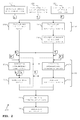
- FIG. 2 is an exemplary flow chart according to one embodiment of the computer implemented method of the invention.
- FIG. 3 illustrates plots for an exemplary recursive regression processing of a GP for sequentially arriving measurement data sets.
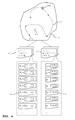
- FIG. 4 shows an illustration of the locations of a movable sensor node in a physical area.
- FIG. 5 shows an exemplary interpolation of a physical area for an illustration of a heat map.
- FIG. 1 shows an overview of one embodiment of the invention that includes computer system 100 and a plurality of sensor nodes in physical area 102.
- computer system 100 and the area, are depicted.
- the computer system and the area are illustratively separated by the vertical and horizontal double-solid lines.
- computer system 100 can be distinguished into initialization part 110, update part 120, and presentation part 130.
- Physical area 102 is covered by at least one sensor node out of a plurality of sensor nodes.
- a sensor node can be placed within the area or be directed at the area, such as for measuring luminous intensity of light sources.
- a sensor node is a hardware, which includes at least one measurement unit for measuring a specific phenomenon type of a spatio-temporal phenomenon.
- the measurement data may be raw data measured by the respective sensor node.
- Measurement data 109 may be measurements of one sensor node or the measurements of a part or all sensor nodes out of the plurality of sensor nodes. Measurement data 109 can be seen as a data set taken at a specific time. Thus, at different time instances different measurements can be available. In FIG. 1 , having measurement data 109 at different time instances is illustrated by the stacked document symbol.
- measurement data 109 may have the measurements from all sensor nodes, or may miss measurements from at least one sensor node or a sensor measurement unit of a sensor node; also including measurements from new sensor nodes or measurement units can be possible.
- Measurement data 109 may be directly communicate to the computer system via interface 121 or may be, for example, relayed by other network nodes to the computer system. Communication structures of a network might be used for the data transmission.
- Measurement data 109 may have associated sensor location data 106 of the respective locations of the sensor nodes.
- a sensor node can be placed at arbitrary locations at physical area 102.
- the plurality of sensor nodes can be uniformly distributed across physical area 102.
- other distributions across physical area 102 can be possible to serve optimized sensor measuring of the spatio-temporal phenomenon.
- a spatio-temporal phenomenon is often Gaussian distributed, thus, a uniformly allocated sensor node network might provide optimized results.
- locations of sensor nodes might change during any two time instances, or, a sensor node might not provide measurements, which means that there is no measurement data from the respective location available.
- the data sets of sensor location data 106 at different time instances is illustrated in FIG. 1 by the stacked document symbol.
- FIG. 4 shows an example of a movable sensor node 520 in physical area 502 at different time instances.
- physical area 502 is also non-moving sensor node 510.
- Route 530 of movable sensor node 520 is illustrated by the curved dotted line; the crosses on route 530 illustrate time instances when movable sensor node 520 is transmitting or polled for measurement data and location data.
- Route 530 has not to be known.
- movable sensor node 520 and non-moving sensor node 510 provide their respective measurements, that is, sensor location data 506 and sensor measurement data 509, at the same time instances.
- the location data matrix X t at time instance t includes the location data of the movable sensor 520 in the first row, whereas the location data of the static sensor 510 are included in the second row.
- the number values used in FIG. 4 are only exemplary and do not represent actual correct values.
- initialization part 110 of the computer system 100 includes location allocation component 116 and initialization component 118.
- Location allocation component 116 has information about physical area 102 and can allocate fixed locations 114 across a representation 112 of physical area 102.
- the allocation of fixed locations 114 can be uniformly distributed or in any other pattern.
- Fixed locations 114 and sensor node locations 104 do not need to be identical, but can be identical.
- Location allocation component 116 provides data set 115 of fixed locations 114 to initialization component 118.
- Data set 115 of fixed locations can also be obtained from other sources than a location allocation component, for example, by using the information about an existing network of sensor nodes.
- Data set 115 can be implemented as a matrix, wherein each fixed location can be represented by a location vector. In this example, no measurement values for fixed locations 114 are available.
- Initialization component 118 calculates an initial covariance matrix C 0 from the data set 115 of fixed locations, also called a kernel matrix, and an initial mean vector ⁇ 0 ⁇ Calculating the initial mean vector ⁇ 0 without information about measurements from the fixed locations can be achieved by, for example, using the zero mean function. Also other mean functions can be used.
- the initial covariance matrix C 0 and mean vector ⁇ 0 are stored in data structure 117.
- Update part 120 includes inference component 128, update component 129, interface component 121, and memory module 123.
- update component 129 updates the initial covariance matrix C 0 and the initial mean vector ⁇ 0 to the resulting data structure 127.
- Data structure 127 is an update of the initial values, thus, it replaces these values and holds the information of sensor measurement data 109 at sensor locations 106. Therefore, the current information about sensor locations and sensor measurement data 109 can be discarded.
- data structure 127 can recursively serve as input for the update round of the covariance matrix C t and mean vector ⁇ t at this new time instance t.
- the update of data structure 117, 127 requires an inversion of the kernel matrix C 0 .
- An inversion of a matrix has the computational complexity of O ( s 3 ), where s is the number of fixed locations. Since the fixed locations do not change during the update cycles the inversion may be stored in memory module 123 to reduce computational effort of the processor.
- Data structure 127 can be further processed in the presentation part 130 of computer system 100.
- Presentation part 130 includes interpolation allocation component 136, interpolation component 138, and presentation component 131.
- Interpolation allocation component 136 can be used to determine data set 125 of interpolation locations 134 according to the respective notification task. For example, if a visual illustration of a spatio-temporal phenomenon should be shown on a smartphone screen, less interpolation locations 134 might be required than on a 24-inch computer screen.
- Interpolation allocation component 136 has - similar to location allocation component 116 - information about physical area 102 and can, for example, uniformly allocate interpolation locations 134 on representation 132 of physical area 102. Interpolation locations 132 need not be identical with sensor locations 104 or fixed locations 114.
- Data set 125 of interpolation locations 134 can also be obtained from other sources than a dedicated interpolation allocation component, for example, it may be determined by the requirements of presentation component 131.
- FIG. 5 shows an exemplary interpolation of a physical area for an illustration of a heat map.
- Representation 610 of the physical area has an overlaid grid 612. The intersections of grid 612, for example, can determine interpolation locations.
- the black dots in representation 610 of the physical area represent fixed locations. Fixed locations are not necessarily sensor node locations. Fixed locations and interpolation locations need no to be identical, however, they can be, for example at location 614, 616.
- Heat map 622 on the representation 620 of the physical area illustrates a distribution of a specific measurement type of the spatio-temporal phenomenon.
- the gaps between the solid lines on heat map 622 represent a high density 624 or low density 626 of the measurement type, respectively.
- Heat map 139 is shown in presentation component 131.
- the values for the respective interpolation locations 134 on heat map 139 are obtained from interpolation component 138.
- Interpolation component 138 processes data set 125 of interpolation locations 134 with data structure 127 in order to estimate covariance matrix C * and mean vector ⁇ *.
- Interpolation component 138 can also use the inversion of the kernel matrix stored in memory module 123.
- Result 137 is used to generate the notification, in this example, heat map 139.
- Data structure 117, 127 is not identical with result 137: data structure 117, 127 is based on the number of fixed locations 114 whereas result 137 is based on the number of interpolation locations 134.
- the dimension (which is, in this example, based on number of locations, fixed locations, or interpolation locations) of result 137 is higher than the dimension of data structure 117, 127, because for an interpolation a much higher number of interpolation locations 134 are used to obtain an appropriate heat map 139.
- Initialization component 118, inference component 128, and interpolation component 138 are based on the same calculations with the respective input data.
- the calculations also include the inversion of the kernel matrix of fixed locations 114. Since, in this example, fixed locations 114 do not change, the inversion can be used as if it is a constant. Thus, it is stored in memory module 123, as mentioned above, to reduce computational effort during the recursive update cycle or the interpolation.
- fixed locations 114 of the kernel matrix may have to be changed.
- a change may be required due to a spatial relocation of the spatio-temporal phenomenon, for example, in case wind influences the spatial gas allocation or the initial data set 115 of fixed locations 114 was not well chosen.
- the inverse of k' can be, for example, calculated by re-using the inverse k -1 of k by exploiting either the Schur complement or the rank-one update. This results in a quadratic computational complexity instead of the cubic complexity of a full inversion of the kernel matrix.
- the person skilled in the art can apply this calculation for adding and deleting fixed locations 114 in order to avoid a anew calculation of the inversion of the kernel matrix in O ( s 3 ) where s is the number of fixed locations 114.
- Fig. 2 is an exemplary flow chart of a computer implemented method 200 according to one embodiment of the invention for updating data structure 117, 127 (cf. Fig. 1 ) reflecting a spatio-temporal phenomenon in a physical area 102 (cf. Fig. 1 ), wherein the spatio-temporal phenomenon is estimated at any location of the physical area by a Gaussian Process with a mean function and a covariance function.
- the method starts with storing 210 a data set that is adapted to represent fixed locations of the physical area, wherein the data set has a mean vector and a covariance matrix according to the Gaussian Process, and wherein the data structure includes the mean vector and the covariance matrix.
- the method further includes receiving 222 sensor measurement data 109 (cf.
- Fig. 1 of the spatio-temporal phenomenon from at least one sensor node (cf. Fig. 1 ) and receiving 224 a corresponding data set 106 (cf. Fig. 1 ) of specific arbitrary sensor locations 104 of that sensor node located in the physical area 102 (cf. Fig. 1 ).
- the output data in step 210, 222, and 224 of computer implemented method 200 is illustrated by a corresponding reference placeholder, that is, y t , X t , and X , respectively.
- the reference placeholder for an output data can be input data at another position in the exemplary flow chart. This illustration is used in order to simplify the flow chart.
- the data set of fixed locations and the data set of specific arbitrary locations are different; there are no sensor nodes located at the locations that are represented by the data set of fixed locations and no measurement data is available.
- the locations can be identical and sensor measurement data may be available.
- Method 200 proceeds with initialization 250 which includes calculating 252 an initial mean vector and calculating 254 and initial covariance matrix.
- the initial mean vector is calculated 252 by applying a mean function, for example, the zero mean function, on the data set of fixed locations X . This can be achieved without having information about any measurement data, since the spatio-temporal phenomenon is assumed to be Gaussian distributed.
- the initial covariance matrix is calculated 254; this is the kernel matrix. In other words, the data set of fixed locations X is applied with itself on the covariance function.
- This mean vector and this covariance matrix are included in data structure 117, 127 (cf. Fig. 1 ). In other embodiments, calculating the initial mean vector may be done with existing measurement data.
- merging 230, and interpolation 280 calculating an inversion of the kernel matrix is required (cf. formulas (16), (22)).
- the calculation of an inversion requires the computational effort O ( s 3 ), where s is the number of fixed locations.
- the number of fixed locations is constant for as long as no new fixed location is added to the data set of fixed locations or a fixed location is deleted from the data set. Therefore, optionally storing 240 the inversion of the kernel matrix in a further data structure, for example, memory module 123 (cf. Fig. 1 ), reduces the overall computing time of a processor when executing method 200. This optional method step is indicated in Fig. 2 by the dashed box for storing step 240.
- Merging 230 includes inferring 232 an intermediary mean vector and inferring 234 an intermediary covariance matrix, as well as, updating 236 the initial mean vector and updating 238 the initial covariance matrix, which means, updating data structure 117, 127 (cf. Fig. 1 ) by incorporating the intermediary mean vector and sensor measurement data y t into the initial mean vector, and the intermediary covariance matrix into the initial covariance matrix.
- Inferring 232, 234 (cf. formulas (16) to (18)) and updating 236, 238 (cf. formulas (19) to (21)) is based on the specific arbitrary locations X t and the data set of fixed locations X .
- the current sensor measurement data y t and the corresponding sensor location data X t can be discarded, since the information which is represented by them is incorporated into data structure 117, 127 (cf. Fig. 1 ); executing method 200 with new sensor measurement data at the same or at other sensor node locations can be done without historic data of former measurements.
- merging 230 can recursively incorporate this information into the mean vector and the covariance matrix.
- the dashed arrows indicate the iterative step and the dashed reference placeholder for y t and X t indicate the input data for the respective method step.
- Such iteration does not require historic sensor measurement data; it does require the data set of fixed locations X and optionally the inversion stored at step 240 in order to reduce processing effort of the processor.
- method 200 can proceed with deriving 280 estimation data of the spatio-temporal phenomenon for arbitrary locations at the physical area.
- This interpolation can be performed at any location, as illustrated by formulas (22) to (24); it is not necessary to have measurement data at locations.
- the estimated interpolation data can be used to generate 290 a notification dependent on this data.
- a notification can be, for example, a visual representation of the spatio-temporal phenomenon.
- a GP is used to infer the latent function g ( ⁇ ) from the data D .
- the GP is completely defined by a mean function m ( x ) E ⁇ g ( x ) ⁇ , which specifies the expected output value, and a positive semidefinite covariance function k ( x , x ' ) cov ⁇ g ( x ) ,g ( x' ) ⁇ , which specifies the covariance between pairs of inputs and is often called a kernel.
- A is a diagonal matrix of the characteristic length-scales for each input dimension and ⁇ 2 is the variance of the latent function h.
- Such parameters of the mean and covariance functions together with the noise variance ⁇ 2 are called the hyper-parameters of the GP. For this illustration, it is assumed that the hyper-parameters are given and thus, need not to be learned from data.
- a GP forms a Gaussian distribution over function, it can be written as ( x ) ⁇ GP ( m ( x ) , k ( x , x ' )) .
- the resulting distribution of the outputs is a multivariate Gaussian.
- y ⁇ 1 : t d ⁇ g ⁇ t c t ⁇ p t y ⁇ t
- of the matrix M is M A ⁇ Q . Further information on the correctness of Lemma 1 and Lemma 2 can be found, for example, at:
- the joint prior can be written as p t - 1 ⁇ g ⁇ , g ⁇ l
- y ⁇ 1 : l - 1 p g ⁇ l
- g t can be updated by means of a Kalman filter update step. Updating g and integrating out g t is then preformed simultaneously.
- the updated data structure that is mean ⁇ ⁇ t g and covariance C t g
- ⁇ ⁇ * m X * + J * ⁇ ⁇ ⁇ t g - m X
- C * k X * ⁇ X * + J * ⁇ C l g - k X ⁇ X ⁇ J * T ,
- Fig. 3 shows plots of the update of the data structure for an exemplary one-dimensional spatio-temporal phenomenon during two sensor data measurements without any prior sensor measurement data.
- the plots illustrate the improvement of the estimates of mean ⁇ ⁇ t g and covariance C t g between two sets of sensor measurement data when there was no prior sensor measurement data available.
- Graph 301 is the real but unknown function of the phenomenon.
- the gray section 308 indicates the variance of the estimates for GP 306. As the accuracy of the estimates is improving, the gray section approximates the real function from plot to plot.
- This function is assumed to be not known and has to be estimated from sensor measurements. In other words, there is no knowledge about the spatio-temporal phenomenon available.
- the dimension of the fixed locations can be of higher a higher value. Therefore, in other embodiments, the fixed locations might be represented by basis vectors.
- the inverse required for J 0 is calculated by inverting C 0 g . This inversion has to be performed only once. That means, the result can be stored and reused in all subsequent steps of the method, which reduces the overall computational load.
- X * [ x 1 x 2 ... x 50 ] T .
- the spatio-temporal phenomenon is described by the unknown function 301 which is illustrated as a solid line.
- the current recursive GP 306 is illustrated as a dashed line, and the fixed locations, i.e., the basis scalars, with their mean values ⁇ * 302 as circles on GP 306. Since at this initial method step no measurement data is available, the estimate is zero everywhere. In other words, the fixed locations may all have zero mean.
- the 2sigma bound of a current estimate is illustrated by grey section 308, which covers plot 300 completely. The 2sigma bound is calculated by taking the square roots of diagonal elements of the covariance matrix C * and then multiplying them with two, since it is the 2sigma bound.
- the current mean ⁇ ⁇ 2 g and covariance C 2 g has all sensor measurement data integrated. Therefore, the spatio-temporal phenomenon can be interpolated at arbitrary locations, for example, at points on the interval [0,4] with a corresponding location matrix X * . This is achieved by applying formula (22) to (24) with X * for deriving the respective ⁇ *and covariance C * for an, for example, visual illustration of the spatio-temporal phenomenon.
- Embodiments of the invention can be implemented in digital electronic circuitry, or in computer hardware, firmware, software, or in combinations of them.
- the invention can be implemented as a computer program product, for example, a computer program tangibly embodied in an information carrier, for example, in a machine-readable storage device, for execution by, or to control the operation of, data processing apparatus, for example, a programmable processor, a computer, or multiple computers.
- a computer program as claimed can be written in any form of programming language, including compiled or interpreted languages, and it can be deployed in any form, including as a standalone program or as a module, component, subroutine, or other unit suitable for use in a computing environment.
- a computer program can be deployed to be executed on one computer or on multiple computers at one site or distributed across multiple sites and interconnected by a communication network.
- the described methods can all be executed by corresponding computer products on the respective devices, for example, the first and second computers, the trusted computers and the communication means.
- Method steps of the invention can be performed by one or more programmable processors executing a computer program to perform functions of the invention by operating on input data and generating output. Method steps can also be performed by, and apparatus of the invention can be implemented as, special purpose logic circuitry, for example, a field programmable gate array (FPGA) or an application-specific integrated circuit (ASIC).
- FPGA field programmable gate array
- ASIC application-specific integrated circuit
- processors suitable for the execution of a computer program include, by way of example, both general and special purpose microprocessors, and any one or more processors of any kind of digital computing device.
- a processor will receive instructions and data from a read-only memory or a random access memory or both.
- the essential elements of a computer are at least one processor for executing instructions and one or more memory devices for storing instructions and data.
- a computer will also include, or be operatively coupled to receive data from or transfer data to, or both, one or more mass storage devices for storing data, for example, magnetic, magneto-optical disks, optical disks or solid state disks.
- mass storage devices for storing data, for example, magnetic, magneto-optical disks, optical disks or solid state disks.
- Such storage means may also provisioned on demand and be accessible through the Internet (e.g., Cloud Computing).
- Information carriers suitable for embodying computer program instructions and data include all forms of non-volatile memory, including by way of example semiconductor memory devices, for example, EPROM, EEPROM, and flash memory devices; magnetic disks, e.g., internal hard disks or removable disks; magneto-optical disks; and CD-ROM and DVD-ROM disks.
- semiconductor memory devices for example, EPROM, EEPROM, and flash memory devices
- magnetic disks e.g., internal hard disks or removable disks
- magneto-optical disks e.g., CD-ROM and DVD-ROM disks.
- the processor and the memory can be supplemented by, or incorporated in special purpose logic circuitry.
- the invention can be implemented on a computer having a display device, for example, a cathode ray tube (CRT) or liquid crystal display (LCD) monitor, for displaying information to the user and an input device such as a keyboard, touchscreen or touchpad, a pointing device, for example, a mouse or a trackball, by which the user can provide input to the computer.
- a display device for example, a cathode ray tube (CRT) or liquid crystal display (LCD) monitor
- an input device such as a keyboard, touchscreen or touchpad, a pointing device, for example, a mouse or a trackball, by which the user can provide input to the computer.
- Other kinds of devices can be used to provide for interaction with a user as well; for example, feedback provided to the user can be any form of sensory feedback, for example, visual feedback, auditory feedback, or tactile feedback; and input from the user can be received in any form, including acoustic, speech, or tactile input.
- the invention can be implemented in a computing system that includes a back-end component, for example, as a data server, or that includes a middleware component, for example, an application server, or that includes a front-end component, for example, a client computer having a graphical user interface or a Web browser through which a user can interact with an implementation of the invention, or any combination of such back-end, middleware, or front-end components.
- Client computers can also be mobile devices, such as smartphones, tablet PCs or any other handheld or wearable computing device.
- the components of the system can be interconnected by any form or medium of digital data communication, for example, a communication network. Examples of communication networks include a local area network (LAN) and a wide area network (WAN), for example, the Internet or wireless LAN or telecommunication networks.
- LAN local area network
- WAN wide area network
- the computing system can include clients and servers.
- a client and a server are generally remote from each other and typically interact through a communication network.
- the relationship of client and server arises by virtue of computer programs running on the respective computers and having a client-server relationship to each other.
Landscapes
- Engineering & Computer Science (AREA)
- Theoretical Computer Science (AREA)
- Physics & Mathematics (AREA)
- General Physics & Mathematics (AREA)
- Data Mining & Analysis (AREA)
- Mathematical Physics (AREA)
- Software Systems (AREA)
- General Engineering & Computer Science (AREA)
- Computing Systems (AREA)
- Artificial Intelligence (AREA)
- Evolutionary Computation (AREA)
- Computational Mathematics (AREA)
- Pure & Applied Mathematics (AREA)
- Mathematical Optimization (AREA)
- Mathematical Analysis (AREA)
- Databases & Information Systems (AREA)
- Algebra (AREA)
- Computer Vision & Pattern Recognition (AREA)
- Medical Informatics (AREA)
- Computational Linguistics (AREA)
- Probability & Statistics with Applications (AREA)
- Testing Or Calibration Of Command Recording Devices (AREA)
- Complex Calculations (AREA)
Priority Applications (7)
| Application Number | Priority Date | Filing Date | Title |
|---|---|---|---|
| EP12179412.7A EP2704065A1 (fr) | 2012-08-06 | 2012-08-06 | Système et procédé pour mettre à jour une structure de données avec des données de mesure de capteur |
| PCT/EP2013/065960 WO2014023607A1 (fr) | 2012-08-06 | 2013-07-30 | Système et procédé pour mettre à jour une structure de données avec des données de mesure de capteur |
| US14/415,608 US20150234880A1 (en) | 2012-08-06 | 2013-07-30 | System and method for updating a data structure with sensor measurement data |
| KR1020157005909A KR20150068948A (ko) | 2012-08-06 | 2013-07-30 | 센서 측정 데이터를 이용하여 데이터 구조를 업데이트하기 위한 시스템 및 방법 |
| CN201380051238.0A CN104798090A (zh) | 2012-08-06 | 2013-07-30 | 用传感器测量数据更新数据结构的系统和方法 |
| JP2015525820A JP2015524594A (ja) | 2012-08-06 | 2013-07-30 | センサ測定データを用いてデータ構造を更新するためのシステムおよび方法 |
| IL236801A IL236801A (en) | 2012-08-06 | 2015-01-19 | A method and system for updating data structure using data sensors |
Applications Claiming Priority (1)
| Application Number | Priority Date | Filing Date | Title |
|---|---|---|---|
| EP12179412.7A EP2704065A1 (fr) | 2012-08-06 | 2012-08-06 | Système et procédé pour mettre à jour une structure de données avec des données de mesure de capteur |
Publications (1)
| Publication Number | Publication Date |
|---|---|
| EP2704065A1 true EP2704065A1 (fr) | 2014-03-05 |
Family
ID=49029068
Family Applications (1)
| Application Number | Title | Priority Date | Filing Date |
|---|---|---|---|
| EP12179412.7A Withdrawn EP2704065A1 (fr) | 2012-08-06 | 2012-08-06 | Système et procédé pour mettre à jour une structure de données avec des données de mesure de capteur |
Country Status (7)
| Country | Link |
|---|---|
| US (1) | US20150234880A1 (fr) |
| EP (1) | EP2704065A1 (fr) |
| JP (1) | JP2015524594A (fr) |
| KR (1) | KR20150068948A (fr) |
| CN (1) | CN104798090A (fr) |
| IL (1) | IL236801A (fr) |
| WO (1) | WO2014023607A1 (fr) |
Cited By (4)
| Publication number | Priority date | Publication date | Assignee | Title |
|---|---|---|---|---|
| US9721162B2 (en) | 2014-06-16 | 2017-08-01 | Agt International Gmbh | Fusion-based object-recognition |
| CN111639787A (zh) * | 2020-04-28 | 2020-09-08 | 北京工商大学 | 一种基于图卷积网络的时空数据预测方法 |
| EP3822882A1 (fr) * | 2019-11-18 | 2021-05-19 | Robert Bosch GmbH | Estimation des effets causaux dans un système physique |
| CN116701371A (zh) * | 2023-06-09 | 2023-09-05 | 中国科学院地理科学与资源研究所 | 协方差分析下大气温度数据缺失值插补方法及其插补装置 |
Families Citing this family (15)
| Publication number | Priority date | Publication date | Assignee | Title |
|---|---|---|---|---|
| US10034144B2 (en) * | 2013-02-22 | 2018-07-24 | International Business Machines Corporation | Application and situation-aware community sensing |
| JP6507512B2 (ja) * | 2014-07-25 | 2019-05-08 | 富士通株式会社 | 推定プログラム、推定方法および推定装置 |
| US9866507B2 (en) | 2015-04-27 | 2018-01-09 | Agt International Gmbh | Method of monitoring well-being of semi-independent persons and system thereof |
| KR101657414B1 (ko) * | 2015-05-20 | 2016-09-30 | 경희대학교 산학협력단 | Cpu 사용률 제어 장치 및 방법 |
| CN105898691B (zh) * | 2016-03-14 | 2019-06-04 | 河海大学常州校区 | 基于粒子化和积算法的无线传感器网络目标跟踪方法 |
| US10267951B2 (en) | 2016-05-12 | 2019-04-23 | The Climate Corporation | Statistical blending of weather data sets |
| US20180073904A1 (en) * | 2016-09-14 | 2018-03-15 | General Electric Company | Estimation approach for use with a virtual flow meter |
| JP6562883B2 (ja) * | 2016-09-20 | 2019-08-21 | 株式会社東芝 | 特性値推定装置および特性値推定方法 |
| US11244091B2 (en) * | 2017-01-23 | 2022-02-08 | International Business Machines Corporation | Missing sensor value estimation |
| US10949497B2 (en) * | 2018-01-26 | 2021-03-16 | Crocus Energy | High-speed multi-input tracker based on in-memory operations of time-dependent data |
| KR102023701B1 (ko) * | 2018-11-26 | 2019-11-04 | 한국건설기술연구원 | 이종 광섬유 센서의 측정결과 융합을 이용한 구조물의 변형률 분포 측정방법 및 장치 |
| CN110516198B (zh) * | 2019-07-17 | 2023-04-07 | 电子科技大学 | 一种分布式非线性卡尔曼滤波方法 |
| CN110659405A (zh) * | 2019-09-25 | 2020-01-07 | 南京源堡科技研究院有限公司 | 一种基于云环境的网络信息采集方法 |
| CN111209537B (zh) * | 2019-12-30 | 2023-04-07 | 中科宇图科技股份有限公司 | 一种基于高斯回归的空间细粒度污染推断方法 |
| DE102021201919A1 (de) * | 2021-03-01 | 2022-09-01 | Robert Bosch Gesellschaft mit beschränkter Haftung | Vorrichtung und insbesondere computerimplementiertes Verfahren für nicht-deterministische technische Systeme |
Family Cites Families (7)
| Publication number | Priority date | Publication date | Assignee | Title |
|---|---|---|---|---|
| US6092033A (en) * | 1997-04-16 | 2000-07-18 | Uhlmann; Jeffrey K. | Method and apparatus for fusing mean and covariance estimates |
| US6829568B2 (en) * | 2002-04-26 | 2004-12-07 | Simon Justin Julier | Method and apparatus for fusing signals with partially known independent error components |
| US7289906B2 (en) * | 2004-04-05 | 2007-10-30 | Oregon Health & Science University | Navigation system applications of sigma-point Kalman filters for nonlinear estimation and sensor fusion |
| US7584081B2 (en) * | 2005-11-21 | 2009-09-01 | Chevron U.S.A. Inc. | Method, system and apparatus for real-time reservoir model updating using ensemble kalman filter |
| US8706424B2 (en) * | 2009-06-30 | 2014-04-22 | H2Scan Corporation | System for estimating a gas concentration in a mixed atmosphere |
| EP2527931B1 (fr) * | 2011-05-23 | 2018-02-07 | Honeywell spol s.r.o. | Filtre Kalman distribué tolérant aux défaillances de communication |
| US9367819B2 (en) * | 2011-06-01 | 2016-06-14 | Bae Systems Plc | Sensor data processing |
-
2012
- 2012-08-06 EP EP12179412.7A patent/EP2704065A1/fr not_active Withdrawn
-
2013
- 2013-07-30 CN CN201380051238.0A patent/CN104798090A/zh active Pending
- 2013-07-30 WO PCT/EP2013/065960 patent/WO2014023607A1/fr not_active Ceased
- 2013-07-30 US US14/415,608 patent/US20150234880A1/en not_active Abandoned
- 2013-07-30 JP JP2015525820A patent/JP2015524594A/ja active Pending
- 2013-07-30 KR KR1020157005909A patent/KR20150068948A/ko not_active Withdrawn
-
2015
- 2015-01-19 IL IL236801A patent/IL236801A/en not_active IP Right Cessation
Non-Patent Citations (10)
| Title |
|---|
| A.H. JAZWINSKI: "Stochastic Processes and Filtering Theory", 2007, DOVER PUBLICATIONS, INC. |
| ATHANASSIOS BOULIS ET AL: "Aggregation in sensor networks: an energy-accuracy trade-off", AD HOC NETWORKS, vol. 1, no. 2-3, 1 September 2003 (2003-09-01), AMSTERDAM, NL, pages 317 - 331, XP055444973, ISSN: 1570-8705, DOI: 10.1016/S1570-8705(03)00009-X * |
| BOULIS A ET AL: "Aggregation in sensor networks: an energy accuracy trade-off", NEW FRONTIERS IN TELECOMMUNICATIONS : 2003 IEEE INTERNATIONAL CONFERENCE ON COMMUNICATIONS ; ICC 2003 ; 11 - 15 MAY 2003, ANCHORAGE, ALASKA, USA; [IEEE INTERNATIONAL CONFERENCE ON COMMUNICATIONS], IEEE OPERATIONS CENTER, PISCATAWAY, NJ, 1 January 2003 (2003-01-01), pages 128 - 138, XP010642624, ISBN: 978-0-7803-7802-5 * |
| CARL E. RASMUSSEN; CHRISTOPHER WILLIAMS: "Gaussian Processes for Machine Learning", 2006, MIT PRESS |
| D. J. SALMOND: "Ph.D. dissertation", vol. A.4, 1989, ROYAL AEROSPACE ESTABLISHMENT, article "Tracking in Uncertain Environments", pages: 261 - 262 |
| DIETER FOX ET AL: "Bayesian Filtering for Location Estimation", vol. 2, no. 3, 30 September 2003 (2003-09-30), pages 24 - 33, XP002598055, ISSN: 1536-1268, Retrieved from the Internet <URL:http://ieeexplore.ieee.org/xpls/abs_all.jsp?arnumber=1228524&tag=1> [retrieved on 20100825] * |
| JONATHAN KO ET AL: "GP-BayesFilters: Bayesian filtering using Gaussian process prediction and observation models", INTELLIGENT ROBOTS AND SYSTEMS, 2008. IROS 2008. IEEE/RSJ INTERNATIONAL CONFERENCE ON, IEEE, PISCATAWAY, NJ, USA, 22 September 2008 (2008-09-22), pages 3471 - 3476, XP031348720, ISBN: 978-1-4244-2057-5 * |
| OSBORNE M A ET AL: "Towards Real-Time Information Processing of Sensor Network Data Using Computationally Efficient Multi-output Gaussian Processes", INFORMATION PROCESSING IN SENSOR NETWORKS, 2008. IPSN '08. INTERNATIONAL CONFERENCE ON, IEEE, PISCATAWAY, NJ, USA, 22 April 2008 (2008-04-22), pages 109 - 120, XP031246704, ISBN: 978-0-7695-3157-1 * |
| W. J. DUNCAN: "Some devices for the solution of large sets of simulations linear equations", PHILOSOPHICAL MAGAZINE SERIES 7, vol. 35, no. 249, 1944, pages 660 - 670 |
| W.H. PRESS; S.A. TEUKOLSKY; W.T. VETTERLING; B.P. FLANNERY: "Numerical Recipes: The Art of Scientific Computing", 2007, CAMBRIDGE UNIVERSITY PRESS |
Cited By (6)
| Publication number | Priority date | Publication date | Assignee | Title |
|---|---|---|---|---|
| US9721162B2 (en) | 2014-06-16 | 2017-08-01 | Agt International Gmbh | Fusion-based object-recognition |
| EP3822882A1 (fr) * | 2019-11-18 | 2021-05-19 | Robert Bosch GmbH | Estimation des effets causaux dans un système physique |
| CN111639787A (zh) * | 2020-04-28 | 2020-09-08 | 北京工商大学 | 一种基于图卷积网络的时空数据预测方法 |
| CN111639787B (zh) * | 2020-04-28 | 2024-03-15 | 北京工商大学 | 一种基于图卷积网络的时空数据预测方法 |
| CN116701371A (zh) * | 2023-06-09 | 2023-09-05 | 中国科学院地理科学与资源研究所 | 协方差分析下大气温度数据缺失值插补方法及其插补装置 |
| CN116701371B (zh) * | 2023-06-09 | 2024-03-22 | 中国科学院地理科学与资源研究所 | 协方差分析下大气温度数据缺失值插补方法及其插补装置 |
Also Published As
| Publication number | Publication date |
|---|---|
| CN104798090A (zh) | 2015-07-22 |
| JP2015524594A (ja) | 2015-08-24 |
| WO2014023607A1 (fr) | 2014-02-13 |
| KR20150068948A (ko) | 2015-06-22 |
| IL236801A (en) | 2017-12-31 |
| US20150234880A1 (en) | 2015-08-20 |
Similar Documents
| Publication | Publication Date | Title |
|---|---|---|
| US20150234880A1 (en) | System and method for updating a data structure with sensor measurement data | |
| Oates et al. | Control functionals for Monte Carlo integration | |
| Stewart et al. | Data assimilation with correlated observation errors: experiments with a 1-D shallow water model | |
| Kantas et al. | Sequential Monte Carlo methods for high-dimensional inverse problems: A case study for the Navier--Stokes equations | |
| Gning et al. | Bernoulli particle/box-particle filters for detection and tracking in the presence of triple measurement uncertainty | |
| Kulikov et al. | Accurate state estimation in the Van der Vusse reaction | |
| Guedri et al. | Robustness of structural reliability analyses to epistemic uncertainties | |
| EP2515260A1 (fr) | Dispositif et procédé de traitement d'informations et support d'enregistrement associé | |
| Matarazzo et al. | Sensitivity metrics for maximum likelihood system identification | |
| Tan et al. | Green’s matching: an efficient approach to parameter estimation in complex dynamic systems | |
| Bao et al. | An implicit algorithm of solving nonlinear filtering problems | |
| Sander | Interpolated experience replay for improved sample efficiency of model-free deep reinforcement learning algorithms | |
| Zou et al. | Adaptive particle-based approximations of the Gibbs posterior for inverse problems | |
| Norton et al. | Numerical Approximation of the Frobenius--Perron Operator using the Finite Volume Method | |
| Kimpton et al. | Cross-validation based adaptive sampling for multi-level Gaussian process models | |
| Särkkä et al. | Probabilistic methods in multiple target tracking | |
| JP7133175B2 (ja) | 空間データ高解像度化装置、空間データ高解像度化方法、及び空間データ高解像度化プログラム | |
| Müller et al. | Statistical trilateration with skew-t errors | |
| Ma et al. | Unifying tree-reweighted belief propagation and mean field for tracking extended targets | |
| Beer et al. | Conceptual comparison of Bayesian approaches and imprecise probabilities | |
| Papamarkou et al. | Geometric adaptive Monte Carlo in random environment | |
| Kurdyaeva et al. | Efficient global sensitivity analysis of biochemical networks using Gaussian process regression | |
| Wendelstorf | The accuracy of indirect measurements and model calibration by falsification | |
| Tong et al. | Computational modeling for parallel grid-based recursive Bayesian estimation: parallel computation using graphics processing unit | |
| Kracker et al. | Uncertainty in gaussian process interpolation |
Legal Events
| Date | Code | Title | Description |
|---|---|---|---|
| AK | Designated contracting states |
Kind code of ref document: A1 Designated state(s): AL AT BE BG CH CY CZ DE DK EE ES FI FR GB GR HR HU IE IS IT LI LT LU LV MC MK MT NL NO PL PT RO RS SE SI SK SM TR |
|
| AX | Request for extension of the european patent |
Extension state: BA ME |
|
| PUAI | Public reference made under article 153(3) epc to a published international application that has entered the european phase |
Free format text: ORIGINAL CODE: 0009012 |
|
| 17P | Request for examination filed |
Effective date: 20140902 |
|
| RBV | Designated contracting states (corrected) |
Designated state(s): AL AT BE BG CH CY CZ DE DK EE ES FI FR GB GR HR HU IE IS IT LI LT LU LV MC MK MT NL NO PL PT RO RS SE SI SK SM TR |
|
| RAP1 | Party data changed (applicant data changed or rights of an application transferred) |
Owner name: AGT INTERNATIONAL GMBH |
|
| RAP1 | Party data changed (applicant data changed or rights of an application transferred) |
Owner name: AGT INTERNATIONAL GMBH |
|
| STAA | Information on the status of an ep patent application or granted ep patent |
Free format text: STATUS: EXAMINATION IS IN PROGRESS |
|
| 17Q | First examination report despatched |
Effective date: 20180201 |
|
| STAA | Information on the status of an ep patent application or granted ep patent |
Free format text: STATUS: THE APPLICATION IS DEEMED TO BE WITHDRAWN |
|
| 18D | Application deemed to be withdrawn |
Effective date: 20180814 |