EP2704245A1 - Verfahren zur Herstellung von kohlenstoffbeschichteten Elektrodenaktivmaterialpartikeln - Google Patents
Verfahren zur Herstellung von kohlenstoffbeschichteten Elektrodenaktivmaterialpartikeln Download PDFInfo
- Publication number
- EP2704245A1 EP2704245A1 EP12380045.0A EP12380045A EP2704245A1 EP 2704245 A1 EP2704245 A1 EP 2704245A1 EP 12380045 A EP12380045 A EP 12380045A EP 2704245 A1 EP2704245 A1 EP 2704245A1
- Authority
- EP
- European Patent Office
- Prior art keywords
- carbon
- active material
- particles
- deposition
- coating
- Prior art date
- Legal status (The legal status is an assumption and is not a legal conclusion. Google has not performed a legal analysis and makes no representation as to the accuracy of the status listed.)
- Withdrawn
Links
- 229910052799 carbon Inorganic materials 0.000 title claims abstract description 146
- OKTJSMMVPCPJKN-UHFFFAOYSA-N Carbon Chemical compound [C] OKTJSMMVPCPJKN-UHFFFAOYSA-N 0.000 title claims abstract description 139
- 239000002245 particle Substances 0.000 title claims abstract description 61
- 238000000034 method Methods 0.000 title claims abstract description 55
- 239000007772 electrode material Substances 0.000 title claims abstract description 23
- 238000000576 coating method Methods 0.000 claims abstract description 42
- 239000011149 active material Substances 0.000 claims abstract description 36
- 239000011248 coating agent Substances 0.000 claims abstract description 36
- 238000000354 decomposition reaction Methods 0.000 claims abstract description 12
- 238000005240 physical vapour deposition Methods 0.000 claims abstract description 9
- 238000000151 deposition Methods 0.000 claims description 31
- 230000008021 deposition Effects 0.000 claims description 28
- 239000000843 powder Substances 0.000 claims description 18
- 229910052744 lithium Inorganic materials 0.000 claims description 17
- 229910052751 metal Inorganic materials 0.000 claims description 10
- 239000002184 metal Substances 0.000 claims description 10
- XEEYBQQBJWHFJM-UHFFFAOYSA-N iron Substances [Fe] XEEYBQQBJWHFJM-UHFFFAOYSA-N 0.000 claims description 8
- PXHVJJICTQNCMI-UHFFFAOYSA-N nickel Substances [Ni] PXHVJJICTQNCMI-UHFFFAOYSA-N 0.000 claims description 7
- 229910052723 transition metal Inorganic materials 0.000 claims description 6
- 150000003624 transition metals Chemical group 0.000 claims description 6
- KEQXNNJHMWSZHK-UHFFFAOYSA-L 1,3,2,4$l^{2}-dioxathiaplumbetane 2,2-dioxide Chemical compound [Pb+2].[O-]S([O-])(=O)=O KEQXNNJHMWSZHK-UHFFFAOYSA-L 0.000 claims description 5
- 239000006182 cathode active material Substances 0.000 claims description 5
- 229910052742 iron Inorganic materials 0.000 claims description 5
- 239000000203 mixture Substances 0.000 claims description 5
- 229910052708 sodium Inorganic materials 0.000 claims description 5
- 239000011734 sodium Substances 0.000 claims description 5
- UQSXHKLRYXJYBZ-UHFFFAOYSA-N Iron oxide Chemical compound [Fe]=O UQSXHKLRYXJYBZ-UHFFFAOYSA-N 0.000 claims description 4
- 229910052782 aluminium Inorganic materials 0.000 claims description 4
- 239000010405 anode material Substances 0.000 claims description 4
- 238000007740 vapor deposition Methods 0.000 claims description 4
- 229920000049 Carbon (fiber) Polymers 0.000 claims description 3
- 239000004917 carbon fiber Substances 0.000 claims description 3
- 229910052748 manganese Inorganic materials 0.000 claims description 3
- VNWKTOKETHGBQD-UHFFFAOYSA-N methane Chemical compound C VNWKTOKETHGBQD-UHFFFAOYSA-N 0.000 claims description 3
- 229910052759 nickel Inorganic materials 0.000 claims description 3
- CMZUMMUJMWNLFH-UHFFFAOYSA-N sodium metavanadate Chemical compound [Na+].[O-][V](=O)=O CMZUMMUJMWNLFH-UHFFFAOYSA-N 0.000 claims description 3
- 229910000693 sodium vanadium oxide Inorganic materials 0.000 claims description 3
- KXNAKBRHZYDSLY-UHFFFAOYSA-N sodium;oxygen(2-);titanium(4+) Chemical compound [O-2].[Na+].[Ti+4] KXNAKBRHZYDSLY-UHFFFAOYSA-N 0.000 claims description 3
- 229910000314 transition metal oxide Inorganic materials 0.000 claims description 3
- WFKWXMTUELFFGS-UHFFFAOYSA-N tungsten Chemical compound [W] WFKWXMTUELFFGS-UHFFFAOYSA-N 0.000 claims description 3
- 229910052721 tungsten Inorganic materials 0.000 claims description 3
- 239000010937 tungsten Substances 0.000 claims description 3
- 229910052720 vanadium Inorganic materials 0.000 claims description 3
- QPLDLSVMHZLSFG-UHFFFAOYSA-N Copper oxide Chemical compound [Cu]=O QPLDLSVMHZLSFG-UHFFFAOYSA-N 0.000 claims description 2
- 239000005751 Copper oxide Substances 0.000 claims description 2
- 229910006483 Li1+xM2−xO4 Inorganic materials 0.000 claims description 2
- XUIMIQQOPSSXEZ-UHFFFAOYSA-N Silicon Chemical compound [Si] XUIMIQQOPSSXEZ-UHFFFAOYSA-N 0.000 claims description 2
- ATJFFYVFTNAWJD-UHFFFAOYSA-N Tin Chemical compound [Sn] ATJFFYVFTNAWJD-UHFFFAOYSA-N 0.000 claims description 2
- GWEVSGVZZGPLCZ-UHFFFAOYSA-N Titan oxide Chemical compound O=[Ti]=O GWEVSGVZZGPLCZ-UHFFFAOYSA-N 0.000 claims description 2
- RLTFLELMPUMVEH-UHFFFAOYSA-N [Li+].[O--].[O--].[O--].[V+5] Chemical compound [Li+].[O--].[O--].[O--].[V+5] RLTFLELMPUMVEH-UHFFFAOYSA-N 0.000 claims description 2
- FDLZQPXZHIFURF-UHFFFAOYSA-N [O-2].[Ti+4].[Li+] Chemical compound [O-2].[Ti+4].[Li+] FDLZQPXZHIFURF-UHFFFAOYSA-N 0.000 claims description 2
- 229910000428 cobalt oxide Inorganic materials 0.000 claims description 2
- IVMYJDGYRUAWML-UHFFFAOYSA-N cobalt(ii) oxide Chemical compound [Co]=O IVMYJDGYRUAWML-UHFFFAOYSA-N 0.000 claims description 2
- 229910052802 copper Inorganic materials 0.000 claims description 2
- 239000010949 copper Substances 0.000 claims description 2
- 229910000431 copper oxide Inorganic materials 0.000 claims description 2
- 230000001747 exhibiting effect Effects 0.000 claims description 2
- 229910002804 graphite Inorganic materials 0.000 claims description 2
- 239000010439 graphite Substances 0.000 claims description 2
- SHXXPRJOPFJRHA-UHFFFAOYSA-K iron(iii) fluoride Chemical compound F[Fe](F)F SHXXPRJOPFJRHA-UHFFFAOYSA-K 0.000 claims description 2
- 229910000686 lithium vanadium oxide Inorganic materials 0.000 claims description 2
- 229910052749 magnesium Inorganic materials 0.000 claims description 2
- 238000001755 magnetron sputter deposition Methods 0.000 claims description 2
- 229910000480 nickel oxide Inorganic materials 0.000 claims description 2
- GNRSAWUEBMWBQH-UHFFFAOYSA-N oxonickel Chemical compound [Ni]=O GNRSAWUEBMWBQH-UHFFFAOYSA-N 0.000 claims description 2
- 238000004549 pulsed laser deposition Methods 0.000 claims description 2
- 229910052710 silicon Inorganic materials 0.000 claims description 2
- 239000010703 silicon Substances 0.000 claims description 2
- 239000011029 spinel Substances 0.000 claims description 2
- 229910052596 spinel Inorganic materials 0.000 claims description 2
- 229910052718 tin Inorganic materials 0.000 claims description 2
- 239000010936 titanium Substances 0.000 claims description 2
- 229910052719 titanium Inorganic materials 0.000 claims description 2
- OGIDPMRJRNCKJF-UHFFFAOYSA-N titanium oxide Inorganic materials [Ti]=O OGIDPMRJRNCKJF-UHFFFAOYSA-N 0.000 claims description 2
- 229910052725 zinc Inorganic materials 0.000 claims description 2
- 230000008569 process Effects 0.000 abstract description 5
- 238000005289 physical deposition Methods 0.000 abstract description 2
- 229910010764 LiFeSO4F Inorganic materials 0.000 description 29
- 229910002986 Li4Ti5O12 Inorganic materials 0.000 description 19
- 229910011279 LiCoPO4 Inorganic materials 0.000 description 17
- UBEWDCMIDFGDOO-UHFFFAOYSA-N cobalt(II,III) oxide Inorganic materials [O-2].[O-2].[O-2].[O-2].[Co+2].[Co+3].[Co+3] UBEWDCMIDFGDOO-UHFFFAOYSA-N 0.000 description 17
- 239000003792 electrolyte Substances 0.000 description 16
- 239000007833 carbon precursor Substances 0.000 description 13
- 229910001416 lithium ion Inorganic materials 0.000 description 12
- 239000002002 slurry Substances 0.000 description 12
- 239000011888 foil Substances 0.000 description 10
- 239000000463 material Substances 0.000 description 10
- 238000002360 preparation method Methods 0.000 description 10
- KMTRUDSVKNLOMY-UHFFFAOYSA-N Ethylene carbonate Chemical compound O=C1OCCO1 KMTRUDSVKNLOMY-UHFFFAOYSA-N 0.000 description 7
- 238000002156 mixing Methods 0.000 description 7
- 238000000197 pyrolysis Methods 0.000 description 7
- WHXSMMKQMYFTQS-UHFFFAOYSA-N Lithium Chemical compound [Li] WHXSMMKQMYFTQS-UHFFFAOYSA-N 0.000 description 6
- 239000002033 PVDF binder Substances 0.000 description 6
- 239000011230 binding agent Substances 0.000 description 6
- 230000005540 biological transmission Effects 0.000 description 6
- 239000005388 borosilicate glass Substances 0.000 description 6
- 238000002474 experimental method Methods 0.000 description 6
- 239000000835 fiber Substances 0.000 description 6
- 230000014759 maintenance of location Effects 0.000 description 6
- 230000003647 oxidation Effects 0.000 description 6
- 238000007254 oxidation reaction Methods 0.000 description 6
- 229920002981 polyvinylidene fluoride Polymers 0.000 description 6
- 229910052493 LiFePO4 Inorganic materials 0.000 description 5
- 239000002131 composite material Substances 0.000 description 5
- 230000001351 cycling effect Effects 0.000 description 5
- 239000007788 liquid Substances 0.000 description 5
- 239000002609 medium Substances 0.000 description 5
- 238000012360 testing method Methods 0.000 description 5
- 229910013188 LiBOB Inorganic materials 0.000 description 4
- 238000002441 X-ray diffraction Methods 0.000 description 4
- 239000000654 additive Substances 0.000 description 4
- 230000008859 change Effects 0.000 description 4
- 239000011247 coating layer Substances 0.000 description 4
- 150000001875 compounds Chemical class 0.000 description 4
- 239000010410 layer Substances 0.000 description 4
- 238000001000 micrograph Methods 0.000 description 4
- 239000002243 precursor Substances 0.000 description 4
- 239000002904 solvent Substances 0.000 description 4
- 239000000126 substance Substances 0.000 description 4
- UHOVQNZJYSORNB-UHFFFAOYSA-N Benzene Chemical compound C1=CC=CC=C1 UHOVQNZJYSORNB-UHFFFAOYSA-N 0.000 description 3
- 238000001669 Mossbauer spectrum Methods 0.000 description 3
- YXFVVABEGXRONW-UHFFFAOYSA-N Toluene Chemical compound CC1=CC=CC=C1 YXFVVABEGXRONW-UHFFFAOYSA-N 0.000 description 3
- 230000000996 additive effect Effects 0.000 description 3
- 238000006243 chemical reaction Methods 0.000 description 3
- KRKNYBCHXYNGOX-UHFFFAOYSA-N citric acid Chemical compound OC(=O)CC(O)(C(O)=O)CC(O)=O KRKNYBCHXYNGOX-UHFFFAOYSA-N 0.000 description 3
- 238000009792 diffusion process Methods 0.000 description 3
- 238000003760 magnetic stirring Methods 0.000 description 3
- 239000011572 manganese Substances 0.000 description 3
- 238000004519 manufacturing process Methods 0.000 description 3
- 239000002105 nanoparticle Substances 0.000 description 3
- VYPSYNLAJGMNEJ-UHFFFAOYSA-N silicon dioxide Inorganic materials O=[Si]=O VYPSYNLAJGMNEJ-UHFFFAOYSA-N 0.000 description 3
- 238000007669 thermal treatment Methods 0.000 description 3
- RYGMFSIKBFXOCR-UHFFFAOYSA-N Copper Chemical compound [Cu] RYGMFSIKBFXOCR-UHFFFAOYSA-N 0.000 description 2
- -1 FeSO4F Chemical compound 0.000 description 2
- DGAQECJNVWCQMB-PUAWFVPOSA-M Ilexoside XXIX Chemical compound C[C@@H]1CC[C@@]2(CC[C@@]3(C(=CC[C@H]4[C@]3(CC[C@@H]5[C@@]4(CC[C@@H](C5(C)C)OS(=O)(=O)[O-])C)C)[C@@H]2[C@]1(C)O)C)C(=O)O[C@H]6[C@@H]([C@H]([C@@H]([C@H](O6)CO)O)O)O.[Na+] DGAQECJNVWCQMB-PUAWFVPOSA-M 0.000 description 2
- 238000004813 Moessbauer spectroscopy Methods 0.000 description 2
- 238000001069 Raman spectroscopy Methods 0.000 description 2
- 238000001237 Raman spectrum Methods 0.000 description 2
- XAGFODPZIPBFFR-UHFFFAOYSA-N aluminium Chemical compound [Al] XAGFODPZIPBFFR-UHFFFAOYSA-N 0.000 description 2
- 239000006229 carbon black Substances 0.000 description 2
- 230000015556 catabolic process Effects 0.000 description 2
- 239000003795 chemical substances by application Substances 0.000 description 2
- 239000011889 copper foil Substances 0.000 description 2
- 239000013078 crystal Substances 0.000 description 2
- 238000006731 degradation reaction Methods 0.000 description 2
- 238000001493 electron microscopy Methods 0.000 description 2
- 238000001704 evaporation Methods 0.000 description 2
- 230000008020 evaporation Effects 0.000 description 2
- 238000010438 heat treatment Methods 0.000 description 2
- 229910000359 iron(II) sulfate Inorganic materials 0.000 description 2
- 238000000386 microscopy Methods 0.000 description 2
- 229920000642 polymer Polymers 0.000 description 2
- 238000012545 processing Methods 0.000 description 2
- 239000010453 quartz Substances 0.000 description 2
- 230000009467 reduction Effects 0.000 description 2
- 238000007086 side reaction Methods 0.000 description 2
- BTBUEUYNUDRHOZ-UHFFFAOYSA-N Borate Chemical compound [O-]B([O-])[O-] BTBUEUYNUDRHOZ-UHFFFAOYSA-N 0.000 description 1
- BWGNESOTFCXPMA-UHFFFAOYSA-N Dihydrogen disulfide Chemical group SS BWGNESOTFCXPMA-UHFFFAOYSA-N 0.000 description 1
- 229910002588 FeOOH Inorganic materials 0.000 description 1
- AVXURJPOCDRRFD-UHFFFAOYSA-N Hydroxylamine Chemical class ON AVXURJPOCDRRFD-UHFFFAOYSA-N 0.000 description 1
- 229910001290 LiPF6 Inorganic materials 0.000 description 1
- HBBGRARXTFLTSG-UHFFFAOYSA-N Lithium ion Chemical compound [Li+] HBBGRARXTFLTSG-UHFFFAOYSA-N 0.000 description 1
- PWHULOQIROXLJO-UHFFFAOYSA-N Manganese Chemical compound [Mn] PWHULOQIROXLJO-UHFFFAOYSA-N 0.000 description 1
- 229910015500 Ni1-xMx Inorganic materials 0.000 description 1
- CZMRCDWAGMRECN-UGDNZRGBSA-N Sucrose Chemical compound O[C@H]1[C@H](O)[C@@H](CO)O[C@@]1(CO)O[C@@H]1[C@H](O)[C@@H](O)[C@H](O)[C@@H](CO)O1 CZMRCDWAGMRECN-UGDNZRGBSA-N 0.000 description 1
- 229930006000 Sucrose Natural products 0.000 description 1
- 239000006230 acetylene black Substances 0.000 description 1
- 230000001464 adherent effect Effects 0.000 description 1
- 238000005054 agglomeration Methods 0.000 description 1
- 230000002776 aggregation Effects 0.000 description 1
- 238000013459 approach Methods 0.000 description 1
- 239000012736 aqueous medium Substances 0.000 description 1
- 238000000498 ball milling Methods 0.000 description 1
- 230000004888 barrier function Effects 0.000 description 1
- 230000015572 biosynthetic process Effects 0.000 description 1
- 230000003139 buffering effect Effects 0.000 description 1
- 239000003575 carbonaceous material Substances 0.000 description 1
- 150000001728 carbonyl compounds Chemical class 0.000 description 1
- 239000003054 catalyst Substances 0.000 description 1
- 150000001869 cobalt compounds Chemical class 0.000 description 1
- 239000002322 conducting polymer Substances 0.000 description 1
- 229920001940 conductive polymer Polymers 0.000 description 1
- 238000005336 cracking Methods 0.000 description 1
- 125000004122 cyclic group Chemical group 0.000 description 1
- 230000003247 decreasing effect Effects 0.000 description 1
- 238000005137 deposition process Methods 0.000 description 1
- 239000006185 dispersion Substances 0.000 description 1
- 230000000694 effects Effects 0.000 description 1
- 238000000157 electrochemical-induced impedance spectroscopy Methods 0.000 description 1
- 238000004453 electron probe microanalysis Methods 0.000 description 1
- 230000007613 environmental effect Effects 0.000 description 1
- 238000005562 fading Methods 0.000 description 1
- 238000002309 gasification Methods 0.000 description 1
- 238000005087 graphitization Methods 0.000 description 1
- 150000004679 hydroxides Chemical class 0.000 description 1
- 238000003384 imaging method Methods 0.000 description 1
- 238000011065 in-situ storage Methods 0.000 description 1
- 239000011261 inert gas Substances 0.000 description 1
- 230000016507 interphase Effects 0.000 description 1
- 239000011872 intimate mixture Substances 0.000 description 1
- 238000001570 ionothermal synthesis Methods 0.000 description 1
- 150000002500 ions Chemical class 0.000 description 1
- BAUYGSIQEAFULO-UHFFFAOYSA-L iron(2+) sulfate (anhydrous) Chemical compound [Fe+2].[O-]S([O-])(=O)=O BAUYGSIQEAFULO-UHFFFAOYSA-L 0.000 description 1
- WBJZTOZJJYAKHQ-UHFFFAOYSA-K iron(3+) phosphate Chemical compound [Fe+3].[O-]P([O-])([O-])=O WBJZTOZJJYAKHQ-UHFFFAOYSA-K 0.000 description 1
- JEIPFZHSYJVQDO-UHFFFAOYSA-N iron(III) oxide Inorganic materials O=[Fe]O[Fe]=O JEIPFZHSYJVQDO-UHFFFAOYSA-N 0.000 description 1
- 229910000399 iron(III) phosphate Inorganic materials 0.000 description 1
- 238000011068 loading method Methods 0.000 description 1
- 238000005259 measurement Methods 0.000 description 1
- 239000004570 mortar (masonry) Substances 0.000 description 1
- 239000002114 nanocomposite Substances 0.000 description 1
- VWBWQOUWDOULQN-UHFFFAOYSA-N nmp n-methylpyrrolidone Chemical compound CN1CCCC1=O.CN1CCCC1=O VWBWQOUWDOULQN-UHFFFAOYSA-N 0.000 description 1
- 239000011255 nonaqueous electrolyte Substances 0.000 description 1
- 239000010450 olivine Substances 0.000 description 1
- 229910052609 olivine Inorganic materials 0.000 description 1
- 239000005486 organic electrolyte Substances 0.000 description 1
- 150000002898 organic sulfur compounds Chemical class 0.000 description 1
- 230000001590 oxidative effect Effects 0.000 description 1
- 239000005077 polysulfide Chemical group 0.000 description 1
- 229920001021 polysulfide Chemical group 0.000 description 1
- 150000008117 polysulfides Chemical group 0.000 description 1
- 239000007774 positive electrode material Substances 0.000 description 1
- 230000001737 promoting effect Effects 0.000 description 1
- 238000010298 pulverizing process Methods 0.000 description 1
- 230000009257 reactivity Effects 0.000 description 1
- 230000001105 regulatory effect Effects 0.000 description 1
- 230000002441 reversible effect Effects 0.000 description 1
- 239000007787 solid Substances 0.000 description 1
- 239000007784 solid electrolyte Substances 0.000 description 1
- 238000005118 spray pyrolysis Methods 0.000 description 1
- 239000005720 sucrose Substances 0.000 description 1
- 239000000725 suspension Substances 0.000 description 1
- 238000003786 synthesis reaction Methods 0.000 description 1
- 238000001149 thermolysis Methods 0.000 description 1
- 238000012546 transfer Methods 0.000 description 1
- 229910021561 transition metal fluoride Inorganic materials 0.000 description 1
- 238000004627 transmission electron microscopy Methods 0.000 description 1
- 238000001771 vacuum deposition Methods 0.000 description 1
- GPPXJZIENCGNKB-UHFFFAOYSA-N vanadium Chemical compound [V]#[V] GPPXJZIENCGNKB-UHFFFAOYSA-N 0.000 description 1
Images



Classifications
-
- H—ELECTRICITY
- H01—ELECTRIC ELEMENTS
- H01M—PROCESSES OR MEANS, e.g. BATTERIES, FOR THE DIRECT CONVERSION OF CHEMICAL ENERGY INTO ELECTRICAL ENERGY
- H01M4/00—Electrodes
- H01M4/02—Electrodes composed of, or comprising, active material
- H01M4/36—Selection of substances as active materials, active masses, active liquids
- H01M4/362—Composites
- H01M4/366—Composites as layered products
-
- H—ELECTRICITY
- H01—ELECTRIC ELEMENTS
- H01M—PROCESSES OR MEANS, e.g. BATTERIES, FOR THE DIRECT CONVERSION OF CHEMICAL ENERGY INTO ELECTRICAL ENERGY
- H01M10/00—Secondary cells; Manufacture thereof
- H01M10/05—Accumulators with non-aqueous electrolyte
- H01M10/052—Li-accumulators
- H01M10/0525—Rocking-chair batteries, i.e. batteries with lithium insertion or intercalation in both electrodes; Lithium-ion batteries
-
- H—ELECTRICITY
- H01—ELECTRIC ELEMENTS
- H01M—PROCESSES OR MEANS, e.g. BATTERIES, FOR THE DIRECT CONVERSION OF CHEMICAL ENERGY INTO ELECTRICAL ENERGY
- H01M4/00—Electrodes
- H01M4/02—Electrodes composed of, or comprising, active material
- H01M4/36—Selection of substances as active materials, active masses, active liquids
- H01M4/48—Selection of substances as active materials, active masses, active liquids of inorganic oxides or hydroxides
- H01M4/485—Selection of substances as active materials, active masses, active liquids of inorganic oxides or hydroxides of mixed oxides or hydroxides for inserting or intercalating light metals, e.g. LiTi2O4 or LiTi2OxFy
-
- H—ELECTRICITY
- H01—ELECTRIC ELEMENTS
- H01M—PROCESSES OR MEANS, e.g. BATTERIES, FOR THE DIRECT CONVERSION OF CHEMICAL ENERGY INTO ELECTRICAL ENERGY
- H01M4/00—Electrodes
- H01M4/02—Electrodes composed of, or comprising, active material
- H01M4/36—Selection of substances as active materials, active masses, active liquids
- H01M4/48—Selection of substances as active materials, active masses, active liquids of inorganic oxides or hydroxides
- H01M4/50—Selection of substances as active materials, active masses, active liquids of inorganic oxides or hydroxides of manganese
- H01M4/505—Selection of substances as active materials, active masses, active liquids of inorganic oxides or hydroxides of manganese of mixed oxides or hydroxides containing manganese for inserting or intercalating light metals, e.g. LiMn2O4 or LiMn2OxFy
-
- H—ELECTRICITY
- H01—ELECTRIC ELEMENTS
- H01M—PROCESSES OR MEANS, e.g. BATTERIES, FOR THE DIRECT CONVERSION OF CHEMICAL ENERGY INTO ELECTRICAL ENERGY
- H01M4/00—Electrodes
- H01M4/02—Electrodes composed of, or comprising, active material
- H01M4/36—Selection of substances as active materials, active masses, active liquids
- H01M4/48—Selection of substances as active materials, active masses, active liquids of inorganic oxides or hydroxides
- H01M4/52—Selection of substances as active materials, active masses, active liquids of inorganic oxides or hydroxides of nickel, cobalt or iron
- H01M4/525—Selection of substances as active materials, active masses, active liquids of inorganic oxides or hydroxides of nickel, cobalt or iron of mixed oxides or hydroxides containing iron, cobalt or nickel for inserting or intercalating light metals, e.g. LiNiO2, LiCoO2 or LiCoOxFy
-
- H—ELECTRICITY
- H01—ELECTRIC ELEMENTS
- H01M—PROCESSES OR MEANS, e.g. BATTERIES, FOR THE DIRECT CONVERSION OF CHEMICAL ENERGY INTO ELECTRICAL ENERGY
- H01M4/00—Electrodes
- H01M4/02—Electrodes composed of, or comprising, active material
- H01M4/36—Selection of substances as active materials, active masses, active liquids
- H01M4/58—Selection of substances as active materials, active masses, active liquids of inorganic compounds other than oxides or hydroxides, e.g. sulfides, selenides, tellurides, halogenides or LiCoFy; of polyanionic structures, e.g. phosphates, silicates or borates
- H01M4/583—Carbonaceous material, e.g. graphite-intercalation compounds or CFx
- H01M4/587—Carbonaceous material, e.g. graphite-intercalation compounds or CFx for inserting or intercalating light metals
-
- Y—GENERAL TAGGING OF NEW TECHNOLOGICAL DEVELOPMENTS; GENERAL TAGGING OF CROSS-SECTIONAL TECHNOLOGIES SPANNING OVER SEVERAL SECTIONS OF THE IPC; TECHNICAL SUBJECTS COVERED BY FORMER USPC CROSS-REFERENCE ART COLLECTIONS [XRACs] AND DIGESTS
- Y02—TECHNOLOGIES OR APPLICATIONS FOR MITIGATION OR ADAPTATION AGAINST CLIMATE CHANGE
- Y02E—REDUCTION OF GREENHOUSE GAS [GHG] EMISSIONS, RELATED TO ENERGY GENERATION, TRANSMISSION OR DISTRIBUTION
- Y02E60/00—Enabling technologies; Technologies with a potential or indirect contribution to GHG emissions mitigation
- Y02E60/10—Energy storage using batteries
Definitions
- the present invention is related to a method for preparing particles having a core made of an electrode active material, and a carbon coating.
- Batteries comprise a positive and a negative electrode which are electronically insulated from each other but in contact with an ionic conducting medium, the electrolyte. Except for metal electrodes (such as lithium anodes) electrodes are made of a metal current collector onto which a material is deposited by different means, said material comprising an active material and preferably some additives, such as a binder to ensure mechanical strength and an electronic conducting agent (for instance carbon black). Still, active materials must exhibit high intrinsic electronic and ionic conductivities in order to have acceptable reaction kinetics and hence to be able to operate at the required intensities. The higher the charge /discharge rates at which the battery is expected to operate, the larger electronic and ionic conductivities the electrodes must have.
- carbon coatings do also prevent surface degradation in electrode materials and hence slow down the capacity fading upon battery cycling [ B.L. Cushing, J.B. Goodenough, Solid State Sciences 4 (2002) 1487 ].
- Other advantages of carbon coating include promoting a more uniform SEI (Solid Electrolyte Interphase) layer [ C. Natarajan, H. Fujimoto, K. Tokumitsu, A. Mabuchi, T. Kasuh, Carbon 39 (2001) 1409 ] and buffering of volume changes in active materials and hence circumventing the peeling-off of active material from the current collector due to cracking and pulverization [ Y.J. Kwon, J. Cho, Chem. Commun 9 (2008) 1109 ].
- SEI Solid Electrolyte Interphase
- Carbon coating on powdered active materials used for battery electrode fabrication is currently achieved through chemical procedures [ H. Li and, H. Zhou. Chem Commun. 48 (2012) 1201 ]: (i) Chemical/Thermal Vapor deposition using toluene, benzene or an alternative carbon source, (ii) in situ growth of the carbon coating layer during the materials synthesis thanks to the addition of a carbon source to the reacting medium (e.g sucrose, citric acid) or (iii) a post-synthetic treatment involving either spray pyrolysis of a suspension containing the active material and a carbon source or mixing the powdered electrode active material with a carbon precursor using a liquid dispersing medium and performing thermolysis of the mixture in order to decompose the precursor into carbon at high temperatures (ca.
- a carbon source e.g sucrose, citric acid
- a post-synthetic treatment involving either spray pyrolysis of a suspension containing the active material and a carbon source or mixing the powdered electrode
- This procedure can be applied to a large variety of materials either for the positive or negative electrode and aims at best at achieving a uniform particle shell on the particle powders, which remain at the core.
- electrode active materials which may decompose under the high temperatures needed to decompose the carbon precursor to achieve carbon coating or which may be reduced under the thermal treatment conditions or in materials needing processing under oxidizing conditions which may lead to burn out of added organic precursors. If the electrode active material has a particle size in the nanometric range, the thermal treatment may also induce particle growth and/or agglomeration.
- Another drawback of such methods is the difficulty of coating materials that can dissolve in the liquid used to prepare the dispersion which will further be thermally treated.
- the control of the thickness and uniformity of the carbon layer is also a challenge since it depends on a large amount of parameters: the precursor used, its weight ratio and the homogeneity of the mixture, particle size of the active material etc. While a low amount of carbon precursor may form a thin but hardly a full coating layer on the particle surface, a too thick layer would act as a barrier for ion diffusion.
- ball milling with carbon is also a generally used procedure to promote intimate mixture which sometimes results in enhanced electrochemical properties. In these cases no continuous conductive film of carbon is achieved but rather a nanocomposite.
- This can be considered as a variant of the traditional electrode preparation procedure where the active material is mixed with carbon black and a binder, rather than a technique to produce uniform carbon coating on particles.
- Carbon evaporation under vacuum (around 10 -2 Pa) from a pre-shaped carbon rod of a woven thread of carbon fiber is known to produce conductive carbon coatings on samples to enable charge free imaging in electron microscopy and microprobe analysis, with a thickness of ca. 2 nm or more [ K. Studdiger-Peters. J. Microscopy 133 (1984) 17 ].
- the technique was introduced by Bradley in the electron microscopy field and produces cohesive films covering even fissured surfaces [LM. Watt. Cambridge University Press. (1997). ISBN-13: 978-0521435918].
- Commercial evaporators are manufactured to that end by various companies but never used to apply a uniform carbon coating on powdered electrode active material.
- US-6 733 923 discloses a method for preparing an electrode, said method comprising a step of preparing a composite electrode material containing an oxide, acetylene black as an electronic conducting agent and PVDF as a binder, a step of preparing a film of said composite material and a step of coating said film with carbon through different techniques for instance a heating deposition process.
- a heating deposition process for instance a heating deposition process.
- the present invention intends to provide a method for the production of particles having an active material core and a carbon coating, said particles being used to manufacture an electrode for a battery.
- Said method is particularly useful for coating particles of an active material that would be degraded at temperatures needed to decompose carbon precursors to yield carbon coating the particles, either because the intrinsic decomposition temperature of said active material is lower than the temperature required for the pyrolitic decomposition of carbon precursor to yield carbon, or because said active material would be degraded under the conditions existing during the pyrolysis process such as the reducing atmosphere.
- the method is particularly useful for particles of an active material that would dissolve in the solvent used for the traditional coating method involving a step where the carbon precursor is mixed with the active material using a liquid dispersing medium prior to pyrolysis.
- the method of the present invention is based on a physical deposition of carbon, wherein the particles to be coated remain under dry conditions at a temperature lower than their decomposition temperature, during the whole process, hence avoiding all the drawbacks mentioned above and being generally applicable to all electrode active materials.
- the method of the present invention comprises the steps of:
- the method of the invention has the following advantages : it avoids heating the active material, it avoids submitting the active material to reducing conditions while hot and it avoids processing the active material in liquid medium.
- it is specially suited to thermally unstable materials, materials containing transition metals in high oxidation states which would be reduced during the pyrolysis of carbon precursors or materials reacting with liquids which cannot be coated by chemical means.
- particle growth is prevented and control of the amount of carbon (i.e. the thickness of the coating layer) is easy through control of deposition time.
- the method is implemented at low temperature, the cost thereof is lower.
- the method of the invention is particularly useful to prepare carbon coated particles having a core made of an active electrode material that is thermally unstable, it may be carried out to prepare carbon coated particles from all types of active materials generally used for either the cathode or the anode of various batteries, in particular for a lithium battery.
- the method of the invention is particularly useful for the preparation of electrode active materials that have low thermal stability and/or that may react with solvents.
- Active cathode materials may be selected from:
- active cathode materials that are unstable at temperatures required for coating methods involving pyrolysis of an organic carbon precursor are: nickel oxihydroxides or hydroxides as Ni 1-x M x (OH) 2 where M can be any transition metal, and lead sulphate.
- Examples of active cathode materials that are unstable because they would degrade within the reducing atmosphere existing during the pyrolysis of an organic carbon precursor are layered A 1+x M 1-x O 2 materials with 0 ⁇ x ⁇ 0.3 where M is a transition metal in high oxidation state.
- Examples are Li[Li 0.2 Mn 0.5 Ni 0.15 Co 0.15 O 2 ], FePO 4 or any other compound containing Fe 3+ such as FeSO 4 F, and LiCoPO 4 .
- LiCoPO 4 exhibits the same olivine structure as LiFePO 4 and an operation voltage that is 1.4 V higher than that of LiFePO 4 , but its electronic conductivity is much lower than that of LiFePO 4 and thus carbon coating is necessary.
- cobalt compounds being effective catalysts in the carbon gasification processes, the achievement of a coating through a process involving high temperature treatment is much more difficult since the added carbon can be consumed, causing reduction of LiCoPO 4 at the surface of the particles to Co 2 P [ J. Wolfenstine, J. Read, J.L. Allen. J. Power Sources 163 (2007) 1070 ].
- Active cathode material that would dissolve or react with a solvent are LiFeSO 4 F and lithium or sodium transition metal fluorides where transition metal is iron, manganese or vanadium.
- LiFeSO 4 F exhibits interesting performances as positive electrode material for lithium ion batteries with reversible capacities around 140mAh/g at 3.6V vs. Li + /Li o .
- LiFeSO 4 F is not stable at temperature higher than 350°C, which prevents any attempt of performing carbon coating on it by the usual methods involving higher temperatures to promote decomposition of the carbon precursors.
- the compound cannot be processed in aqueous medium since it decomposes to yield FeOOH and LiF.
- Active materials useful for an anode are preferably selected from silicon, tin, carbon, graphite, lithium titanium oxide, lithium vanadium oxide, sodium titanium oxide, sodium vanadium oxide, titanium oxide, cobalt oxide, iron oxide, copper oxide, nickel oxide, iron fluoride, lead sulphate or an organic electrode material.
- Active anode materials having a low decomposition temperature are lead sulphate and any organic electrode material [ Y. Liang, Z. Tao, J. Chen. Advanced Energy Materials 2 (2012) 742 ] such as organosulfur compounds (RSSR where R can be any organic moiety) or organosulfur polymers containing disulfide or polysulfide bonds; organic free radical compounds, such as nitroxide-based polymers; or carbonyl compounds like sodium terephtalate or lithium rhodizonate.
- organosulfur compounds organosulfur compounds
- organosulfur polymers containing disulfide or polysulfide bonds organic free radical compounds, such as nitroxide-based polymers
- carbonyl compounds like sodium terephtalate or lithium rhodizonate such as sodium terephtalate or lithium rhodizonate.
- Transition metal oxides such as Fe 2 O 3 or Co 3 O 4 [ B. V. L'vov, Thermochim. Acta, 360 (2000) 109 ].
- Active anode material that would dissolve or react in a solvent are organic electrode materials, sodium titanium oxide, sodium vanadium oxide.
- the particle size of the active material is preferably in the range between 5 nm and 700 ⁇ m.
- the carbon coating on the active material core of the carbon coated particles has preferably a thickness in the range of 1 to 20 nm.
- Examples of coating methods involving evaporation of carbon from a source made of carbon are thermal vapor deposition, pulsed laser deposition and magnetron sputtering.
- the physical vapor deposition (PVD) method is a thermal vapor deposition method (TVD). According to said method:
- the deposition rate is regulated by means of the current applied and the thickness of the deposit depends on the deposition time. A higher current applied provides a higher deposition rate. A longer deposition time provides a thicker coating.
- the deposition rate is preferably in the range of 0.05 to 0.4 nm/s. Deposition time can be varied allowing a direct control on the coating thickness. A deposition time in the range of 1 minute to 2 hours provides generally an efficient coating thickness.
- the amount of active material particles put in the vacuum chamber depends on the size of said vacuum chamber.
- the size of the active material particles is preferably in the range of 5 nm to 700 micrometers.
- the carbon source is preferably a carbon rod or a woven thread of carbon fiber.
- LiFeSO 4 F is prepared as by ionothermal synthesis starting from FeSO 4 H 2 O and LiF as described in N. Recham, J.N. Chotard, L. Dupont, C. Delacourt, W. Walker, M. Armand, J.M. Tarascon. Nat. Mat. 9 (2010) 68 .
- the coated particles were prepared using a high vacuum coating system provided under the trade name Bal-Tec Med 020, by Leica Microsystems.
- Said device comprises a clean high-vacuum pump in combination with a removable vacuum chamber and rotary-planetary-tilting sample holder and quartz crystal film thickness monitor system. The deposition rate was measured through a quartz crystal film inside the vacuum chamber and hence was directly read.
- Carbon coated LiFeSO 4 F was prepared using the above mentioned Bal-Tec Med 020 coating system.
- An amount of 600 mg of LiFeSO 4 F having a particle sizes ranging from 50 to 400 nm was put in the vacuum chamber.
- the carbon source in the vacuum chamber was a carbon rod
- the pressure in the vacuum chamber was about 10 -2 Pa (10 -4 mbar).
- the deposition time was around 2 hours.
- the deposition rate was around 0.1 nm/s.
- the high resolution transmission microscopy represented on figure 1 shows that the resulting carbon coated particles have a uniform coating of about 20 nm.
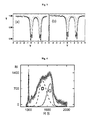
- Mössbauer spectroscopy and X-ray diffraction analysis were performed before and after carbon coating. They indicate that neither the structure nor the oxidation state of iron in the compound are modified by the carbon coating process.
- the iron XRD pattern (represented on figure 2 ) does not change and the Mössbauer spectra (represented on figure 3 ) are identical.
- the Mössbauer spectra were fitted with two doublets in accordance with the two crystallographic sites of Fe 2+ in the tavorite LiFeSO 4 F structure and the Mössbauer parameters are identical to those already reported for that phase. No trace of Fe 3+ is detected.
- the Raman spectrum (represented on figure 4 ) for carbon coated LiFeSO 4 F powder exhibits two broad bands at 1350 and 1580 cm -1 (D and G bands of carbon). The ratio between them allows evaluating the degree of disorder in the carbon as previously reported for carbon coated LiFePO 4 .
- M. M. Doeff, Y. Hu, F. Mc Lamon, R. Kostecki, Electrochem. Solid-State Lett. 6 (2003) A207 ] for which a D/G ratio of ca. 2 or lower has been found to be optimum.
- a D/G bands ratio of ca. 1.5 was calculated from figure 4 , indicating a high degree of graphitization of the carbon coated layer and thus high electronic conductivity.
- Slurries were prepared by mixing 80wt.% of the active material with or without carbon coating, 5wt.% of PVDF as a binder and 15wt.% of Csp as carbon additive in NMP. Mixing of the slurries was performed by magnetic stirring during 3 h, the vial containing the slurry being placed in an ultrasonic bath for 10 minutes every 1 h.
- Composite electrodes were prepared by depositing the slurry on a 20 ⁇ m thick aluminum foil with a 250 ⁇ m Doctor-Blade and further dried at 120 °C under vacuum. Once dried, 0.8 cm 2 disk electrodes were cut and pressed at 7.8 ⁇ 10 8 Pa.
- Powder type electrodes were prepared by simple mixing the carbon coated LiFeSO 4 F with Csp in a weight ratio of 80/20, in an agate mortar for 15 min.
- Said electrodes (typical loading ca. 7 ⁇ 1 mg) were used for electrochemical impedance tests at room temperature in three electrode Swagelok type cells with a disk of Li metal foil as counter and reference electrodes. Two sheets of Whattman GF/d borosilicate glass fiber were used as a separator, soaked with the electrolyte (ca. 0.5 cm 3 of LP30). The charge transfer resistance in the carbon coated sample appeared to be significantly reduced, demonstrating the improved electronic conductivity of the carbon coated particles compared with the uncoated particles (cf. figure 8 ).
- Carbon coated LiCoPO 4 were prepared according to the method described in example 1, using 600 mg of LiCoPO 4 having a particle sizes ranging from 100 nm to 1 ⁇ m, and a deposition time of around 30 minutes
- the resulting carbon coated particles have a uniform coating of about 5 nm, as shown on figure 9 . A gradual change in coloration was observed upon carbon deposition from purple for the uncoated powder to grey for the coated sample.
- “Tape” electrodes were tested in Swagelok type cells with a disk of Li metal foil as counter electrode. Two sheets of Whattman GF/d borosilicate glass fiber were used as a separator, soaked with the electrolyte (ca. 0.5 cm 3 LP30) at room temperature. These experiments were done in galvanostatic mode with potential limitation (GCPL) at a C/20 rate, meaning one mol of Li + per mol of LiCoPO 4 inserted in 20 hours.
- GCPL galvanostatic mode with potential limitation
- Carbon coated Co 3 O 4 were prepared according to the method described in example 1, using 600 mg of Co 3 O 4 having a particle sizes ranging from 30 to 40 nm.
- Slurries were prepared by mixing 65wt.% of the active material with or without carbon coating, 8wt.% of PVDF as a binder and 27wt.% of Csp as carbon additive in NMP. Mixing of the slurries was performed by magnetic stirring during 3 h, the vial containing the slurry being placed in an ultrasonic bath for 10 minutes every 1 h.
- Composite electrodes were prepared by depositing the slurry on a 20 ⁇ m thick copper foil with a 250 ⁇ m Doctor-Blade and further dried at 120 °C under vacuum. Once dried, 0.8 cm 2 disk electrodes were cut and pressed at 7.8 10 8 Pa.
- “Tape” electrodes were tested in Swagelok type cells with a disk of Li metal foil as counter electrode. Two sheets of Whattman GF/d borosilicate glass fiber were used as a separator, soaked with the electrolyte (ca. 0.5 cm 3 LP30) at room temperature. These experiments were done in galvanostatic mode with potential limitation (GCPL) with a succession of 10 cycles at different C rates. First, 10 cycles were performed at C/5 followed by 10 cycles at C, C/5, 2C and finally C/5. Results are shown on figures 13 and 14 .
- GCPL galvanostatic mode with potential limitation
- the first cycle for both carbon coated and uncoated Co 3 O 4 are very similar in terms of capacity, coulombic efficiencies and voltage hysteresis (cf. figure 13a ).
- the electrode prepared with carbon coated Co 3 O 4 exhibits lower overpotential between discharge and charge at the end of the first reduction (cf. figure 13b ). This is in agreement with the conductivity of carbon coated particles higher than the conductivity of the uncoated particles.
- a much better capacity retention is observed for carbon coated Co 3 O 4 with a stable capacity of about ca. 1200 mAhg -1 achieved at C/5 after 90 cycles (cf. figure 14 ).
- Carbon coated Li 4 Ti 5 O 12 was prepared according to the method of example 1. An amount of 600 mg of Li 4 Ti 5 O 12 having a particle sizes ranging from 10 to 100 nm was put in the vacuum chamber.
- the carbon source in the vacuum chamber was a carbon rod, the pressure in the vacuum chamber was about 10 -2 Pa (10 -4 mbar).
- the deposition rate was around 0.1 nm/s.
- Figure 15 shows the change of color from uncoated Li 4 Ti 5 O 12 powder (a), and of carbon coated Li 4 Ti 5 O 12 powder after a deposition time of 10 minutes (b), 20 minutes (c) and 30 minutes (d). After 30 minutes deposition time, the resulting carbon coated particles have a uniform coating of about 4 nm, as shown on figure 16 .
- Slurries were prepared by mixing 65wt.% of the active material with or without carbon coating, 8wt.% of PVDF as a binder and 27wt.% of Csp as carbon additive in NMP. Each slurry was mixed by magnetic stirring during 3 h, the vial containing the slurry being placed in an ultrasonic bath for 10 minutes every 1 h.
- Composite electrodes were prepared by depositing the slurry on a 20 ⁇ m thick copper foil with a 250 ⁇ m Doctor-Blade and further dried at 120 °C under vacuum. Once dried, 0.8 cm 2 disk electrodes were cut and pressed at 7.8 ⁇ 10 8 Pa.
- “Tape” electrodes were tested in Swagelok type cells with a disk of Li metal foil as counter electrode. Two sheets of Whattman GF/d borosilicate glass fiber were used as a separator, soaked with the electrolyte (ca. 0.5 cm 3 LP30) at room temperature. These experiments were done in galvanostatic mode with potential limitation (GCPL) with a succession of 6 cycles at different C rates. First, 6 cycles were performed at C/5 followed by 10 cycles at C, C/5, 2C, C/5, 5C, C/5, 8C and finally C/5. Results are shown on figure 17 and 18 .
- GCPL galvanostatic mode with potential limitation
- the first cycle for both electrodes appeared to be very similar in terms of capacity, coulombic efficiencies and voltage hysteresis (cf. figure 17 ) for coated and uncoated Li 4 Ti 5 O 12 .
- the voltage hysteresis between charge and discharge at high C rates is much lower for carbon coated Li 4 Ti 5 O 12 in agreement with higher electronic conductivity.
- Upon cycling a much better capacity retention is observed for carbon coated Li 4 Ti 5 O 12 with a stable capacity of about ca. 155 mAhg -1 achieved at C/5 compared to only 140 mAhg -1 for uncoated Li 4 Ti 5 O 12 .
- Very good capacity retention at high C rates is also achieved for carbon coated Li 4 Ti 5 O 12 with capacities higher than 135 mAhg -1 obtained at 8C compared to 120 mAhg -1 for uncoated Li 4 Ti 5 O 12 .
Landscapes
- Chemical & Material Sciences (AREA)
- Chemical Kinetics & Catalysis (AREA)
- Electrochemistry (AREA)
- General Chemical & Material Sciences (AREA)
- Inorganic Chemistry (AREA)
- Engineering & Computer Science (AREA)
- Composite Materials (AREA)
- Materials Engineering (AREA)
- Manufacturing & Machinery (AREA)
- Battery Electrode And Active Subsutance (AREA)
Priority Applications (2)
| Application Number | Priority Date | Filing Date | Title |
|---|---|---|---|
| EP12380045.0A EP2704245A1 (de) | 2012-09-03 | 2012-09-03 | Verfahren zur Herstellung von kohlenstoffbeschichteten Elektrodenaktivmaterialpartikeln |
| PCT/EP2013/068107 WO2014033302A1 (en) | 2012-09-03 | 2013-09-02 | Method for preparing carbon coated electrode active material particles |
Applications Claiming Priority (1)
| Application Number | Priority Date | Filing Date | Title |
|---|---|---|---|
| EP12380045.0A EP2704245A1 (de) | 2012-09-03 | 2012-09-03 | Verfahren zur Herstellung von kohlenstoffbeschichteten Elektrodenaktivmaterialpartikeln |
Publications (1)
| Publication Number | Publication Date |
|---|---|
| EP2704245A1 true EP2704245A1 (de) | 2014-03-05 |
Family
ID=46968112
Family Applications (1)
| Application Number | Title | Priority Date | Filing Date |
|---|---|---|---|
| EP12380045.0A Withdrawn EP2704245A1 (de) | 2012-09-03 | 2012-09-03 | Verfahren zur Herstellung von kohlenstoffbeschichteten Elektrodenaktivmaterialpartikeln |
Country Status (2)
| Country | Link |
|---|---|
| EP (1) | EP2704245A1 (de) |
| WO (1) | WO2014033302A1 (de) |
Cited By (6)
| Publication number | Priority date | Publication date | Assignee | Title |
|---|---|---|---|---|
| CN104300113A (zh) * | 2014-08-11 | 2015-01-21 | 苏州大学 | 一种碳包覆氧化铁锂离子电池电极及其制备方法和用途 |
| CN105355839A (zh) * | 2015-10-15 | 2016-02-24 | 浙江大学 | 一种石墨烯-金复合电极及其制备方法和应用 |
| CN110364693A (zh) * | 2018-04-10 | 2019-10-22 | 中国科学院上海硅酸盐研究所 | 一种纳米三维导电骨架/MnO2复合结构材料的制备方法及其在锌电池正极中的应用 |
| CN115679363A (zh) * | 2022-10-12 | 2023-02-03 | 华中科技大学 | 一种有机-无机杂化法合成双功能氟掺杂铠甲型纳米材料、制备方法与应用 |
| CN116525817A (zh) * | 2023-07-04 | 2023-08-01 | 宁波容百新能源科技股份有限公司 | 正极活性材料及其制备方法、正极片和二次电池 |
| CN118084086A (zh) * | 2024-04-26 | 2024-05-28 | 兰州资源环境职业技术大学 | 一种具有高容量、长循环寿命的核壳结构高镍锂电正极材料及其制备方法 |
Families Citing this family (4)
| Publication number | Priority date | Publication date | Assignee | Title |
|---|---|---|---|---|
| JP6460511B2 (ja) * | 2014-03-26 | 2019-01-30 | 本田技研工業株式会社 | リチウム二次電池用活物質及びその製造方法並びにそれを用いたリチウム二次電池 |
| CN106455442B (zh) * | 2016-11-02 | 2019-03-15 | 上海博息电子科技有限公司 | 一种超薄石墨烯高导复合材料 |
| KR102553570B1 (ko) * | 2018-06-27 | 2023-07-10 | 삼성전자 주식회사 | 리튬 이온 전지용 양극 활물질 및 이를 포함하는 리튬 이온 전지 |
| CN109802113A (zh) * | 2019-01-04 | 2019-05-24 | 三峡大学 | 一种Li3VO4/C/rGO/Sn的复合锂离子电池负极材料的制备方法 |
Citations (5)
| Publication number | Priority date | Publication date | Assignee | Title |
|---|---|---|---|---|
| WO2002027823A1 (fr) | 2000-09-26 | 2002-04-04 | HYDRO-QUéBEC | Procede de synthese de materiaux redox enrobes de carbone a taille controlee |
| US6733923B2 (en) | 2000-02-26 | 2004-05-11 | Korea Institute Of Science And Technology | Metal oxide electrode coated with porous metal film, porous metal oxide film or porous carbon film, its fabrication method, and lithium-ion secondary battery using it |
| EP1482581A2 (de) * | 2003-05-20 | 2004-12-01 | Sony Corporation | Anode und Batterie mit dieser Anode |
| WO2010046610A1 (fr) | 2008-10-23 | 2010-04-29 | Centre National De La Recherche Scientifique | Fluorosulfates utiles comme materiaux d'electrode |
| WO2011109457A2 (en) * | 2010-03-03 | 2011-09-09 | Board Of Regents, The University Of Texas System | High capacity layered oxide cathodes with enhanced rate capability |
-
2012
- 2012-09-03 EP EP12380045.0A patent/EP2704245A1/de not_active Withdrawn
-
2013
- 2013-09-02 WO PCT/EP2013/068107 patent/WO2014033302A1/en not_active Ceased
Patent Citations (5)
| Publication number | Priority date | Publication date | Assignee | Title |
|---|---|---|---|---|
| US6733923B2 (en) | 2000-02-26 | 2004-05-11 | Korea Institute Of Science And Technology | Metal oxide electrode coated with porous metal film, porous metal oxide film or porous carbon film, its fabrication method, and lithium-ion secondary battery using it |
| WO2002027823A1 (fr) | 2000-09-26 | 2002-04-04 | HYDRO-QUéBEC | Procede de synthese de materiaux redox enrobes de carbone a taille controlee |
| EP1482581A2 (de) * | 2003-05-20 | 2004-12-01 | Sony Corporation | Anode und Batterie mit dieser Anode |
| WO2010046610A1 (fr) | 2008-10-23 | 2010-04-29 | Centre National De La Recherche Scientifique | Fluorosulfates utiles comme materiaux d'electrode |
| WO2011109457A2 (en) * | 2010-03-03 | 2011-09-09 | Board Of Regents, The University Of Texas System | High capacity layered oxide cathodes with enhanced rate capability |
Non-Patent Citations (15)
| Title |
|---|
| A. PONROUCH; M.R. PALACIN, J. POWER SOURCES, vol. 212, 2012, pages 233 |
| B. V. L'VOV, THERMOCHIM. ACTA, vol. 360, 2000, pages 109 |
| B.L. CUSHING; J.B. GOODENOUGH, SOLID STATE SCIENCES, vol. 4, 2002, pages 1487 |
| C. NATARAJAN; H. FUJIMOTO; K. TOKUMITSU; A. MABUCHI; T. KASUH, CARBON, vol. 39, 2001, pages 1409 |
| D. GUYOMARD; J.M. TARASCON, J. ELECTROCHEM. SOC., vol. 139, 1992, pages 937 |
| H. LI; H. ZHOU., CHEM COMMUN., vol. 48, 2012, pages 1201 |
| J. MOSKON; R. DOMINKO; R. CERC-KOROSEC; M.GABERSCEK; J. JAMNIK., J. POWER SOURCES, vol. 174, 2007, pages 683 |
| J. WANG; X. SUN, ENERGY & ENVIRONMENTAL SCIENCE, vol. 5, no. 2012, pages 5163 |
| J. WOLFENSTINE; J. READ; J.L. ALLEN., J. POWER SOURCES, vol. 163, 2007, pages 1070 |
| J.B. GOODENOUGH; Y. KIM., CHEM. MATER., vol. 22, 2010, pages 587 |
| K. RÜDIGER-PETERS, J. MICROSCOPY, vol. 133, 1984, pages 17 |
| M. M. DOEFF; Y. HU; F. MC LAMON; R. KOSTECKI, ELECTROCHEM. SOLID-STATE LETT., vol. 6, 2003, pages A207 |
| N. RECHAM; J.N. CHOTARD; L. DUPONT; C. DELACOURT; W. WALKER; M. ARMAND; J.M. TARASCON, NAT. MAT., vol. 9, 2010, pages 68 |
| N. RECHAM; J.N. CHOTARD; L. DUPONT; C. DELACOURT; W. WALKER; M. ARMAND; J.M. TARASCON., NAT. MATER., vol. 9, 2010, pages 68 |
| Y.J. KWON; J. CHO, CHEM. COMMUN, vol. 9, 2008, pages 1109 |
Cited By (9)
| Publication number | Priority date | Publication date | Assignee | Title |
|---|---|---|---|---|
| CN104300113A (zh) * | 2014-08-11 | 2015-01-21 | 苏州大学 | 一种碳包覆氧化铁锂离子电池电极及其制备方法和用途 |
| CN105355839A (zh) * | 2015-10-15 | 2016-02-24 | 浙江大学 | 一种石墨烯-金复合电极及其制备方法和应用 |
| CN105355839B (zh) * | 2015-10-15 | 2017-07-21 | 浙江大学 | 一种石墨烯‑金复合电极及其制备方法和应用 |
| CN110364693A (zh) * | 2018-04-10 | 2019-10-22 | 中国科学院上海硅酸盐研究所 | 一种纳米三维导电骨架/MnO2复合结构材料的制备方法及其在锌电池正极中的应用 |
| CN110364693B (zh) * | 2018-04-10 | 2020-11-20 | 浙江浙能中科储能科技有限公司 | 一种纳米三维导电骨架/MnO2复合结构材料的制备方法及其在锌电池正极中的应用 |
| CN115679363A (zh) * | 2022-10-12 | 2023-02-03 | 华中科技大学 | 一种有机-无机杂化法合成双功能氟掺杂铠甲型纳米材料、制备方法与应用 |
| CN116525817A (zh) * | 2023-07-04 | 2023-08-01 | 宁波容百新能源科技股份有限公司 | 正极活性材料及其制备方法、正极片和二次电池 |
| CN116525817B (zh) * | 2023-07-04 | 2023-11-28 | 宁波容百新能源科技股份有限公司 | 正极活性材料及其制备方法、正极片和二次电池 |
| CN118084086A (zh) * | 2024-04-26 | 2024-05-28 | 兰州资源环境职业技术大学 | 一种具有高容量、长循环寿命的核壳结构高镍锂电正极材料及其制备方法 |
Also Published As
| Publication number | Publication date |
|---|---|
| WO2014033302A1 (en) | 2014-03-06 |
Similar Documents
| Publication | Publication Date | Title |
|---|---|---|
| Du et al. | Recent advances in the interface engineering of solid-state Li-ion batteries with artificial buffer layers: challenges, materials, construction, and characterization | |
| EP2704245A1 (de) | Verfahren zur Herstellung von kohlenstoffbeschichteten Elektrodenaktivmaterialpartikeln | |
| Lou et al. | Achieving efficient and stable interface between metallic lithium and garnet-type solid electrolyte through a thin indium tin oxide interlayer | |
| Vanaphuti et al. | Enhancing the Mn redox kinetics of LiMn0. 5Fe0. 5PO4 cathodes through a synergistic co‐doping with niobium and magnesium for lithium‐ion batteries | |
| CN108292780B (zh) | 用于固体电解质的材料 | |
| Reddy et al. | High performance Na x CoO 2 as a cathode material for rechargeable sodium batteries | |
| Tang et al. | Improving the electrochemical performance of Ni-rich cathode material LiNi0. 815Co0. 15Al0. 035O2 by removing the lithium residues and forming Li3PO4 coating layer | |
| Yuan et al. | Synthesis of pristine and carbon-coated Li4Ti5O12 and their low-temperature electrochemical performance | |
| Zhao et al. | One-step integrated surface modification to build a stable interface on high-voltage cathode for lithium-ion batteries | |
| US8404147B2 (en) | Process for producing lithium iron phosphate particles and method for producing secondary cell | |
| US8313858B2 (en) | Electrode of lithium ion battery and lithium ion battery using the same | |
| CA2735248C (en) | Method for producing electrode material, electrode material, electrode and battery | |
| Yuan et al. | Different effect of the atmospheres on the phase formation and performance of Li4Ti5O12 prepared from ball-milling-assisted solid-phase reaction with pristine and carbon-precoated TiO2 as starting materials | |
| Kandhasamy et al. | Polyvinylpyrrolidone assisted sol–gel route LiCo1/3Mn1/3Ni1/3PO4 composite cathode for aqueous rechargeable battery | |
| Ponrouch et al. | A new room temperature and solvent free carbon coating procedure for battery electrode materials | |
| Zhang et al. | Unravelling high-temperature stability of lithium-ion battery with lithium-rich oxide cathode in localized high-concentration electrolyte | |
| EP2615671A1 (de) | Lithium-salz-graphen-haltiger verbundstoff und verfahren zu seiner herstellung | |
| CA3034495A1 (en) | Cathode material including agglomerated particles, electrode including the cathode material, and lithium ion secondary battery including the electrode | |
| WO2007034823A1 (ja) | 正極活物質の製造方法およびそれを用いた非水電解質電池 | |
| Wang et al. | High-stability 5 V spinel LiNi0. 5Mn1. 5O4 sputtered thin film electrodes by modifying with aluminium oxide | |
| Das et al. | Nano-phase tin hollandites, K 2 (M 2 Sn 6) O 16 (M= Co, In) as anodes for Li-ion batteries | |
| US11374221B2 (en) | Lithium-ion secondary battery | |
| KR20180018884A (ko) | 수계 리튬이차전지용 표면 처리된 양극 활물질 | |
| Chen et al. | Realising higher capacity and stability for disordered rocksalt oxyfluoride cathode materials for Li ion batteries | |
| Kebede | An investigation of the lattice parameter and micro-strain behaviour of LiMn2O4 coated with LiMn1. 5Ni0. 5O4 to attain high-rate capability and cycling stability |
Legal Events
| Date | Code | Title | Description |
|---|---|---|---|
| AK | Designated contracting states |
Kind code of ref document: A1 Designated state(s): AL AT BE BG CH CY CZ DE DK EE ES FI FR GB GR HR HU IE IS IT LI LT LU LV MC MK MT NL NO PL PT RO RS SE SI SK SM TR |
|
| AX | Request for extension of the european patent |
Extension state: BA ME |
|
| PUAI | Public reference made under article 153(3) epc to a published international application that has entered the european phase |
Free format text: ORIGINAL CODE: 0009012 |
|
| STAA | Information on the status of an ep patent application or granted ep patent |
Free format text: STATUS: THE APPLICATION IS DEEMED TO BE WITHDRAWN |
|
| 18D | Application deemed to be withdrawn |
Effective date: 20140906 |