EP2704331B1 - Procédé et dispositif pour déterminer un paramètre qui caractérise un certain nombre de positions de secours destinées à être utilisées pour annuler la diaphonie de lignes reliant un groupe de vectorisation de ligne d'abonné numérique - Google Patents
Procédé et dispositif pour déterminer un paramètre qui caractérise un certain nombre de positions de secours destinées à être utilisées pour annuler la diaphonie de lignes reliant un groupe de vectorisation de ligne d'abonné numérique Download PDFInfo
- Publication number
- EP2704331B1 EP2704331B1 EP12306034.5A EP12306034A EP2704331B1 EP 2704331 B1 EP2704331 B1 EP 2704331B1 EP 12306034 A EP12306034 A EP 12306034A EP 2704331 B1 EP2704331 B1 EP 2704331B1
- Authority
- EP
- European Patent Office
- Prior art keywords
- crosstalk
- lines
- metric
- parameter
- line
- Prior art date
- Legal status (The legal status is an assumption and is not a legal conclusion. Google has not performed a legal analysis and makes no representation as to the accuracy of the status listed.)
- Not-in-force
Links
- 238000000034 method Methods 0.000 title claims description 78
- 238000012544 monitoring process Methods 0.000 claims description 15
- 238000004590 computer program Methods 0.000 claims description 11
- 238000004891 communication Methods 0.000 claims description 9
- 238000005259 measurement Methods 0.000 claims description 7
- 238000012546 transfer Methods 0.000 description 9
- 239000011159 matrix material Substances 0.000 description 8
- 238000013459 approach Methods 0.000 description 5
- 239000011230 binding agent Substances 0.000 description 4
- 238000012545 processing Methods 0.000 description 4
- 230000003213 activating effect Effects 0.000 description 3
- 230000005540 biological transmission Effects 0.000 description 3
- 238000013178 mathematical model Methods 0.000 description 3
- 239000004065 semiconductor Substances 0.000 description 3
- 230000004913 activation Effects 0.000 description 2
- 238000007726 management method Methods 0.000 description 2
- 230000003287 optical effect Effects 0.000 description 2
- 101150012579 ADSL gene Proteins 0.000 description 1
- 102100020775 Adenylosuccinate lyase Human genes 0.000 description 1
- 108700040193 Adenylosuccinate lyases Proteins 0.000 description 1
- 239000004020 conductor Substances 0.000 description 1
- 238000013500 data storage Methods 0.000 description 1
- 230000007423 decrease Effects 0.000 description 1
- 230000003247 decreasing effect Effects 0.000 description 1
- 238000003745 diagnosis Methods 0.000 description 1
- 239000013598 vector Substances 0.000 description 1
Images


Classifications
-
- H—ELECTRICITY
- H04—ELECTRIC COMMUNICATION TECHNIQUE
- H04B—TRANSMISSION
- H04B3/00—Line transmission systems
- H04B3/02—Details
- H04B3/32—Reducing cross-talk, e.g. by compensating
- H04B3/34—Reducing cross-talk, e.g. by compensating by systematic interconnection of lengths of cable during laying; by addition of balancing components to cable during laying
-
- H—ELECTRICITY
- H04—ELECTRIC COMMUNICATION TECHNIQUE
- H04B—TRANSMISSION
- H04B3/00—Line transmission systems
- H04B3/02—Details
- H04B3/32—Reducing cross-talk, e.g. by compensating
-
- H—ELECTRICITY
- H04—ELECTRIC COMMUNICATION TECHNIQUE
- H04B—TRANSMISSION
- H04B3/00—Line transmission systems
- H04B3/02—Details
- H04B3/46—Monitoring; Testing
- H04B3/487—Testing crosstalk effects
-
- H—ELECTRICITY
- H04—ELECTRIC COMMUNICATION TECHNIQUE
- H04M—TELEPHONIC COMMUNICATION
- H04M3/00—Automatic or semi-automatic exchanges
- H04M3/18—Automatic or semi-automatic exchanges with means for reducing interference or noise; with means for reducing effects due to line faults with means for protecting lines
-
- H—ELECTRICITY
- H04—ELECTRIC COMMUNICATION TECHNIQUE
- H04M—TELEPHONIC COMMUNICATION
- H04M3/00—Automatic or semi-automatic exchanges
- H04M3/22—Arrangements for supervision, monitoring or testing
- H04M3/26—Arrangements for supervision, monitoring or testing with means for applying test signals or for measuring
- H04M3/34—Testing for cross-talk
Definitions
- the present invention refers to a method for determining a parameter that characterizes a number of spare positions to be used for cancelling the crosstalk of lines joining a digital subscriber line vectoring group, the vectoring comprising cancelling the crosstalk caused by a maximum number of lines of the vectoring group and reserving said number of spare positions.
- the invention refers to a respective device for determining said parameter, a monitoring node, an access node for a wire line access network, and a computer program product programmed for executing such a method.
- vectoring it is known to apply a crosstalk cancellation technique, also referred to as "vectoring" to a group of telecommunication lines such as Digital Subscriber Lines (DSL).
- DSL Digital Subscriber Lines
- Vectoring is described in detail in the ITU-T Recommendation G.993.5.
- Vectoring allows for cancelling the crosstalk internal to a group of lines (vectoring group) or so called in-domain Far-End Crosstalk (FEXT), which is a major limitation to achieve high bitrates over lines that extend within a common cable or binder.
- FEXT Far-End Crosstalk
- vectoring increases significantly the available bit rate on such lines.
- a sub-group of a vectoring group is included in the crosstalk cancelling. That is, an arrangement for crosstalk cancelling according to the vectoring approach typically can cancel the crosstalk for a maximum number of disturbing lines of the vectoring group. As a consequence, there may be some lines in a vectoring group the crosstalk caused by which lines is not cancelled. Limiting the number of lines of the vectoring group that are included into crosstalk cancellation to a maximum number that is less than a total number of lines of the vectoring group is referred to as partial crosstalk cancellation. Partial crosstalk cancellation has less signal processing overhead than full crosstalk cancellation, which includes all lines of a vectoring group into crosstalk cancellation. Partial crosstalk cancellation is often applied for large vectoring groups which may be present in System Level Vectoring (SLV) covering many lines that are usually connected to multiple line cards of an access node.
- SLV System Level Vectoring
- EP 2 466 757 A1 It is known from EP 2 466 757 A1 to define a number of spare positions within the maximum number of disturbing lines so that telecommunication lines that will join the vectoring group can initially be assigned to these spare positions. After a certain time, these spare positions will be freed again. Consequently, the number of disturbing lines the crosstalk of which is cancelled, is less than the supported maximum number.
- the number of spare positions may be tuned automatically or can be configured by an operator of a DSL access network.
- the object of the present invention is to provide a method and a device for determining a number of spare positions such that the vectoring group operates efficiently.
- the invention aims at detecting a high level of crosstalk that is caused by lines that are not part of the vectoring group (so called alien noise or alien crosstalk).
- the present invention is defined by a method according to claim 1 and a device according to claim 10.
- a monitoring node according to claim 12 an access node according to claim 13 and a computer program product according to claim 14 are provided.
- a method for determining a parameter that characterizes a number of spare positions to be used for cancelling the crosstalk of lines joining a digital subscriber line vectoring group comprising cancelling the crosstalk caused by a maximum number of lines of the vectoring group and reserving said number of spare positions
- the method comprises estimating a residual crosstalk metric that depends on a residual crosstalk between at least two subscriber lines of the vectoring group; and determining said parameter that characterizes the number of spare positions depending on the at least one residual crosstalk metric.
- Residual crosstalk is the crosstalk caused by disturbing lines that belong to the vectoring group but are not included into crosstalk cancellation.
- the method comprises successively modifying the parameter until the residual crosstalk metric fulfils a termination condition.
- the parameter may be modified until the crosstalk metric reaches or exceeds a predefined threshold.
- the method comprises successively incrementing the parameter until the residual crosstalk metric fulfils a first predefined termination condition.
- the first predefined termination condition may correspond to the residual crosstalk metric reaching or exceeding the predefined threshold or residing within a predefined range.
- the method comprises successively decrementing the parameter until the residual crosstalk metric fulfils a second predefined termination condition.
- the second predefined termination condition may correspond to the residual crosstalk metric reaching or exceeding a further predefined threshold or residing within a further predefined range.
- the method comprises checking whether or not the residual crosstalk metric is less than a predefined residual crosstalk threshold and depending on the result of said checking either successively incrementing the parameter until the residual crosstalk metric fulfills the first predefined termination condition or successively decrementing the parameter until the residual crosstalk metric fulfils the second predefined termination condition.
- the parameter is successively incremented until the residual crosstalk metric fulfills the first predefined termination condition if the residual crosstalk metric is less than the predefined residual crosstalk threshold; otherwise the parameter is successively decremented until the residual crosstalk metric fulfils the second predefined termination condition.
- the residual crosstalk metric is determined depending on at least one crosstalk ratio of a certain line, the crosstalk ratio corresponding to a ratio of the crosstalk caused by the lines of the vectoring group that are not included into crosstalk cancellation to the crosstalk caused by all lines of the vectoring group.
- the crosstalk between two lines of the vectoring group may be determined by acquiring at least a part of a crosstalk matrix from a device (e.g. access node or DSL modem) connected to one of the telecommunication lines.
- a coefficient of the crosstalk matrix describes a crosstalk transfer function of the crosstalk between two specific lines.
- the coefficients of the crosstalk matrix are therefore also referred to as crosstalk coefficients.
- the crosstalk metric is a maximum value or a mean value of the crosstalk ratio of multiple lines of the vectoring group, preferably of all lines of the vectoring group.
- the method comprises determining a noise level metric for at least one subscriber line, the noise level metric depending on the noise level at the at least one subscriber line.
- the method may comprises acquiring line measurement data from at least one device connected to one of the telecommunication lines and calculating the noise level metric depending on the acquired line measurement data.
- the data acquired from the device connected to at least one of the telecommunication lines may include Quiet Line Noise (QLN) level or data characterizing a transfer function of a telecommunication line such as Hlog data.
- the metric may be a number of disturbers parameter, which may be calculated e.g. by fitting a mathematical model of the noise level to the line measure data.
- An exemplary fitting approach for calculating the number of disturbers is described in EP 2 383 899 A1 .
- the invention is not limited to the number of disturbers metric or to a specific approach on how to calculate this metric.
- other metrics may be used as the noise level metric.
- the method comprises detecting that the at least on subscriber line is subject to alien crosstalk depending on the noise level metric, preferably if the noise level metric is greater than a predefined noise level threshold.
- the noise level metric only, does not allow reliably detecting alien crosstalk.
- alien crosstalk can be distinguished from noise originating from crosstalking lines that belong to the vectoring group and alien crosstalk (also referred to as "alien noise") can be quite reliably detected.
- a device for determining a parameter that characterizes a number of spare positions to be used for cancelling the crosstalk of lines joining a digital subscriber line vectoring group, the vectoring comprising cancelling the crosstalk caused by a maximum number of lines of the vectoring group and reserving said number of spare positions, wherein the device is arranged for determining a residual crosstalk metric that depends on a residual crosstalk between at least two subscriber lines of the vectoring group; and determining said parameter that characterizes the number of spare positions depending on the at least one residual crosstalk metric.
- the device is arranged, preferably programmed, for executing a method according to the invention, embodiments of which methods are herein described.
- a monitoring node comprising a communication interface for connecting the monitoring node to an access network, the access network including at least one device connected to one of the telecommunication lines
- the monitoring node comprises the device for determining a parameter that characterizes a number of spare positions.
- the monitoring node or the device for determining a parameter that characterizes the number of spare positions may be part of a network analyzer.
- the monitoring node or said device for determining the parameter may be integrated in a Dynamic Line Management (DLM) system.
- a DLM system may be provided that is operable for executing the method according to the invention, embodiments of which method are herein described. Integrating the device or method for determining the parameter in the DLM system allows automatically modifying the parameter while operating the telecommunication lines connected to an access node.
- an access node for multiple telecommunication lines preferably a DSLAM
- the access node comprising the device for determining a parameter that characterizes a number of spare positions.
- a computer program product preferably a computer readable storage medium
- the computer program product comprising a computer program that is programmed for executing a method according to the invention, embodiments of which methods are herein described.
- the storage medium may comprise magnetic, optical or semiconductor memory.
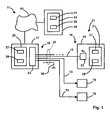
- Figure 1 shows a communication network 11 comprising telecommunication lines 13. At least one telecommunication line 13 has a pair of electrical conductors. A first end 16 of the line 13 is connected to a network side termination node of the network 11, further referred to as access node 17, and a second end 18 of the line 13 is connected to a terminal side termination node 19 of the network 11.
- the terminal side termination node 19 may be part of customer premises equipment (CPE 21) of the network 11.
- CPE 21 customer premises equipment
- the telecommunication line 13 is a Digital Subscriber Line (DSL), such as an ADSL, a VDSL or the like. Consequently, the access node 17 may be a DSL Access Multiplexer (DSLAM) or another type of DSL access node.
- the terminal side termination node 19 may be a DSL modem or include a DSL modem.
- the network 11 comprises a different type of telecommunication line 13.
- the access node 17 has first modem circuitry 23 to which the first end 16 of the line 13 is connected.
- the access node 17 has a first controller 25 adapted for controlling the operation of the access node 17.
- the first controller 25 is a programmable computer comprising a processor 27, e. g. a microprocessor, and a storage element 29, e.g. semiconductor memory.
- the terminal side termination node 19 includes second modem circuitry 33 to which the second end 18 of the line 13 is connected. Furthermore, the terminal side termination node 19 comprises a second controller 31.
- the second controller 31 may have the same basic configuration as the first controller 25, i.e. the second controller 31 may be a programmable computer and comprise a processor 27 and/or a storage element 29.
- the binder 35 may comprise an electrically conductive, preferably metallic, shielding 38 that may be grounded as depicted in Figure 1 .
- the network 11 may comprise an optional monitoring station 39 connected e. g. via an interconnection network 41 to at least one of the nodes 17, 19 such that the station 39 can communicate with at least one of the nodes 17, 19, preferably the access node 17.
- the station 39 comprises a third controller 43.
- the third controller 43 may have the same basic configuration as the first controller 25, i.e. the third controller 43 may be a programmable computer and comprise a processor 27 and/or a storage element 29.
- the station 39 may be a server computer, a personal computer, a handheld computer such as a PDA or cell phone, etc.
- At least one of the controllers 25, 31, or 43 is arranged for executing a method for determining a parameter that characterizes a number of spare positions to be used for cancelling the crosstalk of lines joining a digital subscriber line vectoring group.
- a computer program may be provided that is programmed such that at least one of the controllers 25, 31, 43 executes the method when running said computer program.
- the method may be executed on the access node 17, on the station 39, or the terminal side termination node 19.
- the computer program may be stored on at least one storage element 29.
- the computer program may be stored on any type of data storage media such as magnetic or optical disk or semiconductor storage media.
- the program can be provided by a server for transmission over a network, preferably the Internet.
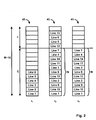
- Figure 2 shows a list of telecommunication lines that cause crosstalk to a certain telecommunication line 13 is shown for 3 different instants of time, t 1 ⁇ t 2 ⁇ t 3 .
- a so called group join occurs between time t 1 and time t 2 . That is, a group of telecommunication lines 13 is activated.
- the lines 13 labelled with “line 7" - "line 13" are activated.
- Activating a line 13 may be caused by turning on the CPE 21 connected to that line 13.
- Another reason for activating a line 13 may be that a network operator is unlocking it in the access node 17.
- These lines 13 have initially no impact on the other lines in the vectoring group before their activation, but after activation they will join the vectoring group because they may generate crosstalk and possibly must be considered when cancelling crosstalk. Consequently, they are included in a disturber list 45.
- the disturber list 45 is updated in every vectoring cycle during which the crosstalk coefficients that characterise the crosstalk between the lines 13 of the vectoring group, are estimated.
- a vectoring cycle starts when lines 13 join or leave the vectoring group, e. g. when they are activated or deactivated.
- the network 11, in particular the access node 17, may be configured such that a vectoring tracking mode is activated. When the vectoring tracking mode is activated, new vectoring cycles are started periodically, e. g. every minute, and the crosstalk coefficients are estimated periodically.
- the disturbing lines may be ordered according the extent of crosstalk they cause to a certain telecommunication line 13.
- the disturber list 45 in the middle of Figure 2 refers to instant t 2 when the additional lines have joined the vectoring group, the crosstalk coefficients have been estimated and the lines have been ordered according to the extent of crosstalk.
- the most dominant disturbing line 13 is in the bottom of the list (line 1) and the less dominant disturbing line is in the top of the list (line 13).
- a vectoring group is a set of lines 13 over which transmission is eligible to be subject to crosstalk cancelling.
- the vectoring group may comprise all active telecommunication lines connected to a single access node 17.
- the access node 17 having limited signal processing resources, supports a maximum number M of disturbing lines 13 that crosstalk of which affecting a certain (victim) line 13 can be cancelled.
- a total number N of lines 13 belonging to the vectoring group is greater than the number of lines that can be cancelled, i.e. included into crosstalk cancellation. That is, the access node 17 performs partial crosstalk cancellation.
- the crosstalk caused by some of the active lines cannot be cancelled.
- the most dominant cross-talkers are included in crosstalk cancellation.
- the new activated lines 13 are initially included into crosstalk cancellation.
- a number v of spare positions is reserved within the total number M of lines, the crosstalk of which can be cancelled. Consequently, after a certain number of lines have joined the vectoring group, the access node 17 excludes one or more least dominant disturbing lines from crosstalk cancelling in order to make sure that there are at least v spare positions available again.
- the access node 17 has excluded the lines 13 labelled with "line 12", “line 5", "line 6", "line 13" from crosstalk cancelling, as shown in the disturber list 45 for time t 3 .
- the parameter v corresponds to the number of lines 13 that may join the vectoring group simultaneously
- the parameter v is also referred to as vce-min-par-join (vectoring control entity minimum parallel joining number).
- This parameter may either be predefined manually, e. g. by a network operator of the network 11, or be determined automatically by means of the method described herein.
- the parameter v determines the number of disturbing lines 13 that can be permanently included in vectoring.
- C M - v lines can be included into crosstalk cancellation. That is, the higher the parameter v, the less lines 13 can be included into crosstalk cancellation.
- reducing the parameter v decreases the number of activated lines that can join the vectoring group simultaneously.
- a size of a group of lines that want to join the vectoring group is greater than v, then the group of joining lines must be split into multiple sub-groups. These sub-groups are then joined one after another. Joining multiple sub-groups is time consuming, because a certain group or sub-group can join the vectoring group only after the access node 17 has freed the number v of spare positions.
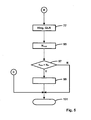
- Figures 3 , 4 and 5 show a flowchart of a method 51 for determining the parameter v that describes the number of spare positions to be used for cancelling crosstalk of additional lines joining the vectoring group.
- the value of the parameter v is exactly the number of spare positions to be reserved.
- the method may be executed on the monitoring station 39 which may be part of a network analyser for optimizing the performance of the network 11 and for diagnosis of technical issues in the network 11.
- the method 51 may be integrated in a dynamic line management (DLM) system.
- the method 51 iteratively modifies the parameter v until a residual crosstalk metric ⁇ a reaches an acceptable value and therefore allows to automatically configure the parameter v for a certain access node 17.
- the method 51 retrieves data from nodes connected to the communication lines 13, e. g. the access node 17 or the terminal side termination node 19, by using appropriate communication protocols, such as SNMP. These data include information about measurement results performed by the nodes 17, 19 connected to the lines 13, e.g. crosstalk coefficients h kj of a crosstalk matrix H, transfer function data Hlog related to the individual lines 13, and the quiet line noise (QLN).
- the crosstalk coefficient h kj describes a crosstalk transfer function of the crosstalk from line k to line j.
- the retrieved data e.g. the crosstalk matrix H, the crosstalk coefficients h kj , the transfer function data Hlog, and/or the QLN, may be frequency dependant and therefore may be represented as frequency dependant vectors.
- the method 51 may be implemented on the access node 17.
- An access node 17 that can execute the method 51 may include a user interface to be used e.g. by administrative personnel that allows the administrative personnel either to define a fixed value of the parameter v or to let the access node 17 determine the value of the parameter v automatically by means of the method 51.
- step 59 of this group - which may executed after the start 53 of the method 51 - acquires at least one crosstalk coefficient h kj that characterises a crosstalk transfer function between a telecommunication line i and a telecommunication line j.
- step 59 may comprise acquiring the whole crosstalk matrix H including the crosstalk coefficients h kj related to all pairs of communication lines 13 of a vectoring group. If the method 51 is executed by the monitoring station 39, step 59 may use a communication protocol in order to retrieve the crosstalk coefficients h kj or the crosstalk matrix H from the line termination nodes 17, 19, in particular from the access node 17.
- a step 61 of the group 57 is executed that calculates a list L of the most dominant crosstalkers that are taken into account in the crosstalk cancellation.
- this list L is determined a certain time after the last joining of additional lines 13 when the access node 17 has made sure that the minimum number of spare positions v are unused, e. g. in the example of Figure 2 at instance t 1 or t 3 .
- the maximum length of the list L of dominant crosstalkers corresponds to the value C.
- the list L of dominant crosstalkers may be determined by analysing the crosstalk matrix H, e. g. by comparing the individual crosstalk coefficients h kj with each other.
- the disturbing lines that are not part of the list L are line 12, line 5, line 6, and line 13.
- the residual crosstalk ratio ⁇ j corresponds to the ratio of the crosstalk caused by the lines of the vectoring group that are not included into crosstalk cancellation to the crosstalk caused by all lines of the vectoring group. However, the residual crosstalk ratio does not consider crosstalk caused by lines that are not part of the vectoring group (alien crosstalk).
- the crosstalk ratio ⁇ j is calculated for multiple lines 13, preferably all lines j that belong to the vectoring group.
- a step 65 of the group 57 calculates the residual crosstalk metric ⁇ a .
- the residual crosstalk metric ⁇ a may be calculated depending on at least one residual crosstalk ratio ⁇ j , preferably on all calculated residual crosstalk ratios ⁇ j .
- the residual crosstalk metric ⁇ a may be calculated in a different way.
- a branch 67 is executed that checks whether or not the crosstalk metric ⁇ a is less than a predefined residual crosstalk threshold ⁇ opt (see Figure 4 ). If so (Y) then an incrementing loop 69 is executed that successively increments the parameter v until the residual crosstalk metric fulfils a first predefined termination condition. To this end, a step 71 increments the parameter v, a step 73 recalculates the residual crosstalk metric ⁇ j for the new value of the parameter v. Step 71 may include updating the configuration of the access node 17 with the new value of the parameter v so that the access node 17 reserves the new number v of spare positions.
- Step 73 may include waiting until a line 13 has been phased out of the set of lines included in crosstalk cancelling in order to reserve an additional spare position (as described above) and perform at least essentially the same step as group 57 in order to calculate an updated value of the residual crosstalk metric ⁇ a .
- a branch 75 checks whether the first predefined termination condition is fulfilled.
- the first predefined termination condition is ⁇ a ⁇ ⁇ opt , i.e. the parameter v is successively incremented until the residual crosstalk metric ⁇ a is greater or equal the threshold ⁇ opt . If the first termination condition is fulfilled (Y) then the method 51 continues with a step 77 shown in Figure 5 . Otherwise (N), the method 51 returns to step 71.
- Step 67 If the branch 67 detects that the residual crosstalk metric ⁇ a is not less than the predefined residual crosstalk threshold ⁇ opt (N) then a decrementing loop 79 is executed, i.e. the parameter v is successively decremented until the residual crosstalk metric ⁇ a fulfils a second predefined termination condition.
- a step 81 decrements the parameter v
- a step 83 recalculates the residual crosstalk metric ⁇ a at least in similar way as step 73.
- Step 81 may include updating the configuration of the access node 17 with the new value of the parameter v so that the access node 17 reserves the new number v of spare positions.
- a branch 85 checks whether the second predefined termination condition is fulfilled, if so (Y) then the method 51 continues with step 77, otherwise (N) the method 51 goes back to step 81.
- the second predefined termination condition is ⁇ a ⁇ ⁇ opt , i.e. the parameter v is decremented until the residual crosstalk metric ⁇ a is less or equal than the predefined residual crosstalk threshold ⁇ opt .
- the present invention is not limited to the exemplary first and second predefined termination conditions of branches 75 and 85.
- other first and second predefined termination conditions may be selected.
- the residual crosstalk metric ⁇ a may be compared with different thresholds than the predefined threshold ⁇ opt used in branch 67.
- the values to which the residual crosstalk metric ⁇ a is compared may differ in branches 75 and 85.
- the method 51 may comprise verifying, whether successively increasing or decreasing the parameter v converges. If successively decrementing the parameter v does not converge, the global performance of the vectoring system or the vectoring group is limited by the crosstalk caused by the residual crosstalkers that cannot be cancelled because the maximum number M of disturbers is under-dimensioned.
- the method 51 may comprise a branch 87 (e.g. between steps 81 and 83) that checks whether the parameter v has exceeded a minimum value v min . If so (Y), a step 89 determines that the performance of the vectoring group is limited by the non-cancelled residual crosstalkers and terminates the method 51.
- the vectoring system is oversized, i.e. it is possible to reserve more spare positions than needed without affecting the crosstalk between the lines 13 and the bit rate on the individual lines 13. If the method 51 detects that successively incrementing the parameter v does not converge then the method may continue with step 77.
- the method 51 may include a branch 91 (e.g. between steps 71 and 73) for verifying whether the parameter v is greater than a maximum value v max . If so (Y), a step 93 may be executed in order to assert that the maximum number v max has been exceeded and the system is oversized. After step 93 the method 51 may continue with step 77.
- step 77 the method 51 acquires line measurement data such as transfer function data Hlog related to at least one line 13 of the vectoring group, that transfer function data Hlog describing a transfer function of that individual line 13, e.g. in an logarithmic scale.
- step 77 may retrieve line measurement date in the form of Quiet Line Noise (QLN) data that describe the noise on a transmission line 13 of the vectoring group when that line 13 is not carrying a data signal.
- QLN Quiet Line Noise
- the data Hlog, QLN may be retrieved from at least one of the nodes 17, 19 connected to the telecommunication lines 13, preferably from the access node 17, by means of a communication protocol such as SNMP.
- a step 95 determines a noise level metric N dist for at least one line 13, with the noise level metric N dist depending on the noise level at the at least one telecommunication line.
- the method 51 described herein can be applied with any suitable type of noise level metric.
- the exemplary embodiment described herein uses a metric referred to as "number of disturbers N dist " described in detail in the published patent application EP 2 383 899 A1 .
- the number of disturber metric Ndist is determined by fitting a mathematical model for the far end crosstalk (FEXT) to the data Hlog, QLN acquired in step 77 by optimising the parameter N dist of the mathematical model.
- the parameter N dist describes a number of disturbing users.
- the optimum value of the parameter N dist obtained by this curve fitting approach corresponds to the noise level metric determined in step 95. Details on how to determine the data Hlog and QLN in step 77 and how to calculate the metric N dist in step 95 are described in the above-mentioned patent application. Furthermore, the metric N dist may be computed using further collected parameters, e.g. bit rate, noise margin, output power, actual Impulse Noise Protection (INP) expressed as a number of Discrete Multi-Tone (DMT) symbols, actual delay.
- the Method 51 has a branch 97 executed after the line noise level metric N dist has been calculated in step 95, which branch 97 compares the noise level metric N dist with a noise level threshold N th . If the noise level metric N dist is greater than the noise level threshold N th (Y) then the method 51 performs a step 99 in order to determine or signal that alien crosstalk has been detected. Otherwise (N) step 99 is skipped. Step 99 is the last step of the method 51. That is, after step 99 the method 51 is terminated in step 101.
- the noise level metric N dist is related to both in-domain crosstalk and alien crosstalk. It is thus not possible to separate these two kinds of crosstalk by analysing that noise level metric N dist only.
- the previously executed steps of the method 51 operate with the residual crosstalk metric ⁇ a that reflects the crosstalk within the vectoring group only (i.e. only in-domain crosstalk). If the method 51 reaches branch 97 and is not terminated in step 89 then it is known that the in-domain crosstalk has been cancelled to a sufficient extent. If the overall noise on a telecommunication line 13 is still too high, e.g.
- the method 51 described herein does not only allow for optimizing the parameter v but also serves to detect alien crosstalk.
- the method described herein basically compares a residual crosstalk with a target or optimal residual crosstalk. If the crosstalk is too high, the parameter v will be decremented until the optimal or target residual crosstalk is reached. If the residual crosstalk is very low, the parameter v will be incremented until the optimal or target residual crosstalk is reached. Once the optimal or target residual crosstalk is reached, the noise level metric N dist that represents the noise which surrounds the line and the residual crosstalk after vectoring processing is performed. Knowing that the majority of residual crosstalk is cancelled, the noise level metric N dist is dominated by the alien crosstalk. Thus, alien crosstalk can be detected and diagnosed if the value of the noise level metric is too high.
Landscapes
- Engineering & Computer Science (AREA)
- Signal Processing (AREA)
- Computer Networks & Wireless Communication (AREA)
- Cable Transmission Systems, Equalization Of Radio And Reduction Of Echo (AREA)
Claims (14)
- Procédé (51) pour déterminer un paramètre (v) qui caractérise un nombre de positions de secours destinées à être utilisées pour annuler la diaphonie de lignes (13) reliant un groupe de vectorisation de ligne d'abonné numérique, la vectorisation comprenant l'annulation de la diaphonie due à un nombre maximum (M) de lignes (13) du groupe de vectorisation et la réservation dudit nombre de positions de secours, caractérisé en ce que le procédé (51) comprend les étapes suivantes :- déterminer (57) une mesure de diaphonie résiduelle (αa) qui dépend d'une diaphonie résiduelle entre au moins deux lignes d'abonné (13) du groupe de vectorisation ; et- déterminer (67, 69, 79) ledit paramètre (v) qui caractérise le nombre de positions de secours en fonction de l'au moins une mesure de diaphonie résiduelle (αa) en modifiant progressivement (69, 79) le paramètre (v) jusqu'à ce que la mesure de diaphonie résiduelle réponde à une condition de terminaison (75, 85).
- Procédé (51) selon la revendication 1, dans lequel le procédé (51) comprend l'augmentation progressive (69) du paramètre (v) jusqu'à ce que la mesure de diaphonie résiduelle (αa) réponde à une première condition de terminaison prédéfinie (75).
- Procédé (51) selon l'une des revendications précédentes, dans lequel le procédé (51) comprend la diminution progressive (79) du paramètre jusqu'à ce que la mesure de diaphonie résiduelle (αa) réponde à une deuxième condition de terminaison prédéfinie (85).
- Procédé (51) selon l'une des revendications précédentes, le procédé (51) consistant à vérifier (67) si la mesure de diaphonie résiduelle (αa) est inférieure ou non à un seuil de diaphonie résiduelle prédéfini (αopt) et, selon le résultat de ladite vérification, à augmenter progressivement (69) le paramètre (v) jusqu'à ce que la mesure de diaphonie résiduelle (αa) réponde à la première condition de terminaison prédéfinie (75) ou à diminuer progressivement (81) le paramètre (v) jusqu'à ce que la mesure de diaphonie résiduelle (αa) réponde à la deuxième condition de terminaison prédéfinie (85).
- Procédé (51) selon l'une des revendications précédentes, dans lequel la mesure de diaphonie résiduelle (αa) est déterminée en fonction d'au moins un rapport de diaphonie (αj) d'une certaine ligne, le rapport de diaphonie (αj) correspondant à un rapport entre la diaphonie due aux lignes (13) du groupe de vectorisation qui ne sont pas incluses dans l'annulation de diaphonie et la diaphonie due à toutes les lignes (13) du groupe de vectorisation.
- Procédé (51) selon la revendication 5, dans lequel la mesure de diaphonie (αa) est une valeur maximale ou une valeur moyenne du rapport de diaphonie (αj) de lignes multiples (13) du groupe de vectorisation, de préférence de toutes les lignes (13) du groupe de vectorisation.
- Procédé (51) selon l'une des revendications précédentes, le procédé (51) consistant à déterminer (95) une mesure du niveau de bruit (Ndist) pour au moins une ligne (13), la mesure du niveau de bruit (Ndist) dépendant du niveau de bruit au niveau de l'au moins une ligne (13).
- Procédé (51) selon l'une des revendications précédentes, le procédé (51) consistant à acquérir (77) des données de mesure de ligne (QLN, Hlog) à partir d'au moins un dispositif de terminaison (17, 19) connecté à une des lignes de télécommunication (13) et à calculer (95) la mesure du niveau de bruit en fonction des données de mesure de ligne (QLN, Hlog) acquises.
- Procédé (51) selon la revendication 7 ou 8, le procédé (51) consistant à détecter (97, 99) que l'au moins une ligne d'abonné (13) est soumise à une diaphonie exogène dépendant de la mesure du niveau de bruit (Ndist), de préférence si la mesure du niveau de bruit (Ndist) est supérieure à un seuil de niveau de bruit prédéfini (Nth).
- Dispositif (25, 31, 43) pour déterminer un paramètre (v) qui caractérise un nombre de positions de secours destinées à être utilisées pour annuler la diaphonie de lignes (13) reliant un groupe de vectorisation de ligne d'abonné numérique, la vectorisation comprenant l'annulation de la diaphonie due à un nombre maximum (M) de lignes (13) du groupe de vectorisation et la réservation dudit nombre de positions de secours, caractérisé en ce que le dispositif (39, 17, 19) est conçu pour- déterminer (57) une mesure de diaphonie résiduelle (αa) qui dépend d'une diaphonie résiduelle entre au moins deux lignes d'abonné (13) du groupe de vectorisation ; et- déterminer (67, 69, 79) ledit paramètre (v) qui caractérise le nombre de positions de secours en fonction de l'au moins une mesure de diaphonie résiduelle (αa) en modifiant progressivement (69, 79) le paramètre (v) jusqu'à ce que la mesure de diaphonie résiduelle réponde à une condition de terminaison (75, 85).
- Dispositif (25, 31, 43) selon la revendication 10, le dispositif étant conçu, de préférence programmé, pour exécuter un procédé selon l'une des revendications 1 à 9.
- Noeud de surveillance (39) comprenant une interface de communication pour connecter le noeud de surveillance à un réseau (11), le réseau (11) comprenant au moins un dispositif (17, 19) connecté à au moins une ligne de télécommunication (13) d'un groupe de vectorisation de ligne d'abonné numérique, le noeud de surveillance (39) comprenant un dispositif (25, 31, 43) selon la revendication 10 ou 11.
- Noeud d'accès (17), de préférence un DSLAM, le noeud d'accès (17) comprenant un dispositif (25, 31, 43) selon l'une des revendications 10 et 11.
- Produit de programme informatique, de préférence un support de stockage lisible par un ordinateur (29), comprenant un programme informatique qui est programmé pour exécuter un procédé selon l'une des revendications 1 à 9 lorsqu'il est exécuté sur un ordinateur (25, 31, 43).
Priority Applications (5)
| Application Number | Priority Date | Filing Date | Title |
|---|---|---|---|
| EP12306034.5A EP2704331B1 (fr) | 2012-08-30 | 2012-08-30 | Procédé et dispositif pour déterminer un paramètre qui caractérise un certain nombre de positions de secours destinées à être utilisées pour annuler la diaphonie de lignes reliant un groupe de vectorisation de ligne d'abonné numérique |
| JP2015528924A JP5955464B2 (ja) | 2012-08-30 | 2013-07-24 | デジタル加入者回線ベクトル化グループに入っている回線のクロストークをキャンセルするために使用されるべき、予備位置の数を特徴付けるパラメータを決定するための方法およびデバイス |
| US14/407,444 US9509368B2 (en) | 2012-08-30 | 2013-07-24 | Method and device for determining a parameter that characterizes a number of spare positions to be used for cancelling the crosstalk of lines joining a digital subscriber line vectoring group |
| CN201380039071.6A CN104488198B (zh) | 2012-08-30 | 2013-07-24 | 用于确定表征备用位置的数目的参数的方法和设备 |
| PCT/EP2013/065619 WO2014032870A1 (fr) | 2012-08-30 | 2013-07-24 | Procédé et dispositif pour déterminer un paramètre qui caractérise un nombre de positions disponibles qui doivent être utilisées pour annuler la diaphonie de lignes qui rejoignent un groupe de vectorisation de lignes d'abonnés numériques |
Applications Claiming Priority (1)
| Application Number | Priority Date | Filing Date | Title |
|---|---|---|---|
| EP12306034.5A EP2704331B1 (fr) | 2012-08-30 | 2012-08-30 | Procédé et dispositif pour déterminer un paramètre qui caractérise un certain nombre de positions de secours destinées à être utilisées pour annuler la diaphonie de lignes reliant un groupe de vectorisation de ligne d'abonné numérique |
Publications (2)
| Publication Number | Publication Date |
|---|---|
| EP2704331A1 EP2704331A1 (fr) | 2014-03-05 |
| EP2704331B1 true EP2704331B1 (fr) | 2014-12-24 |
Family
ID=46851361
Family Applications (1)
| Application Number | Title | Priority Date | Filing Date |
|---|---|---|---|
| EP12306034.5A Not-in-force EP2704331B1 (fr) | 2012-08-30 | 2012-08-30 | Procédé et dispositif pour déterminer un paramètre qui caractérise un certain nombre de positions de secours destinées à être utilisées pour annuler la diaphonie de lignes reliant un groupe de vectorisation de ligne d'abonné numérique |
Country Status (5)
| Country | Link |
|---|---|
| US (1) | US9509368B2 (fr) |
| EP (1) | EP2704331B1 (fr) |
| JP (1) | JP5955464B2 (fr) |
| CN (1) | CN104488198B (fr) |
| WO (1) | WO2014032870A1 (fr) |
Families Citing this family (4)
| Publication number | Priority date | Publication date | Assignee | Title |
|---|---|---|---|---|
| PL2953304T3 (pl) * | 2013-03-22 | 2017-07-31 | Huawei Technologies Co., Ltd. | Sposób sterowania mocą, urządzenie i system |
| EP2986062B1 (fr) * | 2013-05-03 | 2017-04-12 | Huawei Technologies Co., Ltd. | Procédé, dispositif et système de commande de puissance |
| US10097237B1 (en) * | 2014-12-05 | 2018-10-09 | Aquantia Corp. | On-chip alien crosstalk characterization and diagnostics |
| EP3096463A1 (fr) * | 2015-05-21 | 2016-11-23 | Alcatel Lucent | Procédé et dispositif pour déterminer une opération corrective pour une ligne d'abonné numérique |
Family Cites Families (10)
| Publication number | Priority date | Publication date | Assignee | Title |
|---|---|---|---|---|
| US7843949B2 (en) * | 2007-08-17 | 2010-11-30 | Lantiq Deutschland Gmbh | Communication apparatus and method with changing composition of a vectored group |
| US8300803B2 (en) * | 2008-04-09 | 2012-10-30 | Ikanos Communications, Inc. | Cooperative MIMO for alien noise cancellation (COMAC) for upstream VDSL systems |
| WO2010019486A2 (fr) * | 2008-08-13 | 2010-02-18 | Ikanos Communications, Inc. | Retrait d'interférence étrangère dans une ligne d'abonné numérique vectorisée |
| US8179774B2 (en) * | 2009-01-30 | 2012-05-15 | Lantiq Deutschland Gmbh | Cross-talk coefficient updating in vector transmission |
| EP2383899B1 (fr) | 2010-04-30 | 2013-03-06 | Alcatel Lucent | Procédé de détermination du niveau de bruit dans un circuit de transmission de données et dispositifs associés |
| US8817857B2 (en) * | 2010-07-28 | 2014-08-26 | Ikanos Communications, Inc. | UPBO for vectored DSL |
| EP2466757A1 (fr) * | 2010-12-17 | 2012-06-20 | Alcatel Lucent | Dispositif d'annulation de diaphonie et procédé avec stabilisation de vectorisation améliorée |
| US8537655B2 (en) * | 2011-01-28 | 2013-09-17 | Alcatel Lucent | Multiplicative updating of precoder or postcoder matrices for crosstalk control in a communication system |
| EP3461015B1 (fr) * | 2011-08-29 | 2020-04-15 | Lantiq Beteiligungs-GmbH & Co.KG | Contrôle adaptatif de résistance de couplage diaphonique |
| CN102388588B (zh) | 2011-09-30 | 2014-04-16 | 华为技术有限公司 | 一种串扰信道估计方法、装置及系统 |
-
2012
- 2012-08-30 EP EP12306034.5A patent/EP2704331B1/fr not_active Not-in-force
-
2013
- 2013-07-24 US US14/407,444 patent/US9509368B2/en not_active Expired - Fee Related
- 2013-07-24 CN CN201380039071.6A patent/CN104488198B/zh not_active Expired - Fee Related
- 2013-07-24 JP JP2015528924A patent/JP5955464B2/ja not_active Expired - Fee Related
- 2013-07-24 WO PCT/EP2013/065619 patent/WO2014032870A1/fr not_active Ceased
Also Published As
| Publication number | Publication date |
|---|---|
| JP5955464B2 (ja) | 2016-07-20 |
| US9509368B2 (en) | 2016-11-29 |
| CN104488198A (zh) | 2015-04-01 |
| CN104488198B (zh) | 2016-08-24 |
| JP2015534310A (ja) | 2015-11-26 |
| WO2014032870A1 (fr) | 2014-03-06 |
| EP2704331A1 (fr) | 2014-03-05 |
| US20150155914A1 (en) | 2015-06-04 |
Similar Documents
| Publication | Publication Date | Title |
|---|---|---|
| JP4694093B2 (ja) | 多数搬送波dsl環境でブロードバンド信号を使用して伝送回線を特性付けるためのシステムおよび方法 | |
| EP2704331B1 (fr) | Procédé et dispositif pour déterminer un paramètre qui caractérise un certain nombre de positions de secours destinées à être utilisées pour annuler la diaphonie de lignes reliant un groupe de vectorisation de ligne d'abonné numérique | |
| CN101908909B (zh) | 估计远端串扰信道的方法和装置 | |
| US20150163349A1 (en) | Selt based diagnostic methods & systems for twisted pair telephone lines | |
| JP2015526920A (ja) | インパルスノイズを検出および緩和するための装置、システムおよび方法 | |
| CN101572569B (zh) | 一种线路拓扑管理方法、系统及相关装置 | |
| EP2712161B1 (fr) | Procédé et dispositif pour tester un équipement de locaux d'abonné | |
| CN104365025B (zh) | 用于检测电信线路内的桥接抽头的方法和设备 | |
| US7254217B2 (en) | Fault characterization using information indicative of echo | |
| US7480367B2 (en) | Fault characterization using information indicative of echo | |
| EP2837169A1 (fr) | Procédés et systèmes de diagnostic fondés sur selt et delt pour lignes téléphoniques à paire torsadée | |
| US9300358B2 (en) | Method and device for identifying crosstalk | |
| EP2770670A1 (fr) | Procédé et dispositif pour surveiller la performance d'un groupe de vectorisation de lignes de télécommunication | |
| EP2733858B1 (fr) | Procédé et dispositif pour déterminer une valeur de longueur d'une section d'une ligne de télécommunication | |
| JP5856694B2 (ja) | 電気通信回線内の機能障害を位置特定するための方法およびデバイス | |
| EP2945297A1 (fr) | Procédé et dispositif pour estimer un débit binaire réalisable d'une ligne de télécommunication électrique | |
| EP3076601B1 (fr) | Procédé et dispositif permettant de prédire le débit binaire pouvant être atteint sur une ligne de télécommunication | |
| CN107979390A (zh) | 一种矢量化系统识别外部串入端口的方法及装置 |
Legal Events
| Date | Code | Title | Description |
|---|---|---|---|
| 17P | Request for examination filed |
Effective date: 20130321 |
|
| AK | Designated contracting states |
Kind code of ref document: A1 Designated state(s): AL AT BE BG CH CY CZ DE DK EE ES FI FR GB GR HR HU IE IS IT LI LT LU LV MC MK MT NL NO PL PT RO RS SE SI SK SM TR |
|
| AX | Request for extension of the european patent |
Extension state: BA ME |
|
| PUAI | Public reference made under article 153(3) epc to a published international application that has entered the european phase |
Free format text: ORIGINAL CODE: 0009012 |
|
| 111Z | Information provided on other rights and legal means of execution |
Free format text: AL AT BE BG CH CY CZ DE DK EE ES FI FR GB GR HR HU IE IS IT LI LT LU LV MC MK MT NL NO PL PT RO RS SE SI SK SM TR Effective date: 20140516 |
|
| RAP1 | Party data changed (applicant data changed or rights of an application transferred) |
Owner name: ALCATEL LUCENT |
|
| GRAP | Despatch of communication of intention to grant a patent |
Free format text: ORIGINAL CODE: EPIDOSNIGR1 |
|
| RBV | Designated contracting states (corrected) |
Designated state(s): AL AT BE BG CH CY CZ DE DK EE ES FI FR GB GR HR HU IE IS IT LI LT LU LV MC MK MT NL NO PL PT RO RS SE SI SK SM TR |
|
| INTG | Intention to grant announced |
Effective date: 20141002 |
|
| GRAS | Grant fee paid |
Free format text: ORIGINAL CODE: EPIDOSNIGR3 |
|
| D11X | Information provided on other rights and legal means of execution (deleted) | ||
| GRAA | (expected) grant |
Free format text: ORIGINAL CODE: 0009210 |
|
| AK | Designated contracting states |
Kind code of ref document: B1 Designated state(s): AL AT BE BG CH CY CZ DE DK EE ES FI FR GB GR HR HU IE IS IT LI LT LU LV MC MK MT NL NO PL PT RO RS SE SI SK SM TR |
|
| REG | Reference to a national code |
Ref country code: GB Ref legal event code: FG4D |
|
| REG | Reference to a national code |
Ref country code: CH Ref legal event code: EP |
|
| REG | Reference to a national code |
Ref country code: IE Ref legal event code: FG4D |
|
| REG | Reference to a national code |
Ref country code: AT Ref legal event code: REF Ref document number: 703588 Country of ref document: AT Kind code of ref document: T Effective date: 20150115 |
|
| REG | Reference to a national code |
Ref country code: DE Ref legal event code: R096 Ref document number: 602012004497 Country of ref document: DE Effective date: 20150219 |
|
| REG | Reference to a national code |
Ref country code: NL Ref legal event code: VDEP Effective date: 20141224 |
|
| PG25 | Lapsed in a contracting state [announced via postgrant information from national office to epo] |
Ref country code: LT Free format text: LAPSE BECAUSE OF FAILURE TO SUBMIT A TRANSLATION OF THE DESCRIPTION OR TO PAY THE FEE WITHIN THE PRESCRIBED TIME-LIMIT Effective date: 20141224 Ref country code: FI Free format text: LAPSE BECAUSE OF FAILURE TO SUBMIT A TRANSLATION OF THE DESCRIPTION OR TO PAY THE FEE WITHIN THE PRESCRIBED TIME-LIMIT Effective date: 20141224 Ref country code: NO Free format text: LAPSE BECAUSE OF FAILURE TO SUBMIT A TRANSLATION OF THE DESCRIPTION OR TO PAY THE FEE WITHIN THE PRESCRIBED TIME-LIMIT Effective date: 20150324 |
|
| REG | Reference to a national code |
Ref country code: LT Ref legal event code: MG4D |
|
| PG25 | Lapsed in a contracting state [announced via postgrant information from national office to epo] |
Ref country code: GR Free format text: LAPSE BECAUSE OF FAILURE TO SUBMIT A TRANSLATION OF THE DESCRIPTION OR TO PAY THE FEE WITHIN THE PRESCRIBED TIME-LIMIT Effective date: 20150325 Ref country code: SE Free format text: LAPSE BECAUSE OF FAILURE TO SUBMIT A TRANSLATION OF THE DESCRIPTION OR TO PAY THE FEE WITHIN THE PRESCRIBED TIME-LIMIT Effective date: 20141224 Ref country code: HR Free format text: LAPSE BECAUSE OF FAILURE TO SUBMIT A TRANSLATION OF THE DESCRIPTION OR TO PAY THE FEE WITHIN THE PRESCRIBED TIME-LIMIT Effective date: 20141224 Ref country code: RS Free format text: LAPSE BECAUSE OF FAILURE TO SUBMIT A TRANSLATION OF THE DESCRIPTION OR TO PAY THE FEE WITHIN THE PRESCRIBED TIME-LIMIT Effective date: 20141224 Ref country code: LV Free format text: LAPSE BECAUSE OF FAILURE TO SUBMIT A TRANSLATION OF THE DESCRIPTION OR TO PAY THE FEE WITHIN THE PRESCRIBED TIME-LIMIT Effective date: 20141224 |
|
| REG | Reference to a national code |
Ref country code: AT Ref legal event code: MK05 Ref document number: 703588 Country of ref document: AT Kind code of ref document: T Effective date: 20141224 |
|
| PG25 | Lapsed in a contracting state [announced via postgrant information from national office to epo] |
Ref country code: NL Free format text: LAPSE BECAUSE OF FAILURE TO SUBMIT A TRANSLATION OF THE DESCRIPTION OR TO PAY THE FEE WITHIN THE PRESCRIBED TIME-LIMIT Effective date: 20141224 |
|
| PG25 | Lapsed in a contracting state [announced via postgrant information from national office to epo] |
Ref country code: SK Free format text: LAPSE BECAUSE OF FAILURE TO SUBMIT A TRANSLATION OF THE DESCRIPTION OR TO PAY THE FEE WITHIN THE PRESCRIBED TIME-LIMIT Effective date: 20141224 Ref country code: RO Free format text: LAPSE BECAUSE OF FAILURE TO SUBMIT A TRANSLATION OF THE DESCRIPTION OR TO PAY THE FEE WITHIN THE PRESCRIBED TIME-LIMIT Effective date: 20141224 Ref country code: EE Free format text: LAPSE BECAUSE OF FAILURE TO SUBMIT A TRANSLATION OF THE DESCRIPTION OR TO PAY THE FEE WITHIN THE PRESCRIBED TIME-LIMIT Effective date: 20141224 Ref country code: CZ Free format text: LAPSE BECAUSE OF FAILURE TO SUBMIT A TRANSLATION OF THE DESCRIPTION OR TO PAY THE FEE WITHIN THE PRESCRIBED TIME-LIMIT Effective date: 20141224 Ref country code: ES Free format text: LAPSE BECAUSE OF FAILURE TO SUBMIT A TRANSLATION OF THE DESCRIPTION OR TO PAY THE FEE WITHIN THE PRESCRIBED TIME-LIMIT Effective date: 20141224 |
|
| REG | Reference to a national code |
Ref country code: FR Ref legal event code: PLFP Year of fee payment: 4 |
|
| PG25 | Lapsed in a contracting state [announced via postgrant information from national office to epo] |
Ref country code: PL Free format text: LAPSE BECAUSE OF FAILURE TO SUBMIT A TRANSLATION OF THE DESCRIPTION OR TO PAY THE FEE WITHIN THE PRESCRIBED TIME-LIMIT Effective date: 20141224 Ref country code: AT Free format text: LAPSE BECAUSE OF FAILURE TO SUBMIT A TRANSLATION OF THE DESCRIPTION OR TO PAY THE FEE WITHIN THE PRESCRIBED TIME-LIMIT Effective date: 20141224 Ref country code: IS Free format text: LAPSE BECAUSE OF FAILURE TO SUBMIT A TRANSLATION OF THE DESCRIPTION OR TO PAY THE FEE WITHIN THE PRESCRIBED TIME-LIMIT Effective date: 20150424 |
|
| REG | Reference to a national code |
Ref country code: DE Ref legal event code: R097 Ref document number: 602012004497 Country of ref document: DE |
|
| PG25 | Lapsed in a contracting state [announced via postgrant information from national office to epo] |
Ref country code: DK Free format text: LAPSE BECAUSE OF FAILURE TO SUBMIT A TRANSLATION OF THE DESCRIPTION OR TO PAY THE FEE WITHIN THE PRESCRIBED TIME-LIMIT Effective date: 20141224 |
|
| PLBE | No opposition filed within time limit |
Free format text: ORIGINAL CODE: 0009261 |
|
| STAA | Information on the status of an ep patent application or granted ep patent |
Free format text: STATUS: NO OPPOSITION FILED WITHIN TIME LIMIT |
|
| 26N | No opposition filed |
Effective date: 20150925 |
|
| PG25 | Lapsed in a contracting state [announced via postgrant information from national office to epo] |
Ref country code: IT Free format text: LAPSE BECAUSE OF FAILURE TO SUBMIT A TRANSLATION OF THE DESCRIPTION OR TO PAY THE FEE WITHIN THE PRESCRIBED TIME-LIMIT Effective date: 20141224 |
|
| PG25 | Lapsed in a contracting state [announced via postgrant information from national office to epo] |
Ref country code: SI Free format text: LAPSE BECAUSE OF FAILURE TO SUBMIT A TRANSLATION OF THE DESCRIPTION OR TO PAY THE FEE WITHIN THE PRESCRIBED TIME-LIMIT Effective date: 20141224 |
|
| PG25 | Lapsed in a contracting state [announced via postgrant information from national office to epo] |
Ref country code: LU Free format text: LAPSE BECAUSE OF FAILURE TO SUBMIT A TRANSLATION OF THE DESCRIPTION OR TO PAY THE FEE WITHIN THE PRESCRIBED TIME-LIMIT Effective date: 20150830 Ref country code: MC Free format text: LAPSE BECAUSE OF FAILURE TO SUBMIT A TRANSLATION OF THE DESCRIPTION OR TO PAY THE FEE WITHIN THE PRESCRIBED TIME-LIMIT Effective date: 20141224 |
|
| REG | Reference to a national code |
Ref country code: CH Ref legal event code: PL |
|
| PG25 | Lapsed in a contracting state [announced via postgrant information from national office to epo] |
Ref country code: CH Free format text: LAPSE BECAUSE OF NON-PAYMENT OF DUE FEES Effective date: 20150831 Ref country code: LI Free format text: LAPSE BECAUSE OF NON-PAYMENT OF DUE FEES Effective date: 20150831 |
|
| PG25 | Lapsed in a contracting state [announced via postgrant information from national office to epo] |
Ref country code: BE Free format text: LAPSE BECAUSE OF FAILURE TO SUBMIT A TRANSLATION OF THE DESCRIPTION OR TO PAY THE FEE WITHIN THE PRESCRIBED TIME-LIMIT Effective date: 20141224 |
|
| REG | Reference to a national code |
Ref country code: IE Ref legal event code: MM4A |
|
| PG25 | Lapsed in a contracting state [announced via postgrant information from national office to epo] |
Ref country code: IE Free format text: LAPSE BECAUSE OF NON-PAYMENT OF DUE FEES Effective date: 20150830 |
|
| REG | Reference to a national code |
Ref country code: FR Ref legal event code: PLFP Year of fee payment: 5 |
|
| PG25 | Lapsed in a contracting state [announced via postgrant information from national office to epo] |
Ref country code: MT Free format text: LAPSE BECAUSE OF FAILURE TO SUBMIT A TRANSLATION OF THE DESCRIPTION OR TO PAY THE FEE WITHIN THE PRESCRIBED TIME-LIMIT Effective date: 20141224 |
|
| PG25 | Lapsed in a contracting state [announced via postgrant information from national office to epo] |
Ref country code: SM Free format text: LAPSE BECAUSE OF FAILURE TO SUBMIT A TRANSLATION OF THE DESCRIPTION OR TO PAY THE FEE WITHIN THE PRESCRIBED TIME-LIMIT Effective date: 20141224 Ref country code: HU Free format text: LAPSE BECAUSE OF FAILURE TO SUBMIT A TRANSLATION OF THE DESCRIPTION OR TO PAY THE FEE WITHIN THE PRESCRIBED TIME-LIMIT; INVALID AB INITIO Effective date: 20120830 Ref country code: BG Free format text: LAPSE BECAUSE OF FAILURE TO SUBMIT A TRANSLATION OF THE DESCRIPTION OR TO PAY THE FEE WITHIN THE PRESCRIBED TIME-LIMIT Effective date: 20141224 |
|
| PG25 | Lapsed in a contracting state [announced via postgrant information from national office to epo] |
Ref country code: CY Free format text: LAPSE BECAUSE OF FAILURE TO SUBMIT A TRANSLATION OF THE DESCRIPTION OR TO PAY THE FEE WITHIN THE PRESCRIBED TIME-LIMIT Effective date: 20141224 |
|
| REG | Reference to a national code |
Ref country code: FR Ref legal event code: PLFP Year of fee payment: 6 |
|
| PGFP | Annual fee paid to national office [announced via postgrant information from national office to epo] |
Ref country code: FR Payment date: 20170822 Year of fee payment: 6 Ref country code: DE Payment date: 20170822 Year of fee payment: 6 Ref country code: GB Payment date: 20170822 Year of fee payment: 6 |
|
| PG25 | Lapsed in a contracting state [announced via postgrant information from national office to epo] |
Ref country code: TR Free format text: LAPSE BECAUSE OF FAILURE TO SUBMIT A TRANSLATION OF THE DESCRIPTION OR TO PAY THE FEE WITHIN THE PRESCRIBED TIME-LIMIT Effective date: 20141224 Ref country code: MK Free format text: LAPSE BECAUSE OF FAILURE TO SUBMIT A TRANSLATION OF THE DESCRIPTION OR TO PAY THE FEE WITHIN THE PRESCRIBED TIME-LIMIT Effective date: 20141224 |
|
| PG25 | Lapsed in a contracting state [announced via postgrant information from national office to epo] |
Ref country code: PT Free format text: LAPSE BECAUSE OF FAILURE TO SUBMIT A TRANSLATION OF THE DESCRIPTION OR TO PAY THE FEE WITHIN THE PRESCRIBED TIME-LIMIT Effective date: 20141224 |
|
| PG25 | Lapsed in a contracting state [announced via postgrant information from national office to epo] |
Ref country code: AL Free format text: LAPSE BECAUSE OF FAILURE TO SUBMIT A TRANSLATION OF THE DESCRIPTION OR TO PAY THE FEE WITHIN THE PRESCRIBED TIME-LIMIT Effective date: 20141224 |
|
| REG | Reference to a national code |
Ref country code: DE Ref legal event code: R119 Ref document number: 602012004497 Country of ref document: DE |
|
| GBPC | Gb: european patent ceased through non-payment of renewal fee |
Effective date: 20180830 |
|
| REG | Reference to a national code |
Ref country code: GB Ref legal event code: 732E Free format text: REGISTERED BETWEEN 20190418 AND 20190426 |
|
| PG25 | Lapsed in a contracting state [announced via postgrant information from national office to epo] |
Ref country code: DE Free format text: LAPSE BECAUSE OF NON-PAYMENT OF DUE FEES Effective date: 20190301 |
|
| PG25 | Lapsed in a contracting state [announced via postgrant information from national office to epo] |
Ref country code: FR Free format text: LAPSE BECAUSE OF NON-PAYMENT OF DUE FEES Effective date: 20180831 |
|
| PG25 | Lapsed in a contracting state [announced via postgrant information from national office to epo] |
Ref country code: GB Free format text: LAPSE BECAUSE OF NON-PAYMENT OF DUE FEES Effective date: 20180830 |