EP2706060A2 - Composé semi-conducteur organique, son procédé de préparation, et dispositif semi-conducteur organique utilisant celui-ci - Google Patents
Composé semi-conducteur organique, son procédé de préparation, et dispositif semi-conducteur organique utilisant celui-ci Download PDFInfo
- Publication number
- EP2706060A2 EP2706060A2 EP12777095.6A EP12777095A EP2706060A2 EP 2706060 A2 EP2706060 A2 EP 2706060A2 EP 12777095 A EP12777095 A EP 12777095A EP 2706060 A2 EP2706060 A2 EP 2706060A2
- Authority
- EP
- European Patent Office
- Prior art keywords
- groups
- alkyl
- chemical formula
- alkoxy
- organic semiconductor
- Prior art date
- Legal status (The legal status is an assumption and is not a legal conclusion. Google has not performed a legal analysis and makes no representation as to the accuracy of the status listed.)
- Withdrawn
Links
- 0 *C(C1*c2cc(c(*)c(C=C(*3)C(*)=O)c3c3)c3c(*)c2C1)=O Chemical compound *C(C1*c2cc(c(*)c(C=C(*3)C(*)=O)c3c3)c3c(*)c2C1)=O 0.000 description 5
- XRCLYUSBYPFMJC-UHFFFAOYSA-N CCCCC(CC)COC(C(C=O)C=C1)c2c1c(OCC(CC)CCCC)c(C=O)cc2 Chemical compound CCCCC(CC)COC(C(C=O)C=C1)c2c1c(OCC(CC)CCCC)c(C=O)cc2 XRCLYUSBYPFMJC-UHFFFAOYSA-N 0.000 description 1
- HVOYZOQVDYHUPF-UHFFFAOYSA-N CNCCN(C)C Chemical compound CNCCN(C)C HVOYZOQVDYHUPF-UHFFFAOYSA-N 0.000 description 1
Images
Classifications
-
- C—CHEMISTRY; METALLURGY
- C07—ORGANIC CHEMISTRY
- C07D—HETEROCYCLIC COMPOUNDS
- C07D495/00—Heterocyclic compounds containing in the condensed system at least one hetero ring having sulfur atoms as the only ring hetero atoms
- C07D495/02—Heterocyclic compounds containing in the condensed system at least one hetero ring having sulfur atoms as the only ring hetero atoms in which the condensed system contains two hetero rings
- C07D495/04—Ortho-condensed systems
-
- C—CHEMISTRY; METALLURGY
- C08—ORGANIC MACROMOLECULAR COMPOUNDS; THEIR PREPARATION OR CHEMICAL WORKING-UP; COMPOSITIONS BASED THEREON
- C08G—MACROMOLECULAR COMPOUNDS OBTAINED OTHERWISE THAN BY REACTIONS ONLY INVOLVING UNSATURATED CARBON-TO-CARBON BONDS
- C08G61/00—Macromolecular compounds obtained by reactions forming a carbon-to-carbon link in the main chain of the macromolecule
- C08G61/12—Macromolecular compounds containing atoms other than carbon in the main chain of the macromolecule
- C08G61/122—Macromolecular compounds containing atoms other than carbon in the main chain of the macromolecule derived from five- or six-membered heterocyclic compounds, other than imides
- C08G61/123—Macromolecular compounds containing atoms other than carbon in the main chain of the macromolecule derived from five- or six-membered heterocyclic compounds, other than imides derived from five-membered heterocyclic compounds
-
- C—CHEMISTRY; METALLURGY
- C08—ORGANIC MACROMOLECULAR COMPOUNDS; THEIR PREPARATION OR CHEMICAL WORKING-UP; COMPOSITIONS BASED THEREON
- C08G—MACROMOLECULAR COMPOUNDS OBTAINED OTHERWISE THAN BY REACTIONS ONLY INVOLVING UNSATURATED CARBON-TO-CARBON BONDS
- C08G61/00—Macromolecular compounds obtained by reactions forming a carbon-to-carbon link in the main chain of the macromolecule
- C08G61/12—Macromolecular compounds containing atoms other than carbon in the main chain of the macromolecule
- C08G61/122—Macromolecular compounds containing atoms other than carbon in the main chain of the macromolecule derived from five- or six-membered heterocyclic compounds, other than imides
- C08G61/123—Macromolecular compounds containing atoms other than carbon in the main chain of the macromolecule derived from five- or six-membered heterocyclic compounds, other than imides derived from five-membered heterocyclic compounds
- C08G61/126—Macromolecular compounds containing atoms other than carbon in the main chain of the macromolecule derived from five- or six-membered heterocyclic compounds, other than imides derived from five-membered heterocyclic compounds with a five-membered ring containing one sulfur atom in the ring
-
- H—ELECTRICITY
- H10—SEMICONDUCTOR DEVICES; ELECTRIC SOLID-STATE DEVICES NOT OTHERWISE PROVIDED FOR
- H10K—ORGANIC ELECTRIC SOLID-STATE DEVICES
- H10K85/00—Organic materials used in the body or electrodes of devices covered by this subclass
- H10K85/10—Organic polymers or oligomers
- H10K85/111—Organic polymers or oligomers comprising aromatic, heteroaromatic, or aryl chains, e.g. polyaniline, polyphenylene or polyphenylene vinylene
- H10K85/113—Heteroaromatic compounds comprising sulfur or selene, e.g. polythiophene
-
- H—ELECTRICITY
- H10—SEMICONDUCTOR DEVICES; ELECTRIC SOLID-STATE DEVICES NOT OTHERWISE PROVIDED FOR
- H10K—ORGANIC ELECTRIC SOLID-STATE DEVICES
- H10K85/00—Organic materials used in the body or electrodes of devices covered by this subclass
- H10K85/60—Organic compounds having low molecular weight
- H10K85/649—Aromatic compounds comprising a hetero atom
- H10K85/657—Polycyclic condensed heteroaromatic hydrocarbons
- H10K85/6576—Polycyclic condensed heteroaromatic hydrocarbons comprising only sulfur in the heteroaromatic polycondensed ring system, e.g. benzothiophene
-
- C—CHEMISTRY; METALLURGY
- C08—ORGANIC MACROMOLECULAR COMPOUNDS; THEIR PREPARATION OR CHEMICAL WORKING-UP; COMPOSITIONS BASED THEREON
- C08G—MACROMOLECULAR COMPOUNDS OBTAINED OTHERWISE THAN BY REACTIONS ONLY INVOLVING UNSATURATED CARBON-TO-CARBON BONDS
- C08G2261/00—Macromolecular compounds obtained by reactions forming a carbon-to-carbon link in the main chain of the macromolecule
- C08G2261/10—Definition of the polymer structure
- C08G2261/14—Side-groups
- C08G2261/142—Side-chains containing oxygen
- C08G2261/1424—Side-chains containing oxygen containing ether groups, including alkoxy
-
- C—CHEMISTRY; METALLURGY
- C08—ORGANIC MACROMOLECULAR COMPOUNDS; THEIR PREPARATION OR CHEMICAL WORKING-UP; COMPOSITIONS BASED THEREON
- C08G—MACROMOLECULAR COMPOUNDS OBTAINED OTHERWISE THAN BY REACTIONS ONLY INVOLVING UNSATURATED CARBON-TO-CARBON BONDS
- C08G2261/00—Macromolecular compounds obtained by reactions forming a carbon-to-carbon link in the main chain of the macromolecule
- C08G2261/10—Definition of the polymer structure
- C08G2261/14—Side-groups
- C08G2261/142—Side-chains containing oxygen
- C08G2261/1426—Side-chains containing oxygen containing carboxy groups (COOH) and/or -C(=O)O-moieties
-
- C—CHEMISTRY; METALLURGY
- C08—ORGANIC MACROMOLECULAR COMPOUNDS; THEIR PREPARATION OR CHEMICAL WORKING-UP; COMPOSITIONS BASED THEREON
- C08G—MACROMOLECULAR COMPOUNDS OBTAINED OTHERWISE THAN BY REACTIONS ONLY INVOLVING UNSATURATED CARBON-TO-CARBON BONDS
- C08G2261/00—Macromolecular compounds obtained by reactions forming a carbon-to-carbon link in the main chain of the macromolecule
- C08G2261/10—Definition of the polymer structure
- C08G2261/14—Side-groups
- C08G2261/142—Side-chains containing oxygen
- C08G2261/1428—Side-chains containing oxygen containing acyl groups
-
- C—CHEMISTRY; METALLURGY
- C08—ORGANIC MACROMOLECULAR COMPOUNDS; THEIR PREPARATION OR CHEMICAL WORKING-UP; COMPOSITIONS BASED THEREON
- C08G—MACROMOLECULAR COMPOUNDS OBTAINED OTHERWISE THAN BY REACTIONS ONLY INVOLVING UNSATURATED CARBON-TO-CARBON BONDS
- C08G2261/00—Macromolecular compounds obtained by reactions forming a carbon-to-carbon link in the main chain of the macromolecule
- C08G2261/10—Definition of the polymer structure
- C08G2261/14—Side-groups
- C08G2261/146—Side-chains containing halogens
-
- C—CHEMISTRY; METALLURGY
- C08—ORGANIC MACROMOLECULAR COMPOUNDS; THEIR PREPARATION OR CHEMICAL WORKING-UP; COMPOSITIONS BASED THEREON
- C08G—MACROMOLECULAR COMPOUNDS OBTAINED OTHERWISE THAN BY REACTIONS ONLY INVOLVING UNSATURATED CARBON-TO-CARBON BONDS
- C08G2261/00—Macromolecular compounds obtained by reactions forming a carbon-to-carbon link in the main chain of the macromolecule
- C08G2261/30—Monomer units or repeat units incorporating structural elements in the main chain
- C08G2261/32—Monomer units or repeat units incorporating structural elements in the main chain incorporating heteroaromatic structural elements in the main chain
- C08G2261/324—Monomer units or repeat units incorporating structural elements in the main chain incorporating heteroaromatic structural elements in the main chain condensed
- C08G2261/3243—Monomer units or repeat units incorporating structural elements in the main chain incorporating heteroaromatic structural elements in the main chain condensed containing one or more sulfur atoms as the only heteroatom, e.g. benzothiophene
-
- C—CHEMISTRY; METALLURGY
- C08—ORGANIC MACROMOLECULAR COMPOUNDS; THEIR PREPARATION OR CHEMICAL WORKING-UP; COMPOSITIONS BASED THEREON
- C08G—MACROMOLECULAR COMPOUNDS OBTAINED OTHERWISE THAN BY REACTIONS ONLY INVOLVING UNSATURATED CARBON-TO-CARBON BONDS
- C08G2261/00—Macromolecular compounds obtained by reactions forming a carbon-to-carbon link in the main chain of the macromolecule
- C08G2261/30—Monomer units or repeat units incorporating structural elements in the main chain
- C08G2261/33—Monomer units or repeat units incorporating structural elements in the main chain incorporating non-aromatic structural elements in the main chain
- C08G2261/334—Monomer units or repeat units incorporating structural elements in the main chain incorporating non-aromatic structural elements in the main chain containing heteroatoms
-
- C—CHEMISTRY; METALLURGY
- C08—ORGANIC MACROMOLECULAR COMPOUNDS; THEIR PREPARATION OR CHEMICAL WORKING-UP; COMPOSITIONS BASED THEREON
- C08G—MACROMOLECULAR COMPOUNDS OBTAINED OTHERWISE THAN BY REACTIONS ONLY INVOLVING UNSATURATED CARBON-TO-CARBON BONDS
- C08G2261/00—Macromolecular compounds obtained by reactions forming a carbon-to-carbon link in the main chain of the macromolecule
- C08G2261/90—Applications
- C08G2261/91—Photovoltaic applications
-
- Y—GENERAL TAGGING OF NEW TECHNOLOGICAL DEVELOPMENTS; GENERAL TAGGING OF CROSS-SECTIONAL TECHNOLOGIES SPANNING OVER SEVERAL SECTIONS OF THE IPC; TECHNICAL SUBJECTS COVERED BY FORMER USPC CROSS-REFERENCE ART COLLECTIONS [XRACs] AND DIGESTS
- Y02—TECHNOLOGIES OR APPLICATIONS FOR MITIGATION OR ADAPTATION AGAINST CLIMATE CHANGE
- Y02E—REDUCTION OF GREENHOUSE GAS [GHG] EMISSIONS, RELATED TO ENERGY GENERATION, TRANSMISSION OR DISTRIBUTION
- Y02E10/00—Energy generation through renewable energy sources
- Y02E10/50—Photovoltaic [PV] energy
- Y02E10/549—Organic PV cells
-
- Y—GENERAL TAGGING OF NEW TECHNOLOGICAL DEVELOPMENTS; GENERAL TAGGING OF CROSS-SECTIONAL TECHNOLOGIES SPANNING OVER SEVERAL SECTIONS OF THE IPC; TECHNICAL SUBJECTS COVERED BY FORMER USPC CROSS-REFERENCE ART COLLECTIONS [XRACs] AND DIGESTS
- Y02—TECHNOLOGIES OR APPLICATIONS FOR MITIGATION OR ADAPTATION AGAINST CLIMATE CHANGE
- Y02P—CLIMATE CHANGE MITIGATION TECHNOLOGIES IN THE PRODUCTION OR PROCESSING OF GOODS
- Y02P70/00—Climate change mitigation technologies in the production process for final industrial or consumer products
- Y02P70/50—Manufacturing or production processes characterised by the final manufactured product
Definitions
- the present invention relates to an organic semiconductor compound and uses thereof. More particularly, the present invention relates to an organic semiconductor compound having high solubility and charge mobility as an organic semiconductor compound, which is a material capable of being used in an organic semiconductor device, and uses thereof.
- this device may form a semiconductor thin film on various substrates or form a film at room temperature, such that this device is expected to decrease cost or implement flexibility by forming a thin film on a polymer film, or the like.
- An organic semiconductor material has been widely used in devices or apparatus including, for example, an organic field-effect transistor (OFET), an organic light emitting diode (OLED), a photo detector, a photovoltaic (PV), a sensor, a memory device, and a logical circuit.
- OFET organic field-effect transistor
- OLED organic light emitting diode
- PV photovoltaic
- organic semiconductor materials In order to manufacture a more various and cheap electronic device, organic semiconductor materials have been developed.
- polyacene compounds such as anthracene, tetracene, pentacene, and the like, have been widely studied together with polyphenylenevinylene, polypyrrole, polythiophene, and oligothiophene.
- polyacene compounds as a length of a chain is extended, a n system is widened, and a large orbital overlap is formed between molecules adjacent to each other, such that charge mobility is expected to be improved.
- Z is S or Se, and R is one selected from hydrogen, an alkyl group, and a phenyl group.
- An object of the present invention is to provide a new organic semiconductor compound having high solubility and charge mobility.
- Another object of the present invention is to provide a method for synthesizing the new organic semiconductor compound as described above.
- Still another object of the present invention is to provide a polymer compound including the organic semiconductor compound according to the present invention as a monomer.
- Still another object of the present invention is to provide an organic semiconductor device containing the polymer compound according to the present invention.
- the present invention relates to an organic semiconductor compound, a method for preparing the same, a polymer compound including the organic semiconductor compound according to the present invention as a monomer, and an organic semiconductor device containing this polymer compound. More particularly, the present invention relates to an organic semiconductor compound used as a material of an organic semiconductor device, having a side chain to thereby have high solubility, and having a naphthalene-dithiophene fused ring to thereby have high charge mobility, a method for preparing the same, a polymer compound including the organic semiconductor compound according to the present invention as a monomer, and an organic semiconductor device containing this polymer compound.
- an organic semiconductor compound represented by the following Chemical Formula 1 represented by the following Chemical Formula 1.
- R 1 and R 2 each may be independently (C 1 -C 20 )alkyl or (C 1 -C 20 )alkoxy.
- Z may be S.
- the terms ⁇ alkyl ⁇ , ⁇ alkoxy ⁇ , and other substituents including a ⁇ alkyl ⁇ part include both of the straight chain type and the branched chain type.
- ⁇ aryl ⁇ described herein which is an organic radical derived from aromatic hydrocarbon by removing one hydrogen atom therefrom, may include a single ring or a fused ring containing, properly 4 to 7 ring atoms, and preferably 5 or 6 ring atoms, and include rings in which two or more aryls are combined through single bond(s).
- aryl may include phenyl, naphthyl, biphenyl, anthryl, indenyl, fluorenyl, and the like, but is not limited thereto.
- the heteroaryl may be a 5- or 6-membered monocyclic heteroaryl or a polycyclic heteroaryl which is fused with one or more benzene ring(s), and may be partially saturated.
- the heteroaryl in the present invention may include the structures having one or more heteroaryl group(s) bonded through a single bond.
- a method for preparing an organic semiconductor compound represented by Chemical Formula 1 including: introducing a protective group in a compound represented by the following Chemical Formula 2 to prepare a compound represented by Chemical Formula 3;
- a compound represented by the following Chemical Formula 8 may be prepared from a compound represented by the following Chemical Formula 7, and the compound represented by the Chemical Formula 2 may be prepared from a compound represented by the following Chemical Formula 8 again.
- the protective group is not particularly limited, but one selected from N,N-dimethylethylenediamine, 1,3-propanediol, 1,3-propanedithiol, and pinacol may be used.
- the halogenating agent is not particularly limited, but one selected from bromine, chlorine, N-bromosuccinimide, and 1,2-dibromotetrachloroethane may be used.
- a method for introducing several substituents in R 1 of Chemical Formula 1 according to the present invention is not particularly limited, but several substituents may be firstly introduced in R 1 of a naphthalene backbone and then fused with a thiophene ring, or after the naphthalene backbone may be fused with the thiophene ring, and several substituents may be introduced in R 1 .
- Z may be S, and R may be (C 1 -C 20 )alkoxy.
- a polymer compound including an organic semiconductor compound represented by Chemical Formula 1 as a monomer.
- the polymer compound according to the exemplary embodiment of the present invention may be represented by the following Chemical Formula 11.
- A is an arylene or heteroarylene compound, and any compound may be used as long as the compound may provide a divalent bond and be an electron acceptor compound. More specifically, A may be at least one selected from compounds having the following structures.
- the polymer compound according to the exemplary embodiment of the present invention may be selected from compounds represented by the following Structural Formulas, but is not limited thereto.
- an organic semiconductor device containing a polymer compound prepared according to the present invention.
- An organic semiconductor compound according to the present invention may have high solubility as well as charge mobility by having side chains at 4,9-positions of a naphthalene-dithiophene fused ring, such that there are advantages in that the organic semiconductor compound may be applied to solution-based processes and used to synthesize a polymer as a monomer.
- an organic semiconductor device containing the polymer compound according to the present invention has the naphthalene-dithiophene fused ring, the organic semiconductor device may have high charge mobility and solubility, thereby having excellent efficiency and performance.
- the title compound was synthesized by the same method as in Example 3 except for using 4,9-bis(2-ethylhexyloxy)-1,6-dithia-dicyclopenta[b,g]naphthalene synthesized in Example 1 instead of the compound synthesized in Example 2 and using heptadecan-9-yl 4,6-dibromothieno[3,4-b]thiophene-2-carboxylate instead of 1-(4,6-dibromothieno[3,4-b]thiophen-2-yl)-2-ethylhexan-1-one.
- the title compound was synthesized by the same method as in Example 3 except for using 2-ethylhexyl 4,6-dibromo-3-fluorothieno[3,4-b]thiophene-2-carboxylate instead of 1-(4,6-dibromothieno[3,4-b]thiophen-2-yl)- 2-ethylhexan-1-one.
- the title compound was synthesized by the same method as in Example 3 except for using 1,3-dibromo-5-octyl-5H-thieno[3,4-c]pyrrole-4,6-dione instead of 1-(4,6-dibromothieno[3,4-b]thiophen-2-yl)-2-ethylhexan-1-one.
- the title compound was synthesized by the same method as in Example 3 except for using 2-ethylhexyl 4,6-dibromoselenopheno[3,4-b]thiophene-2-carboxylate instead of 1-(4,6-dibromothieno[3,4-b]thiophen-2-yl)- 2-ethylhexan-1-one.
- the title compound was synthesized by the same method as in Example 3 except for using 1,3-dibromo-5-(heptadecan-9-yl)-5H-thieno[3,4-c]pyrrole-4,6-dione instead of 1-(4,6-dibromothieno[3,4-b]thiophen-2-yl)- 2-ethylhexan-1-one.
- the title compound was synthesized by the same method as in Example 3 except for using 1,3-dibromo-5-(2-butyloctyl)-5H-thieno[3,4-c]pyrrole-4,6-dione instead of 1-(4,6-dibromothieno[3,4-b]thiophen-2-yl)-2-ethylhexan-1-one.
- the title compound was synthesized by the same method as in Example 3 except for using 1-(4,6-dibromo-3-fluorothieno[3,4-b]thiophen-2-yl)-2-ethylhexan-1-one instead of 1-(4,6-dibromothieno[3,4-b]thiophen-2-yl)-2-ethylhexan-1-one.
- the title compound was synthesized by the same method as in Example 3 except for using 4,7-bis(5-bromo-4-(2-ethylhexyl)thiophen-2-yl)-[1,2,5]thiadiazolo[3,4-c]pyridine instead of 1-(4,6-dibromothieno[3,4-b]thiophen-2-yl)-2-ethylhexan-1-one.
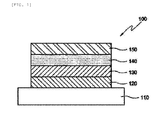
- a polymer photovoltaic device containing the polymer in Examples 3 to 11 was manufactured so as to have a typical sandwich structure (ITO/PEDOT:PSS/active layer/LiF or TiO x /Al).
- ITO indium tin oxide
- a glass substrate coated with indium tin oxide (ITO) was washed by a general cleaning process, ultrasonic treatment in detergent, and cleaning with distilled water, acetone, and 2-propanol.
- a poly(3,4-ethylenedioxythiophene): polystyrene sulfonate (PEDOT: PSS, Baytron P) layer having a thickness of 45nm was spin coated on the ITO substrate.
- the PEDOT:PSS layer was baked on a hot plate at 140°C for 10 minutes.
- An active layer was formed by spin coating the composite solution dissolved in advance after filtering using a 0.45 ⁇ m (PTFE) syringe filter.
- PTFE 0.45 ⁇ m
- a LiF electrode having a thickness of 0.7nm or a Ca electrode having a thickness of 2.0nm and an Al cathode having a thickness of 100nm as the uppermost electrode were deposited on the obtained device structure body in a thermal distiller under vacuum (3x10 - 6 torr), thereby completing the photovoltaic device.
- Current density-voltage (J-V) characteristics of all of the polymer photovoltaic cells were measured under solar simulated illumination of 100 mW/cm 2 (AM 1.5 G) by using an Oriel 1000W solar simulator. Electric data was recorded using a Keithley 236 source-measure unit, and all of the characteristics were measured at room temperature.
- the illuminance was compensated by employing a standard Si photodiode detector (PV measurements Inc.) calibrated at National Renewable Energy Laboratory (NREL). Incident photon-to-current conversion efficiency (IPCE) was measured as a function of the wavelength in a range of 360 to 800nm (PV Measurements Inc) using a halogen lamp as a light source and calibrated using a standard silicon photodiode. A thickness of the thin film was measured using a KLA Tencor Alpha-step IQ surface profilometer with an accuracy of ⁇ 1 nm.
- Example 12 Measurement results of Example 12 were shown in Table 1. That is, open circuit voltage (V oc ), short-circuit current density (J sc ), fill factor (FF), and a photovoltaic parameter of overall conversion efficiency ( ⁇ ) were shown in Table 1.
- energy conversion efficiency % fill factor ⁇ J sc ⁇ V oc 100
- An optical band gap from UV spectrum was low (1.60 to 1.78), such that an increase in the open circuit voltage may be generally expected.
- the photoelectric conversion efficiency was tendentiously changed according to an intensity of electron-withdrawing effect of an acceptor group. That is, as shown in Table 1, as the intensity of the electro-withdrawing effect was increased in a substitution sequence (Example 4 -> Example 3 -> Example 10) of ester, ketone, and fluoro and ketone, which were substituents of the thienothiophene, the efficiency was sequentially increased.
Landscapes
- Chemical & Material Sciences (AREA)
- Organic Chemistry (AREA)
- Engineering & Computer Science (AREA)
- Materials Engineering (AREA)
- Physics & Mathematics (AREA)
- Spectroscopy & Molecular Physics (AREA)
- Health & Medical Sciences (AREA)
- Chemical Kinetics & Catalysis (AREA)
- Medicinal Chemistry (AREA)
- Polymers & Plastics (AREA)
- Heterocyclic Carbon Compounds Containing A Hetero Ring Having Oxygen Or Sulfur (AREA)
- Polyoxymethylene Polymers And Polymers With Carbon-To-Carbon Bonds (AREA)
- Thin Film Transistor (AREA)
- Addition Polymer Or Copolymer, Post-Treatments, Or Chemical Modifications (AREA)
Applications Claiming Priority (3)
| Application Number | Priority Date | Filing Date | Title |
|---|---|---|---|
| KR20110039597 | 2011-04-27 | ||
| KR1020120043437A KR101934806B1 (ko) | 2011-04-27 | 2012-04-25 | 유기 반도체 화합물, 이의 제조방법 및 이를 채용한 유기 반도체 디바이스 |
| PCT/KR2012/003230 WO2012148185A2 (fr) | 2011-04-27 | 2012-04-26 | Composé semi-conducteur organique, son procédé de préparation, et dispositif semi-conducteur organique utilisant celui-ci |
Publications (2)
| Publication Number | Publication Date |
|---|---|
| EP2706060A2 true EP2706060A2 (fr) | 2014-03-12 |
| EP2706060A4 EP2706060A4 (fr) | 2014-10-29 |
Family
ID=47072912
Family Applications (1)
| Application Number | Title | Priority Date | Filing Date |
|---|---|---|---|
| EP12777095.6A Withdrawn EP2706060A4 (fr) | 2011-04-27 | 2012-04-26 | Composé semi-conducteur organique, son procédé de préparation, et dispositif semi-conducteur organique utilisant celui-ci |
Country Status (6)
| Country | Link |
|---|---|
| US (1) | US9236573B2 (fr) |
| EP (1) | EP2706060A4 (fr) |
| JP (1) | JP6016891B2 (fr) |
| KR (1) | KR101934806B1 (fr) |
| CN (1) | CN103502251A (fr) |
| WO (1) | WO2012148185A2 (fr) |
Families Citing this family (3)
| Publication number | Priority date | Publication date | Assignee | Title |
|---|---|---|---|---|
| CN103881066A (zh) * | 2012-12-24 | 2014-06-25 | 海洋王照明科技股份有限公司 | 一种萘并二噻吩基共聚物及其制备方法与应用 |
| KR101587268B1 (ko) | 2015-04-21 | 2016-01-20 | 주식회사 이너지테크놀러지스 | 지중열로 직접 냉방하는 지열히트펌프 냉난방 급탕 시스템 |
| KR101713543B1 (ko) | 2015-08-14 | 2017-03-09 | 주식회사 이너지테크놀러지스 | 열회수 온수공급 기능을 보유한 히트펌프 냉난방기 |
Family Cites Families (9)
| Publication number | Priority date | Publication date | Assignee | Title |
|---|---|---|---|---|
| US5936259A (en) * | 1997-10-16 | 1999-08-10 | Lucent Technologies Inc. | Thin film transistor and organic semiconductor material thereof |
| JP2006216814A (ja) | 2005-02-04 | 2006-08-17 | Konica Minolta Holdings Inc | 有機半導体材料、有機半導体薄膜、有機薄膜トランジスタ、電界効果トランジスタ及びスイッチング素子 |
| JP2007067262A (ja) | 2005-09-01 | 2007-03-15 | Konica Minolta Holdings Inc | 有機半導体材料、有機半導体膜、有機半導体デバイス及び有機薄膜トランジスタ |
| KR101314998B1 (ko) * | 2006-12-13 | 2013-10-04 | 삼성전자주식회사 | 헤테로아센 화합물, 이를 포함하는 유기 박막 및 당해 박막을 포함하는 전자 소자 |
| CN101412651A (zh) * | 2007-10-18 | 2009-04-22 | 北京化工大学 | 并五苯及其衍生物和制备 |
| JP5544650B2 (ja) | 2008-11-21 | 2014-07-09 | 国立大学法人広島大学 | 新規化合物の製造方法 |
| JP2010180151A (ja) * | 2009-02-04 | 2010-08-19 | Hokkaido Univ | チオフェン環縮合多環芳香族化合物 |
| KR101156630B1 (ko) * | 2009-02-27 | 2012-06-15 | 경상대학교산학협력단 | 디알콕시치환체를 갖는 나프탈렌 교대 공중합체와 이를 이용한 유기전자소자 |
| JP5620256B2 (ja) * | 2009-12-25 | 2014-11-05 | 住友化学株式会社 | 高分子化合物、これを含む薄膜及びインク組成物 |
-
2012
- 2012-04-25 KR KR1020120043437A patent/KR101934806B1/ko not_active Expired - Fee Related
- 2012-04-26 CN CN201280020827.8A patent/CN103502251A/zh active Pending
- 2012-04-26 EP EP12777095.6A patent/EP2706060A4/fr not_active Withdrawn
- 2012-04-26 WO PCT/KR2012/003230 patent/WO2012148185A2/fr not_active Ceased
- 2012-04-26 US US14/114,065 patent/US9236573B2/en not_active Expired - Fee Related
- 2012-04-26 JP JP2014508293A patent/JP6016891B2/ja not_active Expired - Fee Related
Also Published As
| Publication number | Publication date |
|---|---|
| EP2706060A4 (fr) | 2014-10-29 |
| JP6016891B2 (ja) | 2016-10-26 |
| US20140046013A1 (en) | 2014-02-13 |
| WO2012148185A2 (fr) | 2012-11-01 |
| KR20120122924A (ko) | 2012-11-07 |
| JP2014517826A (ja) | 2014-07-24 |
| KR101934806B1 (ko) | 2019-01-04 |
| CN103502251A (zh) | 2014-01-08 |
| WO2012148185A3 (fr) | 2013-03-21 |
| US9236573B2 (en) | 2016-01-12 |
Similar Documents
| Publication | Publication Date | Title |
|---|---|---|
| De Rossi et al. | Modified P3HT materials as hole transport layers for flexible perovskite solar cells | |
| Cui et al. | Improvement of open-circuit voltage and photovoltaic properties of 2D-conjugated polymers by alkylthio substitution | |
| JP6270867B2 (ja) | エレクトロニクス用途のための官能化ベンゾジチオフェンポリマー | |
| DE112010004202T5 (de) | Makromolekulare Verbindung | |
| CN104086752A (zh) | 苯并二噻吩类聚合物、其制备方法、包括其的半导体组合物及应用其的太阳能电池 | |
| JP2013523931A (ja) | 縮合環系ジチオフェンコポリマー | |
| EP3275026A1 (fr) | Composés colorants fluorés pour cellules solaires organiques | |
| EP2927259B1 (fr) | Copolymère à base de benzodithiophène contenant des motifs thiophène pyrroledione et procédé pour le préparer et ses applications | |
| Zou et al. | The effect of alkylthio side chains in oligothiophene-based donor materials for organic solar cells | |
| Burney‐Allen et al. | Benzobisoxazole Cruciforms: A Cross‐conjugated Platform for Designing Tunable Donor/Acceptor Materials | |
| EP2706060A2 (fr) | Composé semi-conducteur organique, son procédé de préparation, et dispositif semi-conducteur organique utilisant celui-ci | |
| KR101259865B1 (ko) | 저밴드갭의 공중합체 및 이의 제조방법 | |
| US20150194608A1 (en) | Building block for low bandgap conjugated polymers | |
| JP5946273B2 (ja) | 有機半導体化合物および、これを含むトランジスタと電子素子 | |
| KR101495152B1 (ko) | 유기 반도체 화합물 및 제조방법과 이를 포함하는 유기전자소자 | |
| JP2014185192A (ja) | 共重合体、これを用いた有機太陽電池およびその製造方法 | |
| Zhang et al. | The effect of molecular geometry on the photovoltaic property of diketopyrrolopyrrole based non-fullerene acceptors | |
| KR101400077B1 (ko) | 신규한 중합체, 이의 제조방법 및 이를 함유하는 유기 광전자 소자 | |
| Agneeswari et al. | Modulation of the properties of pyrrolo [3, 4-c] pyrrole-1, 4-dione based polymers containing 2, 5-di (2-thienyl) pyrrole derivatives with different substitutions on the pyrrole unit | |
| JP2013095813A (ja) | 高分子化合物及びそれを用いた光電変換素子 | |
| Wang et al. | Synthesis and photovoltaic properties of organic small molecules containing triphenylamine and benzothiadiazole moieties with different terminal groups | |
| KR101833215B1 (ko) | 유기 반도체 화합물, 이의 제조방법 및 이를 포함하는 유기 전자 소자 | |
| Ogueri | Organic Semiconducting Oligothiophenes and Thiophene-Based Polyphosphazenes: Synthesis, Characterization, and Application | |
| KR101947020B1 (ko) | 낮은 밴드 갭을 갖는 유기 반도체 화합물 및 이를 포함하는 트랜지스터와 전자 소자 | |
| CN110536915B (zh) | 用于电子和光子应用的垂直苯并二噻吩基给体-受体聚合物 |
Legal Events
| Date | Code | Title | Description |
|---|---|---|---|
| PUAI | Public reference made under article 153(3) epc to a published international application that has entered the european phase |
Free format text: ORIGINAL CODE: 0009012 |
|
| 17P | Request for examination filed |
Effective date: 20131104 |
|
| AK | Designated contracting states |
Kind code of ref document: A2 Designated state(s): AL AT BE BG CH CY CZ DE DK EE ES FI FR GB GR HR HU IE IS IT LI LT LU LV MC MK MT NL NO PL PT RO RS SE SI SK SM TR |
|
| DAX | Request for extension of the european patent (deleted) | ||
| A4 | Supplementary search report drawn up and despatched |
Effective date: 20140930 |
|
| RIC1 | Information provided on ipc code assigned before grant |
Ipc: H01L 51/46 20060101ALI20140924BHEP Ipc: H01L 51/00 20060101ALI20140924BHEP Ipc: C07D 495/04 20060101AFI20140924BHEP Ipc: H01L 51/54 20060101ALI20140924BHEP Ipc: H01L 51/30 20060101ALI20140924BHEP |
|
| STAA | Information on the status of an ep patent application or granted ep patent |
Free format text: STATUS: THE APPLICATION HAS BEEN WITHDRAWN |
|
| 18W | Application withdrawn |
Effective date: 20160408 |