EP2708492B1 - Couche mesoporeuse comprenant des aggrégats-j et procédé de production - Google Patents
Couche mesoporeuse comprenant des aggrégats-j et procédé de production Download PDFInfo
- Publication number
- EP2708492B1 EP2708492B1 EP13176195.9A EP13176195A EP2708492B1 EP 2708492 B1 EP2708492 B1 EP 2708492B1 EP 13176195 A EP13176195 A EP 13176195A EP 2708492 B1 EP2708492 B1 EP 2708492B1
- Authority
- EP
- European Patent Office
- Prior art keywords
- aggregates
- pores
- quantum dots
- assembly according
- mesoporous
- Prior art date
- Legal status (The legal status is an assumption and is not a legal conclusion. Google has not performed a legal analysis and makes no representation as to the accuracy of the status listed.)
- Active
Links
Images



Classifications
-
- B—PERFORMING OPERATIONS; TRANSPORTING
- B82—NANOTECHNOLOGY
- B82Y—SPECIFIC USES OR APPLICATIONS OF NANOSTRUCTURES; MEASUREMENT OR ANALYSIS OF NANOSTRUCTURES; MANUFACTURE OR TREATMENT OF NANOSTRUCTURES
- B82Y30/00—Nanotechnology for materials or surface science, e.g. nanocomposites
-
- B—PERFORMING OPERATIONS; TRANSPORTING
- B82—NANOTECHNOLOGY
- B82B—NANOSTRUCTURES FORMED BY MANIPULATION OF INDIVIDUAL ATOMS, MOLECULES, OR LIMITED COLLECTIONS OF ATOMS OR MOLECULES AS DISCRETE UNITS; MANUFACTURE OR TREATMENT THEREOF
- B82B1/00—Nanostructures formed by manipulation of individual atoms or molecules, or limited collections of atoms or molecules as discrete units
- B82B1/001—Devices without movable or flexible elements
-
- B—PERFORMING OPERATIONS; TRANSPORTING
- B82—NANOTECHNOLOGY
- B82B—NANOSTRUCTURES FORMED BY MANIPULATION OF INDIVIDUAL ATOMS, MOLECULES, OR LIMITED COLLECTIONS OF ATOMS OR MOLECULES AS DISCRETE UNITS; MANUFACTURE OR TREATMENT THEREOF
- B82B3/00—Manufacture or treatment of nanostructures by manipulation of individual atoms or molecules, or limited collections of atoms or molecules as discrete units
- B82B3/0009—Forming specific nanostructures
- B82B3/0014—Array or network of similar nanostructural elements
-
- B—PERFORMING OPERATIONS; TRANSPORTING
- B82—NANOTECHNOLOGY
- B82B—NANOSTRUCTURES FORMED BY MANIPULATION OF INDIVIDUAL ATOMS, MOLECULES, OR LIMITED COLLECTIONS OF ATOMS OR MOLECULES AS DISCRETE UNITS; MANUFACTURE OR TREATMENT THEREOF
- B82B3/00—Manufacture or treatment of nanostructures by manipulation of individual atoms or molecules, or limited collections of atoms or molecules as discrete units
- B82B3/0042—Assembling discrete nanostructures into nanostructural devices
- B82B3/0052—Aligning two or more elements
-
- B—PERFORMING OPERATIONS; TRANSPORTING
- B82—NANOTECHNOLOGY
- B82Y—SPECIFIC USES OR APPLICATIONS OF NANOSTRUCTURES; MEASUREMENT OR ANALYSIS OF NANOSTRUCTURES; MANUFACTURE OR TREATMENT OF NANOSTRUCTURES
- B82Y15/00—Nanotechnology for interacting, sensing or actuating, e.g. quantum dots as markers in protein assays or molecular motors
-
- B—PERFORMING OPERATIONS; TRANSPORTING
- B82—NANOTECHNOLOGY
- B82B—NANOSTRUCTURES FORMED BY MANIPULATION OF INDIVIDUAL ATOMS, MOLECULES, OR LIMITED COLLECTIONS OF ATOMS OR MOLECULES AS DISCRETE UNITS; MANUFACTURE OR TREATMENT THEREOF
- B82B3/00—Manufacture or treatment of nanostructures by manipulation of individual atoms or molecules, or limited collections of atoms or molecules as discrete units
- B82B3/0085—Testing nanostructures
-
- B—PERFORMING OPERATIONS; TRANSPORTING
- B82—NANOTECHNOLOGY
- B82Y—SPECIFIC USES OR APPLICATIONS OF NANOSTRUCTURES; MEASUREMENT OR ANALYSIS OF NANOSTRUCTURES; MANUFACTURE OR TREATMENT OF NANOSTRUCTURES
- B82Y20/00—Nanooptics, e.g. quantum optics or photonic crystals
-
- Y—GENERAL TAGGING OF NEW TECHNOLOGICAL DEVELOPMENTS; GENERAL TAGGING OF CROSS-SECTIONAL TECHNOLOGIES SPANNING OVER SEVERAL SECTIONS OF THE IPC; TECHNICAL SUBJECTS COVERED BY FORMER USPC CROSS-REFERENCE ART COLLECTIONS [XRACs] AND DIGESTS
- Y10—TECHNICAL SUBJECTS COVERED BY FORMER USPC
- Y10S—TECHNICAL SUBJECTS COVERED BY FORMER USPC CROSS-REFERENCE ART COLLECTIONS [XRACs] AND DIGESTS
- Y10S977/00—Nanotechnology
- Y10S977/70—Nanostructure
- Y10S977/773—Nanoparticle, i.e. structure having three dimensions of 100 nm or less
- Y10S977/774—Exhibiting three-dimensional carrier confinement, e.g. quantum dots
-
- Y—GENERAL TAGGING OF NEW TECHNOLOGICAL DEVELOPMENTS; GENERAL TAGGING OF CROSS-SECTIONAL TECHNOLOGIES SPANNING OVER SEVERAL SECTIONS OF THE IPC; TECHNICAL SUBJECTS COVERED BY FORMER USPC CROSS-REFERENCE ART COLLECTIONS [XRACs] AND DIGESTS
- Y10—TECHNICAL SUBJECTS COVERED BY FORMER USPC
- Y10S—TECHNICAL SUBJECTS COVERED BY FORMER USPC CROSS-REFERENCE ART COLLECTIONS [XRACs] AND DIGESTS
- Y10S977/00—Nanotechnology
- Y10S977/902—Specified use of nanostructure
- Y10S977/932—Specified use of nanostructure for electronic or optoelectronic application
-
- Y—GENERAL TAGGING OF NEW TECHNOLOGICAL DEVELOPMENTS; GENERAL TAGGING OF CROSS-SECTIONAL TECHNOLOGIES SPANNING OVER SEVERAL SECTIONS OF THE IPC; TECHNICAL SUBJECTS COVERED BY FORMER USPC CROSS-REFERENCE ART COLLECTIONS [XRACs] AND DIGESTS
- Y10—TECHNICAL SUBJECTS COVERED BY FORMER USPC
- Y10T—TECHNICAL SUBJECTS COVERED BY FORMER US CLASSIFICATION
- Y10T428/00—Stock material or miscellaneous articles
- Y10T428/249921—Web or sheet containing structurally defined element or component
- Y10T428/249953—Composite having voids in a component [e.g., porous, cellular, etc.]
- Y10T428/249967—Inorganic matrix in void-containing component
- Y10T428/24997—Of metal-containing material
-
- Y—GENERAL TAGGING OF NEW TECHNOLOGICAL DEVELOPMENTS; GENERAL TAGGING OF CROSS-SECTIONAL TECHNOLOGIES SPANNING OVER SEVERAL SECTIONS OF THE IPC; TECHNICAL SUBJECTS COVERED BY FORMER USPC CROSS-REFERENCE ART COLLECTIONS [XRACs] AND DIGESTS
- Y10—TECHNICAL SUBJECTS COVERED BY FORMER USPC
- Y10T—TECHNICAL SUBJECTS COVERED BY FORMER US CLASSIFICATION
- Y10T428/00—Stock material or miscellaneous articles
- Y10T428/249921—Web or sheet containing structurally defined element or component
- Y10T428/249953—Composite having voids in a component [e.g., porous, cellular, etc.]
- Y10T428/249986—Void-containing component contains also a solid fiber or solid particle
-
- Y—GENERAL TAGGING OF NEW TECHNOLOGICAL DEVELOPMENTS; GENERAL TAGGING OF CROSS-SECTIONAL TECHNOLOGIES SPANNING OVER SEVERAL SECTIONS OF THE IPC; TECHNICAL SUBJECTS COVERED BY FORMER USPC CROSS-REFERENCE ART COLLECTIONS [XRACs] AND DIGESTS
- Y10—TECHNICAL SUBJECTS COVERED BY FORMER USPC
- Y10T—TECHNICAL SUBJECTS COVERED BY FORMER US CLASSIFICATION
- Y10T428/00—Stock material or miscellaneous articles
- Y10T428/249921—Web or sheet containing structurally defined element or component
- Y10T428/249994—Composite having a component wherein a constituent is liquid or is contained within preformed walls [e.g., impregnant-filled, previously void containing component, etc.]
-
- Y—GENERAL TAGGING OF NEW TECHNOLOGICAL DEVELOPMENTS; GENERAL TAGGING OF CROSS-SECTIONAL TECHNOLOGIES SPANNING OVER SEVERAL SECTIONS OF THE IPC; TECHNICAL SUBJECTS COVERED BY FORMER USPC CROSS-REFERENCE ART COLLECTIONS [XRACs] AND DIGESTS
- Y10—TECHNICAL SUBJECTS COVERED BY FORMER USPC
- Y10T—TECHNICAL SUBJECTS COVERED BY FORMER US CLASSIFICATION
- Y10T428/00—Stock material or miscellaneous articles
- Y10T428/25—Web or sheet containing structurally defined element or component and including a second component containing structurally defined particles
- Y10T428/256—Heavy metal or aluminum or compound thereof
Definitions
- the present invention relates to the field of nanotechnology. More specifically, it concerns an assembly made up of:
- J-aggregates are self-arrangements of cyanine molecules which form very ordered assemblies whereof the organizations are of the crystalline type.
- a description of J-aggregates and their properties can be found in the article by H. Kuhn et al. in a book entitled " J-aggregates" by T. Kobayashi, ISBN 981-02-2737-X . Due to the nearly flawless organization of J-aggregates, they have remarkable properties. Mainly, the electro-optical properties of J-aggregates result from exceptional interactions between the transition dipole moments of the dyes, creating extended exciton states after exposure to light. Characteristics for J-aggregates are a narrow excitonic absorption band and resonance fluorescence.
- J-aggregates Connected to that are many other exceptional properties of J-aggregates, such as super-radiant emission, high non-linear susceptibilities, efficient energy migration and superquenching.
- Applications in sensing, light harvesting, light-emitting diodes and non-linear optics can all greatly benefit from the unique properties of J-aggregates.
- Device driven research on J-aggregates is further highly motivated by the fact that a counterpart on the side of inorganic semiconductors does not exist.
- Promoting energy transfer through J-aggregates is the purpose of the assembly of the present invention.
- an exciton spread in a J-aggregates can be caught by a suitable energy acceptor having a spectral overlap between its absorption spectrum and the emission spectrum of the J-aggregates.
- the energy acceptor should be arranged in the vicinity of the J-aggregates.
- Suitable energy acceptors for excited J-aggregates can be dye molecules, semiconductor or metal based nanoparticles.
- colloidal semiconductor quantum dots QD can be used as energy acceptors.
- QD quantum dots
- a quantum dot is a portion of matter (in general semiconductor based) whose excitons are confined in all three spatial dimensions. Consequently, such materials have electronic properties intermediate between those of bulk semiconductors and those of discrete molecules. Nanoparticles made of metals may also be labelled quantum dots if they are small enough (typically sub 10 nm) so that quantization of electronic energy levels occurs. Some experiments known in the art have shown that metal based nanoparticles present such properties and one can expect that transition metals may also present such QD properties.
- QD will include semi-conducting QD, metal based particles the dimension of which enabling them to present QD properties, and rare earth doped oxide based nanoparticles.
- semi-conductor based QD will include CdS, CdSe, ZnS, CdTe, InAs, InP, CdSeS, ZnO, Ag halides and mixed systems containing one or several of these semiconductors.
- Metal based QD will include Cu, Ag, Au, Ni, Pd, Pt, Co, Cr, Ru, Fe.
- Oxide based QD will preferably include BaTiO 3 , and YVO 4 doped with rare earth elements.
- the distance between J-aggregates and quantum dots is an important criterion to obtain an energy transfer between these species. Typically, this distance should be comprised between 0.1 and 10 nm. Correct distances for energy transfer have been adjusted by the Langmuir-Blodgett (LB) technique ( J. Imaging Sci. 1988, 32(2), 64 ). A patent by Tischler et al. (US7799422, 2006 ), Walker et al. (Nano Letters 2010, 10(10), 3995 ) and Agranovich et al.
- LB Langmuir-Blodgett
- the present invention aims to propose a new method making it possible to obtain rather simply energy transfer between J-aggregates and energy donors or acceptors.
- the invention concerns an assembly made up of
- QD are chosen so as to be able to act as energy acceptors or donors for the J-aggregates.
- QD are chosen so as to be able to act as electron acceptors or donors.
- said pores have an average diameter dimensioned so as to enable macromolecules with dendritic architecture to penetrate them.
- the assembly is also made up of such macromolecules forming a functionalized layer at least in said pores and said layer of molecules from the family of cyanines interact with the macromolecules with dendritic architecture to form J-aggregates.
- the method essentially consists of preparing near room temperature a nanoparticular metal-oxide coating on a substrate chosen among organic, metallic or ceramic substrates so as to form a mesoporous coating.
- the dimensions of the pores are typically ranged between 1 and 100 nm, preferably between 2 and 50 nm.
- dendritic architecture molecules are adsorbed along the mesoporous coating walls including the mesopores walls of the metal-oxide coating and thus define a dendrimer support.
- Cyanine molecules are subsequently self-assembled into supramolecular J-aggregates on this dendrimer support at least within the pores.
- QD are then incorporated into the pores containing the J-aggregates from aqueous solutions.
- One or more QD can be introduced within one pore.
- cyanines to form J-aggregates [5, 5'-diphenyl-dibenzoxazolo N, N'-propylsulfonate]-9 ethyl trimethine cyanine, called Myline 1 (Myl-1), and 5,5',6,6'-tetrachloro dibenzimidalolo 2,2'-butylsulfonate 9,9'-N-diethyl trimethine cyanine, called Myline 2 (Myl-2) (see structures in patent EP1788936 fig. 4 and 9 respectively).
- Myl-1 and Myl-2 were synthesized by ILFORD IMAGING Switzerland. More generally, cyanines, mero-cyanines, squaraines and their derivatives, are capable of self-assembly in order to form J-aggregates.
- Dried coatings containing the J-aggregates were functionalized with an aqueous solution of commercially available QD, rinsed and dried before spectroscopic measurements.
- QD can be supplied by Cytodiagnostics, proposing core-shell structured colloidal QD, the semiconducting core being composed of different Cd or Zn sulphides and selenides, and the external shell made of a stabilising organic layer presenting different chemical groups (e.g. OH or NH 2 , referred below as QD-OH and QD-NH 2 respectively).
- the total diameter is approximately 10 nm. Concentrations of QD solutions were varied between 1 to 25 mg per mL as shown in results proposed thereafter.
- FIG. 1 The configuration obtained is schematically illustrated in figure 1 .
- macromolecules with dendritic architecture are adsorbed on the internal walls of the pores.
- Said pores have an average diameter dimensioned so as to enable macromolecules with dendritic architecture to penetrate them.
- the macromolecules with dendritic architecture form a functionalized layer at least in said pores.
- One or more QD may also be accommodated within the same pores as those containing the J-aggregates and, as it will be explained thereafter, may interact and undergo energy transfer with J-aggregates.
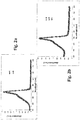
- Figure 2 represents absorption spectra of J-aggregate of Myl-1. As previously described in application EP2028236 , high quality J-aggregates are formed in the pores as proved by the sharp absorption peaks.
- a monolayer of a highly perfect Myl-1 J-aggregate on a PAMAM G4 support deposited on a glass substrate has been prepared.
- a 5 times diluted commercial aqueous QD solution is applied by spin-coating onto the dried J-aggregate layer.
- Spectral measurements shown in Figure 3 were carried out after rinsing and drying.
- Results obtained are 50% J-aggregate fluorescence quenching and enhancement of the QD signal by a factor of 2.5, to be compared to 100% J-aggregate fluorescence quenching and enhancement of the QD signal by a factor of 2.5 in Bulovic's method cited in prior art.
- Figure 4 represents several materials used to form the mesoporous substrate.
- the table indicates the shape and the diameter of agglomerated particles and in parenthesis, the diameter of elementary particles.
- AIOOH Types 1 and 2 were purchased from SASOL Ltd.
- SiO 2 was purchased from CABOT Ltd.
- the table also indicates the volume and mean diameter of pores measured with the nitrogen adsorption method. Materials should be chosen so as to enable molecules from the family of cyanines intended to form the J-aggregates and QD to penetrate them.
- mesoporous coatings can be realized in a material chosen among AIOOH, TiO 2 , ITO, SiO 2 , ⁇ Q-Al 2 O 3 , ZrO 2 , SnO 2 , ZnO, Ta 2 O 5 , mixture of them or with a base of doped conductor oxide nanoparticles.
- the mesoporous coatings can also be made of organic matrix, as described in references mentioned in paragraph [0021] above.
- the mean diameter of pores of the mesoporous layer should be large enough to enable encapsulation of the selected QD.
- QD are inserted into the pores of the mesoporous substrate by using similar methods as those proposed for glass substrate.
- QD within the mesoporous coating should not lead to a modification of the absorption spectrum of the J-aggregates that would result from the disassembling of the J-aggregates.
- QD should also not be destabilized (i.e. not aggregated) by J-aggregates or by the chemical compounds present in the assembly according to the invention. It should also present an overlap between the emission spectrum of the donor with the absorption spectrum of the acceptor to make the energy transfer possible.
- the distance between the QD and the donor/acceptor for electron transfer should be much shorter, typically below 2 nm (see for example Barbara et al., J. Phys. Chem., 1996, 100, 13148-13168 ).
- Figure 5 shows the emission spectra of Myl-1 after deconvolution with and without commercial QD solutions diluted 30 times on SiO 2 .
- Spectrum A represents fluorescence intensity of J-aggregate alone in SiO 2 mesoporous coatings.
- Spectrum B represents the fluorescence intensity of the QD alone (diluted 30 times in water) in SiO 2 mesoporous coatings.
- Spectrum C1 represents the fluorescence intensity of the J-aggregate in presence of the QD (diluted 30 times in water) in SiO 2 mesoporous coatings.
- Spectrum C2 represents the fluorescence intensity of QD diluted 30 times in water in presence of the J-aggregate in SiO 2 mesoporous coating.
- Fig. 6 shows emission spectra for QD (emission near 590 nm) in SiO 2 (films) during storage in air and absence of actinic light near room temperature.
- Figs. 6 A-D show spectra after 0, 2, 6 and 22 days respectively, showing that the fluorescence emission of the QD varies little and rather improves somewhat with storage time.
- Fig. 7 demonstrates reverse energy transfer from an excited QD to the J-aggregate. The results are obtained by exciting QD and transferring energy to the J-aggregate of Myl-2. Fig. 7 shows that energy transfer is improved due to confinement in mesopores.
- Fig. 7a shows experimental emission spectra. Spectrum A displays the emission of the J-aggregate alone showing weak emission with a maximum near 590 nm (excitation at 375 nm). Spectrum B shows that the QD alone strongly emits near 550 nm, but very weakly near 590 nm. Comparison between spectrum C (QD and J-aggregate together) and spectrum A (J-aggregate alone) demonstrates energy transfer from the QD to the J-aggregate.
- J-aggregate emission near 590 nm increases by a factor of 2.5 - 3 (several experiments) due to energy transfer from the QD, while the emission of the QD near 550 nm is quenched by 14% due to energy transfer (B compared with C).
- Energy transfer is further illustrated in the excitation spectra of Fig. 7b (emission 590 nm), where the excitation spectrum B (J-aggregate and QD) vs. spectrum A (J-aggregate alone) show the contribution of the QD in the energy transfer process.
- Increase of the J-aggregate fluorescence emission when exciting in the range 460 to 550 nm is attributed to enhanced absorption of light by the QD.
- the forthcoming example describes the preparation of assembly with QD of gold and J-aggregates of Myl-1 in pores of metal oxide nanoparticle coatings (SiO 2 and AIOOH type 1, Fig. 4 ).
- Dried coatings containing the J-aggregate of Myl-1 were functionalized with a few drops of an aqueous solution of commercially available gold QD (concentration of 3.40 10 13 particles/mL in water) rinsed and dried before spectroscopic measurements.
- Gold QD were purchased from Sigma-Aldrich. QD-diameters of 5 nm were used.
- Gold nanoparticle concentrations in aqueous solutions were varied between 6.8 10 12 particles/mL and 6.8 10 13 particles/mL. The same quenching rate, in the range of 80% to 90%, was obtained.
- FIG 8 shows the emission spectra (excitation 510 nm) of the J-aggregate of Myl-1 with and without commercial gold-QD solutions on SiO 2 .
- the dashed-line spectrum represents the fluorescence intensity of J-aggregate alone in SiO 2 mesoporous coatings.
- the solid-line spectrum represents the fluorescence intensity of the J-aggregate in presence of the gold-QD in SiO 2 mesoporous coatings.
Landscapes
- Chemical & Material Sciences (AREA)
- Engineering & Computer Science (AREA)
- Nanotechnology (AREA)
- Crystallography & Structural Chemistry (AREA)
- Physics & Mathematics (AREA)
- Manufacturing & Machinery (AREA)
- General Physics & Mathematics (AREA)
- Condensed Matter Physics & Semiconductors (AREA)
- Materials Engineering (AREA)
- Composite Materials (AREA)
- Health & Medical Sciences (AREA)
- Life Sciences & Earth Sciences (AREA)
- General Health & Medical Sciences (AREA)
- Molecular Biology (AREA)
- Luminescent Compositions (AREA)
- Investigating, Analyzing Materials By Fluorescence Or Luminescence (AREA)
- Optics & Photonics (AREA)
Claims (14)
- Ensemble constitué de- un support comprenant un revêtement mésoporeux dont les pores ont un diamètre moyen de 1 à 100 nm de façon à permettre aux molécules de la famille des cyanines de diffuser dans le revêtement mésoporeux,- molécules de la famille des cyanines organisées en agrégats J au moins dans les pores du revêtement mésoporeux,caractérisé en ce que ledit ensemble comprend en outre des points quantiques situés dans les mêmes pores que ceux contenant les agrégats J, lesdits points quantiques maintenant une structure d'agrégats J.
- Ensemble selon la revendication 1, caractérisé en ce que la distance entre les agrégats J et les points quantiques étant comprise entre 0,1 nm et 10 nm.
- Ensemble selon la revendication 1 ou revendication 2, dans lequel lesdits pores comprennent des macromolécules ayant une architecture dendritique formant une couche fonctionnalisée au moins dans lesdits pores.
- Ensemble selon l'une des revendications 1 à 3, dans lequel lesdits points quantiques et les agrégats J présentent un chevauchement entre le spectre d'émission du donneur et le spectre d'absorption de l'accepteur pour permettre le transfert d'énergie.
- Ensemble selon l'une des revendications 1 à 3, dans lequel lesdits points quantiques et les agrégats J présentent un chevauchement des états électroniques entre le donneur et l'accepteur pour permettre le transfert d'électron.
- Ensemble selon l'une des revendications précédentes, dans lequel ledit point quantique mesure moins de 15 nm, de préférence moins de 10 nm, au moins dans une dimension spatiale.
- Ensemble selon l'une des revendications précédentes, dans lequel lesdits points quantiques sont des espèces nanoparticulaires semi-conductrices parmi CdS, CdSe, ZnS, CdTe, InAs, InP, CdSeS, ZnO, des halogénures de Ag et des systèmes mixtes contenant un ou plusieurs de ces semi-conducteurs, ou
dans lequel lesdits points quantiques sont lesdites espèces nanoparticulaires métalliques parmi Cu, Ag, Au, Ni, Pd, Pt, Co, Cr, Ru, Fe, ou
dans lequel lesdits points quantiques comprennent BaTiO3 et YVO4 dopés avec des éléments terres rares. - Ensemble selon l'une quelconque des revendications précédentes, dans lequel ladite macromolécule ayant une architecture dendritique est une molécule de dendrimère.
- Ensemble selon l'une quelconque des revendications précédentes dans lequel ledit support comprend un revêtement d'oxyde métallique mésoporeux.
- Ensemble selon la revendication 9, dans lequel ledit revêtement mésoporeux est réalisé en un matériau choisi parmi AIOOH, TiO2, ITO, SiO2, γ-Al2O3, ZrO2, SnO2, ZnO, Ta2O5, ou un mélange de ces matériaux ou des nanoparticules d'oxyde conducteur dopé.
- Ensemble selon l'une quelconque des revendications précédentes, dans lequel le diamètre moyen des pores du revêtement mésoporeux est compris entre 2 et 50 nm.
- Procédé de production d'un ensemble selon l'une des revendications précédentes, comprenant les étapes suivantes :i. obtention d'un support comprenant un revêtement mésoporeux dont les pores ont un diamètre moyen de 1 à 100 nm de façon à permettre à des molécules de la famille des cyanines et des points quantiques de les pénétrer,ii. formation d'une couche d'agrégats J de molécules de cyanines dans les pores du support,iii. introduction de points quantiques dans les mêmes pores que ceux contenant les agrégats J, lesdits points quantiques maintenant la structure d'agrégats J.
- Procédé selon la revendication 12 comprenant en outre les étapes de :iv. dépôt d'une solution de macromolécules ayant une architecture dendritique sur le support de façon à fonctionnaliser les pores,la couche d'agrégats J étant formée sur la couche de macromolécules ayant une architecture dendritique.
- Procédé selon l'une des revendications 12 et 13, dans lequel des points quantiques sont introduits dans des pores dans une solution diluée de façon à éviter les effets d'agrégation dans les pores.
Priority Applications (1)
| Application Number | Priority Date | Filing Date | Title |
|---|---|---|---|
| EP13176195.9A EP2708492B1 (fr) | 2012-07-13 | 2013-07-11 | Couche mesoporeuse comprenant des aggrégats-j et procédé de production |
Applications Claiming Priority (2)
| Application Number | Priority Date | Filing Date | Title |
|---|---|---|---|
| EP20120176306 EP2684839A1 (fr) | 2012-07-13 | 2012-07-13 | Couche mesoporeuse comprenant des aggrégats-j |
| EP13176195.9A EP2708492B1 (fr) | 2012-07-13 | 2013-07-11 | Couche mesoporeuse comprenant des aggrégats-j et procédé de production |
Publications (2)
| Publication Number | Publication Date |
|---|---|
| EP2708492A1 EP2708492A1 (fr) | 2014-03-19 |
| EP2708492B1 true EP2708492B1 (fr) | 2017-11-29 |
Family
ID=48746406
Family Applications (2)
| Application Number | Title | Priority Date | Filing Date |
|---|---|---|---|
| EP20120176306 Withdrawn EP2684839A1 (fr) | 2012-07-13 | 2012-07-13 | Couche mesoporeuse comprenant des aggrégats-j |
| EP13176195.9A Active EP2708492B1 (fr) | 2012-07-13 | 2013-07-11 | Couche mesoporeuse comprenant des aggrégats-j et procédé de production |
Family Applications Before (1)
| Application Number | Title | Priority Date | Filing Date |
|---|---|---|---|
| EP20120176306 Withdrawn EP2684839A1 (fr) | 2012-07-13 | 2012-07-13 | Couche mesoporeuse comprenant des aggrégats-j |
Country Status (2)
| Country | Link |
|---|---|
| US (1) | US9238582B2 (fr) |
| EP (2) | EP2684839A1 (fr) |
Cited By (2)
| Publication number | Priority date | Publication date | Assignee | Title |
|---|---|---|---|---|
| WO2020108069A1 (fr) * | 2018-11-28 | 2020-06-04 | Tcl科技集团股份有限公司 | Nano-oxyde métallique, son procédé de préparation et diode électroluminescente à points quantiques |
| FR3156994A1 (fr) | 2023-12-18 | 2025-06-20 | Commissariat à l'Energie Atomique et aux Energies Alternatives | Dispositif optoélectronique et procédé de fabrication associé |
Families Citing this family (3)
| Publication number | Priority date | Publication date | Assignee | Title |
|---|---|---|---|---|
| CN104932136B (zh) * | 2015-07-01 | 2018-01-26 | 合肥鑫晟光电科技有限公司 | 彩膜基板及其制作方法、显示面板和显示装置 |
| KR20180022042A (ko) * | 2016-08-23 | 2018-03-06 | 삼성전자주식회사 | 양자점 조성물, 이의 제조 방법 및 이를 이용한 장치 |
| CN115608382B (zh) * | 2022-10-24 | 2024-08-06 | 上海科技大学 | 一种半导体纳米晶聚集体及其制备方法和应用 |
Family Cites Families (8)
| Publication number | Priority date | Publication date | Assignee | Title |
|---|---|---|---|---|
| WO2006020920A2 (fr) | 2003-01-29 | 2006-02-23 | Medtronic, Inc. | Dispositif catheter pour traiter l'arythmie cardiaque |
| EP1788936B1 (fr) | 2004-08-12 | 2018-11-28 | Medtronic, Inc. | Dispositif catheter pour traiter l'arythmie cardiaque |
| US7799422B2 (en) | 2004-11-03 | 2010-09-21 | Massachusetts Institute Of Technology | Absorbing film |
| CH703675B1 (fr) | 2005-11-16 | 2012-03-15 | Suisse Electronique Microtech | Procédé de réalisation d'agrégats J. |
| ATE451246T1 (de) | 2006-02-21 | 2009-12-15 | Ilford Imaging Ch Gmbh | Aufzeichnungsmaterial für den tintenstrahldruck |
| EP2188825B1 (fr) | 2007-08-17 | 2015-01-07 | Massachusetts Institute of Technology | Matériau électroluminescent |
| EP2028236B1 (fr) | 2007-08-23 | 2010-08-11 | CSEM Centre Suisse d'Electronique et de Microtechnique SA - Recherche et Développement | Ensemble comportant des agrégats J |
| US20110278536A1 (en) | 2010-05-17 | 2011-11-17 | Massachusetts Institute Of Technology | Light emitting material |
-
2012
- 2012-07-13 EP EP20120176306 patent/EP2684839A1/fr not_active Withdrawn
-
2013
- 2013-07-11 EP EP13176195.9A patent/EP2708492B1/fr active Active
- 2013-07-15 US US13/941,578 patent/US9238582B2/en active Active
Non-Patent Citations (1)
| Title |
|---|
| None * |
Cited By (3)
| Publication number | Priority date | Publication date | Assignee | Title |
|---|---|---|---|---|
| WO2020108069A1 (fr) * | 2018-11-28 | 2020-06-04 | Tcl科技集团股份有限公司 | Nano-oxyde métallique, son procédé de préparation et diode électroluminescente à points quantiques |
| FR3156994A1 (fr) | 2023-12-18 | 2025-06-20 | Commissariat à l'Energie Atomique et aux Energies Alternatives | Dispositif optoélectronique et procédé de fabrication associé |
| EP4577006A1 (fr) | 2023-12-18 | 2025-06-25 | Commissariat à l'Energie Atomique et aux Energies Alternatives | Dispositif optoélectronique et procédé de fabrication associé |
Also Published As
| Publication number | Publication date |
|---|---|
| EP2708492A1 (fr) | 2014-03-19 |
| US9238582B2 (en) | 2016-01-19 |
| EP2684839A1 (fr) | 2014-01-15 |
| US20140017485A1 (en) | 2014-01-16 |
Similar Documents
| Publication | Publication Date | Title |
|---|---|---|
| Sarma et al. | Fabrication of Ag/ZnO heterostructure and the role of surface coverage of ZnO microrods by Ag nanoparticles on the photophysical and photocatalytic properties of the metal-semiconductor system | |
| Boldt et al. | Synthesis of highly luminescent and photo-stable, graded shell CdSe/Cd x Zn1–x S nanoparticles by in situ alloying | |
| Cao et al. | An improved strategy for high-quality cesium bismuth bromine perovskite quantum dots with remarkable electrochemiluminescence activities | |
| Hu et al. | Interfacial synthesis of highly stable CsPbX3/oxide Janus nanoparticles | |
| Guo et al. | Luminescent CdSe/CdS core/shell nanocrystals in dendron boxes: superior chemical, photochemical and thermal stability | |
| Mir et al. | Colloidal Mn-doped cesium lead halide perovskite nanoplatelets | |
| KR101140309B1 (ko) | 양자점 다층 박막을 포함한 전기발광소자 | |
| Stouwdam et al. | Photostability of colloidal PbSe and PbSe/PbS core/shell nanocrystals in solution and in the solid state | |
| Guldi et al. | CNT− CdTe versatile donor− acceptor nanohybrids | |
| Thomas et al. | Making gold nanoparticles glow: Enhanced emission from a surface-bound fluoroprobe | |
| EP2708492B1 (fr) | Couche mesoporeuse comprenant des aggrégats-j et procédé de production | |
| Gu et al. | Energy transfer from a surface-bound arene to the gold core in ω-fluorenyl-alkane-1-thiolate monolayer-protected gold clusters | |
| Ahmed et al. | Size-dependent photodegradation of CdS particles deposited onto TiO2 mesoporous films by SILAR method | |
| US20070116627A1 (en) | Carbon nanotube compositions and devices and methods of making thereof | |
| US20110278536A1 (en) | Light emitting material | |
| Kinder et al. | Fabrication of all-inorganic nanocrystal solids through matrix encapsulation of nanocrystal arrays | |
| Zhang et al. | Photoluminescence quenching of CdSe core/shell quantum dots by hole transporting materials | |
| Steiger et al. | J-aggregation of cyanine dyes by self-assembly | |
| Kim et al. | Enhanced colloidal stability of perovskite quantum dots via split-ligand re-precipitation for efficient bi-functional interlayer in photovoltaic application | |
| Kumari et al. | Effect of surface passivating ligand on structural and optoelectronic properties of polymer: CdSe quantum dot composites | |
| Pramata et al. | TiO2/CsPbBr3 quantum dots coupled with polyoxometalate redox clusters for photoswitches | |
| Aggarwal et al. | Enhanced stability and energy transfer in perovskite nanocrystals: paving the way for moisture-resistant light-harvesting devices | |
| Valli et al. | Photoresponsive multilayer films by assembling cationic amphiphilic cyclodextrins and anionic porphyrins at the air/water interface | |
| Matsunaga et al. | Energy Transfer from a Perovskite Nanocrystal to Cyanine Dyes Depending on Spectral Overlap Revealed by a Single-Particle Spectroscopy | |
| Erdem et al. | Morphology-dependent energy transfer of polyfluorene nanoparticles decorating InGaN/GaN quantum-well nanopillars |
Legal Events
| Date | Code | Title | Description |
|---|---|---|---|
| PUAB | Information related to the publication of an a document modified or deleted |
Free format text: ORIGINAL CODE: 0009199EPPU |
|
| PUAI | Public reference made under article 153(3) epc to a published international application that has entered the european phase |
Free format text: ORIGINAL CODE: 0009012 |
|
| PUAI | Public reference made under article 153(3) epc to a published international application that has entered the european phase |
Free format text: ORIGINAL CODE: 0009012 |
|
| AK | Designated contracting states |
Kind code of ref document: A1 Designated state(s): AL AT BE BG CH CY CZ DE DK EE ES FI FR GB GR HR HU IE IS IT LI LT LU LV MC MK MT NL NO PL PT RO RS SE SI SK SM TR |
|
| AX | Request for extension of the european patent |
Extension state: BA ME |
|
| 17P | Request for examination filed |
Effective date: 20140919 |
|
| RBV | Designated contracting states (corrected) |
Designated state(s): AL AT BE BG CH CY CZ DE DK EE ES FI FR GB GR HR HU IE IS IT LI LT LU LV MC MK MT NL NO PL PT RO RS SE SI SK SM TR |
|
| RIC1 | Information provided on ipc code assigned before grant |
Ipc: B82Y 30/00 20110101AFI20170522BHEP Ipc: B82Y 15/00 20110101ALI20170522BHEP Ipc: B82Y 20/00 20110101ALI20170522BHEP Ipc: B82B 3/00 20060101ALI20170522BHEP Ipc: B82B 1/00 20060101ALI20170522BHEP |
|
| GRAP | Despatch of communication of intention to grant a patent |
Free format text: ORIGINAL CODE: EPIDOSNIGR1 |
|
| INTG | Intention to grant announced |
Effective date: 20170707 |
|
| GRAS | Grant fee paid |
Free format text: ORIGINAL CODE: EPIDOSNIGR3 |
|
| GRAA | (expected) grant |
Free format text: ORIGINAL CODE: 0009210 |
|
| AK | Designated contracting states |
Kind code of ref document: B1 Designated state(s): AL AT BE BG CH CY CZ DE DK EE ES FI FR GB GR HR HU IE IS IT LI LT LU LV MC MK MT NL NO PL PT RO RS SE SI SK SM TR |
|
| REG | Reference to a national code |
Ref country code: CH Ref legal event code: EP |
|
| REG | Reference to a national code |
Ref country code: AT Ref legal event code: REF Ref document number: 950195 Country of ref document: AT Kind code of ref document: T Effective date: 20171215 |
|
| REG | Reference to a national code |
Ref country code: IE Ref legal event code: FG4D |
|
| REG | Reference to a national code |
Ref country code: DE Ref legal event code: R096 Ref document number: 602013030023 Country of ref document: DE |
|
| REG | Reference to a national code |
Ref country code: CH Ref legal event code: NV Representative=s name: NOVAGRAAF INTERNATIONAL SA, CH |
|
| REG | Reference to a national code |
Ref country code: NL Ref legal event code: MP Effective date: 20171129 |
|
| REG | Reference to a national code |
Ref country code: LT Ref legal event code: MG4D |
|
| REG | Reference to a national code |
Ref country code: AT Ref legal event code: MK05 Ref document number: 950195 Country of ref document: AT Kind code of ref document: T Effective date: 20171129 |
|
| PG25 | Lapsed in a contracting state [announced via postgrant information from national office to epo] |
Ref country code: NO Free format text: LAPSE BECAUSE OF FAILURE TO SUBMIT A TRANSLATION OF THE DESCRIPTION OR TO PAY THE FEE WITHIN THE PRESCRIBED TIME-LIMIT Effective date: 20180228 Ref country code: LT Free format text: LAPSE BECAUSE OF FAILURE TO SUBMIT A TRANSLATION OF THE DESCRIPTION OR TO PAY THE FEE WITHIN THE PRESCRIBED TIME-LIMIT Effective date: 20171129 Ref country code: SE Free format text: LAPSE BECAUSE OF FAILURE TO SUBMIT A TRANSLATION OF THE DESCRIPTION OR TO PAY THE FEE WITHIN THE PRESCRIBED TIME-LIMIT Effective date: 20171129 Ref country code: ES Free format text: LAPSE BECAUSE OF FAILURE TO SUBMIT A TRANSLATION OF THE DESCRIPTION OR TO PAY THE FEE WITHIN THE PRESCRIBED TIME-LIMIT Effective date: 20171129 Ref country code: FI Free format text: LAPSE BECAUSE OF FAILURE TO SUBMIT A TRANSLATION OF THE DESCRIPTION OR TO PAY THE FEE WITHIN THE PRESCRIBED TIME-LIMIT Effective date: 20171129 |
|
| PG25 | Lapsed in a contracting state [announced via postgrant information from national office to epo] |
Ref country code: HR Free format text: LAPSE BECAUSE OF FAILURE TO SUBMIT A TRANSLATION OF THE DESCRIPTION OR TO PAY THE FEE WITHIN THE PRESCRIBED TIME-LIMIT Effective date: 20171129 Ref country code: BG Free format text: LAPSE BECAUSE OF FAILURE TO SUBMIT A TRANSLATION OF THE DESCRIPTION OR TO PAY THE FEE WITHIN THE PRESCRIBED TIME-LIMIT Effective date: 20180228 Ref country code: GR Free format text: LAPSE BECAUSE OF FAILURE TO SUBMIT A TRANSLATION OF THE DESCRIPTION OR TO PAY THE FEE WITHIN THE PRESCRIBED TIME-LIMIT Effective date: 20180301 Ref country code: RS Free format text: LAPSE BECAUSE OF FAILURE TO SUBMIT A TRANSLATION OF THE DESCRIPTION OR TO PAY THE FEE WITHIN THE PRESCRIBED TIME-LIMIT Effective date: 20171129 Ref country code: AT Free format text: LAPSE BECAUSE OF FAILURE TO SUBMIT A TRANSLATION OF THE DESCRIPTION OR TO PAY THE FEE WITHIN THE PRESCRIBED TIME-LIMIT Effective date: 20171129 Ref country code: LV Free format text: LAPSE BECAUSE OF FAILURE TO SUBMIT A TRANSLATION OF THE DESCRIPTION OR TO PAY THE FEE WITHIN THE PRESCRIBED TIME-LIMIT Effective date: 20171129 |
|
| PG25 | Lapsed in a contracting state [announced via postgrant information from national office to epo] |
Ref country code: NL Free format text: LAPSE BECAUSE OF FAILURE TO SUBMIT A TRANSLATION OF THE DESCRIPTION OR TO PAY THE FEE WITHIN THE PRESCRIBED TIME-LIMIT Effective date: 20171129 |
|
| REG | Reference to a national code |
Ref country code: FR Ref legal event code: PLFP Year of fee payment: 6 |
|
| PG25 | Lapsed in a contracting state [announced via postgrant information from national office to epo] |
Ref country code: CY Free format text: LAPSE BECAUSE OF FAILURE TO SUBMIT A TRANSLATION OF THE DESCRIPTION OR TO PAY THE FEE WITHIN THE PRESCRIBED TIME-LIMIT Effective date: 20171129 Ref country code: CZ Free format text: LAPSE BECAUSE OF FAILURE TO SUBMIT A TRANSLATION OF THE DESCRIPTION OR TO PAY THE FEE WITHIN THE PRESCRIBED TIME-LIMIT Effective date: 20171129 Ref country code: EE Free format text: LAPSE BECAUSE OF FAILURE TO SUBMIT A TRANSLATION OF THE DESCRIPTION OR TO PAY THE FEE WITHIN THE PRESCRIBED TIME-LIMIT Effective date: 20171129 Ref country code: DK Free format text: LAPSE BECAUSE OF FAILURE TO SUBMIT A TRANSLATION OF THE DESCRIPTION OR TO PAY THE FEE WITHIN THE PRESCRIBED TIME-LIMIT Effective date: 20171129 Ref country code: SK Free format text: LAPSE BECAUSE OF FAILURE TO SUBMIT A TRANSLATION OF THE DESCRIPTION OR TO PAY THE FEE WITHIN THE PRESCRIBED TIME-LIMIT Effective date: 20171129 |
|
| REG | Reference to a national code |
Ref country code: DE Ref legal event code: R097 Ref document number: 602013030023 Country of ref document: DE |
|
| PG25 | Lapsed in a contracting state [announced via postgrant information from national office to epo] |
Ref country code: SM Free format text: LAPSE BECAUSE OF FAILURE TO SUBMIT A TRANSLATION OF THE DESCRIPTION OR TO PAY THE FEE WITHIN THE PRESCRIBED TIME-LIMIT Effective date: 20171129 Ref country code: PL Free format text: LAPSE BECAUSE OF FAILURE TO SUBMIT A TRANSLATION OF THE DESCRIPTION OR TO PAY THE FEE WITHIN THE PRESCRIBED TIME-LIMIT Effective date: 20171129 Ref country code: IT Free format text: LAPSE BECAUSE OF FAILURE TO SUBMIT A TRANSLATION OF THE DESCRIPTION OR TO PAY THE FEE WITHIN THE PRESCRIBED TIME-LIMIT Effective date: 20171129 Ref country code: RO Free format text: LAPSE BECAUSE OF FAILURE TO SUBMIT A TRANSLATION OF THE DESCRIPTION OR TO PAY THE FEE WITHIN THE PRESCRIBED TIME-LIMIT Effective date: 20171129 |
|
| PLBE | No opposition filed within time limit |
Free format text: ORIGINAL CODE: 0009261 |
|
| STAA | Information on the status of an ep patent application or granted ep patent |
Free format text: STATUS: NO OPPOSITION FILED WITHIN TIME LIMIT |
|
| 26N | No opposition filed |
Effective date: 20180830 |
|
| PG25 | Lapsed in a contracting state [announced via postgrant information from national office to epo] |
Ref country code: SI Free format text: LAPSE BECAUSE OF FAILURE TO SUBMIT A TRANSLATION OF THE DESCRIPTION OR TO PAY THE FEE WITHIN THE PRESCRIBED TIME-LIMIT Effective date: 20171129 |
|
| PG25 | Lapsed in a contracting state [announced via postgrant information from national office to epo] |
Ref country code: LU Free format text: LAPSE BECAUSE OF NON-PAYMENT OF DUE FEES Effective date: 20180711 Ref country code: MC Free format text: LAPSE BECAUSE OF FAILURE TO SUBMIT A TRANSLATION OF THE DESCRIPTION OR TO PAY THE FEE WITHIN THE PRESCRIBED TIME-LIMIT Effective date: 20171129 |
|
| REG | Reference to a national code |
Ref country code: BE Ref legal event code: MM Effective date: 20180731 |
|
| REG | Reference to a national code |
Ref country code: IE Ref legal event code: MM4A |
|
| PG25 | Lapsed in a contracting state [announced via postgrant information from national office to epo] |
Ref country code: IE Free format text: LAPSE BECAUSE OF NON-PAYMENT OF DUE FEES Effective date: 20180711 |
|
| PG25 | Lapsed in a contracting state [announced via postgrant information from national office to epo] |
Ref country code: BE Free format text: LAPSE BECAUSE OF NON-PAYMENT OF DUE FEES Effective date: 20180731 |
|
| PG25 | Lapsed in a contracting state [announced via postgrant information from national office to epo] |
Ref country code: MT Free format text: LAPSE BECAUSE OF NON-PAYMENT OF DUE FEES Effective date: 20180711 |
|
| PG25 | Lapsed in a contracting state [announced via postgrant information from national office to epo] |
Ref country code: TR Free format text: LAPSE BECAUSE OF FAILURE TO SUBMIT A TRANSLATION OF THE DESCRIPTION OR TO PAY THE FEE WITHIN THE PRESCRIBED TIME-LIMIT Effective date: 20171129 |
|
| PG25 | Lapsed in a contracting state [announced via postgrant information from national office to epo] |
Ref country code: HU Free format text: LAPSE BECAUSE OF FAILURE TO SUBMIT A TRANSLATION OF THE DESCRIPTION OR TO PAY THE FEE WITHIN THE PRESCRIBED TIME-LIMIT; INVALID AB INITIO Effective date: 20130711 Ref country code: PT Free format text: LAPSE BECAUSE OF FAILURE TO SUBMIT A TRANSLATION OF THE DESCRIPTION OR TO PAY THE FEE WITHIN THE PRESCRIBED TIME-LIMIT Effective date: 20171129 |
|
| PG25 | Lapsed in a contracting state [announced via postgrant information from national office to epo] |
Ref country code: MK Free format text: LAPSE BECAUSE OF NON-PAYMENT OF DUE FEES Effective date: 20171129 |
|
| PG25 | Lapsed in a contracting state [announced via postgrant information from national office to epo] |
Ref country code: AL Free format text: LAPSE BECAUSE OF FAILURE TO SUBMIT A TRANSLATION OF THE DESCRIPTION OR TO PAY THE FEE WITHIN THE PRESCRIBED TIME-LIMIT Effective date: 20171129 Ref country code: IS Free format text: LAPSE BECAUSE OF FAILURE TO SUBMIT A TRANSLATION OF THE DESCRIPTION OR TO PAY THE FEE WITHIN THE PRESCRIBED TIME-LIMIT Effective date: 20180329 |
|
| PGFP | Annual fee paid to national office [announced via postgrant information from national office to epo] |
Ref country code: DE Payment date: 20250722 Year of fee payment: 13 |
|
| PGFP | Annual fee paid to national office [announced via postgrant information from national office to epo] |
Ref country code: GB Payment date: 20250724 Year of fee payment: 13 |
|
| PGFP | Annual fee paid to national office [announced via postgrant information from national office to epo] |
Ref country code: FR Payment date: 20250723 Year of fee payment: 13 |
|
| PGFP | Annual fee paid to national office [announced via postgrant information from national office to epo] |
Ref country code: CH Payment date: 20250801 Year of fee payment: 13 |