EP2709334A2 - System und Verfahren für positionsabhängige Authentifizierung - Google Patents
System und Verfahren für positionsabhängige Authentifizierung Download PDFInfo
- Publication number
- EP2709334A2 EP2709334A2 EP13004282.3A EP13004282A EP2709334A2 EP 2709334 A2 EP2709334 A2 EP 2709334A2 EP 13004282 A EP13004282 A EP 13004282A EP 2709334 A2 EP2709334 A2 EP 2709334A2
- Authority
- EP
- European Patent Office
- Prior art keywords
- user
- movement
- authentication
- location
- server
- Prior art date
- Legal status (The legal status is an assumption and is not a legal conclusion. Google has not performed a legal analysis and makes no representation as to the accuracy of the status listed.)
- Ceased
Links
- 238000000034 method Methods 0.000 title claims abstract description 37
- 230000004044 response Effects 0.000 claims description 23
- 238000012544 monitoring process Methods 0.000 claims description 18
- 206010039203 Road traffic accident Diseases 0.000 claims description 9
- 230000009471 action Effects 0.000 claims description 9
- 230000002708 enhancing effect Effects 0.000 abstract description 2
- 230000008569 process Effects 0.000 description 11
- 238000012545 processing Methods 0.000 description 9
- 238000004891 communication Methods 0.000 description 5
- 238000001514 detection method Methods 0.000 description 5
- 230000008901 benefit Effects 0.000 description 3
- 230000006870 function Effects 0.000 description 3
- 238000012790 confirmation Methods 0.000 description 2
- 238000010586 diagram Methods 0.000 description 2
- 230000008520 organization Effects 0.000 description 2
- 241000208140 Acer Species 0.000 description 1
- 230000006978 adaptation Effects 0.000 description 1
- 238000012986 modification Methods 0.000 description 1
- 230000004048 modification Effects 0.000 description 1
- 238000012795 verification Methods 0.000 description 1
Images


Classifications
-
- H—ELECTRICITY
- H04—ELECTRIC COMMUNICATION TECHNIQUE
- H04L—TRANSMISSION OF DIGITAL INFORMATION, e.g. TELEGRAPHIC COMMUNICATION
- H04L63/00—Network architectures or network communication protocols for network security
- H04L63/12—Applying verification of the received information
-
- H—ELECTRICITY
- H04—ELECTRIC COMMUNICATION TECHNIQUE
- H04L—TRANSMISSION OF DIGITAL INFORMATION, e.g. TELEGRAPHIC COMMUNICATION
- H04L63/00—Network architectures or network communication protocols for network security
- H04L63/08—Network architectures or network communication protocols for network security for authentication of entities
-
- H—ELECTRICITY
- H04—ELECTRIC COMMUNICATION TECHNIQUE
- H04L—TRANSMISSION OF DIGITAL INFORMATION, e.g. TELEGRAPHIC COMMUNICATION
- H04L63/00—Network architectures or network communication protocols for network security
- H04L63/10—Network architectures or network communication protocols for network security for controlling access to devices or network resources
- H04L63/105—Multiple levels of security
Definitions
- the embodiments are generally directed to computer security and in particular to authentication systems.
- a method for authenticating a user attempting to access a service or application comprising:
- retrieving the location of the authorized device comprises:
- retrieving the location of the authorized device comprises:
- the authentication question is a detail that is viewed from the location of the authorized device.
- determining the authentication question comprises retrieving the authentication question from a database.
- determining the authentication question comprises:
- the method further comprises:
- the method further comprises transmitting a second authentication question if the received response does not match the expected response.
- a method for authenticating a user attempting to access a service or application comprising:
- the method further comprises:
- a user device for detecting the occurrence of an event comprising:
- the movement criteria are enrolled in the memory by a user.
- the movement criteria are selected by the user.
- the movement criteria are indicative of movement of a device during an automobile accident.
- a system for detecting and responding to the occurrence of an event, comprising:
- the movement criteria are enrolled in the memory by a user.
- the movement criteria are selected by the user.
- the movement criteria are indicative of movement of a device during an automobile accident.
- the monitoring server is further configured to confirm occurrence of the event with the user device.
- the responsive action includes causing a set of cameras to monitor a location having the user device.
- Figure 1 depicts a system diagram of an example network environment including a location-based authentication system, according to an embodiment.
- Figure 2 depicts a flowchart of an exemplary method for authenticating a user using the location of the user's device, in accordance with an embodiment.
- Figure 3 depicts a flowchart of an exemplary method for authenticating a user using movement of a mobile device as an additional authentication factor, in accordance with an embodiment.
- Figure 4 depicts a flowchart of an exemplary method 400 of detecting an event based on a movement of a mobile device, in accordance with an embodiment.
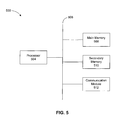
- Figure 5 depicts an exemplary processing system, according to an embodiment.
- a system may receive location information for a mobile device associated with the user attempting to access a service or application.
- the system can send the user a series of questions based on where the authorized mobile device is located. If the user is accessing the service or application from an unauthorized device, that user will not be in a position to answer these questions. These questions are designed so that only an individual having access to the authorized mobile device for the user can answer the question correctly.
- Another potential dimension of unique authentication may involve movement of the device by a user. A user may set-up a movement pattern as an additional authentication factor. When the user performs the movement, the mobile device can send a movement signature for authentication. The authentication server compares the received signature to an expected signature for that user.
- FIG. 1 is a block diagram of an exemplary environment 100 including an authentication system, according to embodiments of the disclosure.
- Environment 100 includes server 120, communications network 130, and one or more mobile devices 140.
- Mobile device 140 may be any computing device that provides network connectivity including, but not limited to, a mobile phone, tablet computer, laptop computer, navigation system, etc.
- a service or application may associate a user with a specific device or set of devices 140.
- authentication is tied to the location of the enrolled device(s) for a user.
- mobile device 140 may include location module 142.
- Location module 142 includes software, hardware, or a combination thereof, configured to determine or estimate the geographical location of the device.
- the location services may include or make use of a Global Positioning System (GPS) receiver or a GPS navigation system.
- GPS Global Positioning System
- a service or application may assign a movement pattern to a device as an additional authentication factor for the user.
- the movement pattern may be set by the service or application or alternatively may be selected by the user and enrolled as additional authentication criteria for the user.
- a mobile device 140 may also include movement sensing module 144.
- Movement sensing module 144 is configured to sense the mobile device's position, orientation or velocity.
- mobile device 140 may contain an accelerometer, a gyroscope, an infrared sensor, etc., and/or any combination thereof.
- the movement sensing module 144 is further configured to capture movement or criteria indicative of movement and convert the movements into a movement signature.
- mobile device 140 may further support event monitoring.
- mobile device 140 stores one or more movement patterns indicative of an event.
- a business may provide employees with a movement pattern to use in emergency situations such as a robbery.
- mobile device 140 may store one or more patterns or criteria indicative of device movement during events such as an automobile accident.
- movement sensing module 144 monitors for one of the predefined patterns or criteria. When detected, movement sensing module 144 is configured to send notification to monitoring server 170.
- Access point 135 may be any network access point.
- access point 135 may be a wireless network access point or base station.
- device 140 can communicate with an access point using any protocol including, but not limited to, WiFi, CDMA, TDMA, GSM, or the like.
- Server 120 is configured to host all or a portion of an application or service offered to users. Users attempting to gain access to a service or application communicate with server 120.
- Authentication module 110 is configured to provide authentication of a user and/or user device on behalf of an application or service offered by server 120 or another server (not shown). Authentication module 110 may be included in server 120 or may be a separate device or module in the network.
- authentication module 110 is configured to provide location-based authentication of a user for an application or service.
- authentication module 110 is configured to determine the location of a device enrolled for the user requesting access to a service or application. Using the enrolled device location, authentication module 110 retrieves one or more questions for a user based on the location of the enrolled device. Alternatively, authentication module 110 may retrieve information about the location of the mobile device and form a location-based authentication question. When an additional authentication factor is required, authentication module 110 transmits the location-based authentication question to the user.
- authentication module is configured to provide movement-based authentication of a user for an application or service.
- authentication module 110 requests that the user perform an authentication movement.
- the authentication module receives a movement signature from the user's device and compares the received movement against a stored movement signature for the user.
- Authentication module 110 is coupled to a user database 114 and a geographic information database 116.
- user database 114 may include identification information for a device or devices enrolled for a user.
- the stored credentials for a user may include a password, a biometric (e.g., fingerprint), or a movement signature. Each of these credentials would be enrolled in advance by the user of the service or application.
- a service or application may define the number and type of authentication criteria to request when accessing a service.
- Geographic information database 116 is configured to store information regarding specific locations. For example, geographic information database 116 may store a set of questions for a location. Alternatively, geographic information database 116 may store a set of general information about a location. Authentication module 110 (or geographic information database 116) may be configured to generate a question or set of questions using the stored general information about the location.
- Network 130 may be any communications network or combination of networks over which a device can transmit data.
- network 130 may comprise a public data communications network such as the Internet, the public switched telephone network (PSTN), a wireless network, local area network, wide area network, etc., a private communications network, and/or any combination thereof.
- PSTN public switched telephone network
- wireless network local area network, wide area network, etc.
- private communications network and/or any combination thereof.
- Monitoring server 170 is configured to take action based on a condition or event detected by a mobile device 140.
- monitoring server 170 includes a set of response protocols to apply to each detection condition or event.
- the event is a robbery or similar event
- monitoring server 170 can notify security personnel and/or direct cameras to monitor the area containing the mobile phone detecting the condition or event.
- monitoring server 170 may be configured to first confirm with the mobile device user and then take action based on the confirmation response (or lack of response).
- an organization such as a bank, school, or government entity
- module shall be understood to include at least one of software, firmware, and hardware (such as one or more circuits, microchips, or devices, or any combination thereof), and any combination thereof.
- each module can include one, or more than one, component within an actual device, and each component that forms a part of the described module can function either cooperatively or independently of any other component forming a part of the module.
- multiple modules described herein can represent a single component within an actual device. Further, components within a module can be in a single device or distributed among multiple devices in a wired or wireless manner.
- FIG. 2 depicts a flowchart 200 of an exemplary method for authenticating a user using the location of the user's device, in accordance with an embodiment.
- an authentication system can introduce an additional factor of authentication using device location information. For example, the current location for a device enrolled for the user is obtained. Based on the location, one or more location-based questions are used to confirm that the party requesting authentication has possession of the enrolled device in its current known location. For example, the system may ask the user "what color is the door at 345 Maple Street?" or "what store is on the corner of D and 11 th Street?" If a party is attempting to access the service or application from an unauthorized device, the party will not be in a position to correctly answer these questions.
- Flowchart 200 is described with continued reference to the embodiment described in FIG. 1 . However, flowchart 200 is not limited to that embodiment.
- a user attempts to access a service or application.
- an authentication module associated with the requested service or application sends an authentication message to user's device.
- the authentication message requests one or more authentication credentials such as a username, a password, etc.
- the user enters the requested authentication credentials and the credentials are transmitted to the authentication module.
- the authentication module verifies the received user credentials against the credentials stored for the user. If the credentials do not match, the process proceeds to step 245 where access to the requested service or application is denied. If the credentials match, the process moves to step 250.
- the authentication module determines whether additional authentication is required.
- the authentication module may be configured to require additional authentication based on any factor or factors such as, for example, the type of service the user is trying to access or the particular user requesting access. If no additional authentication is required, the process proceeds to step 255 and access to the requested service or application is granted. If additional authentication is required, the process proceeds to step 260.
- the authentication module retrieves current location data for the device enrolled for the user.
- a user or a service may enroll a device. This device is the device expected to be used to access the service or application.
- the authentication module may use the received credentials to access information including identification data for the device associated with the user's credentials.
- the authentication module then uses device identification data to request current location data for the device from the serving network or directly from the device.
- an authentication question is retrieved for the location of the user device.
- the authentication question is based on street level detail for the location where the device associated with the legitimate user is currently residing. For example, the question may inquire as to what stores, monuments or landmarks are located nearby, the color of features such as doors on specific buildings are, etc.
- geographic information database 116 stores questions associated with particular locations for retrieval by the authentication module. Alternatively, geographic information database 116 or authentication module 110 generates questions based on location information stored in geographic information database 116.
- the retrieved question is forwarded to the user.
- the user is prompted for a response to the authentication question by, for example, displaying the question on the display.
- the user enters a response and the response is transmitted to the authentication module.
- step 280 the authentication module determines whether the received answer is correct. If the answer is correct, operation proceeds to step 290 where access to the service or application is granted. If the answer is not correct, operation proceeds to step 284.
- the number of attempts allowed for a user can be a configurable setting. By way of example, the number of attempts can be configured to depend on the service or application being requested, on the particular user requesting access, on the level of security desired, etc. Those skilled in the relevant art(s) will recognize other factors to consider in determining the number of attempts to permit. If an additional question is provided, operation returns to step 265. If no additional request is provided, operation proceeds to step 288 where access to the service or application is denied.
- FIG. 3 depicts a flowchart 300 of an exemplary method for authenticating a user using movement of a mobile device as an additional authentication factor, in accordance with an embodiment.
- Flowchart 300 is described with continued reference to the embodiment described in FIG. 1 .
- flowchart 300 is not limited to that embodiment.
- the legitimate user enrolls a movement signature as an additional authentication factor with the service or application.
- a movement signature As an additional authentication factor with the service or application.
- the user may rotate, shake, turn or otherwise move the phone in any pattern. This movement is used to generate a movement signature that is stored in a database with the credentials for the legitimate user.
- a user attempts to access a service or application.
- an authentication module associated with the requested service or application sends an authentication message to user's device.
- the authentication message requests one or more authentication credentials such as a username, a password, etc.
- the user enters the requested authentication credentials and the credentials are transmitted to the authentication module.
- the authentication module verifies the received user credentials against the credentials stored for the user. If the credentials do not match, the process proceeds to step 345 where access to the requested service or application is denied. If the credentials match, the process moves to step 350.
- the authentication module determines if additional authentication is required.
- the authentication module may be configured to require additional authentication based on any factor or factors such as, for example, the type of service the user is trying to access or the particular user requesting access. If no additional authentication is required, the process proceeds to step 355 and access to the requested service or application is granted. If additional authentication is required, the process proceeds to step 360.
- the authentication module sends a request for a movement signature.
- the user moves the mobile device in a pattern.
- the mobile device monitors the movement and generates a movement signature.
- the movement signature is received at the authentication module.
- the authentication module then retrieves the stored signature associated with the user.
- step 380 if the received movement signature matches the stored movement signature, operation proceeds to step 390 where access to service or application is granted. Otherwise, operation proceeds to step 385 where access is denied.
- a mobile device can be configured with event detection capabilities in which it monitors for particular movements and responds by triggering an event response.
- a mobile device can be configured to enable a user to report an emergency condition by moving the device in a predetermined pattern.
- a bank can provide tellers with phones having event detection capabilities. If a robbery or other emergency condition is taking place, the bank teller can move the phone in a pattern that triggers emergency assistance action.
- the mobile device can be configured to detect movement indicative of an automobile accident such as a very rapid deceleration of the device or flipping in a particular manner.
- FIG. 4 depicts a flowchart 400 of an exemplary method 400 of detecting an event based on a movement of a mobile device, in accordance with an embodiment.
- Flowchart 400 is described with continued reference to the embodiment described in FIG. 1 .
- flowchart 400 is not limited to that embodiment.
- a mobile device Prior to step 410, a mobile device is configured with event detection functionality.
- signatures or criteria for specific movements and their associated condition indicators are entered into mobile device.
- event detection functionality can be turned on or off.
- the mobile device monitors for a device movement.
- mobile device determines whether the movement matches movement criteria or signatures stored in the device. If the detected movement matches a stored criteria or signature, operation proceeds to step 430. If the detected movement does not match stored criteria, operation returns to step 410.
- the device may associate a condition type with the detected event (e.g., a potential robbery may be assigned a first code whereas an automobile accident may be assigned a second code).
- a condition type code and/or condition signature or criteria are transmitted to a monitoring server 102.
- the device may further transmit its location.
- monitoring server may confirm the reported condition by sending an event verification question. This step is optional. When not present, operation proceeds from step 430 to step 460.
- monitoring server determines if the user confirmed the event. If the event is not confirmed, the process returns to step 410, where the mobile device monitors for movement. This step is also optional and will only be present if step 450 is performed.
- monitoring server For example, if an automobile accident event is detected, monitoring server, through the mobile device, asks the user to confirm that an accident has actually occurred. If the user responds affirmatively, or if the user does not respond, authentication server can decide to deploy emergency assistance. But if the user responds that no accident has occurred, processing of the detected condition can end. As discussed above, in an embodiment, the monitoring server does not perform the event confirmation steps of 440 and 450 for some types of events where the user cannot confirm the event without compromising the user's security (e.g., a robbery).
- monitoring server initiates one or more actions in response to the detected and reported condition. For example, if the detected condition is an automobile accident, monitoring server can notify emergency personnel of the accident and direct them to the location of the mobile device. In another example, if the event is a robbery or similar event, monitoring server can notify security personnel and/or direct cameras to monitor the area containing the mobile phone.
- an organization such as a bank, school, or government entity
- FIG. 5 illustrates an exemplary processing system 500 in which exemplary embodiments of the present disclosure, or portions thereof, can be implemented as processor-executable code.
- FIG. 2-4 the methods illustrated by flowcharts of FIGs. 2-4 , can be implemented in processing system 500.
- Various embodiments of the disclosure are described in terms of this example processing system 500. After reading this description, it will become apparent to a person of ordinary skill in the art how to implement the disclosure using other processing systems and/or architectures.
- Processing system 500 includes one or more processors, such as processor 504.
- Processor 504 can be a special purpose or a general purpose processor.
- Processor 504 may be connected to a communication infrastructure 506 (for example, a bus or network) for communicating with other elements of the system.
- Processing system 500 also includes a main memory 508, such as a random access memory (RAM), and may also include a secondary memory 510, such as an EEPROM, which may be used for storing processor-executable code and other data, such as a digital signature, in a semi-permanent manner.
- Processor 504 reads from and/or writes to these memory units in a well-known manner.
- processor-executable code when executed, enable processing system 400 to implement exemplary embodiments of the present disclosure as discussed herein.
- processor-executable programs when executed, enable processor 504 to implement the processes of the present disclosure, such as the steps in the methods illustrated by flowcharts of FIGs. 2-4 , but also, functionality directed the mobile device, monitoring server or authentication module.
- references to "one embodiment,” “an embodiment,” “an example embodiment,” etc. indicate that the embodiment described may include a particular feature, structure, or characteristic, but every embodiment may not necessarily include the particular feature, structure, or characteristic. Moreover, such phrases are not necessarily referring to the same embodiment. Further, when a particular feature, structure, or characteristic is described in connection with an embodiment, it is submitted that it is within the knowledge of one skilled in the art to affect such feature, structure, or characteristic in connection with other embodiments whether or not explicitly described.
Landscapes
- Engineering & Computer Science (AREA)
- Computer Security & Cryptography (AREA)
- Computer Hardware Design (AREA)
- Computing Systems (AREA)
- General Engineering & Computer Science (AREA)
- Computer Networks & Wireless Communication (AREA)
- Signal Processing (AREA)
- Telephonic Communication Services (AREA)
- Mobile Radio Communication Systems (AREA)
Applications Claiming Priority (2)
| Application Number | Priority Date | Filing Date | Title |
|---|---|---|---|
| US201261702712P | 2012-09-18 | 2012-09-18 | |
| US13/730,267 US20140082713A1 (en) | 2012-09-18 | 2012-12-28 | System and Method for Location-Based Authentication |
Publications (2)
| Publication Number | Publication Date |
|---|---|
| EP2709334A2 true EP2709334A2 (de) | 2014-03-19 |
| EP2709334A3 EP2709334A3 (de) | 2014-05-21 |
Family
ID=49118268
Family Applications (1)
| Application Number | Title | Priority Date | Filing Date |
|---|---|---|---|
| EP13004282.3A Ceased EP2709334A3 (de) | 2012-09-18 | 2013-08-30 | System und Verfahren für positionsabhängige Authentifizierung |
Country Status (4)
| Country | Link |
|---|---|
| US (2) | US20140082713A1 (de) |
| EP (1) | EP2709334A3 (de) |
| CN (1) | CN103685218B (de) |
| TW (1) | TWI513266B (de) |
Cited By (5)
| Publication number | Priority date | Publication date | Assignee | Title |
|---|---|---|---|---|
| US11749045B2 (en) | 2021-03-01 | 2023-09-05 | Honeywell International Inc. | Building access using a mobile device |
| US11887424B2 (en) | 2019-06-12 | 2024-01-30 | Honeywell International Inc. | Access control system using mobile device |
| US12621664B2 (en) | 2015-05-15 | 2026-05-05 | Honeywell International Inc. | Access control via a mobile device |
| US12620281B2 (en) | 2023-09-13 | 2026-05-05 | Honeywell International Inc. | Building access using a mobile device |
| US12633185B2 (en) | 2024-05-08 | 2026-05-19 | Honeywell International Inc. | Building access control using a mobile device |
Families Citing this family (17)
| Publication number | Priority date | Publication date | Assignee | Title |
|---|---|---|---|---|
| US9282086B2 (en) * | 2013-04-26 | 2016-03-08 | Broadcom Corporation | Methods and systems for secured authentication of applications on a network |
| JP2015046028A (ja) * | 2013-08-28 | 2015-03-12 | ソニー株式会社 | 情報処理装置、及び情報処理方法 |
| CN103475998A (zh) * | 2013-08-30 | 2013-12-25 | 北京智谷睿拓技术服务有限公司 | 无线网络服务提供方法及系统 |
| US10447677B1 (en) * | 2014-03-14 | 2019-10-15 | United Services Automobile Association (Usaa) | Mobile application authentication infrastructure |
| GB2529214B (en) * | 2014-08-14 | 2016-10-19 | Soloprotect Ltd | An identity card holder and system |
| US9706376B2 (en) * | 2015-05-15 | 2017-07-11 | Avaya Inc. | Navigational aid for emergency response personnel |
| US9457754B1 (en) * | 2015-07-13 | 2016-10-04 | State Farm Mutual Automobile Insurance Company | Method and system for identifying vehicle collisions using sensor data |
| CN105100096B (zh) * | 2015-07-17 | 2018-07-31 | 小米科技有限责任公司 | 验证方法和装置 |
| US10389731B2 (en) * | 2016-11-22 | 2019-08-20 | Microsoft Technology Licensing, Llc | Multi-factor authentication using positioning data |
| US10057257B1 (en) | 2017-12-29 | 2018-08-21 | Ringcentral, Inc. | Systems and methods for authenticating a user for access to a conference session by validating the user's location |
| FR3080693B1 (fr) * | 2018-04-30 | 2021-10-08 | Ledger | Authentification mutuelle d'un dispositif ou d'un systeme contenant des donnees sensibles ou confidentielles commandable par un utilisateur |
| US11509642B2 (en) * | 2019-08-21 | 2022-11-22 | Truist Bank | Location-based mobile device authentication |
| DE102019123615A1 (de) * | 2019-09-04 | 2021-03-04 | Audi Ag | Verfahren zum Betreiben eines Kraftfahrzeugsystems, Steuereinrichtung, und Kraftfahrzeug |
| WO2021162629A1 (en) * | 2020-02-11 | 2021-08-19 | Grabtaxi Holdings Pte. Ltd. | Communications device, method and communications system for managing an authentication event |
| US11438342B2 (en) * | 2020-03-23 | 2022-09-06 | T-Mobile Usa, Inc. | Location-based identity authentication (LIA) system |
| US11877218B1 (en) | 2021-07-13 | 2024-01-16 | T-Mobile Usa, Inc. | Multi-factor authentication using biometric and subscriber data systems and methods |
| TWI779924B (zh) * | 2021-11-12 | 2022-10-01 | 宏碁股份有限公司 | 多重認證系統及多重認證方法 |
Citations (1)
| Publication number | Priority date | Publication date | Assignee | Title |
|---|---|---|---|---|
| US20050212911A1 (en) * | 2004-03-23 | 2005-09-29 | Marvit David L | Gesture identification of controlled devices |
Family Cites Families (15)
| Publication number | Priority date | Publication date | Assignee | Title |
|---|---|---|---|---|
| US7418474B2 (en) | 1994-03-03 | 2008-08-26 | Schwab Barry H | Secure identification system |
| US7216361B1 (en) | 2000-05-19 | 2007-05-08 | Aol Llc, A Delaware Limited Liability Company | Adaptive multi-tier authentication system |
| US8171298B2 (en) | 2002-10-30 | 2012-05-01 | International Business Machines Corporation | Methods and apparatus for dynamic user authentication using customizable context-dependent interaction across multiple verification objects |
| TWI293844B (en) | 2005-01-11 | 2008-02-21 | Ind Tech Res Inst | A system and method for performing application layer service authentication and providing secure access to an application server |
| US8902154B1 (en) * | 2006-07-11 | 2014-12-02 | Dp Technologies, Inc. | Method and apparatus for utilizing motion user interface |
| US20080020733A1 (en) * | 2006-07-21 | 2008-01-24 | Tomas Karl-Axel Wassingbo | Mobile electronic device with motion detection authentication |
| CN101365193A (zh) * | 2007-08-09 | 2009-02-11 | 财团法人Seoul大学校产学协力财团 | 用于基于用户行为模式执行用户认证的系统和方法 |
| US8301684B2 (en) | 2009-02-26 | 2012-10-30 | Google Inc. | User challenge using information based on geography or user identity |
| US8910251B2 (en) | 2009-03-06 | 2014-12-09 | Facebook, Inc. | Using social information for authenticating a user session |
| CN101714154B (zh) * | 2009-08-14 | 2012-10-10 | 中电天讯信息技术(北京)有限公司 | 利用综合识别设备对服务器进行互动操作的方法 |
| US8307071B2 (en) | 2010-01-15 | 2012-11-06 | Microsoft Corporation | Fine-grained location determination of networked computers |
| EP2431904A1 (de) | 2010-09-21 | 2012-03-21 | Research In Motion Limited | Detaillierte Authentifizierung |
| US20120124662A1 (en) * | 2010-11-16 | 2012-05-17 | Baca Jim S | Method of using device motion in a password |
| US8886153B2 (en) * | 2010-12-22 | 2014-11-11 | Verizon Patent And Licensing Inc. | Method and apparatus for configuring a mobile device to provide emergency notification |
| US20120302200A1 (en) * | 2010-12-24 | 2012-11-29 | Daniel Esbensen | Method and apparatus to take emergency actions by a portable device |
-
2012
- 2012-12-28 US US13/730,267 patent/US20140082713A1/en active Granted
-
2013
- 2013-08-29 CN CN201310385038.0A patent/CN103685218B/zh active Active
- 2013-08-30 EP EP13004282.3A patent/EP2709334A3/de not_active Ceased
- 2013-09-09 TW TW102132421A patent/TWI513266B/zh active
-
2018
- 2018-12-03 US US16/207,986 patent/US20190104133A1/en not_active Abandoned
Patent Citations (1)
| Publication number | Priority date | Publication date | Assignee | Title |
|---|---|---|---|---|
| US20050212911A1 (en) * | 2004-03-23 | 2005-09-29 | Marvit David L | Gesture identification of controlled devices |
Cited By (8)
| Publication number | Priority date | Publication date | Assignee | Title |
|---|---|---|---|---|
| US12621664B2 (en) | 2015-05-15 | 2026-05-05 | Honeywell International Inc. | Access control via a mobile device |
| US11887424B2 (en) | 2019-06-12 | 2024-01-30 | Honeywell International Inc. | Access control system using mobile device |
| US11749045B2 (en) | 2021-03-01 | 2023-09-05 | Honeywell International Inc. | Building access using a mobile device |
| US12027007B2 (en) | 2021-03-01 | 2024-07-02 | Honeywell International Inc. | Building access using a mobile device |
| US12367726B2 (en) | 2021-03-01 | 2025-07-22 | Honeywell International Inc. | Building access using a mobile device |
| US12511966B2 (en) | 2021-03-01 | 2025-12-30 | Honeywell International Inc. | Building access using a mobile device |
| US12620281B2 (en) | 2023-09-13 | 2026-05-05 | Honeywell International Inc. | Building access using a mobile device |
| US12633185B2 (en) | 2024-05-08 | 2026-05-19 | Honeywell International Inc. | Building access control using a mobile device |
Also Published As
| Publication number | Publication date |
|---|---|
| CN103685218B (zh) | 2018-09-21 |
| CN103685218A (zh) | 2014-03-26 |
| EP2709334A3 (de) | 2014-05-21 |
| US20190104133A1 (en) | 2019-04-04 |
| TW201424326A (zh) | 2014-06-16 |
| TWI513266B (zh) | 2015-12-11 |
| US20140082713A1 (en) | 2014-03-20 |
Similar Documents
| Publication | Publication Date | Title |
|---|---|---|
| US20190104133A1 (en) | Movement-based event detection in a mobile device | |
| US11508382B2 (en) | System, device and method for enforcing privacy during a communication session with a voice assistant | |
| US10831923B2 (en) | System, device and method for enforcing privacy during a communication session with a voice assistant | |
| US11443024B2 (en) | Authentication of a client | |
| US9355231B2 (en) | Frictionless multi-factor authentication system and method | |
| EP2589232B1 (de) | Automatische geofence-erstellung und -änderung | |
| EP2836957B1 (de) | Ortsabhängige zugriffskontrolle für eine tragbare elektronische vorrichtung | |
| US11706627B2 (en) | System and method for encounter identity verification | |
| US20130305325A1 (en) | Methods for Thwarting Man-In-The-Middle Authentication Hacking | |
| US7496948B1 (en) | Method for controlling access to a target application | |
| US9058482B2 (en) | Controlling user access to electronic resources without password | |
| US9699656B2 (en) | Systems and methods of authenticating and controlling access over customer data | |
| CN105306204A (zh) | 安全验证方法、装置及系统 | |
| US12081544B2 (en) | Systems and methods for preventing unauthorized network access | |
| CA3007707C (en) | System, device and method for enforcing privacy during a communication session with a voice assistant | |
| JP2000040064A (ja) | ネットワークアクセスの認証方式 | |
| JP6947529B2 (ja) | 判定装置、判定方法及び判定プログラム | |
| JP6310233B2 (ja) | 認証装置、認証方法及びプログラム | |
| JP2016184350A (ja) | 認証情報生成プログラム、認証情報生成装置、及び認証情報生成方法 | |
| HK1193253A (en) | System and method for location-based authentication | |
| KR20140023085A (ko) | 사용자 인증 방법, 인증 서버 및 사용자 인증 시스템 | |
| US12613945B2 (en) | User authentication by means of vehicle-specific data | |
| KR102653338B1 (ko) | 단말기 위치 정보에 근거한 위치 범위와 약속 시간 정보를 이용한 안심 서비스 제공 방법 및 시스템 | |
| SE1751576A1 (en) | Mobile identification using thin client devices | |
| KR20170020061A (ko) | 근태관리 시스템, 방법 및 애플리케이션 |
Legal Events
| Date | Code | Title | Description |
|---|---|---|---|
| PUAI | Public reference made under article 153(3) epc to a published international application that has entered the european phase |
Free format text: ORIGINAL CODE: 0009012 |
|
| 17P | Request for examination filed |
Effective date: 20130830 |
|
| AK | Designated contracting states |
Kind code of ref document: A2 Designated state(s): AL AT BE BG CH CY CZ DE DK EE ES FI FR GB GR HR HU IE IS IT LI LT LU LV MC MK MT NL NO PL PT RO RS SE SI SK SM TR |
|
| AX | Request for extension of the european patent |
Extension state: BA ME |
|
| PUAL | Search report despatched |
Free format text: ORIGINAL CODE: 0009013 |
|
| AK | Designated contracting states |
Kind code of ref document: A3 Designated state(s): AL AT BE BG CH CY CZ DE DK EE ES FI FR GB GR HR HU IE IS IT LI LT LU LV MC MK MT NL NO PL PT RO RS SE SI SK SM TR |
|
| AX | Request for extension of the european patent |
Extension state: BA ME |
|
| RIC1 | Information provided on ipc code assigned before grant |
Ipc: H04L 29/06 20060101AFI20140416BHEP |
|
| 17Q | First examination report despatched |
Effective date: 20140502 |
|
| RBV | Designated contracting states (corrected) |
Designated state(s): AL AT BE BG CH CY CZ DE DK EE ES FI FR GB GR HR HU IE IS IT LI LT LU LV MC MK MT NL NO PL PT RO RS SE SI SK SM TR |
|
| RAP1 | Party data changed (applicant data changed or rights of an application transferred) |
Owner name: AVAGO TECHNOLOGIES GENERAL IP (SINGAPORE) PTE. LTD |
|
| RAP1 | Party data changed (applicant data changed or rights of an application transferred) |
Owner name: AVAGO TECHNOLOGIES INTERNATIONAL SALES PTE. LIMITE |
|
| STAA | Information on the status of an ep patent application or granted ep patent |
Free format text: STATUS: THE APPLICATION HAS BEEN REFUSED |
|
| 18R | Application refused |
Effective date: 20191125 |