EP2709380B1 - Aktive Monoblock-Lautsprecherbox, die zur Einzel- oder paarweisen Benutzung konfiguriert werden kann, mit Verstärkung des Stereobilds - Google Patents
Aktive Monoblock-Lautsprecherbox, die zur Einzel- oder paarweisen Benutzung konfiguriert werden kann, mit Verstärkung des Stereobilds Download PDFInfo
- Publication number
- EP2709380B1 EP2709380B1 EP13179515.5A EP13179515A EP2709380B1 EP 2709380 B1 EP2709380 B1 EP 2709380B1 EP 13179515 A EP13179515 A EP 13179515A EP 2709380 B1 EP2709380 B1 EP 2709380B1
- Authority
- EP
- European Patent Office
- Prior art keywords
- signal
- channel
- lateral
- component
- enclosure
- Prior art date
- Legal status (The legal status is an assumption and is not a legal conclusion. Google has not performed a legal analysis and makes no representation as to the accuracy of the status listed.)
- Not-in-force
Links
Images


Classifications
-
- H—ELECTRICITY
- H04—ELECTRIC COMMUNICATION TECHNIQUE
- H04R—LOUDSPEAKERS, MICROPHONES, GRAMOPHONE PICK-UPS OR LIKE ACOUSTIC ELECTROMECHANICAL TRANSDUCERS; ELECTRIC HEARING AIDS; PUBLIC ADDRESS SYSTEMS
- H04R5/00—Stereophonic arrangements
- H04R5/02—Spatial or constructional arrangements of loudspeakers
-
- H—ELECTRICITY
- H04—ELECTRIC COMMUNICATION TECHNIQUE
- H04R—LOUDSPEAKERS, MICROPHONES, GRAMOPHONE PICK-UPS OR LIKE ACOUSTIC ELECTROMECHANICAL TRANSDUCERS; ELECTRIC HEARING AIDS; PUBLIC ADDRESS SYSTEMS
- H04R1/00—Details of transducers, loudspeakers or microphones
- H04R1/20—Arrangements for obtaining desired frequency or directional characteristics
- H04R1/32—Arrangements for obtaining desired frequency or directional characteristics for obtaining desired directional characteristic only
- H04R1/323—Arrangements for obtaining desired frequency or directional characteristics for obtaining desired directional characteristic only for loudspeakers
-
- H—ELECTRICITY
- H04—ELECTRIC COMMUNICATION TECHNIQUE
- H04S—STEREOPHONIC SYSTEMS
- H04S1/00—Two-channel systems
- H04S1/002—Non-adaptive circuits, e.g. manually adjustable or static, for enhancing the sound image or the spatial distribution
-
- H—ELECTRICITY
- H04—ELECTRIC COMMUNICATION TECHNIQUE
- H04R—LOUDSPEAKERS, MICROPHONES, GRAMOPHONE PICK-UPS OR LIKE ACOUSTIC ELECTROMECHANICAL TRANSDUCERS; ELECTRIC HEARING AIDS; PUBLIC ADDRESS SYSTEMS
- H04R2205/00—Details of stereophonic arrangements covered by H04R5/00 but not provided for in any of its subgroups
- H04R2205/022—Plurality of transducers corresponding to a plurality of sound channels in each earpiece of headphones or in a single enclosure
Definitions
- the invention relates to the reproduction of audio signals by a high fidelity installation, with restitution and reinforcement of the stereo effect facing a listener.
- the ideal configuration for stereo listening is to have two distant speakers forming an isosceles triangle with the listener.
- a stereo image is formed between the two speakers, that is to say that various sources (different instruments for example) will appear distributed on the axis connecting the two speakers.
- the acoustic environment of the speakers be empty or absorbent to avoid spurious reflections on the walls of the room, which then form new sources.
- the environment is symmetrical, which will at least not to unbalance the stereo image.
- a first problem is that of obtaining such an effect with a single speaker placed facing the listener.
- a single monobloc enclosure is likely to be placed on one side of the room and not in the middle of a wall, which can make its acoustic environment unbalanced, reducing to nothing the effects of processing a stereo image homogeneous.
- One of the aims of the invention is to overcome these various limitations, by providing a compact one-piece monobloc enclosure, which can render the stereo image optimally, without significant deformation of the acoustic signal, and this in a parameterizable manner to be able to if necessary adapt to different configurations of the listening room.
- One of the aims of the invention is to allow the use of a single speaker or two speakers in one or the other mode, regardless of the same speaker model, simply by modifying a parameter of configuration of the internal processing executed by algorithms implanted in a digital signal processor.
- Another object of the invention is, in such a configuration in duo mode, to further enlarge the restored sound stage, by using the space located beyond the speakers (to the left of the left speaker and to the right from the right speaker).
- the invention proposes a multi-channel monoblock active acoustic loudspeaker of the general type disclosed in the aforementioned article by Schulman, comprising the elements set forth in the preamble of the independent claims 1 and 7.
- the chamber In a first mode of operation, the chamber is intended to be used separately in front of a listener, with the first direction directed towards this listener.
- the enclosure then comprises the particular elements set forth in the characterizing part of claim 1.
- the subclaims 2 to 6 relate to specific, advantageous embodiments of this first mode of operation.
- the speaker is a first speaker intended to be used in association with a second similar speaker, the two speakers being disposed respectively to the left and right of a listener.
- the enclosure then comprises the particular elements set forth in the characterizing part of claim 7.
- the subclaims 8 to 12 relate to specific, advantageous embodiments of this second mode of operation.
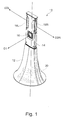
- the Figure 1 is an overview of an enclosure according to the invention, showing the acoustic architecture of the different speakers used.
- the enclosure 10 is externally in the form of a flared column in its lower part, with a base 12 supporting a raised portion 14 of flattened shape, with a section of the order of 3 x 12 cm.
- the flattened raised portion 14 carries a first speaker 16 whose main direction of radiation D1 is horizontal and perpendicular to the largest dimension of the rectangular section of the raised portion 14.
- This speaker 16 will be called thereafter “high "central speaker”, corresponding to a "central channel” of the multi-channel loudspeaker.
- the enclosure 10 also has on the edge of the raised portion 14, that is to say on the narrowest side face, a left speaker 18L and a right speaker 18R.
- These loudspeakers are oriented with their respective main directions of radiation D2L and D2R horizontal and perpendicular to the direction D1.
- These speakers will be later called “side speakers”, corresponding to the "left and right" side channels of the multi-channel speaker.
- the central loudspeaker 16 is advantageously a loudspeaker combining a distributed mode and a pistonic mode operation, for example a BMR model from HiWave Technologies.
- the side speakers 18L and 18R are advantageously high form factor (ie very elongated and very narrow) distributed mode loudspeakers, for example HARP models from HiWave Technologies.
- DML Distributed Mode Loudspeaker
- the flat diaphragm is vibrated according to a complex diagram where the amplitude and phase of the different points of the diaphragm are distributed in a decorrelated manner. that is, the diaphragm appears to vibrate randomly across its surface area, resulting in excellent sound reproduction throughout the spectrum with minimal distortion.
- the membrane is however subject to a coherent vibration, that is to say a movement whose amplitude and phase of displacement are in principle constant over the entire range of the diaphragm.
- the center speaker 16 and the side speakers 18L and 18R are used to render, together, the medium / treble portion of the spectrum, for example the band 350-20000 Hz of the sound spectrum.
- a bass channel For the reproduction of the lower part of the spectrum, for example of the band 30-350 Hz, there is provided a bass channel with a bass speaker 20, which may be of a conventional pistonic type for the reproduction of the frequencies the most serious ( subwoofer ) .
- This bass speaker 20 is for example a loudspeaker mounted in closed cavity, turned towards the ground to radiate in the interval between the base and the ground (the base being provided with feet), a configuration that does not present no particular difficulty given the very low directivity of the acoustic waves in the frequency band considered.
- the acoustic architecture that has just been described with reference to this Figure 1 will be used in combination with digital processing specific to each channel, different treatments depending on whether the speaker will be used in "solo" mode, with a single speaker turned towards the listener, or in "duo” mode, with a pair of speakers placed in front of the listener to the left and right of it.
- the Figure 2 illustrates, in block diagram form, the processing steps in the case of a single speaker, used in single-player mode.
- the stereo components L 'and R' obtained at the output of the separator stage 22 are subjected to a filtering by a stage 24 of the double gradient pressure type (described in more detail with reference to FIG. give two corresponding filtered components L "and R" applied to the speakers of the left and right lanes 18L and 18R.
- the mono component C meanwhile, is separated by a crossover filter 26, 28 separating the mid / high end of the spectrum of the mono component C, to apply it to the central loudspeaker 16, and the lower part of the same. component C, to apply it to the loudspeaker of the bass channel 20.
- the signals reproduced by the loudspeakers 16, 18L, 18R and 20 are each subjected to an equalization (blocks 32) with linear filtering, to correct possible acoustic accidents of the loudspeakers and apply an appropriate relative gain to the different channels so as to increase or decrease the relative level, including the level of stereo signals reproduced by the side channels with respect to the central channel and the channel of low, to compensate for the difference in sensitivity of the speakers and / or increase or decrease the stereo effect.
- the Figure 3 Explains the dual pressure gradient filtering performed by block 24.
- the component L ' is applied to a direct filter 34 (simple gain stage).
- the left component R ' is applied to a low-pass filter 36 with a typical cut-off frequency of 4 kHz.
- the signal at the output of this filter 36 is subjected to an adjustable delay (block 38) and to an inversion (block 40), before being recombined at 42 at the output signal of block 34, to give the filtered component L "which , after amplification and equalization, will be reproduced by the left-side speaker 18L.
- the right speaker 18R is powered by a filtered stereo component R "derived from the components R 'and L' after treatment with stages 34 ', 36', 38 ', 40' and 42 ' operating identically to that of the stages 34 to 42 described above.
- This double gradient filtering filtering treatment (that is to say that each of the filtered stereo components is derived from the two input stereo components L 'and R') makes it possible to modify in a controlled manner, by adjusting delays. , 38 ', the directivity diagram of each of the side speakers.
- the dual pressure gradient filtering makes it possible to play on the directivity diagram so as to reproduce the stereo components optimally for a listener facing the single speaker, and for different listening room configurations (the mono component C being restored by the central loudspeaker 16 facing the listener, and by the subwoofer 20).
- the directivity diagram of the left speaker 18L is that illustrated Figure 4a , where it is noted that the loudspeaker is directional in the acute part of the spectrum (diagram A in continuous line, for the frequencies beyond 4000 Hz), and omnidirectional in the medium / bass (diagram B in broken line , for frequencies in the range 350-4000 Hz).
- the directivity diagram resulting from the combination L "of the two right and left signals L 'and R ', for a signal played only on the left corresponds to the one shown Figure 4b : in the medium / bass the diagram comprises two side lobes B and B 'separated by a hollow defining a direction of cancellation A.
- the low-pass filter 36 stops the signal, so that the double gradient pressure filter has no specific action in this region of the spectrum (the diagram A is not modified).
- a the width of the enclosure (that is to say the spacing between the two speakers 18L and 18R, typically of the order of 12 cm)
- c is the speed of sound
- D is the delay introduced by the delay stage 38.
- the directivity diagram is of course symmetrical.
- Having a cancellation direction can amplify the stereo in different ways.
- the angle ⁇ is small, of the order of 3 to 4 °, so that if the listener 44 is in the main direction D1 of the enclosure, the cancellation direction ⁇ for the left channel is found close to the right ear 46R of the listener, and similarly the direction of cancellation of the right track is near the left ear 46L of the listener.
- the left ear will mostly capture the stereo component L ', and the right ear predominantly the right component R': the listener will distinctly hear the stereo information as if the speakers were located on both sides of her head.
- This first case is particularly suitable for situations where there are no acoustic reflections, or when they are symmetrical.
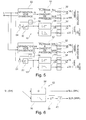
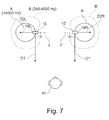
- FIGS 5 to 7 illustrate how the signal processing can be modified when the speaker according to the invention is used with another similar speaker, the pair of left 10 and right speakers being arranged on either side of the listener 44 according to a conventional configuration (schematically illustrated Figure 7 ) where the two speakers are respectively arranged on the left and right facing the listener.
- the treatment applied in duo mode is intended to enrich the conventional stereo image formed between the two speakers 10 and 10 ', in particular by widening the sound stage (which is particularly advantageous when the two speakers 10 and 10' are placed relatively close to each other), and this without introducing distortion into the restored signal, especially without altering the mono component.
- the separation stage or upmix (block 50) operates an extraction of the ambience channels, with a left ambience component SL for the speaker 10 placed to the left of the listener, and in the same way a right surround component SR for the speaker 10 'located to the right of the listener.
- the ambient signal SL (respectively SR) is applied to a filter stage 52 with a simple pressure gradient, to give two filtered ambient components SLL and SLR respectively reproduced by the left speaker 18L. and by the right speaker 18R of this speaker 10 (itself placed to the left of the listener).
- the right surround component SR is filtered to give two filtered components SRL and SRR reproduced respectively by the left speaker 18L and by the loudspeaker right 18R of this speaker 10 '(itself placed to the right of the listener).
- the central channel of the loudspeaker 16 is powered by a component derived from the left signal L from which the room component SL has been subtracted by the blocks 54 and 56.
- the central channel of the speaker 16 is powered by a component from the right signal R which has been subtracted by the blocks 54 and 56, the ambient component SR.
- the ambient components are reproduced by the side channels (speakers 18L and 18R) while the components of the stereo signal which are not ambient components are reproduced by the central channel (speaker 16), in a conventional manner but without interference between the ambient components of the signal and the components of this signal which are not ambient.
- the linear filtering stages 32 make it possible, as needed, to correct the acoustic accidents of the various loudspeakers, and to increase or decrease the level of the stereo side channels with respect to the mono central channel and the mono bass path, to compensate for the difference in sensitivity of the speakers and increase or decrease the stereo effect.
- the Figure 6 illustrates in greater detail the treatment performed by the (simple) pressure gradient filter 52.
- This comprises a direct filter 34, ie a simple gain stage, which delivers the filtered SLL component from the inputted ambient component SL (respectively, the filtered component SRL from input SR component).
- the SLR component (SRR, for its part) results from the application of the ambient component SL (respectively SR) to the low-pass filter 36 and then to the delay stage 38 and to the inversion stage. 40.
- stages 34, 36, 38 and 40 are the same as that described with reference to FIG. Figure 3 for solo mode, the only difference being that here the filter is a single-input filter.
- the angle ⁇ a value of 90 ° so that the cancellation direction ⁇ of the diagram B of the enclosure 10 placed on the left is turned towards the right in the direction of the 'enclosure 10' arranged to the right of the listener, and that in the same way the cancellation direction ⁇ 'of the diagram B' of the enclosure 10 'arranged on the right is turned towards the left in the direction of the enclosure 10 arranged to the left of the listener.
- the radiation patterns of the ambient component in the bass / midrange (A or A ') and in the treble (B or B') will then be located entirely on one side of the chamber with maximum radiation at beyond the area where the two speakers are, allowing to widen the sound stage by restoring content beyond this area.
Landscapes
- Physics & Mathematics (AREA)
- Engineering & Computer Science (AREA)
- Acoustics & Sound (AREA)
- Signal Processing (AREA)
- Health & Medical Sciences (AREA)
- Otolaryngology (AREA)
- Stereophonic System (AREA)
- Stereophonic Arrangements (AREA)
- Details Of Audible-Bandwidth Transducers (AREA)
Claims (12)
- Aktive Mehrkanal-Monoblock-Lautsprecherbox für eine Verwendung in einer ersten Betriebsart, bei der diese Box (10) dazu bestimmt ist, einzeln gegenüber einem Hörer (44) mit einer zu diesem Hörer gerichteten ersten Richtung (D1) verwendet zu werden,
wobei diese Box enthält:- einen zentralen Kanal mit einem zentralen Lautsprecher (16), dessen Hauptachse des eigenen Richtdiagramms gemäß der ersten Richtung (D1) ausgerichtet ist;- linke bzw. rechte seitliche Kanäle, je mit einem seitlichen Lautsprecher (18L, 18R), dessen Hauptachse des eigenen Richtdiagramms gemäß einer zweiten Richtung (D2L, D2R) lotrecht zur ersten Richtung in entgegengesetzte Richtungen für den linken Lautsprecher und den rechten Lautsprecher ausgerichtet ist;- Trenneinrichtungen (22), die am Eingang ein zu reproduzierendes Verbundstereosignal, das ein linkes Signal (L) und ein rechtes Signal (R) aufweist, empfangen und am Ausgang Kombinationen dieser linken und rechten Signale liefern können; und- Kombiniereinrichtungen (24, 26, 28), die zwischen dem zentralen Kanal und den seitlichen Kanälen gemäß einer vorbestimmten Verteilung Kombinationen der von den Trenneinrichtungen gelieferten Signale ausgeben können,dadurch gekennzeichnet, dass:- die Trenneinrichtungen (22) Einrichtungen sind, die aus dem Verbundstereosignal auf der Basis einer Analyse im Frequenzbereich mit Vergleich der Pegel der Spektralenergie des linken bzw. rechten Signals (L, R) des Verbundstereosignals extrahieren können: eine Mono-Komponente (C), die dem linken und rechten Signal gemeinsam ist, eine reine linke seitliche Komponente (L') und eine reine rechte seitliche Komponente (R'):- die Kombiniereinrichtungen (24, 26, 28) Filtereinrichtungen enthalten, die das in jedem seitlichen Kanal wiederhergestellte Richtdiagramm (B, B') so verändern können, dass dort eine Unterdrückungsrichtung (Δ) erzeugt wird,
wobei diese Filtereinrichtungen Filtereinrichtungen mit doppeltem Druckgradienten sind, die am Eingang die eine und die andere der reinen linken (L') und rechten (R') seitlichen Komponenten empfangen und am Ausgang sowohl ein linkes gefiltertes Signal (L") als auch ein rechtes gefiltertes Signal (R") liefern, wobei jedes der linken und rechten gefilterten Signale (L", R") von den am Eingang empfangenen zwei reinen linken (L') und rechten (R') seitlichen Komponenten abgeleitet wird; und- die Kombiniereinrichtungen (24, 26, 28) ausgeben können:• an den zentralen Kanal ein abgeleitetes Signal der Mono-Komponente (C);• an den linken seitlichen Kanal das linke gefilterte Signal (L"); und• an den rechten seitlichen Kanal das rechte gefilterte Signal (R"). - Aktive Lautsprecherbox nach Anspruch 1, wobei die Kombiniereinrichtungen (24, 26, 28) außerdem eine zeitliche Verzögerung (30) an das Signal anwenden können, die von der an den zentralen Kanal ausgegebenen Mono-Komponente (C) abgeleitet wird.
- Aktive Lautsprecherbox nach Anspruch 1, die außerdem einen Basskanal mit einem nichtrichtenden Basslautsprecher (20) enthält, und wobei die Kombiniereinrichtungen (24, 26, 28) an diesen Basskanal ein von der Mono-Komponente (C) abgeleitetes Signal ausgeben können.
- Aktive Lautsprecherbox nach Anspruch 1, wobei der Winkel (θ) der Unterdrückungsrichtung bezüglich der ersten Richtung (D1) kleiner als 10°, vorzugsweise kleiner als 5° ist.
- Aktive Lautsprecherbox nach Anspruch 1, wobei die Filterung mit doppeltem Druckgradienten (24) eine Filterung ist, die nur unterhalb einer Schwenkfrequenz angewendet wird, damit das eigene Richtdiagramm (A) jedes seitlichen Kanals oberhalb der Schwenkfrequenz beibehalten wird.
- Aktive Lautsprecherbox nach Anspruch 5, wobei die Filterung mit doppeltem Druckgradienten (24) eine Filterung ist, die am Ausgang liefern kann:- an den linken Kanal eine Kombination (L"):• eines von der reinen linken seitlichen Komponente (L') abgeleiteten Signals, mit• einem von der reinen rechten seitlichen Komponente (R') abgeleiteten Signal, mit Tiefpassfilterung (36) unterhalb der Schwenkfrequenz und anschließendem Anwenden einer zeitlichen Verzögerung (38) und einer Invertierung (40), und- an den rechten Kanal eine Kombination (R"):• eines von der reinen rechten seitlichen Komponente (R') abgeleiteten Signals mit• einem von der reinen linken seitlichen Komponente (L') abgeleiteten Signal, mit Tiefpassfilterung (36') unterhalb der Schwenkfrequenz und anschließendem Anwenden einer zeitlichen Verzögerung (38') und einer Invertierung (40).
- Aktive Mehrkanal-Monoblock-Lautsprecherbox für eine Verwendung in einer zweiten Betriebsart, bei der diese Box (10) dazu bestimmt ist, als eine links bzw. rechts von einem Hörer (44) zusammen mit einer zweiten ähnlichen Box (10') platzierte Box verwendet zu werden, die dazu bestimmt ist, rechts bzw. links von diesem gleichen Hörer (44) platziert zu werden,
wobei diese Box enthält:- einen zentralen Kanal mit einem zentralen Lautsprecher (16), dessen Hauptachse des eigenen Richtdiagramms gemäß einer ersten Richtung (D1) ausgerichtet ist;- linke bzw. rechte seitliche Kanäle je mit einem seitlichen Lautsprecher (18L, 18R), dessen Hauptachse des eigenen Richtdiagramms gemäß einer zweiten Richtung (D2L, D2R) lotrecht zur ersten Richtung in entgegengesetzte Richtungen für den linken und für den rechten Lautsprecher ausgerichtet ist;- Trenneinrichtungen (50), die am Eingang ein zu reproduzierendes Verbundstereosignal, das ein linkes Signal (L) und ein rechtes Signal (R) aufweist, empfangen und am Ausgang eine Kombination dieser linken und rechten Signale liefern können; und- Kombiniereinrichtungen (52), die zwischen den seitlichen Kanälen gemäß einer vorbestimmten Verteilung Kombinationen der von den Trenneinrichtungen gelieferten Signale ausgeben können,dadurch gekennzeichnet, dass:- die Trenneinrichtungen (50) Einrichtungen sind, die aus dem Verbundstereosignal auf der Basis einer Analyse im Frequenzbereich mit Vergleich der Spektralenergiepegel des linken und rechten Signals (L, R) des Verbundstereosignals eine linke Umgebungskomponente (SL) bzw. rechte Umgebungskomponente (SR) extrahieren können;- die Kombiniereinrichtungen (52) Filtereinrichtungen enthalten, die das in jedem seitlichen Kanal wiederhergestellte Richtdiagramm (B, B') verändern können, um dort eine Unterdrückungsrichtung (Δ, Δ') zu erzeugen,
wobei diese Filtereinrichtungen Filtereinrichtungen mit einfachem Druckgradienten sind, die am Eingang eine einzige linke (SL) bzw. rechte (SR) Umgebungskomponente empfangen und am Ausgang sowohl ein linkes gefiltertes Signal (SLL; SRL) als auch ein rechtes gefiltertes Signal (SLR; SRR) liefern, wobei jedes dieser linken und rechten gefilterten Signale von der am Eingang empfangenen einzigen linken (SL) bzw. rechten Umgebungskomponente (SR) abgeleitet wird; und- die Kombiniereinrichtungen (52) ausgeben können:• an den linken seitlichen Kanal das linke gefilterte Signal (SLL; SRL); und• an den rechten seitlichen Kanal das rechte gefilterte Signal (SLR; SRR). - Aktive Lautsprecherbox nach Anspruch 7, die außerdem Einrichtungen enthält, die eine zeitliche Verzögerung (30) an das Signal anwenden können, die von der an den zentralen Kanal ausgegebenen Mono-Komponente (C) abgeleitet ist.
- Aktive Lautsprecherbox nach Anspruch 7, die außerdem Einrichtungen enthält, die die linke Umgebungskomponente (SL) vom an den zentralen Kanal ausgegebenen linken Signal (L) bzw. die rechte Umgebungskomponente (SR) vom an den zentralen Kanal ausgegebenen rechten Signal (R) subtrahieren können.
- Aktive Lautsprecherbox nach Anspruch 7, wobei die Unterdrückungsrichtung des rechten seitlichen Kanals (Δ) bzw. des linken seitlichen Kanals (Δ') eine zur ähnlichen zweiten Box (10'), die dazu bestimmt ist, rechts bzw. links vom Hörer (44) platziert zu werden, gerichtete Richtung ist.
- Aktive Lautsprecherbox nach Anspruch 7, wobei die Filterung mit einfachem Druckgradienten eine Filterung ist, die nur unterhalb einer Schwenkfrequenz angewendet wird, damit das eigene Richtdiagramm (A) jedes seitlichen Kanals oberhalb der Schwenkfrequenz beibehalten wird.
- Aktive Lautsprecherbox nach Anspruch 11, wobei die Filterung mit einfachem Druckgradienten (52) eine Filterung ist, die am Ausgang liefern kann:- an den linken Kanal ein direkt von der linken Umgebungskomponente (SL) abgeleitetes Signal (SLL); und- an den rechten Kanal ein von der linken Umgebungskomponente (SL) abgeleitetes Signal (SLR) mit Tiefpassfilterung (36) unterhalb der Schwenkfrequenz und anschließendem Anwenden einer zeitlichen Verzögerung (38) und einer Invertierung (40),beziehungsweise:- an den rechten Kanal ein direkt von der rechten Umgebungskomponente (SR) abgeleitetes Signal (SRR); und- an den linken Kanal ein von der rechten Umgebungskomponente (SR) abgeleitetes Signal (SRL) mit Tiefpassfilterung (36) unterhalb der Schwenkfrequenz und anschließendem Anwenden einer zeitlichen Verzögerung (38) und einer Invertierung (40).
Applications Claiming Priority (1)
| Application Number | Priority Date | Filing Date | Title |
|---|---|---|---|
| FR1258755A FR2995752B1 (fr) | 2012-09-18 | 2012-09-18 | Enceinte acoustique active monobloc configurable pour etre utilisee isolement ou par paire, avec renforcement de l'image stereo. |
Publications (2)
| Publication Number | Publication Date |
|---|---|
| EP2709380A1 EP2709380A1 (de) | 2014-03-19 |
| EP2709380B1 true EP2709380B1 (de) | 2015-12-09 |
Family
ID=47178174
Family Applications (1)
| Application Number | Title | Priority Date | Filing Date |
|---|---|---|---|
| EP13179515.5A Not-in-force EP2709380B1 (de) | 2012-09-18 | 2013-08-07 | Aktive Monoblock-Lautsprecherbox, die zur Einzel- oder paarweisen Benutzung konfiguriert werden kann, mit Verstärkung des Stereobilds |
Country Status (5)
| Country | Link |
|---|---|
| US (1) | US20140079256A1 (de) |
| EP (1) | EP2709380B1 (de) |
| JP (1) | JP2014060720A (de) |
| CN (1) | CN103686545A (de) |
| FR (1) | FR2995752B1 (de) |
Families Citing this family (7)
| Publication number | Priority date | Publication date | Assignee | Title |
|---|---|---|---|---|
| US9913011B1 (en) | 2014-01-17 | 2018-03-06 | Apple Inc. | Wireless audio systems |
| US9838819B2 (en) * | 2014-07-02 | 2017-12-05 | Qualcomm Incorporated | Reducing correlation between higher order ambisonic (HOA) background channels |
| CN104080025A (zh) * | 2014-07-25 | 2014-10-01 | 赵春宁 | 扬声器系统及扬声器系统低频的控制方法 |
| US10524044B2 (en) | 2014-09-30 | 2019-12-31 | Apple Inc. | Airflow exit geometry |
| EP3416406A1 (de) | 2014-09-30 | 2018-12-19 | Apple Inc. | Lautsprecher mit reduzierter, durch reflektionen von einer oberfläche verursachter audiofärbung |
| USD762192S1 (en) | 2015-06-18 | 2016-07-26 | Loud Technologies Inc | Portable sound system |
| US9736610B2 (en) | 2015-08-21 | 2017-08-15 | Sonos, Inc. | Manipulation of playback device response using signal processing |
Family Cites Families (8)
| Publication number | Priority date | Publication date | Assignee | Title |
|---|---|---|---|---|
| US3892624A (en) * | 1970-02-03 | 1975-07-01 | Sony Corp | Stereophonic sound reproducing system |
| JP3663461B2 (ja) * | 1997-03-13 | 2005-06-22 | スリーエス テック カンパニー リミテッド | 周波数選択的空間感向上システム |
| FI106355B (fi) * | 1998-05-07 | 2001-01-15 | Nokia Display Products Oy | Menetelmä ja laite virtuaalisen äänilähteen syntetisoimiseksi |
| US6169812B1 (en) * | 1998-10-14 | 2001-01-02 | Francis Allen Miller | Point source speaker system |
| US7412380B1 (en) * | 2003-12-17 | 2008-08-12 | Creative Technology Ltd. | Ambience extraction and modification for enhancement and upmix of audio signals |
| FR2915051B1 (fr) | 2007-04-12 | 2009-07-10 | Parrot Sa | Enceinte acoustique active avec haut-parleur a mode distribue |
| US9264813B2 (en) * | 2010-03-04 | 2016-02-16 | Logitech, Europe S.A. | Virtual surround for loudspeakers with increased constant directivity |
| US9185490B2 (en) * | 2010-11-12 | 2015-11-10 | Bradley M. Starobin | Single enclosure surround sound loudspeaker system and method |
-
2012
- 2012-09-18 FR FR1258755A patent/FR2995752B1/fr not_active Expired - Fee Related
-
2013
- 2013-08-06 US US13/960,664 patent/US20140079256A1/en not_active Abandoned
- 2013-08-07 EP EP13179515.5A patent/EP2709380B1/de not_active Not-in-force
- 2013-09-17 CN CN201310425785.2A patent/CN103686545A/zh active Pending
- 2013-09-18 JP JP2013192523A patent/JP2014060720A/ja active Pending
Also Published As
| Publication number | Publication date |
|---|---|
| JP2014060720A (ja) | 2014-04-03 |
| FR2995752A1 (fr) | 2014-03-21 |
| US20140079256A1 (en) | 2014-03-20 |
| EP2709380A1 (de) | 2014-03-19 |
| FR2995752B1 (fr) | 2015-06-05 |
| CN103686545A (zh) | 2014-03-26 |
Similar Documents
| Publication | Publication Date | Title |
|---|---|---|
| EP2709380B1 (de) | Aktive Monoblock-Lautsprecherbox, die zur Einzel- oder paarweisen Benutzung konfiguriert werden kann, mit Verstärkung des Stereobilds | |
| JP6877664B2 (ja) | 不一致のトランスオーラルラウドスピーカシステムのためのエンハンスド仮想ステレオ再生 | |
| FR2790634A1 (fr) | Procede de synthese d'un champ sonore tridimensionnel | |
| FR2919454A1 (fr) | Systeme de reproduction sonore a enceinte a events. | |
| CN107925816A (zh) | 用于在波束成形的音频中重新创建方向提示的方法和装置 | |
| FR3065137A1 (fr) | Procede de spatialisation sonore | |
| EP1728409B1 (de) | Mit einer geometrischen und elektronischen schallabstrahlsteuerung ausgestattete schalleinrichtung | |
| CA2137695A1 (fr) | Dispositif de reproduction sonore stereophonique utilisant une pluralite de haut-parleurs dans chaque canal | |
| WO2015063377A1 (fr) | Systeme de sonorisation a directivite reglable ameliore | |
| EP3868127A1 (de) | Lautsprechergehäuse und modulationsverfahren für ein lautsprechergehäuse | |
| EP2636227A2 (de) | Mehrkanallautsprecher | |
| EP2901717B1 (de) | Verfahren und vorrichtung zur erzeugung von tonsignalen zur lieferung an ein schallwiedergabesystem | |
| WO2013060761A1 (fr) | Enceinte acoustique comprenant un haut-parleur coaxial a directivite controlee et variable | |
| FR3114209A1 (fr) | Systeme de reproduction de sons avec virtualisation du champ reverbere | |
| WO1992005673A1 (fr) | Salle polyphonique a son homogene et installation du meme type | |
| EP0100805B1 (de) | Gerät zur Schallwiedergabe einer stereophonen Aufzeichnung | |
| FR3127858A1 (fr) | Systeme de generation d’ondes sonores pour au moins deux zones distinctes d’un meme espace et procede associe | |
| FR2857550A1 (fr) | Enceinte acoustique omnidirectionnelle bipolaire | |
| WO2024156849A1 (fr) | Procédé de contrôle d'un champ acoustique, système de contrôle et programme d'ordinateur associés | |
| EP2957110B1 (de) | Verfahren und vorrichtung zur erzeugung von eingangssignalen für ein klangwiedergabesystem | |
| FR2666473A1 (fr) | Procede et appareil pour ameliorer la qualite de la restitution d'une ambiance sonore en stereophonie. | |
| FR3166776A1 (fr) | Système et procédé de génération d’un signal audio multi-canal à partir d’un signal audio stéréo, et système et procédé de spatialisation correspondant | |
| WO2026082831A1 (fr) | Enceinte de diffusion de son par reflexion, procede de generation de son spatialise et installation de cinema a domicile associes | |
| CN116405819A (zh) | 头戴式耳机装置 | |
| FR3165539A1 (fr) | Methode d’optimisation de la reponse en frequence d’au moins deux enceintes placees dans un environnement specifique |
Legal Events
| Date | Code | Title | Description |
|---|---|---|---|
| PUAI | Public reference made under article 153(3) epc to a published international application that has entered the european phase |
Free format text: ORIGINAL CODE: 0009012 |
|
| AK | Designated contracting states |
Kind code of ref document: A1 Designated state(s): AL AT BE BG CH CY CZ DE DK EE ES FI FR GB GR HR HU IE IS IT LI LT LU LV MC MK MT NL NO PL PT RO RS SE SI SK SM TR |
|
| AX | Request for extension of the european patent |
Extension state: BA ME |
|
| 17P | Request for examination filed |
Effective date: 20140903 |
|
| RBV | Designated contracting states (corrected) |
Designated state(s): AL AT BE BG CH CY CZ DE DK EE ES FI FR GB GR HR HU IE IS IT LI LT LU LV MC MK MT NL NO PL PT RO RS SE SI SK SM TR |
|
| GRAP | Despatch of communication of intention to grant a patent |
Free format text: ORIGINAL CODE: EPIDOSNIGR1 |
|
| RIC1 | Information provided on ipc code assigned before grant |
Ipc: H04S 1/00 20060101ALI20150709BHEP Ipc: H04R 1/32 20060101ALI20150709BHEP Ipc: H04R 5/02 20060101AFI20150709BHEP Ipc: G10L 19/008 20130101ALN20150709BHEP |
|
| RIC1 | Information provided on ipc code assigned before grant |
Ipc: H04R 1/32 20060101ALI20150710BHEP Ipc: H04S 1/00 20060101ALI20150710BHEP Ipc: G10L 19/008 20130101ALN20150710BHEP Ipc: H04R 5/02 20060101AFI20150710BHEP |
|
| RIC1 | Information provided on ipc code assigned before grant |
Ipc: H04S 1/00 20060101ALI20150729BHEP Ipc: H04R 5/02 20060101AFI20150729BHEP Ipc: H04R 1/32 20060101ALI20150729BHEP Ipc: G10L 19/008 20130101ALN20150729BHEP |
|
| INTG | Intention to grant announced |
Effective date: 20150812 |
|
| GRAS | Grant fee paid |
Free format text: ORIGINAL CODE: EPIDOSNIGR3 |
|
| GRAA | (expected) grant |
Free format text: ORIGINAL CODE: 0009210 |
|
| AK | Designated contracting states |
Kind code of ref document: B1 Designated state(s): AL AT BE BG CH CY CZ DE DK EE ES FI FR GB GR HR HU IE IS IT LI LT LU LV MC MK MT NL NO PL PT RO RS SE SI SK SM TR |
|
| REG | Reference to a national code |
Ref country code: GB Ref legal event code: FG4D Free format text: NOT ENGLISH |
|
| REG | Reference to a national code |
Ref country code: AT Ref legal event code: REF Ref document number: 765026 Country of ref document: AT Kind code of ref document: T Effective date: 20151215 Ref country code: CH Ref legal event code: EP |
|
| REG | Reference to a national code |
Ref country code: IE Ref legal event code: FG4D Free format text: LANGUAGE OF EP DOCUMENT: FRENCH |
|
| REG | Reference to a national code |
Ref country code: DE Ref legal event code: R096 Ref document number: 602013004091 Country of ref document: DE |
|
| REG | Reference to a national code |
Ref country code: NL Ref legal event code: FP |
|
| REG | Reference to a national code |
Ref country code: LT Ref legal event code: MG4D |
|
| PG25 | Lapsed in a contracting state [announced via postgrant information from national office to epo] |
Ref country code: ES Free format text: LAPSE BECAUSE OF FAILURE TO SUBMIT A TRANSLATION OF THE DESCRIPTION OR TO PAY THE FEE WITHIN THE PRESCRIBED TIME-LIMIT Effective date: 20151209 Ref country code: NO Free format text: LAPSE BECAUSE OF FAILURE TO SUBMIT A TRANSLATION OF THE DESCRIPTION OR TO PAY THE FEE WITHIN THE PRESCRIBED TIME-LIMIT Effective date: 20160309 Ref country code: LT Free format text: LAPSE BECAUSE OF FAILURE TO SUBMIT A TRANSLATION OF THE DESCRIPTION OR TO PAY THE FEE WITHIN THE PRESCRIBED TIME-LIMIT Effective date: 20151209 |
|
| REG | Reference to a national code |
Ref country code: AT Ref legal event code: MK05 Ref document number: 765026 Country of ref document: AT Kind code of ref document: T Effective date: 20151209 |
|
| PG25 | Lapsed in a contracting state [announced via postgrant information from national office to epo] |
Ref country code: LV Free format text: LAPSE BECAUSE OF FAILURE TO SUBMIT A TRANSLATION OF THE DESCRIPTION OR TO PAY THE FEE WITHIN THE PRESCRIBED TIME-LIMIT Effective date: 20151209 Ref country code: FI Free format text: LAPSE BECAUSE OF FAILURE TO SUBMIT A TRANSLATION OF THE DESCRIPTION OR TO PAY THE FEE WITHIN THE PRESCRIBED TIME-LIMIT Effective date: 20151209 Ref country code: GR Free format text: LAPSE BECAUSE OF FAILURE TO SUBMIT A TRANSLATION OF THE DESCRIPTION OR TO PAY THE FEE WITHIN THE PRESCRIBED TIME-LIMIT Effective date: 20160310 Ref country code: RS Free format text: LAPSE BECAUSE OF FAILURE TO SUBMIT A TRANSLATION OF THE DESCRIPTION OR TO PAY THE FEE WITHIN THE PRESCRIBED TIME-LIMIT Effective date: 20151209 Ref country code: SE Free format text: LAPSE BECAUSE OF FAILURE TO SUBMIT A TRANSLATION OF THE DESCRIPTION OR TO PAY THE FEE WITHIN THE PRESCRIBED TIME-LIMIT Effective date: 20151209 |
|
| PG25 | Lapsed in a contracting state [announced via postgrant information from national office to epo] |
Ref country code: IS Free format text: LAPSE BECAUSE OF FAILURE TO SUBMIT A TRANSLATION OF THE DESCRIPTION OR TO PAY THE FEE WITHIN THE PRESCRIBED TIME-LIMIT Effective date: 20151209 |
|
| RAP2 | Party data changed (patent owner data changed or rights of a patent transferred) |
Owner name: PARROT DRONES |
|
| REG | Reference to a national code |
Ref country code: DE Ref legal event code: R081 Ref document number: 602013004091 Country of ref document: DE Owner name: PARROT DRONES, FR Free format text: FORMER OWNER: PARROT, PARIS, FR |
|
| PG25 | Lapsed in a contracting state [announced via postgrant information from national office to epo] |
Ref country code: CZ Free format text: LAPSE BECAUSE OF FAILURE TO SUBMIT A TRANSLATION OF THE DESCRIPTION OR TO PAY THE FEE WITHIN THE PRESCRIBED TIME-LIMIT Effective date: 20151209 |
|
| REG | Reference to a national code |
Ref country code: FR Ref legal event code: PLFP Year of fee payment: 4 |
|
| PG25 | Lapsed in a contracting state [announced via postgrant information from national office to epo] |
Ref country code: SK Free format text: LAPSE BECAUSE OF FAILURE TO SUBMIT A TRANSLATION OF THE DESCRIPTION OR TO PAY THE FEE WITHIN THE PRESCRIBED TIME-LIMIT Effective date: 20151209 Ref country code: EE Free format text: LAPSE BECAUSE OF FAILURE TO SUBMIT A TRANSLATION OF THE DESCRIPTION OR TO PAY THE FEE WITHIN THE PRESCRIBED TIME-LIMIT Effective date: 20151209 Ref country code: IS Free format text: LAPSE BECAUSE OF FAILURE TO SUBMIT A TRANSLATION OF THE DESCRIPTION OR TO PAY THE FEE WITHIN THE PRESCRIBED TIME-LIMIT Effective date: 20160409 Ref country code: RO Free format text: LAPSE BECAUSE OF FAILURE TO SUBMIT A TRANSLATION OF THE DESCRIPTION OR TO PAY THE FEE WITHIN THE PRESCRIBED TIME-LIMIT Effective date: 20151209 Ref country code: SM Free format text: LAPSE BECAUSE OF FAILURE TO SUBMIT A TRANSLATION OF THE DESCRIPTION OR TO PAY THE FEE WITHIN THE PRESCRIBED TIME-LIMIT Effective date: 20151209 Ref country code: AT Free format text: LAPSE BECAUSE OF FAILURE TO SUBMIT A TRANSLATION OF THE DESCRIPTION OR TO PAY THE FEE WITHIN THE PRESCRIBED TIME-LIMIT Effective date: 20151209 Ref country code: PT Free format text: LAPSE BECAUSE OF FAILURE TO SUBMIT A TRANSLATION OF THE DESCRIPTION OR TO PAY THE FEE WITHIN THE PRESCRIBED TIME-LIMIT Effective date: 20160411 |
|
| REG | Reference to a national code |
Ref country code: GB Ref legal event code: 732E Free format text: REGISTERED BETWEEN 20160811 AND 20160817 |
|
| REG | Reference to a national code |
Ref country code: DE Ref legal event code: R097 Ref document number: 602013004091 Country of ref document: DE |
|
| PGFP | Annual fee paid to national office [announced via postgrant information from national office to epo] |
Ref country code: NL Payment date: 20160824 Year of fee payment: 4 |
|
| REG | Reference to a national code |
Ref country code: NL Ref legal event code: PD Owner name: PARROT DRONES; FR Free format text: DETAILS ASSIGNMENT: VERANDERING VAN EIGENAAR(S), OVERDRACHT; FORMER OWNER NAME: PARROT Effective date: 20160804 |
|
| PLBE | No opposition filed within time limit |
Free format text: ORIGINAL CODE: 0009261 |
|
| STAA | Information on the status of an ep patent application or granted ep patent |
Free format text: STATUS: NO OPPOSITION FILED WITHIN TIME LIMIT |
|
| PG25 | Lapsed in a contracting state [announced via postgrant information from national office to epo] |
Ref country code: DK Free format text: LAPSE BECAUSE OF FAILURE TO SUBMIT A TRANSLATION OF THE DESCRIPTION OR TO PAY THE FEE WITHIN THE PRESCRIBED TIME-LIMIT Effective date: 20151209 Ref country code: PL Free format text: LAPSE BECAUSE OF FAILURE TO SUBMIT A TRANSLATION OF THE DESCRIPTION OR TO PAY THE FEE WITHIN THE PRESCRIBED TIME-LIMIT Effective date: 20151209 |
|
| PGFP | Annual fee paid to national office [announced via postgrant information from national office to epo] |
Ref country code: DE Payment date: 20160823 Year of fee payment: 4 Ref country code: IT Payment date: 20160831 Year of fee payment: 4 |
|
| 26N | No opposition filed |
Effective date: 20160912 |
|
| PG25 | Lapsed in a contracting state [announced via postgrant information from national office to epo] |
Ref country code: SI Free format text: LAPSE BECAUSE OF FAILURE TO SUBMIT A TRANSLATION OF THE DESCRIPTION OR TO PAY THE FEE WITHIN THE PRESCRIBED TIME-LIMIT Effective date: 20151209 |
|
| PGFP | Annual fee paid to national office [announced via postgrant information from national office to epo] |
Ref country code: FR Payment date: 20160829 Year of fee payment: 4 |
|
| PG25 | Lapsed in a contracting state [announced via postgrant information from national office to epo] |
Ref country code: BE Free format text: LAPSE BECAUSE OF NON-PAYMENT OF DUE FEES Effective date: 20160831 |
|
| PG25 | Lapsed in a contracting state [announced via postgrant information from national office to epo] |
Ref country code: MC Free format text: LAPSE BECAUSE OF FAILURE TO SUBMIT A TRANSLATION OF THE DESCRIPTION OR TO PAY THE FEE WITHIN THE PRESCRIBED TIME-LIMIT Effective date: 20151209 |
|
| REG | Reference to a national code |
Ref country code: CH Ref legal event code: PL |
|
| PG25 | Lapsed in a contracting state [announced via postgrant information from national office to epo] |
Ref country code: LI Free format text: LAPSE BECAUSE OF NON-PAYMENT OF DUE FEES Effective date: 20160831 Ref country code: CH Free format text: LAPSE BECAUSE OF NON-PAYMENT OF DUE FEES Effective date: 20160831 |
|
| REG | Reference to a national code |
Ref country code: IE Ref legal event code: MM4A |
|
| PG25 | Lapsed in a contracting state [announced via postgrant information from national office to epo] |
Ref country code: IE Free format text: LAPSE BECAUSE OF NON-PAYMENT OF DUE FEES Effective date: 20160807 |
|
| PG25 | Lapsed in a contracting state [announced via postgrant information from national office to epo] |
Ref country code: LU Free format text: LAPSE BECAUSE OF NON-PAYMENT OF DUE FEES Effective date: 20160807 |
|
| REG | Reference to a national code |
Ref country code: DE Ref legal event code: R119 Ref document number: 602013004091 Country of ref document: DE |
|
| REG | Reference to a national code |
Ref country code: NL Ref legal event code: MM Effective date: 20170901 |
|
| GBPC | Gb: european patent ceased through non-payment of renewal fee |
Effective date: 20170807 |
|
| REG | Reference to a national code |
Ref country code: FR Ref legal event code: ST Effective date: 20180430 |
|
| PG25 | Lapsed in a contracting state [announced via postgrant information from national office to epo] |
Ref country code: CY Free format text: LAPSE BECAUSE OF FAILURE TO SUBMIT A TRANSLATION OF THE DESCRIPTION OR TO PAY THE FEE WITHIN THE PRESCRIBED TIME-LIMIT Effective date: 20151209 Ref country code: HU Free format text: LAPSE BECAUSE OF FAILURE TO SUBMIT A TRANSLATION OF THE DESCRIPTION OR TO PAY THE FEE WITHIN THE PRESCRIBED TIME-LIMIT; INVALID AB INITIO Effective date: 20130807 |
|
| PG25 | Lapsed in a contracting state [announced via postgrant information from national office to epo] |
Ref country code: MT Free format text: LAPSE BECAUSE OF FAILURE TO SUBMIT A TRANSLATION OF THE DESCRIPTION OR TO PAY THE FEE WITHIN THE PRESCRIBED TIME-LIMIT Effective date: 20151209 Ref country code: HR Free format text: LAPSE BECAUSE OF FAILURE TO SUBMIT A TRANSLATION OF THE DESCRIPTION OR TO PAY THE FEE WITHIN THE PRESCRIBED TIME-LIMIT Effective date: 20151209 Ref country code: MK Free format text: LAPSE BECAUSE OF FAILURE TO SUBMIT A TRANSLATION OF THE DESCRIPTION OR TO PAY THE FEE WITHIN THE PRESCRIBED TIME-LIMIT Effective date: 20151209 Ref country code: NL Free format text: LAPSE BECAUSE OF NON-PAYMENT OF DUE FEES Effective date: 20170901 |
|
| PG25 | Lapsed in a contracting state [announced via postgrant information from national office to epo] |
Ref country code: GB Free format text: LAPSE BECAUSE OF NON-PAYMENT OF DUE FEES Effective date: 20170807 Ref country code: DE Free format text: LAPSE BECAUSE OF NON-PAYMENT OF DUE FEES Effective date: 20180301 Ref country code: BG Free format text: LAPSE BECAUSE OF FAILURE TO SUBMIT A TRANSLATION OF THE DESCRIPTION OR TO PAY THE FEE WITHIN THE PRESCRIBED TIME-LIMIT Effective date: 20151209 |
|
| PG25 | Lapsed in a contracting state [announced via postgrant information from national office to epo] |
Ref country code: FR Free format text: LAPSE BECAUSE OF NON-PAYMENT OF DUE FEES Effective date: 20170831 Ref country code: IT Free format text: LAPSE BECAUSE OF NON-PAYMENT OF DUE FEES Effective date: 20170807 |
|
| PG25 | Lapsed in a contracting state [announced via postgrant information from national office to epo] |
Ref country code: TR Free format text: LAPSE BECAUSE OF FAILURE TO SUBMIT A TRANSLATION OF THE DESCRIPTION OR TO PAY THE FEE WITHIN THE PRESCRIBED TIME-LIMIT Effective date: 20151209 Ref country code: AL Free format text: LAPSE BECAUSE OF FAILURE TO SUBMIT A TRANSLATION OF THE DESCRIPTION OR TO PAY THE FEE WITHIN THE PRESCRIBED TIME-LIMIT Effective date: 20151209 |