EP2710075B1 - Composition de résine époxy et carte de circuit à chaleur rayonnante l'utilisant - Google Patents
Composition de résine époxy et carte de circuit à chaleur rayonnante l'utilisant Download PDFInfo
- Publication number
- EP2710075B1 EP2710075B1 EP12789163.8A EP12789163A EP2710075B1 EP 2710075 B1 EP2710075 B1 EP 2710075B1 EP 12789163 A EP12789163 A EP 12789163A EP 2710075 B1 EP2710075 B1 EP 2710075B1
- Authority
- EP
- European Patent Office
- Prior art keywords
- epoxy resin
- resin composition
- crystalline
- inorganic filler
- curing agent
- Prior art date
- Legal status (The legal status is an assumption and is not a legal conclusion. Google has not performed a legal analysis and makes no representation as to the accuracy of the status listed.)
- Active
Links
Images
Classifications
-
- H—ELECTRICITY
- H05—ELECTRIC TECHNIQUES NOT OTHERWISE PROVIDED FOR
- H05K—PRINTED CIRCUITS; CASINGS OR CONSTRUCTIONAL DETAILS OF ELECTRIC APPARATUS; MANUFACTURE OF ASSEMBLAGES OF ELECTRICAL COMPONENTS
- H05K1/00—Printed circuits
- H05K1/02—Details
- H05K1/03—Use of materials for the substrate
- H05K1/05—Insulated conductive substrates, e.g. insulated metal substrate
-
- C—CHEMISTRY; METALLURGY
- C08—ORGANIC MACROMOLECULAR COMPOUNDS; THEIR PREPARATION OR CHEMICAL WORKING-UP; COMPOSITIONS BASED THEREON
- C08G—MACROMOLECULAR COMPOUNDS OBTAINED OTHERWISE THAN BY REACTIONS ONLY INVOLVING UNSATURATED CARBON-TO-CARBON BONDS
- C08G59/00—Polycondensates containing more than one epoxy group per molecule; Macromolecules obtained by polymerising compounds containing more than one epoxy group per molecule using curing agents or catalysts which react with the epoxy groups
- C08G59/18—Macromolecules obtained by polymerising compounds containing more than one epoxy group per molecule using curing agents or catalysts which react with the epoxy groups ; e.g. general methods of curing
- C08G59/20—Macromolecules obtained by polymerising compounds containing more than one epoxy group per molecule using curing agents or catalysts which react with the epoxy groups ; e.g. general methods of curing characterised by the epoxy compounds used
- C08G59/22—Di-epoxy compounds
-
- C—CHEMISTRY; METALLURGY
- C08—ORGANIC MACROMOLECULAR COMPOUNDS; THEIR PREPARATION OR CHEMICAL WORKING-UP; COMPOSITIONS BASED THEREON
- C08G—MACROMOLECULAR COMPOUNDS OBTAINED OTHERWISE THAN BY REACTIONS ONLY INVOLVING UNSATURATED CARBON-TO-CARBON BONDS
- C08G59/00—Polycondensates containing more than one epoxy group per molecule; Macromolecules obtained by polymerising compounds containing more than one epoxy group per molecule using curing agents or catalysts which react with the epoxy groups
- C08G59/18—Macromolecules obtained by polymerising compounds containing more than one epoxy group per molecule using curing agents or catalysts which react with the epoxy groups ; e.g. general methods of curing
- C08G59/40—Macromolecules obtained by polymerising compounds containing more than one epoxy group per molecule using curing agents or catalysts which react with the epoxy groups ; e.g. general methods of curing characterised by the curing agents used
- C08G59/62—Alcohols or phenols
- C08G59/621—Phenols
-
- C—CHEMISTRY; METALLURGY
- C08—ORGANIC MACROMOLECULAR COMPOUNDS; THEIR PREPARATION OR CHEMICAL WORKING-UP; COMPOSITIONS BASED THEREON
- C08G—MACROMOLECULAR COMPOUNDS OBTAINED OTHERWISE THAN BY REACTIONS ONLY INVOLVING UNSATURATED CARBON-TO-CARBON BONDS
- C08G59/00—Polycondensates containing more than one epoxy group per molecule; Macromolecules obtained by polymerising compounds containing more than one epoxy group per molecule using curing agents or catalysts which react with the epoxy groups
- C08G59/18—Macromolecules obtained by polymerising compounds containing more than one epoxy group per molecule using curing agents or catalysts which react with the epoxy groups ; e.g. general methods of curing
- C08G59/68—Macromolecules obtained by polymerising compounds containing more than one epoxy group per molecule using curing agents or catalysts which react with the epoxy groups ; e.g. general methods of curing characterised by the catalysts used
- C08G59/686—Macromolecules obtained by polymerising compounds containing more than one epoxy group per molecule using curing agents or catalysts which react with the epoxy groups ; e.g. general methods of curing characterised by the catalysts used containing nitrogen
-
- C—CHEMISTRY; METALLURGY
- C08—ORGANIC MACROMOLECULAR COMPOUNDS; THEIR PREPARATION OR CHEMICAL WORKING-UP; COMPOSITIONS BASED THEREON
- C08K—Use of inorganic or non-macromolecular organic substances as compounding ingredients
- C08K3/00—Use of inorganic substances as compounding ingredients
-
- C—CHEMISTRY; METALLURGY
- C08—ORGANIC MACROMOLECULAR COMPOUNDS; THEIR PREPARATION OR CHEMICAL WORKING-UP; COMPOSITIONS BASED THEREON
- C08K—Use of inorganic or non-macromolecular organic substances as compounding ingredients
- C08K3/00—Use of inorganic substances as compounding ingredients
- C08K3/34—Silicon-containing compounds
- C08K3/36—Silica
-
- C—CHEMISTRY; METALLURGY
- C08—ORGANIC MACROMOLECULAR COMPOUNDS; THEIR PREPARATION OR CHEMICAL WORKING-UP; COMPOSITIONS BASED THEREON
- C08L—COMPOSITIONS OF MACROMOLECULAR COMPOUNDS
- C08L63/00—Compositions of epoxy resins; Compositions of derivatives of epoxy resins
-
- C—CHEMISTRY; METALLURGY
- C09—DYES; PAINTS; POLISHES; NATURAL RESINS; ADHESIVES; COMPOSITIONS NOT OTHERWISE PROVIDED FOR; APPLICATIONS OF MATERIALS NOT OTHERWISE PROVIDED FOR
- C09K—MATERIALS FOR MISCELLANEOUS APPLICATIONS, NOT PROVIDED FOR ELSEWHERE
- C09K5/00—Heat-transfer, heat-exchange or heat-storage materials, e.g. refrigerants; Materials for the production of heat or cold by chemical reactions other than by combustion
- C09K5/08—Materials not undergoing a change of physical state when used
- C09K5/14—Solid materials, e.g. powdery or granular
-
- H—ELECTRICITY
- H05—ELECTRIC TECHNIQUES NOT OTHERWISE PROVIDED FOR
- H05K—PRINTED CIRCUITS; CASINGS OR CONSTRUCTIONAL DETAILS OF ELECTRIC APPARATUS; MANUFACTURE OF ASSEMBLAGES OF ELECTRICAL COMPONENTS
- H05K1/00—Printed circuits
- H05K1/02—Details
- H05K1/03—Use of materials for the substrate
- H05K1/05—Insulated conductive substrates, e.g. insulated metal substrate
- H05K1/056—Insulated conductive substrates, e.g. insulated metal substrate the metal substrate being covered by an organic insulating layer
-
- H—ELECTRICITY
- H05—ELECTRIC TECHNIQUES NOT OTHERWISE PROVIDED FOR
- H05K—PRINTED CIRCUITS; CASINGS OR CONSTRUCTIONAL DETAILS OF ELECTRIC APPARATUS; MANUFACTURE OF ASSEMBLAGES OF ELECTRICAL COMPONENTS
- H05K7/00—Constructional details common to different types of electric apparatus
- H05K7/20—Modifications to facilitate cooling, ventilating, or heating
-
- C—CHEMISTRY; METALLURGY
- C08—ORGANIC MACROMOLECULAR COMPOUNDS; THEIR PREPARATION OR CHEMICAL WORKING-UP; COMPOSITIONS BASED THEREON
- C08K—Use of inorganic or non-macromolecular organic substances as compounding ingredients
- C08K3/00—Use of inorganic substances as compounding ingredients
- C08K3/18—Oxygen-containing compounds, e.g. metal carbonyls
- C08K3/20—Oxides; Hydroxides
- C08K3/22—Oxides; Hydroxides of metals
- C08K2003/2227—Oxides; Hydroxides of metals of aluminium
-
- C—CHEMISTRY; METALLURGY
- C08—ORGANIC MACROMOLECULAR COMPOUNDS; THEIR PREPARATION OR CHEMICAL WORKING-UP; COMPOSITIONS BASED THEREON
- C08K—Use of inorganic or non-macromolecular organic substances as compounding ingredients
- C08K3/00—Use of inorganic substances as compounding ingredients
- C08K3/28—Nitrogen-containing compounds
- C08K2003/282—Binary compounds of nitrogen with aluminium
-
- C—CHEMISTRY; METALLURGY
- C08—ORGANIC MACROMOLECULAR COMPOUNDS; THEIR PREPARATION OR CHEMICAL WORKING-UP; COMPOSITIONS BASED THEREON
- C08K—Use of inorganic or non-macromolecular organic substances as compounding ingredients
- C08K3/00—Use of inorganic substances as compounding ingredients
- C08K3/38—Boron-containing compounds
- C08K2003/382—Boron-containing compounds and nitrogen
- C08K2003/385—Binary compounds of nitrogen with boron
-
- C—CHEMISTRY; METALLURGY
- C08—ORGANIC MACROMOLECULAR COMPOUNDS; THEIR PREPARATION OR CHEMICAL WORKING-UP; COMPOSITIONS BASED THEREON
- C08K—Use of inorganic or non-macromolecular organic substances as compounding ingredients
- C08K3/00—Use of inorganic substances as compounding ingredients
- C08K3/01—Use of inorganic substances as compounding ingredients characterized by their specific function
- C08K3/013—Fillers, pigments or reinforcing additives
-
- H—ELECTRICITY
- H05—ELECTRIC TECHNIQUES NOT OTHERWISE PROVIDED FOR
- H05K—PRINTED CIRCUITS; CASINGS OR CONSTRUCTIONAL DETAILS OF ELECTRIC APPARATUS; MANUFACTURE OF ASSEMBLAGES OF ELECTRICAL COMPONENTS
- H05K2201/00—Indexing scheme relating to printed circuits covered by H05K1/00
- H05K2201/02—Fillers; Particles; Fibers; Reinforcement materials
- H05K2201/0203—Fillers and particles
- H05K2201/0206—Materials
- H05K2201/0209—Inorganic, non-metallic particles
-
- H—ELECTRICITY
- H05—ELECTRIC TECHNIQUES NOT OTHERWISE PROVIDED FOR
- H05K—PRINTED CIRCUITS; CASINGS OR CONSTRUCTIONAL DETAILS OF ELECTRIC APPARATUS; MANUFACTURE OF ASSEMBLAGES OF ELECTRICAL COMPONENTS
- H05K2201/00—Indexing scheme relating to printed circuits covered by H05K1/00
- H05K2201/10—Details of components or other objects attached to or integrated in a printed circuit board
- H05K2201/10007—Types of components
- H05K2201/10106—Light emitting diode [LED]
Definitions
- the present disclosure relates to an epoxy resin composition, and more particularly, to an epoxy resin for an insulating layer of a radiant heat circuit board.
- a circuit board includes an electric insulation board and a circuit pattern formed on the electric insulation board. Such a circuit board is used for mounting components such as electronic components thereon.
- Such electronic components may include a heat-generating device such as a light emitting diode (LED) that generates a large amount of heat. Heat generated from such as a heat-generating device increases the temperature of a circuit board and causes malfunction and reliability problems of the heat-generating device.
- a heat-generating device such as a light emitting diode (LED) that generates a large amount of heat.
- Heat generated from such as a heat-generating device increases the temperature of a circuit board and causes malfunction and reliability problems of the heat-generating device.
- a radiant heat structure is important for dissipating heat from an electronic component to the outside of a circuit board, and the thermal conductivity of an insulating layer formed on the circuit board has a large influence on heat dissipation.
- the thermal conductivity of an insulating layer can be increased by filling an inorganic filler in the insulating layer at a high density, and an epoxy resin having a low viscosity is proposed as an inorganic filler.
- Resins such as Bisphenol A type epoxy resin and bisphenol F type epoxy resin are generally used as low viscosity epoxy resins. Since such epoxy resins are difficult to handle because such epoxy resins are liquid at room temperature and are disadvantageous in terms of heat resistance, mechanical strength, and toughness.
- US 5,458,929 discloses an epoxy resin composition comprising a crystalline epoxy resin with a mesogen structure, a curing agent and optionally a filler.
- US 6,548,152 discloses a thermally conductive substrate including a thermally conductive sheet comprising a thermosetting resin, a curing agent and an inorganic filler.
- Embodiments provide an epoxy resin composition having a new composition ratio.
- Embodiments provide a radiant heat circuit board with an improved thermal efficiency.
- an epoxy resin composition as defined in claim 1 including an epoxy resin, a curing agent, and inorganic filler as main components, wherein the epoxy resin includes an epoxy resin of the following Chemical Formula: where m is an integer of 0 to 50, R is hydrogen or an alkyl group.
- a radiant heat circuit board as defined in claim 5, including a metal plate, an insulating layer on the metal plate, and a circuit pattern on the insulating layer, in which the insulting layer is formed by curing an epoxy resin composition including an epoxy resin, a curing agent, and inorganic filler as main components, and the epoxy resin includes the epoxy resin of the above Chemical Formula.
- thermal conductivity can be increased by using the epoxy resin having a mesogen structure that facilitates crystallizability.
- a high radiant heat board can be provided by using the epoxy resin as an insulating material for a printed circuit board.
- the epoxy resin having a crystalline structure can be easily formed into a desired shape and be reliably used.
- the epoxy resin has high thermal conductivity, low absorbency, low thermal expansibility, and high heat resistance.
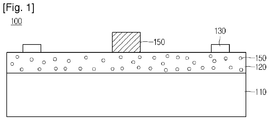
- Fig. 1 is a cross-sectional view illustrating a radiant heat circuit board according to an embodiment.
- a layer, a film, a region, or a plate when referred to as being 'on' another layer, film, region, or plate, it can be directly on the other layer, film, region, or plate, or intervening layers, films, regions, or plates may also be present. However, if a layer, a film, a region, or a plate is referred to as being 'directly on' another layer, film, region, or plate, there is not intervening layer, film, region, or plate.
- the present disclosure provides an epoxy resin composition having an improved thermal conductivity owing to high crystalline characteristics.
- the crystalline epoxy resin composition of the present disclosure includes an epoxy resin, a curing agent, and an inorganic filler as main components.
- the epoxy resin includes at least 50 wt% of crystalline epoxy resin.
- the crystalline epoxy resin is expressed by the following Chemical Formula. where m is an integer of 0 to 50, R is hydrogen or an alkyl group.
- the content of the crystalline epoxy resin is less than the above-mentioned value, effects such as an increase in thermal conductivity are reduced because the epoxy resin is not crystallized when hardened.
- the epoxy resin further includes a general amorphous epoxy resin in which a molecule has at least two epoxy groups as well as the crystalline epoxy resin which is an essential component.
- amorphous epoxy examples include: bisphenol A; 3,3',5,5'-tetramethyl-4,4'-dihydroxydiphenylmethane; 4,4'-dihydroxydiphenylsulfone; 4,4'-dihydroxydiphenylsulfide; 4,4'-dihydroxydiphenylketone; fluorenbisphenol; 4,4'-biphenol,3,3',5,5'-tetramethyl-4,4'-dihydroxybiphenyl; 2,2'-biphenol; resorcin; catechol; t-butylcatechol; hydroquinone; t-butylhydroquinone; 1,2-dihydroxynaphthalene; 1,3-dihydroxynaphthalene; 1,4-dihydroxynaphthalene; 1,5-dihydroxynaphthalene; 1,6-dihydroxynaphthalene; 1,7-dihydroxynaphthalene; 1,8-dihydroxynaphthalene; 2,
- the curing agent used for the epoxy resin composition of the present disclosure may be any of generally known epoxy resin curing agent.
- the curing agent may be a phenol-based curing agent.
- the phenol-based curing agent includes a phenol resin in addition to a phenol compound.
- phenol-based curing agent examples include bisphenol A, bisphenol F, 4,4'dihydroxydiphenylmethane, 4,4'dihydroxyphenylether, 1,4-bis(4-hydroxyphenoxy)benzene, 1,3-bis(4-hydroxyphenoxy)benzene, 4,4'dihydroxydiphenylsulfide, 4,4'dihydroxydiphenylketone, 4,4'dihydroxydiphenylsulfone, 4,4'dihydroxybiphenyl, 2,2'dihydroxybiphenyl, 10-(2,5-dihydroxyphenyl)-10H-9-oxa-10-phosphaphenanthrene-10-oxide, phenol novolac, bisphenol A novolac, o-cresol novolac, m-cresol novolac, p-cresol novolac, Xylenole novolac, poly-p-hydroxysyrene, hydroquinone, resorsin, catechol, t-buty
- At least two curing agents may be mixed and then used as the curing agent.
- a generally known curing agent may be used in addition to the phenol-based curing agent.
- generally known curing agent include an amine-based curing agent, an acid anhydride-based curing agent, a phenol-based curing agent, a polymercaptan-based curing agent, a polyaminoamide-based curing agent, an isocyanate-based curing agent, and a block isocyanate-based curing agent.
- the mixing ratio of the above curing agents may be properly selected according to the type of curing agent to be mixed or physical properties of a thermal conductive epoxy resin product.
- Examples of the amine-based curing agent include aliphatic amines, polyetherpolyamines, cycloaliphatic amines, and aromatic amines.
- Examples of the aliphatic amines include ethylene diamine, 1,3-diaminopropane, 1,4-diaminopropane, hexamethylenediamine, 2,5-dimethylhexamethylenediamine, trimethylhexamethylenediamine, diethylenetriamine, aminobispropylamine, bis(hexamethylene)triamine, triethylenetetramine, tetraethylenephentamine, pentaethylenehexamine, N-hydroxyethylethylenediamine, and tetra(hydroxyethyl)ethylenediamine.
- polyetherpolyamines examples include triethyleneglycoldiamine, tetraethyleneglycoldiamine, diethyleneglycolbis(propylamine), polyoxypropylenediamine, and polyoxypropylenetriamines.
- cycloaliphatic amines include isophorone diamine, metacendiamine, N-aminoethylpiperazine, bis(4-amino-3-methyldicyclohexyl)methane, bis (aminomethyl)cyclohexane, 3,9-bis(3-aminopropyl)2,4,8,10-tetraoxaspiro(5,5)undecane, and norbornen diamine.
- aromatic amines examples include tetrachloro-p-xylylenediamine, m-xylylenediamine, p-xylylenediamine, m-phenylenediamine, o-phenylenediamine, p-phenylenediamine, 2,4-diaminoanisole, 2,4-toluenediamine, 2,4-diaminodiphenylmethane, 4,4'-diaminodiphenylmethane, 4,4'-diamino-1,2-diphenylethane, 2,4-diaminodiphenylsulfone, 4,4'-diaminodiphenylsulfone, m-aminophenol, m-aminobenzylamine, benzyldimethylamine, 2-dimethylaminomethyl)phenol, triethanolphenol, methylbenzylamine, ⁇ -(m-aminophenyl)ethylamine,
- Examples of the acid anhydride curing agent include dodecenyl succinic anhydride, polyadipic acid anhydride, polyazellainc acid anhydride, polysebacic acid anhydride, poly(ethyloctadecanoic acid)anhydride, poly(phenylhexadecanoic acid)anhydride, methyltetrahydro phthalic anhydride, methylhexahydro phthalic anhydride, hexahydro phthalic anhydride, anhydrous methyl hymic acid, tetrahydro phthalic anhydride, trialkyltetrahydro phthalic anhydride, methylcyclohexenedicarbonic acid anhydride, methylcyclohexenetetracarbonic acid anhydride, phthalic anhydride, anhydrous trimellitic acid, anhydrous pyromellitic acid, benzophenone tetracarbonic acid anhydride, ethylene glycol bistrimellitate, hetic
- the epoxy resin composition includes 40 wt% to 97 wt% of the inorganic filler.
- the content of the inorganic filler When the content of the inorganic filler is lower than the above range, it may be difficult to attain effects of the present disclosure such as high thermal conductivity, low thermal expansibility, and high thermal resistance.
- the above-described mentioned effects are obtained by controlled high order structure in a polymer state. It seems that a specific content of the inorganic filler is necessary because the higher order structure is mainly achieved on the surface of the inorganic filler. Meanwhile, when the content of the inorganic filler is greater than the above range, the viscosity of the epoxy resin composition may increase to make it difficult to form the epoxy resin composition in a desired shape.
- the inorganic filler may have a globular shape.
- the shape of the inorganic filler is not limited as long as the inorganic filler has a globular shape.
- the inorganic filler may have an elliptical sectional shape.
- the fluidity of the epoxy resin composition improves.
- the inorganic filler may be alumina, aluminum nitride, silicon nitride, boron nitride, or crystalline silica, and the like. In addition, two or more different inorganic fillers may be used in combination as the inorganic filler.
- the average particle diameter of the inorganic filler may be less than 30 ⁇ m. When the average particle diameter is above the above range, the fluidity and strength of the epoxy resin composition are decreased.
- the epoxy resin composition of the present disclosure may be mixed with a known curing accelerator.
- the curing accelerator include amines, imidazoles, organic phosphines, and Lewis acids.
- examples of the curing accelerator may include: tertiary amines such as 1,8-diazabicyclo(5,4,0)undecene-7, triethylenediamine, benzyldimethylamine, triethanolamine, dimethylaminoethanol, and tris(dimethylaminomethyl)phenol; imidazoles such as 2-methylimidazole, 2-phenylimidazole, 2-phenyl-4-methylimidazole, and 2-heptadecylimidazole; organic phosphines such as tributylphosphine, methyldiphenylphosphine, triphenylphosphine, diphenylphosphine, and phenylphosphine; and tetra substituted phosphonium ⁇ tetra substituted
- General wax may be used as a release agent for wax may be used as a release agent for the epoxy resin composition of the present disclosure.
- the wax include stearic acid, montanic acid, montanic acid ester, and phosphoric acid ester.
- a coupling agent that is generally used for an epoxy resin composition may be used so as to improve the adhesion strength between the inorganic filler and the resin component.
- the coupling agent include an epoxy silane.
- the epoxy resin composition of the present disclosure includes the epoxy resin, the curing agent, and the inorganic filler as main components
- the epoxy resin composition includes 3 wt% to 60 wt% of the epoxy resin, 40 wt% to 97wt% of the inorganic filler, and 0.5 wt% to 5wt% of the curing agent.
- the epoxy resin, the curing agent, and other components are dissolved in a solvent such as acetone, MEK, MIBK, IPA, butanol, or toluene and are agitated while applying heat.
- the inorganic filler is added to the solution is uniformly mixed using a device such as a mixer.
- the coupling agent is added to the mixture and the mixture is kneaded using a device such as a heating roll and a kneader.
- the mixing order of the above components is not limited.
- the solvent is used in 10 wt% to 20 wt% based on the total weight of the epoxy resin composition.
- the epoxy resin composition of the present disclosure may be applied to a radiant heat circuit board 100 as shown in Fig. 1 .
- the radiant heat circuit board 100 of the present disclosure includes a metal plate 110, an insulating layer 120 on the metal plate 110, circuit patterns 130 on the insulating layer 120.
- the metal plate 110 may be formed of one of alloys including copper, aluminum, nickel, gold, platinum, and the like that have good thermal conductivity.
- the metal plate 110 may include a metal projection (now shown) that constitutes a mounting pad on which a heat-generating device 150 is mounted.
- the metal projection may extend vertically from the metal plate 110.
- the heat-generating device 150 is mounted on a portion of the topside of the metal projection, and the portion of the topside of the metal projection has a predetermined width so that solder balls can be placed.
- the insulating layer 120 is disposed on the metal plate 110.
- the insulating layer 120 may include a plurality of insulating layers.
- the insulating layer 120 is disposed between the metal plate 110 and the circuit patterns 130.
- the insulating layer 120 may be formed by curing the above-described crystalline epoxy resin composition.
- An inorganic filler 125 is evenly dispersed in the insulating layer 120.
- the circuit patterns 130 are disposed on the insulating layer 120.
- the thermal conductivity of the insulating layer 120 is increased so that heat generated from the heat-generating device 150 can be transferred to the metal plate 110 through the insulating layer 120.
- the thermal conductivity of the epoxy resin composition was measured by a unsteady hot wire method using LFA447 Type thermal conductivity meter available from NETZSCH Company.
- Melting heat of the epoxy resin composition was measured at a temperature increasing rate of 10°C/minute by using a differential scanning calorimeter (DSC Q100 available from TA Company).
- the glass transition temperature of the epoxy resin composition was measured at a temperature increasing rate of 10°C/minute by using a DSC Q100 Thermo-mechanical measuring device available from TA Company.
- Example 4 the thermal conductivity of the crystalline epoxy resin composition of Example 4 including a crystalline epoxy resin is higher than the thermal conductivity of the epoxy resin composition of Comparative Example 3.
Landscapes
- Chemical & Material Sciences (AREA)
- Chemical Kinetics & Catalysis (AREA)
- Organic Chemistry (AREA)
- Health & Medical Sciences (AREA)
- Medicinal Chemistry (AREA)
- Polymers & Plastics (AREA)
- Engineering & Computer Science (AREA)
- Microelectronics & Electronic Packaging (AREA)
- Physics & Mathematics (AREA)
- Thermal Sciences (AREA)
- Combustion & Propulsion (AREA)
- Materials Engineering (AREA)
- Compositions Of Macromolecular Compounds (AREA)
- Epoxy Resins (AREA)
- Laminated Bodies (AREA)
- Reinforced Plastic Materials (AREA)
Claims (6)
- Composition de résine époxy comprenant une résine époxy, un agent de durcissement, et une charge inorganique,
dans laquelle la résine époxy comprend une résine époxy cristalline, et une résine époxy amorphe ;
dans laquelle la résine époxy cristalline présente une structure mésogène,
dans laquelle la résine époxy cristalline est exprimée par la formule chimique suivante :
dans laquelle la résine époxy comprend au moins 50 % en poids de la résine époxy cristalline,
dans laquelle la composition de résine époxy comprend 40 % en poids à 97 % en poids de la charge inorganique. - Composition de résine époxy selon la revendication 1, dans laquelle la charge inorganique est au moins l'une parmi une alumine, un nitrure de bore, un nitrure d'aluminium, une silice cristalline, et un nitrure de silicium.
- Composition de résine époxy selon la revendication 1, dans laquelle la composition de résine époxy comprend 3 % en poids à 60 % en poids de la résine époxy, et 0,5 % en poids à 5 % en poids de l'agent de durcissement.
- Composition de résine époxy selon la revendication 1, dans laquelle la composition de résine époxy est utilisée comme couche isolante d'une carte de circuit à chaleur rayonnante, et la composition de résine époxy comprend en outre un accélérateur de durcissement et un agent de couplage.
- Carte de circuit à chaleur rayonnante comprenant :une plaque métallique ;une couche isolante sur la plaque métallique ; etun motif de circuit sur la couche isolante,dans laquelle la couche isolante est formée par le durcissement d'une composition de résine époxy comprenant une résine époxy, un agent de durcissement, et une charge inorganique,dans laquelle la résine époxy comprend une résine époxy cristalline et une résine époxy amorphe,dans laquelle la résine époxy cristalline présente une structure mésogène,dans laquelle la résine époxy cristalline est exprimée par la formule chimique suivante :
 où m est un nombre entier allant de 0 à 50, et R est un hydrogène ou un groupe alkyle,dans laquelle la résine époxy comprend au moins 50 % en poids de la résine époxy cristalline,dans laquelle la composition de résine époxy comprend 40 % en poids à 97 % en poids de la charge inorganique.
 - Carte de circuit à chaleur rayonnante selon la revendication 5, dans laquelle la charge inorganique est au moins l'une parmi une alumine, un nitrure de bore, un nitrure d'aluminium, une silice cristalline, et un nitrure de silicium.
Applications Claiming Priority (2)
| Application Number | Priority Date | Filing Date | Title |
|---|---|---|---|
| KR1020110048109A KR101326960B1 (ko) | 2011-05-20 | 2011-05-20 | 에폭시 수지 조성물 및 이를 이용한 방열회로기판 |
| PCT/KR2012/003991 WO2012161490A2 (fr) | 2011-05-20 | 2012-05-21 | Composition de résine époxy et carte de circuit à chaleur rayonnante l'utilisant |
Publications (3)
| Publication Number | Publication Date |
|---|---|
| EP2710075A2 EP2710075A2 (fr) | 2014-03-26 |
| EP2710075A4 EP2710075A4 (fr) | 2015-05-20 |
| EP2710075B1 true EP2710075B1 (fr) | 2019-10-16 |
Family
ID=47217882
Family Applications (1)
| Application Number | Title | Priority Date | Filing Date |
|---|---|---|---|
| EP12789163.8A Active EP2710075B1 (fr) | 2011-05-20 | 2012-05-21 | Composition de résine époxy et carte de circuit à chaleur rayonnante l'utilisant |
Country Status (6)
| Country | Link |
|---|---|
| US (1) | US9451695B2 (fr) |
| EP (1) | EP2710075B1 (fr) |
| KR (1) | KR101326960B1 (fr) |
| CN (1) | CN103562308B (fr) |
| TW (1) | TWI481320B (fr) |
| WO (1) | WO2012161490A2 (fr) |
Families Citing this family (8)
| Publication number | Priority date | Publication date | Assignee | Title |
|---|---|---|---|---|
| KR101326934B1 (ko) | 2011-08-31 | 2013-11-11 | 엘지이노텍 주식회사 | 에폭시 수지 조성물 및 이를 이용한 방열회로기판 |
| CN104344235A (zh) * | 2013-07-26 | 2015-02-11 | 盈胜科技股份有限公司 | 具有桥接单元的一体化多层式led灯管的制作方法 |
| KR101503284B1 (ko) * | 2013-12-17 | 2015-03-17 | 전자부품연구원 | 고열전도도를 갖는 복합 절연 조성물 및 제조방법 |
| JP2018044072A (ja) * | 2016-09-15 | 2018-03-22 | 株式会社トクヤマ | 窒化アルミニウム含有硬化性樹脂組成物 |
| EP3840547A1 (fr) * | 2019-12-20 | 2021-06-23 | AT & S Austria Technologie & Systemtechnik Aktiengesellschaft | Support de composant à incrustation magnétique intégrée et à structure de bobine intégrée |
| US12482595B2 (en) | 2019-12-20 | 2025-11-25 | At&S Austria Technologie & Systemtechnik Ag | Component carrier with embedded magnetic inlay and integrated coil structure |
| CN115141463A (zh) * | 2021-03-31 | 2022-10-04 | 华为技术有限公司 | 一种导热材料及其制作方法、半固化片、层压板、电路板 |
| US12516032B2 (en) | 2022-01-24 | 2026-01-06 | Industrial Technology Research Institute | Epoxy compound, composition and cured product thereof |
Family Cites Families (18)
| Publication number | Priority date | Publication date | Assignee | Title |
|---|---|---|---|---|
| US3637572A (en) * | 1969-05-26 | 1972-01-25 | Hitachi Ltd | Epoxy resins with organoboron cure promotors |
| KR950011902B1 (ko) | 1990-04-04 | 1995-10-12 | 도오레 가부시끼가이샤 | 반도체 장치 캡슐 봉입 에폭시 수지 조성물 |
| US5264502A (en) | 1990-08-03 | 1993-11-23 | The Dow Chemical Company | Diamino-alpha-alkylstilbene curing agents for epoxy resins |
| JPH05267808A (ja) | 1992-03-18 | 1993-10-15 | Hitachi Chem Co Ltd | 金属ベース基板 |
| JPH06107911A (ja) * | 1992-09-24 | 1994-04-19 | Sumitomo Bakelite Co Ltd | 半導体封止用樹脂組成物 |
| US5458929A (en) * | 1994-02-15 | 1995-10-17 | The Dow Chemical Company | Cure controlled catalyzed mixtures of epoxy resins and curing agents containing mesogenic moieties, B-staged and cured products therefrom |
| US5412057A (en) | 1994-02-15 | 1995-05-02 | The Dow Chemical Company | Mesogen-containing aromatic anhydride compounds |
| US5798400A (en) | 1995-01-05 | 1998-08-25 | Toray Industries, Inc. | Epoxy resin compound |
| JPH08302161A (ja) * | 1995-05-10 | 1996-11-19 | Hitachi Chem Co Ltd | 樹脂組成物及びその樹脂組成物をケミカルエッチングする方法 |
| TW398163B (en) * | 1996-10-09 | 2000-07-11 | Matsushita Electric Industrial Co Ltd | The plate for heat transfer substrate and manufacturing method thereof, the heat-transfer substrate using such plate and manufacturing method thereof |
| US6190787B1 (en) | 1997-07-02 | 2001-02-20 | Sumitomo Bakelite Company, Ltd. | Epoxy resin compositions for encapsulating semiconductors, and semiconductor devices |
| JP4639412B2 (ja) | 1999-01-28 | 2011-02-23 | 住友ベークライト株式会社 | エポキシ樹脂組成物及び半導体装置 |
| JP2000223838A (ja) * | 1999-02-03 | 2000-08-11 | Sumitomo Bakelite Co Ltd | 多層プリント配線板用層間絶縁接着剤 |
| US6555602B1 (en) | 1999-10-06 | 2003-04-29 | Nitto Denko Corporation | Composition of epoxy resin, anhydride and microcapsule accelerator |
| JP2002212268A (ja) | 2001-01-19 | 2002-07-31 | Japan Epoxy Resin Kk | 半導体封止用エポキシ樹脂組成物 |
| JP4663169B2 (ja) * | 2001-07-27 | 2011-03-30 | 電気化学工業株式会社 | 金属ベ−ス回路基板 |
| US8030818B2 (en) * | 2004-06-15 | 2011-10-04 | Siemens Energy, Inc. | Stator coil with improved heat dissipation |
| KR101096626B1 (ko) * | 2008-02-15 | 2011-12-21 | 엘지이노텍 주식회사 | 방열회로기판 및 그 제조방법 |
-
2011
- 2011-05-20 KR KR1020110048109A patent/KR101326960B1/ko active Active
-
2012
- 2012-05-21 EP EP12789163.8A patent/EP2710075B1/fr active Active
- 2012-05-21 US US14/119,122 patent/US9451695B2/en active Active
- 2012-05-21 CN CN201280024618.0A patent/CN103562308B/zh active Active
- 2012-05-21 WO PCT/KR2012/003991 patent/WO2012161490A2/fr not_active Ceased
- 2012-05-21 TW TW101117987A patent/TWI481320B/zh active
Non-Patent Citations (1)
| Title |
|---|
| None * |
Also Published As
| Publication number | Publication date |
|---|---|
| WO2012161490A9 (fr) | 2013-05-23 |
| US20140231122A1 (en) | 2014-08-21 |
| WO2012161490A2 (fr) | 2012-11-29 |
| KR101326960B1 (ko) | 2013-11-13 |
| EP2710075A2 (fr) | 2014-03-26 |
| CN103562308A (zh) | 2014-02-05 |
| EP2710075A4 (fr) | 2015-05-20 |
| TWI481320B (zh) | 2015-04-11 |
| KR20120129684A (ko) | 2012-11-28 |
| CN103562308B (zh) | 2016-11-02 |
| US9451695B2 (en) | 2016-09-20 |
| WO2012161490A3 (fr) | 2013-03-21 |
| TW201304625A (zh) | 2013-01-16 |
Similar Documents
| Publication | Publication Date | Title |
|---|---|---|
| EP2731993B1 (fr) | Composition de résine époxyde et carte de circuit imprimé à chaleur rayonnante l'utilisant | |
| US9974172B2 (en) | Epoxy resin compound and radiant heat circuit board using the same | |
| EP2710075B1 (fr) | Composition de résine époxy et carte de circuit à chaleur rayonnante l'utilisant | |
| CN103382284B (zh) | 环氧树脂、包含该环氧树脂的环氧树脂复合物以及使用该复合物的辐射热电路板 | |
| KR20120074109A (ko) | 에폭시 수지 조성물 및 이를 이용한 방열회로기판 | |
| TWI452084B (zh) | 環氧樹脂組合物及使用其之散熱電路板 | |
| EP2698400B1 (fr) | Composé de résine époxy et carte de circuit de chaleur radiante utilisant celui-ci | |
| CN103842434B (zh) | 环氧树脂组合物以及使用该环氧树脂组合物的辐射热电路板 | |
| KR101360551B1 (ko) | 에폭시 수지 조성물 및 이를 이용한 방열회로기판 | |
| TWI545141B (zh) | 環氧樹脂組成物及使用其之散熱電路板 | |
| KR101896965B1 (ko) | 에폭시 수지 조성물 및 이를 이용한 방열회로기판 | |
| KR101976579B1 (ko) | 에폭시 수지 조성물 및 이를 이용한 방열회로기판 | |
| KR101987260B1 (ko) | 에폭시 수지, 에폭시 수지 조성물 및 이를 이용한 방열회로기판 | |
| KR20130008408A (ko) | 에폭시 수지 조성물 및 이를 이용한 방열회로기판 |
Legal Events
| Date | Code | Title | Description |
|---|---|---|---|
| PUAI | Public reference made under article 153(3) epc to a published international application that has entered the european phase |
Free format text: ORIGINAL CODE: 0009012 |
|
| 17P | Request for examination filed |
Effective date: 20131128 |
|
| AK | Designated contracting states |
Kind code of ref document: A2 Designated state(s): AL AT BE BG CH CY CZ DE DK EE ES FI FR GB GR HR HU IE IS IT LI LT LU LV MC MK MT NL NO PL PT RO RS SE SI SK SM TR |
|
| DAX | Request for extension of the european patent (deleted) | ||
| A4 | Supplementary search report drawn up and despatched |
Effective date: 20150420 |
|
| RIC1 | Information provided on ipc code assigned before grant |
Ipc: C08K 3/00 20060101ALI20150414BHEP Ipc: C08L 63/00 20060101AFI20150414BHEP Ipc: H05K 7/20 20060101ALI20150414BHEP Ipc: C08G 59/22 20060101ALI20150414BHEP |
|
| RAP1 | Party data changed (applicant data changed or rights of an application transferred) |
Owner name: LG INNOTEK CO., LTD. |
|
| STAA | Information on the status of an ep patent application or granted ep patent |
Free format text: STATUS: EXAMINATION IS IN PROGRESS |
|
| 17Q | First examination report despatched |
Effective date: 20180820 |
|
| 17Q | First examination report despatched |
Effective date: 20180830 |
|
| GRAP | Despatch of communication of intention to grant a patent |
Free format text: ORIGINAL CODE: EPIDOSNIGR1 |
|
| STAA | Information on the status of an ep patent application or granted ep patent |
Free format text: STATUS: GRANT OF PATENT IS INTENDED |
|
| INTG | Intention to grant announced |
Effective date: 20190506 |
|
| GRAS | Grant fee paid |
Free format text: ORIGINAL CODE: EPIDOSNIGR3 |
|
| GRAA | (expected) grant |
Free format text: ORIGINAL CODE: 0009210 |
|
| STAA | Information on the status of an ep patent application or granted ep patent |
Free format text: STATUS: THE PATENT HAS BEEN GRANTED |
|
| AK | Designated contracting states |
Kind code of ref document: B1 Designated state(s): AL AT BE BG CH CY CZ DE DK EE ES FI FR GB GR HR HU IE IS IT LI LT LU LV MC MK MT NL NO PL PT RO RS SE SI SK SM TR |
|
| REG | Reference to a national code |
Ref country code: GB Ref legal event code: FG4D |
|
| REG | Reference to a national code |
Ref country code: CH Ref legal event code: EP |
|
| REG | Reference to a national code |
Ref country code: DE Ref legal event code: R096 Ref document number: 602012064926 Country of ref document: DE |
|
| REG | Reference to a national code |
Ref country code: IE Ref legal event code: FG4D |
|
| REG | Reference to a national code |
Ref country code: AT Ref legal event code: REF Ref document number: 1191217 Country of ref document: AT Kind code of ref document: T Effective date: 20191115 |
|
| REG | Reference to a national code |
Ref country code: NL Ref legal event code: MP Effective date: 20191016 |
|
| REG | Reference to a national code |
Ref country code: LT Ref legal event code: MG4D |
|
| REG | Reference to a national code |
Ref country code: AT Ref legal event code: MK05 Ref document number: 1191217 Country of ref document: AT Kind code of ref document: T Effective date: 20191016 |
|
| PG25 | Lapsed in a contracting state [announced via postgrant information from national office to epo] |
Ref country code: PT Free format text: LAPSE BECAUSE OF FAILURE TO SUBMIT A TRANSLATION OF THE DESCRIPTION OR TO PAY THE FEE WITHIN THE PRESCRIBED TIME-LIMIT Effective date: 20200217 Ref country code: NO Free format text: LAPSE BECAUSE OF FAILURE TO SUBMIT A TRANSLATION OF THE DESCRIPTION OR TO PAY THE FEE WITHIN THE PRESCRIBED TIME-LIMIT Effective date: 20200116 Ref country code: BG Free format text: LAPSE BECAUSE OF FAILURE TO SUBMIT A TRANSLATION OF THE DESCRIPTION OR TO PAY THE FEE WITHIN THE PRESCRIBED TIME-LIMIT Effective date: 20200116 Ref country code: FI Free format text: LAPSE BECAUSE OF FAILURE TO SUBMIT A TRANSLATION OF THE DESCRIPTION OR TO PAY THE FEE WITHIN THE PRESCRIBED TIME-LIMIT Effective date: 20191016 Ref country code: LV Free format text: LAPSE BECAUSE OF FAILURE TO SUBMIT A TRANSLATION OF THE DESCRIPTION OR TO PAY THE FEE WITHIN THE PRESCRIBED TIME-LIMIT Effective date: 20191016 Ref country code: SE Free format text: LAPSE BECAUSE OF FAILURE TO SUBMIT A TRANSLATION OF THE DESCRIPTION OR TO PAY THE FEE WITHIN THE PRESCRIBED TIME-LIMIT Effective date: 20191016 Ref country code: AT Free format text: LAPSE BECAUSE OF FAILURE TO SUBMIT A TRANSLATION OF THE DESCRIPTION OR TO PAY THE FEE WITHIN THE PRESCRIBED TIME-LIMIT Effective date: 20191016 Ref country code: PL Free format text: LAPSE BECAUSE OF FAILURE TO SUBMIT A TRANSLATION OF THE DESCRIPTION OR TO PAY THE FEE WITHIN THE PRESCRIBED TIME-LIMIT Effective date: 20191016 Ref country code: GR Free format text: LAPSE BECAUSE OF FAILURE TO SUBMIT A TRANSLATION OF THE DESCRIPTION OR TO PAY THE FEE WITHIN THE PRESCRIBED TIME-LIMIT Effective date: 20200117 Ref country code: ES Free format text: LAPSE BECAUSE OF FAILURE TO SUBMIT A TRANSLATION OF THE DESCRIPTION OR TO PAY THE FEE WITHIN THE PRESCRIBED TIME-LIMIT Effective date: 20191016 Ref country code: NL Free format text: LAPSE BECAUSE OF FAILURE TO SUBMIT A TRANSLATION OF THE DESCRIPTION OR TO PAY THE FEE WITHIN THE PRESCRIBED TIME-LIMIT Effective date: 20191016 Ref country code: LT Free format text: LAPSE BECAUSE OF FAILURE TO SUBMIT A TRANSLATION OF THE DESCRIPTION OR TO PAY THE FEE WITHIN THE PRESCRIBED TIME-LIMIT Effective date: 20191016 |
|
| PG25 | Lapsed in a contracting state [announced via postgrant information from national office to epo] |
Ref country code: RS Free format text: LAPSE BECAUSE OF FAILURE TO SUBMIT A TRANSLATION OF THE DESCRIPTION OR TO PAY THE FEE WITHIN THE PRESCRIBED TIME-LIMIT Effective date: 20191016 Ref country code: HR Free format text: LAPSE BECAUSE OF FAILURE TO SUBMIT A TRANSLATION OF THE DESCRIPTION OR TO PAY THE FEE WITHIN THE PRESCRIBED TIME-LIMIT Effective date: 20191016 Ref country code: IS Free format text: LAPSE BECAUSE OF FAILURE TO SUBMIT A TRANSLATION OF THE DESCRIPTION OR TO PAY THE FEE WITHIN THE PRESCRIBED TIME-LIMIT Effective date: 20200224 |
|
| PG25 | Lapsed in a contracting state [announced via postgrant information from national office to epo] |
Ref country code: AL Free format text: LAPSE BECAUSE OF FAILURE TO SUBMIT A TRANSLATION OF THE DESCRIPTION OR TO PAY THE FEE WITHIN THE PRESCRIBED TIME-LIMIT Effective date: 20191016 |
|
| REG | Reference to a national code |
Ref country code: DE Ref legal event code: R097 Ref document number: 602012064926 Country of ref document: DE |
|
| PG2D | Information on lapse in contracting state deleted |
Ref country code: IS |
|
| PG25 | Lapsed in a contracting state [announced via postgrant information from national office to epo] |
Ref country code: DK Free format text: LAPSE BECAUSE OF FAILURE TO SUBMIT A TRANSLATION OF THE DESCRIPTION OR TO PAY THE FEE WITHIN THE PRESCRIBED TIME-LIMIT Effective date: 20191016 Ref country code: EE Free format text: LAPSE BECAUSE OF FAILURE TO SUBMIT A TRANSLATION OF THE DESCRIPTION OR TO PAY THE FEE WITHIN THE PRESCRIBED TIME-LIMIT Effective date: 20191016 Ref country code: RO Free format text: LAPSE BECAUSE OF FAILURE TO SUBMIT A TRANSLATION OF THE DESCRIPTION OR TO PAY THE FEE WITHIN THE PRESCRIBED TIME-LIMIT Effective date: 20191016 Ref country code: CZ Free format text: LAPSE BECAUSE OF FAILURE TO SUBMIT A TRANSLATION OF THE DESCRIPTION OR TO PAY THE FEE WITHIN THE PRESCRIBED TIME-LIMIT Effective date: 20191016 Ref country code: IS Free format text: LAPSE BECAUSE OF FAILURE TO SUBMIT A TRANSLATION OF THE DESCRIPTION OR TO PAY THE FEE WITHIN THE PRESCRIBED TIME-LIMIT Effective date: 20200216 |
|
| PLBE | No opposition filed within time limit |
Free format text: ORIGINAL CODE: 0009261 |
|
| STAA | Information on the status of an ep patent application or granted ep patent |
Free format text: STATUS: NO OPPOSITION FILED WITHIN TIME LIMIT |
|
| PG25 | Lapsed in a contracting state [announced via postgrant information from national office to epo] |
Ref country code: SK Free format text: LAPSE BECAUSE OF FAILURE TO SUBMIT A TRANSLATION OF THE DESCRIPTION OR TO PAY THE FEE WITHIN THE PRESCRIBED TIME-LIMIT Effective date: 20191016 Ref country code: SM Free format text: LAPSE BECAUSE OF FAILURE TO SUBMIT A TRANSLATION OF THE DESCRIPTION OR TO PAY THE FEE WITHIN THE PRESCRIBED TIME-LIMIT Effective date: 20191016 Ref country code: IT Free format text: LAPSE BECAUSE OF FAILURE TO SUBMIT A TRANSLATION OF THE DESCRIPTION OR TO PAY THE FEE WITHIN THE PRESCRIBED TIME-LIMIT Effective date: 20191016 |
|
| 26N | No opposition filed |
Effective date: 20200717 |
|
| PG25 | Lapsed in a contracting state [announced via postgrant information from national office to epo] |
Ref country code: SI Free format text: LAPSE BECAUSE OF FAILURE TO SUBMIT A TRANSLATION OF THE DESCRIPTION OR TO PAY THE FEE WITHIN THE PRESCRIBED TIME-LIMIT Effective date: 20191016 |
|
| PG25 | Lapsed in a contracting state [announced via postgrant information from national office to epo] |
Ref country code: MC Free format text: LAPSE BECAUSE OF FAILURE TO SUBMIT A TRANSLATION OF THE DESCRIPTION OR TO PAY THE FEE WITHIN THE PRESCRIBED TIME-LIMIT Effective date: 20191016 Ref country code: LI Free format text: LAPSE BECAUSE OF NON-PAYMENT OF DUE FEES Effective date: 20200531 Ref country code: CH Free format text: LAPSE BECAUSE OF NON-PAYMENT OF DUE FEES Effective date: 20200531 |
|
| REG | Reference to a national code |
Ref country code: BE Ref legal event code: MM Effective date: 20200531 |
|
| GBPC | Gb: european patent ceased through non-payment of renewal fee |
Effective date: 20200521 |
|
| PG25 | Lapsed in a contracting state [announced via postgrant information from national office to epo] |
Ref country code: LU Free format text: LAPSE BECAUSE OF NON-PAYMENT OF DUE FEES Effective date: 20200521 |
|
| PG25 | Lapsed in a contracting state [announced via postgrant information from national office to epo] |
Ref country code: IE Free format text: LAPSE BECAUSE OF NON-PAYMENT OF DUE FEES Effective date: 20200521 Ref country code: GB Free format text: LAPSE BECAUSE OF NON-PAYMENT OF DUE FEES Effective date: 20200521 |
|
| PG25 | Lapsed in a contracting state [announced via postgrant information from national office to epo] |
Ref country code: BE Free format text: LAPSE BECAUSE OF NON-PAYMENT OF DUE FEES Effective date: 20200531 |
|
| PG25 | Lapsed in a contracting state [announced via postgrant information from national office to epo] |
Ref country code: TR Free format text: LAPSE BECAUSE OF FAILURE TO SUBMIT A TRANSLATION OF THE DESCRIPTION OR TO PAY THE FEE WITHIN THE PRESCRIBED TIME-LIMIT Effective date: 20191016 Ref country code: MT Free format text: LAPSE BECAUSE OF FAILURE TO SUBMIT A TRANSLATION OF THE DESCRIPTION OR TO PAY THE FEE WITHIN THE PRESCRIBED TIME-LIMIT Effective date: 20191016 Ref country code: CY Free format text: LAPSE BECAUSE OF FAILURE TO SUBMIT A TRANSLATION OF THE DESCRIPTION OR TO PAY THE FEE WITHIN THE PRESCRIBED TIME-LIMIT Effective date: 20191016 |
|
| PG25 | Lapsed in a contracting state [announced via postgrant information from national office to epo] |
Ref country code: MK Free format text: LAPSE BECAUSE OF FAILURE TO SUBMIT A TRANSLATION OF THE DESCRIPTION OR TO PAY THE FEE WITHIN THE PRESCRIBED TIME-LIMIT Effective date: 20191016 |
|
| PGFP | Annual fee paid to national office [announced via postgrant information from national office to epo] |
Ref country code: DE Payment date: 20250422 Year of fee payment: 14 |
|
| PGFP | Annual fee paid to national office [announced via postgrant information from national office to epo] |
Ref country code: FR Payment date: 20250422 Year of fee payment: 14 |