EP2711059A2 - System und Verfahren zum Ermöglichung der Interaktion mit einem virtuellen Raum - Google Patents
System und Verfahren zum Ermöglichung der Interaktion mit einem virtuellen Raum Download PDFInfo
- Publication number
- EP2711059A2 EP2711059A2 EP20130175686 EP13175686A EP2711059A2 EP 2711059 A2 EP2711059 A2 EP 2711059A2 EP 20130175686 EP20130175686 EP 20130175686 EP 13175686 A EP13175686 A EP 13175686A EP 2711059 A2 EP2711059 A2 EP 2711059A2
- Authority
- EP
- European Patent Office
- Prior art keywords
- user
- virtual space
- sensitive surface
- touch sensitive
- gesture
- Prior art date
- Legal status (The legal status is an assumption and is not a legal conclusion. Google has not performed a legal analysis and makes no representation as to the accuracy of the status listed.)
- Granted
Links
Images








Classifications
-
- G—PHYSICS
- G06—COMPUTING OR CALCULATING; COUNTING
- G06F—ELECTRIC DIGITAL DATA PROCESSING
- G06F3/00—Input arrangements for transferring data to be processed into a form capable of being handled by the computer; Output arrangements for transferring data from processing unit to output unit, e.g. interface arrangements
- G06F3/01—Input arrangements or combined input and output arrangements for interaction between user and computer
-
- A—HUMAN NECESSITIES
- A63—SPORTS; GAMES; AMUSEMENTS
- A63F—CARD, BOARD, OR ROULETTE GAMES; INDOOR GAMES USING SMALL MOVING PLAYING BODIES; VIDEO GAMES; GAMES NOT OTHERWISE PROVIDED FOR
- A63F13/00—Video games, i.e. games using an electronically generated display having two or more dimensions
- A63F13/80—Special adaptations for executing a specific game genre or game mode
- A63F13/837—Shooting of targets
-
- A—HUMAN NECESSITIES
- A63—SPORTS; GAMES; AMUSEMENTS
- A63F—CARD, BOARD, OR ROULETTE GAMES; INDOOR GAMES USING SMALL MOVING PLAYING BODIES; VIDEO GAMES; GAMES NOT OTHERWISE PROVIDED FOR
- A63F13/00—Video games, i.e. games using an electronically generated display having two or more dimensions
- A63F13/20—Input arrangements for video game devices
- A63F13/21—Input arrangements for video game devices characterised by their sensors, purposes or types
- A63F13/214—Input arrangements for video game devices characterised by their sensors, purposes or types for locating contacts on a surface, e.g. floor mats or touch pads
-
- A—HUMAN NECESSITIES
- A63—SPORTS; GAMES; AMUSEMENTS
- A63F—CARD, BOARD, OR ROULETTE GAMES; INDOOR GAMES USING SMALL MOVING PLAYING BODIES; VIDEO GAMES; GAMES NOT OTHERWISE PROVIDED FOR
- A63F13/00—Video games, i.e. games using an electronically generated display having two or more dimensions
- A63F13/20—Input arrangements for video game devices
- A63F13/21—Input arrangements for video game devices characterised by their sensors, purposes or types
- A63F13/214—Input arrangements for video game devices characterised by their sensors, purposes or types for locating contacts on a surface, e.g. floor mats or touch pads
- A63F13/2145—Input arrangements for video game devices characterised by their sensors, purposes or types for locating contacts on a surface, e.g. floor mats or touch pads the surface being also a display device, e.g. touch screens
-
- A—HUMAN NECESSITIES
- A63—SPORTS; GAMES; AMUSEMENTS
- A63F—CARD, BOARD, OR ROULETTE GAMES; INDOOR GAMES USING SMALL MOVING PLAYING BODIES; VIDEO GAMES; GAMES NOT OTHERWISE PROVIDED FOR
- A63F13/00—Video games, i.e. games using an electronically generated display having two or more dimensions
- A63F13/20—Input arrangements for video game devices
- A63F13/21—Input arrangements for video game devices characterised by their sensors, purposes or types
- A63F13/219—Input arrangements for video game devices characterised by their sensors, purposes or types for aiming at specific areas on the display, e.g. light-guns
-
- A—HUMAN NECESSITIES
- A63—SPORTS; GAMES; AMUSEMENTS
- A63F—CARD, BOARD, OR ROULETTE GAMES; INDOOR GAMES USING SMALL MOVING PLAYING BODIES; VIDEO GAMES; GAMES NOT OTHERWISE PROVIDED FOR
- A63F13/00—Video games, i.e. games using an electronically generated display having two or more dimensions
- A63F13/40—Processing input control signals of video game devices, e.g. signals generated by the player or derived from the environment
- A63F13/42—Processing input control signals of video game devices, e.g. signals generated by the player or derived from the environment by mapping the input signals into game commands, e.g. mapping the displacement of a stylus on a touch screen to the steering angle of a virtual vehicle
- A63F13/426—Processing input control signals of video game devices, e.g. signals generated by the player or derived from the environment by mapping the input signals into game commands, e.g. mapping the displacement of a stylus on a touch screen to the steering angle of a virtual vehicle involving on-screen location information, e.g. screen coordinates of an area at which the player is aiming with a light gun
-
- A—HUMAN NECESSITIES
- A63—SPORTS; GAMES; AMUSEMENTS
- A63F—CARD, BOARD, OR ROULETTE GAMES; INDOOR GAMES USING SMALL MOVING PLAYING BODIES; VIDEO GAMES; GAMES NOT OTHERWISE PROVIDED FOR
- A63F13/00—Video games, i.e. games using an electronically generated display having two or more dimensions
- A63F13/50—Controlling the output signals based on the game progress
- A63F13/52—Controlling the output signals based on the game progress involving aspects of the displayed game scene
- A63F13/525—Changing parameters of virtual cameras
- A63F13/5255—Changing parameters of virtual cameras according to dedicated instructions from a player, e.g. using a secondary joystick to rotate the camera around a player's character
-
- G—PHYSICS
- G06—COMPUTING OR CALCULATING; COUNTING
- G06F—ELECTRIC DIGITAL DATA PROCESSING
- G06F15/00—Digital computers in general; Data processing equipment in general
- G06F15/16—Combinations of two or more digital computers each having at least an arithmetic unit, a program unit and a register, e.g. for a simultaneous processing of several programs
-
- G—PHYSICS
- G06—COMPUTING OR CALCULATING; COUNTING
- G06F—ELECTRIC DIGITAL DATA PROCESSING
- G06F3/00—Input arrangements for transferring data to be processed into a form capable of being handled by the computer; Output arrangements for transferring data from processing unit to output unit, e.g. interface arrangements
- G06F3/01—Input arrangements or combined input and output arrangements for interaction between user and computer
- G06F3/03—Arrangements for converting the position or the displacement of a member into a coded form
- G06F3/041—Digitisers, e.g. for touch screens or touch pads, characterised by the transducing means
-
- G—PHYSICS
- G06—COMPUTING OR CALCULATING; COUNTING
- G06F—ELECTRIC DIGITAL DATA PROCESSING
- G06F3/00—Input arrangements for transferring data to be processed into a form capable of being handled by the computer; Output arrangements for transferring data from processing unit to output unit, e.g. interface arrangements
- G06F3/01—Input arrangements or combined input and output arrangements for interaction between user and computer
- G06F3/048—Interaction techniques based on graphical user interfaces [GUI]
- G06F3/0484—Interaction techniques based on graphical user interfaces [GUI] for the control of specific functions or operations, e.g. selecting or manipulating an object, an image or a displayed text element, setting a parameter value or selecting a range
-
- G—PHYSICS
- G06—COMPUTING OR CALCULATING; COUNTING
- G06F—ELECTRIC DIGITAL DATA PROCESSING
- G06F3/00—Input arrangements for transferring data to be processed into a form capable of being handled by the computer; Output arrangements for transferring data from processing unit to output unit, e.g. interface arrangements
- G06F3/01—Input arrangements or combined input and output arrangements for interaction between user and computer
- G06F3/048—Interaction techniques based on graphical user interfaces [GUI]
- G06F3/0487—Interaction techniques based on graphical user interfaces [GUI] using specific features provided by the input device, e.g. functions controlled by the rotation of a mouse with dual sensing arrangements, or of the nature of the input device, e.g. tap gestures based on pressure sensed by a digitiser
- G06F3/0488—Interaction techniques based on graphical user interfaces [GUI] using specific features provided by the input device, e.g. functions controlled by the rotation of a mouse with dual sensing arrangements, or of the nature of the input device, e.g. tap gestures based on pressure sensed by a digitiser using a touch-screen or digitiser, e.g. input of commands through traced gestures
-
- G—PHYSICS
- G06—COMPUTING OR CALCULATING; COUNTING
- G06F—ELECTRIC DIGITAL DATA PROCESSING
- G06F3/00—Input arrangements for transferring data to be processed into a form capable of being handled by the computer; Output arrangements for transferring data from processing unit to output unit, e.g. interface arrangements
- G06F3/14—Digital output to display device ; Cooperation and interconnection of the display device with other functional units
-
- A—HUMAN NECESSITIES
- A63—SPORTS; GAMES; AMUSEMENTS
- A63F—CARD, BOARD, OR ROULETTE GAMES; INDOOR GAMES USING SMALL MOVING PLAYING BODIES; VIDEO GAMES; GAMES NOT OTHERWISE PROVIDED FOR
- A63F2300/00—Features of games using an electronically generated display having two or more dimensions, e.g. on a television screen, showing representations related to the game
- A63F2300/10—Features of games using an electronically generated display having two or more dimensions, e.g. on a television screen, showing representations related to the game characterized by input arrangements for converting player-generated signals into game device control signals
- A63F2300/1068—Features of games using an electronically generated display having two or more dimensions, e.g. on a television screen, showing representations related to the game characterized by input arrangements for converting player-generated signals into game device control signals being specially adapted to detect the point of contact of the player on a surface, e.g. floor mat, touch pad
-
- A—HUMAN NECESSITIES
- A63—SPORTS; GAMES; AMUSEMENTS
- A63F—CARD, BOARD, OR ROULETTE GAMES; INDOOR GAMES USING SMALL MOVING PLAYING BODIES; VIDEO GAMES; GAMES NOT OTHERWISE PROVIDED FOR
- A63F2300/00—Features of games using an electronically generated display having two or more dimensions, e.g. on a television screen, showing representations related to the game
- A63F2300/20—Features of games using an electronically generated display having two or more dimensions, e.g. on a television screen, showing representations related to the game characterised by details of the game platform
- A63F2300/204—Features of games using an electronically generated display having two or more dimensions, e.g. on a television screen, showing representations related to the game characterised by details of the game platform the platform being a handheld device
-
- A—HUMAN NECESSITIES
- A63—SPORTS; GAMES; AMUSEMENTS
- A63F—CARD, BOARD, OR ROULETTE GAMES; INDOOR GAMES USING SMALL MOVING PLAYING BODIES; VIDEO GAMES; GAMES NOT OTHERWISE PROVIDED FOR
- A63F2300/00—Features of games using an electronically generated display having two or more dimensions, e.g. on a television screen, showing representations related to the game
- A63F2300/60—Methods for processing data by generating or executing the game program
- A63F2300/6045—Methods for processing data by generating or executing the game program for mapping control signals received from the input arrangement into game commands
-
- A—HUMAN NECESSITIES
- A63—SPORTS; GAMES; AMUSEMENTS
- A63F—CARD, BOARD, OR ROULETTE GAMES; INDOOR GAMES USING SMALL MOVING PLAYING BODIES; VIDEO GAMES; GAMES NOT OTHERWISE PROVIDED FOR
- A63F2300/00—Features of games using an electronically generated display having two or more dimensions, e.g. on a television screen, showing representations related to the game
- A63F2300/60—Methods for processing data by generating or executing the game program
- A63F2300/66—Methods for processing data by generating or executing the game program for rendering three dimensional images
- A63F2300/6661—Methods for processing data by generating or executing the game program for rendering three dimensional images for changing the position of the virtual camera
- A63F2300/6676—Methods for processing data by generating or executing the game program for rendering three dimensional images for changing the position of the virtual camera by dedicated player input
Definitions
- the present invention relates to a system and method for facilitating interaction with a virtual space.
- the invention relates to a system and method for facilitating interaction with a virtual space via a touch sensitive surface.
- First person shooter games played on hand held devices with touch panel displays exist.
- first person shooter games played on hand held devices with touch panel displays use a "virtual stick" method to control a user character and/or other elements of the game.
- the virtual stick method of control simulates electronic gaming console style controls on the touch panel display.
- the virtual stick method of control requires the user to play the first person shooter game with two hands.
- a system for facilitating interaction with a virtual space comprising: a touch sensitive surface configured to generate output signals responsive to contact by a user, the output signals configured to convey information related to one or more locations where the touch sensitive surface is contacted; and one or more processors configured to execute computer program modules, the computer program modules comprising: a game module configured to facilitate interaction of the user with a virtual space by assembling a view of the virtual space for presentation to the user, wherein the user interacts with the virtual space by providing control inputs that are reflected in the view of the virtual space; a gesture recognition module configured to identify individual ones of a set of gestures made by the user on the touch sensitive surface based on the output signals from the touch sensitive surface, and wherein the individual ones of the set of gestures include a two fingered tap gesture, the two fingered tap gesture comprising tapping the touch sensitive surface at two locations substantially simultaneously; and a control module configured to determine control inputs from the user based on the identified gestures, wherein
- control module is configured such that responsive to the gesture recognition module identifying the two fingered tap gesture, the first control input specifies a target location in the virtual space toward which the projectile is directed, the target location corresponding to a control location on the touch sensitive surface that corresponds to one or both of the locations at which the user contacted the touch sensitive surface in making the two fingered tap gesture.
- the touch sensitive surface is a touchscreen configured to present the view of the virtual space, and wherein the control location is the location on the touchscreen at which the target location is displayed.
- control location is the center point between the two locations at which the user contacted the touch sensitive surface in making the two fingered tap gesture.
- the gesture recognition module is configured such that the individual ones of the set of gestures include a reverse pinch gesture, the reverse pinch gesture comprising contacting the touch sensitive surface at two locations substantially simultaneously, then moving the two contact locations farther apart while remaining in contact with the touch sensitive surface, and wherein the control module is configured such that responsive to the gesture recognition module identifying the reverse pinch gesture, the control module determines a second control input from the user that causes a zoom level of the view of the virtual space presented to the user to change from a first zoom level to a second zoom level, the second zoom level increased relative to the first zoom level.
- the second zoom level is configured to simulate a zoom level of a sighting view through a sighting tool of a firearm.
- the game module is configured such that the view of the virtual space for presentation to the user includes a first view and a second view, the first view corresponding to a current location in the virtual space, and the second view corresponding to a move location in the virtual space.
- the gesture recognition module is configured such that the individual ones of the set of gestures include a move gesture, the move gesture comprising contacting the touch sensitive surface at a location that corresponds to the move location in the virtual space, and wherein the control module is configured such that responsive to the gesture recognition module identifying the move gesture, the control module determines a third control input that causes the game module to change the view presented to the user from the first view to the second view.
- the touch sensitive surface is a touchscreen configured to present the first view and the second view of the virtual space, and wherein the move location is the location on the touchscreen at which the user contacts the touchscreen with the move gesture.
- changing from the first view to the second view comprises simulated movement through the virtual space.
- the game module facilitates interaction with the virtual space by causing the virtual space to express an instance of a first person shooter game for presentation to the user, wherein the user interacts with the first person shooter game by providing the control inputs via the touch sensitive surface.
- a method for facilitating interaction with a virtual space comprising: assembling a view of the virtual space for presentation to a user; receiving control inputs to a touch sensitive surface from the user, the touch sensitive surface configured to generate output signals responsive to contact by the user, the output signals configured to convey information related to one or more locations where the touch sensitive surface is contacted, the control inputs reflected in the view of the virtual space; identifying individual ones of a set of gestures made by the user on the touch sensitive surface based on the output signals from the touch sensitive surface, wherein the individual ones of the set of gestures include a two fingered tap gesture, the two fingered tap gesture comprising tapping the touch sensitive surface at two locations substantially simultaneously; and determining the control inputs from the user based on the identified gestures, wherein, responsive identifying the two fingered tap gesture, a first control input from the user is determined, the first control input causing a release of a projectile in the virtual space.
- the method comprises, responsive to identifying the two fingered tap gesture, specifying a target location in the virtual space toward which the projectile is directed, the target location corresponding to a control location on the touch sensitive surface that corresponds to one or both of the locations at which the user contacted the touch sensitive surface in making the two fingered tap gesture.
- the touch sensitive surface is a touchscreen configured to present the view of the virtual space, and wherein the control location is the location on the touchscreen at which the target location is displayed.
- control location is the center point between the two locations at which the user contacted the touch sensitive surface in making the two fingered tap gesture.
- a system for facilitating interaction with a virtual space comprising: a touch sensitive surface configured to generate output signals responsive to contact by a user, the output signals configured to convey information related to one or more locations where the touch sensitive surface is contacted; and one or more processors configured to execute computer program modules, the computer program modules comprising: a game module configured to facilitate interaction of the user with a virtual space by assembling a view of the virtual space for presentation to the user, wherein the user interacts with the virtual space by providing control inputs that are reflected in the view of the virtual space; a gesture recognition module configured to identify individual ones of a set of gestures made by the user on the touch sensitive surface based on the output signals from the touch sensitive surface, and wherein the individual ones of the set of gestures include a gesture requiring only one hand; and a control module configured to determine control inputs from the user based on the identified gestures, wherein the control module is configured such that responsive to the gesture recognition module identifying the gesture, the control
- One aspect of the disclosure relates to a system configured to facilitate interaction of a user with a virtual space.
- the user may interact with the virtual space via a touch sensitive surface in a wireless client device.
- the user may interact with the virtual space by providing control inputs to the touch sensitive surface.
- the control inputs may be reflected in one or more views of the virtual space.
- the system may be configured such that the one or more views of the virtual space include one or more views of a shooter game.
- the system may be configured such that the user may interact with the game primarily with fingers from one hand via the touch sensitive surface.
- the user may enter various command inputs into the touch sensitive surface that correspond to actions in the virtual space presented to the user.
- the system may comprise the wireless client device, a game server, and/or other components.
- the wireless client device may be a mobile device configured to provide an interface for the user to interact with the virtual space, the game and/or other applications.
- the wireless client device may be configured to communicate with the game server, other wireless clients, and/or other devices in a client/server configuration.
- the wireless client device may include a user interface, one or more processors, electronic storage, and/or other components.
- the user interface may be configured to provide an interface between the wireless client and the user through which the user may provide information to and receive information from the system.
- the user interface may comprise a touch sensitive surface, a display, and/or other components.
- the processor may be configured to execute one or more computer program modules.
- the one or more computer program modules may comprise one or more of a game module, a gesture recognition module, a control module, and/or other modules.
- the game module may be configured to execute an instance of the virtual space.
- the game module may be configured to facilitate interaction of the user with the virtual space by assembling one or more views of the virtual space for presentation to the user on the wireless client.
- the user may interact with the virtual space by providing control inputs to the touch sensitive surface that are reflected in the view(s) of the virtual space.
- the game module may execute an instance of the virtual space, and may use the instance of the virtual space to determine view information that defines the view.
- the game module may obtain view information from the game server, which may execute an instance of the virtual space to determine the view information.
- the view information may include one or more of virtual space state information, map information, object or entity location information, manifestation information (defining how objects or entities are manifested in the virtual space), and/or other information related to the view(s) and/or the virtual space.
- the game module may be configured such that the user may participate in a game in the virtual space.
- the game may include a shooter game mechanic.
- a shooter game mechanic may involve aiming and/or releasing a projectile toward a target in a field of view presented to the user.
- the projectile may be released from a virtual weapon in the virtual space ( e.g ., carried or operated by a user controlled character or other entity).
- a shooter game mechanic may include controlling a position of a character (e.g ., a user character or other entity) within the virtual space, in addition to the aiming and/or releasing of the projectile.
- the shooter game mechanic may involve sighting the target through a simulated sighting tool on the weapon, changing weapons, reloading the weapon, and/or other aspects of the shooter game mechanic
- the gesture recognition module may be configured to identify individual ones of a set of gestures made by the user on the touch sensitive surface.
- the gesture recognition module may be configured to identify the individual ones of the set of gestures based on output signals from the touch sensitive surface.
- a gesture may be defined by one or more gesture parameters.
- the one or more gesture parameters may include one or more directions of motion during a contact, a shape of a motion made during a contact, one or more contact locations, a specific sequence of one or more motions, a specific arrangement of one or more contact locations, relative positioning between multiple contacts, a relative timing of multiple contacts, a hold time of one or more contacts, and/or other parameters.
- a gesture definition of an individual gesture may specify parameter values for one or more gesture parameters.
- the gesture recognition module may have access to a plurality of stored gesture definitions.
- Identification of a user gesture may be made based on analysis of the information conveyed by the output signals from the touch sensitive surface.
- the analysis may include a comparison between the gesture definitions and the information conveyed by the output signals.
- the gesture recognition module may be configured to determine the parameter values for gesture parameters of a current or previously performed interaction of the user with the touch sensitive surface. The determined parameter values may then be compared with the parameter values specified by the gesture definitions to determine whether the current or previously performed interaction matches one of the gesture definitions. Responsive to a match between a gesture definition and the interaction performed by the user, the gesture recognition module may be configured to identify the user's interaction as the gesture corresponding to the matched gesture definition.
- the control module may be configured to determine control inputs from the user.
- the control module may be configured to determine the control inputs based on the identified gestures.
- the control module may be configured such that responsive to the gesture recognition module identifying individual ones of the set of gestures, the control module may determine control inputs corresponding to the identified gestures.
- the game module may be configured such that reception of the control inputs may cause actions in the virtual space.
- the touch sensitive surface may be configured to generate output signals responsive to contact by a user.
- the output signals may be configured to convey information related to one or more locations where the touch sensitive surface is contacted.
- the touch sensitive surface may include the display.
- the display may be configured to present visual information to the user.
- the visual information may include one or more views of the virtual space and/or one or more other views.
- the one or more contact locations on the touch sensitive surface may correspond to one or more locations on the display.
- the touch sensitive surface may comprise a touchscreen.
- the touchscreen may be configured to provide the interface to the wireless client through which the user may input information to and/or receives information from the wireless client.
- views of the virtual space, views of the first person shooter game, graphics, text, and/or other visual content may be presented to the user.
- the touchscreen may include one or more sensors configured to generate output signals that indicate a position of one or more objects that are in contact with and/or proximate to the surface of the touchscreen.
- a first user interaction made by a user on the touch sensitive surface may be a two fingered tap gesture.
- the first user interaction may effect release of a corresponding projectile from a weapon, for example, in a first view of the virtual space.
- the user may use the first interaction to release and/or aim the release of the projectile in the virtual space.
- the first user interaction may comprise tapping the touch sensitive surface at two locations substantially simultaneously.
- the gesture recognition module may be configured to identify the first user interaction as the two fingered tap gesture made by the user on the touch sensitive surface.
- the control module may be configured such that responsive to the gesture recognition module identifying the two fingered tap gesture, the control module may determine a first control input from the user that causes the game module to cause the release of the projectile in the virtual space.
- the first control input may specify a target location in the virtual space toward which the projectile is directed.
- the target location may correspond to a control location on the touch sensitive surface that corresponds to one or both of the locations at which the user contacted the touch sensitive surface in making the two fingered tap gesture.
- the control location may be the location on the touchscreen at which the target location is displayed.
- the control location may be the center point between the two locations at which the user contacted the touch sensitive surface in making the two fingered tap gesture.
- a second user interaction on the touch sensitive surface may be a reverse pinch gesture.
- the system may be configured to present one or more views simulating sighting through a sighting tool of a firearm responsive to an entry of the second user interaction on the touch sensitive surface.
- the second user interaction may comprise contacting the touch sensitive surface at two locations substantially simultaneously, then moving the two contact locations farther apart while remaining in contact with the touch sensitive surface.
- the gesture recognition module may be configured to identify the second user interaction as the reverse pinch gesture made by the user on the touch sensitive surface.
- the control module may be configured such that responsive to the gesture recognition module identifying the reverse pinch gesture, the control module may determine a second control input from the user.
- the second control input may cause the game module to simulate sighting through a sighting tool in a second view of the virtual space.
- the game module may be configured such that at least some of the virtual space and/or or game functionality normally available to a user during game play is reduced responsive to the second control input causing the game module to cause the second view to simulate sighting through a sighting tool.
- the system may be configured such that the sighting view is discontinued responsive to a third user interaction on the touch sensitive surface. The third user interaction may be a pinch gesture.
- a fourth user interaction made by the user on the touch sensitive surface may be a move gesture.
- the fourth interaction may comprise contacting the touch sensitive surface at a location that corresponds to a move location in the virtual space.
- the gesture recognition module may be configured to identify the fourth user interaction as the move gesture made by the user on the touch sensitive surface.
- the control module may be configured such that responsive to the gesture recognition module identifying the move gesture, the control module may determine a fourth control input that causes the game module to change the view presented to the user from a third view representative of a current location in the virtual space to a fourth view representative of the move location.
- the move location may be the location on the touchscreen at which the user contacts the touchscreen with the move gesture.
- FIG. 1 is a schematic illustration of a system 10 configured to facilitate interaction of a user with a virtual space.
- the user may interact with the virtual space via a touch sensitive surface in a wireless client device 12.
- the user may interact with the virtual space by providing control inputs to the touch sensitive surface.
- the control inputs may be reflected in one or more views of the virtual space.
- system 10 may be configured such that the one or more views of the virtual space include one or more views of a shooter game (e.g ., a first person shooter, a third person shooter, and/or other shooter mechanics).
- the game may not be entirely a shooter-style game, but may be a game that has other components and/or mechanics besides a shooter mechanic.
- System 10 may be configured such that the user may interact with the game primarily with fingers from one hand via the touch sensitive surface. The user may enter various command inputs into the touch sensitive surface that correspond to actions in the virtual space presented to the user.
- system 10 may comprise the wireless client device 12, a game server 14, and/or other components.
- Wireless client device 12 may be a mobile device configured to provide an interface for the user to interact with the virtual space, the game and/or other applications.
- Wireless client device 12 may include, for example, a smartphone, a tablet computing platform, and/or other mobile devices.
- Wireless client device 12 may be configured to communicate with game server 14, other wireless clients, and/or other devices in a client/server configuration. Such communications may be accomplished at least in part via one or more wireless communication media. Such communication may be transmitted through a network such as the Internet and/or other networks.
- Wireless client device 12 may include a user interface 16, one or more processors 18, electronic storage 20, and/or other components.
- User interface 16 may be configured to provide an interface between wireless client 12 and the user through which the user may provide information to and receive information from system 10.
- User interface 16 may comprise a touch sensitive surface 22, a display 24, and/or other components.
- Processor 18 may be configured to execute one or more computer program modules.
- the one or more computer program modules may comprise one or more of a game module 30, a gesture recognition module 32, a control module 34, and/or other modules.
- Game module 30 may be configured to execute an instance of the virtual space. Game module 30 may be configured to facilitate interaction of the user with the virtual space by assembling one or more views of the virtual space for presentation to the user on wireless client 12. The user may interact with the virtual space by providing control inputs to touch sensitive surface 22 that are reflected in the view(s) of the virtual space.
- game module 30 may execute an instance of the virtual space, and may use the instance of the virtual space to determine view information that defines the view.
- game module 30 may obtain view information from game server 14, which may execute an instance of the virtual space to determine the view information.
- the view information may include one or more of virtual space state information, map information, object or entity location information, manifestation information (defining how objects or entities are manifested in the virtual space), and/or other information related to the view(s) and/or the virtual space.
- the virtual space may comprise a simulated space that is accessible by users via clients (e.g ., wireless client device 12) that present the views of the virtual space to a user.
- the simulated space may have a topography, express ongoing real-time interaction by one or more users, and/or include one or more objects positioned within the topography that are capable of locomotion within the topography.
- the topography may be a 2-dimensional topography. In other instances, the topography may be a 3-dimensional topography.
- the topography may include dimensions of the space, and/or surface features of a surface or objects that are "native" to the space.
- the topography may describe a surface (e.g ., a ground surface) that runs through at least a substantial portion of the space.
- the topography may describe a volume with one or more bodies positioned therein (e.g ., a simulation of gravity-deprived space with one or more celestial bodies positioned therein).
- the user may control one or more entities to interact with the virtual space and/or each other.
- the entities may include one or more of characters, objects, simulated physical phenomena (e.g ., wind, rain, earthquakes, and/or other phenomena), and/or other elements within the virtual space.
- the user characters may include avatars.
- an entity may refer to an object (or group of objects) present in the virtual space that represents an individual user.
- the entity may be controlled by the user with which it is associated.
- the user controlled element(s) may move through and interact with the virtual space (e.g ., non-user characters in the virtual space, other objects in the virtual space).
- the user controlled elements controlled by and/or associated with a given user may be created and/or customized by the given user.
- the user may have an "inventory" of virtual goods and/or currency that the user can use ( e.g ., by manipulation of a user character or other user controlled element, and/or other items) within the virtual space.
- the users may interact with each other through communications exchanged within the virtual space.
- Such communications may include one or more of textual chat, instant messages, private messages, voice communications, and/or other communications.
- Communications may be received and entered by the users via their respective client devices (e.g ., wireless client device 12). Communications may be routed to and from the appropriate users through game server 14.
- game module 30 may be configured such that the user may participate in a game in the virtual space.
- the game may include a shooter game mechanic.
- a shooter game mechanic may involve aiming and/or releasing a projectile toward a target in a field of view presented to the user.
- the projectile may be released from a virtual weapon in the virtual space ( e.g ., carried or operated by a user controlled character or other entity).
- a shooter game mechanic may include controlling a position of a character (e.g ., a user character or other entity) within the virtual space, in addition to the aiming and/or releasing of the projectile.
- the shooter game mechanic may involve sighting the target through a simulated sighting tool on the weapon, changing weapons, reloading the weapon, and/or other aspects of the shooter game mechanic.
- the game may include various tasks, levels, quests, and/or other challenges or activities in which one or more users may participate.
- the game may include activities in which users (or their entities) are adversaries, and/or activities in which users (or their entities) are allies.
- the game may include activities in which users (or their entities) are adversaries of non-player characters, and/or activities in which users (or their entities) are allies of non-player characters.
- entities controlled by the user may obtain points, virtual currency or other virtual items, experience points, levels, and/or other demarcations indicating experience and/or success.
- the game may be implemented in the virtual space, or may be implemented without the virtual space.
- the game (and/or a virtual space in which it may be implemented) may be synchronous, asynchronous, and/or semi-synchronous.
- Gesture recognition module 32 may be configured to identify individual ones of a set of gestures made by the user on touch sensitive surface 22. Gesture recognition module 32 may be configured to identify the individual ones of the set of gestures based on output signals from touch sensitive surface 22.
- a gesture may be defined by one or more gesture parameters. The one or more gesture parameters may include one or more directions of motion during a contact, a shape of a motion made during a contact, one or more contact locations, a specific sequence of one or more motions, a specific arrangement of one or more contact locations, relative positioning between multiple contacts, a relative timing of multiple contacts, a hold time of one or more contacts, and/or other parameters.
- a gesture definition of an individual gesture may specify parameter values for one or more gesture parameters.
- Gesture recognition module 32 may have access to a plurality of stored gesture definitions (e.g ., stored locally on wireless client device 12).
- Identification of a user gesture may be made based on analysis of the information conveyed by the output signals from touch sensitive surface 22. The analysis may include a comparison between the gesture definitions and the information conveyed by the output signals.
- Gesture recognition module 32 may be configured to determine the parameter values for gesture parameters of a current or previously performed interaction of the user with touch sensitive surface 22. The determined parameter values may then be compared with the parameter values specified by the gesture definitions to determine whether the current or previously performed interaction matches one of the gesture definitions. Responsive to a match between a gesture definition and the interaction performed by the user, gesture recognition module 32 may be configured to identify the user's interaction as the gesture corresponding to the matched gesture definition.
- the individual ones of the set of gestures may include a two fingered tap gesture, a reverse pinch gesture, a move gesture, a look gesture, a turn gesture, a weapon change gesture, a reload gesture, and/or other gestures.
- Control module 34 may be configured to determine control inputs from the user. Control module 34 may be configured to determine the control inputs based on the identified gestures. Control module 34 may be configured such that responsive to the gesture recognition module identifying individual ones of the set of gestures, control module 34 may determine control inputs corresponding to the identified gestures. Game module 30 may be configured such that reception of the control inputs may cause actions in the virtual space, and/or in the first person shooter game, for example.
- control inputs may be configured to cause one or more actions including aiming and/or releasing a projectile (e.g ., responsive to the two fingered tap gesture), sighting one or more objects through a sighting tool (e.g ., responsive to the reverse pinch gesture), moving a user character within the virtual space (e.g., responsive to the move gesture), looking in a specific direction ( e.g ., responsive to the look gesture), turning around ( e.g ., responsive to the turn gesture), changing a weapon ( e.g ., responsive to the weapon change gesture), reloading a weapon (e.g., responsive to the reload gesture), and/or other actions.
- a projectile e.g ., responsive to the two fingered tap gesture
- sighting tool e.g ., responsive to the reverse pinch gesture
- moving a user character within the virtual space e.g., responsive to the move gesture
- looking in a specific direction e.g ., responsive to the look gesture
- Touch sensitive surface 22 may be configured to generate output signals responsive to contact by a user.
- the output signals may be configured to convey information related to one or more locations where the touch sensitive surface is contacted.
- touch sensitive surface 22 may include display 24.
- Display 24 may be configured to present visual information to the user.
- the visual information may include one or more views of the virtual space and/or one or more other views.
- the one or more contact locations on touch sensitive surface 22 may correspond to one or more locations on display 24.
- touch sensitive surface 22 may comprise a touchscreen.
- the touchscreen may be configured to provide the interface to wireless client 12 through which the user may input information to and/or receives information from wireless client 12.
- views of the virtual space, views of the first person shooter game, graphics, text, and/or other visual content may be presented to the user.
- the touchscreen may include one or more sensors configured to generate output signals that indicate a position of one or more objects that are in contact with and/or proximate to the surface of the touchscreen.
- the sensor(s) of the touchscreen may include one or more of a resistive, a capacitive, surface acoustic wave, or other sensors.
- the touchscreen may comprise one or more of a glass panel, a conductive layer, a resistive layer, a scratch resistant layer, a layer that stores electrical charge, a transducer, a reflector or other components.
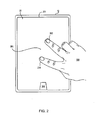
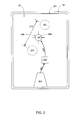
- FIG. 2 and FIG. 3 illustrate a first user interaction 200 ( FIG. 2 ) made by a user 100 on touch sensitive surface 22 (illustrated as a touchscreen in FIG. 2 and FIG. 3 ).
- First user interaction 200 may be a two fingered tap gesture.
- First user interaction 200 may effect release 302 ( FIG. 3 ) of a corresponding projectile 300 from a weapon 304, for example, in a first view 201 of the virtual space.
- User 100 may use interaction 200 to release and/or aim the release of projectile 300 in the virtual space.
- interaction 200 may comprise tapping touch sensitive surface 22 at two locations 202, 204 substantially simultaneously.
- the tapping interactions at locations 202 and 204 may be determined to be substantially simultaneous if both tapping interactions at locations 202 and 204 are made within a predetermined period of time.
- the predetermined period of time may begin when touch sensitive surface 22 receives the first one of contact at location 204, and/or contact at location 202, for example.
- the predetermined period of time may be determined at manufacture, set by a user via a user interface of a wireless client (e.g., user interface 16 of wireless client 12), and/or determined by another method.
- a gesture recognition module e.g ., gesture recognition module 32 shown in FIG. 1 and described herein
- the gesture recognition module may be configured to determine the parameter values for the gesture parameters of interaction 200. The determined parameter values may then be compared with the parameter values specified by the definition of the two fingered tap gesture to determine whether interaction 200 matches the gesture definition of the two fingered tap gesture. Responsive to a match between the parameter values of the two fingered tap gesture definition and the parameter values of interaction 200 performed by the user, the gesture recognition module may be configured to identify interaction 200 as the two finger tap gesture.
- the gesture definition used to determine whether interaction 200 is a two finger tap gesture may include parameter values and/or parameter value thresholds defining one or more of a distance 210 between contact locations 202, 204, a minimum contact time and/or a maximum contact time, a maximum motion distance for contact locations 202 and/or 204, a maximum period of time between contact at location 202 and contact at location 204, and/or other gesture parameters.
- a control module may be configured such that responsive to the gesture recognition module identifying the two fingered tap gesture ( FIG. 2 ), the control module may determine a first control input from user 100 that causes a game module (e.g., game module 30 shown in FIG. 1 and described herein) to cause the release 302 of projectile 300 in the virtual space ( FIG. 3 ).
- the first control input may specify a target location 306 in the virtual space toward which the projectile is directed.
- target location 306 may correspond to a control location 308 on touch sensitive surface 22 that corresponds to one or both of the locations at which user 100 contacted the touch sensitive surface in making the two fingered tap gesture.
- control location 308 may be the location on the touchscreen at which target location 306 is displayed. In some implementations, control location 308 may be the center point between the two locations 202, 204 at which user 100 contacted touch sensitive surface 22 in making the two fingered tap gesture.
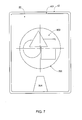
- FIG. 4 - FIG. 7 illustrate a second user interaction 400 ( FIG. 4 ) on touch sensitive surface 22 (illustrated as a touchscreen in FIG. 4 - FIG. 7 ).
- Second user interaction 400 may be a reverse pinch gesture.
- System 10 may be configured to present one or more views simulating sighting through a sighting tool (sighting view 700 shown in FIG. 7 ) of a firearm responsive to an entry of second user interaction 400 on touch sensitive surface 22.
- second user interaction 400 may comprise contacting touch sensitive surface 22 at two locations 402, 404 substantially simultaneously, then moving 406 the two contact locations 402, 404 farther apart while remaining in contact with touch sensitive surface 22.
- FIG. 5 illustrates locations 402 and 404 farther apart at new locations 502 and 504.
- a gesture recognition module may be configured to identify user interaction 400 as the reverse pinch gesture made by user 100 on touch sensitive surface 22.
- the gesture recognition module may be configured to determine the parameter values for the gesture parameters of interaction 400. The determined parameter values may then be compared with the parameter values specified by the definition of the reverse pinch gesture to determine whether interaction 400 matches the gesture definition of the reverse pinch gesture. Responsive to a match between the parameter values of the reverse pinch gesture definition and the parameter values of interaction 400 performed by user 100, the gesture recognition module may be configured to identify interaction 400 as the reverse pinch gesture.
- the gesture definitions used to determine whether interaction 400 is a reverse pinch gesture may include parameter values and/or parameter value thresholds defining one or more of a minimum and/or a maximum distance 511 ( FIG. 5 ) between contact locations 402, and 404, a maximum and/or a maximum distance 514 between contact locations 502 and 504, a minimum motion distance 510, 512 for contact locations 402 and/or 404, and/or other values.
- a control module (e.g., control module 34 shown in FIG. 1 and described herein) may be configured such that responsive to the gesture recognition module identifying the reverse pinch gesture, the control module may determine a second control input from user 100.
- the second control input may cause a game module (e.g., game module 30 shown in FIG. 1 and described herein) to simulate sighting through a sighting tool in a second view 401 of the virtual space.
- simulation of sighting through a sighting tool may cause the zoom level of second view 401 of the virtual space presented to user 100 to change from a first zoom level 600 to a second zoom level 602.
- Second zoom level 602 may be increased relative to first zoom level 600. As shown in FIG.
- second zoom level 602 may be configured to simulate a zoom level of a sighting view 700 through a sight of a firearm.
- the second control input may cause a portion of second view 401 (e.g., the portion viewed through the simulated firearm sighting view) to increase to second zoom level 602 while the rest of second view 401 remains at first zoom level 600.
- the game module may be configured such that at least some of the virtual space and/or or game functionality normally available to a user during game play is reduced responsive to the second control input causing the game module to cause second view 401 to simulate sighting through a sighting tool. For example, while playing the first person shooter game, a user may be able to change weapons when viewing the game at first zoom level 600 but may not be able to change weapons when viewing the game through simulated sighting view 700 at second zoom level 602.
- system 10 may be configured such that sighting view 700 is discontinued responsive to a third user interaction on touch sensitive surface 22.
- the third user interaction may be a pinch gesture.
- the third user interaction may comprise contacting touch sensitive surface 22 at two locations substantially simultaneously, then moving the two contact locations closer together while remaining in contact with touch sensitive surface 22 (e.g., substantially opposite the motion depicted in FIG. 5 and FIG. 4 ).
- the gesture recognition module may be configured to identify the third user interaction as a pinch gesture made by user 100 on touch sensitive surface 22.
- the gesture recognition module may be configured to determine the parameter values for the gesture parameters of the third interaction. The determined parameter values may then be compared with the parameter values specified by the definition of the pinch gesture to determine whether the third interaction matches the gesture definition of the pinch gesture.
- the gesture recognition module may be configured to identify the third interaction as the pinch gesture.
- a control module e.g., control module 34 shown in FIG. 1 and described herein
- the control module may determine a third control input from user 100.
- the third control input may cause the game module to cause sighting view 700 to be discontinued.
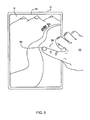
- FIG. 8 - FIG. 10 illustrate a fourth user interaction 800 ( FIG. 8 ) made by user 100 on touch sensitive surface 22 (illustrated as a touchscreen in FIG. 8 - FIG. 10 ) and a corresponding change from a third view 801 ( FIG. 8 ) of the virtual space to a fourth view 1001 ( FIG. 10 ) of the virtual space.
- a game module e.g., game module 30 shown in FIG. 1 and described herein
- the one or more views of the virtual space for presentation to user 100 include third view 801 ( FIG. 8 ) and fourth view 1001 ( FIG.10 ).
- third view 801 may correspond to a current location in the virtual space
- fourth view 1001 may correspond to a move location 804 ( FIG. 8 and FIG. 9 ) in the virtual space.
- Fourth interaction 800 may be a move gesture. Fourth interaction 800 may comprise contacting touch sensitive surface 22 at a location that corresponds to move location 804 in the virtual space.
- a gesture recognition module e.g., gesture recognition module 32 shown in FIG. 1 and described herein
- the gesture recognition module may be configured to identify user interaction 800 as the move gesture made by user 100 on touch sensitive surface 22.
- the gesture recognition module may be configured to determine the parameter values for the gesture parameters of interaction 800. The determined parameter values may then be compared with the parameter values specified by the definition of the move gesture to determine whether interaction 800 matches the gesture definition of the move gesture. Responsive to a match between the parameter values of the move gesture definition and the parameter values of interaction 800 performed by the user, the gesture recognition module may be configured to identify interaction 800 as the move gesture.
- the gesture definitions used to determine whether interaction 800 is a move gesture may include parameter values and/or parameter value thresholds defining one or more of a minimum and/or a maximum area 820 ( FIG. 9 ) on touch sensitive surface 22 that defines move location 804 in the virtual space, a minimum and a maximum contact time for the contact made by the user on touch sensitive surface 22 at location 1502, and/or other gesture parameters.
- a control module (e.g., control module 34 shown in FIG. 1 and described herein) may be configured such that responsive to the gesture recognition module identifying the move gesture, the control module may determine a fourth control input that causes the game module to change the view presented to user 100 from third view 801 ( FIG. 8 , FIG. 9 ) to fourth view 1001 ( FIG. 10 ).
- move location 804 may be the location on the touchscreen at which user 100 contacts the touchscreen with move gesture 800.
- changing from third view 801 to fourth view 1001 may comprise simulated movement through the virtual space and/or through the first person shooter game.
- simulated movement through the virtual space may comprise automatically (e.g., without user 100 making any additional contact with touch sensitive surface 22 during the simulated movement) path finding around objects in the instance of the virtual space displayed to user 100.
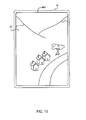
- FIG. 11 and FIG. 12 illustrate a fifth user interaction 1100 ( FIG. 11 ) made by user 100 on touch sensitive surface 22 (illustrated as a touchscreen in FIG. 11 and FIG. 12 ) in a fifth view 1101 of the virtual space.
- Fifth user interaction 1100 may be a look gesture.
- a user may use interaction 1100 to "look" in one or more directions in the virtual space.
- looking may comprise a game module (e.g., game module 30 shown in FIG. 1 and described herein) causing a view of the virtual space to change from fifth view 1101 to a sixth view 1103 ( FIG. 12 ) that is representative of the virtual space in the direction indicated by user 100 via interaction 1100.
- game module e.g., game module 30 shown in FIG. 1 and described herein
- interaction 1100 may comprise a directional swipe 1102 on touch sensitive surface 22.
- Directional swipe 1102 may comprise contacting touch sensitive surface 22 at a single location 1104, then moving contact location 1104 in one or more of a first direction 1106, a second direction 1108, a third direction 1110, a fourth direction 1112, and/or other directions, while remaining in contact with touch sensitive surface 22.
- a gesture recognition module e.g., gesture recognition module 32 shown in FIG. 1 and described herein
- the gesture recognition module may be configured to determine the parameter values for the gesture parameters of interaction 1100.
- the determined parameter values may then be compared with the parameter values specified by the definition of the look gesture to determine whether interaction 1100 matches the gesture definition of the look gesture. Responsive to a match between the parameter values of the look gesture definition and the parameter values of interaction 1100 performed by the user, the gesture recognition module may be configured to identify interaction 1100 as the look gesture.
- the gesture definitions used to determine whether interaction 1100 is a move gesture may include parameter values and/or parameter value thresholds defining one or more of a two dimensional direction on touch sensitive surface 22, a minimum distance 1210 of the swipe made by the user on touch sensitive surface 22, and/or other gesture parameters.
- a control module (e.g., control module 34) may be configured such that responsive to the gesture recognition module identifying the look gesture ( FIG. 11 ), the control module may determine a fifth control input from user 100 that causes the game module to change fifth view 1101 to sixth view 1103 that is representative of the virtual space in the direction indicated by user 100 via interaction 1100.
- the control module may determine the fifth control input such that the game module changes fifth view 1101 to sixth view 1103 that is representative of looking down in the virtual space. In some implementations, responsive to directional swipe 1102 in second direction 1108, the control module may determine the fifth control input such that the game module changes fifth view 1101 to sixth view 1103 that is representative of looking up in the virtual space. In some implementations, responsive to directional swipe 1102 in third direction 1110, the control module may determine the fifth control input such that the game module changes fifth view 1101 to sixth view 1103 that is representative of looking to the left in the virtual space.
- the control module may determine the fifth control input such that the game module changes fifth view 1101 to sixth view 1103 that is representative of looking to the right in the virtual space.
- the four directions described herein are not intended to be limiting.
- System 10 may be configured such that a user may use similar swiping gestures in one or more other directions to "look" in any direction in the virtual space.
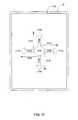
- FIG. 13 illustrates a sixth user interaction 1300 on touch sensitive surface 22 (illustrated as a touchscreen in FIG. 13 ) in a seventh view 1301 of the virtual space.
- Sixth user interaction 1300 may be a turn gesture.
- User interaction 1300 may comprise contacting touch sensitive surface 22 at a single location 1302 toward an edge 1304 of touch sensitive surface 22 in a turn gesture area 1306.
- user interaction 1300 may comprise contacting turn gesture area 1306 at and/or near the center of turn gesture area 1306.
- a gesture recognition module (e.g., gesture recognition module 32) may be configured to identify user interaction 1300 as the turn gesture made by user 100 on touch sensitive surface 22.
- the gesture recognition module may be configured to determine the parameter values for the gesture parameters of interaction 1300.
- the determined parameter values may then be compared with the parameter values specified by the definition of the turn gesture to determine whether interaction 1300 matches the gesture definition of the turn gesture. Responsive to a match between the parameter values of the turn gesture definition and the parameter values of interaction 1300 performed by the user, the gesture recognition module may be configured to identify interaction 1300 as the turn gesture.
- the gesture definitions used to determine whether interaction 1300 is a turn gesture may include parameter values and/or parameter value thresholds defining one or more of a minimum and/or a maximum area 1310 on touch sensitive surface 22 that defines turn gesture area 1306, a contact time parameter, and/or other parameters.
- a control module (e.g., control module 34 shown in FIG. 1 ) may be configured such that responsive to the gesture recognition module identifying the turn gesture, the control module may determine a sixth control input from user 100 that causes a game module (e.g., game module 30) to change seventh view 1301 to an eighth view that is representative of the virtual space in the direction substantially behind (e.g., a 180° turn from seventh view 1301) user 100.
- system 10 may be configured such that turn gesture area 1306 may be visible to a user via lines enclosing turn gesture area 1306, for example, and/or other visible markings that show turn gesture area 1306 relative to other areas of seventh view 1301 displayed to user 100.
- system 10 may be configured such that turn gesture area 1306 is invisible to user 100.
- FIG. 14 illustrates a seventh user interaction 1400 on touch sensitive surface 22 (illustrated as a touchscreen in FIG. 14 ) in a ninth view 1401 of the virtual space.
- Seventh user interaction 1400 may be a weapon change gesture.
- a game module e.g., game module 30
- Seventh user interaction 1400 may comprise contacting touch sensitive surface 22 at a single location 1402 that corresponds to a location where weapon 304 is displayed in the virtual space.
- user interaction 1400 may further comprise contacting touch sensitive surface 22 at the location that corresponds to weapon 304 and directionally swiping 1102 location 1402 on touch sensitive surface 22 in second direction 1108 toward edge 1304 of touch sensitive surface 22.
- a gesture recognition module (e.g., gesture recognition module 32) may be configured to identify user interaction 1400 as the weapon change gesture made by user 100 on touch sensitive surface 22.
- the gesture recognition module may be configured to determine the parameter values for the gesture parameters of interaction 1400. The determined parameter values may then be compared with the parameter values specified by the definition of the weapon change gesture to determine whether interaction 1400 matches the gesture definition of the weapon change gesture. Responsive to a match between the parameter values of the weapon change gesture definition and the parameter values of interaction 1400 performed by user 100, the gesture recognition module may be configured to identify interaction 1400 as the weapon change gesture.
- the gesture definitions used to determine whether interaction 1400 is a weapon change gesture may include parameter values and/or parameter value thresholds defining one or more of a minimum and/or a maximum area 1410 on touch sensitive surface 22 that defines location 1402 where weapon 304 is displayed, a direction on touch sensitive surface 22, a minimum distance 1412 of the swipe made by the user on touch sensitive surface 22, and/or other gesture parameters.
- a control module (e.g., control module 34) may be configured such that responsive to the gesture recognition module identifying the weapon change gesture, the control module may determine a seventh control input from user 100 that causes the game module (e.g., game module 30) to change weapon 304 to another weapon.
- the swipe direction and edge description related to interaction 1400 described herein is not intended to be limiting. Interaction 1400 may include swiping on weapon 304 in any direction toward any edge of touch sensitive surface 22.
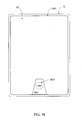
- FIG. 15 and FIG. 16 illustrate an eighth user interaction1500 made by user 100 on touch sensitive surface 22 (illustrated as a touchscreen in FIG. 15 and FIG. 16 ) in a tenth view 1501 of the virtual space.
- Eighth user interaction 1500 may be a reload gesture.
- a game module e.g., game module 30
- User interaction1500 may comprise a single tap on touch sensitive surface 22 at a location 1502 on touch sensitive surface 22 that corresponds to a location where weapon 304 is displayed in the virtual space.
- a gesture recognition module (e.g., gesture recognition module 32) may be configured to identify user interaction 1500 as the reload gesture made by user 100 on touch sensitive surface 22.
- the gesture recognition module may be configured to determine the parameter values for the gesture parameters of interaction 1500. The determined parameter values may then be compared with the parameter values specified by the definition of the reload gesture to determine whether interaction 1500 matches the gesture definition of the reload gesture. Responsive to a match between the parameter values of the reload gesture definition and the parameter values of interaction 1500 performed by the user, the gesture recognition module may be configured to identify interaction 1500 as the reload gesture.
- the gesture definitions used to determine whether interaction 1500 is a reload gesture may include parameter values and/or parameter value thresholds defining one or more of a minimum and/or a maximum area 1610 ( FIG. 16 ) on touch sensitive surface 22 that defines location 1502 where weapon 304 is displayed, a minimum and a maximum contact time for the contact made by the user on touch sensitive surface 22 at location 1502, and/or other gesture parameters.
- a control module (e.g., control module 34) may be configured such that responsive to the gesture recognition module identifying the reload gesture, the control module may determine an eighth control input from the user that causes the game module to reload weapon 304.
- user interface 16 may be configured to provide an interface between system 10 and the user through which the user may provide information to system 10, and receive information from system 10. This enables additional data, cues, results, and/or instructions and any other communicable items, collectively referred to as "information," to be communicated between the user and system 10.
- additional interface devices suitable for inclusion in user interface 16 comprise touch sensitive surface 22, display 24, a keypad, buttons, switches, a keyboard, knobs, levers, speakers, a microphone, an indicator light, an audible alarm, a printer, and/or other interface devices.
- user interface 16 comprises a plurality of separate interfaces.
- user interface 16 comprises at least one interface that is provided integrally with wireless client 12.
- user interface 16 may be integrated with a removable storage interface provided in wireless client 12.
- information may be loaded into wireless client 12 from removable storage (e.g., a smart card, a flash drive, a removable disk, etc.) that enables the user to customize the implementation of wireless client 12.
- removable storage e.g., a smart card, a flash drive, a removable disk, etc.
- Other exemplary input devices and techniques adapted for use with wireless client 12 as at least a portion of user interface 16 comprise, but are not limited to, an RS-232 port, RF link, an IR link, modem (telephone, cable or other).
- any additional technique for communicating information with client computing platform 16 is contemplated by the present disclosure as user interface 16.
- Electronic storage 20 may comprise electronic storage media that electronically stores information.
- the electronic storage media of electronic storage 20 may include one or both of system storage that is provided integrally (i.e., substantially non-removable) within wireless client 12 and/or removable storage that is removably connectable to wireless client 12 via, for example, a port (e.g., a USB port, a firewire port, etc.) or a drive (e.g., a disk drive, etc.).
- a port e.g., a USB port, a firewire port, etc.
- a drive e.g., a disk drive, etc.
- Electronic storage 20 may include one or more of optically readable storage media (e.g., optical disks, etc.), magnetically readable storage media (e.g., magnetic tape, magnetic hard drive, floppy drive, etc.), electrical charge-based storage media (e.g., EEPROM, RAM, etc.), solid-state storage media (e.g., flash drive, etc.), and/or other electronically readable storage media.
- Electronic storage 20 may include one or more virtual storage resources (e.g ., cloud storage, a virtual private network, and/or other virtual storage resources).
- Electronic storage 20 may store software algorithms, information determined by processor 18, information received from game server 14, and/or other information that enables wireless client 12 to function as described herein.
- the definitions of the set of gestures recognized by gesture recognition module 32 may be stored in electronic storage 20.
- Game server 14 may be configured to host the virtual space, the first person shooter game, and/or other applications, in a networked manner.
- Game server 14 may include one or more processors 40, electronic storage 42, and/or other components.
- Processor 40 may be configured to execute a game server module 44.
- Game server module 44 may be configured to communicate virtual space and/or game information with a game module (e.g., game module 30) being executed on wireless client device 12 and/or one or more other wireless client devices in order to provide an online multi-player experience to the users of the wireless client devices.
- a game module e.g., game module 30
- This may include executing an instance of the virtual space and providing virtual space information, including view information, virtual space state information, and/or other virtual space information, to wireless client device 12 and/or the one or more other wireless client devices to facilitate participation of the users of the wireless client devices in a shared virtual space experience.
- Game server module 44 may be configured to facilitate communication between the users, as well as gameplay.
- Processors 40 may be implemented in one or more of the manners described with respect to processor 18 (shown in FIG. 1 and described above). This includes implementations in which processor 40 includes a plurality of separate processing units, and/or implementations in which processor 40 is virtualized in the cloud.
- Electronic storage 42 may be implemented in one or more of the manners described with respect to electronic storage 20 (shown in FIG. 1 and described above).
- FIG. 17 illustrates a method 1700 for facilitating interaction with a virtual space.
- the operations of method 1700 presented below are intended to be illustrative. In some implementations, method 1700 may be accomplished with one or more additional operations not described, and/or without one or more of the operations discussed. Additionally, the order in which the operations of method 1700 are illustrated in FIG. 17 and described herein is not intended to be limiting.
- method 1700 may be implemented in one or more processing devices (e.g., a digital processor, an analog processor, a digital circuit designed to process information, an analog circuit designed to process information, a state machine, and/or other mechanisms for electronically processing information).
- the one or more processing devices may include one or more devices executing some or all of the operations of method 1700 in response to instructions stored electronically on an electronic storage medium.
- the one or more processing devices may include one or more devices configured through hardware, firmware, and/or software to be specifically designed for execution of one or more of the operations of method 1700.
- at least some of the operations described below may be implemented by a server wherein the system described herein communicates with the server in a client / server relationship over a network.
- a view of a virtual space may be assembled for presentation to a user.
- operation 1702 may be performed by a game module similar to, and/or the same as game module 30 (shown in FIG. 1 , and described herein).
- control inputs to a touch sensitive surface may be received.
- the touch sensitive surface may be configured to generate output signals responsive to contact by the user.
- the output signals may be configured to convey information related to one or more locations where the touch sensitive surface is contacted.
- the control inputs may be reflected in the view of the virtual space.
- operation 1704 may be performed by a touch sensitive surface similar to and/or the same as touch sensitive surface 22 (shown in FIG. 1 , and described herein).
- individual ones of a set of gestures may be identified.
- the individual ones of the set of gestures may be made by the user on the touch sensitive surface.
- the individual ones of the set of gestures may be identified based on the output signals from the touch sensitive surface.
- the individual ones of the set of gestures may include a two fingered tap gesture.
- the two fingered tap gesture may comprise tapping the touch sensitive surface at two locations substantially simultaneously.
- operation 1706 may be performed by a gesture recognition module similar to, and/or the same as gesture recognition module 32 (shown in FIG. 1 and described herein).
- control inputs from the user may be determined. Determining the control inputs from the user may be based on the identified gestures. Responsive to identifying the two fingered tap gesture, a first control input from the user may be determined. In some implementations, operation 1708 may be performed by a control module similar to, and/or the same as control module 34 (shown in FIG. 1 and described herein).
- a projectile may be caused to be released in the virtual space.
- the first control input may cause the release of the projectile in the virtual space.
- a target location in the virtual space may be specified toward which the projectile is directed.
- the target location may correspond to a control location on the touch sensitive surface that corresponds to one or both of the locations at which the user contacted the touch sensitive surface in making the two fingered tap gesture.
- operation 1710 may be performed by a game module similar to, and/or the same as game module 30 (shown in FIG. 1 and described herein).
Landscapes
- Engineering & Computer Science (AREA)
- Multimedia (AREA)
- Human Computer Interaction (AREA)
- Theoretical Computer Science (AREA)
- General Engineering & Computer Science (AREA)
- Physics & Mathematics (AREA)
- General Physics & Mathematics (AREA)
- Computer Hardware Design (AREA)
- Software Systems (AREA)
- User Interface Of Digital Computer (AREA)
Applications Claiming Priority (1)
| Application Number | Priority Date | Filing Date | Title |
|---|---|---|---|
| US13/600,806 US8777743B2 (en) | 2012-08-31 | 2012-08-31 | System and method for facilitating interaction with a virtual space via a touch sensitive surface |
Publications (3)
| Publication Number | Publication Date |
|---|---|
| EP2711059A2 true EP2711059A2 (de) | 2014-03-26 |
| EP2711059A3 EP2711059A3 (de) | 2015-03-04 |
| EP2711059B1 EP2711059B1 (de) | 2018-05-23 |
Family
ID=48792986
Family Applications (1)
| Application Number | Title | Priority Date | Filing Date |
|---|---|---|---|
| EP13175686.8A Not-in-force EP2711059B1 (de) | 2012-08-31 | 2013-07-09 | System und Verfahren zum Ermöglichung der Interaktion mit einem virtuellen Raum |
Country Status (5)
| Country | Link |
|---|---|
| US (2) | US8777743B2 (de) |
| EP (1) | EP2711059B1 (de) |
| JP (2) | JP5563709B2 (de) |
| KR (1) | KR20140029158A (de) |
| CN (1) | CN103677620A (de) |
Cited By (2)
| Publication number | Priority date | Publication date | Assignee | Title |
|---|---|---|---|---|
| FR3036818A1 (fr) * | 2015-06-01 | 2016-12-02 | Sagem Defense Securite | Systeme de visee comportant un ecran recouvert d'une interface tactile et procede de visee correspondant |
| EP3034983B1 (de) | 2014-12-19 | 2020-11-18 | Diehl Defence GmbH & Co. KG | Maschinenwaffe |
Families Citing this family (23)
| Publication number | Priority date | Publication date | Assignee | Title |
|---|---|---|---|---|
| WO2014163220A1 (ko) * | 2013-04-05 | 2014-10-09 | 그리 가부시키가이샤 | 온라인 슈팅 게임 제공 장치 및 방법 |
| JP5723050B1 (ja) * | 2014-08-29 | 2015-05-27 | グリー株式会社 | ゲームプログラム、コンピュータの制御方法、およびコンピュータ |
| JP6637662B2 (ja) * | 2015-03-16 | 2020-01-29 | 株式会社バンダイナムコエンターテインメント | ゲーム装置及びプログラム |
| JP5789067B1 (ja) * | 2015-03-26 | 2015-10-07 | グリー株式会社 | ゲームプログラム、コンピュータの制御方法、およびコンピュータ |
| JP5856345B1 (ja) * | 2015-07-30 | 2016-02-09 | グリー株式会社 | ゲームプログラム、コンピュータの制御方法、およびコンピュータ |
| CN105498202A (zh) * | 2015-11-26 | 2016-04-20 | 珠海网易达电子科技发展有限公司 | 全触屏划屏射击操作方式 |
| CN105426052A (zh) * | 2015-12-01 | 2016-03-23 | 成都龙渊网络科技有限公司 | 用于在触摸终端上管理操作工具的方法与设备 |
| CN105607851A (zh) * | 2015-12-18 | 2016-05-25 | 上海逗屋网络科技有限公司 | 用于触摸终端的场景控制方法及设备 |
| CN105688409A (zh) * | 2016-01-27 | 2016-06-22 | 网易(杭州)网络有限公司 | 游戏控制方法及装置 |
| US20170232348A1 (en) * | 2016-02-05 | 2017-08-17 | Prizm Labs, Inc. | Methods for executing an instance of a virtual multiplayer game at multiple local devices |
| CN105808106B (zh) * | 2016-03-22 | 2018-12-04 | 苏州熙烁数字科技有限公司 | 基于滑动轨迹执行战斗操作的游戏设备及游戏提供方法 |
| JP6089143B1 (ja) * | 2016-09-26 | 2017-03-01 | 株式会社 ディー・エヌ・エー | ゲームを提供するためのシステム、方法、及びプログラム |
| CN107193479B (zh) * | 2017-05-26 | 2018-07-10 | 网易(杭州)网络有限公司 | 信息处理方法、装置、电子设备及存储介质 |
| JP6309143B1 (ja) * | 2017-05-30 | 2018-04-11 | 株式会社 ディー・エヌ・エー | ゲームプログラム、情報処理装置、及び、情報処理方法 |
| CN107890672B (zh) * | 2017-08-30 | 2018-12-28 | 网易(杭州)网络有限公司 | 补偿声音信息的视觉方法及装置、存储介质、电子设备 |
| CN108363531A (zh) * | 2018-01-17 | 2018-08-03 | 网易(杭州)网络有限公司 | 一种游戏中的交互方法及装置 |
| WO2020028826A1 (en) * | 2018-08-02 | 2020-02-06 | Firefly Dimension, Inc. | System and method for human interaction with virtual objects |
| US11045719B2 (en) * | 2018-09-12 | 2021-06-29 | King.Com Ltd. | Method and computer device for controlling a touch screen |
| CN109508093B (zh) * | 2018-11-13 | 2022-08-09 | 江苏视睿迪光电有限公司 | 一种虚拟现实交互方法及装置 |
| CN110433489A (zh) * | 2018-11-28 | 2019-11-12 | 网易(杭州)网络有限公司 | 游戏中瞄准的控制方法、装置、存储介质和电子装置 |
| CN109701264A (zh) * | 2018-12-21 | 2019-05-03 | 努比亚技术有限公司 | 游戏放大镜控制方法、装置、移动终端及存储介质 |
| CN110585704B (zh) * | 2019-09-20 | 2021-04-09 | 腾讯科技(深圳)有限公司 | 虚拟场景中的对象提示方法、装置、设备及存储介质 |
| US11517812B2 (en) | 2021-02-19 | 2022-12-06 | Blok Party, Inc. | Application of RFID gamepieces for a gaming console |
Family Cites Families (24)
| Publication number | Priority date | Publication date | Assignee | Title |
|---|---|---|---|---|
| US4353552A (en) * | 1979-02-23 | 1982-10-12 | Peptek, Incorporated | Touch panel system and method |
| US5053757A (en) * | 1987-06-04 | 1991-10-01 | Tektronix, Inc. | Touch panel with adaptive noise reduction |
| JP3345600B2 (ja) * | 2000-04-10 | 2002-11-18 | コナミ株式会社 | ゲームシステムおよびコンピュータ読取可能な記憶媒体 |
| US8059099B2 (en) * | 2006-06-02 | 2011-11-15 | Apple Inc. | Techniques for interactive input to portable electronic devices |
| JP2005342266A (ja) | 2004-06-03 | 2005-12-15 | Aruze Corp | ゲームシステム |
| US20070257891A1 (en) * | 2006-05-03 | 2007-11-08 | Esenther Alan W | Method and system for emulating a mouse on a multi-touch sensitive surface |
| JP2008017934A (ja) * | 2006-07-11 | 2008-01-31 | Aruze Corp | ゲーム装置およびゲーム装置の画像変化制御方法 |
| US7710318B2 (en) * | 2006-08-24 | 2010-05-04 | Sirf Technology | Method of enhanced cold start and associated user interface for navigational receivers |
| US8277316B2 (en) | 2006-09-14 | 2012-10-02 | Nintendo Co., Ltd. | Method and apparatus for using a common pointing input to control 3D viewpoint and object targeting |
| US8564546B1 (en) * | 2008-02-27 | 2013-10-22 | Cypress Semiconductor Corporation | Multiple touch resolve |
| US8441452B1 (en) * | 2008-04-10 | 2013-05-14 | Cypress Semiconductor Corporation | Multiple touch detection |
| JP2010017395A (ja) * | 2008-07-11 | 2010-01-28 | Namco Bandai Games Inc | プログラム、情報記憶媒体及びゲーム装置 |
| US9310992B2 (en) * | 2008-08-22 | 2016-04-12 | Google Inc. | Panning in a three dimensional environment on a mobile device |
| US8698750B2 (en) * | 2008-09-18 | 2014-04-15 | Microsoft Corporation | Integrated haptic control apparatus and touch sensitive display |
| US20100214218A1 (en) * | 2009-02-20 | 2010-08-26 | Nokia Corporation | Virtual mouse |
| US8312387B2 (en) * | 2009-08-10 | 2012-11-13 | Microsoft Corporation | Target element zoom |
| JP5269745B2 (ja) * | 2009-10-30 | 2013-08-21 | 任天堂株式会社 | オブジェクト制御プログラム、オブジェクト制御装置、オブジェクト制御システム及びオブジェクト制御方法 |
| US9262073B2 (en) * | 2010-05-20 | 2016-02-16 | John W. Howard | Touch screen with virtual joystick and methods for use therewith |
| JP5840385B2 (ja) * | 2010-08-30 | 2016-01-06 | 任天堂株式会社 | ゲームシステム、ゲーム装置、ゲームプログラム、および、ゲーム処理方法 |
| US8661354B2 (en) * | 2010-09-24 | 2014-02-25 | Nokia Corporation | Methods, apparatuses and computer program products for using near field communication to implement games and applications on devices |
| US8866735B2 (en) * | 2010-12-16 | 2014-10-21 | Motorla Mobility LLC | Method and apparatus for activating a function of an electronic device |
| US20130002567A1 (en) * | 2011-06-30 | 2013-01-03 | Ricky Lee | Method and System of Implementing Multi-Touch Panel Gestures in Computer Applications Without Multi-Touch Panel Functions |
| JP5204286B2 (ja) * | 2011-11-02 | 2013-06-05 | 株式会社東芝 | 電子機器および入力方法 |
| TWI597626B (zh) * | 2011-11-08 | 2017-09-01 | 威盛電子股份有限公司 | 觸控面板的控制裝置、單點多指動作判斷方法以及用於產生單點多指動作的觸控筆 |
-
2012
- 2012-08-31 US US13/600,806 patent/US8777743B2/en not_active Expired - Fee Related
-
2013
- 2013-07-09 EP EP13175686.8A patent/EP2711059B1/de not_active Not-in-force
- 2013-07-10 KR KR20130080664A patent/KR20140029158A/ko not_active Withdrawn
- 2013-08-27 JP JP2013175462A patent/JP5563709B2/ja not_active Expired - Fee Related
- 2013-08-29 CN CN201310384496.2A patent/CN103677620A/zh active Pending
-
2014
- 2014-01-24 JP JP2014011500A patent/JP2014139789A/ja active Pending
- 2014-05-19 US US14/281,719 patent/US9700787B2/en not_active Expired - Fee Related
Non-Patent Citations (1)
| Title |
|---|
| None |
Cited By (5)
| Publication number | Priority date | Publication date | Assignee | Title |
|---|---|---|---|---|
| EP3034983B1 (de) | 2014-12-19 | 2020-11-18 | Diehl Defence GmbH & Co. KG | Maschinenwaffe |
| EP3034983B2 (de) † | 2014-12-19 | 2024-01-24 | Diehl Defence GmbH & Co. KG | Maschinenwaffe |
| FR3036818A1 (fr) * | 2015-06-01 | 2016-12-02 | Sagem Defense Securite | Systeme de visee comportant un ecran recouvert d'une interface tactile et procede de visee correspondant |
| WO2016193271A1 (fr) * | 2015-06-01 | 2016-12-08 | Safran Electronics & Defense | Système de visée comportant un écran recouvert d'une interface tactile et procédé de visée correspondant |
| US10563954B2 (en) | 2015-06-01 | 2020-02-18 | Safran Electronics & Defense | Aiming system comprising a screen covered with a tactile interface and corresponding aiming method |
Also Published As
| Publication number | Publication date |
|---|---|
| EP2711059A3 (de) | 2015-03-04 |
| US9700787B2 (en) | 2017-07-11 |
| JP2014139789A (ja) | 2014-07-31 |
| EP2711059B1 (de) | 2018-05-23 |
| KR20140029158A (ko) | 2014-03-10 |
| US8777743B2 (en) | 2014-07-15 |
| JP2014049130A (ja) | 2014-03-17 |
| JP5563709B2 (ja) | 2014-07-30 |
| CN103677620A (zh) | 2014-03-26 |
| US20140066197A1 (en) | 2014-03-06 |
| US20140256442A1 (en) | 2014-09-11 |
Similar Documents
| Publication | Publication Date | Title |
|---|---|---|
| US9700787B2 (en) | System and method for facilitating interaction with a virtual space via a touch sensitive surface | |
| US12128312B2 (en) | Method and apparatus for prompting that virtual object is attacked, terminal, and storage medium | |
| US11712634B2 (en) | Method and apparatus for providing online shooting game | |
| US9687741B1 (en) | System and method for providing separate drift and steering controls | |
| KR101662500B1 (ko) | 디스플레이-인에이블드 키보드, 키패드, 및/또는 다른 사용자 입력 장치를 사용하여 시각 인터페이스 콘텐츠를 관리, 선택, 및 갱신하는 시스템 및 방법 | |
| JP2023552772A (ja) | 仮想アイテムの切り替え方法、装置、端末及びコンピュータプログラム | |
| CN113813603A (zh) | 一种游戏的显示控制方法、装置、电子设备及存储介质 | |
| WO2022257653A1 (zh) | 虚拟道具的显示方法、装置、电子设备及存储介质 | |
| CN110639205B (zh) | 操作响应方法、装置、存储介质及终端 | |
| US20240390795A1 (en) | Method and apparatus for controlling virtual object, and terminal and storage medium | |
| JP6647600B1 (ja) | ゲームプログラム及び情報処理装置 | |
| KR102557808B1 (ko) | 게임 서비스 시스템 및 상기 시스템에서의 메모 공유 방법 | |
| JP6661595B2 (ja) | ゲームプログラム、方法および情報処理装置 | |
| WO2024152681A1 (zh) | 基于虚拟对象的互动方法、装置、电子设备及存储介质 | |
| JP2025511594A (ja) | 仮想オブジェクトのマーキング方法、装置、端末、及びコンピュータプログラム | |
| CN115999142A (zh) | 游戏控制的方法、装置、介质及设备 | |
| CN116115994A (zh) | 游戏角色的控制方法、装置和电子设备 | |
| CN111643895A (zh) | 操作响应方法、装置、终端及存储介质 | |
| CN113209609B (zh) | 基于牌类对象的交互方法、装置、设备及介质 | |
| JP2019103815A (ja) | ゲームプログラム、方法および情報処理装置 | |
| CN115920368A (zh) | 画面控制方法、装置、介质及设备 | |
| KR20250085778A (ko) | 사용자 인터페이스 제공 방법 및 장치 | |
| US10099134B1 (en) | System and method to better engage passive users of a virtual space by providing panoramic point of views in real time | |
| WO2025112530A1 (zh) | 控制方法、装置、设备及计算机可读存储介质 | |
| HK40028601A (en) | Operation response method and device, terminal and storage medium |
Legal Events
| Date | Code | Title | Description |
|---|---|---|---|
| PUAI | Public reference made under article 153(3) epc to a published international application that has entered the european phase |
Free format text: ORIGINAL CODE: 0009012 |
|
| AK | Designated contracting states |
Kind code of ref document: A2 Designated state(s): AL AT BE BG CH CY CZ DE DK EE ES FI FR GB GR HR HU IE IS IT LI LT LU LV MC MK MT NL NO PL PT RO RS SE SI SK SM TR |
|
| AX | Request for extension of the european patent |
Extension state: BA ME |
|
| PUAL | Search report despatched |
Free format text: ORIGINAL CODE: 0009013 |
|
| AK | Designated contracting states |
Kind code of ref document: A3 Designated state(s): AL AT BE BG CH CY CZ DE DK EE ES FI FR GB GR HR HU IE IS IT LI LT LU LV MC MK MT NL NO PL PT RO RS SE SI SK SM TR |
|
| AX | Request for extension of the european patent |
Extension state: BA ME |
|
| RIC1 | Information provided on ipc code assigned before grant |
Ipc: A63F 13/214 20140101AFI20150128BHEP Ipc: A63F 13/837 20140101ALN20150128BHEP |
|
| 17P | Request for examination filed |
Effective date: 20150904 |
|
| RBV | Designated contracting states (corrected) |
Designated state(s): AL AT BE BG CH CY CZ DE DK EE ES FI FR GB GR HR HU IE IS IT LI LT LU LV MC MK MT NL NO PL PT RO RS SE SI SK SM TR |
|
| REG | Reference to a national code |
Ref country code: DE Ref legal event code: R079 Ref document number: 602013037738 Country of ref document: DE Free format text: PREVIOUS MAIN CLASS: A63F0013200000 Ipc: A63F0013214000 |
|
| RIC1 | Information provided on ipc code assigned before grant |
Ipc: A63F 13/426 20140101ALI20171221BHEP Ipc: A63F 13/837 20140101ALN20171221BHEP Ipc: A63F 13/214 20140101AFI20171221BHEP Ipc: A63F 13/2145 20140101ALN20171221BHEP |
|
| GRAP | Despatch of communication of intention to grant a patent |
Free format text: ORIGINAL CODE: EPIDOSNIGR1 |
|
| INTG | Intention to grant announced |
Effective date: 20180201 |
|
| GRAS | Grant fee paid |
Free format text: ORIGINAL CODE: EPIDOSNIGR3 |
|
| GRAA | (expected) grant |
Free format text: ORIGINAL CODE: 0009210 |
|
| AK | Designated contracting states |
Kind code of ref document: B1 Designated state(s): AL AT BE BG CH CY CZ DE DK EE ES FI FR GB GR HR HU IE IS IT LI LT LU LV MC MK MT NL NO PL PT RO RS SE SI SK SM TR |
|
| REG | Reference to a national code |
Ref country code: GB Ref legal event code: FG4D |
|
| REG | Reference to a national code |
Ref country code: CH Ref legal event code: EP |
|
| REG | Reference to a national code |
Ref country code: IE Ref legal event code: FG4D |
|
| REG | Reference to a national code |
Ref country code: AT Ref legal event code: REF Ref document number: 1001069 Country of ref document: AT Kind code of ref document: T Effective date: 20180615 |
|
| REG | Reference to a national code |
Ref country code: DE Ref legal event code: R096 Ref document number: 602013037738 Country of ref document: DE |
|
| REG | Reference to a national code |
Ref country code: FR Ref legal event code: PLFP Year of fee payment: 6 |
|
| REG | Reference to a national code |
Ref country code: NL Ref legal event code: MP Effective date: 20180523 |
|
| REG | Reference to a national code |
Ref country code: LT Ref legal event code: MG4D |
|
| PG25 | Lapsed in a contracting state [announced via postgrant information from national office to epo] |
Ref country code: BG Free format text: LAPSE BECAUSE OF FAILURE TO SUBMIT A TRANSLATION OF THE DESCRIPTION OR TO PAY THE FEE WITHIN THE PRESCRIBED TIME-LIMIT Effective date: 20180823 Ref country code: ES Free format text: LAPSE BECAUSE OF FAILURE TO SUBMIT A TRANSLATION OF THE DESCRIPTION OR TO PAY THE FEE WITHIN THE PRESCRIBED TIME-LIMIT Effective date: 20180523 Ref country code: LT Free format text: LAPSE BECAUSE OF FAILURE TO SUBMIT A TRANSLATION OF THE DESCRIPTION OR TO PAY THE FEE WITHIN THE PRESCRIBED TIME-LIMIT Effective date: 20180523 Ref country code: NO Free format text: LAPSE BECAUSE OF FAILURE TO SUBMIT A TRANSLATION OF THE DESCRIPTION OR TO PAY THE FEE WITHIN THE PRESCRIBED TIME-LIMIT Effective date: 20180823 Ref country code: FI Free format text: LAPSE BECAUSE OF FAILURE TO SUBMIT A TRANSLATION OF THE DESCRIPTION OR TO PAY THE FEE WITHIN THE PRESCRIBED TIME-LIMIT Effective date: 20180523 Ref country code: SE Free format text: LAPSE BECAUSE OF FAILURE TO SUBMIT A TRANSLATION OF THE DESCRIPTION OR TO PAY THE FEE WITHIN THE PRESCRIBED TIME-LIMIT Effective date: 20180523 |
|
| PG25 | Lapsed in a contracting state [announced via postgrant information from national office to epo] |
Ref country code: RS Free format text: LAPSE BECAUSE OF FAILURE TO SUBMIT A TRANSLATION OF THE DESCRIPTION OR TO PAY THE FEE WITHIN THE PRESCRIBED TIME-LIMIT Effective date: 20180523 Ref country code: HR Free format text: LAPSE BECAUSE OF FAILURE TO SUBMIT A TRANSLATION OF THE DESCRIPTION OR TO PAY THE FEE WITHIN THE PRESCRIBED TIME-LIMIT Effective date: 20180523 Ref country code: GR Free format text: LAPSE BECAUSE OF FAILURE TO SUBMIT A TRANSLATION OF THE DESCRIPTION OR TO PAY THE FEE WITHIN THE PRESCRIBED TIME-LIMIT Effective date: 20180824 Ref country code: LV Free format text: LAPSE BECAUSE OF FAILURE TO SUBMIT A TRANSLATION OF THE DESCRIPTION OR TO PAY THE FEE WITHIN THE PRESCRIBED TIME-LIMIT Effective date: 20180523 Ref country code: NL Free format text: LAPSE BECAUSE OF FAILURE TO SUBMIT A TRANSLATION OF THE DESCRIPTION OR TO PAY THE FEE WITHIN THE PRESCRIBED TIME-LIMIT Effective date: 20180523 |
|
| REG | Reference to a national code |
Ref country code: AT Ref legal event code: MK05 Ref document number: 1001069 Country of ref document: AT Kind code of ref document: T Effective date: 20180523 |
|
| PG25 | Lapsed in a contracting state [announced via postgrant information from national office to epo] |
Ref country code: SK Free format text: LAPSE BECAUSE OF FAILURE TO SUBMIT A TRANSLATION OF THE DESCRIPTION OR TO PAY THE FEE WITHIN THE PRESCRIBED TIME-LIMIT Effective date: 20180523 Ref country code: PL Free format text: LAPSE BECAUSE OF FAILURE TO SUBMIT A TRANSLATION OF THE DESCRIPTION OR TO PAY THE FEE WITHIN THE PRESCRIBED TIME-LIMIT Effective date: 20180523 Ref country code: DK Free format text: LAPSE BECAUSE OF FAILURE TO SUBMIT A TRANSLATION OF THE DESCRIPTION OR TO PAY THE FEE WITHIN THE PRESCRIBED TIME-LIMIT Effective date: 20180523 Ref country code: CZ Free format text: LAPSE BECAUSE OF FAILURE TO SUBMIT A TRANSLATION OF THE DESCRIPTION OR TO PAY THE FEE WITHIN THE PRESCRIBED TIME-LIMIT Effective date: 20180523 Ref country code: RO Free format text: LAPSE BECAUSE OF FAILURE TO SUBMIT A TRANSLATION OF THE DESCRIPTION OR TO PAY THE FEE WITHIN THE PRESCRIBED TIME-LIMIT Effective date: 20180523 Ref country code: EE Free format text: LAPSE BECAUSE OF FAILURE TO SUBMIT A TRANSLATION OF THE DESCRIPTION OR TO PAY THE FEE WITHIN THE PRESCRIBED TIME-LIMIT Effective date: 20180523 Ref country code: AT Free format text: LAPSE BECAUSE OF FAILURE TO SUBMIT A TRANSLATION OF THE DESCRIPTION OR TO PAY THE FEE WITHIN THE PRESCRIBED TIME-LIMIT Effective date: 20180523 |
|
| REG | Reference to a national code |
Ref country code: DE Ref legal event code: R097 Ref document number: 602013037738 Country of ref document: DE |
|
| PG25 | Lapsed in a contracting state [announced via postgrant information from national office to epo] |
Ref country code: SM Free format text: LAPSE BECAUSE OF FAILURE TO SUBMIT A TRANSLATION OF THE DESCRIPTION OR TO PAY THE FEE WITHIN THE PRESCRIBED TIME-LIMIT Effective date: 20180523 Ref country code: IT Free format text: LAPSE BECAUSE OF FAILURE TO SUBMIT A TRANSLATION OF THE DESCRIPTION OR TO PAY THE FEE WITHIN THE PRESCRIBED TIME-LIMIT Effective date: 20180523 |
|
| REG | Reference to a national code |
Ref country code: CH Ref legal event code: PL |
|
| PG25 | Lapsed in a contracting state [announced via postgrant information from national office to epo] |
Ref country code: MC Free format text: LAPSE BECAUSE OF FAILURE TO SUBMIT A TRANSLATION OF THE DESCRIPTION OR TO PAY THE FEE WITHIN THE PRESCRIBED TIME-LIMIT Effective date: 20180523 Ref country code: LU Free format text: LAPSE BECAUSE OF NON-PAYMENT OF DUE FEES Effective date: 20180709 |
|
| PLBE | No opposition filed within time limit |
Free format text: ORIGINAL CODE: 0009261 |
|
| STAA | Information on the status of an ep patent application or granted ep patent |
Free format text: STATUS: NO OPPOSITION FILED WITHIN TIME LIMIT |
|
| REG | Reference to a national code |
Ref country code: BE Ref legal event code: MM Effective date: 20180731 |
|
| REG | Reference to a national code |
Ref country code: IE Ref legal event code: MM4A |
|
| PG25 | Lapsed in a contracting state [announced via postgrant information from national office to epo] |
Ref country code: CH Free format text: LAPSE BECAUSE OF NON-PAYMENT OF DUE FEES Effective date: 20180731 Ref country code: LI Free format text: LAPSE BECAUSE OF NON-PAYMENT OF DUE FEES Effective date: 20180731 Ref country code: IE Free format text: LAPSE BECAUSE OF NON-PAYMENT OF DUE FEES Effective date: 20180709 |
|
| 26N | No opposition filed |
Effective date: 20190226 |
|
| PG25 | Lapsed in a contracting state [announced via postgrant information from national office to epo] |
Ref country code: BE Free format text: LAPSE BECAUSE OF NON-PAYMENT OF DUE FEES Effective date: 20180731 Ref country code: SI Free format text: LAPSE BECAUSE OF FAILURE TO SUBMIT A TRANSLATION OF THE DESCRIPTION OR TO PAY THE FEE WITHIN THE PRESCRIBED TIME-LIMIT Effective date: 20180523 |
|
| PG25 | Lapsed in a contracting state [announced via postgrant information from national office to epo] |
Ref country code: AL Free format text: LAPSE BECAUSE OF FAILURE TO SUBMIT A TRANSLATION OF THE DESCRIPTION OR TO PAY THE FEE WITHIN THE PRESCRIBED TIME-LIMIT Effective date: 20180523 |
|
| PG25 | Lapsed in a contracting state [announced via postgrant information from national office to epo] |
Ref country code: MT Free format text: LAPSE BECAUSE OF NON-PAYMENT OF DUE FEES Effective date: 20180709 |
|
| PG25 | Lapsed in a contracting state [announced via postgrant information from national office to epo] |
Ref country code: TR Free format text: LAPSE BECAUSE OF FAILURE TO SUBMIT A TRANSLATION OF THE DESCRIPTION OR TO PAY THE FEE WITHIN THE PRESCRIBED TIME-LIMIT Effective date: 20180523 |
|
| PG25 | Lapsed in a contracting state [announced via postgrant information from national office to epo] |
Ref country code: HU Free format text: LAPSE BECAUSE OF FAILURE TO SUBMIT A TRANSLATION OF THE DESCRIPTION OR TO PAY THE FEE WITHIN THE PRESCRIBED TIME-LIMIT; INVALID AB INITIO Effective date: 20130709 Ref country code: PT Free format text: LAPSE BECAUSE OF FAILURE TO SUBMIT A TRANSLATION OF THE DESCRIPTION OR TO PAY THE FEE WITHIN THE PRESCRIBED TIME-LIMIT Effective date: 20180523 |
|
| PG25 | Lapsed in a contracting state [announced via postgrant information from national office to epo] |
Ref country code: MK Free format text: LAPSE BECAUSE OF NON-PAYMENT OF DUE FEES Effective date: 20180523 Ref country code: CY Free format text: LAPSE BECAUSE OF FAILURE TO SUBMIT A TRANSLATION OF THE DESCRIPTION OR TO PAY THE FEE WITHIN THE PRESCRIBED TIME-LIMIT Effective date: 20180523 |
|
| PG25 | Lapsed in a contracting state [announced via postgrant information from national office to epo] |
Ref country code: IS Free format text: LAPSE BECAUSE OF FAILURE TO SUBMIT A TRANSLATION OF THE DESCRIPTION OR TO PAY THE FEE WITHIN THE PRESCRIBED TIME-LIMIT Effective date: 20180923 |
|
| PGFP | Annual fee paid to national office [announced via postgrant information from national office to epo] |
Ref country code: DE Payment date: 20200721 Year of fee payment: 8 Ref country code: GB Payment date: 20200727 Year of fee payment: 8 Ref country code: FR Payment date: 20200723 Year of fee payment: 8 |
|
| REG | Reference to a national code |
Ref country code: DE Ref legal event code: R119 Ref document number: 602013037738 Country of ref document: DE |
|
| GBPC | Gb: european patent ceased through non-payment of renewal fee |
Effective date: 20210709 |
|
| PG25 | Lapsed in a contracting state [announced via postgrant information from national office to epo] |
Ref country code: GB Free format text: LAPSE BECAUSE OF NON-PAYMENT OF DUE FEES Effective date: 20210709 Ref country code: DE Free format text: LAPSE BECAUSE OF NON-PAYMENT OF DUE FEES Effective date: 20220201 |
|
| PG25 | Lapsed in a contracting state [announced via postgrant information from national office to epo] |
Ref country code: FR Free format text: LAPSE BECAUSE OF NON-PAYMENT OF DUE FEES Effective date: 20210731 |