EP2713253A1 - Procédés d'entrée de texte sécurisés pour dispositifs électroniques portables - Google Patents
Procédés d'entrée de texte sécurisés pour dispositifs électroniques portables Download PDFInfo
- Publication number
- EP2713253A1 EP2713253A1 EP12180771.3A EP12180771A EP2713253A1 EP 2713253 A1 EP2713253 A1 EP 2713253A1 EP 12180771 A EP12180771 A EP 12180771A EP 2713253 A1 EP2713253 A1 EP 2713253A1
- Authority
- EP
- European Patent Office
- Prior art keywords
- selectable
- obscuration
- state
- entry field
- feature
- Prior art date
- Legal status (The legal status is an assumption and is not a legal conclusion. Google has not performed a legal analysis and makes no representation as to the accuracy of the status listed.)
- Ceased
Links
Images



Classifications
-
- G—PHYSICS
- G06—COMPUTING OR CALCULATING; COUNTING
- G06F—ELECTRIC DIGITAL DATA PROCESSING
- G06F3/00—Input arrangements for transferring data to be processed into a form capable of being handled by the computer; Output arrangements for transferring data from processing unit to output unit, e.g. interface arrangements
- G06F3/01—Input arrangements or combined input and output arrangements for interaction between user and computer
- G06F3/048—Interaction techniques based on graphical user interfaces [GUI]
- G06F3/0487—Interaction techniques based on graphical user interfaces [GUI] using specific features provided by the input device, e.g. functions controlled by the rotation of a mouse with dual sensing arrangements, or of the nature of the input device, e.g. tap gestures based on pressure sensed by a digitiser
- G06F3/0488—Interaction techniques based on graphical user interfaces [GUI] using specific features provided by the input device, e.g. functions controlled by the rotation of a mouse with dual sensing arrangements, or of the nature of the input device, e.g. tap gestures based on pressure sensed by a digitiser using a touch-screen or digitiser, e.g. input of commands through traced gestures
-
- G—PHYSICS
- G06—COMPUTING OR CALCULATING; COUNTING
- G06F—ELECTRIC DIGITAL DATA PROCESSING
- G06F21/00—Security arrangements for protecting computers, components thereof, programs or data against unauthorised activity
- G06F21/70—Protecting specific internal or peripheral components, in which the protection of a component leads to protection of the entire computer
- G06F21/82—Protecting input, output or interconnection devices
- G06F21/83—Protecting input, output or interconnection devices input devices, e.g. keyboards, mice or controllers thereof
-
- G—PHYSICS
- G06—COMPUTING OR CALCULATING; COUNTING
- G06F—ELECTRIC DIGITAL DATA PROCESSING
- G06F9/00—Arrangements for program control, e.g. control units
- G06F9/06—Arrangements for program control, e.g. control units using stored programs, i.e. using an internal store of processing equipment to receive or retain programs
- G06F9/44—Arrangements for executing specific programs
- G06F9/451—Execution arrangements for user interfaces
Definitions
- the present disclosure relates to electronic devices including, but not limited to, portable electronic devices having entry fields and the control of placeholders for entry fields.
- Portable electronic devices include several types of devices including mobile stations such as simple cellular telephones, smart telephones (smart phones), Personal Digital Assistants (PDAs), tablet computers, and laptop computers, with wireless network communications or near-field communications connectivity such as Bluetooth ® capabilities.
- mobile stations such as simple cellular telephones, smart telephones (smart phones), Personal Digital Assistants (PDAs), tablet computers, and laptop computers, with wireless network communications or near-field communications connectivity such as Bluetooth ® capabilities.
- Portable electronic devices such as PDAs, or tablet computers are generally intended for handheld use and ease of portability. Smaller devices are generally desirable for portability.
- a touch-sensitive display also known as a touchscreen display, is particularly useful on handheld devices, which are small and may have limited space for user input and output. The information displayed on the display may be modified depending on the functions and operations being performed.
- a method includes displaying information on a display of an electronic device, the information comprising an entry field and a selectable obscuration feature within the entry field, the selectable obscuration feature operable to be toggled between a first state and a second state; when the current state of the selectable obscuration feature is the first state, displaying characters as entered in the entry field; and, when the current state of the selectable obscuration feature is the second state, displaying obscuration symbols in place of the characters as entered in the entry field.
- An electronic device includes a touch-sensitive display and at least one processor coupled to the touch-sensitive display and configured to display information on a display of the electronic device, the information comprising an entry field and a selectable obscuration feature within the entry field, the selectable obscuration feature operable to be toggled between a first state and a second state; display characters as entered in the entry field when the current state of the selectable obscuration feature is the first state; and display obscuration symbols in place of the characters as entered in the entry field when the current state of the selectable obscuration feature is the second state.
- FIG. 1 is a block diagram of a portable electronic device in accordance with an example
- FIG. 2 is a flowchart illustrating an example of a method of providing a secure information entry field on an electronic device
- FIG. 3 is a flowchart illustrating another example of a method of providing a secure information entry field on an electronic device.
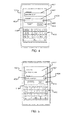
- FIG. 4 through FIG. 7 are views illustrating examples of a secure information entry field on an electronic device in accordance with the methods of FIG. 2 and FIG. 3 .
- the following describes an electronic device and method including displaying information on a display of an electronic device, the information comprising an entry field and a selectable obscuration feature operable to be toggled between a first state and a second state within the entry field.
- a selectable obscuration feature operable to be toggled between a first state and a second state within the entry field.
- the disclosure generally relates to an electronic device, such as a portable electronic device as described herein.
- electronic devices include mobile, or handheld, wireless communication devices such as pagers, cellular phones, cellular smart-phones, wireless organizers, personal digital assistants, wirelessly enabled notebook computers, tablet computers, mobile internet devices, electronic navigation devices, and so forth.
- the portable electronic device may also be a portable electronic device without wireless communication capabilities, such as a handheld electronic game device, digital photograph album, digital camera, media player, e-book reader, and so forth.
- FIG. 1 A block diagram of an example of a portable electronic device 100, also referred to as an electronic device 100 or a device 100, is shown in FIG. 1 .
- the electronic device 100 includes multiple components, such as a processor 102 that controls the overall operation of the portable electronic device 100. Communication functions, including data and voice communications, are performed through a communication subsystem 104. Data received by the portable electronic device 100 is decompressed and decrypted by a decoder 106. The communication subsystem 104 receives messages from and sends messages to a wireless network 150.
- the wireless network 150 may be any type of wireless network, including, but not limited to, data wireless networks, voice wireless networks, and networks that support both voice and data communications.
- a power source 142 such as one or more rechargeable batteries or a port to an external power supply, powers the portable electronic device 100.
- the processor 102 interacts with other components, such as a Random Access Memory (RAM) 108, memory 110, a touch-sensitive display 118, an optional actuator 120, an auxiliary input/output (I/O) subsystem 124, a data port 126, a speaker 128, a microphone 130, short-range communications 132 and other device subsystems 134.
- the touch-sensitive display 118 includes a display 112 and touch sensors 114 that are coupled to at least one controller 116 utilized to interact with the processor 102. Input via a graphical user interface is provided via the touch-sensitive display 118.
- Information such as text, characters, symbols, images, icons, and other items that may be displayed or rendered on a portable electronic device, is displayed on the touch-sensitive display 118 via the processor 102.
- the processor may interact with one or more force sensors 122.
- the portable electronic device 100 may utilize a Subscriber Identity Module or a Removable User Identity Module (SIM/RUIM) card 138 for communication with a network, such as the wireless network 150.
- SIM/RUIM Removable User Identity Module
- user identification information may be programmed into memory 110.
- the portable electronic device 100 includes an operating system 146 and software programs, applications, or components 148 that are executed by the processor 102 and are typically stored in a persistent, updatable store such as the memory 110. Additional applications or programs may be loaded onto the portable electronic device 1 00 through the wireless network 150, the auxiliary I/O subsystem 124, the data port 126, the short-range communications subsystem 132, or any other suitable subsystem 134.
- a received signal such as a text message, an e-mail message, or web page download is processed by the communication subsystem 104 and input to the processor 102.
- the processor 102 processes the received signal for output to the display 112 and/or to the auxiliary I/O subsystem 124.
- a subscriber may generate data items, for example e-mail messages, which may be transmitted over the wireless network 150 through the communication subsystem 104.
- the speaker 128 outputs audible information converted from electrical signals, and the microphone 130 converts audible information into electrical signals for processing.
- the processor 102 may also interact with an accelerometer 136 to detect direction of gravitational forces or gravity-induced reaction forces that may determine the tilt of the portable electronic device 100.
- the touch-sensitive display 118 may be any suitable touch-sensitive display, such as a capacitive, resistive, infrared, surface acoustic wave (SAW) touch-sensitive display, strain gauge, optical imaging, dispersive signal technology, acoustic pulse recognition, and so forth.
- a capacitive touch-sensitive display includes one or more capacitive touch sensors 114.
- the capacitive touch sensors may comprise any suitable material, such as indium tin oxide (ITO).
- One or more touches may be detected by the touch-sensitive display 118.
- the processor 102 may determine attributes of the touch, including a location of the touch.
- Touch location data may include data for an area of contact or data for a single point of contact, such as a point at or near a center of the area of contact.
- the location of a detected touch may include x and y components, e.g., horizontal and vertical components, respectively, with respect to one's view of the touch-sensitive display 118.
- a touch may be detected from any suitable input member, such as a finger, thumb, appendage, or other objects, for example, a stylus, pen, or other pointer, depending on the nature of the touch-sensitive display 118. Multiple simultaneous touches may be detected.
- One or more gestures may also be detected by the touch-sensitive display 118.
- a gesture such as a swipe, also known as a flick, is a particular type of touch on a touch-sensitive display 118 and may begin at an origin point and continue to an end point, for example, a concluding end of the gesture.
- a gesture may be identified by attributes of the gesture, including the origin point, the end point, the distance travelled, the duration, the velocity, and the direction, for example.
- a gesture may be long or short in distance and/or duration. Two points of the gesture may be utilized to determine a direction of the gesture.
- a gesture may also include a hover.
- a hover may be a touch at generally unchanged location over a period of time or a touch associated with the same selection item for a period of time.
- Optional force sensors 122 may be disposed in conjunction with the touch-sensitive display 118 to determine or react to forces applied to the touch-sensitive display 118.
- the force sensors 122 may be force-sensitive resistors, strain gauges, piezoelectric or piezoresistive devices, pressure sensors, quantum tunneling composites, force-sensitive switches, or other suitable devices.
- Force as utilized throughout the specification, including the claims, refers to force measurements, estimates, and/or calculations, such as pressure, deformation, stress, strain, force density, force-area relationships, thrust, torque, and other effects that include force or related quantities.
- force information associated with a detected touch may be utilized to select information, such as information associated with a location of a touch.
- a touch that does not meet a force threshold may highlight a selection option, whereas a touch that meets a force threshold may select or input that selection option.
- Selection options include, for example, displayed or virtual keys of a keyboard; selection boxes or windows, e.g., "cancel,” “delete,” or “unlock”; function buttons, such as play or stop on a music player; and so forth.
- Different magnitudes of force may be associated with different functions or input. For example, a lesser force may result in panning, and a higher force may result in zoom ing.
- Forms such as online or web forms, typically include entry fields and labels and/or other instructions describing the input, particularly text input, to be entered in each entry field.
- Common forms include such entry fields and corresponding labels as "Name”, “Email”, “Mobile Number”, “User ID”, “Password”, etc.
- Such forms may be used to sign-in to online services, to complete online orders, to provide address or contact information, to submit search queries, and the like.
- Such forms may also be used to provide information to applications such as a calendar, contacts or address book applications.
- an entry field also referred to as a text field, text box, or input element, is a graphical user interface element that receives entered text input or character input from the user.
- the entry field may be a single-line or multi-line entry field.
- a selected entry field may receive text input from any suitable keyboard such as a QWERTY keyboard, QWERTZ keyboard, AZERTY keyboard, and so forth.
- the keyboard may be a physical keyboard or a virtual keyboard, and includes a plurality of keys that are associated with characters, symbols, and the like, that may be entered utilizing the keyboard.
- a selected entry field may also receive input by other means, such as for example a numerical input pad, a speech recognition application, or any other input source.
- Forms sometimes include one or more text entry fields into which secure or confidential information is to be entered.
- entry fields for passwords are often configurable to obscure the characters being entered by replacing them with other characters or symbols, such as a string of asterisks, bullets, dots, or the like.
- each character of the password might be shown for a short time before turning into an asterisk (or other symbol).
- an asterisk is shown for every character entered without ever showing the character to the user.
- the user may miss the short visual cue if they are not looking at the display, and in the latter case the user never knows if they have entered the password correctly until they try to proceed and submit the password.
- embodiments disclosed herein provide a selectable obscuration feature within an entry field which may be selected by the user to toggle between two states - one state wherein the entered characters are displayed and one state wherein obscuration symbols are displayed in place of the entered characters.
- the selectable obscuration feature is combined with and positioned within the password text entry field, such that there is just one element that needs to be positioned in the GUI design, and only one element needs to be considered when redesigning the layout for different form factors or orientations.
- a checkbox is included within a password text entry field, which is operable to toggle the password between asterisks and actual letters as shown in FIG. 4 and FIG. 5 and discussed further below.
- the selectable obscuration feature includes an obscuration symbol (e.g. an asterisk) when in a character obscuring state, and is blank when in a character displaying state.
- the asterisk symbol is enough (when the password is being displayed as a number of asterisks) to demonstrate that there is an option to turn off the obscuration and show the password.
- One advantage provided by certain embodiments is that no text that usually accompanies a button or check box (e.g. "Show password") is required.
- text within forms needs to be translated into different languages for use in different countries, reducing the amount of text in a form reduces the overhead for providing translations in different languages.
- Another advantage is that by integrating the selectable obscuration feature inside the entry field, the connection or bond between the entry field and the functionality of the selectable obscuration feature becomes stronger, thus easing the cognitive load of having to (in prior solutions), first; read a label next to the checkbox, and second; connect the label and checkbox to an entity close by (in this case the text field for passwords, which again is identifiable only by a label).
- Another advantage is space savings. Providing the selectable obscuration feature inside the entry field takes up less space on the display than having a checkbox underneath or above the entry field.
- FIG. 2 A flowchart illustrating an example of method 200 of providing an entry field for entry of secure information on an electronic device, such as the electronic device 100, is shown in FIG. 2 .
- the method 200 and methods according to other embodiments may, for example, be carried out by software executed by processor 102. Coding of software for carrying out such methods is within the scope of a person of ordinary skill in the art given the present description.
- the methods may contain additional or fewer processes than shown and/or described, and may be performed in a different order.
- Computer-readable code executable by at least one controller or processor of the portable electronic device to perform the methods may be stored in a computer-readable storage medium, such as a non-transitory computer-readable medium.
- the selectable obscuration feature is operational or toggleable between a character displaying state (also referred to as the first state) and an obscuring state (also referred to as the second state).
- the selectable obscuration feature is initially displayed in the obscuring state.
- the selectable obscuration feature is initially displayed in the character displaying state.
- the selectable obscuration feature is initially displayed in a most recently used state (e.g., the processor 102 may retrieve a most recent state from the RAM 108 or the memory 110 which was stored the last time the method 200 was invoked).
- the processor 102 determines the current state of the selectable obscuration feature.
- the processor 102 displays the characters as entered by a user in the entry field.
- the processor 102 displays obscuration symbols in place of the characters as entered in the entry field. The user is thus provided with the option of either displaying or obscuring secure information entered in the entry field by toggling between the two states of the selectable obscuration feature.
- FIG. 3 show a flowchart of another example method 300 of providing an entry field for entry of secure information on an electronic device.
- the method 300 has a number of features in common with the method 200 of FIG. 2 that are identified with the same reference numbers and will not be described again.
- the selectable obscuration feature is toggled between the first and second states whenever the user selects the selectable obscuration feature.
- the processor 102 determines whether the selectable obscuration feature has been selected. As long as the selectable obscuration feature is not selected, the processor cycles through 302, 204 and one of 206 and 208 (depending on the current state of the selectable obscuration feature).
- the processor detects a selection of the selectable obscuration feature (e.g. by detecting a touch on the touch-sensitive display 118 at the selectable obscuration feature)
- the state of the selectable obscuration feature is changed and the method returns to 204.
- FIG. 4 and FIG. 5 show an example portable electronic device 100 with a selectable obscuration feature in different states according to an example embodiment.
- Information is displayed on the touch-sensitive display 118 including a secure information entry field 402 having a selectable obscuration feature 404 therein.
- the secure information entry field 402 is a password field
- the selectable obscuration feature 404 is positioned at the right end of the secure information entry field 402.
- the secure information entry field 402 could be a different type of field
- the selectable obscuration feature 404 could be positioned at different locations within the secure information entry field 402.
- Other information is also displayed on the touch-sensitive display in FIG. 4 and FIG. 5 , including a virtual keyboard 410, another entry field 412 (e.g. a username field), and a plurality of buttons 414.
- the selectable obscuration feature 404 is in an obscuring state, and obscuration symbols 408 are displayed in the entry field 402.
- a single obscuration symbol 406 is displayed within the selectable obscuration feature 404 to indicate the obscuring state in the embodiment of FIG. 4 .
- different means may be used to indicate the state of the selectable obscuration feature 404, such as for example, a check mark or other symbol, different fill colors or patterns, and the like.
- the selectable obscuration feature 404 is in a character displaying state, and characters as entered 409 are displayed in the entry field 402.
- FIG. 6 and FIG. 7 show another embodiment similar to the example discussed above with respect to FIG. 4 and FIG. 5 .
- bullets are used as obscuration symbols 406 and 408, and a reduced size placeholder 602 is used to identify secure information entry field 402.
- Another reduced size placeholder 612 is used to identify the other entry field 412.
- Use of the reduced sized placeholders 602 and 612 eliminates the need for labels for fields 402 and 412, providing further space saving. Implementation of reduced size placeholders and other placeholders is described US Patent Application No.
Landscapes
- Engineering & Computer Science (AREA)
- Theoretical Computer Science (AREA)
- General Engineering & Computer Science (AREA)
- Computer Hardware Design (AREA)
- Physics & Mathematics (AREA)
- General Physics & Mathematics (AREA)
- Computer Security & Cryptography (AREA)
- Software Systems (AREA)
- Human Computer Interaction (AREA)
- User Interface Of Digital Computer (AREA)
- Telephone Function (AREA)
Priority Applications (1)
| Application Number | Priority Date | Filing Date | Title |
|---|---|---|---|
| EP12180771.3A EP2713253A1 (fr) | 2012-08-17 | 2012-08-17 | Procédés d'entrée de texte sécurisés pour dispositifs électroniques portables |
Applications Claiming Priority (1)
| Application Number | Priority Date | Filing Date | Title |
|---|---|---|---|
| EP12180771.3A EP2713253A1 (fr) | 2012-08-17 | 2012-08-17 | Procédés d'entrée de texte sécurisés pour dispositifs électroniques portables |
Publications (2)
| Publication Number | Publication Date |
|---|---|
| EP2713253A1 true EP2713253A1 (fr) | 2014-04-02 |
| EP2713253A9 EP2713253A9 (fr) | 2014-06-11 |
Family
ID=46690411
Family Applications (1)
| Application Number | Title | Priority Date | Filing Date |
|---|---|---|---|
| EP12180771.3A Ceased EP2713253A1 (fr) | 2012-08-17 | 2012-08-17 | Procédés d'entrée de texte sécurisés pour dispositifs électroniques portables |
Country Status (1)
| Country | Link |
|---|---|
| EP (1) | EP2713253A1 (fr) |
Cited By (2)
| Publication number | Priority date | Publication date | Assignee | Title |
|---|---|---|---|---|
| US10601977B2 (en) | 2016-07-19 | 2020-03-24 | Nick Loughran | Messaging application |
| CN115131809A (zh) * | 2021-03-26 | 2022-09-30 | 富士胶片商业创新有限公司 | 信息处理装置、存储介质及信息处理方法 |
Citations (3)
| Publication number | Priority date | Publication date | Assignee | Title |
|---|---|---|---|---|
| US20060056626A1 (en) * | 2004-09-16 | 2006-03-16 | International Business Machines Corporation | Method and system for selectively masking the display of data field values |
| US20080115078A1 (en) * | 2006-11-13 | 2008-05-15 | Sandeep Suresh Girgaonkar | Method for secure data entry in an application |
| US20100064375A1 (en) * | 2008-09-09 | 2010-03-11 | Applied Systems, Inc. | Method, system and apparatus for secure data editing |
-
2012
- 2012-08-17 EP EP12180771.3A patent/EP2713253A1/fr not_active Ceased
Patent Citations (3)
| Publication number | Priority date | Publication date | Assignee | Title |
|---|---|---|---|---|
| US20060056626A1 (en) * | 2004-09-16 | 2006-03-16 | International Business Machines Corporation | Method and system for selectively masking the display of data field values |
| US20080115078A1 (en) * | 2006-11-13 | 2008-05-15 | Sandeep Suresh Girgaonkar | Method for secure data entry in an application |
| US20100064375A1 (en) * | 2008-09-09 | 2010-03-11 | Applied Systems, Inc. | Method, system and apparatus for secure data editing |
Non-Patent Citations (5)
| Title |
|---|
| "HTML5: Up and Running", 17 August 2010, O'REILLY MEDIA, INC., 1005 Gravenstein Highway North, Sebastopol, CA 95472, ISBN: 978-0-59-680602-6, article MARK PILGRIM: "HTML5: Up and Running", pages: 147 - 161, XP055038515 * |
| TREVOR DAVIS: "jQuery Show Password Plugin screen capture on a personal computer", 15 August 2010 (2010-08-15), XP055038504, Retrieved from the Internet <URL:http://web.archive.org/web/20100815083724/http://trevordavis.net/play/jquery-show-password/> [retrieved on 20120918] * |
| TREVOR DAVIS: "jQuery Show Password Plugin screen capture on a Samsung GT-I9000 mobile phone running Android 2.3.3", 15 August 2010 (2010-08-15), XP055038511, Retrieved from the Internet <URL:http://web.archive.org/web/20100815083724/http://trevordavis.net/play/jquery-show-password/> [retrieved on 20120918] * |
| TREVOR DAVIS: "jQuery Show Password Plugin", 30 November 2010 (2010-11-30), XP055038495, Retrieved from the Internet <URL:http://web.archive.org/web/20101130183714/http://trevordavis.net/blog/jquery-show-password-plugin> [retrieved on 20120918] * |
| TREVOR DAVIS: "jquery-show-password HTML page source", 15 August 2010 (2010-08-15), XP055038498, Retrieved from the Internet <URL:http://web.archive.org/web/20100815083724/http://trevordavis.net/play/jquery-show-password> [retrieved on 20120918] * |
Cited By (2)
| Publication number | Priority date | Publication date | Assignee | Title |
|---|---|---|---|---|
| US10601977B2 (en) | 2016-07-19 | 2020-03-24 | Nick Loughran | Messaging application |
| CN115131809A (zh) * | 2021-03-26 | 2022-09-30 | 富士胶片商业创新有限公司 | 信息处理装置、存储介质及信息处理方法 |
Also Published As
| Publication number | Publication date |
|---|---|
| EP2713253A9 (fr) | 2014-06-11 |
Similar Documents
| Publication | Publication Date | Title |
|---|---|---|
| US8730188B2 (en) | Gesture input on a portable electronic device and method of controlling the same | |
| US8659569B2 (en) | Portable electronic device including touch-sensitive display and method of controlling same | |
| US20130342452A1 (en) | Electronic device including touch-sensitive display and method of controlling a position indicator | |
| US10503398B2 (en) | Portable electronic device and method of controlling display of selectable elements | |
| US20130326392A1 (en) | Portable electronic device including a placeholder for an entry field and method of controlling same | |
| US9141280B2 (en) | Touch-sensitive display method and apparatus | |
| US20140053098A1 (en) | Secure text entry methods for portable electronic devices | |
| US8994670B2 (en) | Electronic device having touch-sensitive display and method of controlling same to identify touches on the touch-sensitive display | |
| US20120206381A1 (en) | Electronic device and method of controlling same | |
| US20130111390A1 (en) | Electronic device and method of character entry | |
| US9170669B2 (en) | Electronic device and method of controlling same | |
| EP2713253A9 (fr) | Procédés d'entrée de texte sécurisés pour dispositifs électroniques portables | |
| US8884881B2 (en) | Portable electronic device and method of controlling same | |
| EP2469384A1 (fr) | Dispositif électronique portable et son procédé de commande | |
| EP2669780A1 (fr) | Dispositif électronique portable comprenant un paramètre fictif pour un champ d'entrée et procédé de commande de celui-ci | |
| EP2549366A1 (fr) | Dispositif électronique tactile et son procédé de commande | |
| EP2587355A1 (fr) | Dispositif électronique et procédé de saisie de caractères | |
| US20140035817A1 (en) | Input device for use with a portable electronic device | |
| CA2747036C (fr) | Appareil electronique et methode de commande dudit appareil | |
| US20130057479A1 (en) | Electronic device including touch-sensitive displays and method of controlling same | |
| EP2804086B1 (fr) | Dispositif électronique et son procédé de commande | |
| EP2662752B1 (fr) | Dispositif et méthode pour l'entrée de caractères dans un dispositif électronique portable | |
| EP2677410A1 (fr) | Dispositif électronique incluant un affichage sensible au toucher et procédé de contrôle d'un indicateur de position | |
| EP2565761A1 (fr) | Dispositif électronique incluant un affichage sensible au toucher et son procédé de contrôle | |
| WO2013166580A1 (fr) | Détection d'une entrée de caractère adjacente à la barre d'espace |
Legal Events
| Date | Code | Title | Description |
|---|---|---|---|
| PUAI | Public reference made under article 153(3) epc to a published international application that has entered the european phase |
Free format text: ORIGINAL CODE: 0009012 |
|
| 17P | Request for examination filed |
Effective date: 20120817 |
|
| AK | Designated contracting states |
Kind code of ref document: A1 Designated state(s): AL AT BE BG CH CY CZ DE DK EE ES FI FR GB GR HR HU IE IS IT LI LT LU LV MC MK MT NL NO PL PT RO RS SE SI SK SM TR |
|
| AX | Request for extension of the european patent |
Extension state: BA ME |
|
| STAA | Information on the status of an ep patent application or granted ep patent |
Free format text: STATUS: THE APPLICATION HAS BEEN REFUSED |
|
| 18R | Application refused |
Effective date: 20140918 |