EP2717268A1 - Anzeigevorrichtung und Steuerungsverfahren dafür - Google Patents
Anzeigevorrichtung und Steuerungsverfahren dafür Download PDFInfo
- Publication number
- EP2717268A1 EP2717268A1 EP13186762.4A EP13186762A EP2717268A1 EP 2717268 A1 EP2717268 A1 EP 2717268A1 EP 13186762 A EP13186762 A EP 13186762A EP 2717268 A1 EP2717268 A1 EP 2717268A1
- Authority
- EP
- European Patent Office
- Prior art keywords
- content
- edition information
- reproducing
- display apparatus
- information
- Prior art date
- Legal status (The legal status is an assumption and is not a legal conclusion. Google has not performed a legal analysis and makes no representation as to the accuracy of the status listed.)
- Withdrawn
Links
Images


Classifications
-
- G—PHYSICS
- G11—INFORMATION STORAGE
- G11B—INFORMATION STORAGE BASED ON RELATIVE MOVEMENT BETWEEN RECORD CARRIER AND TRANSDUCER
- G11B27/00—Editing; Indexing; Addressing; Timing or synchronising; Monitoring; Measuring tape travel
- G11B27/02—Editing, e.g. varying the order of information signals recorded on, or reproduced from, record carriers
-
- G—PHYSICS
- G06—COMPUTING OR CALCULATING; COUNTING
- G06F—ELECTRIC DIGITAL DATA PROCESSING
- G06F40/00—Handling natural language data
- G06F40/10—Text processing
- G06F40/166—Editing, e.g. inserting or deleting
-
- G—PHYSICS
- G11—INFORMATION STORAGE
- G11B—INFORMATION STORAGE BASED ON RELATIVE MOVEMENT BETWEEN RECORD CARRIER AND TRANSDUCER
- G11B20/00—Signal processing not specific to the method of recording or reproducing; Circuits therefor
- G11B20/10—Digital recording or reproducing
-
- G—PHYSICS
- G11—INFORMATION STORAGE
- G11B—INFORMATION STORAGE BASED ON RELATIVE MOVEMENT BETWEEN RECORD CARRIER AND TRANSDUCER
- G11B27/00—Editing; Indexing; Addressing; Timing or synchronising; Monitoring; Measuring tape travel
- G11B27/02—Editing, e.g. varying the order of information signals recorded on, or reproduced from, record carriers
- G11B27/031—Electronic editing of digitised analogue information signals, e.g. audio or video signals
- G11B27/034—Electronic editing of digitised analogue information signals, e.g. audio or video signals on discs
-
- G—PHYSICS
- G11—INFORMATION STORAGE
- G11B—INFORMATION STORAGE BASED ON RELATIVE MOVEMENT BETWEEN RECORD CARRIER AND TRANSDUCER
- G11B27/00—Editing; Indexing; Addressing; Timing or synchronising; Monitoring; Measuring tape travel
- G11B27/10—Indexing; Addressing; Timing or synchronising; Measuring tape travel
- G11B27/11—Indexing; Addressing; Timing or synchronising; Measuring tape travel by using information not detectable on the record carrier
-
- H—ELECTRICITY
- H04—ELECTRIC COMMUNICATION TECHNIQUE
- H04N—PICTORIAL COMMUNICATION, e.g. TELEVISION
- H04N5/00—Details of television systems
- H04N5/76—Television signal recording
- H04N5/91—Television signal processing therefor
-
- H—ELECTRICITY
- H04—ELECTRIC COMMUNICATION TECHNIQUE
- H04N—PICTORIAL COMMUNICATION, e.g. TELEVISION
- H04N5/00—Details of television systems
- H04N5/76—Television signal recording
- H04N5/91—Television signal processing therefor
- H04N5/93—Regeneration of the television signal or of selected parts thereof
Definitions
- Methods and apparatuses consistent with exemplary embodiments relate to a display apparatus and a method for controlling thereof, and more particularly, to a display apparatus which can edit a content and a method for controlling thereof.
- a related-art display apparatus edits only the content that is stored in a DVD-RW or a BD-RE, which is a read/write (RW) media, and generates a play list according to the edited content and stores the play list in the RW media which is being reproduced.
- RW read/write
- the RW media such as a DVD-RW or a BD-RE is problematic not only in utility and price aspects but also in a copyright aspect, and thus is not widely used. For this reason, contents are stored in a read only disk such as a blue-ray disk or an ultra HD disk and are released.
- a user re-watches the movie that is stored in a read only disk, the user cannot perform an editing function such as deleting unnecessary scenes. Therefore, the user should watch unnecessary scenes or fast forward the movie to skip the unnecessary scenes every time that the user watches the movie.
- One or more exemplary embodiments may overcome the above disadvantages and other disadvantages not described above. However, it is understood that one or more exemplary embodiment are not required to overcome the disadvantages described above, and may not overcome any of the problems described above.
- One or more exemplary embodiments provide a display apparatus which can easily edit a content that is stored in a recording medium such as a read only disk or a content that is set to be read only by a user, and a method for controlling thereof.
- a display apparatus may include: a communication unit which receives a content; an output unit which outputs the received content; and a controller which, if the content is received, determines whether edition information for editing the content has been already set or not with reference to identification information included in the received content, and controls to output the content in one of a general reproducing mode and an editing-reproducing mode according to a result of the determination.
- the edition information may be stored in at least one of the display apparatus and an external apparatus, and the edition information may include information for editing a reproducing section corresponding to a user command from among reproducing sections of the content, and identification information on the content.
- the edition information may further include reproduction setting information of the content, and, if the edition information on the content has been already set, the controller may control to output the content in the general reproducing mode or to edit at least one reproducing section corresponding to the edition information from among the reproducing sections of the content and output the content, based on the reproduction setting information included in the edition information.
- the controller may control to generate a user interface screen to select the editing-reproducing mode and output the user interface screen.
- the display apparatus may further include an input unit which receives a user command, and, if a user command to select the editing-reproducing mode is input through the user interface screen, the controller may control to edit at least one reproducing section corresponding to the edition information from among the reproducing sections of the content and output the content.
- the display apparatus may further include an input unit which receives a user command, and, if the edition information on the content has not been set, the controller may control to output the content in the general reproducing mode.
- the controller may generate edition information corresponding to the user command.
- a method for controlling a display apparatus may include: receiving a content; determining whether edition information for editing the content has been already set or not with reference to identification information included in the received content; and outputting the content in one of a general reproducing mode and an editing-reproducing mode according to a result of the determination.
- the edition information may be stored in at least one of the display apparatus and an external apparatus, and the edition information may include information for editing a reproducing section corresponding to a user command from among reproducing sections of the content, and identification information on the content.
- the edition information may further include reproduction setting information of the content, and the outputting may include, if the edition information on the content has been already set, outputting the content in the general reproducing mode or editing at least one reproducing section corresponding to the edition information from among the reproducing sections of the content and outputting the content, based on the reproduction setting information included in the edition information.
- the outputting may include, if the edition information on the content has been already set, generating a user interface screen to select the editing-reproducing mode and outputting the user interface screen.
- the outputting may include, if a user command to select the editing-reproducing mode is input through the user interface screen, editing at least one reproducing section corresponding to the edition information from among the reproducing sections of the content and outputting the content.
- the outputting may include, if the edition information on the content has not been set, outputting the content in the general reproducing mode.
- the method may further include, if a user command to edit the content is input while the content is being output, generating edition information corresponding to the user command.
- the display apparatus may edit the content that is stored in a recording medium reproducing apparatus such as a read only disk or the content that is set to be read only by a user.
- a recording medium reproducing apparatus such as a read only disk or the content that is set to be read only by a user.
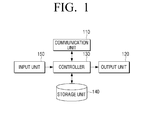
- FIG. 1 is a block diagram illustrating a display apparatus according to one or more embodiments.
- the display apparatus may include a communication unit 110, an output unit 120, a controller 130, a storage unit 140, and an input unit 150.
- the communication unit 110 may communicate with an external apparatus according to various communication methods and may receive a content, and the output unit 120 may output the content received through the communication unit 110.
- the external apparatus recited herein may be an apparatus that provides a content. If a content is received from the external apparatus, the controller 130 may determine whether edition information for editing the content is stored in the storage unit 140 or not with reference to identification information included in the received content. However, this should not be considered as limiting.
- the edition information for editing the content may be stored in the external apparatus, which is communicable with the display apparatus through the communication unit 110, besides the storage unit 140.
- the controller 130 may determine whether the edition information for editing the content is stored in the storage unit 140 or the external apparatus, may set a reproducing mode of the content to one of a general reproducing mode and an editing-reproducing mode according to a result of the determination, and may output the content through the output unit 120.
- the controller 130 may edit at least one reproducing section corresponding to the edition information from among reproducing sections of the contents, based on the pre-stored edition information, and may output the content.
- the controller 130 may set the reproducing mode of the content to the general reproducing mode and may output the content.
- FIG. 2 is a block diagram illustrating a display apparatus in detail according to one or more embodiments.
- a display apparatus may generally include a communication unit 110, an output unit 120, a controller 130, a storage unit 140, and an input unit 150.
- the communication unit 110 which may communicate with an external apparatus and receive a content, may include various communication modules such as, for example, a near field communication (NFC) module and a wireless communication module (not shown).
- the NFC module (not shown) is a communication module that wirelessly communicates with an external apparatus located at a near distance, and may be Bluetooth or Zigbee for example.
- the wireless communication module (not shown) is a communication module that is connected to an external network and communicates with an external apparatus according to a wireless communication protocol such as, for example, WiFi or IEEE.
- the wireless communication module may further include a mobile communication module that is connected to a mobile communication network and communicates with an external apparatus according to various mobile communication standards such as 3 rd generation (3G), 3 rd generation partnership project (3GPP), and long term evolution (LTE).
- 3G 3 rd generation
- 3GPP 3 rd generation partnership project
- LTE long term evolution
- the display apparatus may further include a receiver 170, which receives a content from a broadcasting station through a broadcasting network or receives a content from a web server through the Internet. If a content is received from a broadcasting station through a broadcasting network, the receiver 170 may include a tuner (not shown), a demodulator (not shown), and an equalizer (not shown). If a content is received from a web server through the Internet, the receiver 170 may be realized by a network interface (not shown).
- the receiver 170 may receive contents from various recording medium reproducing apparatuses, which are provided in the display apparatus or are connected to the display apparatus.
- the recording medium reproducing apparatus recited herein refers to an apparatus that reproduces contents stored in various types of recording media such as, for example, a CD, a DVD, a hard disk, a blue-ray disk, a memory card, and a USB memory.
- the controller 130 may control to signal process audio and video data included in the received content.
- the display apparatus may further include a signal processor 160, which performs signal processing with respect to audio and video data included in the content according to a control command of the controller 130.
- the signal processor 160 may include an audio signal processor 161 to perform signal processing with respect to the audio data included in the content, and a video signal processor 162 to perform signal processing with respect to the video data.
- the audio signal processor 161 may decode audio data included in the received content and may modulate the decoded audio data to an audio signal.
- the video signal processor 162 may decode video data included in the received content. After that, the video signal processor 162 may scale up or down an image frame of the decoded video data to be suitable for an output screen size. If scaling is performed on the video data, the video signal processor 162 may convert a frame rate of the image frame of the scaled video data with reference to an output rate of the display apparatus.
- the signal processor 160 which may signal process the audio and video data included in the received content in a format that can be output through the audio signal processor 161 and the video signal processor 162, may further include an additional data processor 163.
- the additional data processor 163 may determine whether the received content includes additional data such as an electronic program guide (EPG) and subtitles. If additional data is included as a result of the determination, the additional data processor 163 may add the additional data included in the content to an image frame corresponding to the additional data.
- EPG electronic program guide
- the output unit 120 which may output the received content, may include an audio output unit 121 and a video output unit 122.
- the audio output unit 121 may output the audio data which has been modulated to the audio signal by the audio signal processor 161 in an audible sound format
- the video output unit 122 may output the image frame of the video data the frame rate of which has been converted.
- the controller 130 may determine whether edition information for editing the content has been already set or not with reference to identification information included in the received content. After that, according to whether the edition information for editing the received content has been already set or not, the controller 130 may control to set a reproducing mode of the content to one of a general reproducing mode and an editing-reproducing mode and output the content.
- the edition information may refer to information that is stored in at least one of the display apparatus and the external apparatus, and specifically, may be stored in the storage unit 140 of the display apparatus or the external apparatus which is communicable with the display apparatus through the communication unit 110.
- the edition information may include information for editing a reproducing section corresponding to a user command from among the reproducing sections of the content, and identification information on the content.
- the identification information on the content may be a title of the content, for example.
- the controller 130 may extract identification information from the received content. After that, the controller 130 may determine whether edition information including the identification information has been already set and stored in the storage unit 140 or the external apparatus, with reference to the extracted identification information. If the edition information on the received content has been already set as a result of the determination, the controller 130 may set the reproducing mode of the content to the general reproducing mode and output the content, or may set the reproducing mode to the editing-reproducing mode and output the content. That is, if the reproducing mode is set to the editing-reproducing mode, the controller 130 may edit a reproducing section that corresponds to the already set edition information from among reproducing sections of the content, and may output the content.
- the reproducing mode may be converted into the editing-reproducing mode and the content may be edited according to the already set edition information, even if the content is provided from a different source apparatus (an external apparatus, a recording medium reproducing apparatus, a web server, and a broadcasting station).
- a different source apparatus an external apparatus, a recording medium reproducing apparatus, a web server, and a broadcasting station.
- the controller 130 may set the reproducing mode of the received content to the general reproducing mode or the editing-reproducing mode based on reproducing setting information included in the edition information, and may output the content.
- the reproduction setting information recited herein may refer to information which has been set by the user in advance regarding whether the received content is output in the general reproducing mode or the editing-reproducing mode.
- the user may set the reproduction setting information so that the content in which edition information is set can be edited and output.
- the controller 130 may edit a reproducing section that corresponds to the edition information from among reproducing sections of the content according to the reproduction setting information included in the already set edition information, and may output the content.
- the user may set the reproducing mode of the received content according to time. For example, if the reproduction setting information is set so that the content is output in the editing-reproducing mode until 10 p.m., and, if the content is received before 10 p.m., the controller 130 may edit the reproducing section that corresponds to the edition information from among the reproducing sections of the content, and may output the content. If the content is received after 10 p.m., the controller 130 does not edit the received content and outputs the content in the general reproducing mode.
- the controller 130 may control to generate a user interface screen to select the editing-reproducing mode and output the user interface screen. Specifically, with reference to identification information included in the received content, the controller 130 may determine whether edition information including the identification information has been already set and stored in the storage unit 140 or the external apparatus. If the edition information on the received content has been already set as a result of the determination, the controller 130 may generate a user interface screen to select the editing-reproducing mode. Accordingly, the output unit 120 may output the user interface screen to select the editing-reproducing mode on a screen.
- the user may identify that the edition information has been set and stored in advance in connection with the currently received content, and may select the reproducing mode of the content. If a user command to select the editing-reproducing mode is input through the input unit 150, the controller 130 may control to edit at least one reproducing section that corresponds to the edition information on the content from among the reproducing sections of the content, and output the content. On the other hand, if a user command to select the general reproducing mode is input through the input unit 150, the controller 130 may control to output the content in the general reproducing mode without editing the content.
- the controller 130 may edit the content according to the already set edition information and output the content.
- the controller 130 may output the content in the general reproducing mode.
- the controller 130 may generate edition information corresponding to the input user command and may store the edition information in at least one of the storage unit 140 and the external apparatus.
- the controller 130 may generate edition information on a reproducing section of the content corresponding to the time that the user command is input. After that, the controller 130 may determine whether edition information on the content has been already set and stored in at least one of the storage unit 140 and the external apparatus. As a result of the determination, if edition information on the content has not been set, the controller 130 may generate edition information including the identification information of the content and edition information on the reproducing section of the content corresponding to the time that the user command is input, and store the edition information in at least one of the storage unit 140 and the external apparatus.
- the controller 130 may determine whether edition information on the reproducing section of the content corresponding to the time that the user command is input has been already set or not with reference to the already set edition information. If the edition information on the reproducing section has been already set as a result of the determination, the controller 130 may generate a notice message informing that the edition information has been already set and outputs the notice message. If it is determined that the edition information on the reproducing section of the content corresponding to the time that the user command is input has not been set, the controller 130 may add the edition information on the reproducing section to the already set edition information, and may generate a notice message informing that the edition information has been added and may output the notice message.
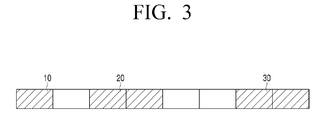
- FIG. 3 is a view illustrating an operation of generating edition information for editing a content in a display apparatus according to one or more embodiments.
- a received content may consist of 1 st to 8 th image frames.
- the user may request editing of the 1 st image frame 10, the 3 rd and 4 th image frames 20, and the 7 th and 8 th image frames 30, such as deleting or repeating the image frames, from among the 1 st to 8 th image frames.
- the controller 130 may generate edition information which includes edition information on the 1 st image frame 10, the 3 rd and 4 th image frames 20, and the 7 th and 8 th image frames 30 and identification information of the content, and may store the edition information in at least one of the storage unit 140 and the external apparatus.
- the controller 130 may edit a reproducing section corresponding to the already set edition information from among reproducing sections of the content according to a predetermined event condition. That is, the controller 130 may edit the first image frame 10, the 3 rd and 4 th image frames 20, and the 7 th and 8 th image frames 30 from among the 1 st to 8 th image frames of the content based on the already set edition information. At this time, the controller 130 may edit audio data and additional data corresponding to the 1 st image frame 10, the 3 rd and 4 th image frames 20, and the 7 th and 8 th image frames 30, and may output the audio data and the additional data.
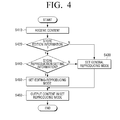
- FIG. 4 is a flowchart illustrating a method for controlling a display apparatus which edits and outputs a content according to one or more embodiments.
- the display apparatus may communicate with an external apparatus and receive a content (S41 0).
- the display apparatus may communicate with the external apparatus through, for example, an NFC module such as Bluetooth and Zigbee or a wireless communication module, which is connected to an external network according to a wireless communication protocol such as WiFi and IEEE and may perform communication, and may receive the content.
- an NFC module such as Bluetooth and Zigbee
- a wireless communication module which is connected to an external network according to a wireless communication protocol such as WiFi and IEEE and may perform communication, and may receive the content.
- the display apparatus may receive a content from a broadcasting station through a broadcasting network or receive a content from a web server through the internet. Also, the display apparatus may receive a content from various types of recording medium reproducing apparatuses which are provided in the display apparatus or are connected to the display apparatus, such as, for example, a CD, a DVD, a hard disk, a blue-ray disk, and a memory card.
- the display apparatus may determine whether edition information for editing the content has been already set or not with reference to identification information included in the content (S420).
- the edition information for editing the content may be stored in at least one of the display apparatus and the external apparatus.
- Such edition information may include information for editing a reproducing section corresponding to a user command from among reproducing sections of the content and identification information on the content.
- the identification information on the content may be a title of the content, for example.
- the display apparatus may extract the identification information included in the received content, and determine whether the edition information including the identification information has been already set and stored in the display apparatus or the external apparatus with reference to the extracted identification information. As a result of the determination, if the edition information including the identification information of the received content has not been set, the display apparatus may set a reproducing mode of the received content to a general reproducing mode (S430).
- the display apparatus may determine whether the edition information includes reproduction setting information or not (S440).
- the reproduction setting information may be information that has been set in advance by the user so that the received content is output in an editing-producing mode based on the edition information. Accordingly, if the already set edition information does not include reproduction setting information, the display apparatus may set the reproducing mode of the received content to the general reproducing mode as in operation S430. If the already set edition information includes the reproduction setting information, the display apparatus may set the reproducing mode of the received content to the editing-reproducing mode (S450).
- the reproduction setting information may be information that has been set in advance by the user so that the received content is output in the editing-reproducing mode based on the edition information or is output in the general reproducing mode.
- the user may set the reproducing mode of the received content according to time. For example, if the reproduction setting information is set so that the content is output in the editing-reproducing mode until 10 p.m., and, if the content is received before 10 p.m., the display apparatus may set the reproducing mode of the content to the editing-reproducing mode. If the content is received after 10 p.m., the display apparatus may set the reproducing mode of the received content to the general reproducing mode.
- the display apparatus may output the content in the general reproducing mode or may edit the content based on the already set edition information and output the content, according to the set reproducing mode.
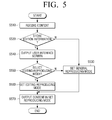
- FIG. 5 is a flowchart illustrating a method for controlling a display apparatus which edits and outputs a content according to one or more embodiments.
- a display apparatus may communicate with an external apparatus and receive a content (S510).
- the display apparatus may communicate with the external apparatus through, for example, an NFC module such as Bluetooth and Zigbee or a wireless communication module, which is connected to an external network according to a wireless communication protocol such as, for example, WiFi and IEEE and performs communication, and may receive the content.
- an NFC module such as Bluetooth and Zigbee
- a wireless communication module which is connected to an external network according to a wireless communication protocol such as, for example, WiFi and IEEE and performs communication, and may receive the content.
- the display apparatus may receive a content from a broadcasting station through a broadcasting network or receive a content from a web server through the internet. Also, the display apparatus may receive a content from various types of recording medium reproducing apparatuses which are provided in the display apparatus or are connected to the display apparatus, such as a CD, a DVD, a hard disk, a blue-ray disk, and a memory card.
- the display apparatus may determine whether edition information for editing the content has been already set or not with reference to identification information included in the received content (S520).
- the edition information for editing the content may be stored in at least one of the display apparatus and the external apparatus.
- Such edition information may include information for editing a reproducing section corresponding to a user command from among reproducing sections of the content, and identification information on the content.
- the identification information on the content may be a title of the content, for example.
- the display apparatus may extract the identification information included in the received content, and determine whether edition information including the identification information has been already set and stored in the display apparatus or the external apparatus with reference to the extracted identification information. If the edition information including the identification information of the received content has not been set as a result of the determination, the display apparatus may set a reproducing mode of the received content to a general reproducing mode (S530).
- the display apparatus may generate a user interface screen to select an editing-reproducing mode and may output the user interface screen (S540). Since the user interface screen to select the editing-reproducing mode is output on the screen, the user may identify that the edition information has been set and stored in advance in connection with the currently received content, and may select the reproducing mode of the content. If such a user command is input, the display apparatus may determine whether the user command relates to the editing-reproducing mode or the general reproducing mode (S550).
- the display apparatus may set the reproducing mode of the content to the general reproducing mode as in operation S530.
- the display apparatus may set the reproducing mode of the received content to the editing-reproducing mode (S560).
- the display apparatus may output the content in the general reproducing mode or edit a reproducing section corresponding to the already set edition information from among reproducing sections of the content and output the content, according to the set reproducing mode (S570).
- the display apparatus which may set the reproducing mode of the received content to the general reproducing mode or the editing-reproducing mode and may output the content, may perform signal processing with respect to audio and video data included in the received content in a format that can be output, and may output the content.
- the operation of signal processing the audio and video data included in the content in the format that can be output has been described above with reference to FIG. 2 , and thus a detailed description is omitted.
- FIG. 6 is a flowchart illustrating a method for generating edition information in a display apparatus according to one or more embodiments.
- the display apparatus may output a content received from a source apparatus in audio and video formats (S610).
- the content output in the audio and video formats may be set in a general reproducing mode or may be set in an editing-reproducing mode based on already set edition information.
- the display apparatus may generate edition information on a reproducing section of the content corresponding to the time that the user command is input (S620 and S630).
- the display apparatus may determine whether edition information on the content has been already set and stored in at least one of the display apparatus and an external apparatus or not. That is, with reference to identification information of the output content, the display apparatus may determine whether edition information including the identification information of the content has been already set and stored in at least one of the display apparatus and the external apparatus. If the edition information on the content has not been set as a result of the determination, the display apparatus may generate edition information which includes the identification information of the output content and edition information on the reproducing section of the content corresponding to the time that the user command is input, and may store the edition information in at least one of the display apparatus and the external apparatus.
- the display apparatus may determine whether edition information on the reproducing section of the content corresponding to the time that the user command is input has been already set or not with reference to the already set edition information. If the edition information on the reproducing section has been already set, the display apparatus may output a notice message informing that the edition information has been already set. On the other hand, if it is determined that the edition information on the reproducing section of the content corresponding to the time that the user command is input has not been set, the display apparatus may add the edition information on the reproducing section to the already set edition information, and generate a notice message that the edition information has been added and output the notice message.
- the display apparatus may generate edition information on the reproducing section of the content corresponding to the time that the user command is input and may store the edition information.
- any apparatus, system, element, or interpretable unit descriptions herein include one or more hardware devices or hardware processing elements.
- any described apparatus, system, element, retriever, pre or post-processing elements, tracker, detector, encoder, decoder, etc. may further include one or more memories and/or processing elements, and any hardware input/output transmission devices, or represent operating portions/aspects of one or more respective processing elements or devices.
- the term apparatus should be considered synonymous with elements of a physical system, not limited to a single device or enclosure or all described elements embodied in single respective enclosures in all embodiments, but rather, depending on embodiment, is open to being embodied together or separately in differing enclosures and/or locations through differing hardware elements.
- embodiments can also be implemented through computer readable code/instructions in/on a non-transitory medium, e.g., a computer readable medium, to control at least one processing device, such as a processor or computer, to implement any above described embodiment.
- a non-transitory medium e.g., a computer readable medium
- the medium can correspond to any defined, measurable, and tangible structure permitting the storing and/or transmission of the computer readable code.
- the media may also include, e.g., in combination with the computer readable code, data files, data structures, and the like.
- One or more embodiments of computer-readable media include: magnetic media such as hard disks, floppy disks, and magnetic tape; optical media such as CD ROM disks and DVDs; magneto-optical media such as optical disks; and hardware devices that are specially configured to store and perform program instructions, such as read-only memory (ROM), random access memory (RAM), flash memory, and the like.
- Computer readable code may include both machine code, such as produced by a compiler, and files containing higher level code that may be executed by the computer using an interpreter, for example.
- the media may also be any defined, measurable, and tangible distributed network, so that the computer readable code is stored and executed in a distributed fashion.
- the processing element could include a processor or a computer processor, and processing elements may be distributed and/or included in a single device.
- the computer-readable media may also be embodied in at least one application specific integrated circuit (ASIC) or Field Programmable Gate Array (FPGA), as only examples, which execute (e.g., processes like a processor) program instructions.
- ASIC application specific integrated circuit
- FPGA Field Programmable Gate Array
Landscapes
- Engineering & Computer Science (AREA)
- Multimedia (AREA)
- Signal Processing (AREA)
- Theoretical Computer Science (AREA)
- General Health & Medical Sciences (AREA)
- Computational Linguistics (AREA)
- Audiology, Speech & Language Pathology (AREA)
- Physics & Mathematics (AREA)
- General Engineering & Computer Science (AREA)
- General Physics & Mathematics (AREA)
- Artificial Intelligence (AREA)
- Health & Medical Sciences (AREA)
- Television Signal Processing For Recording (AREA)
Applications Claiming Priority (1)
| Application Number | Priority Date | Filing Date | Title |
|---|---|---|---|
| KR1020120110333A KR20140044232A (ko) | 2012-10-04 | 2012-10-04 | 디스플레이 장치 및 제어 방법 |
Publications (1)
| Publication Number | Publication Date |
|---|---|
| EP2717268A1 true EP2717268A1 (de) | 2014-04-09 |
Family
ID=49253213
Family Applications (1)
| Application Number | Title | Priority Date | Filing Date |
|---|---|---|---|
| EP13186762.4A Withdrawn EP2717268A1 (de) | 2012-10-04 | 2013-09-30 | Anzeigevorrichtung und Steuerungsverfahren dafür |
Country Status (4)
| Country | Link |
|---|---|
| US (1) | US20140101541A1 (de) |
| EP (1) | EP2717268A1 (de) |
| KR (1) | KR20140044232A (de) |
| CN (1) | CN103716705A (de) |
Citations (4)
| Publication number | Priority date | Publication date | Assignee | Title |
|---|---|---|---|---|
| US20030026592A1 (en) * | 2000-12-28 | 2003-02-06 | Minoru Kawahara | Content creating device and method |
| EP1638102A1 (de) * | 2004-09-15 | 2006-03-22 | Sony Corporation | Bildverarbeitungsgerät, -Verfahren, -Programm und -Programmspeichermedium |
| WO2007128003A2 (en) * | 2006-03-28 | 2007-11-08 | Motionbox, Inc. | System and method for enabling social browsing of networked time-based media |
| WO2008035022A1 (en) * | 2006-09-20 | 2008-03-27 | John W Hannay & Company Limited | Methods and apparatus for creation, distribution and presentation of polymorphic media |
Family Cites Families (6)
| Publication number | Priority date | Publication date | Assignee | Title |
|---|---|---|---|---|
| US5351135A (en) * | 1990-06-01 | 1994-09-27 | Thomson Consumer Electronics, Inc. | Managing letterbox signals with logos |
| US20060031870A1 (en) * | 2000-10-23 | 2006-02-09 | Jarman Matthew T | Apparatus, system, and method for filtering objectionable portions of a multimedia presentation |
| US7127736B2 (en) * | 2000-11-17 | 2006-10-24 | Sony Corporation | Content processing apparatus and content processing method for digest information based on input of a content user |
| KR20020080666A (ko) * | 2001-04-17 | 2002-10-26 | 엘지전자 주식회사 | 디지털 방송 시스템 및 방법 |
| TW200516574A (en) * | 2003-11-06 | 2005-05-16 | Liteon It Corp | The method of recording and displaying the video and audio stream |
| CN101047814A (zh) * | 2006-03-30 | 2007-10-03 | 南京Lg同创彩色显示系统有限责任公司 | 无线电视接收机的字幕显示方法 |
-
2012
- 2012-10-04 KR KR1020120110333A patent/KR20140044232A/ko not_active Withdrawn
-
2013
- 2013-09-30 EP EP13186762.4A patent/EP2717268A1/de not_active Withdrawn
- 2013-10-01 US US14/043,123 patent/US20140101541A1/en not_active Abandoned
- 2013-10-08 CN CN201310464551.9A patent/CN103716705A/zh active Pending
Patent Citations (4)
| Publication number | Priority date | Publication date | Assignee | Title |
|---|---|---|---|---|
| US20030026592A1 (en) * | 2000-12-28 | 2003-02-06 | Minoru Kawahara | Content creating device and method |
| EP1638102A1 (de) * | 2004-09-15 | 2006-03-22 | Sony Corporation | Bildverarbeitungsgerät, -Verfahren, -Programm und -Programmspeichermedium |
| WO2007128003A2 (en) * | 2006-03-28 | 2007-11-08 | Motionbox, Inc. | System and method for enabling social browsing of networked time-based media |
| WO2008035022A1 (en) * | 2006-09-20 | 2008-03-27 | John W Hannay & Company Limited | Methods and apparatus for creation, distribution and presentation of polymorphic media |
Also Published As
| Publication number | Publication date |
|---|---|
| US20140101541A1 (en) | 2014-04-10 |
| KR20140044232A (ko) | 2014-04-14 |
| CN103716705A (zh) | 2014-04-09 |
Similar Documents
| Publication | Publication Date | Title |
|---|---|---|
| US8555175B2 (en) | Display generation device, display generation method, program, and content download system | |
| KR102545837B1 (ko) | 디스플레이 장치, 디스플레이 장치의 배경음악 제공방법 및 배경음악 제공 시스템 | |
| CN102208205A (zh) | 动画再现装置 | |
| CN110740386B (zh) | 直播切换方法、装置及存储介质 | |
| US8875213B2 (en) | Video player and portable computer with detection | |
| US9807360B2 (en) | Method and apparatus for reproducing content | |
| US9538119B2 (en) | Method of capturing moving picture and apparatus for reproducing moving picture | |
| EP2717268A1 (de) | Anzeigevorrichtung und Steuerungsverfahren dafür | |
| JP2008537440A (ja) | ビデオ・ピクチャ・スクリーン・セーバ機能の抽出 | |
| JP6037630B2 (ja) | 再生装置並びに再生装置の制御方法及び制御プログラム | |
| US20100195980A1 (en) | Information storage medium, reproducing apparatus, and reproducing method | |
| JP2014082545A (ja) | 録画再生装置およびその制御方法 | |
| JP2014072589A (ja) | コンテンツ再生装置、テレビジョン受像機、コンテンツ再生方法、プログラムおよび記録媒体 | |
| JP2011205567A (ja) | 動画出力装置、動画出力方法及びプログラム | |
| JP2018056871A (ja) | 画像再生装置、及び画像再生システム | |
| KR20150006753A (ko) | 영상처리장치, 영상처리방법 및 광디스크 | |
| JP2016091473A (ja) | 再生装置、サーバ、通知方法、サービス管理方法、再生システム、及び、プログラム | |
| JP2012147296A (ja) | ハイライトシーンを生成する映像処理装置 | |
| JP2007288335A (ja) | デジタル放送記録装置 | |
| KR20160001899A (ko) | 정보 저장 매체, 정보 저장 매체 재생 장치 및 정보 저장 매체 재생 방법 | |
| JP2008084489A (ja) | 光ディスク再生装置及び光ディスク再生方法 | |
| WO2009022783A1 (en) | Information storage medium, reproducing apparatus, and reproducing method |
Legal Events
| Date | Code | Title | Description |
|---|---|---|---|
| PUAI | Public reference made under article 153(3) epc to a published international application that has entered the european phase |
Free format text: ORIGINAL CODE: 0009012 |
|
| AK | Designated contracting states |
Kind code of ref document: A1 Designated state(s): AL AT BE BG CH CY CZ DE DK EE ES FI FR GB GR HR HU IE IS IT LI LT LU LV MC MK MT NL NO PL PT RO RS SE SI SK SM TR |
|
| AX | Request for extension of the european patent |
Extension state: BA ME |
|
| STAA | Information on the status of an ep patent application or granted ep patent |
Free format text: STATUS: THE APPLICATION IS DEEMED TO BE WITHDRAWN |
|
| 18D | Application deemed to be withdrawn |
Effective date: 20141010 |