EP2717593A2 - Génération et analyse de trafic pour l'émulation d'un ONU - Google Patents
Génération et analyse de trafic pour l'émulation d'un ONU Download PDFInfo
- Publication number
- EP2717593A2 EP2717593A2 EP13187066.9A EP13187066A EP2717593A2 EP 2717593 A2 EP2717593 A2 EP 2717593A2 EP 13187066 A EP13187066 A EP 13187066A EP 2717593 A2 EP2717593 A2 EP 2717593A2
- Authority
- EP
- European Patent Office
- Prior art keywords
- onu
- emulated
- traffic
- messages
- onus
- Prior art date
- Legal status (The legal status is an assumption and is not a legal conclusion. Google has not performed a legal analysis and makes no representation as to the accuracy of the status listed.)
- Withdrawn
Links
- 238000011144 upstream manufacturing Methods 0.000 claims abstract description 39
- 230000003287 optical effect Effects 0.000 claims abstract description 22
- 230000006870 function Effects 0.000 claims abstract description 14
- 230000005540 biological transmission Effects 0.000 claims abstract description 13
- 238000000034 method Methods 0.000 claims description 27
- 230000004044 response Effects 0.000 claims description 12
- 230000001360 synchronised effect Effects 0.000 claims description 6
- 230000008859 change Effects 0.000 claims description 3
- 238000005538 encapsulation Methods 0.000 claims description 3
- 238000012423 maintenance Methods 0.000 claims description 3
- 238000007726 management method Methods 0.000 description 33
- 238000012360 testing method Methods 0.000 description 22
- 238000010586 diagram Methods 0.000 description 11
- 230000008569 process Effects 0.000 description 6
- 230000000694 effects Effects 0.000 description 4
- 238000004088 simulation Methods 0.000 description 4
- 230000009471 action Effects 0.000 description 3
- 230000006399 behavior Effects 0.000 description 2
- 230000006855 networking Effects 0.000 description 2
- 238000012545 processing Methods 0.000 description 2
- 230000002776 aggregation Effects 0.000 description 1
- 238000004220 aggregation Methods 0.000 description 1
- 230000004075 alteration Effects 0.000 description 1
- 238000004422 calculation algorithm Methods 0.000 description 1
- 238000004891 communication Methods 0.000 description 1
- 230000008878 coupling Effects 0.000 description 1
- 238000010168 coupling process Methods 0.000 description 1
- 238000005859 coupling reaction Methods 0.000 description 1
- 238000005265 energy consumption Methods 0.000 description 1
- 239000000835 fiber Substances 0.000 description 1
- 230000000977 initiatory effect Effects 0.000 description 1
- 230000007246 mechanism Effects 0.000 description 1
- 230000004048 modification Effects 0.000 description 1
- 238000012986 modification Methods 0.000 description 1
- 238000012913 prioritisation Methods 0.000 description 1
- 230000000135 prohibitive effect Effects 0.000 description 1
- 230000000644 propagated effect Effects 0.000 description 1
- 230000001902 propagating effect Effects 0.000 description 1
- 238000013515 script Methods 0.000 description 1
- 239000013589 supplement Substances 0.000 description 1
Images




Classifications
-
- H—ELECTRICITY
- H04—ELECTRIC COMMUNICATION TECHNIQUE
- H04Q—SELECTING
- H04Q11/00—Selecting arrangements for multiplex systems
- H04Q11/0001—Selecting arrangements for multiplex systems using optical switching
- H04Q11/0062—Network aspects
- H04Q11/0067—Provisions for optical access or distribution networks, e.g. Gigabit Ethernet Passive Optical Network (GE-PON), ATM-based Passive Optical Network (A-PON), PON-Ring
-
- H—ELECTRICITY
- H04—ELECTRIC COMMUNICATION TECHNIQUE
- H04L—TRANSMISSION OF DIGITAL INFORMATION, e.g. TELEGRAPHIC COMMUNICATION
- H04L41/00—Arrangements for maintenance, administration or management of data switching networks, e.g. of packet switching networks
- H04L41/14—Network analysis or design
- H04L41/145—Network analysis or design involving simulating, designing, planning or modelling of a network
-
- H—ELECTRICITY
- H04—ELECTRIC COMMUNICATION TECHNIQUE
- H04L—TRANSMISSION OF DIGITAL INFORMATION, e.g. TELEGRAPHIC COMMUNICATION
- H04L43/00—Arrangements for monitoring or testing data switching networks
- H04L43/50—Testing arrangements
-
- H—ELECTRICITY
- H04—ELECTRIC COMMUNICATION TECHNIQUE
- H04Q—SELECTING
- H04Q11/00—Selecting arrangements for multiplex systems
- H04Q11/0001—Selecting arrangements for multiplex systems using optical switching
- H04Q11/0062—Network aspects
- H04Q2011/0079—Operation or maintenance aspects
Definitions
- Embodiments of the invention relate to network simulation; and more specifically, to an optical network unit (ONU) emulator in a Gigabit-capable Passive Optical Network (GPON).
- ONU optical network unit
- GPON Gigabit-capable Passive Optical Network
- a passive optical network consists of one or more optical line termination (OLT) systems (also referred to as OLTs), a number of optical network units (ONUs), and an optical distribution network (ODN) including fibers and splitters between the OLTs and the ONUs.
- OLT optical line termination
- ONU optical network units
- ODN optical distribution network
- Each OLT is a service provider node
- each ONU is a subscriber node.
- a PON is a widely-adopted architecture for economically delivering telecommunications services to individual subscribers or groups of subscribers.
- ITU-T G.984 Gigabit-capable PON (GPON)
- an OLT system In a GPON system, there is in general a one-to-many relationship between an OLT system and the ONUs.
- An example of an ONU is a Single Family Unit (SFU), which typically serves one house or apartment, or a Multi-Dueling Unit (MDU), which typically serves multiple houses or apartments.
- SFU Single Family Unit
- MDU Multi-Dueling Unit
- GPON venders provide an OLT system and a portfolio of ONUs to address different market needs.
- Some ONU types are designed to provide both voice services (based on plain-old telephone service (POTS)) and data services; whereas other ONU types are designed to provide data services only, such as high speed internet access (HSIA), video and/or session initiation protocol (SIP) based services.
- Some ONU types are designed to include residential gateway capabilities; whereas other ONU types rely on an external third-party residential gateway.
- a typical leading GPON vendor may offer over twenty versions of ONU types to be supported by the same OLT system.
- 14x16x64 14,336 ONUs.
- an equipment vendor often needs to test various traffic usage patterns and load conditions that are generated to/from the large number of ONUs.
- Figure 1 illustrates an example of an ONU emulation system according to one embodiment of the invention.
- Figure 2 illustrates an example of an emulated ONU platform according to one embodiment of the invention.
- Figure 3 illustrates further details of an ONU emulation system according to one embodiment of the invention.
- Figure 4 illustrates an example of the circuitry within an emulated ONU platform according to one embodiment of the invention.
- Figure 5 is a diagram illustrating ONU traffic generation according to one embodiment of the invention.
- Figure 6 is a flow diagram illustrating a method of emulating ONU traffic generation according to one embodiment of the invention.
- Figure 7 is a flow diagram illustrating a method of processing downstream traffic according to one embodiment of the invention.
- Figure 8 is a diagram illustrating an ONU traffic generation process according to one embodiment of the invention.
- An emulated ONU platform executes the functions of multiple emulated ONUs to enable traffic emulation in a Gigabit-capable Passive Optical Network (GPON).
- the emulated ONU platform includes multiple ONU emulator blocks, and each ONU emulator block includes circuitry to emulate multiple emulated ONUs simultaneously.
- a method performed by the emulated ONU platform comprising: generating ONU management control interface (OMCI) messages, Physical Layer Operation, Administration and Maintenance (PLOAM) messages, Dynamic Bandwidth Report upstream (DBRu) messages, data traffic and control traffic according to respective statistical specifications in respective profiles of the emulated ONUs.
- the method further comprising: formatting and encapsulating emulated traffic for upstream transmission to an OLT system according to dynamic bandwidth allocation instructions received from the OLT system, sending the emulated traffic upstream to the OLT system, and receiving downstream traffic from the OLT system.
- an emulated ONU platform comprises a plurality of ONU emulator blocks, memory within each of the ONU emulator blocks to store profiles of emulated ONUs, and traffic generation hardware within each of the ONU emulator blocks to emulate multiple ones of the emulated ONUs simultaneously.
- the traffic generation hardware is adapted to generate OMCI messages, PLOAM messages, DBRu messages, data traffic and control traffic according to respective statistical specifications in respective profiles of the emulated ONUs, format and encapsulate the emulated traffic for upstream transmission to an OLT system according to dynamic bandwidth allocation instructions received from the OLT system.
- the emulated ONU platform also comprises a plurality of GPON ports, which are adapted to send the emulated traffic upstream to the OLT system and receive downstream traffic from the OLT system.
- Embodiments of the invention provide a GPON ONU emulator that optimizes the testing of an OLT system (also referred to as an "OLT") in cost effective, flexible and user friendly ways.
- the ONU emulator allows end-users to test real-world scenarios using various traffic patterns and load conditions.
- Embodiments of the invention also provide a GPON ONU emulation test environment setup that can be used for testing a fully loaded GPON OLT system in the lab.
- the ONU emulator under test can generate upstream management traffic, control traffic and data traffic for transmission to an OLT, and can process downstream management traffic, control traffic and data traffic from the OLT.
- the generation of upstream traffic and processing of downstream traffic is performed according to respective profiles of emulated ONUs.
- the ONU emulator described herein is capable of emulating a large number of GPON ONUs of various types concurrently.
- the ONU emulator can be used for testing the scalability, capacity, reliability, performance and functionality of a fully-loaded OLT.
- the ONU emulator provides tools and mechanisms for generating various traffic load conditions to allow simulation of various real-world scenarios and traffic patterns. Through the simulations, an end user can easily test various "what-if" scenarios and verify the impact of certain load conditions and traffic patterns on the OLT's behavior and functions.
- Embodiments of the invention also allow the OLT performance to be tested under a variety of test conditions, including a combination of real network traffic and emulated network traffic.
- the OLT can be tested under a controlled level of load, and the effect of the emulated network traffic on the OLT and on the real ONUs can be observed and analyzed.
- the OLT's dynamic bandwidth allocation function and bandwidth limitation can be tested under various emulated network traffic load, and the effect of the various emulated network traffic load on the real ONUs can be analyzed.
- FIG 1 illustrates an example of a GPON emulation system 100 that includes an OLT 120 coupled to multiple real ONUs 112 and emulated ONUs 110 via an Optical Distribution Network (ODN) 101 that includes one or more passive optical splitters 170.
- the real ONUs 112 are the ONUs installed on a customer's premise, such as a Single Family Unit (SFU) (which usually serves one house/apartment), or a Multi-Dwelling Unit (MDU) (which usually serves multiple houses/apartments).
- SFU Single Family Unit
- MDU Multi-Dwelling Unit
- real ONU is used to indicate a field-deployable ONU that functions as customer-premise equipment such as telephone 113 (for voice communication), set-top box 114 (e.g., for IPTV) and computers 115 (for high-speed Internet access (HSIA)).
- customer-premise equipment such as telephone 113 (for voice communication), set-top box 114 (e.g., for IPTV) and computers 115 (for high-speed Internet access (HSIA)).
- an emulated ONU 110 emulates the functions of a real ONU, such that the emulated ONU 110 interacts with the OLT 120 in the same way as a real ONU.
- an emulated ONU 110 is not field-deployable but instead it operates according to profiles that are configurable to characterize the emulated ONU 110 as any one of ONU types, including SFUs and MDUs, with different types of ports and interfaces, different number of ports per port type, and the like.
- each emulated ONU 110 can emulate an ONU type, such as SFU or MDU with some variations of supported features.
- some of the emulated ONUs 110 may have support for wireless interfaces (e.g., Wi-Fi), radio frequency (RF) videos, and/or residential gateway capabilities, while some of the emulated ONUs 110 may not have one or more of these supports.
- the different ONU types being emulated can also include some variation in supported features; for example, some features may be supported by newer versions of a given ONU type only, and some advanced features may be supported by a given ONU type but not supported in other ONU types.
- Different emulated ONUs 110 can emulate different types of ONUs such that the operation and performance of the GPON system 100 can be evaluated under a controlled load condition.
- the OLT 120 shown in Figure 1 includes multiple OLT packs 121 and controller packs 122 arranged in a chassis.
- Each OLT pack 121 includes multiple OLT ports 123 for connecting to the real and emulated ONUs 110 and 112.
- the OLT 120 may include two controller packs 122 and fourteen OLT packs 121.
- Each OLT pack 121 may include sixteen OLT ports 123, and each OLT port 123 may connect to sixty-four ONUs (including real and emulated ONUs).
- an OLT may have different numbers of OLT packs and OLT ports, and each OLT port may be connected to a different number of real and emulated ONUs.
- FIG 2 illustrates an example of an emulated ONU platform 200, which can be configured as a collection of mixed types of emulated ONUs, such as any of the emulated ONUs 110 shown in Figure 1 .
- the emulated ONU platform 200 includes multiple GPON ports 240 for connecting to an OLT (e.g., the OLT 120 of Figure 1 ), and multiple control ports 250 and 252 for connecting to external control entities, such as a central management system and a command line interface (CLI), for receiving commands and configuration inputs and outputting data logs and other information.
- the emulated ONU platform 200 also includes multiple Gigabit Ethernet (GbE) ports 260 for connecting to an external traffic generator or analyzer.
- the emulated ONU platform 200 includes eight GPON ports 240, sixteen gigabit ports 260 and two control ports 250; different embodiments may have different numbers of these ports.
- Figure 3 illustrates an example of a GPON emulation system 300 in which an ONU emulator 310 is deployed according to one embodiment.
- the ONU emulator 310 includes multiple emulated ONU platforms 200, which can be stacked up one on top of another in a rack. Alternatively, the emulated ONU platforms 200 can be distributed across multiple locations or arranged in other kinds of physical frames or containers.
- Each of the emulated ONU platforms 200 includes traffic generation hardware 320 for generating emulated ONU traffic.
- the ONU emulator 310 is coupled to the OLT 120 via GPON ports 240, where each GPON port 240 can be connected to one of the OLT ports 123 via GPON links.
- the ONU emulator 310 is also coupled to an external traffic generator 360 via GbE ports 260.
- the GbE ports 260 are connected to an external Ethernet switch module 362 via a GbE link.
- the external traffic generator 360 can generate background network traffic as well as analyze the data exchanges between the OLT 120 and the ONU emulator 310.
- the external traffic generator 360 can analyze the ONU upstream traffic received by the OLT 120, and the OLT downstream traffic received by the ONU emulator 310. It is understood that these connections are shown by way of example but not limitation; in alternative embodiments more or fewer connections may be established.
- the ONU emulator 310 can be connected to an external Ethernet switch module 363 via a GbE link. Through the external Ethernet switch module 363 and a fast Ethernet link, the ONU emulator 310 can communicate with a command line interface (CLI) 351 and a central management system 352.
- the CLI 351 manages the ONU emulator 110 such as start, shutdown, and reboot of ONU emulation.
- the CLI 351 also allows a user (e.g., a test engineer) to view the emulated ONU logs and status (e.g. the number of emulated ONUs, ONU types, operational status and the like) and to manage operations of the ONUs (e.g., create an ONU simulation profile, trigger actions on emulated ONUs and the like).
- the central management system 352 manages all of the ONU emulator instances. This management function can be performed through CLI-based automation scripts or a user-friendly graphical user interface (GUI).
- GUI user-friendly graphical user interface
- the OLT 120 shown in Figure 3 includes multiple OLT ports 123 in multiple OLT packs 121, and each OLT port 123 can be connected to multiple ONUs, including real ONUs and emulated ONUs.
- the controller packs 122 of the OLT 120 may be connected to the external traffic generator 360 and an element management system (EMS) 372.
- EMS element management system
- the EMS 172 manages and monitors the operations of the OLT 120 and the ONUs (real and emulated) that are coupled to the OLT 120.
- Each OLT port 123 may be connected to real ONUs and emulated ONUs directly or via a splitter.
- some of the OLT ports 123 are directly connected to the GPON ports 240 of the ONU emulator 310 via GPON links, and some of the OLT ports 123 are connected to a combination of the real ONUs 112 and the GPON ports 240 of the ONU emulator 310 via one or more passive optical splitters (only one passive optical splitter 170 is shown).
- the passive optical splitter 170 is connected to one of the OLT ports 123 via a GPON link shared by the real ONUs 112 and the ONU emulator 310.
- the performance of the OLT 120 can be tested under a variety of test conditions, including a combination of real network traffic and emulated network traffic.
- the OLT 120 can be tested under a controlled level of load, and the effect of the emulated network traffic on the OLT 120 and on the real ONUs 112 can be observed and analyzed.
- Each OLT port 123 may be connected, either directly or via a splitter, to any one of the GPON ports 240 in any one of the emulated ONU platforms 200.
- each GPON port 240 in any one of the emulated ONU platforms 200 may be connected, either directly or via a splitter, to any one of the OLT ports 123 in any one of the OLT packs 121.
- the real ONUs 112 can be also connected to any one of the OLT ports 123 in any one of the OLT packs 121 either directly or via a splitter.
- Figure 4 illustrates the hardware architecture of an emulated ONU platform 200 according to one embodiment.
- the emulated ONU platform 200 includes M ONU platform blocks 410, and each ONU platform block 410 emulates a group of K ONUs (where M and K are positive integers).
- Each ONU platform 200 can emulate the behavior of K x M ONUs simultaneously.
- K and M may be different numbers.
- the K ONUs can be configured as different types of ONUs (e.g., SFUs, MDUs, ONU for data services only and/or ONUs for data and voice services).
- the emulated traffic of the K ONUs can have mixed frame sizes, Virtual Local Area Network (VLAN) tags and QoS per user network interface (UNI).
- Each ON U platform block 410 is connected to a GPON port 240, which in turn can be connected to an OLT port 123.
- M ONU platform blocks 410 are connected to M OLT ports 123 (as shown in Figure 4 )
- these M OLT ports 123 can be in the same OLT pack 121 or in different OLT packs 121 (of Figure 3 ).
- upstream traffic i.e., from an ONU to an OLT
- upstream traffic can be generated with an aggregate capacity sufficient to oversubscribe the total upstream links.
- the responses from the OLT 120 can be used to evaluate the OLT's traffic control and management features (e.g., dynamic bandwidth allocation (DBA), bandwidth allocation limits, traffic prioritization, etc.) under overload conditions.
- DBA dynamic bandwidth allocation
- bandwidth allocation limits bandwidth allocation limits
- traffic prioritization etc.
- each ONU platform block 410 includes a processor 411 coupled to a specialized hardware device, such as a field-programmable gate array (FPGA) 412.
- FPGA field-programmable gate array
- Each processor 411 can be coupled to the CLI 351 and the central management system 352 via one of GbE transceivers 430 and control ports 250 and 252 (shown as 10/100/1000 ports 250 and 252).
- Each processor 411 is also coupled to a number of memory devices 415.
- Each processor 411 emulates the control and management functions of K ONUs at the same time.
- each processor 411 executes software that provides support for logging various events (Physical Layer Operations, Administration and Management (PLOAM) messages, ONU Management and Control Interface (OMCI) messages, reboot/shutdown events, etc.) for each emulated ONU, and sends the logged messages to a debug port.
- PLOAM Physical Layer Operations, Administration and Management
- OMCI ONU Management and Control Interface
- reboot/shutdown events etc.
- the logged messages can be analyzed by externally developed tool or utility.
- each FPGA 412 includes four medium access control (MAC) ports.
- a first MAC port is connected to the processor 411 of the same group, a second MAC port is connected to a GPON transceiver 440 that can in turn be connected to one of the OLT ports 123, and third and fourth MAC ports are connected to the GbE transceivers 430 that can in turn be connected to the external traffic generator 360.
- Each FPGA 412 is also coupled to one or more memory devices 416.
- Each FPGA 412 includes an internal traffic generator (not shown) that emulates the traffic of K ONUs. In one embodiment, the FPGA 412 generates upstream high-speed Internet access (HSIA) traffic for the K ONUs to send to the OLT 120.
- HSIA high-speed Internet access
- the FPGA 412 may implement a GPON MAC, a GPON Transmission Convergence (GPON) Frame composer, and HSIA traffic generation for the K ONUs in the same ONU platform block 410. Additional functions may also be implemented by the FPGA 412.
- GPON GPON Transmission Convergence
- the processor 411 manages the profiles of the K ONUs in the same ONU platform block 410.
- the profiles may be stored in Management Information Bases (MIBs), and may be configurable by the CLI 351 and the central management system 352 to control the emulation of the K ONUs.
- the processor 411 is responsible for emulating system Operations, Administration and Management (OAM) functions, OMCI management, configuration management, and ONU control traffic generation for the K ONUs in the same ONU platform block 410.
- Examples of the control traffic may include IGMP, DHCP, PPPoE, ARP, and 802.1x /RADIUS traffic.
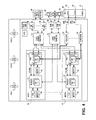
- Figure 5 illustrates an embodiment of traffic generation architecture implemented in each ONU emulator block 410 (of Figure 4 ) for emulating K ONUs.
- the processor 410 of an ONU emulator block 410 includes an OMCI generator 512, an OMCI manager 513 and a control traffic generator 514.
- the FPGA 412 of the ONU emulator block 410 includes a HSIA traffic generator 522, a dynamic bandwidth report upstream (DBRu) traffic generator 523 and a PLOAM traffic generator 524.
- the processor 411 generates upstream OMCI traffic and control traffic and sends the generated traffic to the FPGA 412, which passes them to the OLT 120.
- DBRu dynamic bandwidth report upstream
- the FPGA 412 generates upstream HSIA traffic, DBRu traffic and PLOAM traffic, and sends them to the OLT 120.
- the upstream traffic includes, but is not limited to, a mix of OMCI traffic, PLOAM traffic, HSIA traffic, control traffic and DBRu traffic.
- the processor 411 and the FPGA 412 also exchange logs, statistics, profile data and local traffic.
- Downstream traffic from the OLT 120 includes, but is not limited to, a mix of OMCI traffic, PLOAM traffic, HSIA traffic, Internet Protocol Television (IPTV) traffic, control traffic and DBA related traffic.
- IPTV Internet Protocol Television
- the processor 411 1 also exchange ONU emulator platform OAM messages with the central management system 351 and/or CLI 352.
- the processor 411 may also send logs, statistics, control packets, OMCI packets and PLOAM packets to an external system 510 for analysis.
- the external system 510 may be the central management system 351.
- the FPGA 412 may forward the downstream HSIA traffic and IPTV packets from the OLT 120 to the external traffic generator (analyzer) 360 for analysis.
- the FPGA 412 may also receive HSIA traffic generated by the external traffic generator 360 and forward it as part of the upstream traffic to the OLT 120.
- the operation of the OLT 120, as well as its connection to the emulated ONUs, is managed by the element management system 372 by the exchange of OAM messages between the OLT 120 and the element management system 372.
- FIG 6 is a flow diagram illustrating a method 600 performed by an emulated ONU platform 200 (e.g., the emulated ONU platform 200 of Figure 2 ).
- the emulated ONU platform 200 includes multiple ONU emulator blocks 410 ( Figure 4 ), and each ONU emulator block 410 includes circuitry to emulate multiple emulated ONUs simultaneously.
- the emulated ONU platform 200 executes functions of a plurality of emulated ONUs to enable traffic emulation in a GPON system. Although the operation of one emulated ONU is described, it is understood that multiple emulated ONU platforms 200 may emulate traffic generation of multiple ONUs simultaneously.
- the emulated ONU platform 200 generates OMCI messages according to respective statistical specifications in respective profiles of the emulated ONUs (block 610).
- the OMCI messages include, but are not limited to, one or more of Threshold Crossing Alert (TCA) notifications, alarm notifications, Attribute Value Change (AVC) notifications, and Performance Management (PM) counters.
- TCA Threshold Crossing Alert
- AVC Attribute Value Change
- PM Performance Management
- These OMCI messages may be concurrently generated across any number of the ONU emulator blocks 410 and across any number of the emulated ONU platforms 200.
- the alarm notifications in the OMCI messages may include alarms that are synchronized across any number of the ONU emulator blocks 410 and across any number of the emulated ONU emulator platforms 200.
- the numbers of the ONU emulator blocks 410 and the emulated ONU platforms 200 may be specified (selected) by the respective profiles of the emulated ONUs and/or the test scenarios currently being executed.
- the OMCI messages include emulated responses to messages and commands that were received from the OLT system, such as, but not limited to, configuration management, performance management and software downloads related commands.
- the emulated ONU platform 200 also generates PLOAM messages and DBRu messages according to the respective profiles of the emulated ONUs (block 620).
- the PLOAM messages support various management functions of the GPON.
- the PLOAM messages include emulated responses to messages and commands that were received from the OLT system.
- the DBRu messages arc used by the OLT system for bandwidth allocation purposes.
- the emulated ONU platform 200 also generates data traffic and control traffic according to the respective profiles of the emulated ONUs (block 630).
- An example of the data traffic may include HSIA traffic.
- the HSIA traffic may be transmitted in multiple frame sizes, with multiple Virtual Local Area Network (VLAN) tags and multiple levels of Quality of Service (QoS) per User Network Interface (UNI) of the emulated ONU platform 200.
- Examples of the control traffic may include IGMP, DHCP, PPPoE, ARP, and 802.1x /RADIUS traffic.
- the data traffic and control traffic may be generated per UNI, per GPON Encapsulation Method (GEM) port ID and per Transmission Container (T-CONT).
- GEM GPON Encapsulation Method
- each emulated ONU can be configured to have multiple T-CONTs, where each T-CONT has multiple GEM ports and is treated as a single entity for upstream bandwidth assignments.
- the GEM port ID is used to differentiate the upstream control traffic generated from each control traffic generation/handling instance.
- the GEM port ID is also used to differentiate the upstream data traffic generated from each data traffic generation/handling instance.
- the same GEM port ID is used to differentiate the downstream control traffic addressed to each traffic generation/handling instance, and to differentiate the downstream data traffic addressed to each data traffic generation/handling instance.
- the control traffic includes emulated responses to messages and commands that were received from the OLT system. Generation of the OMCI messages, PLOAM messages, DBRu messages, data traffic and control traffic may be concurrently or in any order. It is understood that the emulated ONU platform 200 may generate additional upstream traffic as necessary.
- the emulated ONU platform 200 formats and encapsulates the OMCI messages, the PLOAM messages, the DBRu messages, the data traffic and the control traffic for upstream transmission to an OLT system according to dynamic (real-time) bandwidth allocation instructions received from the OLT system (block 640).
- the emulated ONU platform 200 then sends the OMCI messages, the PLOAM messages, the DBRu messages, the data traffic and the control traffic upstream to the OLT system (block 650).
- the emulated ONU platform 200 also receives downstream traffic from the OLT system (block 660).
- the profiles of an emulated ONU include an ONU emulation profile, which contains information such as: ONU unique information (e.g., serial number, MAC address, PLOAM password, etc.), ONU variant type (e.g., model, number of Ethernet UNI ports, Plain Old Telephone Service (POTS) ports, etc.), ONU status (e.g. enabled/disabled, activated/ deactivated, ranged, in-service/out-of-service), software version, and the like.
- the ONU emulation profile may also specify the emulation triggers for triggering emulation events on the specified emulated ONU.
- the emulated ONU platform 200 receives the profiles, configuration and commands from the CLI 351 or the central management system 352, according to which the emulated ONUs are created to generate data, management and control traffic for transmission to an OLT.
- the emulated ONU platform 200 may trigger concurrent shutdown, reboot, downloads, or upgrade of the emulated ONUs across a selected number of the ONU emulator blocks 410 and across a selected number of the ONU emulator platforms 200.
- the emulated ONU platform 200 may also trigger synchronized initialization of the emulated ONUs across a selected number of the ONU emulator blocks and across a selected number of the ONU emulator platforms.
- the emulated ONU platform 200 also handles the responses and queries from the OLT and the network.
- the responses from the OLT and the network may be forwarded by the ONUs to an external traffic generator (e.g., the external traffic generator 360 of Figure 3 ), which analyzes the responses.
- the external traffic generator 360 may generate data traffic and send the data traffic to one of the emulated ONU platforms 200, and the emulated ONU platform 200 passes that data traffic upstream to an OLT.
- the emulated ONU platform 200 may also receive emulated HSIA traffic from the external traffic generator 360 via a GbE port, and one or more of the ONU emulator blocks 410 may multiplex the emulated HSIA traffic with internally generated pseudo random data traffic. The multiplexed data traffic may then be sent upstream to the OLT system.
- Figure 7 is a diagram illustrating a process for the emulated ONU platform 200 to process downstream traffic received from an OLT according to one embodiment. Although only one emulated ONU platform is described in connection with Figure 7 , it is understood that the operation of the diagrams of Figure 7 can be performed by multiple emulated ONU platforms concurrently.
- the emulated ONU platform 200 when the emulated ONU platform 200 receives downstream traffic from an OLT (710), it parses the received downstream traffic into five streams: OMCI messages, PLOAM message, data traffic, control traffic and DBA related messages (720). In particular, the emulated ONU platform 200 parses the OMCI messages for generating subsequent upstream frames in response to the OMCI messages (730). It parses the PLOAM messages for generating subsequent upstream frames in response to the PLOAM messages (740). It also parses the control packets for generating subsequent upstream frames in response to the control packets (750). It also parses the DBA related messages for generating subsequent upstream traffic according to the DBA allocation algorithm at the OLT (750).
- the emulated ONU platform 200 may log the received the OMCI messages and the PLOAM messages (770). The logging of the OMCI messages and the PLOAM messages may be enabled/disabled by the operator of the emulated ONU platform 200.
- the emulated ONU platform 200 parses the data traffic and may deliver the data traffic to an external traffic analyzer for analysis of the test results (780). The delivery of the data traffic to an external traffic analyzer may be enabled/disabled by the operator of the emulated ONU platform 200. If this feature (data traffic delivery) is disabled, the emulated ONU platform 200 may drop the received data traffic.
- blocks 770 and 780 are shown in dotted boxes to indicate that the operations of 770 and 780 can be optional.
- Figure 8 illustrates an example process for executing ONU emulator traffic generation test scenarios. Although the operation of one processor and one FPGA is described herein, it is understood that the processors and the FPGAs of one or more emulated ONU platforms may perform the same or similar operations concurrently.
- the process starts with the processor 411 receiving a number of profiles from the central management system 351 and/or CLI 352.
- the profiles include, but are not limited to, OMCI traffic generation profiles, HSIA generation profiles, control traffic generation profiles, PLOAM traffic generation profiles, DBRu traffic generation profiles (810). These received profiles may overwrite or supplement pre-configured ONU emulation profiles (820) and pre-created user test scenarios (830).
- the processor 411 then executes traffic generation software to perform test actions for K emulated ONUs in an emulator block 410 (840).
- the processor 411 passes OMCI traffic and control traffic to the FPGA 412 (850), according to which the FPGA 412 performs test actions for K emulated ONUs in the emulator block 410 (860).
- the processor 411 and the FPGA 412 exchange PLOAM handling data, DBRu handling data, HSIA traffic handling data, logs and statistics, test results, etc. (850).
- the FPGA 412 sends the OMCI traffic, control traffic, HSIA traffic, PLOAM traffic, DBRu traffic to the OLT 120 (870).
- the OLT 120 also sends OMCI traffic, control traffic, HSIA traffic, IPTV traffic, PLOAM traffic, DBA related traffic to the FPGA 412 (870). Additional information, such as test results, software image, test signals, etc., may also be exchanged between the FPGA 412 and the OLT 120 (870).
- the processor 411 may also send OMCI logs, PLOAM logs, system logs and statistics to an external system 510 for analysis (880).
- the FPGA 412 may forward the downstream HSIA traffic and IPTV packets from the OLT 120 to the external traffic generator (analyzer) 360 for analysis (890).
- the FPGA 412 may also receive HSIA traffic generated by the external traffic generator 360 (890) and forward it as part of the upstream traffic to the OLT 120.
- the FPGA 412 may store data logs, statistics logs, system logs, statistics and the like, in a local or remote storage (892).
- the operation of the OLT 120, as well as its connection to the emulated ONUs, is managed by the element management system 372 by the exchange of OAM messages between the OLT 120 and the element management system 372 (894).
- the OAM messages may include configuration, alarms, events, Threshold Crossing Alerts (TCAs), performance management data, software images, test results, and the like.
- TCAs Threshold Crossing Alerts
- the techniques shown in the figures can be implemented using code and data stored and executed on one or more electronic devices (e.g., an end station, a network node).
- electronic devices store and transmit (internally and/or with other electronic devices over a network) code (composed of software instructions) and data using computer-readable media, such as non-transitory tangible computer-readable media (e.g., computer-readable storage media such as magnetic disks; optical disks; read only memory; flash memory devices) and transitory computer-readable transmission media (e.g., electrical, optical, acoustical or other form of propagated signals - such as carrier waves, infrared signals).
- non-transitory tangible computer-readable media e.g., computer-readable storage media such as magnetic disks; optical disks; read only memory; flash memory devices
- transitory computer-readable transmission media e.g., electrical, optical, acoustical or other form of propagated signals - such as carrier waves, infrared signals.
- such electronic devices typically include a set of one or more processors coupled to one or more other components, such as one or more non-transitory machine-readable media (to store code and/or data), user input/output devices (e.g., a keyboard, a touchscreen, and/or a display), and network connections (to transmit code and/or data using propagating signals).
- the coupling of the set of processors and other components is typically through one or more busses and bridges (also termed as bus controllers).
- a non-transitory computer-readable medium of a given electronic device typically stores instructions for execution on one or more processors of that electronic device.
- One or more parts of an embodiment of the invention may be implemented using different combinations of software, firmware, and/or hardware
- a network node e.g., a router, switch, bridge, controller
- a network node is a piece of networking equipment, including hardware and software, that communicatively interconnects other equipment on the network (e.g., other network nodes, end stations).
- Some network nodes are "multiple services network nodes" that provide support for multiple networking functions (e.g., routing, bridging, switching, Layer 2 aggregation, session border control, Quality of Service, and/or subscriber management), and/or provide support for multiple application services (e.g., data, voice, and video).
- Subscriber end stations e.g., servers, workstations, laptops, netbooks, palm tops, mobile phones, smartphones, multimedia phones, Voice Over Internet Protocol (VOIP) phones, user equipment, terminals, portable media players, GPS units, gaming systems, set-top boxes access content/services provided over the Internet and/or content/services provided on virtual private networks (VPNs) overlaid on (e.g., tunneled through) the Internet.
- VOIP Voice Over Internet Protocol
- VPNs virtual private networks
- the content and/or services are typically provided by one or more end stations (e.g., server end stations) belonging to a service or content provider or end stations participating in a peer to peer service, and may include, for example, public webpages (e.g., free content, store fronts, search services), private webpages (e.g., username/password accessed webpages providing email services), and/or corporate networks over VPNs.
- end stations e.g., server end stations
- subscriber end stations are coupled (e.g., through customer premise equipment coupled to an access network (wired or wirelessly)) to edge network nodes, which are coupled (e.g., through one or more core network nodes) to other edge network nodes, which are coupled to other end stations (e.g., server end stations).
Landscapes
- Engineering & Computer Science (AREA)
- Computer Networks & Wireless Communication (AREA)
- Signal Processing (AREA)
- Small-Scale Networks (AREA)
Applications Claiming Priority (1)
| Application Number | Priority Date | Filing Date | Title |
|---|---|---|---|
| US13/645,955 US8818188B2 (en) | 2012-10-05 | 2012-10-05 | Traffic generation and analysis for ONU emulation |
Publications (2)
| Publication Number | Publication Date |
|---|---|
| EP2717593A2 true EP2717593A2 (fr) | 2014-04-09 |
| EP2717593A3 EP2717593A3 (fr) | 2015-04-01 |
Family
ID=49303794
Family Applications (1)
| Application Number | Title | Priority Date | Filing Date |
|---|---|---|---|
| EP13187066.9A Withdrawn EP2717593A3 (fr) | 2012-10-05 | 2013-10-02 | Génération et analyse de trafic pour l'émulation d'un ONU |
Country Status (2)
| Country | Link |
|---|---|
| US (1) | US8818188B2 (fr) |
| EP (1) | EP2717593A3 (fr) |
Cited By (2)
| Publication number | Priority date | Publication date | Assignee | Title |
|---|---|---|---|---|
| CN111385679A (zh) * | 2018-12-29 | 2020-07-07 | 创发信息科技(苏州)有限公司 | 光网络单元自动化测试系统 |
| US11470408B2 (en) * | 2019-09-09 | 2022-10-11 | Viavi Solutions Inc. | Test instruments and methods for emulating optical network terminal (ONT) devices and testing optical networks based on the emulation |
Families Citing this family (13)
| Publication number | Priority date | Publication date | Assignee | Title |
|---|---|---|---|---|
| US8855493B2 (en) * | 2012-10-05 | 2014-10-07 | Telefonaktiebolaget L M Ericsson (Publ) | ONU emulator deployment for mixed types of ONU traffic |
| CN104218995B (zh) * | 2013-06-04 | 2018-06-05 | 中兴通讯股份有限公司 | 一种onu、通信系统及onu通信方法 |
| US9529950B1 (en) | 2015-03-18 | 2016-12-27 | Altera Corporation | Systems and methods for performing profile-based circuit optimization using high-level system modeling |
| CN106330505A (zh) * | 2015-06-29 | 2017-01-11 | 中兴通讯股份有限公司 | 光网络单元onu管理方法、消息处理方法及装置 |
| US10467120B2 (en) * | 2016-11-11 | 2019-11-05 | Silexica GmbH | Software optimization for multicore systems |
| US10623129B2 (en) * | 2017-09-15 | 2020-04-14 | Futurewei Technologies, Inc. | Control and management of a first PON using a second PON |
| CN110858779B (zh) * | 2018-08-24 | 2022-03-29 | 中兴通讯股份有限公司 | Onu通道处理方法、设备以及计算机可读存储介质 |
| US11178004B2 (en) * | 2019-06-06 | 2021-11-16 | 5V Technologies Ltd. | Method for transmitting physical layer operation administration and maintenance message over ethernet and system thereof |
| US10938706B1 (en) | 2019-09-18 | 2021-03-02 | Cisco Technology, Inc. | Systems and methods for providing traffic generation on network devices |
| CN111786816A (zh) * | 2020-06-12 | 2020-10-16 | 芯河半导体科技(无锡)有限公司 | 一种omci配置结果的图形化显示方法 |
| CN116208565A (zh) * | 2021-11-30 | 2023-06-02 | 华为技术有限公司 | 一种数据的传输方法,光发送设备以及光接收设备 |
| CN116781152B (zh) * | 2023-08-24 | 2023-11-17 | 珠海星云智联科技有限公司 | 一种光线路终端设计验证系统、方法、设备以及存储介质 |
| CN118074795A (zh) * | 2024-03-22 | 2024-05-24 | 广州芯德通信科技股份有限公司 | 快速自动检测批量onu稳定性的系统、方法和计算机介质 |
Family Cites Families (7)
| Publication number | Priority date | Publication date | Assignee | Title |
|---|---|---|---|---|
| US7277637B2 (en) * | 2003-01-03 | 2007-10-02 | Tellabs Bedford, Inc. | Fiber to the home broadband home unit |
| US20090324228A1 (en) * | 2008-06-30 | 2009-12-31 | Tellabs Petaluma, Inc. | Ont test unit |
| EP2501058B1 (fr) * | 2009-12-22 | 2018-10-24 | ZTE Corporation | Dispositif pour intégration d'unités de réseau optique |
| CN102136900B (zh) * | 2010-01-22 | 2014-11-05 | 华为技术有限公司 | 无源光网络的时间同步方法、装置及系统 |
| EP2552057B1 (fr) * | 2010-03-24 | 2021-11-03 | Mitsubishi Electric Corporation | Procédé de communication, système de communication optique, terminal de ligne optique et unité de réseau optique |
| FR2966996A1 (fr) * | 2010-10-27 | 2012-05-04 | France Telecom | Traitement de donnees pour la gestion de la mise en veille |
| US9615153B2 (en) * | 2012-05-25 | 2017-04-04 | Avago Technologies General Ip (Singapore) Pte. Ltd. | System and method for applying an extended multipoint protocol to wireless access systems |
-
2012
- 2012-10-05 US US13/645,955 patent/US8818188B2/en not_active Expired - Fee Related
-
2013
- 2013-10-02 EP EP13187066.9A patent/EP2717593A3/fr not_active Withdrawn
Non-Patent Citations (1)
| Title |
|---|
| None |
Cited By (4)
| Publication number | Priority date | Publication date | Assignee | Title |
|---|---|---|---|---|
| CN111385679A (zh) * | 2018-12-29 | 2020-07-07 | 创发信息科技(苏州)有限公司 | 光网络单元自动化测试系统 |
| US11470408B2 (en) * | 2019-09-09 | 2022-10-11 | Viavi Solutions Inc. | Test instruments and methods for emulating optical network terminal (ONT) devices and testing optical networks based on the emulation |
| US20230074614A1 (en) * | 2019-09-09 | 2023-03-09 | Viavi Solutions Inc. | Test instruments and methods for emulating optical network terminal (ont) devices and testing optical networks based on the emulation |
| US11910136B2 (en) * | 2019-09-09 | 2024-02-20 | Viavi Solutions Inc. | Test instruments and methods for emulating optical network terminal (ONT) devices and testing optical networks based on the emulation |
Also Published As
| Publication number | Publication date |
|---|---|
| US8818188B2 (en) | 2014-08-26 |
| EP2717593A3 (fr) | 2015-04-01 |
| US20140099101A1 (en) | 2014-04-10 |
Similar Documents
| Publication | Publication Date | Title |
|---|---|---|
| US8818188B2 (en) | Traffic generation and analysis for ONU emulation | |
| US8855493B2 (en) | ONU emulator deployment for mixed types of ONU traffic | |
| CN101924649B (zh) | 一种无源光网络系统中光网络单元的远程管理方法和系统 | |
| Saridis et al. | Lightness: A function-virtualizable software defined data center network with all-optical circuit/packet switching | |
| US7826378B2 (en) | PON with distributed virtual port loopback | |
| EP3829080A1 (fr) | Procédé et dispositif de localisation de défaillance de pon | |
| CN101675615B (zh) | 使用IEEE 802.1ag方法的千兆位无源光网络运行、管理和维护 | |
| CN102571198B (zh) | 基于仿真onu进行epon性能测试的系统及测试方法 | |
| US10374714B2 (en) | Method for online switching of operation mode of ONT, ONT and OLT | |
| CN108809672A (zh) | 一种虚拟端口的管理方法及装置 | |
| CN110049386B (zh) | 通信网络及相关设备 | |
| US9325580B2 (en) | Method and apparatus for service control on access node | |
| US9900100B2 (en) | Optical line terminal, communication control method, and communication control program | |
| CN105122759B (zh) | 一种接入网中报文处理的方法及网络设备 | |
| CN101834745A (zh) | 一种自动生成onu网元拓扑的方法、服务器及系统 | |
| ES2585004T3 (es) | Método, sistema y aparato para poner en práctica una multidifusión de intercomunicación en una red óptica pasiva | |
| CN104956633B (zh) | 光线路终端、分配点单元、系统及数据流调度方法 | |
| CN101141193B (zh) | 在吉比特无源光网络系统中对用户侧设备远程管理的方法 | |
| CN103795816A (zh) | 无源光网络系统及其配置方法和访问方法 | |
| CN101902274A (zh) | 监控数据传输的方法及光网络单元 | |
| CN106412727B (zh) | 多管理系统管理之下的设备配置协同方法及装置、设备 | |
| Horvath et al. | Time and Memory Complexity of Next-Generation Passive Optical Networks in NS-3 | |
| Parol et al. | How to build a flexible and cost-effective high-speed access network based on FTTB+ LAN architecture | |
| CN106712985B (zh) | 一种多管理系统下的协同管理方法及装置、设备 | |
| Sassi et al. | Integrated management of 10G-PON network element using NETCONF and OpenFlow |
Legal Events
| Date | Code | Title | Description |
|---|---|---|---|
| PUAI | Public reference made under article 153(3) epc to a published international application that has entered the european phase |
Free format text: ORIGINAL CODE: 0009012 |
|
| AK | Designated contracting states |
Kind code of ref document: A2 Designated state(s): AL AT BE BG CH CY CZ DE DK EE ES FI FR GB GR HR HU IE IS IT LI LT LU LV MC MK MT NL NO PL PT RO RS SE SI SK SM TR |
|
| AX | Request for extension of the european patent |
Extension state: BA ME |
|
| PUAL | Search report despatched |
Free format text: ORIGINAL CODE: 0009013 |
|
| AK | Designated contracting states |
Kind code of ref document: A3 Designated state(s): AL AT BE BG CH CY CZ DE DK EE ES FI FR GB GR HR HU IE IS IT LI LT LU LV MC MK MT NL NO PL PT RO RS SE SI SK SM TR |
|
| AX | Request for extension of the european patent |
Extension state: BA ME |
|
| RIC1 | Information provided on ipc code assigned before grant |
Ipc: H04Q 11/00 20060101AFI20150220BHEP Ipc: H04L 12/24 20060101ALI20150220BHEP Ipc: H04L 12/26 20060101ALI20150220BHEP |
|
| STAA | Information on the status of an ep patent application or granted ep patent |
Free format text: STATUS: THE APPLICATION IS DEEMED TO BE WITHDRAWN |
|
| 18D | Application deemed to be withdrawn |
Effective date: 20151002 |