EP2719112B1 - Procédés et appareils pour des perfectionnements basés sur un équipement utilisateur d'une commande de liaison radio pour des transmissions sans fil multipoint - Google Patents
Procédés et appareils pour des perfectionnements basés sur un équipement utilisateur d'une commande de liaison radio pour des transmissions sans fil multipoint Download PDFInfo
- Publication number
- EP2719112B1 EP2719112B1 EP12727088.2A EP12727088A EP2719112B1 EP 2719112 B1 EP2719112 B1 EP 2719112B1 EP 12727088 A EP12727088 A EP 12727088A EP 2719112 B1 EP2719112 B1 EP 2719112B1
- Authority
- EP
- European Patent Office
- Prior art keywords
- user equipment
- gap
- data stream
- sequence number
- nak
- Prior art date
- Legal status (The legal status is an assumption and is not a legal conclusion. Google has not performed a legal analysis and makes no representation as to the accuracy of the status listed.)
- Active
Links
Images





Classifications
-
- H—ELECTRICITY
- H04—ELECTRIC COMMUNICATION TECHNIQUE
- H04L—TRANSMISSION OF DIGITAL INFORMATION, e.g. TELEGRAPHIC COMMUNICATION
- H04L1/00—Arrangements for detecting or preventing errors in the information received
- H04L1/12—Arrangements for detecting or preventing errors in the information received by using return channel
- H04L1/16—Arrangements for detecting or preventing errors in the information received by using return channel in which the return channel carries supervisory signals, e.g. repetition request signals
- H04L1/18—Automatic repetition systems, e.g. Van Duuren systems
- H04L1/1829—Arrangements specially adapted for the receiver end
- H04L1/1848—Time-out mechanisms
-
- H—ELECTRICITY
- H04—ELECTRIC COMMUNICATION TECHNIQUE
- H04L—TRANSMISSION OF DIGITAL INFORMATION, e.g. TELEGRAPHIC COMMUNICATION
- H04L1/00—Arrangements for detecting or preventing errors in the information received
- H04L1/12—Arrangements for detecting or preventing errors in the information received by using return channel
- H04L1/16—Arrangements for detecting or preventing errors in the information received by using return channel in which the return channel carries supervisory signals, e.g. repetition request signals
- H04L1/18—Automatic repetition systems, e.g. Van Duuren systems
- H04L1/1829—Arrangements specially adapted for the receiver end
- H04L1/1835—Buffer management
- H04L1/1841—Resequencing
-
- H—ELECTRICITY
- H04—ELECTRIC COMMUNICATION TECHNIQUE
- H04L—TRANSMISSION OF DIGITAL INFORMATION, e.g. TELEGRAPHIC COMMUNICATION
- H04L1/00—Arrangements for detecting or preventing errors in the information received
- H04L2001/0092—Error control systems characterised by the topology of the transmission link
Definitions
- aspects of the present disclosure relate generally to wireless communication systems, and more particularly, to downlink channel aggregation in high-speed wireless networks.
- Wireless communication networks are widely deployed to provide various communication services such as telephony, video, data, messaging, broadcasts, and so on.
- Such networks which are usually multiple access networks, support communications for multiple users by sharing the available network resources.
- UTRAN UMTS Terrestrial Radio Access Network
- the UTRAN is the radio access network (RAN) defined as a part of the Universal Mobile Telecommunications System (UMTS), a third generation (3G) mobile phone technology supported by the 3rd Generation Partnership Project (3GPP).
- UMTS Universal Mobile Telecommunications System
- 3GPP 3rd Generation Partnership Project
- the UMTS which is the successor to Global System for Mobile Communications (GSM) technologies, currently supports various air interface standards, such as Wideband-Code Division Multiple Access (W-CDMA), Time Division-Code Division Multiple Access (TD-CDMA), and Time Division-Synchronous Code Division Multiple Access (TD- SCDMA).
- W-CDMA Wideband-Code Division Multiple Access
- TD-CDMA Time Division-Code Division Multiple Access
- TD- SCDMA Time Division-Synchronous Code Division Multiple Access
- the UMTS also supports enhanced 3G data communications protocols, such as High Speed Packet Access (HSDPA), which provides higher data transfer speeds and capacity to associated UMTS networks.
- HSDPA High Speed Packet Access
- the data stream is split for two cells to transmit.
- intra-NodeB MP TX a single Medium Access Control (MAC) entity is shared by the two cells, and thus the split can occur at the MAC layer.
- inter-NodeB MP TX the MAC entity at each NodeB is separate.
- RLC Radio Link Control
- data packets can result in out-of-order delivery, or skew, between the two MAC entities on a downlink to user equipment (UE).
- UE has incomplete knowledge about the transmission in that skew cannot be readily distinguished from data loss.
- US2005/0270996A1 describes an unacknowledged mode radio link control (RLC) entity which receives RLC protocol data units (PDU) delivered through one or more logical channels and re-orders the received PDUs by referring to their sequence numbers and by using a receive window and timer to minimize delivery delay time, to reduce missing PDUs received from each logical channel and to process the PDUs by avoiding duplicate PDUs.
- RLC radio link control
- the present disclosure provides a method for wireless communication as set out in claim 1.
- the present disclosure provides a computer program produce of wireless communications as set out in claim 4.
- the present disclosure provides a user equipment for wireless communication as set out in claim 5.
- the one or more aspects comprise the features hereinafter described in detail and particularly pointed out in the claims.
- the following description and the annexed drawings set forth in detail certain illustrative features of the one or more aspects. These features are indicative, however, of but a few of the various ways in which the principles of various aspects may be employed, and this description is intended to include all such aspects and their equivalents.
- the invention is defined and limited by the scope of appended claims 1-5. In the following description, any embodiment(s) referred to and not falling within the scope of the appended claims, is (are) merely example(s) useful to the understanding of the invention.
- the incoming data stream has to be split for the two cells at the two Node Bs.
- One option is to split the data at the radio link control layer (RLC).
- RLC radio link control layer
- RLC enhancements are necessary to solve the issue of out-of-order delivery, or skew, between the two Media Access Control (MAC) entities.
- MAC Media Access Control
- a UE based approach can address skew in a manner that reduces feedback overhead.
- the present disclosure provides an apparatus, depicted as user equipment 100 for wireless communication.
- UE 100 receives multi-point (MP) transmissions (TX) on a downlink 102 from first cell and a second cell, depicted respectively as a first NodeB 104 and a second NodeB 106 of a communication network 108.
- a Radio Network Controller (RNC) 110 separate a transmission data stream 112 into a first data stream 114 and a second data stream 116 for inter-NodeB transmission respectively by the first NodeB 104 and a second NodeB 106.
- RNC Radio Network Controller
- a transceiver 118 of the UE 100 receives the first data stream 114 from a first Medium Access Control (MAC) entity 120 of the first cell (first NodeB 104 ) and a second data stream 116 from a second MAC entity 122 of the second cell (second NodeB 106 ).
- a Radio Link Control (RLC) receiver 124 of the UE 100 decodes RLC Packet Data Units (PDUs) having respective sequence numbers from the first data stream 114 and the second data stream 116.
- the transceiver 118 further transmits an acknowledgment (ACK) for successfully received RLC PDUs.
- MAC Medium Access Control
- ACK acknowledgment
- a multipoint aggregation component 130 detects a gap in sequence numbers in a sequence number queue made up of sequence numbers from the first data stream 114 and sequence numbers from the second data stream 116, delays transmitting a not acknowledged (NAK) by starting a NAK delay timer 132, and transmits, by the transceiver 118, NAK for the gap in sequence numbers in the sequence number queue in response to the NAK delay timer 132 expiring and detecting that the gap has not been filled during the delaying.
- NAK not acknowledged
- the RLC receiver 124 further decodes the RLC PDUs by identifying that a selected RLC PDU was transmitted by the first MAC entity 120 or the second MAC entity 122.
- the multipoint aggregation component 130 further determines whether the gap in sequence numbers in the sequence number queue is due to skew by out-of-order delivery or due to data loss by tracking sequence numbers for RLC PDUs received from each of the first MAC entity 120 and the second MAC entity 122, determining a highest sequence number respectively corresponding to each of the first MAC entity 120 and the second MAC entity 122, wherein the transmitting the NAK for the gap in sequence numbers in the sequence number queue is in response to determining that the gap in sequence numbers in the sequence number queue is lower than each of the respective highest sequence numbers.
- the multipoint aggregation component 130 further determines a skew duration when the gap in sequence numbers in the sequence number queue is subsequently filled, and adapts the NAK delay timer 132 to correspond to the skew duration.
- a hardware implementation for the apparatus can employ a processing system 140.
- the processing system 140 may be implemented with a bus architecture, represented generally by the bus 142.
- the bus 142 may include any number of interconnecting buses and bridges depending on the specific application of the processing system 140 and the overall design constraints.
- the bus 142 links together various circuits including one or more processors, represented generally by a processor 144, and computer-readable media, represented generally by a computer-readable medium 146.
- the bus 142 may also link various other circuits such as timing sources, peripherals, voltage regulators, and power management circuits, which are well known in the art, and therefore, will not be described any further.
- a bus interface 148 provides an interface between the bus 142 and a transceiver 118 comprising a transmitter 150 and a receiver 152.
- the transceiver 118 provides a means for communicating with various other apparatus over a transmission medium.
- a user interface 154 e.g., keypad, display, speaker, microphone, joystick
- the processor 144 is responsible for managing the bus 142 and general processing, including the execution of software stored on the computer-readable medium 146.
- the software when executed by the processor 144, causes the processing system 140 to perform the various functions described infra for any particular apparatus.
- the computer-readable medium 146 may also be used for storing data that is manipulated by the processor 144 when executing software.
- the multipoint aggregation component 130 can reside at least in part within the computer-readable medium 146.
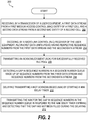
- the present disclosure provides a methodology 200 for wireless communication.
- the method further comprises receiving, by a transceiver of a user equipment, a first data stream from a first MAC entity of a first cell and a second data stream from a second MAC entity of a second cell (block 202 ).
- Decoding is performed by a RLC receiver of the user equipment of RLC PDUs having respective sequence numbers from the first data stream and the second data stream (block 204 ).
- An ACK is transmitted for successfully received RLC PDUs (block 206 ).
- a gap is detected in sequence numbers in a sequence number queue, which is made up of sequence numbers from the first data stream and sequence numbers from the second data stream (block 208 ).
- Transmitting a NAK is delayed by starting a NAK delay timer (block 210 ).
- the NAK is transmitted for the gap in sequence numbers in the sequence number queue in response to the NAK delay timer expiring and detecting that the gap has not been filled during the delaying (block 212 ).
- the method 200 further comprises decoding the RLC PDUs further comprises identifying that a selected RLC PDU was transmitted by the first MAC entity or the second MAC entity.
- the method 200 further comprises determining whether the gap in sequence numbers in the sequence number queue is due to skew by out-of-order delivery or due to data loss by tracking sequence numbers for RLC PDUs received from each of the first MAC entity and the second MAC entity, determining a highest sequence number respectively for each of the first MAC entity and the second MAC entity, and transmitting the NAK for the gap in sequence numbers in the sequence number queue in response to determining that the gap in sequence numbers is lower than all of the highest sequence numbers.
- the method 200 further comprises tracking a skew duration by detecting when the gap in sequence numbers in the sequence number queue is subsequently filled, and adapting the NAK delay timer to correspond to the skew duration.
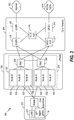
- a UMTS network includes three interacting domains: a Core Network (CN) 304, a UMTS Terrestrial Radio Access Network (UTRAN) 302, and User Equipment (UE) 310.
- CN Core Network
- UTRAN UMTS Terrestrial Radio Access Network
- UE User Equipment
- the UTRAN 302 provides various wireless services including telephony, video, data, messaging, broadcasts, and/or other services.
- the UTRAN 302 may include a plurality of Radio Network Subsystems (RNSs) such as an RNS 303, each controlled by a respective Radio Network Controller (RNC) such as an RNC 306.
- RNSs Radio Network Subsystems
- RNC Radio Network Controller
- the UTRAN 302 may include any number of RNCs 306 and RNSs 303 in addition to the RNCs 306 and RNSs 303 illustrated herein.
- the RNC 306 is an apparatus responsible for, among other things, assigning, reconfiguring, and releasing radio resources within the RNS 303.
- the RNC 306 may be interconnected to other RNCs (not shown) in the UTRAN 302 through various types of interfaces such as a direct physical connection, a virtual network, or the like, using any suitable transport network.
- Communication between a UE 310 and a NodeB 308 may be considered as including a physical (PHY) layer and a medium access control (MAC) layer. Further, communication between a UE 310 and an RNC 306 by way of a respective NodeB 308 may be considered as including a radio resource control (RRC) layer.
- RRC radio resource control
- the PHY layer may be considered layer 1; the MAC layer may be considered layer 2; and the RRC layer may be considered layer 3.
- Information herein below utilizes terminology introduced in Radio Resource Control (RRC) Protocol Specification, 3GPP TS 25.331 v9.1.0.
- the geographic region covered by the SRNS 303 may be divided into a number of cells, with a radio transceiver apparatus serving each cell.
- a radio transceiver apparatus is commonly referred to as a NodeB in UMTS applications, but may also be referred to by those skilled in the art as a base station (BS), a base transceiver station (BTS), a radio base station, a radio transceiver, a transceiver function, a basic service set (BSS), an extended service set (ESS), an access point (AP), or some other suitable terminology.
- BS basic service set
- ESS extended service set
- AP access point
- three NodeBs 308 are shown in each SRNS 303; however, the SRNSs 303 may include any number of wireless NodeBs.
- the NodeBs 308 provide wireless access points to a core network (CN) 304 for any number of mobile apparatuses.
- a mobile apparatus include a cellular phone, a smart phone, a session initiation protocol (SIP) phone, a laptop, a notebook, a netbook, a smartbook, a personal digital assistant (PDA), a satellite radio, a global positioning system (GPS) device, a multimedia device, a video device, a digital audio player (e.g., MP3 player), a camera, a game console, or any other similar functioning device.
- SIP session initiation protocol
- PDA personal digital assistant
- GPS global positioning system
- multimedia device e.g., a digital audio player (e.g., MP3 player), a camera, a game console, or any other similar functioning device.
- MP3 player digital audio player
- the mobile apparatus is commonly referred to as user equipment (UE) in UMTS applications, but may also be referred to by those skilled in the art as a mobile station (MS), a subscriber station, a mobile unit, a subscriber unit, a wireless unit, a remote unit, a mobile device, a wireless device, a wireless communications device, a remote device, a mobile subscriber station, an access terminal (AT), a mobile terminal, a wireless terminal, a remote terminal, a handset, a terminal, a user agent, a mobile client, a client, or some other suitable terminology.
- the UE 310 may further include a universal subscriber identity module (USIM) 311, which contains a user's subscription information to a network.
- USIM universal subscriber identity module
- DL downlink
- UL uplink
- the core network 304 interfaces with one or more access networks, such as the UTRAN 302.
- the core network 304 is a GSM core network.
- GSM Global System for Mobile communications
- the core network 304 includes a circuit-switched (CS) domain and a packet-switched (PS) domain.
- Some of the circuit-switched elements are a Mobile services Switching Centre (MSC), a Visitor location register (VLR) and a Gateway MSC.
- Packet-switched elements include a Serving GPRS Support Node (SGSN) and a Gateway GPRS Support Node (GGSN).
- Some network elements, like EIR, HLR, VLR and AuC may be shared by both of the circuit-switched and packet-switched domains.
- the core network 304 supports circuit-switched services with a MSC 312 and a GMSC 314.
- the GMSC 314 may be referred to as a media gateway (MGW).
- MGW media gateway
- One or more RNCs, such as the RNC 306, may be connected to the MSC 312.
- the MSC 312 is an apparatus that controls call setup, call routing, and UE mobility functions.
- the MSC 312 also includes a visitor location register (VLR) that contains subscriber-related information for the duration that a UE is in the coverage area of the MSC 312.
- VLR visitor location register
- the GMSC 314 provides a gateway through the MSC 312 for the UE to access a circuit-switched network 316.
- the GMSC 314 includes a home location register (HLR) 315 containing subscriber data, such as the data reflecting the details of the services to which a particular user has subscribed.
- HLR home location register
- the HLR is also associated with an authentication center (AuC) that contains subscriber-specific authentication data.
- AuC authentication center
- the GMSC 314 queries the HLR 315 to determine the UE's location and forwards the call to the particular MSC serving that location.
- the core network 304 also supports packet-data services with a serving GPRS support node (SGSN) 318 and a gateway GPRS support node (GGSN) 320.
- GPRS which stands for General Packet Radio Service, is designed to provide packet-data services at speeds higher than those available with standard circuit-switched data services.
- the GGSN 320 provides a connection for the UTRAN 302 to a packet-based network 322.
- the packet-based network 322 may be the Internet, a private data network, or some other suitable packet-based network.
- the primary function of the GGSN 320 is to provide the UEs 310 with packet-based network connectivity. Data packets may be transferred between the GGSN 320 and the UEs 310 through the SGSN 318, which performs primarily the same functions in the packet-based domain as the MSC 312 performs in the circuit-switched domain.
- the UMTS air interface is a spread spectrum Direct-Sequence Code Division Multiple Access (DS-CDMA) system.
- the spread spectrum DS-CDMA spreads user data through multiplication by a sequence of pseudorandom bits called chips.
- the W-CDMA air interface for UMTS is based on such direct sequence spread spectrum technology and additionally calls for a frequency division duplexing (FDD).
- FDD uses a different carrier frequency for the uplink (UL) and downlink (DL) between a NodeB 308 and a UE 310.
- Another air interface for UMTS that utilizes DS-CDMA, and uses time division duplexing, is the TD-SCDMA air interface.
- HSPA air interface includes a series of enhancements to the 3G/W-CDMA air interface, facilitating greater throughput and reduced latency.
- HSPA utilizes hybrid automatic repeat request (HARQ), shared channel transmission, and adaptive modulation and coding.
- HARQ hybrid automatic repeat request
- the standards that define HSPA include HSDPA (high speed downlink packet access) and HSUPA (high speed uplink packet access, also referred to as enhanced uplink, or EUL).
- HSDPA utilizes as its transport channel the high-speed downlink shared channel (HS-DSCH).
- the HS-DSCH is implemented by three physical channels: the high-speed physical downlink shared channel (HS-PDSCH), the high-speed shared control channel (HS-SCCH), and the high-speed dedicated physical control channel (HS-DPCCH).
- HS-PDSCH high-speed physical downlink shared channel
- HS-SCCH high-speed shared control channel
- HS-DPCCH high-speed dedicated physical control channel
- the HS-DPCCH carries the HARQ ACK/NACK signaling on the uplink to indicate whether a corresponding packet transmission was decoded successfully. That is, with respect to the downlink, the UE 310 provides feedback to the NodeB 308 over the HS-DPCCH to indicate whether it correctly decoded a packet on the downlink.
- HS-DPCCH further includes feedback signaling from the UE 310 to assist the NodeB 308 in taking the right decision in terms of modulation and coding scheme and precoding weight selection, this feedback signaling including the CQI and PCI.
- HSPA Evolved or HSPA+ is an evolution of the HSPA standard that includes MIMO and 64-QAM, enabling increased throughput and higher performance. That is, in an aspect of the disclosure, the NodeB 308 and/or the UE 310 may have multiple antennas supporting MIMO technology. The use of MIMO technology enables the NodeB 308 to exploit the spatial domain to support spatial multiplexing, beamforming, and transmit diversity.
- MIMO Multiple Input Multiple Output
- MIMO systems generally enhance data transmission performance, enabling diversity gains to reduce multipath fading and increase transmission quality, and spatial multiplexing gains to increase data throughput.
- Spatial multiplexing may be used to transmit different streams of data simultaneously on the same frequency.
- the data steams may be transmitted to a single UE 310 to increase the data rate or to multiple UEs 310 to increase the overall system capacity. This is achieved by spatially precoding each data stream and then transmitting each spatially precoded stream through a different transmit antenna on the downlink.
- the spatially precoded data streams arrive at the UE(s) 310 with different spatial signatures, which enables each of the UE(s) 310 to recover the one or more the data streams destined for that UE 310.
- each UE 310 may transmit one or more spatially precoded data streams, which enables the NodeB 308 to identify the source of each spatially precoded data stream.
- Spatial multiplexing may be used when channel conditions are good.
- beamforming may be used to focus the transmission energy in one or more directions, or to improve transmission based on characteristics of the channel. This may be achieved by spatially precoding a data stream for transmission through multiple antennas. To achieve good coverage at the edges of the cell, a single stream beamforming transmission may be used in combination with transmit diversity.
- n transport blocks may be transmitted simultaneously over the same carrier utilizing the same channelization code. Note that the different transport blocks sent over the n transmit antennas may have the same or different modulation and coding schemes from one another.
- Single Input Multiple Output generally refers to a system utilizing a single transmit antenna (a single input to the channel) and multiple receive antennas (multiple outputs from the channel).
- a single transport block is sent over the respective carrier.
- UE 310 can incorporate an MP aggregation component 130 that can perform the methodology 200 and other aspects as described herein.
- the multiple access wireless communication system includes multiple cellular regions (cells), including cells 402, 404, and 406, each of which may include one or more sectors.
- the multiple sectors can be formed by groups of antennas with each antenna responsible for communication with UEs in a portion of the cell. For example, in cell 402, antenna groups 412, 414, and 416 may each correspond to a different sector. In cell 404, antenna groups 418, 420, and 422 each correspond to a different sector. In cell 406, antenna groups 424, 426, and 428 each correspond to a different sector.
- the cells 402, 404 and 406 may include several wireless communication devices, e.g., User Equipment or UEs, which may be in communication with one or more sectors of each cell 402, 404 or 406.
- UEs 430 and 432 may be in communication with NodeB 442
- UEs 434 and 436 may be in communication with NodeB 444
- UEs 438 and 440 can be in communication with NodeB 446.
- each NodeB 442, 444, 446 is configured to provide an access point to a core network for all the UEs 430, 412, 434, 436, 438, 440 in the respective cells 402, 404, and 406.
- a serving cell change (SCC) or handover may occur in which communication with the UE 434 transitions from the cell 404, which may be referred to as the source cell, to cell 406, which may be referred to as the target cell.
- Management of the handover procedure may take place at the UE 434, at the NodeBs corresponding to the respective cells, at a radio network controller 406, or at another suitable node in the wireless network.
- the UE 434 may monitor various parameters of the source cell 404 as well as various parameters of neighboring cells such as cells 406 and 402.
- the UE 434 may maintain communication with one or more of the neighboring cells. During this time, the UE 434 may maintain an Active Set, that is, a list of cells that the UE 434 is simultaneously connected to (i.e., the UTRA cells that are currently assigning a downlink dedicated physical channel DPCH or fractional downlink dedicated physical channel F-DPCH to the UE 434 may constitute the Active Set).
- an Active Set that is, a list of cells that the UE 434 is simultaneously connected to (i.e., the UTRA cells that are currently assigning a downlink dedicated physical channel DPCH or fractional downlink dedicated physical channel F-DPCH to the UE 434 may constitute the Active Set).
- the modulation and multiple access scheme employed by the access network 400 may vary depending on the particular telecommunications standard being deployed.
- the standard may include Evolution-Data Optimized (EV-DO) or Ultra Mobile Broadband (UMB).
- EV-DO and UMB are air interface standards promulgated by the 3rd Generation Partnership Project 2 (3GPP2) as part of the CDMA2000 family of standards and employs CDMA to provide broadband Internet access to mobile stations.
- 3GPP2 3rd Generation Partnership Project 2
- the standard may alternately be Universal Terrestrial Radio Access (UTRA) employing Wideband-CDMA (W-CDMA) and other variants of CDMA, such as TD-SCDMA; Global System for Mobile Communications (GSM) employing TDMA; and Evolved UTRA (E-UTRA), Ultra Mobile Broadband (UMB), IEEE 802.11 (Wi-Fi), IEEE 802.16 (WiMAX), IEEE 802.20, and Flash-OFDM employing OFDMA.
- UTRA, E-UTRA, UMTS, LTE, LTE Advanced, and GSM are described in documents from the 3GPP organization.
- CDMA2000 and UMB are described in documents from the 3GPP2 organization.
- the actual wireless communication standard and the multiple access technology employed will depend on the specific application and the overall design constraints imposed on the system.
- the UE 432 can incorporate an MP aggregation component 130 that can perform the methodology 200 and other aspects as described herein.
- FIG. 5 is a block diagram of a NodeB 510 in communication with a UE 550, where the NodeB 510 may be the NodeB 500 ( FIG. 5 ), and the UE 550 may be the UE 514 ( FIG. 5 ).
- a transmit processor 520 may receive data from a data source 512 and control signals from a controller/processor 540. The transmit processor 520 provides various signal processing functions for the data and control signals, as well as reference signals (e.g., pilot signals).
- the transmit processor 520 may provide cyclic redundancy check (CRC) codes for error detection, coding and interleaving to facilitate forward error correction (FEC), mapping to signal constellations based on various modulation schemes (e.g., binary phase-shift keying (BPSK), quadrature phase-shift keying (QPSK), M-phase-shift keying (M-PSK), M-quadrature amplitude modulation (M-QAM), and the like), spreading with orthogonal variable spreading factors (OVSF), and multiplying with scrambling codes to produce a series of symbols.
- BPSK binary phase-shift keying
- QPSK quadrature phase-shift keying
- M-PSK M-phase-shift keying
- M-QAM M-quadrature amplitude modulation
- OVSF orthogonal variable spreading factors
- channel estimates may be derived from a reference signal transmitted by the UE 550 or from feedback from the UE 550.
- the symbols generated by the transmit processor 520 are provided to a transmit frame processor 530 to create a frame structure.
- the transmit frame processor 530 creates this frame structure by multiplexing the symbols with information from the controller/processor 540, resulting in a series of frames.
- the frames are then provided to a transmitter 532, which provides various signal conditioning functions including amplifying, filtering, and modulating the frames onto a carrier for downlink transmission over the wireless medium through antenna 534.
- the antenna 534 may include one or more antennas, for example, including beam steering bidirectional adaptive antenna arrays or other similar beam technologies.
- a receiver 554 receives the downlink transmission through an antenna 552 and processes the transmission to recover the information modulated onto the carrier.
- the information recovered by the receiver 554 is provided to a receive frame processor 560, which parses each frame, and provides information from the frames to a channel processor 594 and the data, control, and reference signals to a receive processor 570.
- the receive processor 570 then performs the inverse of the processing performed by the transmit processor 520 in the NodeB 510. More specifically, the receive processor 570 descrambles and despreads the symbols, and then determines the most likely signal constellation points transmitted by the NodeB 510 based on the modulation scheme. These soft decisions may be based on channel estimates computed by the channel processor 594.
- the soft decisions are then decoded and deinterleaved to recover the data, control, and reference signals.
- the CRC codes are then checked to determine whether the frames were successfully decoded.
- the data carried by the successfully decoded frames will then be provided to a data sink 572, which represents applications running in the UE 550 and/or various user interfaces (e.g., display).
- Control signals carried by successfully decoded frames will be provided to a controller/processor 590.
- the controller/processor 590 may also use an acknowledgement (ACK) and/or negative acknowledgement (NACK) protocol to support retransmission requests for those frames.
- ACK acknowledgement
- NACK negative acknowledgement
- a transmit processor 580 receives data from a data source 578 and control signals from the controller/processor 590 and provides various signal processing functions including CRC codes, coding and interleaving to facilitate FEC, mapping to signal constellations, spreading with OVSFs, and scrambling to produce a series of symbols.
- Channel estimates may be used to select the appropriate coding, modulation, spreading, and/or scrambling schemes.
- the symbols produced by the transmit processor 580 will be provided to a transmit frame processor 582 to create a frame structure.
- the transmit frame processor 582 creates this frame structure by multiplexing the symbols with information from the controller/processor 590, resulting in a series of frames.
- the frames are then provided to a transmitter 556, which provides various signal conditioning functions including amplification, filtering, and modulating the frames onto a carrier for uplink transmission over the wireless medium through the antenna 552.
- the uplink transmission is processed at the NodeB 510 in a manner similar to that described in connection with the receiver function at the UE 550.
- a receiver 535 receives the uplink transmission through the antenna 534 and processes the transmission to recover the information modulated onto the carrier.
- the information recovered by the receiver 535 is provided to a receive frame processor 536, which parses each frame, and provides information from the frames to the channel processor 544 and the data, control, and reference signals to a receive processor 538.
- the receive processor 538 performs the inverse of the processing performed by the transmit processor 580 in the UE 550.
- the data and control signals carried by the successfully decoded frames may then be provided to a data sink 535 and the controller/processor, respectively. If some of the frames were unsuccessfully decoded by the receive processor, the controller/processor 540 may also use an acknowledgement (ACK) and/or negative acknowledgement (NAK) protocol to support retransmission requests for those frames.
- ACK acknowledgement
- NAK negative acknowledgement
- the controller/processors 540 and 590 may be used to direct the operation at the NodeB 510 and the UE 550, respectively.
- the controller/processors 540 and 590 may provide various functions including timing, peripheral interfaces, voltage regulation, power management, and other control functions.
- the computer readable media of memories 542 and 592 may store data and software for the NodeB 510 and the UE 550, respectively.
- a scheduler/processor 546 at the NodeB 510 may be used to allocate resources to the UEs and schedule downlink and/or uplink transmissions for the UEs.
- the receiver processor 570 can utilize an RLC Receiver 124 that decodes RLC PDUs for an MP aggregation component 130 that is resident respectively in memory 592.
- the radio protocol architecture may take on various forms depending on the particular application.
- An example for an HSPA system will now be presented with reference to FIG. 6.
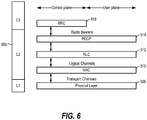
- FIG. 6 is a conceptual diagram illustrating an example of the radio protocol architecture for the user and control planes.
- Layer 1 is the lowest lower and implements various physical layer signal processing functions. Layer 1 will be referred to herein as the physical layer 606.
- Layer 2 (L2 layer) 608 is above the physical layer 606 and is responsible for the link between the UE and node B over the physical layer 606.
- the L2 layer 608 includes a media access control (MAC) sublayer 610, a radio link control (RLC) sublayer 612, and a packet data convergence protocol (PDCP) 614 sublayer, which are terminated at the node B on the network side.
- MAC media access control
- RLC radio link control
- PDCP packet data convergence protocol
- the UE may have several upper layers above the L2 layer 608 including a network layer (e.g., IP layer) that is terminated at a PDN gateway on the network side, and an application layer that is terminated at the other end of the connection (e.g., far end UE, server, etc.).
- IP layer e.g., IP layer
- the PDCP sublayer 614 provides multiplexing between different radio bearers and logical channels.
- the PDCP sublayer 614 also provides header compression for upper layer data packets to reduce radio transmission overhead, security by ciphering the data packets, and handover support for UEs between NodeBs.
- the RLC sublayer 612 provides segmentation and reassembly of upper layer data packets, retransmission of lost data packets, and reordering of data packets to compensate for out-of-order reception due to hybrid automatic repeat request (HARQ).
- HARQ hybrid automatic repeat request
- the MAC sublayer 610 provides multiplexing between logical and transport channels.
- the MAC sublayer 610 is also responsible for allocating the various radio resources (e.g., resource blocks) in one cell among the UEs.
- the MAC sublayer 610 is also responsible for HARQ operations.
- the incoming data stream in HSDPA multi-point transmission has to be split for the two cells.
- the split is on the MAC layer, namely, the two cells have a shared MAC entity and separate physical layer entities including separate HARQs.
- the split must be above MAC since the MAC entity at each Node B must be separate.
- One option is to split the data at RLC. In this case, RLC enhancements are necessary to solve the issue of out-of-order delivery, or skew, between the two MAC entities.
- a method 800 is provided for aggregating data in wireless communication at a UE.
- Data received by inter-NodeB HSPDA MP TX (block 802 ).
- RLU PDU is decoded by UE RLC receiver (block 804 ).
- a determination is made either explicitly or implicitly as to whether the respective MAC entity identified itself to the RLC (block 806 ). If not, a determination is made as to whether this is a new gap (block 808 ). If so, a new NAKDelayTimer is started (block 810 ). If not a new gap in block 808 or after block 810, then a further determination is made as to whether any NAKDelayTimer has expired (block 812 ). If so, the corresponding NAK is transmitted (block 814 ).
- adaptive timer adjustments can be achieved by determining skew duration (block 816 ). Then, the NAKDelayTimer can be adapted in correspondence to the skew duration (block 818 ).
- the RLC receiver can map the decoded RLU PDUs to the transmitting cell (NodeB) (block 820 ). With this information, then skew can be distinguished from genuine data loss (block 822 )
- a gap is detected in RLC sequence numbers (SN) in a sequence number queue made up of sequence numbers from a first data stream and a second data stream (block 902 ).
- the highest SN ACKed to all cells is determined based upon the decoded RLC PDUs delivered from all MAC entities (block 904 ). From these, a further determination is made to which is the lowest SN of these highest SN ACKed to all cells (block 906 ). Then a determination is made as to whether the SN gap is lowest (lower than the previously identified lowest of the highest SN ACKED to all cells) (block 908 ).
- processing can proceed to block 916 to expedite sending the NAK without waiting for a corresponding NAKDelayTimer to expire.
- system 1000 can reside at least partially within user equipment that is capable of Over-The-Air (OTA) communication.
- system 1000 is represented as including functional blocks, which can be functional blocks that represent functions implemented by a computing platform, processor, software, or combination thereof (e.g., firmware).
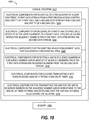
- System 1000 includes a logical grouping 1002 of electrical components that can act in conjunction.
- logical grouping 1002 can include an electrical component 1004 for receiving, by a transceiver of user equipment, a first data stream from a first Medium Access Control (MAC) entity of a first cell and a second data stream from a second MAC entity of a second cell.
- MAC Medium Access Control
- logical grouping 1002 can include an electrical component 1006 for decoding, by a Radio Link Control (RLC) receiver of the user equipment, RLC Packet Data Units (PDUs) having respective sequence numbers from the first data stream and the second data stream. Further, logical grouping 1002 can include an electrical component 1008 for transmitting an acknowledgment (ACK) for successfully received RLC PDUs. Further, logical grouping 1002 can include an electrical component 1010 for detecting a gap in sequence numbers in a sequence number queue made up of sequence numbers from the first data stream and sequence numbers from the second data stream. In addition, logical grouping 1002 can include an electrical component 1012 for delaying transmitting a not acknowledged (NAK) by starting a NAK delay timer.
- NAK not acknowledged
- logical grouping 1002 can include an electrical component 1014 for transmitting the NAK for the gap in sequence numbers in the sequence number queue in response to the NAK delay timer expiring and detecting that the gap has not been filled during the delaying.
- system 1000 can include a memory 1020 that retains instructions for executing functions associated with electrical components 1004-1014. While shown as being external to memory 1020, it is to be understood that one or more of electrical components 1004-1014 can exist within memory 1020.
- Exemplary aspects described herein are largely or entirely performed by UE in aggregating multipoint transmission on a downlink to address skew between deliveries from different MAC entities, especially when data loss can occur. It should be appreciated with the benefit of the present disclosure addresses that complimentary and independent features can be implemented in the Radio Network Controller (RNC), NodeBs, or other network entities to address data aggregation in HSPDA MP TX.
- RNC Radio Network Controller
- the UE can delay all NAKs using a NAKDelayTimer.
- the UE starts a timer for any new gap detected, with one timer per gap. If the timer of a gap expires, a NAK is sent for to request the remaining missing data. Thereby, no additional information exchange is required between MAC and RLC. Processing does not determining the highest sequence number that has been ACKed for each cell. In some instances, a NAK for a genuine data loss can be delayed by the NAKDelayTimer.
- the UE can partially recover information as which to cell a RLC PDU was sent from if each of the MAC entities exposes its identity when delivering data to the RLC entity.
- the UE RLC receiver can map each decoded RLU PDU to the originating cell to which it was sent by the RNC. If a sequence number gap seen by the UE is lower than the lowest among the highest ACKed sequence numbers in each of the cells, then the gap is a genuine loss of data, without having to wait for the NAKDelayTimer expiring. Otherwise, the UE can start a timer (NAKDelayTimer) for each new gap that it receives. When this timer expires, the remaining gap can be NAKed.
- genuine loss can be distinguished from skew by the UE when the UE has the knowledge of the highest sequence number ACKed in each cell based on the decoded RLC PDUs delivered from the MAC entities. If a sequence number gap seen by the UEs is lower than the lowest among the highest ACKed sequence numbers in ALL the cells, this gap is a genuine loss for sure. Otherwise, the UE starts a timer (NAKDelayTimer) for each new gap it receives. When this timer expires, the remaining gap will be NAKed. NAK generation can be by the UE RLC receiver. Note that when it is time to generate the Status PDU, the UE can check again to confirm whether any gap it is going to NAK has been filled. If so, the NAK is not sent for that gap.
- NAKDelayTimer a timer for each new gap it receives.
- this UE based approach delays the NAK generation.
- the retransmission for the genuine loss is delayed up to the duration between the time instant that this gap becomes lower than the highest ACKed sequence number in the same cell, and the time instant that this gap becomes lower than the lowest among highest ACKed sequence number in all the cells. If the RNC sends data to each cell in an alternate fashion with small batches, this extra delay may be very small.
- the UE based algorithm is clearly inferior to the RNC based algorithm.
- An advantage of the UE based approach is that it reduces the number of NAKs in the Status PDU and therefore reduces the feedback overhead.
- the NAKDelayTimer can be adapted to correspond with a skew duration being experienced. For each gap or hole seen by the UE but eventually filled before a NAK is sent, the UE can keep track of the duration between the appearance and filling of the hole. This duration can be referred to as DurationSkew.
- the measured DurationSkew can be used to adapt the value for the NAKDelayTimer.
- NAKDelayTimer ⁇ 1 ⁇ 1 / Tc * NAKDelayTimer + 1 / Tc * DurationSkew .
- the timer adaptation by the UE can be easier than by the RNC due to accurate measurement of the duration of a skew at the UE.
- RNC based RLC enhancements to RNC to distinguish genuine loss from skew by comparing a gap in the RLC sequence number with the highest sequence number that was acknowledged ("ACKed") in that cell. This is possible for the RNC as long as it remembers which packets are sent to which cell so that it can associate each gap to the cell where the data are sent originally. The UE can't associate the gap with the cell to which the data are sent.
- LTE Long Term Evolution
- LTE-A LTE-Advanced
- EV-DO Evolution-Data Optimized
- UMB Ultra Mobile Broadband
- IEEE 802.11 Wi-Fi
- IEEE 802.16 WiMAX
- IEEE 802.20 Ultra-Wideband
- Bluetooth and/or other suitable systems.
- the actual telecommunication standard, network architecture, and/or communication standard employed will depend on the specific application and the overall design constraints imposed on the system.
- processors include microprocessors, microcontrollers, digital signal processors (DSPs), field programmable gate arrays (FPGAs), programmable logic devices (PLDs), state machines, gated logic, discrete hardware circuits, and other suitable hardware configured to perform the various functionality described throughout this disclosure.
- DSPs digital signal processors
- FPGAs field programmable gate arrays
- PLDs programmable logic devices
- state machines gated logic, discrete hardware circuits, and other suitable hardware configured to perform the various functionality described throughout this disclosure.
- One or more processors in the processing system may execute software.
- Software shall be construed broadly to mean instructions, instruction sets, code, code segments, program code, programs, subprograms, software modules, applications, software applications, software packages, routines, subroutines, objects, executables, threads of execution, procedures, functions, etc., whether referred to as software, firmware, middleware, microcode, hardware description language, or otherwise.
- the software may reside on a computer-readable medium.
- the computer-readable medium may be a non-transitory computer-readable medium.
- a non-transitory computer-readable medium includes, by way of example, a magnetic storage device (e.g., hard disk, floppy disk, magnetic strip), an optical disk (e.g., compact disk (CD), digital versatile disk (DVD)), a smart card, a flash memory device (e.g., card, stick, key drive), random access memory (RAM), read only memory (ROM), programmable ROM (PROM), erasable PROM (EPROM), electrically erasable PROM (EEPROM), a register, a removable disk, and any other suitable medium for storing software and/or instructions that may be accessed and read by a computer.
- a magnetic storage device e.g., hard disk, floppy disk, magnetic strip
- an optical disk e.g., compact disk (CD), digital versatile disk (DVD)
- a smart card e.g., a flash memory device (e.g., card, stick, key drive), random access memory (RAM), read only memory (ROM), programmable ROM
- the computer-readable medium may also include, by way of example, a carrier wave, a transmission line, and any other suitable medium for transmitting software and/or instructions that may be accessed and read by a computer.
- the computer-readable medium may be resident in the processing system, external to the processing system, or distributed across multiple entities including the processing system.
- the computer-readable medium may be embodied in a computer-program product.
- a computer-program product may include a computer-readable medium in packaging materials.
- a phrase referring to "at least one of a list of items refers to any combination of those items, including single members.
- "at least one of: a, b, or c" is intended to cover: a; b; c; a and b; a and c; b and c; and a, b and c.
- the scope of the invention is defined by the independent claims. Preferred embodiments are defined by the dependent claims.
Landscapes
- Engineering & Computer Science (AREA)
- Computer Networks & Wireless Communication (AREA)
- Signal Processing (AREA)
- Mobile Radio Communication Systems (AREA)
- Communication Control (AREA)
Claims (5)
- Procédé (800) de communication sans fil, comprenant :une réception (802), par un émetteur-récepteur (118) d'un équipement d'utilisateur (100), d'un premier flux de données à partir d'une première entité de commande d'accès au support, MAC, (120) d'une première cellule (104) et d'un second flux de données à partir d'une seconde entité MAC (122) d'une seconde cellule (106) ;un décodage (804), par un récepteur de commande de liaison radio, RLC, (124) de l'équipement d'utilisateur (100), d'unités de données en paquet, PDU, de RLC présentant des numéros de séquences respectifs à partir du premier flux de données et du second flux de données ;une transmission d'un accusé de réception, ACK, pour des PDU de RLC décodées ;une détection d'un écart dans des numéros de séquences dans une file d'attente de numéros de séquences dans lequel la file d'attente de numéros de séquences comprend une compilation des numéros de séquences à partir du premier flux de données et de numéros de séquences à partir du second flux de données ;un retardement, au niveau de l'équipement d'utilisateur, d'une transmission d'un accusé de réception négatif, NAK, pour l'écart dans les numéros de séquences des PDU de RLC en démarrant un temporisateur de retard de NAK dans l'équipement d'utilisateur lors d'une détection de l'écart ;une détermination, au niveau de l'équipement d'utilisateur pendant une période de retard après que le temporisateur de retard de NAK a démarré, du fait que le temporisateur de retard de NAK a expiré ;une détection, au niveau de l'équipement d'utilisateur pendant la période de retard, du fait que l'écart a été comblé, etune détermination, au niveau de l'équipement d'utilisateur pendant la période de retard, du fait que chaque numéro de séquence de l'écart est inférieur à chacun d'un numéro de séquence reconnue le plus élevé du premier flux de données et d'un numéro de séquence reconnue le plus élevé du second flux de données avant que le temporisateur de retard de NAK n'ait expiré, etune transmission, par l'équipement d'utilisateur, du NAK lors d'une détermination d'une occurrence en premier :d'une détermination par l'équipement d'utilisateur du fait que le temporisateur de retard de NAK a expiré et d'une détection du fait que l'écart n'a pas été comblé pendant la période de retard ; etd'une détermination par l'équipement d'utilisateur du fait que chaque numéro de séquence de l'écart est inférieur à chacun du numéro de séquence reconnue le plus élevé du premier flux de données et du numéro de séquence reconnue le plus élevé du second flux de données avant que le temporisateur de retard de NAK n'ait expiré.
- Procédé (800) selon la revendication 1, dans lequel un décodage (804) des PDU de RLC comprend en outre une identification du fait qu'une PDU de RLC sélectionnée a été transmise par la première entité MAC (120) ou la seconde entité MAC (122).
- Procédé selon la revendication 1, comprenant en outre :un suivi d'une durée de désaxement en détectant lorsque l'écart dans des numéros de séquences dans la file d'attente de numéros de séquences est comblé de manière subséquente ; etune adaptation du temporisateur de retard de NAK pour correspondre à la durée de désaxement.
- Produit de programme informatique pour une communication sans fil, comprenant :
un support de stockage lisible par ordinateur non transitoire pour un stockage d'ensembles de code comprenant un code pour une réalisation du procédé selon la revendication 1. - Équipement d'utilisateur (100) pour une communication sans fil, configuré pour réaliser le procédé selon l'une quelconque des revendications 1 à 3.
Applications Claiming Priority (3)
| Application Number | Priority Date | Filing Date | Title |
|---|---|---|---|
| US201161494328P | 2011-06-07 | 2011-06-07 | |
| US13/429,927 US9294235B2 (en) | 2011-06-07 | 2012-03-26 | Methods and apparatuses for user equipment-based enhancements of radio link control for multi-point wireless transmission |
| PCT/US2012/041405 WO2012170724A1 (fr) | 2011-06-07 | 2012-06-07 | Procédés et appareils pour des perfectionnements basés sur un équipement utilisateur d'une commande de liaison radio pour des transmissions sans fil multipoint |
Publications (2)
| Publication Number | Publication Date |
|---|---|
| EP2719112A1 EP2719112A1 (fr) | 2014-04-16 |
| EP2719112B1 true EP2719112B1 (fr) | 2019-03-20 |
Family
ID=47293150
Family Applications (1)
| Application Number | Title | Priority Date | Filing Date |
|---|---|---|---|
| EP12727088.2A Active EP2719112B1 (fr) | 2011-06-07 | 2012-06-07 | Procédés et appareils pour des perfectionnements basés sur un équipement utilisateur d'une commande de liaison radio pour des transmissions sans fil multipoint |
Country Status (8)
| Country | Link |
|---|---|
| US (1) | US9294235B2 (fr) |
| EP (1) | EP2719112B1 (fr) |
| JP (1) | JP5820063B2 (fr) |
| KR (1) | KR101609342B1 (fr) |
| BR (1) | BR112013030817B1 (fr) |
| CA (1) | CA2838245C (fr) |
| RU (1) | RU2592068C2 (fr) |
| WO (1) | WO2012170724A1 (fr) |
Families Citing this family (23)
| Publication number | Priority date | Publication date | Assignee | Title |
|---|---|---|---|---|
| US9408125B2 (en) | 2012-07-05 | 2016-08-02 | Qualcomm Incorporated | Aggregation of data bearers for carrier aggregation |
| WO2014119946A1 (fr) * | 2013-01-29 | 2014-08-07 | Samsung Electronics Co., Ltd. | Procédé et appareil pour transmettre un rapport d'état de commande de liaison radio dans un système de communication basé sur de multiples technologies d'accès radio |
| US20140301362A1 (en) * | 2013-04-04 | 2014-10-09 | Nokia Siemens Networks Oy | Delivery of protocol data units |
| JP6215447B2 (ja) * | 2013-04-05 | 2017-10-18 | エルジー エレクトロニクス インコーポレイティド | 無線通信システムでmacエンティティを確立/リリースするための方法及びこのための装置 |
| US20140307622A1 (en) * | 2013-04-12 | 2014-10-16 | Qualcomm Incorporated | Packet-level splitting for data transmission via multiple carriers |
| JP6604955B2 (ja) | 2013-10-21 | 2019-11-13 | エルジー エレクトロニクス インコーポレイティド | 二重接続性における上りリンクデータ送信方法及びそのための装置 |
| US10574399B2 (en) * | 2014-01-31 | 2020-02-25 | Nokia Solutions And Networks Oy | Acknowledgement of a range of sequence numbers |
| US10999012B2 (en) | 2014-11-07 | 2021-05-04 | Strong Force Iot Portfolio 2016, Llc | Packet coding based network communication |
| US9825733B1 (en) | 2014-11-07 | 2017-11-21 | Speedy Packets, Inc. | Packet coding based network communication |
| US9992126B1 (en) | 2014-11-07 | 2018-06-05 | Speedy Packets, Inc. | Packet coding based network communication |
| US10530700B2 (en) * | 2015-07-07 | 2020-01-07 | Strong Force Iot Portfolio 2016, Llc | Message reordering timers |
| US10320526B1 (en) | 2014-11-07 | 2019-06-11 | Strong Force Iot Portfolio 2016, Llc | Packet coding based network communication |
| US9992088B1 (en) | 2014-11-07 | 2018-06-05 | Speedy Packets, Inc. | Packet coding based network communication |
| JP6471624B2 (ja) * | 2015-06-23 | 2019-02-20 | 株式会社デンソー | 無線通信装置 |
| US10430374B2 (en) * | 2016-06-29 | 2019-10-01 | Mellanox Technologies, Ltd. | Selective acknowledgement of RDMA packets |
| EP3513520A4 (fr) * | 2016-10-13 | 2020-05-13 | Telefonaktiebolaget LM Ericsson (publ) | Procédé, dispositif et programme informatique de rétroaction de transmission de données dans un système de communication sans fil |
| US10728952B2 (en) | 2017-01-09 | 2020-07-28 | Huawei Technologies Co., Ltd. | System and methods for session management |
| WO2018203305A1 (fr) | 2017-05-05 | 2018-11-08 | Nokia Technologies Oy | Rapport d'état de commande de liaison radio |
| EP4072050B1 (fr) | 2020-01-16 | 2025-02-26 | Guangdong Oppo Mobile Telecommunications Corp., Ltd. | Procédé de rétroaction d'informations et dispositif associé |
| WO2022006831A1 (fr) * | 2020-07-10 | 2022-01-13 | Qualcomm Incorporated | Amélioration intercouche au moyen d'une rétroaction de commande de liaison radio sur couche physique |
| CN114520711B (zh) | 2020-11-19 | 2024-05-03 | 迈络思科技有限公司 | 数据包的选择性重传 |
| KR20230166612A (ko) * | 2022-05-31 | 2023-12-07 | 에스케이하이닉스 주식회사 | 메모리 컨트롤러 및 그 동작 방법 |
| GB2639653A (en) * | 2024-03-21 | 2025-10-01 | Nokia Technologies Oy | Method, apparatus and computer program relating to providing feedback about data units |
Family Cites Families (22)
| Publication number | Priority date | Publication date | Assignee | Title |
|---|---|---|---|---|
| US7031904B1 (en) * | 1999-01-26 | 2006-04-18 | Adaptec, Inc. | Methods for implementing an ethernet storage protocol in computer networks |
| US6335933B1 (en) * | 1999-05-21 | 2002-01-01 | Broadcom Homenetworking, Inc. | Limited automatic repeat request protocol for frame-based communication channels |
| JP4116470B2 (ja) * | 2002-03-06 | 2008-07-09 | ヒューレット・パッカード・カンパニー | メディア・ストリーミング配信システム |
| US6987780B2 (en) * | 2002-06-10 | 2006-01-17 | Qualcomm, Incorporated | RLP retransmission for CDMA communication systems |
| US7058407B2 (en) | 2003-05-12 | 2006-06-06 | Motorola, Inc. | Adapting a diversity transmission mode in a wireless communication system |
| US7093061B2 (en) * | 2004-02-19 | 2006-08-15 | Avago Technologies Fiber Ip (Singapore) Pte. Ltd. | FIFO module, deskew circuit and rate matching circuit having the same |
| KR101000699B1 (ko) * | 2004-04-19 | 2010-12-10 | 엘지전자 주식회사 | 무선링크 제어계층에서의 데이터 처리방법 |
| US7590064B1 (en) | 2004-07-20 | 2009-09-15 | Nortel Networks Limited | Method and system of flow control in multi-hop wireless access networks |
| US7839858B2 (en) * | 2004-08-31 | 2010-11-23 | Telefonaktiebolaget Lm Ericsson | Data unit sender and data unit relay device |
| KR100912784B1 (ko) * | 2006-01-05 | 2009-08-18 | 엘지전자 주식회사 | 데이터 송신 방법 및 데이터 재전송 방법 |
| KR20130045395A (ko) * | 2007-03-15 | 2013-05-03 | 인터디지탈 테크날러지 코포레이션 | 진화된 고속 패킷 액세스 시스템에서 데이터를 재정렬하기 위한 방법 및 장치 |
| US7876677B2 (en) * | 2007-05-22 | 2011-01-25 | Apple Inc. | Transmission control protocol queue sorting |
| KR101474585B1 (ko) * | 2007-07-06 | 2014-12-18 | 지티이 (유에스에이) 인크. | 무선 멀티홉 중계 네트워크에서의 자원 할당 방법 및 시스템 |
| CN101127587B (zh) * | 2007-09-25 | 2011-12-28 | 中兴通讯股份有限公司 | 一种自动重传请求状态报告触发方法 |
| US8873471B2 (en) * | 2007-10-01 | 2014-10-28 | Qualcomm Incorporated | Method and apparatus for implementing LTE RLC header formats |
| US8121128B2 (en) * | 2008-02-26 | 2012-02-21 | Qualcomm Incorporated | Method and apparatus for link control in a wireless communication system |
| US8358614B2 (en) * | 2008-10-31 | 2013-01-22 | Interdigital Patent Holdings, Inc. | Method and apparatus for handling uplink transmissions using multiple uplink carriers |
| JP2012507960A (ja) * | 2008-10-31 | 2012-03-29 | インターデイジタル パテント ホールディングス インコーポレイテッド | 複数のアップリンク搬送波を使用するワイヤレス送信のための方法および装置 |
| KR101679691B1 (ko) | 2009-08-14 | 2016-11-28 | 삼성전자주식회사 | 무선통신시스템에서 데이터 재전송을 위한 장치 및 방법 |
| US9392515B2 (en) * | 2010-02-12 | 2016-07-12 | Interdigital Technology Corporation | Data split between multiple sites |
| EP2622774B1 (fr) | 2010-10-01 | 2023-12-13 | InterDigital Patent Holdings, Inc. | Architecture mac et rlc et procédures permettant la réception à partir de plusieurs points de transmission |
| US8954084B2 (en) * | 2011-08-01 | 2015-02-10 | Alcatel Lucent | Method and system for reducing MAC-is reset ambiguity for common E-DCH transmissions |
-
2012
- 2012-03-26 US US13/429,927 patent/US9294235B2/en active Active
- 2012-06-07 BR BR112013030817-6A patent/BR112013030817B1/pt active IP Right Grant
- 2012-06-07 JP JP2014514852A patent/JP5820063B2/ja not_active Expired - Fee Related
- 2012-06-07 CA CA2838245A patent/CA2838245C/fr not_active Expired - Fee Related
- 2012-06-07 KR KR1020147000415A patent/KR101609342B1/ko active Active
- 2012-06-07 EP EP12727088.2A patent/EP2719112B1/fr active Active
- 2012-06-07 WO PCT/US2012/041405 patent/WO2012170724A1/fr not_active Ceased
- 2012-06-07 RU RU2013158878/07A patent/RU2592068C2/ru active
Non-Patent Citations (1)
| Title |
|---|
| None * |
Also Published As
| Publication number | Publication date |
|---|---|
| RU2013158878A (ru) | 2015-07-20 |
| WO2012170724A1 (fr) | 2012-12-13 |
| JP5820063B2 (ja) | 2015-11-24 |
| CA2838245C (fr) | 2017-10-24 |
| US20120314648A1 (en) | 2012-12-13 |
| US9294235B2 (en) | 2016-03-22 |
| EP2719112A1 (fr) | 2014-04-16 |
| KR101609342B1 (ko) | 2016-04-05 |
| JP2014520450A (ja) | 2014-08-21 |
| BR112013030817A2 (pt) | 2016-12-06 |
| CA2838245A1 (fr) | 2012-12-13 |
| RU2592068C2 (ru) | 2016-07-20 |
| BR112013030817B1 (pt) | 2022-06-07 |
| CN103621002A (zh) | 2014-03-05 |
| KR20140020352A (ko) | 2014-02-18 |
Similar Documents
| Publication | Publication Date | Title |
|---|---|---|
| EP2719112B1 (fr) | Procédés et appareils pour des perfectionnements basés sur un équipement utilisateur d'une commande de liaison radio pour des transmissions sans fil multipoint | |
| EP3039936B1 (fr) | Procede et appareil pour ameliorer la performance de liaison montante à un équipement utilisateur | |
| US9531499B2 (en) | Methods and apparatus for dynamic transmission of retransmission requests | |
| US20150245214A1 (en) | Enhanced polling for security mode procedures | |
| WO2014137753A1 (fr) | Hiérarchisation de données critiques relatives au temps pour la transmission pendant un état limité de largeur de bande dans une opération dc-hsupa | |
| US9564920B2 (en) | Method and apparatus for mitigation of false packet decodes due to early decoding | |
| EP2898619B1 (fr) | Procédés et appareils de retransmission d'état améliorée | |
| US8977279B2 (en) | Apparatus and method of prioritizing RRC signaling messages | |
| EP3008848B1 (fr) | Procédés et appareil pour améliorer des performances d'appel et un débit de données | |
| US20160150522A1 (en) | Uplink resource management during radio link control (rlc) transmission window full state | |
| EP3022862B1 (fr) | Procédés et appareils pour transmission dynamique de requêtes de retransmission | |
| WO2015143693A1 (fr) | Procédés et appareil pour valider des messages de reconfiguration sur la base d'une durée de vie d'unité de données de service (sdu) | |
| CN103621002B (zh) | 用于基于用户装备来增强多点无线传输的无线电链路控制的方法和装置 | |
| US9590714B2 (en) | Method and apparatus for PCI signaling design | |
| WO2014146427A1 (fr) | Procédé et appareil d'optimisation de rapport snpl |
Legal Events
| Date | Code | Title | Description |
|---|---|---|---|
| PUAI | Public reference made under article 153(3) epc to a published international application that has entered the european phase |
Free format text: ORIGINAL CODE: 0009012 |
|
| 17P | Request for examination filed |
Effective date: 20131219 |
|
| AK | Designated contracting states |
Kind code of ref document: A1 Designated state(s): AL AT BE BG CH CY CZ DE DK EE ES FI FR GB GR HR HU IE IS IT LI LT LU LV MC MK MT NL NO PL PT RO RS SE SI SK SM TR |
|
| DAX | Request for extension of the european patent (deleted) | ||
| STAA | Information on the status of an ep patent application or granted ep patent |
Free format text: STATUS: EXAMINATION IS IN PROGRESS |
|
| 17Q | First examination report despatched |
Effective date: 20171013 |
|
| GRAP | Despatch of communication of intention to grant a patent |
Free format text: ORIGINAL CODE: EPIDOSNIGR1 |
|
| STAA | Information on the status of an ep patent application or granted ep patent |
Free format text: STATUS: GRANT OF PATENT IS INTENDED |
|
| RIC1 | Information provided on ipc code assigned before grant |
Ipc: H04L 1/00 20060101ALI20180831BHEP Ipc: H04L 1/18 20060101AFI20180831BHEP |
|
| INTG | Intention to grant announced |
Effective date: 20181001 |
|
| GRAS | Grant fee paid |
Free format text: ORIGINAL CODE: EPIDOSNIGR3 |
|
| GRAA | (expected) grant |
Free format text: ORIGINAL CODE: 0009210 |
|
| STAA | Information on the status of an ep patent application or granted ep patent |
Free format text: STATUS: THE PATENT HAS BEEN GRANTED |
|
| AK | Designated contracting states |
Kind code of ref document: B1 Designated state(s): AL AT BE BG CH CY CZ DE DK EE ES FI FR GB GR HR HU IE IS IT LI LT LU LV MC MK MT NL NO PL PT RO RS SE SI SK SM TR |
|
| REG | Reference to a national code |
Ref country code: GB Ref legal event code: FG4D |
|
| REG | Reference to a national code |
Ref country code: CH Ref legal event code: EP |
|
| REG | Reference to a national code |
Ref country code: DE Ref legal event code: R096 Ref document number: 602012058011 Country of ref document: DE |
|
| REG | Reference to a national code |
Ref country code: AT Ref legal event code: REF Ref document number: 1111613 Country of ref document: AT Kind code of ref document: T Effective date: 20190415 |
|
| REG | Reference to a national code |
Ref country code: IE Ref legal event code: FG4D |
|
| REG | Reference to a national code |
Ref country code: NL Ref legal event code: MP Effective date: 20190320 |
|
| PG25 | Lapsed in a contracting state [announced via postgrant information from national office to epo] |
Ref country code: FI Free format text: LAPSE BECAUSE OF FAILURE TO SUBMIT A TRANSLATION OF THE DESCRIPTION OR TO PAY THE FEE WITHIN THE PRESCRIBED TIME-LIMIT Effective date: 20190320 Ref country code: LT Free format text: LAPSE BECAUSE OF FAILURE TO SUBMIT A TRANSLATION OF THE DESCRIPTION OR TO PAY THE FEE WITHIN THE PRESCRIBED TIME-LIMIT Effective date: 20190320 Ref country code: SE Free format text: LAPSE BECAUSE OF FAILURE TO SUBMIT A TRANSLATION OF THE DESCRIPTION OR TO PAY THE FEE WITHIN THE PRESCRIBED TIME-LIMIT Effective date: 20190320 Ref country code: NO Free format text: LAPSE BECAUSE OF FAILURE TO SUBMIT A TRANSLATION OF THE DESCRIPTION OR TO PAY THE FEE WITHIN THE PRESCRIBED TIME-LIMIT Effective date: 20190620 |
|
| REG | Reference to a national code |
Ref country code: LT Ref legal event code: MG4D |
|
| PG25 | Lapsed in a contracting state [announced via postgrant information from national office to epo] |
Ref country code: HR Free format text: LAPSE BECAUSE OF FAILURE TO SUBMIT A TRANSLATION OF THE DESCRIPTION OR TO PAY THE FEE WITHIN THE PRESCRIBED TIME-LIMIT Effective date: 20190320 Ref country code: NL Free format text: LAPSE BECAUSE OF FAILURE TO SUBMIT A TRANSLATION OF THE DESCRIPTION OR TO PAY THE FEE WITHIN THE PRESCRIBED TIME-LIMIT Effective date: 20190320 Ref country code: LV Free format text: LAPSE BECAUSE OF FAILURE TO SUBMIT A TRANSLATION OF THE DESCRIPTION OR TO PAY THE FEE WITHIN THE PRESCRIBED TIME-LIMIT Effective date: 20190320 Ref country code: GR Free format text: LAPSE BECAUSE OF FAILURE TO SUBMIT A TRANSLATION OF THE DESCRIPTION OR TO PAY THE FEE WITHIN THE PRESCRIBED TIME-LIMIT Effective date: 20190621 Ref country code: RS Free format text: LAPSE BECAUSE OF FAILURE TO SUBMIT A TRANSLATION OF THE DESCRIPTION OR TO PAY THE FEE WITHIN THE PRESCRIBED TIME-LIMIT Effective date: 20190320 Ref country code: BG Free format text: LAPSE BECAUSE OF FAILURE TO SUBMIT A TRANSLATION OF THE DESCRIPTION OR TO PAY THE FEE WITHIN THE PRESCRIBED TIME-LIMIT Effective date: 20190620 |
|
| REG | Reference to a national code |
Ref country code: AT Ref legal event code: MK05 Ref document number: 1111613 Country of ref document: AT Kind code of ref document: T Effective date: 20190320 |
|
| PG25 | Lapsed in a contracting state [announced via postgrant information from national office to epo] |
Ref country code: EE Free format text: LAPSE BECAUSE OF FAILURE TO SUBMIT A TRANSLATION OF THE DESCRIPTION OR TO PAY THE FEE WITHIN THE PRESCRIBED TIME-LIMIT Effective date: 20190320 Ref country code: IT Free format text: LAPSE BECAUSE OF FAILURE TO SUBMIT A TRANSLATION OF THE DESCRIPTION OR TO PAY THE FEE WITHIN THE PRESCRIBED TIME-LIMIT Effective date: 20190320 Ref country code: CZ Free format text: LAPSE BECAUSE OF FAILURE TO SUBMIT A TRANSLATION OF THE DESCRIPTION OR TO PAY THE FEE WITHIN THE PRESCRIBED TIME-LIMIT Effective date: 20190320 Ref country code: RO Free format text: LAPSE BECAUSE OF FAILURE TO SUBMIT A TRANSLATION OF THE DESCRIPTION OR TO PAY THE FEE WITHIN THE PRESCRIBED TIME-LIMIT Effective date: 20190320 Ref country code: AL Free format text: LAPSE BECAUSE OF FAILURE TO SUBMIT A TRANSLATION OF THE DESCRIPTION OR TO PAY THE FEE WITHIN THE PRESCRIBED TIME-LIMIT Effective date: 20190320 Ref country code: ES Free format text: LAPSE BECAUSE OF FAILURE TO SUBMIT A TRANSLATION OF THE DESCRIPTION OR TO PAY THE FEE WITHIN THE PRESCRIBED TIME-LIMIT Effective date: 20190320 Ref country code: SK Free format text: LAPSE BECAUSE OF FAILURE TO SUBMIT A TRANSLATION OF THE DESCRIPTION OR TO PAY THE FEE WITHIN THE PRESCRIBED TIME-LIMIT Effective date: 20190320 Ref country code: PT Free format text: LAPSE BECAUSE OF FAILURE TO SUBMIT A TRANSLATION OF THE DESCRIPTION OR TO PAY THE FEE WITHIN THE PRESCRIBED TIME-LIMIT Effective date: 20190720 |
|
| PG25 | Lapsed in a contracting state [announced via postgrant information from national office to epo] |
Ref country code: PL Free format text: LAPSE BECAUSE OF FAILURE TO SUBMIT A TRANSLATION OF THE DESCRIPTION OR TO PAY THE FEE WITHIN THE PRESCRIBED TIME-LIMIT Effective date: 20190320 Ref country code: SM Free format text: LAPSE BECAUSE OF FAILURE TO SUBMIT A TRANSLATION OF THE DESCRIPTION OR TO PAY THE FEE WITHIN THE PRESCRIBED TIME-LIMIT Effective date: 20190320 |
|
| PG25 | Lapsed in a contracting state [announced via postgrant information from national office to epo] |
Ref country code: AT Free format text: LAPSE BECAUSE OF FAILURE TO SUBMIT A TRANSLATION OF THE DESCRIPTION OR TO PAY THE FEE WITHIN THE PRESCRIBED TIME-LIMIT Effective date: 20190320 Ref country code: IS Free format text: LAPSE BECAUSE OF FAILURE TO SUBMIT A TRANSLATION OF THE DESCRIPTION OR TO PAY THE FEE WITHIN THE PRESCRIBED TIME-LIMIT Effective date: 20190720 |
|
| REG | Reference to a national code |
Ref country code: DE Ref legal event code: R097 Ref document number: 602012058011 Country of ref document: DE |
|
| PLBE | No opposition filed within time limit |
Free format text: ORIGINAL CODE: 0009261 |
|
| STAA | Information on the status of an ep patent application or granted ep patent |
Free format text: STATUS: NO OPPOSITION FILED WITHIN TIME LIMIT |
|
| PG25 | Lapsed in a contracting state [announced via postgrant information from national office to epo] |
Ref country code: MC Free format text: LAPSE BECAUSE OF FAILURE TO SUBMIT A TRANSLATION OF THE DESCRIPTION OR TO PAY THE FEE WITHIN THE PRESCRIBED TIME-LIMIT Effective date: 20190320 Ref country code: DK Free format text: LAPSE BECAUSE OF FAILURE TO SUBMIT A TRANSLATION OF THE DESCRIPTION OR TO PAY THE FEE WITHIN THE PRESCRIBED TIME-LIMIT Effective date: 20190320 |
|
| REG | Reference to a national code |
Ref country code: CH Ref legal event code: PL |
|
| 26N | No opposition filed |
Effective date: 20200102 |
|
| PG25 | Lapsed in a contracting state [announced via postgrant information from national office to epo] |
Ref country code: SI Free format text: LAPSE BECAUSE OF FAILURE TO SUBMIT A TRANSLATION OF THE DESCRIPTION OR TO PAY THE FEE WITHIN THE PRESCRIBED TIME-LIMIT Effective date: 20190320 |
|
| REG | Reference to a national code |
Ref country code: BE Ref legal event code: MM Effective date: 20190630 |
|
| PG25 | Lapsed in a contracting state [announced via postgrant information from national office to epo] |
Ref country code: TR Free format text: LAPSE BECAUSE OF FAILURE TO SUBMIT A TRANSLATION OF THE DESCRIPTION OR TO PAY THE FEE WITHIN THE PRESCRIBED TIME-LIMIT Effective date: 20190320 |
|
| PG25 | Lapsed in a contracting state [announced via postgrant information from national office to epo] |
Ref country code: IE Free format text: LAPSE BECAUSE OF NON-PAYMENT OF DUE FEES Effective date: 20190607 |
|
| PG25 | Lapsed in a contracting state [announced via postgrant information from national office to epo] |
Ref country code: LI Free format text: LAPSE BECAUSE OF NON-PAYMENT OF DUE FEES Effective date: 20190630 Ref country code: BE Free format text: LAPSE BECAUSE OF NON-PAYMENT OF DUE FEES Effective date: 20190630 Ref country code: LU Free format text: LAPSE BECAUSE OF NON-PAYMENT OF DUE FEES Effective date: 20190607 Ref country code: CH Free format text: LAPSE BECAUSE OF NON-PAYMENT OF DUE FEES Effective date: 20190630 |
|
| PG25 | Lapsed in a contracting state [announced via postgrant information from national office to epo] |
Ref country code: CY Free format text: LAPSE BECAUSE OF FAILURE TO SUBMIT A TRANSLATION OF THE DESCRIPTION OR TO PAY THE FEE WITHIN THE PRESCRIBED TIME-LIMIT Effective date: 20190320 |
|
| PG25 | Lapsed in a contracting state [announced via postgrant information from national office to epo] |
Ref country code: MT Free format text: LAPSE BECAUSE OF FAILURE TO SUBMIT A TRANSLATION OF THE DESCRIPTION OR TO PAY THE FEE WITHIN THE PRESCRIBED TIME-LIMIT Effective date: 20190320 Ref country code: HU Free format text: LAPSE BECAUSE OF FAILURE TO SUBMIT A TRANSLATION OF THE DESCRIPTION OR TO PAY THE FEE WITHIN THE PRESCRIBED TIME-LIMIT; INVALID AB INITIO Effective date: 20120607 |
|
| PG25 | Lapsed in a contracting state [announced via postgrant information from national office to epo] |
Ref country code: MK Free format text: LAPSE BECAUSE OF FAILURE TO SUBMIT A TRANSLATION OF THE DESCRIPTION OR TO PAY THE FEE WITHIN THE PRESCRIBED TIME-LIMIT Effective date: 20190320 |
|
| PGFP | Annual fee paid to national office [announced via postgrant information from national office to epo] |
Ref country code: DE Payment date: 20250509 Year of fee payment: 14 |
|
| PGFP | Annual fee paid to national office [announced via postgrant information from national office to epo] |
Ref country code: GB Payment date: 20250508 Year of fee payment: 14 |
|
| PGFP | Annual fee paid to national office [announced via postgrant information from national office to epo] |
Ref country code: FR Payment date: 20250512 Year of fee payment: 14 |