EP2720115A2 - Appareil d'affichage transparent et son procédé de commande - Google Patents
Appareil d'affichage transparent et son procédé de commande Download PDFInfo
- Publication number
- EP2720115A2 EP2720115A2 EP13186959.6A EP13186959A EP2720115A2 EP 2720115 A2 EP2720115 A2 EP 2720115A2 EP 13186959 A EP13186959 A EP 13186959A EP 2720115 A2 EP2720115 A2 EP 2720115A2
- Authority
- EP
- European Patent Office
- Prior art keywords
- user
- transparent display
- virtual object
- virtual
- transparent
- Prior art date
- Legal status (The legal status is an assumption and is not a legal conclusion. Google has not performed a legal analysis and makes no representation as to the accuracy of the status listed.)
- Withdrawn
Links
Images


Classifications
-
- G—PHYSICS
- G06—COMPUTING OR CALCULATING; COUNTING
- G06F—ELECTRIC DIGITAL DATA PROCESSING
- G06F3/00—Input arrangements for transferring data to be processed into a form capable of being handled by the computer; Output arrangements for transferring data from processing unit to output unit, e.g. interface arrangements
- G06F3/01—Input arrangements or combined input and output arrangements for interaction between user and computer
- G06F3/011—Arrangements for interaction with the human body, e.g. for user immersion in virtual reality
-
- G—PHYSICS
- G06—COMPUTING OR CALCULATING; COUNTING
- G06T—IMAGE DATA PROCESSING OR GENERATION, IN GENERAL
- G06T19/00—Manipulating three-dimensional [3D] models or images for computer graphics
- G06T19/006—Mixed reality
-
- G—PHYSICS
- G02—OPTICS
- G02B—OPTICAL ELEMENTS, SYSTEMS OR APPARATUS
- G02B30/00—Optical systems or apparatus for producing three-dimensional [3D] effects, e.g. stereoscopic images
-
- G—PHYSICS
- G06—COMPUTING OR CALCULATING; COUNTING
- G06F—ELECTRIC DIGITAL DATA PROCESSING
- G06F3/00—Input arrangements for transferring data to be processed into a form capable of being handled by the computer; Output arrangements for transferring data from processing unit to output unit, e.g. interface arrangements
- G06F3/01—Input arrangements or combined input and output arrangements for interaction between user and computer
- G06F3/03—Arrangements for converting the position or the displacement of a member into a coded form
- G06F3/0304—Detection arrangements using opto-electronic means
-
- G—PHYSICS
- G09—EDUCATION; CRYPTOGRAPHY; DISPLAY; ADVERTISING; SEALS
- G09F—DISPLAYING; ADVERTISING; SIGNS; LABELS OR NAME-PLATES; SEALS
- G09F9/00—Indicating arrangements for variable information in which the information is built-up on a support by selection or combination of individual elements
Definitions
- Apparatuses and methods consistent with what is disclosed herein relate to a transparent display apparatus and a controlling method thereof, and more specifically, to a transparent display apparatus displaying 3D virtual objects and a controlling method thereof.
- a 'transparent display apparatus' refers to an apparatus having transparent property that enables one to see things at the back there through.
- non-transparent semiconductor compounds such as Si or GaAs are used in manufacturing a display panel.
- efforts in developing new type of electronic components have been made.
- One of the results from developing efforts is a transparent display apparatus.
- a transparent display apparatus is implemented by including transparent oxide semiconductor layers which confers transparent properties. Thus, if a transparent display apparatus is used, a user can view both the screen provided from a transparent display apparatus and the real objects placed at the back of the apparatus.
- a transparent display apparatus can be used conveniently in various methods and various environments. For instance, if shop window is manufactured with a transparent display, the shop window may display advertising or clothes so that mannequins standing at the back seem to wear clothes. Thus, the transparent display may be utilized as reality-strengthening display apparatus harmonizing and displaying virtual objects with real objects.
- a transparent display apparatus has many advantages because of transparency while having problems occurred from transparency. Specifically, because virtual objects are displayed with real objects, the reality of the displayed virtual objects on a transparent display apparatus may be seldom delivered.
- Exemplary embodiments of the present disclosure overcome the above disadvantages and other disadvantages not described above. Also, the present disclosure is not required to overcome the disadvantages described above, and an exemplary embodiment of the present disclosure may not overcome any of the problems described above.
- the disclosure is suggested for the necessity described above, and the aspect is to provide a transparent display apparatus displaying virtual objects with more reality and a controlling method thereof.
- a transparent display apparatus which may include a transparent display which displays a virtual object having a predetermined position on a virtual dimensional area, a first detector which detects position of a real object placed in a first direction from the transparent display, a second detector which detects position of a user in a second direction from the transparent display, and a controller which estimates distances of the real object and the virtual object with respect to the position of the user, and an overlapping area of the real object and the virtual object on the transparent display with respect to the position of the user based on the detected position of the real object, the detected position of the user and the predetermined position of the virtual object.
- the controller may control the transparent display to display the virtual object on the overlapping area based on the distances of the real object and the virtual object regarding the position of the user.
- the controller may display the virtual object on the overlapping area, if the distance of the virtual object regarding the position of the user is closer than the distance of the real object regarding the position of the user, and may not display the virtual object on the overlapping area, if the distance of the virtual object regarding the position of the user is longer than the distance of the real object regarding the position of the user.
- the virtual object may be displayed non-transparently so as not to penetrate the real object on the transparent display.
- the controller may estimate an area that the real object penetrates and shows on the transparent display with respect to the position of the user by utilizing the position of the user and the position of the real object, estimate an area in which the virtual object displays on the transparent display by utilizing the position of the user and the predetermined position of the virtual object, and estimate the overlapping area.
- the second detector may detect coordinate information of the user's eyes as the position of the user.
- the virtual object displayed on the transparent display may be a three-dimensional (3D) virtual object.
- a method of controlling a transparent display apparatus displaying a virtual object having a predetermined position on a virtual dimensional area may include detecting position of a real object placed in a first direction from the transparent display, and position of a user in a second direction from the transparent display, estimating distances of the real object and the virtual object with respect to the position of the user and an overlapping area of the real object and the virtual object on the transparent display from the position of the user based on the detected position of the real object, the detected position of the user and the predetermined position of the virtual object, determining as to whether or not to display the virtual object on the overlapping area based on the distances of the real object and the virtual object with respect to the position of the user, and displaying the virtual object based on the determination results.
- the determining may include determining to display the virtual object on the overlapping area, if the distance of the virtual object regarding the position of the user is closer than the distance of the real object regarding the position of the user, and determining not to display the virtual object on the overlapping area, if the distance of the virtual object regarding the position of the user is longer than the distance of the real object regarding the position of the user.
- the virtual object may be displayed non-transparently so as not to penetrate the real object on the transparent display.
- the estimating the overlapping area of the real object and the virtual object may include estimating an area in which the real object penetrates and shows on the transparent display from the position of the user by utilizing the position of the user and the position of the real object, estimating an area in which the virtual object displays on the transparent display by utilizing the position of the user and predetermined position of the virtual object, and estimating the overlapping area based on the area in which the real object penetrates and the area the virtual object is to be displayed.
- the detecting the position of the user may include detecting coordinate information of user's eyes as the position of the user.
- the virtual object displayed on the transparent display may be a three dimensional (3D) virtual object.
- a virtual object displayed on a transparent display apparatus may have more reality.
- FIG. 1 is a view provided to explain operations of a transparent display apparatus according to an embodiment.
- the transparent display apparatus 100 may display a virtual object 10 on display screen.
- the 'virtual objects' as used herein may refer to every object that can be displayed on a display screen, for instance, objects such as plants or furniture as well as texts or backgrounds.
- the transparent display apparatus 100 may be implemented to be transparent display screen, and a real object 20 may be shown on the transparent display apparatus.
- a real object 20 may be shown on the transparent display apparatus.
- the user 30 may view the real object 20 on the opposite side through the transparent apparatus 100.
- the transparent display apparatus 100 may display the virtual object 10 by considering the real object 20 at the back. For instance, the transparent display apparatus 100 may display information regarding commodities placed at the back. Further, if there is a flower vase 20 as the real object like in the example illustrated in FIG. 1 , the transparent display apparatus 100 may display flower 10 as a virtual object so that the flower 10 is displayed as being placed in the flower vase 20.
- the virtual object 10 displayed on the transparent display apparatus 100 may overlap with the real object at the back, or, the virtual object 10 may cover the real object 20, thus degrading reality.
- the flower 10 as virtual may be displayed to overlap the flower vase 20 as real.
- the flower 10 as virtual is displayed non-transparently, it may be viewed that the flower 10 is out of the flower vase 20.
- the transparent display apparatus 100 may differently display the overlapping area when displaying a virtual object according to comparative distance of real and virtual objects from a user position.
- the transparent display apparatus 100 may recognize position of the real object 20 placed in a first direction and position of the user 10 placed in a second direction.
- a virtual object may have a predetermined position on a virtual dimensional area which can be inputted by a user with specific applications or software or determined automatically.
- the transparent display apparatus 100 may estimate an area in which a real object shows through, and an area in which a virtual object is displayed, by using positions of a user, a real object, and a virtual object to, and estimate overlapping area of the real object and the virtual object. Thus, regarding the estimated overlapping area, if a virtual object is placed longer than a real object from a user position, the transparent display apparatus 100 may not display a virtual object. If a virtual object is placed closer than a real object, the transparent display apparatus 100 may display a virtual object non-transparently and show the virtual object with more reality.
- a second direction based on the screen of the transparent display apparatus 100 i.e., the user side is defined as a front direction
- a first direction i.e., the direction opposite to the user is defined as a rear direction.
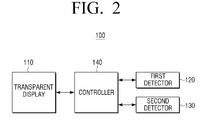
- FIG. 2 is a block diagram of a transparent display apparatus according to an embodiment.
- the transparent display apparatus 100 may include a transparent display 110, a first detector 120, a second detector 130, and a controller 140.
- the transparent display 110 may display a virtual object.
- Virtual objects have a predetermined position on a virtual dimensional area. Positions of virtual objects may be inputted by a user with specific applications or software, or determined automatically.
- a transparent display apparatus may display new clothes and a user can view it from an exterior of clothes shop, i.e., from the front of a transparent display apparatus.
- a user may manipulate virtual clothes having predetermined shapes so that a mannequin seems to wear virtual clothes on the virtual dimensional area, and thus, clothes position on the virtual dimensional area may be calculated.
- a position of a mannequin as a real object changes, a virtual position of clothes as the virtual object may change as calculated according to the changed position of a mannequin.
- the transparent display apparatus 100 may display virtual objects on an overlapping area based on distances of real and virtual objects regarding a user position according to controlling of the controller 140.
- the transparent display 110 may display a virtual object on an overlapping area if a distance of the virtual object is closer than distance of a real object from a user position, and may not display the virtual object on an overlapping area if distance of the virtual object is longer than distance of the real object from a user position.
- a user may recognize the virtual object with the real object displayed on the transparent display 110 with reality.
- the transparent display 110 may be implemented as various types such as Liquid Crystal Display (LCD) type, transparent Thin-Film Electroluminescent Panel (TFEL) type, transparent OLED type, or penetrating type.
- LCD Liquid Crystal Display
- TFEL transparent Thin-Film Electroluminescent Panel
- OLED transparent OLED
- penetrating type a type of the transparent display 110 according to various embodiments.
- the "transparent LCD type” as used herein indicates a transparent display apparatus in which backlight units are omitted from a currently-used LCD apparatus, where a pair of polarized substrates, optical films, transparent thin film transistors, or transparent electrodes are used.
- the transparent LCD apparatuses may have a lower transmittance compared to polarized substrates or optical films, and lower light efficiency because ambient light is used instead of backlight units. However, it may have an advantage in implementing a wide-facing transparent display.
- the "transparent TFEL type” as used herein indicates an apparatus using transparent electrodes, inorganic fluorescent materials, and alternating inorganic thin film EL display (AC-TFEL) consisting of insulating films.
- AC-TFEL is a display in which accelerated electrons pass through interior of inorganic fluorescent materials to excite fluorescent materials, thus generating lights. If the transparent display 110 is implemented as transparent TFEL type, the controller 130 may adjust so that electrons are transmitted toward proper places, and determine position of placing information. Because inorganic fluorescent objects and insulating films have transparency, a highly transparent display may be implemented.
- the "transparent OLED type” indicates a transparent display apparatus using OLED which is self-illuminating. Because an organic light-emitting layer is transparent, if both electrodes are used as transparent electrodes, a transparent display apparatus may be implemented. OLED may generate lights by injecting electrons and holes from both sides of organic light-emitting layer, according to which the electrons and holes are coupled to generate light within organic light-emitting layer. A transparent OLED apparatus may use the above principle, inject electrons and holes toward determined positions and display information.
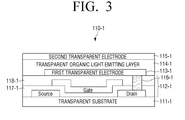
- FIG. 3 illustrates detailed constitution of a transparent display implemented as transparent OLED type.
- 110-1 indicates a transparent display implemented as a transparent OLED (Organic Light-Emitting Diodes) type.
- OLED Organic Light-Emitting Diodes
- the transparent display 110-1 may include a transparent substrate 111-1, a transparent transistor layer 112-1, a first transparent electrode 113-1, a transparent organic light-emitting layer 114-1, a second transparent electrode 115-1, and a connecting electrode 116-1.
- the transparent substrate 111-1 may use polymer materials having transparent properties such as plastic or glasses. Material of the transparent substrate 111-1 may be determined according to use environment applied with the transparent display apparatus 100. For instance, because polymer materials have advantages in being light-weight and flexible, it may be utilized in mobile display apparatuses. Glasses may be used in show windows of shops or other windows.
- the transparent transistor layer 112-1 indicates a layer including a transistor manufactured by substituting non-transparent silicon with transparent materials such as zinc oxide or titanium oxide.
- a source, a gate, a drain and several types of conductive films 117-1, 118-1 may be formed, and further, the connecting electrode 116-1 electrically connecting the drain and the first transparent electrode 113-1 may also be formed.
- FIG. 3 illustrates one transparent transistor including a source, a gate and a drain, in actual implementation, there may be a plurality of transparent transistors regularly distributed on a whole area of a display surface may also be installed for implementation.
- the controller 140 may allow controlling signals to be applied to the gates of the respective transistors within the transparent transistor layer 112-1, and drive a corresponding transparent transistor to display information.
- the first transparent electrode 113-1 and the second transparent electrode 115-1 may be placed on both opposite sides based on the transparent organic light-emitting layer 114-1.
- the first transparent electrode, the transparent organic light-emitting layer and the second transparent electrode 113-1, 114-1, 115-1 may constitute transparent organic light-emitting diodes.
- Transparent organic light-emitting diodes may be largely classified into passive matrix OLED (PMOLED) and active matrix OLED (AMOLED).
- PMOLED is a structure wherein crossing parts of the first transparent electrode 113-1 and the second transparent electrode 115-1 form pixels.
- AMOLED is a structure wherein thin film transistors (TFT) driving each of pixels are placed.
- FIG. 3 illustrates AMOLED.
- the first transparent electrode 113-1 and the second transparent electrode 115-2 may have a plurality of line electrodes, and arranging direction of the line electrodes may be formed orthogonally to each other. For instance, if line electrodes of the first transparent electrode 113-1 are arranged horizontally, line electrodes of the second transparent electrodes 115-1 may be arranged vertically. Thus, between the first transparent electrode 113-1 and the second transparent electrode 115-1, a plurality of crossing areas may be formed. Referring to FIG. 3 , in each crossing area, a transparent transistor may be connected.
- the controller 140 may use a transparent transistor to generate potential difference in each crossing area. Within crossing areas wherein potential difference is formed, electrons and holes from each electrode are injected and combined to emit lights. Meanwhile, in crossing areas wherein potential difference is not formed, light-emitting may not be implemented, and the things at the back may be shown transparently.
- the first transparent electrode 113-1 and the second transparent electrode 115-1 may use indium tin oxide (ITO). Alternatively, new materials such as graphene may be used. Graphene is a material having transparency wherein carbon atoms are connected to each other and show beehive-shaped planar structure. Additionally, the transparent organic light-emitting layer 114-1 may be implemented with various materials.
- ITO indium tin oxide
- new materials such as graphene may be used.
- Graphene is a material having transparency wherein carbon atoms are connected to each other and show beehive-shaped planar structure.
- the transparent organic light-emitting layer 114-1 may be implemented with various materials.
- the transparent display 110 may be implemented as penetrating type as well as a Liquid Crystal Display (LCD) type, transparent Thin-Film Electroluminescent Panel (TFEL) type, and transparent OLED type.
- the penetrating type employs a method of projecting and displaying image on transparent screen such as Head Up Display (HUD).
- HUD Head Up Display
- the first detector 120 may detect position of real objects placed in a first direction of the transparent display apparatus 100. Specifically, the first detector 120 may detect position of real objects by calculating a three-dimensional (3D) coordinate of the position where real objects are placed on 3D area.
- 3D three-dimensional
- the first detector 120 may be implemented as a 3D camera using a plurality of photographing positions, detect a real object position by a triangulation method or by using a light sensor and light intensity reflected from real objects.
- the second detector 130 may detect the position of a user standing on a second direction of the transparent display apparatus 100.
- the second detector 130 may detect position of a user on a 3D area with a similar method of the first detector 120.
- the second detector 130 may detect the coordinate information of the user's eyes to be the position of a user.
- the second detector 130 may include a photographing apparatus such as an IR camera to recognize the position of the user's eyes.
- the second detector 130 may be implemented to be an interior part of the transparent display apparatus 100. However, it may also be separated from the transparent display apparatus 100, i.e., to be an exterior part that a user can wear. Methods of detecting position of a user or the user's eyes on 3D area are already known in the art, which will not be further described.
- the controller 140 may estimate distances of real and virtual objects from position of a user based on real object position, user position, and predetermined position of virtual objects detected by the first detector 120 and the second detector 130.
- the controller 140 may calculate distance from the position of the user's eyes on a 3D area to be dimensions of real and virtual objects on the 3D area.
- the controller 140 may estimate overlapping areas of real and virtual objects on the transparent display 110 from the position of the user's eyes. Specifically, the controller 140 may estimate area where real objects penetrate and show on the transparent display 110 by using positions of a user and real objects, and estimate the area where virtual objects show on the transparent display 110 by using the position of a user and the predetermined position of virtual objects. Based on areas where real and virtual objects penetrate and show, the controller 140 may estimate the overlapping area. A method of estimating overlapping area of real and virtual objects will be further described below by referring to FIGS. 4 to 6 .
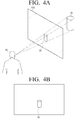
- FIGS. 4A and 4B are views provided to explain a method of estimating area where a real object penetrates and shows on a transparent display apparatus.
- a user 30 is at the front of a transparent display apparatus 100 and a real object 20 is placed at the rear of the transparent display apparatus 100.
- the real object 20 may penetrate through the transparent display apparatus 100 and be shown to the user 30.
- Position of the real object 20 on the 3D area, position of the user 30, and position of the transparent display 100 should be recognized in order to estimate an area 20' where the real object 20 penetrates on the transparent display 100. Since the controller 140 already recognizes predetermined position of the first detector 120 or the second detector 130, size of a transparent display, position of a user and relative distance from a real object, it is possible to calculate the position of the transparent display apparatus 100 on the 3D area. Further, since the controller 140 may use positions of a real object and a user detected by the first detector 120 and the second detector 130, it is possible to estimate an area 20' where a real object penetrates and shows on a display as illustrated in FIG. 4A . If the user 30 views the transparent display apparatus 100, a real object 20' penetrated through the transparent display apparatus 100 may be displayed as illustrated in FIG. 4B .
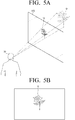
- FIGS. 5A and 5B are views provided to explain a method of estimating an area where a virtual object shows on a transparent display apparatus.
- a user 30 is at the front of a transparent display apparatus 100, and a virtual object 10' having virtual position on a 3D area is placed at the rear of the transparent display apparatus 100.
- Position of the virtual object 10' on the 3D area, position of the user 30, and position of the transparent display apparatus 100 should be recognized in order to estimate an area 10 where the virtual object 10' having predetermined position on the 3D area shows on the transparent display apparatus 100.
- the transparent controller 140 since the transparent controller 140 already recognizes the predetermined position of the first detector 120 or the second detector 130, size of a transparent display, position of a user and relative distance from a real object, it is possible to calculate position of the transparent display apparatus 100 on the 3D area. Further, since the controller 140 recognizes the position of a user measured by the second detector 130 and the predetermined position of a virtual object, it is possible to estimate the area 10 where a virtual object shows on a display as illustrated in FIG. 5A . If the user 30 views the transparent display apparatus 100, the virtual object 10 on the transparent display apparatus 100 may be shown as illustrated in FIG. 5B .
- FIG. 6 is a view provided to explain a method of estimating an overlapping area of a real object and a virtual object on a transparent display apparatus. If an area penetrating and showing a real object and an area showing a virtual object are estimated, the transparent display apparatus 100 may calculate overlapping areas 40-1, 40-2 of the estimated real object area and the estimated virtual object area.
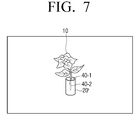
- FIG. 7 illustrates a display screen showing a virtual object according to an embodiment.
- the controller 140 may display a virtual object regarding the overlapping areas 40-1, 40-2 of the real and virtual objects estimated in FIG. 6 based on comparative distances of real and virtual objects.
- the controller 140 may display the virtual object on an overlapping area if a distance of the virtual object is closer than the distance of the real object from position of a user, and may not display the virtual object if a distance of the virtual object is longer than the distance of the real object from a position of a user.
- the controller 140 may display a flower on a transparent display because the flower as a virtual object is closer to position of a user than the flower vase as a real object in the overlapping area 40-1 among the overlapping areas 40-1, 40-2.
- the controller 140 may not display the flower on a transparent display.
- the controller 140 may non-transparently display the virtual object on the transparent display 110 so as not to penetrate the real object at the back.
- a user can be provided with image having more reality.
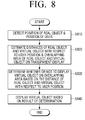
- FIG. 8 is a flowchart explaining a method of controlling a transparent display apparatus according to an embodiment.
- position of a real object placed in a first direction from a transparent display and position of a user placed in a second direction may be detected.
- position of a user may be coordinate information of the user's eyes.
- estimating an overlapping area of the real and virtual objects may include estimating an area penetrating the real object on the transparent display from the position of the user by using the user position and the real object position, estimating an area displaying the virtual object on the transparent display by using the user position and predetermined position of the virtual object, and estimating an overlapping area based on the area penetrating the real object and the area displaying the virtual object.
- the virtual object may be displayed on the overlapping area. Specifically, if a distance of the virtual object toward the user position is closer than a distance of the real object toward the user position, the virtual object may be displayed on the overlapping area. If the distance of the virtual object toward the user position is longer than the distance of the real object toward the user position, the virtual object may not be displayed on the overlapping area. Based on determination results, the virtual object may be displayed at S840.
- the virtual object may be non-transparently displayed so as not to penetrate the real object on the transparent display.
- the virtual object displayed on the transparent display may be 3D virtual.
- controlling method of the transparent display apparatus may be implemented with programs that can be available on healthcare service providing apparatuses. These programs may be stored and used in various types of recording medium.
- codes to implement the above methods may be stored in various types of non-transitory recording medium such as a flash memory, the Read Only Memory (ROM), the Erasable Programmable ROM (EPROM), the Electronically Erasable and Programmable ROM (EEPROM), a hard disk, a removable disk, a memory card, a USB memory, and the CD-ROM.
- non-transitory recording medium such as a flash memory, the Read Only Memory (ROM), the Erasable Programmable ROM (EPROM), the Electronically Erasable and Programmable ROM (EEPROM), a hard disk, a removable disk, a memory card, a USB memory, and the CD-ROM.
Landscapes
- Engineering & Computer Science (AREA)
- Theoretical Computer Science (AREA)
- General Engineering & Computer Science (AREA)
- Physics & Mathematics (AREA)
- General Physics & Mathematics (AREA)
- Human Computer Interaction (AREA)
- Computer Graphics (AREA)
- Computer Hardware Design (AREA)
- Software Systems (AREA)
- Optics & Photonics (AREA)
- User Interface Of Digital Computer (AREA)
- Controls And Circuits For Display Device (AREA)
Applications Claiming Priority (1)
| Application Number | Priority Date | Filing Date | Title |
|---|---|---|---|
| KR1020120112014A KR20140045801A (ko) | 2012-10-09 | 2012-10-09 | 투명 디스플레이 장치 및 그 제어 방법 |
Publications (2)
| Publication Number | Publication Date |
|---|---|
| EP2720115A2 true EP2720115A2 (fr) | 2014-04-16 |
| EP2720115A3 EP2720115A3 (fr) | 2016-07-06 |
Family
ID=49326529
Family Applications (1)
| Application Number | Title | Priority Date | Filing Date |
|---|---|---|---|
| EP13186959.6A Withdrawn EP2720115A3 (fr) | 2012-10-09 | 2013-10-01 | Appareil d'affichage transparent et son procédé de commande |
Country Status (4)
| Country | Link |
|---|---|
| US (1) | US20140098088A1 (fr) |
| EP (1) | EP2720115A3 (fr) |
| KR (1) | KR20140045801A (fr) |
| CN (1) | CN103714749A (fr) |
Cited By (2)
| Publication number | Priority date | Publication date | Assignee | Title |
|---|---|---|---|---|
| EP2757549A1 (fr) * | 2013-01-22 | 2014-07-23 | Samsung Electronics Co., Ltd | Appareil d'affichage transparent et son procédé |
| EP3974950A4 (fr) * | 2019-07-19 | 2022-08-10 | Huawei Technologies Co., Ltd. | Procédé et appareil interactifs dans une scène de réalité virtuelle |
Families Citing this family (18)
| Publication number | Priority date | Publication date | Assignee | Title |
|---|---|---|---|---|
| KR101793628B1 (ko) | 2012-04-08 | 2017-11-06 | 삼성전자주식회사 | 투명 디스플레이 장치 및 그 디스플레이 방법 |
| FR3004817B1 (fr) * | 2013-04-19 | 2015-05-15 | Thales Sa | Systeme de visualisation hybride affichant des informations en superposition sur l exterieur |
| US10318100B2 (en) * | 2013-10-16 | 2019-06-11 | Atheer, Inc. | Method and apparatus for addressing obstruction in an interface |
| US9727896B2 (en) * | 2014-03-13 | 2017-08-08 | Johnnie E. Richardson | Systems, apparatus and methods facilitating mobile communications |
| CN103997606B (zh) * | 2014-06-10 | 2017-10-03 | 重庆工商大学 | 动态隐形装置及动态隐形方法 |
| KR101592365B1 (ko) * | 2014-06-11 | 2016-02-11 | (주)피엑스디 | 디지털 스크린과 인쇄 매체가 결합된 증강정보 제공 장치 및 증강정보 제공 방법 |
| CN104494529A (zh) * | 2014-12-24 | 2015-04-08 | 南京光棱瑞电子科技有限公司 | 基于toled屏幕的车载抬头显示器及安装应用方法 |
| US20160207262A1 (en) * | 2015-01-15 | 2016-07-21 | Disney Enterprises, Inc. | Electronically enabled effect for a printed object |
| KR101674043B1 (ko) * | 2015-04-10 | 2016-11-08 | 서울과학기술대학교 산학협력단 | 증강현실을 이용한 건축 디자인 검증 시스템과 방법 |
| US10484824B1 (en) * | 2015-06-26 | 2019-11-19 | Lucasfilm Entertainment Company Ltd. | Content presentation and layering across multiple devices |
| US10924784B2 (en) * | 2016-08-30 | 2021-02-16 | Sony Corporation | Transmitting device, transmitting method, receiving device, and receiving method |
| CN109388233B (zh) * | 2017-08-14 | 2022-07-29 | 财团法人工业技术研究院 | 透明显示装置及其控制方法 |
| CN108388020B (zh) * | 2018-05-22 | 2022-09-27 | 成都工业学院 | 显示器及显示系统 |
| CN108764998B (zh) * | 2018-05-25 | 2022-06-24 | 京东方科技集团股份有限公司 | 智能展示装置以及智能展示方法 |
| TWI719343B (zh) | 2018-08-28 | 2021-02-21 | 財團法人工業技術研究院 | 資訊顯示方法及其顯示系統 |
| TWI792106B (zh) * | 2020-07-09 | 2023-02-11 | 財團法人工業技術研究院 | 資訊顯示方法及其處理裝置與顯示系統 |
| CN112102655B (zh) * | 2020-09-16 | 2023-07-21 | 联想(北京)有限公司 | 一种输出控制方法及电子设备 |
| KR102828046B1 (ko) * | 2022-06-21 | 2025-07-03 | 엘지전자 주식회사 | 투명 디스플레이 장치 및 그의 동작 제어 방법 |
Family Cites Families (19)
| Publication number | Priority date | Publication date | Assignee | Title |
|---|---|---|---|---|
| US20020044152A1 (en) * | 2000-10-16 | 2002-04-18 | Abbott Kenneth H. | Dynamic integration of computer generated and real world images |
| JP4553362B2 (ja) * | 2005-01-31 | 2010-09-29 | キヤノン株式会社 | システム、画像処理装置、情報処理方法 |
| JP4738870B2 (ja) * | 2005-04-08 | 2011-08-03 | キヤノン株式会社 | 情報処理方法、情報処理装置および遠隔複合現実感共有装置 |
| KR100790892B1 (ko) * | 2006-10-18 | 2008-01-02 | 삼성전자주식회사 | 투명 객체의 화질 향상을 위한 3차원 그래픽스 데이터렌더링 방법 및 장치 |
| CN102763400B (zh) * | 2010-02-12 | 2015-07-15 | 京瓷株式会社 | 便携式电子设备 |
| US8964298B2 (en) * | 2010-02-28 | 2015-02-24 | Microsoft Corporation | Video display modification based on sensor input for a see-through near-to-eye display |
| JP5602618B2 (ja) * | 2010-06-10 | 2014-10-08 | 任天堂株式会社 | 画像処理プログラム、画像処理装置、画像処理システム、および画像処理方法 |
| US9122053B2 (en) * | 2010-10-15 | 2015-09-01 | Microsoft Technology Licensing, Llc | Realistic occlusion for a head mounted augmented reality display |
| US8884984B2 (en) * | 2010-10-15 | 2014-11-11 | Microsoft Corporation | Fusing virtual content into real content |
| WO2012054063A1 (fr) * | 2010-10-22 | 2012-04-26 | Hewlett-Packard Development Company L.P. | Système d'affichage à réalité augmentée et procédé d'affichage |
| US9286711B2 (en) * | 2011-09-30 | 2016-03-15 | Microsoft Technology Licensing, Llc | Representing a location at a previous time period using an augmented reality display |
| US9268406B2 (en) * | 2011-09-30 | 2016-02-23 | Microsoft Technology Licensing, Llc | Virtual spectator experience with a personal audio/visual apparatus |
| US20130141419A1 (en) * | 2011-12-01 | 2013-06-06 | Brian Mount | Augmented reality with realistic occlusion |
| US9497501B2 (en) * | 2011-12-06 | 2016-11-15 | Microsoft Technology Licensing, Llc | Augmented reality virtual monitor |
| US9734633B2 (en) * | 2012-01-27 | 2017-08-15 | Microsoft Technology Licensing, Llc | Virtual environment generating system |
| US9165381B2 (en) * | 2012-05-31 | 2015-10-20 | Microsoft Technology Licensing, Llc | Augmented books in a mixed reality environment |
| US9645394B2 (en) * | 2012-06-25 | 2017-05-09 | Microsoft Technology Licensing, Llc | Configured virtual environments |
| WO2014077798A1 (fr) * | 2012-11-13 | 2014-05-22 | Empire Technology Development Llc | Imagerie holographique |
| US10192358B2 (en) * | 2012-12-20 | 2019-01-29 | Microsoft Technology Licensing, Llc | Auto-stereoscopic augmented reality display |
-
2012
- 2012-10-09 KR KR1020120112014A patent/KR20140045801A/ko not_active Withdrawn
-
2013
- 2013-09-10 US US14/022,796 patent/US20140098088A1/en not_active Abandoned
- 2013-10-01 EP EP13186959.6A patent/EP2720115A3/fr not_active Withdrawn
- 2013-10-09 CN CN201310467629.2A patent/CN103714749A/zh active Pending
Non-Patent Citations (1)
| Title |
|---|
| None |
Cited By (6)
| Publication number | Priority date | Publication date | Assignee | Title |
|---|---|---|---|---|
| EP2757549A1 (fr) * | 2013-01-22 | 2014-07-23 | Samsung Electronics Co., Ltd | Appareil d'affichage transparent et son procédé |
| US9857867B2 (en) | 2013-01-22 | 2018-01-02 | Samsung Electronics Co., Ltd. | Transparent display apparatus and method thereof |
| US10175749B2 (en) | 2013-01-22 | 2019-01-08 | Samsung Electronics Co., Ltd. | Transparent display apparatus and method thereof |
| US10509460B2 (en) | 2013-01-22 | 2019-12-17 | Samsung Electronics Co., Ltd. | Transparent display apparatus and method thereof |
| EP3974950A4 (fr) * | 2019-07-19 | 2022-08-10 | Huawei Technologies Co., Ltd. | Procédé et appareil interactifs dans une scène de réalité virtuelle |
| US11798234B2 (en) | 2019-07-19 | 2023-10-24 | Huawei Technologies Co., Ltd. | Interaction method in virtual reality scenario and apparatus |
Also Published As
| Publication number | Publication date |
|---|---|
| CN103714749A (zh) | 2014-04-09 |
| US20140098088A1 (en) | 2014-04-10 |
| KR20140045801A (ko) | 2014-04-17 |
| EP2720115A3 (fr) | 2016-07-06 |
Similar Documents
| Publication | Publication Date | Title |
|---|---|---|
| EP2720115A2 (fr) | Appareil d'affichage transparent et son procédé de commande | |
| EP2693332B1 (fr) | Appareil d'affichage et son procédé d'affichage | |
| RU2675043C2 (ru) | Прозрачное устройство отображения и способ управления им | |
| KR101793628B1 (ko) | 투명 디스플레이 장치 및 그 디스플레이 방법 | |
| KR102126503B1 (ko) | 디스플레이 장치 및 그 제어 방법 | |
| US9594286B2 (en) | Transparent display apparatus with adjustable transmissive area and a method for controlling the same | |
| US9916635B2 (en) | Transparent display device and control method thereof | |
| US9547919B2 (en) | Display apparatus and control method thereof | |
| US20140111470A1 (en) | Three-dimensional touch display panel and method for operating the same | |
| WO2018171170A1 (fr) | Dispositif d'affichage tridimensionnel | |
| KR101971521B1 (ko) | 투명 디스플레이 장치 및 그 디스플레이 방법 | |
| KR102113301B1 (ko) | 디스플레이 장치 및 그의 제어 방법 | |
| KR102231587B1 (ko) | 디스플레이 장치 및 그의 제어 방법 | |
| KR101896099B1 (ko) | 투명 디스플레이 장치 및 그 디스플레이 방법 |
Legal Events
| Date | Code | Title | Description |
|---|---|---|---|
| PUAI | Public reference made under article 153(3) epc to a published international application that has entered the european phase |
Free format text: ORIGINAL CODE: 0009012 |
|
| AK | Designated contracting states |
Kind code of ref document: A2 Designated state(s): AL AT BE BG CH CY CZ DE DK EE ES FI FR GB GR HR HU IE IS IT LI LT LU LV MC MK MT NL NO PL PT RO RS SE SI SK SM TR |
|
| AX | Request for extension of the european patent |
Extension state: BA ME |
|
| PUAL | Search report despatched |
Free format text: ORIGINAL CODE: 0009013 |
|
| AK | Designated contracting states |
Kind code of ref document: A3 Designated state(s): AL AT BE BG CH CY CZ DE DK EE ES FI FR GB GR HR HU IE IS IT LI LT LU LV MC MK MT NL NO PL PT RO RS SE SI SK SM TR |
|
| AX | Request for extension of the european patent |
Extension state: BA ME |
|
| RIC1 | Information provided on ipc code assigned before grant |
Ipc: G06F 3/01 20060101AFI20160527BHEP Ipc: G06F 3/03 20060101ALI20160527BHEP Ipc: G06T 19/00 20110101ALI20160527BHEP |
|
| STAA | Information on the status of an ep patent application or granted ep patent |
Free format text: STATUS: THE APPLICATION HAS BEEN PUBLISHED |
|
| STAA | Information on the status of an ep patent application or granted ep patent |
Free format text: STATUS: THE APPLICATION IS DEEMED TO BE WITHDRAWN |
|
| 18D | Application deemed to be withdrawn |
Effective date: 20170110 |