EP2722143A1 - Procédé de fabrication de feuille inorganique - Google Patents
Procédé de fabrication de feuille inorganique Download PDFInfo
- Publication number
- EP2722143A1 EP2722143A1 EP12290361.0A EP12290361A EP2722143A1 EP 2722143 A1 EP2722143 A1 EP 2722143A1 EP 12290361 A EP12290361 A EP 12290361A EP 2722143 A1 EP2722143 A1 EP 2722143A1
- Authority
- EP
- European Patent Office
- Prior art keywords
- sheet
- rollers
- inorganic
- ceramic
- pair
- Prior art date
- Legal status (The legal status is an assumption and is not a legal conclusion. Google has not performed a legal analysis and makes no representation as to the accuracy of the status listed.)
- Granted
Links
Images


Classifications
-
- C—CHEMISTRY; METALLURGY
- C04—CEMENTS; CONCRETE; ARTIFICIAL STONE; CERAMICS; REFRACTORIES
- C04B—LIME, MAGNESIA; SLAG; CEMENTS; COMPOSITIONS THEREOF, e.g. MORTARS, CONCRETE OR LIKE BUILDING MATERIALS; ARTIFICIAL STONE; CERAMICS; REFRACTORIES; TREATMENT OF NATURAL STONE
- C04B35/00—Shaped ceramic products characterised by their composition; Ceramics compositions; Processing powders of inorganic compounds preparatory to the manufacturing of ceramic products
- C04B35/622—Forming processes; Processing powders of inorganic compounds preparatory to the manufacturing of ceramic products
- C04B35/62218—Forming processes; Processing powders of inorganic compounds preparatory to the manufacturing of ceramic products obtaining ceramic films, e.g. by using temporary supports
-
- B—PERFORMING OPERATIONS; TRANSPORTING
- B22—CASTING; POWDER METALLURGY
- B22F—WORKING METALLIC POWDER; MANUFACTURE OF ARTICLES FROM METALLIC POWDER; MAKING METALLIC POWDER; APPARATUS OR DEVICES SPECIALLY ADAPTED FOR METALLIC POWDER
- B22F3/00—Manufacture of workpieces or articles from metallic powder characterised by the manner of compacting or sintering; Apparatus specially adapted therefor ; Presses and furnaces
- B22F3/18—Manufacture of workpieces or articles from metallic powder characterised by the manner of compacting or sintering; Apparatus specially adapted therefor ; Presses and furnaces by using pressure rollers
-
- B—PERFORMING OPERATIONS; TRANSPORTING
- B22—CASTING; POWDER METALLURGY
- B22F—WORKING METALLIC POWDER; MANUFACTURE OF ARTICLES FROM METALLIC POWDER; MAKING METALLIC POWDER; APPARATUS OR DEVICES SPECIALLY ADAPTED FOR METALLIC POWDER
- B22F5/00—Manufacture of workpieces or articles from metallic powder characterised by the special shape of the product
- B22F5/006—Manufacture of workpieces or articles from metallic powder characterised by the special shape of the product of flat products, e.g. sheets
-
- B—PERFORMING OPERATIONS; TRANSPORTING
- B22—CASTING; POWDER METALLURGY
- B22F—WORKING METALLIC POWDER; MANUFACTURE OF ARTICLES FROM METALLIC POWDER; MAKING METALLIC POWDER; APPARATUS OR DEVICES SPECIALLY ADAPTED FOR METALLIC POWDER
- B22F7/00—Manufacture of composite layers, workpieces, or articles, comprising metallic powder, by sintering the powder, with or without compacting wherein at least one part is obtained by sintering or compression
- B22F7/02—Manufacture of composite layers, workpieces, or articles, comprising metallic powder, by sintering the powder, with or without compacting wherein at least one part is obtained by sintering or compression of composite layers
-
- B—PERFORMING OPERATIONS; TRANSPORTING
- B28—WORKING CEMENT, CLAY, OR STONE
- B28B—SHAPING CLAY OR OTHER CERAMIC COMPOSITIONS; SHAPING SLAG; SHAPING MIXTURES CONTAINING CEMENTITIOUS MATERIAL, e.g. PLASTER
- B28B1/00—Producing shaped prefabricated articles from the material
- B28B1/52—Producing shaped prefabricated articles from the material specially adapted for producing articles from mixtures containing fibres, e.g. asbestos cement
- B28B1/522—Producing shaped prefabricated articles from the material specially adapted for producing articles from mixtures containing fibres, e.g. asbestos cement for producing multi-layered articles
-
- B—PERFORMING OPERATIONS; TRANSPORTING
- B28—WORKING CEMENT, CLAY, OR STONE
- B28B—SHAPING CLAY OR OTHER CERAMIC COMPOSITIONS; SHAPING SLAG; SHAPING MIXTURES CONTAINING CEMENTITIOUS MATERIAL, e.g. PLASTER
- B28B1/00—Producing shaped prefabricated articles from the material
- B28B1/52—Producing shaped prefabricated articles from the material specially adapted for producing articles from mixtures containing fibres, e.g. asbestos cement
- B28B1/525—Producing shaped prefabricated articles from the material specially adapted for producing articles from mixtures containing fibres, e.g. asbestos cement containing organic fibres, e.g. wood fibres
-
- B—PERFORMING OPERATIONS; TRANSPORTING
- B28—WORKING CEMENT, CLAY, OR STONE
- B28B—SHAPING CLAY OR OTHER CERAMIC COMPOSITIONS; SHAPING SLAG; SHAPING MIXTURES CONTAINING CEMENTITIOUS MATERIAL, e.g. PLASTER
- B28B3/00—Producing shaped articles from the material by using presses; Presses specially adapted therefor
- B28B3/12—Producing shaped articles from the material by using presses; Presses specially adapted therefor wherein one or more rollers exert pressure on the material
- B28B3/126—Producing shaped articles from the material by using presses; Presses specially adapted therefor wherein one or more rollers exert pressure on the material on material passing directly between the co-operating rollers
-
- B—PERFORMING OPERATIONS; TRANSPORTING
- B28—WORKING CEMENT, CLAY, OR STONE
- B28B—SHAPING CLAY OR OTHER CERAMIC COMPOSITIONS; SHAPING SLAG; SHAPING MIXTURES CONTAINING CEMENTITIOUS MATERIAL, e.g. PLASTER
- B28B3/00—Producing shaped articles from the material by using presses; Presses specially adapted therefor
- B28B3/12—Producing shaped articles from the material by using presses; Presses specially adapted therefor wherein one or more rollers exert pressure on the material
- B28B3/16—Producing shaped articles from the material by using presses; Presses specially adapted therefor wherein one or more rollers exert pressure on the material with co-operating profiled rollers
-
- B—PERFORMING OPERATIONS; TRANSPORTING
- B29—WORKING OF PLASTICS; WORKING OF SUBSTANCES IN A PLASTIC STATE IN GENERAL
- B29C—SHAPING OR JOINING OF PLASTICS; SHAPING OF MATERIAL IN A PLASTIC STATE, NOT OTHERWISE PROVIDED FOR; AFTER-TREATMENT OF THE SHAPED PRODUCTS, e.g. REPAIRING
- B29C43/00—Compression moulding, i.e. applying external pressure to flow the moulding material; Apparatus therefor
- B29C43/22—Compression moulding, i.e. applying external pressure to flow the moulding material; Apparatus therefor of articles of indefinite length
- B29C43/24—Calendering
-
- B—PERFORMING OPERATIONS; TRANSPORTING
- B30—PRESSES
- B30B—PRESSES IN GENERAL
- B30B11/00—Presses specially adapted for forming shaped articles from material in particulate or plastic state, e.g. briquetting presses, tabletting presses
- B30B11/18—Presses specially adapted for forming shaped articles from material in particulate or plastic state, e.g. briquetting presses, tabletting presses using profiled rollers
-
- B—PERFORMING OPERATIONS; TRANSPORTING
- B30—PRESSES
- B30B—PRESSES IN GENERAL
- B30B3/00—Presses characterised by the use of rotary pressing members, e.g. rollers, rings, discs
- B30B3/04—Presses characterised by the use of rotary pressing members, e.g. rollers, rings, discs co-operating with one another, e.g. with co-operating cones
-
- B—PERFORMING OPERATIONS; TRANSPORTING
- B32—LAYERED PRODUCTS
- B32B—LAYERED PRODUCTS, i.e. PRODUCTS BUILT-UP OF STRATA OF FLAT OR NON-FLAT, e.g. CELLULAR OR HONEYCOMB, FORM
- B32B18/00—Layered products essentially comprising ceramics, e.g. refractory products
-
- C—CHEMISTRY; METALLURGY
- C04—CEMENTS; CONCRETE; ARTIFICIAL STONE; CERAMICS; REFRACTORIES
- C04B—LIME, MAGNESIA; SLAG; CEMENTS; COMPOSITIONS THEREOF, e.g. MORTARS, CONCRETE OR LIKE BUILDING MATERIALS; ARTIFICIAL STONE; CERAMICS; REFRACTORIES; TREATMENT OF NATURAL STONE
- C04B33/00—Clay-wares
- C04B33/02—Preparing or treating the raw materials individually or as batches
- C04B33/04—Clay; Kaolin
-
- C—CHEMISTRY; METALLURGY
- C04—CEMENTS; CONCRETE; ARTIFICIAL STONE; CERAMICS; REFRACTORIES
- C04B—LIME, MAGNESIA; SLAG; CEMENTS; COMPOSITIONS THEREOF, e.g. MORTARS, CONCRETE OR LIKE BUILDING MATERIALS; ARTIFICIAL STONE; CERAMICS; REFRACTORIES; TREATMENT OF NATURAL STONE
- C04B33/00—Clay-wares
- C04B33/02—Preparing or treating the raw materials individually or as batches
- C04B33/13—Compounding ingredients
- C04B33/1305—Organic additives
-
- C—CHEMISTRY; METALLURGY
- C04—CEMENTS; CONCRETE; ARTIFICIAL STONE; CERAMICS; REFRACTORIES
- C04B—LIME, MAGNESIA; SLAG; CEMENTS; COMPOSITIONS THEREOF, e.g. MORTARS, CONCRETE OR LIKE BUILDING MATERIALS; ARTIFICIAL STONE; CERAMICS; REFRACTORIES; TREATMENT OF NATURAL STONE
- C04B35/00—Shaped ceramic products characterised by their composition; Ceramics compositions; Processing powders of inorganic compounds preparatory to the manufacturing of ceramic products
- C04B35/01—Shaped ceramic products characterised by their composition; Ceramics compositions; Processing powders of inorganic compounds preparatory to the manufacturing of ceramic products based on oxide ceramics
- C04B35/10—Shaped ceramic products characterised by their composition; Ceramics compositions; Processing powders of inorganic compounds preparatory to the manufacturing of ceramic products based on oxide ceramics based on aluminium oxide
- C04B35/111—Fine ceramics
-
- C—CHEMISTRY; METALLURGY
- C04—CEMENTS; CONCRETE; ARTIFICIAL STONE; CERAMICS; REFRACTORIES
- C04B—LIME, MAGNESIA; SLAG; CEMENTS; COMPOSITIONS THEREOF, e.g. MORTARS, CONCRETE OR LIKE BUILDING MATERIALS; ARTIFICIAL STONE; CERAMICS; REFRACTORIES; TREATMENT OF NATURAL STONE
- C04B35/00—Shaped ceramic products characterised by their composition; Ceramics compositions; Processing powders of inorganic compounds preparatory to the manufacturing of ceramic products
- C04B35/622—Forming processes; Processing powders of inorganic compounds preparatory to the manufacturing of ceramic products
- C04B35/626—Preparing or treating the powders individually or as batches ; preparing or treating macroscopic reinforcing agents for ceramic products, e.g. fibres; mechanical aspects section B
- C04B35/62605—Treating the starting powders individually or as mixtures
- C04B35/62625—Wet mixtures
- C04B35/6263—Wet mixtures characterised by their solids loadings, i.e. the percentage of solids
-
- C—CHEMISTRY; METALLURGY
- C04—CEMENTS; CONCRETE; ARTIFICIAL STONE; CERAMICS; REFRACTORIES
- C04B—LIME, MAGNESIA; SLAG; CEMENTS; COMPOSITIONS THEREOF, e.g. MORTARS, CONCRETE OR LIKE BUILDING MATERIALS; ARTIFICIAL STONE; CERAMICS; REFRACTORIES; TREATMENT OF NATURAL STONE
- C04B35/00—Shaped ceramic products characterised by their composition; Ceramics compositions; Processing powders of inorganic compounds preparatory to the manufacturing of ceramic products
- C04B35/622—Forming processes; Processing powders of inorganic compounds preparatory to the manufacturing of ceramic products
- C04B35/626—Preparing or treating the powders individually or as batches ; preparing or treating macroscopic reinforcing agents for ceramic products, e.g. fibres; mechanical aspects section B
- C04B35/63—Preparing or treating the powders individually or as batches ; preparing or treating macroscopic reinforcing agents for ceramic products, e.g. fibres; mechanical aspects section B using additives specially adapted for forming the products, e.g.. binder binders
- C04B35/632—Organic additives
- C04B35/634—Polymers
- C04B35/63404—Polymers obtained by reactions only involving carbon-to-carbon unsaturated bonds
-
- C—CHEMISTRY; METALLURGY
- C04—CEMENTS; CONCRETE; ARTIFICIAL STONE; CERAMICS; REFRACTORIES
- C04B—LIME, MAGNESIA; SLAG; CEMENTS; COMPOSITIONS THEREOF, e.g. MORTARS, CONCRETE OR LIKE BUILDING MATERIALS; ARTIFICIAL STONE; CERAMICS; REFRACTORIES; TREATMENT OF NATURAL STONE
- C04B35/00—Shaped ceramic products characterised by their composition; Ceramics compositions; Processing powders of inorganic compounds preparatory to the manufacturing of ceramic products
- C04B35/622—Forming processes; Processing powders of inorganic compounds preparatory to the manufacturing of ceramic products
- C04B35/626—Preparing or treating the powders individually or as batches ; preparing or treating macroscopic reinforcing agents for ceramic products, e.g. fibres; mechanical aspects section B
- C04B35/63—Preparing or treating the powders individually or as batches ; preparing or treating macroscopic reinforcing agents for ceramic products, e.g. fibres; mechanical aspects section B using additives specially adapted for forming the products, e.g.. binder binders
- C04B35/632—Organic additives
- C04B35/636—Polysaccharides or derivatives thereof
- C04B35/6365—Cellulose or derivatives thereof
-
- C—CHEMISTRY; METALLURGY
- C04—CEMENTS; CONCRETE; ARTIFICIAL STONE; CERAMICS; REFRACTORIES
- C04B—LIME, MAGNESIA; SLAG; CEMENTS; COMPOSITIONS THEREOF, e.g. MORTARS, CONCRETE OR LIKE BUILDING MATERIALS; ARTIFICIAL STONE; CERAMICS; REFRACTORIES; TREATMENT OF NATURAL STONE
- C04B35/00—Shaped ceramic products characterised by their composition; Ceramics compositions; Processing powders of inorganic compounds preparatory to the manufacturing of ceramic products
- C04B35/622—Forming processes; Processing powders of inorganic compounds preparatory to the manufacturing of ceramic products
- C04B35/64—Burning or sintering processes
-
- C—CHEMISTRY; METALLURGY
- C04—CEMENTS; CONCRETE; ARTIFICIAL STONE; CERAMICS; REFRACTORIES
- C04B—LIME, MAGNESIA; SLAG; CEMENTS; COMPOSITIONS THEREOF, e.g. MORTARS, CONCRETE OR LIKE BUILDING MATERIALS; ARTIFICIAL STONE; CERAMICS; REFRACTORIES; TREATMENT OF NATURAL STONE
- C04B37/00—Joining burned ceramic articles with other burned ceramic articles or other articles by heating
-
- B—PERFORMING OPERATIONS; TRANSPORTING
- B22—CASTING; POWDER METALLURGY
- B22F—WORKING METALLIC POWDER; MANUFACTURE OF ARTICLES FROM METALLIC POWDER; MAKING METALLIC POWDER; APPARATUS OR DEVICES SPECIALLY ADAPTED FOR METALLIC POWDER
- B22F2998/00—Supplementary information concerning processes or compositions relating to powder metallurgy
- B22F2998/10—Processes characterised by the sequence of their steps
-
- B—PERFORMING OPERATIONS; TRANSPORTING
- B29—WORKING OF PLASTICS; WORKING OF SUBSTANCES IN A PLASTIC STATE IN GENERAL
- B29L—INDEXING SCHEME ASSOCIATED WITH SUBCLASS B29C, RELATING TO PARTICULAR ARTICLES
- B29L2009/00—Layered products
-
- C—CHEMISTRY; METALLURGY
- C04—CEMENTS; CONCRETE; ARTIFICIAL STONE; CERAMICS; REFRACTORIES
- C04B—LIME, MAGNESIA; SLAG; CEMENTS; COMPOSITIONS THEREOF, e.g. MORTARS, CONCRETE OR LIKE BUILDING MATERIALS; ARTIFICIAL STONE; CERAMICS; REFRACTORIES; TREATMENT OF NATURAL STONE
- C04B2235/00—Aspects relating to ceramic starting mixtures or sintered ceramic products
- C04B2235/02—Composition of constituents of the starting material or of secondary phases of the final product
- C04B2235/50—Constituents or additives of the starting mixture chosen for their shape or used because of their shape or their physical appearance
- C04B2235/52—Constituents or additives characterised by their shapes
- C04B2235/5208—Fibers
- C04B2235/5212—Organic
-
- C—CHEMISTRY; METALLURGY
- C04—CEMENTS; CONCRETE; ARTIFICIAL STONE; CERAMICS; REFRACTORIES
- C04B—LIME, MAGNESIA; SLAG; CEMENTS; COMPOSITIONS THEREOF, e.g. MORTARS, CONCRETE OR LIKE BUILDING MATERIALS; ARTIFICIAL STONE; CERAMICS; REFRACTORIES; TREATMENT OF NATURAL STONE
- C04B2235/00—Aspects relating to ceramic starting mixtures or sintered ceramic products
- C04B2235/02—Composition of constituents of the starting material or of secondary phases of the final product
- C04B2235/50—Constituents or additives of the starting mixture chosen for their shape or used because of their shape or their physical appearance
- C04B2235/54—Particle size related information
- C04B2235/5418—Particle size related information expressed by the size of the particles or aggregates thereof
- C04B2235/5436—Particle size related information expressed by the size of the particles or aggregates thereof micrometer sized, i.e. from 1 to 100 micron
-
- C—CHEMISTRY; METALLURGY
- C04—CEMENTS; CONCRETE; ARTIFICIAL STONE; CERAMICS; REFRACTORIES
- C04B—LIME, MAGNESIA; SLAG; CEMENTS; COMPOSITIONS THEREOF, e.g. MORTARS, CONCRETE OR LIKE BUILDING MATERIALS; ARTIFICIAL STONE; CERAMICS; REFRACTORIES; TREATMENT OF NATURAL STONE
- C04B2235/00—Aspects relating to ceramic starting mixtures or sintered ceramic products
- C04B2235/60—Aspects relating to the preparation, properties or mechanical treatment of green bodies or pre-forms
- C04B2235/602—Making the green bodies or pre-forms by moulding
-
- C—CHEMISTRY; METALLURGY
- C04—CEMENTS; CONCRETE; ARTIFICIAL STONE; CERAMICS; REFRACTORIES
- C04B—LIME, MAGNESIA; SLAG; CEMENTS; COMPOSITIONS THEREOF, e.g. MORTARS, CONCRETE OR LIKE BUILDING MATERIALS; ARTIFICIAL STONE; CERAMICS; REFRACTORIES; TREATMENT OF NATURAL STONE
- C04B2235/00—Aspects relating to ceramic starting mixtures or sintered ceramic products
- C04B2235/60—Aspects relating to the preparation, properties or mechanical treatment of green bodies or pre-forms
- C04B2235/608—Green bodies or pre-forms with well-defined density
-
- C—CHEMISTRY; METALLURGY
- C04—CEMENTS; CONCRETE; ARTIFICIAL STONE; CERAMICS; REFRACTORIES
- C04B—LIME, MAGNESIA; SLAG; CEMENTS; COMPOSITIONS THEREOF, e.g. MORTARS, CONCRETE OR LIKE BUILDING MATERIALS; ARTIFICIAL STONE; CERAMICS; REFRACTORIES; TREATMENT OF NATURAL STONE
- C04B2235/00—Aspects relating to ceramic starting mixtures or sintered ceramic products
- C04B2235/65—Aspects relating to heat treatments of ceramic bodies such as green ceramics or pre-sintered ceramics, e.g. burning, sintering or melting processes
- C04B2235/656—Aspects relating to heat treatments of ceramic bodies such as green ceramics or pre-sintered ceramics, e.g. burning, sintering or melting processes characterised by specific heating conditions during heat treatment
- C04B2235/6562—Heating rate
-
- C—CHEMISTRY; METALLURGY
- C04—CEMENTS; CONCRETE; ARTIFICIAL STONE; CERAMICS; REFRACTORIES
- C04B—LIME, MAGNESIA; SLAG; CEMENTS; COMPOSITIONS THEREOF, e.g. MORTARS, CONCRETE OR LIKE BUILDING MATERIALS; ARTIFICIAL STONE; CERAMICS; REFRACTORIES; TREATMENT OF NATURAL STONE
- C04B2235/00—Aspects relating to ceramic starting mixtures or sintered ceramic products
- C04B2235/65—Aspects relating to heat treatments of ceramic bodies such as green ceramics or pre-sintered ceramics, e.g. burning, sintering or melting processes
- C04B2235/656—Aspects relating to heat treatments of ceramic bodies such as green ceramics or pre-sintered ceramics, e.g. burning, sintering or melting processes characterised by specific heating conditions during heat treatment
- C04B2235/6565—Cooling rate
-
- C—CHEMISTRY; METALLURGY
- C04—CEMENTS; CONCRETE; ARTIFICIAL STONE; CERAMICS; REFRACTORIES
- C04B—LIME, MAGNESIA; SLAG; CEMENTS; COMPOSITIONS THEREOF, e.g. MORTARS, CONCRETE OR LIKE BUILDING MATERIALS; ARTIFICIAL STONE; CERAMICS; REFRACTORIES; TREATMENT OF NATURAL STONE
- C04B2235/00—Aspects relating to ceramic starting mixtures or sintered ceramic products
- C04B2235/70—Aspects relating to sintered or melt-casted ceramic products
- C04B2235/74—Physical characteristics
- C04B2235/77—Density
-
- C—CHEMISTRY; METALLURGY
- C04—CEMENTS; CONCRETE; ARTIFICIAL STONE; CERAMICS; REFRACTORIES
- C04B—LIME, MAGNESIA; SLAG; CEMENTS; COMPOSITIONS THEREOF, e.g. MORTARS, CONCRETE OR LIKE BUILDING MATERIALS; ARTIFICIAL STONE; CERAMICS; REFRACTORIES; TREATMENT OF NATURAL STONE
- C04B2235/00—Aspects relating to ceramic starting mixtures or sintered ceramic products
- C04B2235/70—Aspects relating to sintered or melt-casted ceramic products
- C04B2235/96—Properties of ceramic products, e.g. mechanical properties such as strength, toughness, wear resistance
-
- C—CHEMISTRY; METALLURGY
- C04—CEMENTS; CONCRETE; ARTIFICIAL STONE; CERAMICS; REFRACTORIES
- C04B—LIME, MAGNESIA; SLAG; CEMENTS; COMPOSITIONS THEREOF, e.g. MORTARS, CONCRETE OR LIKE BUILDING MATERIALS; ARTIFICIAL STONE; CERAMICS; REFRACTORIES; TREATMENT OF NATURAL STONE
- C04B2237/00—Aspects relating to ceramic laminates or to joining of ceramic articles with other articles by heating
- C04B2237/30—Composition of layers of ceramic laminates or of ceramic or metallic articles to be joined by heating, e.g. Si substrates
- C04B2237/32—Ceramic
- C04B2237/34—Oxidic
- C04B2237/341—Silica or silicates
-
- C—CHEMISTRY; METALLURGY
- C04—CEMENTS; CONCRETE; ARTIFICIAL STONE; CERAMICS; REFRACTORIES
- C04B—LIME, MAGNESIA; SLAG; CEMENTS; COMPOSITIONS THEREOF, e.g. MORTARS, CONCRETE OR LIKE BUILDING MATERIALS; ARTIFICIAL STONE; CERAMICS; REFRACTORIES; TREATMENT OF NATURAL STONE
- C04B2237/00—Aspects relating to ceramic laminates or to joining of ceramic articles with other articles by heating
- C04B2237/30—Composition of layers of ceramic laminates or of ceramic or metallic articles to be joined by heating, e.g. Si substrates
- C04B2237/32—Ceramic
- C04B2237/34—Oxidic
- C04B2237/343—Alumina or aluminates
-
- C—CHEMISTRY; METALLURGY
- C04—CEMENTS; CONCRETE; ARTIFICIAL STONE; CERAMICS; REFRACTORIES
- C04B—LIME, MAGNESIA; SLAG; CEMENTS; COMPOSITIONS THEREOF, e.g. MORTARS, CONCRETE OR LIKE BUILDING MATERIALS; ARTIFICIAL STONE; CERAMICS; REFRACTORIES; TREATMENT OF NATURAL STONE
- C04B2237/00—Aspects relating to ceramic laminates or to joining of ceramic articles with other articles by heating
- C04B2237/50—Processing aspects relating to ceramic laminates or to the joining of ceramic articles with other articles by heating
-
- C—CHEMISTRY; METALLURGY
- C04—CEMENTS; CONCRETE; ARTIFICIAL STONE; CERAMICS; REFRACTORIES
- C04B—LIME, MAGNESIA; SLAG; CEMENTS; COMPOSITIONS THEREOF, e.g. MORTARS, CONCRETE OR LIKE BUILDING MATERIALS; ARTIFICIAL STONE; CERAMICS; REFRACTORIES; TREATMENT OF NATURAL STONE
- C04B2237/00—Aspects relating to ceramic laminates or to joining of ceramic articles with other articles by heating
- C04B2237/50—Processing aspects relating to ceramic laminates or to the joining of ceramic articles with other articles by heating
- C04B2237/70—Forming laminates or joined articles comprising layers of a specific, unusual thickness
- C04B2237/704—Forming laminates or joined articles comprising layers of a specific, unusual thickness of one or more of the ceramic layers or articles
Definitions
- the present application is directed to methods for making an inorganic sheet, a sintered ceramic sheet and a sintered multilayered ceramic composite, to an inorganic sheet, sintered ceramic sheet and a sintered multilayered ceramic composite obtainable by such methods, and to an apparatus configured to carry out such methods.
- a paper-making method has been adapted for the shaping of ceramic materials as well as laminates, as described in, for example, EP-A-0554820 , WO-A-9406728 and US-B-7597781 .
- a papermaking suspension comprising fibres, ceramic powders, retention aids, and binder is transferred to the paper machine, where a continuous sheet of paper is then formed by dewatering and drying.
- Extrusion methods consist of extruding a mouldable mixture into a sheet through a screw or ram extruder. However, it is difficult to obtain relatively large sheets and thin layers without wrinkles.
- US-A-7090480 proposes to precisely control the temperature of the die area in order to produce a relatively flat ceramic sheet.
- EP-A-1726419 describes a combined system of a twin screw extruder with a single screw extruder for producing ceramic sheet.
- Other methods to produce thin ceramic layers are to cut an extruded cylinder into board and then compact it into a sheet of desired thickness by rolling as described in US-A-6399013 , or to directly calendar extruded materials between a set of rollers as described in US-A-5800647 .
- WO-A-03049935 describes a method of producing inorganic sheet with PTFE resin by rolling without pre-extrusion. However, it was found to be difficult to obtain a homogeneous layer of a non-resin formulation with such equipment. Another example to produce inorganically filled organic polymer sheets directly by rolling is described in US-A-2005508072 . However, this method is not concerned with the manufacture of sintered materials.
- a method for making an inorganic sheet comprising: passing a sheet-forming composition comprising a major amount of inorganic particulate material through at least one pair of indented rollers forming an inorganic board; and passing said inorganic board through at least one pair of finishing rollers, thereby forming an inorganic sheet.
- a method for making a sintered ceramic sheet comprising:
- a method for making a multilayered ceramic composite comprising:
- an apparatus configured to carry out a method according to any one of the first, second and third aspects of the present invention, said apparatus comprising a pair of indented rollers and at least one pair of finishing rollers positioned downstream from the pair of indented rollers.
- an inorganic sheet or ceramic sheet obtainable by the method of any one of the first, second and third aspects of the present invention.
- a green inorganic sheet, or green ceramic sheet, or green laminated product obtainable by the method of any one of the first, second and third aspects of the present invention.
- a sintered ceramic sheet or sintered multilayered ceramic composite obtainable by the method of any one of the second and third aspects of the present invention.
- board and sheet are used herein merely to differentiate between the body formed after the composition is passed through the (first) pair of indented rollers and the downstream finishing rollers. It will be understood that a board has sheet like properties, e.g., a substantially planar form having a width/length scale significantly greater than its thickness. Thus, in embodiments in which the at least one pair of finishing rollers is a pair of smoothing rollers, the difference between any board and sheet formed in the same process is that the sheet will have a smoother outer surface and/or a reduced thickness compared to the board from which it is formed.
- inorganic board or “inorganic sheet” mean that the board and sheet are formed from a sheet-forming composition comprising a major amount of inorganic particulate material, e.g., greater than about 50 % by weight inorganic particulate material, or at least about 60 % by weight inorganic particulate material, based on the total weight of the sheet-forming composition.
- the term "green” referring, for example, to an inorganic or ceramic sheet or multilayered ceramic composite, means a body in an unfired state.
- the body e.g., sheet or multilayered composite, may be formed by sintering a ceramic precursor composition as defined herein.
- the mean (average) equivalent particle diameter (d 50 value) referred to herein is as measured in a well known manner by laser light scattering of the particulate material in a fully dispersed condition in an aqueous medium using a LA950 machine as supplied by Horiba, referred to herein as a "Horiba LA950 unit".
- a LA950 machine as supplied by Horiba, referred to herein as a "Horiba LA950 unit".
- Such a machine provides measurements and a plot of the cumulative percentage by volume of particles having a size, referred to in the art as the 'equivalent spherical diameter' (esd), less than given esd values.
- the mean particle size d 50 is the value determined in this way of the particle esd at which there are 50% by volume of the particles which have an equivalent spherical diameter less than that d 50 value.
- d 90 is the value determined in this way of the particle esd at which there are 90% by volume of the particles which have an equivalent spherical diameter less than that d 90 value.
- d 10 is the value determined in this way of the particle esd at which there are 10 % by volume of the particles which have an equivalent spherical diameter less than that d 10 value.
- total weight of the sheet-forming composition comprising inorganic particulate material refers to the total weight of any compounds discussed herein to be suitable to be used in the sheet-forming composition, i.e., the total weight of the intermetallic, metallic and/or ceramic precursor compounds and compositions and the organic additives such as fibre, binder, plasticizer, lubricant, etc.
- the “total weight” is thus understood to include such organic additives that are liquid under ambient conditions, but it does not include solvent, e.g., water in aqueous solutions of such compounds and compositions if such are used to prepare the sheet-forming composition.
- weight % or "wt. %, or “by weight” are based on the total weight of the sheet-forming composition comprising inorganic particulate material.
- the term “width of a roller” means the dimension of the roller parallel its central axis.
- the term “diameter of a roller” means the largest, straight-line, cross-sectional dimension of the roller perpendicular to its central axis.
- depth of indentation means the distance (along a radius of the roller) between an outer circumference of the roller, which is tangential with respect to the outermost surface of a segment/protrusion, and an inner circumference of the roller.
- the inner circumference is a circumference of an indented roller which is located at the surface of the roller from which the segments/protrusions extend or protrude.
- the term "ceramic precursor composition” means a composition which comprises materials which may be intimately mixed and milled, optionally in the presence of a liquid medium (e.g. water), formed into a ceramic sheet, and fired (e.g., at a temperature of at least about 800°C) to form a ceramic article, for example, a multilayered ceramic composite or a porcelain tile.
- the materials typically comprise a mixture of inorganic minerals, clays and processing aids, such as sintering aids, fibres (organic and/or inorganic), binding agents, lubricants, plasticizers and dispersant/deflocculant.
- the term "inner sheet” means an inorganic sheet (e.g., ceramic sheet) which is sandwiched between at least two adjacent inorganic sheets (e.g., ceramic sheets).
- the inner sheet is the middle layer sandwiched between two outer layers.
- the sheet-forming composition is passed through at least one pair of indented rollers forming an inorganic board.
- the inorganic board is then passed through at least one pair of finishing rollers, forming an inorganic sheet.
- the inorganic board is passed through at least one pair of smoothing rollers to smoothen and/or reduce the thickness of the board.
- indented is meant that the radial distance between the central axis and the outer facing surface of the roller varies about the central axis of the roller.
- the indented roller may have a series of raised segments and/or protrusions about its surface.
- the protrusions may be spaced regularly or irregularly about the surface of the roller.
- the protrusion may have the form of a cube, cuboid, cone, frustrum cone, pyramid (triangular or square-based), cylinder, dome (e.g., half-sphere), domed cylinder, triangular prism, or hexagonal prism.
- the raised segments may traverse laterally (i.e., axially) along the surface and may be continuous or discontinuous.
- the raised segment or segments traverse laterally (i.e., axially) along the surface of the roller.
- the raised segment or segments may traverse part of the way along the width of the roller, or extend approximately all of the way along the width of the roller.
- the spacing between adjacent raised segments may be equal or unequal, preferably equal.
- the plurality of raised segments may be orientated such that each segment is substantially parallel to an adjacent segment.
- Each of the plurality of raised segments may follow a substantially linear path along the width of the roller or may traverse about the roller in a coiled, spiral, helical, or screw-shaped arrangement.
- the pattern of indentation will be the same for each pair of rollers.
- the profile of the segment or segments may be angular or curved.
- the profile of the segment of segments may be approximately, triangular, square, rectangular or otherwise polygonal. Use of the term 'approximately' in this context is intend to reflect that that the profile is not a regular polygon since one of its edges will be the rounded surface of the roller.
- the corners of the polygonal profile may be rounded.
- each segment is curved, approximately U-shaped, and a plurality of such segments will form an undulating profile about the circumference of the roller, e.g., a series of alternating U-shapes and inverted U-shapes.
- the use of at least one pair of indented rollers in the initial board forming step has an advantageous compacting effect, producing board and, thus, sheet having desirable mechanical integrity, e.g., increased resistance to tearing and hole-formation.
- This, in turn, may facilitate further processing of the sheet, e.g., shaping, cutting, stamping, stacking to form a laminate, with the sheet less prone to damage or failure.
- the compacting effect using at least one pair of indented rollers has also been found to enhance the mechanical properties of the final sintered ceramic.
- a further advantage is that the methods and apparatus of the present invention do not require an extrusion step and associated extruding machinery.
- the indented and finishing rollers may be made of any suitable material, including but not limited to, cast iron, stainless steel and any suitably robust polymeric material, e.g., rubber.
- the rollers are made of stainless steel.
- Any of the rollers may be surface treated to modify (e.g., reduce) adhesion and/or abrasion of the sheet-forming mixture to the surface of the rollers.
- surface treatment includes treatment with Cr or Ni which will decrease adhesion and/or abrasion of the sheet-forming mixture to the surface of the rollers.
- the rollers could be heated to facilitate sheet formation. Heat may be supplied by a heating element positioned within the body of the roller, for example, a heated mandrel. Alternatively, the rollers may be located in a heating zone.
- the method includes one pair of indented rollers followed by two or more pairs of finishing rollers (e.g., smoothing rollers). In another embodiment, the method includes two pairs of indented rollers, followed by at least one or two or more pairs of finishing rollers (e.g., smoothing rollers). In embodiments comprising multiple pairs of indented rollers and/or multiple pairs of finishing rollers (e.g., smoothing rollers), the distance between rollers in any one pair may be arranged such that the thickness of the board and then sheet is gradually reduced as it passes through the rollers.
- the board forming and/or sheet forming steps may be performed in reduced atmosphere conditions, for example, under vacuum conditions.
- the rollers of the apparatus may be housed in a sealed section of the apparatus providing said reduced atmosphere conditions or vacuum conditions.
- the sheet-forming composition may be fed to the pair of indented rollers using any suitable delivery means.
- the sheet-forming composition may be fed to the pair of indented rollers from a hopper situated above or proximate to the pair of indented rollers.
- a sheet-forming composition is continuously fed to the pair of indented rollers and the process, overall, is a continuous process in which inorganic sheet is continually exiting or drawn from the final pair of finishing rollers (e.g., smoothing rollers).
- the inorganic sheet may be passed to a further processing zone for further processing.
- Further processing of the inorganic sheet may comprise sizing, e.g., cutting and/or stamping, and/or stacking into a laminated product with like sheets or sheets of different composition, and/or drying the inorganic sheet and/or a heating the inorganic sheet to combust organic additives.
- the method may further comprise sintering the inorganic sheet in a firing zone.
- the inorganic sheet is a ceramic sheet, i.e., comprised of ceramic precursor materials.
- the method of the first aspect further comprises drying the ceramic sheet to form a green ceramic sheet, and sintering said green ceramic sheet at a suitable temperature to form a sintered ceramic sheet.
- Drying may be conducted at a temperature of at least about 40°C, e.g., about 70°C, or about 105°C, and fired at a suitable temperature for a suitable time to form a fired ceramic body. Drying may be carried out in a drying chamber. The drying and firing conditions will vary depending the ceramic processing conditions composition, forming, size of green body and nature of equipments. Firing may be conducted in any suitable oven or kiln.
- the ceramic sheet may be placed between plates to reduce or negate deformation of the sheet.
- the ceramic sheet may be placed between gypsum plates at about 40°C during drying.
- drying may be effected using far infrared radiation or heated rollers. If using heated rollers, care should be taken to use pressures which do not cause further reduction in the thickness of the inorganic/ceramic sheet.
- Suitable firing temperatures include temperatures above about 800°C, for example, the firing may be conducted at a temperature of at least 900°C, for example, at least about 1000°C, or at least about 1100°C, or at least about 1200°C, or at least 1250°C, or at least about 1300°C, or at least about 1350°C, or at least about 1400°C, or at least about 1450°C, or at least about 1500°C, or at least about 1550°C, or at least about 1600°C, or at least about 1650°C, or at least about 1700°C.
- the firing temperature may be less than about 1800° C, for example, less than about 1700°C, or less than about 1600°C, or less than about 1500°C, or, less than about 1450°C, or less than about 1300°C, or less than about 1250°C, or less than about 1200°C.
- the green ceramic sheet may be heated at a suitable temperature to combust organic additives prior to firing.
- the green ceramic object may be heated at a temperature between about 200°C and 600°C, for example, between about 200° and about 500°C, or between about 200°C and 400°C.
- Firing time may be between about 5 hours and 48 hours, for example, from about 10 hours to about 36 hours, for example, from about 10 hours to about 24 hours.
- a relatively slow heating rate may be used during initial heating, e.g., between about 0.5 and 5°C per minute, until the temperature has reached about 500-700°C.
- Firing at higher temperatures, e.g., above about 500-700°C may employ a faster heating rate, e.g., between 10 and 50°C per minute until the maximum firing temperature is obtained.
- There may be a dwell time at the maximum firing temperature, e.g., from about 1 to about 60 minutes, typically less than about 30 minutes, or less than about 20 minutes, or less than about 10 minutes, followed by a cooling cycle.
- the cooling may be natural or controlled.
- the method of the first aspect further comprises either the steps of:
- Drying and firing protocols are as above for the second aspect of the present invention.
- the formation of the laminated product may comprise pressing, e.g., rolling the laminated product before and/or after drying and prior to heating (when carried out) and sintered.
- sheet-forming composition the inorganic sheet, green ceramic sheet or green laminated product may aged for a suitable period of time prior to sintering.
- the organic additives comprise a hydrolysable component (as described above), and aging is carried out for a suitable period of time and under suitable conditions such that the hydrolysable component is hydrolysed prior to sintering. Aging may increase the cohesion of the sheet-forming composition, which, in turn, may facilitate the sheet forming process.
- the sheet-forming composition is aged prior to sheet forming.
- the sheet-forming composition may be dried and/or aged for a suitable period of time, e.g., up to about 24 hours, or up to about 18 hours, or up to about 12 hours.
- the sheet or laminated product may be dried and/or aged for a suitable period of time, e.g., up to about 24 hours, or up to about 18 hours, or up to about 12 hours.
- the method further comprise preparing the sheet-forming composition comprising inorganic particulate material.
- the sheet-forming composition and methods of its preparation are discussed below.
- Sheet-forming composition comprising inorganic particulate material
- the sheet-forming composition comprising inorganic particulate material comprises from about 60-100 wt. % inorganic particulate material, and from 0-40 wt. % organic additives, based on the total weight of the sheet-forming composition (excluding solvent, e.g., water).
- the sheets formed by the process are not suitable for human or animal consumption.
- the organic additives are used to control or modify the processibility of the sheet-forming composition as well as properties of the green sheet; the inorganic particulate material will mainly condition the final properties of the dried and/or fired sheets.
- the sheet-forming composition may comprise from about 60-99 wt. % inorganic particulate material and from about 1-40 wt % organic additives, for example, from about 65-99 wt. % inorganic particulate material and from about 1-35 wt. % organic additives, for example, from about 70-99 wt. % inorganic particulate material and from about 1-30 wt. % organic additives, or from about 75 -95 wt. % inorganic particulate material and from about 5-25 wt. % organic additives, or from about 80-95 wt. % inorganic particulate material and from about 5-15 wt. % organic additives.
- the sheet-forming composition comprising inorganic particulate material has a composition which, following preparing of said inorganic sheet is suitable for use in the field of electronic components, e.g., an electrode, electronic component support, filtration, proppants, composite for ballistic protection devices, catalyst support, heat exchange devices, refractory applications, e.g., ceramic articles such as tableware, tiles, heavy clay articles and solid counter-tops, refractory linings, etc, as surface finishing material, e.g., for decorative purposes, or as an element in 3D prototyping.
- electronic components e.g., an electrode, electronic component support, filtration, proppants, composite for ballistic protection devices, catalyst support, heat exchange devices, refractory applications, e.g., ceramic articles such as tableware, tiles, heavy clay articles and solid counter-tops, refractory linings, etc, as surface finishing material, e.g., for decorative purposes, or as an element in 3D prototyping.
- the inorganic particulate material is selected from the group consisting of metals, intermetallic compounds, ceramic-precursor materials, and combinations thereof.
- Suitable metals include, but are not limited to, aluminium, silicon, alkali metals, alkaline earth metals, transition metals, and p-block metals.
- Suitable ceramic precursor materials include, but are not limited, alumina, aluminosilicate, nepheline syenite, feldspar, talc, mica, quartz, silica, titania, zirconia, zirconia silicate, wollastonite, perlite, diatomaceous earth, an alkaline earth metal carbonate or sulphate, such as calcium carbonate, magnesium carbonate, dolomite, and gypsum, a carbide such as silicon carbide, boron carbide, tungsten carbide and titanium carbide, boron nitride, a silicide such as nickel silicide, sodium silicide, magnesium silicide, platinum silicide, titanium silicide, tungsten silicide, graphite, other carbon based ceramic precursor materials, and combinations thereof.
- the aluminosilicate may be one or more of andalusite, kyanite, sillimanite, mullite, molochite, a hydrous kandite clay such as kaolin, illite, halloysite or ball clay, or an anhydrous (calcined) kandite clay such as metakaolin or fully calcined kaolin.
- the alumina may be selected from one or more of fused alumina (e.g., corundum), sintered alumina, calcined alumina, reactive or semi-reactive alumina, bauxite, and calcined chamotte having an alumina content.
- fused alumina e.g., corundum
- sintered alumina e.g., sintered alumina
- calcined alumina e.g., reactive or semi-reactive alumina
- bauxite e.g., calcined chamotte having an alumina content.
- the sheet-forming composition comprising inorganic particulate material is a ceramic precursor composition.
- the ceramic precursor composition is suitable for forming ceramic tiles therefrom, for example, stoneware or earthenware tiles, for example, porcelain tiles.
- the ceramic precursor composition comprises raw materials which are suitable to form a ceramic tile, for example, a porcelain tile therefrom.
- the ceramic precursor composition comprises: from about 5 to about 50 % by weight ball clay, for example, from about 10 to about 40 % by weight ball clay, or from about 15 to about 30 % by weight ball clay, based on the total dry weight of the ceramic precursor composition; up to about 50 % by weight kaolin, for example, from about 10 to about 40 % by weight kaolin, or from about 15 to about 30 % by weight kaolin, based on the total dry weight of the ceramic precursor composition; up to about 50 % by weight quartz, for example, from about 1 to about 30% by weight quart, or from about 5 to about 20 % by weight quartz, or from about 5 to about 15 % by weight quartz; and from about 20 to about 70 % by weight feldspar and/or nepheline syenite, for example, from about 40 to about 70 % by weight feldspar and/
- the feldspar may be an alkali feldspar, for example, sodium feldspar, potassium feldspar, or combinations thereof.
- the ceramic precursor composition may further comprise up to about 30 % by weight of silica sand/and or feldspathic sand.
- the ceramic precursor composition comprises from about 40-60 % by weight ball clay, from about 5-15 % by weight quartz, and from about 30-70 % by weight feldspar and/or nepheline syenite, for example, from about 10-20 % by weight potassium feldspar, and from about 40-50 % by weight sodium feldspar.
- the inorganic particulate components of the sheet-forming composition comprises particles having a particular particle size distribution.
- the inorganic particulate components of the sheet-forming composition may have a d 50 of from about 0.1 to ⁇ m about 500 ⁇ m, for example, from about 0.1 ⁇ m to about 250 ⁇ m, or from about 0.1 ⁇ m to about 100 ⁇ m, or from about 0.1 ⁇ m to about 50 ⁇ m, or from about 0.1 ⁇ m to about 25 ⁇ m, or from about 0.5 to about 10 ⁇ m, or from about 0.5 ⁇ m to about 8 ⁇ m, or from about 1 ⁇ m to about 6 ⁇ m, or from about 1 ⁇ m to about 5 ⁇ m.
- the size of the particles in the sheet-forming composition may influence the thinness (or thickness) of the inorganic sheet obtainable therefrom.
- the inorganic particulate of the sheet-forming composition may comprise particles of varying morphology.
- components of the inorganic particulate may be in the form of powder, or an aggregate, or comprise plate-like particles, or whiskers, or substantially rounded particles, or pointed and/or angular particles, or blocky particles, or mixtures thereof.
- the sheet-forming composition may have a bimodal or multimodal particle size distribution.
- particle size ranges of components may be selected such that the sheet-forming composition has a monomodal particle size distribution.
- the sheet-forming composition may be subjected to size classification step, for example, by milling or sieving, prior to sheet forming, to homogenize the mixture particle size distribution, e.g., milling to obtain a sheet-forming composition having a monomodal particle size distribution, as described below.
- the sheet-forming composition comprises from about 0.1 to about 20 wt. % inorganic fibres (based on the total weight of the sheet-forming composition). Since these additives are inorganic the amount of inorganic fibres, when present, should be treated as making up part of the inorganic particulate material.
- the sheet-forming composition may comprise from about 0.1-15 wt. % inorganic fibres, for example, from about 1-10 wt. % inorganic fibres, or from about 2-9 wt. %, or from about 2-8 wt. %, or from about 3- 7 wt. % inorganic fibres.
- the inorganic fibre may be of natural or synthetic origin.
- the inorganic fibre may be one or more of carbon fibre, glass fibre, metal fibre (e.g., boron fibre), silica fibre, silicon carbide fibre and ceramic fibre.
- carbon fibre is treated as an inorganic fibre, since it shares many qualities with the other inorganic fibres listed above.
- Carbon fibres can be produced through heat treatment and pyrolysis of different polymeric precursors such as rayon, polyacrylonitrile, aromatic polyamide and phenolic resin, or may be produced from the bottoms of petroleum or tar distillation, .e.g., pitch or tar residue.
- Ceramic fibres are typically derived from materials such as boron, silica, carbide species, alumina and/or zirconia.
- Boron fibres may be obtained through deposition of boron microgranules on a tungsten or carbonate yarn.
- Suitable organic additives are many and various and include, but are not limited, to organic fibre, binding agents, auxiliant (e.g., plasticizer, glidants, lubricants, and the like), dispersant and/or deflocculant.
- auxiliant e.g., plasticizer, glidants, lubricants, and the like
- organic additives that may be used in the present invention are all commercially available from various sources known to the skilled person in the art.
- the sheet-forming composition comprises from about 0.1 to about 20 wt. % organic fibre (based on the total weight of the sheet-forming composition).
- the sheet-forming composition may comprise from about 0.1-15 wt. % organic fibres, for example, from about 1-10 wt. % organic fibres, or from about 2-9 wt. %, or from about 2-8 wt. %, or from about 3- 7 wt. % organic fibres.
- the fibre may be of natural or synthetic origin.
- the sheet-forming composition may comprise deciduous fibre and/or resinous fibre. Deciduous fibres are relatively short in length compared to resinous fibres. For example, the deciduous fibre may have a mean length of less than about 1 mm.
- the resinous fibre may have a mean length of greater than about 1 mm, for example, a mean length of greater than about 1.5 mm.
- Organic fibres include, but are not limited to, polypropylene, polyacrylonitrile or polyvinylalcohol fibres, natural fibres derived from any suitable source, such as coconuts, wood, grasses (e.g., sugarcane, bamboo) textile waste, cotton, hemp, flax or linen, and combinations thereof.
- Fibre mean length also referred to as fibre average length, may be determined in accordance with the methods described in 'A comparative study of two automated techniques for measuring fiber length', M. M. Figueiredo et at., Tappi Journal, Vol. 80, No. 2, p137 .
- the fibre mean length is a length-weighted average. In another embodiment, the fibre length is a weight-weighted average.
- the mean fibre length may be determined in accordance with the Kajaani FS-200 (indirect) method or the Galai CIS-100 (direct visual) method.
- fibres either inorganic, organic or both, may improve the strength of the green sheets during the processing and sheet-forming steps. Further, any inorganic fibre present in the sheet-forming composition may enhance the mechanical strength of sintered sheets.
- the organic additives comprise one or more binding agents selected from the group consisting of, methyl cellulose (MC), hydroxymethylpropyl cellulose (HEMC), carboxy methyl cellulose (CMC, polyvinyl butyrals, emulsified acrylates, polyvinyl alcohols (PVOH), polyvinyl pyrrolidones, polyacrylics, starch, silicon binders, polyacrylates, silicates, polyethylene imine, lignosulfonates, and alginates.
- the binding agents can be present in a total amount between about 0.1 wt. % and about 10 wt. %, or between about 0.2 wt. % and about 8 wt.
- the binder comprises or is a hydrolysable binder, for example, a cellulose ether binder such as, for example, methyl cellulose, hydroxymethylpropyl cellulose and/or carboxy methyl cellulose, optionally in combination with a polyvinyl alcohol.
- a hydrolysable binder for example, a cellulose ether binder such as, for example, methyl cellulose, hydroxymethylpropyl cellulose and/or carboxy methyl cellulose, optionally in combination with a polyvinyl alcohol.
- the sheet-forming composition comprises one or more mineral binders.
- Suitable mineral binder may be selected from the group including, but not limited to, one or more of bentonite, aluminum phosphate, boehmite, sodium silicates, boron silicates, or mixtures thereof. Since these additives are inorganic the amount of mineral binder, when present, should be treated as making up part of the inorganic particulate material.
- the organic additives comprise one or more auxiliants (e.g. plasticizers and lubricants) selected from the group consisting of polyethylene glycols (PEGs), glycerol, glycerine, ethylene glycol, octyl phthalates, stearates such as ammonium stearate, wax emulsions, oleic acid, Manhattan fish oil, stearic acid, wax, palmitic acid, linoleic acid, myristic acid, and lauric acid.
- the auxiliants can be present in a total amount between 0.5 wt. % and 15 wt. % (based on the total weight of the sheet-forming composition), for example, between about 1 wt. % and about 10 wt. %, or between about 1 wt. % and 5 wt. %, or between about 1 wt. % and 3 wt. %.
- the organic additives comprise one or more dispersants selected from the group consisting of sulfonated naphthalene formaldehyde condensate (SNFC), polyelectrolytes such as polyacrylates and copolymers containing polyacrylate species, especially polyacrylate salts (e.g., sodium and aluminium optionally with a group II metal salt), sodium hexametaphosphates, non-ionic polyol, polyphosphoric acid, condensed sodium phosphate, non-ionic surfactants, alkanolamine and other reagents commonly used for this function.
- the dispersant may, for example, be selected from conventional dispersant materials commonly used in the processing and grinding of inorganic particulate materials.
- Such dispersants will be well recognised by those skilled in this art. They are generally water-soluble salts capable of supplying anionic species which in their effective amounts can adsorb on the surface of the inorganic particles and thereby inhibit aggregation of the particles.
- the unsolvated salts suitably include alkali metal cations such as sodium. Solvation may in some cases be assisted by making the aqueous suspension slightly alkaline.
- Suitable dispersants include: water soluble condensed phosphates, e.g., polymetaphosphate salts [general form of the sodium salts: (NaPO 3 ) x ] such as tetrasodium metaphosphate or so-called "sodium hexametaphosphate” (Graham's salt); water-soluble salts of polysilicic acids; polyelectrolytes; salts of homopolymers or copolymers of acrylic acid or methacrylic acid, or salts of polymers of other derivatives of acrylic acid, suitably having a weight average molecular mass of less than about 20,000.
- the dispersant may be present in an amount up to about 5 wt. %, for example, up to about 2 wt. %, for example, from about 0.1 to about 2 wt. %, or from about 0.5 to 1.5 wt. %.
- the sheet-forming composition may further comprise a deflocculating agent.
- Deflocculating agents that may be used in the present invention are commercially available from various sources known to the person skilled in the art. Examples for deflocculating agents suitable for the purposes of the present invention include, but are not limited to, sodium tripolyphosphate (STPP), sodium hexametaphosphate (HMP), sodium silicate, and sodium polyacrylate, which are typically used in the range of 0.001 wt. % to 5.0 wt. %, based on the total weight of the sheet-forming composition, for example, in the range of 0.001 wt. % to about 3.0 wt. %, or from about 0.001 to about 1.0 wt. %, or from about 0.001 to about 0.1 wt. %.
- the method of the first, second and/or third aspects of the present invention may further include a step of preparing the sheet-forming composition.
- the sheet-forming composition may be provided in any form which is suitable for being fed to the pair of indented rollers and processed in accordance with the methods described herein.
- the sheet-forming composition may be of a granular form or a mouldable mixture, e.g., having a paste-like consistency.
- the sheet-forming composition may be prepared by combining inorganic particulate material, organic additives and optional solvent, typically water, in the appropriate amounts and mixing for a suitable period of time to obtain said sheet-forming composition.
- Mixing may be carried out in any suitable mixing apparatus, for example, a Z-arm mixer or an Eirich mixer, optionally under reduced atmosphere conditions, for example, under vacuum conditions.
- the preparation of the sheet-forming composition may be carried out under vacuum conditions, for example, mixing is performed under vacuum conditions.
- raw inorganic particulate material which may be a mixture of raw inorganic particulate materials, is subjected to a sizing step, e.g., milling/grinding/sieving to obtain a sized inorganic particulate having a desired particle size distribution, before combining with organic additives.
- a sizing step e.g., milling/grinding/sieving to obtain a sized inorganic particulate having a desired particle size distribution
- raw inorganic particulate materials may be combined and milled in a mill, for example, a ball mill, in dry conditions or in a liquid medium, e.g., water. The milling may be carried out for a suitable period of time sufficient to obtain the desired particle size distribution.
- the duration of milling will depend on a number of processing parameters such as, for example, the type of mill, energy input, amount of raw materials and the desired particle size distribution.
- the raw inorganic particulate materials are milled to obtain a sized inorganic particulate having a d 50 of from about 0.1 to ⁇ m about 500 ⁇ m, for example, from about 0.1 ⁇ m to about 250 ⁇ m, or from about 0.1 ⁇ m to about 100 ⁇ m, or from about 0.1 ⁇ m to about 50 ⁇ m, or from about 0.1 ⁇ m to about 25 ⁇ m, or from about 0.5 to about 10 ⁇ m, or from about 0.5 ⁇ m to about 8 ⁇ m, or from about 1 ⁇ m to about 6 ⁇ m, or from about 1 ⁇ m to about 5 ⁇ m.
- the organic additives may be added to the sized inorganic particulate material in any order or at the same time. Typically, in embodiments in which more than one type of organic additives is added, the additives are added gradually in different stages. Alternatively, in other embodiments, some or all of the organic additives may be combined with the solvent, e.g., water, and then mixed in to the sized inorganic particulate material. For example, in an embodiment, the sized inorganic particulate material is combined with binder, for example, a hydrolysable binder, and then mixed for a period of time, e.g., from about 1 to about 60 minutes.
- binder for example, a hydrolysable binder
- dispersant may be dissolved in the solvent, preferably water, by mixing for a suitable period of time (e.g., from about 1-30 minutes), followed by addition of organic fibre, and then further mixing (e.g., from about 1-60 minutes).
- Auxiliants such as a plasticizer or lubricant may be added to the dispersion of organic fibres by mixing for a suitable period of time (e.g., from about 1-30 minutes).
- An appropriate amount of the dispersion of organic fibre and auxiliant may then be mixed with the sized inorganic particulate and binder to obtain a sheet-forming composition have the desired form, e.g., a granular form or a mouldable mixture.
- the sheet-forming composition may be aged for a suitable period of time such that the hydrolysable binder is hydrolysed, at least partially or wholly.
- a suitable period of time may be up to about 24 hours, or up to about 18 hours, or up to about 12 hours.
- the aging process may be carried after inorganic sheet formation.
- the inorganic particulate materials and organic additives may be combined with an amount of solvent.
- the solvent is water.
- the amount of solvent, e.g., water may be from about 1 wt. % to about 50 wt. %, based on the total weight of the sheet-forming composition, for example, from about 6-50 wt. %, or from about 8-50 wt. %, or from about 5-45 wt. %, or from about 10-40 wt. %, or from about 15-35 wt. %, or from about 20-35 wt. %, or from about 25-35 wt. % of water may be added during preparation of the sheet-forming composition.
- an apparatus configured to carry out the method of the first aspect of the present invention, said apparatus comprising a pair of indented rollers and at least one pair of finishing rollers (e.g., smoothing rollers), wherein said at least one pair of finishing rollers (e.g., smoothing rollers) is downstream from the pair of indented rollers.
- the pairs of rollers may be housed in any suitable housing means, for example, a jig, which may be fixed to a surface, for example, a bench and the like.
- the housing means may comprise supports for each roller.
- the rollers may be permanently fixed to the support or may be detachably coupled to the support.
- the rollers are detachably coupled to the support allowing the relative position of the rollers to be changed depending on, for example, the desired thickness of inorganic sheet.
- the finishing rollers e.g., smoothing rollers
- the indented rollers are positioned downstream from the indented rollers.
- the indented rollers are positioned above the finishing rollers (e.g., smoothing rollers), i.e., the central axis of each of the indented rollers is positioned in a horizontal plane which lies above the central axis of each of the smoothing rollers.
- FIG. 1 One advantageous arrangement is depicted schematically in Figure 1 , in which the indented rollers (1a, 1b) and smoothing rollers (3a, 3b) are orientated in a staggered arrangement.
- sheet-forming composition (13) is fed to the indented rollers (1a, 1 b) and the inorganic board (5) formed in the indented rollers (1 a, 1 b) is fed to smoothing rollers (3a, 3b) with the aid of gravity.
- the central axis of each roller is located on a different horizontal plane (indicated in Fig.
- the central axis of the uppermost indented roller may be on the same vertical plane (indicated in Fig. 1 by a vertical dashed line passing through the central axis of rollers 1 a and 3a) as the central axis of the uppermost smoothing roller.
- the central axis of the lowermost indented roller may be on the same vertical plane (indicated in Fig.
- the pair of indented rollers and the at least one pair of finishing rollers may be positioned substantially in the same horizontal plane.
- separate conveying means for example, a conveyor belt, may be required to support the inorganic board as it exits the indented rollers and passed to the finishing rollers (e.g., smoothing rollers).
- the central axes of at least one of the pairs of rollers i.e., indented and/or finishing rollers, is parallel. In other embodiments, the central axes of at least one of the pairs of rollers, i.e., indented and/or finishing rollers, is not parallel.
- the at least two pairs of indented rollers may be positioned substantially in the same horizontal plane.
- the at least two pairs of indented rollers may be positioned in different horizontal planes, for example, a first pair of indented rollers may be positioned above a second pair of indented rollers.
- the central axes of at least one of the pairs of indented rollers may be parallel or not parallel (i.e., convergent or divergent).
- the central axes of both rollers in each pair are orientated in a non-parallel arrangement.
- the first pair of indent rollers may have central axes which converge in the opposite sense to the central axes of the rollers in the second pair of indented rollers.
- Such an arrangement may ensure that the inorganic board exiting the second pair of indented rollers has a uniform thickness.
- the smoothing rollers could be a pair of finishing rollers other than smoothing rollers, as described below.
- the at least one pair of finishing rollers is a pair of smoothing rollers.
- the sheet formed in the process will have a smoother outer surface and/or a reduced thickness compared to the board from which it is formed.
- the at least on pair of finishing rollers comprises rollers having a surface which imparts a regular surface pattern to the inorganic board as it passes through the at least one pair of finishing rollers.
- the regular surface pattern may be, for example, a pattern of corrugation, or a pattern of dimples, or holes, or pinpricks, or lines (e.g., cross-hatch, or criss-cross), or indents of a selected shape (e.g., rounded, spherical, spheroidal, oval, triangular, square, rectangular, diamond-shaped, pentagonal, hexagonal, octagonal, star-shaped, or any other regular or non-regular shape), and the like.
- the surface of the rollers of the at least one pair of finishing rollers may be the 'positive' of the 'negative' surface pattern imparted to the inorganic board.
- the at least one pair of finishing rollers is a pair of indented rollers, as described herein.
- the at least one pair of finishing rollers may comprise a smoothing roller and a roller which imparts a regular surface pattern to the inorganic board. This enables sheet to be formed in which only one surface has a regular surface pattern.
- the rollers in each pair will act in an opposing rotational direction (as indicated by curved arrows 9 and 11 in Fig. 1 ).
- the indented rollers will preferably be arranged such that upon rotation, and at the point at which the distance between the inner circumference of each roller is a at a minimum, the segment/protrusion of one roller is proximate an area of the other roller which is not a segment/protrusion.
- each of the pair of indented rollers will preferably have an identical pattern of indentation. The distance between each pair of rollers may be adjusted to obtain to the desired thickness of board and/or sheet.
- the distance may be adjusted such that the inorganic board exiting the indented rollers has a thickness of between about 0.1 and 50 mm, for example, between about 0.1 and 45 mm, or between about 0.5 and 40 mm, or between about 0.5 and 35 mm, or between about 0.5 and 30 mm, or between about 0.5 and 25 mm, or between about 0.5 and 20 mm, or between about 0.5 and 15 mm, or between about 0.5 and 10 mm, or between about 0.5 and 8.0 mm, or between about 0.5 and 7.0 mm, or between about 0.5 and 6.0 mm, or between about 0.5 and 5.0 mm, or between about 0.5 and 4 mm, or between about 0.5 and 3.5 mm, or between about 0.5 and 3.0 mm, or between about 1.0 and 3.0 mm.
- the distance between the at least one pair of smoothing rollers may be adjusted such that the inorganic sheet exiting the smoothing rollers has a thickness of between about 0.1 and 50 mm, for example, between about 0.1 and 45 mm, or between about 0.5 and 40 mm, or between about 0.5 and 35 mm, or between about 0.5 and 30 mm, or between about 0.5 and 25 mm, or between about 0.5 and 20 mm, or between about 0.5 and 15 mm, or between about 0.5 and 10 mm, or between about 0.5 and 8.0 mm, or between about 0.5 and 7.0 mm, or between about 0.5 and 6.0 mm, or between about 0.5 and 5.0 mm, or between about 0.5 and 4.0 mm, or between about 0.5 and 3.5 mm, or between about 0.5 and 3.0 mm, or between about 1.0 and 3.0 mm, with the proviso in some embodiments that the thickness of the inorganic sheet is less than the thickness of the inorganic board.
- the diameter of the rollers may be any suitable diameter.
- the diameter of the rollers may be between about 100 and 3000 mm, for example, between about 100 and 2500 mm, or between about 100 and 2000 mm, or between about 100 and 1500 mm, or between about 100 and 1000 mm, or between about 100 and 750 mm, or between about 100 and 500 mm, or between about 150 and 400 mm, or between about 200 and about 350 mm, or between about 200 and 300 mm, or between about 200 and 250 mm.
- the at least one pair of indented rollers advantageously has a depth of indentation which is consistent about the circumference of the each roller.
- each roller in any pair has the same depth of indentation.
- the depth of indentation is from about 10-100 mm, for example, from about 10-80 mm, or from about 10-60 mm, or from about 10-50 mm, or from about 10-40 mm, or from about 10-30 mm, or from about 10-20 mm.
- the depth of indentation of one pair of indented rollers may be the same as, or different compared to, the depth of indentation of the other pair(s) of indented rollers.
- the first pair of indented rollers i.e., the pair of rollers into which the sheet-forming composition is fed
- the first pair of indented rollers may have a depth of indentation which is greater than a subsequent pair of indented rollers.
- the depth of indentation of the first pair of rollers may be up to about 5 % greater than the depth of indentation of the subsequent pair of rollers, for example, up to about 10 % greater, or up to about 15 % greater, or up to about 20 % greater, or up to about 25 % greater than the depth of indentation of the subsequent pair of indented rollers.
- the finishing rollers e.g., smoothing rollers
- the finishing rollers will be of a comparable size to the indented rollers, i.e., the same width and the same largest cross-sectional dimension.
- the speed of rotation of each pair of rollers will be adjusted so that inorganic board and inorganic sheet travel through the apparatus at a consistent speed, i.e., to avoid adverse stretching or compression of the inorganic board as it passes from the indented rollers to the finishing rollers (e.g., smoothing rollers) and beyond.
- the smoothing rollers are calendering rollers.
- the inorganic sheet (7) may be passed to a further processing zone (not shown).
- a finishing rollers e.g., smoothing rollers
- the further processing zone may comprise a sizing zone and/or a sheet stacking zone and/or a drying zone for drying the inorganic sheet and/or a heating zone for heating the inorganic sheet to combust organic additives.
- Further processing may include sizing the inorganic sheet, e.g., by cutting or stamping.
- the inorganic sheet may be cut into sections of a desired size and then stacked with like sheets or sheets having a different composition to form a laminated product and then sintered to form a multilayered ceramic composite.
- the laminated product may be formed by pressing the stacked sheets, e.g., between a pair of rollers, with or without adhesive between each layer of sheet.
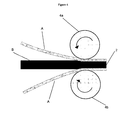
- An illustrative embodiment of the manufacture of a three-layer laminated product is depicted in Figure 4 .
- the laminated product (2) is formed by rolling using a pair of rollers (4a, 4b) and pressing two like inorganic sheets (A) either side of a different inorganic sheet (B) formed from a different sheet-forming composition comprising inorganic particulate material.
- Sheets A may have a coefficient of thermal expansion (CTE) which is lower than the CTE of B.
- Sheets A and B may have any suitable thickness.
- Sheet B may be thicker than either of sheets A. Alternatively, each of sheets A may be thicker than sheet B.
- the ratio of the thickness of B to the total thickness of A/B/A may be from about 0.5-1.5.
- the laminating process may be conducted such that the thickness ratio B:(A/B/A) does not change.
- the thickness of any one sheet will be less than about 50 mm, for example, less than about 35 mm, or less than about 20 mm, or less than about 15 mm, or less than about 10 mm, or less than about 8 mm, or less than about 6 mm.
- the further processing zone or zones may be an integral part of the apparatus, or may be detachably engaged to, or otherwise in communication with, the apparatus.
- The may be further conveying means between further processing zones.
- the conveyance of inorganic sheet from the exit of the smoothing rollers to and through the various further processing zones may be automated (e.g., computed controlled) or manually operated or by a combination of automation and manual control/operation.
- the apparatus may further comprise, be detachably engaged to, or otherwise in communication wit, a firing zone for sintering a green inorganic sheet or a green laminated product formed from a green inorganic sheet, for example, a green ceramic sheet.
- the firing zone may comprise an oven or kiln suitable for firing the ceramic sheets or laminated products described herein to obtain sintered articles. Suitable ovens and kilns will be readily apparent to the skilled person.
- the apparatus may further comprising delivery means for feeding the sheet-forming composition comprising inorganic particulate material to the pair of indented rollers.
- the sheet-forming composition may be fed to the pair of indented rollers from a hopper situated above or proximate to the pair of indented rollers.
- a sheet-forming composition is continuously fed to the pair of indented rollers and the process, overall, is a continuous process in which inorganic sheet is continually exiting or drawn from the final pair of smoothing rollers.
- the sheet-forming composition or sheet formed therefrom may be dried and/or aged for a suitable period of time, e.g., up to about 24 hours, or up to about 18 hours, or up to about 12 hours.
- a suitable period of time e.g., up to about 24 hours, or up to about 18 hours, or up to about 12 hours.
- the sheet-forming composition is aged before being fed to the sheet-forming apparatus.
- the inorganic sheet also referred to as a green inorganic sheet or green ceramic sheet
- the inorganic sheet may be sintered at suitable temperature to form a ceramic sheet.
- the laminate is typically made up from green ceramic sheets, pressed and then sintered at a suitable temperature, as described above in connection with the first, second and third aspects of the present invention.
- the laminated product (and hence the sintered multilayered ceramic composite formed therefrom) may comprise at least two, for example, at least about 3 or more sheets, at least one of which, and preferably all of which, are inorganic sheets made in accordance with the present invention.
- An illustrated embodiment is depicted in Fig. 4 and described above.
- the sheets may have the same or different compositions; that is to say, the sheets may be formed from the same or different sheet-forming composition.
- the laminated product is to be fired to form a sintered multilayered ceramic composite, in which case the ceramic sheets may have variable mechanical and/or thermomechanical properties.
- the sheets may have variable coefficient of thermal expansion (CTE).
- the sintered multilayered ceramic composite has three layers and is formed from a laminated product comprising three inorganic sheets.
- the inner sheet may have a CTE which is higher than a CTE of adjacent outer ceramic sheets (as measured at 800°C by dilatometry according to DIN 51045).
- the inorganic sheets or ceramic sheets formed in accordance with the present invention will have a width of at least about 100 mm, for example, at least about 200 mm, or at least about 300 mm, or at least about 400 mm, or at least about 500 mm, or at least about 600 mm, or at least about 700 mm, or at least about 800 mm, or at least about 1000 mm.
- the inorganic sheets or ceramic sheets may have a width of less than about 3000 mm, for example, less than about 2500 mm, or less than about 2000 mm, or less than about 1500 mm.
- the inorganic sheets may have a length of a from about 200 to about 10,000 mm, for example, a length of least about 500 mm, for example, at least about 1000 mm, or at least about 1500 mm, or at least about 2000 mm, or at least about 2500 mm, or at least about 3000 mm, or at least about 3500 mm, or at least about 4000 mm or at least about, 4500 mm, or at least about 5000 m, or at least about 5500 mm, or at least about 6000 mm, or at least about 6500 mm, or at least about 7000 mm, or at least about 7500 mm, or at least about 8000 mm, or at least about 8500, or at least about 9000 mm, or at least about 9500 mm.
- a length of least about 500 mm for example, at least about 1000 mm, or at least about 1500 mm, or at least about 2000 mm, or at least about 2500 mm, or at least about 3000 mm, or at least about 3
- green (dried) ceramic sheets formed in accordance with the methods of the present invention may be characterized as having desirable mechanical properties.
- green (dried) ceramic sheet obtainable by the methods of the present invention may have a flexion of greater than about 1.0 mm, for example, greater than about 1.5 mm, or greater than about 2.0 mm, or greater than about 3.0 mm, or greater than about 3.5 mm, or greater than about 4.0 mm, or greater than about 4. 5 mm, or greater than about 5.0 mm, or greater than about 7.0 mm, or greater than about 9.0 mm, or greater than about 11.0 mm, or greater than about 13.0 mm, or greater than about 15.0 mm.
- a green (dried) ceramic sheet obtainable by the methods of the present invention may have a Bending Strength of at least about 3 MPa, for example, at least about 5 MPa, or at least about 10 MPa, or at least about 15 MPa, or at least about 20 MPa, or at least about 25 MPa.
- the Bending Strength is no greater than about 50 MPa, for example, no greater than about 40 MPa, or no greater than about 30 MPa, or no greater than about 25 MPa.
- the Bending Strength is from about 3 MPa to about 20 MPa, for example, from about 3 to about 15 MPa, or from about 4 to about 15 MPa, or from about 5 to about 15 MPa.
- Bending Strength and Flexion may be determined using a 3-point bending strength test in accordance with the following method: five green rectangular samples of the green ceramic having dimensions of 100mm (length) x 20mm (width) x 2mm (thickness) have their flexural strength and flexion measured through a three-point bending test using a Zwick Roell Z030.
- the support span (L) is 50mm and the loading rate applied is 0.5mm/min. The test is automatically stopped when cracks start to appear across the surface of each sample and the applied force decreased. After cracking, the width and the thickness of the specimens are measured as close as possible to the cracking point. These values, together with the break force and the support span are used to calculate the Bending Strength. Flexion is the maximum deflection (mm) of the centre of sample.
- Example 1 details the composition from which the inorganic sheets were prepared (samples 1-5). Each composition comprised about 90 wt. % inorganic particulate. A comparative sheet was prepared by pressing a spray dried powder (sample 6).
- the inorganic particulate materials were milled to obtain a particle size distribution having a d 50 of 5 ⁇ m.
- the milled material was then combined with the other components and water in a Z-arm mixer. Each mixture was aged overnight until the binder was completely hydrolysed.
- the resulting mixtures were continuously fed between indented rollers to form compact board followed by normal rollers to produce an inorganic sheet.
- the rollers had diameter of 240 mm and length of 600 mm. They were made of stainless steel.
- the thickness of as formed sheet varied between 0.1mm and 10mm.
- the inorganic sheets were dried between gypsum plates to avoid any deformation.
- Drying shrinkage was about 4% for all inorganic sheets prepared by the inventive method and ⁇ 1% for compared sample prepared by powder pressing.
- the green density was about 1.6 g/cm 3 for inventive samples and 1.75 g/cm 3 for comparative sample.
- Fig. 3 Bending Strength and Flexion (determined in accordance with the method described above) for all of samples 1-6 is shown in Fig. 3 .
- the strength of samples 1-5 was at least about 100 % greater compared to a sheet formed by pressing in the conventional manner.
- the ceramic sheets prepared in accordance with the present invention had capacity of deflection at least 20 times (e.g., sample 1) greater than a conventional pressed body (sample 6).
- green inorganic sheets prepared in accordance with the present invention were also used as an element to form a multilayer composite by lamination.
- the lamination was carried out at room temperature without any intermediate adhesive between inorganic sheets.
- the laminated product consisted of three sheet in an A/B/A arrangement.
- the composition of each sheet is given in Table 2.
- Sample A and Sample B have the same organic additives, but the inorganic particulate recipe of Sample A was varied from that of Sample B in order to create sheets having a different coefficient of thermal expansion.
- the thickness of the green sheets was 0.5 mm for sheet A and 4 mm for sheet B.
- the ratio of B:(A/B/A) was the same before and after lamination.
- the laminated product were then dried in accordance with protocol described in Example 1.
- the laminated products were then sintered with a predetermined cycle to produce a solid and rigid body.
- the sintering conditions varied according to the inorganic sheet composition, size of green body and desired final properties.
- a relatively slow heating rate was use for all inorganic sheets to eliminate the organic additives at beginning of firing cycle.
- the firing cycle is presented in Fig. 2 .
- Alumina based ceramic sheets were prepared from the following mixture - detailed in Table 4 - using the procedure described in Example 1. Table 4. Composition quantity (part by weight) alumina 100 fibre 5 binder 2 dispersant 1 lubricant 2 water 25
- the as prepared sheets were then fired to 1600°C.
- the fired sheets have a density of 3.06g/cm 3 and a 3-point bending strength of 180 MPa.
Landscapes
- Engineering & Computer Science (AREA)
- Chemical & Material Sciences (AREA)
- Ceramic Engineering (AREA)
- Manufacturing & Machinery (AREA)
- Mechanical Engineering (AREA)
- Materials Engineering (AREA)
- Structural Engineering (AREA)
- Organic Chemistry (AREA)
- Inorganic Chemistry (AREA)
- Dispersion Chemistry (AREA)
- Composite Materials (AREA)
- Life Sciences & Earth Sciences (AREA)
- Wood Science & Technology (AREA)
- Chemical Kinetics & Catalysis (AREA)
- Compositions Of Oxide Ceramics (AREA)
- Producing Shaped Articles From Materials (AREA)
- Devices For Post-Treatments, Processing, Supply, Discharge, And Other Processes (AREA)
Priority Applications (8)
| Application Number | Priority Date | Filing Date | Title |
|---|---|---|---|
| EP12290361.0A EP2722143B1 (fr) | 2012-10-22 | 2012-10-22 | Procédé de fabrication de feuille inorganique |
| HUE12290361A HUE031514T2 (en) | 2012-10-22 | 2012-10-22 | Procedure for producing inorganic sheet |
| ES12290361.0T ES2636930T3 (es) | 2012-10-22 | 2012-10-22 | Proceso para elaborar una lámina inorgánica |
| PT122903610T PT2722143T (pt) | 2012-10-22 | 2012-10-22 | Processo para fabrico de uma folha inorgânica |
| BR112015008907-0A BR112015008907B1 (pt) | 2012-10-22 | 2013-10-21 | Processo para produzir uma folha cerâmica sinterizada e processo para produção de um compósito cerâmico multicamada |
| CA2888389A CA2888389C (fr) | 2012-10-22 | 2013-10-21 | Processus et appareil de formation de feuille inorganique |
| US14/437,273 US20150274601A1 (en) | 2012-10-22 | 2013-10-21 | Process and apparatus for making inorganic sheet |
| PCT/EP2013/071920 WO2014064027A1 (fr) | 2012-10-22 | 2013-10-21 | Processus et appareil de formation de feuille inorganique |
Applications Claiming Priority (1)
| Application Number | Priority Date | Filing Date | Title |
|---|---|---|---|
| EP12290361.0A EP2722143B1 (fr) | 2012-10-22 | 2012-10-22 | Procédé de fabrication de feuille inorganique |
Publications (2)
| Publication Number | Publication Date |
|---|---|
| EP2722143A1 true EP2722143A1 (fr) | 2014-04-23 |
| EP2722143B1 EP2722143B1 (fr) | 2016-10-19 |
Family
ID=47137640
Family Applications (1)
| Application Number | Title | Priority Date | Filing Date |
|---|---|---|---|
| EP12290361.0A Active EP2722143B1 (fr) | 2012-10-22 | 2012-10-22 | Procédé de fabrication de feuille inorganique |
Country Status (8)
| Country | Link |
|---|---|
| US (1) | US20150274601A1 (fr) |
| EP (1) | EP2722143B1 (fr) |
| BR (1) | BR112015008907B1 (fr) |
| CA (1) | CA2888389C (fr) |
| ES (1) | ES2636930T3 (fr) |
| HU (1) | HUE031514T2 (fr) |
| PT (1) | PT2722143T (fr) |
| WO (1) | WO2014064027A1 (fr) |
Cited By (5)
| Publication number | Priority date | Publication date | Assignee | Title |
|---|---|---|---|---|
| EP3067198A1 (fr) * | 2015-03-11 | 2016-09-14 | M.J. International Flooring and Interior Products Inc. | Tuile en chlorure de polyvinyle (pvc) |
| CN107074668A (zh) * | 2015-02-18 | 2017-08-18 | 株式会社Ihi | 陶瓷基复合材料的制造方法 |
| CN109624031A (zh) * | 2018-12-21 | 2019-04-16 | 洛阳盛豫重工机械研发中心有限公司 | 一种刚玉废料的回收处理方法 |
| RU190142U1 (ru) * | 2019-04-01 | 2019-06-21 | Федеральное государственное бюджетное образовательное учреждение высшего образования "Кубанский государственный технологический университет" (ФГБОУ ВО "КубГТУ") | Устройство для получения композитного материала |
| WO2025124678A1 (fr) * | 2023-12-14 | 2025-06-19 | Knauf Gips Kg | Procédé de fourniture d'un matériau cimentaire séché dans la production d'un panneau de construction et unité de presse |
Families Citing this family (4)
| Publication number | Priority date | Publication date | Assignee | Title |
|---|---|---|---|---|
| JP2015095551A (ja) * | 2013-11-12 | 2015-05-18 | 東京エレクトロン株式会社 | シャワーヘッドアセンブリ及びプラズマ処理装置 |
| UA118117C2 (uk) * | 2014-03-14 | 2018-11-26 | Сандвік Інтеллектуал Проперті Аб | Складений валок |
| EP3656751A1 (fr) * | 2018-11-21 | 2020-05-27 | Imertech Sas | Compositions de pâte en céramique pour impression 3d |
| JP7090955B2 (ja) * | 2020-11-06 | 2022-06-27 | 燕山大学 | 半固体の金属粉末に基づく圧延鋼帯形成装置 |
Citations (15)
| Publication number | Priority date | Publication date | Assignee | Title |
|---|---|---|---|---|
| US1977699A (en) * | 1933-07-14 | 1934-10-23 | Sebring | Apparatus for manufacturing pottery ware |
| US2917821A (en) * | 1954-04-01 | 1959-12-22 | Mannesmann Ag | Method for rolling metal powder |
| GB1013170A (en) * | 1963-02-19 | 1965-12-15 | New England Materials Lab Inc | Improvements in or relating to the hot consolidation of metal powders |
| US4329271A (en) | 1980-12-15 | 1982-05-11 | Gte Products Corporation | Flexible ceramic tape and method of making same |
| EP0554820A1 (fr) | 1992-02-03 | 1993-08-11 | Lanxide Technology Company, Lp | Procédé de fabrication de laminés céramiques |
| WO1994006728A1 (fr) | 1992-09-17 | 1994-03-31 | Colorobbia S.P.A. | Procede et equipement perfectionne pour la formation d'un produit lamellaire destine a emailler la surface de carreaux ou autres, et systemes d'application dudit produit |
| US5508072A (en) | 1992-08-11 | 1996-04-16 | E. Khashoggi Industries | Sheets having a highly inorganically filled organic polymer matrix |
| US5800647A (en) | 1992-08-11 | 1998-09-01 | E. Khashoggi Industries, Llc | Methods for manufacturing articles from sheets having a highly inorganically filled organic polymer matrix |
| US6399013B1 (en) | 2000-03-10 | 2002-06-04 | Nihon-Ceraboth Co., Ltd. | Method of manufacturing large-scale ceramics board |
| WO2003002167A2 (fr) | 2001-06-26 | 2003-01-09 | Feg Textiltechnik Forschungs- Und Entwicklungsgesellschaft Mbh | Implant textile |
| WO2003049935A1 (fr) | 2001-12-13 | 2003-06-19 | Beijing Meiliyuan Tech. Co., Ltd | Feuille de micropoudre compacte inorganique, son procede de production et produit ainsi obtenu |
| FR2818015B1 (fr) | 2000-12-08 | 2003-09-26 | Centre Nat Rech Scient | Procede de fabrication de films minces en composite metal/ceramique |
| US7090480B2 (en) | 2000-06-30 | 2006-08-15 | Denso Corporation | Method and apparatus for molding ceramic sheet |
| EP1726419A1 (fr) | 2004-03-19 | 2006-11-29 | Denki Kagaku Kogyo Kabushiki Kaisha | Procédé de fabrication de feuille céramique, substrat céramique utilisant ledit procédé et utilisation de celui-ci |
| US7597781B2 (en) | 2004-11-24 | 2009-10-06 | Nippon Sheet Glass Company, Limited | Inorganic fiber paper |
Family Cites Families (10)
| Publication number | Priority date | Publication date | Assignee | Title |
|---|---|---|---|---|
| US2717419A (en) * | 1952-11-01 | 1955-09-13 | Electrolyser Corp Ltd | Method and apparatus for forming compacted bodies |
| US3122434A (en) * | 1960-06-03 | 1964-02-25 | Republic Steel Corp | Continuous process of producing strips and sheets of ferrous metal directly from metal powder |
| GB982128A (en) * | 1962-12-20 | 1965-02-03 | Fetok Gmbh | Process for producing thin sheets of plastic ceramic materials |
| US3458329A (en) * | 1963-02-13 | 1969-07-29 | Minnesota Mining & Mfg | Ceramic greensheets |
| US3518756A (en) * | 1967-08-22 | 1970-07-07 | Ibm | Fabrication of multilevel ceramic,microelectronic structures |
| FR2031152A5 (fr) * | 1969-02-26 | 1970-11-13 | Ibm | |
| JPS5723409A (en) * | 1980-07-17 | 1982-02-06 | Matsushita Electric Industrial Co Ltd | Method of producing ceramic sheet |
| DE4102469A1 (de) * | 1991-01-28 | 1992-07-30 | Dyko Industriekeramik Gmbh | Verfahren zur kontinuierlichen herstellung duennwandiger formkoerper aus keramischer masse |
| JP2001310317A (ja) * | 2000-04-28 | 2001-11-06 | Inax Corp | セラミックス成形体への模様転写装置 |
| EP2455353A1 (fr) * | 2010-11-19 | 2012-05-23 | Imerys Services | Structures céramiques multicouches |
-
2012
- 2012-10-22 HU HUE12290361A patent/HUE031514T2/en unknown
- 2012-10-22 PT PT122903610T patent/PT2722143T/pt unknown
- 2012-10-22 ES ES12290361.0T patent/ES2636930T3/es active Active
- 2012-10-22 EP EP12290361.0A patent/EP2722143B1/fr active Active
-
2013
- 2013-10-21 WO PCT/EP2013/071920 patent/WO2014064027A1/fr not_active Ceased
- 2013-10-21 BR BR112015008907-0A patent/BR112015008907B1/pt active IP Right Grant
- 2013-10-21 US US14/437,273 patent/US20150274601A1/en not_active Abandoned
- 2013-10-21 CA CA2888389A patent/CA2888389C/fr active Active
Patent Citations (15)
| Publication number | Priority date | Publication date | Assignee | Title |
|---|---|---|---|---|
| US1977699A (en) * | 1933-07-14 | 1934-10-23 | Sebring | Apparatus for manufacturing pottery ware |
| US2917821A (en) * | 1954-04-01 | 1959-12-22 | Mannesmann Ag | Method for rolling metal powder |
| GB1013170A (en) * | 1963-02-19 | 1965-12-15 | New England Materials Lab Inc | Improvements in or relating to the hot consolidation of metal powders |
| US4329271A (en) | 1980-12-15 | 1982-05-11 | Gte Products Corporation | Flexible ceramic tape and method of making same |
| EP0554820A1 (fr) | 1992-02-03 | 1993-08-11 | Lanxide Technology Company, Lp | Procédé de fabrication de laminés céramiques |
| US5508072A (en) | 1992-08-11 | 1996-04-16 | E. Khashoggi Industries | Sheets having a highly inorganically filled organic polymer matrix |
| US5800647A (en) | 1992-08-11 | 1998-09-01 | E. Khashoggi Industries, Llc | Methods for manufacturing articles from sheets having a highly inorganically filled organic polymer matrix |
| WO1994006728A1 (fr) | 1992-09-17 | 1994-03-31 | Colorobbia S.P.A. | Procede et equipement perfectionne pour la formation d'un produit lamellaire destine a emailler la surface de carreaux ou autres, et systemes d'application dudit produit |
| US6399013B1 (en) | 2000-03-10 | 2002-06-04 | Nihon-Ceraboth Co., Ltd. | Method of manufacturing large-scale ceramics board |
| US7090480B2 (en) | 2000-06-30 | 2006-08-15 | Denso Corporation | Method and apparatus for molding ceramic sheet |
| FR2818015B1 (fr) | 2000-12-08 | 2003-09-26 | Centre Nat Rech Scient | Procede de fabrication de films minces en composite metal/ceramique |
| WO2003002167A2 (fr) | 2001-06-26 | 2003-01-09 | Feg Textiltechnik Forschungs- Und Entwicklungsgesellschaft Mbh | Implant textile |
| WO2003049935A1 (fr) | 2001-12-13 | 2003-06-19 | Beijing Meiliyuan Tech. Co., Ltd | Feuille de micropoudre compacte inorganique, son procede de production et produit ainsi obtenu |
| EP1726419A1 (fr) | 2004-03-19 | 2006-11-29 | Denki Kagaku Kogyo Kabushiki Kaisha | Procédé de fabrication de feuille céramique, substrat céramique utilisant ledit procédé et utilisation de celui-ci |
| US7597781B2 (en) | 2004-11-24 | 2009-10-06 | Nippon Sheet Glass Company, Limited | Inorganic fiber paper |
Non-Patent Citations (1)
| Title |
|---|
| M. M. FLGUELREDO: "A comparative study of two automated techniques for measuring fiber length", TAPPL JOUMAL, vol. 80, no. 2, pages 137, XP002682636 |
Cited By (6)
| Publication number | Priority date | Publication date | Assignee | Title |
|---|---|---|---|---|
| CN107074668A (zh) * | 2015-02-18 | 2017-08-18 | 株式会社Ihi | 陶瓷基复合材料的制造方法 |
| EP3199503A4 (fr) * | 2015-02-18 | 2018-06-13 | IHI Corporation | Procédé de fabrication d'un matériau composite à base de céramique |
| EP3067198A1 (fr) * | 2015-03-11 | 2016-09-14 | M.J. International Flooring and Interior Products Inc. | Tuile en chlorure de polyvinyle (pvc) |
| CN109624031A (zh) * | 2018-12-21 | 2019-04-16 | 洛阳盛豫重工机械研发中心有限公司 | 一种刚玉废料的回收处理方法 |
| RU190142U1 (ru) * | 2019-04-01 | 2019-06-21 | Федеральное государственное бюджетное образовательное учреждение высшего образования "Кубанский государственный технологический университет" (ФГБОУ ВО "КубГТУ") | Устройство для получения композитного материала |
| WO2025124678A1 (fr) * | 2023-12-14 | 2025-06-19 | Knauf Gips Kg | Procédé de fourniture d'un matériau cimentaire séché dans la production d'un panneau de construction et unité de presse |
Also Published As
| Publication number | Publication date |
|---|---|
| CA2888389A1 (fr) | 2014-05-01 |
| WO2014064027A1 (fr) | 2014-05-01 |
| CA2888389C (fr) | 2019-03-05 |
| PT2722143T (pt) | 2017-01-18 |
| US20150274601A1 (en) | 2015-10-01 |
| BR112015008907B1 (pt) | 2021-11-30 |
| HUE031514T2 (en) | 2017-07-28 |
| ES2636930T3 (es) | 2017-10-10 |
| BR112015008907A2 (pt) | 2017-07-04 |
| EP2722143B1 (fr) | 2016-10-19 |
Similar Documents
| Publication | Publication Date | Title |
|---|---|---|
| EP2722143B1 (fr) | Procédé de fabrication de feuille inorganique | |
| Leo et al. | Near‐net‐shaping methods for ceramic elements of (body) armor systems | |
| CN101553446B (zh) | 钛酸铝批料组合物及方法 | |
| EP0133307B1 (fr) | Procédé de préparation d'un corps moulé en céramique | |
| EP2364283B1 (fr) | Element en nid d'abeille en cordierite et procede de fabrication | |
| JP6940792B2 (ja) | 無機繊維成形体、加熱炉、構造体、及び無機繊維成形体の製造方法 | |
| JP3090462B2 (ja) | 水性分散液からのシートの製造法 | |
| EP2374756B1 (fr) | Pâte céramique, article en céramique et procédés de fabrication correspondants | |
| WO2006017676A2 (fr) | Procede de fabrication d'articles en ceramique et articles en ceramique produits par le procede | |
| Ananthakumar et al. | Rheology and packing characteristics of alumina extrusion using boehmite gel as a binder | |
| WO2008044497A1 (fr) | Argile de friction pour céramique et son utilisation | |
| US7858554B2 (en) | Cordierite fiber substrate and method for forming the same | |
| da Silva et al. | Forming of thin porcelain tiles: a comparison between tape casting and dry pressing | |
| US5591287A (en) | Process for producing layered ceramic product | |
| US10759702B2 (en) | Forming a ceramic product | |
| Ananthakumar et al. | Extrusion characteristics of alumina–aluminium titanate composite using boehmite as a reactive binder | |
| EP2539301B1 (fr) | Compositions et procédés de fabrication de corps céramiques à faible expansion thermique | |
| WO2015108484A2 (fr) | Matrice minérale argileuse frittée, dopée avec des métaux du groupe des terres rares, des métaux de transition, ou des métaux de post-transition | |
| JP2022114211A (ja) | 無機繊維成形体、および炉 | |
| EP0554820B1 (fr) | Procédé de fabrication de feuilles céramiques | |
| US20130330388A1 (en) | Porous Sphere-like Objects, Method to Form Same and Uses Thereof Involvoing the Treatment of Fluids Including Anti-bacterial Applications | |
| CN114315329A (zh) | 一种危废回转窑用刚玉碳化硅复合砖及其制备方法 | |
| Scheithauer et al. | New lightweight kiln furniture made by combination of ceramic green tapes and extrudates | |
| JP2614809B2 (ja) | 耐熱性低比重繊維質成形体の製造法 | |
| CN109020567A (zh) | 耐急冷急热氧化铝辊棒的配方及其制作工艺 |
Legal Events
| Date | Code | Title | Description |
|---|---|---|---|
| PUAI | Public reference made under article 153(3) epc to a published international application that has entered the european phase |
Free format text: ORIGINAL CODE: 0009012 |
|
| AK | Designated contracting states |
Kind code of ref document: A1 Designated state(s): AL AT BE BG CH CY CZ DE DK EE ES FI FR GB GR HR HU IE IS IT LI LT LU LV MC MK MT NL NO PL PT RO RS SE SI SK SM TR |
|
| AX | Request for extension of the european patent |
Extension state: BA ME |
|
| 17P | Request for examination filed |
Effective date: 20141013 |
|
| RBV | Designated contracting states (corrected) |
Designated state(s): AL AT BE BG CH CY CZ DE DK EE ES FI FR GB GR HR HU IE IS IT LI LT LU LV MC MK MT NL NO PL PT RO RS SE SI SK SM TR |
|
| 17Q | First examination report despatched |
Effective date: 20150304 |
|
| GRAP | Despatch of communication of intention to grant a patent |
Free format text: ORIGINAL CODE: EPIDOSNIGR1 |
|
| RIC1 | Information provided on ipc code assigned before grant |
Ipc: B30B 11/18 20060101ALI20160413BHEP Ipc: B22F 5/00 20060101ALI20160413BHEP Ipc: B22F 3/18 20060101ALI20160413BHEP Ipc: C04B 33/13 20060101ALI20160413BHEP Ipc: B30B 3/04 20060101ALI20160413BHEP Ipc: C04B 35/111 20060101ALI20160413BHEP Ipc: C04B 35/622 20060101ALI20160413BHEP Ipc: B22F 7/02 20060101ALI20160413BHEP Ipc: C04B 35/626 20060101ALI20160413BHEP Ipc: B28B 3/12 20060101ALI20160413BHEP Ipc: B32B 18/00 20060101ALI20160413BHEP Ipc: B28B 3/16 20060101ALI20160413BHEP Ipc: B28B 1/52 20060101AFI20160413BHEP |
|
| INTG | Intention to grant announced |
Effective date: 20160511 |
|
| GRAS | Grant fee paid |
Free format text: ORIGINAL CODE: EPIDOSNIGR3 |
|
| GRAA | (expected) grant |
Free format text: ORIGINAL CODE: 0009210 |
|
| AK | Designated contracting states |
Kind code of ref document: B1 Designated state(s): AL AT BE BG CH CY CZ DE DK EE ES FI FR GB GR HR HU IE IS IT LI LT LU LV MC MK MT NL NO PL PT RO RS SE SI SK SM TR |
|
| REG | Reference to a national code |
Ref country code: GB Ref legal event code: FG4D |
|
| REG | Reference to a national code |
Ref country code: CH Ref legal event code: EP |
|
| REG | Reference to a national code |
Ref country code: AT Ref legal event code: REF Ref document number: 837935 Country of ref document: AT Kind code of ref document: T Effective date: 20161115 |
|
| REG | Reference to a national code |
Ref country code: IE Ref legal event code: FG4D |
|
| REG | Reference to a national code |
Ref country code: DE Ref legal event code: R096 Ref document number: 602012024278 Country of ref document: DE |
|
| REG | Reference to a national code |
Ref country code: FR Ref legal event code: PLFP Year of fee payment: 5 |
|
| REG | Reference to a national code |
Ref country code: RO Ref legal event code: EPE |
|
| REG | Reference to a national code |
Ref country code: PT Ref legal event code: SC4A Ref document number: 2722143 Country of ref document: PT Date of ref document: 20170118 Kind code of ref document: T Free format text: AVAILABILITY OF NATIONAL TRANSLATION Effective date: 20170110 |
|
| REG | Reference to a national code |
Ref country code: NL Ref legal event code: MP Effective date: 20161019 |
|
| REG | Reference to a national code |
Ref country code: LT Ref legal event code: MG4D |
|
| PG25 | Lapsed in a contracting state [announced via postgrant information from national office to epo] |
Ref country code: LV Free format text: LAPSE BECAUSE OF FAILURE TO SUBMIT A TRANSLATION OF THE DESCRIPTION OR TO PAY THE FEE WITHIN THE PRESCRIBED TIME-LIMIT Effective date: 20161019 Ref country code: BE Free format text: LAPSE BECAUSE OF NON-PAYMENT OF DUE FEES Effective date: 20161031 |
|
| REG | Reference to a national code |
Ref country code: AT Ref legal event code: MK05 Ref document number: 837935 Country of ref document: AT Kind code of ref document: T Effective date: 20161019 |
|
| PG25 | Lapsed in a contracting state [announced via postgrant information from national office to epo] |
Ref country code: NO Free format text: LAPSE BECAUSE OF FAILURE TO SUBMIT A TRANSLATION OF THE DESCRIPTION OR TO PAY THE FEE WITHIN THE PRESCRIBED TIME-LIMIT Effective date: 20170119 Ref country code: LT Free format text: LAPSE BECAUSE OF FAILURE TO SUBMIT A TRANSLATION OF THE DESCRIPTION OR TO PAY THE FEE WITHIN THE PRESCRIBED TIME-LIMIT Effective date: 20161019 Ref country code: GR Free format text: LAPSE BECAUSE OF FAILURE TO SUBMIT A TRANSLATION OF THE DESCRIPTION OR TO PAY THE FEE WITHIN THE PRESCRIBED TIME-LIMIT Effective date: 20170120 Ref country code: SE Free format text: LAPSE BECAUSE OF FAILURE TO SUBMIT A TRANSLATION OF THE DESCRIPTION OR TO PAY THE FEE WITHIN THE PRESCRIBED TIME-LIMIT Effective date: 20161019 |
|
| PG25 | Lapsed in a contracting state [announced via postgrant information from national office to epo] |
Ref country code: AT Free format text: LAPSE BECAUSE OF FAILURE TO SUBMIT A TRANSLATION OF THE DESCRIPTION OR TO PAY THE FEE WITHIN THE PRESCRIBED TIME-LIMIT Effective date: 20161019 Ref country code: IS Free format text: LAPSE BECAUSE OF FAILURE TO SUBMIT A TRANSLATION OF THE DESCRIPTION OR TO PAY THE FEE WITHIN THE PRESCRIBED TIME-LIMIT Effective date: 20170219 Ref country code: HR Free format text: LAPSE BECAUSE OF FAILURE TO SUBMIT A TRANSLATION OF THE DESCRIPTION OR TO PAY THE FEE WITHIN THE PRESCRIBED TIME-LIMIT Effective date: 20161019 Ref country code: PL Free format text: LAPSE BECAUSE OF FAILURE TO SUBMIT A TRANSLATION OF THE DESCRIPTION OR TO PAY THE FEE WITHIN THE PRESCRIBED TIME-LIMIT Effective date: 20161019 Ref country code: FI Free format text: LAPSE BECAUSE OF FAILURE TO SUBMIT A TRANSLATION OF THE DESCRIPTION OR TO PAY THE FEE WITHIN THE PRESCRIBED TIME-LIMIT Effective date: 20161019 Ref country code: RS Free format text: LAPSE BECAUSE OF FAILURE TO SUBMIT A TRANSLATION OF THE DESCRIPTION OR TO PAY THE FEE WITHIN THE PRESCRIBED TIME-LIMIT Effective date: 20161019 Ref country code: BE Free format text: LAPSE BECAUSE OF FAILURE TO SUBMIT A TRANSLATION OF THE DESCRIPTION OR TO PAY THE FEE WITHIN THE PRESCRIBED TIME-LIMIT Effective date: 20161019 Ref country code: NL Free format text: LAPSE BECAUSE OF FAILURE TO SUBMIT A TRANSLATION OF THE DESCRIPTION OR TO PAY THE FEE WITHIN THE PRESCRIBED TIME-LIMIT Effective date: 20161019 |
|
| REG | Reference to a national code |
Ref country code: CH Ref legal event code: PL |
|
| REG | Reference to a national code |
Ref country code: DE Ref legal event code: R097 Ref document number: 602012024278 Country of ref document: DE |
|
| REG | Reference to a national code |
Ref country code: IE Ref legal event code: MM4A |
|
| REG | Reference to a national code |
Ref country code: HU Ref legal event code: AG4A Ref document number: E031514 Country of ref document: HU |
|
| PG25 | Lapsed in a contracting state [announced via postgrant information from national office to epo] |
Ref country code: LI Free format text: LAPSE BECAUSE OF NON-PAYMENT OF DUE FEES Effective date: 20161031 Ref country code: SK Free format text: LAPSE BECAUSE OF FAILURE TO SUBMIT A TRANSLATION OF THE DESCRIPTION OR TO PAY THE FEE WITHIN THE PRESCRIBED TIME-LIMIT Effective date: 20161019 Ref country code: MC Free format text: LAPSE BECAUSE OF FAILURE TO SUBMIT A TRANSLATION OF THE DESCRIPTION OR TO PAY THE FEE WITHIN THE PRESCRIBED TIME-LIMIT Effective date: 20161019 Ref country code: CH Free format text: LAPSE BECAUSE OF NON-PAYMENT OF DUE FEES Effective date: 20161031 Ref country code: CZ Free format text: LAPSE BECAUSE OF FAILURE TO SUBMIT A TRANSLATION OF THE DESCRIPTION OR TO PAY THE FEE WITHIN THE PRESCRIBED TIME-LIMIT Effective date: 20161019 Ref country code: EE Free format text: LAPSE BECAUSE OF FAILURE TO SUBMIT A TRANSLATION OF THE DESCRIPTION OR TO PAY THE FEE WITHIN THE PRESCRIBED TIME-LIMIT Effective date: 20161019 Ref country code: DK Free format text: LAPSE BECAUSE OF FAILURE TO SUBMIT A TRANSLATION OF THE DESCRIPTION OR TO PAY THE FEE WITHIN THE PRESCRIBED TIME-LIMIT Effective date: 20161019 |
|
| PLBE | No opposition filed within time limit |
Free format text: ORIGINAL CODE: 0009261 |
|
| STAA | Information on the status of an ep patent application or granted ep patent |
Free format text: STATUS: NO OPPOSITION FILED WITHIN TIME LIMIT |
|
| PG25 | Lapsed in a contracting state [announced via postgrant information from national office to epo] |
Ref country code: LU Free format text: LAPSE BECAUSE OF NON-PAYMENT OF DUE FEES Effective date: 20161022 Ref country code: BG Free format text: LAPSE BECAUSE OF FAILURE TO SUBMIT A TRANSLATION OF THE DESCRIPTION OR TO PAY THE FEE WITHIN THE PRESCRIBED TIME-LIMIT Effective date: 20170119 Ref country code: SM Free format text: LAPSE BECAUSE OF FAILURE TO SUBMIT A TRANSLATION OF THE DESCRIPTION OR TO PAY THE FEE WITHIN THE PRESCRIBED TIME-LIMIT Effective date: 20161019 |
|
| 26N | No opposition filed |
Effective date: 20170720 |
|
| REG | Reference to a national code |
Ref country code: ES Ref legal event code: FG2A Ref document number: 2636930 Country of ref document: ES Kind code of ref document: T3 Effective date: 20171010 |
|
| REG | Reference to a national code |
Ref country code: FR Ref legal event code: PLFP Year of fee payment: 6 |
|
| PG25 | Lapsed in a contracting state [announced via postgrant information from national office to epo] |
Ref country code: IE Free format text: LAPSE BECAUSE OF NON-PAYMENT OF DUE FEES Effective date: 20161022 Ref country code: SI Free format text: LAPSE BECAUSE OF FAILURE TO SUBMIT A TRANSLATION OF THE DESCRIPTION OR TO PAY THE FEE WITHIN THE PRESCRIBED TIME-LIMIT Effective date: 20161019 |
|
| PG25 | Lapsed in a contracting state [announced via postgrant information from national office to epo] |
Ref country code: CY Free format text: LAPSE BECAUSE OF FAILURE TO SUBMIT A TRANSLATION OF THE DESCRIPTION OR TO PAY THE FEE WITHIN THE PRESCRIBED TIME-LIMIT Effective date: 20161019 |
|
| PG25 | Lapsed in a contracting state [announced via postgrant information from national office to epo] |
Ref country code: MT Free format text: LAPSE BECAUSE OF NON-PAYMENT OF DUE FEES Effective date: 20161031 Ref country code: MK Free format text: LAPSE BECAUSE OF FAILURE TO SUBMIT A TRANSLATION OF THE DESCRIPTION OR TO PAY THE FEE WITHIN THE PRESCRIBED TIME-LIMIT Effective date: 20161019 |
|
| REG | Reference to a national code |
Ref country code: FR Ref legal event code: PLFP Year of fee payment: 7 |
|
| PG25 | Lapsed in a contracting state [announced via postgrant information from national office to epo] |
Ref country code: TR Free format text: LAPSE BECAUSE OF FAILURE TO SUBMIT A TRANSLATION OF THE DESCRIPTION OR TO PAY THE FEE WITHIN THE PRESCRIBED TIME-LIMIT Effective date: 20161019 |
|
| REG | Reference to a national code |
Ref country code: DE Ref legal event code: R081 Ref document number: 602012024278 Country of ref document: DE Owner name: IMERTECH SAS, FR Free format text: FORMER OWNER: IMERYS CERAMICS FRANCE, PARIS, FR Ref country code: DE Ref legal event code: R082 Ref document number: 602012024278 Country of ref document: DE Representative=s name: HASELTINE LAKE KEMPNER LLP, DE Ref country code: DE Ref legal event code: R082 Ref document number: 602012024278 Country of ref document: DE Representative=s name: HL KEMPNER PATENTANWALT, RECHTSANWALT, SOLICIT, DE Ref country code: DE Ref legal event code: R082 Ref document number: 602012024278 Country of ref document: DE Representative=s name: HASELTINE LAKE LLP, DE |
|
| REG | Reference to a national code |
Ref country code: GB Ref legal event code: 732E Free format text: REGISTERED BETWEEN 20190314 AND 20190320 |
|
| REG | Reference to a national code |
Ref country code: HU Ref legal event code: FH1C Free format text: FORMER REPRESENTATIVE(S): DANUBIA SZABADALMI ES JOGI IRODA KFT., HU Representative=s name: DANUBIA SZABADALMI ES JOGI IRODA KFT., HU Ref country code: HU Ref legal event code: GB9C Owner name: IMERTECH SAS, FR Free format text: FORMER OWNER(S): IMERYS CERAMICS FRANCE, FR |
|
| PG25 | Lapsed in a contracting state [announced via postgrant information from national office to epo] |
Ref country code: AL Free format text: LAPSE BECAUSE OF FAILURE TO SUBMIT A TRANSLATION OF THE DESCRIPTION OR TO PAY THE FEE WITHIN THE PRESCRIBED TIME-LIMIT Effective date: 20161019 |
|
| REG | Reference to a national code |
Ref country code: DE Ref legal event code: R082 Ref document number: 602012024278 Country of ref document: DE Representative=s name: HL KEMPNER PATENTANWAELTE, SOLICITORS (ENGLAND, DE Ref country code: DE Ref legal event code: R082 Ref document number: 602012024278 Country of ref document: DE Representative=s name: HL KEMPNER PATENTANWALT, RECHTSANWALT, SOLICIT, DE Ref country code: DE Ref legal event code: R082 Ref document number: 602012024278 Country of ref document: DE Representative=s name: HL KEMPNER PARTG MBB, DE |
|
| P01 | Opt-out of the competence of the unified patent court (upc) registered |
Effective date: 20230524 |
|
| PGFP | Annual fee paid to national office [announced via postgrant information from national office to epo] |
Ref country code: PT Payment date: 20250926 Year of fee payment: 14 |
|
| PGFP | Annual fee paid to national office [announced via postgrant information from national office to epo] |
Ref country code: IT Payment date: 20250923 Year of fee payment: 14 |
|
| PGFP | Annual fee paid to national office [announced via postgrant information from national office to epo] |
Ref country code: GB Payment date: 20250923 Year of fee payment: 14 |
|
| PGFP | Annual fee paid to national office [announced via postgrant information from national office to epo] |
Ref country code: FR Payment date: 20250924 Year of fee payment: 14 |
|
| PGFP | Annual fee paid to national office [announced via postgrant information from national office to epo] |
Ref country code: HU Payment date: 20251029 Year of fee payment: 14 |
|
| PGFP | Annual fee paid to national office [announced via postgrant information from national office to epo] |
Ref country code: DE Payment date: 20250923 Year of fee payment: 14 |
|
| PGFP | Annual fee paid to national office [announced via postgrant information from national office to epo] |
Ref country code: RO Payment date: 20251021 Year of fee payment: 14 |
|
| PGFP | Annual fee paid to national office [announced via postgrant information from national office to epo] |
Ref country code: ES Payment date: 20251103 Year of fee payment: 14 |