EP2722158A1 - Liaison par manchon - Google Patents
Liaison par manchon Download PDFInfo
- Publication number
- EP2722158A1 EP2722158A1 EP13004983.6A EP13004983A EP2722158A1 EP 2722158 A1 EP2722158 A1 EP 2722158A1 EP 13004983 A EP13004983 A EP 13004983A EP 2722158 A1 EP2722158 A1 EP 2722158A1
- Authority
- EP
- European Patent Office
- Prior art keywords
- sleeve
- socket joint
- plastic pipes
- pipe
- einsteckschürze
- Prior art date
- Legal status (The legal status is an assumption and is not a legal conclusion. Google has not performed a legal analysis and makes no representation as to the accuracy of the status listed.)
- Withdrawn
Links
- 238000010438 heat treatment Methods 0.000 claims abstract description 54
- 229920003023 plastic Polymers 0.000 claims abstract description 45
- 239000004033 plastic Substances 0.000 claims abstract description 45
- 238000003466 welding Methods 0.000 claims abstract description 9
- 238000003780 insertion Methods 0.000 claims description 18
- 230000037431 insertion Effects 0.000 claims description 18
- 238000009423 ventilation Methods 0.000 claims description 5
- 238000005516 engineering process Methods 0.000 claims description 3
- 239000000155 melt Substances 0.000 claims description 3
- 238000000034 method Methods 0.000 claims description 3
- 238000000465 moulding Methods 0.000 claims 1
- 238000004804 winding Methods 0.000 claims 1
- 239000000463 material Substances 0.000 description 8
- 238000002844 melting Methods 0.000 description 4
- 230000008018 melting Effects 0.000 description 4
- 230000004323 axial length Effects 0.000 description 2
- 230000008878 coupling Effects 0.000 description 1
- 238000010168 coupling process Methods 0.000 description 1
- 238000005859 coupling reaction Methods 0.000 description 1
- 230000001419 dependent effect Effects 0.000 description 1
- 238000011161 development Methods 0.000 description 1
- 230000018109 developmental process Effects 0.000 description 1
- 230000000694 effects Effects 0.000 description 1
- 230000001788 irregular Effects 0.000 description 1
- 238000004519 manufacturing process Methods 0.000 description 1
- 239000000126 substance Substances 0.000 description 1
Images



Classifications
-
- B—PERFORMING OPERATIONS; TRANSPORTING
- B29—WORKING OF PLASTICS; WORKING OF SUBSTANCES IN A PLASTIC STATE IN GENERAL
- B29C—SHAPING OR JOINING OF PLASTICS; SHAPING OF MATERIAL IN A PLASTIC STATE, NOT OTHERWISE PROVIDED FOR; AFTER-TREATMENT OF THE SHAPED PRODUCTS, e.g. REPAIRING
- B29C65/00—Joining or sealing of preformed parts, e.g. welding of plastics materials; Apparatus therefor
- B29C65/02—Joining or sealing of preformed parts, e.g. welding of plastics materials; Apparatus therefor by heating, with or without pressure
- B29C65/34—Joining or sealing of preformed parts, e.g. welding of plastics materials; Apparatus therefor by heating, with or without pressure using heated elements which remain in the joint, e.g. "verlorenes Schweisselement"
- B29C65/3404—Joining or sealing of preformed parts, e.g. welding of plastics materials; Apparatus therefor by heating, with or without pressure using heated elements which remain in the joint, e.g. "verlorenes Schweisselement" characterised by the type of heated elements which remain in the joint
- B29C65/342—Joining or sealing of preformed parts, e.g. welding of plastics materials; Apparatus therefor by heating, with or without pressure using heated elements which remain in the joint, e.g. "verlorenes Schweisselement" characterised by the type of heated elements which remain in the joint comprising at least a single wire, e.g. in the form of a winding
-
- B—PERFORMING OPERATIONS; TRANSPORTING
- B29—WORKING OF PLASTICS; WORKING OF SUBSTANCES IN A PLASTIC STATE IN GENERAL
- B29C—SHAPING OR JOINING OF PLASTICS; SHAPING OF MATERIAL IN A PLASTIC STATE, NOT OTHERWISE PROVIDED FOR; AFTER-TREATMENT OF THE SHAPED PRODUCTS, e.g. REPAIRING
- B29C65/00—Joining or sealing of preformed parts, e.g. welding of plastics materials; Apparatus therefor
- B29C65/02—Joining or sealing of preformed parts, e.g. welding of plastics materials; Apparatus therefor by heating, with or without pressure
- B29C65/34—Joining or sealing of preformed parts, e.g. welding of plastics materials; Apparatus therefor by heating, with or without pressure using heated elements which remain in the joint, e.g. "verlorenes Schweisselement"
- B29C65/3468—Joining or sealing of preformed parts, e.g. welding of plastics materials; Apparatus therefor by heating, with or without pressure using heated elements which remain in the joint, e.g. "verlorenes Schweisselement" characterised by the means for supplying heat to said heated elements which remain in the join, e.g. special electrical connectors of windings
-
- B—PERFORMING OPERATIONS; TRANSPORTING
- B29—WORKING OF PLASTICS; WORKING OF SUBSTANCES IN A PLASTIC STATE IN GENERAL
- B29C—SHAPING OR JOINING OF PLASTICS; SHAPING OF MATERIAL IN A PLASTIC STATE, NOT OTHERWISE PROVIDED FOR; AFTER-TREATMENT OF THE SHAPED PRODUCTS, e.g. REPAIRING
- B29C65/00—Joining or sealing of preformed parts, e.g. welding of plastics materials; Apparatus therefor
- B29C65/02—Joining or sealing of preformed parts, e.g. welding of plastics materials; Apparatus therefor by heating, with or without pressure
- B29C65/34—Joining or sealing of preformed parts, e.g. welding of plastics materials; Apparatus therefor by heating, with or without pressure using heated elements which remain in the joint, e.g. "verlorenes Schweisselement"
- B29C65/3472—Joining or sealing of preformed parts, e.g. welding of plastics materials; Apparatus therefor by heating, with or without pressure using heated elements which remain in the joint, e.g. "verlorenes Schweisselement" characterised by the composition of the heated elements which remain in the joint
- B29C65/3476—Joining or sealing of preformed parts, e.g. welding of plastics materials; Apparatus therefor by heating, with or without pressure using heated elements which remain in the joint, e.g. "verlorenes Schweisselement" characterised by the composition of the heated elements which remain in the joint being metallic
- B29C65/348—Joining or sealing of preformed parts, e.g. welding of plastics materials; Apparatus therefor by heating, with or without pressure using heated elements which remain in the joint, e.g. "verlorenes Schweisselement" characterised by the composition of the heated elements which remain in the joint being metallic with a polymer coating
-
- B—PERFORMING OPERATIONS; TRANSPORTING
- B29—WORKING OF PLASTICS; WORKING OF SUBSTANCES IN A PLASTIC STATE IN GENERAL
- B29C—SHAPING OR JOINING OF PLASTICS; SHAPING OF MATERIAL IN A PLASTIC STATE, NOT OTHERWISE PROVIDED FOR; AFTER-TREATMENT OF THE SHAPED PRODUCTS, e.g. REPAIRING
- B29C66/00—General aspects of processes or apparatus for joining preformed parts
- B29C66/01—General aspects dealing with the joint area or with the area to be joined
- B29C66/05—Particular design of joint configurations
- B29C66/10—Particular design of joint configurations particular design of the joint cross-sections
- B29C66/12—Joint cross-sections combining only two joint-segments; Tongue and groove joints; Tenon and mortise joints; Stepped joint cross-sections
- B29C66/122—Joint cross-sections combining only two joint-segments, i.e. one of the parts to be joined comprising only two joint-segments in the joint cross-section
- B29C66/1222—Joint cross-sections combining only two joint-segments, i.e. one of the parts to be joined comprising only two joint-segments in the joint cross-section comprising at least a lapped joint-segment
-
- B—PERFORMING OPERATIONS; TRANSPORTING
- B29—WORKING OF PLASTICS; WORKING OF SUBSTANCES IN A PLASTIC STATE IN GENERAL
- B29C—SHAPING OR JOINING OF PLASTICS; SHAPING OF MATERIAL IN A PLASTIC STATE, NOT OTHERWISE PROVIDED FOR; AFTER-TREATMENT OF THE SHAPED PRODUCTS, e.g. REPAIRING
- B29C66/00—General aspects of processes or apparatus for joining preformed parts
- B29C66/01—General aspects dealing with the joint area or with the area to be joined
- B29C66/05—Particular design of joint configurations
- B29C66/10—Particular design of joint configurations particular design of the joint cross-sections
- B29C66/12—Joint cross-sections combining only two joint-segments; Tongue and groove joints; Tenon and mortise joints; Stepped joint cross-sections
- B29C66/122—Joint cross-sections combining only two joint-segments, i.e. one of the parts to be joined comprising only two joint-segments in the joint cross-section
- B29C66/1224—Joint cross-sections combining only two joint-segments, i.e. one of the parts to be joined comprising only two joint-segments in the joint cross-section comprising at least a butt joint-segment
-
- B—PERFORMING OPERATIONS; TRANSPORTING
- B29—WORKING OF PLASTICS; WORKING OF SUBSTANCES IN A PLASTIC STATE IN GENERAL
- B29C—SHAPING OR JOINING OF PLASTICS; SHAPING OF MATERIAL IN A PLASTIC STATE, NOT OTHERWISE PROVIDED FOR; AFTER-TREATMENT OF THE SHAPED PRODUCTS, e.g. REPAIRING
- B29C66/00—General aspects of processes or apparatus for joining preformed parts
- B29C66/01—General aspects dealing with the joint area or with the area to be joined
- B29C66/05—Particular design of joint configurations
- B29C66/10—Particular design of joint configurations particular design of the joint cross-sections
- B29C66/12—Joint cross-sections combining only two joint-segments; Tongue and groove joints; Tenon and mortise joints; Stepped joint cross-sections
- B29C66/124—Tongue and groove joints
- B29C66/1246—Tongue and groove joints characterised by the female part, i.e. the part comprising the groove
- B29C66/12469—Tongue and groove joints characterised by the female part, i.e. the part comprising the groove being asymmetric
-
- B—PERFORMING OPERATIONS; TRANSPORTING
- B29—WORKING OF PLASTICS; WORKING OF SUBSTANCES IN A PLASTIC STATE IN GENERAL
- B29C—SHAPING OR JOINING OF PLASTICS; SHAPING OF MATERIAL IN A PLASTIC STATE, NOT OTHERWISE PROVIDED FOR; AFTER-TREATMENT OF THE SHAPED PRODUCTS, e.g. REPAIRING
- B29C66/00—General aspects of processes or apparatus for joining preformed parts
- B29C66/50—General aspects of joining tubular articles; General aspects of joining long products, i.e. bars or profiled elements; General aspects of joining single elements to tubular articles, hollow articles or bars; General aspects of joining several hollow-preforms to form hollow or tubular articles
- B29C66/51—Joining tubular articles, profiled elements or bars; Joining single elements to tubular articles, hollow articles or bars; Joining several hollow-preforms to form hollow or tubular articles
- B29C66/52—Joining tubular articles, bars or profiled elements
- B29C66/522—Joining tubular articles
- B29C66/5229—Joining tubular articles involving the use of a socket
- B29C66/52291—Joining tubular articles involving the use of a socket said socket comprising a stop
- B29C66/52292—Joining tubular articles involving the use of a socket said socket comprising a stop said stop being internal
-
- B—PERFORMING OPERATIONS; TRANSPORTING
- B29—WORKING OF PLASTICS; WORKING OF SUBSTANCES IN A PLASTIC STATE IN GENERAL
- B29C—SHAPING OR JOINING OF PLASTICS; SHAPING OF MATERIAL IN A PLASTIC STATE, NOT OTHERWISE PROVIDED FOR; AFTER-TREATMENT OF THE SHAPED PRODUCTS, e.g. REPAIRING
- B29C66/00—General aspects of processes or apparatus for joining preformed parts
- B29C66/50—General aspects of joining tubular articles; General aspects of joining long products, i.e. bars or profiled elements; General aspects of joining single elements to tubular articles, hollow articles or bars; General aspects of joining several hollow-preforms to form hollow or tubular articles
- B29C66/51—Joining tubular articles, profiled elements or bars; Joining single elements to tubular articles, hollow articles or bars; Joining several hollow-preforms to form hollow or tubular articles
- B29C66/52—Joining tubular articles, bars or profiled elements
- B29C66/522—Joining tubular articles
- B29C66/5229—Joining tubular articles involving the use of a socket
- B29C66/52298—Joining tubular articles involving the use of a socket said socket being composed by several elements
-
- B—PERFORMING OPERATIONS; TRANSPORTING
- B29—WORKING OF PLASTICS; WORKING OF SUBSTANCES IN A PLASTIC STATE IN GENERAL
- B29C—SHAPING OR JOINING OF PLASTICS; SHAPING OF MATERIAL IN A PLASTIC STATE, NOT OTHERWISE PROVIDED FOR; AFTER-TREATMENT OF THE SHAPED PRODUCTS, e.g. REPAIRING
- B29C66/00—General aspects of processes or apparatus for joining preformed parts
- B29C66/50—General aspects of joining tubular articles; General aspects of joining long products, i.e. bars or profiled elements; General aspects of joining single elements to tubular articles, hollow articles or bars; General aspects of joining several hollow-preforms to form hollow or tubular articles
- B29C66/51—Joining tubular articles, profiled elements or bars; Joining single elements to tubular articles, hollow articles or bars; Joining several hollow-preforms to form hollow or tubular articles
- B29C66/53—Joining single elements to tubular articles, hollow articles or bars
- B29C66/534—Joining single elements to open ends of tubular or hollow articles or to the ends of bars
- B29C66/5344—Joining single elements to open ends of tubular or hollow articles or to the ends of bars said single elements being substantially annular, i.e. of finite length, e.g. joining flanges to tube ends
-
- F—MECHANICAL ENGINEERING; LIGHTING; HEATING; WEAPONS; BLASTING
- F16—ENGINEERING ELEMENTS AND UNITS; GENERAL MEASURES FOR PRODUCING AND MAINTAINING EFFECTIVE FUNCTIONING OF MACHINES OR INSTALLATIONS; THERMAL INSULATION IN GENERAL
- F16L—PIPES; JOINTS OR FITTINGS FOR PIPES; SUPPORTS FOR PIPES, CABLES OR PROTECTIVE TUBING; MEANS FOR THERMAL INSULATION IN GENERAL
- F16L47/00—Connecting arrangements or other fittings specially adapted to be made of plastics or to be used with pipes made of plastics
- F16L47/02—Welded joints; Adhesive joints
- F16L47/03—Welded joints with an electrical resistance incorporated in the joint
-
- H—ELECTRICITY
- H05—ELECTRIC TECHNIQUES NOT OTHERWISE PROVIDED FOR
- H05B—ELECTRIC HEATING; ELECTRIC LIGHT SOURCES NOT OTHERWISE PROVIDED FOR; CIRCUIT ARRANGEMENTS FOR ELECTRIC LIGHT SOURCES, IN GENERAL
- H05B3/00—Ohmic-resistance heating
- H05B3/40—Heating elements having the shape of rods or tubes
- H05B3/42—Heating elements having the shape of rods or tubes non-flexible
- H05B3/48—Heating elements having the shape of rods or tubes non-flexible heating conductor embedded in insulating material
-
- B—PERFORMING OPERATIONS; TRANSPORTING
- B29—WORKING OF PLASTICS; WORKING OF SUBSTANCES IN A PLASTIC STATE IN GENERAL
- B29C—SHAPING OR JOINING OF PLASTICS; SHAPING OF MATERIAL IN A PLASTIC STATE, NOT OTHERWISE PROVIDED FOR; AFTER-TREATMENT OF THE SHAPED PRODUCTS, e.g. REPAIRING
- B29C65/00—Joining or sealing of preformed parts, e.g. welding of plastics materials; Apparatus therefor
- B29C65/02—Joining or sealing of preformed parts, e.g. welding of plastics materials; Apparatus therefor by heating, with or without pressure
- B29C65/34—Joining or sealing of preformed parts, e.g. welding of plastics materials; Apparatus therefor by heating, with or without pressure using heated elements which remain in the joint, e.g. "verlorenes Schweisselement"
- B29C65/3404—Joining or sealing of preformed parts, e.g. welding of plastics materials; Apparatus therefor by heating, with or without pressure using heated elements which remain in the joint, e.g. "verlorenes Schweisselement" characterised by the type of heated elements which remain in the joint
- B29C65/342—Joining or sealing of preformed parts, e.g. welding of plastics materials; Apparatus therefor by heating, with or without pressure using heated elements which remain in the joint, e.g. "verlorenes Schweisselement" characterised by the type of heated elements which remain in the joint comprising at least a single wire, e.g. in the form of a winding
- B29C65/3432—Joining or sealing of preformed parts, e.g. welding of plastics materials; Apparatus therefor by heating, with or without pressure using heated elements which remain in the joint, e.g. "verlorenes Schweisselement" characterised by the type of heated elements which remain in the joint comprising at least a single wire, e.g. in the form of a winding comprising several wires, e.g. in the form of several independent windings
-
- B—PERFORMING OPERATIONS; TRANSPORTING
- B29—WORKING OF PLASTICS; WORKING OF SUBSTANCES IN A PLASTIC STATE IN GENERAL
- B29C—SHAPING OR JOINING OF PLASTICS; SHAPING OF MATERIAL IN A PLASTIC STATE, NOT OTHERWISE PROVIDED FOR; AFTER-TREATMENT OF THE SHAPED PRODUCTS, e.g. REPAIRING
- B29C66/00—General aspects of processes or apparatus for joining preformed parts
- B29C66/50—General aspects of joining tubular articles; General aspects of joining long products, i.e. bars or profiled elements; General aspects of joining single elements to tubular articles, hollow articles or bars; General aspects of joining several hollow-preforms to form hollow or tubular articles
- B29C66/51—Joining tubular articles, profiled elements or bars; Joining single elements to tubular articles, hollow articles or bars; Joining several hollow-preforms to form hollow or tubular articles
- B29C66/52—Joining tubular articles, bars or profiled elements
- B29C66/522—Joining tubular articles
- B29C66/5221—Joining tubular articles for forming coaxial connections, i.e. the tubular articles to be joined forming a zero angle relative to each other
-
- B—PERFORMING OPERATIONS; TRANSPORTING
- B29—WORKING OF PLASTICS; WORKING OF SUBSTANCES IN A PLASTIC STATE IN GENERAL
- B29C—SHAPING OR JOINING OF PLASTICS; SHAPING OF MATERIAL IN A PLASTIC STATE, NOT OTHERWISE PROVIDED FOR; AFTER-TREATMENT OF THE SHAPED PRODUCTS, e.g. REPAIRING
- B29C66/00—General aspects of processes or apparatus for joining preformed parts
- B29C66/70—General aspects of processes or apparatus for joining preformed parts characterised by the composition, physical properties or the structure of the material of the parts to be joined; Joining with non-plastics material
- B29C66/71—General aspects of processes or apparatus for joining preformed parts characterised by the composition, physical properties or the structure of the material of the parts to be joined; Joining with non-plastics material characterised by the composition of the plastics material of the parts to be joined
-
- B—PERFORMING OPERATIONS; TRANSPORTING
- B29—WORKING OF PLASTICS; WORKING OF SUBSTANCES IN A PLASTIC STATE IN GENERAL
- B29C—SHAPING OR JOINING OF PLASTICS; SHAPING OF MATERIAL IN A PLASTIC STATE, NOT OTHERWISE PROVIDED FOR; AFTER-TREATMENT OF THE SHAPED PRODUCTS, e.g. REPAIRING
- B29C66/00—General aspects of processes or apparatus for joining preformed parts
- B29C66/80—General aspects of machine operations or constructions and parts thereof
- B29C66/82—Pressure application arrangements, e.g. transmission or actuating mechanisms for joining tools or clamps
- B29C66/826—Pressure application arrangements, e.g. transmission or actuating mechanisms for joining tools or clamps without using a separate pressure application tool, e.g. the own weight of the parts to be joined
- B29C66/8264—Pressure application arrangements, e.g. transmission or actuating mechanisms for joining tools or clamps without using a separate pressure application tool, e.g. the own weight of the parts to be joined using the thermal expansion of the parts to be joined
Definitions
- the innovation relates to a socket joint for plastic pipes and pipe fittings, in particular plastic pipes and pipe fittings for ventilation technology comprising at least one sleeve member, at least one end insertable in the sleeve member tube element and at least one Hugheslelement for electrically welding the pipe element and sleeve member in a connection region in which axially overlap tubular element and sleeve element, wherein the Schuchtlelement is inserted into an annular gap provided in the connecting region between the pipe element and the sleeve element, wherein the Russell mindfullelement is formed as a insertable into the annular gap between the pipe element and sleeve element rigid plastic skirting, embedded in the heating wires are and wherein the Einsteckschürze has an insertable into the annular gap between the pipe element and sleeve element axis-parallel approximately cylindrical insertion portion and a d the end of the sleeve element cross-determining section.
- the Schwarzerlement is here a pure heating wire, can provide in this way only the melting of the heat of plastic sleeve and pipe melting material for the weld.
- a helically bent wire is not dimensionally stable, so that, in particular with a comparatively narrow annular gap, shifts of the heating wire loops with one another and an irregular non-axis-parallel arrangement of the heating wire in the annular gap can occur. This does not happen a homogeneous uniform load-bearing welded joint, which meets the requirements demanded in practice.
- the Swiss patent CH 336 980 A describes a method for welding together pipe elements made of plastic comprising a sleeve element, which is referred to there as a plastic fitting, a plastic tube smaller in outer diameter and a insertable into the annular gap between the sleeve member and plastic pipe connecting element, in which a heating element is embedded.
- the connecting element here is purely cylindrical, so that this does not find a stop when inserted into the bore of the sleeve member outside at the end of the sleeve member.
- the connecting element has such an axial length, which corresponds exactly to the length of a stepped bore of the sleeve member and the length of the insertion path of the connecting element is limited by the annular shoulder of the stepped bore in the sleeve member.
- the connecting element after the insertion of the connecting element into the sleeve element, there is no mutual fixing of these two components relative to one another, so that the risk exists that the connecting element will slip before the welded connection is made.
- This sleeve member has a greater axial length than the sleeve member, so that after connecting the front end of the sleeve member is located at a distance from the front end of the sleeve member. After pushing the bushing element consequently the front end of the sleeve member is no longer visible and there is no control over the relative axial position of the components to each other, for example, the sleeve member can slide axially outwardly in the outer sleeve member prior to the production of the welded joint, wherein also shifts the relative position of the innermost tubular element relative to the outer sleeve element.
- the object of the present innovation is to provide a socket joint for plastic pipes with the features of the type mentioned, in which a high-quality welded joint between pipe element and sleeve element can be produced.
- the fixing portion of the Einsteckschürze in longitudinal section has approximately an L-shape.
- the Schuetzlelement is thus an insertable into the annular gap between the pipe element and sleeve element rigid plastic skirt, are embedded in the heating wires, wherein the fixing section defines an end stop when inserted between the sleeve element and pipe element Schuchtlelement.
- this fixing portion of the heating coil member enables clamping fixing of the heating coil member to the sleeve member because the fixing portion overlaps the axial end of the sleeve member.
- the axially parallel approximately cylindrical insertion portion of the Einsteckschürze engages in the annular gap between the pipe element and sleeve member where a welding of the two elements is desired.
- additional material in the connection area is provided, which melts when heated by the heating coil and each enters into a cohesive connection with the plastic of the radially inner tube member and the radially outer sleeve member.
- tube element, sleeve element and heating coil element may be made, for example, PE, PP, PVC, PPS, PP-EL, PE-EL or similar materials into consideration, which are particularly suitable for piping and pipe fittings in ventilation. Because of the necessary weldability you will usually use the same materials for pipe element and sleeve element and Schuetzlelement in general because the welding of chemically differently constructed plastics is often not possible.
- This leg then runs behind the end of the sleeve member and can serve as a stop for the Einsteckschürze.
- the fixing portion of the Einsteckschürze has in longitudinal section a total of about an L-shape with a radially outwardly extending leg and an approximately perpendicular to this and extending in the opposite direction to the male and about this parallel axially parallel outer leg, which the end of the sleeve element overlaps.
- One leg thus serves as a stop and the other leg engages over the end of the sleeve member and extends in the opposite direction.
- the fixing portion has an annular groove which serves as a receptacle for the axial end of the sleeve member.
- This axial end of the sleeve element can thus be received approximately positively in this annular groove and when inserting the Einsteckschürze creates a certain clamping action.
- the Einsteckschürze is thus held in the final position between sleeve end and inserted into the sleeve pipe.
- the sleeve has an enlarged diameter end portion into which the tube end is inserted, which can be connected to this extended end portion of a sleeve portion with the same diameter as the end portion of the tubular element, so that a total of a pipe between the pipe element and sleeve member approximately constant inside diameter results.
- the insertion of the Einsteckschürze in its Einsteckend Scheme a taper or bevel.
- the Einsteckschürze thus runs at its front end pointed and narrower.
- the Schurylelement have at least two connection elements for connecting the electrical leads to the heating coils, said connecting elements are preferably located on the radially outwardly extending leg of Festfestungsabitess, wherein the connecting elements preferably at the Socket element facing away from the fixing element are mounted.
- connection elements may be terminals of different designs, to which a line is connected to the positive pole or negative pole of a current source. It is also possible to use sockets or plugs for the electrical connections.
- the heating coils in the heating coil element extend in mutually spaced spiral turns, i. unlike in the prior art, each turn is then embedded in the plastic of the Einsteckschürze, the turns are not directly adjacent to each other.
- the heating coils are covered in the Einsteckschürze to the radial inside and / or to the radial outside with a layer of plastic, which melts by the heating during the welding process, ie, that the heating coils preferably not on the inside or outside of the Schuchtlelements exposed, but are embedded in the plastic. The melting of this plastic material is available, which enters the welded joint.
- the heating coil can also run in several spiral sections or, for example, initially straight sections have, for example, coming from the positive pole, which then go into a spiral shape or eg the heating coil first spiral and the negative terminal leading end portion of the heating coil then runs straight.
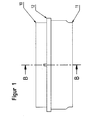
- FIG. 1 shows a view of an exemplary socket joint according to the invention.
- This comprises on the one hand, the cylindrical tube member 10, of which only one end portion is shown, and in its end portion 11 a a larger inner and outer diameter than the tube member having sleeve member 11 which engages over the tubular element 10 in the end region, so that a Overlap area results.
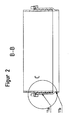
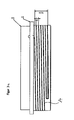
- the inner diameter of the sleeve element 11 is so much larger than the outer diameter of the tubular element 10 that a gap remains between the two, which is particularly shown in the enlarged detail view of the longitudinal section according to FIG FIG. 3 can recognize well.
- a Walkerlelement 12 is inserted, which is designed as Einsteckschürze and the material thickness is formed so that it can be easily inserted into the gap, which can ideally be clamped to the end portion 11 a of the sleeve member 11.
- the Schuetzlelement which is usually made of the same plastic as tube member 10 and sleeve member 11, an elongated insertion portion 12 a, which may have a bevel 13 at its front end to facilitate insertion into the annular gap.
- This chamfer 13 makes the front end of the male element taper to a point.
- a fixing portion At the rear end of the Einsteckabitess of the heating element 12 is followed by a fixing portion, on the one hand, a radially outwardly projecting and thus perpendicular to the insertion portion 12 a extending leg 12 b includes, and starting from this in turn approximately at a right angle in the Counter direction and parallel to the insertion portion 12 a extending axially parallel outer leg 12 c, so that a total of the longitudinal section for the Schuchtlelement 12 results in an L-shape.
- the fixing portion overlaps with its two legs 12 b and 12 c in the inserted state, in the FIGS. 1 to 3 is shown, the end portion of the sleeve member 11, whereby the Schuchtlelement is clamped to the sleeve member and thereby fixed.
- the sleeve member 11 before its in the outer and inner diameter enlarged end portion 11 a has a narrower in outer and inner diameter portion 11 b, which is dimensioned in particular in the inner diameter so that it approximately coincides with the inner diameter of the tubular member 10 so on the inside, the section 11 b of the sleeve element 11 and the tube element 10 which adjoins it axially adjacent to this form a continuous pipeline with an approximately constant free cross section.
- sleeve member 11 and pipe member 10 are used for ventilation piping. It need not be pure pipe sections as in the present embodiment, but the pipe element and sleeve element may be more complex components, such as pipe fittings, elbows or the like, which are each end connected to each other and welded according to the principle of the invention.
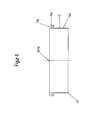
- the Schuetzlelement 12 is shown once in the side view and once in a frontal view. It is an annular component with as already described above about L-shaped cross-section.
- spirally extending heating wires 14 are embedded, such that they are both radially inwardly and radially outwardly each covered by a thin layer of plastic.
- electrical connections connecting elements 15, 16 are provided, which are located on the top of the radially outwardly projecting leg 12 b.
- connection lines from a power source which is usually a DC power source to be connected, for example, by plugging or pinching lines.
- connection elements 15, 16 are provided for the two poles of the supply lines.
- the heating wires 14 laid spirally in the interior of the heating coil element 12 are then heated when a voltage is applied and melt the plastic of the heating coil element 12 as well as a partial layer of the two elements to be connected, namely the tubular element 10 and the sleeve element 11, when the heating coil element 12 in the Socket joint is inserted, as in FIG. 3 is shown. This creates a material connection between all three elements.
- the heating spiral element 12 designed as a skirting board can also be made of a plastic which contains a proportion of an expandate (when heating a volume expansion of the plastic causing substance) or even has corresponding volume expansion properties. In this way, one can increase the resulting in the region of the connection between the pipe element and sleeve element by the melting of the plastic of the Schuchtlelements welding pressure and thereby further improve the uniform cohesive connection between pipe element and sleeve element.
- FIG. 3 shows a view of an exemplary socket joint according to the invention in the assembled state again, with a possible course of the heating wire 14 inside the Schuchtlelements 12 is shown as an example for illustrative purposes.
- the heating wire coming from one of the connection elements 15 inside the heating coil element 12 runs from top to bottom in the circumferential direction in a spiral manner in the cylindrical annular body of the heating coil element, being embedded in its plastic.
- the direction of rotation of the helix of the heating wire 14 is then reversed in the lowermost helix (turn), for example, and this is then re-wound either helically or in a direct straight section parallel to the axis of the second connecting element (in FIG FIG. 3 a not visible, as lying on the opposite side of the Schuchtlelements) returned to the upper end of the Schuchtlelements.
Landscapes
- Engineering & Computer Science (AREA)
- Mechanical Engineering (AREA)
- General Engineering & Computer Science (AREA)
- Branch Pipes, Bends, And The Like (AREA)
- Pipe Accessories (AREA)
Applications Claiming Priority (1)
| Application Number | Priority Date | Filing Date | Title |
|---|---|---|---|
| DE102012110018.7A DE102012110018A1 (de) | 2012-10-19 | 2012-10-19 | Muffenverbindung |
Publications (1)
| Publication Number | Publication Date |
|---|---|
| EP2722158A1 true EP2722158A1 (fr) | 2014-04-23 |
Family
ID=49486334
Family Applications (1)
| Application Number | Title | Priority Date | Filing Date |
|---|---|---|---|
| EP13004983.6A Withdrawn EP2722158A1 (fr) | 2012-10-19 | 2013-10-18 | Liaison par manchon |
Country Status (2)
| Country | Link |
|---|---|
| EP (1) | EP2722158A1 (fr) |
| DE (2) | DE102012110018A1 (fr) |
Citations (5)
| Publication number | Priority date | Publication date | Assignee | Title |
|---|---|---|---|---|
| CH336980A (de) | 1955-09-16 | 1959-03-15 | Fischer Ag Georg | Verfahren zum Zusammenschweissen von Rohrleitungselementen aus Kunststoff |
| CH504642A (de) | 1969-01-17 | 1971-03-15 | Gebert & Cie | Aus Kunststoff bestehende Verbindungsmuffe für Kunststoffleitungen |
| US4266997A (en) | 1976-06-03 | 1981-05-12 | Pont-A-Mousson S.A. | Method of coupling plastic pipes by welding |
| EP0382593A2 (fr) * | 1989-01-30 | 1990-08-16 | Etex | Système d'assemblage par soudure d'éléments tubulaires emboitables |
| DE4214279A1 (de) * | 1992-04-30 | 1993-11-04 | Hansen Rolf Polymelt Gmbh | Verbindungselement zum verschweissen von rohren |
Family Cites Families (1)
| Publication number | Priority date | Publication date | Assignee | Title |
|---|---|---|---|---|
| US3061503A (en) * | 1956-10-29 | 1962-10-30 | Dow Chemical Co | Method of joining pipes by means of an electrically heatable sleeve |
-
2012
- 2012-10-19 DE DE102012110018.7A patent/DE102012110018A1/de not_active Ceased
-
2013
- 2013-10-18 EP EP13004983.6A patent/EP2722158A1/fr not_active Withdrawn
- 2013-10-18 DE DE202013011948.9U patent/DE202013011948U1/de not_active Expired - Lifetime
Patent Citations (5)
| Publication number | Priority date | Publication date | Assignee | Title |
|---|---|---|---|---|
| CH336980A (de) | 1955-09-16 | 1959-03-15 | Fischer Ag Georg | Verfahren zum Zusammenschweissen von Rohrleitungselementen aus Kunststoff |
| CH504642A (de) | 1969-01-17 | 1971-03-15 | Gebert & Cie | Aus Kunststoff bestehende Verbindungsmuffe für Kunststoffleitungen |
| US4266997A (en) | 1976-06-03 | 1981-05-12 | Pont-A-Mousson S.A. | Method of coupling plastic pipes by welding |
| EP0382593A2 (fr) * | 1989-01-30 | 1990-08-16 | Etex | Système d'assemblage par soudure d'éléments tubulaires emboitables |
| DE4214279A1 (de) * | 1992-04-30 | 1993-11-04 | Hansen Rolf Polymelt Gmbh | Verbindungselement zum verschweissen von rohren |
Also Published As
| Publication number | Publication date |
|---|---|
| DE202013011948U1 (de) | 2014-11-04 |
| DE102012110018A1 (de) | 2014-06-12 |
Similar Documents
| Publication | Publication Date | Title |
|---|---|---|
| DE202007010502U1 (de) | Konfektionierte Medienleitung | |
| EP2132024B1 (fr) | Élément compensateur pour relier des éléments de construction | |
| EP0819892B1 (fr) | Echangeur de chaleur pour la production d'eau sanitaire | |
| EP2725659B1 (fr) | Manchon de câble coaxial | |
| DE102009048246A1 (de) | Versprungbogen | |
| EP0919761B1 (fr) | Manchon de soudage | |
| DE4214279C2 (de) | Verbindungselement zum Verschweißen von Rohren | |
| EP2722158A1 (fr) | Liaison par manchon | |
| DE3405957C2 (de) | Gas-Hauseinführung | |
| DE202012104040U1 (de) | Muffenverbindung | |
| DE102013108881A1 (de) | Muffenverbindung | |
| DE10340056B4 (de) | Durchflußmesser | |
| DE102014108919B4 (de) | Düsenheizung mit einer Rohrwendelpatrone | |
| EP2295888B1 (fr) | Accumulateur d'eau chaude | |
| EP3104057B1 (fr) | Raccord de tuyauterie comprenant au moins deux tuyaux avec parois de tuyau en plastique | |
| CH712158A2 (de) | Schlauch, insbesondere Brauseschlauch. | |
| CH396536A (de) | Kunststoff-Schweissmuffe und Verfahren zu ihrer Herstellung | |
| DE102006036747B4 (de) | Verfahren zur Herstellung einer Verbindung zwischen einem Messrohr und mindestens einem Flansch und Coriolismassendurchflussmesser | |
| DE102015108083A1 (de) | Flanschverbindung für Bauteile aus Kunststoff, insbesondere für rohrförmige Bauteile aus Kunststoff | |
| EP0430866A2 (fr) | Pièce de raccordement | |
| DE3412390C2 (de) | Durchlauferhitzer | |
| EP3530434B1 (fr) | Procédé d'enrobage ultérieur d'une pièce tubulaire | |
| EP3371866B1 (fr) | Méthode de fabrication d'une ligne de transport d'énergie électrique | |
| DE19547507A1 (de) | Rohr oder dgl. Formstück mit Elektromuffe, Verfahren zur Herstellung der Elektromuffe und Verfahren zur Herstellung einer Verbindung zwischen derartigen Rohren oder dgl. Formstücke | |
| EP2463080B1 (fr) | Elément de chauffage, procédé de soudage de composants en matière synthétique tubulaires avec un élément de chauffage et système constitué de composants tubulaires et d'un élément de chauffage |
Legal Events
| Date | Code | Title | Description |
|---|---|---|---|
| PUAI | Public reference made under article 153(3) epc to a published international application that has entered the european phase |
Free format text: ORIGINAL CODE: 0009012 |
|
| AK | Designated contracting states |
Kind code of ref document: A1 Designated state(s): AL AT BE BG CH CY CZ DE DK EE ES FI FR GB GR HR HU IE IS IT LI LT LU LV MC MK MT NL NO PL PT RO RS SE SI SK SM TR |
|
| AX | Request for extension of the european patent |
Extension state: BA ME |
|
| STAA | Information on the status of an ep patent application or granted ep patent |
Free format text: STATUS: THE APPLICATION IS DEEMED TO BE WITHDRAWN |
|
| 18D | Application deemed to be withdrawn |
Effective date: 20141024 |