EP2722980A2 - Systeme und Verfahren zum Bremsen eines Elektromotors - Google Patents
Systeme und Verfahren zum Bremsen eines Elektromotors Download PDFInfo
- Publication number
- EP2722980A2 EP2722980A2 EP20130189435 EP13189435A EP2722980A2 EP 2722980 A2 EP2722980 A2 EP 2722980A2 EP 20130189435 EP20130189435 EP 20130189435 EP 13189435 A EP13189435 A EP 13189435A EP 2722980 A2 EP2722980 A2 EP 2722980A2
- Authority
- EP
- European Patent Office
- Prior art keywords
- stator
- rotor
- motor
- power
- motor controller
- Prior art date
- Legal status (The legal status is an assumption and is not a legal conclusion. Google has not performed a legal analysis and makes no representation as to the accuracy of the status listed.)
- Withdrawn
Links
- 238000000034 method Methods 0.000 title claims description 53
- 230000004044 response Effects 0.000 claims abstract description 17
- 238000012544 monitoring process Methods 0.000 claims description 5
- 238000005406 washing Methods 0.000 description 14
- 238000002347 injection Methods 0.000 description 11
- 239000007924 injection Substances 0.000 description 11
- 238000004590 computer program Methods 0.000 description 9
- 230000006870 function Effects 0.000 description 6
- 238000005516 engineering process Methods 0.000 description 5
- 238000010586 diagram Methods 0.000 description 4
- 230000002441 reversible effect Effects 0.000 description 4
- 230000006698 induction Effects 0.000 description 2
- 230000007935 neutral effect Effects 0.000 description 2
- 238000004804 winding Methods 0.000 description 2
- 230000005355 Hall effect Effects 0.000 description 1
- 238000013459 approach Methods 0.000 description 1
- 230000002860 competitive effect Effects 0.000 description 1
- 230000001934 delay Effects 0.000 description 1
- 238000001514 detection method Methods 0.000 description 1
- 230000010354 integration Effects 0.000 description 1
- 238000012423 maintenance Methods 0.000 description 1
- 238000011022 operating instruction Methods 0.000 description 1
- 230000003287 optical effect Effects 0.000 description 1
- 239000013307 optical fiber Substances 0.000 description 1
- 230000008569 process Effects 0.000 description 1
- 230000001172 regenerating effect Effects 0.000 description 1
- 230000008439 repair process Effects 0.000 description 1
- 239000004065 semiconductor Substances 0.000 description 1
- 230000003068 static effect Effects 0.000 description 1
- 238000006467 substitution reaction Methods 0.000 description 1
- 230000001360 synchronised effect Effects 0.000 description 1
Images


Classifications
-
- H—ELECTRICITY
- H02—GENERATION; CONVERSION OR DISTRIBUTION OF ELECTRIC POWER
- H02P—CONTROL OR REGULATION OF ELECTRIC MOTORS, ELECTRIC GENERATORS OR DYNAMO-ELECTRIC CONVERTERS; CONTROLLING TRANSFORMERS, REACTORS OR CHOKE COILS
- H02P3/00—Arrangements for stopping or slowing electric motors, generators, or dynamo-electric converters
- H02P3/06—Arrangements for stopping or slowing electric motors, generators, or dynamo-electric converters for stopping or slowing an individual dynamo-electric motor or dynamo-electric converter
- H02P3/18—Arrangements for stopping or slowing electric motors, generators, or dynamo-electric converters for stopping or slowing an individual dynamo-electric motor or dynamo-electric converter for stopping or slowing an AC motor
- H02P3/22—Arrangements for stopping or slowing electric motors, generators, or dynamo-electric converters for stopping or slowing an individual dynamo-electric motor or dynamo-electric converter for stopping or slowing an AC motor by short-circuit or resistive braking
-
- H—ELECTRICITY
- H02—GENERATION; CONVERSION OR DISTRIBUTION OF ELECTRIC POWER
- H02P—CONTROL OR REGULATION OF ELECTRIC MOTORS, ELECTRIC GENERATORS OR DYNAMO-ELECTRIC CONVERTERS; CONTROLLING TRANSFORMERS, REACTORS OR CHOKE COILS
- H02P3/00—Arrangements for stopping or slowing electric motors, generators, or dynamo-electric converters
-
- H—ELECTRICITY
- H02—GENERATION; CONVERSION OR DISTRIBUTION OF ELECTRIC POWER
- H02P—CONTROL OR REGULATION OF ELECTRIC MOTORS, ELECTRIC GENERATORS OR DYNAMO-ELECTRIC CONVERTERS; CONTROLLING TRANSFORMERS, REACTORS OR CHOKE COILS
- H02P3/00—Arrangements for stopping or slowing electric motors, generators, or dynamo-electric converters
- H02P3/06—Arrangements for stopping or slowing electric motors, generators, or dynamo-electric converters for stopping or slowing an individual dynamo-electric motor or dynamo-electric converter
- H02P3/18—Arrangements for stopping or slowing electric motors, generators, or dynamo-electric converters for stopping or slowing an individual dynamo-electric motor or dynamo-electric converter for stopping or slowing an AC motor
Definitions
- the present disclosure relates to systems and methods for braking electric motors.
- Electric motors commonly include a stationary component called a stator and a rotating component called a rotor.
- the rotor rotates within (or around) the stator when the motor is energized with a driving waveform.
- the driving waveform is removed from the motor, the rotor may coast to a standstill over time due to the inertia of the rotor and anything coupled to the rotor.
- Friction brakes add cost to a motor and are therefore not desirable for low cost applications such as washing machines. Friction brakes also eventually wear out with use and require repair or replacement.
- DC injection braking in which a direct current (DC) voltage is applied to a motor's stator windings to brake the rotor.
- the DC voltage creates a stationary magnetic field which applies a static torque to the rotor. This slows and eventually halts rotation of the rotor.
- DC injection braking is relatively simple, cost-effective, and maintenance free and is therefore a popular choice of braking for many motor applications; however, it has not been used effectively in some applications as described below.
- sensorless techniques for determining motor speed have been developed.
- One type of sensorless speed detection employs various algorithms for estimating when a rotor stops based on measured electrical parameters.
- the measured electrical parameters and thus the results of the algorithms, are less accurate when the motor is being braked with the above-described DC injection braking techniques.
- DC injection braking techniques generally require a motor shaft sensor.
- Another sensorless technique to ensure a motor has stopped rotating is to simply have a time delay that must lapse after power is removed from the motor.
- a similar technique uses DC injection braking to slow the motor as described above and continues the DC injection until a time delay has lapsed.
- the first of these methods unfortunately wastes time between motor cycles because the time delay must account for the maximum possible coast time of a motor, and the second of these methods wastes energy and time because the DC injection braking must be maintained longer to account for the maximum possible breaking time even though the motor may in fact stop sooner.
- Embodiments of the present invention solve the above described problems by providing improved systems and methods for braking electric motors and for determining when the rotors of the motors have stopped rotating.
- embodiments of the invention provide systems and methods for quickly and efficiently braking an electric motor with DC injection braking without the use of a motor speed sensor and without requiring time delays.
- a motor assembly constructed in accordance with an embodiment of the present invention may be used in a washing machine, HVAC system, pump system or any other application.
- the motor assembly broadly comprises an electric motor and a motor controller for powering and controlling the motor.
- the motor may be any type of motor and includes a stator and a rotor. In one embodiment, the motor may be a three phase AC induction motor.
- the motor controller powers and controls the motor and is programmed or otherwise configured to perform at least some of the methods described herein.
- the motor controller is programmed or configured to apply a DC injection braking waveform to the stator of the motor while the rotor is rotating, monitor a reactive power of the stator, detect an increase in the reactive power of the stator to determine the rotor has substantially stopped rotating, and remove the applied braking waveform from the stator in response to detecting the increase in the reactive power.
- the motor controller monitors both the reactive power and active power of the stator, determines a ratio between the reactive power and the active power to determine the power factor of the stator, and uses the power factor to determine when the rotor has substantially stopped rotating. In one embodiment, the motor controller determines the rotor has stopped rotating when the power factor is approximately 1. Determining that the rotor has stopped by monitoring the power factor is advantageous because the power factor level that indicates the rotor has stopped is the same regardless of the magnitude of the DC injection braking waveform.
- the braking waveform is a controlled current waveform.
- the motor controller is programmed or configured in this embodiment to apply the controlled current braking waveform to the stator while the rotor is rotating, determine when the rotor has substantially stopped rotating, and remove the applied controlled current braking waveform from the stator in response to determining the rotor has substantially stopped rotating.
- the motor or the motor controller includes one or more current shunts.
- the motor controller is programmed or configured in this embodiment to apply a braking waveform to the stator while the stator is rotating, monitor a current through one of the current shunts while the braking waveform is applied to the stator, determine whether the rotor has substantially stopped rotating using the monitored current through the current shunt, and remove the applied braking waveform from the stator in response to determining the rotor has substantially stopped rotating.
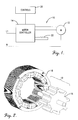
- Fig. 1 is a block diagram of a motor assembly constructed in accordance with an embodiment of the invention.
- Fig. 2 is a schematic representation of the stator and rotor of the motor in the motor assembly of Fig. 1 .
- Fig. 3 is a graph of rotor speed over a time period according to one exemplary embodiment of the present disclosure.
- Fig. 4 is a graph of stator reactive power over the same time period as Figure 3 .
- Fig. 5 is a flow diagram depicting steps in a method of the invention and/or code segments of a computer program of the invention.
- Fig. 6 is a flow diagram depicting steps in another method of the invention and/or code segments of another computer program of the invention.
- Fig. 7 is a flow diagram depicting steps in yet another method of the invention and/or code segments of another computer program of the invention.
- references to “one embodiment”, “an embodiment”, or “embodiments” mean that the feature or features being referred to are included in at least one embodiment of the technology.
- references to “one embodiment”, “an embodiment”, or “embodiments” in this description do not necessarily refer to the same embodiment and are also not mutually exclusive unless so stated and/or except as will be readily apparent to those skilled in the art from the description.
- a feature, structure, act, etc. described in one embodiment may also be included in other embodiments, but is not necessarily included.
- the present technology can include a variety of combinations and/or integrations of the embodiments described herein.
- a motor assembly 10 constructed in accordance with embodiments of the invention is illustrated.
- the motor assembly 10 may be used in any application, such as in a washing machine, HVAC system, pump system, or appliance.
- the motor assembly 10 is designed for use with a horizontal axis, front-loading washing machine, but the principles of the present invention are equally applicable to all uses of the motor assembly.
- An embodiment of the motor assembly 10 broadly includes an electric motor 12 and a motor controller 14.
- the motor assembly 10 may also include or be coupled with other components not relevant to the present invention.
- the electric motor 12 includes a rotor 16 and a stator 18.
- the motor 12 may operate on direct current (DC) or alternating current (AC), may be synchronous or asynchronous, and may be single phase or three phase.
- the motor 12 may be of any type, including but not limited to, a brushed DC motor, a switched reluctance motor, a coreless or ironless DC motor, a series wound universal motor, an induction motor, a torque motor, or a stepper motor.
- the motor may be fixed speed, multi-speed, or variable speed and may have any horsepower (HP) rating.
- the motor 12 is a 1/3 - 1 HP, three phase, reversible and variable speed switched reluctance type motor.
- Such a motor provides maximum drive performance at a competitive price for washing machine applications which require a wide range of operating speeds and a high start-up torque.
- the principles of the present invention are not limited to any particular motor type, technology, or size.
- the motor controller 14 provides power to and controls operation of the electric motor 12 and is programmed or otherwise configured to perform one or more of the function or methods described below.
- the motor controller 14 may include any combination of circuitry, hardware, firmware, and/or software.
- the motor controller 14 includes a custom application specific integrated circuit (ASIC) with a microprocessor that controls and drives a 3-phase inverter and various other electronic components.
- ASIC application specific integrated circuit
- the motor controller 14 may receive power from a single phase AC supply voltage at 115 VAC supplied by connections L1 and N, where L1 represents the "hot" side of the AC supply and N represents neutral, which is typically at earth potential.
- the AC supply voltage may also be 230 VAC, in which case the neutral line would be replaced with another hot supply line.
- the AC supply voltage may also be three phase 480 VAC.
- the motor controller 14 may receive commands or operating instructions from one or more controls 20 such as a keypad, switches, or buttons as are commonly found on washing machines and other appliances and devices.
- the controls may be one or more separate components or may be integrated in the motor controller 14.
- the motor controller 14 may also be coupled to a single current shunt 22 for determining a stator current as described below.
- This single current shunt 22 may be a discrete component coupled to the printed circuit board of the motor controller ASIC or may be incorporated in the stator of the motor or the inverter module of the motor controller.
- aspects of the invention may be implemented with one or more computer programs stored in or on computer-readable medium residing on or accessible by the microprocessor of the motor controller 14.
- Each computer program preferably comprises an ordered listing of executable instructions for implementing logical functions in the motor controller 14.
- Each computer program can be embodied in any non-transitory computer-readable medium for use by or in connection with an instruction execution system, apparatus, or device, such as a computer-based system, processor-containing system, or other system that can fetch the instructions from the instruction execution system, apparatus, or device, and execute the instructions.
- a "computer-readable medium" can be any non-transitory means that can store the program for use by or in connection with the instruction execution system, apparatus, or device.
- the computer-readable medium can be, for example, but not limited to, an electronic, magnetic, optical, electro-magnetic, infrared, or semi-conductor system, apparatus, or device. More specific, although not inclusive, examples of the computer-readable medium would include the following: an electrical connection having one or more wires, a portable computer diskette, a random access memory (RAM), a read-only memory (ROM), an erasable, programmable, read-only memory (EPROM or Flash memory), an optical fiber, and a portable compact disk read-only memory (CDROM).
- RAM random access memory
- ROM read-only memory
- EPROM or Flash memory erasable, programmable, read-only memory
- CDROM portable compact disk read-only memory
- the motor controller 14 is programmed or otherwise configured to implement a method 500 of braking the electric motor 12.
- the method broadly includes the steps of energizing the stator 18 of the motor 12, with a braking waveform determining a reactive power of the stator 18, detecting an increase in the determined reactive power of the stator 18, and removing the braking waveform from the stator 18 in response to detecting the increase in the determined reactive power of the stator.
- the increase in reactive power indicates that the rotor 16 has substantially stopped rotating.
- the motor controller monitors both the reactive power and active power of the stator, determines a ratio between the reactive power and the active power to determine the power factor of the stator, and uses the power factor to determine when the rotor has substantially stopped rotating. In one embodiment, the motor controller determines the rotor has stopped rotating when the power factor is approximately 1. Determining that the rotor has stopped by monitoring the power factor is advantageous because the power factor level that indicates the rotor has stopped is the same regardless of the magnitude of the DC injection braking waveform.
- the flow chart of Fig. 5 shows the functionality and operation of a preferred implementation of the above described method 500 in more detail.
- some of the blocks of the flow chart may represent the method 500 and/or a module segment or portion of code of the computer programs of the present invention.
- the functions noted in the various blocks may occur out of the order depicted in Fig. 5 .
- two blocks shown in succession in Fig. 5 may in fact be executed substantially concurrently, or the blocks may sometimes be executed in the reverse order depending upon the functionality involved.
- the method 500 begins while the rotor 16 of the motor 12 is moving as depicted in box 502.
- the motor 12 may be operating at a high RPM during a spin cycle.
- the motor controller 14 may receive or internally process a brake signal as depicted in box 504.
- the motor controller 14 may receive a signal from an internal or external timing circuit that indicates a spin cycle or other motor cycle has ended and that the rotor should be slowed or stopped.
- the motor controller 14 In response to the brake signal or other indication that the motor 12 has been de-energized, the motor controller 14 energizes the stator 18 to apply a braking force to the rotor in order to brake the rotor as depicted in box 506.
- the stator 18 may be energized by driving the stator with a controlled current waveform as described in more detail below in connection with the method 600. Alternatively, the stator 18 may be driven with a voltage controlled waveform.
- the motor controller 14 determines a reactive power of the stator 18 as depicted in box 508.
- the reactive power may be determined in any conventional manner. For example, the reactive power may be determined based on detecting current through the current shunt 22 as described in more detail below in connection with the method 700. The reactive power may also be determined through multiple current shunts, etc.
- the motor controller 14 detects an increase in the reactive power of the stator 18 as depicted in box 510.
- the increase in the reactive power indicates the rotor 16 has substantially stopped rotating.
- the motor controller may detect an increase in the magnitude of the stator reactive power.
- the motor controller may detect an increase in a ratio of the determined reactive power and a determined active power of the stator to determine the rotor has stopped rotating.
- Figures 3 and 4 show graphs that illustrate a specific embodiment of the method 500.
- Figure 3 shows a motor's rotor speed over a time period
- Figure 4 shows the stator's reactive power over the same time period.
- the rotor 16 rotates and the stator 18 reactive power is zero.
- Braking begins at the beginning of a second time period 102 as the stator 18 is energized with a braking waveform, causing the rotor 16 to slow down.
- the motor controller 14 detects the increase in stator reactive power, and at the end of a third period 104, the motor controller 14 removes the braking waveform from the stator in response to the detected increase in stator reactive power.
- stator reactive power may be greater than zero during the first period 100.
- stator reactive power may be zero during the second period 102.
- the third period 104 may be very brief to minimize the power dissipated in the stator.
- the method 500 minimizes the time that the stator 18 is energized with the braking waveform in order to save energy and minimize power dissipation that may damage the stator. Specifically, stator power dissipation is minimized by de-energizing the stator 18 when the rotor 16 has substantially stopped rotating. Also, a shorter braking cycle time increases the throughput of devices driven by the electric motor 12. For example, when the motor assembly 10 is used in a washing machine, the method 500 allows quick and efficient braking of the motor 12 after a high speed spin cycle so that the washing machine can be unloaded or operated in a different cycle.
- the motor controller 14 may be programmed or otherwise configured to implement another method 600 of braking the electric motor 12.
- the method 600 broadly includes the steps of energizing the stator 18 of the motor 12 to brake the motor, determining a reactive power of the stator 18, detecting an increase in the determined reactive power of the stator 18, and removing the braking waveform from the stator in response to detecting the increase in the determined reactive power of the stator.
- the method 600 energizes the stator of the motor with a controlled current braking waveform.
- the flow chart of Fig. 6 shows the functionality and operation of a preferred implementation of the above described method 600 in more detail.
- some of the blocks of the flow chart may represent the method 600 and/or a module segment or portion of code of the computer programs of the present invention.
- the functions noted in the various blocks may occur out of the order depicted in Fig. 6 .
- two blocks shown in succession in Fig. 6 may in fact be executed substantially concurrently, or the blocks may sometimes be executed in the reverse order depending upon the functionality involved.
- Steps 602, 604, 608, 610, and 612 of method 600 are substantially identical to steps 502, 504, 508, 510, and 512, respectively, of method 500 and will therefore not be described again.
- the motor controller 14 energizes the stator 18 with a controlled current waveform to apply a braking force to the rotor 16 in order to brake the rotor.
- the motor controller 14 may also vary the amplitude of the controlled current waveform.
- the amplitude of the controlled current waveform is varied at a fixed frequency.
- the fixed frequency is preferably between about 1 Hz and about 10 Hz. More preferably the fixed frequency is about 2 Hz.
- Energizing the stator 18 with a controlled current waveform to brake the rotor 16 is superior to braking the motor with a controlled voltage. This is because the stator generates a magnetic field based on the stator current (not based on the stator voltage) and it is the magnetic field that interacts with the rotor to brake the rotor.
- a controlled stator voltage may generate variable stator current since the stator resistance changes as the stator heats. Thus, a controlled stator current will result in more consistent rotor braking than would a controlled stator voltage.
- the motor controller 14 is programmed or otherwise configured to implement another method 700 of braking the electric motor 12.
- the method 700 broadly includes the steps of energizing the stator of the motor to brake the motor, determining when the rotor stops rotating, and de-energizing the stator 18 in response to determining that the rotor has stopped. As explained in more detail below, the method 700 determines the rotor 16 has stopped rotating by monitoring the current shunt 22.
- the flow chart of Fig. 7 shows the functionality and operation of a preferred implementation of the above described method 700 in more detail.
- some of the blocks of the flow chart may represent the method 700 and/or a module segment or portion of code of the computer programs of the present invention.
- the functions noted in the various blocks may occur out of the order depicted in Fig. 7 .
- two blocks shown in succession in Fig. 6 may in fact be executed substantially concurrently, or the blocks may sometimes be executed in the reverse order depending upon the functionality involved.
- Steps 702, 704, and 706 of method 700 are substantially identical to steps 502, 504, and 506, respectively, of method 500 and will therefore not be described again.
- the motor controller 14 determines a current through the single current shunt 22.
- This step may include computing one or more motor phase currents as a function of the signal on the current shunt.
- the computed phase currents may provide the indication that the rotor has substantially stopped rotating.
- the signal on the single current shunt may indicate an increase of a reactive power of the stator.
- the signal may indicate an increase of the motor power factor, etc.
- a single current shunt is lower cost than multiple current shunts; accordingly, implementing this method may be lower cost than implementing a method that requires multiple current shunts.
- step 710 of the method 700 the motor controller 14 de-energizes the stator 18 to remove the braking force on the rotor 16. This may be done in response to a signal on the current shunt 22 indicating that the rotor 16 has stopped rotating.
Landscapes
- Engineering & Computer Science (AREA)
- Power Engineering (AREA)
- Control Of Motors That Do Not Use Commutators (AREA)
- Control Of Ac Motors In General (AREA)
Applications Claiming Priority (1)
| Application Number | Priority Date | Filing Date | Title |
|---|---|---|---|
| US13/657,335 US8922142B2 (en) | 2012-10-22 | 2012-10-22 | Systems and methods for braking an electric motor |
Publications (1)
| Publication Number | Publication Date |
|---|---|
| EP2722980A2 true EP2722980A2 (de) | 2014-04-23 |
Family
ID=49447423
Family Applications (1)
| Application Number | Title | Priority Date | Filing Date |
|---|---|---|---|
| EP20130189435 Withdrawn EP2722980A2 (de) | 2012-10-22 | 2013-10-18 | Systeme und Verfahren zum Bremsen eines Elektromotors |
Country Status (3)
| Country | Link |
|---|---|
| US (2) | US8922142B2 (de) |
| EP (1) | EP2722980A2 (de) |
| CN (2) | CN203691298U (de) |
Families Citing this family (6)
| Publication number | Priority date | Publication date | Assignee | Title |
|---|---|---|---|---|
| US8922142B2 (en) * | 2012-10-22 | 2014-12-30 | Nidec Motor Corporation | Systems and methods for braking an electric motor |
| GB2549740B (en) * | 2016-04-26 | 2019-04-17 | Dyson Technology Ltd | A method for controlling an electric motor |
| US11251725B2 (en) * | 2017-07-20 | 2022-02-15 | Valmont Industries, Inc. | Electronic braking system for an irrigation machine |
| AU2018355113B2 (en) * | 2017-10-16 | 2024-10-24 | Valmont Industries, Inc. | Electronic braking system for an irrigation machine |
| CN110393472B (zh) * | 2018-04-25 | 2021-10-22 | 添可电器有限公司 | 吸尘器 |
| WO2020234686A1 (en) * | 2019-05-11 | 2020-11-26 | Lee Linda Caroline | Motor and motor control apparatus |
Family Cites Families (9)
| Publication number | Priority date | Publication date | Assignee | Title |
|---|---|---|---|---|
| US3644810A (en) * | 1971-01-20 | 1972-02-22 | Alexander J Lewus | Sensing and control device for electric motor-starting circuits |
| US4833386A (en) * | 1987-10-02 | 1989-05-23 | Allen-Bradley Company, Inc. | Apparatus and method for braking an electric motor |
| US5703449A (en) * | 1990-10-19 | 1997-12-30 | Seiko Epson Corporation | Controller for brushless DC motor without position sensor |
| EP0742970B1 (de) * | 1994-01-31 | 1997-10-22 | Siemens Aktiengesellschaft | Verfahren mit phasenanschnittsteuerung zum sanftauslauf eines antriebs |
| US5675231A (en) * | 1996-05-15 | 1997-10-07 | General Electric Company | Systems and methods for protecting a single phase motor from circulating currents |
| JP2004229462A (ja) * | 2003-01-27 | 2004-08-12 | Rohm Co Ltd | 電動機の制御装置 |
| JP4847060B2 (ja) * | 2005-07-15 | 2011-12-28 | 日立オートモティブシステムズ株式会社 | 交流モータ駆動装置及びその制御方法 |
| US8154228B2 (en) * | 2009-06-10 | 2012-04-10 | Kollmorgen Corporation | Dynamic braking for electric motors |
| US8922142B2 (en) * | 2012-10-22 | 2014-12-30 | Nidec Motor Corporation | Systems and methods for braking an electric motor |
-
2012
- 2012-10-22 US US13/657,335 patent/US8922142B2/en not_active Expired - Fee Related
-
2013
- 2013-10-18 EP EP20130189435 patent/EP2722980A2/de not_active Withdrawn
- 2013-10-22 CN CN201320653993.3U patent/CN203691298U/zh not_active Expired - Fee Related
- 2013-10-22 CN CN201310499983.3A patent/CN103825502A/zh active Pending
-
2014
- 2014-12-29 US US14/584,308 patent/US9577552B2/en not_active Expired - Fee Related
Non-Patent Citations (1)
| Title |
|---|
| None |
Also Published As
| Publication number | Publication date |
|---|---|
| US9577552B2 (en) | 2017-02-21 |
| US20140111124A1 (en) | 2014-04-24 |
| US20150108928A1 (en) | 2015-04-23 |
| CN103825502A (zh) | 2014-05-28 |
| CN203691298U (zh) | 2014-07-02 |
| US8922142B2 (en) | 2014-12-30 |
Similar Documents
| Publication | Publication Date | Title |
|---|---|---|
| US9577552B2 (en) | Systems and methods for braking an electric motor | |
| US20080297098A1 (en) | Washing machine apparatus and method | |
| EP2212991B1 (de) | Motor mit Vektorregelung im Startmodus | |
| GB2549740A (en) | A method for controlling an electric motor | |
| KR20090053232A (ko) | 세탁기 모터, 세탁기 모터의 제어방법 및 세탁기의제어방법 | |
| US9602027B2 (en) | Systems, methods, and assemblies for detecting stoppage of electric motors | |
| US20190036465A1 (en) | System and method for starting an electric motor | |
| CN103380568B (zh) | 永磁体同步马达控制电路 | |
| US8390229B2 (en) | Washing machine with improved method of braking to a non-zero speed | |
| US10254318B2 (en) | Systems and methods for estimating input power of an electric motor | |
| US9000699B2 (en) | Determination of magnetic flux and temperature of permanent magnets in washing machine motor | |
| GB2561093A (en) | A Method For Controlling An Electric Motor | |
| WO2019021663A1 (ja) | モータ駆動制御装置及びモータの駆動制御方法 | |
| KR101443388B1 (ko) | 모터, 모터의 제어장치, 모터의 제어방법, 및 세탁기 | |
| KR100393793B1 (ko) | 비엘디씨 모터의 센서리스 제어장치 | |
| KR100408063B1 (ko) | 센서리스 비엘디씨 모터를 채용한 세탁기의 제동방법 | |
| JP2003264990A (ja) | ブラシレスモータの回転数計算方法 | |
| KR20090081050A (ko) | 모터, 모터의 제어시스템, 모터의 제어방법 및 세탁기 | |
| KR20220084574A (ko) | 모터 제어 장치 및 모터 제어 방법 | |
| TR2021006626A2 (tr) | Motor kontrolörü, çamaşir maki̇nesi̇ ve yöntemi̇ |
Legal Events
| Date | Code | Title | Description |
|---|---|---|---|
| PUAI | Public reference made under article 153(3) epc to a published international application that has entered the european phase |
Free format text: ORIGINAL CODE: 0009012 |
|
| 17P | Request for examination filed |
Effective date: 20131029 |
|
| AK | Designated contracting states |
Kind code of ref document: A2 Designated state(s): AL AT BE BG CH CY CZ DE DK EE ES FI FR GB GR HR HU IE IS IT LI LT LU LV MC MK MT NL NO PL PT RO RS SE SI SK SM TR |
|
| AX | Request for extension of the european patent |
Extension state: BA ME |
|
| STAA | Information on the status of an ep patent application or granted ep patent |
Free format text: STATUS: THE APPLICATION IS DEEMED TO BE WITHDRAWN |
|
| 18D | Application deemed to be withdrawn |
Effective date: 20160503 |