EP2723029A1 - Ein-Aus-Tastungsmodulierter Signalempfänger - Google Patents
Ein-Aus-Tastungsmodulierter Signalempfänger Download PDFInfo
- Publication number
- EP2723029A1 EP2723029A1 EP12188712.9A EP12188712A EP2723029A1 EP 2723029 A1 EP2723029 A1 EP 2723029A1 EP 12188712 A EP12188712 A EP 12188712A EP 2723029 A1 EP2723029 A1 EP 2723029A1
- Authority
- EP
- European Patent Office
- Prior art keywords
- signal
- data
- ook
- modulated signal
- frequency
- Prior art date
- Legal status (The legal status is an assumption and is not a legal conclusion. Google has not performed a legal analysis and makes no representation as to the accuracy of the status listed.)
- Withdrawn
Links
- 238000005070 sampling Methods 0.000 claims abstract description 35
- 238000000034 method Methods 0.000 claims abstract description 12
- 238000004422 calculation algorithm Methods 0.000 claims abstract description 8
- 238000001228 spectrum Methods 0.000 claims description 23
- 238000004590 computer program Methods 0.000 claims description 7
- 238000001914 filtration Methods 0.000 claims description 4
- 238000004364 calculation method Methods 0.000 description 6
- 238000004891 communication Methods 0.000 description 5
- 238000010586 diagram Methods 0.000 description 4
- 238000013459 approach Methods 0.000 description 2
- 230000005540 biological transmission Effects 0.000 description 2
- 230000001419 dependent effect Effects 0.000 description 2
- 238000004148 unit process Methods 0.000 description 2
- 230000000694 effects Effects 0.000 description 1
- 230000003287 optical effect Effects 0.000 description 1
Images




Classifications
-
- H—ELECTRICITY
- H04—ELECTRIC COMMUNICATION TECHNIQUE
- H04L—TRANSMISSION OF DIGITAL INFORMATION, e.g. TELEGRAPHIC COMMUNICATION
- H04L27/00—Modulated-carrier systems
- H04L27/02—Amplitude-modulated carrier systems, e.g. using on-off keying; Single sideband or vestigial sideband modulation
- H04L27/06—Demodulator circuits; Receiver circuits
Definitions
- This invention relates to the field of communications, and more particular to receiving on-off keying modulated communication signals
- OOK modulation is typically used for a low bitrate and low complexity data communication.
- the concept of OOK modulation is illustrated in Figure 1 , which show the amplitude variation of an OOK modulated signal (carrying digital data) against time.
- a digital '0' is represented via the presence of a carrier signal
- a digital '1' is represented via the absence of a carrier signal.
- the digital data carried by the OOK modulated signal shown in Figure 1 comprises a bit pattern of "101001".
- OOK modulation is commonly used in variety of applications requiring low bitrate and low complexity, such as for Remote Electrical Tilt of mobile tower antennas from a base station for example.
- the carrier frequency is dependent on the channel used in the application.
- typical carrier frequencies of a few MHz are used for the transmission of OOK modulated signal over Radio Frequency (RF) feeder cable (e.g. carrier frequencies of 2.176 MHz and 4.352 MHz are commonly used for OOK modulation on an RF feeder cable).
- RF Radio Frequency
- Such carrier frequencies therefore require an OOK modulated signal receiver (otherwise referred to more simply as an OOK receiver) to employ a complex Digital Signal Processing (DSP) system which operates at a high frequency.
- DSP Digital Signal Processing
- the operating frequency of the DSP system of the receiver (which undertakes 20 operations per sample) will need to be 174.464 MHz, which is very high.
- the above example uses 4.352 MHz, similar calculations are also applicable for the use of a 2.176 MHz carrier frequency.
- an OOK modulated signal receiver according to independent claim 1.
- embodiments reduce the sampling rate employed by the OOK receiver.
- embodiment may use a sub-sampling rate (i.e. a sampling rate lower than the Nyquist rate) which is selected so as to ensure aliased components are kept away from the OOK baseband data spectrum.
- embodiments may use a signal processing unit (or DSP system) which employs a low clock frequency, thus enabling a reduction in complexity of the signal processing unit.
- a low cost and low power OOK receiver may therefore be provided.
- embodiments may enable more receiver channels to be in integrated onto a chip or integrated circuit.
- Embodiments may thus be employed in an OOK modem, an OOK transceiver, a remote antenna tilting apparatus or a tower mounted amplifier apparatus.
- This invention proposes to reduce the sampling rate of a received OOK modulated signal, and more particularly to reduce the sampling rate to below Nyquist sample rate.
- the received OOK modulated signal can therefore be referred to as being 'sub-sampled' (i.e. sampled at a sub-optimal rate in terms of alias-free signal sampling).
- the complexity of a method or apparatus for receiving an OOK modulated signal can be significantly reduced. This enables OOK modulated signal reception to be implemented using DSP operating at a lower speed (e.g. with a lower clock frequency). Cost and power savings may therefore be made in a receiver implementing such a concept.
- the sub-sampling rate is selected to ensure that the aliases carrier is away from the baseband.
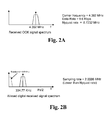
- Figure 2A illustrates the signal spectrum of an OOK modulated signal transmitted over an RF feeder cable.
- the OOK carrier frequency in this example is 4.352 MHz with a data rate of 9.6 Kbps.
- the Nyquist rate for this signal is 8.7232 MHz (calculated as follows: 2*(4352000+9600)).
- Figure 2B illustrates the signal spectrum of the aliased signal that is obtained by sampling the OOK modulated signal of Figure 2a at a sampling rate of 2.0086 MHz. It will be appreciated that the sampling rate of 2.0086 MHz is well below the Nyquist rate of the OOK modulated signal of Figure 2A .
- the aliased carrier frequency is located at abs(4.352 - n*2.0086), where 'abs' is absolute value and 'n' is an integer. An 'n' value which makes the multiple of sampling rate closest to the carrier frequency should be used. In this case 'n' should be 2.
- the frequency spectrum of the aliased carrier is separated from the baseband data spectrum (which extends to 9.6KHz).
- the aliased carrier frequency is still positioned away from the baseband of 9.6 KHz in the frequency domain. DSP algorithms can then be applied on this signal to recover the modulated baseband data.
- the sub-sampling rate is selected such that the aliased carrier frequency (as calculated above) is away from the baseband.
- this example uses 2.0086 MHz of sub-sampling rate, same effect can also be achieved by other appropriately selected sampling rates.
- one such exemplary algorithm comprises applying a squaring function to each received sample followed by a low pass filtering.
- Figure 3A shows the frequency spectrum of the aliased carrier obtained by sampling the OOK modulated signal of Figure 2A at a sampling rate of 2.0086 MHz. As has already been calculated above, the frequency spectrum of the aliased carrier is centred at 334.77 KHz.
- the frequency spectrum of the aliased carrier will be further away from the baseband data spectrum as shown in Figure 3B .
- the centre of the frequency spectrum of the aliased carrier is moved to 669.54.77 KHz (i.e. it is doubled by the squaring function).
- a low pass filter function (having a cut-off frequency less than the lowest frequency of the aliased carrier) can then be applied to only pass the baseband data spectrum and filter out the aliased carrier frequency.
- the baseband data signal remains (as illustrated in Figure 3D .
- the squaring and filtering operations described above are applied to each sample. Such operations may, for example, require 20 clock cycles to be performed by signal processing apparatus. Accordingly, if these operations are performed on a signal obtained at a sampling rate of 2.0086 MHz, the signal processing apparatus is required to operate at a frequency of 40.172 MHz (calculated as follows: 20*2.0086 MHz). This is substantially lower than the clock frequency requirement of 174.464 MHz for a conventional approach employing a signal sampling rate equal to the Nyquist rate.
- the lower operating frequency saves cost and power in apparatus employing the proposed concept of subsampling a received OOK modulated signal.
- an analytical (complex) signal y(n) is obtained when the Real part of y(n) is the sampled signal and the complex part of y(n) is the Hilbert transformed signal.
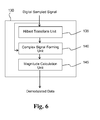
- such an alternative algorithm comprises applying a Hilbert transform to the sampled signal, generating a complex analytical signal having a real part equal to the sampled signal and an imaginary part equal to the Hilbert transformed signal, and performing magnitude calculation on the analytical signal so as to recover the data.
- FIG. 4 there is shown a schematic block diagram of an OOK modulated signal receiver 100 (otherwise referred to as an OOK receiver 100) according to an embodiment of the invention.
- the OOK receiver 100 comprises an analog front end 105, an analog-to-digital (A/D) convertor 110, and a DSP unit 115.
- A/D analog-to-digital
- the analog front end 105 is adapted to receive an OOK modulated signal transmitted via an RF feeder cable. Then analog front end 105 provides the received analog OOK modulated signal to the A/D convertor 110, which as adapted to convert the analog OOK modulated signal to a digital signal. More specifically, the A/D convertor 110 converts the signal to a digital signal by performing time domain sampling on the received analog OOK modulated signal at a sampling rate which is less than the Nyquist rate of the received analog OOK modulated signal. Each sample is converted to a digital format by representing the sampled value of the OOK modulated signal as a digital value.
- the digital signal obtained by the A/D convertor 110 is passed to the DSP unit 115.
- the DSP unit processes the digital signal in accordance with a predetermined algorithm so as to recover data from the sampled signal.
- the DSP unit 118 comprises a squaring unit 120 and a low pass filter 125.
- a digital signal obtained by an A/D convertor of an OOK receiver is passed to the squaring unit 120 of DSP unit 118.
- the squaring unit performs a squaring operation on each digital sample, thus moving the frequency spectrum of the aliased carrier further away from the baseband data spectrum (as has been shown in Figure 3B ).
- the digital signal is provided from the squaring unit 120 to the low pass filter 125.
- the low pass filter 125 which applies a low pass filter function (having a cut-off frequency less than the lowest frequency of the aliased carrier) to the digital signal. In this way, the low pass filter 125 only passes the baseband data spectrum and filter out the aliased carrier frequency.
- the demodulated data is then output by the low pass filter 125.
- the DSP unit 130 comprises a Hilbert transform unit 135, a complex signal forming unit 140 and magnitude calculation unit 145.
- a digital signal obtained by an A/D convertor of an OOK receiver is passed to the Hilbert transform unit 135 and the complex signal forming unit 140 of the DSP unit 130.
- the Hilbert transform unit 135 performs a Hilbert transform operation on each digital sample, thus forming a Hilbert transformed signal.
- the Hilbert transformed signal is provided to the complex signal forming unit 140.
- the complex signal forming unit 140 forms a complex analytical signal using the sampled digital signal from the OOK receiver and the Hilbert transformed signal.
- the complex analytical signal is formed by making the Real part of y(n) equal to the sampled digital signal from the OOK receiver and the complex part equal to the Hilbert transformed signal.
- the complex analytical signal is then passed from the complex signal forming unit 140 to the magnitude calculation unit 145.
- the magnitude calculation unit 145 calculates a magnitude of the complex analytical signal to recover/demodulate the data.
- the demodulated data is then output by the magnitude calculation unit 145.
- OOK modulated signals are communication with a mobile tower antenna to remotely tilt the antenna. Tilting of mobile antennas is necessary for optimized coverage.
- the OOK-based communication is used for sending control commands to antenna, wherein the same RF coax cable as used by the Base Station to communicate with the antenna is also used to communicate the OOK-based control commands.
- Remote antenna tilting apparatus 200 is illustrated in Figure 7 .
- a base station 205 communicates with an antenna 210 via a RF coax cable 215.
- the antenna 210 comprises tilting apparatus (not shown) which is adapted to tilt the antenna (i.e. varying its angle and/or orientation) based on a received tilt signal.
- First 220 and second 225 OOK modems are situated at opposite ends of the RF coax cable (i.e. near the base station 205 and near the antenna 210).
- the second OOK modem comprises an OOK receiver according to the embodiment described above with reference to Figures 4 and 5 .
- the first OOK modem 220 (situated near the base station 205) sends tilt commands over the RF coax cable using OOK modulation, and the second OOK modem 225 (situated near the antenna 210) receives the commands.
- the received OOK-modulated commands are demodulated to recover the tilt commands and, based on the commands, a tilt signal is applied to the tilting apparatus of the antenna 210 to control is angle and/or orientation.
- the second OOK modem 225 (and more particularly, the A/D convertor) employs a lower sampling rate than the Nyquist rate.
- the operating speed and complexity of the DSP unit is lower than that of a convention OOK modem. Cost and power savings may therefore be made in the second OOK modem 225. Similar cost and power saving can also be made in the first modem 210 for received OOK modulated signals from second modem 225 for receiving feedback on tilt operation.
- the proposed concept reduces complexity of implementing an OOK receiver, thereby reducing cost and power requirements of an Integrated Circuit (IC) employing the receiver.
- Embodiments may be captured in a computer program product for execution on a processor of a computer, e.g. a personal computer or a network server, where the computer program product, if executed on the computer, causes the computer to implement the steps of a method according to an embodiment. Since implementation of these steps into a computer program product requires routine skill only for a skilled person, such an implementation will not be discussed in further detail for reasons of brevity only.
- the computer program product is stored on a computer-readable medium.
- a computer-readable medium e.g. a CD-ROM, DVD, USB stick, memory card, network-area storage device, internet-accessible data repository, and so on, may be considered.
Landscapes
- Engineering & Computer Science (AREA)
- Computer Networks & Wireless Communication (AREA)
- Signal Processing (AREA)
- Digital Transmission Methods That Use Modulated Carrier Waves (AREA)
Priority Applications (1)
| Application Number | Priority Date | Filing Date | Title |
|---|---|---|---|
| EP12188712.9A EP2723029A1 (de) | 2012-10-16 | 2012-10-16 | Ein-Aus-Tastungsmodulierter Signalempfänger |
Applications Claiming Priority (1)
| Application Number | Priority Date | Filing Date | Title |
|---|---|---|---|
| EP12188712.9A EP2723029A1 (de) | 2012-10-16 | 2012-10-16 | Ein-Aus-Tastungsmodulierter Signalempfänger |
Publications (1)
| Publication Number | Publication Date |
|---|---|
| EP2723029A1 true EP2723029A1 (de) | 2014-04-23 |
Family
ID=47142929
Family Applications (1)
| Application Number | Title | Priority Date | Filing Date |
|---|---|---|---|
| EP12188712.9A Withdrawn EP2723029A1 (de) | 2012-10-16 | 2012-10-16 | Ein-Aus-Tastungsmodulierter Signalempfänger |
Country Status (1)
| Country | Link |
|---|---|
| EP (1) | EP2723029A1 (de) |
Cited By (3)
| Publication number | Priority date | Publication date | Assignee | Title |
|---|---|---|---|---|
| JP2017537493A (ja) * | 2014-10-01 | 2017-12-14 | ケーエムダブリュ・インコーポレーテッド | 携帯用アンテナ制御装置及びアンテナ制御システム |
| CN112314007A (zh) * | 2018-04-20 | 2021-02-02 | 瑞典爱立信有限公司 | 使用混叠来进行信号的节能传输和接收的方法和设备 |
| EP4535740A4 (de) * | 2022-06-16 | 2025-10-08 | Huawei Tech Co Ltd | Kommunikationsverfahren und kommunikationsvorrichtung |
-
2012
- 2012-10-16 EP EP12188712.9A patent/EP2723029A1/de not_active Withdrawn
Non-Patent Citations (7)
| Title |
|---|
| GUVENC I ET AL: "On the transceiver types of IR-UWB systems at sub-Nyquist sampling rates", WIRELESS PERSONAL COMMUNICATIONS, vol. 46, no. 3, August 2008 (2008-08-01), SPRINGER NETHERLANDS NETHERLANDS, pages 329 - 350, XP002692474, ISSN: 0929-6212, DOI: 10.1007/S11277-007-9437-2 * |
| RICE D W ET AL: "QUADRATURE SAMPLING WITH HIGH DYNAMIC RANGE", IEEE TRANSACTIONS ON AEROSPACE AND ELECTRONIC SYSTEMS, IEEE SERVICE CENTER, PISCATAWAY, NJ, US, vol. AES-18, no. 4, 1 November 1982 (1982-11-01), pages 736 - 739, XP000670457, ISSN: 0018-9251 * |
| ROSENKRANZ W: "QUADRATURE SAMPLING OF FM-BANDPASS SIGNALS - IMPLEMENTATION AND ERROR ANALYSIS", DIGITAL SIGNAL PROCESSING. PROCEEDINGS OF THE INTERNATIONALCONFERENCE, XX, XX, 7 September 1987 (1987-09-07), pages 377 - 381, XP000670954 * |
| SHAN CUI ET AL: "Pseudocoherent Detection of OOK/PPM Signals as Zero-Delay Transmitted-Reference Signals With Bandpass Downsampling for UWB Communications", IEEE TRANSACTIONS ON VEHICULAR TECHNOLOGY, IEEE SERVICE CENTER, PISCATAWAY, NJ, US, vol. 58, no. 8, 1 October 2009 (2009-10-01), pages 4141 - 4148, XP011268392, ISSN: 0018-9545, DOI: 10.1109/TVT.2009.2021269 * |
| TAUB H ET AL: "Principles of Communication Systems, Amplitude-Modulation Systems", 1 January 1986, PRINCIPLES OF COMMUNICATION SYSTEMS, NEW YORK, MCGRAW HILL, US, PAGE(S) 113 - 120, ISBN: 978-0-07-062955-4, XP002531747 * |
| TAUB H ET AL: "PRINCIPLES OF COMMUNICATION SYSTEMS, PASSAGE", 1 January 1991, PRINCIPLES OF COMMUNICATION SYSTEMS, NEW YORK, MCGRAW HILL, US, PAGE(S) 188 - 192, ISBN: 978-0-07-062955-4, XP002029535 * |
| VAUGHAN R G ET AL: "The theory of bandpass sampling", IEEE TRANSACTIONS ON SIGNAL PROCESSING USA, vol. 39, no. 9, September 1991 (1991-09-01), pages 1973 - 1984, XP002692475, ISSN: 1053-587X, DOI: 10.1109/78.134430 * |
Cited By (5)
| Publication number | Priority date | Publication date | Assignee | Title |
|---|---|---|---|---|
| JP2017537493A (ja) * | 2014-10-01 | 2017-12-14 | ケーエムダブリュ・インコーポレーテッド | 携帯用アンテナ制御装置及びアンテナ制御システム |
| CN112314007A (zh) * | 2018-04-20 | 2021-02-02 | 瑞典爱立信有限公司 | 使用混叠来进行信号的节能传输和接收的方法和设备 |
| EP3782405A1 (de) * | 2018-04-20 | 2021-02-24 | Telefonaktiebolaget Lm Ericsson (Publ) | Verfahren und vorrichtung zum energieeffizienten senden und empfangen eines signals unter verwendung von aliasing |
| CN112314007B (zh) * | 2018-04-20 | 2024-04-23 | 瑞典爱立信有限公司 | 使用混叠来进行信号的节能传输和接收的方法和设备 |
| EP4535740A4 (de) * | 2022-06-16 | 2025-10-08 | Huawei Tech Co Ltd | Kommunikationsverfahren und kommunikationsvorrichtung |
Similar Documents
| Publication | Publication Date | Title |
|---|---|---|
| EP3195626B1 (de) | Vorrichtung und verfahren zur direkten hochfrequenzabtastung in nahfeldkommunikationsvorrichtungen | |
| US10484215B2 (en) | Asynchronous transmission for NFC card emulation mode | |
| US20070140382A1 (en) | Bandpass sampling receiver and the sampling method | |
| CN102047574B (zh) | 采用数字rf处理技术的本地无线信号发送/接收装置及方法 | |
| US20230421249A1 (en) | Systems and methods for communicating data over satellites | |
| EP2723029A1 (de) | Ein-Aus-Tastungsmodulierter Signalempfänger | |
| EP2988461A1 (de) | Empfänger vereinheitlichter Kommunikationen und zugehöriges Verfahren | |
| EP2235967B1 (de) | Gleichwellenkommunikationssysteme mit seitenbandunterdrückung und verfahren zur erhöhung der kommunikationsgeschwindigkeit, spektralen effizienz und nutzung anderer vorteile | |
| JP6530986B2 (ja) | 無線受信装置、電子機器、及び無線受信方法 | |
| CN102916736B (zh) | 无线通信系统的无线电监测方法和装置 | |
| US9106485B1 (en) | System and method for FSK demodulation | |
| US9337888B2 (en) | Method for radio transmission by ultra wideband transmission | |
| EP3425807B1 (de) | Drahtloskommunikationssystem und kommunikationsverfahren | |
| KR100972297B1 (ko) | 가변 비트 해상도 혹은 클락 주파수를 가지는 아날로그디지털 변환기를 이용한 적응형 변조방식 및 그 장치 | |
| CN101595673A (zh) | 窄带接收机 | |
| JP6229518B2 (ja) | 無線受信装置及び無線受信方法 | |
| CN103986485A (zh) | 一种可接收多种无线信号的应急接收系统 | |
| Alashqar et al. | Digital Communication Software–Defined Radio–Transceiver Implementation Using MATLAB and USRP | |
| Lodro et al. | Ber measurement and ota performance of qpsk receiver in an anechoic chamber | |
| KR20130065458A (ko) | 데이터 수신기를 공유한 센싱 방법 및 장치 | |
| JP4383214B2 (ja) | 無線システムの特定方法および特定装置 | |
| Ramganesh et al. | Realtime text file transmission using software defined radio with high directional circular waveguide antennas | |
| JP7673366B2 (ja) | 通信装置および通信方法 | |
| US20120114020A1 (en) | De-spreading method for noncoherent receiver and receiver applying the same | |
| US6999535B1 (en) | Apparatus, and associated method, for recovering a desired component of a receive signal received at a radio device |
Legal Events
| Date | Code | Title | Description |
|---|---|---|---|
| PUAI | Public reference made under article 153(3) epc to a published international application that has entered the european phase |
Free format text: ORIGINAL CODE: 0009012 |
|
| AK | Designated contracting states |
Kind code of ref document: A1 Designated state(s): AL AT BE BG CH CY CZ DE DK EE ES FI FR GB GR HR HU IE IS IT LI LT LU LV MC MK MT NL NO PL PT RO RS SE SI SK SM TR |
|
| AX | Request for extension of the european patent |
Extension state: BA ME |
|
| STAA | Information on the status of an ep patent application or granted ep patent |
Free format text: STATUS: THE APPLICATION IS DEEMED TO BE WITHDRAWN |
|
| 18D | Application deemed to be withdrawn |
Effective date: 20141024 |