EP2723123A1 - Autonome Bestimmung von optimalen Werten für Übergabeparameter - Google Patents
Autonome Bestimmung von optimalen Werten für Übergabeparameter Download PDFInfo
- Publication number
- EP2723123A1 EP2723123A1 EP12306292.9A EP12306292A EP2723123A1 EP 2723123 A1 EP2723123 A1 EP 2723123A1 EP 12306292 A EP12306292 A EP 12306292A EP 2723123 A1 EP2723123 A1 EP 2723123A1
- Authority
- EP
- European Patent Office
- Prior art keywords
- handover
- values
- ttt
- cell
- mobile stations
- Prior art date
- Legal status (The legal status is an assumption and is not a legal conclusion. Google has not performed a legal analysis and makes no representation as to the accuracy of the status listed.)
- Withdrawn
Links
Images



Classifications
-
- H—ELECTRICITY
- H04—ELECTRIC COMMUNICATION TECHNIQUE
- H04W—WIRELESS COMMUNICATION NETWORKS
- H04W36/00—Hand-off or reselection arrangements
- H04W36/0005—Control or signalling for completing the hand-off
- H04W36/0009—Control or signalling for completing the hand-off for a plurality of users or terminals, e.g. group communication or moving wireless networks
-
- H—ELECTRICITY
- H04—ELECTRIC COMMUNICATION TECHNIQUE
- H04W—WIRELESS COMMUNICATION NETWORKS
- H04W36/00—Hand-off or reselection arrangements
- H04W36/0005—Control or signalling for completing the hand-off
- H04W36/0007—Control or signalling for completing the hand-off for multicast or broadcast services, e.g. MBMS
-
- H—ELECTRICITY
- H04—ELECTRIC COMMUNICATION TECHNIQUE
- H04W—WIRELESS COMMUNICATION NETWORKS
- H04W24/00—Supervisory, monitoring or testing arrangements
- H04W24/02—Arrangements for optimising operational condition
-
- H—ELECTRICITY
- H04—ELECTRIC COMMUNICATION TECHNIQUE
- H04W—WIRELESS COMMUNICATION NETWORKS
- H04W36/00—Hand-off or reselection arrangements
- H04W36/0005—Control or signalling for completing the hand-off
- H04W36/0083—Determination of parameters used for hand-off, e.g. generation or modification of neighbour cell lists
- H04W36/00837—Determination of triggering parameters for hand-off
-
- H—ELECTRICITY
- H04—ELECTRIC COMMUNICATION TECHNIQUE
- H04W—WIRELESS COMMUNICATION NETWORKS
- H04W36/00—Hand-off or reselection arrangements
- H04W36/0005—Control or signalling for completing the hand-off
- H04W36/0083—Determination of parameters used for hand-off, e.g. generation or modification of neighbour cell lists
- H04W36/0085—Hand-off measurements
- H04W36/0094—Definition of hand-off measurement parameters
Definitions
- the present invention relates to mobility within a mobile or wireless network, and more specifically to the configuration of handover parameters used for detecting that a given neighboring cell fulfills a given handover condition within a given serving cell.
- RRM Radio Resource Management
- the handover procedure is performed upon triggering conditions which have to be properly configured and optimized so that target Quality of service (Qos) and Quality of Experience (QoE) objectives are achieved.
- Qos Quality of service
- QoE Quality of Experience
- MRO Mobility Robustness Optimization
- handover is performed as following.
- the user performs periodic measurements, typically filtered Reference Signal Received Powers (RSRP) on the serving (Ms) and neighbor cells (Mn).
- RSRP Reference Signal Received Powers
- Ms serving
- Mn neighbor cells
- RSRP Reference Signal Received Powers
- the UE reports its measurements to the serving cell, which eventually decides to trigger or not a handover based on the user's recommendations.
- A3 event reporting by the UE is triggered if at least one neighbor cell becomes better than the serving cell by a configurable offset value.
- Handover reporting measurement by the UE is triggered if the condition is met for a minimal configurable duration or Time-To-Trigger (TTT).
- TTT Time-To-Trigger
- the hysteresis parameter is iteratively adjusted (increased/decreased) so as to minimize handover failure rate, accounting for neighbor cells load, the user speed or the traffic type.
- a method for adjusting handover parameters used for handover detection within a given serving cell comprises, for respective ones of a plurality of mobile stations served by the serving cell, gathering measurement samples of the serving cell and of a respective neighboring cell carried out by a respective mobile station at successive time instances, and determining delta values indicative of the time-indexed difference between respective ones of the measurement samples of the serving cell and corresponding ones of the measurement samples of the neighboring cell.
- the method further comprises determining near-optimal values for the handover parameters by statistical characterization of the ensembles of delta values for the plurality of mobile stations.
- a configuration agent for adjusting handover parameters used for handover detection within a given serving cell is adapted, for respective ones of a plurality of mobile stations served by the serving cell, to gather measurement samples of the serving cell and of a respective neighboring cell carried out by a respective mobile station at successive time instances, and to determine delta values indicative of the time-indexed difference between respective ones of the measurement samples of the serving cell and corresponding ones of the measurement samples of the neighboring cell.
- the configuration agent is further adapted to determine near-optimal values for the handover parameters by statistical characterization of the ensembles of delta values for the plurality of mobile stations.
- the configuration agent may form part of either a radio access node, such as an evolved NodeB (eNB), a radio access controller, such as a Base Station Controller (BSC) or a Radio Network Controller (RNC), or a network manager.
- a radio access node such as an evolved NodeB (eNB)
- eNB evolved NodeB
- BSC Base Station Controller
- RNC Radio Network Controller
- the near-optimal values are input to an iterative closed-loop optimization algorithm in order to determine optimal values for the handover parameters.
- the iterative closed-loop optimization algorithm is based on a Simulated Annealing (SA) algorithm.
- SA Simulated Annealing
- the measurement samples are indicative of the respective strengths of pilot signals received by the respective mobile stations from the respective serving and neighboring cells.
- the measurement samples are indicative of the respective qualities of pilot signals received by the respective mobile stations from the respective serving and neighboring cells.
- the plurality of mobile stations belongs to a particular speed class, and the near-optimal values for the handover parameters are determined on per speed class basis.
- the statistical characterization of the ensembles of delta values for the plurality of mobile stations involves the characterization of variances of the delta values for respective ones of the plurality of mobile stations over varying time windows.
- This embodiment is particularly helpful for determining the near-optimal values for TTT and/or offset handover parameters.
- the method further comprises, for respective ones of the plurality of mobile stations, and from a given time index onwards, estimating variance values over a time-window of K successive delta values for respective increasing K values, and determining a minimum time-window length beyond which the so-determined variance values lies within a given small interval.
- the method further comprises determining a Time-To-Trigger TTT value, during which measurement samples of the serving cell and a given target cell shall fulfill the handover condition before triggering a handover, by statistical characterization of the so-determined minimum time-window lengths for the plurality of mobile terminals.
- the configuration agent is further adapted, for respective ones of the plurality of mobile stations, and from a given time index onwards, to estimate variance values over a time-window of K successive delta values for respective increasing K values, and to determine a minimum time-window length beyond which the so-determined variance values lies within a given small interval.
- the configuration agent is further adapted to determine a Time-To-Trigger TTT value, during which measurement samples of the serving cell and a given target cell shall fulfill a given handover condition, by statistical characterization of the so-determined minimum time-window lengths for the plurality of mobile terminals.
- the so-determined TTT value is such that a given proportion of the so-determined minimum time-window lengths for the plurality of mobile stations are lower than or equal to the TTT value.
- the method further comprises determining a nominal variance value by statistical characterization of the so-estimated variance values, and inputting the so-determined nominal variance value, along with a first upper bound for a handover detection time and a second upper bound for a false handover detection rate, to a Page Hinkley statistical test so as to determine an offset value whereby the target cell shall be measured offset-better than the serving cell for the handover condition to be fulfilled.
- the configuration agent is further adapted to determine a nominal variance value by statistical characterization of the so-estimated variance values, and inputting the so-determined nominal variance value, along with a first upper bound for a handover detection time and a second upper bound for a false handover detection rate, to a Page Hinkley statistical test so as to determine an offset value whereby the target cell shall be measured offset-better than the serving cell for the handover condition to be fulfilled.
- the nominal variance value is determined such that a further given proportion of the variance values estimated for the plurality of mobile stations over time-windows of lengths equal to the TTT value are lower than or equal to the nominal variance value.
- the determination of the offset value is instantiated on a per neighboring cell basis, and the first upper bound is adjusted based on an inter-site distance between the serving cell and a given neighboring cell and based on the particular speed class.
- the proposed solution relies on theoretical framework to jointly estimate the handover parameters based on handover counters specified by the MRO feature in 3GPP specification. This has the advantage to enable easy and direct implementation in real networks.
- the proposed scheme relies on a two-stage procedure where the first stage is a learning (or sensing) phase to find out near-optimal values for the handover parameters by statistical characterization of the measurement samples gathered from the mobile stations, and the second stage is an optimization stage to fine-tune the handover parameter values by means of an iterative closed-loop algorithm, starting from the near optimal values output from the first stage.
- the first stage is a learning (or sensing) phase to find out near-optimal values for the handover parameters by statistical characterization of the measurement samples gathered from the mobile stations
- the second stage is an optimization stage to fine-tune the handover parameter values by means of an iterative closed-loop algorithm, starting from the near optimal values output from the first stage.
- the first stage is a learning (or sensing) phase to find out near-optimal values for the handover parameters by statistical characterization of the measurement samples gathered from the mobile stations
- the second stage is an optimization stage to fine-tune the handover parameter values by means of an iterative closed-l
- E-RAN Evolved Radio Access Network
- EPC Evolved Packet Core
- the eNBs 10 are coupled to the MME 20 through an S1-MME interface, and to the S-GW 30 through an S1-U interface.
- the S-GW 30 is further coupled to the P-GW 40 through an S5 interface.
- the P-GW 40 is further coupled to a PDN 50 through an SGi interface.
- the neighboring eNBs 10 establish neighbor relationships through an X2 interface.
- the eNBs 10 operate macro, micro or pico cells with a radio coverage area ranging from a few kilometers up to a few tens meters.
- the eNBs 10 are configured to set up and operate radio communication channels (i.e., a set of downlink and uplink traffic radio resources) with the UEs 60 through a Uu radio interface.
- each of the eNBs 10 hosts the following functions:
- the MME 20 hosts the following functions:
- the S-GW 30 hosts the following functions:
- the P-GW 40 hosts the following functions:
- FIG. 2 further details about an eNB 100 as per the present invention, and configured to operate one or more serving cells.
- the eNB 100 comprises the following functional blocks:
- the network termination unit 130 is coupled to the digital base-band unit 111, the digital base-band unit 111 is coupled to the analog band-pass unit 112, the analog band-pass unit 112 is coupled to the coupling unit 120, and the coupling unit 120 is coupled to an external or internal antenna 180.
- the radio resource controller 140 is coupled to the transceivers 110.
- the handover configuration agent 150 is coupled to the radio resource controller 140.
- the UE speed characterization unit 160 and the cell characterization unit 170 are coupled to the handover configuration agent 150.
- the transceivers 110 are configured to establish and operate radio communication channels with UEs under control of the radio resource controller 140.
- the digital base-band unit 111 is for digitally processing the received and transmit data symbols.
- the digital base-band unit 111 implements the necessary protocol suites for issuing, terminating or relaying data and control packets.
- the analog band-pass unit 112 is for modulating, amplifying and shaping the transmit signal that ultimately feds the antenna 180, and for filtering, amplifying with as little noise as possible and demodulating the received signal from the antenna 180.
- the analog band-pass 112 unit can be merged with the digital base-band unit, or can be moved closer to the antenna in a so-called Remote Radio Head-end (RRH) configuration.
- RRH Remote Radio Head-end
- the coupling unit 120 is for combining and passing the transmit signals from the transceivers 110 towards the antenna 180, and for dispatching the receive signal from the antenna 180 towards the transceivers 110.
- the network termination unit 130 accommodates the appropriate Medium Access Control (MAC) and Physical transport (PHY) layers for communication through a PDN, as well as some frame dispatching logic for routing the incoming/outgoing frames towards the appropriate Input/output (I/O) ports.
- MAC Medium Access Control
- PHY Physical transport
- the radio resource controller 140 is for assigning and managing downlink and uplink radio resources used by the transceivers 110 and the respective UEs for radio communication over the air interface, that is to say a set of time and/or frequency resources assigned to a serving cell operated by the eNB 100 for transport of user or control traffic within that serving cell. More noticeably, the radio resource controller 140 makes decisions for outgoing handovers from the current serving cell towards a more suitable neighboring cell based on the UE measurement reports.
- the radio resource controller 140 is for further configuring an ad-hoc measurement policy within the one or more serving cells operated by the eNB 100 (see "Meas_Policy(CS)" in fig. 2 ).
- the UEs are configured with a trigger criteria for reporting the cell measurements to the eNB 100.
- the UEs are configured to periodically report the receive power or quality of the serving cell and of one or more best neighboring cells at a given reporting interval.
- the UEs are then configured to trigger measurement reporting only upon fulfillment of a particular handover condition, as typical in LTE networks.
- the cell measurement data gathered during the sensing phase are held in a local data repository for further retrieval by the handover configuration agent 150 (see "M(i,CS,k); M(i,CN,k)" in fig. 2 ), along with further measurement context data such as the UE identity, the UE speed category, the UE location, the time-of-the-day the measurements took place, the user device manufacturer, etc.
- the UEs are also configured with one or more handover conditions for detecting that a given neighboring cell is a more suitable candidate cell for radio communication.
- the UEs can be configured with an A3 handover condition (neighboring becomes offset better than serving) that comprises an hysteresis value HYS, a TTT value, a generic offset value OFF, and possibly cell-specific offset values OCN to manage specificities towards particular neighboring cells.
- the values of these parameters are directly obtained from the handover configuration agent 150.
- a so-configured UE reports an A3 measurement event whenever the received power of a reference signal from a neighboring cell is measured as being better than the receive power of a reference signal from the serving cell by the offset amount OFF - possibly increased or decreased by the cell individual offset OCN - and for TTT seconds.
- the hysteresis HYS prevents excessive toggling between the A3 entering and leaving condition.
- the Entering and Leaving A3 conditions are defined by the following inequalities: Mn + OCN - HYS > Ms + 0 ⁇ FF 1 Entering Condition , Mn + OCN - HYS > Ms + OFF 2 Leaving Condition , Wherein Mn (respectively Ms) denotes the Layer 3 (L3) filtered Reference Signal Receive Power (RSRP) from the neighbor (respectively serving) cell.
- Mn denotes the Layer 3 (L3) filtered Reference Signal Receive Power (RSRP) from the neighbor (respectively serving) cell.
- the handover configuration agent 150 is for processing the UE measurement reports so as to determine optimal values for handover parameters used for handover detection within the one or more serving cells operated by the eNB 100.
- the so-determined handover parameter values are returned to the radio resource controller 140 for proper configuration of the handover conditions (see "TTT(CS); OFF(CS); OCN(CS,CN)" in fig. 2 ).
- the UE speed characterization unit 160 is configured to characterize a particular UE as belonging to a particular speed class, e.g. low/medium/high-speed class (LS/MS/HS) by comparing the UE speed to respective speed thresholds.
- a particular speed class e.g. low/medium/high-speed class (LS/MS/HS)
- the UE speed characterization unit 160 may determine the UE speed category according to first speed information supplied by the UE (e.g., as estimated from GPS positioning data), and/or according to second speed information determined by the eNB 100 (e.g., the Doppler frequency shift is indicative of the radial UE speed with respect to the eNB 100), and/or according to third speed information relayed by a source eNB during an incoming handover procedure (e.g., as derived from the time spent in previous visited cells, or as explicitly encoded by the source eNB).
- first speed information supplied by the UE e.g., as estimated from GPS positioning data
- second speed information determined by the eNB 100 e.g., the Doppler frequency shift is indicative of the radial UE speed with respect to the eNB 100
- third speed information relayed by a source eNB during an incoming handover procedure e.g., as derived from the time spent in previous visited cells, or as explicitly encoded by the source eNB
- the neighboring cell characterization unit 170 is for determining Inter Site Distance (ISD) values between the one or more serving cells operated by the eNB 100 and their respective neighboring cells.
- the ISD values are either derived by characterization of the radio communication environment (possibly involving the UEs), or are field engineering data obtained from a network manager or from a network planning tool.
- the respective ISD values are passed to the handover configuration agent 150 as possible inputs to the optimization algorithm (see "ISD(CS,CN)"in fig. 2 ).
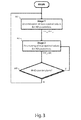
- Fig. 3 represents an overall description of the algorithm that is used within the handover configuration agent 150 for determining optimal values for the handover parameters, namely the handover parameters TTT and OFF.
- the output of the first stage are the near-optimal values TTT NO and OFF NO for the handover parameters, which are the input of the optimisation phase in stage 2.
- the second stage aims at fine-tuning the near-optimal 1 values TTT NO and OFF NO to yield optimal values TTTo and OFFo for the handover parameters (see step 302 in fig. 3 ).
- a condition can be added at this level to provoke a return to stage 1 when needed, e.g. when the performances in term of MRO counters are below a predefined threshold (see step 303 in fig. 3 ).
- the processing of the UE measurements can be made depending on the speed class of the UE (e.g., Small, Medium or High Speed classes) and/or the ISD, that is to say the distance separating the antenna sites of the serving and neighboring cells.
- the speed class of the UE e.g., Small, Medium or High Speed classes
- the ISD that is to say the distance separating the antenna sites of the serving and neighboring cells.
- OFF shall account for the variance of the measurements. For example, small OFF values with strong fluctuations of measurements is likely to lead to false handover alarms.
- TTT is the duration of persistence of the handover condition.
- the condition has to remain verified even if measurements fluctuate. So, TTT is directly linked to how the measurements are spread around their mean values: the variance.
- OFF is computed from the variance of measurements that are estimated over the TTT window size.
- the latter corresponds to the minimum duration over which the variance is stabilized to a steady value.
- M(i,CS,k) and M(i,CN,k) denote the L3-filtered RSRP measurements carried out by a given UE UEi for the serving cell CS and a neighbor cell CN (out of all the neighboring cells of the serving cell CS) at successive time instances k.
- Var ⁇ ⁇ be the variance of the difference ⁇ (i,CN,k) estimated over a time window comprising K measurement samples from a reference time index k0 onwards, wherein K denotes a positive integer value taken from the range [K min ;K max ].
- TTT(i,CN) be the minimum K value beyond which the variance Var ⁇ ⁇ lies within a given small interval around its asymptotic value. This is illustrated in fig. 4A : TTT(i,CN) is the minimum time window beyond which the variance Var ⁇ ⁇ gets substantially constant.
- TTTi computation is re-iterated for further neighboring cells as measured by the UE UEi, as well as for further attached UEs at various geographical positions within the serving cell CS, thereby yielding a statistical ensemble ⁇ TTT(-i,CN) ⁇ i,CN .
- TTT NO CDF 90 % ⁇ TTT i ⁇ CN i , CN
- handover decision should be ideally triggered as soon as the signal received from the neighbor cell exceeds the signal from the serving cell by a given handover margin.
- Change detection comes to detecting a change in mean values of the difference between M(i,CS,k) and M(i,CN,k).
- R is the delay separating the instant the neighboring cell is detected offset-better than the serving cell and the instant the handover decision is made. Minimizing R comes to minimizing the risk of Too Late HO; and maximizing F comes to minimizing the risk for Too Early HO and HO to Wrong Cells.
- OFF NO ⁇ ⁇ 2 ⁇ Log F HO / R HO
- F HO denotes the target maximum duration that can be tolerated between two HO failures of type HO Too early or HO To wrong cells
- R HO denotes the upper bound on the detection duration (distance from the frontier between 2 cells and the actual Handover Decision) that shall occur before the users cross the cell boundary (otherwise handover fails because triggered too lately).
- R HO is either set by the operator in such a way that users have completed their handover before crossing the cell boundary, or is estimated as the probable duration from the frontier between the cells and the cell boundary.
- ⁇ 2 is set to a nominal variance value derived from the statistics of the previously computed var ⁇ A with K being set to the generic TTT value. For instance, ⁇ 2 is set as the CDF at 90% of the statistical ensembles ⁇ Var TTT ⁇ (i, CN) ⁇ i,CN .
- TTT is derived from the variance of the measurements on a set of possible window sizes; this variance estimated over TTT is then injected as input to an Offset module for the estimation of OFF parameter.
- the determination of the offset parameter can be instantiated on per speed class basis and on per neighbor cell basis. Only the measurements of a given neighboring cell and from UEs of a given speed class are now considered.
- the generic OFF value is then set to a default value, and one adjusts the actual offset value used for a given neighboring cell by playing with the cell specific offset parameter OCN (positive or negative value).
- the ISD between the serving cell and the given neighboring cell may also be considered for appropriately adjusting RHO value.
- a user terminal that moves at a high speed from a serving cell to a neighbor cell stays a short time in the critical area (the overlapping area).
- the duration for deciding about a handover shall be short, and so shall be RHO.
- PDF Probability Density Function
- the second stage is a closed-loop optimization algorithm initialized with the parameter values (TTT NO ,OFF NO ) as computed during the first stage.
- the idea consists in adjusting (incrementing or decrementing) the parameter values (TTT NO ,OFF NO ) depending on the experienced MRO counters.
- SA Simulated Annealing
- SA is a meta heuristic technique for solving a global optimization problem. It consists in iteratively perturbing some sub optimal solution towards a better one.
- the main advantage of SA is that it can deal with non linear, non differentiable problems with many local optima and requires very few assumptions.
- SA is based on an analogy with the annealing process in metallurgy.
- Annealing consists in a controlled process of heating then cooling before freezing the metal in order to achieve the desired material properties: hardness or flexibility properties.
- simulated annealing when the temperature is high, large bounces from one state to another is tolerated. When temperature gets low, less and less random movement from one state to another is tolerated and the system is stabilized to the final frozen state (the optimal one).
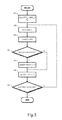
- the SA applied to the iterative optimization of handover parameters is depicted in fig. 5 .
- a new state S' is selected.
- p exp(- ⁇ /T) is the probability the new state S' is accepted if the objective function has increased.
- step 506 the temperature is adjusted.
- step 507 if the stopping conditions are met, then current state S can be frozen. It is the optimum solution; else, go to step 502.
- the second stage can also be initialized by any other method, heuristically initial configuration or simply randomly. This will impact the convergence duration.
- UMTS Universal Mobile Terrestrial System
- GSM Global System for Mobility
- the distribution of the functional units depicted in fig. 2 over the various network elements may vary from one technology to the other.
- the radio resource controller 140 and related handover configuration agent 150 typically form part of an RNC for UMTS, or of a BSC for GSM.
- the signal characteristics that are being measured by the mobile stations and that are used by the handover optimization algorithm may also vary from one technology to the other. For instance, the Receive Signal 1 code Power (RSCP) or Reference Signal Receive Quality (RSRQ) may be used in lieu of the present RSRP.
- RSCP Receive Signal 1 code Power
- RSRQ Reference Signal Receive Quality
- the term 'coupled' should not be interpreted as being restricted to direct connections only.
- the scope of the expression 'a device A coupled to a device B' should not be limited to devices or systems wherein an output of device A is directly connected to an input of device B, and/or vice-versa. It means that there exists a path between an output of A and an input of B, and/or vice-versa, which may be a path including other devices or means.
- DSP digital signal processor
- ASIC application specific integrated circuit
- FPGA field programmable gate array
- Other hardware, conventional and/or custom, such as read only memory (ROM), random access memory (RAM), and non volatile storage, may also be included.
Landscapes
- Engineering & Computer Science (AREA)
- Computer Networks & Wireless Communication (AREA)
- Signal Processing (AREA)
- Mobile Radio Communication Systems (AREA)
Priority Applications (4)
| Application Number | Priority Date | Filing Date | Title |
|---|---|---|---|
| EP12306292.9A EP2723123A1 (de) | 2012-10-18 | 2012-10-18 | Autonome Bestimmung von optimalen Werten für Übergabeparameter |
| CN201380054730.3A CN104756546A (zh) | 2012-10-18 | 2013-10-15 | 对于切换参数的最优数值的自主确定 |
| PCT/EP2013/071498 WO2014060396A1 (en) | 2012-10-18 | 2013-10-15 | Autonomous determination of optimal values for handover parameters |
| US14/436,279 US9572071B2 (en) | 2012-10-18 | 2013-10-15 | Autonomous determination of optimal values for handover parameters |
Applications Claiming Priority (1)
| Application Number | Priority Date | Filing Date | Title |
|---|---|---|---|
| EP12306292.9A EP2723123A1 (de) | 2012-10-18 | 2012-10-18 | Autonome Bestimmung von optimalen Werten für Übergabeparameter |
Publications (1)
| Publication Number | Publication Date |
|---|---|
| EP2723123A1 true EP2723123A1 (de) | 2014-04-23 |
Family
ID=47221263
Family Applications (1)
| Application Number | Title | Priority Date | Filing Date |
|---|---|---|---|
| EP12306292.9A Withdrawn EP2723123A1 (de) | 2012-10-18 | 2012-10-18 | Autonome Bestimmung von optimalen Werten für Übergabeparameter |
Country Status (4)
| Country | Link |
|---|---|
| US (1) | US9572071B2 (de) |
| EP (1) | EP2723123A1 (de) |
| CN (1) | CN104756546A (de) |
| WO (1) | WO2014060396A1 (de) |
Cited By (5)
| Publication number | Priority date | Publication date | Assignee | Title |
|---|---|---|---|---|
| WO2016022050A1 (en) * | 2014-08-08 | 2016-02-11 | Telefonaktiebolaget L M Ericsson (Publ) | Radio network node, and method for determining whether a wireless device is a suitable candidate for handover to a target cell for load balancing reasons |
| EP3225045A4 (de) * | 2014-12-09 | 2017-11-08 | Huawei Technologies Co., Ltd. | Verfahren und vorrichtung zur optimierung von zellspezifischen antennenkonfigurationsparametern |
| WO2019052658A1 (en) * | 2017-09-15 | 2019-03-21 | Nokia Solutions And Networks Oy | GLOBAL OPTIMIZATION METHOD FOR BINDING ASSOCIATIONS |
| CN110401969A (zh) * | 2018-04-24 | 2019-11-01 | 英特尔公司 | 用于在无线通信中控制测量报告触发的装置和方法 |
| US11665605B2 (en) | 2020-03-04 | 2023-05-30 | Nokia Solutions And Networks Oy | Machine learning based handover parameter optimization |
Families Citing this family (13)
| Publication number | Priority date | Publication date | Assignee | Title |
|---|---|---|---|---|
| US9591532B2 (en) * | 2012-11-13 | 2017-03-07 | Nec Corporation | Communication control method, radio communication system, radio base station, and non-transitory computer readable medium |
| US9622124B2 (en) * | 2014-07-10 | 2017-04-11 | Viavi Solutions Uk Limited | Techniques for improved allocation of network resources using geolocation and handover management |
| KR102447859B1 (ko) * | 2016-04-26 | 2022-09-27 | 삼성전자 주식회사 | 무선 통신 시스템에서 핸드오버를 지원하는 방법 및 장치 |
| US10250491B2 (en) * | 2016-05-09 | 2019-04-02 | Qualcomm Incorporated | In-flow packet prioritization and data-dependent flexible QoS policy |
| ITUA20164800A1 (it) * | 2016-06-30 | 2017-12-30 | Octo Telematics Spa | Procedimento per la stima della durata di un viaggio di un veicolo basato sulla determinazione dello stato del veicolo. |
| KR102452106B1 (ko) * | 2017-07-13 | 2022-10-07 | 삼성전자주식회사 | 무선 통신 시스템에서 핸드오버를 수행하기 위한 장치 및 방법 |
| CN110351786B (zh) * | 2018-04-03 | 2022-06-14 | 维沃移动通信有限公司 | 一种配置方法、终端及网络侧设备 |
| US11184232B2 (en) * | 2018-11-26 | 2021-11-23 | Eagle Technology, Llc | Radio frequency (RF) communication system providing enhanced RF equipment configuration updates for mobile vehicles based upon reward matrices and related methods |
| CN110381531B (zh) * | 2019-08-16 | 2021-05-25 | 北京紫光展锐通信技术有限公司 | 测量配置及上报方法、装置和用户设备 |
| WO2021189351A1 (zh) * | 2020-03-26 | 2021-09-30 | Oppo广东移动通信有限公司 | 一种小区切换方法、电子设备及存储介质 |
| US12231976B2 (en) * | 2020-06-24 | 2025-02-18 | Nokia Technologies Oy | Methods, devices and computer readable medium for handover rate control |
| EP3952439A1 (de) * | 2020-08-03 | 2022-02-09 | Telefónica Germany GmbH & Co. OHG | Verfahren, vorrichtung und system zur definition und einstellung von parametern in zellularen mobilen kommunikationsnetzen |
| CN115484647B (zh) * | 2022-07-26 | 2025-08-26 | 浪潮通信技术有限公司 | 切换测量参数下发方法、装置、服务器及电子设备 |
Family Cites Families (5)
| Publication number | Priority date | Publication date | Assignee | Title |
|---|---|---|---|---|
| US9554319B2 (en) * | 2005-09-27 | 2017-01-24 | Qualcomm Incorporated | Channel handoff methods in wireless broadcast systems |
| CN101141335A (zh) * | 2006-09-07 | 2008-03-12 | 日电(中国)有限公司 | 基于用户终端的快速越区切换的方法和设备 |
| US8498609B2 (en) * | 2007-10-11 | 2013-07-30 | Nec Corporation | Radio communication system and method |
| CN101282559A (zh) * | 2008-05-16 | 2008-10-08 | 中兴通讯股份有限公司 | 移动通信系统及其信号测量方法、基站和终端 |
| GB2498513A (en) * | 2011-12-14 | 2013-07-24 | Actix Ltd | Mobile phone network management and optimisation |
-
2012
- 2012-10-18 EP EP12306292.9A patent/EP2723123A1/de not_active Withdrawn
-
2013
- 2013-10-15 WO PCT/EP2013/071498 patent/WO2014060396A1/en not_active Ceased
- 2013-10-15 CN CN201380054730.3A patent/CN104756546A/zh active Pending
- 2013-10-15 US US14/436,279 patent/US9572071B2/en not_active Expired - Fee Related
Non-Patent Citations (8)
| Title |
|---|
| A. SCHRODER; H. LUNDQVIST; G. NUNZI: "Distributed Self- optimization of Handover for the Long Term Evolution", 2008 IN COMPUTING SCIENCE, vol. 5343, 2008, pages 281 - 286, XP019113422 |
| D-W LEE; G-T GIL; D-H KIM: "A Cost-based Adaptive Handover Hysteresis Scheme to Minimize the Handover Failure Rate in 3GPP LTE system", EURASIP JOURNAL ON WIRELESS COMMUNICATIONS AND NETWORKING, July 2010 (2010-07-01) |
| H. ZHANG; X. WEN: "A Novel Self- optimizing Handover Mechanism for Multi-Service provisioning in LTE-Advanced", RESEARCH CHALLENGES IN COMPUTER SCIENCE ICRCCS '09, 2009 |
| HUAWEI: "Addressing the requirements for HO optimisation", 3GPP DRAFT; S5-081672 ADDRESSING THE REQUIREMENTS FOR HO OPTIMISATION, 3RD GENERATION PARTNERSHIP PROJECT (3GPP), MOBILE COMPETENCE CENTRE ; 650, ROUTE DES LUCIOLES ; F-06921 SOPHIA-ANTIPOLIS CEDEX ; FRANCE, no. Dalian, China; 20081006, 6 October 2008 (2008-10-06), XP050335753 * |
| SHIH-FAN CHOU ET AL: "An efficient measurement report mechanism for Long Term Evolution networks", PERSONAL INDOOR AND MOBILE RADIO COMMUNICATIONS (PIMRC), 2011 IEEE 22ND INTERNATIONAL SYMPOSIUM ON, IEEE, 11 September 2011 (2011-09-11), pages 197 - 201, XP032102258, ISBN: 978-1-4577-1346-0, DOI: 10.1109/PIMRC.2011.6139858 * |
| SUNG KYUNG KIM ET AL: "A adaptive handover decision algorithm based on the estimating mobility from signal strength measurements", 2004 IEEE 60TH VEHICULAR TECHNOLOGY CONFERENCE. VTC2004-FALL (IEEE CAT. NO.04CH37575) IEEE PISCATAWAY, NJ, USA, IEEE, vol. 2, 26 September 2004 (2004-09-26), pages 1004 - 1008, XP010786773, ISBN: 978-0-7803-8521-4, DOI: 10.1109/VETECF.2004.1400172 * |
| T. JANSEN; I. BALAN: "Handover Parameter optimization in LTE se7f-organizing Networks", IEEE 72ND VEHICULAR TECHNOLOGY CONFERENCE IN OTTAWA (CANADA, September 2010 (2010-09-01) |
| VERONIQUE CAPDEVIELLE ET AL: "Joint interference management and handover optimization in LTE small cells network", COMMUNICATIONS (ICC), 2012 IEEE INTERNATIONAL CONFERENCE ON, IEEE, 10 June 2012 (2012-06-10), pages 6769 - 6773, XP032274608, ISBN: 978-1-4577-2052-9, DOI: 10.1109/ICC.2012.6364783 * |
Cited By (9)
| Publication number | Priority date | Publication date | Assignee | Title |
|---|---|---|---|---|
| WO2016022050A1 (en) * | 2014-08-08 | 2016-02-11 | Telefonaktiebolaget L M Ericsson (Publ) | Radio network node, and method for determining whether a wireless device is a suitable candidate for handover to a target cell for load balancing reasons |
| US10021608B2 (en) | 2014-08-08 | 2018-07-10 | Telefonaktiebolaget Lm Ericsson (Publ) | Radio network node, and method for determining whether a wireless device is a suitable candidate for handover to a target cell for load balancing reasons |
| EP3225045A4 (de) * | 2014-12-09 | 2017-11-08 | Huawei Technologies Co., Ltd. | Verfahren und vorrichtung zur optimierung von zellspezifischen antennenkonfigurationsparametern |
| WO2019052658A1 (en) * | 2017-09-15 | 2019-03-21 | Nokia Solutions And Networks Oy | GLOBAL OPTIMIZATION METHOD FOR BINDING ASSOCIATIONS |
| CN111095972A (zh) * | 2017-09-15 | 2020-05-01 | 诺基亚通信公司 | 用于链路关联的全局优化过程 |
| US11166171B2 (en) | 2017-09-15 | 2021-11-02 | Nokia Solutions And Networks Oy | Global optimization process for link associations |
| CN111095972B (zh) * | 2017-09-15 | 2023-10-10 | 诺基亚通信公司 | 用于链路关联的全局优化过程 |
| CN110401969A (zh) * | 2018-04-24 | 2019-11-01 | 英特尔公司 | 用于在无线通信中控制测量报告触发的装置和方法 |
| US11665605B2 (en) | 2020-03-04 | 2023-05-30 | Nokia Solutions And Networks Oy | Machine learning based handover parameter optimization |
Also Published As
| Publication number | Publication date |
|---|---|
| CN104756546A (zh) | 2015-07-01 |
| US20150289169A1 (en) | 2015-10-08 |
| WO2014060396A1 (en) | 2014-04-24 |
| US9572071B2 (en) | 2017-02-14 |
Similar Documents
| Publication | Publication Date | Title |
|---|---|---|
| US9572071B2 (en) | Autonomous determination of optimal values for handover parameters | |
| JP5648071B2 (ja) | 隣接セル情報の報告を実現する方法及びシステム | |
| US8229434B2 (en) | Using mobility statistics to enhance telecommunications handover | |
| CN101836478B (zh) | 移动终端、网络实体及其相关方法 | |
| JP5302338B2 (ja) | Rat間/周波数間隣接関係リストの自動管理 | |
| US11350322B2 (en) | Altitude dependent measurement reporting | |
| EP3479621B1 (de) | Verfahren für auf mobilitäts- und klassifikationsinformationen basierter erstellung einer eingeschränkten messungsliste in virtualzellen | |
| US20150208314A1 (en) | Method for reducing signaling messages and handovers in wireless networks | |
| EP2613586B1 (de) | Verbesserte Behandlung von Hochgeschwindigkeitsbenutzern innerhalb eines heterogenen mobilen Netzwerks mittels Pico-Zellen-ABS | |
| WO2014000478A1 (zh) | 小区切换控制方法、小区切换方法以及装置和系统 | |
| WO2014010977A1 (ko) | 무선 통신 시스템에서 이동성 상태 정보 보고 방법 및 이를 지원하는 장치 | |
| Tayyab et al. | A simulation study on LTE handover and the impact of cell size | |
| KR20180002968A (ko) | 핸드오버 파라미터 최적화를 위한 방법 및 장치 | |
| Ahmad et al. | An efficient handover decision in heterogeneous LTE-A networks under the assistance of users’ profile | |
| CN107155189B (zh) | 应用于超级小区的通信方法和装置 | |
| Awada et al. | Cell-pair specific optimization of the inter-RAT handover parameters in SON | |
| CN102714841A (zh) | 跨模式移动性优化的方法和装置 | |
| CN102711168B (zh) | 移动终端、网络实体及其相关方法 | |
| Akhila et al. | Averaging mechanisms to decision making for handover in GSM | |
| CN103260185A (zh) | 移动终端、网络实体及其相关方法 | |
| CN119031428A (zh) | 小区切换方法、装置、终端设备和计算机可读存储介质 | |
| WO2025210191A1 (en) | Using an ai/ml model for handover and cell reselection | |
| WO2025176375A1 (en) | Condition based l1 measurement and reporting | |
| JP2015104000A (ja) | 無線通信システム、基地局、ネットワーク管理装置、ハンドオーバ制御方法及びプログラム | |
| Muñoz | Handover and cell reselection study in LTE: Simulation of critical |
Legal Events
| Date | Code | Title | Description |
|---|---|---|---|
| PUAI | Public reference made under article 153(3) epc to a published international application that has entered the european phase |
Free format text: ORIGINAL CODE: 0009012 |
|
| AK | Designated contracting states |
Kind code of ref document: A1 Designated state(s): AL AT BE BG CH CY CZ DE DK EE ES FI FR GB GR HR HU IE IS IT LI LT LU LV MC MK MT NL NO PL PT RO RS SE SI SK SM TR |
|
| AX | Request for extension of the european patent |
Extension state: BA ME |
|
| RAP1 | Party data changed (applicant data changed or rights of an application transferred) |
Owner name: ALCATEL LUCENT |
|
| 17P | Request for examination filed |
Effective date: 20141023 |
|
| RBV | Designated contracting states (corrected) |
Designated state(s): AL AT BE BG CH CY CZ DE DK EE ES FI FR GB GR HR HU IE IS IT LI LT LU LV MC MK MT NL NO PL PT RO RS SE SI SK SM TR |
|
| STAA | Information on the status of an ep patent application or granted ep patent |
Free format text: STATUS: THE APPLICATION HAS BEEN WITHDRAWN |
|
| 18W | Application withdrawn |
Effective date: 20170919 |