EP2724841A1 - Diaphragme pour la production d'un module photovoltaïque et procédé pour la production d'un module photovoltaïque - Google Patents
Diaphragme pour la production d'un module photovoltaïque et procédé pour la production d'un module photovoltaïque Download PDFInfo
- Publication number
- EP2724841A1 EP2724841A1 EP12803320.6A EP12803320A EP2724841A1 EP 2724841 A1 EP2724841 A1 EP 2724841A1 EP 12803320 A EP12803320 A EP 12803320A EP 2724841 A1 EP2724841 A1 EP 2724841A1
- Authority
- EP
- European Patent Office
- Prior art keywords
- cross
- rubber
- diaphragm
- linked
- linking
- Prior art date
- Legal status (The legal status is an assumption and is not a legal conclusion. Google has not performed a legal analysis and makes no representation as to the accuracy of the status listed.)
- Granted
Links
- 238000004519 manufacturing process Methods 0.000 title claims description 14
- 229920002943 EPDM rubber Polymers 0.000 claims abstract description 124
- 229920001971 elastomer Polymers 0.000 claims abstract description 113
- 239000005060 rubber Substances 0.000 claims abstract description 108
- 239000005038 ethylene vinyl acetate Substances 0.000 claims abstract description 48
- 239000000203 mixture Substances 0.000 claims abstract description 48
- 229920001200 poly(ethylene-vinyl acetate) Polymers 0.000 claims abstract description 48
- 239000003054 catalyst Substances 0.000 claims abstract description 38
- 229920005549 butyl rubber Polymers 0.000 claims abstract description 26
- 238000007731 hot pressing Methods 0.000 claims abstract description 23
- 229920005989 resin Polymers 0.000 claims abstract description 16
- 239000011347 resin Substances 0.000 claims abstract description 16
- DQXBYHZEEUGOBF-UHFFFAOYSA-N but-3-enoic acid;ethene Chemical compound C=C.OC(=O)CC=C DQXBYHZEEUGOBF-UHFFFAOYSA-N 0.000 claims abstract description 9
- 238000010030 laminating Methods 0.000 claims abstract description 6
- 238000004132 cross linking Methods 0.000 claims description 61
- 239000003431 cross linking reagent Substances 0.000 claims description 22
- 238000004073 vulcanization Methods 0.000 claims description 22
- 238000000034 method Methods 0.000 claims description 13
- 238000003825 pressing Methods 0.000 abstract description 25
- 230000015556 catabolic process Effects 0.000 description 19
- 238000006731 degradation reaction Methods 0.000 description 19
- 239000003795 chemical substances by application Substances 0.000 description 18
- 229920002379 silicone rubber Polymers 0.000 description 18
- 239000004945 silicone rubber Substances 0.000 description 18
- VGGSQFUCUMXWEO-UHFFFAOYSA-N Ethene Chemical compound C=C VGGSQFUCUMXWEO-UHFFFAOYSA-N 0.000 description 16
- 239000005977 Ethylene Substances 0.000 description 16
- 238000002156 mixing Methods 0.000 description 15
- 150000001993 dienes Chemical class 0.000 description 13
- 230000003712 anti-aging effect Effects 0.000 description 11
- 238000005336 cracking Methods 0.000 description 10
- 150000002978 peroxides Chemical class 0.000 description 10
- 239000000126 substance Substances 0.000 description 10
- 238000010438 heat treatment Methods 0.000 description 9
- 230000000052 comparative effect Effects 0.000 description 8
- 238000012360 testing method Methods 0.000 description 8
- -1 dicyclooctadiene Chemical compound 0.000 description 7
- 150000001451 organic peroxides Chemical class 0.000 description 7
- 239000010734 process oil Substances 0.000 description 7
- QQONPFPTGQHPMA-UHFFFAOYSA-N propylene Natural products CC=C QQONPFPTGQHPMA-UHFFFAOYSA-N 0.000 description 7
- 125000004805 propylene group Chemical group [H]C([H])([H])C([H])([*:1])C([H])([H])[*:2] 0.000 description 7
- CSCPPACGZOOCGX-UHFFFAOYSA-N Acetone Chemical compound CC(C)=O CSCPPACGZOOCGX-UHFFFAOYSA-N 0.000 description 6
- 239000006057 Non-nutritive feed additive Substances 0.000 description 6
- XLOMVQKBTHCTTD-UHFFFAOYSA-N Zinc monoxide Chemical compound [Zn]=O XLOMVQKBTHCTTD-UHFFFAOYSA-N 0.000 description 6
- 238000000465 moulding Methods 0.000 description 6
- 229920000181 Ethylene propylene rubber Polymers 0.000 description 5
- VYPSYNLAJGMNEJ-UHFFFAOYSA-N Silicium dioxide Chemical compound O=[Si]=O VYPSYNLAJGMNEJ-UHFFFAOYSA-N 0.000 description 5
- 239000000806 elastomer Substances 0.000 description 5
- 239000000463 material Substances 0.000 description 5
- 238000005259 measurement Methods 0.000 description 5
- 239000012968 metallocene catalyst Substances 0.000 description 5
- OJOWICOBYCXEKR-APPZFPTMSA-N (1S,4R)-5-ethylidenebicyclo[2.2.1]hept-2-ene Chemical compound CC=C1C[C@@H]2C[C@@H]1C=C2 OJOWICOBYCXEKR-APPZFPTMSA-N 0.000 description 4
- NINIDFKCEFEMDL-UHFFFAOYSA-N Sulfur Chemical compound [S] NINIDFKCEFEMDL-UHFFFAOYSA-N 0.000 description 4
- 238000009826 distribution Methods 0.000 description 4
- 239000000945 filler Substances 0.000 description 4
- 239000011593 sulfur Substances 0.000 description 4
- 229910052717 sulfur Inorganic materials 0.000 description 4
- 150000001412 amines Chemical class 0.000 description 3
- 238000003490 calendering Methods 0.000 description 3
- 239000006229 carbon black Substances 0.000 description 3
- 238000006243 chemical reaction Methods 0.000 description 3
- 230000007423 decrease Effects 0.000 description 3
- 235000014113 dietary fatty acids Nutrition 0.000 description 3
- 239000000194 fatty acid Substances 0.000 description 3
- 229930195729 fatty acid Natural products 0.000 description 3
- 238000004898 kneading Methods 0.000 description 3
- 238000013031 physical testing Methods 0.000 description 3
- 229920001296 polysiloxane Polymers 0.000 description 3
- 238000004611 spectroscopical analysis Methods 0.000 description 3
- 239000011550 stock solution Substances 0.000 description 3
- 230000035882 stress Effects 0.000 description 3
- 239000011787 zinc oxide Substances 0.000 description 3
- KOMNUTZXSVSERR-UHFFFAOYSA-N 1,3,5-tris(prop-2-enyl)-1,3,5-triazinane-2,4,6-trione Chemical compound C=CCN1C(=O)N(CC=C)C(=O)N(CC=C)C1=O KOMNUTZXSVSERR-UHFFFAOYSA-N 0.000 description 2
- BJELTSYBAHKXRW-UHFFFAOYSA-N 2,4,6-triallyloxy-1,3,5-triazine Chemical compound C=CCOC1=NC(OCC=C)=NC(OCC=C)=N1 BJELTSYBAHKXRW-UHFFFAOYSA-N 0.000 description 2
- VTYYLEPIZMXCLO-UHFFFAOYSA-L Calcium carbonate Chemical compound [Ca+2].[O-]C([O-])=O VTYYLEPIZMXCLO-UHFFFAOYSA-L 0.000 description 2
- CERQOIWHTDAKMF-UHFFFAOYSA-M Methacrylate Chemical compound CC(=C)C([O-])=O CERQOIWHTDAKMF-UHFFFAOYSA-M 0.000 description 2
- 238000001069 Raman spectroscopy Methods 0.000 description 2
- 229920005556 chlorobutyl Polymers 0.000 description 2
- 239000000470 constituent Substances 0.000 description 2
- 229920001577 copolymer Polymers 0.000 description 2
- 239000006059 cover glass Substances 0.000 description 2
- 239000004744 fabric Substances 0.000 description 2
- 150000004665 fatty acids Chemical class 0.000 description 2
- 239000011521 glass Substances 0.000 description 2
- 229920002037 poly(vinyl butyral) polymer Polymers 0.000 description 2
- 239000012744 reinforcing agent Substances 0.000 description 2
- 239000000377 silicon dioxide Substances 0.000 description 2
- ZICNIEOYWVIEQJ-UHFFFAOYSA-N (2-methylbenzoyl) 2-methylbenzenecarboperoxoate Chemical compound CC1=CC=CC=C1C(=O)OOC(=O)C1=CC=CC=C1C ZICNIEOYWVIEQJ-UHFFFAOYSA-N 0.000 description 1
- AGKBXKFWMQLFGZ-UHFFFAOYSA-N (4-methylbenzoyl) 4-methylbenzenecarboperoxoate Chemical compound C1=CC(C)=CC=C1C(=O)OOC(=O)C1=CC=C(C)C=C1 AGKBXKFWMQLFGZ-UHFFFAOYSA-N 0.000 description 1
- PRBHEGAFLDMLAL-GQCTYLIASA-N (4e)-hexa-1,4-diene Chemical compound C\C=C\CC=C PRBHEGAFLDMLAL-GQCTYLIASA-N 0.000 description 1
- OJOWICOBYCXEKR-KRXBUXKQSA-N (5e)-5-ethylidenebicyclo[2.2.1]hept-2-ene Chemical compound C1C2C(=C/C)/CC1C=C2 OJOWICOBYCXEKR-KRXBUXKQSA-N 0.000 description 1
- UBRWPVTUQDJKCC-UHFFFAOYSA-N 1,3-bis(2-tert-butylperoxypropan-2-yl)benzene Chemical compound CC(C)(C)OOC(C)(C)C1=CC=CC(C(C)(C)OOC(C)(C)C)=C1 UBRWPVTUQDJKCC-UHFFFAOYSA-N 0.000 description 1
- XQUPVDVFXZDTLT-UHFFFAOYSA-N 1-[4-[[4-(2,5-dioxopyrrol-1-yl)phenyl]methyl]phenyl]pyrrole-2,5-dione Chemical compound O=C1C=CC(=O)N1C(C=C1)=CC=C1CC1=CC=C(N2C(C=CC2=O)=O)C=C1 XQUPVDVFXZDTLT-UHFFFAOYSA-N 0.000 description 1
- HECLRDQVFMWTQS-RGOKHQFPSA-N 1755-01-7 Chemical compound C1[C@H]2[C@@H]3CC=C[C@@H]3[C@@H]1C=C2 HECLRDQVFMWTQS-RGOKHQFPSA-N 0.000 description 1
- KAESVJOAVNADME-UHFFFAOYSA-N 1H-pyrrole Natural products C=1C=CNC=1 KAESVJOAVNADME-UHFFFAOYSA-N 0.000 description 1
- DMWVYCCGCQPJEA-UHFFFAOYSA-N 2,5-bis(tert-butylperoxy)-2,5-dimethylhexane Chemical compound CC(C)(C)OOC(C)(C)CCC(C)(C)OOC(C)(C)C DMWVYCCGCQPJEA-UHFFFAOYSA-N 0.000 description 1
- XMNIXWIUMCBBBL-UHFFFAOYSA-N 2-(2-phenylpropan-2-ylperoxy)propan-2-ylbenzene Chemical compound C=1C=CC=CC=1C(C)(C)OOC(C)(C)C1=CC=CC=C1 XMNIXWIUMCBBBL-UHFFFAOYSA-N 0.000 description 1
- BIISIZOQPWZPPS-UHFFFAOYSA-N 2-tert-butylperoxypropan-2-ylbenzene Chemical compound CC(C)(C)OOC(C)(C)C1=CC=CC=C1 BIISIZOQPWZPPS-UHFFFAOYSA-N 0.000 description 1
- WTQBISBWKRKLIJ-UHFFFAOYSA-N 5-methylidenebicyclo[2.2.1]hept-2-ene Chemical compound C1C2C(=C)CC1C=C2 WTQBISBWKRKLIJ-UHFFFAOYSA-N 0.000 description 1
- OMPJBNCRMGITSC-UHFFFAOYSA-N Benzoylperoxide Chemical compound C=1C=CC=CC=1C(=O)OOC(=O)C1=CC=CC=C1 OMPJBNCRMGITSC-UHFFFAOYSA-N 0.000 description 1
- VHOQXEIFYTTXJU-UHFFFAOYSA-N Isobutylene-isoprene copolymer Chemical compound CC(C)=C.CC(=C)C=C VHOQXEIFYTTXJU-UHFFFAOYSA-N 0.000 description 1
- AFCARXCZXQIEQB-UHFFFAOYSA-N N-[3-oxo-3-(2,4,6,7-tetrahydrotriazolo[4,5-c]pyridin-5-yl)propyl]-2-[[3-(trifluoromethoxy)phenyl]methylamino]pyrimidine-5-carboxamide Chemical compound O=C(CCNC(=O)C=1C=NC(=NC=1)NCC1=CC(=CC=C1)OC(F)(F)F)N1CC2=C(CC1)NN=N2 AFCARXCZXQIEQB-UHFFFAOYSA-N 0.000 description 1
- FZWLAAWBMGSTSO-UHFFFAOYSA-N Thiazole Chemical compound C1=CSC=N1 FZWLAAWBMGSTSO-UHFFFAOYSA-N 0.000 description 1
- 238000010521 absorption reaction Methods 0.000 description 1
- 239000000654 additive Substances 0.000 description 1
- 239000004840 adhesive resin Substances 0.000 description 1
- 229920006223 adhesive resin Polymers 0.000 description 1
- 150000001336 alkenes Chemical class 0.000 description 1
- XAGFODPZIPBFFR-UHFFFAOYSA-N aluminium Chemical compound [Al] XAGFODPZIPBFFR-UHFFFAOYSA-N 0.000 description 1
- 229910052782 aluminium Inorganic materials 0.000 description 1
- 235000019400 benzoyl peroxide Nutrition 0.000 description 1
- 229920005557 bromobutyl Polymers 0.000 description 1
- 230000001680 brushing effect Effects 0.000 description 1
- 239000001273 butane Substances 0.000 description 1
- 229910000019 calcium carbonate Inorganic materials 0.000 description 1
- 239000004927 clay Substances 0.000 description 1
- 229910052570 clay Inorganic materials 0.000 description 1
- 239000011248 coating agent Substances 0.000 description 1
- 238000000576 coating method Methods 0.000 description 1
- 150000001875 compounds Chemical class 0.000 description 1
- 230000008602 contraction Effects 0.000 description 1
- 238000001816 cooling Methods 0.000 description 1
- 230000003247 decreasing effect Effects 0.000 description 1
- LSXWFXONGKSEMY-UHFFFAOYSA-N di-tert-butyl peroxide Chemical compound CC(C)(C)OOC(C)(C)C LSXWFXONGKSEMY-UHFFFAOYSA-N 0.000 description 1
- 230000000694 effects Effects 0.000 description 1
- 238000005187 foaming Methods 0.000 description 1
- 239000011888 foil Substances 0.000 description 1
- 229920005555 halobutyl Polymers 0.000 description 1
- 238000005984 hydrogenation reaction Methods 0.000 description 1
- 238000007373 indentation Methods 0.000 description 1
- 238000001746 injection moulding Methods 0.000 description 1
- 239000002648 laminated material Substances 0.000 description 1
- 239000000155 melt Substances 0.000 description 1
- CPOFMOWDMVWCLF-UHFFFAOYSA-N methyl(oxo)alumane Chemical compound C[Al]=O CPOFMOWDMVWCLF-UHFFFAOYSA-N 0.000 description 1
- DZCCLNYLUGNUKQ-UHFFFAOYSA-N n-(4-nitrosophenyl)hydroxylamine Chemical compound ONC1=CC=C(N=O)C=C1 DZCCLNYLUGNUKQ-UHFFFAOYSA-N 0.000 description 1
- OFBQJSOFQDEBGM-UHFFFAOYSA-N n-pentane Natural products CCCCC OFBQJSOFQDEBGM-UHFFFAOYSA-N 0.000 description 1
- 239000003921 oil Substances 0.000 description 1
- JRZJOMJEPLMPRA-UHFFFAOYSA-N olefin Natural products CCCCCCCC=C JRZJOMJEPLMPRA-UHFFFAOYSA-N 0.000 description 1
- 238000004806 packaging method and process Methods 0.000 description 1
- ISWSIDIOOBJBQZ-UHFFFAOYSA-N phenol group Chemical group C1(=CC=CC=C1)O ISWSIDIOOBJBQZ-UHFFFAOYSA-N 0.000 description 1
- 230000000704 physical effect Effects 0.000 description 1
- 229920003192 poly(bis maleimide) Polymers 0.000 description 1
- 229920013716 polyethylene resin Polymers 0.000 description 1
- 230000037048 polymerization activity Effects 0.000 description 1
- 238000006116 polymerization reaction Methods 0.000 description 1
- 239000012005 post-metallocene catalyst Substances 0.000 description 1
- 238000002360 preparation method Methods 0.000 description 1
- 238000012545 processing Methods 0.000 description 1
- 239000012783 reinforcing fiber Substances 0.000 description 1
- QAZLUNIWYYOJPC-UHFFFAOYSA-M sulfenamide Chemical compound [Cl-].COC1=C(C)C=[N+]2C3=NC4=CC=C(OC)C=C4N3SCC2=C1C QAZLUNIWYYOJPC-UHFFFAOYSA-M 0.000 description 1
- 238000010059 sulfur vulcanization Methods 0.000 description 1
- 239000000454 talc Substances 0.000 description 1
- 229910052623 talc Inorganic materials 0.000 description 1
- 230000008646 thermal stress Effects 0.000 description 1
- 238000001721 transfer moulding Methods 0.000 description 1
- 229910052720 vanadium Inorganic materials 0.000 description 1
- LEONUFNNVUYDNQ-UHFFFAOYSA-N vanadium atom Chemical compound [V] LEONUFNNVUYDNQ-UHFFFAOYSA-N 0.000 description 1
- 238000004383 yellowing Methods 0.000 description 1
- QMBQEXOLIRBNPN-UHFFFAOYSA-L zirconocene dichloride Chemical compound [Cl-].[Cl-].[Zr+4].C=1C=C[CH-]C=1.C=1C=C[CH-]C=1 QMBQEXOLIRBNPN-UHFFFAOYSA-L 0.000 description 1
Images

Classifications
-
- B—PERFORMING OPERATIONS; TRANSPORTING
- B29—WORKING OF PLASTICS; WORKING OF SUBSTANCES IN A PLASTIC STATE IN GENERAL
- B29C—SHAPING OR JOINING OF PLASTICS; SHAPING OF MATERIAL IN A PLASTIC STATE, NOT OTHERWISE PROVIDED FOR; AFTER-TREATMENT OF THE SHAPED PRODUCTS, e.g. REPAIRING
- B29C66/00—General aspects of processes or apparatus for joining preformed parts
- B29C66/40—General aspects of joining substantially flat articles, e.g. plates, sheets or web-like materials; Making flat seams in tubular or hollow articles; Joining single elements to substantially flat surfaces
- B29C66/41—Joining substantially flat articles ; Making flat seams in tubular or hollow articles
- B29C66/43—Joining a relatively small portion of the surface of said articles
- B29C66/433—Casing-in, i.e. enclosing an element between two sheets by an outlined seam
-
- B—PERFORMING OPERATIONS; TRANSPORTING
- B29—WORKING OF PLASTICS; WORKING OF SUBSTANCES IN A PLASTIC STATE IN GENERAL
- B29C—SHAPING OR JOINING OF PLASTICS; SHAPING OF MATERIAL IN A PLASTIC STATE, NOT OTHERWISE PROVIDED FOR; AFTER-TREATMENT OF THE SHAPED PRODUCTS, e.g. REPAIRING
- B29C35/00—Heating, cooling or curing, e.g. crosslinking or vulcanising; Apparatus therefor
- B29C35/02—Heating or curing, e.g. crosslinking or vulcanizing during moulding, e.g. in a mould
-
- B—PERFORMING OPERATIONS; TRANSPORTING
- B29—WORKING OF PLASTICS; WORKING OF SUBSTANCES IN A PLASTIC STATE IN GENERAL
- B29C—SHAPING OR JOINING OF PLASTICS; SHAPING OF MATERIAL IN A PLASTIC STATE, NOT OTHERWISE PROVIDED FOR; AFTER-TREATMENT OF THE SHAPED PRODUCTS, e.g. REPAIRING
- B29C63/00—Lining or sheathing, i.e. applying preformed layers or sheathings of plastics; Apparatus therefor
- B29C63/02—Lining or sheathing, i.e. applying preformed layers or sheathings of plastics; Apparatus therefor using sheet or web-like material
- B29C63/16—Lining or sheathing, i.e. applying preformed layers or sheathings of plastics; Apparatus therefor using sheet or web-like material applied by "rubber" bag or diaphragm
-
- B—PERFORMING OPERATIONS; TRANSPORTING
- B29—WORKING OF PLASTICS; WORKING OF SUBSTANCES IN A PLASTIC STATE IN GENERAL
- B29C—SHAPING OR JOINING OF PLASTICS; SHAPING OF MATERIAL IN A PLASTIC STATE, NOT OTHERWISE PROVIDED FOR; AFTER-TREATMENT OF THE SHAPED PRODUCTS, e.g. REPAIRING
- B29C65/00—Joining or sealing of preformed parts, e.g. welding of plastics materials; Apparatus therefor
- B29C65/02—Joining or sealing of preformed parts, e.g. welding of plastics materials; Apparatus therefor by heating, with or without pressure
- B29C65/18—Joining or sealing of preformed parts, e.g. welding of plastics materials; Apparatus therefor by heating, with or without pressure using heated tools
-
- B—PERFORMING OPERATIONS; TRANSPORTING
- B29—WORKING OF PLASTICS; WORKING OF SUBSTANCES IN A PLASTIC STATE IN GENERAL
- B29C—SHAPING OR JOINING OF PLASTICS; SHAPING OF MATERIAL IN A PLASTIC STATE, NOT OTHERWISE PROVIDED FOR; AFTER-TREATMENT OF THE SHAPED PRODUCTS, e.g. REPAIRING
- B29C66/00—General aspects of processes or apparatus for joining preformed parts
- B29C66/01—General aspects dealing with the joint area or with the area to be joined
- B29C66/05—Particular design of joint configurations
- B29C66/10—Particular design of joint configurations particular design of the joint cross-sections
- B29C66/11—Joint cross-sections comprising a single joint-segment, i.e. one of the parts to be joined comprising a single joint-segment in the joint cross-section
- B29C66/112—Single lapped joints
- B29C66/1122—Single lap to lap joints, i.e. overlap joints
-
- B—PERFORMING OPERATIONS; TRANSPORTING
- B29—WORKING OF PLASTICS; WORKING OF SUBSTANCES IN A PLASTIC STATE IN GENERAL
- B29C—SHAPING OR JOINING OF PLASTICS; SHAPING OF MATERIAL IN A PLASTIC STATE, NOT OTHERWISE PROVIDED FOR; AFTER-TREATMENT OF THE SHAPED PRODUCTS, e.g. REPAIRING
- B29C66/00—General aspects of processes or apparatus for joining preformed parts
- B29C66/70—General aspects of processes or apparatus for joining preformed parts characterised by the composition, physical properties or the structure of the material of the parts to be joined; Joining with non-plastics material
- B29C66/71—General aspects of processes or apparatus for joining preformed parts characterised by the composition, physical properties or the structure of the material of the parts to be joined; Joining with non-plastics material characterised by the composition of the plastics material of the parts to be joined
-
- B—PERFORMING OPERATIONS; TRANSPORTING
- B29—WORKING OF PLASTICS; WORKING OF SUBSTANCES IN A PLASTIC STATE IN GENERAL
- B29C—SHAPING OR JOINING OF PLASTICS; SHAPING OF MATERIAL IN A PLASTIC STATE, NOT OTHERWISE PROVIDED FOR; AFTER-TREATMENT OF THE SHAPED PRODUCTS, e.g. REPAIRING
- B29C66/00—General aspects of processes or apparatus for joining preformed parts
- B29C66/70—General aspects of processes or apparatus for joining preformed parts characterised by the composition, physical properties or the structure of the material of the parts to be joined; Joining with non-plastics material
- B29C66/71—General aspects of processes or apparatus for joining preformed parts characterised by the composition, physical properties or the structure of the material of the parts to be joined; Joining with non-plastics material characterised by the composition of the plastics material of the parts to be joined
- B29C66/712—General aspects of processes or apparatus for joining preformed parts characterised by the composition, physical properties or the structure of the material of the parts to be joined; Joining with non-plastics material characterised by the composition of the plastics material of the parts to be joined the composition of one of the parts to be joined being different from the composition of the other part
-
- B—PERFORMING OPERATIONS; TRANSPORTING
- B29—WORKING OF PLASTICS; WORKING OF SUBSTANCES IN A PLASTIC STATE IN GENERAL
- B29C—SHAPING OR JOINING OF PLASTICS; SHAPING OF MATERIAL IN A PLASTIC STATE, NOT OTHERWISE PROVIDED FOR; AFTER-TREATMENT OF THE SHAPED PRODUCTS, e.g. REPAIRING
- B29C66/00—General aspects of processes or apparatus for joining preformed parts
- B29C66/70—General aspects of processes or apparatus for joining preformed parts characterised by the composition, physical properties or the structure of the material of the parts to be joined; Joining with non-plastics material
- B29C66/73—General aspects of processes or apparatus for joining preformed parts characterised by the composition, physical properties or the structure of the material of the parts to be joined; Joining with non-plastics material characterised by the intensive physical properties of the material of the parts to be joined, by the optical properties of the material of the parts to be joined, by the extensive physical properties of the parts to be joined, by the state of the material of the parts to be joined or by the material of the parts to be joined being a thermoplastic or a thermoset
- B29C66/737—General aspects of processes or apparatus for joining preformed parts characterised by the composition, physical properties or the structure of the material of the parts to be joined; Joining with non-plastics material characterised by the intensive physical properties of the material of the parts to be joined, by the optical properties of the material of the parts to be joined, by the extensive physical properties of the parts to be joined, by the state of the material of the parts to be joined or by the material of the parts to be joined being a thermoplastic or a thermoset characterised by the state of the material of the parts to be joined
- B29C66/7375—General aspects of processes or apparatus for joining preformed parts characterised by the composition, physical properties or the structure of the material of the parts to be joined; Joining with non-plastics material characterised by the intensive physical properties of the material of the parts to be joined, by the optical properties of the material of the parts to be joined, by the extensive physical properties of the parts to be joined, by the state of the material of the parts to be joined or by the material of the parts to be joined being a thermoplastic or a thermoset characterised by the state of the material of the parts to be joined uncured, partially cured or fully cured
- B29C66/73751—General aspects of processes or apparatus for joining preformed parts characterised by the composition, physical properties or the structure of the material of the parts to be joined; Joining with non-plastics material characterised by the intensive physical properties of the material of the parts to be joined, by the optical properties of the material of the parts to be joined, by the extensive physical properties of the parts to be joined, by the state of the material of the parts to be joined or by the material of the parts to be joined being a thermoplastic or a thermoset characterised by the state of the material of the parts to be joined uncured, partially cured or fully cured the to-be-joined area of at least one of the parts to be joined being uncured, i.e. non cross-linked, non vulcanized
- B29C66/73752—General aspects of processes or apparatus for joining preformed parts characterised by the composition, physical properties or the structure of the material of the parts to be joined; Joining with non-plastics material characterised by the intensive physical properties of the material of the parts to be joined, by the optical properties of the material of the parts to be joined, by the extensive physical properties of the parts to be joined, by the state of the material of the parts to be joined or by the material of the parts to be joined being a thermoplastic or a thermoset characterised by the state of the material of the parts to be joined uncured, partially cured or fully cured the to-be-joined area of at least one of the parts to be joined being uncured, i.e. non cross-linked, non vulcanized the to-be-joined areas of both parts to be joined being uncured
-
- B—PERFORMING OPERATIONS; TRANSPORTING
- B29—WORKING OF PLASTICS; WORKING OF SUBSTANCES IN A PLASTIC STATE IN GENERAL
- B29C—SHAPING OR JOINING OF PLASTICS; SHAPING OF MATERIAL IN A PLASTIC STATE, NOT OTHERWISE PROVIDED FOR; AFTER-TREATMENT OF THE SHAPED PRODUCTS, e.g. REPAIRING
- B29C66/00—General aspects of processes or apparatus for joining preformed parts
- B29C66/80—General aspects of machine operations or constructions and parts thereof
- B29C66/81—General aspects of the pressing elements, i.e. the elements applying pressure on the parts to be joined in the area to be joined, e.g. the welding jaws or clamps
- B29C66/812—General aspects of the pressing elements, i.e. the elements applying pressure on the parts to be joined in the area to be joined, e.g. the welding jaws or clamps characterised by the composition, by the structure, by the intensive physical properties or by the optical properties of the material constituting the pressing elements, e.g. constituting the welding jaws or clamps
- B29C66/8122—General aspects of the pressing elements, i.e. the elements applying pressure on the parts to be joined in the area to be joined, e.g. the welding jaws or clamps characterised by the composition, by the structure, by the intensive physical properties or by the optical properties of the material constituting the pressing elements, e.g. constituting the welding jaws or clamps characterised by the composition of the material constituting the pressing elements, e.g. constituting the welding jaws or clamps
-
- B—PERFORMING OPERATIONS; TRANSPORTING
- B29—WORKING OF PLASTICS; WORKING OF SUBSTANCES IN A PLASTIC STATE IN GENERAL
- B29C—SHAPING OR JOINING OF PLASTICS; SHAPING OF MATERIAL IN A PLASTIC STATE, NOT OTHERWISE PROVIDED FOR; AFTER-TREATMENT OF THE SHAPED PRODUCTS, e.g. REPAIRING
- B29C66/00—General aspects of processes or apparatus for joining preformed parts
- B29C66/80—General aspects of machine operations or constructions and parts thereof
- B29C66/81—General aspects of the pressing elements, i.e. the elements applying pressure on the parts to be joined in the area to be joined, e.g. the welding jaws or clamps
- B29C66/812—General aspects of the pressing elements, i.e. the elements applying pressure on the parts to be joined in the area to be joined, e.g. the welding jaws or clamps characterised by the composition, by the structure, by the intensive physical properties or by the optical properties of the material constituting the pressing elements, e.g. constituting the welding jaws or clamps
- B29C66/8126—General aspects of the pressing elements, i.e. the elements applying pressure on the parts to be joined in the area to be joined, e.g. the welding jaws or clamps characterised by the composition, by the structure, by the intensive physical properties or by the optical properties of the material constituting the pressing elements, e.g. constituting the welding jaws or clamps characterised by the intensive physical properties or by the optical properties of the material constituting the pressing elements, e.g. constituting the welding jaws or clamps
- B29C66/81264—Mechanical properties, e.g. hardness
-
- B—PERFORMING OPERATIONS; TRANSPORTING
- B29—WORKING OF PLASTICS; WORKING OF SUBSTANCES IN A PLASTIC STATE IN GENERAL
- B29C—SHAPING OR JOINING OF PLASTICS; SHAPING OF MATERIAL IN A PLASTIC STATE, NOT OTHERWISE PROVIDED FOR; AFTER-TREATMENT OF THE SHAPED PRODUCTS, e.g. REPAIRING
- B29C66/00—General aspects of processes or apparatus for joining preformed parts
- B29C66/80—General aspects of machine operations or constructions and parts thereof
- B29C66/81—General aspects of the pressing elements, i.e. the elements applying pressure on the parts to be joined in the area to be joined, e.g. the welding jaws or clamps
- B29C66/814—General aspects of the pressing elements, i.e. the elements applying pressure on the parts to be joined in the area to be joined, e.g. the welding jaws or clamps characterised by the design of the pressing elements, e.g. of the welding jaws or clamps
- B29C66/8145—General aspects of the pressing elements, i.e. the elements applying pressure on the parts to be joined in the area to be joined, e.g. the welding jaws or clamps characterised by the design of the pressing elements, e.g. of the welding jaws or clamps characterised by the constructional aspects of the pressing elements, e.g. of the welding jaws or clamps
- B29C66/81455—General aspects of the pressing elements, i.e. the elements applying pressure on the parts to be joined in the area to be joined, e.g. the welding jaws or clamps characterised by the design of the pressing elements, e.g. of the welding jaws or clamps characterised by the constructional aspects of the pressing elements, e.g. of the welding jaws or clamps being a fluid inflatable bag or bladder, a diaphragm or a vacuum bag for applying isostatic pressure
-
- B—PERFORMING OPERATIONS; TRANSPORTING
- B32—LAYERED PRODUCTS
- B32B—LAYERED PRODUCTS, i.e. PRODUCTS BUILT-UP OF STRATA OF FLAT OR NON-FLAT, e.g. CELLULAR OR HONEYCOMB, FORM
- B32B37/00—Methods or apparatus for laminating, e.g. by curing or by ultrasonic bonding
- B32B37/10—Methods or apparatus for laminating, e.g. by curing or by ultrasonic bonding characterised by the pressing technique, e.g. using action of vacuum or fluid pressure
- B32B37/1018—Methods or apparatus for laminating, e.g. by curing or by ultrasonic bonding characterised by the pressing technique, e.g. using action of vacuum or fluid pressure using only vacuum
-
- H—ELECTRICITY
- H10—SEMICONDUCTOR DEVICES; ELECTRIC SOLID-STATE DEVICES NOT OTHERWISE PROVIDED FOR
- H10F—INORGANIC SEMICONDUCTOR DEVICES SENSITIVE TO INFRARED RADIATION, LIGHT, ELECTROMAGNETIC RADIATION OF SHORTER WAVELENGTH OR CORPUSCULAR RADIATION
- H10F19/00—Integrated devices, or assemblies of multiple devices, comprising at least one photovoltaic cell covered by group H10F10/00, e.g. photovoltaic modules
- H10F19/80—Encapsulations or containers for integrated devices, or assemblies of multiple devices, having photovoltaic cells
-
- H—ELECTRICITY
- H10—SEMICONDUCTOR DEVICES; ELECTRIC SOLID-STATE DEVICES NOT OTHERWISE PROVIDED FOR
- H10F—INORGANIC SEMICONDUCTOR DEVICES SENSITIVE TO INFRARED RADIATION, LIGHT, ELECTROMAGNETIC RADIATION OF SHORTER WAVELENGTH OR CORPUSCULAR RADIATION
- H10F19/00—Integrated devices, or assemblies of multiple devices, comprising at least one photovoltaic cell covered by group H10F10/00, e.g. photovoltaic modules
- H10F19/80—Encapsulations or containers for integrated devices, or assemblies of multiple devices, having photovoltaic cells
- H10F19/804—Materials of encapsulations
-
- H—ELECTRICITY
- H10—SEMICONDUCTOR DEVICES; ELECTRIC SOLID-STATE DEVICES NOT OTHERWISE PROVIDED FOR
- H10F—INORGANIC SEMICONDUCTOR DEVICES SENSITIVE TO INFRARED RADIATION, LIGHT, ELECTROMAGNETIC RADIATION OF SHORTER WAVELENGTH OR CORPUSCULAR RADIATION
- H10F71/00—Manufacture or treatment of devices covered by this subclass
-
- B—PERFORMING OPERATIONS; TRANSPORTING
- B29—WORKING OF PLASTICS; WORKING OF SUBSTANCES IN A PLASTIC STATE IN GENERAL
- B29C—SHAPING OR JOINING OF PLASTICS; SHAPING OF MATERIAL IN A PLASTIC STATE, NOT OTHERWISE PROVIDED FOR; AFTER-TREATMENT OF THE SHAPED PRODUCTS, e.g. REPAIRING
- B29C66/00—General aspects of processes or apparatus for joining preformed parts
- B29C66/80—General aspects of machine operations or constructions and parts thereof
- B29C66/83—General aspects of machine operations or constructions and parts thereof characterised by the movement of the joining or pressing tools
- B29C66/832—Reciprocating joining or pressing tools
- B29C66/8322—Joining or pressing tools reciprocating along one axis
-
- B—PERFORMING OPERATIONS; TRANSPORTING
- B29—WORKING OF PLASTICS; WORKING OF SUBSTANCES IN A PLASTIC STATE IN GENERAL
- B29C—SHAPING OR JOINING OF PLASTICS; SHAPING OF MATERIAL IN A PLASTIC STATE, NOT OTHERWISE PROVIDED FOR; AFTER-TREATMENT OF THE SHAPED PRODUCTS, e.g. REPAIRING
- B29C66/00—General aspects of processes or apparatus for joining preformed parts
- B29C66/90—Measuring or controlling the joining process
- B29C66/91—Measuring or controlling the joining process by measuring or controlling the temperature, the heat or the thermal flux
- B29C66/914—Measuring or controlling the joining process by measuring or controlling the temperature, the heat or the thermal flux by controlling or regulating the temperature, the heat or the thermal flux
- B29C66/9141—Measuring or controlling the joining process by measuring or controlling the temperature, the heat or the thermal flux by controlling or regulating the temperature, the heat or the thermal flux by controlling or regulating the temperature
- B29C66/91411—Measuring or controlling the joining process by measuring or controlling the temperature, the heat or the thermal flux by controlling or regulating the temperature, the heat or the thermal flux by controlling or regulating the temperature of the parts to be joined, e.g. the joining process taking the temperature of the parts to be joined into account
-
- B—PERFORMING OPERATIONS; TRANSPORTING
- B29—WORKING OF PLASTICS; WORKING OF SUBSTANCES IN A PLASTIC STATE IN GENERAL
- B29C—SHAPING OR JOINING OF PLASTICS; SHAPING OF MATERIAL IN A PLASTIC STATE, NOT OTHERWISE PROVIDED FOR; AFTER-TREATMENT OF THE SHAPED PRODUCTS, e.g. REPAIRING
- B29C66/00—General aspects of processes or apparatus for joining preformed parts
- B29C66/90—Measuring or controlling the joining process
- B29C66/91—Measuring or controlling the joining process by measuring or controlling the temperature, the heat or the thermal flux
- B29C66/914—Measuring or controlling the joining process by measuring or controlling the temperature, the heat or the thermal flux by controlling or regulating the temperature, the heat or the thermal flux
- B29C66/9141—Measuring or controlling the joining process by measuring or controlling the temperature, the heat or the thermal flux by controlling or regulating the temperature, the heat or the thermal flux by controlling or regulating the temperature
- B29C66/91441—Measuring or controlling the joining process by measuring or controlling the temperature, the heat or the thermal flux by controlling or regulating the temperature, the heat or the thermal flux by controlling or regulating the temperature the temperature being non-constant over time
- B29C66/91443—Measuring or controlling the joining process by measuring or controlling the temperature, the heat or the thermal flux by controlling or regulating the temperature, the heat or the thermal flux by controlling or regulating the temperature the temperature being non-constant over time following a temperature-time profile
- B29C66/91445—Measuring or controlling the joining process by measuring or controlling the temperature, the heat or the thermal flux by controlling or regulating the temperature, the heat or the thermal flux by controlling or regulating the temperature the temperature being non-constant over time following a temperature-time profile by steps
-
- B—PERFORMING OPERATIONS; TRANSPORTING
- B29—WORKING OF PLASTICS; WORKING OF SUBSTANCES IN A PLASTIC STATE IN GENERAL
- B29C—SHAPING OR JOINING OF PLASTICS; SHAPING OF MATERIAL IN A PLASTIC STATE, NOT OTHERWISE PROVIDED FOR; AFTER-TREATMENT OF THE SHAPED PRODUCTS, e.g. REPAIRING
- B29C66/00—General aspects of processes or apparatus for joining preformed parts
- B29C66/90—Measuring or controlling the joining process
- B29C66/91—Measuring or controlling the joining process by measuring or controlling the temperature, the heat or the thermal flux
- B29C66/919—Measuring or controlling the joining process by measuring or controlling the temperature, the heat or the thermal flux characterised by specific temperature, heat or thermal flux values or ranges
-
- B—PERFORMING OPERATIONS; TRANSPORTING
- B29—WORKING OF PLASTICS; WORKING OF SUBSTANCES IN A PLASTIC STATE IN GENERAL
- B29C—SHAPING OR JOINING OF PLASTICS; SHAPING OF MATERIAL IN A PLASTIC STATE, NOT OTHERWISE PROVIDED FOR; AFTER-TREATMENT OF THE SHAPED PRODUCTS, e.g. REPAIRING
- B29C66/00—General aspects of processes or apparatus for joining preformed parts
- B29C66/90—Measuring or controlling the joining process
- B29C66/91—Measuring or controlling the joining process by measuring or controlling the temperature, the heat or the thermal flux
- B29C66/919—Measuring or controlling the joining process by measuring or controlling the temperature, the heat or the thermal flux characterised by specific temperature, heat or thermal flux values or ranges
- B29C66/9192—Measuring or controlling the joining process by measuring or controlling the temperature, the heat or the thermal flux characterised by specific temperature, heat or thermal flux values or ranges in explicit relation to another variable, e.g. temperature diagrams
- B29C66/91921—Measuring or controlling the joining process by measuring or controlling the temperature, the heat or the thermal flux characterised by specific temperature, heat or thermal flux values or ranges in explicit relation to another variable, e.g. temperature diagrams in explicit relation to another temperature, e.g. to the softening temperature or softening point, to the thermal degradation temperature or to the ambient temperature
-
- B—PERFORMING OPERATIONS; TRANSPORTING
- B29—WORKING OF PLASTICS; WORKING OF SUBSTANCES IN A PLASTIC STATE IN GENERAL
- B29C—SHAPING OR JOINING OF PLASTICS; SHAPING OF MATERIAL IN A PLASTIC STATE, NOT OTHERWISE PROVIDED FOR; AFTER-TREATMENT OF THE SHAPED PRODUCTS, e.g. REPAIRING
- B29C66/00—General aspects of processes or apparatus for joining preformed parts
- B29C66/90—Measuring or controlling the joining process
- B29C66/92—Measuring or controlling the joining process by measuring or controlling the pressure, the force, the mechanical power or the displacement of the joining tools
- B29C66/929—Measuring or controlling the joining process by measuring or controlling the pressure, the force, the mechanical power or the displacement of the joining tools characterized by specific pressure, force, mechanical power or displacement values or ranges
-
- B—PERFORMING OPERATIONS; TRANSPORTING
- B29—WORKING OF PLASTICS; WORKING OF SUBSTANCES IN A PLASTIC STATE IN GENERAL
- B29C—SHAPING OR JOINING OF PLASTICS; SHAPING OF MATERIAL IN A PLASTIC STATE, NOT OTHERWISE PROVIDED FOR; AFTER-TREATMENT OF THE SHAPED PRODUCTS, e.g. REPAIRING
- B29C66/00—General aspects of processes or apparatus for joining preformed parts
- B29C66/90—Measuring or controlling the joining process
- B29C66/94—Measuring or controlling the joining process by measuring or controlling the time
- B29C66/949—Measuring or controlling the joining process by measuring or controlling the time characterised by specific time values or ranges
-
- B—PERFORMING OPERATIONS; TRANSPORTING
- B29—WORKING OF PLASTICS; WORKING OF SUBSTANCES IN A PLASTIC STATE IN GENERAL
- B29C—SHAPING OR JOINING OF PLASTICS; SHAPING OF MATERIAL IN A PLASTIC STATE, NOT OTHERWISE PROVIDED FOR; AFTER-TREATMENT OF THE SHAPED PRODUCTS, e.g. REPAIRING
- B29C66/00—General aspects of processes or apparatus for joining preformed parts
- B29C66/90—Measuring or controlling the joining process
- B29C66/95—Measuring or controlling the joining process by measuring or controlling specific variables not covered by groups B29C66/91 - B29C66/94
- B29C66/959—Measuring or controlling the joining process by measuring or controlling specific variables not covered by groups B29C66/91 - B29C66/94 characterised by specific values or ranges of said specific variables
- B29C66/9592—Measuring or controlling the joining process by measuring or controlling specific variables not covered by groups B29C66/91 - B29C66/94 characterised by specific values or ranges of said specific variables in explicit relation to another variable, e.g. X-Y diagrams
-
- B—PERFORMING OPERATIONS; TRANSPORTING
- B29—WORKING OF PLASTICS; WORKING OF SUBSTANCES IN A PLASTIC STATE IN GENERAL
- B29K—INDEXING SCHEME ASSOCIATED WITH SUBCLASSES B29B, B29C OR B29D, RELATING TO MOULDING MATERIALS OR TO MATERIALS FOR MOULDS, REINFORCEMENTS, FILLERS OR PREFORMED PARTS, e.g. INSERTS
- B29K2995/00—Properties of moulding materials, reinforcements, fillers, preformed parts or moulds
- B29K2995/0037—Other properties
- B29K2995/007—Hardness
-
- B—PERFORMING OPERATIONS; TRANSPORTING
- B32—LAYERED PRODUCTS
- B32B—LAYERED PRODUCTS, i.e. PRODUCTS BUILT-UP OF STRATA OF FLAT OR NON-FLAT, e.g. CELLULAR OR HONEYCOMB, FORM
- B32B2457/00—Electrical equipment
- B32B2457/12—Photovoltaic modules
-
- Y—GENERAL TAGGING OF NEW TECHNOLOGICAL DEVELOPMENTS; GENERAL TAGGING OF CROSS-SECTIONAL TECHNOLOGIES SPANNING OVER SEVERAL SECTIONS OF THE IPC; TECHNICAL SUBJECTS COVERED BY FORMER USPC CROSS-REFERENCE ART COLLECTIONS [XRACs] AND DIGESTS
- Y02—TECHNOLOGIES OR APPLICATIONS FOR MITIGATION OR ADAPTATION AGAINST CLIMATE CHANGE
- Y02E—REDUCTION OF GREENHOUSE GAS [GHG] EMISSIONS, RELATED TO ENERGY GENERATION, TRANSMISSION OR DISTRIBUTION
- Y02E10/00—Energy generation through renewable energy sources
- Y02E10/50—Photovoltaic [PV] energy
Definitions
- the present invention relates to a diaphragm for a vacuum press device that is used in producing a photovoltaic module, and to a method for producing a photovoltaic module.
- diaphragms for producing a photovoltaic module include one using halogenated butyl rubber (patent document 1) and one using silicone rubber into which reinforcing fibers have been embedded (patent document 2).
- Photovoltaic modules are produced by packaging photovoltaic cells using laminate materials such as heat-resistant glass plates; adhesive resin sheets of ethylene vinyl acetate resin (hereinbelow "EVA"), polyvinyl butyral (PVB), or the like; or moisture-proof sheets such as aluminum foil.
- EVA ethylene vinyl acetate resin
- PVB polyvinyl butyral
- One example of a method of production involves stacking an EVA sheet, a photovoltaic cell, an EVA sheet, and a moisture-proof sheet in the stated order onto a heat-resistant glass plate, and cross-linking the EVA sheets while also heating under a vacuum to adhesively bond same together.
- One method for carrying out the bonding would be a vacuum press format, which is a method of laminating by clamping bonding members between a lower heater panel and an upper diaphragm.
- a laminate body comprising the EVA sheets and the photovoltaic cell is first placed on the heater panel, which has been set to a temperature at which the EVA sheets are cross-linked, and then pressure is applied with the diaphragm from above to press-bond the laminate body together. At this time, the temperature and time range at which the EVA sheets are cross-linked must be maintained.
- One example of such cross-linking conditions has conventionally been to perform a primary cross-linking at 135-155°C for about 5 minutes and then perform a secondary cross-linking at 150-160°C for about 15 to 20 minutes.
- the primary cross-linking is carried out by hot pressing, and the conditions for this primary cross-linking are greatly affected by the durability of the rubber sheet of the diaphragm included as part of the pressing machine.
- the two-stage cross-linking has the purpose of completely cross-linking the EVA sheets and in many instances is carried out using an oven.
- a conventional diaphragm used in the bonding step is made of silicone rubber and withstands 5,000 or more cycles of pressing, where the primary cross-linking step represents one cycle of pressing.
- a millable silicone rubber has been used as the silicone rubber used in these diaphragms made of silicone rubber.
- the butyl rubber softens and ends up sticking to the laminated body comprising the EVA sheets and photovoltaic cell.
- the present invention has been contrived in order to address the problems of such description, it being an object thereof to provide a rubber diaphragm of excellent durability that does not readily break in a production method for reducing the total cross-linking time by cross-linking EVA sheets with one cycle of hot pressing at higher temperature and in less time, as well as a method for producing a photovoltaic module in which the diaphragm is used.
- a diaphragm for producing a photovoltaic module in the present invention is a rubber diaphragm for a vacuum press device that is used in producing a photovoltaic module, the diaphragm being characterized in that:
- a rubber diaphragm is also characterized in that a surface that comes into contact with at least the resin sheets when the hot pressing is carried out comprises a bumpy surface.
- a diaphragm for producing a photovoltaic module is characterized in that in particular the resin sheets are EVA sheets and the cross-linked rubber composition is a cross-linked rubber composition that can be used in hot pressing conditions for cross-linking the EVA sheets.
- the hot pressing conditions are conditions under which the EVA sheets are cross-linked by two-stage cross-linking.
- one-stage cross-linking refers to cross-linking the EVA sheets under one set of cross-linking conditions (cross-linking temperature and cross-linking time).
- a diaphragm is characterized in that the EPDM is an EPDM that has been polymerized using a single-site catalyst such as a metallocene catalyst.
- a diaphragm is characterized in that the ratio of the EPDM in relation to the total amount of rubber is 10 mass% or more.
- a diaphragm is characterized in that a butyl rubber is blended into the EPDM, less than 75 parts by mass being blended in relation to the total amount of the EPDM and butyl rubber together.
- hot pressing refers to pressure bonding with the diaphragm from above and heating from a lower-surface heating plate in a diaphragm-type vacuum press device.
- a method for producing a photovoltaic module in the present invention comprises laminating a photovoltaic cell using EVA sheets, the method being characterized by comprising:
- the use of the diaphragm made of a cross-linked rubber composition in the present invention improves the productivity of making photovoltaic modules, because the cross-linking of the EVA sheets is only the one-stage cross-linking by hot pressing.
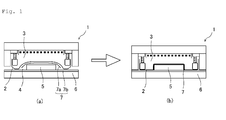
- FIG. 1 illustrates a cross-sectional view of a vacuum press device that is used in producing photovoltaic modules and the like.
- FIG. 1(a) is a drawing illustrating the state before the start of vacuum pressing and
- FIG. 1(b) is a drawing illustrating the state during vacuum pressing.
- a vacuum press device 1 is a device of a double vacuum format in which a first chamber 3 and a second chamber 4 are separated from one another by a diaphragm 2.
- each of the first chamber 3 and the second chamber 4 is evacuated to about 0.002 Pa, and the photovoltaic cell 5 surrounded by the EVA sheets 7 is heated. Once the heating reaches a predetermined temperature, the first chamber 3 is returned to atmospheric pressure ( FIG. 1(b) ). Returning the first chamber 3 to atmospheric pressure causes the EVA sheets 7 to be vacuum press-bonded to the photovoltaic cell 5 along with the diaphragm 2.
- Maintaining this state for a predetermined length of time causes a cross-linking reaction in the EVA sheets 7 to proceed and causes the photovoltaic cell 5 to be sealed by the EVA sheets 7.
- the vacuum press device 1 is cooled and thereafter the second chamber 4 is returned back to atmospheric pressure, thereby concluding the pressing step.
- the diaphragm 2 is used while mechanical and thermal stress are applied by the vacuum press-bonding and the heating, and is replaced after a regular interval of a plurality of cycles of the pressing step. For this reason, the durability of the diaphragm 2 has a direct impact on the productivity for making photovoltaic modules and the like.
- the temperature at which EVA melts is about 85°C
- the temperature at which a cross-linking reaction starts is said to be about 130°C.
- the reason for having the one-stage cross-linking be about 5 minutes is to minimize foaming and yellowing of the EVA sheets, and the reason for having the two-stage cross-linking be at 150-160° for 15 to 20 minutes is to fully run the cross-linking reaction in the EVA sheets so as to prevent the EVA sheets from experiencing softening or the like in relation to the temperature changes in the outdoors.
- the present invention adopts a method of production for cross-linking the EVA sheets with solely a hot pressing in which the vacuum press device 1 is used as the conditions for cross-linking the EVA sheets. That is to say, the EVA sheets are cross-linked with only the conventional one-stage cross-linking. That is to say, one cycle of cross-linking is carried out under conditions of one cross-linking temperature and cross-linking time. For this reason, a pressing temperature of 135-180°C and a pressing time of 10 to 20 minutes are adopted as conditions for hot pressing.
- a conventional diaphragm 2 made of silicone rubber becomes unusable in very little time when the pressing temperature exceeds 155°C. More specifically, the number of cycles at which the conventional diaphragm 2 can be used without replacement is reduced to about one-fifth.
- FIG. 2 is a plan view of the diaphragm 2 made of silicone rubber, which has become unusable at about 1,000 cycles of pressing under conditions of a pressing temperature of 135-180°C and pressing time of 10 to 20 minutes.
- the diaphragm 2 in a step for bonding the photovoltaic cell 5, the diaphragm 2 has been demonstrated to readily fracture, readily suffering cracking 8, fine crazing 9 not quite amounting to cracking, and the like at places where the mechanical stress thereof is repeatedly applied, in the direction in which the stress is applied; i.e., a direction in which expansion and contraction occur.
- the rubber hardness represents the International Rubber Hardness Degree (IRHD), a hardness scale where "0" is the hardness of a material for which the Young's modulus is zero and "100” is the hardness of a material for which the Young's modulus is infinite, and is a value denoted by the indentation depth of when a rubber sample surface that has suffered degradation is vertically indented at a constant force with a spherical surface.
- IRHD International Rubber Hardness Degree
- the rubber hardness at the portion where no degradation of the diaphragm was observed even after usage was 1.17 times that of the unused product. This shows that when a diaphragm made of silicone rubber still has a rubber hardness not greater than about 1.2 times that of an unused diaphragm, there would be obtained a rubber diaphragm that has excellent durability even under conditions where the conditions for cross-linking the EVA sheets are only a one-stage cross-linking of a press temperature of 135-180°C and pressing time of 10 to 20 minutes.
- the change in rubber hardness has also been shown to be a measure of durability for diaphragms for photovoltaic modules.
- a diaphragm made of silicone rubber experiences changes in rubber hardness and a decrease in durability of the diaphragm because of the peroxides included in the EVA sheets. For this reason, a rubber composition having little change in rubber hardness, other than a silicone rubber, becomes important for the diaphragm.
- a rubber composition which can be used in the present invention is a cross-linked ethylene propylene diene monomer (EPDM) composition.
- EPDM cross-linked ethylene propylene diene monomer
- Diaphragms were fabricated using the cross-linked EPDM composition illustrated in example 17 (described below), and subjected to physical testing under a pressing temperature of 160° and pressing time of 18 minutes. The results showed that cracking did not occur even at 5,000 or more cycles of pressing. When, after 5,000 cycles, the physical testing was further continued to measure the rubber hardness of portions that did experience cracking, the rubber hardness was 80. The scaling factor of hardness was 1.38, because the rubber hardness of the diaphragm at the start of testing was 58. The diaphragm made using the cross-linked EPDM composition was thus found to have excellent durability.
- the EPDM is a rubber obtained by introducing a small amount of a third component to an ethylene-propylene rubber, which is a copolymer of ethylene and propylene, to endow the main chain with double bonds.
- a third component include ethylidene norbornene, 1,4-hexadiene, dicyclopentadiene, 5-methylene-2-norbornene, dicyclooctadiene, 5-ethylidene-2-norbornene, and other dienes.
- An EPDM in which the ethylene content is 50 to 75 mass%, the diene serving as the third component is 4.5 to 8.5 mass%, and the remainder is propylene is preferable as an EPDM that can be preferably used in the present invention.
- EPDMs include the Mitsui EPTTM series from Mitsui Chemical, the EspreneTM series from Sumitomo Chemical Industries, the JSREPTM series from JSR, the KeltanTM series from DSM, the NordelTM series from DuPont, the EpsynTM series from Copolymer Rubber & Chemical Corp., and the PolysarTM series from Polysar Rubber Corp. NordelTM from DuPont and Dow Elastomers is an EPDM that has been polymerized using a single-site catalyst.
- An EPDM that is particularly preferably used in the present invention is an EPDM that has been polymerized using a single-site catalyst such as a metallocene catalyst.
- a single-site catalyst such as a metallocene catalyst.
- Such an EPDM has a narrow overall distribution of molecular weight overall, and the ethylene distribution has no distribution of molecular weight, for which reason there is relatively little crystallinity.
- the EPDM has excellent low-temperature properties, a low brittle temperature, and mild stress relaxation, and is therefore suitable for the present invention.
- Single-site catalysts include a metallocene catalyst; such a metallocene catalyst is obtained by combining zirconocene dichloride and methylaluminoxane, and features high polymerization activity against ethylene as well as uniform active sites.
- Other catalysts having uniform active sites include catalysts for olefin polymerization positioned in post-metallocene catalysts, e.g., phenoxyimine catalysts (FI catalysts), pyrrole imine catalysts (PI catalysts), and the like.
- FI catalysts phenoxyimine catalysts
- PI catalysts pyrrole imine catalysts
- conventional catalysts such as Ziegler-Natta catalysts are called multi-site catalysts, comprising many active site structures in the catalyst.
- a feature of single-site catalysts is that an EPDM of a narrower molecular weight distribution, with comonomers contained in each molecule being substantially equal, is obtained.
- EPDMs polymerized using a single-site catalyst include Mitsui 4045MTM and Mitsui 2060MTM from Mitsui Chemical, and Nordel IP5565TM, Nordel IP4725PTM, and Nordel IP4640TM from DuPont and Dow Elastomer.
- the EPDMs described above can be used independently as a rubber component. It would also be possible to blend as appropriate two or more types of EPDM, with the aim of adjusting the Mooney viscosity, the propylene content, the vulcanization rate, the amount of oil, or the like.
- the EPDM component there is preferably 10 mass% or more of EPDM that has been polymerized using a single-site catalyst in relation to the total amount of EPDM. Also, as the EPDM component, there is preferably not more than 75 mass% of EPDM that has been polymerized using a single-site catalyst in relation to the total amount of EPDM. More preferable is 10 to 75 mass%; particularly preferable is 25 to 75 mass%; and even more preferable is 30 to 50 mass%. When the ratio of EPDM that has been polymerized using a single-site catalyst is less than 10 mass%, the composition tends to harden more readily than when the ratio of EPDM that has been polymerized using a single-site catalyst is 50 mass%.
- a butyl rubber is preferable as a rubber that can be blended into the EPDM. Blending in a butyl rubber has been found to minimize any increase in the rubber hardness of the EPDM. In particular, any increase in the rubber hardness can be minimized when the butyl rubber is less than 75 parts by mass, preferably not more than 50 parts by mass in relation to 100 parts by mass of the combined total of the EPDM and butyl rubber.
- Butyl rubbers that can be used include uncross-linked regular-type butyl rubbers that are isobutylene-isoprene copolymer rubbers, chlorinated butyl rubbers, brominated butyl rubbers, and partially cross-linked-type butyl rubbers in a partially cross-linked state.
- butyl rubbers include the JSR ButylTM, ChlorobutylTM, and BromobutylTM series from JSR, or the Polysar ButylTM, ChlorobutylTM, and BromobutylTM series from Polysar Rubber Corp.
- Cross-linked EPDM compositions that can be used in the present invention are obtained by blending a filler, reinforcer, processing aid, softener, cross-linking agent, co-cross-linking agent, vulcanization accelerator, vulcanization accelerator auxiliary, anti-aging agent, or the like into the EPDM described above or into a blended rubber of the EPDM and a butyl rubber, and kneading, molding, and cross-linking.
- blended agents for the blended agents described above, it is possible to use blended agents that have been used as blending agents for EPDM or butyl rubbers. Blended agents which are particularly preferable in diaphragms for producing photovoltaic modules shall be described below.
- Fillers include calcium carbonate, clay, talc, and the like.
- the blending ratio is 0 to 100 parts by mass of the filler in relation to 100 parts by mass of crude rubber. When 100 parts by mass is exceeded, the rubber strength declines greatly and the durability of the diaphragm is reduced.
- Reinforcers include a variety of types of carbon black, white carbon such as silica, and the like.
- the blending ratio is 30 to 150 parts by mass of the reinforcer in relation to 100 parts by mass of crude rubber. At less than 30 parts by mass, the strength is low, and when 150 parts by mass is exceeded, the rubber has reduced elongation and the durability of the diaphragm is reduced.
- Softeners include process oils such as naphthenic process oils, paraffinic process oils, hydrogenation process oils, and semi-synthetic process oils, and the like.
- the blending ratio is 0 to 90 parts by mass of the softener in relation to 100 parts by mass of crude rubber. When 90 parts by mass is exceeded, the softener bleeds out and contaminates the surface of the photovoltaic module.
- Cross-linking agents include sulfur and organic peroxides.
- the blending ratio is 0.5 to 10 parts by mass of the cross-linking agent in relation to 100 parts by mass of crude rubber. At less than 0.5 parts by mass, the cross-linking is insufficient and strength is lacking, and when 10 parts by mass is exceeded, then there is less elongation and the durability of the diaphragm is reduced.
- organic peroxides examples include 2,5-dimethyl-2,5-di-t-butyl-peroxyhexane-3, di-t-butyl peroxide, 2,5-dimethyl-2,5-di-t-butyl-peroxyhexane, t-butyl cumyl peroxide, 1,3-bis(t-butylperoxy-isopropyl) benzene, dicumyl peroxide, 4,4-di-t-butyl peroxy butyl valerate, 2,2-di-t-butyl peroxy butane, 1,1-di-t-butyl peroxy-3,3,5-trimethyl cyclohexane, dibenzoyl peroxide, bis(o-methyl benzoyl) peroxide, bis(p-methyl benzoyl) peroxide, and the like.
- a known co-cross-linking agent may be used in combination, with the purpose of improving the efficiency of cross-linking by the organic peroxide.
- co-cross-linking agents include sulfur, triallyl isocyanurate (TAIC), triallyl cyanurate (TAC), bismaleimide, quinone dioxime, and the like.
- a known vulcanization accelerator/vulcanization accelerator auxiliary could be blended, with the purpose of improving the efficiency of cross-linking of sulfur vulcanization.
- a vulcanization accelerator auxiliary could also be blended with the purpose of improving the efficiency of cross-linking of the organic peroxide cross-linking.
- an organic peroxide a co-cross-linking agent, and a vulcanization accelerator in combination.
- Zinc oxide is a preferable vulcanization accelerator.
- a known anti-aging agent could be used as the anti-aging agent.
- Illustrative examples include amine-based anti-aging agents, phenolic anti-aging agents, and sulfur-based anti-aging agents.
- the cross-linked EPDM composition is obtained by molding a sheet or diaphragm of the blended uncross-linked EPDM composition described above, and thereafter cross-linking same.
- Adjustments can be made, for example, by first performing several minutes to several tens of minutes of kneading, at an appropriate temperature, of a rubber composition obtained by blending the EPDM, EPDM/butyl rubber blend, a cross-linking agent, and other additives using a mixer such as a Banbury mixer, a kneader, an Intermix mixer, an internal mixer, or rolls; and then withdrawing the kneaded material.
- a mixer such as a Banbury mixer, a kneader, an Intermix mixer, an internal mixer, or rolls; and then withdrawing the kneaded material.
- a vulcanizable uncross-linked EPDM composition that has been adjusted by kneading is molded using a variety of molding techniques involving the use of extruders, calender rolls, presses, injection molding machines, transfer molding machines, or the like, the molded product being introduced into a vulcanization tank and vulcanized simultaneously with the molding or after the molding, yielding the intended cross-linked EPDM molded article. Molding may entail the use of a die, or continuous vulcanization without the use of a die would also be possible.
- the front side and/or reverse side surface of the sheet or diaphragm is comprised bumpy. It is particularly preferable to comprise the bumpy surface that will be in contact with the resin sheet.
- Cloth-texturizing, paper-texturizing, matte-film processing, brushing, and other texturizing formats can be adopted. Particularly preferable among these is cloth-texturizing, which has excellent mold-release properties.
- Cloth-texturizing is a process for imparting a cloth-form texture to a surface, and is obtained by affixing a releasable cloth having a predetermined weave pattern to a sheet-shaped or diaphragm-shaped surface and vulcanizing. After vulcanization, the cloth having this pattern is peeled off.
- the diaphragm surface that is in contact with the resin sheet is cloth-grained. The cloth-graining improves the mold-release properties during production of the photovoltaic modules.
- the diaphragm made using the cross-linked EPDM composition or the blend composition with the butyl rubber as in the present invention can be used as a diaphragm for a photovoltaic module, as a diaphragm for a vacuum press device without two-stage cross-linking, under conditions of a hot pressing temperature of 135-180°C and pressing time of 10 to 20 minutes.
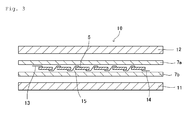
- FIG. 3 illustrates a photovoltaic module produced by using the above-described vacuum press device 1.
- FIG. 3 is a drawing illustrating a cross-sectional structure of a photovoltaic module 10.
- the photovoltaic module 10 has a configuration in which photovoltaic cells 5 are sandwiched, with EVA sheets 7a, 7b interposed therebetween, between a transparent cover glass 11 that is arranged on the lower side and a transparent reverse side material 12, such as, for example, a polyethylene resin, that is arranged on the upper side.
- the photovoltaic cells 5 are of a configuration in which a plurality of photovoltaic cells 5 are arranged between electrodes 13, 14 and connected with a lead line 15.
- the photovoltaic module 10 is obtained by using the vacuum press device 1 to laminate while also heating these constituent members, superimposed atop each other, in a vacuum. As a result, solely under one-stage cross-linking, the photovoltaic module is produced by the EVA sheets 7a, 7b being cross-linked and affixed together with each of the constituent members being superimposed atop one another.
- Rubber compositions kneaded with the blends illustrated in table 2 were calendered into sheets 3 mm thick, and cross-linked for 30 minutes at 170°C.
- the units of the blending ratios are parts by mass; the silicone rubber in comparative example 1 was cross-linked under 30 minutes of one-stage cross-linking at 170°C and 4 hours of two-stage cross-linking at 200°C.
- the EPDM 1 has an ethylene content of 51 mass%, a propylene content of 40.9 mass%, and a 5-ethylidene-2-norbornene (diene) content of 8.1 mass%;
- the EPDM 2 has an ethylene content of 70 mass%, a propylene content of 25.1 mass%, and a 5-ethylidene-2-norbornene (diene) content of 4.9 mass%;
- the EPDM 3 has an ethylene content of 56 mass%, a propylene content of 39.3 mass%, and a 5-ethylidene-2-norbornene (as the diene) content of 4.7 mass%.
- the butyl rubber was a chlorinated butyl rubber; the ethylene propylene rubber (“EPM”) had an ethylene content of 52 mass% and a propylene content of 48 mass%; and the silicone rubber was a high-tear silicone compound mainly composed of silicone crude rubber and silica.
- a fatty acid amide was used as a processing aid.
- the softener was a process oil and the reinforcing agent was carbon black.
- the cross-linking agent 1 is an organic peroxide and the cross-linking agent 2 is sulfur.
- the co-cross-linking agent used was a trifunctional-type methacrylate; the vulcanization accelerator was a sulfenamide and thiazole, the vulcanization accelerator auxiliary was zinc oxide, and the anti-aging agent was an amine.
- the peroxide-coated surfaces also included thermal degradation simultaneously with the hardening (change in hardness) caused by the peroxide.
- the reverse sides not coated with the peroxide also manifested changes in hardness caused by simple thermal degradation. Both were measured to be able to confirm whether the factors of changes in hardness were more impacted by peroxide degradation or thermal degradation.
- Each of the diaphragms obtained by the example 1 and the comparative example 1 was attached to the pressing device 1 illustrated in FIG. 1 and the photovoltaic module 10 illustrated in FIG. 3 was produced by a format of carrying out only the one-stage cross-linking.
- the diaphragm of example 1 remained usable for 1.56 times as many cycles of pressing at the hot pressing conditions A (20 minutes at 155°C) and 6.8 times as many cycles of pressing at the hot pressing conditions B (15 minutes at 165°C).
- the diaphragm of the present invention improves the productivity of producing photovoltaic modules, because the diaphragms are replaced with less frequency.
- photovoltaic modules produced by using the diaphragm of the present invention in terms of performance of the photovoltaic modules, have shown no significant difference in the products of the initial stages and later stages of production.
- Rubber compositions kneaded with the blends illustrated in table 3 were calendered into sheets 3 mm thick, and cross-linked for 30 minutes at 170°C.
- the blending ratios are indicated as parts by mass.
- the EPDM 4 has an ethylene content of 52 mass% and a diene content of 8.1 mass%
- the EPDM 5 has an ethylene content of 54 mass% and a diene content of 8 mass%
- the EPDM 6 has an ethylene content of 56 mass% and a diene content of 8 mass%
- the EPDM 7 has an ethylene content of 59 mass% and a diene content of 9 mass%
- the EPDM 8 has an ethylene content of 45 mass% and a diene content of 7.6 mass%
- the EPDM 9 has an ethylene content of 70 mass% and a diene content of 4.9 mass%
- the EPDM 10 has an ethylene content of 55 mass% and a diene content of 5 mass%
- the EPDM 11 has an ethylene content of 55 mass% and a diene content of 2.3 mass%.
- the EPDM 1 and the EPDM 3 to EPDM 6 are obtained using a vanadium-based catalyst, which is a multi-site catalyst, and the EPDM 7 to EPDM 11 are polymerized using a single-site catalyst such as a metallocene catalyst.
- the EPDM 1 is Mitsui EPT 4021TM From Mitsui Chemical.
- the EPDM 2 and EPDM 9 are Nordel IP4725PTM from DuPont & Dow Elastomer.
- the EPDM 3 is Mitsui EPT 3045TM from Mitsui Chemical.
- the EPDM 4 is JSR EP33TM from JSR.
- the EPDM 5 is Mitsui EPT 4045TM from Mitsui Chemical.
- the EPDM 6 is Mitsui EPT 4070TM from Mitsui Chemical.
- the EPDM 7 is Nordel IP 5565TM from DuPont & Dow Elastomer.
- the EPDM 8 is Mitsui EPT 4045MTM from Mitsui Chemical.
- the EPDM 10 is Nordel IP 4640TM from DuPont & Dow Elastomer.
- the EPDM 11 is "Mitsui EPT 2060MTM from Mitsui Chemical.
- a fatty acid amide and fatty acid salt were used as the processing aids illustrated in table 3.
- the softener was a process oil and the reinforcing agent was a carbon black.
- the cross-linking agent was an organic peroxide, while the co-cross-linking agent, vulcanization accelerator auxiliary, and anti-aging agent were a trifunctional methacrylate system, zinc oxide system, and amine system, respectively.
- the EPDM 1 that was polymerized using the multi-site catalyst and the EPDM 10 that was polymerized using the single-site catalyst were used to obtain rubber compositions kneaded at the blends illustrated in FIG. 4 , which were calendered into sheets 3 mm thick and then cross-linked for 30 minutes at 170°C.
- the blending ratios are expressed in terms of parts by mass.
- Example 17 is the same blending as that of example 7, and example 23 is the same blending as example 15, but the sheet preparation timing and assessment timing were different.
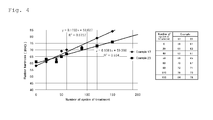
- FIG. 4 illustrates the results obtained from assessing examples 17 and 23 up to 150 treatment cycles.
- FIG. 4 illustrates the relationship between the rubber hardness and the number of cycles of treatment. The rubber hardness was measured on the "front", and the right side of the graph shows the actual values.
- the rubber hardness and the number of cycles of treatment exhibit a strong first-order correlation, where rubber hardness increases in linear fashion as the number of cycles of treatment increases.
- the slope of the straight line is smaller for example 23 than for example 17. That is to say, in the accelerated testing, the rubber hardness did not increase but rather maintained its initial state.
- the diaphragm made of cross-linked EPDM as in the present invention can be utilized for future mass production of photovoltaic modules, because the productivity of making photovoltaic modules is improved thereby and photovoltaic modules can be stably produced.
Landscapes
- Engineering & Computer Science (AREA)
- Mechanical Engineering (AREA)
- Physics & Mathematics (AREA)
- Manufacturing & Machinery (AREA)
- Health & Medical Sciences (AREA)
- Oral & Maxillofacial Surgery (AREA)
- Thermal Sciences (AREA)
- Fluid Mechanics (AREA)
- Compositions Of Macromolecular Compounds (AREA)
- Photovoltaic Devices (AREA)
- Lining Or Joining Of Plastics Or The Like (AREA)
- Manufacture Of Macromolecular Shaped Articles (AREA)
Applications Claiming Priority (3)
| Application Number | Priority Date | Filing Date | Title |
|---|---|---|---|
| JP2011138763 | 2011-06-22 | ||
| JP2012021823 | 2012-02-03 | ||
| PCT/JP2012/064896 WO2012176642A1 (fr) | 2011-06-22 | 2012-06-11 | Diaphragme pour la production d'un module photovoltaïque et procédé pour la production d'un module photovoltaïque |
Publications (3)
| Publication Number | Publication Date |
|---|---|
| EP2724841A1 true EP2724841A1 (fr) | 2014-04-30 |
| EP2724841A4 EP2724841A4 (fr) | 2015-08-26 |
| EP2724841B1 EP2724841B1 (fr) | 2017-11-01 |
Family
ID=47422482
Family Applications (1)
| Application Number | Title | Priority Date | Filing Date |
|---|---|---|---|
| EP12803320.6A Not-in-force EP2724841B1 (fr) | 2011-06-22 | 2012-06-11 | Diaphragme pour la production d'un module photovoltaïque et procédé pour la production d'un module photovoltaïque |
Country Status (6)
| Country | Link |
|---|---|
| EP (1) | EP2724841B1 (fr) |
| JP (1) | JP5998134B2 (fr) |
| KR (1) | KR101820564B1 (fr) |
| CN (1) | CN103619564B (fr) |
| TW (1) | TWI557932B (fr) |
| WO (1) | WO2012176642A1 (fr) |
Cited By (6)
| Publication number | Priority date | Publication date | Assignee | Title |
|---|---|---|---|---|
| EP2584614A4 (fr) * | 2011-07-04 | 2014-11-19 | Nisshinbo Mechatronics Inc | Feuille de diaphragme, procédé de fabrication d'un module de cellule solaire à l'aide de la feuille de diaphragme, procédé de stratification utilisant un appareil de stratification pour la production d'un module de cellule solaire |
| CN105529991A (zh) * | 2014-09-29 | 2016-04-27 | 全能科技股份有限公司 | 兼具发电及热交换功能的太阳能复合模板及其制造方法 |
| FR3043841A1 (fr) * | 2015-11-16 | 2017-05-19 | Commissariat Energie Atomique | Module photovoltaique leger comportant une couche avant en verre ou polymere et une couche arriere en relief |
| US20180243966A1 (en) * | 2016-04-15 | 2018-08-30 | Lg Chem, Ltd. | Apparatus and method for forming pouch case for secondary battery |
| WO2019112728A1 (fr) * | 2017-12-08 | 2019-06-13 | Exxonmobil Chemical Patents Inc. | Compositions de terpolymère élastomère destinées à des applications de moulures de coins |
| WO2019182949A1 (fr) * | 2018-03-19 | 2019-09-26 | Exxonmobil Chemical Patents Inc. | Compositions de terpolymère de propylène-alpha-oléfine-diène élastomère |
Families Citing this family (2)
| Publication number | Priority date | Publication date | Assignee | Title |
|---|---|---|---|---|
| WO2017179898A1 (fr) * | 2016-04-15 | 2017-10-19 | 주식회사 엘지화학 | Appareil et procédé de moulage de matériau extérieur de poche pour batterie rechargeable |
| KR102638297B1 (ko) | 2016-09-23 | 2024-02-20 | 삼성디스플레이 주식회사 | 표시 장치의 제조 방법 및 제조 장치 |
Family Cites Families (9)
| Publication number | Priority date | Publication date | Assignee | Title |
|---|---|---|---|---|
| JP2948508B2 (ja) * | 1995-08-10 | 1999-09-13 | キヤノン株式会社 | 真空ラミネート装置および真空ラミネート方法並びに太陽電池の製造法 |
| AU2002335176A1 (en) * | 2002-10-02 | 2004-04-23 | Jsr Trading Co., Ltd. | Laminating system |
| JP2004281834A (ja) * | 2003-03-18 | 2004-10-07 | Tigers Polymer Corp | 太陽電池モジュール製造用ダイヤフラム |
| DE10316774B4 (de) * | 2003-04-11 | 2010-08-19 | Metzeler Technical Rubber Systems Gmbh | Membrane für Laminatoren zur Produktion von photovoltaischen Zellen |
| JP5588433B2 (ja) * | 2009-05-13 | 2014-09-10 | 三井・デュポンポリケミカル株式会社 | 太陽電池封止材用シート及び太陽電池モジュール |
| CN102449060B (zh) * | 2009-06-01 | 2013-09-25 | 三井化学株式会社 | 乙烯系树脂组合物、太阳能电池密封材料和使用其的太阳能电池组件 |
| US20110076462A1 (en) * | 2009-08-04 | 2011-03-31 | Jette Steven R | Edge reinforced elastomeric membranes |
| CN101847667A (zh) * | 2010-01-06 | 2010-09-29 | 湖南寰球太阳能技术开发有限公司 | 太阳能电池专用背封膜 |
| JP5129866B2 (ja) * | 2010-02-25 | 2013-01-30 | 日清紡ホールディングス株式会社 | ダイアフラムシート |
-
2012
- 2012-06-11 KR KR1020147001693A patent/KR101820564B1/ko not_active Expired - Fee Related
- 2012-06-11 WO PCT/JP2012/064896 patent/WO2012176642A1/fr not_active Ceased
- 2012-06-11 EP EP12803320.6A patent/EP2724841B1/fr not_active Not-in-force
- 2012-06-11 CN CN201280030802.6A patent/CN103619564B/zh not_active Expired - Fee Related
- 2012-06-11 JP JP2013521528A patent/JP5998134B2/ja active Active
- 2012-06-20 TW TW101122081A patent/TWI557932B/zh not_active IP Right Cessation
Cited By (11)
| Publication number | Priority date | Publication date | Assignee | Title |
|---|---|---|---|---|
| EP2584614A4 (fr) * | 2011-07-04 | 2014-11-19 | Nisshinbo Mechatronics Inc | Feuille de diaphragme, procédé de fabrication d'un module de cellule solaire à l'aide de la feuille de diaphragme, procédé de stratification utilisant un appareil de stratification pour la production d'un module de cellule solaire |
| CN105529991A (zh) * | 2014-09-29 | 2016-04-27 | 全能科技股份有限公司 | 兼具发电及热交换功能的太阳能复合模板及其制造方法 |
| FR3043841A1 (fr) * | 2015-11-16 | 2017-05-19 | Commissariat Energie Atomique | Module photovoltaique leger comportant une couche avant en verre ou polymere et une couche arriere en relief |
| WO2017085021A1 (fr) * | 2015-11-16 | 2017-05-26 | Commissariat A L'energie Atomique Et Aux Energies Alternatives | Module photovoltaïque léger comportant une couche avant en verre ou polymère et une couche arrière en relief |
| US10546966B2 (en) | 2015-11-16 | 2020-01-28 | Commissariat A L'energie Atomique Et Aux Energies Alternatives | Lightweight photovoltaic module including a front layer made from glass or polymer and a rear layer comprising raised portions |
| US20180243966A1 (en) * | 2016-04-15 | 2018-08-30 | Lg Chem, Ltd. | Apparatus and method for forming pouch case for secondary battery |
| US10933575B2 (en) * | 2016-04-15 | 2021-03-02 | Lg Chem, Ltd. | Apparatus and method for forming pouch case for secondary battery |
| WO2019112728A1 (fr) * | 2017-12-08 | 2019-06-13 | Exxonmobil Chemical Patents Inc. | Compositions de terpolymère élastomère destinées à des applications de moulures de coins |
| US11390734B2 (en) | 2017-12-08 | 2022-07-19 | Exxonmobil Chemical Patents Inc. | Elastomeric terpolymer compositions for corner molding applications |
| WO2019182949A1 (fr) * | 2018-03-19 | 2019-09-26 | Exxonmobil Chemical Patents Inc. | Compositions de terpolymère de propylène-alpha-oléfine-diène élastomère |
| US11732121B2 (en) | 2018-03-19 | 2023-08-22 | Exxonmobil Chemical Patents Inc. | Elastomeric propylene-alpha-olefin-diene terpolymer compositions |
Also Published As
| Publication number | Publication date |
|---|---|
| EP2724841B1 (fr) | 2017-11-01 |
| EP2724841A4 (fr) | 2015-08-26 |
| JPWO2012176642A1 (ja) | 2015-02-23 |
| CN103619564A (zh) | 2014-03-05 |
| TWI557932B (zh) | 2016-11-11 |
| CN103619564B (zh) | 2016-08-17 |
| KR101820564B1 (ko) | 2018-01-19 |
| TW201306296A (zh) | 2013-02-01 |
| WO2012176642A1 (fr) | 2012-12-27 |
| KR20140047085A (ko) | 2014-04-21 |
| JP5998134B2 (ja) | 2016-09-28 |
Similar Documents
| Publication | Publication Date | Title |
|---|---|---|
| EP2724841B1 (fr) | Diaphragme pour la production d'un module photovoltaïque et procédé pour la production d'un module photovoltaïque | |
| EP1363773B1 (fr) | Structure composite de polymere | |
| US7863364B2 (en) | Process for making dynamically-loaded articles comprising propylene-based elastomers, composition for use in such processes, and article made using such processes | |
| CN108299744B (zh) | 橡胶组合物,及在发泡制品的应用和生产方法 | |
| EP3569652B1 (fr) | Composition de caoutchouc et courroie transporteuse l'utilisant | |
| CN108329559A (zh) | 橡胶组合物,及应用其的耐老化橡胶制品和生产方法 | |
| EP3822312A1 (fr) | Composition de caoutchouc polaire anti-vieillissement, procédé de traitement associé et application associée | |
| CN108329602B (zh) | 橡胶组合物及加工方法,及应用其的密封件及生产方法 | |
| US12180355B2 (en) | Rubber composition, processing method thereof, and braking-resistant liquid product using the same | |
| CN101497717A (zh) | 热塑性弹性体组合物和复合模制品 | |
| JPWO2013005742A1 (ja) | ダイアフラムシート、ダイアフラムシートを用いた太陽電池モジュール製造方法、太陽電池モジュール製造用のラミネート装置を用いたラミネート方法 | |
| KR970004919B1 (ko) | 도료 밀착성이 우수한 열가소성 엘라스토머 조성물, 및 상기 열가소성 엘라스토머 층 및 폴리우레탄 층으로 구성된 적층제 | |
| WO2018130187A1 (fr) | Composite de caoutchouc, procédé de traitement, applications et procédé de fabrication de produits en caoutchouc à haute résistance | |
| EP2541621A1 (fr) | Feuille de diaphragme | |
| WO2018130192A1 (fr) | Composite de caoutchouc, produit de caoutchouc résistant au vieillissement utilisant ce composite, et procédé de fabrication | |
| EP0657501B1 (fr) | Caoutchouc vulcanisé pour isolateurs de vibration résistant à la chaleur | |
| CN117863583B (zh) | 一种橡塑发泡结合体、其制备方法及应用 | |
| JP2015186876A (ja) | ダイアフラムシートの製造方法 | |
| WO2018130193A1 (fr) | Composite de caoutchouc, procédé de traitement, applications, et élément d'étanchéité de condensateur comprenant un composite | |
| KR20090080962A (ko) | 반응성 커플링된 물품 및 관련 방법 | |
| EP2544245A1 (fr) | Feuille de mesure de densité de réticulation | |
| WO2017221583A1 (fr) | Corps assemblé et son procédé de fabrication | |
| CN114785243A (zh) | 包含热塑性硫化橡胶组合物的光伏模块背板 | |
| EP4067074A1 (fr) | Complexe caoutchouc-métal, pneu et article en caoutchouc | |
| JP6772581B2 (ja) | 接合体の製造方法 |
Legal Events
| Date | Code | Title | Description |
|---|---|---|---|
| PUAI | Public reference made under article 153(3) epc to a published international application that has entered the european phase |
Free format text: ORIGINAL CODE: 0009012 |
|
| 17P | Request for examination filed |
Effective date: 20140120 |
|
| AK | Designated contracting states |
Kind code of ref document: A1 Designated state(s): AL AT BE BG CH CY CZ DE DK EE ES FI FR GB GR HR HU IE IS IT LI LT LU LV MC MK MT NL NO PL PT RO RS SE SI SK SM TR |
|
| DAX | Request for extension of the european patent (deleted) | ||
| RA4 | Supplementary search report drawn up and despatched (corrected) |
Effective date: 20150723 |
|
| RIC1 | Information provided on ipc code assigned before grant |
Ipc: B29C 65/02 20060101AFI20150717BHEP Ipc: H01L 31/042 20140101ALI20150717BHEP |
|
| REG | Reference to a national code |
Ref country code: DE Ref legal event code: R079 Ref document number: 602012039283 Country of ref document: DE Free format text: PREVIOUS MAIN CLASS: B29C0065020000 Ipc: B29C0065180000 |
|
| GRAP | Despatch of communication of intention to grant a patent |
Free format text: ORIGINAL CODE: EPIDOSNIGR1 |
|
| STAA | Information on the status of an ep patent application or granted ep patent |
Free format text: STATUS: GRANT OF PATENT IS INTENDED |
|
| RIC1 | Information provided on ipc code assigned before grant |
Ipc: B29C 65/18 20060101AFI20170522BHEP Ipc: H01L 31/048 20140101ALI20170522BHEP Ipc: B29C 35/02 20060101ALI20170522BHEP Ipc: B32B 37/10 20060101ALI20170522BHEP Ipc: B29C 63/16 20060101ALI20170522BHEP Ipc: B29C 65/00 20060101ALI20170522BHEP Ipc: H01L 31/18 20060101ALI20170522BHEP |
|
| INTG | Intention to grant announced |
Effective date: 20170619 |
|
| GRAS | Grant fee paid |
Free format text: ORIGINAL CODE: EPIDOSNIGR3 |
|
| GRAA | (expected) grant |
Free format text: ORIGINAL CODE: 0009210 |
|
| STAA | Information on the status of an ep patent application or granted ep patent |
Free format text: STATUS: THE PATENT HAS BEEN GRANTED |
|
| AK | Designated contracting states |
Kind code of ref document: B1 Designated state(s): AL AT BE BG CH CY CZ DE DK EE ES FI FR GB GR HR HU IE IS IT LI LT LU LV MC MK MT NL NO PL PT RO RS SE SI SK SM TR |
|
| REG | Reference to a national code |
Ref country code: GB Ref legal event code: FG4D |
|
| REG | Reference to a national code |
Ref country code: CH Ref legal event code: EP Ref country code: AT Ref legal event code: REF Ref document number: 941621 Country of ref document: AT Kind code of ref document: T Effective date: 20171115 |
|
| REG | Reference to a national code |
Ref country code: IE Ref legal event code: FG4D |
|
| REG | Reference to a national code |
Ref country code: DE Ref legal event code: R096 Ref document number: 602012039283 Country of ref document: DE |
|
| REG | Reference to a national code |
Ref country code: NL Ref legal event code: MP Effective date: 20171101 |
|
| REG | Reference to a national code |
Ref country code: LT Ref legal event code: MG4D |
|
| REG | Reference to a national code |
Ref country code: AT Ref legal event code: MK05 Ref document number: 941621 Country of ref document: AT Kind code of ref document: T Effective date: 20171101 |
|
| PG25 | Lapsed in a contracting state [announced via postgrant information from national office to epo] |
Ref country code: NO Free format text: LAPSE BECAUSE OF FAILURE TO SUBMIT A TRANSLATION OF THE DESCRIPTION OR TO PAY THE FEE WITHIN THE PRESCRIBED TIME-LIMIT Effective date: 20180201 Ref country code: ES Free format text: LAPSE BECAUSE OF FAILURE TO SUBMIT A TRANSLATION OF THE DESCRIPTION OR TO PAY THE FEE WITHIN THE PRESCRIBED TIME-LIMIT Effective date: 20171101 Ref country code: NL Free format text: LAPSE BECAUSE OF FAILURE TO SUBMIT A TRANSLATION OF THE DESCRIPTION OR TO PAY THE FEE WITHIN THE PRESCRIBED TIME-LIMIT Effective date: 20171101 Ref country code: SE Free format text: LAPSE BECAUSE OF FAILURE TO SUBMIT A TRANSLATION OF THE DESCRIPTION OR TO PAY THE FEE WITHIN THE PRESCRIBED TIME-LIMIT Effective date: 20171101 Ref country code: LT Free format text: LAPSE BECAUSE OF FAILURE TO SUBMIT A TRANSLATION OF THE DESCRIPTION OR TO PAY THE FEE WITHIN THE PRESCRIBED TIME-LIMIT Effective date: 20171101 Ref country code: FI Free format text: LAPSE BECAUSE OF FAILURE TO SUBMIT A TRANSLATION OF THE DESCRIPTION OR TO PAY THE FEE WITHIN THE PRESCRIBED TIME-LIMIT Effective date: 20171101 |
|
| PG25 | Lapsed in a contracting state [announced via postgrant information from national office to epo] |
Ref country code: BG Free format text: LAPSE BECAUSE OF FAILURE TO SUBMIT A TRANSLATION OF THE DESCRIPTION OR TO PAY THE FEE WITHIN THE PRESCRIBED TIME-LIMIT Effective date: 20180201 Ref country code: IS Free format text: LAPSE BECAUSE OF FAILURE TO SUBMIT A TRANSLATION OF THE DESCRIPTION OR TO PAY THE FEE WITHIN THE PRESCRIBED TIME-LIMIT Effective date: 20180301 Ref country code: RS Free format text: LAPSE BECAUSE OF FAILURE TO SUBMIT A TRANSLATION OF THE DESCRIPTION OR TO PAY THE FEE WITHIN THE PRESCRIBED TIME-LIMIT Effective date: 20171101 Ref country code: AT Free format text: LAPSE BECAUSE OF FAILURE TO SUBMIT A TRANSLATION OF THE DESCRIPTION OR TO PAY THE FEE WITHIN THE PRESCRIBED TIME-LIMIT Effective date: 20171101 Ref country code: GR Free format text: LAPSE BECAUSE OF FAILURE TO SUBMIT A TRANSLATION OF THE DESCRIPTION OR TO PAY THE FEE WITHIN THE PRESCRIBED TIME-LIMIT Effective date: 20180202 Ref country code: LV Free format text: LAPSE BECAUSE OF FAILURE TO SUBMIT A TRANSLATION OF THE DESCRIPTION OR TO PAY THE FEE WITHIN THE PRESCRIBED TIME-LIMIT Effective date: 20171101 Ref country code: HR Free format text: LAPSE BECAUSE OF FAILURE TO SUBMIT A TRANSLATION OF THE DESCRIPTION OR TO PAY THE FEE WITHIN THE PRESCRIBED TIME-LIMIT Effective date: 20171101 |
|
| PG25 | Lapsed in a contracting state [announced via postgrant information from national office to epo] |
Ref country code: SK Free format text: LAPSE BECAUSE OF FAILURE TO SUBMIT A TRANSLATION OF THE DESCRIPTION OR TO PAY THE FEE WITHIN THE PRESCRIBED TIME-LIMIT Effective date: 20171101 Ref country code: DK Free format text: LAPSE BECAUSE OF FAILURE TO SUBMIT A TRANSLATION OF THE DESCRIPTION OR TO PAY THE FEE WITHIN THE PRESCRIBED TIME-LIMIT Effective date: 20171101 Ref country code: CZ Free format text: LAPSE BECAUSE OF FAILURE TO SUBMIT A TRANSLATION OF THE DESCRIPTION OR TO PAY THE FEE WITHIN THE PRESCRIBED TIME-LIMIT Effective date: 20171101 Ref country code: EE Free format text: LAPSE BECAUSE OF FAILURE TO SUBMIT A TRANSLATION OF THE DESCRIPTION OR TO PAY THE FEE WITHIN THE PRESCRIBED TIME-LIMIT Effective date: 20171101 Ref country code: CY Free format text: LAPSE BECAUSE OF FAILURE TO SUBMIT A TRANSLATION OF THE DESCRIPTION OR TO PAY THE FEE WITHIN THE PRESCRIBED TIME-LIMIT Effective date: 20171101 |
|
| REG | Reference to a national code |
Ref country code: DE Ref legal event code: R097 Ref document number: 602012039283 Country of ref document: DE |
|
| PG25 | Lapsed in a contracting state [announced via postgrant information from national office to epo] |
Ref country code: SM Free format text: LAPSE BECAUSE OF FAILURE TO SUBMIT A TRANSLATION OF THE DESCRIPTION OR TO PAY THE FEE WITHIN THE PRESCRIBED TIME-LIMIT Effective date: 20171101 Ref country code: PL Free format text: LAPSE BECAUSE OF FAILURE TO SUBMIT A TRANSLATION OF THE DESCRIPTION OR TO PAY THE FEE WITHIN THE PRESCRIBED TIME-LIMIT Effective date: 20171101 Ref country code: RO Free format text: LAPSE BECAUSE OF FAILURE TO SUBMIT A TRANSLATION OF THE DESCRIPTION OR TO PAY THE FEE WITHIN THE PRESCRIBED TIME-LIMIT Effective date: 20171101 Ref country code: IT Free format text: LAPSE BECAUSE OF FAILURE TO SUBMIT A TRANSLATION OF THE DESCRIPTION OR TO PAY THE FEE WITHIN THE PRESCRIBED TIME-LIMIT Effective date: 20171101 |
|
| PLBE | No opposition filed within time limit |
Free format text: ORIGINAL CODE: 0009261 |
|
| STAA | Information on the status of an ep patent application or granted ep patent |
Free format text: STATUS: NO OPPOSITION FILED WITHIN TIME LIMIT |
|
| 26N | No opposition filed |
Effective date: 20180802 |
|
| PG25 | Lapsed in a contracting state [announced via postgrant information from national office to epo] |
Ref country code: SI Free format text: LAPSE BECAUSE OF FAILURE TO SUBMIT A TRANSLATION OF THE DESCRIPTION OR TO PAY THE FEE WITHIN THE PRESCRIBED TIME-LIMIT Effective date: 20171101 |
|
| REG | Reference to a national code |
Ref country code: DE Ref legal event code: R119 Ref document number: 602012039283 Country of ref document: DE |
|
| REG | Reference to a national code |
Ref country code: CH Ref legal event code: PL |
|
| GBPC | Gb: european patent ceased through non-payment of renewal fee |
Effective date: 20180611 |
|
| REG | Reference to a national code |
Ref country code: BE Ref legal event code: MM Effective date: 20180630 |
|
| REG | Reference to a national code |
Ref country code: IE Ref legal event code: MM4A |
|
| PG25 | Lapsed in a contracting state [announced via postgrant information from national office to epo] |
Ref country code: MC Free format text: LAPSE BECAUSE OF FAILURE TO SUBMIT A TRANSLATION OF THE DESCRIPTION OR TO PAY THE FEE WITHIN THE PRESCRIBED TIME-LIMIT Effective date: 20171101 Ref country code: LU Free format text: LAPSE BECAUSE OF NON-PAYMENT OF DUE FEES Effective date: 20180611 |
|
| PG25 | Lapsed in a contracting state [announced via postgrant information from national office to epo] |
Ref country code: LI Free format text: LAPSE BECAUSE OF NON-PAYMENT OF DUE FEES Effective date: 20180630 Ref country code: FR Free format text: LAPSE BECAUSE OF NON-PAYMENT OF DUE FEES Effective date: 20180630 Ref country code: GB Free format text: LAPSE BECAUSE OF NON-PAYMENT OF DUE FEES Effective date: 20180611 Ref country code: CH Free format text: LAPSE BECAUSE OF NON-PAYMENT OF DUE FEES Effective date: 20180630 Ref country code: DE Free format text: LAPSE BECAUSE OF NON-PAYMENT OF DUE FEES Effective date: 20190101 Ref country code: IE Free format text: LAPSE BECAUSE OF NON-PAYMENT OF DUE FEES Effective date: 20180611 |
|
| PG25 | Lapsed in a contracting state [announced via postgrant information from national office to epo] |
Ref country code: BE Free format text: LAPSE BECAUSE OF NON-PAYMENT OF DUE FEES Effective date: 20180630 |
|
| PG25 | Lapsed in a contracting state [announced via postgrant information from national office to epo] |
Ref country code: MT Free format text: LAPSE BECAUSE OF NON-PAYMENT OF DUE FEES Effective date: 20180611 |
|
| PG25 | Lapsed in a contracting state [announced via postgrant information from national office to epo] |
Ref country code: TR Free format text: LAPSE BECAUSE OF FAILURE TO SUBMIT A TRANSLATION OF THE DESCRIPTION OR TO PAY THE FEE WITHIN THE PRESCRIBED TIME-LIMIT Effective date: 20171101 |
|
| PG25 | Lapsed in a contracting state [announced via postgrant information from national office to epo] |
Ref country code: PT Free format text: LAPSE BECAUSE OF FAILURE TO SUBMIT A TRANSLATION OF THE DESCRIPTION OR TO PAY THE FEE WITHIN THE PRESCRIBED TIME-LIMIT Effective date: 20171101 Ref country code: HU Free format text: LAPSE BECAUSE OF FAILURE TO SUBMIT A TRANSLATION OF THE DESCRIPTION OR TO PAY THE FEE WITHIN THE PRESCRIBED TIME-LIMIT; INVALID AB INITIO Effective date: 20120611 |
|
| PG25 | Lapsed in a contracting state [announced via postgrant information from national office to epo] |
Ref country code: MK Free format text: LAPSE BECAUSE OF NON-PAYMENT OF DUE FEES Effective date: 20171101 |
|
| PG25 | Lapsed in a contracting state [announced via postgrant information from national office to epo] |
Ref country code: AL Free format text: LAPSE BECAUSE OF FAILURE TO SUBMIT A TRANSLATION OF THE DESCRIPTION OR TO PAY THE FEE WITHIN THE PRESCRIBED TIME-LIMIT Effective date: 20171101 |