EP2728343A1 - Sonde optique pour la détermination quantitative d'un analyte - Google Patents
Sonde optique pour la détermination quantitative d'un analyte Download PDFInfo
- Publication number
- EP2728343A1 EP2728343A1 EP12191447.7A EP12191447A EP2728343A1 EP 2728343 A1 EP2728343 A1 EP 2728343A1 EP 12191447 A EP12191447 A EP 12191447A EP 2728343 A1 EP2728343 A1 EP 2728343A1
- Authority
- EP
- European Patent Office
- Prior art keywords
- solid state
- spectrum
- state material
- emission
- luminescent solid
- Prior art date
- Legal status (The legal status is an assumption and is not a legal conclusion. Google has not performed a legal analysis and makes no representation as to the accuracy of the status listed.)
- Withdrawn
Links
Images




Classifications
-
- G—PHYSICS
- G01—MEASURING; TESTING
- G01N—INVESTIGATING OR ANALYSING MATERIALS BY DETERMINING THEIR CHEMICAL OR PHYSICAL PROPERTIES
- G01N21/00—Investigating or analysing materials by the use of optical means, i.e. using sub-millimetre waves, infrared, visible or ultraviolet light
- G01N21/62—Systems in which the material investigated is excited whereby it emits light or causes a change in wavelength of the incident light
- G01N21/63—Systems in which the material investigated is excited whereby it emits light or causes a change in wavelength of the incident light optically excited
- G01N21/64—Fluorescence; Phosphorescence
- G01N21/6408—Fluorescence; Phosphorescence with measurement of decay time, time resolved fluorescence
-
- G—PHYSICS
- G01—MEASURING; TESTING
- G01N—INVESTIGATING OR ANALYSING MATERIALS BY DETERMINING THEIR CHEMICAL OR PHYSICAL PROPERTIES
- G01N21/00—Investigating or analysing materials by the use of optical means, i.e. using sub-millimetre waves, infrared, visible or ultraviolet light
- G01N21/62—Systems in which the material investigated is excited whereby it emits light or causes a change in wavelength of the incident light
- G01N21/63—Systems in which the material investigated is excited whereby it emits light or causes a change in wavelength of the incident light optically excited
- G01N21/64—Fluorescence; Phosphorescence
- G01N21/6428—Measuring fluorescence of fluorescent products of reactions or of fluorochrome labelled reactive substances, e.g. measuring quenching effects, using measuring "optrodes"
- G01N21/643—Measuring fluorescence of fluorescent products of reactions or of fluorochrome labelled reactive substances, e.g. measuring quenching effects, using measuring "optrodes" non-biological material
-
- G—PHYSICS
- G01—MEASURING; TESTING
- G01N—INVESTIGATING OR ANALYSING MATERIALS BY DETERMINING THEIR CHEMICAL OR PHYSICAL PROPERTIES
- G01N33/00—Investigating or analysing materials by specific methods not covered by groups G01N1/00 - G01N31/00
- G01N33/48—Biological material, e.g. blood, urine; Haemocytometers
- G01N33/50—Chemical analysis of biological material, e.g. blood, urine; Testing involving biospecific ligand binding methods; Immunological testing
- G01N33/53—Immunoassay; Biospecific binding assay; Materials therefor
- G01N33/536—Immunoassay; Biospecific binding assay; Materials therefor with immune complex formed in liquid phase
- G01N33/542—Immunoassay; Biospecific binding assay; Materials therefor with immune complex formed in liquid phase with steric inhibition or signal modification, e.g. fluorescent quenching
Definitions
- the invention relates to an optical probe and a method for quantitatively determining an analyte.
- Optical probes for various analytes such as oxygen, carbon dioxide, protons (for pH-measurements) and other ions are nowadays widely used in science and technology.
- Such probes also referred to as optical chemosensors mostly rely on absorption indicator dyes or luminescent solid state materials which respond to the analyte of interest by changing their optical properties, such as absorption- or emission spectrum, luminescence decay time or luminescence anisotropy.
- the common problem of the absorption/reflectance sensors is that the light from the light source used to excite the luminescent solid state material is not only absorbed and reflected on the sensor surface but also on all the components of the optical equipment (e.g. connections between filters and fibres).
- Luminescence intensity as such is a problematic parameter to measure since it is strongly influenced by a number of factors such as the intensity of the excitation light and its distance to the sensor, the sensitivity of the photodetector, scattering and coloration and turbidity in the specimen to be measured.
- This disadvantage can be overcome by measuring luminescence decay time. Measurement of the luminescence decay time is very common in case of oxygen sensors which rely on long-lived phosphorescent solid state materials. However, the equipment becomes more bulky and expensive for measuring fluorescence decay time. Here, ratiometric measurement of the luminescence intensity is often preferable. To do so, typically, a luminescent (analyte-insensitive) solid state material is immobilised along with an indicator dye. Both, the indicator dye and the luminescent solid state material are excitable together, but possess substantially different emission spectra. The emission ratio of the indicator dye and the luminescent solid state material serves as an analytical parameter. Alternatively, a probe which possesses two different emission spectra in the absence and in the presence of the analyte can be used.
- Optical probes or sensors based on the above referencing schemes possess several limitations: first, the interferences from background fluorescence of the probe is not eliminated; second, the presence of luminescence quenchers in the analysed media can severely affect the response of the sensors; third, the number of fluorescent indicators which fulfil the requirements of brightness, sensitivity, solubility in the sensor matrices, chemical- and photostability is rather limited. On the other hand, many robust absorption-based indicators are known. The use of such indicators can overcome the above drawbacks providing that a robust referencing scheme is found.
- a luminescent solid state material which possesses long-lived luminescence is dissolved in a polymer matrix along with an absorption-based indicator dye.
- the emission of the luminescent solid state material overlaps with the absorption of one chemical form of the indicator dye (for example protonated or deprotonated form in case of a pH indicator) so that the luminescence intensity, and also the decay time decrease due to Förster Resonance Energy Transfer (FRET). Since the other form of the absorption-based indicator dye does not overlap with the emission spectrum of the luminescent solid state material, the FRET is absent in this case.
- FRET Förster Resonance Energy Transfer
- an optical probe for quantitatively determining an analyte comprising a luminescent solid state material as an internal light source having an excitation spectrum and an emission spectrum and an indicator dye having different, analyte-dependent chemical forms and corresponding analyte-dependent absorption spectra, wherein the absorption spectrum of at least one form of the indicator dye overlaps with either the excitation spectrum or the emission spectrum of the luminescent solid state material, referred to as a probing spectrum, and the luminescent solid state material has a probing spectrum broader than the absorption spectrum of the indicator dye, wherein by virtue of the indicator dye, a first portion and a second portion of the probing spectrum of the luminescent solid state material are quenched to different extents, and wherein the decay time of the emission of the luminescent solid state material is longer than 1 ⁇ s.
- Such an optical probe allows for ratiometric measurement of an analyte by the analyte-dependent quenching of the probing spectrum of a luminescent solid state material at different wavelengths by the indicator dye.
- quenching is used for extinction of light due to inner filter effect between the luminescent solid state material and the indicator dye. Since the probing spectrum is overlapped only in part by an absorption spectrum of one analyte-dependent chemical form of the indicator dye, the indicator dye quenches the probing spectrum differently in different portions of the probing spectrum, the ratio of quenching is only dependent on the concentration of the analyte.
- the ratio of quenching is not affected by outer influences even when the absolute values measured are influenced by scattering, reflectance of the probe and the like.
- inventive optical probe allows for robust, standardised quantitative determination of an analyte's concentration without having to take into account external influences of the medium in which the measurement is carried out.
- the relatively long decay time of the luminescent solid state material allows for a time resolved measurement of the emission light independent from the excitation.
- the luminescent solid state material and the indicator dye would be selected to strongly quench a first portion of the probing spectrum and leave the second portion of the probing spectrum of the luminescent solid state material unquenched in order to have pronounced changes in the ratio of quenching depending on the concentration of the analyte. In practice, however, one has to accept quenching in all portions of the probing spectrum of the luminescent solid state material.
- the first portion and the second portion of the probing spectrum of the luminescent solid state material are quenched in a ratio of quenching of at least 2:1, preferably at least 3:1, more preferably at least 5:1, even more preferably at least 10:1, and most preferably at least 20:1.
- the probing spectrum of the luminescent solid state material has a first maximum and a second maximum and the indicator dye is selected to quench the first maximum of the probing spectrum and the second maximum of the probing spectrum in said ratio of quenching.
- the probing spectrum has discernible maxima or peaks it is possible to select the indicator dye to quench only one of the maxima whereas the other maximum remains more or less unquenched so that high ratios of quenching can be achieved, which allows for precise determination of the concentration of the analyte.
- luminescent solid state materials stand out for their high chemical and photochemical stability and their relatively long fluorescent decay-times (>1 ⁇ s) favouring time-resolved measurements as described below in more detail.
- the time-resolved measurement allows for determining an analyte without potential influences from a fluorescent specimen or excitation light.
- Preferred indicator dyes are selected from the group consisting of triphenylmethene dyes, xanthene dyes, diketopyrrolopyrrol dyes, azaborodipyrromethene and azadipyrromethene.
- the luminescent solid state material is Cr(III)-doped gadolinium aluminium borate (GdAl 3 (BO 3 ) 4 ) and the indicator dye is azaborodipyrromethene. This particular useful combination will be discussed below.
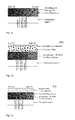
- the optical probe is preferably devised such that the luminescent solid state material and the indicator dye are contained in layers on a solid carrier.
- the luminescent solid state material and the indicator dye are contained in one common layer on the solid carrier.
- the optical probe is advantageously devised such that the luminescent solid state material and the indicator dye are contained in separate layers on the solid carrier.
- the optical probe is preferably further developed such that the optical probe further has at least one additional layer containing a pigment, in particular TiO 2 particles.
- the TiO 2 particles in the additional layer reflect incoming light and therefore increase the optical path length in the optical probe thus increasing sensitivity.
- the inventive method for quantitatively determining an analyte comprises the steps of exposing an optical probe to an analyte, the optical probe containing a luminescent solid state material having an excitation spectrum and an emission spectrum, the optical probe further containing an indicator dye having different, analyte-dependent chemical forms and corresponding analyte-dependent absorption spectra wherein the absorption spectrum of at least one form of the indicator dye overlaps with the emission spectrum of the luminescent solid state material, the emission spectrum of the luminescent solid state material being broader than the overlapping absorption spectrum of the indicator dye, exciting the optical probe with light at a single wavelength within the excitation spectrum of the luminescent solid state material measuring emission of light at different wavelengths within the emission spectrum of the luminescent solid state material, calculating a ratio of quenching of emission of light at said different wavelengths and comparing the ratio of quenching with a prerecorded calibration curve, wherein the excitation and the measuring of the corresponding emission are carried out subsequently with a delay-time within
- the inventive concept of the present concept is, however, also realised by a method for quantitatively determining an analyte comprising the steps of exposing an optical probe to an analyte, the optical probe containing a luminescent solid state material having an excitation spectrum and an emission spectrum and further containing an indicator dye having different, analyte-dependent chemical forms and corresponding analyte-dependent absorption spectra wherein the absorption spectrum of at least one form of the indicator dye overlaps with the excitation spectrum of the luminescent solid state material, the excitation spectrum of the luminescent solid state material being broader than the overlapping absorption spectrum of the indicator dye, exciting the optical probe with light of different wavelengths within the excitation spectrum of the luminescent solid state material measuring emission of light at a single wavelength within the emission spectrum of the luminescent solid state material, calculating the ratio of quenching of the excitation by measuring emission at said single wavelength within the emission spectrum of the luminescent solid state material and comparing the ratio of quenching with a prerecorded
- the inventive idea is to be seen in creating a probing spectrum of the luminescent solid state material by overlapping a relatively large excitation spectrum or emission spectrum of a luminescent solid state material with a comparatively narrower absorption spectrum of an indicator dye and either measuring the emission from the emission spectrum of the luminescent solid state material upon excitation or exciting the so created probing spectrum with light of different wavelengths and measuring the resulting emission.
- the excitation with light of a single wavelength will lead to emission of light at a greater wavelength, the emission being differently quenched at different wavelengths by the indicator dye depending on the concentration of the analyte.
- the indicator dye will absorb part of the excitation light and accordingly reduce the emission of the luminescent solid state material at a greater wavelength.
- the indicator dye absorbs light in the excitation spectrum differently at different wavelengths, depending on the concentration of the analyte, the intensity of emission of light, i.e. luminescence will be different upon excitation at said different wavelengths.
- the excitation and the measuring of the corresponding emission are carried out subsequently with a delay-time within the range of the luminescence decay-time of an excited state of the luminescent solid state material. This is necessary for determining an analyte without potential influences from a fluorescent specimen.
- the ratio of quenching that is calculated in both embodiments either from directly measured, quenched emission of light or from measuring emitted light where the energy transfer during excitation has been quenched allows for a precise quantitative determination of an analyte, i.e. its concentration in a medium, without having to take into account any external influences
- the invention is preferably carried out in such a way that the excitation or the measurement of emission at different wavelengths is carried out at maxima of the spectrum of the luminescent solid state material that is overlapped by the indicator dye. Pronounced changes in the ratios of quenching provide for a high sensitivity for measuring the concentration of the analyte to be determined.
- a preferred way to carry out the invention is realised in that the wavelength of excitation is 590 nm and the wavelengths of measuring emission of light are 733 nm and 690 nm when the luminescent solid state material is Cr(III)-doped gadolinium aluminium borate and the indicator dye is azaborodipyrromethene.
- This method can further be improved when the excitation and the measuring of the emission of light are carried out with a delay-time between 1 ⁇ s and 4000 ⁇ s, preferably with a delay-time between 10 ⁇ s and 2000 ⁇ s, more preferably with a delay-time between 30 ⁇ s and 1000 ⁇ s and most preferably with a delay-time between 50 ⁇ s and 300 ⁇ s.
- Another preferred embodiment of the present invention provides for the wavelengths of excitation being 667 nm and 596 nm and the wavelength of measuring emission of light being 910 nm when the luminescent solid state material is calcium-copper silicate (Egyptian Blue) and the indicator dye is m-Cresol purple.
- This method can further be improved when the excitation and the measuring of the emission of light preferably are carried out with a delay-time between 5 ⁇ s and 40 ⁇ s, preferably between 10 ⁇ s and 30 ⁇ s, more preferably with a delay-time of 20 ⁇ s.
- Optical probe for sensing pH based on 2-wavelength time-resolved measurement of the luminescence emission.
- hydrogel D4 100 mg of hydrogel D4, 1 mg of the pH indicator dye BF 2 chelate of [5-(3-chloro-4-hydroxyphenyl)-3-phenyl-1 H-pyrrol-2-yl]-[5-phenyl-3-phenylpyrrol-2-ylidene]amine ("azaBODIPY”), and 100 mg of Cr(III)-doped gadolinium aluminium borate (Cr-GAB) microcrystals were dissolved/dispersed in 900 mg of EtOH:H 2 O mixture (9:1 v/v). The mixture was knife-coated on a polyethylene terephthalate support to give about 8 ⁇ m-thick sensing layer after solvent evaporation. The sensor configuration is shown in Fig.1a .
- the emission spectra were measured on a Fluorolog 3 Horiba fluorescence spectrometer, with a wavelength of excitation at 590 nm corresponding to the maximum of the excitation spectrum of the Cr-GAB material.
- the emission was acquired in two modes: a steady-state mode and time-resolved measurement mode using a pulsed Xe-lamp (delay after pulse of 20 ⁇ s) to eliminate the background fluorescence.
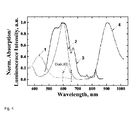
- Fig. 2 The absorption (excitation) and the emission spectra of the components are shown in Fig. 2 ( 1 and 2 - excitation and emission spectra of the Cr-GAB microcrystalline powder; 3 and 4 - absorption spectra of the pH indicator in the protonated and deprotonated forms, respectively; 5 - the emission spectrum of the protonated form of the pH indicator).
- the broad NIR emission from the Cr-GAB is observed upon excitation with orange light (590 nm).
- the emission spectrum of Cr-GAB overlaps with the absorption spectra of both the protonated and the deprotonated form of the pH indicator thus forming a probing spectrum.
- the protonated form of the pH indicator is also excitable at 590 nm and is highly fluorescent.
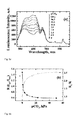
- the fluorescence spectrum overlaps with the emission spectrum of Cr-GAB which results in undesired background. This is revealed by Fig. 3a which shows the steady-state emission spectra of the sensing material when excited at 590 nm.
- the emission of the optical probe is dominated by the fluorescence of the pH indicator which decreases upon deprotonation of the indicator dye due to quenching via photoinduced electron transfer.
- the maximum of the emission spectrum at 733 nm is strongly quenched by the absorption spectrum of the indicator dye, whereas the maximum at 690 nm remains more or less unchanged.
- a calibration curve which is obtained by plotting the ratio of the luminescence intensities obtained at 733 and 690 nm vs. pH.
- the calibration curve in this example is a typical sigmoidal curve ( Fig. 3c )
- the probe ( Fig. 1b ) was prepared according to the following procedure. 100 ⁇ L of tetraoctylammonium hydroxide (TOAOH) were added to 2 mg of m-Cresol Purple and the resulting solution was saturated with carbon dioxide. In another vial 0.2 g of ethyl cellulose (ethoxyl content 49%) were dissolved in a mixture of 1.52 g of ethanol and 2.28 g of toluene. The content of both vials was combined and the obtained mixture was knife-coated on a polyethylene terephthalate support and was allowed to dry for 1h at room temperature. The thickness of this CO 2 -sensitive layer after solvent evaporation was estimated to be about 3.5 ⁇ m.
- TOAOH tetraoctylammonium hydroxide
- a mixture of silicone primers was obtained by mixing 800 mg of the vinyl-terminated polydimethylsiloxane (1000 cSt viscosity), 32 ⁇ l of methylhydrosiloxane-dimethylsiloxane copolymer, 2 ⁇ l of tetravinyltetramethyl cyclotetrasiloxane and 800 mg of hexane. 400 mg micro-powder of Egyptian Blue were dispersed in the mixture. Finally, 4 ⁇ l of the platinum complex catalyst were added and the composition was knife-coated onto the CO2-sensitive layer (75 ⁇ m spacer) and was allowed to cross-link at 60 °C for 20 min.
- Fig. 4 Spectral properties of the components are shown in Fig. 4 .
- the excitation spectrum partly overlaps with the absorption spectra of triphenylmethene dyes in the deprotonated form which is the basis of ratiometric interrogation of the optical probe via excitation.
- the pH indicator m-Cresol purple was dissolved in ethylcellulose along with a lipophilic base (tetraoctylammonium hydroxide).
- the long luminescence decay time (210 ⁇ s) allows elimination of background fluorescence in time-resolved measurements as already described.
- the excitation and the measuring of the corresponding emission were, hence, carried out subsequently with a delay-time within the range of the luminescence decay-time of an excited state of the luminescent solid state material. This allows for determining an analyte without potential influences from a fluorescent specimen.
- Figure 5a shows the excitation spectra of the CO 2 -sensing material.
- pCO 2 the signal with decreasing CO 2 -partial pressure
- excitation from 650 to 700 nm is almost independent from pCO 2 .
- the ratio of quenching of luminescence at 667 and 596 nm (R, Fig. 5b ) is used as an analytical parameter.
- the plot of the ratio at 0 kPa CO 2 and a pCO 2 is very similar to an intensity plot (I 0 /I) of a typical carbon dioxide sensor ( Fig. 5b )
- CO 2 -sensing optical probe based on 2-wavelength time-resolved measurement of the luminescence excitation.
- the optical probe ( Fig. 1c ) was prepared according to the following procedure. 100 ⁇ L of tetraoctylammonium hydroxide were added to 2 mg of m-Cresol Purple and the resulting solution was saturated with carbon dioxide. In the second vial 0.2 g of ethyl cellulose (ethoxyl content 49%) and 0.2 g of Si(CH 3 ) 3 -modified Egyptian Blue were dissolved/dispersed in a mixture of 1.52 g of ethanol and 2.28 g of toluene.
- the mixture of silicone primers was obtained by mixing 800 mg of the vinyl-terminated polydimethylsiloxane (1000 cSt viscosity), 32 ⁇ l of methylhydrosiloxane-dimethylsiloxane copolymer, 2 ⁇ l of tetravinyltetramethyl cyclotetrasiloxane and 800 mg of hexane. 0.25g of lipophilic titanium dioxide nanoparticles were dispersed in the mixture. Finally, 4 ⁇ l of the platinum complex catalyst were added and the composition was knife-coated onto the CO 2 -sensitive layer (75 ⁇ m spacer) and was allowed to cross-link at 60 °C for 20 min.
- Fig. 6a shows the excitation spectra of the CO 2 -sensing material and Fig. 6b the respective calibration plots.
- the spectral changes and the calibration plots are similar to those obtained in the example 2, but the relative changes in the luminescence intensity, i.e. the changes in the ratio of quenching, for the region 550-650 nm are more significant.
- CO 2 -sensing optical probe based on 2-wavelength time-resolved measurement of the luminescence excitation using a dually-emitting LED as an excitation source.
- the sensor was prepared as described in the example 2. Excitation was performed with a dually-emitting LED: orange ( ⁇ max 594 nm) and red ( ⁇ max 653 nm). The LED light was sinusoidally modulated at a frequency of 916 Hz to eliminate the daylight component. The emission was detected with a photodiode after passing a long-pass RG-9 filter.
- Fig. 7 demonstrates feasibility of the approach using a dually-emitting LED as an excitation source. The calibration plots are similar to those obtained from the measurements of the excitation spectra ( Fig. 5b ). The approach demonstrates that realisation of compact sensor set-up for time-resolved ratiometric measurements is possible.
Landscapes
- Health & Medical Sciences (AREA)
- Immunology (AREA)
- Life Sciences & Earth Sciences (AREA)
- Chemical & Material Sciences (AREA)
- Physics & Mathematics (AREA)
- General Physics & Mathematics (AREA)
- Pathology (AREA)
- Molecular Biology (AREA)
- Biochemistry (AREA)
- General Health & Medical Sciences (AREA)
- Engineering & Computer Science (AREA)
- Analytical Chemistry (AREA)
- Nuclear Medicine, Radiotherapy & Molecular Imaging (AREA)
- Hematology (AREA)
- Urology & Nephrology (AREA)
- Biomedical Technology (AREA)
- Cell Biology (AREA)
- Medicinal Chemistry (AREA)
- Food Science & Technology (AREA)
- Microbiology (AREA)
- Biotechnology (AREA)
- Chemical Kinetics & Catalysis (AREA)
- Optics & Photonics (AREA)
- Investigating, Analyzing Materials By Fluorescence Or Luminescence (AREA)
Priority Applications (1)
| Application Number | Priority Date | Filing Date | Title |
|---|---|---|---|
| EP12191447.7A EP2728343A1 (fr) | 2012-11-06 | 2012-11-06 | Sonde optique pour la détermination quantitative d'un analyte |
Applications Claiming Priority (1)
| Application Number | Priority Date | Filing Date | Title |
|---|---|---|---|
| EP12191447.7A EP2728343A1 (fr) | 2012-11-06 | 2012-11-06 | Sonde optique pour la détermination quantitative d'un analyte |
Publications (1)
| Publication Number | Publication Date |
|---|---|
| EP2728343A1 true EP2728343A1 (fr) | 2014-05-07 |
Family
ID=47469746
Family Applications (1)
| Application Number | Title | Priority Date | Filing Date |
|---|---|---|---|
| EP12191447.7A Withdrawn EP2728343A1 (fr) | 2012-11-06 | 2012-11-06 | Sonde optique pour la détermination quantitative d'un analyte |
Country Status (1)
| Country | Link |
|---|---|
| EP (1) | EP2728343A1 (fr) |
Cited By (3)
| Publication number | Priority date | Publication date | Assignee | Title |
|---|---|---|---|---|
| US20210055229A1 (en) * | 2019-08-21 | 2021-02-25 | Endress+Hauser Conducta Gmbh+Co. Kg | Optochemical sensor, sensor cap, use of the optochemical sensor, and method for producing an analyte-sensitive layer of an optochemical sensor |
| CN115078317A (zh) * | 2017-12-28 | 2022-09-20 | 伊鲁米那股份有限公司 | 具有降低的荧光范围噪声的检测器 |
| CN116242812A (zh) * | 2023-03-10 | 2023-06-09 | 复旦大学 | 一种非接触式磷光离子传感材料及其制备和应用方法 |
Citations (5)
| Publication number | Priority date | Publication date | Assignee | Title |
|---|---|---|---|---|
| WO1992012424A1 (fr) * | 1991-01-04 | 1992-07-23 | Iowa State University Research Foundation, Inc. | Sonde optique et procede permettant de surveiller la concentration d'un analyte |
| US5942189A (en) * | 1996-10-16 | 1999-08-24 | Avl Medical Instruments Ag | Luminescence-optical method and sensor layer for quantitative determination of at least one chemical component of a gaseous or liquid sample |
| US20030108911A1 (en) * | 2001-08-01 | 2003-06-12 | Chromeon Gmbh | Arrangement and method for multiple-fluorescence measurement |
| US20040166024A1 (en) * | 2000-12-29 | 2004-08-26 | Ingo Klimant | Sensor for luminescense-optical determination of an analyte |
| AT506177A1 (de) * | 2008-03-26 | 2009-06-15 | Univ Graz Tech | Optischer sensor |
-
2012
- 2012-11-06 EP EP12191447.7A patent/EP2728343A1/fr not_active Withdrawn
Patent Citations (5)
| Publication number | Priority date | Publication date | Assignee | Title |
|---|---|---|---|---|
| WO1992012424A1 (fr) * | 1991-01-04 | 1992-07-23 | Iowa State University Research Foundation, Inc. | Sonde optique et procede permettant de surveiller la concentration d'un analyte |
| US5942189A (en) * | 1996-10-16 | 1999-08-24 | Avl Medical Instruments Ag | Luminescence-optical method and sensor layer for quantitative determination of at least one chemical component of a gaseous or liquid sample |
| US20040166024A1 (en) * | 2000-12-29 | 2004-08-26 | Ingo Klimant | Sensor for luminescense-optical determination of an analyte |
| US20030108911A1 (en) * | 2001-08-01 | 2003-06-12 | Chromeon Gmbh | Arrangement and method for multiple-fluorescence measurement |
| AT506177A1 (de) * | 2008-03-26 | 2009-06-15 | Univ Graz Tech | Optischer sensor |
Non-Patent Citations (2)
| Title |
|---|
| ANNA S VASYLEVSKA ET AL: "Novel coumarin-based fluorescent pH indicators, probes and membranes covering a broad pH range", ANALYTICAL AND BIOANALYTICAL CHEMISTRY, SPRINGER, BERLIN, DE, vol. 387, no. 6, 24 January 2007 (2007-01-24), pages 2131 - 2141, XP019488688, ISSN: 1618-2650, DOI: 10.1007/S00216-006-1061-6 * |
| MATTHIEU STARCK ET AL: "Towards Libraries of Luminescent Lanthanide Complexes and Labels from Generic Synthons", CHEMISTRY - A EUROPEAN JOURNAL, vol. 17, no. 33, 8 August 2011 (2011-08-08), pages 9164 - 9179, XP055024807, ISSN: 0947-6539, DOI: 10.1002/chem.201100390 * |
Cited By (4)
| Publication number | Priority date | Publication date | Assignee | Title |
|---|---|---|---|---|
| CN115078317A (zh) * | 2017-12-28 | 2022-09-20 | 伊鲁米那股份有限公司 | 具有降低的荧光范围噪声的检测器 |
| US20210055229A1 (en) * | 2019-08-21 | 2021-02-25 | Endress+Hauser Conducta Gmbh+Co. Kg | Optochemical sensor, sensor cap, use of the optochemical sensor, and method for producing an analyte-sensitive layer of an optochemical sensor |
| CN112414980A (zh) * | 2019-08-21 | 2021-02-26 | 恩德莱斯和豪瑟尔分析仪表两合公司 | 光化学传感器、传感器盖、光化学传感器的用途及制造光化学传感器的分析物敏感层的方法 |
| CN116242812A (zh) * | 2023-03-10 | 2023-06-09 | 复旦大学 | 一种非接触式磷光离子传感材料及其制备和应用方法 |
Similar Documents
| Publication | Publication Date | Title |
|---|---|---|
| Borisov et al. | Composite luminescent material for dual sensing of oxygen and temperature | |
| Wang et al. | Optical oxygen sensors move towards colorimetric determination | |
| Baleizao et al. | Dual fluorescence sensor for trace oxygen and temperature with unmatched range and sensitivity | |
| Wang et al. | Optical methods for sensing and imaging oxygen: materials, spectroscopies and applications | |
| Stich et al. | Multiple fluorescent chemical sensing and imaging | |
| Schäferling | The art of fluorescence imaging with chemical sensors | |
| Pfeifer et al. | Green to red emitting BODIPY dyes for fluorescent sensing and imaging of carbon dioxide | |
| Liao et al. | Optical chemosensors for the gas phase detection of aldehydes: mechanism, material design, and application | |
| Borisov et al. | A novel planar optical sensor for simultaneous monitoring of oxygen, carbon dioxide, pH and temperature | |
| Lochman et al. | Red-emitting CO2 sensors with tunable dynamic range based on pH-sensitive azaphthalocyanine indicators | |
| Fischer et al. | Red‐and green‐emitting iridium (III) complexes for a dual barometric and temperature‐sensitive paint | |
| JP4272347B2 (ja) | 蛍光強度のシグナルを基準化するための方法および装置 | |
| Klimant et al. | Dual lifetime referencing (DLR)—a new scheme for converting fluorescence intensity into a frequency-domain or time-domain information | |
| Schröder et al. | pH fluorosensors for use in marine systems | |
| Mayr et al. | Dual lifetime referenced optical sensor membrane for the determination of copper (II) ions | |
| Papkovsky et al. | Quenched-phosphorescence detection of molecular oxygen: applications in life sciences | |
| CA2318948A1 (fr) | Capteurs optiques comportant des materiaux reflechissants et procedes de fabrication de ces capteurs | |
| Chu | Optical fiber oxygen sensor based on Pd (II) complex embedded in sol–gel matrix | |
| Ehgartner et al. | Low cost referenced luminescent imaging of oxygen and pH with a 2-CCD colour near infrared camera | |
| EP1346220B1 (fr) | Capteur destine a la determination optique de luminescence d'un analyte | |
| Georges et al. | Study of europium-sensitized fluorescence of tetracycline in a micellar solution of Triton X-100 by fluorescence and thermal lens spectrometry | |
| Borisov et al. | A versatile approach for ratiometric time-resolved read-out of colorimetric chemosensors using broadband phosphors as secondary emitters | |
| Huber et al. | Energy transfer-based lifetime sensing of chloride using a luminescent transition metal complex | |
| Lee et al. | Photoluminescent oxygen sensing on a specific surface area using phosphorescence quenching of Pt-porphyrin | |
| US20150011010A1 (en) | Optode for determining chemical parameters |
Legal Events
| Date | Code | Title | Description |
|---|---|---|---|
| PUAI | Public reference made under article 153(3) epc to a published international application that has entered the european phase |
Free format text: ORIGINAL CODE: 0009012 |
|
| 17P | Request for examination filed |
Effective date: 20121106 |
|
| AK | Designated contracting states |
Kind code of ref document: A1 Designated state(s): AL AT BE BG CH CY CZ DE DK EE ES FI FR GB GR HR HU IE IS IT LI LT LU LV MC MK MT NL NO PL PT RO RS SE SI SK SM TR |
|
| AX | Request for extension of the european patent |
Extension state: BA ME |
|
| STAA | Information on the status of an ep patent application or granted ep patent |
Free format text: STATUS: THE APPLICATION IS DEEMED TO BE WITHDRAWN |
|
| 18D | Application deemed to be withdrawn |
Effective date: 20141108 |