EP2728771A2 - Verfahren zur durchführung eines direktzugriffsverfahrens und drahtlose vorrichtung zu seiner anwendung - Google Patents
Verfahren zur durchführung eines direktzugriffsverfahrens und drahtlose vorrichtung zu seiner anwendung Download PDFInfo
- Publication number
- EP2728771A2 EP2728771A2 EP12824218.7A EP12824218A EP2728771A2 EP 2728771 A2 EP2728771 A2 EP 2728771A2 EP 12824218 A EP12824218 A EP 12824218A EP 2728771 A2 EP2728771 A2 EP 2728771A2
- Authority
- EP
- European Patent Office
- Prior art keywords
- random access
- access procedure
- pdcch
- wireless device
- triggered
- Prior art date
- Legal status (The legal status is an assumption and is not a legal conclusion. Google has not performed a legal analysis and makes no representation as to the accuracy of the status listed.)
- Withdrawn
Links
Images




Classifications
-
- H—ELECTRICITY
- H04—ELECTRIC COMMUNICATION TECHNIQUE
- H04B—TRANSMISSION
- H04B7/00—Radio transmission systems, i.e. using radiation field
- H04B7/24—Radio transmission systems, i.e. using radiation field for communication between two or more posts
- H04B7/26—Radio transmission systems, i.e. using radiation field for communication between two or more posts at least one of which is mobile
- H04B7/2612—Arrangements for wireless medium access control, e.g. by allocating physical layer transmission capacity
-
- H—ELECTRICITY
- H04—ELECTRIC COMMUNICATION TECHNIQUE
- H04W—WIRELESS COMMUNICATION NETWORKS
- H04W74/00—Wireless channel access
- H04W74/02—Hybrid access
-
- H—ELECTRICITY
- H04—ELECTRIC COMMUNICATION TECHNIQUE
- H04L—TRANSMISSION OF DIGITAL INFORMATION, e.g. TELEGRAPHIC COMMUNICATION
- H04L5/00—Arrangements affording multiple use of the transmission path
- H04L5/003—Arrangements for allocating sub-channels of the transmission path
- H04L5/0053—Allocation of signalling, i.e. of overhead other than pilot signals
-
- H—ELECTRICITY
- H04—ELECTRIC COMMUNICATION TECHNIQUE
- H04W—WIRELESS COMMUNICATION NETWORKS
- H04W74/00—Wireless channel access
- H04W74/08—Non-scheduled access, e.g. ALOHA
- H04W74/0833—Random access procedures, e.g. with 4-step access
-
- H—ELECTRICITY
- H04—ELECTRIC COMMUNICATION TECHNIQUE
- H04W—WIRELESS COMMUNICATION NETWORKS
- H04W74/00—Wireless channel access
- H04W74/08—Non-scheduled access, e.g. ALOHA
- H04W74/0833—Random access procedures, e.g. with 4-step access
- H04W74/0838—Random access procedures, e.g. with 4-step access using contention-free random access [CFRA]
Definitions
- the present invention relates to wireless communication, and more particularly, to a method of performing a random access procedure in a wireless communication system, and a wireless device using the method.
- LTE Long term evolution
- 3GPP 3 rd generation partnership project
- TS technical specification
- LTE-A LTE-advanced
- One carrier corresponds to one cell, and as a result, a user equipment can receive a service from a plurality of serving cells in a multiple-carrier system.
- a random access procedure is used to maintain an uplink time alignment between a base station and a user equipment or to deliver a scheduling request.
- the random access procedure includes transmission of a random access preamble and reception of a random access response.
- the present invention provides a method of performing a random access when a plurality of random access procedures are triggered simultaneously, and a wireless device using the method.
- a method of performing a random access procedure in a wireless communication system may comprise: selecting one of a first random access procedure and a second random access procedure if the first random access procedure and the second random access procedure are triggered in a single subframe; and transmitting to a base station a random access preamble for the selected random access procedure in the single subframe.
- the first random access procedure may be triggered by an order of the base station, and the second random access procedure may be triggered by a medium access control (MAC) layer.
- MAC medium access control
- the first random access procedure and the second random access procedure may be triggered in different serving cells
- a wireless device for performing a random access procedure in a wireless communication system.
- the wireless device may comprise: a radio frequency (RF) unit for transmitting and receiving a radio signal; and a processor operatively coupled to the RF unit, wherein the processor is configured to: select one of a first random access procedure and a second random access procedure if the first random access procedure and the second random access procedure are triggered in a single subframe; and transmit to a base station a random access preamble for the selected random access procedure in the single subframe.
- RF radio frequency
- a method of selectively performing a random access procedure is proposed when a plurality of random access procedures are triggered.
- a wireless device may be fixed or mobile, and may be referred to as another terminology, such as a user equipment (UE), a mobile station (MS), a mobile terminal (MT), a user terminal (UT), a subscriber station (SS), a wireless device, a personal digital assistant (PDA), a wireless modem, a handheld device, etc.
- the wireless device may also be a device supporting only data communication such as a machine-type communication (MTC) device.
- MTC machine-type communication
- a base station is generally a fixed station that communicates with the wireless device, and may be referred to as another terminology, such as an evolved-NodeB (eNB), a base transceiver system (BTS), an access point, etc.
- eNB evolved-NodeB
- BTS base transceiver system
- access point etc.
- 3GPP 3 rd generation partnership project
- LTE long term evolution
- TS technical specification
- LTE-A 3GPP LTE-advanced
- FIG. 1 shows a structure of a downlink radio frame in 3GPP LTE-A.
- the section 6 of 3GPP TS 36.211 V10.2.0 (2011-06) "Evolved Universal Terrestrial Radio Access (E-UTRA); Physical Channels and Modulation (Release 10)” may be incorporated herein by reference.
- a radio frame includes 10 subframes indexed with 0 to 9.
- One subframe includes 2 consecutive slots.
- a time required for transmitting one subframe is defined as a transmission time interval (TTI).
- TTI transmission time interval
- one subframe may have a length of 1 millisecond (ms), and one slot may have a length of 0.5 ms.
- One slot may include a plurality of orthogonal frequency division multiplexing (OFDM) symbols in a time domain.
- OFDM orthogonal frequency division multiplexing
- the OFDM symbol is only for expressing one symbol period in the time domain, and there is no limitation in a multiple access scheme or terminologies.
- the OFDM symbol may also be referred to as another terminology such as a single carrier frequency division multiple access (SC-FDMA) symbol, a symbol period, etc.
- SC-FDMA single carrier frequency division multiple access
- one slot includes 7 OFDM symbols for example, the number of OFDM symbols included in one slot may vary depending on a length of a cyclic prefix (CP).
- CP cyclic prefix
- a resource block is a resource allocation unit, and includes a plurality of subcarriers in one slot. For example, if one slot includes 7 OFDM symbols in a time domain and the RB includes 12 subcarriers in a frequency domain, one RB can include 7 ⁇ 12 resource elements (REs).
- REs resource elements
- a DL subframe is divided into a control region and a data region in the time domain.
- the control region includes up to first four OFDM symbols of a first slot in the subframe. However, the number of OFDM symbols included in the control region may vary.
- a physical downlink control channel (PDCCH) and other control channels are allocated to the control region, and a physical downlink shared channel (PDSCH) is allocated to the data region.
- PDCCH physical downlink control channel
- PDSCH physical downlink shared channel
- a UL subframe may be divided into a control region and a data region.
- the control region is a region to which a physical uplink control channel (PUCCH) carrying UL control information is allocated.
- the data region is a region to which a physical uplink shared channel (PUSCH) carrying user data is allocated.
- PUCCH physical uplink control channel
- PUSCH physical uplink shared channel
- examples of a physical control channel in 3GPP LTE/LTE-A include a physical downlink control channel (PDCCH), a physical control format indicator channel (PCFICH), and a physical hybrid-ARQ indicator channel (PHICH).
- a control signal transmitted in a physical layer may be a primary synchronization signal (PSS), a secondary synchronization signal (SSS), and a random access preamble.
- the PSS is transmitted in last OFDM symbols of a 1 st slot (or a 1 st subframe (i.e., a subframe with an index 0) and an 11 th slot (or a 6 th subframe (i.e., a subframe with an index 5).
- the PSS is used to attain OFDM symbol synchronization or slot synchronization, and is in association with a physical cell identify (ID).
- a primary synchronization code (PSC) is a sequence used for the PSS.
- the SSS includes a 1 st SSS and a 2 nd SSS.
- the 1 st SSS and the 2 nd SSS are transmitted in an OFDM symbol adjacent to an OFDM symbol in which the PSS is transmitted.
- the SSS is used to attain frame synchronization.
- the SSS is used to attain a cell ID together with the PSS.
- the 1 st SSS and the 2 nd SSS use different secondary synchronization codes (SSCs). If the 1 st SSS and the 2 nd SSS each include 31 subcarriers, sequences of two SSCs with a length of 31 are respectively used for the 1 st SSS and the 2 nd SSS.
- the PCFICH transmitted in a first OFDM symbol of the subframe carries a control format indicator (CFI) regarding the number of OFDM symbols (i.e., a size of the control region) used for transmission of control channels in the subframe.
- CFI control format indicator
- a wireless device first receives the CFI on the PCFICH, and thereafter monitors the PDCCH.
- the PCFICH does not use blind decoding, and is transmitted by using a fixed PCFICH resource of the subframe.
- the PHICH carries a positive-acknowledgement (ACK)/negative-acknowledgement (NACK) signal for an uplink hybrid automatic repeat request (HARQ).
- ACK positive-acknowledgement
- NACK negative-acknowledgement
- HARQ uplink hybrid automatic repeat request
- the ACK/NACK signal for uplink (UL) data on a PUSCH transmitted by the wireless device is transmitted on the PHICH.
- a physical broadcast channel is transmitted in first four OFDM symbols in a second slot of a first subframe of a radio frame.
- the PBCH carries system information necessary for communication between the wireless device and a BS.
- the system information transmitted through the PBCH is referred to as a master information block (MIB).
- MIB master information block
- SIB system information transmitted on the PDCCH
- the DCI may include resource allocation of the PDSCH (this is referred to as a downlink (DL) grant), resource allocation of a PUSCH (this is referred to as an uplink (UL) grant), a set of transmit power control commands for individual UEs in any UE group, and/or activation of a voice over Internet protocol (VoIP).
- DL downlink
- UL uplink
- VoIP voice over Internet protocol
- the 3GPP LTE/LTE-A uses blind decoding for PDCCH detection.
- the blind decoding is a scheme in which a desired identifier is de-masked from a cyclic redundancy check (CRC) of a received PDCCH (referred to as a candidate PDCCH) to determine whether the PDCCH is its own control channel by performing CRC error checking.
- CRC cyclic redundancy check
- the BS determines a PDCCH format according to DCI to be transmitted to the UE, attaches a CRC to the DCI, and masks a unique identifier (referred to as a radio network temporary identifier (RNTI)) to the CRC according to an owner or usage of the PDCCH.
- RNTI radio network temporary identifier
- a control region in a subframe includes a plurality of control channel elements (CCEs).
- the CCE is a logical allocation unit used to provide the PDCCH with a coding rate depending on a radio channel state, and corresponds to a plurality of resource element groups (REGs).
- the REG includes a plurality of resource elements. According to an association relation of the number of CCEs and the coding rate provided by the CCEs, a PDCCH format and the number of bits of an available PDCCH are determined.
- One REG includes 4 REs.
- One CCE includes 9 REGs.
- the number of CCEs used to configure one PDCCH may be selected from a set ⁇ 1, 2, 4, 8 ⁇ . Each element of the set ⁇ 1, 2, 4, 8 ⁇ is referred to as a CCE aggregation level.
- the BS determines the number of CCEs used in transmission of the PDCCH according to a channel state. For example, a wireless device having a good DL channel state may use one CCE in PDCCH transmission. A wireless device having a poor DL channel state may use 8 CCEs in PDCCH transmission.
- a control channel consisting of one or more CCEs performs interleaving on an REG basis, and is mapped to a physical resource after performing cyclic shift based on a cell identifier (ID).
- ID cell identifier
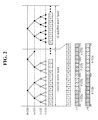
- FIG. 2 shows an example of monitoring a PDCCH.
- the section 9 of 3GPP TS 36.213 V10.2.0 (2011-06) may be incorporated herein by reference.
- the 3GPP LTE uses blind decoding for PDCCH detection.
- the blind decoding is a scheme in which a desired identifier is de-masked from a CRC of a received PDCCH (referred to as a PDCCH candidate) to determine whether the PDCCH is its own control channel by performing CRC error checking.
- a wireless device cannot know about a specific position in a control region in which its PDCCH is transmitted and about a specific CCE aggregation or DCI format used for PDCCH transmission.
- a plurality of PDCCHs may be transmitted in one subframe.
- the wireless device monitors the plurality of PDCCHs in every subframe. Monitoring is an operation of attempting PDCCH decoding by the wireless device according to a format of the monitored PDCCH.
- the 3GPP LTE uses a search space to reduce a load of blind decoding.
- the search space may also be called a monitoring set of a CCE for the PDCCH.
- the wireless device monitors the PDCCH in the search space.
- the search space is classified into a common search space and a UE-specific search space.
- the common search space is a space for searching for a PDCCH having common control information and consists of 16 CCEs indexed with 0 to 15.
- the common search space supports a PDCCH having a CCE aggregation level of ⁇ 4, 8 ⁇ .
- a PDCCH e.g., DCI formats 0, 1A
- the UE-specific search space supports a PDCCH having a CCE aggregation level of ⁇ 1, 2, 4, 8 ⁇ .
- Table 1 shows the number of PDCCH candidates monitored by the wireless device.
- Search Space Type Aggregation level L Size [In CCEs] Number of PDCCH candidates DCI formats UE-specific 1 6 6 0, 1, 1A, 1B, 1D, 2, 2A 2 12 6 4 8 2 8 16 2 Common 4 16 4 0, 1A, 1C, 3/3A 8 16 2
- a size of the search space is determined by Table 1 above, and a start point of the search space is defined differently in the common search space and the UE-specific search space.
- a start point of the common search space is fixed irrespective of a subframe, a start point of the UE-specific search space may vary in every subframe according to a UE identifier (e.g., C-RNTI), a CCE aggregation level, and/or a slot number in a radio frame. If the start point of the UE-specific search space exists in the common search space, the UE-specific search space and the common search space may overlap with each other.
- a search space S (L) k is defined as a set of PDCCH candidates.
- a CCE corresponding to a PDCCH candidate m of the search space S (L) k is given by Equation 1 below. L ⁇ Y k + m ⁇ mod ⁇ N CCE , k / L ⁇ + i
- N CCE,k denotes the total number of CCEs that can be used for PDCCH transmission in a control region of a subframe k.
- the control region includes a set of CCEs numbered from 0 to N CCE,k -1.
- M (L) denotes the number of PDCCH candidates in a CCE aggregation level L of a given search space.
- a variable Y k is defined by Equation 2 below.
- Y k A ⁇ Y k - 1 mod D
- transmission of a DL transport block is performed in a pair of the PDCCH and the PDSCH.
- Transmission of a UL transport block is performed in a pair of the PDCCH and the PUSCH.
- the wireless device receives the DL transport block on a PDSCH indicated by the PDCCH.
- the wireless device receives a DL resource assignment on the PDCCH by monitoring the PDCCH in a DL subframe.
- the wireless device receives the DL transport block on a PDSCH indicated by the DL resource assignment.
- a 3GPP LTE system supports a case in which a DL bandwidth and a UL bandwidth are differently configured under the premise that one component carrier (CC) is used.
- the 3GPP LTE system supports up to 20 MHz, and the UL bandwidth and the DL bandwidth may be different from each other. However, only one CC is supported in each ofUL and DL cases.
- Spectrum aggregation (also referred to as bandwidth aggregation or carrier aggregation) supports a plurality of CCs. For example, if 5 CCs are assigned as a granularity of a carrier unit having a bandwidth of 20MHz, a bandwidth of up to 100MHz can be supported.
- One DL CC or a pair of a UL CC and a DL CC may be mapped to one cell. Therefore, when a wireless device communicates with a BS through a plurality of DL CCs, it can be said that the wireless device receives a service from a plurality of serving cells.
- FIG. 3 shows an example of multiple carriers.
- a PDCCH and a PDSCH are independently transmitted in each DL CC.
- a PUCCH and a PUSCH are independently transmitted in each UL CC. Since three DL CC-UL CC pairs are defined, it can be said that the wireless device receives a service from three serving cells.
- the wireless device may monitor the PDCCH in a plurality of DL CCs, and may receive a DL transport block simultaneously via the plurality of DL CCs.
- the wireless device may transmit a plurality of UL transport blocks simultaneously via a plurality of UL CCs.
- a pair of a DL CC #1 and a UL CC #1 is a 1 st serving cell
- a pair of a DL CC #2 and a UL CC #2 is a 2 nd serving cell
- a DL CC #3 is a 3 rd serving cell.
- Each serving cell may be identified by using a cell index (CI).
- the CI may be cell-specific or UE-specific.
- the serving cell may be classified into a primary cell and a secondary cell.
- the primary cell operates at a primary frequency, and is a cell designated as the primary cell when the wireless device performs an initial network entry process or starts a network reentry process or performs a handover process.
- the primary cell is also called a reference cell.
- the secondary cell operates at a secondary frequency.
- the secondary cell may be configured after a radio resource control (RRC) connection is established, and may be used to provide an additional radio resource. At least one primary cell is configured always.
- the secondary cell may be added/modified/released by using higher-layer signaling (e.g., RRC messages).
- the CI of the primary cell may be fixed.
- a lowest CI may be designated as a CI of the primary cell. It is assumed hereinafter that the CI of the primary cell is 0 and a CI of the secondary cell is allocated sequentially starting from 1.
- the UE may monitor a PDCCH through a plurality of serving cells. However, even if there are N serving cells, the BS may be configured to monitor the PDCCH for M (M ⁇ N) serving cells. In addition, the BS may be configured to preferentially monitor the PDCCH for L (L ⁇ M ⁇ N) serving cells.
- the multiple carrier system can use two types of scheduling.
- PDSCH scheduling is performed only in each serving cell.
- a PDSCH of a primary cell is scheduled in a PDCCH of the primary cell, and a PDSCH of a secondary cell is scheduled in a PDCCH of the secondary cell.
- a PDCCH-PDSCH structure of the conventional 3GPP LTE may be directly used.
- a PDCCH of each serving cell may schedule not only its PDSCH but also a PDSCH of another serving cell.
- a serving cell in which the PDCCH is transmitted is called a scheduling cell
- a serving cell in which the PDSCH to be scheduled is transmitted through the PDCCH of the scheduling cell
- the scheduling cell may also be called a scheduling CC
- the scheduled CC may also be called a scheduled CC.
- the scheduling cell and the scheduled cell are identical.
- the scheduling cell and the scheduled cell may be identical or different.
- a carrier indicator field (CIF) is introduced in DCI.
- the CIF includes a CI of a cell having a PDSCH to be scheduled. It can be said that the CIF indicates a CI of a scheduled cell.
- the CIF is not included in DCI of a PDCCH.
- the CIF is included in the DCI of the PDCCH.
- the BS may configure the per-CC scheduling or the cross-CC scheduling in a cell-specific or UE-specific manner.
- the BS may configure the cross-CC scheduling to a specific UE by using a higher layer message such as an RRC message.
- the BS may monitor the PDCCH only in a specific serving cell to decrease a load of blind decoding.
- a cell activated to monitor the PDCCH is called an activated cell (or a monitoring cell).
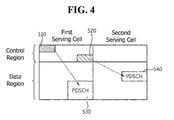
- FIG. 4 shows an example of cross-CC scheduling.
- a UE detects a PDCCH 510. Then, on the basis of DCI on the PDCCH 510, the UE receives a DL transport block on a PDSCH 530. Even if the cross-CC scheduling is configured, a PDCCH-PDSCH pair in the same cell may be used.
- the UE detects a PDCCH 520. Assume that a CIF included in DCI on the PDCCH 520 indicates a second serving cell. The UE receives a DL transport block on a PDSCH 540 of the second serving cell.
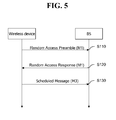
- FIG. 5 is a flowchart showing a random access procedure in 3GPP LTE/LTE-A.
- a wireless device receives a root index and a physical random access channel (PRACH) configuration index from a BS.
- Each cell has 64 candidate random access preambles defined by a Zadoff-Chu (ZC) sequence.
- the root index is a logical index for generating the 64 candidate random access preambles by the wireless device.
- the random access preamble is limited to a specific time and frequency resource for each cell.
- the PRACH configuration index indicates a specific subframe and preamble format capable of transmitting the random access preamble.
- Table 2 shows an example of the random access configuration disclosed in the section 5.7 of 3GPP TS 36.211 V8.7.0 (2009-05 ).
- PRACH configuration index Preamble format System frame number Subframe number 0 0 Even 1 1 0 Even 4 2 0 Even 7 3 0 Any 1 4 0 Any 4 5 0 Any 7 6 0 Any 1, 6
- the wireless device transmits a randomly selected random access preamble to the BS (step S110).
- the wireless device selects one of the 64 candidate random access preambles.
- the wireless device selects a corresponding subframe by using the PRACH configuration index.
- the wireless device transmits the selected random access preamble in the selected subframe.
- the BS Upon receiving the random access preamble, the BS transmits a random access response (RAR) to the wireless device (step S120).
- RAR random access response
- the RAR is detected in two steps. First, the wireless device detects a PDCCH masked with a random access-RNTI (RA-RNTI). The wireless device receives the RAR included in a medium access control (MAC) protocol data unit (PDU) through a PDSCH indicated by the detected PDCCH.
- MAC medium access control
- FIG. 6 shows an example of a random access response (RAR).
- the RAR may include a timing advance command (TAC), a UL grant, and a temporary C-RNTI.
- TAC timing advance command
- UL grant UL grant
- C-RNTI temporary C-RNTI
- the TAC is information indicating a time alignment value sent by a BS to a wireless device to maintain a UL time alignment.
- the wireless device updates UL transmission timing by using the time alignment value.
- a time alignment timer starts or restarts.
- the wireless device may perform UL transmission only when the time alignment timer is running.
- the UL grant is a UL resource used in transmission of a scheduling message described below.
- the wireless device transmits a scheduled message to the BS according to a UL grant included in the RAR (step S130).
- the random access preamble, the RAR, and the scheduled message may also be called messages M1, M2, and M3, respectively.
- the random access procedure may be triggered by at least one of the followings.
- 3GPP LTE/LTE-A there is a restriction in that the random access procedure is performed only through a primary cell even if the wireless device has a plurality of serving cells. Both of the MAC-random access procedure and the PDCCH-random access procedure are performed only in the primary cell.
- a primary cell and a second cell may have different frequency features, and thus a random access procedure for UL time alignment may also need to be performed in the secondary cell.
- the plurality of serving cells are managed by one BS
- the wireless device has a plurality of MAC layers.
- the plurality of MAC layers operate independently, there may be a case where a plurality of random access procedures are simultaneously triggered by the plurality of MAC layers in the same time point (i.e., the same subframe).
- FIG. 7 shows an example of triggering a plurality of random access procedures.
- a PDCCH-random access procedure of a secondary cell is triggered in a primary cell by a PDCCH order 710. This is for a BS to acquire UL timing information of the secondary cell.
- the subframe n+k is a UL subframe which satisfies a PRACH configuration. It is assumed herein that a first random access preamble 720 for the PDCCH-random access procedure is transmitted in a subframe n+8.
- a second random access preamble 730 for a MAC-random access procedure is transmitted for a scheduling request in the subframe n+8.
- a plurality of serving cells and/or a plurality of MAC layers may lead to various situations in which transmission of a plurality of random access preambles starts in the same subframe.
- the present invention proposes to perform one selected random access procedure even if the plurality of random access procedures are triggered in the same subframe as described above. In doing so, simultaneous transmission of the plurality of random access preambles can be avoided. This is because excessive UL transmit power is consumed to transmit the plurality of random access preambles, and implementation of the wireless device and the network may become complicated.
- FIG. 8 is a flowchart showing a method of performing a random access according to an embodiment of the present invention.
- a wireless device selects one of a plurality of random access procedures triggered simultaneously. For example, a first random access procedure and a second random access procedure may be triggered in one subframe. Although it is considered hereinafter that two random access procedures are simultaneously triggered, the number of random access procedures to be triggered is not limited thereto.
- the plurality of random access procedures to be triggered may be classified according to a triggering cause, a dedicated random access preamble assignment, a serving cell to be triggered, and a combination of them.
- the first and second random access procedure may have different triggering causes.
- the first random access procedure may be a PDCCH-random access procedure triggered by the aforementioned BS order
- the second random access procedure may be a MAC- random access procedure triggered by a MAC layer of the wireless device.
- the first random access procedure may be a non-contention based random access procedure which uses a pre-assigned dedicated random access preamble
- the second random access procedure may be a contention based random access procedure which uses a randomly selected random access preamble.
- the PDCCH-random access procedure may be the non-contention based random access procedure or the contention based random access procedure.
- the MAC-random access procedure may be the non-contention based random access procedure or the contention based random access procedure.
- the first and second random access procedure may be triggered in different serving cells.
- the serving cell to be triggered may include at least any one of a serving cell for transmitting a random access preamble and a serving cell for receiving a random access response.
- the first random access procedure may be triggered in the secondary cell, and the second random access procedure may be triggered in the primary cell.
- step S820 the wireless device performs the selected random access procedure. Assume that the first random access procedure is selected between the first random access procedure and the second random access procedure.
- the wireless device may transmit a random access preamble for the first random access procedure to the BS in the aforementioned single subframe.
- a first random access procedure is a PDCCH-random access procedure
- a second random access procedure is a MAC-random access procedure.
- this is for exemplary purposes only, and thus there is no restriction on the number of random access procedures to be triggered or a triggering cause.
- the MAC-random access procedure may be discarded (or stopped), and only the PDCCH-random access procedure may be performed.
- the PDCCH-random access procedure is assigned a higher priority than the MAC-random access procedure. This is because, even if the wireless device give up to perform the MAC-random access procedure for a scheduling request, a buffer status report (BSR) can be transmitted through scheduled PUSCH transmission.
- BSR buffer status report
- the MAC-random access procedure may be delayed, and the PDCCH-random access procedure may be first performed.
- the subframe n+k is a first subframe which satisfies a random access configuration.
- the random access preamble for the MAC-random access procedure may be transmitted in a first subframe which satisfies the random access configuration after the subframe n+k.
- the random access preamble for the MAC-random access procedure may be transmitted in the first subframe which satisfies the random access configuration after the PDCCH-random access procedure is complete.
- the 'after the PDCCH-random access procedure is complete' may imply 'after an M2 message is received' or 'after an M3 message is transmitted'. This is to avoid unnecessary overlapping of the random access procedures.
- the PDCCH-random access procedure may be discarded (or stopped), and only the MAC-random access procedure may be performed.
- the MAC-random access procedure triggered by the MAC layer of the wireless device is necessary to perform direct data communication. Therefore, an increase in a latency for a case of performing data communication may have a greater effect to a user than an increase in a latency for a case of acquiring UL timing. Accordingly, the MAC-random access procedure may be assigned a higher priority than the PCCH-random access procedure.
- the BS may transmit a new PDCCH order to the wireless device.
- the PDCCH-random access procedure may be delayed, and the MAC-random access procedure may be first performed.
- the subframe n+k is a first subframe which satisfies a random access configuration.
- the wireless device may transmit a random access preamble for the PDCCH-random access procedure in a first subframe which satisfies the random access configuration after the subframe n+k.
- the random access preamble for the PDCCH-random access procedure may be transmitted in the first subframe which satisfies the random access configuration after the MAC-random access procedure is complete.
- the 'after the MAC-random access procedure is complete' may imply 'after an M2 message is received' or 'after an M3 message is transmitted'. This is to avoid unnecessary overlapping of the random access procedures.
- the BS may assign the dedicated random access preamble by considering the delay of the PDCCH-random access procedure.
- the 'simultaneous' triggering of the plurality of random access procedures implies that a transmission time of the plurality of random access preambles overlaps partially or entirely.
- the PDCCH-random access procedure and the MAC-random access procedure are triggered simultaneously, it may include a case where the MAC-random access procedure is triggered before a corresponding random access preamble is received after a PDCCH order is received.
- the PDCCH order is received in a subframe n
- the MAC-random access procedure is triggered in a subframe n+4
- one of the aforementioned first to fourth embodiments may be applied.
- the PDCCH-random access procedure may include a random access procedure which is triggered by using various mechanisms as well as by the PDCCH order.
- the MAC-random access procedure may include a random access procedure triggered by the wireless device autonomously as well as by the MAC layer.
- the PDCCH-random access procedure and the MAC-random access procedure may be related to a serving cell to be triggered.
- the PDCCH-random access procedure may include a random access procedure triggered by the BS in a secondary cell.
- the MAC-random access procedure may include a random access procedure triggered by the wireless device in a primary cell.
- the PDCCH-random access procedure may include a non-contention based random access procedure, and the MAC-random access procedure may include a contention based random access procedure.
- FIG. 9 is a block diagram showing a wireless communication system according to an embodiment of the present invention.
- a BS 50 includes a processor 51, a memory 52, and a radio frequency (RF) unit 53.
- the memory 52 is coupled to the processor 51, and stores a variety of information for driving the processor 51.
- the RF unit 53 is coupled to the processor 51, and transmits and/or receives a radio signal.
- the processor 51 implements the proposed functions, procedures, and/or methods. In the aforementioned embodiment, an operation of the BS may be implemented by the processor 51.
- a wireless device 60 includes a processor 61, a memory 62, and an RF unit 63.
- the memory 62 is coupled to the processor 61, and stores a variety of information for driving the processor 61.
- the RF unit 63 is coupled to the processor 61, and transmits and/or receives a radio signal.
- the processor 61 implements the proposed functions, procedures, and/or methods. In the aforementioned embodiment, an operation of the wireless device may be implemented by the processor 61.
- the processor may include an application-specific integrated circuit (ASIC), a separate chipset, a logic circuit, and/or a data processing unit.
- the memory may include a read-only memory (ROM), a random access memory (RAM), a flash memory, a memory card, a storage medium, and/or other equivalent storage devices.
- the RF unit may include a base-band circuit for processing a radio signal.
- the aforementioned methods can be implemented with a module (i.e., process, function, etc.) for performing the aforementioned functions.
- the module may be stored in the memory and may be performed by the processor.
- the memory may be located inside or outside the processor, and may be coupled to the processor by using various well-known means.
Landscapes
- Engineering & Computer Science (AREA)
- Signal Processing (AREA)
- Computer Networks & Wireless Communication (AREA)
- Mobile Radio Communication Systems (AREA)
Applications Claiming Priority (2)
| Application Number | Priority Date | Filing Date | Title |
|---|---|---|---|
| US201161522694P | 2011-08-12 | 2011-08-12 | |
| PCT/KR2012/006367 WO2013025009A2 (ko) | 2011-08-12 | 2012-08-10 | 랜덤 액세스 과정을 수행하는 방법 및 이를 이용한 무선기기 |
Publications (2)
| Publication Number | Publication Date |
|---|---|
| EP2728771A2 true EP2728771A2 (de) | 2014-05-07 |
| EP2728771A4 EP2728771A4 (de) | 2015-03-11 |
Family
ID=47715568
Family Applications (1)
| Application Number | Title | Priority Date | Filing Date |
|---|---|---|---|
| EP12824218.7A Withdrawn EP2728771A4 (de) | 2011-08-12 | 2012-08-10 | Verfahren zur durchführung eines direktzugriffsverfahrens und drahtlose vorrichtung zu seiner anwendung |
Country Status (4)
| Country | Link |
|---|---|
| US (1) | US9265069B2 (de) |
| EP (1) | EP2728771A4 (de) |
| KR (1) | KR101530808B1 (de) |
| WO (1) | WO2013025009A2 (de) |
Cited By (2)
| Publication number | Priority date | Publication date | Assignee | Title |
|---|---|---|---|---|
| WO2016168024A1 (en) * | 2015-04-14 | 2016-10-20 | Qualcomm Incorporated | Random access for low latency wireless communications |
| EP3073649A4 (de) * | 2013-11-19 | 2017-07-12 | LG Electronics Inc. | Verfahren zur durchführung einer direktzugriffsprozedur |
Families Citing this family (33)
| Publication number | Priority date | Publication date | Assignee | Title |
|---|---|---|---|---|
| US8395985B2 (en) | 2011-07-25 | 2013-03-12 | Ofinno Technologies, Llc | Time alignment in multicarrier OFDM network |
| US9237537B2 (en) | 2012-01-25 | 2016-01-12 | Ofinno Technologies, Llc | Random access process in a multicarrier base station and wireless device |
| US8964780B2 (en) | 2012-01-25 | 2015-02-24 | Ofinno Technologies, Llc | Sounding in multicarrier wireless communications |
| US8964683B2 (en) | 2012-04-20 | 2015-02-24 | Ofinno Technologies, Llc | Sounding signal in a multicarrier wireless device |
| EP3937551A3 (de) | 2012-01-25 | 2022-02-09 | Comcast Cable Communications, LLC | Direktzugriffskanal in einer drahtlosen mehrträgerkommunikation mit zeitvorlaufsgruppen |
| US20130259008A1 (en) | 2012-04-01 | 2013-10-03 | Esmael Hejazi Dinan | Random Access Response Process in a Wireless Communications |
| WO2013151651A1 (en) | 2012-04-01 | 2013-10-10 | Dinan Esmael Hejazi | Cell group configuration in a wireless device and base station with timing advance groups |
| US11943813B2 (en) | 2012-04-01 | 2024-03-26 | Comcast Cable Communications, Llc | Cell grouping for wireless communications |
| US8964593B2 (en) | 2012-04-16 | 2015-02-24 | Ofinno Technologies, Llc | Wireless device transmission power |
| US11825419B2 (en) | 2012-04-16 | 2023-11-21 | Comcast Cable Communications, Llc | Cell timing in a wireless device and base station |
| EP3337079B1 (de) | 2012-04-16 | 2024-06-05 | Comcast Cable Communications, LLC | Zellgruppenkonfiguration für uplink-übertragung in einer drahtlosen mehrträgervorrichtung und basisstation mit zeitvorlaufsgruppen |
| US11252679B2 (en) | 2012-04-16 | 2022-02-15 | Comcast Cable Communications, Llc | Signal transmission power adjustment in a wireless device |
| US9210664B2 (en) | 2012-04-17 | 2015-12-08 | Ofinno Technologies. LLC | Preamble transmission in a wireless device |
| US11582704B2 (en) | 2012-04-16 | 2023-02-14 | Comcast Cable Communications, Llc | Signal transmission power adjustment in a wireless device |
| US11882560B2 (en) | 2012-06-18 | 2024-01-23 | Comcast Cable Communications, Llc | Carrier grouping in multicarrier wireless networks |
| US9084228B2 (en) | 2012-06-20 | 2015-07-14 | Ofinno Technologies, Llc | Automobile communication device |
| US9113387B2 (en) | 2012-06-20 | 2015-08-18 | Ofinno Technologies, Llc | Handover signalling in wireless networks |
| US8971298B2 (en) | 2012-06-18 | 2015-03-03 | Ofinno Technologies, Llc | Wireless device connection to an application server |
| US11622372B2 (en) | 2012-06-18 | 2023-04-04 | Comcast Cable Communications, Llc | Communication device |
| US9107206B2 (en) | 2012-06-18 | 2015-08-11 | Ofinne Technologies, LLC | Carrier grouping in multicarrier wireless networks |
| US9179457B2 (en) | 2012-06-20 | 2015-11-03 | Ofinno Technologies, Llc | Carrier configuration in wireless networks |
| US9210619B2 (en) | 2012-06-20 | 2015-12-08 | Ofinno Technologies, Llc | Signalling mechanisms for wireless device handover |
| US9609499B2 (en) * | 2013-05-22 | 2017-03-28 | Avago Technologies General Ip (Singapore) Pte. Ltd. | Apparatus and method to prioritize a random access procedure for emergency access |
| WO2015010332A1 (zh) * | 2013-07-26 | 2015-01-29 | 华为技术有限公司 | 一种数据传输的方法、设备与系统 |
| US20150245252A1 (en) * | 2014-02-26 | 2015-08-27 | Qualcomm Incorporated | High speed inter-radio access technology handover |
| EP3180954B1 (de) * | 2014-08-11 | 2017-11-08 | Telefonaktiebolaget LM Ericsson (publ) | Drahtlose vorrichtung, erster netzwerkknoten und verfahren darin |
| US20180302924A1 (en) * | 2015-10-26 | 2018-10-18 | Lg Electronics Inc. | Method for performing random access in wireless lan system and apparatus therefor |
| KR102734276B1 (ko) | 2016-05-11 | 2024-11-27 | 주식회사 윌러스표준기술연구소 | 랜덤 액세스 기반의 상향 다중 사용자 전송을 위한 무선 통신 단말 및 무선 통신 방법 |
| KR102390645B1 (ko) | 2016-12-27 | 2022-04-28 | 주식회사 윌러스표준기술연구소 | Ofdma 랜덤 액세스를 사용하는 무선 통신 방법 및 이를 사용하는 무선 통신 단말 |
| CN115413056B (zh) * | 2017-01-06 | 2025-04-18 | 北京三星通信技术研究有限公司 | 前导序列重传的方法、用户设备及基站 |
| CN110786073A (zh) * | 2017-06-16 | 2020-02-11 | 摩托罗拉移动有限责任公司 | 执行多个随机接入过程 |
| US11057936B2 (en) * | 2018-07-12 | 2021-07-06 | Telefonaktiebolaget Lm Ericsson (Publ) | Mechanism for merging colliding RACH procedures |
| US20240340961A1 (en) * | 2023-04-07 | 2024-10-10 | Qualcomm Incorporated | Random access channel collision during timing adjustment acquisition for layer 1 or layer 2 triggered mobility |
Family Cites Families (14)
| Publication number | Priority date | Publication date | Assignee | Title |
|---|---|---|---|---|
| KR100991937B1 (ko) * | 2007-10-08 | 2010-11-04 | 엘지전자 주식회사 | 무선통신 시스템에서 제어신호 전송 방법 |
| KR101461939B1 (ko) * | 2007-11-14 | 2014-11-14 | 엘지전자 주식회사 | 우선순위 기반의 랜덤 액세스 방법 |
| KR100925450B1 (ko) * | 2008-03-03 | 2009-11-06 | 엘지전자 주식회사 | 상향링크 신호의 충돌 해결 방법 |
| KR101548748B1 (ko) | 2008-08-07 | 2015-09-11 | 엘지전자 주식회사 | 랜덤 접속 절차를 수행하는 방법 |
| KR101539775B1 (ko) | 2009-01-08 | 2015-07-30 | 엘지전자 주식회사 | Tdd에 기반한 무선통신 시스템에서 데이터 중계 방법 |
| KR101485807B1 (ko) | 2009-04-01 | 2015-01-28 | 삼성전자주식회사 | 무선 통신 시스템의 랜덤 액세스 방법 및 장치 |
| KR101616605B1 (ko) * | 2009-04-23 | 2016-04-28 | 인터디지탈 패튼 홀딩스, 인크 | 멀티캐리어 무선 통신에서의 임의 접속을 위한 방법 및 장치 |
| KR101294401B1 (ko) | 2009-10-12 | 2013-08-16 | 한국전자통신연구원 | 3GPP LTE-Advanced 시스템의 소규모 셀에서의 랜덤 액세스 방법 및 시스템 |
| US8917593B2 (en) * | 2010-03-18 | 2014-12-23 | Qualcomm Incorporated | Random access design in a multiple component carrier communication network |
| KR101776873B1 (ko) * | 2011-01-11 | 2017-09-11 | 삼성전자 주식회사 | 이동통신 시스템에서 역방향 전송 출력 결정 방법 및 장치 |
| EP2695454B1 (de) * | 2011-04-01 | 2020-09-09 | Intel Corporation | Durchführung mehrerer zeitvorlaufeinstellungen in einem trägeraggregationskommunikationssystem |
| US20120300714A1 (en) * | 2011-05-06 | 2012-11-29 | Samsung Electronics Co., Ltd. | Methods and apparatus for random access procedures with carrier aggregation for lte-advanced systems |
| WO2013006111A1 (en) * | 2011-07-06 | 2013-01-10 | Telefonaktiebolaget L M Ericsson (Publ) | Random access with primary and secondary component carrier communications |
| US8395985B2 (en) * | 2011-07-25 | 2013-03-12 | Ofinno Technologies, Llc | Time alignment in multicarrier OFDM network |
-
2012
- 2012-08-10 KR KR1020137033392A patent/KR101530808B1/ko not_active Expired - Fee Related
- 2012-08-10 EP EP12824218.7A patent/EP2728771A4/de not_active Withdrawn
- 2012-08-10 US US14/235,320 patent/US9265069B2/en not_active Expired - Fee Related
- 2012-08-10 WO PCT/KR2012/006367 patent/WO2013025009A2/ko not_active Ceased
Cited By (11)
| Publication number | Priority date | Publication date | Assignee | Title |
|---|---|---|---|---|
| EP3073649A4 (de) * | 2013-11-19 | 2017-07-12 | LG Electronics Inc. | Verfahren zur durchführung einer direktzugriffsprozedur |
| US10009932B2 (en) | 2013-11-19 | 2018-06-26 | Lg Electronics Inc. | Method for performing random access procedure |
| US10327266B2 (en) | 2013-11-19 | 2019-06-18 | Lg Electronics Inc. | Method for performing random access procedure |
| EP3627954A1 (de) * | 2013-11-19 | 2020-03-25 | LG Electronics Inc. | Verfahren zur durchführung einer direktzugriffsprozedur |
| US10887924B2 (en) | 2013-11-19 | 2021-01-05 | Lg Electronics Inc. | Method for performing random access procedure |
| WO2016168024A1 (en) * | 2015-04-14 | 2016-10-20 | Qualcomm Incorporated | Random access for low latency wireless communications |
| CN107534995A (zh) * | 2015-04-14 | 2018-01-02 | 高通股份有限公司 | 用于低等待时间无线通信的随机接入 |
| JP2018516495A (ja) * | 2015-04-14 | 2018-06-21 | クゥアルコム・インコーポレイテッドQualcomm Incorporated | 低レイテンシワイヤレス通信のためのランダムアクセス |
| US10433339B2 (en) | 2015-04-14 | 2019-10-01 | Qualcomm Incorporated | Random access for low latency wireless communications |
| CN107534995B (zh) * | 2015-04-14 | 2021-03-23 | 高通股份有限公司 | 用于低等待时间无线通信的随机接入 |
| US11191106B2 (en) | 2015-04-14 | 2021-11-30 | Qualcomm Incorporated | Random access for low latency wireless communications |
Also Published As
| Publication number | Publication date |
|---|---|
| KR101530808B1 (ko) | 2015-06-25 |
| US9265069B2 (en) | 2016-02-16 |
| EP2728771A4 (de) | 2015-03-11 |
| US20140161089A1 (en) | 2014-06-12 |
| WO2013025009A3 (ko) | 2013-05-30 |
| KR20140085380A (ko) | 2014-07-07 |
| WO2013025009A2 (ko) | 2013-02-21 |
Similar Documents
| Publication | Publication Date | Title |
|---|---|---|
| US9265069B2 (en) | Method of performing a random access process and wireless device using same | |
| US11751256B2 (en) | Method for transmitting and receiving signal in wireless communication system supporting unlicensed band, and apparatus supporting same | |
| EP3500035B1 (de) | Verfahren zum empfangen von daten in einem drahtloskommunikationssystem mit unterstützung von schmalbandigem internet der dinge und vorrichtung dafür | |
| US11398882B2 (en) | Early termination of repeated transmissions between terminal and base station in wireless communication system | |
| KR101498846B1 (ko) | 랜덤 액세스 과정 수행 방법 및 장치 | |
| US10123292B2 (en) | Method and apparatus for transmitting and receiving signal for device-to-device terminal in wireless communication system | |
| CN106134098B (zh) | 用于在无线通信系统中发送数据的方法和设备 | |
| KR101528091B1 (ko) | 랜덤 액세스 수행 방법 및 장치 | |
| KR102017710B1 (ko) | 무선 통신 시스템에서 무선 신호 송수신 방법 및 장치 | |
| US20200196256A1 (en) | Method for transmitting/receiving synchronization signal in wireless communication system and apparatus therefor | |
| KR101730758B1 (ko) | 가변 대역폭을 지원하는 통신 방법 및 무선기기 | |
| EP3226630A1 (de) | Vorrichtung und verfahren zur ausführung einer direkten d2d-kommunikation in einem drahtloskommunikationssystem mit unterstützung eines unlizenzierten bandes | |
| EP3534558A1 (de) | Verfahren und mtc-vorrichtung zur durchführung einer direktzugriffsprozedur zur reichweitenerhöhung | |
| US20140133433A1 (en) | Communication method and wireless device supporting variable bandwidth | |
| EP2712259A1 (de) | Übertragungsverfahren und -system für einen physikalischen direktzugriffskanal | |
| US9401794B2 (en) | Method and apparatus for acquiring control information in wireless communication system | |
| US20150029905A1 (en) | Data transmission method and apparatus for half-duplex devices | |
| US9722752B2 (en) | Method and apparatus for transmitting sounding reference signal | |
| US9876666B2 (en) | Method and apparatus for acquiring synchronization by device-to-device terminal in wireless communication system | |
| KR102078373B1 (ko) | 무선 통신 시스템에서 무선 신호 송수신 방법 및 장치 | |
| US9407393B2 (en) | Method for receiving downlink data and wireless device using same |
Legal Events
| Date | Code | Title | Description |
|---|---|---|---|
| PUAI | Public reference made under article 153(3) epc to a published international application that has entered the european phase |
Free format text: ORIGINAL CODE: 0009012 |
|
| 17P | Request for examination filed |
Effective date: 20140131 |
|
| AK | Designated contracting states |
Kind code of ref document: A2 Designated state(s): AL AT BE BG CH CY CZ DE DK EE ES FI FR GB GR HR HU IE IS IT LI LT LU LV MC MK MT NL NO PL PT RO RS SE SI SK SM TR |
|
| DAX | Request for extension of the european patent (deleted) | ||
| A4 | Supplementary search report drawn up and despatched |
Effective date: 20150209 |
|
| RIC1 | Information provided on ipc code assigned before grant |
Ipc: H04W 74/08 20090101AFI20150203BHEP Ipc: H04B 7/26 20060101ALI20150203BHEP |
|
| STAA | Information on the status of an ep patent application or granted ep patent |
Free format text: STATUS: EXAMINATION IS IN PROGRESS |
|
| 17Q | First examination report despatched |
Effective date: 20161114 |
|
| STAA | Information on the status of an ep patent application or granted ep patent |
Free format text: STATUS: THE APPLICATION IS DEEMED TO BE WITHDRAWN |
|
| 18D | Application deemed to be withdrawn |
Effective date: 20190711 |