EP2731929B1 - Verfahren zur herstellung von acylglycinaten und zusammensetzungen enthaltend derartige verbindungen - Google Patents
Verfahren zur herstellung von acylglycinaten und zusammensetzungen enthaltend derartige verbindungen Download PDFInfo
- Publication number
- EP2731929B1 EP2731929B1 EP12737207.6A EP12737207A EP2731929B1 EP 2731929 B1 EP2731929 B1 EP 2731929B1 EP 12737207 A EP12737207 A EP 12737207A EP 2731929 B1 EP2731929 B1 EP 2731929B1
- Authority
- EP
- European Patent Office
- Prior art keywords
- weight
- fatty acid
- acyl groups
- proportion
- formula
- Prior art date
- Legal status (The legal status is an assumption and is not a legal conclusion. Google has not performed a legal analysis and makes no representation as to the accuracy of the status listed.)
- Not-in-force
Links
- 239000000203 mixture Substances 0.000 title claims description 78
- 238000004519 manufacturing process Methods 0.000 title claims description 4
- 150000001875 compounds Chemical class 0.000 title description 8
- 239000000194 fatty acid Substances 0.000 claims description 106
- 235000014113 dietary fatty acids Nutrition 0.000 claims description 105
- 229930195729 fatty acid Natural products 0.000 claims description 105
- -1 fatty acid chlorides Chemical class 0.000 claims description 62
- 125000002252 acyl group Chemical group 0.000 claims description 60
- 150000004665 fatty acids Chemical class 0.000 claims description 48
- DHMQDGOQFOQNFH-UHFFFAOYSA-N Glycine Chemical compound NCC(O)=O DHMQDGOQFOQNFH-UHFFFAOYSA-N 0.000 claims description 32
- 229920006395 saturated elastomer Polymers 0.000 claims description 29
- XLYOFNOQVPJJNP-UHFFFAOYSA-N water Substances O XLYOFNOQVPJJNP-UHFFFAOYSA-N 0.000 claims description 29
- 238000000034 method Methods 0.000 claims description 24
- 125000004432 carbon atom Chemical group C* 0.000 claims description 23
- 239000002537 cosmetic Substances 0.000 claims description 17
- 150000001768 cations Chemical class 0.000 claims description 16
- 125000003892 C18 acyl group Chemical group 0.000 claims description 14
- 239000004471 Glycine Substances 0.000 claims description 14
- 239000003960 organic solvent Substances 0.000 claims description 12
- 239000004094 surface-active agent Substances 0.000 claims description 9
- 229910052783 alkali metal Inorganic materials 0.000 claims description 8
- 239000000126 substance Substances 0.000 claims description 8
- 238000009472 formulation Methods 0.000 claims description 5
- 150000001339 alkali metal compounds Chemical class 0.000 claims description 4
- 150000001340 alkali metals Chemical class 0.000 claims description 4
- 150000004649 carbonic acid derivatives Chemical class 0.000 claims description 2
- 150000004679 hydroxides Chemical class 0.000 claims description 2
- HEMHJVSKTPXQMS-UHFFFAOYSA-M Sodium hydroxide Chemical compound [OH-].[Na+] HEMHJVSKTPXQMS-UHFFFAOYSA-M 0.000 description 45
- 239000011734 sodium Substances 0.000 description 26
- 238000002360 preparation method Methods 0.000 description 23
- VEXZGXHMUGYJMC-UHFFFAOYSA-M Chloride anion Chemical compound [Cl-] VEXZGXHMUGYJMC-UHFFFAOYSA-M 0.000 description 18
- 239000000460 chlorine Substances 0.000 description 17
- 235000011121 sodium hydroxide Nutrition 0.000 description 15
- FAPWRFPIFSIZLT-UHFFFAOYSA-M Sodium chloride Chemical compound [Na+].[Cl-] FAPWRFPIFSIZLT-UHFFFAOYSA-M 0.000 description 14
- 238000003756 stirring Methods 0.000 description 14
- 239000006260 foam Substances 0.000 description 13
- 235000013162 Cocos nucifera Nutrition 0.000 description 11
- 244000060011 Cocos nucifera Species 0.000 description 11
- 239000000243 solution Substances 0.000 description 11
- 230000000052 comparative effect Effects 0.000 description 10
- 238000004128 high performance liquid chromatography Methods 0.000 description 10
- 238000006243 chemical reaction Methods 0.000 description 9
- 239000000047 product Substances 0.000 description 9
- 239000011780 sodium chloride Substances 0.000 description 8
- 239000003513 alkali Substances 0.000 description 6
- 239000011541 reaction mixture Substances 0.000 description 6
- 239000013543 active substance Substances 0.000 description 5
- 238000001816 cooling Methods 0.000 description 5
- 238000005187 foaming Methods 0.000 description 5
- 150000002332 glycine derivatives Chemical class 0.000 description 5
- 238000004448 titration Methods 0.000 description 5
- DHMQDGOQFOQNFH-UHFFFAOYSA-M Aminoacetate Chemical compound NCC([O-])=O DHMQDGOQFOQNFH-UHFFFAOYSA-M 0.000 description 4
- 150000001298 alcohols Chemical class 0.000 description 4
- 238000009826 distribution Methods 0.000 description 4
- NGNBDVOYPDDBFK-UHFFFAOYSA-N 2-[2,4-di(pentan-2-yl)phenoxy]acetyl chloride Chemical compound CCCC(C)C1=CC=C(OCC(Cl)=O)C(C(C)CCC)=C1 NGNBDVOYPDDBFK-UHFFFAOYSA-N 0.000 description 3
- POULHZVOKOAJMA-UHFFFAOYSA-N dodecanoic acid Chemical compound CCCCCCCCCCCC(O)=O POULHZVOKOAJMA-UHFFFAOYSA-N 0.000 description 3
- IPCSVZSSVZVIGE-UHFFFAOYSA-N hexadecanoic acid Chemical compound CCCCCCCCCCCCCCCC(O)=O IPCSVZSSVZVIGE-UHFFFAOYSA-N 0.000 description 3
- 239000007788 liquid Substances 0.000 description 3
- 229940065859 sodium cocoyl glycinate Drugs 0.000 description 3
- DGAQECJNVWCQMB-PUAWFVPOSA-M Ilexoside XXIX Chemical compound C[C@@H]1CC[C@@]2(CC[C@@]3(C(=CC[C@H]4[C@]3(CC[C@@H]5[C@@]4(CC[C@@H](C5(C)C)OS(=O)(=O)[O-])C)C)[C@@H]2[C@]1(C)O)C)C(=O)O[C@H]6[C@@H]([C@H]([C@@H]([C@H](O6)CO)O)O)O.[Na+] DGAQECJNVWCQMB-PUAWFVPOSA-M 0.000 description 2
- KFZMGEQAYNKOFK-UHFFFAOYSA-N Isopropanol Chemical compound CC(C)O KFZMGEQAYNKOFK-UHFFFAOYSA-N 0.000 description 2
- DKGAVHZHDRPRBM-UHFFFAOYSA-N Tert-Butanol Chemical compound CC(C)(C)O DKGAVHZHDRPRBM-UHFFFAOYSA-N 0.000 description 2
- ZXEKIIBDNHEJCQ-UHFFFAOYSA-N isobutanol Chemical compound CC(C)CO ZXEKIIBDNHEJCQ-UHFFFAOYSA-N 0.000 description 2
- 229910052708 sodium Inorganic materials 0.000 description 2
- IKGKWKGYFJBGQJ-UHFFFAOYSA-M sodium;2-(dodecanoylamino)acetate Chemical compound [Na+].CCCCCCCCCCCC(=O)NCC([O-])=O IKGKWKGYFJBGQJ-UHFFFAOYSA-M 0.000 description 2
- FYSNRJHAOHDILO-UHFFFAOYSA-N thionyl chloride Chemical compound ClS(Cl)=O FYSNRJHAOHDILO-UHFFFAOYSA-N 0.000 description 2
- WRIDQFICGBMAFQ-UHFFFAOYSA-N (E)-8-Octadecenoic acid Natural products CCCCCCCCCC=CCCCCCCC(O)=O WRIDQFICGBMAFQ-UHFFFAOYSA-N 0.000 description 1
- MLQBTMWHIOYKKC-KTKRTIGZSA-N (z)-octadec-9-enoyl chloride Chemical compound CCCCCCCC\C=C/CCCCCCCC(Cl)=O MLQBTMWHIOYKKC-KTKRTIGZSA-N 0.000 description 1
- 0 *NCC(O)=O Chemical compound *NCC(O)=O 0.000 description 1
- LQJBNNIYVWPHFW-UHFFFAOYSA-N 20:1omega9c fatty acid Natural products CCCCCCCCCCC=CCCCCCCCC(O)=O LQJBNNIYVWPHFW-UHFFFAOYSA-N 0.000 description 1
- QSBYPNXLFMSGKH-UHFFFAOYSA-N 9-Heptadecensaeure Natural products CCCCCCCC=CCCCCCCCC(O)=O QSBYPNXLFMSGKH-UHFFFAOYSA-N 0.000 description 1
- WKBOTKDWSSQWDR-UHFFFAOYSA-N Bromine atom Chemical group [Br] WKBOTKDWSSQWDR-UHFFFAOYSA-N 0.000 description 1
- ZQPPMHVWECSIRJ-UHFFFAOYSA-N Oleic acid Natural products CCCCCCCCC=CCCCCCCCC(O)=O ZQPPMHVWECSIRJ-UHFFFAOYSA-N 0.000 description 1
- 239000005642 Oleic acid Substances 0.000 description 1
- YGYAWVDWMABLBF-UHFFFAOYSA-N Phosgene Chemical compound ClC(Cl)=O YGYAWVDWMABLBF-UHFFFAOYSA-N 0.000 description 1
- 238000003436 Schotten-Baumann reaction Methods 0.000 description 1
- 206010039792 Seborrhoea Diseases 0.000 description 1
- 125000004442 acylamino group Chemical group 0.000 description 1
- 239000012670 alkaline solution Substances 0.000 description 1
- 150000001413 amino acids Chemical class 0.000 description 1
- GDTBXPJZTBHREO-UHFFFAOYSA-N bromine Chemical group BrBr GDTBXPJZTBHREO-UHFFFAOYSA-N 0.000 description 1
- 229910052794 bromium Inorganic materials 0.000 description 1
- 239000006227 byproduct Substances 0.000 description 1
- 239000007810 chemical reaction solvent Substances 0.000 description 1
- 238000005660 chlorination reaction Methods 0.000 description 1
- 229910052801 chlorine Inorganic materials 0.000 description 1
- 150000001805 chlorine compounds Chemical class 0.000 description 1
- 125000001309 chloro group Chemical group Cl* 0.000 description 1
- 239000012459 cleaning agent Substances 0.000 description 1
- 239000008367 deionised water Substances 0.000 description 1
- 229910021641 deionized water Inorganic materials 0.000 description 1
- 150000002009 diols Chemical class 0.000 description 1
- 230000001815 facial effect Effects 0.000 description 1
- 239000012530 fluid Substances 0.000 description 1
- PNDPGZBMCMUPRI-UHFFFAOYSA-N iodine Chemical group II PNDPGZBMCMUPRI-UHFFFAOYSA-N 0.000 description 1
- QXJSBBXBKPUZAA-UHFFFAOYSA-N isooleic acid Natural products CCCCCCCC=CCCCCCCCCC(O)=O QXJSBBXBKPUZAA-UHFFFAOYSA-N 0.000 description 1
- 238000002156 mixing Methods 0.000 description 1
- 238000006386 neutralization reaction Methods 0.000 description 1
- 230000037312 oily skin Effects 0.000 description 1
- ZQPPMHVWECSIRJ-KTKRTIGZSA-N oleic acid Chemical compound CCCCCCCC\C=C/CCCCCCCC(O)=O ZQPPMHVWECSIRJ-KTKRTIGZSA-N 0.000 description 1
- 239000011022 opal Substances 0.000 description 1
- 238000006053 organic reaction Methods 0.000 description 1
- 230000020477 pH reduction Effects 0.000 description 1
- 238000005191 phase separation Methods 0.000 description 1
- FAIAAWCVCHQXDN-UHFFFAOYSA-N phosphorus trichloride Chemical compound ClP(Cl)Cl FAIAAWCVCHQXDN-UHFFFAOYSA-N 0.000 description 1
- 229940079988 potassium cocoyl glycinate Drugs 0.000 description 1
- 238000000746 purification Methods 0.000 description 1
- 150000003839 salts Chemical class 0.000 description 1
- FSYKKLYZXJSNPZ-UHFFFAOYSA-N sarcosine Chemical class C[NH2+]CC([O-])=O FSYKKLYZXJSNPZ-UHFFFAOYSA-N 0.000 description 1
- 230000001953 sensory effect Effects 0.000 description 1
- 238000000926 separation method Methods 0.000 description 1
- 239000002904 solvent Substances 0.000 description 1
- 150000004670 unsaturated fatty acids Chemical class 0.000 description 1
- 235000021122 unsaturated fatty acids Nutrition 0.000 description 1
- 238000005406 washing Methods 0.000 description 1
- 239000002351 wastewater Substances 0.000 description 1
- 238000010626 work up procedure Methods 0.000 description 1
Classifications
-
- C—CHEMISTRY; METALLURGY
- C07—ORGANIC CHEMISTRY
- C07C—ACYCLIC OR CARBOCYCLIC COMPOUNDS
- C07C231/00—Preparation of carboxylic acid amides
- C07C231/02—Preparation of carboxylic acid amides from carboxylic acids or from esters, anhydrides, or halides thereof by reaction with ammonia or amines
-
- A—HUMAN NECESSITIES
- A61—MEDICAL OR VETERINARY SCIENCE; HYGIENE
- A61K—PREPARATIONS FOR MEDICAL, DENTAL OR TOILETRY PURPOSES
- A61K8/00—Cosmetics or similar toiletry preparations
- A61K8/02—Cosmetics or similar toiletry preparations characterised by special physical form
- A61K8/04—Dispersions; Emulsions
- A61K8/046—Aerosols; Foams
-
- A—HUMAN NECESSITIES
- A61—MEDICAL OR VETERINARY SCIENCE; HYGIENE
- A61K—PREPARATIONS FOR MEDICAL, DENTAL OR TOILETRY PURPOSES
- A61K8/00—Cosmetics or similar toiletry preparations
- A61K8/18—Cosmetics or similar toiletry preparations characterised by the composition
- A61K8/30—Cosmetics or similar toiletry preparations characterised by the composition containing organic compounds
- A61K8/40—Cosmetics or similar toiletry preparations characterised by the composition containing organic compounds containing nitrogen
- A61K8/42—Amides
-
- A—HUMAN NECESSITIES
- A61—MEDICAL OR VETERINARY SCIENCE; HYGIENE
- A61K—PREPARATIONS FOR MEDICAL, DENTAL OR TOILETRY PURPOSES
- A61K8/00—Cosmetics or similar toiletry preparations
- A61K8/18—Cosmetics or similar toiletry preparations characterised by the composition
- A61K8/30—Cosmetics or similar toiletry preparations characterised by the composition containing organic compounds
- A61K8/40—Cosmetics or similar toiletry preparations characterised by the composition containing organic compounds containing nitrogen
- A61K8/44—Aminocarboxylic acids or derivatives thereof, e.g. aminocarboxylic acids containing sulfur; Salts; Esters or N-acylated derivatives thereof
-
- A—HUMAN NECESSITIES
- A61—MEDICAL OR VETERINARY SCIENCE; HYGIENE
- A61K—PREPARATIONS FOR MEDICAL, DENTAL OR TOILETRY PURPOSES
- A61K8/00—Cosmetics or similar toiletry preparations
- A61K8/18—Cosmetics or similar toiletry preparations characterised by the composition
- A61K8/30—Cosmetics or similar toiletry preparations characterised by the composition containing organic compounds
- A61K8/40—Cosmetics or similar toiletry preparations characterised by the composition containing organic compounds containing nitrogen
- A61K8/44—Aminocarboxylic acids or derivatives thereof, e.g. aminocarboxylic acids containing sulfur; Salts; Esters or N-acylated derivatives thereof
- A61K8/442—Aminocarboxylic acids or derivatives thereof, e.g. aminocarboxylic acids containing sulfur; Salts; Esters or N-acylated derivatives thereof substituted by amido group(s)
-
- A—HUMAN NECESSITIES
- A61—MEDICAL OR VETERINARY SCIENCE; HYGIENE
- A61Q—SPECIFIC USE OF COSMETICS OR SIMILAR TOILETRY PREPARATIONS
- A61Q19/00—Preparations for care of the skin
-
- A—HUMAN NECESSITIES
- A61—MEDICAL OR VETERINARY SCIENCE; HYGIENE
- A61Q—SPECIFIC USE OF COSMETICS OR SIMILAR TOILETRY PREPARATIONS
- A61Q19/00—Preparations for care of the skin
- A61Q19/10—Washing or bathing preparations
-
- C—CHEMISTRY; METALLURGY
- C07—ORGANIC CHEMISTRY
- C07C—ACYCLIC OR CARBOCYCLIC COMPOUNDS
- C07C233/00—Carboxylic acid amides
- C07C233/01—Carboxylic acid amides having carbon atoms of carboxamide groups bound to hydrogen atoms or to acyclic carbon atoms
- C07C233/45—Carboxylic acid amides having carbon atoms of carboxamide groups bound to hydrogen atoms or to acyclic carbon atoms having the nitrogen atom of at least one of the carboxamide groups bound to a carbon atom of a hydrocarbon radical substituted by carboxyl groups
- C07C233/46—Carboxylic acid amides having carbon atoms of carboxamide groups bound to hydrogen atoms or to acyclic carbon atoms having the nitrogen atom of at least one of the carboxamide groups bound to a carbon atom of a hydrocarbon radical substituted by carboxyl groups with the substituted hydrocarbon radical bound to the nitrogen atom of the carboxamide group by an acyclic carbon atom
- C07C233/47—Carboxylic acid amides having carbon atoms of carboxamide groups bound to hydrogen atoms or to acyclic carbon atoms having the nitrogen atom of at least one of the carboxamide groups bound to a carbon atom of a hydrocarbon radical substituted by carboxyl groups with the substituted hydrocarbon radical bound to the nitrogen atom of the carboxamide group by an acyclic carbon atom having the carbon atom of the carboxamide group bound to a hydrogen atom or to a carbon atom of an acyclic saturated carbon skeleton
-
- C—CHEMISTRY; METALLURGY
- C07—ORGANIC CHEMISTRY
- C07C—ACYCLIC OR CARBOCYCLIC COMPOUNDS
- C07C233/00—Carboxylic acid amides
- C07C233/01—Carboxylic acid amides having carbon atoms of carboxamide groups bound to hydrogen atoms or to acyclic carbon atoms
- C07C233/45—Carboxylic acid amides having carbon atoms of carboxamide groups bound to hydrogen atoms or to acyclic carbon atoms having the nitrogen atom of at least one of the carboxamide groups bound to a carbon atom of a hydrocarbon radical substituted by carboxyl groups
- C07C233/46—Carboxylic acid amides having carbon atoms of carboxamide groups bound to hydrogen atoms or to acyclic carbon atoms having the nitrogen atom of at least one of the carboxamide groups bound to a carbon atom of a hydrocarbon radical substituted by carboxyl groups with the substituted hydrocarbon radical bound to the nitrogen atom of the carboxamide group by an acyclic carbon atom
- C07C233/49—Carboxylic acid amides having carbon atoms of carboxamide groups bound to hydrogen atoms or to acyclic carbon atoms having the nitrogen atom of at least one of the carboxamide groups bound to a carbon atom of a hydrocarbon radical substituted by carboxyl groups with the substituted hydrocarbon radical bound to the nitrogen atom of the carboxamide group by an acyclic carbon atom having the carbon atom of the carboxamide group bound to a carbon atom of an acyclic unsaturated carbon skeleton
-
- A—HUMAN NECESSITIES
- A61—MEDICAL OR VETERINARY SCIENCE; HYGIENE
- A61K—PREPARATIONS FOR MEDICAL, DENTAL OR TOILETRY PURPOSES
- A61K2800/00—Properties of cosmetic compositions or active ingredients thereof or formulation aids used therein and process related aspects
- A61K2800/10—General cosmetic use
Definitions
- the invention relates to a process for the preparation of acylglycinates, compositions containing acylglycinates and their use for the preparation of cosmetic preparations or as a surfactant in cosmetic preparations.
- Acylglycinates such.
- Cocoylglycinates with Na + or K + as counterions are surfactants that are particularly appreciated in skin cleansing product cosmetics in Asia for facial cleansing formulations.
- the surfactants especially the sodium and potassium cocoylglycinate, foam excellently in a slightly alkaline solution and produce a pleasant, non-oily skin feel.
- acylglycinates can be obtained in water without additional solvent, although in purities of just over 90%, but form in the Schotten-Baumann reaction very highly viscous reaction solutions.
- the JP 8053693 suggests in the preparation of Acylglycinaten the addition of alcohols such as isopropanol, isobutanol or tert-butanol.
- the WO 2009/065530 (Clariant) describes a process for the preparation of acylglycinates of the formula R 1 -NH-CH 2 -COO - X + , where R 1 is a linear or branched, saturated alkanoyl group having 6 to 30 carbon atoms or for a linear or branched, one or more or polyunsaturated alkenoyl group having 6 to 30 carbon atoms, and Q + is a cation selected from the alkali metals Li + , Na + and K + , glycine having fatty acid chloride R 1 Cl in water and in the presence of a basic alkali compound, the cations Q + selected from Li + , Na + and K + , but in the absence of organic solvents, is reacted at 30 to 35 ° C, and the proportion of fatty acid chloride R 1 Cl containing acyl groups R 1 having 18 or more carbon atoms, based on the Total amount of fatty acid chloride used, less than 2.0
- WO 2009/065530 also describes certain compositions containing specific acylglycinates and water but no organic solvents and their use for the preparation of cosmetic preparations or as a surfactant in cosmetic preparations.
- the method described is that no cheap standard fatty acid chain cuts are used and therefore there are still economic improvement opportunities.
- the foaming behavior of the resulting surfactants or compositions is in need of further improvement, in particular the achievable overall foam heights.
- the WO 02/057217 discloses a process for the preparation of acylamino acids in which a mixture of at least one amino acid or its salt and an alkali source is introduced in a reactor and mixed in a mixing element with fatty acid halides of the formula R 1 COX, where R 1 is an alkyl radical. or alkenyl radical having 6 to 22 carbon atoms and X is chlorine, bromine, iodine, the products resulting therefrom and their use in cosmetic products and in washing, rinsing and cleaning agents.
- the preparation is carried out in the presence of organic solvents.
- B. provides advantageous achievable overall foam heights.
- the process should also enable the direct production of high active content compositions of acylglycinate and of low viscosities.
- compositions containing acylglycinates available. These compositions should therefore, for example, have the following advantages: they should contain the acylglycinate in high purity, have an advantageous foaming power and, in particular, allow advantageous attainable total foam heights.
- the compositions should have low viscosities while containing the high active acyl glycinate. They should also contain no organic solvents. It should also be possible to prepare the acylglycinates or compositions themselves contained in the compositions with inexpensive and marketable chain cuts of the fatty acid component.
- the fatty acid chlorides used in the process according to the invention can be obtained by methods known to those skilled in the art, for. B. by chlorination of fatty acids such. B. commercial coconut fatty acid by means of phosphorus trichloride, thionyl chloride or phosgene.
- the basic alkali metal compounds used are preferably carbonates or hydroxides of the alkali metal cations Na + or K + , ie Na 2 CO 3 , NaOH, K 2 CO 3 or KOH, or mixtures thereof. Particularly preferred are Na 2 CO 3 or NaOH or mixtures thereof, and particularly preferred is NaOH.
- the process according to the invention is preferably carried out at a pH of 9 to 13, more preferably 12 to 13.
- the process according to the invention is carried out in such a way that glycine and fatty acid chloride R 1 Cl are used in approximately equimolar amounts.
- the fatty acid chloride R 1 Cl is particularly preferably used in an equimolar amount or in slight excess, based on glycine.
- the molar ratio of glycine to fatty acid chloride R 1 Cl is particularly preferably from 1.1: 1.0 to 1.0: 1.0, and more preferably from 1.05: 1.0 to 1.0: 1.0.
- fatty acid chlorides R 1 Cl wherein R 1 is an acyl group having 6 to 30, preferably 8 to 22 and particularly preferably 8 to 18 carbon atoms, wherein the proportion of fatty acid chlorides with saturated C 8 acyl groups is 5.0-8.0% by weight, the proportion of fatty acid chlorides with saturated C 10 acyl groups is 5.0-8.0% by weight, the proportion of fatty acid chlorides with C 12 acyl groups 44.0 - 50.0 wt .-%, the proportion of fatty acid chlorides with C 14 acyl groups is 14.0 - 20.0 wt .-%, the proportion of fatty acid chlorides with C 16 acyl groups is 8.0-10.0 wt%, the proportion of fatty acid chlorides having saturated C 18 acyl groups is 1.0-3.0 wt%, and the proportion of fatty acid chlorides having unsaturated C 18 -acyl groups, preferably oleic acid chloride, is 4.0-10.0% by weight, in each case
- the fatty acid chlorides are preferably linear.
- the fatty acid chlorides having 12, 14 and 16 carbon atoms are preferably saturated.
- the proportion of fatty acid chloride having 8 to 18 carbon atoms based on the total amount of fatty acid chloride used, 95 wt .-% or greater, and particularly preferably 96.5 wt .-% or greater.
- cocoyl chlorides are furthermore preferably reacted, the cocoyl section corresponding to a natural coconut fatty acid.
- the process according to the invention is preferably carried out such that glycine is introduced into water in the presence of the basic alkali compound and the fatty acid chloride is added at 25 to 50 ° C. and preferably at 30 to 40 ° C.
- the addition of the fatty acid chloride is preferably carried out slowly with stirring.
- highly concentrated saline glycinate solutions with low by-product content (such as fatty acid salt) can be prepared, which are single-phase and low-viscosity at 40 ° C, and therefore easy to handle and moreover cost-effective since no separation step has to be performed.
- no organic reaction solvent is needed, which must be separated again and possibly disposed of.
- compositions of the invention allow advantageous achievable overall foam heights and also good foam stabilities.
- compositions according to the invention contain as component a) one or more acylglycinates of the formula (I) in which R 1 represents an acyl group having from 6 to 30, preferably 8 to 22 and more preferably 8 to 18 carbon atoms, and Q + is selected from a cation Na + and K +, and preferably Na + , in amounts of from 21.0 to 28.0% by weight and preferably in amounts of from 23.0 to 27.0% by weight, based on the total composition, and wherein in the one or more acylglycinates of the formula (I) the proportion of saturated C 8 acyl groups is 5.0-8.0% by weight, the proportion of saturated C 10 acyl groups is 5.0-8.0% by weight, the proportion of C 12 acyl groups is 44.0-50.0% by weight, the proportion of C 14 acyl groups is 14.0-20.0% by weight, the proportion of C 16 acyl groups is 8.0-10.0% by weight, the proportion of saturated C 18 acyl groups is 1.0-3.0% by weight and the proportion
- the acyl groups in the one or more acylglycinates of formula (I) are preferably linear.
- the acyl groups having 12, 14 and 16 carbon atoms are preferably saturated.
- the proportion of acyl groups having 8 to 18 carbon atoms is 95% by weight or greater, and more preferably 96.5% by weight or greater, said proportions being by total amount in the one or more acylglycinates contained acyl groups, but not on the basis of the acyl groups themselves, but are calculated on the basis of corresponding to the acyl fatty acid chlorides.
- compositions comprising sodium cocoylglycinate, where the cocoyl section corresponds to a natural coconut fatty acid.
- Q + C l- is referred to in the context of the present application as QCI, z. B. Na + Cl - as NaCl.
- Q + Cl - Q + is selected from Na + and K + and preferably Q + is Na + .
- compositions according to the invention comprise the one or more substances Q + Cl - in amounts of greater than or equal to 1.0% by weight, preferably in amounts of from 1.0 to 8.0% by weight, more preferably in amounts of 2, 0 to 7.0 wt .-% and particularly preferably in amounts of 4.0 to 6.0 wt .-%, based on the total composition.
- Q + Cl - as a viscosity regulator in the cosmetic final formulations prepared with the aid of compositions according to the invention can be dispensed with.
- compositions according to the invention can thus be used, for example, advantageously for cosmetic applications and for the preparation of cosmetic preparations.
- compositions according to the invention comprise the one or more fatty acid salts of the formula (II) in amounts of less than or equal to 3.0% by weight, preferably in amounts of from 0.01 to 2.0% by weight, more preferably in amounts of zero , 1 to 2.0 wt .-% and particularly preferably in amounts of 0.1 to 1.5 wt .-%, based on the total composition.
- compositions according to the invention contain only small amounts of fatty acid salt of the formula (II) and thereby acylglycinates of the formula (I) with high purity.
- the purity of the acylglycinates of formula (I), and preferably the sodium cocoylglycinates, contained in the compositions of the invention is 90% or greater, and preferably 92% or greater.
- compositions of the invention are liquid at 40 ° C and single phase.
- compositions according to the invention preferably have viscosities at 40 ° C. of less than 5,000 mPa ⁇ s, more preferably from 50 to 2,000 mPa ⁇ s and particularly preferably from 80 to 500 mPa ⁇ s.
- the device used to determine the viscosity is a rotameter manufactured by Thermo Haake (Viskotester 550).
- the spindle used was MV-DIN (45.3 revolutions / minute).
- compositions of the invention contain no organic solvents, such as lower alcohols, diols or other organic solvents.
- compositions according to the invention consist of components a), b), c) and d).
- compositions of the invention consist of the components a), b), c), d) and H 2 NCH 2 COO - Q + , where Q + is a cation selected from Na + and K + and preferably Na + .
- Q + is a cation selected from Na + and K + and preferably Na + .
- the compound H 2 NCH 2 COO - Q + based on the total composition according to the invention, is preferably from 0.01 to 2.0% by weight and more preferably from 0.05 to 1.5% by weight. %, contain.
- Another object of the invention also relates to the preparation of the compositions according to the invention by the method according to the invention.
- compositions according to the invention are advantageously suitable for the preparation of cosmetic preparations.
- Another object of the invention therefore relates to the use of the compositions according to the invention for the preparation of a cosmetic preparation. It is particularly advantageous that the compositions according to the invention as obtained from the inventive method, d. H. without further work-up or purification, can be used.
- compositions of the invention are also advantageously suitable as surfactants in cosmetic preparations.
- compositions according to the invention as surfactants in cosmetic preparations.
- the compositions according to the invention can also be used here directly as obtained from the process according to the invention.
- Cocoyl chloride (A) coconut cut with reduced content of C 16 and C 18
- cocoyl chloride used: C 8 / C 10 saturated: 10.0 - 14.0% by weight C 12 : 60.0-62.0% by weight C 14 : 19.0-24.0% by weight C 16: 3.0-10.0% by weight C 18 saturated: ⁇ 2.0% by weight
- the product obtained has the following properties: At 25 ° C: liquid, opal Dry residue (1 hour, 140 ° C): 31.0% by weight Glycine salt (HPLC): 0.6% by weight Fatty acid salt (HPLC): 0.6% by weight NaCl (titration): 5.3% by weight Active substance: 24.5% by weight Viscosity (35 ° C): 756 mPa ⁇ s
- weight amount of acylglycinate dry residue - fatty acid salt - glycine salt - Q + Cl - ".
- active content dry residue - fatty acid salt - glycine salt - Q + Cl -
- Comparative Example 1 corresponds to the prior art of WO 2009/065530 , This gives a solution of sodium cocoylglycinate which is liquid at room temperature (25 ° C.) but which is based on a less commercially available chain cut.
- the product obtained has the following properties: At 25 ° C: fluid, cloudy Dry residue (1 hour, 140 ° C): 25.8% by weight Glycine salt (HPLC): 0.8% by weight Fatty acid salt (HPLC): 1.2% by weight NaCl (titration): 4.1% by weight Active substance: 19.7% by weight Viscosity: not determined
- Comparative Example 2 shows that higher contents of saturated C 16/18 fatty acid chlorides lead to low-concentration, unmanageable glycinate solutions, provided that no proportions of C 8 , C 10 and unsaturated C 18 -chloroacid are present in the acid chloride.
- fatty acid chloride Wt .-% C 6 fatty acid chloride 0.5 C 8 fatty acid chloride, saturated 7.4 C 10 fatty acid chloride, saturated 5.9 C 12 fatty acid chloride 49.4 C 14 fatty acid chloride 18.5 C 16 fatty acid chloride 8.4 C 18 fatty acid chloride, unsaturated 5.2 C 18 fatty acid chloride, saturated 2.2 Sum x 2.5 x: indefinite substances
- the product obtained has the following properties: At 40 ° C: thin, clear, homogeneous Dry residue (1 hour, 140 ° C): 30.0% by weight Glycine salt (HPLC): 0.9% by weight Fatty acid salt (HPLC): 1.8% by weight NaCl (titration): 5.0% by weight Active substance: 22.3% by weight Viscosity (40 ° C): 100 mPa ⁇ s
- Inventive Example 1 shows that with fatty acid chlorides containing both significant amounts of C 8 and C 10 fatty acid chloride and unsaturated C 18 fatty acid chloride (chain cut corresponding to a naturally occurring coconut fatty acid cut) at 40 ° C homogeneous glycinate solutions having a high active content to be obtained.
- fatty acid chloride Wt .-% C 8 fatty acid chloride saturated 0.1 C 10 fatty acid chloride, saturated 0.5 C 12 fatty acid chloride 55.1 C 14 fatty acid chloride 23.0 C 16 fatty acid chloride 10.7 C 18 acid chloride, unsaturated 6.8 C 18 acid chloride saturated 2.9 Sum x 1.0 x: indefinite substances
- the product obtained has the following properties: At 40 ° C: non-stirrable viscous mass Dry residue (1 hour, 140 ° C): 31.2% by weight Glycine salt (HPLC): 2.5% by weight Fatty acid salt (HPLC): 4.4% by weight NaCl (titration): 4.6% by weight Active substance: 19.7% by weight Viscosity: not determined
- Comparative Example 3 shows that with fatty acid chlorides containing no significant amounts of C 8 and C 10 fatty acid chloride but, on the other hand, significant amounts of C 18 unsaturated fatty acid chloride (corresponding to a commercial, naturally occurring coconut fatty acid cut which was capped) as products at 40 ° C only non-stirrable, viscous masses are obtained with low purity.
- fatty acid chloride Wt .-% C 8 fatty acid chloride saturated 5.0 C 10 fatty acid chloride, saturated 8.0 C 12 fatty acid chloride 48.3 C 14 fatty acid chloride 20.1 C 16 fatty acid chloride 9.3 C 18 fatty acid chloride, unsaturated 5.8 C 18 fatty acid chloride, saturated 2.5 Sum x 1.0 x: indefinite substances
- the mixture is then heated with stirring to 35-40 ° C and 55.5 g (0.239 mol) of cocoyl chloride added within 6 hours at 35-40 ° C while cooling the reaction mixture.
- the pH is maintained at 12-13 by simultaneous metering of caustic soda (33% by weight in water). The approach is easy to stir.
- the pH is allowed to drop to 9.5-10.5.
- To complete the reaction is stirred for 2 hours at 40 ° C and pH 9.5 - 10.5.
- the product obtained has the following properties: At 40 ° C: thin, clear, homogeneous Dry residue (1 hour, 140 ° C): 29.7% by weight Glycine salt (HPLC): 0.8% by weight Fatty acid salt (HPLC): 1.9% by weight NaCl (titration): 4.6% by weight Active substance: 22.4% by weight Viscosity (40 ° C): 388 mPa ⁇ s
- Example 2 shows that with fatty acid chlorides containing both significant amounts of C 8 and C 10 fatty acid chloride and of unsaturated C 18 -fatty acid chloride (chain cut corresponding to a naturally occurring coconut fatty acid cut) at 40 ° C. homogeneous glycinate solutions with high yields Active content can be obtained.
Landscapes
- Health & Medical Sciences (AREA)
- Chemical & Material Sciences (AREA)
- Life Sciences & Earth Sciences (AREA)
- Organic Chemistry (AREA)
- General Health & Medical Sciences (AREA)
- Veterinary Medicine (AREA)
- Public Health (AREA)
- Animal Behavior & Ethology (AREA)
- Birds (AREA)
- Epidemiology (AREA)
- Dermatology (AREA)
- Chemical Kinetics & Catalysis (AREA)
- Dispersion Chemistry (AREA)
- Organic Low-Molecular-Weight Compounds And Preparation Thereof (AREA)
- Cosmetics (AREA)
- Detergent Compositions (AREA)
Description
- Die Erfindung betrifft ein Verfahren zur Herstellung von Acylglycinaten, Zusammensetzungen enthaltend Acylglycinate sowie deren Verwendung zur Herstellung von kosmetischen Zubereitungen oder als Tensid in kosmetischen Zubereitungen.
- Acylglycinate wie z. B. Cocoylglycinate mit Na+ oder K+ als Gegenionen sind Tenside, die besonders in der Kosmetik für Gesichtsreinigungsrezepturen in Asien in Hautreinigungsprodukten geschätzt werden. Die Tenside, insbesondere das Natrium- und das Kaliumcocoylglycinat, schäumen in leicht alkalischer Lösung exzellent und erzeugen ein angenehmes, nicht öliges Hautgefühl.
- Im Gegensatz zu den entsprechenden N-Methylglycinderivaten, den sogenannten Sarkosinaten, weisen Glycinate bei der Herstellung jedoch problematische Eigenschaften auf. Wie in
JP 8053693 JP 8053693 - Diese Vorgehensweise ist jedoch wegen des Geruchs der Alkohole nicht vorteilhaft, weshalb die Alkohole aus der Reaktionsmischung auch nach Ansäuern und Phasentrennung wieder entfernt werden und das gewünschte Alkanoylglycinat nach Neutralisation meist als salzarme Qualität erhalten wird. Dieses Verfahren ist aufwändig und verursacht kochsalzhaltige Abwässer, die entsorgt werden müssen.
- Die
WO 2009/065530 (Clariant) beschreibt ein Verfahren zur Herstellung von Acylglycinaten der Formel R1-NH-CH2-COO-X+, worin R1 für eine lineare oder verzweigte, gesättigte Alkanoylgruppe mit 6 bis 30 Kohlenstoffatomen oder für eine lineare oder verzweigte, ein- oder mehrfach ungesättigte Alkenoylgruppe mit 6 bis 30 Kohlenstoffatomen steht, und Q+ für ein Kation ausgewählt aus den Alkalimetallen Li+, Na+ und K+ steht, wobei Glycin mit Fettsäurechlorid R1Cl in Wasser und in Gegenwart einer basischen Alkaliverbindung, die Kationen Q+ ausgewählt aus Li+, Na+ und K+ liefert, aber in Abwesenheit von organischen Lösungsmitteln, bei 30 bis 35 °C umgesetzt wird, und der Anteil an Fettsäurechlorid R1Cl enthaltend Acylgruppen R1 mit 18 oder mehr Kohlenstoffatomen, bezogen auf die Gesamtmenge an eingesetztem Fettsäurechlorid, kleiner als 2,0 Gew.-% ist. Des Weiteren werden in derWO 2009/065530 auch bestimmte Zusammensetzungen beschrieben enthaltend spezielle Acylglycinate und Wasser aber keine organischen Lösungsmittel sowie deren Verwendung zur Herstellung kosmetischer Zubereitungen oder als Tensid in kosmetischen Zubereitungen. Nachteil des in derWO 2009/065530 beschriebenen Verfahrens ist allerdings, dass keine preiswerten Standard-Fettsäurekettenschnitte Verwendung finden und deshalb noch ökonomische Verbesserungsmöglichkeiten bestehen. Zudem ist das Schaumverhalten der resultierenden Tenside bzw. Zusammensetzungen noch weiter verbesserungswürdig, insbesondere die erzielbaren Gesamtschaumhöhen. - Die
WO 02/057217 WO 02/057217 - Es bestand daher die Aufgabe, ein Verfahren zur Herstellung von Acylglycinaten bzw. von Zusammensetzungen enthaltend Acylglycinate zur Verfügung zu stellen, das die oben genannten Nachteile nicht aufweist oder diese Nachteile zumindest abschwächt und insbesondere den Vorteil aufweist, dass es ohne Einsatz von organischen Lösungsmitteln unter Verwendung preisgünstiger und marktgängiger Kettenschnitte der Fettsäurekomponente erfolgen kann und Acylglycinate von hoher Reinheit und mit vorteilhaftem Schaumvermögen wie z. B. vorteilhaften erzielbaren Gesamtschaumhöhen liefert. Das Verfahren sollte auch die direkte Herstellung von Zusammensetzungen mit hohem Aktivgehalt an Acylglycinat und mit niedrigen Viskositäten ermöglichen.
- Weiterhin Aufgabe war es auch, entsprechende Zusammensetzungen enthaltend Acylglycinate zur Verfügung zu stellen. Diese Zusammensetzungen sollten daher beispielsweise folgende Vorteile aufweisen: Sie sollten das Acylglycinat in hoher Reinheit enthalten, ein vorteilhaftes Schaumvermögen besitzen und insbesondere vorteilhafte erzielbare Gesamtschaumhöhen ermöglichen. Die Zusammensetzungen sollten niedrige Viskositäten besitzen und gleichzeitig das Acylglycinat mit hohem Aktivgehalt enthalten. Sie sollten zudem keine organischen Lösungsmittel enthalten. Es sollte auch möglich sein, die in den Zusammensetzungen enthaltenen Acylglycinate oder die Zusammensetzungen selbst mit preisgünstigen und marktgängigen Kettenschnitten der Fettsäurekomponente herzustellen.
- Überraschenderweise wurde gefunden, dass die Aufgabe gelöst wird, wenn Acylglycinate der Formel (I)

- R1
- für eine lineare oder verzweigte, gesättigte Alkanoylgruppe mit 6 bis 30, vorzugsweise 8 bis 22 und besonders bevorzugt 8 bis 18 Kohlenstoffatomen, oder für eine lineare oder verzweigte, ein- oder mehrfach ungesättigte Alkenoylgruppe mit 6 bis 30, vorzugsweise 8 bis 22 und besonders bevorzugt 8 bis 18 Kohlenstoffatomen, steht, und
- Q+
- für ein Kation ausgewählt aus den Alkalimetallkationen Na+ und K+ und vorzugsweise für Na+ steht,
- Gegenstand der Erfindung ist daher ein Verfahren zur Herstellung von Acylglycinaten der Formel (I)

- R1
- für eine lineare oder verzweigte, gesättigte Alkanoylgruppe mit 6 bis 30, vorzugsweise 8 bis 22 und besonders bevorzugt 8 bis 18 Kohlenstoffatomen, oder für eine lineare oder verzweigte, ein- oder mehrfach ungesättigte Alkenoylgruppe mit 6 bis 30, vorzugsweise 8 bis 22 und besonders bevorzugt 8 bis 18 Kohlenstoffatomen, steht, und
- Q+
- für ein Kation ausgewählt aus den Alkalimetallkationen Na+ und K+ und vorzugsweise für Na+ steht,
- Im Rahmen der vorliegenden Erfindung werden die linearen oder verzweigten, gesättigten Alkanoylgruppen R1 aus Formel (I) und die linearen oder verzweigten, ein- oder mehrfach ungesättigten Alkenoylgruppen R1 aus Formel (I) zusammen auch als "Acylgruppen" bezeichnet.
- Durch das erfindungsgemäße Verfahren erhält man Zusammensetzungen, die bei 40 °C als einphasige Zusammensetzungen vorliegen und sich deshalb für einen ökonomischen Transport eignen.
- Die im erfindungsgemäßen Verfahren verwendeten Fettsäurechloride können nach dem Fachmann bekannten Methoden erhalten werden, z. B. durch Chlorierung von Fettsäuren wie z. B. handelsüblicher Kokosfettsäure mittels Phosphortrichlorid, Thionylchlorid oder Phosgen.
- Als basische Alkaliverbindungen werden vorzugsweise Carbonate oder Hydroxide der Alkalimetallkationen Na+ oder K+, d.h. Na2CO3, NaOH, K2CO3 oder KOH, oder Mischungen davon eingesetzt. Besonders bevorzugt sind Na2CO3 oder NaOH oder Mischungen davon und insbesondere bevorzugt ist NaOH.
- Das erfindungsgemäße Verfahren wird vorzugsweise bei einem pH-Wert von 9 bis 13, besonders bevorzugt 12 bis 13, durchgeführt.
- Weiterhin bevorzugt wird das erfindungsgemäße Verfahren derart durchgeführt, dass Glycin und Fettsäurechlorid R1Cl in annähernd äquimolaren Mengen eingesetzt werden. Besonders bevorzugt wird das Fettsäurechlorid R1Cl bezogen auf Glycin in äquimolarer Menge oder in leichtem Unterschuss eingesetzt. Das molare Verhältnis von Glycin zu Fettsäurechlorid R1Cl ist insbesondere bevorzugt von 1,1 : 1,0 bis 1,0 : 1,0 und außerordentlich bevorzugt von 1,05 : 1,0 bis 1,0 : 1,0.
- Weiterhin werden in dem erfindungsgemäßen Verfahren Fettsäurechloride R1Cl, worin R1 für eine Acylgruppe mit 6 bis 30, vorzugsweise 8 bis 22 und besonders bevorzugt 8 bis 18 Kohlenstoffatomen steht, wobei
der Anteil an Fettsäurechloriden mit gesättigten C8-Acylgruppen 5,0 - 8,0 Gew.-% ist,
der Anteil an Fettsäurechloriden mit gesättigten C10-Acylgruppen 5,0 - 8,0 Gew.-% ist,
der Anteil an Fettsäurechloriden mit C12-Acylgruppen 44,0 - 50,0 Gew.-% ist, der Anteil an Fettsäurechloriden mit C14-Acylgruppen 14,0 - 20,0 Gew.-% ist, der Anteil an Fettsäurechloriden mit C16-Acylgruppen 8,0 - 10,0 Gew.-% ist, der Anteil an Fettsäurechloriden mit gesättigten C18-Acylgruppen 1,0 - 3,0 Gew.-% ist und
der Anteil an Fettsäurechloriden mit ungesättigten C18-Acylgruppen, vorzugsweise Ölsäurechlorid, 4,0 - 10,0 Gew.-% ist,
jeweils bezogen auf die Gesamtmenge an eingesetztem Fettsäurechlorid, umgesetzt. Vorzugsweise findet diese Umsetzung in Gegenwart einer basischen Alkaliverbindung, die Na+-Kationen liefert, statt. Bei den basischen Alkaliverbindungen handelt es sich dabei vorzugsweise um Na2CO3 oder NaOH oder um Mischungen davon und besonders bevorzugt um NaOH. - Die Fettsäurechloride sind vorzugsweise linear.
- Die Fettsäurechloride mit 12, 14 und 16 Kohlenstoffatomen sind vorzugsweise gesättigt.
- Vorzugsweise ist der Anteil an Fettsäurechlorid mit 8 bis 18 Kohlenstoffatomen, bezogen auf die Gesamtmenge an eingesetztem Fettsäurechlorid, 95 Gew.-% oder größer und besonders bevorzugt 96,5 Gew.-% oder größer.
- Weiterhin bevorzugt werden in dem erfindungsgemäßen Verfahren Cocoylchloride umgesetzt, wobei der Cocoylschnitt einer natürlichen Kokosfettsäure entspricht.
- Das erfindungsgemäße Verfahren wird vorzugsweise derart ausgeführt, dass Glycin in Wasser in Gegenwart der basischen Alkaliverbindung vorgelegt wird und das Fettsäurechlorid bei 25 bis 50 °C und bevorzugt bei 30 bis 40 °C zugegeben wird. Die Zugabe des Fettsäurechlorids erfolgt dabei vorzugsweise langsam unter Rühren.
- Durch das erfindungsgemäße Verfahren können hoch konzentrierte, salzhaltige Glycinatlösungen mit niedrigem Gehalt an Nebenprodukten (wie beispielsweise Fettsäuresalz) hergestellt werden, die bei 40 °C einphasig und niedrigviskos und dementsprechend einfach zu handhaben sind und darüber hinaus kosteneffektiv sind, da kein Separationsschritt durchgeführt werden muss. Außerdem wird dabei kein organisches Reaktionslösungsmittel benötigt, das wieder abgetrennt und gegebenenfalls entsorgt werden muss.
- Weiterer Gegenstand der Erfindung sind daher Zusammensetzungen enthaltend
- a) ein oder mehrere Acylglycinate der Formel (I)

- R1
- für eine lineare oder verzweigte, gesättigte Alkanoylgruppe mit 6 bis 30, vorzugsweise 8 bis 22 und besonders bevorzugt 8 bis 18 Kohlenstoffatomen, oder für eine lineare oder verzweigte, ein- oder mehrfach ungesättigte Alkenoylgruppe mit 6 bis 30, vorzugsweise 8 bis 22 und besonders bevorzugt 8 bis 18 Kohlenstoffatomen, steht, und
- Q+
- für ein Kation ausgewählt aus den Alkalimetallkationen Na+ und K+ und vorzugsweise für Na+ steht,
und wobei in dem einen oder den mehreren Acylglycinaten der Formel (I)
der Anteil an gesättigten C8-Acylgruppen 5,0 - 8,0 Gew.-% ist,
der Anteil an gesättigten C10-Acylgruppen 5,0 - 8,0 Gew.-% ist,
der Anteil an C12-Acylgruppen 44,0 - 50,0 Gew.-% ist,
der Anteil an C14-Acylgruppen 14,0 - 20,0 Gew.-% ist,
der Anteil an C16-Acylgruppen 8,0 - 10,0 Gew.-% ist,
der Anteil an gesättigten C18-Acylgruppen 1,0 - 3,0 Gew.-% ist und der Anteil an ungesättigten C18-Acylgruppen 4,0 - 10,0 Gew.-% ist, und wobei die genannten Anteile auf die Gesamtmenge der in dem einen oder den mehreren Acylglycinaten enthaltenen Acylgruppen bezogen sind, aber nicht auf Basis der Acylgruppen selbst, sondern auf Basis der zu den Acylgruppen korrespondierenden Fettsäurechloride berechnet werden, - b) ein oder mehrere Substanzen Q+Cl-, worin Q+ die Bedeutung von Q+ aus Formel (I) hat, in Mengen größer oder gleich 1,0 Gew.-%, vorzugsweise in Mengen von 1,0 bis 8,0 Gew.-%, besonders bevorzugt in Mengen von 2,0 bis 7,0 Gew.-% und insbesondere bevorzugt in Mengen von 4,0 bis 6,0 Gew.-%, bezogen auf die gesamte Zusammensetzung,
- c) ein oder mehrere Fettsäuresalze der Formel (II)
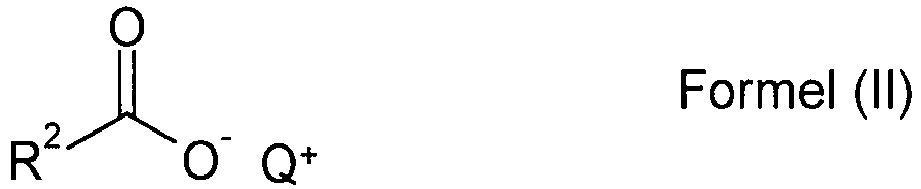
- R2CO
- die Bedeutung von R1 aus Formel (I) und
- Q+
- die Bedeutung von Q+ aus Formel (I) hat,
- d) Wasser,
- e) aber keine organischen Lösungsmittel.
- Die erfindungsgemäßen Zusammensetzungen ermöglichen vorteilhafte erzielbare Gesamtschaumhöhen und zudem gute Schaumstabilitäten.
- Die erfindungsgemäßen Zusammensetzungen erhalten als Komponente a) ein oder mehrere Acylglycinate der Formel (I), worin R1 für eine Acylgruppe mit 6 bis 30, vorzugsweise 8 bis 22 und besonders bevorzugt 8 bis 18 Kohlenstoffatomen steht, und Q+ für ein Kation ausgewählt aus Na+ und K+ und vorzugsweise für Na+ steht, in Mengen von 21,0 - 28,0 Gew.-% und vorzugsweise in Mengen von 23,0 - 27,0 Gew.-%, bezogen auf die gesamte Zusammensetzung, und wobei in dem einen oder den mehreren Acylglycinaten der Formel (I)
der Anteil an gesättigten C8-Acylgruppen 5,0 - 8,0 Gew.-% ist,
der Anteil an gesättigten C10-Acylgruppen 5,0 - 8,0 Gew.-% ist,
der Anteil an C12-Acylgruppen 44,0 - 50,0 Gew.-% ist,
der Anteil an C14-Acylgruppen 14,0 - 20,0 Gew.-% ist,
der Anteil an C16-Acylgruppen 8,0 - 10,0 Gew.-% ist,
der Anteil an gesättigten C18-Acylgruppen 1,0 - 3,0 Gew.-% ist und
der Anteil an ungesättigten C18-Acylgruppen, vorzugsweise an Acylgruppen abgeleitet von Ölsäure, 4,0 - 10,0 Gew.-% ist,
und wobei die genannten Anteile auf die Gesamtmenge der in dem einen oder den mehreren Acylglycinaten enthaltenen Acylgruppen bezogen sind, aber nicht auf Basis der Acylgruppen selbst, sondern auf Basis der zu den Acylgruppen korrespondierenden Fettsäurechloride berechnet werden. - Die Acylgruppen in der einen oder den mehreren Acylglycinaten der Formel (I) sind vorzugsweise linear.
- In dem einen oder den mehreren Acylglycinaten der Formel (I) sind die Acylgruppen mit 12, 14 und 16 Kohlenstoffatomen vorzugsweise gesättigt.
- Vorzugsweise ist in dem einen oder den mehreren Acylglycinaten der Formel (I) der Anteil an Acylgruppen mit 8 bis 18 Kohlenstoffatomen 95 Gew.-% oder größer und besonders bevorzugt 96,5 Gew.-% oder größer, wobei die genannten Anteile auf die Gesamtmenge der in dem einen oder den mehreren Acylglycinaten enthaltenen Acylgruppen bezogen sind, aber nicht auf Basis der Acylgruppen selbst, sondern auf Basis der zu den Acylgruppen korrespondierenden Fettsäurechloride berechnet werden.
- Weiterhin bevorzugt sind Zusammensetzungen enthaltend Natriumcocoylglycinat, wobei der Cocoylschnitt einer natürlichen Kokosfettsäure entspricht.
- Q+Cl- wird im Rahmen der vorliegenden Anmeldung auch als QCI bezeichnet, z. B. Na+Cl- als NaCl.
- In den Verbindungen der Formeln (I) und (II) sowie in Q+Cl- ist Q+ ausgewählt aus Na+ und K+ und vorzugsweise steht Q+ für Na+.
- Die erfindungsgemäßen Zusammensetzungen enthalten die eine oder die mehreren Substanzten Q+Cl- in Mengen größer oder gleich 1,0 Gew.-%, vorzugsweise in Mengen von 1,0 bis 8,0 Gew.-%, besonders bevorzugt in Mengen von 2,0 bis 7,0 Gew.-% und insbesondere bevorzugt in Mengen von 4,0 bis 6,0 Gew.-%, bezogen auf die gesamte Zusammensetzung. Dies ist z.B. für kosmetische Anwendungen sehr vorteilhaft, weil eine gesonderte Zugabe von Q+Cl- als Viskositätsregulierer in den mit Hilfe von erfindungsgemäßen Zusammensetzungen hergestellten kosmetischen Endformulierungen entfallen kann.
- Die erfindungsgemäßen Zusammensetzungen können somit beispielsweise vorteilhaft für kosmetische Anwendungen und zur Herstellung kosmetischer Zubereitungen verwendet werden.
- Die erfindungsgemäßen Zusammensetzungen enthalten das eine oder die mehreren Fettsäuresalze der Formel (II) in Mengen kleiner oder gleich 3,0 Gew.-%, vorzugsweise in Mengen von 0,01 bis 2,0 Gew.-%, besonders bevorzugt in Mengen von 0,1 bis 2,0 Gew.-% und insbesondere bevorzugt in Mengen von 0,1 bis 1,5 Gew.-%, bezogen auf die gesamte Zusammensetzung.
- Ein weiterer Vorteil der erfindungsgemäßen Zusammensetzungen ist, dass diese nur geringe Mengen an Fettsäuresalz der Formel (II) und dadurch Acylglycinate der Formel (I) mit hoher Reinheit enthalten.
- Vorzugsweise ist die Reinheit der in den erfindungsgemäßen Zusammensetzungen enthaltenen Acylglycinate der Formel (I) und vorzugsweise der Natriumcocoylglycinate 90 % oder größer und vorzugsweise 92 % oder größer. Diese Reinheit ist auf die Summe an Fettsäuresalz der Formel (II) und Acylglycinat der Formel (I) bezogen. Sie berechnet sich nach der Formel "Reinheit der Acylglycinate = [Menge an Acylglycinat : (Menge an Acylglycinat + Menge an Fettsäuresalz)]".
- Die erfindungsgemäßen Zusammensetzungen sind bei 40 °C flüssig und einphasig.
- Sehr vorteilhaft ist auch die relativ geringe Viskosität und damit eine einfache Handhabung der erfindungsgemäßen Zusammensetzungen.
- Vorzugsweise weisen die erfindungsgemäßen Zusammensetzungen Viskositäten bei 40 °C von kleiner als 5 000 mPa·s, besonders bevorzugt von 50 bis 2 000 mPa·s und insbesondere bevorzugt von 80 bis 500 mPa·s auf.
- Bei dem für die Bestimmung der Viskosität verwendeten Gerät handelt es sich um ein Rotameter der Firma Thermo Haake (Viskotester 550). Als Spindel wurde MV-DIN (45,3 Umdrehungen / Minute) verwendet.
- Die erfindungsgemäßen Zusammensetzungen enthalten keine organischen Lösungsmittel, wie beispielsweise niedere Alkohole, Diole oder andere organische Lösungsmittel.
- In einer besonders bevorzugten Ausführungsform der Erfindung bestehen die erfindungsgemäßen Zusammensetzungen aus den Komponenten a), b), c) und d).
- In einer weiteren besonders bevorzugten Ausführungsform der Erfindung bestehen die erfindungsgemäßen Zusammensetzungen aus den Komponenten a), b), c), d) und H2NCH2COO- Q+, wobei Q+ für ein Kation ausgewählt aus Na+ und K+ und vorzugsweise für Na+ steht. In diesen erfindungsgemäßen Zusammensetzungen ist die Verbindung H2NCH2COO- Q+, bezogen auf die gesamte erfindungsgemäße Zusammensetzung, vorzugsweise von 0,01 bis 2,0 Gew.-% und besonders bevorzugt von 0,05 bis 1,5 Gew.-%, enthalten.
- Ein weiterer Gegenstand der Erfindung betrifft auch die Herstellung der erfindungsgemäßen Zusammensetzungen durch das erfindungsgemäße Verfahren.
- Wie bereits erwähnt sind die erfindungsgemäßen Zusammensetzungen in vorteilhafter Weise zur Herstellung kosmetischer Zubereitungen geeignet.
- Ein weiterer Gegenstand der Erfindung betrifft daher die Verwendung der erfindungsgemäßen Zusammensetzungen zur Herstellung einer kosmetischen Zubereitung. Besonders vorteilhaft dabei ist, dass die erfindungsgemäßen Zusammensetzungen wie aus dem erfindungsgemäßen Verfahren erhalten, d. h. ohne weitere Aufarbeitung oder Aufreinigung, verwendet werden können.
- Die erfindungsgemäßen Zusammensetzungen sind zudem in vorteilhafter Weise als Tenside in kosmetischen Zubereitungen geeignet.
- Ein weiterer Gegenstand der Erfindung betrifft daher die Verwendung der erfindungsgemäßen Zusammensetzungen als Tenside in kosmetischen Zubereitungen. Die erfindungsgemäßen Zusammensetzungen können auch hierbei direkt wie aus dem erfindungsgemäßen Verfahren erhalten verwendet werden.
- Die nachfolgenden Beispiele und Anwendungen sollen die Erfindung näher erläutern, ohne sie jedoch darauf zu beschränken. Bei allen Prozentangaben handelt es sich um Gewichtsprozent (Gew.-%), sofern nicht explizit anders angegeben.
- Spezifikation des verwendeten Cocoylchlorids:
C8/C10 gesättigt: 10,0 - 14,0 Gew.-% C12: 60,0 - 62,0 Gew.-% C14: 19,0 - 24,0 Gew.-% C16: 3,0 - 10,0 Gew.-% C18 gesättigt: < 2,0 Gew.-% - 37,8 g (0,504 mol) Glycin wird in 276 g VE-Wasser (vollentsalztes Wasser) unter Rühren gelöst und der pH-Wert (telquel) mit Natronlauge (33 Gew.-% in Wasser) auf 12 - 13 eingestellt. Anschließend wird unter Rühren auf 30 - 35 °C aufgeheizt und 106,4 g (0,478 mol) Cocoylchlorid (A) innerhalb 6 Stunden bei 30 - 35 °C unter Kühlung des Reaktionsgemisches zudosiert. Der pH-Wert wird durch gleichzeitige Dosierung von Natronlauge (33 Gew.-% in Wasser) bei 12 - 13 gehalten. Gegen Ende der Dosierung des Cocoylchlorids lässt man den pH-Wert auf 9,5 - 10,5 abfallen. Zur Vervollständigung der Reaktion wird noch 2 Stunden bei pH 9,5 - 10,5 gerührt.
- Das erhaltene Produkt hat folgende Eigenschaften:
Bei 25 °C: flüssig, opal Trockenrückstand (1 Stunde, 140 °C): 31,0 Gew.-% Glycinsalz (HPLC): 0,6 Gew.-% Fettsäuresalz (HPLC): 0,6 Gew.-% NaCl (Titration): 5,3 Gew.-% Aktivgehalt: 24,5 Gew.-% Viskosität (35 °C): 756 mPa·s - Die Berechnung der Gewichtsmenge an Acylglycinat in den Zusammensetzungen erfolgt durch die Formel "Gewichtsmenge an Acylglycinat = Trockenrückstand - Fettsäuresalz - Glycinsalz - Q+Cl-". Der Wert wird im Rahmen der vorliegenden Anmeldung als "Aktivgehalt" bezeichnet.
- Vergleichbeispiel 1 entspricht dem Stand der Technik der
WO 2009/065530 . Hierbei wird eine bei Raumtemperatur (25 °C) flüssige Lösung von Natriumcocoylglycinat erhalten, die jedoch auf einem kommerziell weniger verfügbaren Kettenschnitt beruht. - Verteilung des verwendeten Cocoylchlorids (B) :
C12: 55,6 Gew.-% C14: 23,0 Gew.-% C16: 11,1 Gew.-% C18 gesättigt: 10,3 Gew.-% - 36,0 g (0,480 mol) Glycin wird in 280 g VE-Wasser unter Rühren gelöst und der pH-Wert (telquel) mit Natronlauge (33 Gew.-% in Wasser) auf 12-13 eingestellt. Anschließend wird unter Rühren auf 30 - 35 °C aufgeheizt und 109,6 g (0,456 mol) Cocoylchlorid (B) innerhalb 6 Stunden bei 30 - 35 °C unter Kühlung des Reaktionsgemisches zudosiert. Der pH-Wert wird durch gleichzeitige Dosierung von Natronlauge (33 Gew.-% in Wasser) bei 12 - 13 gehalten. Im Laufe der Dosierung des Cocoylchlorids wird der Ansatz immer zähflüssiger bis er nicht mehr rührbar ist. Durch Zugabe von 110 g Wasser und anschließende Erhöhung der Reaktionstemperatur auf 40 °C bleibt der Ansatz einigermaßen rührbar. Gegen Ende der Dosierung des Cocoylchlorids lässt man den den pH-Wert auf 9,5 - 10,5 abfallen. Zur Vervollständigung der Reaktion wird noch 2 Stunden bei pH 9,5 - 10,5 gerührt.
- Das erhaltene Produkt hat folgende Eigenschaften:
Bei 25 °C: flüssig, trüb Trockenrückstand (1 Stunde, 140 °C): 25,8 Gew.-% Glycinsalz (HPLC): 0,8 Gew.-% Fettsäuresalz (HPLC): 1,2 Gew.-% NaCl (Titration): 4,1 Gew.-% Aktivgehalt: 19,7 Gew.-% Viskosität: nicht bestimmt - Vergleichsbeispiel 2 zeigt, dass höhere Gehalte an gesättigten C16/18-Fettsäurechloriden zu niedrigkonzentrierten, nicht handhabbaren Glycinatlösungen führen, sofern im Säurechlorid keine Anteile an C8-, C10- und ungesättigtem C18-Säurechlorid vorliegen.
-
Verteilung des verwendeten Cocoylchlorids: Fettsäurechlorid Gew.-% C6-Fettsäurechlorid 0,5 C8-Fettsäurechlorid, gesättigt 7,4 C10-Fettsäurechlorid, gesättigt 5,9 C12-Fettsäurechlorid 49,4 C14-Fettsäurechlorid 18,5 C16-Fettsäurechlorid 8,4 C18-Fettsäurechlorid, ungesättigt 5,2 C18-Fettsäurechlorid, gesättigt 2,2 Summe x 2,5 x: unbestimmte Substanzen - 18,9 g (0,252 mol) Glycin wird in 146 g VE-Wasser unter Rühren gelöst und der pH-Wert (telquel) mit Natronlauge (33 Gew.-% in Wasser) auf 12 - 13 eingestellt. Anschließend wird unter Rühren auf 35 - 40°C aufgeheizt und 53,1 g (0,239 mol) Cocoylchlorid innerhalb 6 Stunden bei 35 - 40°C unter Kühlung des Reaktionsgemisches zudosiert. Der pH-Wert wird durch gleichzeitige Dosierung von Natronlauge (33 Gew.-% in Wasser) bei 12 - 13 gehalten. Gegen Ende der Dosierung des Cocoylchlorids lässt man den pH-Wert auf 9,5 - 10,5 abfallen. Zur Vervollständigung der Reaktion wird noch 2 Stunden bei 40 °C und pH 9,5 - 10,5 gerührt.
- Das erhaltene Produkt hat folgende Eigenschaften:
Bei 40 °C: dünnflüssig, klar, homogen Trockenrückstand (1 Stunde, 140 °C): 30,0 Gew.-% Glycinsalz (HPLC): 0,9 Gew.-% Fettsäuresalz (HPLC): 1,8 Gew.-% NaCl (Titration): 5,0 Gew.-% Aktivgehalt: 22,3 Gew.-% Viskosität (40 °C): 100 mPa·s - Das erfindungsgemäße Beispiel 1 zeigt, dass mit Fettsäurechloriden, die sowohl signifikante Mengen C8- und C10-Fettsäurechlorid, als auch ungesättigtes C18-Fettsäurechlorid enthalten (Kettenschnitt entsprechend einem natürlich vorkommenden Kokosfettsäureschnitt), bei 40 °C homogene Glycinatlösungen mit einem hohen Aktivgehalt erhalten werden.
-
Verteilung des verwendeten Cocoylchlorids: Fettsäurechlorid Gew.-% C8-Fettsäurechlorid, gesättigt 0,1 C10-Fettsäurechlorid, gesättigt 0,5 C12-Fettsäurechlorid 55,1 C14-Fettsäurechlorid 23,0 C16-Fettsäurechlorid 10,7 C18-Säurechlorid, ungesättigt 6,8 C18-Säurechlorid, gesättigt 2,9 Summe x 1,0 x: unbestimmte Substanzen - 18,9 g (0,252 mol) Glycin wird in 155 g VE-Wasser unter Rühren gelöst und der pH-Wert (telquel) mit Natronlauge (33 Gew.-% in Wasser) auf 12 - 13 eingestellt. Anschließend wird unter Rühren auf 35 - 40 °C aufgeheizt und 57,2 g (0,239 mol) Cocoylchlorid innerhalb 6 Stunden bei 35 - 40 °C unter Kühlung des Reaktionsgemisches zudosiert. Der pH-Wert wird durch gleichzeitige Dosierung von Natronlauge (33 Gew.-% in Wasser) bei 12 - 13 gehalten. Im Laufe der Dosierung des Cocoylchlorids wird der Ansatz immer zähflüssiger bis er schließlich nicht mehr rührbar ist. Dies macht es notwendig, die Temperatur zuerst auf 45 °C und dann auf 50 °C anzuheben. Trotzdem bleibt der Ansatz viskos. Gegen Ende der Dosierung des Cocoylchlorids lässt man den pH-Wert auf 9,5 - 10,5 abfallen. Zur Vervollständigung der Reaktion wird noch 2 Stunden bei 50 °C und pH 9,5 - 10,5 gerührt.
- Das erhaltene Produkt hat folgende Eigenschaften:
Bei 40 °C: nicht rührbare zähe Masse Trockenrückstand (1 Stunde, 140 °C): 31,2 Gew.-% Glycinsalz (HPLC): 2,5 Gew.-% Fettsäuresalz (HPLC): 4,4 Gew.-% NaCl (Titration): 4,6 Gew.-% Aktivgehalt: 19,7 Gew.-% Viskosität: nicht bestimmt - Das Vergleichsbeispiel 3 zeigt, dass mit Fettsäurechloriden, die keine signifikanten Mengen C8- und C10-Fettsäurechlorid, aber andererseits signifikante Mengen ungesättigtes C18-Fettsäurechlorid enthalten (entsprechend einem kommerziellen, natürlich vorkommenden Kokosfettsäureschnitt, der gekappt wurde), als Produkte bei 40 °C lediglich nicht rührbare, zähe Massen mit geringer Reinheit erhalten werden.
-
Verteilung des verwendeten Cocoylchlorids: Fettsäurechlorid Gew.-% C8-Fettsäurechlorid, gesättigt 5,0 C10-Fettsäurechlorid, gesättigt 8,0 C12-Fettsäurechlorid 48,3 C14-Fettsäurechlorid 20,1 C16-Fettsäurechlorid 9,3 C18-Fettsäurechlorid, ungesättigt 5,8 C18-Fettsäurechlorid, gesättigt 2,5 Summe x 1,0 x: unbestimmte Substanzen - 18,9 g (0,252 mol) Glycin wird in 156 g VE-Wasser unter Rühren gelöst und der pH-Wert (telquel) mit Natronlauge (33 Gew.-% in Wasser) auf 12 - 13 eingestellt.
- Anschließend wird unter Rühren auf 35 - 40 °C aufgeheizt und 55,5 g (0,239 mol) Cocoylchlorid innerhalb 6 Stunden bei 35 - 40 °C unter Kühlung des Reaktionsgemisches zudosiert. Der pH-Wert wird durch gleichzeitige Dosierung von Natronlauge (33 Gew.-% in Wasser) bei 12 - 13 gehalten. Der Ansatz ist gut rührbar. Gegen Ende der Dosierung des Cocoylchlorids lässt man den pH-Wert auf 9,5 - 10,5 abfallen. Zur Vervollständigung der Reaktion wird noch 2 Stunden bei 40 °C und pH 9,5 - 10,5 gerührt.
- Das erhaltene Produkt hat folgende Eigenschaften:
Bei 40 °C: dünnflüssig, klar, homogen Trockenrückstand (1 Stunde, 140 °C): 29,7 Gew.-% Glycinsalz (HPLC): 0,8 Gew.-% Fettsäuresalz (HPLC): 1,9 Gew.-% NaCl (Titration): 4,6 Gew.-% Aktivgehalt: 22,4 Gew.-% Viskosität (40 °C): 388 mPa·s - Das erfindungsgemäße Beispiel 2 zeigt, dass mit Fettsäurechloriden, die sowohl signifikante Mengen an C8- und C10-Fettsäurechlorid, als auch an ungesättigtem C18-Fettsäurechlorid enthalten (Kettenschnitt entsprechend einem natürlich vorkommenden Kokosfettsäureschnitt), bei 40 °C homogene Glycinatlösungen mit hohem Aktivgehalt erhalten werden.
- Das Schaumvermögen wurde in einem SITA Foamtester bei einer Tensidkonzentration von 0,01 Gew.-% bei pH = 9 und 37 °C gemessen. In der folgenden Tabelle 1 sind die Schaumhöhen in Abhängigkeit den Rührzyklen wiedergegeben.
Tabelle 1: gemessene Schaumhöhen [mm] in Abhängigkeit von den Rührzyklen Rührzyklen 2 4 6 8 10 15 20 25 30 Schaumhöhen [mm] Beispiel 1 22 60 98 130 150 195 225 235 245 Schaumhöhen [mm] Vergleichsbeispiel 1 96 130 130 130 130 130 130 130 130 - Die in Tabelle 1 wiedergegebenen Versuchsergebnisse zeigen, dass das erfindungsgemäße Acylglycinat bzw. die erfindungsgemäßen Zusammensetzungen deutlich höhere erzielbare Gesamtschaumhöhen als das Acylglycinat bzw. die Zusammensetzung aus Vergleichsbeispiel 1 ermöglichen. Die hohen erzielbaren Gesamtschaumhöhen führen z. B. in kosmetischen Formulierungen zu cremigen Schäumen, die sensorisch ansprechend sind.
und für eine Acylgruppe mit 6 bis 30, vorzugsweise 8 bis 22 und besonders bevorzugt 8 bis 18 Kohlenstoffatomen steht, wobei
der Anteil an Fettsäurechloriden mit gesättigten C8-Acylgruppen 5,0 - 8,0 Gew.-% ist,
der Anteil an Fettsäurechloriden mit gesättigten C10-Acylgruppen 5,0 - 8,0 Gew.-% ist,
der Anteil an Fettsäurechloriden mit C12-Acylgruppen 44,0 - 50,0 Gew.-% ist,
der Anteil an Fettsäurechloriden mit C14-Acylgruppen 14,0 - 20,0 Gew.-% ist,
der Anteil an Fettsäurechloriden mit C16-Acylgruppen 8,0 - 10,0 Gew.-% ist,
der Anteil an Fettsäurechloriden mit gesättigten C18-Acylgruppen 1,0 - 3,0 Gew.-% ist, und
der Anteil an Fettsäurechloriden mit ungesättigten C18-Acylgruppen 4,0 - 10,0 Gew.-% ist,
jeweils bezogen auf die Gesamtmenge an eingesetztem Fettsäurechlorid,
in Wasser und in Gegenwart einer basischen Alkaliverbindung, die Kationen Q+ ausgewählt aus Na+ und K+ und vorzugsweise Na+ liefert, aber in Abwesenheit von organischen Lösungsmitteln, bei einer Temperatur von 25 - 50 °C, bevorzugt bei einer Temperatur von 30 - 40 °C, hergestellt werden.
und für eine Acylgruppe mit 6 bis 30, vorzugsweise 8 bis 22 und besonders bevorzugt 8 bis 18 Kohlenstoffatomen steht, wobei
der Anteil an Fettsäurechloriden mit gesättigten C8-Acylgruppen 5,0 - 8,0 Gew.-% ist,
der Anteil an Fettsäurechloriden mit gesättigten C10-Acylgruppen 5,0 - 8,0 Gew.-% ist,
der Anteil an Fettsäurechloriden mit C12-Acylgruppen 44,0 - 50,0 Gew.-% ist,
der Anteil an Fettsäurechloriden mit C14-Acylgruppen 14,0 - 20,0 Gew.-% ist,
der Anteil an Fettsäurechloriden mit C16-Acylgruppen 8,0 - 10,0 Gew.-% ist,
der Anteil an Fettsäurechloriden mit gesättigten C18-Acylgruppen 1,0 - 3,0 Gew.-% ist, und
der Anteil an Fettsäurechloriden mit ungesättigten C18-Acylgruppen 4,0 - 10,0 Gew.-% ist,
jeweils bezogen auf die Gesamtmenge an eingesetztem Fettsäurechlorid,
in Wasser und in Gegenwart einer basischen Alkaliverbindung, die Kationen Q+ ausgewählt aus Na+ und K+ und vorzugsweise Na+ liefert, aber in Abwesenheit von organischen Lösungsmitteln, bei 25 - 50 °C, vorzugsweise bei 30 - 40 °C, umgesetzt wird.
Claims (13)
- Verfahren zur Herstellung von Acylglycinaten der Formel (I)
 R1 für eine lineare oder verzweigte, gesättigte Alkanoylgruppe mit 6 bis 30 Kohlenstoffatomen oder für eine lineare oder verzweigte, ein- oder mehrfach ungesättigte Alkenoylgruppe mit 6 bis 30 Kohlenstoffatomen steht, undQ+ für ein Kation ausgewählt aus den Alkalimetallkationen Na+ und K+ steht,dadurch gekennzeichnet, dass Glycin mit Fettsäurechlorid R1Cl, wobei R1 die in Formel (I) angegebene Bedeutung besitzt,
und für eine Acylgruppe mit 6 bis 30 Kohlenstoffatomen steht, wobei der Anteil an Fettsäurechloriden mit gesättigten C8-Acylgruppen 5,0 - 8,0 Gew.-% ist,
der Anteil an Fettsäurechloriden mit gesättigten C10-Acylgruppen 5,0 - 8,0 Gew.-% ist,
der Anteil an Fettsäurechloriden mit C12-Acylgruppen 44,0 - 50,0 Gew.-% ist,
der Anteil an Fettsäurechloriden mit C14-Acylgruppen 14,0 - 20,0 Gew.-% ist,
der Anteil an Fettsäurechloriden mit C16-Acylgruppen 8,0 - 10,0 Gew.-% ist,
der Anteil an Fettsäurechloriden mit gesättigten C18-Acylgruppen 1,0 - 3,0 Gew.-% ist und
der Anteil an Fettsäurechloriden mit ungesättigten C18-Acylgruppen 4,0 - 10,0 Gew.-% ist,
jeweils bezogen auf die Gesamtmenge an eingesetztem Fettsäurechlorid, in Wasser und in Gegenwart einer basischen Alkaliverbindung, die Kationen Q+ ausgewählt aus Na+ und K+ liefert, aber in Abwesenheit von organischen Lösungsmitteln, bei 25 - 50 °C umgesetzt wird. - Verfahren nach Anspruch 1, dadurch gekennzeichnet, dass als basische Alkaliverbindungen Carbonate oder Hydroxide der Alkalimetallkationen Na+ oder K+ oder Mischungen davon eingesetzt werden.
- Verfahren nach Anspruch 1 oder 2, dadurch gekennzeichnet, dass es bei einem pH-Wert von 9 bis 13 durchgeführt wird.
- Verfahren nach einem oder mehreren der Ansprüche 1 bis 3, dadurch gekennzeichnet, dass das molare Verhältnis von Glycin zu Fettsäurechlorid R1Cl von 1,1 : 1,0 bis 1,0 : 1,0 ist.
- Zusammensetzung enthaltenda) ein oder mehrere Acylglycinate der Formel (I)
 R1 für eine lineare oder verzweigte, gesättigte Alkanoylgruppe mit 6 bis 30 Kohlenstoffatomen oder für eine lineare oder verzweigte, ein- oder mehrfach ungesättigte Alkenoylgruppe mit 6 bis 30 Kohlenstoffatomen steht, undQ+ für ein Kation ausgewählt aus den Alkalimetallkationen Na+ und K+ steht,in Mengen von 21,0 - 28,0 Gew.-%, bezogen auf die gesamte Zusammensetzung, und wobei in dem einen oder den mehreren Acylglycinaten der Formel (I)
der Anteil an gesättigten C8-Acylgruppen 5,0 - 8,0 Gew.-% ist,
der Anteil an gesättigten C10-Acylgruppen 5,0 - 8,0 Gew.-% ist,
der Anteil an C12-Acylgruppen 44,0 - 50,0 Gew.-% ist,
der Anteil an C14-Acylgruppen 14,0 - 20,0 Gew.-% ist,
der Anteil an C16-Acylgruppen 8,0 - 10,0 Gew.-% ist,
der Anteil an gesättigten C18-Acylgruppen 1,0 - 3,0 Gew.-% ist und
der Anteil an ungesättigten C18-Acylgruppen 4,0 - 10,0 Gew.-% ist,
und wobei die genannten Anteile auf die Gesamtmenge der in dem einen oder den mehreren Acylglycinaten enthaltenen Acylgruppen bezogen sind, aber nicht auf Basis der Acylgruppen selbst, sondern auf Basis der zu den Acylgruppen korrespondierenden Fettsäurechloride berechnet werden,b) ein oder mehrere Substanzen Q+Cl-, worin Q+ die Bedeutung von Q+ aus Formel (I) hat, in Mengen größer oder gleich 1,0 Gew.-%, bezogen auf die gesamte Zusammensetzung,c) ein oder mehrere Fettsäuresalze der Formel (II) R2CO die Bedeutung von R1 aus Formel (I) undQ+ die Bedeutung von Q+ aus Formel (I) hat,in Mengen kleiner oder gleich 3,0 Gew.-%, bezogen auf die gesamte Zusammensetzung, undd) Wasser,e) aber keine organischen Lösungsmittel.
 - Zusammensetzung nach Anspruch 5, dadurch gekennzeichnet, dass sie die Komponente a) in Mengen von 23,0 - 27,0 Gew.-%, bezogen auf die gesamte Zusammensetzung, enthält.
- Zusammensetzung nach Anspruch 5 oder 6, dadurch gekennzeichnet, dass Q+ für Na+ steht.
- Zusammensetzung nach einem oder mehreren der Ansprüche 5 bis 7, dadurch gekennzeichnet, dass sie die eine oder die mehreren Substanzen Q+Cl- in Mengen von 1,0 bis 8,0 Gew.-%, bezogen auf die gesamte Zusammensetzung, enthält.
- Zusammensetzung nach einem oder mehreren der Ansprüche 5 bis 8, dadurch gekennzeichnet, dass sie das eine oder die mehreren Fettsäuresalze der Formel (II) in Mengen von 0,01 bis 2,0 Gew.-%, bezogen auf die gesamte Zusammensetzung, enthält.
- Zusammensetzung nach einem oder mehreren der Ansprüche 5 bis 9, dadurch gekennzeichnet, dass die Reinheit der darin enthaltenen Acylglycinate der Formel (I) 90 % oder größer ist, wobei diese Reinheit auf die Summe an Fettsäuresalz der Formel (II) und Acylglycinat der Formel (I) bezogen ist und sich nach der Formel "Reinheit der Acylglycinate = [Menge an Acylglycinat : (Menge an Acylglycinat + Menge an Fettsäuresalz)]" berechnet.
- Zusammensetzung nach einem oder mehreren der Ansprüche 5 bis 10, dadurch gekennzeichnet, dass sie eine Viskosität bei 40 °C von kleiner als 5 000 mPa·s aufweist.
- Verwendung einer Zusammensetzung nach einem oder mehreren der Ansprüche 5 bis 11 zur Herstellung einer kosmetischen Zubereitung.
- Verwendung einer Zusammensetzung nach einem oder mehreren der Ansprüche 5 bis 11 als Tensid in einer kosmetischen Zubereitung.
Priority Applications (1)
| Application Number | Priority Date | Filing Date | Title |
|---|---|---|---|
| EP16191908.9A EP3156392A1 (de) | 2011-07-15 | 2012-07-11 | Verwendung von acylglycinaten zum schäumen kosmetischer zusammensetzungen |
Applications Claiming Priority (2)
| Application Number | Priority Date | Filing Date | Title |
|---|---|---|---|
| DE102011107503A DE102011107503A1 (de) | 2011-07-15 | 2011-07-15 | Verfahren zur Herstellung von Acylglycinaten und Zusammensetzungen enthaltend derartige Verbindungen |
| PCT/EP2012/002931 WO2013010650A1 (de) | 2011-07-15 | 2012-07-11 | Verfahren zur herstellung von acylglycinaten und zusammensetzungen enthaltend derartige verbindungen |
Related Child Applications (1)
| Application Number | Title | Priority Date | Filing Date |
|---|---|---|---|
| EP16191908.9A Division EP3156392A1 (de) | 2011-07-15 | 2012-07-11 | Verwendung von acylglycinaten zum schäumen kosmetischer zusammensetzungen |
Publications (2)
| Publication Number | Publication Date |
|---|---|
| EP2731929A1 EP2731929A1 (de) | 2014-05-21 |
| EP2731929B1 true EP2731929B1 (de) | 2016-10-05 |
Family
ID=45566414
Family Applications (2)
| Application Number | Title | Priority Date | Filing Date |
|---|---|---|---|
| EP12737207.6A Not-in-force EP2731929B1 (de) | 2011-07-15 | 2012-07-11 | Verfahren zur herstellung von acylglycinaten und zusammensetzungen enthaltend derartige verbindungen |
| EP16191908.9A Withdrawn EP3156392A1 (de) | 2011-07-15 | 2012-07-11 | Verwendung von acylglycinaten zum schäumen kosmetischer zusammensetzungen |
Family Applications After (1)
| Application Number | Title | Priority Date | Filing Date |
|---|---|---|---|
| EP16191908.9A Withdrawn EP3156392A1 (de) | 2011-07-15 | 2012-07-11 | Verwendung von acylglycinaten zum schäumen kosmetischer zusammensetzungen |
Country Status (8)
| Country | Link |
|---|---|
| US (2) | US9662287B2 (de) |
| EP (2) | EP2731929B1 (de) |
| JP (1) | JP2014523434A (de) |
| CN (1) | CN103748069A (de) |
| BR (1) | BR112014000701A2 (de) |
| DE (1) | DE102011107503A1 (de) |
| ES (1) | ES2617609T3 (de) |
| WO (1) | WO2013010650A1 (de) |
Families Citing this family (6)
| Publication number | Priority date | Publication date | Assignee | Title |
|---|---|---|---|---|
| GB201215054D0 (en) * | 2012-08-23 | 2012-10-10 | Unilever Plc | Mild foaming make-up remover composition |
| EP3016746A2 (de) | 2013-07-05 | 2016-05-11 | Akzo Nobel Chemicals International B.V. | Synthese von neuen anionischen tensiden und deren verwendung als sammler bei der schaumflotation nichtsulfidischer erze |
| JP7338471B2 (ja) | 2017-11-06 | 2023-09-05 | 味の素株式会社 | 洗浄剤組成物 |
| CN108358802A (zh) * | 2018-01-05 | 2018-08-03 | 石家庄菠莉亚日用化工有限公司 | 一种脂肪酰基甘氨酸盐表面活性剂的制备方法 |
| CN112190494A (zh) * | 2020-07-06 | 2021-01-08 | 拜尔斯道夫股份有限公司 | 化妆品清洁配制物 |
| US20220401328A1 (en) * | 2021-06-08 | 2022-12-22 | The Procter & Gamble Company | N-acyl amino acid surfactants and derivatives thereof |
Family Cites Families (6)
| Publication number | Priority date | Publication date | Assignee | Title |
|---|---|---|---|---|
| DE4415312A1 (de) * | 1994-05-02 | 1995-11-09 | Hoechst Ag | Verfahren zur Herstellung von N-Acylglycinderivaten |
| JP3304646B2 (ja) | 1994-06-07 | 2002-07-22 | 味の素株式会社 | 洗浄剤組成物 |
| DE19629717C1 (de) * | 1996-07-25 | 1998-02-12 | Hoechst Ag | Verfahren zur katalytischen Herstellung von N-Acylglycinderivaten |
| EP1419137A2 (de) | 2001-01-18 | 2004-05-19 | Cognis Deutschland GmbH & Co. KG | Verfahren zur herstellung von acylaminosäuren |
| US20070299269A1 (en) * | 2006-06-27 | 2007-12-27 | Conopco, Inc., D/B/A Unilever | Process for converting primary amidoalcohols to amidocarboxylic acids in high yield |
| DE102007055265A1 (de) * | 2007-11-20 | 2009-05-28 | Clariant International Ltd. | Verfahren zur Herstellung von Acylglycinaten |
-
2011
- 2011-07-15 DE DE102011107503A patent/DE102011107503A1/de not_active Withdrawn
-
2012
- 2012-07-11 CN CN201280034817.XA patent/CN103748069A/zh active Pending
- 2012-07-11 JP JP2014519452A patent/JP2014523434A/ja active Pending
- 2012-07-11 BR BR112014000701A patent/BR112014000701A2/pt not_active IP Right Cessation
- 2012-07-11 US US14/232,844 patent/US9662287B2/en not_active Expired - Fee Related
- 2012-07-11 EP EP12737207.6A patent/EP2731929B1/de not_active Not-in-force
- 2012-07-11 WO PCT/EP2012/002931 patent/WO2013010650A1/de not_active Ceased
- 2012-07-11 ES ES12737207.6T patent/ES2617609T3/es active Active
- 2012-07-11 EP EP16191908.9A patent/EP3156392A1/de not_active Withdrawn
-
2017
- 2017-04-24 US US15/494,900 patent/US20170226048A1/en not_active Abandoned
Also Published As
| Publication number | Publication date |
|---|---|
| US20140213665A1 (en) | 2014-07-31 |
| CN103748069A (zh) | 2014-04-23 |
| US9662287B2 (en) | 2017-05-30 |
| DE102011107503A1 (de) | 2012-03-01 |
| JP2014523434A (ja) | 2014-09-11 |
| BR112014000701A2 (pt) | 2017-01-10 |
| WO2013010650A1 (de) | 2013-01-24 |
| US20170226048A1 (en) | 2017-08-10 |
| ES2617609T3 (es) | 2017-06-19 |
| EP3156392A1 (de) | 2017-04-19 |
| EP2731929A1 (de) | 2014-05-21 |
Similar Documents
| Publication | Publication Date | Title |
|---|---|---|
| EP2212278B1 (de) | Verfahren zur herstellung von acylglycinaten | |
| EP2731929B1 (de) | Verfahren zur herstellung von acylglycinaten und zusammensetzungen enthaltend derartige verbindungen | |
| EP0560114B1 (de) | Wässrige flüssige Lösung eines Betains mit mindestens 40 Gew.-% Festkörpergehalt | |
| EP2990026B1 (de) | Wässrige Tensid-Zusammensetzungen | |
| EP2739136B1 (de) | Verwendung von isosorbiddiestern als verdicker | |
| EP2902011B1 (de) | Wässrige tensid-zusammensetzungen | |
| DE69433755T3 (de) | Verfahren zur Herstellung von Imidazolin abgeleiteten Amphoacetat-Tensiden von höherer Reinheit | |
| EP2655586A1 (de) | Zusammensetzungen enthaltend sekundäres paraffinsulfonat und alkoholalkoxylat | |
| DE1668525B2 (de) | Hydroxylierte Verbindungen und diese enthaltende Mittel | |
| EP3630056B1 (de) | Verfahren zur herstellung von hellfarbigem disalz | |
| EP0647613B1 (de) | Verfahren zur Herstellung hochkonzentrierter fliessfähiger wässriger Lösungen von Betainen | |
| DE4412481A1 (de) | Verfahren zur Herstellung hochkonzentrierter fließfähiger wäßriger Lösungen von Betainen | |
| EP0609274A1 (de) | Verfahren zur herstellung hellfarbiger alkyloligoglykosid-pasten. | |
| EP2655585A1 (de) | Zusammensetzungen enthaltend sekundäres paraffinsulfonat und alkoholalkoxylat | |
| EP0739878B1 (de) | Verfahren zur Herstellung hochkonzentrierter fliessfähiger wässriger Lösungen von Betainen | |
| DE69314698T2 (de) | Verwendung eines Amids als Verdickungsmittel und dieses enthaltende Zusammensetzung | |
| DE10040165A1 (de) | ortho-Phenylphenolat-Konzentrate | |
| EP2655584A1 (de) | Zusammensetzungen enthaltend sekundäres paraffinsulfonat und tetrahydroxypropylethylendiamin | |
| EP3458025B1 (de) | Wässrige tensid-zusammensetzungen | |
| EP3246008A1 (de) | Wässrige tensid-zusammensetzungen | |
| DE102008017379B4 (de) | Wässrige Lösung zur Oxidation, Entkeimung und Desodorierung sowie Verfahren zur Herstellung dieser Lösung | |
| DE102018205244A1 (de) | Kosmetische Reinigungszubereitung enthaltend Amylase | |
| EP3246012A1 (de) | Wässrige tensid-zusammensetzungen | |
| WO2018007059A1 (de) | Wässrige tensid-zusammensetzungen |
Legal Events
| Date | Code | Title | Description |
|---|---|---|---|
| PUAI | Public reference made under article 153(3) epc to a published international application that has entered the european phase |
Free format text: ORIGINAL CODE: 0009012 |
|
| 17P | Request for examination filed |
Effective date: 20140217 |
|
| AK | Designated contracting states |
Kind code of ref document: A1 Designated state(s): AL AT BE BG CH CY CZ DE DK EE ES FI FR GB GR HR HU IE IS IT LI LT LU LV MC MK MT NL NO PL PT RO RS SE SI SK SM TR |
|
| DAX | Request for extension of the european patent (deleted) | ||
| 17Q | First examination report despatched |
Effective date: 20141219 |
|
| RAP1 | Party data changed (applicant data changed or rights of an application transferred) |
Owner name: CLARIANT INTERNATIONAL LTD |
|
| TPAC | Observations by third parties |
Free format text: ORIGINAL CODE: EPIDOSNTIPA |
|
| GRAP | Despatch of communication of intention to grant a patent |
Free format text: ORIGINAL CODE: EPIDOSNIGR1 |
|
| INTG | Intention to grant announced |
Effective date: 20160429 |
|
| GRAS | Grant fee paid |
Free format text: ORIGINAL CODE: EPIDOSNIGR3 |
|
| GRAA | (expected) grant |
Free format text: ORIGINAL CODE: 0009210 |
|
| AK | Designated contracting states |
Kind code of ref document: B1 Designated state(s): AL AT BE BG CH CY CZ DE DK EE ES FI FR GB GR HR HU IE IS IT LI LT LU LV MC MK MT NL NO PL PT RO RS SE SI SK SM TR |
|
| RAP1 | Party data changed (applicant data changed or rights of an application transferred) |
Owner name: CLARIANT INTERNATIONAL LTD |
|
| REG | Reference to a national code |
Ref country code: GB Ref legal event code: FG4D Free format text: NOT ENGLISH |
|
| REG | Reference to a national code |
Ref country code: CH Ref legal event code: EP |
|
| REG | Reference to a national code |
Ref country code: AT Ref legal event code: REF Ref document number: 834495 Country of ref document: AT Kind code of ref document: T Effective date: 20161015 |
|
| REG | Reference to a national code |
Ref country code: IE Ref legal event code: FG4D Free format text: LANGUAGE OF EP DOCUMENT: GERMAN |
|
| REG | Reference to a national code |
Ref country code: DE Ref legal event code: R096 Ref document number: 502012008435 Country of ref document: DE |
|
| REG | Reference to a national code |
Ref country code: NL Ref legal event code: MP Effective date: 20161005 |
|
| REG | Reference to a national code |
Ref country code: LT Ref legal event code: MG4D |
|
| PG25 | Lapsed in a contracting state [announced via postgrant information from national office to epo] |
Ref country code: LV Free format text: LAPSE BECAUSE OF FAILURE TO SUBMIT A TRANSLATION OF THE DESCRIPTION OR TO PAY THE FEE WITHIN THE PRESCRIBED TIME-LIMIT Effective date: 20161005 |
|
| PG25 | Lapsed in a contracting state [announced via postgrant information from national office to epo] |
Ref country code: GR Free format text: LAPSE BECAUSE OF FAILURE TO SUBMIT A TRANSLATION OF THE DESCRIPTION OR TO PAY THE FEE WITHIN THE PRESCRIBED TIME-LIMIT Effective date: 20170106 Ref country code: NO Free format text: LAPSE BECAUSE OF FAILURE TO SUBMIT A TRANSLATION OF THE DESCRIPTION OR TO PAY THE FEE WITHIN THE PRESCRIBED TIME-LIMIT Effective date: 20170105 Ref country code: SE Free format text: LAPSE BECAUSE OF FAILURE TO SUBMIT A TRANSLATION OF THE DESCRIPTION OR TO PAY THE FEE WITHIN THE PRESCRIBED TIME-LIMIT Effective date: 20161005 Ref country code: LT Free format text: LAPSE BECAUSE OF FAILURE TO SUBMIT A TRANSLATION OF THE DESCRIPTION OR TO PAY THE FEE WITHIN THE PRESCRIBED TIME-LIMIT Effective date: 20161005 |
|
| PG25 | Lapsed in a contracting state [announced via postgrant information from national office to epo] |
Ref country code: PT Free format text: LAPSE BECAUSE OF FAILURE TO SUBMIT A TRANSLATION OF THE DESCRIPTION OR TO PAY THE FEE WITHIN THE PRESCRIBED TIME-LIMIT Effective date: 20170206 Ref country code: HR Free format text: LAPSE BECAUSE OF FAILURE TO SUBMIT A TRANSLATION OF THE DESCRIPTION OR TO PAY THE FEE WITHIN THE PRESCRIBED TIME-LIMIT Effective date: 20161005 Ref country code: NL Free format text: LAPSE BECAUSE OF FAILURE TO SUBMIT A TRANSLATION OF THE DESCRIPTION OR TO PAY THE FEE WITHIN THE PRESCRIBED TIME-LIMIT Effective date: 20161005 Ref country code: IS Free format text: LAPSE BECAUSE OF FAILURE TO SUBMIT A TRANSLATION OF THE DESCRIPTION OR TO PAY THE FEE WITHIN THE PRESCRIBED TIME-LIMIT Effective date: 20170205 Ref country code: FI Free format text: LAPSE BECAUSE OF FAILURE TO SUBMIT A TRANSLATION OF THE DESCRIPTION OR TO PAY THE FEE WITHIN THE PRESCRIBED TIME-LIMIT Effective date: 20161005 Ref country code: PL Free format text: LAPSE BECAUSE OF FAILURE TO SUBMIT A TRANSLATION OF THE DESCRIPTION OR TO PAY THE FEE WITHIN THE PRESCRIBED TIME-LIMIT Effective date: 20161005 Ref country code: RS Free format text: LAPSE BECAUSE OF FAILURE TO SUBMIT A TRANSLATION OF THE DESCRIPTION OR TO PAY THE FEE WITHIN THE PRESCRIBED TIME-LIMIT Effective date: 20161005 |
|
| REG | Reference to a national code |
Ref country code: ES Ref legal event code: FG2A Ref document number: 2617609 Country of ref document: ES Kind code of ref document: T3 Effective date: 20170619 |
|
| REG | Reference to a national code |
Ref country code: DE Ref legal event code: R097 Ref document number: 502012008435 Country of ref document: DE |
|
| REG | Reference to a national code |
Ref country code: FR Ref legal event code: PLFP Year of fee payment: 6 |
|
| PG25 | Lapsed in a contracting state [announced via postgrant information from national office to epo] |
Ref country code: RO Free format text: LAPSE BECAUSE OF FAILURE TO SUBMIT A TRANSLATION OF THE DESCRIPTION OR TO PAY THE FEE WITHIN THE PRESCRIBED TIME-LIMIT Effective date: 20161005 Ref country code: DK Free format text: LAPSE BECAUSE OF FAILURE TO SUBMIT A TRANSLATION OF THE DESCRIPTION OR TO PAY THE FEE WITHIN THE PRESCRIBED TIME-LIMIT Effective date: 20161005 Ref country code: SK Free format text: LAPSE BECAUSE OF FAILURE TO SUBMIT A TRANSLATION OF THE DESCRIPTION OR TO PAY THE FEE WITHIN THE PRESCRIBED TIME-LIMIT Effective date: 20161005 Ref country code: CZ Free format text: LAPSE BECAUSE OF FAILURE TO SUBMIT A TRANSLATION OF THE DESCRIPTION OR TO PAY THE FEE WITHIN THE PRESCRIBED TIME-LIMIT Effective date: 20161005 Ref country code: EE Free format text: LAPSE BECAUSE OF FAILURE TO SUBMIT A TRANSLATION OF THE DESCRIPTION OR TO PAY THE FEE WITHIN THE PRESCRIBED TIME-LIMIT Effective date: 20161005 |
|
| PLBE | No opposition filed within time limit |
Free format text: ORIGINAL CODE: 0009261 |
|
| STAA | Information on the status of an ep patent application or granted ep patent |
Free format text: STATUS: NO OPPOSITION FILED WITHIN TIME LIMIT |
|
| PG25 | Lapsed in a contracting state [announced via postgrant information from national office to epo] |
Ref country code: SM Free format text: LAPSE BECAUSE OF FAILURE TO SUBMIT A TRANSLATION OF THE DESCRIPTION OR TO PAY THE FEE WITHIN THE PRESCRIBED TIME-LIMIT Effective date: 20161005 Ref country code: BG Free format text: LAPSE BECAUSE OF FAILURE TO SUBMIT A TRANSLATION OF THE DESCRIPTION OR TO PAY THE FEE WITHIN THE PRESCRIBED TIME-LIMIT Effective date: 20170105 |
|
| 26N | No opposition filed |
Effective date: 20170706 |
|
| PG25 | Lapsed in a contracting state [announced via postgrant information from national office to epo] |
Ref country code: SI Free format text: LAPSE BECAUSE OF FAILURE TO SUBMIT A TRANSLATION OF THE DESCRIPTION OR TO PAY THE FEE WITHIN THE PRESCRIBED TIME-LIMIT Effective date: 20161005 |
|
| REG | Reference to a national code |
Ref country code: CH Ref legal event code: PL |
|
| REG | Reference to a national code |
Ref country code: IE Ref legal event code: MM4A |
|
| PG25 | Lapsed in a contracting state [announced via postgrant information from national office to epo] |
Ref country code: LI Free format text: LAPSE BECAUSE OF NON-PAYMENT OF DUE FEES Effective date: 20170731 Ref country code: IE Free format text: LAPSE BECAUSE OF NON-PAYMENT OF DUE FEES Effective date: 20170711 Ref country code: CH Free format text: LAPSE BECAUSE OF NON-PAYMENT OF DUE FEES Effective date: 20170731 |
|
| REG | Reference to a national code |
Ref country code: BE Ref legal event code: MM Effective date: 20170731 |
|
| PG25 | Lapsed in a contracting state [announced via postgrant information from national office to epo] |
Ref country code: LU Free format text: LAPSE BECAUSE OF NON-PAYMENT OF DUE FEES Effective date: 20170711 |
|
| REG | Reference to a national code |
Ref country code: FR Ref legal event code: PLFP Year of fee payment: 7 |
|
| PG25 | Lapsed in a contracting state [announced via postgrant information from national office to epo] |
Ref country code: BE Free format text: LAPSE BECAUSE OF NON-PAYMENT OF DUE FEES Effective date: 20170731 |
|
| REG | Reference to a national code |
Ref country code: AT Ref legal event code: MM01 Ref document number: 834495 Country of ref document: AT Kind code of ref document: T Effective date: 20170711 |
|
| PG25 | Lapsed in a contracting state [announced via postgrant information from national office to epo] |
Ref country code: MT Free format text: LAPSE BECAUSE OF FAILURE TO SUBMIT A TRANSLATION OF THE DESCRIPTION OR TO PAY THE FEE WITHIN THE PRESCRIBED TIME-LIMIT Effective date: 20161005 |
|
| PGFP | Annual fee paid to national office [announced via postgrant information from national office to epo] |
Ref country code: ES Payment date: 20180828 Year of fee payment: 7 Ref country code: IT Payment date: 20180725 Year of fee payment: 7 Ref country code: FR Payment date: 20180726 Year of fee payment: 7 |
|
| PG25 | Lapsed in a contracting state [announced via postgrant information from national office to epo] |
Ref country code: AT Free format text: LAPSE BECAUSE OF NON-PAYMENT OF DUE FEES Effective date: 20170711 |
|
| PGFP | Annual fee paid to national office [announced via postgrant information from national office to epo] |
Ref country code: GB Payment date: 20180731 Year of fee payment: 7 |
|
| PGFP | Annual fee paid to national office [announced via postgrant information from national office to epo] |
Ref country code: DE Payment date: 20180928 Year of fee payment: 7 |
|
| PG25 | Lapsed in a contracting state [announced via postgrant information from national office to epo] |
Ref country code: HU Free format text: LAPSE BECAUSE OF FAILURE TO SUBMIT A TRANSLATION OF THE DESCRIPTION OR TO PAY THE FEE WITHIN THE PRESCRIBED TIME-LIMIT; INVALID AB INITIO Effective date: 20120711 Ref country code: MC Free format text: LAPSE BECAUSE OF FAILURE TO SUBMIT A TRANSLATION OF THE DESCRIPTION OR TO PAY THE FEE WITHIN THE PRESCRIBED TIME-LIMIT Effective date: 20161005 |
|
| PG25 | Lapsed in a contracting state [announced via postgrant information from national office to epo] |
Ref country code: CY Free format text: LAPSE BECAUSE OF NON-PAYMENT OF DUE FEES Effective date: 20161005 |
|
| PG25 | Lapsed in a contracting state [announced via postgrant information from national office to epo] |
Ref country code: MK Free format text: LAPSE BECAUSE OF FAILURE TO SUBMIT A TRANSLATION OF THE DESCRIPTION OR TO PAY THE FEE WITHIN THE PRESCRIBED TIME-LIMIT Effective date: 20161005 |
|
| REG | Reference to a national code |
Ref country code: DE Ref legal event code: R119 Ref document number: 502012008435 Country of ref document: DE |
|
| GBPC | Gb: european patent ceased through non-payment of renewal fee |
Effective date: 20190711 |
|
| PG25 | Lapsed in a contracting state [announced via postgrant information from national office to epo] |
Ref country code: TR Free format text: LAPSE BECAUSE OF FAILURE TO SUBMIT A TRANSLATION OF THE DESCRIPTION OR TO PAY THE FEE WITHIN THE PRESCRIBED TIME-LIMIT Effective date: 20161005 |
|
| PG25 | Lapsed in a contracting state [announced via postgrant information from national office to epo] |
Ref country code: GB Free format text: LAPSE BECAUSE OF NON-PAYMENT OF DUE FEES Effective date: 20190711 Ref country code: DE Free format text: LAPSE BECAUSE OF NON-PAYMENT OF DUE FEES Effective date: 20200201 |
|
| PG25 | Lapsed in a contracting state [announced via postgrant information from national office to epo] |
Ref country code: FR Free format text: LAPSE BECAUSE OF NON-PAYMENT OF DUE FEES Effective date: 20190731 |
|
| PG25 | Lapsed in a contracting state [announced via postgrant information from national office to epo] |
Ref country code: AL Free format text: LAPSE BECAUSE OF FAILURE TO SUBMIT A TRANSLATION OF THE DESCRIPTION OR TO PAY THE FEE WITHIN THE PRESCRIBED TIME-LIMIT Effective date: 20161005 |
|
| PG25 | Lapsed in a contracting state [announced via postgrant information from national office to epo] |
Ref country code: IT Free format text: LAPSE BECAUSE OF NON-PAYMENT OF DUE FEES Effective date: 20190711 |
|
| REG | Reference to a national code |
Ref country code: ES Ref legal event code: FD2A Effective date: 20201126 |
|
| PG25 | Lapsed in a contracting state [announced via postgrant information from national office to epo] |
Ref country code: ES Free format text: LAPSE BECAUSE OF NON-PAYMENT OF DUE FEES Effective date: 20190712 |