EP2732964A1 - Plaque dotée d'une couche d'usure extérieure et procédé de fabrication d'une plaque - Google Patents
Plaque dotée d'une couche d'usure extérieure et procédé de fabrication d'une plaque Download PDFInfo
- Publication number
- EP2732964A1 EP2732964A1 EP13005424.0A EP13005424A EP2732964A1 EP 2732964 A1 EP2732964 A1 EP 2732964A1 EP 13005424 A EP13005424 A EP 13005424A EP 2732964 A1 EP2732964 A1 EP 2732964A1
- Authority
- EP
- European Patent Office
- Prior art keywords
- plate
- layer
- wear layer
- textile
- coating
- Prior art date
- Legal status (The legal status is an assumption and is not a legal conclusion. Google has not performed a legal analysis and makes no representation as to the accuracy of the status listed.)
- Withdrawn
Links
- 238000004519 manufacturing process Methods 0.000 title claims description 13
- 238000000034 method Methods 0.000 title claims description 12
- 239000010410 layer Substances 0.000 claims abstract description 129
- 239000004753 textile Substances 0.000 claims abstract description 73
- 239000004744 fabric Substances 0.000 claims abstract description 45
- 239000012790 adhesive layer Substances 0.000 claims abstract description 8
- 239000012815 thermoplastic material Substances 0.000 claims abstract 4
- 239000011248 coating agent Substances 0.000 claims description 36
- 238000000576 coating method Methods 0.000 claims description 36
- 239000000463 material Substances 0.000 claims description 35
- 239000012876 carrier material Substances 0.000 claims description 9
- 239000004816 latex Substances 0.000 claims description 9
- 229920000126 latex Polymers 0.000 claims description 9
- 239000002174 Styrene-butadiene Substances 0.000 claims description 4
- MTAZNLWOLGHBHU-UHFFFAOYSA-N butadiene-styrene rubber Chemical compound C=CC=C.C=CC1=CC=CC=C1 MTAZNLWOLGHBHU-UHFFFAOYSA-N 0.000 claims description 4
- 238000010276 construction Methods 0.000 claims description 4
- 230000004224 protection Effects 0.000 claims description 4
- 239000011115 styrene butadiene Substances 0.000 claims description 4
- 229920003048 styrene butadiene rubber Polymers 0.000 claims description 4
- 238000009941 weaving Methods 0.000 claims description 4
- DQXBYHZEEUGOBF-UHFFFAOYSA-N but-3-enoic acid;ethene Chemical compound C=C.OC(=O)CC=C DQXBYHZEEUGOBF-UHFFFAOYSA-N 0.000 claims description 3
- 239000005038 ethylene vinyl acetate Substances 0.000 claims description 3
- 239000013538 functional additive Substances 0.000 claims description 3
- 229920001200 poly(ethylene-vinyl acetate) Polymers 0.000 claims description 3
- 239000000835 fiber Substances 0.000 description 18
- 239000011230 binding agent Substances 0.000 description 6
- 230000006870 function Effects 0.000 description 6
- 239000000758 substrate Substances 0.000 description 6
- 239000004952 Polyamide Substances 0.000 description 5
- 239000002131 composite material Substances 0.000 description 5
- 229920003023 plastic Polymers 0.000 description 5
- 239000004033 plastic Substances 0.000 description 5
- -1 polyacrylic Polymers 0.000 description 5
- 229920002647 polyamide Polymers 0.000 description 5
- 239000002023 wood Substances 0.000 description 5
- 239000002657 fibrous material Substances 0.000 description 4
- 238000005470 impregnation Methods 0.000 description 4
- 239000004745 nonwoven fabric Substances 0.000 description 4
- WSFSSNUMVMOOMR-UHFFFAOYSA-N Formaldehyde Chemical compound O=C WSFSSNUMVMOOMR-UHFFFAOYSA-N 0.000 description 3
- 229920002522 Wood fibre Polymers 0.000 description 3
- 238000005299 abrasion Methods 0.000 description 3
- 239000000654 additive Substances 0.000 description 3
- 229910052500 inorganic mineral Inorganic materials 0.000 description 3
- 239000011707 mineral Substances 0.000 description 3
- 239000000203 mixture Substances 0.000 description 3
- 229920000728 polyester Polymers 0.000 description 3
- 229920002635 polyurethane Polymers 0.000 description 3
- 239000004814 polyurethane Substances 0.000 description 3
- 229920005989 resin Polymers 0.000 description 3
- 239000011347 resin Substances 0.000 description 3
- 238000007711 solidification Methods 0.000 description 3
- 230000008023 solidification Effects 0.000 description 3
- 239000000126 substance Substances 0.000 description 3
- 229920001169 thermoplastic Polymers 0.000 description 3
- 239000002025 wood fiber Substances 0.000 description 3
- 244000025254 Cannabis sativa Species 0.000 description 2
- 235000012766 Cannabis sativa ssp. sativa var. sativa Nutrition 0.000 description 2
- 235000012765 Cannabis sativa ssp. sativa var. spontanea Nutrition 0.000 description 2
- 241000283707 Capra Species 0.000 description 2
- 229920000742 Cotton Polymers 0.000 description 2
- 241001465754 Metazoa Species 0.000 description 2
- 229920001410 Microfiber Polymers 0.000 description 2
- 239000004695 Polyether sulfone Substances 0.000 description 2
- 239000004698 Polyethylene Substances 0.000 description 2
- 229920001807 Urea-formaldehyde Polymers 0.000 description 2
- 230000000996 additive effect Effects 0.000 description 2
- WNROFYMDJYEPJX-UHFFFAOYSA-K aluminium hydroxide Chemical compound [OH-].[OH-].[OH-].[Al+3] WNROFYMDJYEPJX-UHFFFAOYSA-K 0.000 description 2
- 230000015572 biosynthetic process Effects 0.000 description 2
- 235000009120 camo Nutrition 0.000 description 2
- 235000005607 chanvre indien Nutrition 0.000 description 2
- 239000007799 cork Substances 0.000 description 2
- 238000005520 cutting process Methods 0.000 description 2
- 230000001419 dependent effect Effects 0.000 description 2
- 210000003746 feather Anatomy 0.000 description 2
- 239000011487 hemp Substances 0.000 description 2
- 238000009413 insulation Methods 0.000 description 2
- 239000003658 microfiber Substances 0.000 description 2
- 239000002557 mineral fiber Substances 0.000 description 2
- 230000008447 perception Effects 0.000 description 2
- ISWSIDIOOBJBQZ-UHFFFAOYSA-N phenol group Chemical group C1(=CC=CC=C1)O ISWSIDIOOBJBQZ-UHFFFAOYSA-N 0.000 description 2
- 229920001568 phenolic resin Polymers 0.000 description 2
- 229920006393 polyether sulfone Polymers 0.000 description 2
- 229920000573 polyethylene Polymers 0.000 description 2
- 229920000139 polyethylene terephthalate Polymers 0.000 description 2
- 239000005020 polyethylene terephthalate Substances 0.000 description 2
- 239000002994 raw material Substances 0.000 description 2
- 239000007787 solid Substances 0.000 description 2
- 238000009987 spinning Methods 0.000 description 2
- 229920002994 synthetic fiber Polymers 0.000 description 2
- 239000012209 synthetic fiber Substances 0.000 description 2
- 239000004416 thermosoftening plastic Substances 0.000 description 2
- 230000007704 transition Effects 0.000 description 2
- 238000009732 tufting Methods 0.000 description 2
- 235000013311 vegetables Nutrition 0.000 description 2
- XLYOFNOQVPJJNP-UHFFFAOYSA-N water Substances O XLYOFNOQVPJJNP-UHFFFAOYSA-N 0.000 description 2
- 239000011155 wood-plastic composite Substances 0.000 description 2
- 210000002268 wool Anatomy 0.000 description 2
- 229920005823 ACRODUR® Polymers 0.000 description 1
- NIXOWILDQLNWCW-UHFFFAOYSA-M Acrylate Chemical compound [O-]C(=O)C=C NIXOWILDQLNWCW-UHFFFAOYSA-M 0.000 description 1
- 239000004925 Acrylic resin Substances 0.000 description 1
- 229920000178 Acrylic resin Polymers 0.000 description 1
- 244000198134 Agave sisalana Species 0.000 description 1
- 244000060011 Cocos nucifera Species 0.000 description 1
- 235000013162 Cocos nucifera Nutrition 0.000 description 1
- 240000000491 Corchorus aestuans Species 0.000 description 1
- 235000011777 Corchorus aestuans Nutrition 0.000 description 1
- 235000010862 Corchorus capsularis Nutrition 0.000 description 1
- 239000004593 Epoxy Substances 0.000 description 1
- 241000219146 Gossypium Species 0.000 description 1
- 241001494479 Pecora Species 0.000 description 1
- 239000004743 Polypropylene Substances 0.000 description 1
- 230000006750 UV protection Effects 0.000 description 1
- 229920001587 Wood-plastic composite Polymers 0.000 description 1
- 230000002745 absorbent Effects 0.000 description 1
- 239000002250 absorbent Substances 0.000 description 1
- 238000010521 absorption reaction Methods 0.000 description 1
- 239000010425 asbestos Substances 0.000 description 1
- 229920002678 cellulose Polymers 0.000 description 1
- 239000001913 cellulose Substances 0.000 description 1
- 239000004568 cement Substances 0.000 description 1
- 229910010293 ceramic material Inorganic materials 0.000 description 1
- 238000004140 cleaning Methods 0.000 description 1
- 230000000295 complement effect Effects 0.000 description 1
- 238000011161 development Methods 0.000 description 1
- 230000018109 developmental process Effects 0.000 description 1
- 238000009792 diffusion process Methods 0.000 description 1
- 238000000578 dry spinning Methods 0.000 description 1
- 238000001035 drying Methods 0.000 description 1
- 230000000694 effects Effects 0.000 description 1
- 239000003344 environmental pollutant Substances 0.000 description 1
- 230000002349 favourable effect Effects 0.000 description 1
- 238000007380 fibre production Methods 0.000 description 1
- 239000011521 glass Substances 0.000 description 1
- 239000010440 gypsum Substances 0.000 description 1
- 229910052602 gypsum Inorganic materials 0.000 description 1
- 210000004209 hair Anatomy 0.000 description 1
- 239000013067 intermediate product Substances 0.000 description 1
- 238000009940 knitting Methods 0.000 description 1
- 230000002045 lasting effect Effects 0.000 description 1
- 229920005610 lignin Polymers 0.000 description 1
- 239000007788 liquid Substances 0.000 description 1
- 239000011159 matrix material Substances 0.000 description 1
- 238000002074 melt spinning Methods 0.000 description 1
- 239000011490 mineral wool Substances 0.000 description 1
- 229920005615 natural polymer Polymers 0.000 description 1
- 239000002245 particle Substances 0.000 description 1
- 230000035515 penetration Effects 0.000 description 1
- 239000011120 plywood Substances 0.000 description 1
- 231100000719 pollutant Toxicity 0.000 description 1
- ODGAOXROABLFNM-UHFFFAOYSA-N polynoxylin Chemical compound O=C.NC(N)=O ODGAOXROABLFNM-UHFFFAOYSA-N 0.000 description 1
- 229920001155 polypropylene Polymers 0.000 description 1
- 239000004800 polyvinyl chloride Substances 0.000 description 1
- 230000001603 reducing effect Effects 0.000 description 1
- 229910052895 riebeckite Inorganic materials 0.000 description 1
- 230000035945 sensitivity Effects 0.000 description 1
- 239000011492 sheep wool Substances 0.000 description 1
- 239000002356 single layer Substances 0.000 description 1
- 239000007858 starting material Substances 0.000 description 1
- 229920001059 synthetic polymer Polymers 0.000 description 1
- 230000000007 visual effect Effects 0.000 description 1
- 238000002166 wet spinning Methods 0.000 description 1
- 239000002759 woven fabric Substances 0.000 description 1
Images

Classifications
-
- B—PERFORMING OPERATIONS; TRANSPORTING
- B32—LAYERED PRODUCTS
- B32B—LAYERED PRODUCTS, i.e. PRODUCTS BUILT-UP OF STRATA OF FLAT OR NON-FLAT, e.g. CELLULAR OR HONEYCOMB, FORM
- B32B5/00—Layered products characterised by the non- homogeneity or physical structure, i.e. comprising a fibrous, filamentary, particulate or foam layer; Layered products characterised by having a layer differing constitutionally or physically in different parts
- B32B5/02—Layered products characterised by the non- homogeneity or physical structure, i.e. comprising a fibrous, filamentary, particulate or foam layer; Layered products characterised by having a layer differing constitutionally or physically in different parts characterised by structural features of a fibrous or filamentary layer
-
- B—PERFORMING OPERATIONS; TRANSPORTING
- B32—LAYERED PRODUCTS
- B32B—LAYERED PRODUCTS, i.e. PRODUCTS BUILT-UP OF STRATA OF FLAT OR NON-FLAT, e.g. CELLULAR OR HONEYCOMB, FORM
- B32B21/00—Layered products comprising a layer of wood, e.g. wood board, veneer, wood particle board
- B32B21/04—Layered products comprising a layer of wood, e.g. wood board, veneer, wood particle board comprising wood as the main or only constituent of a layer, which is next to another layer of the same or of a different material
- B32B21/08—Layered products comprising a layer of wood, e.g. wood board, veneer, wood particle board comprising wood as the main or only constituent of a layer, which is next to another layer of the same or of a different material of synthetic resin
-
- B—PERFORMING OPERATIONS; TRANSPORTING
- B32—LAYERED PRODUCTS
- B32B—LAYERED PRODUCTS, i.e. PRODUCTS BUILT-UP OF STRATA OF FLAT OR NON-FLAT, e.g. CELLULAR OR HONEYCOMB, FORM
- B32B27/00—Layered products comprising a layer of synthetic resin
- B32B27/12—Layered products comprising a layer of synthetic resin next to a fibrous or filamentary layer
Definitions
- the invention relates to a plate, such as a floor covering, wall or ceiling trim panel and / or a monbauteil-, housing, covering orreausbauplatte, and / or as a façade, panel or plank element or as a screen, with a plate body and a applied to the plate body preferably upper, outer-side wear layer.
- the present invention relates to a method for producing a plate of the aforementioned type.
- Plates of the type mentioned are already known from the prior art and are used in different applications.
- the known plates usually have a plate base body and an applied on the plate body, outside wear layer.
- the panel body acts as a support layer and must absorb loads as a supporting or connecting element and ensure lasting dimensional stability.
- the wear layer constitutes the uppermost layer of the panel which is either primarily and immediately exposed to human activity or contact with other objects and associated mechanical stress, and / or which acts as a visual surface of the panel in paneling or Cover or their use as a component takes over.
- Wear layers can be provided to increase the abrasion or scratch resistance of the plates in question against mechanical stress.
- the wear layer may be provided to protect against moisture penetration of the plate body, which is particularly advantageous for the use of the plate outdoors.
- Decorative layers can give the board base the natural appearance of any raw materials.
- wear layers can help to give the board body a certain fire resistance and / or a certain Schadstoffabsorptionslitis.
- a laminate floor panel which has a support plate and a wear layer with abrasion-resistant particles for protection against wear.
- the wear layer on a decorative paper or an elastic decorative film on which a decorative figure is located.
- Object of the present invention is to provide a plate of the type described above with a plate body and an applied to the plate body wear layer available, wherein the plate by a simple and highly resilient structure and by a wear layer with respect to the prior art should feature enhanced functionality.
- the wear layer is formed as a textile wear layer with a multi-layered structure and is fixed as a prefabricated, one-piece layer component on the plate body.
- the textile wear layer has an upper-side textile fabric and a lower-side coating made of a thermoplastic, wherein the underside coating is adhesively bonded directly to the main body of the panel. Since in the invention, a prefabricated, monolayer layer component is used, which is connected as such with the plate body, namely glued to this, the plate according to the invention can be produced in a particularly simple manner.
- the plate has a highly resilient structure, wherein a detachment of the wear layer is not to be feared even under heavy load. In the simplest case, this results in a three-layer structure of the plate according to the invention, which is formed by the top-side textile wear layer, an adhesive layer and the plate body.
- Previous panels of the type in question have sound-hard surfaces, such as laminates or parquet floors.
- the invention proposes to form the surface of the plate by using a textile wear layer, for example, more sound-absorbing and / or more sound-absorbing than is the case with the plates known from the prior art.
- a textile wear layer By the textile wear layer, a soft surface of the plate can be generated, which leads to a pleasant haptic perception when touched by hand.
- the textile wear layer of the plate the appearance of a textile material and thus an aesthetically pleasing appearance to lend.
- the textile useful surface can also act as a thermal insulation layer. For example, if the panel is a floor covering panel, the textile floor space may help to make the surface of the panel foot warm.
- the textile wear layer may have the task of improving a room climate, and / or the textile surface is permeable, but at the same time preferably waterproof, in order to facilitate drying out of the plate body in case of any moisture contained in the plate body.
- the textile fabric in a dif fusion open design of the textile fabric as low as possible resistance to steam is realized.
- the watertightness ensures that any liquid present on the textile fabric does not penetrate into the board body.
- the textile wear layer has an upper-side textile fabric and a lower-side coating. This results in an at least two-layered layer structure of the wear layer. Since the wear layer has a coating on the underside as a prefabricated unit or component, it goes without saying that further back equipment, as is customary, for example, in the case of tufted carpets, is not provided for in the invention. The function of the back equipment takes over in the invention, the disk body. By dispensing with the additional back equipment that is usually provided in carpets, this results in a minimization of material and cost.
- the coating comprises a latex material or another material from the group of thermoplastics, in particular based on styrene-butadiene and / or ethylene-vinyl acetate.
- the coating can consist entirely of this latex material or else have functional additives for improving various properties, such as, for example, the fire protection and / or antistatic properties.
- aluminum hydroxide is well suited as an additive.
- the application of the coating or the coating as such has a dry weight of between 100 and 700 g / m 2 , preferably between 200 and 600 g / m 2 , preferably 300 to 500 g / m 2 and more preferably between 390 and 430 g / m 2 .
- a dry weight of about 410 g / m 2 which may correspond to an order of about 600 g / m 2 in the wet state.
- the coating in particular with the aforementioned dry weight, has several functions.
- the coating binds the upper-side textile fabric.
- the individual threads or fibers of the textile fabric are thus held in the wear layer or on the coating, resulting in a one-piece component.
- the coating ensures that a good cut resistance of the edge is achieved. This plays a major role both in the production but also in the laying and use of the plate according to the invention.
- the coating may result in an insulating and / or insulating layer, in particular as a waterproof insulating layer.
- the textile wear layer is formed in two layers or three-layered. It is understood that in principle a larger number of layers can be possible, but that - depending on the production of the textile wear layer - the two- or three-layered layer structure is ultimately favorable. In both variants, the textile fabric is provided on the upper side and the coating on the underside.
- the textile fabric preferably meets the requirements for floor coverings according to DIN EN 1307, in particular the requirements for impact sound insulation (DIN EN ISO 140-8), sound absorption (DIN EN 20 354) and / or thermal resistance (ISO 8302).
- the textile fabric in the panel according to the invention can fulfill an impregnation function and / or be distinguished by a specific fire resistance and thus fulfill a fire protection function.
- pollutant-absorbing or reducing effects of the wear layer can be achieved.
- a "textile fabric” may be a fiber composite of fibrous materials, wherein the fibrous materials may be selected from the group of vegetable fibers, such as coconut, sisal, jute, cotton or hemp fibers or the like, and or from the group of animal fibers, such as sheep's wool, goat's hair or silk, and / or from the group of synthetic fibers, such as polyacrylic, polyamide, polyester or polypropylene fibers, or mixtures of the abovementioned groups. It is understood that the aforementioned list of possible pulps is not exhaustive and the skilled person further fiber materials are known, which can basically form a fiber composite.
- the fiber composite may also consist of at least two different Faserstof fen.
- the textile fabric can be given different properties, which are due to the respective types of fiber used, such as in particular sound-absorbing, sound-absorbing, heat-insulating or a certain haptic perception of the fabric ensuring properties.
- fibers may be incorporated into the fabric which are pollutant absorbing or absorbent to provide a healthy indoor climate when the panel is used indoors.
- the textile fabric is a woven, knitted or knitted fabric.
- the textile layer can also be knotted or tufted.
- the textile layer is particularly preferably designed as a carpet material, namely as a woven or knotted carpet or as a carpet material.
- a carpet can be produced by various methods, such as flocking, Klebepol process, needles, tufting, weaving or knitting, whereby various fiber materials can be used.
- a velor carpet or a loop carpet can form the textile fabric.
- upholstery textiles and upholstery fabrics which are usually used in furniture construction, are basically suitable and advantageous for use as a textile fabric in the sense of the invention.
- nonwoven fabric may be provided as a textile fabric, a nonwoven fabric, felt, solid or micro-fiber fabric, such as Alcantara, namely a polyester and polyurethane-based microfibre fabric.
- synthetic fiber webs the chemical fibers of natural or synthetic polymers, such as polyamide (PA), polyethylene (PE), polyvinyl chloride (PVC), polyester, in particular polyethylene terephthalate (PET), and / or natural fiber nonwovens, which have animal fibers, such as silk or wool, especially goat or sheep wool, or vegetable fibers, such as hemp or cotton or silk, and Mineral fiber webs, the mineral fibers, such as glass, asbestos, mineral wool or basalt, have on, are advantageously used.
- PA polyamide
- PE polyethylene
- PVC polyvinyl chloride
- PET polyethylene terephthalate
- mineral fiber webs the mineral fibers, such as glass, asbestos, mineral wool or basalt, have on, are advantageously used.
- spinning processes such as dry spinning, wet spinning, melt spinning or matrix spinning
- the solidification may be mechanical, needling or hydroentanglement, or chemical, by the addition of binders, such as water-based acrylate resins or reactive resins, such as phenolic or urea resins, or epoxy or polyurethane binders, or else thermally, by softening in a suitable gas stream , between heated rollers or in a vapor stream, take place.
- the binder can be used to improve the mechanical properties of the textile material, such as higher strength and lower tendency to abrasion. Additional impregnations can improve the performance properties. For example, by means of a suitable impregnation, it is possible to reduce the dirt sensitivity of the textile material and to achieve easy cleanability with low care requirements. UV protection is also possible through additional impregnation.
- a woven fabric produced in the weaving process is provided as an upper-side textile fabric on which the coating is provided on the underside.
- the fabric preferably has a thickness between 1 to 10 mm, more preferably between 1.5 to 8 mm and in particular between 2 to 6 mm.
- pile threads in the form of loops or velours are formed as upper-side textile fabrics intended.
- the pole can thus be made in two versions, either as loop pile (Loop Pile) or cut pile (Cut Pile), also known as suede.
- the pile threads are sewn into a carrier material layer which forms the second layer.
- the aforementioned coating is provided as a third layer.
- the pile threads in particular made of polyamide, have a weight between 380 and 1500 g / m 2 , preferably between 420 and 650 g / m 2 .
- the pile height is between 1 to 6 mm, preferably between 2.5 to 5 mm, so that a sufficiently good carpet impression is created.
- the carrier material is preferably a nonwoven, preferably of a thermoplastic plastic, in particular polyethersulfone.
- the carrier material layer should preferably have a weight between 70 and 150 g / m 2 and in particular between 100 and 120 g / m.
- the textile wear layer is applied in the inventive method as a prefabricated and thus one-piece layer material on the plate body, in particular laminated, which allows a simple and cost-effective production of the plate according to the invention.
- the textile wear layer can be provided, for example, in the form of web or roll goods as a starting material for the production process of the plate.
- the textile wear layer may be a carpet material in the manner of an intermediate product of carpet manufacture, has been dispensed with the usual back equipment, as is common, for example, in tufted carpets, since the plate body takes over this function.
- a counter-pull is provided on the underside of the plate body in order to avoid distortion of the plate body due to any stresses occurring.
- the textile fabric as part of the textile wear layer may preferably have a layer thickness between 0.2 to 8 mm, preferably between 1 to 7 mm.
- the layer thickness of the textile fabric is preferably between 2 to 6 mm
- the layer thickness preferably between 2.5 to 5 mm.
- the plate main body may have a thickness of 5 to 20 mm, preferably 6 to 10 mm, in particular about 8 mm. It is understood that the required thickness of the plate body depends on the mechanical load of the plate according to the invention.
- the wear layer can be embossed on the outside, i. H. have recessed structures, which makes it possible to give the plate the natural appearance of certain raw materials, such as wood or cork.
- the plate main body may have a locking contour, in particular a groove or spring contour for forming a tongue and groove connection or a latching contour for forming a latching connection with an adjacent complementary plate base body.
- Suitable locking means for example for the formation of a click connection at the edges of the disk base body, allow the simple connection of individual plates according to the invention with little expenditure of time.
- An aspect of the invention relates in this context to a panel according to the invention having a panel base body which is provided with a textile wear layer in the form of a carpet material and has at its edges locking means, in particular those which are suitable for forming a click connection.
- Such panels can be used as floor covering panels and are easier to handle and to lay compared to as roll or sheet to be laid carpets. This aforementioned aspect of the invention may have its own inventive significance.
- the board material of the board body may be selected from the group of wood materials, in particular solid wood or plywood base, the wood chip materials, the wood fiber materials and / or the composite fe on wood, plastic, pulp and / or mineral base, and / or from the Group of plastics and / or from the group of minerals and / or from the group of lignin and / or cellulose-based materials and / or from the group of ceramic materials and / or mixtures thereof.
- binders and additives may be provided to impart the desired properties to the board material.
- the panel body is an HDF or MDF panel, which provides the panel with high strength and rigidity and permits cost-effective manufacture.
- the plate body is made of plastic or plastic / wood fiber composite (WPC - Wood Plastic Composite). Likewise, sheet materials based on mineral or cement or gypsum are possible.
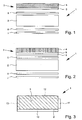
- Fig. 1 is schematically shown the layer structure of a plate 1, which may be, for example, a floor covering, wall or ceiling panel.
- the plate 1 is a panel element.
- the plate 1 has a plate base body 2 and an upper textile wear layer 3 applied to the plate base 2.
- the textile wear layer 3 is in the two in the Fig. 1 and 2 illustrated embodiments each formed multi-layered. It is at the in Fig. 1 embodiment shown a two-layer and in the in Fig. 2 illustrated embodiment a provided three-layered layer structure. It is important that the textile wear layer 3 is a one-piece component after its production, which is processed as a one-piece unit. When connecting the textile wear layer 3 so not the individual layers of the wear layer 3 are connected to the plate body 2, but the textile wear layer 3 is connected as a prefabricated one-piece layer component with the plate body 2.
- the textile wear layer 3 has an upper-side textile fabric 4 and a lower-side coating 5.
- the coating 5 comprises a latex material.
- a latex material based on styrene-butadiene is provided. It is understood that the aforementioned materials can also be realized in reverse, that is, in the respective other embodiment.
- other latex materials may be provided.
- an additive in the form of aluminum hydroxide while in the embodiment according to Fig. 1 is missing. Instead, other or additional functional additives for influencing various properties of the plate or of the textile wear layer 3 can be provided there.
- the attachment of the textile wear layer 3 on the base plate body 2 takes place in both embodiments via an adhesive layer 6.
- the plate 1 On the underside, the plate 1 in each case a counter-pull 7, which consists for example of cork, a fleece or felt.
- the counter-pull which has a thickness of between 1 and 2 mm, is likewise connected via an adhesive layer 8 to the underside of the panel main body 2.
- the textile wear layer 3 has been produced by the weaving process.
- the solidification of the fabric as a textile fabric 4 is effected by the coating 5.
- the grammage of the coating order is preferably between 300 to 600 g / m 2 .
- the textile wear layer 3 itself has been produced with its three layers in the illustrated embodiment in the tufting process.
- the pile threads which are located on the outside and form the textile fabric 4, have been sewn into the substrate layer 9.
- the pile yarn is preferably made of polyamide and has a Pol centimeter difference between 420 to 650 g / m 2 .
- the pole can be made in two versions, namely as Schlingenpol and the other as Thomaspol.
- the pile height, ie the height of the textile fabric 4 calculated from the substrate layer 9, is between 2.5 to 5 mm.
- the carrier material consists of a PES nonwoven with a weight of between 100 and 120 g / m 2 .
- the provided on the underside of the substrate layer 9 coating 5 is used, inter alia, for solidification of the pile threads.
- latex material based on styrene-butadiene is used for the coating.
- the coating combines the pile threads with the backing material layer 9 to form a stable, tear-resistant layer, at the same time achieving a cut resistance in the region of the edges.
- the order of the latex material is about 410 g / m 2 , which in the wet state in the present case corresponds to about 600 g / m 2 .
- the special feature of the embodiment according to Fig. 2 is that on the underside coating 5 of the textile wear layer 3 no further back equipment, as is common, for example, in tufted carpets, has.
- the function of the back equipment for carpets takes over in the present case, the plate body.
- This consists in the illustrated embodiments of an HDF carrier plate with a thickness between 6 to 9 mm.
- an MDF board or a plate made of plastic or a plastic-wood fiber mixture is possible.
- Fig. 3 shows a plate 1 in a schematic view from above.
- the plate 1 has at the outer edges springs 10, 11 and corresponding grooves 12, 13 as locking means, which make it possible to connect a plurality of plates 1 at the longitudinal and transverse edges together to form a floor covering.
- the locking means may be designed to form a click connection.
- the wear layer 3 covers the main body 2 on the visible upper side of the plate 1 over its entire surface.
- the springs 10, 11 are preferably not covered by the wear layer 3, so that a connection between adjacent plates 1 can be easily produced.
- the wear layer 3 is designed at the edges such that the transition between two wear layers 3 in the plate assembly of adjacent and interconnected plates 1 is not perceived by a viewer. This can be achieved, for example, by a higher fiber density, thickness and / or length in the region of the edges of the wear layer 3 and / or by fibers of the wear layer 3 projecting beyond the edges of the plate body 2.
- the production of in Fig. 3 shown plate 1 can be done in different ways. On the one hand, it is possible for a large-area plate material to be connected over the entire area to the wear layer 3 first.
- the plate material may have a conventional press dimension of, for example, 2.0 m width and 5.2 m length or 1.3 m width and 4.8 m length. Prior to cutting out the plates 5 from the plate material, this is made ready for surface, which may include, for example, cleaning the surface of the plate material from excess fibers. After cutting out the plates 1 then the locking contours can be subsequently generated on the plates 1.
- An alternative way of producing a plate 1 can therefore provide that initially the plate main body 2 is produced with the locking contours and subsequently provided with a wear layer. The formation of exact transitions between the wear layer 3 and the edge locking contours can thus be ensured in a simple manner.
Landscapes
- Life Sciences & Earth Sciences (AREA)
- Engineering & Computer Science (AREA)
- Wood Science & Technology (AREA)
- Floor Finish (AREA)
Priority Applications (1)
| Application Number | Priority Date | Filing Date | Title |
|---|---|---|---|
| EP13005424.0A EP2732964A1 (fr) | 2012-11-19 | 2013-11-19 | Plaque dotée d'une couche d'usure extérieure et procédé de fabrication d'une plaque |
Applications Claiming Priority (3)
| Application Number | Priority Date | Filing Date | Title |
|---|---|---|---|
| DE201210022490 DE102012022490A1 (de) | 2012-11-19 | 2012-11-19 | Platte mit außenseitiger Nutzschicht |
| EP13005185 | 2013-11-04 | ||
| EP13005424.0A EP2732964A1 (fr) | 2012-11-19 | 2013-11-19 | Plaque dotée d'une couche d'usure extérieure et procédé de fabrication d'une plaque |
Publications (1)
| Publication Number | Publication Date |
|---|---|
| EP2732964A1 true EP2732964A1 (fr) | 2014-05-21 |
Family
ID=49752892
Family Applications (1)
| Application Number | Title | Priority Date | Filing Date |
|---|---|---|---|
| EP13005424.0A Withdrawn EP2732964A1 (fr) | 2012-11-19 | 2013-11-19 | Plaque dotée d'une couche d'usure extérieure et procédé de fabrication d'une plaque |
Country Status (1)
| Country | Link |
|---|---|
| EP (1) | EP2732964A1 (fr) |
Citations (2)
| Publication number | Priority date | Publication date | Assignee | Title |
|---|---|---|---|---|
| WO2005066431A2 (fr) | 2004-01-07 | 2005-07-21 | Akzenta Paneele + Profile Gmbh | Panneau de revetement de sol |
| WO2008101678A2 (fr) * | 2007-02-21 | 2008-08-28 | Johns Manville Europe Gmbh | Nouveaux matériaux composites, procédé pour leur fabrication et leur utilisation |
-
2013
- 2013-11-19 EP EP13005424.0A patent/EP2732964A1/fr not_active Withdrawn
Patent Citations (2)
| Publication number | Priority date | Publication date | Assignee | Title |
|---|---|---|---|---|
| WO2005066431A2 (fr) | 2004-01-07 | 2005-07-21 | Akzenta Paneele + Profile Gmbh | Panneau de revetement de sol |
| WO2008101678A2 (fr) * | 2007-02-21 | 2008-08-28 | Johns Manville Europe Gmbh | Nouveaux matériaux composites, procédé pour leur fabrication et leur utilisation |
Similar Documents
| Publication | Publication Date | Title |
|---|---|---|
| EP1634696B1 (fr) | Elément pour revêtement de sol | |
| DE69612012T2 (de) | Verbundwerkstoff zur verwendung bei der herstellung des shuhwerks | |
| EP2782751A1 (fr) | Plaque et procédé de fabrication d'une plaque | |
| DE102016112404A1 (de) | Korkboden mit Klickverbindung | |
| DE19534252A1 (de) | Verfahren zum Herstellen einer mehrlagigen Bahn insbesondere als Polsterbezugsmaterial für Fahrzeugsitze | |
| DE102012022490A1 (de) | Platte mit außenseitiger Nutzschicht | |
| EP2377684A1 (fr) | Nouvelles matières premières composites, leur procédé de fabrication et leur utilisation dans le domaine du revêtement de sol | |
| DE10201867B4 (de) | Wand- oder Bodenbelag | |
| EP0992340B1 (fr) | Panneau à plusieurs couches amortissant le bruit | |
| DE102005037572A1 (de) | Verkleidungsteil, insbesondere Innenverkleidungs- oder Auskleidungsteil für Kraftfahrzeuge | |
| EP2787146B1 (fr) | Procédé de fabrication d'une plaque ayant une couche textile d'usure | |
| DE1435762A1 (de) | Mehrschichtiges,vernadeltes Flaechengebilde mit mindestens einer Daemmschicht | |
| EP2963204B1 (fr) | Plaque pour un revêtement de sol, de mur ou de plafond ou pour un composant de meuble et procédé et dispositif de pressage pour la fabrication d'une telle plaque | |
| DE1294916B (de) | Verfahren zur Herstellung von insbesondere als Polstermaterial geeigneten Schichtstoffen | |
| DE2544033C3 (de) | Teppichunterlage | |
| DE3134396A1 (de) | Laminatstruktur fuer akustische anwendungen und verfahren zu ihrer herstellung | |
| DE102013114524A1 (de) | Fußbodenelement | |
| EP3003707B1 (fr) | Module acoustique | |
| EP4048515B1 (fr) | Revêtement de sol dimensionnellement stable et procédé pour sa fabrication | |
| DE9307319U1 (de) | Zwei- oder mehrlagig kaschiertes flexibles Bahnmaterial | |
| DE102016225575A1 (de) | Verfahren zur Herstellung von Bodenelementen und Bodenelemente | |
| DE3932726A1 (de) | Mehrschichtiger punktelastischer wandbelag | |
| DE202019005552U1 (de) | Dimensionsstabiler Bodenbelag | |
| DE20018439U1 (de) | Fußbodenplatte | |
| DE9413478U1 (de) | Mehrschichtige elastische Paneele für Wandverkleidungen |
Legal Events
| Date | Code | Title | Description |
|---|---|---|---|
| PUAI | Public reference made under article 153(3) epc to a published international application that has entered the european phase |
Free format text: ORIGINAL CODE: 0009012 |
|
| 17P | Request for examination filed |
Effective date: 20131119 |
|
| AK | Designated contracting states |
Kind code of ref document: A1 Designated state(s): AL AT BE BG CH CY CZ DE DK EE ES FI FR GB GR HR HU IE IS IT LI LT LU LV MC MK MT NL NO PL PT RO RS SE SI SK SM TR |
|
| AX | Request for extension of the european patent |
Extension state: BA ME |
|
| R17P | Request for examination filed (corrected) |
Effective date: 20140701 |
|
| RBV | Designated contracting states (corrected) |
Designated state(s): AL AT BE BG CH CY CZ DE DK EE ES FI FR GB GR HR HU IE IS IT LI LT LU LV MC MK MT NL NO PL PT RO RS SE SI SK SM TR |
|
| RAP1 | Party data changed (applicant data changed or rights of an application transferred) |
Owner name: PARADOR GMBH |
|
| 17Q | First examination report despatched |
Effective date: 20170412 |
|
| STAA | Information on the status of an ep patent application or granted ep patent |
Free format text: STATUS: THE APPLICATION IS DEEMED TO BE WITHDRAWN |
|
| 18D | Application deemed to be withdrawn |
Effective date: 20170823 |